EP1430559B1 - Materiau polymere conducteur pour pile a combustible ou cellule d'electrolyse - Google Patents
Materiau polymere conducteur pour pile a combustible ou cellule d'electrolyse Download PDFInfo
- Publication number
- EP1430559B1 EP1430559B1 EP02765031A EP02765031A EP1430559B1 EP 1430559 B1 EP1430559 B1 EP 1430559B1 EP 02765031 A EP02765031 A EP 02765031A EP 02765031 A EP02765031 A EP 02765031A EP 1430559 B1 EP1430559 B1 EP 1430559B1
- Authority
- EP
- European Patent Office
- Prior art keywords
- ion
- polymeric material
- groups
- cell according
- repeat unit
- Prior art date
- Legal status (The legal status is an assumption and is not a legal conclusion. Google has not performed a legal analysis and makes no representation as to the accuracy of the status listed.)
- Expired - Lifetime
Links
- 239000000463 material Substances 0.000 title claims abstract description 94
- 239000000446 fuel Substances 0.000 title claims abstract description 39
- 125000001997 phenyl group Chemical group [H]C1=C([H])C([H])=C(*)C([H])=C1[H] 0.000 claims abstract description 30
- 238000005342 ion exchange Methods 0.000 claims abstract description 29
- 229920000642 polymer Polymers 0.000 claims description 45
- 239000012528 membrane Substances 0.000 claims description 35
- QIGBRXMKCJKVMJ-UHFFFAOYSA-N Hydroquinone Chemical compound OC1=CC=C(O)C=C1 QIGBRXMKCJKVMJ-UHFFFAOYSA-N 0.000 claims description 22
- 238000000034 method Methods 0.000 claims description 15
- 238000004519 manufacturing process Methods 0.000 claims description 7
- 239000003054 catalyst Substances 0.000 claims description 6
- RXNYJUSEXLAVNQ-UHFFFAOYSA-N 4,4'-Dihydroxybenzophenone Chemical compound C1=CC(O)=CC=C1C(=O)C1=CC=C(O)C=C1 RXNYJUSEXLAVNQ-UHFFFAOYSA-N 0.000 claims description 5
- LSQARZALBDFYQZ-UHFFFAOYSA-N 4,4'-difluorobenzophenone Chemical compound C1=CC(F)=CC=C1C(=O)C1=CC=C(F)C=C1 LSQARZALBDFYQZ-UHFFFAOYSA-N 0.000 claims description 5
- 125000001174 sulfone group Chemical group 0.000 claims description 5
- -1 1,3-disubstituted phenyl moiety Chemical group 0.000 claims description 3
- 125000000524 functional group Chemical group 0.000 claims description 2
- IJGRMHOSHXDMSA-UHFFFAOYSA-N Atomic nitrogen Chemical compound N#N IJGRMHOSHXDMSA-UHFFFAOYSA-N 0.000 description 24
- XLYOFNOQVPJJNP-UHFFFAOYSA-N water Substances O XLYOFNOQVPJJNP-UHFFFAOYSA-N 0.000 description 22
- CSCPPACGZOOCGX-UHFFFAOYSA-N Acetone Chemical compound CC(C)=O CSCPPACGZOOCGX-UHFFFAOYSA-N 0.000 description 14
- 238000009835 boiling Methods 0.000 description 13
- 229910052757 nitrogen Inorganic materials 0.000 description 12
- 229920001643 poly(ether ketone) Polymers 0.000 description 11
- QAOWNCQODCNURD-UHFFFAOYSA-N Sulfuric acid Chemical compound OS(O)(=O)=O QAOWNCQODCNURD-UHFFFAOYSA-N 0.000 description 10
- 239000001117 sulphuric acid Substances 0.000 description 10
- 235000011149 sulphuric acid Nutrition 0.000 description 10
- 239000004696 Poly ether ether ketone Substances 0.000 description 9
- 239000002131 composite material Substances 0.000 description 9
- 239000008367 deionised water Substances 0.000 description 8
- 229920002530 polyetherether ketone Polymers 0.000 description 8
- 238000006243 chemical reaction Methods 0.000 description 7
- 125000003118 aryl group Chemical group 0.000 description 6
- 239000005518 polymer electrolyte Substances 0.000 description 6
- BWHMMNNQKKPAPP-UHFFFAOYSA-L potassium carbonate Chemical compound [K+].[K+].[O-]C([O-])=O BWHMMNNQKKPAPP-UHFFFAOYSA-L 0.000 description 6
- 229920001577 copolymer Polymers 0.000 description 5
- 239000000178 monomer Substances 0.000 description 5
- 238000006068 polycondensation reaction Methods 0.000 description 5
- ZXDDPOHVAMWLBH-UHFFFAOYSA-N 2,4-Dihydroxybenzophenone Chemical compound OC1=CC(O)=CC=C1C(=O)C1=CC=CC=C1 ZXDDPOHVAMWLBH-UHFFFAOYSA-N 0.000 description 4
- CDBYLPFSWZWCQE-UHFFFAOYSA-L Sodium Carbonate Chemical compound [Na+].[Na+].[O-]C([O-])=O CDBYLPFSWZWCQE-UHFFFAOYSA-L 0.000 description 4
- 229920004695 VICTREX™ PEEK Polymers 0.000 description 4
- 239000002585 base Substances 0.000 description 4
- 229920001519 homopolymer Polymers 0.000 description 4
- 238000003756 stirring Methods 0.000 description 4
- 125000001273 sulfonato group Chemical group [O-]S(*)(=O)=O 0.000 description 4
- 238000004448 titration Methods 0.000 description 4
- IUNJCFABHJZSKB-UHFFFAOYSA-N 2,4-Dihydroxybenzaldehyde Natural products OC1=CC=C(C=O)C(O)=C1 IUNJCFABHJZSKB-UHFFFAOYSA-N 0.000 description 3
- JXLHNMVSKXFWAO-UHFFFAOYSA-N azane;7-fluoro-2,1,3-benzoxadiazole-4-sulfonic acid Chemical compound N.OS(=O)(=O)C1=CC=C(F)C2=NON=C12 JXLHNMVSKXFWAO-UHFFFAOYSA-N 0.000 description 3
- 239000011324 bead Substances 0.000 description 3
- 229920001940 conductive polymer Polymers 0.000 description 3
- 238000001035 drying Methods 0.000 description 3
- 238000003487 electrochemical reaction Methods 0.000 description 3
- 238000001914 filtration Methods 0.000 description 3
- 239000000203 mixture Substances 0.000 description 3
- 230000007935 neutral effect Effects 0.000 description 3
- 239000007800 oxidant agent Substances 0.000 description 3
- 230000001590 oxidative effect Effects 0.000 description 3
- BASFCYQUMIYNBI-UHFFFAOYSA-N platinum Chemical compound [Pt] BASFCYQUMIYNBI-UHFFFAOYSA-N 0.000 description 3
- 229910000027 potassium carbonate Inorganic materials 0.000 description 3
- 238000002360 preparation method Methods 0.000 description 3
- 238000011084 recovery Methods 0.000 description 3
- 239000002904 solvent Substances 0.000 description 3
- YBBRCQOCSYXUOC-UHFFFAOYSA-N sulfuryl dichloride Chemical group ClS(Cl)(=O)=O YBBRCQOCSYXUOC-UHFFFAOYSA-N 0.000 description 3
- 238000005406 washing Methods 0.000 description 3
- PLVUIVUKKJTSDM-UHFFFAOYSA-N 1-fluoro-4-(4-fluorophenyl)sulfonylbenzene Chemical compound C1=CC(F)=CC=C1S(=O)(=O)C1=CC=C(F)C=C1 PLVUIVUKKJTSDM-UHFFFAOYSA-N 0.000 description 2
- GPAPPPVRLPGFEQ-UHFFFAOYSA-N 4,4'-dichlorodiphenyl sulfone Chemical compound C1=CC(Cl)=CC=C1S(=O)(=O)C1=CC=C(Cl)C=C1 GPAPPPVRLPGFEQ-UHFFFAOYSA-N 0.000 description 2
- VPWNQTHUCYMVMZ-UHFFFAOYSA-N 4,4'-sulfonyldiphenol Chemical compound C1=CC(O)=CC=C1S(=O)(=O)C1=CC=C(O)C=C1 VPWNQTHUCYMVMZ-UHFFFAOYSA-N 0.000 description 2
- RTZKZFJDLAIYFH-UHFFFAOYSA-N Diethyl ether Chemical compound CCOCC RTZKZFJDLAIYFH-UHFFFAOYSA-N 0.000 description 2
- LCGLNKUTAGEVQW-UHFFFAOYSA-N Dimethyl ether Chemical compound COC LCGLNKUTAGEVQW-UHFFFAOYSA-N 0.000 description 2
- SECXISVLQFMRJM-UHFFFAOYSA-N N-Methylpyrrolidone Chemical compound CN1CCCC1=O SECXISVLQFMRJM-UHFFFAOYSA-N 0.000 description 2
- PISLKPDKKIDMQT-UHFFFAOYSA-N [3-(4-fluorobenzoyl)phenyl]-(4-fluorophenyl)methanone Chemical compound C1=CC(F)=CC=C1C(=O)C1=CC=CC(C(=O)C=2C=CC(F)=CC=2)=C1 PISLKPDKKIDMQT-UHFFFAOYSA-N 0.000 description 2
- 238000002835 absorbance Methods 0.000 description 2
- 229910052784 alkaline earth metal Inorganic materials 0.000 description 2
- 125000002915 carbonyl group Chemical group [*:2]C([*:1])=O 0.000 description 2
- 230000000052 comparative effect Effects 0.000 description 2
- 238000004132 cross linking Methods 0.000 description 2
- 239000003792 electrolyte Substances 0.000 description 2
- 125000001033 ether group Chemical group 0.000 description 2
- 239000005337 ground glass Substances 0.000 description 2
- 229910052739 hydrogen Inorganic materials 0.000 description 2
- 239000001257 hydrogen Substances 0.000 description 2
- 125000004356 hydroxy functional group Chemical group O* 0.000 description 2
- 239000000155 melt Substances 0.000 description 2
- 229910052697 platinum Inorganic materials 0.000 description 2
- 229920006260 polyaryletherketone Polymers 0.000 description 2
- 230000008569 process Effects 0.000 description 2
- 229920005604 random copolymer Polymers 0.000 description 2
- 239000000376 reactant Substances 0.000 description 2
- 239000011541 reaction mixture Substances 0.000 description 2
- 229920006126 semicrystalline polymer Polymers 0.000 description 2
- 239000000126 substance Substances 0.000 description 2
- 125000001424 substituent group Chemical group 0.000 description 2
- 239000002352 surface water Substances 0.000 description 2
- DEQUKPCANKRTPZ-UHFFFAOYSA-N (2,3-dihydroxyphenyl)-phenylmethanone Chemical group OC1=CC=CC(C(=O)C=2C=CC=CC=2)=C1O DEQUKPCANKRTPZ-UHFFFAOYSA-N 0.000 description 1
- 125000004178 (C1-C4) alkyl group Chemical group 0.000 description 1
- AZUYLZMQTIKGSC-UHFFFAOYSA-N 1-[6-[4-(5-chloro-6-methyl-1H-indazol-4-yl)-5-methyl-3-(1-methylindazol-5-yl)pyrazol-1-yl]-2-azaspiro[3.3]heptan-2-yl]prop-2-en-1-one Chemical compound ClC=1C(=C2C=NNC2=CC=1C)C=1C(=NN(C=1C)C1CC2(CN(C2)C(C=C)=O)C1)C=1C=C2C=NN(C2=CC=1)C AZUYLZMQTIKGSC-UHFFFAOYSA-N 0.000 description 1
- BVKZGUZCCUSVTD-UHFFFAOYSA-M Bicarbonate Chemical compound OC([O-])=O BVKZGUZCCUSVTD-UHFFFAOYSA-M 0.000 description 1
- UFHFLCQGNIYNRP-UHFFFAOYSA-N Hydrogen Chemical compound [H][H] UFHFLCQGNIYNRP-UHFFFAOYSA-N 0.000 description 1
- 229910004727 OSO3H Inorganic materials 0.000 description 1
- 229910018828 PO3H2 Inorganic materials 0.000 description 1
- 239000003513 alkali Substances 0.000 description 1
- 229910000288 alkali metal carbonate Inorganic materials 0.000 description 1
- 150000008041 alkali metal carbonates Chemical class 0.000 description 1
- 150000001342 alkaline earth metals Chemical class 0.000 description 1
- 125000000217 alkyl group Chemical group 0.000 description 1
- 239000000956 alloy Substances 0.000 description 1
- 229910045601 alloy Inorganic materials 0.000 description 1
- 150000001412 amines Chemical class 0.000 description 1
- 150000004945 aromatic hydrocarbons Chemical class 0.000 description 1
- RWCCWEUUXYIKHB-UHFFFAOYSA-N benzophenone Chemical compound C=1C=CC=CC=1C(=O)C1=CC=CC=C1 RWCCWEUUXYIKHB-UHFFFAOYSA-N 0.000 description 1
- 239000012965 benzophenone Substances 0.000 description 1
- 229920001400 block copolymer Polymers 0.000 description 1
- 229910052791 calcium Inorganic materials 0.000 description 1
- 238000005266 casting Methods 0.000 description 1
- 125000002091 cationic group Chemical group 0.000 description 1
- 239000002322 conducting polymer Substances 0.000 description 1
- 239000013078 crystal Substances 0.000 description 1
- 230000009849 deactivation Effects 0.000 description 1
- 238000000113 differential scanning calorimetry Methods 0.000 description 1
- 230000000694 effects Effects 0.000 description 1
- 238000001704 evaporation Methods 0.000 description 1
- 230000008020 evaporation Effects 0.000 description 1
- 239000011521 glass Substances 0.000 description 1
- 230000009477 glass transition Effects 0.000 description 1
- 229910052736 halogen Inorganic materials 0.000 description 1
- 150000002367 halogens Chemical class 0.000 description 1
- XLYOFNOQVPJJNP-ZSJDYOACSA-N heavy water Substances [2H]O[2H] XLYOFNOQVPJJNP-ZSJDYOACSA-N 0.000 description 1
- 230000003301 hydrolyzing effect Effects 0.000 description 1
- GPRLSGONYQIRFK-UHFFFAOYSA-N hydron Chemical compound [H+] GPRLSGONYQIRFK-UHFFFAOYSA-N 0.000 description 1
- 229920001477 hydrophilic polymer Polymers 0.000 description 1
- 229910052742 iron Inorganic materials 0.000 description 1
- 229910052749 magnesium Inorganic materials 0.000 description 1
- 238000005259 measurement Methods 0.000 description 1
- 230000008018 melting Effects 0.000 description 1
- 238000002844 melting Methods 0.000 description 1
- 229910052751 metal Inorganic materials 0.000 description 1
- 239000002184 metal Substances 0.000 description 1
- 239000003960 organic solvent Substances 0.000 description 1
- 230000035699 permeability Effects 0.000 description 1
- 229920001652 poly(etherketoneketone) Polymers 0.000 description 1
- 229920000151 polyglycol Polymers 0.000 description 1
- 239000010695 polyglycol Substances 0.000 description 1
- 239000002861 polymer material Substances 0.000 description 1
- 239000001267 polyvinylpyrrolidone Substances 0.000 description 1
- 235000013855 polyvinylpyrrolidone Nutrition 0.000 description 1
- 229920000036 polyvinylpyrrolidone Polymers 0.000 description 1
- 229910052700 potassium Inorganic materials 0.000 description 1
- 230000035484 reaction time Effects 0.000 description 1
- 230000009467 reduction Effects 0.000 description 1
- 238000010992 reflux Methods 0.000 description 1
- 229910052708 sodium Inorganic materials 0.000 description 1
- 239000011734 sodium Substances 0.000 description 1
- 229910000029 sodium carbonate Inorganic materials 0.000 description 1
- 239000010935 stainless steel Substances 0.000 description 1
- 229910001220 stainless steel Inorganic materials 0.000 description 1
- 238000010561 standard procedure Methods 0.000 description 1
- 238000006467 substitution reaction Methods 0.000 description 1
- FDDDEECHVMSUSB-UHFFFAOYSA-N sulfanilamide Chemical compound NC1=CC=C(S(N)(=O)=O)C=C1 FDDDEECHVMSUSB-UHFFFAOYSA-N 0.000 description 1
- 229940124530 sulfonamide Drugs 0.000 description 1
- 125000000565 sulfonamide group Chemical group 0.000 description 1
- BDHFUVZGWQCTTF-UHFFFAOYSA-N sulfonic acid Chemical group OS(=O)=O BDHFUVZGWQCTTF-UHFFFAOYSA-N 0.000 description 1
- 238000004736 wide-angle X-ray diffraction Methods 0.000 description 1
Images
Classifications
-
- C—CHEMISTRY; METALLURGY
- C08—ORGANIC MACROMOLECULAR COMPOUNDS; THEIR PREPARATION OR CHEMICAL WORKING-UP; COMPOSITIONS BASED THEREON
- C08J—WORKING-UP; GENERAL PROCESSES OF COMPOUNDING; AFTER-TREATMENT NOT COVERED BY SUBCLASSES C08B, C08C, C08F, C08G or C08H
- C08J5/00—Manufacture of articles or shaped materials containing macromolecular substances
- C08J5/20—Manufacture of shaped structures of ion-exchange resins
- C08J5/22—Films, membranes or diaphragms
- C08J5/2206—Films, membranes or diaphragms based on organic and/or inorganic macromolecular compounds
- C08J5/2218—Synthetic macromolecular compounds
- C08J5/2256—Synthetic macromolecular compounds based on macromolecular compounds obtained by reactions other than those involving carbon-to-carbon bonds, e.g. obtained by polycondensation
-
- H—ELECTRICITY
- H01—ELECTRIC ELEMENTS
- H01B—CABLES; CONDUCTORS; INSULATORS; SELECTION OF MATERIALS FOR THEIR CONDUCTIVE, INSULATING OR DIELECTRIC PROPERTIES
- H01B1/00—Conductors or conductive bodies characterised by the conductive materials; Selection of materials as conductors
- H01B1/06—Conductors or conductive bodies characterised by the conductive materials; Selection of materials as conductors mainly consisting of other non-metallic substances
- H01B1/12—Conductors or conductive bodies characterised by the conductive materials; Selection of materials as conductors mainly consisting of other non-metallic substances organic substances
- H01B1/122—Ionic conductors
-
- H—ELECTRICITY
- H01—ELECTRIC ELEMENTS
- H01M—PROCESSES OR MEANS, e.g. BATTERIES, FOR THE DIRECT CONVERSION OF CHEMICAL ENERGY INTO ELECTRICAL ENERGY
- H01M8/00—Fuel cells; Manufacture thereof
- H01M8/10—Fuel cells with solid electrolytes
- H01M8/1016—Fuel cells with solid electrolytes characterised by the electrolyte material
- H01M8/1018—Polymeric electrolyte materials
- H01M8/102—Polymeric electrolyte materials characterised by the chemical structure of the main chain of the ion-conducting polymer
- H01M8/1025—Polymeric electrolyte materials characterised by the chemical structure of the main chain of the ion-conducting polymer having only carbon and oxygen, e.g. polyethers, sulfonated polyetheretherketones [S-PEEK], sulfonated polysaccharides, sulfonated celluloses or sulfonated polyesters
-
- H—ELECTRICITY
- H01—ELECTRIC ELEMENTS
- H01M—PROCESSES OR MEANS, e.g. BATTERIES, FOR THE DIRECT CONVERSION OF CHEMICAL ENERGY INTO ELECTRICAL ENERGY
- H01M8/00—Fuel cells; Manufacture thereof
- H01M8/10—Fuel cells with solid electrolytes
- H01M8/1016—Fuel cells with solid electrolytes characterised by the electrolyte material
- H01M8/1018—Polymeric electrolyte materials
- H01M8/102—Polymeric electrolyte materials characterised by the chemical structure of the main chain of the ion-conducting polymer
- H01M8/1027—Polymeric electrolyte materials characterised by the chemical structure of the main chain of the ion-conducting polymer having carbon, oxygen and other atoms, e.g. sulfonated polyethersulfones [S-PES]
-
- H—ELECTRICITY
- H01—ELECTRIC ELEMENTS
- H01M—PROCESSES OR MEANS, e.g. BATTERIES, FOR THE DIRECT CONVERSION OF CHEMICAL ENERGY INTO ELECTRICAL ENERGY
- H01M8/00—Fuel cells; Manufacture thereof
- H01M8/10—Fuel cells with solid electrolytes
- H01M8/1016—Fuel cells with solid electrolytes characterised by the electrolyte material
- H01M8/1018—Polymeric electrolyte materials
- H01M8/102—Polymeric electrolyte materials characterised by the chemical structure of the main chain of the ion-conducting polymer
- H01M8/1032—Polymeric electrolyte materials characterised by the chemical structure of the main chain of the ion-conducting polymer having sulfur, e.g. sulfonated-polyethersulfones [S-PES]
-
- C—CHEMISTRY; METALLURGY
- C08—ORGANIC MACROMOLECULAR COMPOUNDS; THEIR PREPARATION OR CHEMICAL WORKING-UP; COMPOSITIONS BASED THEREON
- C08J—WORKING-UP; GENERAL PROCESSES OF COMPOUNDING; AFTER-TREATMENT NOT COVERED BY SUBCLASSES C08B, C08C, C08F, C08G or C08H
- C08J2371/00—Characterised by the use of polyethers obtained by reactions forming an ether link in the main chain; Derivatives of such polymers
- C08J2371/08—Polyethers derived from hydroxy compounds or from their metallic derivatives
- C08J2371/10—Polyethers derived from hydroxy compounds or from their metallic derivatives from phenols
- C08J2371/12—Polyphenylene oxides
-
- H—ELECTRICITY
- H01—ELECTRIC ELEMENTS
- H01M—PROCESSES OR MEANS, e.g. BATTERIES, FOR THE DIRECT CONVERSION OF CHEMICAL ENERGY INTO ELECTRICAL ENERGY
- H01M2300/00—Electrolytes
- H01M2300/0017—Non-aqueous electrolytes
- H01M2300/0065—Solid electrolytes
- H01M2300/0082—Organic polymers
-
- Y—GENERAL TAGGING OF NEW TECHNOLOGICAL DEVELOPMENTS; GENERAL TAGGING OF CROSS-SECTIONAL TECHNOLOGIES SPANNING OVER SEVERAL SECTIONS OF THE IPC; TECHNICAL SUBJECTS COVERED BY FORMER USPC CROSS-REFERENCE ART COLLECTIONS [XRACs] AND DIGESTS
- Y02—TECHNOLOGIES OR APPLICATIONS FOR MITIGATION OR ADAPTATION AGAINST CLIMATE CHANGE
- Y02E—REDUCTION OF GREENHOUSE GAS [GHG] EMISSIONS, RELATED TO ENERGY GENERATION, TRANSMISSION OR DISTRIBUTION
- Y02E60/00—Enabling technologies; Technologies with a potential or indirect contribution to GHG emissions mitigation
- Y02E60/30—Hydrogen technology
- Y02E60/50—Fuel cells
Definitions
- This invention relates to cells and particularly, although not exclusively, relates to a fuel cell per se and an electrolytic cell per se. Especially preferred embodiments relate to fuel cells,
- PEMFC polymer electrolyte membrane fuel cell
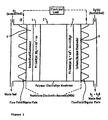
- FIG. 1 of the accompanying diagrammatic drawings may comprise a thin sheet 2 of a hydrogen-ion conducting Polymer Electrolyte Membrane (PEM) sandwiched on both sides by a layer 4 of platinum catalyst and an electrode 6.
- the layers 2, 4, 6 make up a Membrane Electrode Assembly (MEA) of less than 1mm thickness.
- MEA Membrane Electrode Assembly
- Preferred ion-conducting polymeric materials for use as components of polymer electrolyte membranes in fuel cells have high conductivity (low EW, or high ion-exchange capacities) and optimum water uptake for good conductivity and mechanical properties.
- the greater the ionic character of the polymeric material the more soluble the polymeric material is likely to be in water and/or the water absorbance of the polymeric material may increase too much.
- US 5362836 discloses, in the specific examples, only the preparation of sulphonated polyetheretherketone and sulphonated polyetheretheretherketoneketone homopolymers.
- the sulphonation conditions are varied to vary the level of sulphonation and, therefore, properties of the polymers. No values are given for the boiling water uptake of the sulphonated polymers prepared.
- the solution described involves the preparation of sulphonated aromatic polyetherketone polymers, conversion of sulphonate groups of the polymers to sulphonyl chloride groups, treatment of the sulphonyl chloride groups with an amine containing at least one cross-linkable substituent to produce a sulphonamide group, hydrolysing unreacted sulphonyl chloride groups, isolating the resultant aromatic sulphonamide and dissolving it in an organic solvent, converting the solution into a film and then cross-linking the crosslinkable substituents in the film.
- US 5795496 (California Institute of Technology) describes polymer materials for electrolyte membranes in fuel cells which are intended to have high proton conductivity and be stable at high temperature.
- Preferred materials are sulphonated polyetheretherketone or sulphonated polyethersulphone. These materials are modified, by controlled cross-linking of sulphonate groups, to provide materials with asymmetric permeability properties.
- US 5834566 (Hoechst) addresses the problem of providing films of improved properties for electrochemical uses.
- the solution described is the provision of homogenous polymer alloys, for example of sulphonated polyetherketone and non-sulphonated polyethersulphone, in combination with a hydrophilic polymer, for example of polyvinylpyrrolidone or polyglycol dimethylether.
- WO96/29360 (Hoechst) addresses the problem of increasing the level of sulphonation of polyetherketones by providing a method of sulphonating -O-phenyl-CO- units thereof.
- the specific examples disclose the application of the method to polyetheretherketone and polyetheretherketoneketone homopolymers.
- the present invention is based on the discovery of certain copolymers which are surprisingly advantageously adapted for use in fuel cells or electrolytic cells.
- a fuel cell or an electrolytic cell comprising an ion-conductive polymeric material which includes a first repeat unit of formula -(O-Ph 1 -CO-Ph 1 -O-Ph 1 -CO-Ph 1 )- I and a second repeat unit of formula - (O-Ph 2 -O-Ph 3 -CO-Ph 4 ) - II or of formula - (O-Ph 2 -O-Ph 3 -SO 2 -Ph 4 ) - III wherein Ph 1 , Ph 2 , Ph 3 and Ph 4 independently represent phenyl moieties and wherein said second repeat unit is provided with ion-exchange sites.
- ion-conductive polymeric materials of the type described have boiling water uptakes, when used in fuel cells and/or electrolytic cells, which are much lower than expected and, more particularly, much lower than found for ion-conductive polymeric materials of similar equivalent weights (EW) comprising a single ion-conducting homopolymer of formula I, II or III.
- EW equivalent weights
- a phenyl moiety may have 1,4- or 1,3-, especially 1,4-, linkages to moieties to which it is bonded.
- Said ion-conductive polymeric material is preferably crystalline.
- the existence and/or extent of crystallinity in a polymer is preferably measured by wide angle X-ray diffraction, for example as described by Blundell and Osborn (Polymer 24 , 953, 1983).
- DSC Differential Scanning Calorimetry
- the level of crystallinity in said ion-conductive polymeric material may be at least 0.5% suitably at least 1%, preferably at least 5%, more preferably at least 10%, especially at least 15% weight fraction, suitably when measured as described by Blundell and Osborn.
- the level of crystallinity, when measured as described may be at least 20% weight fraction.
- the level of crystallinity in said first polymeric material may be less than 30% weight fraction, preferably less than 25% weight fraction.
- Said ion-conductive polymeric material suitably includes a repeat unit which is crystalline and a repeat unit which is amorphous.
- Said first repeat unit is preferably crystalline.
- less than 1 mole% of groups Ph 1 in said polymeric material are sulphonated and/or otherwise functionalised.
- said first repeat unit comprises unsubstituted phenyl groups Ph 1 with said groups Ph 1 suitably having 1,4-linkages to the -O- and -CO- groups to which they are bonded.
- substantially no groups Ph 1 are substituted in said ion-conductive polymeric material.
- Said second repeat unit preferably includes ion-exchange sites.
- said second repeat unit is sulphonated, phosphorylated, carboxylated, quaternary-aminoalkylated or chloromethylated, and optionally further modified to yield -CH 2 PO 3 H 2 , -CH 2 NR 3 20+ where R 20 is an alkyl, or -CH 2 NAr 3 x+ where Ar x is an aromatic (arene), or provided with -OSO 3 H or -OPO 3 H 2 cationic exchange sites as described in WO95/08581.
- said second repeat unit is sulphonated.
- the only ion-exchange sites of said second repeat unit are sites which are sulphonated.
- references to sulphonation include a reference to substitution with a group -SO 3 M wherein M stands for one or more elements selected with due consideration to ionic valencies from the following group: H, NR 4 y+ , in which R y stands for H, C 1 -C 4 alkyl, or an alkali or alkaline earth metal or a metal of sub-group 8, preferably H, NR 4 + , Na, K, Ca, Mg, Fe, and Pt.
- M represents H.
- groups Ph 3 in said second unit are sulphonated and/or otherwise functionalised.
- groups Ph 4 are sulphonated and/or otherwise functionalised.
- substantially no groups Ph 3 are substituted.
- substantially no groups Ph 4 are substituted.
- Ph 3 represents an unsubstituted phenyl group, suitably having 1,4-linkages to the -O- and -CO- (or -SO 2 -) groups to which it is bonded.
- Ph 4 represents an unsubstituted phenyl groups, suitably having 1,4-linkages to the -O- and-CO- (or -SO 2 -) groups to which it is bonded.
- greater than 70 mole%, preferably greater than 80 mole%, more preferably greater than 90 mole% of groups Ph 2 in said second unit are provided with ion-exchange sites, especially sulphonate groups.
- Groups Ph 2 may be provided with a single ion-exchange site - i.e. they are preferably only monosulphonated.
- phenyl groups of -O-phenyl-O-moieties may be provided with ion-exchange sites, for example sulphonated, readily, e.g. using the relatively mild method described in Examples 2a to 2c hereinafter, (i.e. using a sulphuric acid concentration of less than 98.5% and avoiding the use of oleum) so that up to 100 mole% of the phenyl groups are provided with ion-exchange sites (e.g. sulphonated).
- the phenyl groups of -O-phenyl-CO- moieties and of -O-phenyl-SO 2 - moieties e.g.
- Ph 1 , Ph 3 and Ph 4 are relatively difficult to provide with ion-exchange sites (and, therefore, are not provided with ion-exchange sites) due to deactivation of the phenyl moieties by -CO- or -SO 2 - groups.
- Ph 2 represents a phenyl group provided with an ion-exchange site wherein the phenyl group has 1,4-linkages to the -O- groups to which it is bonded.
- Said second unit suitably is, by virtue of it being provided with ion-exchange sites, amorphous.
- Said ion-conductive polymeric material could include repeat units of formula II and III, each of which is provided with ion-exchange sites. Preferably, however, it includes either unit II or unit III (and not both).
- An especially preferred second repeat unit is of formula II.
- said second repeat unit is preferably an -ether-(monosulphonated)phenyl-ether-(unsubstituted)phenyl-carbonyl-(unsubstituted)phenyl- unit.
- a represents the mole% of units of formula I in said ion-conductive polymeric material
- b represents the sum of the mole% of units of formulae II and III in said polymeric material.
- the ratio of "a” to “b” in said polymeric material is less than 4, preferably less than 3, more preferably less than 2, especially less than 1.
- the ratio of "a” to “b” may be at least 0.15, suitably at least 0.25, preferably at least 0.3, more preferably at least 0.4, especially at least 0.5.
- Said ion-conductive polymeric material may be a random or block copolymer comprising units I, II and/or III.
- said ion-conductive polymeric material is a random copolymer.
- Said ion-conductive polymeric material may include a third repeat unit which is suitably different from units I, II and III.
- Said third unit is preferably amorphous.
- Said third unit is preferably not crystalline or crystallisable.
- Said third unit is preferably not provided with ion-exchange sites.
- Said optional third unit preferably includes phenyl groups linked by -CO-, -SO 2 -, -O- and/or -S- provided said third unit is more difficult to provide with ion-exchange sites (e.g. sulphonate) compared to the ease with which said second unit (prior to its functionalisation as described) can be provided with ion-exchange sites (e.g.
- said third unit suitably includes a means to render it amorphous (hereinafter "said amorphous means") and/or not crystallisable with polyetherketone units.
- Said third unit may include a moiety of formula -Q-Z-Q- wherein Z represents an aromatic group containing moiety and Q is -O or -S-, wherein said unit of formula -Q-Z-Q- is not symmetrical about an imaginary line which passes through the two -Q- moieties provided, however, that said unit is not derived from dihydroxybenzophenone substituted by groups Q at the 4- and 4'- positions (since such a benzophenone acts in the manner of a symmetrical moiety by virtue of the carbonyl group being substantially similar to an ether group thereby allowing the carbonyl group to be interchanged with an ether group in a polyaryletherketone crystal lattice).
- Said third repeat unit preferably includes at least one of the following: a sulphone moiety in the polymer backbone; a 1,3-disubstituted phenyl moiety in the polymer backbone; or a functional group pendent from a phenyl moiety in the polymer backbone.
- Preferred optional third units are of general formula -O-Ph-(SO 2 -Ph) n1 -(CO-Ph) n2 -[AMOR]- IV wherein Ph represents a phenyl group, n1 is 0, 1 or 2, n2 is 0, 1 or 2 and AMOR represents an amorphous unit, for example of formulae:
- the phenyl groups of the third unit of formula IV may be 1,3- or 1,4-substituted by the groups shown. Preferably, they are 1,4-substituted.
- "c” represents the mole% of said third units in said ion-conductive polymeric material and "a" and “b” are as described above.
- the ratio of “c” to the sum of “a” and “b” is suitably less than 0.25, preferably less than 0.2, more preferably less than 0.15, especially less than 0.125.
- "c” is 30 mole% or less, preferably 20 mole% or less, more preferably 15 mole% or less, especially 10 mole% or less.
- "a” is at least 30 mole%, preferably at least 40 mole%, more preferably at least 45 mole%, especially at least 50 mole%.
- "a” is 85 mole% or less.
- "b” is at least 70 mole% or less, preferably 60 mole% or less, more preferably 55 mole% or less, especially 50 mole% or less.
- the equivalent weight (EW) of said ion-conductive polymeric material is preferably less than 850 g/mol, more preferably less than 800g/mol, especially less than 750 g/mol.
- the EW may be greater than 300, 400 or 500 g/mol.
- the boiling water uptake of ion-conductive polymeric material measured as described in Example 4 is suitably less than 350%, preferably less than 300%, more preferably less than 250%.
- the glass transition temperature (T g ) of said ion-conductive polymeric material may be at least 144°C, suitably at least 150°C, preferably at least 154°C, more preferably at least 160°C, especially at least 164°C. In some cases, the Tg may be at least 170°C, or at least 190°C or greater than 250°C or even 300°C.
- Said ion-conductive polymeric material may have an inherent viscosity (IV) of at least 0.1, suitably at least 0.3, preferably at least 0.4, more preferably at least 0.6, especially at least 0.7 (which corresponds to a reduced viscosity (RV) of least 0.8) wherein RV is measured at 25°C on a solution of the polymer in concentrated sulphuric acid of density 1.84gcm -3 , said solution containing 1g of polymer per 100cm -3 of solution. IV is measured at 25°C on a solution of polymer in concentrated sulphuric acid of density 1.84gcm 3 , said solution containing 0.1g of polymer per 100cm 3 of solution.
- RV inherent viscosity
- RV reduced viscosity
- the main peak of the melting endotherm (Tm) for said ion-conductive polymeric material may be at least 300°C.
- Said semi-crystalline polymer may comprise a film, suitably having a thickness of less than 1mm, preferably less than 0.5mm, more preferably less than 0.1mm, especially less than 0.05mm.
- the film may have a thickness of at least 5 ⁇ m.
- the invention of the first aspect preferably relates to a fuel cell.
- Said ion-conductive polymeric material preferably comprises a part of an ion-conducting membrane of said fuel cell.
- Said ion-conducting membrane is preferably substantially non-permeable.
- Said ion-conductive membrane may consist essentially of said ion-conductive polymeric material.
- said membrane comprises a unitary material which may define a PEM of the fuel cell.
- a catalyst material may be associated with the polymeric material, suitably on opposite sides thereof.
- said ion-conductive polymeric material may be part of a composite ion-conducting membrane.
- Said composite ion-conducting membrane may comprise said ion-conductive polymeric material blended with other ion-conducting or non-ion-conducting amorphous or crystalline polymeric materials.
- said ion-conductive polymeric material may be associated with a composite membrane material.
- said ion-conductive polymeric material in the form of an unsupported conductive polymer film can be contacted with, for example laminated to, a said composite membrane material.
- one of either said composite membrane material or said ion-conductive polymeric material may be impregnated with the other one of either said composite membrane material or said ion-conductive polymeric material.
- Said composite membrane material may be a support material for supporting said ion-conductive polymeric material.
- said composite membrane material preferably is stronger and/or has a lower water absorbance compared to said ion-conductive polymeric material.
- said ion-conductive polymeric material may be a support for the composite membrane material.
- the invention extends to a plurality of fuel cells as described according to the first aspect.
- the fuel cells are preferably substantially identical to one another and are preferably provided in a stack in series. Greater than 50 or even greater than 100 of said fuel cells may be provided in a said stack.
- Said plurality of fuel cells may together include more than 0.1m 2 , suitably more than 0.5m 2 , preferably more than 1m 2 , more preferably more than 5m 2 of said ion-conductive polymeric material.
- the amount of said ion-conductive polymeric material may be less than 100m 2 .
- a polymer electrolyte membrane for a fuel cell or electrolytic cell (especially for a fuel cell), the membrane comprising an ion-conductive polymeric material as described according to said first aspect.
- Said polymer electrolyte membrane may have a dimension in a first direction of at least 1cm.
- the dimension of the PEM in a second direction, perpendicular to the first direction may also be at least 1cm. Where the PEM is circular, the diameter may be at least 1cm.
- the dimension(s) in the first and/or second direction(s) may be at least 10cm or at least 20cm.
- the dimension(s) in the first and second direction(s) is/are suitably less than 100cm, preferably less than 50cm, more preferably less than 35cm.
- Said PEM may comprise one or more layers wherein, suitably, at least one layer comprises a film of said semi-crystalline polymer.
- Said membrane may have a thickness of at least 5 ⁇ m and, suitably, less than 1mm, preferably less than 0.5mm, more preferably less than 0.1mm, especially less than 0.05mm.
- a membrane electrode assembly for a fuel cell which comprises an ion-conductive polymeric material according to said first aspect associated with a catalyst material.
- Catalyst material is preferably associated with opposing sides of the ion-conducting polymeric material.
- a method of making a fuel cell or electrolytic cell comprising incorporating an ion-conductive polymeric material according to said first aspect into said fuel cell or electrolytic cell.
- a method of making a fuel cell or electrolytic cell comprising incorporating, into the fuel cell or electrolytic cell, an ion-conductive polymeric material prepared by:
- the polycondensation reaction may, optionally, be carried out in the presence of other monomers.
- examples include 4,4'-dichlorodiphenylsulphone (DCDPS) and/or 4,4'-difluorodiphenylsulphone (DFDPS).
- the polycondensation reaction described for making an ion-conductive polymeric material according to the first aspect and/or using the method described in the fifth aspect is suitably carried out in the presence of a base, especially an alkali metal carbonate or bicarbonate or a mixture of such bases.
- a base especially an alkali metal carbonate or bicarbonate or a mixture of such bases.
- Preferred bases for use in the reaction include sodium carbonate and potassium carbonate and mixtures of these.
- the identity and/or properties of the polymers prepared in a polycondensation reaction described may be varied according to the reaction profile, the identity of the base used, the temperature of the polymerisation, the solvent(s) used and the time of the polymerisation. Also, the molecular weight of a polymer prepared may be controlled by using an excess of halogen or hydroxy reactants, the excess being, for example, in the range 0.1 to 5.0 mole%
- Said means for providing said ion-exchange sites preferably involves sulphonating the polymeric material.
- Sulphonation conditions are preferably selected wherein Ph 2 phenyl groups can be sulphonated but relatively deactivated Ph 1 , Ph 3 and Ph 4 phenyl groups generally cannot be sulphonated.
- sulphonation may be carried out in concentrated sulphuric acid (suitably at least 96% w/w, preferably at least 97%w/w, more preferably at least 98%w/w; and preferably less than 98.5%w/w) at an elevated temperature.
- dried polymer may be contacted with sulphuric acid and heated with stirring at a temperature of greater than 40°C, preferably greater than 55°C, for at least one hour, preferably at least two hours, more preferably at least five hours especially at least ten hours.
- the desired product may be caused to precipitate, suitably by contact with cooled water, and isolated by standard techniques.
- the method can be used to sulphonate 100 mole% of Ph 2 phenyl groups and once this level of sulphonation has been effected no further sulphonation occurs. Thus, there is no need to precisely control the sulphonation conditions (e.g.
- reaction time beyond ensuring that the reaction has proceeded long enough to substantially fully mono-sulphonate the Ph 2 phenyl groups.
- the polycondensation reaction may be carried out in the presence of one or more other monomers.
- Preferred examples of such other monomers are Bis-S and 2,4-DHB.
- Other examples are 1,3-bis(4-fluorobenzoyl)benzene(1,3-DKDF) and its sulphone analogue.
- a method of making a polymer electrolyte membrane of a fuel cell or electrolytic cell including providing an ion-conductive polymeric material as described herein in solution, forming said solution into a desired form (e.g. casting the solution to form a membrane) and providing conditions for removal of the solvent of said solution.
- a method of making a membrane electrode assembly of a fuel cell comprising associating a catalyst material with an ion-conductive polymeric material as described herein.
- a 700ml flanged flask fitted with a ground glass Quickfit lid, stirrer/stirrer guide, nitrogen inlet and outlet was charged with 4,4'-difluorobenzophenone (88.85g, 0.4072 mole) (BDF), hydroquinone (24.22g, 0.22 mole) (HQ), 4,4'-dihydroxybenzophenone 38.56g, 0.18 mole) (DHB) and diphenysulphone (320g) and purged with nitrogen for over 1 hour.
- BDF 4,4'-difluorobenzophenone
- HQ hydroquinone
- DHB 4,4'-dihydroxybenzophenone 38.56g, 0.18 mole
- diphenysulphone 320g
- the reaction mixture was allowed to cool, milled and washed with acetone and water.
- the resulting polymer was dried in an air oven at 120°C.
- the polymer had a melt viscosity at 400°C, 1000sec -1 of 0.46 kNsm- 2 .
- a 700ml flanged flask fitted with a ground glass Quickfit lid, stirrer/stirrer guide, nitrogen inlet and outlet was charged with 4,4'-difluorobenzophenone (88.85g, 0.4072 mole), hydroquinone (24.22g, 0.22 mole), 4,4'-dihydroxybenzophenone (34.32g, 0.160 mole), 4,4'-dihydroxydiphenylsulphone (5.0g, 0.02 mole), and diphenysulphone (320g) and purged with nitrogen for over 1 hour.
- the contents were then heated under a nitrogen blanket to between 140 and 150°C to form an almost colourless solution. While maintaining a nitrogen blanket, dried sodium carbonate (43.24g, 0.408 mole) was added. The temperature was raised gradually to 330°C over 3 hours then maintained for 50 minutes.
- the reaction mixture was allowed to cool, milled and washed with acetone and water.
- the resulting polymer was dried in an air oven at 120°C.
- the polymer had a melt viscosity at 400°C, 1000sec -1 of 0.34 kNsm -2 .
- the polymers from Examples 1a - 1e were sulphonated by stirring the respective polymers in 98% sulphuric acid (7.0g polymer/100g sulphuric acid) for >21 hours at 65°C. Thereafter, the reaction solution was allowed to drip into stirred deionised water. Sulphonated polymer was precipitated as free-flowing beads. Recovery was by filtration, followed by washing with deionised water until the pH was neutral and subsequent drying. In general, titration confirmed that 100 mole% of the phenyl groups present as ether-phenyl-ether para linkages had sulphonated, giving one sulphonic acid group, ortho to the ether linkage, on each of the aromatic rings. The phenyl groups present in ether-phenyl-ketone moieties were unsulphonated as were the phenyl groups present in ether-phenyl-ketone-phenyl-ether-sulphones moieties (if present).
- Membranes were produced from the sulphonated polymers of respective Examples 2a-2g by dissolving respective polymers in N-methylpyrrolidone (NMP). The polymers were dissolved at 80°C at their maximum concentration. The homogeneous solutions were cast onto clean glass plates and then drawn down to give 400 micron films, using a stainless steel Gardner Knife. Evaporation at 100°C under vacuum for 24 hours produced membranes of mean thickness 40 microns:
- the sulphonated polyetherketone polymer (Example 3g) had a substantially higher boiling water uptake compared to the copolymers of Examples 3a to 3e for comparable EW.
- the boiling water uptake was so high that the polymeric material broke up. It is highly surprising that whereas respective homopolymers of sulponated polyetheretherketone and sulphonated polyetherketone have very high boiling water uptakes, copolymers comprising sulphonated polyetherethereketone with polyetherketone have significantly lower boiling water uptakes for similar EWs.
- Example 5 Post treatment of the Membranes of Examples 4a, 4c and 4e with acetone
- the acetone treatment can increase crystallinity of crystalline polyaryletherketones.
- Table 3 shows that a substantial reduction in boiling water uptake can be achieved in some circumstances (Examples 3c and 3e). In some cases, where crystallinity of the polymer is already high, the acetone treatment cannot effect an increase (Example 3a).
Landscapes
- Chemical & Material Sciences (AREA)
- Engineering & Computer Science (AREA)
- Manufacturing & Machinery (AREA)
- Chemical Kinetics & Catalysis (AREA)
- Crystallography & Structural Chemistry (AREA)
- General Chemical & Material Sciences (AREA)
- Electrochemistry (AREA)
- Sustainable Energy (AREA)
- Sustainable Development (AREA)
- Life Sciences & Earth Sciences (AREA)
- Materials Engineering (AREA)
- Spectroscopy & Molecular Physics (AREA)
- Polymers & Plastics (AREA)
- Medicinal Chemistry (AREA)
- Health & Medical Sciences (AREA)
- Physics & Mathematics (AREA)
- Inorganic Chemistry (AREA)
- Organic Chemistry (AREA)
- Polyethers (AREA)
- Manufacture Of Macromolecular Shaped Articles (AREA)
- Conductive Materials (AREA)
- Fuel Cell (AREA)
- Addition Polymer Or Copolymer, Post-Treatments, Or Chemical Modifications (AREA)
- Macromolecular Compounds Obtained By Forming Nitrogen-Containing Linkages In General (AREA)
- Micro-Organisms Or Cultivation Processes Thereof (AREA)
Claims (20)
- Pile à combustible ou cellule d'électrolyse comprenant un matériau polymère conducteur d'ions qui inclut une première unité de répétition de formule :
-(O-Ph1-CO-Ph1-O-Ph1-CO-Ph1)- I
et une seconde unité de répétition de formule :
-(O-Ph2-O-Ph3-CO-Ph4)- II
ou de formule :
-(O-Ph2-O-Ph3-SO2-Ph4)- III
dans lesquelles Ph1, Ph2, Ph3 et Ph4 représentent indépendamment des groupes fonctionnels phényle et dans lesquelles ladite seconde unité de répétition est pourvue de sites d'échange d'ions. - Pile ou cellule selon la revendication 1, dans laquelle ledit matériau polymère conducteur d'ions est cristallin.
- Pile ou cellule selon la revendication 1 ou la revendication 2, dans laquelle ledit matériau polymère conducteur d'ions inclut une unité de répétition qui est cristalline et une unité de répétition qui est amorphe.
- Pile ou cellule selon l'une quelconque des revendications précédentes, dans laquelle ladite première unité de répétition est cristalline.
- Pile ou cellule selon l'une quelconque des revendications précédentes, dans laquelle ladite première unité de répétition comprend des groupes phényle Ph1 non-substitués, lesdits groupes Ph1 ayant des liaisons en 1,4 avec les groupes -O- et -CO- auxquels ils sont liés.
- Pile ou cellule selon l'une quelconque des revendications précédentes, dans laquelle ladite seconde unité de répétition inclut des sites d'échange d'ions.
- Pile ou cellule selon l'une quelconque des revendications précédentes, dans laquelle ladite seconde unité de répétition est sulfonée.
- Pile ou cellule selon l'une quelconque des revendications précédentes, dans laquelle Ph3 représente un groupe phényle non-substitué ayant des liaisons en 1,4 avec les groupes -O- et -CO- ou -SO2- auxquels il est lié.
- Pile ou cellule selon l'une quelconque des revendications précédentes, dans laquelle Ph4 représente un groupe phényle non-substitué ayant des liaisons en 1,4 avec les groupes -O- et -CO- ou -SO2- auxquels il est lié.
- Pile ou cellule selon l'une quelconque des revendications précédentes, dans laquelle Ph2 représente un groupe phényle pourvu d'un site d'échange d'ions, le groupe phényle ayant des liaisons en 1,4 avec les groupes -O-auxquels il est lié.
- Pile ou cellule selon l'une quelconque des revendications précédentes, dans laquelle moins de 1 % molaire des groupes Ph1 au sein dudit matériau polymère sont fonctionnalisés ; moins de 1 % molaire des groupes Ph3 au sein de la seconde unité sont fonctionnalisés ; moins de 1 % molaire des groupes Ph4 sont fonctionnalisés ; et plus de 70 % molaires des groupes Ph2 au sein de la seconde unité sont pourvus de sites d'échange d'ions.
- Pile ou cellule selon l'une quelconque des revendications précédentes, dans laquelle ladite seconde unité de répétition est une unité -éther-(phényle monosulfoné)-éther-(phényle non-substitué)-carbonyl-(phényle non-substitué).
- Pile ou cellule selon l'une quelconque des revendications précédentes, dans laquelle "a" représente le pourcentage molaire d'unités de formule I au sein dudit matériau polymère conducteur d'ions et "b" représente la somme des pourcentages molaires d'unités de formules II et III au sein dudit matériau polymère, le rapport "a" sur "b" au sein dudit matériau polymère étant inférieur à 4 mais étant d'au moins 0,15.
- Pile ou cellule selon l'une quelconque des revendications précédentes, dans laquelle ledit matériau polymère conducteur d'ions inclut une troisième unité de répétition qui est différente des unités I, II et III, ladite troisième unité étant amorphe.
- Pile ou cellule selon la revendication 14, qui inclut au moins l'un des groupes suivants : un groupe fonctionnel sulfone au sein du squelette du polymère ; un groupe fonctionnel phényle disubstitué en 1,3 au sein du squelette du polymère ; ou un groupe fonctionnel en pendentif issu d'un groupe fonctionnel phényle au sein du squelette du polymère.
- Pile ou cellule selon l'une quelconque des revendications précédentes, dans laquelle le poids équivalent (EW) dudit matériau polymère conducteur d'ions est inférieur à 850 g/mol et est supérieur à 300 g/mol.
- Unité d'électrode à membrane pour pile à combustible qui comprend un matériau polymère conducteur d'ions tel que décrit dans l'une quelconque des revendications 1 à 16, associé à un matériau catalyseur.
- Procédé de fabrication d'une pile à combustible ou d'une cellule d'électrolyse, le procédé comprenant l'incorporation d'un matériau polymère conducteur d'ions, tel que décrit dans l'une quelconque des revendications 1 à 16, au sein de ladite pile à combustible ou cellule d'électrolyse.
- Procédé de fabrication d'une pile à combustible ou d'une cellule d'électrolyse, le procédé comprenant l'incorporation, au sein de ladite pile à combustible ou cellule d'électrolyse, d'un matériau polymère conducteur d'ions préparé par :(A) polycondensation de 4,4'-dihydroxybenzophénone (DHB), 4,4'-difluorobenzophénone (BDF) et hydroquinone (HQ) ;(B) traitement du matériau polymère formé avec un moyen de fourniture desdits sites d'échange d'ions.
- Procédé selon la revendication 20, dans lequel ledit moyen de fourniture desdits sites d'échange d'ions implique la sulfonation du matériau polymère.
Applications Claiming Priority (3)
| Application Number | Priority Date | Filing Date | Title |
|---|---|---|---|
| GBGB0123109.1A GB0123109D0 (en) | 2001-09-26 | 2001-09-26 | Cells |
| GB0123109 | 2001-09-26 | ||
| PCT/GB2002/004242 WO2003028139A2 (fr) | 2001-09-26 | 2002-09-18 | Cellules |
Publications (2)
| Publication Number | Publication Date |
|---|---|
| EP1430559A2 EP1430559A2 (fr) | 2004-06-23 |
| EP1430559B1 true EP1430559B1 (fr) | 2007-05-30 |
Family
ID=9922703
Family Applications (1)
| Application Number | Title | Priority Date | Filing Date |
|---|---|---|---|
| EP02765031A Expired - Lifetime EP1430559B1 (fr) | 2001-09-26 | 2002-09-18 | Materiau polymere conducteur pour pile a combustible ou cellule d'electrolyse |
Country Status (9)
| Country | Link |
|---|---|
| US (1) | US7799465B2 (fr) |
| EP (1) | EP1430559B1 (fr) |
| JP (1) | JP4796274B2 (fr) |
| AT (1) | ATE363740T1 (fr) |
| AU (1) | AU2002329405B2 (fr) |
| CA (1) | CA2454697C (fr) |
| DE (1) | DE60220425T2 (fr) |
| GB (1) | GB0123109D0 (fr) |
| WO (1) | WO2003028139A2 (fr) |
Families Citing this family (4)
| Publication number | Priority date | Publication date | Assignee | Title |
|---|---|---|---|---|
| GB0307623D0 (en) * | 2003-04-02 | 2003-05-07 | Victrex Mfg Ltd | Polymeric materials |
| KR20080014058A (ko) * | 2005-06-01 | 2008-02-13 | 폴리퓨얼, 인코포레이티드 | 펜던트 이온 전도성 기를 함유한 이온-전도성 폴리머 |
| JP5866729B2 (ja) * | 2011-10-31 | 2016-02-17 | 株式会社カネカ | 高分子電解質およびその利用 |
| WO2019157377A1 (fr) * | 2018-02-09 | 2019-08-15 | Board Of Regents, The University Of Texas System | Membranes de poly(arylène éther) sulfoné présentant un rejet de sel monovalent élevé même en présence de charges de sel mélangées contenant des sels multivalents |
Family Cites Families (20)
| Publication number | Priority date | Publication date | Assignee | Title |
|---|---|---|---|---|
| US3928295A (en) * | 1973-05-25 | 1975-12-23 | Ici Ltd | Aromatic polymers containing ketone linking groups and process for their preparation |
| ZA784896B (en) * | 1977-09-07 | 1980-04-30 | Ici Ltd | Thermoplastic aromatic polyetherketones |
| DE2861696D1 (en) * | 1977-09-07 | 1982-04-29 | Ici Plc | Thermoplastic aromatic polyetherketones, a method for their preparation and their application as electrical insulants |
| JPS5536296A (en) * | 1978-09-05 | 1980-03-13 | Ici Ltd | Sulfonated polyaryletherketone |
| EP0008894B1 (fr) * | 1978-09-05 | 1983-02-23 | Imperial Chemical Industries Plc | Copolymères de polyaryléthersulfone sulfonés et procédé pour leur préparation |
| EP0041780A1 (fr) * | 1980-06-10 | 1981-12-16 | Imperial Chemical Industries Plc | Polyaryléthercétones sulfonées |
| DE3365117D1 (en) * | 1982-07-30 | 1986-09-11 | Ici Plc | Aromatic etherketone/sulphone copolymers |
| US4413106A (en) * | 1982-12-27 | 1983-11-01 | Albany International Corp. | Heterogeneous sulfonation process for difficultly sulfonatable poly(ether sulfone) |
| GB8902761D0 (en) | 1989-02-08 | 1989-03-30 | Ici Plc | Cation echange membranes |
| TW256843B (fr) | 1992-06-11 | 1995-09-11 | Hoechst Ag | |
| SG73410A1 (en) * | 1992-06-13 | 2000-06-20 | Hoechst Ag | Polymer electrolyte membrane and process for the production thereof |
| TW227601B (fr) * | 1993-01-25 | 1994-08-01 | Gen Electric | |
| DE4422158A1 (de) * | 1994-06-24 | 1996-01-04 | Hoechst Ag | Homogene Polymerlegierungen auf der Basis von sulfonierten, aromatischen Polyetherketonen |
| EP0815160B1 (fr) | 1995-03-20 | 2008-03-26 | BASF Fuel Cell GmbH | Cetones polyether sulfonees, leur procede de production et leur utilisation pour fabriquer des membranes |
| US5795496A (en) * | 1995-11-22 | 1998-08-18 | California Institute Of Technology | Polymer material for electrolytic membranes in fuel cells |
| US5847032A (en) * | 1997-05-08 | 1998-12-08 | The United States Of America As Represented By The Secretary Of The Air Force | Sulfo-pendent aryletherketone copolymers film containing NLO chromophore |
| DE19754305A1 (de) | 1997-12-08 | 1999-06-10 | Hoechst Ag | Verfahren zur Herstellung einer Membran zum Betrieb von Brennstoffzellen und Elektrolyseuren |
| EP1112301B1 (fr) * | 1998-09-11 | 2006-09-06 | Victrex Manufacturing Limited | Polymeres echangeurs d'ions |
| JP2001029800A (ja) * | 1999-05-18 | 2001-02-06 | Sumitomo Electric Ind Ltd | イオン交換膜、イオン交換膜・電極接合体、及びこれらの製造方法 |
| EP1231656B1 (fr) * | 1999-09-21 | 2009-04-29 | Panasonic Corporation | Pile a combustible a electrolyte de polymere et son procede de fabrication |
-
2001
- 2001-09-26 GB GBGB0123109.1A patent/GB0123109D0/en not_active Ceased
-
2002
- 2002-09-18 WO PCT/GB2002/004242 patent/WO2003028139A2/fr not_active Ceased
- 2002-09-18 EP EP02765031A patent/EP1430559B1/fr not_active Expired - Lifetime
- 2002-09-18 DE DE60220425T patent/DE60220425T2/de not_active Expired - Lifetime
- 2002-09-18 JP JP2003531548A patent/JP4796274B2/ja not_active Expired - Fee Related
- 2002-09-18 AU AU2002329405A patent/AU2002329405B2/en not_active Ceased
- 2002-09-18 US US10/490,422 patent/US7799465B2/en not_active Expired - Fee Related
- 2002-09-18 AT AT02765031T patent/ATE363740T1/de not_active IP Right Cessation
- 2002-09-18 CA CA2454697A patent/CA2454697C/fr not_active Expired - Fee Related
Also Published As
| Publication number | Publication date |
|---|---|
| DE60220425D1 (de) | 2007-07-12 |
| CA2454697C (fr) | 2011-03-29 |
| WO2003028139A2 (fr) | 2003-04-03 |
| WO2003028139A3 (fr) | 2004-04-01 |
| ATE363740T1 (de) | 2007-06-15 |
| EP1430559A2 (fr) | 2004-06-23 |
| DE60220425T2 (de) | 2008-01-31 |
| AU2002329405B2 (en) | 2008-05-01 |
| JP2005504421A (ja) | 2005-02-10 |
| CA2454697A1 (fr) | 2003-04-03 |
| JP4796274B2 (ja) | 2011-10-19 |
| US7799465B2 (en) | 2010-09-21 |
| US20040258999A1 (en) | 2004-12-23 |
| GB0123109D0 (en) | 2001-11-14 |
Similar Documents
| Publication | Publication Date | Title |
|---|---|---|
| EP1112301B1 (fr) | Polymeres echangeurs d'ions | |
| US20040005474A1 (en) | Composite ion-exchange material | |
| EP1228122B1 (fr) | Membranes composites echangeuses d'ions | |
| AU783566B2 (en) | Ion-exchange materials | |
| AU2002241152B2 (en) | Polymer electrolyte membrane fuel cell | |
| EP1430559B1 (fr) | Materiau polymere conducteur pour pile a combustible ou cellule d'electrolyse | |
| EP1704175B1 (fr) | Polymeres conducteurs d'ions et membranes les composant | |
| AU2002241152A1 (en) | Polymer electrolyte membrane fuel cell | |
| JP4932129B2 (ja) | 燃料電池 | |
| US7125953B2 (en) | Ion-conducting polymeric materials | |
| AU2002329405A1 (en) | Ion-conductive polymeric material for fuel or electrolytic cells | |
| AU2004226638B2 (en) | Polymeric materials | |
| JP5329754B2 (ja) | イオン伝導性ポリマー材料 | |
| EP1493770A2 (fr) | Polymères échangeurs d'ions | |
| US7572535B2 (en) | Ion conductive copolymers containing one or more hydrophobic oligomers |
Legal Events
| Date | Code | Title | Description |
|---|---|---|---|
| PUAI | Public reference made under article 153(3) epc to a published international application that has entered the european phase |
Free format text: ORIGINAL CODE: 0009012 |
|
| 17P | Request for examination filed |
Effective date: 20040117 |
|
| AK | Designated contracting states |
Kind code of ref document: A2 Designated state(s): AT BE BG CH CY CZ DE DK EE ES FI FR GB GR IE IT LI LU MC NL PT SE SK TR |
|
| AX | Request for extension of the european patent |
Extension state: AL LT LV MK RO SI |
|
| 17Q | First examination report despatched |
Effective date: 20050111 |
|
| GRAP | Despatch of communication of intention to grant a patent |
Free format text: ORIGINAL CODE: EPIDOSNIGR1 |
|
| GRAS | Grant fee paid |
Free format text: ORIGINAL CODE: EPIDOSNIGR3 |
|
| GRAA | (expected) grant |
Free format text: ORIGINAL CODE: 0009210 |
|
| AK | Designated contracting states |
Kind code of ref document: B1 Designated state(s): AT BE BG CH CY CZ DE DK EE ES FI FR GB GR IE IT LI LU MC NL PT SE SK TR |
|
| PG25 | Lapsed in a contracting state [announced via postgrant information from national office to epo] |
Ref country code: LI Free format text: LAPSE BECAUSE OF FAILURE TO SUBMIT A TRANSLATION OF THE DESCRIPTION OR TO PAY THE FEE WITHIN THE PRESCRIBED TIME-LIMIT Effective date: 20070530 Ref country code: FI Free format text: LAPSE BECAUSE OF FAILURE TO SUBMIT A TRANSLATION OF THE DESCRIPTION OR TO PAY THE FEE WITHIN THE PRESCRIBED TIME-LIMIT Effective date: 20070530 Ref country code: CH Free format text: LAPSE BECAUSE OF FAILURE TO SUBMIT A TRANSLATION OF THE DESCRIPTION OR TO PAY THE FEE WITHIN THE PRESCRIBED TIME-LIMIT Effective date: 20070530 |
|
| REG | Reference to a national code |
Ref country code: GB Ref legal event code: FG4D |
|
| REG | Reference to a national code |
Ref country code: CH Ref legal event code: EP |
|
| REG | Reference to a national code |
Ref country code: IE Ref legal event code: FG4D |
|
| REF | Corresponds to: |
Ref document number: 60220425 Country of ref document: DE Date of ref document: 20070712 Kind code of ref document: P |
|
| PG25 | Lapsed in a contracting state [announced via postgrant information from national office to epo] |
Ref country code: SE Free format text: LAPSE BECAUSE OF FAILURE TO SUBMIT A TRANSLATION OF THE DESCRIPTION OR TO PAY THE FEE WITHIN THE PRESCRIBED TIME-LIMIT Effective date: 20070830 |
|
| PG25 | Lapsed in a contracting state [announced via postgrant information from national office to epo] |
Ref country code: ES Free format text: LAPSE BECAUSE OF FAILURE TO SUBMIT A TRANSLATION OF THE DESCRIPTION OR TO PAY THE FEE WITHIN THE PRESCRIBED TIME-LIMIT Effective date: 20070910 |
|
| ET | Fr: translation filed | ||
| PG25 | Lapsed in a contracting state [announced via postgrant information from national office to epo] |
Ref country code: AT Free format text: LAPSE BECAUSE OF FAILURE TO SUBMIT A TRANSLATION OF THE DESCRIPTION OR TO PAY THE FEE WITHIN THE PRESCRIBED TIME-LIMIT Effective date: 20070530 |
|
| NLV1 | Nl: lapsed or annulled due to failure to fulfill the requirements of art. 29p and 29m of the patents act | ||
| REG | Reference to a national code |
Ref country code: CH Ref legal event code: PL |
|
| PG25 | Lapsed in a contracting state [announced via postgrant information from national office to epo] |
Ref country code: BE Free format text: LAPSE BECAUSE OF FAILURE TO SUBMIT A TRANSLATION OF THE DESCRIPTION OR TO PAY THE FEE WITHIN THE PRESCRIBED TIME-LIMIT Effective date: 20070530 |
|
| PG25 | Lapsed in a contracting state [announced via postgrant information from national office to epo] |
Ref country code: NL Free format text: LAPSE BECAUSE OF FAILURE TO SUBMIT A TRANSLATION OF THE DESCRIPTION OR TO PAY THE FEE WITHIN THE PRESCRIBED TIME-LIMIT Effective date: 20070530 Ref country code: CZ Free format text: LAPSE BECAUSE OF FAILURE TO SUBMIT A TRANSLATION OF THE DESCRIPTION OR TO PAY THE FEE WITHIN THE PRESCRIBED TIME-LIMIT Effective date: 20070530 Ref country code: PT Free format text: LAPSE BECAUSE OF FAILURE TO SUBMIT A TRANSLATION OF THE DESCRIPTION OR TO PAY THE FEE WITHIN THE PRESCRIBED TIME-LIMIT Effective date: 20071030 Ref country code: BG Free format text: LAPSE BECAUSE OF FAILURE TO SUBMIT A TRANSLATION OF THE DESCRIPTION OR TO PAY THE FEE WITHIN THE PRESCRIBED TIME-LIMIT Effective date: 20070830 Ref country code: DK Free format text: LAPSE BECAUSE OF FAILURE TO SUBMIT A TRANSLATION OF THE DESCRIPTION OR TO PAY THE FEE WITHIN THE PRESCRIBED TIME-LIMIT Effective date: 20070530 |
|
| PG25 | Lapsed in a contracting state [announced via postgrant information from national office to epo] |
Ref country code: SK Free format text: LAPSE BECAUSE OF FAILURE TO SUBMIT A TRANSLATION OF THE DESCRIPTION OR TO PAY THE FEE WITHIN THE PRESCRIBED TIME-LIMIT Effective date: 20070530 |
|
| PLBE | No opposition filed within time limit |
Free format text: ORIGINAL CODE: 0009261 |
|
| STAA | Information on the status of an ep patent application or granted ep patent |
Free format text: STATUS: NO OPPOSITION FILED WITHIN TIME LIMIT |
|
| PG25 | Lapsed in a contracting state [announced via postgrant information from national office to epo] |
Ref country code: MC Free format text: LAPSE BECAUSE OF NON-PAYMENT OF DUE FEES Effective date: 20070930 Ref country code: GR Free format text: LAPSE BECAUSE OF FAILURE TO SUBMIT A TRANSLATION OF THE DESCRIPTION OR TO PAY THE FEE WITHIN THE PRESCRIBED TIME-LIMIT Effective date: 20070831 |
|
| 26N | No opposition filed |
Effective date: 20080303 |
|
| PG25 | Lapsed in a contracting state [announced via postgrant information from national office to epo] |
Ref country code: IE Free format text: LAPSE BECAUSE OF NON-PAYMENT OF DUE FEES Effective date: 20070918 |
|
| PG25 | Lapsed in a contracting state [announced via postgrant information from national office to epo] |
Ref country code: EE Free format text: LAPSE BECAUSE OF FAILURE TO SUBMIT A TRANSLATION OF THE DESCRIPTION OR TO PAY THE FEE WITHIN THE PRESCRIBED TIME-LIMIT Effective date: 20070530 |
|
| PG25 | Lapsed in a contracting state [announced via postgrant information from national office to epo] |
Ref country code: CY Free format text: LAPSE BECAUSE OF FAILURE TO SUBMIT A TRANSLATION OF THE DESCRIPTION OR TO PAY THE FEE WITHIN THE PRESCRIBED TIME-LIMIT Effective date: 20070530 |
|
| PG25 | Lapsed in a contracting state [announced via postgrant information from national office to epo] |
Ref country code: LU Free format text: LAPSE BECAUSE OF NON-PAYMENT OF DUE FEES Effective date: 20070918 |
|
| PG25 | Lapsed in a contracting state [announced via postgrant information from national office to epo] |
Ref country code: TR Free format text: LAPSE BECAUSE OF FAILURE TO SUBMIT A TRANSLATION OF THE DESCRIPTION OR TO PAY THE FEE WITHIN THE PRESCRIBED TIME-LIMIT Effective date: 20070530 |
|
| PGFP | Annual fee paid to national office [announced via postgrant information from national office to epo] |
Ref country code: DE Payment date: 20130927 Year of fee payment: 12 |
|
| PGFP | Annual fee paid to national office [announced via postgrant information from national office to epo] |
Ref country code: GB Payment date: 20130924 Year of fee payment: 12 |
|
| PGFP | Annual fee paid to national office [announced via postgrant information from national office to epo] |
Ref country code: FR Payment date: 20130927 Year of fee payment: 12 |
|
| PGFP | Annual fee paid to national office [announced via postgrant information from national office to epo] |
Ref country code: IT Payment date: 20130927 Year of fee payment: 12 |
|
| REG | Reference to a national code |
Ref country code: DE Ref legal event code: R119 Ref document number: 60220425 Country of ref document: DE |
|
| GBPC | Gb: european patent ceased through non-payment of renewal fee |
Effective date: 20140918 |
|
| REG | Reference to a national code |
Ref country code: DE Ref legal event code: R119 Ref document number: 60220425 Country of ref document: DE Effective date: 20150401 |
|
| REG | Reference to a national code |
Ref country code: FR Ref legal event code: ST Effective date: 20150529 |
|
| PG25 | Lapsed in a contracting state [announced via postgrant information from national office to epo] |
Ref country code: GB Free format text: LAPSE BECAUSE OF NON-PAYMENT OF DUE FEES Effective date: 20140918 Ref country code: DE Free format text: LAPSE BECAUSE OF NON-PAYMENT OF DUE FEES Effective date: 20150401 |
|
| PG25 | Lapsed in a contracting state [announced via postgrant information from national office to epo] |
Ref country code: IT Free format text: LAPSE BECAUSE OF NON-PAYMENT OF DUE FEES Effective date: 20140918 Ref country code: FR Free format text: LAPSE BECAUSE OF NON-PAYMENT OF DUE FEES Effective date: 20140930 |