EP1430748B1 - Procede et appareil permettant de determiner la fonction reponse non lineaire d'un haut-parleur - Google Patents
Procede et appareil permettant de determiner la fonction reponse non lineaire d'un haut-parleur Download PDFInfo
- Publication number
- EP1430748B1 EP1430748B1 EP02757477A EP02757477A EP1430748B1 EP 1430748 B1 EP1430748 B1 EP 1430748B1 EP 02757477 A EP02757477 A EP 02757477A EP 02757477 A EP02757477 A EP 02757477A EP 1430748 B1 EP1430748 B1 EP 1430748B1
- Authority
- EP
- European Patent Office
- Prior art keywords
- loudspeaker
- response function
- nonlinear response
- determining
- function
- Prior art date
- Legal status (The legal status is an assumption and is not a legal conclusion. Google has not performed a legal analysis and makes no representation as to the accuracy of the status listed.)
- Expired - Lifetime
Links
Images

Classifications
-
- H—ELECTRICITY
- H04—ELECTRIC COMMUNICATION TECHNIQUE
- H04R—LOUDSPEAKERS, MICROPHONES, GRAMOPHONE PICK-UPS OR LIKE ACOUSTIC ELECTROMECHANICAL TRANSDUCERS; ELECTRIC HEARING AIDS; PUBLIC ADDRESS SYSTEMS
- H04R29/00—Monitoring arrangements; Testing arrangements
- H04R29/001—Monitoring arrangements; Testing arrangements for loudspeakers
-
- H—ELECTRICITY
- H04—ELECTRIC COMMUNICATION TECHNIQUE
- H04R—LOUDSPEAKERS, MICROPHONES, GRAMOPHONE PICK-UPS OR LIKE ACOUSTIC ELECTROMECHANICAL TRANSDUCERS; ELECTRIC HEARING AIDS; PUBLIC ADDRESS SYSTEMS
- H04R3/00—Circuits for transducers
- H04R3/04—Circuits for transducers for correcting frequency response
Definitions
- the invention relates generally to loudspeakers and, more particularly, to techniques and structures for determining the response function of a loudspeaker.
- Mobile speaker phones for use within automobiles and other vehicles are subject to echo generation within the vehicle. That is, sounds generated by a loudspeaker of the phone can reverberate within the vehicle and be sensed by a microphone of the phone as an echo. To prevent the return of such echos to the far end user, echo cancellation techniques are often employed.
- a response function of the entire channel from the input of the loudspeaker to the output of the microphone is often generated. This channel is typically characterized as a series of three filters; namely, a loudspeaker filter, an echo filter, and a microphone filter. Knowing the input signal of the loudspeaker, the response function can be used to estimate the echos that will be present in the output signal of the microphone. These estimated echos can then be subtracted from the output signal of the microphone to significantly reduce the level of the echos therein.
- the loudspeaker filter, the echo filter, and the microphone filter were all modeled as linear filters. It has since been found that loudspeakers, particularly small, less expensive loudspeakers, are more accurately modeled as nonlinear filters.
- the echo response of the vehicle chamber will be continuously changing. Thus, it is necessary to adapt the response function used by the echo cancellation functionality on line (i.e., during communication operations). It is difficult, however, to adapt a nonlinear filter response on line. For this reason, the nonlinear response function of the loudspeaker, which does not change much during system operation, can be determined offline and then combined with the adapting linear response function of the echo and microphone on line.
- Past methods for determining the nonlinear response function of a loudspeaker have been complicated and have required expensive test set ups (e.g., an anechoic chamber set up) to perform. There is therefore a need for relatively simple and inexpensive methods and structures for determining nonlinear loudspeaker response functions.
- US 5,680,450 describes a method and apparatus for cancelling acoustic echoes including nonlinear distortion in loudspeaker telephones.
- An echo filter includes a loudspeaker model which generates an estimate of a sound pressure wave, wherein the estimate includes estimates of linear and nonlinear components.
- a method for determining a nonlinear response function in accordance with claim 1 a calibration unit for determining a nonlinear response function in accordance with claim 9; a communication apparatus in accordance with claim 18; and a computer readable medium in accordance with claim 20.
- the present invention relates to methods and structures for determining a nonlinear response function for a loudspeaker in a relatively simple and inexpensive manner.
- the nonlinear response function of a loudspeaker can be determined without the use of an expensive test setup.
- the invention is simple enough to be implemented within an end user device, thus allowing an end user to perform recalibrations of a loudspeaker in the field.
- An iterative process is used during which the response function of the loudspeaker and a combined response function of an echo and microphone are repeatedly and alternately updated and refined.
- cost function minimization processes are used to update the response functions. The iterative process is stopped when a predetermined condition has been satisfied.
- the invention can be used in connection with any application requiring knowledge of a loudspeaker response function.
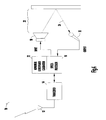
- Fig. 1 is a block diagram illustrating a mobile speaker phone system 10 that can be used within a vehicle to provide hands free wireless voice communication between an occupant of the vehicle and a remote party.
- the system 10 can be implemented as, for example, a dedicated standalone unit that is installed within a vehicle. Alternatively, the system 10 can be implemented as a docking station into which a handheld wireless communicator (e.g., a cell phone) is inserted. Other implementations are also possible.
- the speaker phone system 10 includes: an antenna 12, a wireless transceiver 14, a speech processor 16, a loudspeaker 18, and a microphone 20.
- the wireless transceiver 14 and associated antenna 12 are operative for supporting communication with a remote transceiver (e.g., within a cellular base station, a communications satellite, etc.) through a wireless communication channel.
- the speech processor 16 is operative for, among other things, processing speech signals traveling between a local user and the remote party.
- the loudspeaker 18 and microphone 20 are operative for generating and sensing, respectively, audible signals within an internal chamber 22 of the vehicle.
- the microphone 20 During outgoing communication, the microphone 20 generates an electrical speech signal at an output thereof based on user speech within the vehicle.
- the electrical speech signal is delivered to the speech processor 16 which converts the signal into a format required by the wireless transceiver 14.
- the speech signal delivered to the transceiver 14 can be either digital or analog.
- the wireless transceiver 14 uses the speech signal received from the speech processor 16 to generate an RF transmit signal that is then transmitted into the wireless channel via antenna 12.
- the antenna 12 receives an RF signal from the wireless communication channel and delivers it to the wireless transceiver 14.
- the wireless transceiver 14 then recovers speech information from the RF signal and delivers the speech information to the speech processor 16.
- the speech processor 16 uses the speech information to generate an analog speech signal for delivery to the loudspeaker 18.
- the loudspeaker 18 then generates an audible speech signal within the chamber 22 of the vehicle based on the analog speech signal received from the speech processor 16.
- the audible signal generated by the loudspeaker 18 will often reverberate within the internal chamber 22 of the vehicle. As illustrated in Fig. 1 , a portion of the audible signal may be directed back toward and sensed by the microphone 20 as an echo signal 24. If ignored, the echo signal will be transmitted back to the remote party as part of the outgoing wireless signal. To prevent this from occurring, echo cancellation techniques are commonly employed. In one echo cancellation technique, a response function is generated that characterizes the response from the input of the loudspeaker 18 to the output of the microphone 20.
- this response function is used to calculate an estimated echo component at the output of the microphone 20 based on the known input signal of the loudspeaker 18.
- the estimated echo component is then subtracted from the actual output signal of the microphone 20 to reduce the echo level within the signal.
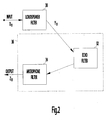
- Fig. 2 is a block diagram illustrating one method of modeling the channel between the input of loudspeaker 18 and the output of microphone 20 of Fig. 1 for purposes of generating the response function necessary to perform echo cancellation.
- the channel is represented as a concatenation of three filters; namely, a loudspeaker filter 30, an echo filter 32, and a microphone filter 34.
- each of these filter components was typically characterized as a linear filter and, therefore, a single linear transfer function could be developed for the entire channel.
- the response function of loudspeakers particularly small, less expensive loudspeakers, is nonlinear in nature. Such devices are more appropriately modeled as, for example, nonlinear Volterra filters.
- the individual response of the echo filter 32 will also change with time. Therefore, the response function used for echo cancellation will have to adapt during system operation. It is typically very difficult to adapt a nonlinear response function while a system in on-line (i.e., during communication with the remote party).
- the nonlinear response function of the loudspeaker filter 30, which does not typically change with time, is determined off-line and stored. The nonlinear response function of the loudspeaker 18 is then combined with the adapting linear response function 36 of the echo/microphone (e.g., using convolution) to generate the response function required for echo cancellation.
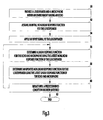
- Fig. 3 is a flowchart illustrating a method for determining a nonlinear response function for a loudspeaker in accordance with an embodiment of the present invention.
- the method can be used in connection with any application requiring knowledge of a loudspeaker response function and is not limited to mobile speaker phone applications. Significantly, the method does not require the use of an expensive test setup or anechoic chamber.
- the method is performed in a manufacturing environment to determine the response function of a loudspeaker either before or after the loudspeaker has been installed within a manufactured product.
- the method is performed in the field (e.g., within an automobile) to calibrate or re- calibrate a loudspeaker that is part of an end user device.
- a loudspeaker and microphone are first provided within an environment having an echo (block 50).
- the loudspeaker is the one for which a response function is desired.
- the microphone does not have to be the same or even a similar microphone to one that will be used with the loudspeaker in the field.
- the echo response within the calibration environment does not have to be similar to the echo response that will be experienced in the field, nor does the echo response have to be known a priori.
- An initial nonlinear response function is next assumed for the loudspeaker (block 52).
- the initial nonlinear response function that is used for the loudspeaker will be one that is believed to approximate the actual response function of the loudspeaker.
- an average nonlinear response function for loudspeakers of the same type is used as the initial nonlinear response function.
- a nonlinear Volterra filter response is used for the loudspeaker.
- y n is the output of the filter
- x is the input of the filter
- b are the filter coefficients
- p1, p2, and p3 are the lengths of the respective filter parts.
- An input signal is next applied to the loudspeaker (block 54).
- a noise generator is used to apply a noise signal to the loudspeaker that is within an audio frequency range.
- Other types of input signal are also possible.
- the loudspeaker will generate an audible output signal, part of which will be sensed by the microphone as an echo. As a result, the microphone will generate an echo signal at an output thereof. This echo signal may be digitized and stored for later use.
- a linear response function is next determined for the combination of the echo and the microphone using the latest nonlinear loudspeaker response function (block 56).
- the latest nonlinear response function of the loudspeaker is the initial nonlinear response function that was assumed previously.
- a cost function minimization process is used to determine the coefficients (ai) of the linear response function.
- the initial nonlinear response function is used to estimate the output signal of the loudspeaker (y n ) using the known input signal of the loudspeaker (x n ).
- the output signal (z n ) of the microphone is known (e.g., measured).
- an updated nonlinear response function is determined for the loudspeaker using the latest linear response function (block 58).
- a cost function minimization process is preferably used to determine the coefficients b n of the revised nonlinear response function of the loudspeaker. It can be shown that, if the coefficients a n of the echo/microphone are known, then the function to be minimized to determine the coefficients b n of the nonlinear response is also a concave function.
- the linear response function of the echo/microphone and the nonlinear response function of the loudspeaker are now repeatedly and alternately redetermined in an iterative process until a predetermined condition has been satisfied (block 60). With each iteration, the linear response function of the echo/microphone and the nonlinear response function of the loudspeaker should each converge toward the actual responses.
- the update process is repeated until no further improvement is being achieved in cost function F 2 on successive iterations.
- the update process is repeated until a predetermined value of cost function F 2 has been achieved.
- a predetermined number of iteration are performed. As will be appreciated, many alternative conditions or combinations of conditions for ending the iterative process can be used.
- the resulting nonlinear response function of the loudspeaker is recorded.
- Fig. 4 is a block diagram illustrating a mobile speaker phone system 70 having loudspeaker calibration functionality in accordance with an embodiment of the present invention.
- the mobile speaker phone system 70 of Fig. 4 is similar to the system 10 of Fig. 1 .
- a loudspeaker calibration unit 72 has been added to the system to allow the nonlinear response function of the loudspeaker 18 to be updated in the field. If the original loudspeaker 18 is repaired or replaced, a new nonlinear response function will often he necessary to perform accurate echo cancellation. Similarly, as the loudspeaker 18 ages, the response of the loudspeaker 18 can drift which may also require the generation of a new nonlinear response function.
- the loudspeaker calibration unit 72 can be programmed to activate automatically during periods when the system 70 is off-line. Alternatively, or in addition, end user activation capabilities can be provided to allow an end user to initiate a recalibration.
- the loudspeaker calibration unit 72 will be programmed to perform an iterative loudspeaker calibration technique, such as the method of Fig. 3 .
- the loudspeaker calibration unit 72 can be implemented, for example, as a software routine that is executed within a digital processing device within the system 70. Hardware and hybrid hardware/software implementations are also possible.
- the loudspeaker calibration unit 72 includes a signal source (e.g., a noise source) for providing an input signal to the loudspeaker 18 during calibration activities. After a new nonlinear response function has been generated for the loudspeaker 18, the loudspeaker calibration unit 72 will typically store the function (e.g., the coefficients of the Volterra filter) for later use during echo cancellation operations.
- Similar loudspeaker calibration functionality can be implemented within other types of systems that may require an accurate model of a loudspeaker response function, such as, for example, stationary (desktop) speaker phones and intercom systems.
Landscapes
- Physics & Mathematics (AREA)
- Engineering & Computer Science (AREA)
- Acoustics & Sound (AREA)
- Signal Processing (AREA)
- Health & Medical Sciences (AREA)
- General Health & Medical Sciences (AREA)
- Otolaryngology (AREA)
- Telephone Function (AREA)
- Cable Transmission Systems, Equalization Of Radio And Reduction Of Echo (AREA)
- Measurement Of Mechanical Vibrations Or Ultrasonic Waves (AREA)
- Interconnected Communication Systems, Intercoms, And Interphones (AREA)
Claims (20)
- Procédé pour déterminer une fonction de réponse non linéaire pour un haut-parleur (18), comprenant :la fourniture (50) d'un haut-parleur et d'un microphone (20) dans un environnement ayant un écho (24) ;caractérisé en ce que le procédé comprend en outre :la supposition (52) d'une fonction de réponse non linéaire initiale pour ledit haut-parleur ;la détermination (56) d'une fonction de réponse linéaire pour une combinaison dudit écho et dudit microphone en utilisant une fonction de réponse non linéaire la plus récente dudit haut-parleur ; etla détermination (58) d'une fonction de réponse non linéaire révisée pour ledit haut-parleur utilisant une fonction de réponse linéaire la plus récente de ladite combinaison.
- Procédé selon la revendication 1, comprenant en outre :la répétition (60) de la détermination d'une fonction de réponse linéaire et la détermination d'une fonction de réponse non linéaire révisée jusqu'à ce qu'une condition prédéterminée soit satisfaite.
- Procédé selon la revendication 2, dans lequel :la détermination d'une fonction de réponse non linéaire révisée pour ledit haut-parleur (18) comprend la minimisation d'une fonction de coût, dans lequel ladite condition prédéterminée comprend la réalisation d'une valeur prédéterminée pour ladite fonction de coût.
- Procédé selon la revendication 2, dans lequel :la détermination d'une fonction de réponse non linéaire révisée pour ledit haut-parleur (18) comprend la minimisation d'une fonction de coût, dans lequel ladite condition prédéterminée comprend la réalisation d'une autre petite réduction dans ladite fonction de coût avec chaque répétition additionnelle.
- Procédé selon la revendication 1, dans lequel
la détermination d'une fonction de réponse linéaire comprend la minimisation d'une première fonction de coût et la détermination d'une fonction de réponse non linéaire révisée comprend la minimisation d'une seconde fonction de coût. - Procédé selon la revendication 1, dans lequel :ladite fonction de réponse non linéaire initiale dudit haut-parleur (18) est une réponse de filtre Volterra.
- Procédé selon la revendication 1, dans lequel :ledit procédé est réalisé dans une installation de fabrication.
- Procédé selon la revendication 1, dans lequel
ledit haut-parleur (18) est destiné à être utilisé dans un appareil de communication dans un véhicule, ledit procédé étant réalisé dans ledit véhicule. - Unité de calibration (72) pour déterminer une fonction de réponse non linéaire pour un haut-parleur (18) lorsque le haut-parleur et un microphone (20) sont fournis dans un environnement ayant un écho, caractérisé par :un moyen pour supposer une fonction de réponse non linéaire initiale pour ledit haut-parleur ;un moyen pour déterminer une fonction de réponse linéaire pour une combinaison dudit écho et dudit microphone en utilisant une fonction de réponse non linéaire la plus récente dudit haut-parleur ; etun moyen pour déterminer une fonction de réponse non linéaire révisée pour ledit haut-parleur en utilisant une fonction de réponse linéaire la plus récente de ladite combinaison.
- Unité de calibration (72) selon la revendication 9, dans lequel :ladite unité de calibration est utilisable pour déterminer ladite fonction de réponse non linéaire dudit haut-parleur (18) dans le domaine.
- Unité de calibration (72) selon la revendication 9, dans lequel :ladite unité de calibration comprend une source de signal pour appliquer un signal d'entrée audit haut-parleur (18).
- Unité de calibration (72) selon la revendication 11, dans lequel :ladite source de signal comprend un générateur de bruit.
- Unité de calibration (72) selon la revendication 9, dans lequel :ladite unité de calibration comprend un module d'itération pour mettre à jour itérativement et alternativement une fonction de réponse linéaire d'une combinaison d'un écho (24) et dudit microphone (20) et ladite fonction de réponse non linéaire dudit haut-parleur (18) jusqu'à ce qu'une condition prédéterminée ait été satisfaite.
- Unité de calibration (72) selon la revendication 9, dans lequel :ladite unité de calibration comprend un module de réponse linéaire pour déterminer une fonction de réponse linéaire pour une combinaison d'un écho (24) et dudit microphone (20) sur la base d'une fonction de réponse non linéaire supposée dudit haut-parleur (18).
- Unité de calibration (72) selon la revendication 14, dans lequel :ledit module de réponse linéaire comprend un module de minimisation pour la minimisation d'une première fonction de coût.
- Unité de calibration (72) selon la revendication 14, dans lequel :ladite unité de calibration comprend un module de réponse non linéaire pour déterminer une fonction de réponse non linéaire mise à jour pour ledit haut-parleur en utilisant ladite fonction de réponse linéaire de ladite combinaison.
- Unité de calibration (72) selon la revendication 16, dans lequel :ledit module de réponse non linéaire comprend un module de minimisation pour minimiser une seconde fonction de coût.
- Appareil de communication, comprenant :un haut-parleur (18) pour générer un signal audible dans une zone utilisant des informations reçues à partir d'une entité distante ;un microphone (20) pour générer un signal de sortie sur la base de sons dans ladite zone, ledit signal de sortie comprenant des informations à transmettre à ladite entité distante ;une unité de suppression d'écho pour réduire les échos (24) dans ledit signal de sortie dudit microphone, ladite unité de suppression d'écho utilisant une fonction de réponse non linéaire dudit haut-parleur pour réduire lesdits échos ; etune unité de calibration selon l'une quelconque des revendications 9 à 17.
- Appareil de communication selon la revendication 18, dans lequel :ledit appareil de communication est un téléphone mobile à haut-parleur destiné à être utilisé dans un véhicule.
- Support lisible par ordinateur caractérisé par des instructions qui, lorsqu'elles sont exécutées par un ordinateur approprié, conduisent l'ordinateur à réaliser un procédé pour déterminer une fonction de réponse non linéaire pour un haut-parleur (18), le haut-parleur et un microphone (20) étant placés dans un environnement ayant un écho (24), dans lequel le procédé comprend :la supposition (52) d'une fonction de réponse non linéaire initiale pour ledit haut-parleur ;la détermination (56) d'une fonction de réponse linéaire pour une combinaison dudit écho et dudit microphone en utilisant une fonction de réponse non linéaire la plus récente dudit haut-parleur ; etla détermination (58) d'une fonction de réponse non linéaire révisée pour ledit haut-parleur en utilisant une fonction de réponse linéaire la plus récente de ladite combinaison.
Applications Claiming Priority (3)
| Application Number | Priority Date | Filing Date | Title |
|---|---|---|---|
| US962503 | 1997-10-31 | ||
| US09/962,503 US7209566B2 (en) | 2001-09-25 | 2001-09-25 | Method and apparatus for determining a nonlinear response function for a loudspeaker |
| PCT/US2002/027609 WO2003028406A2 (fr) | 2001-09-25 | 2002-08-30 | Procede et appareil permettant de determiner la fonction reponse non lineaire d'un haut-parleur |
Publications (2)
| Publication Number | Publication Date |
|---|---|
| EP1430748A2 EP1430748A2 (fr) | 2004-06-23 |
| EP1430748B1 true EP1430748B1 (fr) | 2011-09-28 |
Family
ID=25505971
Family Applications (1)
| Application Number | Title | Priority Date | Filing Date |
|---|---|---|---|
| EP02757477A Expired - Lifetime EP1430748B1 (fr) | 2001-09-25 | 2002-08-30 | Procede et appareil permettant de determiner la fonction reponse non lineaire d'un haut-parleur |
Country Status (7)
| Country | Link |
|---|---|
| US (1) | US7209566B2 (fr) |
| EP (1) | EP1430748B1 (fr) |
| CN (1) | CN100574514C (fr) |
| AT (1) | ATE526795T1 (fr) |
| AU (1) | AU2002323493A1 (fr) |
| MY (1) | MY138150A (fr) |
| WO (1) | WO2003028406A2 (fr) |
Families Citing this family (10)
| Publication number | Priority date | Publication date | Assignee | Title |
|---|---|---|---|---|
| EP1519628A3 (fr) * | 2003-09-29 | 2009-03-04 | Siemens Aktiengesellschaft | Procédé et appareil pour la restitution d'un signal de sortie de mode stéréo qui est obtenu d'un signal d'entrée de mode mono |
| US8170233B2 (en) * | 2004-02-02 | 2012-05-01 | Harman International Industries, Incorporated | Loudspeaker array system |
| US20070155332A1 (en) * | 2005-12-30 | 2007-07-05 | Burgan John M | Method and mobile communication device for characterizing an audio accessory for use with the mobile communication device |
| CN101689371B (zh) * | 2007-06-21 | 2013-02-06 | 皇家飞利浦电子股份有限公司 | 处理音频信号的设备和方法 |
| US9065895B2 (en) | 2012-02-22 | 2015-06-23 | Broadcom Corporation | Non-linear echo cancellation |
| US9743201B1 (en) * | 2013-03-14 | 2017-08-22 | Apple Inc. | Loudspeaker array protection management |
| CN104835502B (zh) * | 2015-05-20 | 2018-04-10 | 北京捷思锐科技股份有限公司 | 音频信号处理方法、装置及电子设备 |
| US10425730B2 (en) * | 2016-04-14 | 2019-09-24 | Harman International Industries, Incorporated | Neural network-based loudspeaker modeling with a deconvolution filter |
| US10153744B1 (en) | 2017-08-02 | 2018-12-11 | 2236008 Ontario Inc. | Automatically tuning an audio compressor to prevent distortion |
| US10985951B2 (en) | 2019-03-15 | 2021-04-20 | The Research Foundation for the State University | Integrating Volterra series model and deep neural networks to equalize nonlinear power amplifiers |
Family Cites Families (14)
| Publication number | Priority date | Publication date | Assignee | Title |
|---|---|---|---|---|
| FR2413009A1 (fr) | 1977-12-20 | 1979-07-20 | Oceanic | Systeme de correction acoustique automatique |
| GB9026906D0 (en) * | 1990-12-11 | 1991-01-30 | B & W Loudspeakers | Compensating filters |
| DE4111884A1 (de) * | 1991-04-09 | 1992-10-15 | Klippel Wolfgang | Schaltungsanordnung zur korrektur des linearen und nichtlinearen uebertragungsverhaltens elektroakustischer wandler |
| US6760451B1 (en) * | 1993-08-03 | 2004-07-06 | Peter Graham Craven | Compensating filters |
| DE4332804C2 (de) * | 1993-09-27 | 1997-06-05 | Klippel Wolfgang | Adaptive Korrekturschaltung für elektroakustische Schallsender |
| US5600718A (en) * | 1995-02-24 | 1997-02-04 | Ericsson Inc. | Apparatus and method for adaptively precompensating for loudspeaker distortions |
| US5680450A (en) * | 1995-02-24 | 1997-10-21 | Ericsson Inc. | Apparatus and method for canceling acoustic echoes including non-linear distortions in loudspeaker telephones |
| US6185300B1 (en) * | 1996-12-31 | 2001-02-06 | Ericsson Inc. | Echo canceler for use in communications system |
| JPH10271595A (ja) * | 1997-03-21 | 1998-10-09 | Nec Corp | 帰還があるスピーカ装置 |
| US6044341A (en) * | 1997-07-16 | 2000-03-28 | Olympus Optical Co., Ltd. | Noise suppression apparatus and recording medium recording processing program for performing noise removal from voice |
| US6058195A (en) * | 1998-03-30 | 2000-05-02 | Klippel; Wolfgang J. | Adaptive controller for actuator systems |
| US6766025B1 (en) * | 1999-03-15 | 2004-07-20 | Koninklijke Philips Electronics N.V. | Intelligent speaker training using microphone feedback and pre-loaded templates |
| DE19960979A1 (de) | 1999-12-17 | 2001-07-05 | Bosch Gmbh Robert | Adaptives Verfahren zur Bestimmung von Lautsprecherparametern |
| ATE417483T1 (de) * | 2000-02-02 | 2008-12-15 | Bernafon Ag | Schaltung und verfahren zur adaptiven geräuschunterdrückung |
-
2001
- 2001-09-25 US US09/962,503 patent/US7209566B2/en not_active Expired - Fee Related
-
2002
- 2002-08-30 CN CNB028233484A patent/CN100574514C/zh not_active Expired - Fee Related
- 2002-08-30 WO PCT/US2002/027609 patent/WO2003028406A2/fr not_active Ceased
- 2002-08-30 AU AU2002323493A patent/AU2002323493A1/en not_active Abandoned
- 2002-08-30 EP EP02757477A patent/EP1430748B1/fr not_active Expired - Lifetime
- 2002-08-30 AT AT02757477T patent/ATE526795T1/de not_active IP Right Cessation
- 2002-09-05 MY MYPI20023320A patent/MY138150A/en unknown
Also Published As
| Publication number | Publication date |
|---|---|
| MY138150A (en) | 2009-04-30 |
| EP1430748A2 (fr) | 2004-06-23 |
| WO2003028406A2 (fr) | 2003-04-03 |
| US20030059056A1 (en) | 2003-03-27 |
| CN100574514C (zh) | 2009-12-23 |
| ATE526795T1 (de) | 2011-10-15 |
| AU2002323493A1 (en) | 2003-04-07 |
| US7209566B2 (en) | 2007-04-24 |
| HK1064252A1 (en) | 2005-01-21 |
| CN1593072A (zh) | 2005-03-09 |
| WO2003028406A3 (fr) | 2003-08-21 |
Similar Documents
| Publication | Publication Date | Title |
|---|---|---|
| US9398374B2 (en) | Systems and methods for nonlinear echo cancellation | |
| EP0811301B1 (fr) | Systeme et procede de precompensation adaptative de distorsions de haut-parleur | |
| US8204210B2 (en) | Method and system for nonlinear acoustic echo cancellation in hands-free telecommunication devices | |
| US7110944B2 (en) | Method and apparatus for noise filtering | |
| US7272224B1 (en) | Echo cancellation | |
| EP1051835B1 (fr) | Generation de signaux d'etalonnage destinee a un formateur de faisceaux | |
| US8472616B1 (en) | Self calibration of envelope-based acoustic echo cancellation | |
| EP2048659B1 (fr) | Gain et réglage de forme spectrale dans un traitement de signal audio | |
| US20070140058A1 (en) | Method and system for correcting transducer non-linearities | |
| US10477031B2 (en) | System and method for suppression of non-linear acoustic echoes | |
| CN100550950C (zh) | 回波消除器电路和方法 | |
| JP4568439B2 (ja) | エコー抑圧装置 | |
| JP4101317B2 (ja) | 適応識別とそれに関する適応エコーキャンセラのための方法と装置 | |
| US7826624B2 (en) | Speakerphone self calibration and beam forming | |
| JP2001509659A (ja) | 複数のセンサで信号のレベル及び遅延を測定する方法及び装置 | |
| EP1672803B1 (fr) | Système pour la limitation des signaux audio de réception | |
| US7209566B2 (en) | Method and apparatus for determining a nonlinear response function for a loudspeaker | |
| US9667803B2 (en) | Nonlinear acoustic echo cancellation based on transducer impedance | |
| CN102263866B (zh) | 使用固定回波消除滤波器系数的方法和音频通信装置 | |
| US8935164B2 (en) | Non-spatial speech detection system and method of using same | |
| CN109417666A (zh) | 噪声去除装置、回声消除装置、异常音检测装置和噪声去除方法 | |
| US6772118B2 (en) | Automated speech recognition filter | |
| HK1064252B (en) | Method and apparatus for determining a nonlinear response function for a loudspeaker | |
| US11553274B2 (en) | Autoregressive based residual echo suppression | |
| JP2003283645A (ja) | 車載用ハンズフリー装置及びその調整データ配信装置、並びに車載用ハンズフリーシステム |
Legal Events
| Date | Code | Title | Description |
|---|---|---|---|
| PUAI | Public reference made under article 153(3) epc to a published international application that has entered the european phase |
Free format text: ORIGINAL CODE: 0009012 |
|
| AK | Designated contracting states |
Kind code of ref document: A2 Designated state(s): AT BE BG CH CY CZ DE DK EE ES FI FR GB GR IE IT LI LU MC NL PT SE SK TR |
|
| AX | Request for extension of the european patent |
Extension state: AL LT LV MK RO SI |
|
| 17P | Request for examination filed |
Effective date: 20040401 |
|
| REG | Reference to a national code |
Ref country code: HK Ref legal event code: DE Ref document number: 1064252 Country of ref document: HK |
|
| 17Q | First examination report despatched |
Effective date: 20070801 |
|
| GRAP | Despatch of communication of intention to grant a patent |
Free format text: ORIGINAL CODE: EPIDOSNIGR1 |
|
| GRAS | Grant fee paid |
Free format text: ORIGINAL CODE: EPIDOSNIGR3 |
|
| GRAA | (expected) grant |
Free format text: ORIGINAL CODE: 0009210 |
|
| AK | Designated contracting states |
Kind code of ref document: B1 Designated state(s): AT BE BG CH CY CZ DE DK EE ES FI FR GB GR IE IT LI LU MC NL PT SE SK TR |
|
| REG | Reference to a national code |
Ref country code: GB Ref legal event code: FG4D |
|
| REG | Reference to a national code |
Ref country code: CH Ref legal event code: EP |
|
| REG | Reference to a national code |
Ref country code: IE Ref legal event code: FG4D |
|
| REG | Reference to a national code |
Ref country code: DE Ref legal event code: R096 Ref document number: 60241157 Country of ref document: DE Effective date: 20111124 |
|
| REG | Reference to a national code |
Ref country code: NL Ref legal event code: VDEP Effective date: 20110928 |
|
| PG25 | Lapsed in a contracting state [announced via postgrant information from national office to epo] |
Ref country code: SE Free format text: LAPSE BECAUSE OF FAILURE TO SUBMIT A TRANSLATION OF THE DESCRIPTION OR TO PAY THE FEE WITHIN THE PRESCRIBED TIME-LIMIT Effective date: 20110928 Ref country code: FI Free format text: LAPSE BECAUSE OF FAILURE TO SUBMIT A TRANSLATION OF THE DESCRIPTION OR TO PAY THE FEE WITHIN THE PRESCRIBED TIME-LIMIT Effective date: 20110928 |
|
| PG25 | Lapsed in a contracting state [announced via postgrant information from national office to epo] |
Ref country code: CY Free format text: LAPSE BECAUSE OF FAILURE TO SUBMIT A TRANSLATION OF THE DESCRIPTION OR TO PAY THE FEE WITHIN THE PRESCRIBED TIME-LIMIT Effective date: 20110928 Ref country code: AT Free format text: LAPSE BECAUSE OF FAILURE TO SUBMIT A TRANSLATION OF THE DESCRIPTION OR TO PAY THE FEE WITHIN THE PRESCRIBED TIME-LIMIT Effective date: 20110928 Ref country code: GR Free format text: LAPSE BECAUSE OF FAILURE TO SUBMIT A TRANSLATION OF THE DESCRIPTION OR TO PAY THE FEE WITHIN THE PRESCRIBED TIME-LIMIT Effective date: 20111229 |
|
| REG | Reference to a national code |
Ref country code: AT Ref legal event code: MK05 Ref document number: 526795 Country of ref document: AT Kind code of ref document: T Effective date: 20110928 |
|
| PG25 | Lapsed in a contracting state [announced via postgrant information from national office to epo] |
Ref country code: BE Free format text: LAPSE BECAUSE OF FAILURE TO SUBMIT A TRANSLATION OF THE DESCRIPTION OR TO PAY THE FEE WITHIN THE PRESCRIBED TIME-LIMIT Effective date: 20110928 |
|
| PG25 | Lapsed in a contracting state [announced via postgrant information from national office to epo] |
Ref country code: SK Free format text: LAPSE BECAUSE OF FAILURE TO SUBMIT A TRANSLATION OF THE DESCRIPTION OR TO PAY THE FEE WITHIN THE PRESCRIBED TIME-LIMIT Effective date: 20110928 Ref country code: CZ Free format text: LAPSE BECAUSE OF FAILURE TO SUBMIT A TRANSLATION OF THE DESCRIPTION OR TO PAY THE FEE WITHIN THE PRESCRIBED TIME-LIMIT Effective date: 20110928 |
|
| REG | Reference to a national code |
Ref country code: HK Ref legal event code: GR Ref document number: 1064252 Country of ref document: HK |
|
| PG25 | Lapsed in a contracting state [announced via postgrant information from national office to epo] |
Ref country code: NL Free format text: LAPSE BECAUSE OF FAILURE TO SUBMIT A TRANSLATION OF THE DESCRIPTION OR TO PAY THE FEE WITHIN THE PRESCRIBED TIME-LIMIT Effective date: 20110928 Ref country code: PT Free format text: LAPSE BECAUSE OF FAILURE TO SUBMIT A TRANSLATION OF THE DESCRIPTION OR TO PAY THE FEE WITHIN THE PRESCRIBED TIME-LIMIT Effective date: 20120130 Ref country code: EE Free format text: LAPSE BECAUSE OF FAILURE TO SUBMIT A TRANSLATION OF THE DESCRIPTION OR TO PAY THE FEE WITHIN THE PRESCRIBED TIME-LIMIT Effective date: 20110928 Ref country code: IT Free format text: LAPSE BECAUSE OF FAILURE TO SUBMIT A TRANSLATION OF THE DESCRIPTION OR TO PAY THE FEE WITHIN THE PRESCRIBED TIME-LIMIT Effective date: 20110928 |
|
| PG25 | Lapsed in a contracting state [announced via postgrant information from national office to epo] |
Ref country code: DK Free format text: LAPSE BECAUSE OF FAILURE TO SUBMIT A TRANSLATION OF THE DESCRIPTION OR TO PAY THE FEE WITHIN THE PRESCRIBED TIME-LIMIT Effective date: 20110928 |
|
| PLBE | No opposition filed within time limit |
Free format text: ORIGINAL CODE: 0009261 |
|
| STAA | Information on the status of an ep patent application or granted ep patent |
Free format text: STATUS: NO OPPOSITION FILED WITHIN TIME LIMIT |
|
| 26N | No opposition filed |
Effective date: 20120629 |
|
| REG | Reference to a national code |
Ref country code: DE Ref legal event code: R097 Ref document number: 60241157 Country of ref document: DE Effective date: 20120629 |
|
| REG | Reference to a national code |
Ref country code: CH Ref legal event code: PL |
|
| PG25 | Lapsed in a contracting state [announced via postgrant information from national office to epo] |
Ref country code: MC Free format text: LAPSE BECAUSE OF NON-PAYMENT OF DUE FEES Effective date: 20120831 |
|
| PG25 | Lapsed in a contracting state [announced via postgrant information from national office to epo] |
Ref country code: LI Free format text: LAPSE BECAUSE OF NON-PAYMENT OF DUE FEES Effective date: 20120831 Ref country code: ES Free format text: LAPSE BECAUSE OF FAILURE TO SUBMIT A TRANSLATION OF THE DESCRIPTION OR TO PAY THE FEE WITHIN THE PRESCRIBED TIME-LIMIT Effective date: 20120108 Ref country code: CH Free format text: LAPSE BECAUSE OF NON-PAYMENT OF DUE FEES Effective date: 20120831 |
|
| REG | Reference to a national code |
Ref country code: FR Ref legal event code: ST Effective date: 20130430 |
|
| REG | Reference to a national code |
Ref country code: IE Ref legal event code: MM4A |
|
| PG25 | Lapsed in a contracting state [announced via postgrant information from national office to epo] |
Ref country code: BG Free format text: LAPSE BECAUSE OF FAILURE TO SUBMIT A TRANSLATION OF THE DESCRIPTION OR TO PAY THE FEE WITHIN THE PRESCRIBED TIME-LIMIT Effective date: 20111228 |
|
| PG25 | Lapsed in a contracting state [announced via postgrant information from national office to epo] |
Ref country code: IE Free format text: LAPSE BECAUSE OF NON-PAYMENT OF DUE FEES Effective date: 20120830 |
|
| PG25 | Lapsed in a contracting state [announced via postgrant information from national office to epo] |
Ref country code: FR Free format text: LAPSE BECAUSE OF NON-PAYMENT OF DUE FEES Effective date: 20120831 |
|
| PG25 | Lapsed in a contracting state [announced via postgrant information from national office to epo] |
Ref country code: TR Free format text: LAPSE BECAUSE OF FAILURE TO SUBMIT A TRANSLATION OF THE DESCRIPTION OR TO PAY THE FEE WITHIN THE PRESCRIBED TIME-LIMIT Effective date: 20110928 |
|
| PG25 | Lapsed in a contracting state [announced via postgrant information from national office to epo] |
Ref country code: LU Free format text: LAPSE BECAUSE OF NON-PAYMENT OF DUE FEES Effective date: 20120830 |
|
| PGFP | Annual fee paid to national office [announced via postgrant information from national office to epo] |
Ref country code: DE Payment date: 20160823 Year of fee payment: 15 Ref country code: GB Payment date: 20160824 Year of fee payment: 15 |
|
| REG | Reference to a national code |
Ref country code: DE Ref legal event code: R119 Ref document number: 60241157 Country of ref document: DE |
|
| GBPC | Gb: european patent ceased through non-payment of renewal fee |
Effective date: 20170830 |
|
| PG25 | Lapsed in a contracting state [announced via postgrant information from national office to epo] |
Ref country code: GB Free format text: LAPSE BECAUSE OF NON-PAYMENT OF DUE FEES Effective date: 20170830 Ref country code: DE Free format text: LAPSE BECAUSE OF NON-PAYMENT OF DUE FEES Effective date: 20180301 |