EP1431091A1 - Verre a vitres pour automobile et son procede de production - Google Patents
Verre a vitres pour automobile et son procede de production Download PDFInfo
- Publication number
- EP1431091A1 EP1431091A1 EP01970202A EP01970202A EP1431091A1 EP 1431091 A1 EP1431091 A1 EP 1431091A1 EP 01970202 A EP01970202 A EP 01970202A EP 01970202 A EP01970202 A EP 01970202A EP 1431091 A1 EP1431091 A1 EP 1431091A1
- Authority
- EP
- European Patent Office
- Prior art keywords
- resin
- glass
- window glass
- natural grade
- vehicle window
- Prior art date
- Legal status (The legal status is an assumption and is not a legal conclusion. Google has not performed a legal analysis and makes no representation as to the accuracy of the status listed.)
- Withdrawn
Links
Images



Classifications
-
- E—FIXED CONSTRUCTIONS
- E05—LOCKS; KEYS; WINDOW OR DOOR FITTINGS; SAFES
- E05F—DEVICES FOR MOVING WINGS INTO OPEN OR CLOSED POSITION; CHECKS FOR WINGS; WING FITTINGS NOT OTHERWISE PROVIDED FOR, CONCERNED WITH THE FUNCTIONING OF THE WING
- E05F11/00—Man-operated mechanisms for operating wings, including those which also operate the fastening
- E05F11/38—Man-operated mechanisms for operating wings, including those which also operate the fastening for sliding windows, e.g. vehicle windows, to be opened or closed by vertical movement
- E05F11/382—Man-operated mechanisms for operating wings, including those which also operate the fastening for sliding windows, e.g. vehicle windows, to be opened or closed by vertical movement for vehicle windows
- E05F11/385—Fixing of window glass to the carrier of the operating mechanism
-
- B—PERFORMING OPERATIONS; TRANSPORTING
- B60—VEHICLES IN GENERAL
- B60J—WINDOWS, WINDSCREENS, NON-FIXED ROOFS, DOORS, OR SIMILAR DEVICES FOR VEHICLES; REMOVABLE EXTERNAL PROTECTIVE COVERINGS SPECIALLY ADAPTED FOR VEHICLES
- B60J1/00—Windows; Windscreens; Accessories therefor
-
- C—CHEMISTRY; METALLURGY
- C09—DYES; PAINTS; POLISHES; NATURAL RESINS; ADHESIVES; COMPOSITIONS NOT OTHERWISE PROVIDED FOR; APPLICATIONS OF MATERIALS NOT OTHERWISE PROVIDED FOR
- C09J—ADHESIVES; NON-MECHANICAL ASPECTS OF ADHESIVE PROCESSES IN GENERAL; ADHESIVE PROCESSES NOT PROVIDED FOR ELSEWHERE; USE OF MATERIALS AS ADHESIVES
- C09J5/00—Adhesive processes in general; Adhesive processes not provided for elsewhere, e.g. relating to primers
-
- C—CHEMISTRY; METALLURGY
- C08—ORGANIC MACROMOLECULAR COMPOUNDS; THEIR PREPARATION OR CHEMICAL WORKING-UP; COMPOSITIONS BASED THEREON
- C08L—COMPOSITIONS OF MACROMOLECULAR COMPOUNDS
- C08L75/00—Compositions of polyureas or polyurethanes; Compositions of derivatives of such polymers
- C08L75/04—Polyurethanes
-
- C—CHEMISTRY; METALLURGY
- C09—DYES; PAINTS; POLISHES; NATURAL RESINS; ADHESIVES; COMPOSITIONS NOT OTHERWISE PROVIDED FOR; APPLICATIONS OF MATERIALS NOT OTHERWISE PROVIDED FOR
- C09J—ADHESIVES; NON-MECHANICAL ASPECTS OF ADHESIVE PROCESSES IN GENERAL; ADHESIVE PROCESSES NOT PROVIDED FOR ELSEWHERE; USE OF MATERIALS AS ADHESIVES
- C09J2400/00—Presence of inorganic and organic materials
- C09J2400/10—Presence of inorganic materials
- C09J2400/14—Glass
- C09J2400/143—Glass in the substrate
-
- C—CHEMISTRY; METALLURGY
- C09—DYES; PAINTS; POLISHES; NATURAL RESINS; ADHESIVES; COMPOSITIONS NOT OTHERWISE PROVIDED FOR; APPLICATIONS OF MATERIALS NOT OTHERWISE PROVIDED FOR
- C09J—ADHESIVES; NON-MECHANICAL ASPECTS OF ADHESIVE PROCESSES IN GENERAL; ADHESIVE PROCESSES NOT PROVIDED FOR ELSEWHERE; USE OF MATERIALS AS ADHESIVES
- C09J2400/00—Presence of inorganic and organic materials
- C09J2400/20—Presence of organic materials
- C09J2400/22—Presence of unspecified polymer
- C09J2400/226—Presence of unspecified polymer in the substrate
-
- C—CHEMISTRY; METALLURGY
- C09—DYES; PAINTS; POLISHES; NATURAL RESINS; ADHESIVES; COMPOSITIONS NOT OTHERWISE PROVIDED FOR; APPLICATIONS OF MATERIALS NOT OTHERWISE PROVIDED FOR
- C09J—ADHESIVES; NON-MECHANICAL ASPECTS OF ADHESIVE PROCESSES IN GENERAL; ADHESIVE PROCESSES NOT PROVIDED FOR ELSEWHERE; USE OF MATERIALS AS ADHESIVES
- C09J2467/00—Presence of polyester
- C09J2467/006—Presence of polyester in the substrate
-
- C—CHEMISTRY; METALLURGY
- C09—DYES; PAINTS; POLISHES; NATURAL RESINS; ADHESIVES; COMPOSITIONS NOT OTHERWISE PROVIDED FOR; APPLICATIONS OF MATERIALS NOT OTHERWISE PROVIDED FOR
- C09J—ADHESIVES; NON-MECHANICAL ASPECTS OF ADHESIVE PROCESSES IN GENERAL; ADHESIVE PROCESSES NOT PROVIDED FOR ELSEWHERE; USE OF MATERIALS AS ADHESIVES
- C09J2475/00—Presence of polyurethane
-
- E—FIXED CONSTRUCTIONS
- E05—LOCKS; KEYS; WINDOW OR DOOR FITTINGS; SAFES
- E05Y—INDEXING SCHEME ASSOCIATED WITH SUBCLASSES E05D AND E05F, RELATING TO CONSTRUCTION ELEMENTS, ELECTRIC CONTROL, POWER SUPPLY, POWER SIGNAL OR TRANSMISSION, USER INTERFACES, MOUNTING OR COUPLING, DETAILS, ACCESSORIES, AUXILIARY OPERATIONS NOT OTHERWISE PROVIDED FOR, APPLICATION THEREOF
- E05Y2600/00—Mounting or coupling arrangements for elements provided for in this subclass
- E05Y2600/50—Mounting methods; Positioning
- E05Y2600/52—Toolless
- E05Y2600/526—Gluing or cementing
-
- E—FIXED CONSTRUCTIONS
- E05—LOCKS; KEYS; WINDOW OR DOOR FITTINGS; SAFES
- E05Y—INDEXING SCHEME ASSOCIATED WITH SUBCLASSES E05D AND E05F, RELATING TO CONSTRUCTION ELEMENTS, ELECTRIC CONTROL, POWER SUPPLY, POWER SIGNAL OR TRANSMISSION, USER INTERFACES, MOUNTING OR COUPLING, DETAILS, ACCESSORIES, AUXILIARY OPERATIONS NOT OTHERWISE PROVIDED FOR, APPLICATION THEREOF
- E05Y2600/00—Mounting or coupling arrangements for elements provided for in this subclass
- E05Y2600/60—Mounting or coupling members; Accessories therefor
- E05Y2600/626—Plates or brackets
-
- E—FIXED CONSTRUCTIONS
- E05—LOCKS; KEYS; WINDOW OR DOOR FITTINGS; SAFES
- E05Y—INDEXING SCHEME ASSOCIATED WITH SUBCLASSES E05D AND E05F, RELATING TO CONSTRUCTION ELEMENTS, ELECTRIC CONTROL, POWER SUPPLY, POWER SIGNAL OR TRANSMISSION, USER INTERFACES, MOUNTING OR COUPLING, DETAILS, ACCESSORIES, AUXILIARY OPERATIONS NOT OTHERWISE PROVIDED FOR, APPLICATION THEREOF
- E05Y2900/00—Application of doors, windows, wings or fittings thereof
- E05Y2900/50—Application of doors, windows, wings or fittings thereof for vehicles
- E05Y2900/53—Type of wing
- E05Y2900/55—Windows
-
- Y—GENERAL TAGGING OF NEW TECHNOLOGICAL DEVELOPMENTS; GENERAL TAGGING OF CROSS-SECTIONAL TECHNOLOGIES SPANNING OVER SEVERAL SECTIONS OF THE IPC; TECHNICAL SUBJECTS COVERED BY FORMER USPC CROSS-REFERENCE ART COLLECTIONS [XRACs] AND DIGESTS
- Y10—TECHNICAL SUBJECTS COVERED BY FORMER USPC
- Y10T—TECHNICAL SUBJECTS COVERED BY FORMER US CLASSIFICATION
- Y10T428/00—Stock material or miscellaneous articles
- Y10T428/16—Two dimensionally sectional layer
- Y10T428/163—Next to unitary web or sheet of equal or greater extent
- Y10T428/164—Continuous two dimensionally sectional layer
- Y10T428/166—Glass, ceramic, or metal sections [e.g., floor or wall tile, etc.]
-
- Y—GENERAL TAGGING OF NEW TECHNOLOGICAL DEVELOPMENTS; GENERAL TAGGING OF CROSS-SECTIONAL TECHNOLOGIES SPANNING OVER SEVERAL SECTIONS OF THE IPC; TECHNICAL SUBJECTS COVERED BY FORMER USPC CROSS-REFERENCE ART COLLECTIONS [XRACs] AND DIGESTS
- Y10—TECHNICAL SUBJECTS COVERED BY FORMER USPC
- Y10T—TECHNICAL SUBJECTS COVERED BY FORMER US CLASSIFICATION
- Y10T428/00—Stock material or miscellaneous articles
- Y10T428/31504—Composite [nonstructural laminate]
- Y10T428/31551—Of polyamidoester [polyurethane, polyisocyanate, polycarbamate, etc.]
- Y10T428/31609—Particulate metal or metal compound-containing
- Y10T428/31612—As silicone, silane or siloxane
Definitions
- the present invention relates to a window glass used for vehicles and a method of producing the same, with special focus on the processes and materials relating to a glass holder and adhesion of said window glass.
- a method of using adhesive and a glass holder as a way of putting together vehicle window glass are already widely known.
- This process involves the retention faculty of the glass holder with glass fiber combining the use of polyacetal resin, polybutylene terephthalate or aliphatic acid nylon resin.
- these resins in particular the nylon resin, are prone to adhesion difficulties and lack the properties of an instant adhesive.
- This situation means that a resin-based bond between the glass and the glass holder requires that the glass itself and/or the glass holder is initially coated with a primer consisting of a silane coupling agent dissolved into an organic solvent such as alcohol. Only once said coating is sufficiently dry is the unit further bonded with a urethane sealant.
- the pungent by-product vapour that is released during the primer coating process contributes to a lessening of efficiency of said process within the facility due to a worsening of the quality of the working environment.
- An object of the present invention is to provide a window glass and a method of producing the same capable of a curtailment of the primer process, reductions in manufacturing costs while dramatically increasing the adhesive properties, a reduction in the number and size of parts.
- a vehicle window glass comprising a vehicle window glass, a glass holder made by a resin material selected from groups of a resin of a natural grade polybutylene terephthalate resin, a resin of a natural grade polyethylene terephthalate resin, a resin containing glass fibers in a natural grade polybutylene terephthalate resin, a resin containing glass fibers in a natural grade polyethylene terephthalate resin, a resin of a natural grade polyamide resin or a resin containing glass fibers in a natural grade polyamide resin, and one-liquid type urethane adhesive layer containing a silane coupling agent formed between the vehicle window glass and the glass holder.
- a resin material selected from groups of a resin of a natural grade polybutylene terephthalate resin, a resin of a natural grade polyethylene terephthalate resin, a resin containing glass fibers in a natural grade polybutylene terephthalate resin, a resin containing glass fibers in a natural grade
- a method of producing a vehicle window glass comprising providing a window glass, providing a glass holder made by a resin material selected from groups of a resin of a natural grade polybutylene terephthalate resin, a resin of a natural grade polyethylene terephthalate resin, a resin containing glass fibers in a natural grade polybutylene terephthalate resin, a resin containing glass fibers in a natural grade polyethylene terephthalate resin, a resin of a natural grade polyamide resin or a resin containing glass fibers in a natural grade polyamide resin, providing a one-liquid type urethane adhesive layer containing a silane coupling agent, and adhering the window glass to the glass holder using the adhesive.
- a resin material selected from groups of a resin of a natural grade polybutylene terephthalate resin, a resin of a natural grade polyethylene terephthalate resin, a resin containing glass fibers in a natural grade polybutylene terephthalate resin,
- a vehicle window glass preferably further comprising spraying water on at least one of the window glass and the glass holder prior to adhering the window glass to the glass holder using the adhesive, or passing the window glass and the glass holder though a high-humidity atmosphere prior to adhering the window glass to the glass holder using the adhesive.
- the window glass and the one-liquid type urethane adhesive containing the silane coupling agent shall be bonded using the process detailed below.
- this process shall entail the bonding of the one-liquid type urethane adhesive containing a silane coupling agent, as shown in Fig. 10, which is completed when the organic functional group X (for example, NH 2 ) and a silicon atom (Si) extends to alkoxy-group (OR).
- a silane coupling agent for example, NH 2
- Si silicon atom
- the silane coupling agent having undergone the silanolization process, will absorb water in the location where it comes into contact with the glass due to a dehydrating condensation reaction, as shown in Fig. 11. Said water will evaporate into the atmosphere. The glass and the silane coupling agent will thereby form a solid siloxane bond.
- the NH 2 group that forms the end section of the silane coupling agent will react with the isocyanate (OCN-NCO) with its urethane end.
- the silane coupling agent will be bonded by urea secreted by the aforementioned urethane.
- the one-liquid type urethane primer as shown in Fig. 13, will react with the OH group polyol and the isocyanate (OCN-NCO) to form a urethane bond.
- OCN-NCO isocyanate
- Polybutylene terephthalate as described in the chemical structure formula shown in Fig. 14, uses a strongly polarized ester group (-COO).
- the ester combination consists of a group of negatively charged aspirated atoms.
- Nylon 6, with a structural formula as shown in Fig. 18, displays the properties of a strongly polarized firm amide bond (-CONH-).
- the amide when in contact with the atmosphere, will extract moisture from the air or can also be artificially provided with H 2 O. Either way, a hydrogen bond results.
- Nylon 6 with its NH group and its OH group that has now bonded with said hydrogen, forms a dehydrating condensation reaction with the silane coupling agent that has also undergone the silanolization process. This mechanism is described in Fig. 19, where it is clearly shown that any water present eventually evaporates off into the atmosphere. In this fashion, Nylon 6 and the silane coupling agent are thereby fixed together by a firm siloxane bond.
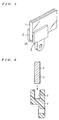
- Fig. 1 an oblique perspective, illustrates the explanation of how the invention relates to both the vehicle window glass and the glass holder.
- the vehicle window glass 1 matches the shape of the glass holder 2 fitting neatly into the recessed area 21 (there is also an adhesive face 21).
- the snug fit together with adhesive 3 ensure a good, solid bond between all units.
- Glass holder 2 is a compound structure made up of natural grade polybutylene terephthalate resin or natural grade polybutylene terephthalate resin containing glass fiber, both of which contain the strongly polarized COO group.
- This glass holder can also be formed from natural grade natural grade polyethylene terephthalate resin or natural grade polyethylene terephthalate resin containing glass fiber, both of which also contain the strongly polarized COO group.
- the glass holder may also be formed from natural grade polyamide resin or natural grade polyamide resin containing glass fiber, both of which also hail from the strongly polarized COO group.
- Adhesive 3 refers to the one-liquid type urethane adhesive containing a silane coupling agent.
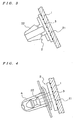
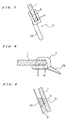
- Fig. 3 through Fig. 9 are cross-sectional diagrams of various areas of the invention during its application.
- Glass holder 2 as shown in Fig. 3, is a resin-based product specifically designed to strengthen the bond between the car body and the vehicle side window glass/back door window glass.
- Vehicle window glass 1, adhesive face 21 and the body of the vehicle (for example a hole) meet at engaging point 22.
- Fig. 4 shows glass holder 2 in the same positional relationship with vehicle window glass 1, adhesive face 21 and engaging point 22 as shown in Fig. 1.
- engaging point 22 on the automotive body is not directly engaged with the body section hole (as shown in Fig. 3) but instead forms part of sleeve 4, which has been added to the automotive body.
- Sleeve 4 would, for example, need to form appropriate connections with the locating pins on the vehicle window glass.
- Glass holder 2 as shown in Fig. 5, is again in the same positional relationship with vehicle window glass 1, adhesive face 21 and engaging point 22 as shown in Fig. 3.
- engaging point 22 is different.
- this arrangement would be most suitable for using engaging point 22 as a locking clip to fix the position of the vehicle window glass in relation to the body.
- Fig. 6 shows glass holder 2 again in the same positional relationship with vehicle window glass 1, adhesive face 21 and engaging point 22 as shown in Fig. 3. The difference this time relates to the sash-less type of side window.
- Vehicle window glass 1 is prevented from failing in the direction of the exterior of the vehicle, which is the tendency due to the air pressure maintained inside the vehicle body shell, by the engaging point 22 which acts as a bracket to prevent the vehicle window glass from such a drastic failure.
- Fig. 7 shows glass holder 2 and an elevation of the door.
- Vehicle window glass 1 is held in place on its bottom edge by the aforementioned recess and by adhesive face 21. It is also apparent that the automotive body and engaging point 22 have been co-joined in this elevation.
- vehicle window glass 1 and adhesive face 21 relate to the aforementioned side rear window and side center window through a join at a location identified as lip 23.
- Fig. 9 shows the relationship between glass holder 2 and a spacer, which is designed to prevent downward slippage and/or failure of the vehicle window glass.
- the spacer fixes the window along its entire perimeter.
- vehicle window glass 1 is cojoined to the vehicle body at adhesion face 24.
- FIG. 1 and Fig. 3 through Fig. 9 illustrate how glass holder 2 falls completely within the general concept of the role of a glass holder as appropriate to the invention.
- the individual functions of all the types of glass holder 2 as described above are all distinct, the points where glass holder 2 retains vehicle window glass 1 are all the same. In this sense, this item is referred to as a glass holder.
- the bonding process between the glass and the one-liquid type urethane adhesive containing a silane coupling agent is as follows:
- This process shall entail the bonding of the one-liquid type urethane adhesive containing a silane coupling agent.
- This bonding is completed when the organic functional group X (for example, NH 2 ) and a silicon atom (Si) extends to alkoxy-group (OR).
- X for example, NH 2
- Si silicon atom
- OR alkoxy-group
- the silane coupling agent having undergone the silanolization process, will, in the location where it comes into contact with the glass, absorb water due to a dehydrating condensation reaction, as shown in Fig. 11. Said water will evaporate into the atmosphere. The glass and the silane coupling agent will thereby form a solid siloxane bond.
- the NH 2 group that forms the end section of the silane coupling agent will react with the isocyanate (OCN-NCO) with its urethane end.
- the silane coupling agent will be bonded by urea secreted by the aforementioned urethane.
- the one-liquid type urethane primer as shown in Fig. 13, will react with the OH group polyol and the isocyanate (OCN-NCO) to form a urethane bond.
- OCN-NCO isocyanate
- Polybutylene terephthalate as described in the chemical structure formula shown in Fig. 14, uses a strongly polarized ester group (-COO). Ester bonding consists of a group of negatively charged aspirated atoms.
- the amide when in contact with the atmosphere, will extract moisture from the air or can also be artificially provided with H 2 O. Either way, a hydrogen bond results.
- the one-liquid type urethane adhesive containing the silane coupling agent undergoes a hydrolysis reaction that absorbs water from the moisture content of the surrounding atmosphere.
- the silane coupling agent undergoes a further dehydrating condensation reaction as part of the siloxane process.
- the glass and the silane coupling agent will thereby form a solid siloxane bond. Therefore, when vehicle window glass 1 and glass holder 2 are bonded together, as shown in Fig. 2, one part (for example, glass holder 2 and adhesive face 21) is coated with a layer of urethane adhesive 3, and the other part (for example, the adhesive face of vehicle window glass 1) is sprayed with water 5.
- the water 5 spray process may be replaced in turn by passage through a high-humidity atmosphere in a controlled climate.
- Fig. 20 shows vehicle window glass 1, after undergoing the water spray process, co-joined with glass holder 2. This amalgam then undergoes drying periods of 10, 20, 40, 60 and 80 hours respectively. These 5 samples, each with a distinct drying time, are then tested for the relative strengths of their bonds. All pass the acceptable criteria value for certification. There is also evidence that even without the water spray process, the bond shows sufficient adhesive properties. The test results indicate that the strongest bond was formed when a relatively short drying was applied (in this case: 40 hours) to items that had undergone the water spray process. Therefore, the current drying times can be shortened, and vehicle window glass productivity can be increased accordingly.
Landscapes
- Chemical & Material Sciences (AREA)
- Organic Chemistry (AREA)
- Engineering & Computer Science (AREA)
- Mechanical Engineering (AREA)
- Adhesives Or Adhesive Processes (AREA)
- Window Of Vehicle (AREA)
- Laminated Bodies (AREA)
- Lining Or Joining Of Plastics Or The Like (AREA)
- Manufacture Of Macromolecular Shaped Articles (AREA)
- Joining Of Glass To Other Materials (AREA)
Applications Claiming Priority (1)
| Application Number | Priority Date | Filing Date | Title |
|---|---|---|---|
| PCT/JP2001/008306 WO2003026909A1 (fr) | 2001-09-25 | 2001-09-25 | Verre a vitres pour automobile et son procede de production |
Publications (2)
| Publication Number | Publication Date |
|---|---|
| EP1431091A1 true EP1431091A1 (fr) | 2004-06-23 |
| EP1431091A4 EP1431091A4 (fr) | 2007-09-19 |
Family
ID=11737750
Family Applications (1)
| Application Number | Title | Priority Date | Filing Date |
|---|---|---|---|
| EP01970202A Withdrawn EP1431091A4 (fr) | 2001-09-25 | 2001-09-25 | Verre a vitres pour automobile et son procede de production |
Country Status (8)
| Country | Link |
|---|---|
| US (1) | US20040209031A1 (fr) |
| EP (1) | EP1431091A4 (fr) |
| KR (1) | KR100696014B1 (fr) |
| CN (1) | CN1253328C (fr) |
| DE (1) | DE10196738T5 (fr) |
| IT (1) | ITMI20022012A1 (fr) |
| SE (1) | SE527270C2 (fr) |
| WO (1) | WO2003026909A1 (fr) |
Families Citing this family (6)
| Publication number | Priority date | Publication date | Assignee | Title |
|---|---|---|---|---|
| DE102004010504B4 (de) * | 2004-03-04 | 2006-05-04 | Degussa Ag | Hochtransparente lasermarkierbare und laserschweißbare Kunststoffmaterialien, deren Verwendung und Herstellung sowie Verwendung von Metallmischoxiden und Verfahren zur Kennzeichnung von Produktionsgütern |
| BRPI0508433B1 (pt) * | 2004-03-04 | 2012-12-25 | materiais plÁsticos tingidos por corantes de modo transparente, translécido ou opaco, uso de partÍculas em nanoescala e processos para produÇço e solda do mesmo. | |
| US7704586B2 (en) * | 2005-03-09 | 2010-04-27 | Degussa Ag | Plastic molded bodies having two-dimensional and three-dimensional image structures produced through laser subsurface engraving |
| DE102007021199B4 (de) * | 2006-07-17 | 2016-02-11 | Evonik Degussa Gmbh | Zusammensetzungen aus organischem Polymer als Matrix und anorganischen Partikeln als Füllstoff, Verfahren zu deren Herstellung sowie deren Verwendung und damit hergestellte Formkörper |
| DE102008008343A1 (de) * | 2008-02-08 | 2009-08-13 | Aluplast Gmbh | Profil für Fenster- oder Türrahmen |
| JP6640612B2 (ja) * | 2016-03-07 | 2020-02-05 | 直本工業株式会社 | 部材付自動車用ガラスの製造方法および部材付自動車用ガラスの製造に用いる過熱水蒸気室 |
Family Cites Families (21)
| Publication number | Priority date | Publication date | Assignee | Title |
|---|---|---|---|---|
| US89055A (en) * | 1869-04-20 | low key | ||
| US4318959A (en) * | 1979-07-03 | 1982-03-09 | Evans Robert M | Low-modulus polyurethane joint sealant |
| US4460737A (en) * | 1979-07-03 | 1984-07-17 | Rpm, Inc. | Polyurethane joint sealing for building structures |
| US4943179A (en) * | 1986-06-27 | 1990-07-24 | Central Glass Company, Limited | Plate member arrangement |
| JPS6422512U (fr) * | 1987-07-31 | 1989-02-06 | ||
| JPH066311B2 (ja) * | 1988-02-18 | 1994-01-26 | 株式会社池田硝子工業所 | モールまたはホルダー付板状体の製造方法 |
| JP2939278B2 (ja) * | 1989-11-28 | 1999-08-25 | 出光興産株式会社 | スタンパブルシート |
| AU628146B2 (en) * | 1990-03-29 | 1992-09-10 | Basf Corporation | Room-temperature, moisture-curable, primerless, polyurethane-based adhesive composition and method |
| CA2040300C (fr) * | 1990-05-30 | 1998-08-25 | Jamil Baghdachi | Composition adhesive a base de polyurethanne et methode connexe |
| US5272224A (en) * | 1990-05-30 | 1993-12-21 | Adco Products, Inc. | Polyurethane based adhesion composition and method |
| JP3112124B2 (ja) * | 1992-09-30 | 2000-11-27 | セントラル硝子株式会社 | モールまたはホルダー付ガラス板状体およびその製法 |
| JP3072495B2 (ja) * | 1993-02-05 | 2000-07-31 | グンゼ株式会社 | 植毛部材 |
| US5401453A (en) * | 1993-02-17 | 1995-03-28 | Mid-American Products, Inc. | Method of forming a vehicle window frame with a seal insert |
| US6089646A (en) * | 1998-01-12 | 2000-07-18 | Donnelly Corporation | Vehicular window assembly |
| US6086138A (en) * | 1998-01-12 | 2000-07-11 | Donnelly Corporation | Vehicular window assembly |
| KR100589300B1 (ko) | 1998-04-27 | 2006-06-14 | 에섹스 스페시얼티 프로덕츠, 인코오포레이티드 | 실란 작용성 접착제 조성물을 사용하여 창유리를 기재에접착시키는 방법 |
| EP1120450A1 (fr) * | 2000-01-27 | 2001-08-01 | 3M Innovative Properties Company | Adhesive du type "hot melt" pour fixer une broche au verre |
| US6494003B1 (en) * | 2000-03-24 | 2002-12-17 | Hori Glass Co., Ltd. | Vehicle window glass and method of producing the same |
| US20030089055A1 (en) * | 2000-03-24 | 2003-05-15 | Hori Glass Co., Ltd. | Vehicle window and method of producing the same |
| JP3073125U (ja) * | 2000-03-29 | 2000-11-14 | 堀硝子株式会社 | 自動車用窓ガラスホルダー |
| US6562907B2 (en) * | 2000-11-30 | 2003-05-13 | Sumitomo Chemical Company, Limited | Olefin polymer and thermoplastic resin composition |
-
2001
- 2001-09-25 CN CNB018194532A patent/CN1253328C/zh not_active Expired - Fee Related
- 2001-09-25 KR KR1020037006837A patent/KR100696014B1/ko not_active Expired - Fee Related
- 2001-09-25 DE DE10196738T patent/DE10196738T5/de not_active Ceased
- 2001-09-25 WO PCT/JP2001/008306 patent/WO2003026909A1/fr not_active Ceased
- 2001-09-25 EP EP01970202A patent/EP1431091A4/fr not_active Withdrawn
- 2001-09-25 US US10/489,320 patent/US20040209031A1/en not_active Abandoned
-
2002
- 2002-09-24 IT IT2002MI002012A patent/ITMI20022012A1/it unknown
- 2002-10-23 SE SE0203120A patent/SE527270C2/sv not_active IP Right Cessation
Also Published As
| Publication number | Publication date |
|---|---|
| WO2003026909A1 (fr) | 2003-04-03 |
| CN1476393A (zh) | 2004-02-18 |
| KR100696014B1 (ko) | 2007-03-15 |
| SE0203120D0 (sv) | 2002-10-23 |
| US20040209031A1 (en) | 2004-10-21 |
| DE10196738T5 (de) | 2004-12-09 |
| CN1253328C (zh) | 2006-04-26 |
| ITMI20022012A1 (it) | 2003-03-25 |
| KR20040025876A (ko) | 2004-03-26 |
| SE527270C2 (sv) | 2006-01-31 |
| SE0203120L (sv) | 2003-07-23 |
| EP1431091A4 (fr) | 2007-09-19 |
Similar Documents
| Publication | Publication Date | Title |
|---|---|---|
| US9050690B2 (en) | Component connection and/or method for connecting components | |
| EP1268697A2 (fr) | Procede permettant d'ameliorer la force de liaison dans des systemes d'adhesif a primaire/agent de liaison | |
| US20040209031A1 (en) | Vehicle window glass and method of producing the same | |
| WO2010070248A3 (fr) | Toile a peindre renfermant un agent apte a pieger le formaldehyde et procede de fabrication | |
| CN110506136A (zh) | 接合用涂装的铝材及铝树脂复合材料 | |
| CN102712237B (zh) | 配件产品以及制造和结合配件产品的方法 | |
| DE2758507B2 (de) | Stabilisierte biochemische Präparate, Verfahren zu ihrer Herstellung und ihre Verwendung | |
| US20020192387A1 (en) | Composites with improved foam-metal adhesion | |
| JP2018187920A (ja) | チタン及びチタン合金構造体をエポキシ含有化合物に接合するための方法及び装置 | |
| CN107849697A (zh) | 金属表面处理用水溶液、金属表面的处理方法和接合体 | |
| ES2234565T3 (es) | Sistema de pegado para conjuntos acristalados y procedimiento de produccion correspondiente. | |
| EP0549095A2 (fr) | Procédé pour améliorer l'adhésion d'une garniture en polyuréthane RIM à une plaque de verre | |
| CN104411543B (zh) | 含硅烷醇的粘合剂,使用含硅烷醇的粘合剂将组件互相结合的制品,和/或相关方法 | |
| JP2002079611A (ja) | ガラスと樹脂の一体構造体及びその製造方法 | |
| US4341686A (en) | Adhesive products and a process for their use in polyurethanes | |
| JP3386447B2 (ja) | 自動車用窓ガラスおよびその製造方法 | |
| JP3073125U (ja) | 自動車用窓ガラスホルダー | |
| JPS60215087A (ja) | 車両用インサイドミラ−取付用接着剤 | |
| US6494003B1 (en) | Vehicle window glass and method of producing the same | |
| US20030089055A1 (en) | Vehicle window and method of producing the same | |
| US20200047595A1 (en) | Variable ratio adhesive application | |
| EP2540774A1 (fr) | Structure composite comprenant un revêtement inorganique adherent à celle-ci et sa méthode de préparation | |
| WO2017006805A1 (fr) | Solution aqueuse de traitement de surface métallique, procédé de traitement de surface métallique et conjugué | |
| JP2005255019A (ja) | 自動車用窓ガラスホルダ | |
| EP1541397B1 (fr) | Procédé de fabrication d'un elément de construction modulaire stable au stockage pour montage par collage |
Legal Events
| Date | Code | Title | Description |
|---|---|---|---|
| PUAI | Public reference made under article 153(3) epc to a published international application that has entered the european phase |
Free format text: ORIGINAL CODE: 0009012 |
|
| 17P | Request for examination filed |
Effective date: 20040323 |
|
| AK | Designated contracting states |
Kind code of ref document: A1 Designated state(s): AT BE CH CY DE DK ES FI FR GB GR IE IT LI LU MC NL PT SE TR |
|
| AX | Request for extension of the european patent |
Extension state: AL LT LV MK RO SI |
|
| A4 | Supplementary search report drawn up and despatched |
Effective date: 20070817 |
|
| 17Q | First examination report despatched |
Effective date: 20081010 |
|
| STAA | Information on the status of an ep patent application or granted ep patent |
Free format text: STATUS: THE APPLICATION IS DEEMED TO BE WITHDRAWN |
|
| 18D | Application deemed to be withdrawn |
Effective date: 20120403 |