EP1431494B1 - Entrainement pour l'ouvrant d'une porte ou d'une fenêtre - Google Patents
Entrainement pour l'ouvrant d'une porte ou d'une fenêtre Download PDFInfo
- Publication number
- EP1431494B1 EP1431494B1 EP03028806A EP03028806A EP1431494B1 EP 1431494 B1 EP1431494 B1 EP 1431494B1 EP 03028806 A EP03028806 A EP 03028806A EP 03028806 A EP03028806 A EP 03028806A EP 1431494 B1 EP1431494 B1 EP 1431494B1
- Authority
- EP
- European Patent Office
- Prior art keywords
- insert part
- drive according
- plastic
- drive
- piston
- Prior art date
- Legal status (The legal status is an assumption and is not a legal conclusion. Google has not performed a legal analysis and makes no representation as to the accuracy of the status listed.)
- Expired - Lifetime
Links
- 239000004033 plastic Substances 0.000 claims abstract description 59
- 229920003023 plastic Polymers 0.000 claims abstract description 59
- 238000000034 method Methods 0.000 claims abstract description 9
- 239000002184 metal Substances 0.000 claims abstract description 6
- 238000013016 damping Methods 0.000 claims description 9
- 239000012530 fluid Substances 0.000 claims description 4
- 238000002844 melting Methods 0.000 claims description 4
- 230000008018 melting Effects 0.000 claims description 4
- 230000015572 biosynthetic process Effects 0.000 claims 6
- 238000005755 formation reaction Methods 0.000 claims 6
- 238000001746 injection moulding Methods 0.000 abstract description 3
- 238000005266 casting Methods 0.000 abstract 1
- 230000000087 stabilizing effect Effects 0.000 abstract 1
- 239000000463 material Substances 0.000 description 9
- 238000004519 manufacturing process Methods 0.000 description 6
- 238000005452 bending Methods 0.000 description 4
- 230000005540 biological transmission Effects 0.000 description 3
- 230000002349 favourable effect Effects 0.000 description 3
- 238000002788 crimping Methods 0.000 description 2
- 238000006073 displacement reaction Methods 0.000 description 2
- 238000003780 insertion Methods 0.000 description 2
- 230000037431 insertion Effects 0.000 description 2
- 238000005304 joining Methods 0.000 description 2
- 238000004080 punching Methods 0.000 description 2
- 240000001439 Opuntia Species 0.000 description 1
- 235000004727 Opuntia ficus indica Nutrition 0.000 description 1
- 230000002411 adverse Effects 0.000 description 1
- 238000010276 construction Methods 0.000 description 1
- 238000001816 cooling Methods 0.000 description 1
- 238000005520 cutting process Methods 0.000 description 1
- 230000000694 effects Effects 0.000 description 1
- 238000004049 embossing Methods 0.000 description 1
- 210000003746 feather Anatomy 0.000 description 1
- 239000010720 hydraulic oil Substances 0.000 description 1
- 239000007788 liquid Substances 0.000 description 1
- 239000000155 melt Substances 0.000 description 1
- 230000002040 relaxant effect Effects 0.000 description 1
- 238000007493 shaping process Methods 0.000 description 1
- 238000005476 soldering Methods 0.000 description 1
- 238000003466 welding Methods 0.000 description 1
Images
Classifications
-
- E—FIXED CONSTRUCTIONS
- E05—LOCKS; KEYS; WINDOW OR DOOR FITTINGS; SAFES
- E05F—DEVICES FOR MOVING WINGS INTO OPEN OR CLOSED POSITION; CHECKS FOR WINGS; WING FITTINGS NOT OTHERWISE PROVIDED FOR, CONCERNED WITH THE FUNCTIONING OF THE WING
- E05F3/00—Closers or openers with braking devices, e.g. checks; Construction of pneumatic or liquid braking devices
- E05F3/04—Closers or openers with braking devices, e.g. checks; Construction of pneumatic or liquid braking devices with liquid piston brakes
- E05F3/10—Closers or openers with braking devices, e.g. checks; Construction of pneumatic or liquid braking devices with liquid piston brakes with a spring, other than a torsion spring, and a piston, the axes of which are the same or lie in the same direction
- E05F3/102—Closers or openers with braking devices, e.g. checks; Construction of pneumatic or liquid braking devices with liquid piston brakes with a spring, other than a torsion spring, and a piston, the axes of which are the same or lie in the same direction with rack-and-pinion transmission between driving shaft and piston within the closer housing
-
- E—FIXED CONSTRUCTIONS
- E05—LOCKS; KEYS; WINDOW OR DOOR FITTINGS; SAFES
- E05F—DEVICES FOR MOVING WINGS INTO OPEN OR CLOSED POSITION; CHECKS FOR WINGS; WING FITTINGS NOT OTHERWISE PROVIDED FOR, CONCERNED WITH THE FUNCTIONING OF THE WING
- E05F3/00—Closers or openers with braking devices, e.g. checks; Construction of pneumatic or liquid braking devices
- E05F3/22—Additional arrangements for closers, e.g. for holding the wing in opened or other position
- E05F3/227—Additional arrangements for closers, e.g. for holding the wing in opened or other position mounted at the top of wings, e.g. details related to closer housings, covers, end caps or rails therefor
-
- E—FIXED CONSTRUCTIONS
- E05—LOCKS; KEYS; WINDOW OR DOOR FITTINGS; SAFES
- E05Y—INDEXING SCHEME ASSOCIATED WITH SUBCLASSES E05D AND E05F, RELATING TO CONSTRUCTION ELEMENTS, ELECTRIC CONTROL, POWER SUPPLY, POWER SIGNAL OR TRANSMISSION, USER INTERFACES, MOUNTING OR COUPLING, DETAILS, ACCESSORIES, AUXILIARY OPERATIONS NOT OTHERWISE PROVIDED FOR, APPLICATION THEREOF
- E05Y2201/00—Constructional elements; Accessories therefor
- E05Y2201/10—Covers; Housings
-
- E—FIXED CONSTRUCTIONS
- E05—LOCKS; KEYS; WINDOW OR DOOR FITTINGS; SAFES
- E05Y—INDEXING SCHEME ASSOCIATED WITH SUBCLASSES E05D AND E05F, RELATING TO CONSTRUCTION ELEMENTS, ELECTRIC CONTROL, POWER SUPPLY, POWER SIGNAL OR TRANSMISSION, USER INTERFACES, MOUNTING OR COUPLING, DETAILS, ACCESSORIES, AUXILIARY OPERATIONS NOT OTHERWISE PROVIDED FOR, APPLICATION THEREOF
- E05Y2600/00—Mounting or coupling arrangements for elements provided for in this subclass
- E05Y2600/60—Mounting or coupling members; Accessories therefor
- E05Y2600/628—Profiles; Strips
-
- E—FIXED CONSTRUCTIONS
- E05—LOCKS; KEYS; WINDOW OR DOOR FITTINGS; SAFES
- E05Y—INDEXING SCHEME ASSOCIATED WITH SUBCLASSES E05D AND E05F, RELATING TO CONSTRUCTION ELEMENTS, ELECTRIC CONTROL, POWER SUPPLY, POWER SIGNAL OR TRANSMISSION, USER INTERFACES, MOUNTING OR COUPLING, DETAILS, ACCESSORIES, AUXILIARY OPERATIONS NOT OTHERWISE PROVIDED FOR, APPLICATION THEREOF
- E05Y2800/00—Details, accessories and auxiliary operations not otherwise provided for
- E05Y2800/45—Manufacturing
-
- E—FIXED CONSTRUCTIONS
- E05—LOCKS; KEYS; WINDOW OR DOOR FITTINGS; SAFES
- E05Y—INDEXING SCHEME ASSOCIATED WITH SUBCLASSES E05D AND E05F, RELATING TO CONSTRUCTION ELEMENTS, ELECTRIC CONTROL, POWER SUPPLY, POWER SIGNAL OR TRANSMISSION, USER INTERFACES, MOUNTING OR COUPLING, DETAILS, ACCESSORIES, AUXILIARY OPERATIONS NOT OTHERWISE PROVIDED FOR, APPLICATION THEREOF
- E05Y2800/00—Details, accessories and auxiliary operations not otherwise provided for
- E05Y2800/67—Materials; Strength alteration thereof
- E05Y2800/68—Combinations of materials creating distinct article parts
-
- E—FIXED CONSTRUCTIONS
- E05—LOCKS; KEYS; WINDOW OR DOOR FITTINGS; SAFES
- E05Y—INDEXING SCHEME ASSOCIATED WITH SUBCLASSES E05D AND E05F, RELATING TO CONSTRUCTION ELEMENTS, ELECTRIC CONTROL, POWER SUPPLY, POWER SIGNAL OR TRANSMISSION, USER INTERFACES, MOUNTING OR COUPLING, DETAILS, ACCESSORIES, AUXILIARY OPERATIONS NOT OTHERWISE PROVIDED FOR, APPLICATION THEREOF
- E05Y2900/00—Application of doors, windows, wings or fittings thereof
- E05Y2900/10—Application of doors, windows, wings or fittings thereof for buildings or parts thereof
- E05Y2900/13—Type of wing
- E05Y2900/132—Doors
Definitions
- the invention relates to a drive for a wing of a door or a window according to the preamble of claim 1 and claim 16.
- a door closer which has a housing filled with a liquid.
- the housing may consist of an oil-tight plastic and is guided via a dovetail-shaped fastening part on a mounting plate to be fastened to the door displaceable and lockable by screws.
- the plastic housing has high wall thicknesses in order to support the forces occurring at and in the door closer can.
- a dimensionally accurate production is made more difficult with non-cutting methods, since plastics, for example, shrink when they are manufactured by injection molding on cooling.
- plastics can flow away with a force in the event of continuous application, as a result of which the dimensions of the housing change.
- the plastic housing of the door closer would melt in case of fire due to the effect of heat and the door closer could not hold the door.
- a door closer is known with a Hubkurvenin which is connected to an emerging from a filled with a damping medium housing drive shaft.
- the Hubkurvenin is seen in the axial direction on each side of a pinch roller and is in operative engagement with a piston acted upon by a closing spring.
- the piston and the housing are made of an oil-tight plastic, wherein the piston is a socket or having a piston ring of a different material.
- the piston enclosing bore may also have a bush made of a different material.
- the disadvantage is that properties of plastics, such as their sliding properties, can not be used because the piston to increase the life of a bush or a piston ring of a material other than plastic encloses, and the piston receiving space is also made of a different material. Due to the large material thicknesses of the plastic in the piston and the housing large shrinkage, which adversely affect the dimensional accuracy and thus the accuracy of fit of the piston and housing.
- the WO 95/20090 A shows a door closer with a guided in a door closer housing and a closing mechanism with a rotatable closer shaft when opening the associated door leaf against a restoring force sliding lock piston.
- the closer shaft is connected to a arranged between the door and the fixed door frame actuator for power transmission between the door leaf and the door frame and a in the door closer housing with the closing piston in the same direction shifted damping piston, which consists of plastic, wherein a non-forming toothing insert made of metal between the Closing and the damping piston is provided.
- a door closer is known, with a door closer housing and a guided therein and displaceable by means of a door closer gear Piston assembly, which has a closing piston, one of which in the direction of displacement spaced damping piston and arranged between the closing and the damping piston piston intermediate piece with a transmission element of the door closer transmission and a support member for this purpose.
- the closing and the damping piston is made of plastic and the non-forming, designed as a toothed insert piston intermediate piece is made of metal and embedded in the end closing and the damping piston.
- the invention has for its object to provide a cost-effective drive for the wing of a door or a window using plastic, with a housing and / or a piston, which are dimensionally stable and stable.
- An inventive drive can be designed as an automatic drive for doors or windows.
- the drive can also be a manual window operator or a floor or overhead door closer.
- overhead door closers are connected via a linkage to the wing of the door closer associated door.
- This linkage transmits the rotational movement of the wing to a shaft in the door closer, which shifts, for example via a toothing or a Hubkurvenement a acted upon by a spring piston.
- This displacement movement takes place within a hydraulic fluid in the housing, wherein the hydraulic fluid can flow from one side of the piston to the other side by overflow and valves.
- Throttle valves are usually arranged in the overflow channels, with which the behavior of the door closer can be adjusted. Opening the sash moves the piston in the door closer so that the spring is tensioned. By relaxing the spring, the piston is moved back and the shaft is rotated back, whereby the wing is guided over the linkage in its closed position. The forces occurring must be supported by the housing and the piston.
- an insert which is at least partially coated with plastic, for example by an injection molding process ,
- the insert is shaped to stiffen all required areas of the drive housing.
- a dome is formed on both sides in the region of the closer shaft, which can support the bearing of the shaft.
- On the side opposite the piston of the spring bent projections are provided on the insert, which can support the spring force of the tensioned spring. Embossing or beading can further stiffen the insert.
- fastening tabs are formed, which allow to secure the drive to the door or in a bottom housing.
- the attachment tabs can be encapsulated with plastic or kept free. It is also advantageous that, for example, threads can be present in the insert for attachment, which has a higher strength than threads in the insert Plastic have. According to the invention the insert is provided with recesses, which favor a flow around plastic.
- the piston of the drive is also manufactured using an insert, whereby a housing adapted piston can be formed.
- the teeth for the closer shaft can be formed with or inserted into the insert part of the piston and fixed thereto.
- recordings may be provided for valves. Possible ribbing and recesses may favor the application of plastic and increase the strength of the insert.
- the material thickness of the plastic can be kept small without losing the advantages of the plastic.
- the housing dimensions can thus also be kept very small, with different housing shapes, in particular in the piston chamber can be formed, which allow a small size of the door closer.
- the piston chamber deviating from the usual round shape may be rectangular or polygonal, whereby a rotation of the piston is achieved.
- the edges of the piston can be rounded.
- the properties of the plastic can be used, and it is a cost-effective production without complex mechanical processing possible.
- the insert may be formed of metal as a stamped and bent part, whereby a favorable production is achieved. However, it can also be produced with other manufacturing processes, such as internal high-pressure forming, whereby seamless inserts are possible. It is also conceivable to use other materials which meet the respective requirements, such as other plastics, if the advantages of the behavior in case of fire can be dispensed with. It is advantageous that in case of plastic inserts made in the form of very complex designs can be produced inexpensively.
- the stamped and bent part after its final shape has been formed, can be joined together by folding over closure tabs, by riveting, screwing or else by soldering or welding. Also favorable is a latching in the manner of a toothing.
- the insert can be one-piece or multi-part. Multi-part inserts can be fixed together.
- the insert is to be provided with recesses, which favor a flow around plastic.
- the piston tread made of plastic can be formed, with special sliding properties of the plastic can be used. In this case, both inside and outside parts of the plastic can be kept free.
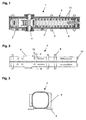
- the in Fig. 1 shown in longitudinal section door closer 1 has a housing 2 for receiving the piston 3, which cooperates with the shaft 4 and the spring 5.
- the shaft 4 is actuated in a known manner via an arranged between the door leaf and the shaft 4 of the door closer 1 linkage.
- the door closer 1 can by the energy stored in the spring 5, which pushes the piston 3 back to its original position, and via the shaft 4 and the rod guide the door back into its closed position.
- the housing 2 has an insert 7 'through which the housing 2 is reinforced.
- the insert 7 ' can be formed as a punched-bent part or stamped-stamped part, as in the FIGS. 2 and 3 is shown. However, it can also be produced with other manufacturing processes, such as internal high-pressure forming, whereby seamless inserts are possible. Other materials can be used which meet the respective requirements, like other plastics. It is advantageous that in case of plastic inserts made in the form of very complex designs can be produced inexpensively.
- projections 10 'and embossments for receiving valves or seals may be provided.
- the fasteners 6 for the housing 2 are likewise formed by tabs 8 formed on the insert part 7 '. This ensures that the attachment of the door closer 1 to a fire door can not melt even in heat, as could otherwise be the case with a mounting in plastic. Likewise, the piston 3 and the shaft 4 are held with their associated bearings in the insert 7 'of the housing 2 even after a melting of the plastic.
- An insert 7 'or a multi-part insert 7' designed as a punched-bent part or a punched-stamped part can be brought together into its final shape after the punching and bending process, wherein the insert part can be locked in meandering latching lugs. Another possibility is fixation by bending, crimping, riveting, screwing or other fastening and joining methods.
- the insert 7 'recesses 13 such as slots or holes, which improve circulation of the plastic around the insert or parts of the insert 7' around and the connection of the plastic with the insert, for example, the tabs 8 for fastening the door closer free can stay.
- the insert 7 ' may have a round cross section or a non-circular shape, as in Fig. 3 represented, z. B. have an approximately rectangular or polygonal shape. The edges can be rounded.
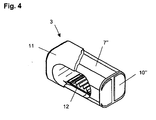
- the Indian Fig. 4 shown piston 3 has a shaping insert 7 "through which the piston 3 is reinforced.
- the insert 7 may be formed as a stamped and bent part, as shown in the Fig. 4 is shown. In this case, all required areas of the piston 3 are amplified. In order to support the spring force acting on the piston 3 by the spring 5, "bent extensions 10" are provided at right angles to the extension direction of the insert 7.
- the insert 7 can also be used with other manufacturing methods, as internal high-pressure forming processes, whereby seamless inserts are possible. Other materials can be used which meet the respective requirements, like other plastics. It is advantageous that in case of plastic inserts made in the form of very complex designs can be produced inexpensively.
- the insert 7 " has a toothing 12, which cooperates with the shaft 4.
- This toothing 12 can be integrally formed on the insertion part 7" or fixed as a separate part on the insertion part 7 ".
- projections 10 "and embossments may be provided, which are designed to receive valves and seals.
- An insert 7 "or a multi-part insert 7" designed as a punched-bent part can be brought together in its final shape after the punching and bending process, wherein the insert part can be locked in meandering latching lugs. Another possibility is fixation by bending, crimping, riveting, screwing or other fastening and joining methods.
- the insert 7 may have a round cross-section or a non-circular shape, as in Fig. 4 represented, z. B. have an approximately rectangular or polygonal shape. The edges can be rounded.
- the piston 3 also retains after a melting of the plastic in case of fire by the insert 7 "with the teeth 12 its supporting function.
Landscapes
- Power-Operated Mechanisms For Wings (AREA)
- Window Of Vehicle (AREA)
- Injection Moulding Of Plastics Or The Like (AREA)
- Seal Device For Vehicle (AREA)
- Lock And Its Accessories (AREA)
- Actuator (AREA)
- Closing And Opening Devices For Wings, And Checks For Wings (AREA)
Claims (30)
- Mécanisme d'entraînement (1) pour un battant d'une porte ou d'une fenêtre, comprenant un boîtier (2) avec un espace d'accueil pour supporter le mécanisme d'entraînement (1), comprenant un piston (3) sollicité par un ressort (5), lequel interagit avec un arbre (4) pour actionner le battant, et comprenant un liquide hydraulique pour l'amortissement, le mécanisme d'entraînement (1) appliquant la force pour le mouvement du battant, caractérisé en ce que le boîtier (2) se compose d'une pièce d'insertion (7') de façonnage et à effet indéformable dans toutes les zones nécessaires, l'épaisseur requise de la paroi du boîtier étant au moins dans certaines portions formée par une couche de protection intérieure et extérieure en matière plastique (11) appliquée sur la pièce d'insertion (7') et la pièce d'insertion (7') étant munie d'évidements (13) à travers lesquels la matière plastique peut s'écouler et le boîtier (2) conservant sa fonction de support grâce à la pièce d'insertion (7'), même après une fusion de la matière plastique en cas d'incendie.
- Mécanisme d'entraînement selon la revendication 1, caractérisé en ce que la pièce d'insertion (7') est façonnée d'une seule pièce.
- Mécanisme d'entraînement selon la revendication 1, caractérisé en ce que la pièce d'insertion (7') est fabriquée en métal.
- Mécanisme d'entraînement selon la revendication 3, caractérisé en ce que la pièce d'insertion (7') est fabriquée sous la forme d'une pièce estampée et pliée.
- Mécanisme d'entraînement selon la revendication 3, caractérisé en ce que la pièce d'insertion (7') est fabriquée avec un procédé de formage par haute pression intérieure.
- Mécanisme d'entraînement selon la revendication 1, caractérisé en ce que la pièce d'insertion (7') est injectée ou moulée en matière plastique.
- Mécanisme d'entraînement selon la revendication 1, caractérisé en ce que l'espace intérieur de la pièce d'insertion (7') est majoritairement recouvert de matière plastique.
- Mécanisme d'entraînement selon la revendication 1, caractérisé en ce que la pièce d'insertion (7') est majoritairement recouverte de matière plastique à l'extérieur.
- Mécanisme d'entraînement selon la revendication 1, caractérisé en ce que la pièce d'insertion (7') est majoritairement recouverte de matière plastique de tous les côtés.
- Mécanisme d'entraînement selon la revendication 1, caractérisé en ce que la pièce d'insertion (7') présente des moulages (8, 9, 10') qui absorbent les forces.
- Mécanisme d'entraînement selon la revendication 10, caractérisé en ce que les moulages sont réalisés sous la formé de languettes (8) destinées à fixer le ferme-porte automatique (1).
- Mécanisme d'entraînement selon la revendication 10, caractérisé en ce que les moulages sont réalisés sous la forme de prolongements (10') repliés sur lesquels peuvent prendre appui les forces d'entraînement qui agissent sur le boîtier (2).
- Mécanisme d'entraînement selon la revendication 10, caractérisé en ce que les moulages sont réalisés sous la forme de dômes (9) pour accueillir des paliers ou des guides.
- Mécanisme d'entraînement selon la revendication 3, caractérisé en ce que la pièce d'insertion (7') présente des cambrures de rigidification.
- Mécanisme d'entraînement selon la revendication 1, caractérisé en ce que la pièce d'insertion (7') est de forme ovalisée dans sa section transversale principale.
- Mécanisme d'entraînement (1) pour un battant d'une porte ou d'une fenêtre, comprenant un boîtier (2) avec un espace d'accueil pour supporter le mécanisme d'entraînement (1), comprenant un piston (3) sollicité par un ressort (5), et comprenant un liquide hydraulique pour l'amortissement, le mécanisme d'entraînement présentant un piston muni d'une denture qui interagit avec un arbre d'entraînement, caractérisé en ce que le piston (3) se compose d'une pièce d'insertion (7") de façonnage et à effet indéformable dans toutes les zones nécessaires, l'épaisseur requise de la paroi du piston étant au moins dans certaines portions formée par une couche de protection intérieure et extérieure en matière plastique (11) appliquée sur la pièce d'insertion (7") et la pièce d'insertion (7") étant munie d'évidements (13) à travers lesquels la matière, plastique peut s'écouler et le piston (3) conservant sa fonction de support grâce à la pièce d'insertion (7''), même après une fusion de la matière plastique en cas d'incendie.
- Mécanisme d'entraînement selon la revendication 16, caractérisé en ce que la pièce d'insertion (7'') est façonnée d'une seule pièce.
- Mécanisme d'entraînement selon la revendication 16, caractérisé en ce que la pièce d'insertion (7'') est fabriquée en métal.
- Mécanisme d'entraînement selon la revendication 18, caractérisé en ce que la pièce d'insertion (7'') est fabriquée sous la forme d'une pièce estampée et pliée.
- Mécanisme d'entraînement selon la revendication 18, caractérisé en ce que la pièce d'insertion (7") est fabriquée avec un procédé de formage par haute pression intérieure.
- mécanisme d'entraînement selon la revendication 16, caractérisé en ce que la pièce d'insertion (7'') est injectée ou moulée en matière plastique.
- Mécanisme d'entraînement selon la revendication 16, caractérisé en ce que l'espace intérieur de la pièce d'insertion (7'') est majoritairement recouvert de matière plastique.
- Mécanisme d'entraînement selon la revendication 16, caractérisé en ce que la pièce d'insertion (7") est majoritairement recouverte de matière plastique à l'extérieur.
- Mécanisme d'entraînement selon la revendication 16, caractérisé en ce que la pièce d'insertion (7") est majoritairement recouverte de matière plastique de tous les côtés.
- Mécanisme d'entraînement selon la revendication 16, caractérisé en ce que la pièce d'insertion (7'') présente des moulages (10'') pour absorber les forces qui agissent sur le piston (3).
- Mécanisme d'entraînement selon la revendication 25, caractérisé en ce que les moulages sont réalisés sous la forme de prolongements (10'') repliés.
- Mécanisme d'entraînement selon la revendication 18, caractérisé en ce que la pièce d'insertion (7") présente des cambrures de rigidification.
- Mécanisme d'entraînement selon la revendication 16, caractérisé en ce que la denture (12) est réalisée d'un seul tenant avec la pièce d'insertion (7'').
- Mécanisme d'entraînement selon la revendication 16, caractérisé en ce que la pièce d'insertion (7'') est de forme ovalisée dans sa section transversale principale.
- Mécanisme d'entraînement selon la revendication 1 et la revendication 16, caractérisé en ce qu'un mécanisme d'entraînement est réalisé avec le boîtier (2) et le piston (3).
Applications Claiming Priority (2)
| Application Number | Priority Date | Filing Date | Title |
|---|---|---|---|
| DE10259237A DE10259237B4 (de) | 2002-12-17 | 2002-12-17 | Antrieb für einen Flügel einer Tür oder eines Fensters |
| DE10259237 | 2002-12-17 |
Publications (3)
| Publication Number | Publication Date |
|---|---|
| EP1431494A2 EP1431494A2 (fr) | 2004-06-23 |
| EP1431494A3 EP1431494A3 (fr) | 2007-05-09 |
| EP1431494B1 true EP1431494B1 (fr) | 2010-02-10 |
Family
ID=32336440
Family Applications (1)
| Application Number | Title | Priority Date | Filing Date |
|---|---|---|---|
| EP03028806A Expired - Lifetime EP1431494B1 (fr) | 2002-12-17 | 2003-12-15 | Entrainement pour l'ouvrant d'une porte ou d'une fenêtre |
Country Status (5)
| Country | Link |
|---|---|
| EP (1) | EP1431494B1 (fr) |
| AT (1) | ATE457404T1 (fr) |
| DE (2) | DE10259237B4 (fr) |
| ES (1) | ES2337035T3 (fr) |
| PT (1) | PT1431494E (fr) |
Families Citing this family (9)
| Publication number | Priority date | Publication date | Assignee | Title |
|---|---|---|---|---|
| EP1705329A1 (fr) * | 2005-03-24 | 2006-09-27 | GEZE GmbH | Entraînement pour un panneau de porte ou de fenêtre |
| DE102008012555A1 (de) * | 2008-03-04 | 2009-09-10 | Eco Schulte Gmbh & Co. Kg | Kunststoffgleitschiene mit Verstärkungselement |
| DE202008008921U1 (de) * | 2008-07-03 | 2008-09-04 | Dorma Gmbh + Co. Kg | Kunststofftürschließer mit eingelegten Metallteilen |
| DE102010003384B4 (de) | 2010-03-29 | 2016-12-01 | Geze Gmbh | Verfahren zur Herstellung eines Kolbens eines Türantriebs |
| EP2993295A1 (fr) * | 2014-09-04 | 2016-03-09 | DORMA Deutschland GmbH | Opérateur de porte invisible |
| DE102017124034A1 (de) | 2017-10-16 | 2019-04-18 | Gretsch-Unitas GmbH Baubeschläge | Schließvorrichtung zum Schließen eines Tür- oder Fensterflügels |
| DE102019205989B4 (de) * | 2019-04-26 | 2024-02-15 | Zf Friedrichshafen Ag | Elektromechanischer Bremskraftverstärker |
| DE102020108623A1 (de) | 2020-03-27 | 2021-09-30 | Gretsch-Unitas GmbH Baubeschläge | Schließvorrichtung zum Schließen eines Tür- oder Fensterflügels |
| DE102023117812A1 (de) | 2023-07-06 | 2025-01-09 | Gretsch-Unitas GmbH Baubeschläge | Türschließer |
Family Cites Families (8)
| Publication number | Priority date | Publication date | Assignee | Title |
|---|---|---|---|---|
| DE3123554C2 (de) * | 1981-06-13 | 1984-03-22 | Webasto-Werk W. Baier GmbH & Co, 8035 Gauting | Flexible Kunststoff-Zahnstange |
| DE3303797C2 (de) * | 1983-02-04 | 1994-05-26 | Dieter Dipl Ing Dieckmann | Federndes Türband |
| US5478867A (en) | 1993-07-07 | 1995-12-26 | The Dow Chemical Company | Microporous isocyanate-based polymer compositions and method of preparation |
| WO1995020090A1 (fr) * | 1994-01-19 | 1995-07-27 | Gretsch-Unitas Gmbh | Systeme de fermeture de portes |
| DE19857297C1 (de) * | 1998-12-14 | 2000-07-06 | Dorma Gmbh & Co Kg | Türschließer |
| DE10014332C2 (de) * | 2000-03-24 | 2002-03-14 | Basf Ag | Verbundbauteil und Verfahren zur seiner Herstellung |
| DE20010423U1 (de) * | 2000-06-09 | 2001-10-11 | Gretsch-Unitas GmbH Baubeschläge, 71254 Ditzingen | Türschließer |
| DE10142756C1 (de) * | 2001-08-31 | 2003-05-28 | Geze Gmbh | Verfahren zur Herstellung einer Verzahnung für ein Getriebe und ein Türschließer mit nach dem Verfahren hergestellten Teilen |
-
2002
- 2002-12-17 DE DE10259237A patent/DE10259237B4/de not_active Withdrawn - After Issue
-
2003
- 2003-12-15 DE DE50312406T patent/DE50312406D1/de not_active Expired - Lifetime
- 2003-12-15 PT PT03028806T patent/PT1431494E/pt unknown
- 2003-12-15 EP EP03028806A patent/EP1431494B1/fr not_active Expired - Lifetime
- 2003-12-15 AT AT03028806T patent/ATE457404T1/de active
- 2003-12-15 ES ES03028806T patent/ES2337035T3/es not_active Expired - Lifetime
Also Published As
| Publication number | Publication date |
|---|---|
| PT1431494E (pt) | 2010-02-18 |
| ATE457404T1 (de) | 2010-02-15 |
| DE10259237B4 (de) | 2006-02-09 |
| EP1431494A3 (fr) | 2007-05-09 |
| EP1431494A2 (fr) | 2004-06-23 |
| DE50312406D1 (de) | 2010-03-25 |
| DE10259237A1 (de) | 2004-07-15 |
| ES2337035T3 (es) | 2010-04-20 |
Similar Documents
| Publication | Publication Date | Title |
|---|---|---|
| EP1042576B2 (fr) | Ferme-porte | |
| DE19857297C1 (de) | Türschließer | |
| EP0991867A1 (fr) | Soupape hydraulique, notamment pour assurer la commande d'un deplacement d'arbre a cames dans une automobile | |
| WO2015113929A1 (fr) | Mécanisme de commande pour véhicule automobile, en particulier pour siège de véhicule automobile | |
| DE19981942B4 (de) | Vakuumpumpe | |
| EP0757742B1 (fr) | Ferme-porte automatique et son procede de montage | |
| WO2024193756A1 (fr) | Dispositif de commande | |
| DE10259237B4 (de) | Antrieb für einen Flügel einer Tür oder eines Fensters | |
| DE3744274A1 (de) | Elektromotor, insbesondere elektrischer kleinmotor | |
| DE102005044103A1 (de) | Türfeststeller mit Haltergehäuse | |
| EP1293633B1 (fr) | Ferme-porte | |
| DE10064512A1 (de) | Schließleiste | |
| DE10142756C1 (de) | Verfahren zur Herstellung einer Verzahnung für ein Getriebe und ein Türschließer mit nach dem Verfahren hergestellten Teilen | |
| EP0740735B1 (fr) | Systeme de fermeture de portes | |
| DE9413039U1 (de) | Türschließer | |
| EP2458124B1 (fr) | Soupape pour un entraînement de porte ou de fenêtre | |
| DE10117573A1 (de) | Lageranordnung sowie Elektroantrieb mit einer solchen Lageranordnung | |
| DE19822498A1 (de) | Türantrieb | |
| EP3848614A1 (fr) | Chaîne de poussée rigide au glissement actionnable par un entraînement à chaîne | |
| DE19808292A1 (de) | Türschließer | |
| EP1619331B1 (fr) | Mécanisme d'entraînement pour une crémone | |
| DE102008030060B4 (de) | Dichtelement für einen Kolben eines Antriebs einer Tür oder dergl. | |
| EP2878751A1 (fr) | Dispositif de fermeture de porte | |
| DE102006038110A1 (de) | Türschließer | |
| DE102017201809B4 (de) | Antrieb für einen tür- oder fensterflügel |
Legal Events
| Date | Code | Title | Description |
|---|---|---|---|
| PUAI | Public reference made under article 153(3) epc to a published international application that has entered the european phase |
Free format text: ORIGINAL CODE: 0009012 |
|
| AK | Designated contracting states |
Kind code of ref document: A2 Designated state(s): AT BE BG CH CY CZ DE DK EE ES FI FR GB GR HU IE IT LI LU MC NL PT RO SE SI SK TR |
|
| AX | Request for extension of the european patent |
Extension state: AL LT LV MK |
|
| PUAL | Search report despatched |
Free format text: ORIGINAL CODE: 0009013 |
|
| AK | Designated contracting states |
Kind code of ref document: A3 Designated state(s): AT BE BG CH CY CZ DE DK EE ES FI FR GB GR HU IE IT LI LU MC NL PT RO SE SI SK TR |
|
| AX | Request for extension of the european patent |
Extension state: AL LT LV MK |
|
| 17P | Request for examination filed |
Effective date: 20071009 |
|
| 17Q | First examination report despatched |
Effective date: 20071107 |
|
| AKX | Designation fees paid |
Designated state(s): AT BE BG CH CY CZ DE DK EE ES FI FR GB GR HU IE IT LI LU MC NL PT RO SE SI SK TR |
|
| GRAP | Despatch of communication of intention to grant a patent |
Free format text: ORIGINAL CODE: EPIDOSNIGR1 |
|
| GRAS | Grant fee paid |
Free format text: ORIGINAL CODE: EPIDOSNIGR3 |
|
| GRAA | (expected) grant |
Free format text: ORIGINAL CODE: 0009210 |
|
| AK | Designated contracting states |
Kind code of ref document: B1 Designated state(s): AT BE BG CH CY CZ DE DK EE ES FI FR GB GR HU IE IT LI LU MC NL PT RO SE SI SK TR |
|
| REG | Reference to a national code |
Ref country code: GB Ref legal event code: FG4D Free format text: NOT ENGLISH |
|
| REG | Reference to a national code |
Ref country code: CH Ref legal event code: EP |
|
| REG | Reference to a national code |
Ref country code: PT Ref legal event code: SC4A Free format text: AVAILABILITY OF NATIONAL TRANSLATION Effective date: 20100211 |
|
| REG | Reference to a national code |
Ref country code: IE Ref legal event code: FG4D |
|
| REF | Corresponds to: |
Ref document number: 50312406 Country of ref document: DE Date of ref document: 20100325 Kind code of ref document: P |
|
| REG | Reference to a national code |
Ref country code: ES Ref legal event code: FG2A Ref document number: 2337035 Country of ref document: ES Kind code of ref document: T3 |
|
| REG | Reference to a national code |
Ref country code: SE Ref legal event code: TRGR |
|
| REG | Reference to a national code |
Ref country code: GR Ref legal event code: EP Ref document number: 20100401037 Country of ref document: GR |
|
| REG | Reference to a national code |
Ref country code: NL Ref legal event code: VDEP Effective date: 20100210 |
|
| PG25 | Lapsed in a contracting state [announced via postgrant information from national office to epo] |
Ref country code: SI Free format text: LAPSE BECAUSE OF FAILURE TO SUBMIT A TRANSLATION OF THE DESCRIPTION OR TO PAY THE FEE WITHIN THE PRESCRIBED TIME-LIMIT Effective date: 20100210 |
|
| REG | Reference to a national code |
Ref country code: IE Ref legal event code: FD4D |
|
| PG25 | Lapsed in a contracting state [announced via postgrant information from national office to epo] |
Ref country code: EE Free format text: LAPSE BECAUSE OF FAILURE TO SUBMIT A TRANSLATION OF THE DESCRIPTION OR TO PAY THE FEE WITHIN THE PRESCRIBED TIME-LIMIT Effective date: 20100210 Ref country code: RO Free format text: LAPSE BECAUSE OF FAILURE TO SUBMIT A TRANSLATION OF THE DESCRIPTION OR TO PAY THE FEE WITHIN THE PRESCRIBED TIME-LIMIT Effective date: 20100210 Ref country code: CY Free format text: LAPSE BECAUSE OF FAILURE TO SUBMIT A TRANSLATION OF THE DESCRIPTION OR TO PAY THE FEE WITHIN THE PRESCRIBED TIME-LIMIT Effective date: 20100210 Ref country code: IE Free format text: LAPSE BECAUSE OF FAILURE TO SUBMIT A TRANSLATION OF THE DESCRIPTION OR TO PAY THE FEE WITHIN THE PRESCRIBED TIME-LIMIT Effective date: 20100210 Ref country code: NL Free format text: LAPSE BECAUSE OF FAILURE TO SUBMIT A TRANSLATION OF THE DESCRIPTION OR TO PAY THE FEE WITHIN THE PRESCRIBED TIME-LIMIT Effective date: 20100210 |
|
| PG25 | Lapsed in a contracting state [announced via postgrant information from national office to epo] |
Ref country code: BG Free format text: LAPSE BECAUSE OF FAILURE TO SUBMIT A TRANSLATION OF THE DESCRIPTION OR TO PAY THE FEE WITHIN THE PRESCRIBED TIME-LIMIT Effective date: 20100510 Ref country code: SK Free format text: LAPSE BECAUSE OF FAILURE TO SUBMIT A TRANSLATION OF THE DESCRIPTION OR TO PAY THE FEE WITHIN THE PRESCRIBED TIME-LIMIT Effective date: 20100210 |
|
| PLBE | No opposition filed within time limit |
Free format text: ORIGINAL CODE: 0009261 |
|
| STAA | Information on the status of an ep patent application or granted ep patent |
Free format text: STATUS: NO OPPOSITION FILED WITHIN TIME LIMIT |
|
| 26N | No opposition filed |
Effective date: 20101111 |
|
| PG25 | Lapsed in a contracting state [announced via postgrant information from national office to epo] |
Ref country code: DK Free format text: LAPSE BECAUSE OF FAILURE TO SUBMIT A TRANSLATION OF THE DESCRIPTION OR TO PAY THE FEE WITHIN THE PRESCRIBED TIME-LIMIT Effective date: 20100210 |
|
| BERE | Be: lapsed |
Owner name: GEZE G.M.B.H. Effective date: 20101231 |
|
| PG25 | Lapsed in a contracting state [announced via postgrant information from national office to epo] |
Ref country code: MC Free format text: LAPSE BECAUSE OF NON-PAYMENT OF DUE FEES Effective date: 20101231 |
|
| PG25 | Lapsed in a contracting state [announced via postgrant information from national office to epo] |
Ref country code: BE Free format text: LAPSE BECAUSE OF NON-PAYMENT OF DUE FEES Effective date: 20101231 |
|
| PG25 | Lapsed in a contracting state [announced via postgrant information from national office to epo] |
Ref country code: LU Free format text: LAPSE BECAUSE OF NON-PAYMENT OF DUE FEES Effective date: 20101215 Ref country code: HU Free format text: LAPSE BECAUSE OF FAILURE TO SUBMIT A TRANSLATION OF THE DESCRIPTION OR TO PAY THE FEE WITHIN THE PRESCRIBED TIME-LIMIT Effective date: 20100811 |
|
| REG | Reference to a national code |
Ref country code: FR Ref legal event code: PLFP Year of fee payment: 13 |
|
| REG | Reference to a national code |
Ref country code: FR Ref legal event code: PLFP Year of fee payment: 14 |
|
| PGFP | Annual fee paid to national office [announced via postgrant information from national office to epo] |
Ref country code: FI Payment date: 20161213 Year of fee payment: 14 Ref country code: CH Payment date: 20161221 Year of fee payment: 14 Ref country code: GB Payment date: 20161222 Year of fee payment: 14 |
|
| PGFP | Annual fee paid to national office [announced via postgrant information from national office to epo] |
Ref country code: ES Payment date: 20161213 Year of fee payment: 14 Ref country code: SE Payment date: 20161221 Year of fee payment: 14 Ref country code: FR Payment date: 20161222 Year of fee payment: 14 Ref country code: GR Payment date: 20161221 Year of fee payment: 14 Ref country code: AT Payment date: 20161222 Year of fee payment: 14 |
|
| PGFP | Annual fee paid to national office [announced via postgrant information from national office to epo] |
Ref country code: IT Payment date: 20161223 Year of fee payment: 14 |
|
| PGFP | Annual fee paid to national office [announced via postgrant information from national office to epo] |
Ref country code: CZ Payment date: 20171213 Year of fee payment: 15 Ref country code: TR Payment date: 20171213 Year of fee payment: 15 |
|
| PGFP | Annual fee paid to national office [announced via postgrant information from national office to epo] |
Ref country code: PT Payment date: 20171215 Year of fee payment: 15 |
|
| PG25 | Lapsed in a contracting state [announced via postgrant information from national office to epo] |
Ref country code: FI Free format text: LAPSE BECAUSE OF NON-PAYMENT OF DUE FEES Effective date: 20171215 |
|
| REG | Reference to a national code |
Ref country code: CH Ref legal event code: PL |
|
| REG | Reference to a national code |
Ref country code: AT Ref legal event code: MM01 Ref document number: 457404 Country of ref document: AT Kind code of ref document: T Effective date: 20171215 |
|
| GBPC | Gb: european patent ceased through non-payment of renewal fee |
Effective date: 20171215 |
|
| PG25 | Lapsed in a contracting state [announced via postgrant information from national office to epo] |
Ref country code: SE Free format text: LAPSE BECAUSE OF NON-PAYMENT OF DUE FEES Effective date: 20171216 |
|
| REG | Reference to a national code |
Ref country code: FR Ref legal event code: ST Effective date: 20180831 |
|
| PG25 | Lapsed in a contracting state [announced via postgrant information from national office to epo] |
Ref country code: IT Free format text: LAPSE BECAUSE OF NON-PAYMENT OF DUE FEES Effective date: 20171215 Ref country code: FR Free format text: LAPSE BECAUSE OF NON-PAYMENT OF DUE FEES Effective date: 20180102 |
|
| PG25 | Lapsed in a contracting state [announced via postgrant information from national office to epo] |
Ref country code: GB Free format text: LAPSE BECAUSE OF NON-PAYMENT OF DUE FEES Effective date: 20171215 Ref country code: CH Free format text: LAPSE BECAUSE OF NON-PAYMENT OF DUE FEES Effective date: 20171231 Ref country code: LI Free format text: LAPSE BECAUSE OF NON-PAYMENT OF DUE FEES Effective date: 20171231 Ref country code: GR Free format text: LAPSE BECAUSE OF NON-PAYMENT OF DUE FEES Effective date: 20180705 Ref country code: AT Free format text: LAPSE BECAUSE OF NON-PAYMENT OF DUE FEES Effective date: 20171215 |
|
| REG | Reference to a national code |
Ref country code: ES Ref legal event code: FD2A Effective date: 20190703 |
|
| PG25 | Lapsed in a contracting state [announced via postgrant information from national office to epo] |
Ref country code: PT Free format text: LAPSE BECAUSE OF NON-PAYMENT OF DUE FEES Effective date: 20190617 Ref country code: CZ Free format text: LAPSE BECAUSE OF NON-PAYMENT OF DUE FEES Effective date: 20181215 Ref country code: ES Free format text: LAPSE BECAUSE OF NON-PAYMENT OF DUE FEES Effective date: 20171216 |
|
| PGFP | Annual fee paid to national office [announced via postgrant information from national office to epo] |
Ref country code: DE Payment date: 20211231 Year of fee payment: 19 |
|
| PG25 | Lapsed in a contracting state [announced via postgrant information from national office to epo] |
Ref country code: TR Free format text: LAPSE BECAUSE OF NON-PAYMENT OF DUE FEES Effective date: 20181215 |
|
| REG | Reference to a national code |
Ref country code: DE Ref legal event code: R119 Ref document number: 50312406 Country of ref document: DE |
|
| PG25 | Lapsed in a contracting state [announced via postgrant information from national office to epo] |
Ref country code: DE Free format text: LAPSE BECAUSE OF NON-PAYMENT OF DUE FEES Effective date: 20230701 |
|
| P01 | Opt-out of the competence of the unified patent court (upc) registered |
Free format text: CASE NUMBER: UPC_APP_117586/2023 Effective date: 20230510 |