EP1431917A2 - Vorrichtung zur Bewegungsschätzung mit paralleler Hardware zur Interpolation und Suche - Google Patents
Vorrichtung zur Bewegungsschätzung mit paralleler Hardware zur Interpolation und Suche Download PDFInfo
- Publication number
- EP1431917A2 EP1431917A2 EP03026210A EP03026210A EP1431917A2 EP 1431917 A2 EP1431917 A2 EP 1431917A2 EP 03026210 A EP03026210 A EP 03026210A EP 03026210 A EP03026210 A EP 03026210A EP 1431917 A2 EP1431917 A2 EP 1431917A2
- Authority
- EP
- European Patent Office
- Prior art keywords
- pixel resolution
- block
- region
- motion vector
- sub
- Prior art date
- Legal status (The legal status is an assumption and is not a legal conclusion. Google has not performed a legal analysis and makes no representation as to the accuracy of the status listed.)
- Ceased
Links
Images




Classifications
-
- H—ELECTRICITY
- H04—ELECTRIC COMMUNICATION TECHNIQUE
- H04N—PICTORIAL COMMUNICATION, e.g. TELEVISION
- H04N5/00—Details of television systems
- H04N5/14—Picture signal circuitry for video frequency region
- H04N5/144—Movement detection
- H04N5/145—Movement estimation
-
- G—PHYSICS
- G06—COMPUTING OR CALCULATING; COUNTING
- G06T—IMAGE DATA PROCESSING OR GENERATION, IN GENERAL
- G06T7/00—Image analysis
- G06T7/20—Analysis of motion
- G06T7/223—Analysis of motion using block-matching
-
- H—ELECTRICITY
- H04—ELECTRIC COMMUNICATION TECHNIQUE
- H04N—PICTORIAL COMMUNICATION, e.g. TELEVISION
- H04N19/00—Methods or arrangements for coding, decoding, compressing or decompressing digital video signals
- H04N19/42—Methods or arrangements for coding, decoding, compressing or decompressing digital video signals characterised by implementation details or hardware specially adapted for video compression or decompression, e.g. dedicated software implementation
- H04N19/43—Hardware specially adapted for motion estimation or compensation
-
- H—ELECTRICITY
- H04—ELECTRIC COMMUNICATION TECHNIQUE
- H04N—PICTORIAL COMMUNICATION, e.g. TELEVISION
- H04N19/00—Methods or arrangements for coding, decoding, compressing or decompressing digital video signals
- H04N19/50—Methods or arrangements for coding, decoding, compressing or decompressing digital video signals using predictive coding
- H04N19/503—Methods or arrangements for coding, decoding, compressing or decompressing digital video signals using predictive coding involving temporal prediction
- H04N19/51—Motion estimation or motion compensation
- H04N19/523—Motion estimation or motion compensation with sub-pixel accuracy
-
- H—ELECTRICITY
- H04—ELECTRIC COMMUNICATION TECHNIQUE
- H04N—PICTORIAL COMMUNICATION, e.g. TELEVISION
- H04N19/00—Methods or arrangements for coding, decoding, compressing or decompressing digital video signals
- H04N19/50—Methods or arrangements for coding, decoding, compressing or decompressing digital video signals using predictive coding
- H04N19/503—Methods or arrangements for coding, decoding, compressing or decompressing digital video signals using predictive coding involving temporal prediction
- H04N19/51—Motion estimation or motion compensation
- H04N19/533—Motion estimation using multistep search, e.g. two-dimensional [2D]-log search or one-at-a-time search [OTS]
-
- H—ELECTRICITY
- H04—ELECTRIC COMMUNICATION TECHNIQUE
- H04N—PICTORIAL COMMUNICATION, e.g. TELEVISION
- H04N19/00—Methods or arrangements for coding, decoding, compressing or decompressing digital video signals
- H04N19/50—Methods or arrangements for coding, decoding, compressing or decompressing digital video signals using predictive coding
- H04N19/503—Methods or arrangements for coding, decoding, compressing or decompressing digital video signals using predictive coding involving temporal prediction
- H04N19/51—Motion estimation or motion compensation
- H04N19/57—Motion estimation characterised by a search window with variable size or shape
-
- G—PHYSICS
- G06—COMPUTING OR CALCULATING; COUNTING
- G06T—IMAGE DATA PROCESSING OR GENERATION, IN GENERAL
- G06T2207/00—Indexing scheme for image analysis or image enhancement
- G06T2207/10—Image acquisition modality
- G06T2207/10016—Video; Image sequence
Definitions
- the present application may relate to co-pending application Serial No. 10/ , (Attorney docket number 02-5710/1496.00263) filed December 20, 2002, which is hereby incorporated by reference in its entirety.
- the present invention relates to motion estimation generally and, more particularly, to a motion estimation engine with parallel interpolation and search hardware.
- Compression of digital video data is performed for many applications, including but not limited to transmission over bandwidth constrained channels, such as satellite broadcasts, and storage on optical media.
- bandwidth constrained channels such as satellite broadcasts
- decoding decompressing
- MPEG-2 Motion Picture Expert Group
- H.264 a new, more efficient standard
- Part of the encoding process involves so-called motion compensation.
- an encoder fetches a block of data from an already transmitted reference frame, computes the difference between a to-be-encoded block and the block from the reference frame and compresses and transmits a difference.
- a decoder uses the same motion vector, fetches the same reference block, decompresses the difference information and adds the decompressed difference to the reference block.
- the H.264 standard employs sub-pixel motion vectors. Both components (i.e., horizontal and vertical) of a motion vector are given in quarter-pixel units.
- the encoder interpolates the reference frame to find the values in-between the actual integer pixels, computes the difference between a to-be-encoded block and the interpolated block from the reference frame, and compresses and transmits the difference.
- the decoder performs the same interpolation before adding the reference block and the decompressed difference.
- FIG. 1 an illustration of a conventional 8x8 block 20 within a frame of a video signal is shown.
- Pixels at integer positions within the block 20 i.e., integer pixels
- I Pixels at integer positions within the block 20
- Each pixel that lies on an integer position vertically but half way between two integer locations horizontally (i.e., H) is computed as a weighted sum of three integer pixels I in integer positions to the left and three integer pixels I in integer positions to the right.
- the pixels H are referred to as (1,1/2) pixels.
- Each pixel that lies on an integer position horizontally but half way between two integer locations vertically (i.e., V) is computed as a weighted sum of three integer pixels I in integer positions above and three integer pixels I in integer positions below.
- the pixels V are referred to as (1/2,1) pixels.
- Each pixel that lies half-way between integer pixels vertically and half-way between pixels horizontally i.e., T) is computed as either (i) a weighted sum of three (1,1/2) pixels above and three (1,1/2) pixels below or (ii) a weighted sum of three (1/2,1) pixels to the left and three (1/2,1) pixels to the right.
- Computation of the pixels V, H and T transforms the block 20 into a 16x16 pixel grid having a half-pixel resolution.
- Pixels on a quarter-pixel resolution grid (i.e., Q) having vertical and/or horizontal components that are not integer multiples of 1/2, are computed from the pixels I, H, V and T of the half-pixel resolution grid.
- a process for generating the pixels Q is fairly simple, involving a bi-linear interpolation process. In the bi-linear interpolation process, only the half-pixel grid neighbors are used to calculate the pixels Q.
- An exact approach for pixel Q generation depends on a position of the interpolated pixels Q relative to the integer pixels I. Details for quarter-pixel resolution interpolation can be found in the H.264 specification.
- a technique that the H.264 specification employs is to use long (i.e., 6-tap) filters for sub-pixel motion compensation.
- the sub-pixel interpolation process in accordance with H.264 can be very computationally intensive.
- a conventional encoder commonly employs one of the following two techniques for sub-pixel interpolation.
- a first technique each reference frame of the video signal is interpolated to quarter-pixel resolution and stored in a memory.
- the needed pixels I, H, V, T and Q are fetched from the memory. Therefore, motion compensation or motion estimation processes is computationally efficient because each sub-pixel position is computed only once.
- the first technique is conceptually simple and used in conventional software decoders. However, the first technique is not appropriate for a low-cost hardware decoder.
- the drawbacks of the first technique include (i) using a large amount of memory since each reference frame uses 16 times as much memory as is otherwise needed and (ii) a memory bandwidth used for motion estimation or motion compensation is greatly increased.
- the integer pixels I are fetched from the memory and the interpolated pixels H, V, T and Q are computed when a block is needed for motion compensation.
- the needed pixels are fetched and interpolation is performed "on-the-fly". That is, for each motion vector considered (i) the interpolated pixels are computed and then (ii) an error score, such as sum of absolute differences, is computed between the interpolated block and the to-be-encoded block. For all motion vectors considered, the motion vector with a smallest "error" is selected.
- the second technique works well for a simple sub-pixel interpolation scheme.
- MPEG-1 and MPEG-2 employ simple bi-linear sub-pixel interpolation, and only half-pixel, not quarter-pixel interpolation is used.
- Some conventional media processors employ the simple, serial, process of the second technique for computing error scores for sub-pixel motion vectors from the integer pixels I.
- special purpose hardware is used to compute 64 sub-pixel positions and an error score between those interpolated values and another block of 64 pixels.
- the second technique is very inefficient. Computing 64 sub-pixel positions is much more complicated and time consuming then computing the error between the interpolated pixels and other pixels. Therefore, the second technique can be slow and much of the time the "error" hardware will be idle, waiting for the "interpolation” hardware to complete.
- the present invention concerns a method for motion estimating.
- the method generally comprises the steps of (A) generating a first interpolated block having a sub-pixel resolution in response to a first interpolation process operating on a reference block of a reference frame of a video signal having an integer pixel resolution, (B) generating a motion vector in response to the first interpolated block and a current block of a current frame of the video signal having the integer pixel resolution and (C) generating a second interpolated block having the sub-pixel resolution in response to a second interpolation process operating on the reference block.
- the objects, features and advantages of the present invention include providing a motion estimation engine and/or method that may (i) occupy a small area, (ii) operate at low clock speed, (iii) provide fast encoding, (iv) provide fast decoding, (v) run software processes quickly and/or (vi) provide closed loop encoding.
- the present invention concerns multiple methods that may efficiently perform sub-pixel motion estimation.
- the approaches may be used independently or together.
- a first approach generally uses a simple interpolation process, such as using only bi-linear interpolation for motion estimation.
- a more complex, long-filter method may be used for motion compensation.
- Another approach generally performs an integer pixel search substantially simultaneously with an interpolation pipelines to a sub-pixel search. Variations on the approaches may also be implemented.
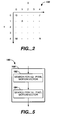
- the pixels may illustrate an interpolation in accordance with an embodiment of the present invention.
- Image information from four neighboring integer pixels e.g., G, J, M and N
- the interpolated pixel A may be at a horizontal distance (e.g., X), measured in quarter-pixel units, and a vertical distance (e.g., Y) from the integer pixel G.
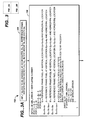
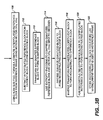
- the method 102 generally (i) finds motion vectors for a current block in a current frame with respect to a reference frame, (ii) compresses the current block using the motion vectors and (iii) reconstructs the current block for later use as a next reference frame.
- the reconstruction may be performed when compressing a sequence of frames.
- An encoder compressing another frame using the reconstructed frame as the reference frame will generally have a copy of the reconstructed frame that matches exactly the same frame constructed in a decoder.
- the encoder may be thus be referred to as a "closed loop" encoder.
- the method 102 generally begins by generating a coarse or integer motion vector (e.g., (Vy, Vx)) for an input or current block having a width (e.g., Bx) and a height (e.g., By) to be encoded at coordinates (e.g., (Ey, Ex)) of a current frame.
- the integer motion vector may be found by searching for the current block in a reference frame (e.g., step 104).
- a second search may then be conducted with an interpolation process generally being performed during the second search (e.g., step 106).
- the interpolation process may be implemented as a bi-linear interpolation process.
- the interpolation process may generate interpolated pixels on a quarter-pixel grid. Other interpolation processes may be implemented to meet a criteria of a particular application.
- the second search may determine a fine motion vector (e.g., (VVy, VVx) having the sub-pixel resolution.
- a region of the reference frame proximate the fine motion vector (VVy, VVx) may be interpolated a second time using a different interpolation process (e.g., step 108).
- the different or second interpolation process may be implemented in accordance with an H.264 standard. See, for example, document JVT-E022d7 entitled "Editor's Proposed Draft Text Modifications for Joint Video Specification (IUT-T Rec.
- the second interpolation process may generate an interpolated reference block that may form a basis for motion compensation.
- the interpolated reference block may be subtracted from the current block in the current frame to generate a difference block (e.g., step 110).
- the difference block may then be transformed and quantized (e.g., step 112) to generate a quantized block.
- Entropy encoding may be used to compress the quantized block and the fine motion vector (VVy, VVx) before storage in a medium or transmission to a decoder (e.g., step 114).
- the method 102 may also inverse quantize the quantized block to generate a reconstructed coefficient block (e.g., step 116).
- An inverse transform operation on the reconstructed coefficient block may generate a reconstructed difference block (e.g., step 118).
- the reconstructed difference block may be added to the interpolated reference block to generate a reconstructed block (e.g., step 120).
- the reconstructed block may be stored for future processing where the reconstructed block is generally used as a new reference block (e.g., block 122).
- the first method 102 may not always produce an absolute "best" motion vector. Therefore, the difference block as computed by the first method 102 may be somewhat larger than a difference between a theoretical block to which the "best" motion vector would refer and an actual block to be encoded. For example, an embodiment using the method 102 with bi-linear interpolation at an estimation stage (e.g., step 106) may experience a slight bit rate increase (e.g., 1%) to achieve a quality similar to an exact interpolation method.
- an encoder implementing the method 102 generally uses the exact same method as a decoder for motion compensation (e.g., step 108), there may be no error propagation induced by a less-then-ideal sub-pixel motion vector (VVy, VVx).
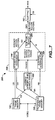
- the apparatus 140 may embody the first method 102.
- the apparatus 140 generally comprises a interpolator/motion estimator circuit 142, a current frame memory circuit 144, a motion estimator circuit 146, a reference frame memory circuit 148, a motion compensation interpolator circuit 150, a subtract circuit 152, a transform circuit 154, a quantization circuit 156, an encoder circuit 158, a inverse quantization circuit 160, an inverse transform circuit 162, an add circuit 164, and a reconstructed frame memory circuit 166.
- the current frame memory circuit 144 may be configured to store a current frame of a video signal (e.g., VIDEO) being encoded.
- the current block (e.g., CB) from the current frame may be presented to the motion estimator circuit 146, the interpolator/motion estimator circuit 142 and the subtract circuit 152.
- the reference frame memory circuit 148 may be configured to store a reference frame of the video signal.
- the reference frame memory circuit 148 may convey a region (e.g., RR) of the reference frame, overlapping and extending slightly beyond the current block CB, to the motion estimator circuit 146, the interpolator/motion estimator circuit 142 and the motion compensation interpolator circuit 150.
- the motion estimator circuit 146 may search for an integer-pixel motion vector between the current block CB and a reference block within the reference region RR producing a lowest error score (e.g., a best match to the current block CB).
- the motion estimator circuit 146 may present an integer-pixel motion vector (e.g., IMV) to the interpolator/motion estimator circuit 142.
- the interpolator/motion estimator circuit 142 may interpolate the region RR to a sub-pixel (e.g., quarter-pixel) resolution while searching for a better motion vector.
- the interpolator/motion estimator circuit 142 may present an updated motion vector (e.g., QMV) having the sub-pixel resolution to the motion compensation interpolator circuit 150 and the entropy encoder circuit 158.
- QMV updated motion vector
- the motion compensation interpolator circuit 150 may be configured to interpolate a current block size portion of the region RR about the quarter-pixel motion vector QMV into the sub-pixel resolution using a second interpolation process.
- the motion compensation interpolator circuit 150 may operate on the reference frame using a 6-tap horizontal and a 6-tap vertical interpolation. Other interpolation processes may be implemented to meet the criteria of a particular application.
- the motion compensation interpolator circuit 150 may present the interpolated region as a motion compensated block (e.g., MCB) to the subtract circuit 152 and the add circuit 164.
- a motion compensated block e.g., MCB
- the subtract circuit 152 may subtract the motion compensated block MCB from the current block CB to generate a difference block (e.g., DB).
- the transform circuit 154 may transform the difference block DB to generate a transformed block (e.g., TB).
- the quantization circuit 156 may quantize the transformed block TB to generate the quantized block (e.g., QB).
- the quantized block QB may be presented to the entropy encoder circuit 158 for encoding based on the quarter-pixel motion vector QMV and then transferred to a decoder and/or a storage medium as an encoded block (e.g., EB).
- Closed loop encoding may be provided by the inverse quantization circuit 160, the inverse transform circuit 162, the add circuit 164 and the reconstructed frame memory 166.
- the quantized block QB may be inverse quantized by the circuit 160 to generate another transformed block (e.g., TB').
- the inverse transform block 162 may convert the transformed block TB' into another difference block (e.g., DB').
- the add circuit 164 may add the motion compensated block MCB to the difference block DB' to generate a reconstructed current block (e.g., CB').
- the reconstructed current block CB' may be identical to the original current block CB.
- the reconstructed current block CB' is generally slightly different than the current block CB.
- the reconstructed current block CB' may be stored in the reconstructed frame memory circuit 166 as part of a reconstructed frame (e.g., RF).
- the encoder apparatus 140 may generate the reconstructed current block CB' in a manner identical, or at least very similar, to how the decoder reconstructs the encoded block EB.
- the reconstructed frame RF may be transferred to the reference frame memory 148 at a later time where the reconstructed frame FB may be used as a new reference frame to encode a new current frame.
- a flow diagram of a portion of a second method 180 of encoding is shown.
- the sub-pixel (e.g., quarter-pixel) motion vectors may be generated from intermediate-pixel (e.g., half-pixel) motion vectors in a two-step process.
- the second method 180 may be similar to the first method 102 with a two-element step 106' substituted for step 106.
- a first step e.g., step 182
- coordinates for the quarter-pixel motion vectors may be derived from the half-pixel vectors looking at VHY + (-1, 0, 1) and VHX + (-1, 0, 1) in quarter-pixel units.
- the steps 182 and 184 may be implemented in the interpolator/motion estimator circuit 142 of the apparatus 140.
- the second method 180 only 18 motion vectors may be evaluated (9 in the first step 182 and 9 in the second step 184), whereas for the first method 102, a total of 49 motion vectors may be evaluated (e.g., 7*7 possible positions).
- the second method 180 is generally faster than the first method 102, while the first method 102 may provide a slightly better compression and have a slightly less complicated form.
- a range from which to search for a selected integer motion vector may be identified, based on the current block at a coordinate (e.g., (Ey, Ex) in the current frame, and then narrowed or made smaller (e.g., step 192).
- the narrowed search range of the integer motion vectors may a rectangle.
- a horizontal component of the rectangle may be anywhere in a range (XMIN, XMAX) and the vertical component may be anywhere in a range (YMIN, YMAX).
- Several techniques may be implemented for narrowing the search range including, but not limited to, a hierarchical search. When a hierarchical search is used, decimated versions of the current frame and the reference frame may be used to find a small range over which an integer-level search may be performed.
- An integer-pixel motion vector search may then be performed (e.g., step 194) to determine a motion vector within the narrowed search rectangular range to generate the integer-pixel motion vector (Vy, Vx). While performing the integer level search step 194, all of the interpolated pixels that may be used to determine any sub-pixel motion vector within a region having a horizontal component in a range (XMIN-3/4, XMAX+3/4) and a vertical horizontal component in a range (YMIN-3/4, YMAX+3/4) may be computed (e.g., step 196). The integer-pixel motion vector search step 194 may be performed in parallel or substantially simultaneously with the interpolation calculation step 196.
- a search may be performed for all sub-pixel motion vectors with a horizontal component in a range (Vx-3/4, Vx+3/4), and a vertical horizontal component in a range (Vy-3/4, Vy+3/4) to adjust the integer-pixel motion vector into a final quarter-pixel motion vectors (e.g, step 198).
- the third method 190 may continue using the steps 108-122 (only step 108 shown for clarity) from the first method 102 to generate a encoded block EB and generate a reconstructed frame RF.
- the apparatus 200 generally comprises the current frame memory circuit 144, the reference frame memory circuit 148, a narrow integer-level search range circuit 202, a integer-pixel motion estimator circuit 146', an interpolator circuit 204 and a sub-pixel motion estimator circuit 206.
- the integer-pixel motion estimator circuit 146' of the apparatus 200 may be designed and/or operate similar to the integer-pixel motion estimator circuit 146 of the apparatus 140, but may search over a narrow range defined by a signal (e.g., RANGE).
- a signal e.g., RANGE
- the integer-pixel motion estimator circuit 146', the interpolator circuit 204 and the sub-pixel motion estimator circuit 206 may be logically and/or physically implemented a single circuit 208.
- the narrow integer-pixel level search range circuit 202 may receive the current block CB from the current frame and the region RR of the reference frame from the current frame memory circuit 144 and the reference frame memory circuit 148, respectively.
- the narrow integer-pixel level search range circuit 202 may determine the narrower range in which a search for a best integer-pixel motion vector IMV may be performed.
- the narrowed range may be presented in the signal RANGE to the integer-pixel motion estimator circuit 146' and to the interpolator circuit 204.
- the integer-pixel motion estimator circuit 146' may operate in parallel or substantially simultaneously with the interpolator circuit 204 to generate the integer-pixel motion vector IMV.
- the interpolator circuit 204 may generate an interpolated block (e.g., IB) from the region RR based on the narrowed range signal RANGE.
- the sub-pixel search circuit 206 may operate on the integer-pixel motion vector IMV and the interpolated block IB information to adjust or update the integer-pixel motion vector IMV into the sub-pixel motion vector QMV.
- the remainder of the apparatus 190 may comprise the circuits 152-166 (only circuit 152 shown for clarity) of the apparatus 140 to generate an encoded block EB and a reconstructed frame RF.
- the method shown in FIG. 6 and/or the apparatus shown in FIG. 8 generally differ from conventional methods and apparatus for motion estimation in at least two ways.
- a first different may be that in the present invention, the region to interpolate may be determined on the range in which the integer-pixel search is performed. Conventional methods either interpolate the entire image, or interpolate a part of the image based on the chosen integer motion vector.
- a second difference may be that in the present invention, the interpolation is generally performed in parallel with the integer-level search. The first difference may enable the second difference.
- Disadvantages for conventionally interpolating the entire reference image may exist.
- a conventional approach to interpolating the reference image on an as-needed basis will interpolate the pixels needed for the sub-pixel search based on the integer-level vector.
- the integer search must complete before the sub-pixel interpolation begins.
- a region based on the search range of the integer search may be interpolated, possibly computing some unnecessary pixels.
- the interpolation may be performed in parallel with the integer level search.
- the fourth method 210 may be similar to the third method 190 with the sub-pixel motion vector generation step 198 implementing a two-step approach (e.g., step 198').
- a first step an intermediate-pixel (e.g., half-pixel) motion vector search may be performed (e.g., step 212).
- a subsequent sub-pixel (e.g., quarter-pixel) motion vector search may be performed (e.g., step 214).
- the steps 212 and 214 may be implemented in the sub-pixel search circuit 206.
- integer-level motion vectors may be generate instead of a single integer-level motion vector.
- Each of the several integer-level motion vectors may be generated for a different block size among multiple block sizes identified within the reference frame.
- Computing the integer-level motion vectors may use a method described in co-pending application Serial No. 10/ , (Attorney docket number 02-5710/1496.00263) which is hereby incorporated by reference in its entirety.
- the interpolated pixels may be computed once for a largest block size (e.g., 16x16 pixels) and then used for all block sizes (e.g., 16x16, 16x8, 8x16, 8x8, 8x4, 4x8 and 4x4 pixels). Computing the interpolated pixels for a single block size is generally more efficient than computing the interpolated pixels for all block sizes.
- the present invention may interpolate a single region based on the integer-level search range and use the interpolated region for a number of block sizes because the integer-level searches for the different block sizes generally have the same search range (as described in the co-pending application).
- a conventional motion estimator that uses a selected integer-level motion vector to perform interpolation would need to interpolate separately for each block if the different blocks select different integer-level vectors.
- the fifth method 220 may be similar to the third method 190 with a variation (e.g., step 196') on the interpolation step 196.
- a variation e.g., step 196'
- values for only the pixels on a half-pixel grid are computed (e.g., step 222).
- Pixels on a quarter-pixel grid in a portion of the region being searched proximate or adjacent to the integer-pixel motion vector may then be interpolated on an as-needed basis while finding the best quarter-pixel motion vector QMV (e.g., step 224).
- the quarter-pixel motion vector search and interpolation to the quarter-pixel grid from the half-pixel grid may be accomplished efficiently at substantially the same time. Furthermore, by interpolating only to the half-pixel grid while finding the integer-level motion vector generally uses less intermediate memory (not shown) for the computations.
- the present invention may also be implemented by the preparation of optimized integrated silicon, ASICs, FPGAs, or by interconnecting an appropriate network of conventional component circuits, as is described herein, modifications of which will be readily apparent to those skilled in the art(s).
- the present invention thus may also include a computer product which may be a storage medium including instructions which may be used to program a computer to perform a process in accordance with the present invention.
- the storage medium may include, but is not limited to, any type of disk including floppy disk, optical disk, CD-ROM, and magneto-optical disks, ROMs, RAMs, EPROMs, EEPROMs, Flash memory, magnetic or optical cards, or any type of media suitable for storing electronic instructions.
- the term “simultaneously” is meant to describe events that share some common time period but the term is not meant to be limited to events that begin at the same point in time, end at the same point in time, or have the same duration.
Landscapes
- Engineering & Computer Science (AREA)
- Multimedia (AREA)
- Signal Processing (AREA)
- Computer Vision & Pattern Recognition (AREA)
- Physics & Mathematics (AREA)
- General Physics & Mathematics (AREA)
- Theoretical Computer Science (AREA)
- Compression Or Coding Systems Of Tv Signals (AREA)
- Image Processing (AREA)
- Control Of Indicators Other Than Cathode Ray Tubes (AREA)
- Television Systems (AREA)
Applications Claiming Priority (2)
| Application Number | Priority Date | Filing Date | Title |
|---|---|---|---|
| US10/325,188 US7408988B2 (en) | 2002-12-20 | 2002-12-20 | Motion estimation engine with parallel interpolation and search hardware |
| US325188 | 2002-12-20 |
Publications (2)
| Publication Number | Publication Date |
|---|---|
| EP1431917A2 true EP1431917A2 (de) | 2004-06-23 |
| EP1431917A3 EP1431917A3 (de) | 2010-11-10 |
Family
ID=32393092
Family Applications (1)
| Application Number | Title | Priority Date | Filing Date |
|---|---|---|---|
| EP03026210A Ceased EP1431917A3 (de) | 2002-12-20 | 2003-11-14 | Vorrichtung zur Bewegungsschätzung mit paralleler Hardware zur Interpolation und Suche |
Country Status (3)
| Country | Link |
|---|---|
| US (1) | US7408988B2 (de) |
| EP (1) | EP1431917A3 (de) |
| JP (2) | JP4444645B2 (de) |
Cited By (12)
| Publication number | Priority date | Publication date | Assignee | Title |
|---|---|---|---|---|
| EP1653744A1 (de) * | 2004-10-27 | 2006-05-03 | QUALCOMM Incorporated | Nicht-integer Pixelverteilung für Videokodierung |
| KR100926752B1 (ko) | 2007-12-17 | 2009-11-16 | 한국전자통신연구원 | 동영상 부호화를 위한 미세 움직임 추정 방법 및 장치 |
| WO2010045730A1 (en) * | 2008-10-24 | 2010-04-29 | Ati Technologies Ulc | Method, apparatus and software for determining motion vectors |
| WO2011090783A1 (en) * | 2010-01-19 | 2011-07-28 | Thomson Licensing | Methods and apparatus for reduced complexity template matching prediction for video encoding and decoding |
| WO2011128272A3 (en) * | 2010-04-13 | 2011-12-15 | Fraunhofer-Gesellschaft zur Förderung der angewandten Forschung e.V. | Hybrid video decoder, hybrid video encoder, data stream |
| US8194740B2 (en) | 2006-09-29 | 2012-06-05 | Electronics And Telecommunications Research Institute | Apparatus and method for compression-encoding moving picture |
| WO2012166600A1 (en) * | 2011-05-27 | 2012-12-06 | Cisco Technology, Inc. | Method, apparatus and computer program product for image motion prediction |
| EP2556488A4 (de) * | 2008-07-30 | 2014-01-22 | Cinnafilm Inc | Verfahren, vorrichtung und computersoftware zum modifizieren von beweglichen bildern über bewegungskompensationsvektoren, entkornung/entrauschung und superauflösung |
| WO2016186782A1 (en) * | 2015-05-19 | 2016-11-24 | Microsoft Technology Licensing, Llc | Video encoding and decoding |
| CN103098476B (zh) * | 2010-04-13 | 2016-11-30 | 弗劳恩霍夫应用研究促进协会 | 混合视频解码器、混合视频编码器及数据流 |
| CN108833916A (zh) * | 2018-06-20 | 2018-11-16 | 腾讯科技(深圳)有限公司 | 视频编码、解码方法、装置、存储介质和计算机设备 |
| CN113489985A (zh) * | 2021-05-26 | 2021-10-08 | 杭州博雅鸿图视频技术有限公司 | 一种分像素运动估计方法及估计系统 |
Families Citing this family (22)
| Publication number | Priority date | Publication date | Assignee | Title |
|---|---|---|---|---|
| NO319629B1 (no) * | 2003-11-28 | 2005-09-05 | Tandberg Telecom As | Fremgangsmate for korrigering av interpolerte pikselverdier |
| US7346109B2 (en) * | 2003-12-23 | 2008-03-18 | Genesis Microchip Inc. | Motion vector computation for video sequences |
| US7480334B2 (en) * | 2003-12-23 | 2009-01-20 | Genesis Microchip Inc. | Temporal motion vector filtering |
| US7499494B2 (en) * | 2003-12-23 | 2009-03-03 | Genesis Microchip Inc. | Vector selection decision for pixel interpolation |
| US7457438B2 (en) | 2003-12-23 | 2008-11-25 | Genesis Microchip Inc. | Robust camera pan vector estimation using iterative center of mass |
| US7505636B2 (en) * | 2004-03-04 | 2009-03-17 | Broadcom Corporation | System and method for two-pass interpolation for quarter-pel motion compensation |
| EP1578137A2 (de) * | 2004-03-17 | 2005-09-21 | Matsushita Electric Industrial Co., Ltd. | Videokodierungsgerät mit Interpolierungsverfahren bestehend aus mehreren Schritten |
| CN101088293A (zh) * | 2004-12-22 | 2007-12-12 | 皇家飞利浦电子股份有限公司 | 视频流修改器 |
| JP4736456B2 (ja) * | 2005-02-15 | 2011-07-27 | 株式会社日立製作所 | 走査線補間装置、映像表示装置、映像信号処理装置 |
| US20070199011A1 (en) * | 2006-02-17 | 2007-08-23 | Sony Corporation | System and method for high quality AVC encoding |
| US20070195888A1 (en) * | 2006-02-17 | 2007-08-23 | Via Technologies, Inc. | Intra-Frame Prediction Processing |
| US7912129B2 (en) * | 2006-03-16 | 2011-03-22 | Sony Corporation | Uni-modal based fast half-pel and fast quarter-pel refinement for video encoding |
| US8208553B2 (en) * | 2006-05-04 | 2012-06-26 | Altera Corporation | Methods and apparatus for quarter-pel refinement in a SIMD array processor |
| US8792556B2 (en) * | 2007-06-19 | 2014-07-29 | Samsung Electronics Co., Ltd. | System and method for correcting motion vectors in block matching motion estimation |
| US20090094173A1 (en) * | 2007-10-05 | 2009-04-09 | Adaptive Logic Control, Llc | Intelligent Power Unit, and Applications Thereof |
| JP2010016453A (ja) * | 2008-07-01 | 2010-01-21 | Sony Corp | 画像符号化装置および方法、画像復号装置および方法、並びにプログラム |
| US8811484B2 (en) * | 2008-07-07 | 2014-08-19 | Qualcomm Incorporated | Video encoding by filter selection |
| US9419620B2 (en) * | 2008-07-22 | 2016-08-16 | Nytell Software LLC | Field programmable object array and video compression processor for video data compression |
| US20120177119A1 (en) * | 2011-01-07 | 2012-07-12 | Sony Corporation | Faster motion estimation in an avc software encoder using general purpose graphic process units (gpgpu) |
| JP5803124B2 (ja) | 2011-02-10 | 2015-11-04 | セイコーエプソン株式会社 | ロボット、位置検出装置、位置検出プログラム、および位置検出方法 |
| WO2020182043A1 (en) * | 2019-03-08 | 2020-09-17 | Huawei Technologies Co., Ltd. | Search region for motion vector refinement |
| CN115037947B (zh) * | 2022-05-30 | 2025-12-30 | 北京百度网讯科技有限公司 | 视频编码方法、装置、电子设备和存储介质 |
Family Cites Families (17)
| Publication number | Priority date | Publication date | Assignee | Title |
|---|---|---|---|---|
| JPH03117991A (ja) * | 1989-09-29 | 1991-05-20 | Victor Co Of Japan Ltd | 動きベクトル符号化装置及び復号化装置 |
| US5235419A (en) * | 1991-10-24 | 1993-08-10 | General Instrument Corporation | Adaptive motion compensation using a plurality of motion compensators |
| JP2611591B2 (ja) * | 1991-10-31 | 1997-05-21 | 日本ビクター株式会社 | 動き補償装置 |
| US6965644B2 (en) * | 1992-02-19 | 2005-11-15 | 8×8, Inc. | Programmable architecture and methods for motion estimation |
| JP2636622B2 (ja) * | 1992-03-13 | 1997-07-30 | 松下電器産業株式会社 | ビデオ信号の符号化方法及び復号化方法ならびにビデオ信号の符号化装置及び復号化装置 |
| CA2091538A1 (en) * | 1993-03-11 | 1994-09-12 | Jan Fandrianto | Programmable architecture and methods for motion estimation |
| JPH07288819A (ja) * | 1994-04-19 | 1995-10-31 | Sony Corp | 動きベクトル検出装置 |
| JPH0993585A (ja) * | 1995-09-22 | 1997-04-04 | Sony Corp | 動きベクトル検出装置及び動きベクトル検出方法 |
| KR100226684B1 (ko) * | 1996-03-22 | 1999-10-15 | 전주범 | 반화소 움직임 추정장치 |
| JP3528115B2 (ja) * | 1996-05-07 | 2004-05-17 | 日本電気エンジニアリング株式会社 | 動き予測ベクトル検出回路 |
| US6560371B1 (en) * | 1997-12-31 | 2003-05-06 | Sarnoff Corporation | Apparatus and method for employing M-ary pyramids with N-scale tiling |
| US6310919B1 (en) * | 1998-05-07 | 2001-10-30 | Sarnoff Corporation | Method and apparatus for adaptively scaling motion vector information in an information stream decoder |
| US6421698B1 (en) * | 1998-11-04 | 2002-07-16 | Teleman Multimedia, Inc. | Multipurpose processor for motion estimation, pixel processing, and general processing |
| US6968008B1 (en) * | 1999-07-27 | 2005-11-22 | Sharp Laboratories Of America, Inc. | Methods for motion estimation with adaptive motion accuracy |
| DE10022331A1 (de) * | 2000-05-10 | 2001-11-15 | Bosch Gmbh Robert | Verfahren zur Transformationscodierung von Bewegtbildsequenzen |
| US6987866B2 (en) * | 2001-06-05 | 2006-01-17 | Micron Technology, Inc. | Multi-modal motion estimation for video sequences |
| US6950469B2 (en) * | 2001-09-17 | 2005-09-27 | Nokia Corporation | Method for sub-pixel value interpolation |
-
2002
- 2002-12-20 US US10/325,188 patent/US7408988B2/en not_active Expired - Lifetime
-
2003
- 2003-11-14 EP EP03026210A patent/EP1431917A3/de not_active Ceased
- 2003-12-22 JP JP2003425334A patent/JP4444645B2/ja not_active Expired - Fee Related
-
2009
- 2009-11-19 JP JP2009263923A patent/JP5021712B2/ja not_active Expired - Fee Related
Cited By (22)
| Publication number | Priority date | Publication date | Assignee | Title |
|---|---|---|---|---|
| KR100964515B1 (ko) * | 2004-10-27 | 2010-06-21 | 퀄컴 인코포레이티드 | 비디오 인코딩을 위한 비-정수 픽셀 공유 |
| EP1653744A1 (de) * | 2004-10-27 | 2006-05-03 | QUALCOMM Incorporated | Nicht-integer Pixelverteilung für Videokodierung |
| US8194740B2 (en) | 2006-09-29 | 2012-06-05 | Electronics And Telecommunications Research Institute | Apparatus and method for compression-encoding moving picture |
| KR100926752B1 (ko) | 2007-12-17 | 2009-11-16 | 한국전자통신연구원 | 동영상 부호화를 위한 미세 움직임 추정 방법 및 장치 |
| US8139643B2 (en) | 2007-12-17 | 2012-03-20 | Electronics And Telecommunications Research Institute | Motion estimation apparatus and method for moving picture coding |
| EP2556488A4 (de) * | 2008-07-30 | 2014-01-22 | Cinnafilm Inc | Verfahren, vorrichtung und computersoftware zum modifizieren von beweglichen bildern über bewegungskompensationsvektoren, entkornung/entrauschung und superauflösung |
| WO2010045730A1 (en) * | 2008-10-24 | 2010-04-29 | Ati Technologies Ulc | Method, apparatus and software for determining motion vectors |
| CN102257534A (zh) * | 2008-10-24 | 2011-11-23 | Ati技术无限责任公司 | 确定运动向量的方法、装置及软件 |
| CN102804774B (zh) * | 2010-01-19 | 2016-08-24 | 汤姆逊许可证公司 | 用于视频编解码的降低了复杂度的模板匹配预测方法和装置 |
| US9516341B2 (en) | 2010-01-19 | 2016-12-06 | Thomson Licensing | Methods and apparatus for reduced complexity template matching prediction for video encoding and decoding |
| US10349080B2 (en) | 2010-01-19 | 2019-07-09 | Interdigital Madison Patent Holdings | Methods and apparatus for reduced complexity template matching prediction for video encoding and decoding |
| CN102804774A (zh) * | 2010-01-19 | 2012-11-28 | 汤姆逊许可证公司 | 用于视频编解码的降低了复杂度的模板匹配预测方法和装置 |
| WO2011090783A1 (en) * | 2010-01-19 | 2011-07-28 | Thomson Licensing | Methods and apparatus for reduced complexity template matching prediction for video encoding and decoding |
| US9420305B2 (en) | 2010-04-13 | 2016-08-16 | Fraunhofer-Gesellschaft Zur Foerderung Der Angewandten Forschung E.V. | Hybrid video decoder, hybrid video encoder, data stream using a reference from a combination of IIR and FIR filters |
| WO2011128272A3 (en) * | 2010-04-13 | 2011-12-15 | Fraunhofer-Gesellschaft zur Förderung der angewandten Forschung e.V. | Hybrid video decoder, hybrid video encoder, data stream |
| CN103098476B (zh) * | 2010-04-13 | 2016-11-30 | 弗劳恩霍夫应用研究促进协会 | 混合视频解码器、混合视频编码器及数据流 |
| CN103098476A (zh) * | 2010-04-13 | 2013-05-08 | 弗兰霍菲尔运输应用研究公司 | 混合视频解码器、混合视频编码器及数据流 |
| US9143799B2 (en) | 2011-05-27 | 2015-09-22 | Cisco Technology, Inc. | Method, apparatus and computer program product for image motion prediction |
| WO2012166600A1 (en) * | 2011-05-27 | 2012-12-06 | Cisco Technology, Inc. | Method, apparatus and computer program product for image motion prediction |
| WO2016186782A1 (en) * | 2015-05-19 | 2016-11-24 | Microsoft Technology Licensing, Llc | Video encoding and decoding |
| CN108833916A (zh) * | 2018-06-20 | 2018-11-16 | 腾讯科技(深圳)有限公司 | 视频编码、解码方法、装置、存储介质和计算机设备 |
| CN113489985A (zh) * | 2021-05-26 | 2021-10-08 | 杭州博雅鸿图视频技术有限公司 | 一种分像素运动估计方法及估计系统 |
Also Published As
| Publication number | Publication date |
|---|---|
| JP4444645B2 (ja) | 2010-03-31 |
| US20040120401A1 (en) | 2004-06-24 |
| JP5021712B2 (ja) | 2012-09-12 |
| JP2004208320A (ja) | 2004-07-22 |
| EP1431917A3 (de) | 2010-11-10 |
| US7408988B2 (en) | 2008-08-05 |
| JP2010081634A (ja) | 2010-04-08 |
Similar Documents
| Publication | Publication Date | Title |
|---|---|---|
| US7408988B2 (en) | Motion estimation engine with parallel interpolation and search hardware | |
| US11856220B2 (en) | Reducing computational complexity when video encoding uses bi-predictively encoded frames | |
| US7170934B2 (en) | Method and/or apparatus for motion estimation using a hierarchical search followed by a computation split for different block sizes | |
| Nam et al. | A fast hierarchical motion vector estimation algorithm using mean pyramid | |
| KR100287211B1 (ko) | 양방향 움직임 추정방법 및 장치 | |
| US6414997B1 (en) | Hierarchical recursive motion estimator for video images encoder | |
| RU2251820C2 (ru) | Экстраполяция вектора движения для перекодировки видеопоследовательности | |
| US8160146B2 (en) | Video coding method and apparatus for calculating motion vectors of the vertices of a patch of an image and transmitting information of horizontal and vertical components of the motion vectors | |
| US5587741A (en) | Apparatus and method for detecting motion vectors to half-pixel accuracy | |
| US8498338B1 (en) | Mode decision using approximate ½ pel interpolation | |
| KR20010083717A (ko) | 움직임 추정 방법 및 장치 | |
| EP1413144A2 (de) | Verfahren und vorrichtung zur bewegungsschätzung mit sub-pixelgenauigkeit | |
| US20050123039A1 (en) | Motion estimation method for motion picture encoding and recording medium having program recorded thereon to implement the motion estimation method | |
| US8135224B2 (en) | Generating image data | |
| US20220264148A1 (en) | Sample Value Clipping on MIP Reduced Prediction | |
| US5907360A (en) | Coder/decoder for television image sub-band compatible coding, and its application to hierarchical motion coding by tree structures | |
| JP3700801B2 (ja) | 画像符号化装置および画像符号化方法 | |
| JP5011854B2 (ja) | 高解像度画像処理装置 | |
| KR0185841B1 (ko) | 영상 부호기에서의 움직임 추정 장치 | |
| KR100240620B1 (ko) | 양방향의 반화소 움직임 추정을 위한 대칭 탐색 윈도우를 형성하는 방법 및 장치 | |
| KR970010096B1 (ko) | 영상 데이타의 압축 부호화를 위한 두계층 움직임 추정장치 및 그 방법 | |
| KR100262962B1 (ko) | 움직임 추정방법 및 장치 | |
| KR100617177B1 (ko) | 움직임 추정 방법 | |
| CN113727107A (zh) | 视频解码方法和装置以及视频编码方法和装置 | |
| Ushashree et al. | Video Compression Based on RMB |
Legal Events
| Date | Code | Title | Description |
|---|---|---|---|
| PUAI | Public reference made under article 153(3) epc to a published international application that has entered the european phase |
Free format text: ORIGINAL CODE: 0009012 |
|
| 17P | Request for examination filed |
Effective date: 20031201 |
|
| AK | Designated contracting states |
Kind code of ref document: A2 Designated state(s): AT BE BG CH CY CZ DE DK EE ES FI FR GB GR HU IE IT LI LU MC NL PT RO SE SI SK TR |
|
| AX | Request for extension of the european patent |
Extension state: AL LT LV MK |
|
| PUAL | Search report despatched |
Free format text: ORIGINAL CODE: 0009013 |
|
| AK | Designated contracting states |
Kind code of ref document: A3 Designated state(s): AT BE BG CH CY CZ DE DK EE ES FI FR GB GR HU IE IT LI LU MC NL PT RO SE SI SK TR |
|
| AX | Request for extension of the european patent |
Extension state: AL LT LV MK |
|
| RIC1 | Information provided on ipc code assigned before grant |
Ipc: G06T 7/20 20060101ALI20101007BHEP Ipc: H04N 7/36 20060101ALI20101007BHEP Ipc: H04N 7/26 20060101AFI20101007BHEP |
|
| AKX | Designation fees paid |
Designated state(s): DE GB |
|
| 17Q | First examination report despatched |
Effective date: 20140321 |
|
| STAA | Information on the status of an ep patent application or granted ep patent |
Free format text: STATUS: THE APPLICATION HAS BEEN REFUSED |
|
| 18R | Application refused |
Effective date: 20150315 |