EP1433488A1 - Künstliches gelenkglied aus einem polymeren material - Google Patents
Künstliches gelenkglied aus einem polymeren material Download PDFInfo
- Publication number
- EP1433488A1 EP1433488A1 EP03705299A EP03705299A EP1433488A1 EP 1433488 A1 EP1433488 A1 EP 1433488A1 EP 03705299 A EP03705299 A EP 03705299A EP 03705299 A EP03705299 A EP 03705299A EP 1433488 A1 EP1433488 A1 EP 1433488A1
- Authority
- EP
- European Patent Office
- Prior art keywords
- artificial joint
- joint member
- phosphoryl choline
- cup
- polymer
- Prior art date
- Legal status (The legal status is an assumption and is not a legal conclusion. Google has not performed a legal analysis and makes no representation as to the accuracy of the status listed.)
- Granted
Links
Images


Classifications
-
- A—HUMAN NECESSITIES
- A61—MEDICAL OR VETERINARY SCIENCE; HYGIENE
- A61F—FILTERS IMPLANTABLE INTO BLOOD VESSELS; PROSTHESES; DEVICES PROVIDING PATENCY TO, OR PREVENTING COLLAPSING OF, TUBULAR STRUCTURES OF THE BODY, e.g. STENTS; ORTHOPAEDIC, NURSING OR CONTRACEPTIVE DEVICES; FOMENTATION; TREATMENT OR PROTECTION OF EYES OR EARS; BANDAGES, DRESSINGS OR ABSORBENT PADS; FIRST-AID KITS
- A61F2/00—Filters implantable into blood vessels; Prostheses, i.e. artificial substitutes or replacements for parts of the body; Appliances for connecting them with the body; Devices providing patency to, or preventing collapsing of, tubular structures of the body, e.g. stents
- A61F2/02—Prostheses implantable into the body
- A61F2/30—Joints
- A61F2/30767—Special external or bone-contacting surface, e.g. coating for improving bone ingrowth
-
- A—HUMAN NECESSITIES
- A61—MEDICAL OR VETERINARY SCIENCE; HYGIENE
- A61F—FILTERS IMPLANTABLE INTO BLOOD VESSELS; PROSTHESES; DEVICES PROVIDING PATENCY TO, OR PREVENTING COLLAPSING OF, TUBULAR STRUCTURES OF THE BODY, e.g. STENTS; ORTHOPAEDIC, NURSING OR CONTRACEPTIVE DEVICES; FOMENTATION; TREATMENT OR PROTECTION OF EYES OR EARS; BANDAGES, DRESSINGS OR ABSORBENT PADS; FIRST-AID KITS
- A61F2/00—Filters implantable into blood vessels; Prostheses, i.e. artificial substitutes or replacements for parts of the body; Appliances for connecting them with the body; Devices providing patency to, or preventing collapsing of, tubular structures of the body, e.g. stents
- A61F2/02—Prostheses implantable into the body
- A61F2/30—Joints
- A61F2/46—Special tools for implanting artificial joints
- A61F2/468—Testing instruments for artificial joints
-
- A—HUMAN NECESSITIES
- A61—MEDICAL OR VETERINARY SCIENCE; HYGIENE
- A61L—METHODS OR APPARATUS FOR STERILISING MATERIALS OR OBJECTS IN GENERAL; DISINFECTION, STERILISATION OR DEODORISATION OF AIR; CHEMICAL ASPECTS OF BANDAGES, DRESSINGS, ABSORBENT PADS OR SURGICAL ARTICLES; MATERIALS FOR BANDAGES, DRESSINGS, ABSORBENT PADS OR SURGICAL ARTICLES
- A61L27/00—Materials for grafts or prostheses or for coating grafts or prostheses
- A61L27/28—Materials for coating prostheses
- A61L27/34—Macromolecular materials
-
- A—HUMAN NECESSITIES
- A61—MEDICAL OR VETERINARY SCIENCE; HYGIENE
- A61L—METHODS OR APPARATUS FOR STERILISING MATERIALS OR OBJECTS IN GENERAL; DISINFECTION, STERILISATION OR DEODORISATION OF AIR; CHEMICAL ASPECTS OF BANDAGES, DRESSINGS, ABSORBENT PADS OR SURGICAL ARTICLES; MATERIALS FOR BANDAGES, DRESSINGS, ABSORBENT PADS OR SURGICAL ARTICLES
- A61L27/00—Materials for grafts or prostheses or for coating grafts or prostheses
- A61L27/50—Materials characterised by their function or physical properties, e.g. injectable or lubricating compositions, shape-memory materials, surface modified materials
-
- A—HUMAN NECESSITIES
- A61—MEDICAL OR VETERINARY SCIENCE; HYGIENE
- A61F—FILTERS IMPLANTABLE INTO BLOOD VESSELS; PROSTHESES; DEVICES PROVIDING PATENCY TO, OR PREVENTING COLLAPSING OF, TUBULAR STRUCTURES OF THE BODY, e.g. STENTS; ORTHOPAEDIC, NURSING OR CONTRACEPTIVE DEVICES; FOMENTATION; TREATMENT OR PROTECTION OF EYES OR EARS; BANDAGES, DRESSINGS OR ABSORBENT PADS; FIRST-AID KITS
- A61F2/00—Filters implantable into blood vessels; Prostheses, i.e. artificial substitutes or replacements for parts of the body; Appliances for connecting them with the body; Devices providing patency to, or preventing collapsing of, tubular structures of the body, e.g. stents
- A61F2/02—Prostheses implantable into the body
- A61F2/30—Joints
- A61F2/32—Joints for the hip
- A61F2/34—Acetabular cups
-
- A—HUMAN NECESSITIES
- A61—MEDICAL OR VETERINARY SCIENCE; HYGIENE
- A61F—FILTERS IMPLANTABLE INTO BLOOD VESSELS; PROSTHESES; DEVICES PROVIDING PATENCY TO, OR PREVENTING COLLAPSING OF, TUBULAR STRUCTURES OF THE BODY, e.g. STENTS; ORTHOPAEDIC, NURSING OR CONTRACEPTIVE DEVICES; FOMENTATION; TREATMENT OR PROTECTION OF EYES OR EARS; BANDAGES, DRESSINGS OR ABSORBENT PADS; FIRST-AID KITS
- A61F2/00—Filters implantable into blood vessels; Prostheses, i.e. artificial substitutes or replacements for parts of the body; Appliances for connecting them with the body; Devices providing patency to, or preventing collapsing of, tubular structures of the body, e.g. stents
- A61F2/02—Prostheses implantable into the body
- A61F2/30—Joints
- A61F2002/30001—Additional features of subject-matter classified in A61F2/28, A61F2/30 and subgroups thereof
- A61F2002/30667—Features concerning an interaction with the environment or a particular use of the prosthesis
- A61F2002/30673—Lubricating means, e.g. synovial pocket
-
- A—HUMAN NECESSITIES
- A61—MEDICAL OR VETERINARY SCIENCE; HYGIENE
- A61F—FILTERS IMPLANTABLE INTO BLOOD VESSELS; PROSTHESES; DEVICES PROVIDING PATENCY TO, OR PREVENTING COLLAPSING OF, TUBULAR STRUCTURES OF THE BODY, e.g. STENTS; ORTHOPAEDIC, NURSING OR CONTRACEPTIVE DEVICES; FOMENTATION; TREATMENT OR PROTECTION OF EYES OR EARS; BANDAGES, DRESSINGS OR ABSORBENT PADS; FIRST-AID KITS
- A61F2/00—Filters implantable into blood vessels; Prostheses, i.e. artificial substitutes or replacements for parts of the body; Appliances for connecting them with the body; Devices providing patency to, or preventing collapsing of, tubular structures of the body, e.g. stents
- A61F2/02—Prostheses implantable into the body
- A61F2/30—Joints
- A61F2002/30001—Additional features of subject-matter classified in A61F2/28, A61F2/30 and subgroups thereof
- A61F2002/30667—Features concerning an interaction with the environment or a particular use of the prosthesis
- A61F2002/30682—Means for preventing migration of particles released by the joint, e.g. wear debris or cement particles
- A61F2002/30685—Means for reducing or preventing the generation of wear particulates
-
- A—HUMAN NECESSITIES
- A61—MEDICAL OR VETERINARY SCIENCE; HYGIENE
- A61F—FILTERS IMPLANTABLE INTO BLOOD VESSELS; PROSTHESES; DEVICES PROVIDING PATENCY TO, OR PREVENTING COLLAPSING OF, TUBULAR STRUCTURES OF THE BODY, e.g. STENTS; ORTHOPAEDIC, NURSING OR CONTRACEPTIVE DEVICES; FOMENTATION; TREATMENT OR PROTECTION OF EYES OR EARS; BANDAGES, DRESSINGS OR ABSORBENT PADS; FIRST-AID KITS
- A61F2/00—Filters implantable into blood vessels; Prostheses, i.e. artificial substitutes or replacements for parts of the body; Appliances for connecting them with the body; Devices providing patency to, or preventing collapsing of, tubular structures of the body, e.g. stents
- A61F2/02—Prostheses implantable into the body
- A61F2/30—Joints
- A61F2/30767—Special external or bone-contacting surface, e.g. coating for improving bone ingrowth
- A61F2002/30934—Special articulating surfaces
-
- A—HUMAN NECESSITIES
- A61—MEDICAL OR VETERINARY SCIENCE; HYGIENE
- A61F—FILTERS IMPLANTABLE INTO BLOOD VESSELS; PROSTHESES; DEVICES PROVIDING PATENCY TO, OR PREVENTING COLLAPSING OF, TUBULAR STRUCTURES OF THE BODY, e.g. STENTS; ORTHOPAEDIC, NURSING OR CONTRACEPTIVE DEVICES; FOMENTATION; TREATMENT OR PROTECTION OF EYES OR EARS; BANDAGES, DRESSINGS OR ABSORBENT PADS; FIRST-AID KITS
- A61F2/00—Filters implantable into blood vessels; Prostheses, i.e. artificial substitutes or replacements for parts of the body; Appliances for connecting them with the body; Devices providing patency to, or preventing collapsing of, tubular structures of the body, e.g. stents
- A61F2/02—Prostheses implantable into the body
- A61F2/30—Joints
- A61F2/32—Joints for the hip
- A61F2/36—Femoral heads ; Femoral endoprostheses
- A61F2/3609—Femoral heads or necks; Connections of endoprosthetic heads or necks to endoprosthetic femoral shafts
- A61F2002/3611—Heads or epiphyseal parts of femur
-
- A—HUMAN NECESSITIES
- A61—MEDICAL OR VETERINARY SCIENCE; HYGIENE
- A61F—FILTERS IMPLANTABLE INTO BLOOD VESSELS; PROSTHESES; DEVICES PROVIDING PATENCY TO, OR PREVENTING COLLAPSING OF, TUBULAR STRUCTURES OF THE BODY, e.g. STENTS; ORTHOPAEDIC, NURSING OR CONTRACEPTIVE DEVICES; FOMENTATION; TREATMENT OR PROTECTION OF EYES OR EARS; BANDAGES, DRESSINGS OR ABSORBENT PADS; FIRST-AID KITS
- A61F2310/00—Prostheses classified in A61F2/28 or A61F2/30 - A61F2/44 being constructed from or coated with a particular material
- A61F2310/00005—The prosthesis being constructed from a particular material
- A61F2310/00011—Metals or alloys
- A61F2310/00017—Iron- or Fe-based alloys, e.g. stainless steel
-
- A—HUMAN NECESSITIES
- A61—MEDICAL OR VETERINARY SCIENCE; HYGIENE
- A61F—FILTERS IMPLANTABLE INTO BLOOD VESSELS; PROSTHESES; DEVICES PROVIDING PATENCY TO, OR PREVENTING COLLAPSING OF, TUBULAR STRUCTURES OF THE BODY, e.g. STENTS; ORTHOPAEDIC, NURSING OR CONTRACEPTIVE DEVICES; FOMENTATION; TREATMENT OR PROTECTION OF EYES OR EARS; BANDAGES, DRESSINGS OR ABSORBENT PADS; FIRST-AID KITS
- A61F2310/00—Prostheses classified in A61F2/28 or A61F2/30 - A61F2/44 being constructed from or coated with a particular material
- A61F2310/00005—The prosthesis being constructed from a particular material
- A61F2310/00011—Metals or alloys
- A61F2310/00029—Cobalt-based alloys, e.g. Co-Cr alloys or Vitallium
-
- A—HUMAN NECESSITIES
- A61—MEDICAL OR VETERINARY SCIENCE; HYGIENE
- A61F—FILTERS IMPLANTABLE INTO BLOOD VESSELS; PROSTHESES; DEVICES PROVIDING PATENCY TO, OR PREVENTING COLLAPSING OF, TUBULAR STRUCTURES OF THE BODY, e.g. STENTS; ORTHOPAEDIC, NURSING OR CONTRACEPTIVE DEVICES; FOMENTATION; TREATMENT OR PROTECTION OF EYES OR EARS; BANDAGES, DRESSINGS OR ABSORBENT PADS; FIRST-AID KITS
- A61F2310/00—Prostheses classified in A61F2/28 or A61F2/30 - A61F2/44 being constructed from or coated with a particular material
- A61F2310/00005—The prosthesis being constructed from a particular material
- A61F2310/00179—Ceramics or ceramic-like structures
- A61F2310/00185—Ceramics or ceramic-like structures based on metal oxides
- A61F2310/00203—Ceramics or ceramic-like structures based on metal oxides containing alumina or aluminium oxide
-
- A—HUMAN NECESSITIES
- A61—MEDICAL OR VETERINARY SCIENCE; HYGIENE
- A61F—FILTERS IMPLANTABLE INTO BLOOD VESSELS; PROSTHESES; DEVICES PROVIDING PATENCY TO, OR PREVENTING COLLAPSING OF, TUBULAR STRUCTURES OF THE BODY, e.g. STENTS; ORTHOPAEDIC, NURSING OR CONTRACEPTIVE DEVICES; FOMENTATION; TREATMENT OR PROTECTION OF EYES OR EARS; BANDAGES, DRESSINGS OR ABSORBENT PADS; FIRST-AID KITS
- A61F2310/00—Prostheses classified in A61F2/28 or A61F2/30 - A61F2/44 being constructed from or coated with a particular material
- A61F2310/00005—The prosthesis being constructed from a particular material
- A61F2310/00179—Ceramics or ceramic-like structures
- A61F2310/00185—Ceramics or ceramic-like structures based on metal oxides
- A61F2310/00239—Ceramics or ceramic-like structures based on metal oxides containing zirconia or zirconium oxide ZrO2
-
- A—HUMAN NECESSITIES
- A61—MEDICAL OR VETERINARY SCIENCE; HYGIENE
- A61L—METHODS OR APPARATUS FOR STERILISING MATERIALS OR OBJECTS IN GENERAL; DISINFECTION, STERILISATION OR DEODORISATION OF AIR; CHEMICAL ASPECTS OF BANDAGES, DRESSINGS, ABSORBENT PADS OR SURGICAL ARTICLES; MATERIALS FOR BANDAGES, DRESSINGS, ABSORBENT PADS OR SURGICAL ARTICLES
- A61L2430/00—Materials or treatment for tissue regeneration
- A61L2430/24—Materials or treatment for tissue regeneration for joint reconstruction
-
- B—PERFORMING OPERATIONS; TRANSPORTING
- B29—WORKING OF PLASTICS; WORKING OF SUBSTANCES IN A PLASTIC STATE IN GENERAL
- B29K—INDEXING SCHEME ASSOCIATED WITH SUBCLASSES B29B, B29C OR B29D, RELATING TO MOULDING MATERIALS OR TO MATERIALS FOR MOULDS, REINFORCEMENTS, FILLERS OR PREFORMED PARTS, e.g. INSERTS
- B29K2995/00—Properties of moulding materials, reinforcements, fillers, preformed parts or moulds
- B29K2995/0037—Other properties
- B29K2995/0087—Wear resistance
-
- B—PERFORMING OPERATIONS; TRANSPORTING
- B29—WORKING OF PLASTICS; WORKING OF SUBSTANCES IN A PLASTIC STATE IN GENERAL
- B29L—INDEXING SCHEME ASSOCIATED WITH SUBCLASS B29C, RELATING TO PARTICULAR ARTICLES
- B29L2031/00—Other particular articles
- B29L2031/753—Medical equipment; Accessories therefor
- B29L2031/7532—Artificial members, protheses
Definitions
- the present invention relates to an artificial joint member made of a polymeric material, and more particularly, to an artificial joint member which is made of a polymeric material and is capable of retaining a satisfactory lubricating state of a sliding part thereof for a long term.
- ciliary substance is arrayed on a sliding surface of an artificial joint member, so that body fluid serving as a lubricating liquid is retainable in the cilia-like substance to provide the sliding surface with a satisfactory lubricating state. It is, however, difficult to artificially create such a state, and it is furthermore difficult to retain such a satisfactory state for a long term. None of the artificial joints has accomplished such a satisfactory state.
- an artificial joint member such as a femoral ball and an acetabular cup.
- an artificial joint member such as a femoral ball and an acetabular cup.
- artificial joints each comprised of a metallic femoral ball using stainless steel, cobalt chromium alloy, titanium alloy, or the like and a polymeric acetabular cup using ultra high molecular weight polyethylene (hereinafter, simply called as "UHMW polyethylene”) or the like have been implanted in several ten thousand surgeries conducted in a year in Japan. Replacement with such artificial joints is beneficial in relieving patients from pain and releasing them from bedridden state, thus improving their quality of life to a level similar to that of healthy people.
- UHMW polyethylene ultra high molecular weight polyethylene
- (crosslink)polyethylene is a substance in which each molecule of UHMV polyethylene is rendered to a cross-linked state by irradiating a gamma ray or an electron beam onto the UHMW polyethylene.
- wear debris of such (crosslinked) polyethylene is reduced as low as 1/5 to 1/10 in quantity compared with that of ordinary UHMW polyethylene which has not been subjected to irradiation (Biomaterials, Vol. 20 (1999), pp. 1659-1688).
- practice of clinical application of (crosslinked) polyethylene is insufficient, and usability thereof has not been verified.
- the artificial joint comprised of the alumina femoral ball and the alumina acetabular cup may be broken during a surgery operation or in use after the surgery because the alumina is brittle, further improvement is desired to accomplish a successful practical use.
- the aforementioned hard materials are rigid with less elasticity, and do not exhibit cushionability like UHMW polyethylene. Such rigid materials are not desirable because they do not exhibit shock absorbing action to an external force, and a load is directly exerted to the bone.
- an object of the present invention to provide an artificial joint member made of a polymeric material which is capable of suppressing generation of wear debris under repeated use in daily life by suppressing friction at a sliding part thereof, and assuring long-term use by providing the artificial joint member with shock absorbability.
- An artificial joint member made of a polymeric material according to the present invention has a feature that a sliding surface of the artificial joint member composed of a polymeric substance is made of polymer having phosphoryl choline groups.
- Preferred examples of the inventive artificial joint member are Examples (1) and (2).
- Example (1) in which the phosphoryl choline group is bound to a polymeric substance by way of a (meth)acryloyloxyalkyl group.
- An example in which polymerizable monomer having the phosphoryl choline group is bound to the polymeric substance by graft bonding is chemically stable, and accordingly desirable.
- Example (2) in which a homopolymer or a copolymer of a phosphoryl-choline-containing compound is coated on the polymeric substance.
- a compound containing (meth)acryloyloxyalkyl phosphoryl choline is recommended as the phosphoryl-choline-containing compound.
- a preferred polymeric substance is UHMW polyethylene of one million or more molecular weight.
- a polymeric substance processed with crosslinking is desirable to secure excellent wear resistance.
- the present invention is also directed to an artificial joint incorporated with the inventive artificial joint member made of a polymeric material.
- polymeric substance indicates a base part of an artificial joint member
- polymeric material indicates the entirety of the artificial joint member including the “polymeric substance” and the “sliding surface of the artificial joint member composed of polymer having phosphoryl choline groups”.
- the inventors have made research and development, from various viewpoints, about modification of the surface of a polymeric substance used for an artificial joint member under the condition that a polymeric material having a superior shock absorbability to a hard material such as a metal is used for an artificial joint member, so that friction at a sliding part of the artincial joint member is minimized, and wear debris generated by friction is rendered inactive to cells in charge of immune function.
- a polymeric material having a superior shock absorbability to a hard material such as a metal is used for an artificial joint member, so that friction at a sliding part of the artincial joint member is minimized, and wear debris generated by friction is rendered inactive to cells in charge of immune function.
- the inventive artificial joint member made of a polymeric material is described in detail in the following.
- a biomembrane constituting a surface of a bone such as a joint in vivo is an assembly of phospholipid molecules with its surface substantially covered with phosphoryl choline groups microscopically (Kazuhiko ISHIHARA, Surgery VoL 61, p. 132 (1999)).
- forming a sliding surface of a femoral ball and/or an acetabular cup of an artificial joint made of a polymeric material, of a polymer having phosphoryl choline groups is advantageous in securing affinity with the lubricating liquid (body fluid) of a patient, which is beneficial in retaining the lubricating liquid and maintaining a desirable lubricating state, and resultantly remarkably reducing friction between the femoral ball and the acetabular cup.
- the compound having the phosphoryl choline group has a chemical structure similar to that of a cell constituting body tissue, the compound exhibits desirable biocompatibility without adversely affecting the human body even if wear debris is generated by friction between the femoral ball and the acetabular cup.
- the above effects of the present invention are obtained by forming the sliding surface of an artificial joint member made of a polymeric substance, of a polymer having phosphoryl choline groups.
- the chemical structure of the polymer having phosphoryl choline groups is not specifically limited. However, since a compound in which a phosphoryl choline group is chemically bound to a polymeric substance by way of a (meth)acryloyloxyalkyl group is chemically stable, and is easy to be synthesized by the below-mentioned polymerization method, use of the compound is desirable.
- Examples of the methods for yielding a structure in which a phosphoryl choline group is chemically bound to a polymeric substance by way of a (meth)acryloyloxyalkyl group are: a method for directly binding polymerizable monomer to a polymeric substance by graft polymerization; a method for synthesizing a reactive polymer having a phosphoryl choline group, followed by reaction with a polymeric substance; and a method for synthesizing a polymer having a cross-linkable phosphoryl choline group, followed by coating of the polymer onto a polymeric substance, and fixing the coated polymer on the polymeric substance by crosslink reaction.
- the method for binding polymerizable monomer having a phosphoryl choline group to a polymeric substance by graft polymerization is preferred because the surface of the polymeric substance can be modified without deteriorating the property of the polymeric substance such as rigidity, the bonded part can be chemically stabilized, and the lubricating liquid can be sufficiently retained in the phosphoryl choline groups by forming a multitude of phosphoryl choline groups on the sliding surface of the artificial joint member.
- Examples of the polymerizable monomer having a phosphoryl choline group are: 2-methacryloyloxyethyl phosphoryl choline, 2-acryloyloxyethyl phosphoryl choline, 4-methacryloyloxybutyl phosphoryl choline, 6-methacryloyloxyhexyl phosphoryl choline, ⁇ -methacryloyloxyethylene phosphoryl choline, and 4-styryloxybutyl phosphoryl choline.
- 2-methacryloyloxyethyl phosphoryl choline (hereinafter, sometimes called as "MPC") represented by the following chemical formula 1 is preferable because the compound consists of a phosphoryl choline group and a unit of polymerizable methacrylic acid and is advantageous in obtaining a polymer of high-molecular weight easily by radical polymerization (Ishihara et al.: Polymer Journal Vol. 22, p. 355 (1990)).
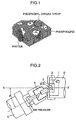
- MPC polymer polymer containing 2-methacryloyloxyethyl phosphoryl choline (hereinafter, sometimes called as "MPC polymer”) is bound to a polymeric substance to thereby form a multitude of phosphoryl choline groups on a sliding surface of an artificial joint member. Since the surface of the artificial joint member where the MPC polymer is formed exhibits a conformation analogous to a biomembrane, as shown in FIG. 1, this arrangement is desirable in suppressing friction against a counterpart member of the joint while sufficiently retaining the lubricating liquid and in minimiang reaction with components constituting a living organism or cells.
- the present invention embraces such a reaction that graft polymerization is conducted in co-existent with other vinyl compound to thereby yield a copolymer with a phosphoryl-choline-containing compound.
- the present invention includes an arrangement in which a homopolymer or a copolymer of a phosphoryl-choline-containing compound is coated on the polymeric substance, as an altered arrangement of the embodiment in which the sliding surface of the artificial joint member made of the polymeric substance is made of the polymer having phosphoryl choline groups.
- (meth)acryloyloxyalkyl phosphoryl choline which is an easily-polymerizable compound to yield a polymer, as the phosphoryl-choline-oontaining compound.
- Examples of (meth)acryloyloxyalkyl phosphoryl choline are: 2-methacryloyloxyethyl phosphoryl choline, 2-acryloyloxyethyl phosphoryl choline, 4-methacryloyloxybutyl phosphoryl choline, 6-methacryloyloxyhexyl phosphoryl choline, ⁇ -methacryloyloxyethylene phosphoryl choline, and 4-styryloxybutyl phosphoryl choline.
- 2-methacryloyloxyethyl phosphoryl choline showing satisfactory polymerization.
- the sliding part made of the polymer having phosphoryl choline groups is formed by preparing an agent in which a homopolymer of a phosphoryl-choline-containing compound, or a copolymer with a vinyl compound, methacrylic acid ester, acrylic acid ester, styrene derivative, or the like, specifically, a copolymer with butyl methacrylate, 2-ethylhexyl methacrylate, butyl acrylate, 2-ethylhexyl acrylate, styrene, or the like is dissolved in a solvent such as ethanol, propanol, or tetrahydrofurane, and by applying the agent on the surface of the polymeric substance by coating, immersion, or a like method.
- a solvent such as ethanol, propanol, or tetrahydrofurane
- the sliding surface of the artificial joint member made of the polymeric substance is made of the polymer having phosphoryl choline groups
- a blend/molding method comprising the steps of blending the phosphoryl-choline-containing compound with the polymeric substance such as UHMW polyethylene and molding the mixture into a sliding part, or a like method.
- UHMW polyethylene As a polymeric substance constituting a base part of the inventive artificial joint member.
- UHMW polyethylene of one million or more molecular weight, and more preferably of three millions or more molecular weight.
- crosslink processing It is desirable to use the polymeric substance applied with crosslink processing in view of securing excellent wear resistance.
- a known method for implementing crosslink processing is applicable. Examples of such a known method are irradiation by X-ray, gamma ray, or electron beam, and crosslinking by microwave or ultrasonic wave.
- either one of a femoral ball or an acetabular cup may serve as the inventive artificial joint member while the other one may serve as a member made of a metal such as stainless steel or cobalt chromium alloy, or ceramics such as alumina or zirconia, in addition to the arrangement in which both of a femoral ball and an acetabular cup serve as the inventive artificial joint member.
- a composite arrangement may be adopted in which merely the sliding part of an artificial joint member (a femoral ball and/or an acetabular cup) serves as the inventive artificial joint member, while the remaining part other than the sliding part is composed of a polymeric material other than the polymeric material constituting the inventive artificial joint member, the aforementioned metal, or ceramics.
- an artificial joint member a femoral ball and/or an acetabular cup
- a polymeric layer containing phosphoryl choline groups was formed on a surface of a UHMW polyethylene column member (cross section: 20mm ⁇ 20mm, length: 50mm) of a molecular weight from three millions to five millions according to the following process.
- the UHMW polyethylene column member was immersed in an acetone solution containing benzophenone (1.0g/dL) for 30 seconds, followed by immediate withdrawal from the solution and removal of the solvent at room temperature.
- the surface of the test sample with formation of the MPC polymer was examined with an X-ray photoelectron spectrometer. In the test, detection of a signal indicative of a nitrogen atom of 399eV and a signal indicative of a phosphorous atom of 133eV was judged as the presence of a phosphoryl choline group in the MPC on the surface of the test sample made of a polymeric material.
- a UHMW polyethylene column member (processed member) with formation of the MPC polymer, and a UHMW polyethylene column member (unprocessed member) without formation of the MPC polymer were used as test samples, and wettability of the respective test samples was evaluated. Wettability was examined by measuring a contact angle of a liquid droplet relative to the surface of the test sample by dropping one droplet (of about 30 mm 3 in volume) of the liquid shown in Table 1 onto the surface of the test sample. The results of the measurement are shown in Table 1.
- the processed column member with formation of the MPC polymer showed a remarkably small contact angle in every case of dropping the liquids, compared with the unprocessed column member without formation of the MPC polymer, thus proving that the processed member has a satisfactory wettability.
- Example II Each of the test samples obtained in a similar manner as Example I was pressed with an end of a metallic rod of 5mm in diameter having the composition shown in Table 2 with purified water interposing between the rod and the test sample as a lubricating liquid, a load corresponding to a surface pressure of 1N/cm 2 was exerted to the contact surface of the column member (test sample) and the metallic rod at a right angle to the contact surface, and a friction coefficient was calculated by sliding the metallic rod relative to the surface of the column member (test sample) at a velocity of 100mm/min.
- the results of the test are shown in Table 2.
- Kind of metal friction coefficient MPC polymer not-formed (unprocessed) MPC polymer formed (processed) brass (copper:zinc 6:4) 0.689 0.242 stainless steel 0.855 0.221
- the processed member with formation of the MPC polymer has a smaller fiction coefficient, and thus provides remarkably improved lubricability. It is conceived that such a superior lubricability is achieved because hydrophilicity is enhanced owning to the formation of the MPC polymeric layer corresponding to several layers of molecules on the surface of the artificial joint member, and the formation of the layer having a free-water content as high as about 90% in maximum on the surface of the artificial joint member.
- a test regarding friction by pivotal rotation was conducted with respect to an artificial joint model in which a UHMW polyethylene cup was used as an acetabular cup, and a stainless-steel ball was used as a femoral ball.
- FIG. 2 is a diagram showing an apparatus for measuring friction by pivotal rotation.
- the apparatus is constructed such that: a UHMW polyethylene cup 1 (molecular weight: three millions to five millions) formed with a hemispherical recess 2 having a diameter of 12.10 mm is mounted on a main shaft B which is freely rotated about a primary axis of rotation X-X; a spherical body 3 of a stainless steel (SUS316) having a diameter of 12.00 mm is mounted on a jig; and the spherical body 3 is pivotally and tiltingly rotated about an axis of its support shaft relative to the primary axis of rotation X-X by an arbitrary angle ⁇ in a state that the spherical body 3 is pressed against the recess 2 (inner wall) of the cup 1 by the force F owing to supply of an air pressure.
- a UHMW polyethylene cup 1 molecular weight: three millions to five millions
- the spherical body 3 is driven by a motor (not shown) whose rotating number per unit time is adjustable.
- An arm is mounted on the main shaft B to measure a friction torque under the condition that the main shaft B is forcibly about to be rotated by a frictional force accompanied by pivotal rotation of the spherical body 3.
- the surface roughness of the spherical body 3 is set at Ra0.02 ⁇ m.
- Two kinds of UHMW polyethylene cups 1 were used: one (processed cup) with the recess 2 being formed with MPC polymer as mentioned above, and the other (unprocessed cup) with the recess 2 not being formed with MPC polymer. The following experiments (i) through (iii) were conducted with use of the aforementioned apparatus.
- the UHMW polyethylene cup with formation of MPC polymer retained a low friction torque irrespective of the sliding number.
- the unprocessed UHMW polyethylene cup without formation of MPC polymer showed increase in friction torque from the sliding start time, as the number of rotations increased, and showed a tendency that the friction torque temporarily decreased after retaining a high friction torque state for a while. It is conceived that such a temporary reduction in friction torque seen in the unprocessed cup without formation of MPC polymer indicates that the cup reached a so-called constant wear zone, which is generally observed in a wear phenomenon, namely, the sliding surface of the cup was brought to a wear tolerable state.
- a test concerning wear by pivotal rotation was conducted with respect to artificial joint models each constructed by a pair of a crosslink-processed UHMW polyethylene cup as an acetabular cup, and a commercially available cobalt chromium alloy ball (diameter: 22 mm) as a femoral ball, and by a pair of a crosslink-unprocessed UHMW polyethylene cup as an acetabular cup, and a commercially available cobalt chromium alloy ball (diameter: 22 mm) as a femoral ball. Both of the crosslink-processed cup and the crosslink-unprocessed cup have been formed with MPC polymer according to the aforementioned process.
- the crosslink processing was conducted by irradiating a gamma ray of 5Mrad in intensity onto the UHMW polyethylene cup for 320 minutes.
- FIG. 5 is a schematic side view of the apparatus.
- a base plate was disposed tiltingly relative to a lower primary axis of rotation XI-XI by 45° , and a UHMW polyethylene cup 11 was fixed to the base plate.
- the quantity of wear debris of the cup 11 was measured by pivotally rotating a rotary shaft about a lower primary axis of rotation XIII-XIII while pressing a spherical body (acetabular ball) 12 against a recess of the cup 11.
- the spherical body 12 is pivotally mounted about an upper primary axis of rotation XII-XII.
- the pressing load was set at 2744N (280kgf), the cycle of rotations was 1 Hz, and a variation in load per cycle of rotations was in conformity with a walking curve of Poul.
- the wear test was conducted under the condition that the cup 11 and the spherical body 12 were immersed in bovine serum (25 mass%) of 37°C to evaluate wear resistance of the cup 11 in a state analogous to an in vivo state.
- bovine serum was replaced every 500,000 times of rotations.
- the wear test was conducted with respect to the crosslink-processed UHMW polyethylene cup 11 with formation of MPC polymer and the crosslink-unprocessed UHMW polyethylene cup 11 with formation of MPC polymer.
- the masses of the respective cups 11 were measured every 500,000 times of rotations.
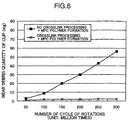
- the quantity of wear debris of each cup 11 was calculated based on a difference in the mass of the cup 11 between before and after the wear test. The results of calculation are shown in FIG. 6 as a relation between the number of cycle of rotations and the quantity of wear debris of the cup.
- use of the crosslink-processed UHMW polyethylene cup is effective in suppressing the quantity of wear debris of the cup to a sagnificantly low level even under a condition of such an extremely long sliding distance corresponding to a cycle of rotations of 3 million times of rotations.
- use of the crosslink-processed polymeric material for a base part of an artificial joint member is advabtageous in further reinforcing wear resistance established by formation of MPC polymer.
- the present invention has been constructed as mentioned above. According to the present invention, a satisfactory lubricating state is secured for a long term. As a result, provided is an artificial joint member having remarkably less wear and excellent shock absorbability. By using an artificial joint incorporated with the inventive artificial joint member, a patient can live his or her daily life with a similar quality of life as a healthy person for a long term.
Landscapes
- Health & Medical Sciences (AREA)
- Transplantation (AREA)
- Life Sciences & Earth Sciences (AREA)
- Veterinary Medicine (AREA)
- Oral & Maxillofacial Surgery (AREA)
- Public Health (AREA)
- General Health & Medical Sciences (AREA)
- Animal Behavior & Ethology (AREA)
- Orthopedic Medicine & Surgery (AREA)
- Biomedical Technology (AREA)
- Vascular Medicine (AREA)
- Heart & Thoracic Surgery (AREA)
- Engineering & Computer Science (AREA)
- Cardiology (AREA)
- Chemical & Material Sciences (AREA)
- Dermatology (AREA)
- Medicinal Chemistry (AREA)
- Epidemiology (AREA)
- Physical Education & Sports Medicine (AREA)
- Prostheses (AREA)
- Materials For Medical Uses (AREA)
Applications Claiming Priority (3)
| Application Number | Priority Date | Filing Date | Title |
|---|---|---|---|
| JP2002042272 | 2002-02-19 | ||
| JP2002042272 | 2002-02-19 | ||
| PCT/JP2003/001750 WO2003070289A1 (en) | 2002-02-19 | 2003-02-19 | Artificial joint member made of polymeric material |
Publications (3)
| Publication Number | Publication Date |
|---|---|
| EP1433488A1 true EP1433488A1 (de) | 2004-06-30 |
| EP1433488A4 EP1433488A4 (de) | 2008-02-06 |
| EP1433488B1 EP1433488B1 (de) | 2010-11-03 |
Family
ID=27750491
Family Applications (1)
| Application Number | Title | Priority Date | Filing Date |
|---|---|---|---|
| EP03705299A Expired - Lifetime EP1433488B1 (de) | 2002-02-19 | 2003-02-19 | Künstliches gelenkglied aus einem polymeren material |
Country Status (7)
| Country | Link |
|---|---|
| US (1) | US7785372B2 (de) |
| EP (1) | EP1433488B1 (de) |
| CN (1) | CN100566762C (de) |
| AT (1) | ATE486619T1 (de) |
| AU (1) | AU2003211465A1 (de) |
| DE (1) | DE60334767D1 (de) |
| WO (1) | WO2003070289A1 (de) |
Cited By (3)
| Publication number | Priority date | Publication date | Assignee | Title |
|---|---|---|---|---|
| WO2007091521A1 (ja) * | 2006-02-06 | 2007-08-16 | Japan Medical Materials Corporation | 低摩耗性摺動部材及びそれを用いた人工関節 |
| EP2468311A4 (de) * | 2009-08-20 | 2014-06-25 | Japan Medical Materials Corp | In hohem masse schmierfähiges gleitelement und künstliches gelenk damit |
| US9132209B2 (en) | 2010-05-07 | 2015-09-15 | Howmedia Osteonics Corp. | Surface crosslinked polyethylene |
Families Citing this family (39)
| Publication number | Priority date | Publication date | Assignee | Title |
|---|---|---|---|---|
| US20020120340A1 (en) | 2001-02-23 | 2002-08-29 | Metzger Robert G. | Knee joint prosthesis |
| US7497874B1 (en) | 2001-02-23 | 2009-03-03 | Biomet Manufacturing Corp. | Knee joint prosthesis |
| EP1434607A1 (de) * | 2001-10-11 | 2004-07-07 | Straumann Holding AG | Osteophile implantate |
| US20110097277A1 (en) | 2005-08-25 | 2011-04-28 | University Of Washington | Particles coated with zwitterionic polymers |
| JP4963838B2 (ja) * | 2006-02-06 | 2012-06-27 | 京セラメディカル株式会社 | 低摩耗性摺動部材及びそれを用いた人工関節 |
| JP5028080B2 (ja) * | 2006-12-15 | 2012-09-19 | 京セラメディカル株式会社 | 低摩耗性摺動部材及びそれを用いた人工関節 |
| JP5100023B2 (ja) * | 2006-03-29 | 2012-12-19 | 京セラメディカル株式会社 | 生体材料、及びそれを用いた人工関節並びにその製造方法 |
| US7812098B2 (en) * | 2006-03-31 | 2010-10-12 | Depuy Products, Inc. | Bearing material of medical implant having reduced wear rate and method for reducing wear rate |
| ES2350708T3 (es) * | 2006-08-25 | 2011-01-26 | Depuy Products, Inc. | Material de soporte de implante médico. |
| US8562616B2 (en) | 2007-10-10 | 2013-10-22 | Biomet Manufacturing, Llc | Knee joint prosthesis system and method for implantation |
| US8328873B2 (en) | 2007-01-10 | 2012-12-11 | Biomet Manufacturing Corp. | Knee joint prosthesis system and method for implantation |
| WO2008118247A1 (en) | 2007-01-10 | 2008-10-02 | Biomet Manufacturing Corp. | Knee joint prosthesis system and method for implantation |
| US8163028B2 (en) | 2007-01-10 | 2012-04-24 | Biomet Manufacturing Corp. | Knee joint prosthesis system and method for implantation |
| US8187280B2 (en) | 2007-10-10 | 2012-05-29 | Biomet Manufacturing Corp. | Knee joint prosthesis system and method for implantation |
| US9192694B2 (en) | 2007-10-03 | 2015-11-24 | Kyocera Medical Corporation | Biocompatible and low-abrasion member, and artificial joint using the same and method of producing the same |
| WO2010058848A1 (ja) | 2008-11-21 | 2010-05-27 | 日本メディカルマテリアル株式会社 | グラフト重合方法およびその生成物 |
| US8765265B2 (en) | 2008-12-25 | 2014-07-01 | Kyocera Medical Corporation | Polymer sliding material, artificial joint member, medical appliance, and manufacturing method therefor |
| CA2706233C (en) | 2009-06-04 | 2015-05-05 | Howmedica Osteonics Corp. | Orthopedic peek-on-polymer bearings |
| GB0922339D0 (en) | 2009-12-21 | 2010-02-03 | Mcminn Derek J W | Acetabular cup prothesis and introducer thereof |
| CN102078227A (zh) * | 2010-11-24 | 2011-06-01 | 南京理工大学 | 改善生物相容性与摩擦学性能的聚乙烯人工关节及其制备方法 |
| JP2014531989A (ja) | 2011-08-05 | 2014-12-04 | マサチューセッツ インスティテュート オブ テクノロジー | 液体含浸表面、作製方法、およびそれらを組み込んだデバイス |
| US20140303737A1 (en) | 2011-11-08 | 2014-10-09 | Danmarks Tekniske Universitet | Pharmaceutical compositions comprising lubricants for preventing or reducing aseptic loosening in a subject |
| CN104349984A (zh) | 2012-03-23 | 2015-02-11 | 麻省理工学院 | 用于食品包装和食品加工设备的自润滑表面 |
| WO2013141953A2 (en) | 2012-03-23 | 2013-09-26 | Massachusetts Institute Of Technology | Liquid-encapsulated rare-earth based ceramic surfaces |
| JP6133017B2 (ja) * | 2012-04-27 | 2017-05-24 | 京セラメディカル株式会社 | 膜製造装置及び人工関節コンポーネントの製造方法 |
| US20130337027A1 (en) | 2012-05-24 | 2013-12-19 | Massachusetts Institute Of Technology | Medical Devices and Implements with Liquid-Impregnated Surfaces |
| US9625075B2 (en) | 2012-05-24 | 2017-04-18 | Massachusetts Institute Of Technology | Apparatus with a liquid-impregnated surface to facilitate material conveyance |
| WO2013180228A1 (ja) * | 2012-05-31 | 2013-12-05 | 京セラメディカル株式会社 | 摺動材料およびその製造方法 |
| JP2015525132A (ja) | 2012-06-13 | 2015-09-03 | マサチューセッツ インスティテュート オブ テクノロジー | 表面上の液体を浮上させるための物品および方法ならびにそれを組み入れたデバイス |
| US20140178611A1 (en) | 2012-11-19 | 2014-06-26 | Massachusetts Institute Of Technology | Apparatus and methods employing liquid-impregnated surfaces |
| CN105188967B (zh) | 2012-11-19 | 2021-07-09 | 麻省理工学院 | 采用液体浸渍表面的装置和方法 |
| US9585757B2 (en) | 2013-09-03 | 2017-03-07 | Massachusetts Institute Of Technology | Orthopaedic joints providing enhanced lubricity |
| JP6292815B2 (ja) * | 2013-10-10 | 2018-03-14 | 京セラ株式会社 | 抗酸化性人工補綴部材 |
| JP6826655B2 (ja) | 2017-03-21 | 2021-02-03 | 京セラ株式会社 | 樹脂成形体の製造方法 |
| CN107474160B (zh) * | 2017-08-10 | 2019-05-28 | 山东师范大学 | 一种磷酰胆碱基聚乙二醇改性壳聚糖及其制备方法 |
| CN110251736B (zh) * | 2019-06-28 | 2022-02-18 | 南京理工大学 | 两性离子聚合物刷润滑剂及其制备方法 |
| JP6896241B2 (ja) * | 2019-12-11 | 2021-06-30 | ケイセイ医科工業株式会社 | 医療用縫合糸 |
| JP7499032B2 (ja) * | 2020-01-16 | 2024-06-13 | 京セラ株式会社 | 人工関節用摺動部材の製造方法および人工関節用摺動部材 |
| CN114209473A (zh) * | 2021-11-22 | 2022-03-22 | 苏州微创关节医疗科技有限公司 | 关节摩擦副及关节假体 |
Family Cites Families (13)
| Publication number | Priority date | Publication date | Assignee | Title |
|---|---|---|---|---|
| US6387379B1 (en) * | 1987-04-10 | 2002-05-14 | University Of Florida | Biofunctional surface modified ocular implants, surgical instruments, medical devices, prostheses, contact lenses and the like |
| US4961954A (en) * | 1987-04-10 | 1990-10-09 | University Of Florida | Surface modified surgical instruments, devices, implants, contact lenses and the like |
| EP0519087B1 (de) * | 1991-05-21 | 1997-04-23 | Hewlett-Packard GmbH | Verfahren zur Vorbehandlung der Oberfläche eines medizinischen Artikels |
| JPH05220218A (ja) * | 1992-02-13 | 1993-08-31 | Norio Nakabayashi | 抗血栓性再生セルロース系膜及びその製造方法 |
| JP3308010B2 (ja) * | 1992-12-15 | 2002-07-29 | ポーラ化成工業株式会社 | 被膜安定化リポソーム及びその製造方法 |
| CA2166450C (en) | 1995-01-20 | 2008-03-25 | Ronald Salovey | Chemically crosslinked ultrahigh molecular weight polyethylene for artificial human joints |
| GB9522332D0 (en) * | 1995-11-01 | 1996-01-03 | Biocompatibles Ltd | Braided stent |
| US6005160A (en) * | 1996-02-22 | 1999-12-21 | National Science Council | Heterobifunctional membrane in application of artificial cornea |
| US6228900B1 (en) * | 1996-07-09 | 2001-05-08 | The Orthopaedic Hospital And University Of Southern California | Crosslinking of polyethylene for low wear using radiation and thermal treatments |
| US6258371B1 (en) * | 1998-04-03 | 2001-07-10 | Medtronic Inc | Method for making biocompatible medical article |
| JPH11318960A (ja) | 1998-05-12 | 1999-11-24 | Nissin Electric Co Ltd | 人工関節及びその製造方法 |
| ATE346873T1 (de) * | 1999-07-14 | 2006-12-15 | Nof Corp | Statistisches copolymer, verfahren zu dessen herstellung und medizinisches material |
| WO2001007097A1 (fr) | 1999-07-28 | 2001-02-01 | Nof Corporation | Substances medicales et leur procede d'obtention |
-
2003
- 2003-02-19 AT AT03705299T patent/ATE486619T1/de not_active IP Right Cessation
- 2003-02-19 CN CNB038010879A patent/CN100566762C/zh not_active Expired - Lifetime
- 2003-02-19 US US10/489,112 patent/US7785372B2/en not_active Expired - Lifetime
- 2003-02-19 EP EP03705299A patent/EP1433488B1/de not_active Expired - Lifetime
- 2003-02-19 AU AU2003211465A patent/AU2003211465A1/en not_active Abandoned
- 2003-02-19 DE DE60334767T patent/DE60334767D1/de not_active Expired - Lifetime
- 2003-02-19 WO PCT/JP2003/001750 patent/WO2003070289A1/ja not_active Ceased
Cited By (7)
| Publication number | Priority date | Publication date | Assignee | Title |
|---|---|---|---|---|
| WO2007091521A1 (ja) * | 2006-02-06 | 2007-08-16 | Japan Medical Materials Corporation | 低摩耗性摺動部材及びそれを用いた人工関節 |
| EP1987849A4 (de) * | 2006-02-06 | 2012-07-25 | Japan Medical Materials Corp | Gleitelement mit geringem abrieb und dieses verwendendes künstliches gelenk |
| US9044323B2 (en) | 2006-02-06 | 2015-06-02 | Kyocera Medical Corporation | High wear-resistant bearing material and artificial joint replacement using the same |
| EP2468311A4 (de) * | 2009-08-20 | 2014-06-25 | Japan Medical Materials Corp | In hohem masse schmierfähiges gleitelement und künstliches gelenk damit |
| US9132209B2 (en) | 2010-05-07 | 2015-09-15 | Howmedia Osteonics Corp. | Surface crosslinked polyethylene |
| US9828474B2 (en) | 2010-05-07 | 2017-11-28 | Howmedica Osteonics Corp. | Surface crosslinked polyethylene |
| US9951190B2 (en) | 2010-05-07 | 2018-04-24 | Howmedica Osteonics Corp. | Surface crosslinked polyethylene |
Also Published As
| Publication number | Publication date |
|---|---|
| AU2003211465A1 (en) | 2003-09-09 |
| EP1433488A4 (de) | 2008-02-06 |
| US7785372B2 (en) | 2010-08-31 |
| DE60334767D1 (de) | 2010-12-16 |
| EP1433488B1 (de) | 2010-11-03 |
| US20040243249A1 (en) | 2004-12-02 |
| CN100566762C (zh) | 2009-12-09 |
| ATE486619T1 (de) | 2010-11-15 |
| CN1556714A (zh) | 2004-12-22 |
| HK1070301A1 (zh) | 2005-06-17 |
| WO2003070289A1 (en) | 2003-08-28 |
Similar Documents
| Publication | Publication Date | Title |
|---|---|---|
| US7785372B2 (en) | Artificial joint member with grafted polymer surface | |
| JP4156945B2 (ja) | 高分子材料製人工関節部材 | |
| US11925547B2 (en) | Prosthesis for in vivo insertion, coated with cross-linked polyphosphorylcholine | |
| Uwais et al. | Surface modification of metallic biomaterials for better tribological properties: a review | |
| EP1987849B1 (de) | Gleitelement mit geringem abrieb und dieses verwendendes künstliches gelenk | |
| US5879388A (en) | Implant pre-treated for reducing the generation of wear particulates | |
| US9192694B2 (en) | Biocompatible and low-abrasion member, and artificial joint using the same and method of producing the same | |
| US9034414B2 (en) | Biomaterial, joint prosthesis using the biomaterial and method of producing the same | |
| US20010011190A1 (en) | Precoated polymeric prosthesis and process for making same | |
| JP4963838B2 (ja) | 低摩耗性摺動部材及びそれを用いた人工関節 | |
| JP2019005624A (ja) | 勾配ポリマーアロイを有する整形外科用インプラント | |
| US5874123A (en) | Precoated polymeric prosthesis and process for making same | |
| Simon et al. | An overview of implant materials | |
| Butter et al. | Diamond-like carbon for biomedical applications | |
| US20120197407A1 (en) | Highly lubricating sliding member and artifical joint using same | |
| US20200155723A1 (en) | Highly hydrophilic coatings for biomedical applications | |
| JP5028080B2 (ja) | 低摩耗性摺動部材及びそれを用いた人工関節 | |
| HK1070301B (en) | Artificial joint member made of polymeric material | |
| Ertem | Corrosion fatigue characteristics of total hip prosthesis in simulated body fluid | |
| CN118252973A (zh) | 一种与骨水泥之间具有高粘接强度的paek关节假体及其处理方法 | |
| Ak | Determination and Evaluation Of S/N Curves for TiN and ZrN Coated 316 L Hip Stems | |
| Bernard et al. | Improvement of Ion Implantation of Prosthetic Femoral Heads. Testing of the Friction Behaviour With a Physiological Hip Joint Simulator | |
| CA2192335A1 (en) | Method of improving mechanical heart valve prostheses and other medical inserts, and products manufactured in accordance with the method |
Legal Events
| Date | Code | Title | Description |
|---|---|---|---|
| PUAI | Public reference made under article 153(3) epc to a published international application that has entered the european phase |
Free format text: ORIGINAL CODE: 0009012 |
|
| 17P | Request for examination filed |
Effective date: 20040318 |
|
| AK | Designated contracting states |
Kind code of ref document: A1 Designated state(s): AT BE BG CH CY CZ DE DK EE ES FI FR GB GR HU IE IT LI LU MC NL PT SE SI SK TR |
|
| AX | Request for extension of the european patent |
Extension state: AL LT LV MK RO |
|
| RAP1 | Party data changed (applicant data changed or rights of an application transferred) |
Owner name: NAKAMURA, KOZO Owner name: KAWAGUCHI, HIROSHI Owner name: ISHIHARA, KAZUHIKO Owner name: MORO, TORU Owner name: KABUSHIKI KAISHA KOBE SEIKO SHO Owner name: TAKATORI, YOSHIO |
|
| A4 | Supplementary search report drawn up and despatched |
Effective date: 20080108 |
|
| 17Q | First examination report despatched |
Effective date: 20080530 |
|
| GRAP | Despatch of communication of intention to grant a patent |
Free format text: ORIGINAL CODE: EPIDOSNIGR1 |
|
| GRAS | Grant fee paid |
Free format text: ORIGINAL CODE: EPIDOSNIGR3 |
|
| GRAA | (expected) grant |
Free format text: ORIGINAL CODE: 0009210 |
|
| AK | Designated contracting states |
Kind code of ref document: B1 Designated state(s): AT BE BG CH CY CZ DE DK EE ES FI FR GB GR HU IE IT LI LU MC NL PT SE SI SK TR |
|
| REG | Reference to a national code |
Ref country code: GB Ref legal event code: FG4D |
|
| REG | Reference to a national code |
Ref country code: CH Ref legal event code: EP |
|
| REG | Reference to a national code |
Ref country code: IE Ref legal event code: FG4D |
|
| REF | Corresponds to: |
Ref document number: 60334767 Country of ref document: DE Date of ref document: 20101216 Kind code of ref document: P |
|
| REG | Reference to a national code |
Ref country code: NL Ref legal event code: VDEP Effective date: 20101103 |
|
| PG25 | Lapsed in a contracting state [announced via postgrant information from national office to epo] |
Ref country code: SE Free format text: LAPSE BECAUSE OF FAILURE TO SUBMIT A TRANSLATION OF THE DESCRIPTION OR TO PAY THE FEE WITHIN THE PRESCRIBED TIME-LIMIT Effective date: 20101103 Ref country code: SI Free format text: LAPSE BECAUSE OF FAILURE TO SUBMIT A TRANSLATION OF THE DESCRIPTION OR TO PAY THE FEE WITHIN THE PRESCRIBED TIME-LIMIT Effective date: 20101103 Ref country code: BG Free format text: LAPSE BECAUSE OF FAILURE TO SUBMIT A TRANSLATION OF THE DESCRIPTION OR TO PAY THE FEE WITHIN THE PRESCRIBED TIME-LIMIT Effective date: 20110203 Ref country code: FI Free format text: LAPSE BECAUSE OF FAILURE TO SUBMIT A TRANSLATION OF THE DESCRIPTION OR TO PAY THE FEE WITHIN THE PRESCRIBED TIME-LIMIT Effective date: 20101103 Ref country code: NL Free format text: LAPSE BECAUSE OF FAILURE TO SUBMIT A TRANSLATION OF THE DESCRIPTION OR TO PAY THE FEE WITHIN THE PRESCRIBED TIME-LIMIT Effective date: 20101103 Ref country code: PT Free format text: LAPSE BECAUSE OF FAILURE TO SUBMIT A TRANSLATION OF THE DESCRIPTION OR TO PAY THE FEE WITHIN THE PRESCRIBED TIME-LIMIT Effective date: 20110303 Ref country code: AT Free format text: LAPSE BECAUSE OF FAILURE TO SUBMIT A TRANSLATION OF THE DESCRIPTION OR TO PAY THE FEE WITHIN THE PRESCRIBED TIME-LIMIT Effective date: 20101103 |
|
| PG25 | Lapsed in a contracting state [announced via postgrant information from national office to epo] |
Ref country code: GR Free format text: LAPSE BECAUSE OF FAILURE TO SUBMIT A TRANSLATION OF THE DESCRIPTION OR TO PAY THE FEE WITHIN THE PRESCRIBED TIME-LIMIT Effective date: 20110204 |
|
| PG25 | Lapsed in a contracting state [announced via postgrant information from national office to epo] |
Ref country code: ES Free format text: LAPSE BECAUSE OF FAILURE TO SUBMIT A TRANSLATION OF THE DESCRIPTION OR TO PAY THE FEE WITHIN THE PRESCRIBED TIME-LIMIT Effective date: 20110214 Ref country code: BE Free format text: LAPSE BECAUSE OF FAILURE TO SUBMIT A TRANSLATION OF THE DESCRIPTION OR TO PAY THE FEE WITHIN THE PRESCRIBED TIME-LIMIT Effective date: 20101103 Ref country code: EE Free format text: LAPSE BECAUSE OF FAILURE TO SUBMIT A TRANSLATION OF THE DESCRIPTION OR TO PAY THE FEE WITHIN THE PRESCRIBED TIME-LIMIT Effective date: 20101103 Ref country code: CZ Free format text: LAPSE BECAUSE OF FAILURE TO SUBMIT A TRANSLATION OF THE DESCRIPTION OR TO PAY THE FEE WITHIN THE PRESCRIBED TIME-LIMIT Effective date: 20101103 |
|
| PG25 | Lapsed in a contracting state [announced via postgrant information from national office to epo] |
Ref country code: SK Free format text: LAPSE BECAUSE OF FAILURE TO SUBMIT A TRANSLATION OF THE DESCRIPTION OR TO PAY THE FEE WITHIN THE PRESCRIBED TIME-LIMIT Effective date: 20101103 Ref country code: DK Free format text: LAPSE BECAUSE OF FAILURE TO SUBMIT A TRANSLATION OF THE DESCRIPTION OR TO PAY THE FEE WITHIN THE PRESCRIBED TIME-LIMIT Effective date: 20101103 |
|
| PLBE | No opposition filed within time limit |
Free format text: ORIGINAL CODE: 0009261 |
|
| STAA | Information on the status of an ep patent application or granted ep patent |
Free format text: STATUS: NO OPPOSITION FILED WITHIN TIME LIMIT |
|
| PG25 | Lapsed in a contracting state [announced via postgrant information from national office to epo] |
Ref country code: MC Free format text: LAPSE BECAUSE OF NON-PAYMENT OF DUE FEES Effective date: 20110228 |
|
| REG | Reference to a national code |
Ref country code: CH Ref legal event code: PL |
|
| 26N | No opposition filed |
Effective date: 20110804 |
|
| PG25 | Lapsed in a contracting state [announced via postgrant information from national office to epo] |
Ref country code: CH Free format text: LAPSE BECAUSE OF NON-PAYMENT OF DUE FEES Effective date: 20110228 Ref country code: LI Free format text: LAPSE BECAUSE OF NON-PAYMENT OF DUE FEES Effective date: 20110228 |
|
| REG | Reference to a national code |
Ref country code: IE Ref legal event code: MM4A |
|
| REG | Reference to a national code |
Ref country code: DE Ref legal event code: R097 Ref document number: 60334767 Country of ref document: DE Effective date: 20110804 |
|
| PG25 | Lapsed in a contracting state [announced via postgrant information from national office to epo] |
Ref country code: IE Free format text: LAPSE BECAUSE OF NON-PAYMENT OF DUE FEES Effective date: 20110219 |
|
| PG25 | Lapsed in a contracting state [announced via postgrant information from national office to epo] |
Ref country code: LU Free format text: LAPSE BECAUSE OF NON-PAYMENT OF DUE FEES Effective date: 20110219 Ref country code: CY Free format text: LAPSE BECAUSE OF FAILURE TO SUBMIT A TRANSLATION OF THE DESCRIPTION OR TO PAY THE FEE WITHIN THE PRESCRIBED TIME-LIMIT Effective date: 20101103 |
|
| PG25 | Lapsed in a contracting state [announced via postgrant information from national office to epo] |
Ref country code: TR Free format text: LAPSE BECAUSE OF FAILURE TO SUBMIT A TRANSLATION OF THE DESCRIPTION OR TO PAY THE FEE WITHIN THE PRESCRIBED TIME-LIMIT Effective date: 20101103 |
|
| PG25 | Lapsed in a contracting state [announced via postgrant information from national office to epo] |
Ref country code: HU Free format text: LAPSE BECAUSE OF FAILURE TO SUBMIT A TRANSLATION OF THE DESCRIPTION OR TO PAY THE FEE WITHIN THE PRESCRIBED TIME-LIMIT Effective date: 20101103 |
|
| REG | Reference to a national code |
Ref country code: FR Ref legal event code: PLFP Year of fee payment: 14 |
|
| REG | Reference to a national code |
Ref country code: FR Ref legal event code: PLFP Year of fee payment: 15 |
|
| REG | Reference to a national code |
Ref country code: FR Ref legal event code: PLFP Year of fee payment: 16 |
|
| PGFP | Annual fee paid to national office [announced via postgrant information from national office to epo] |
Ref country code: GB Payment date: 20211230 Year of fee payment: 20 |
|
| PGFP | Annual fee paid to national office [announced via postgrant information from national office to epo] |
Ref country code: DE Payment date: 20211230 Year of fee payment: 20 |
|
| PGFP | Annual fee paid to national office [announced via postgrant information from national office to epo] |
Ref country code: IT Payment date: 20220111 Year of fee payment: 20 Ref country code: FR Payment date: 20220118 Year of fee payment: 20 |
|
| REG | Reference to a national code |
Ref country code: DE Ref legal event code: R071 Ref document number: 60334767 Country of ref document: DE |
|
| REG | Reference to a national code |
Ref country code: GB Ref legal event code: PE20 Expiry date: 20230218 |
|
| PG25 | Lapsed in a contracting state [announced via postgrant information from national office to epo] |
Ref country code: GB Free format text: LAPSE BECAUSE OF EXPIRATION OF PROTECTION Effective date: 20230218 |