EP1434180A2 - Système de jeu fournissant un jeu - Google Patents
Système de jeu fournissant un jeu Download PDFInfo
- Publication number
- EP1434180A2 EP1434180A2 EP03029809A EP03029809A EP1434180A2 EP 1434180 A2 EP1434180 A2 EP 1434180A2 EP 03029809 A EP03029809 A EP 03029809A EP 03029809 A EP03029809 A EP 03029809A EP 1434180 A2 EP1434180 A2 EP 1434180A2
- Authority
- EP
- European Patent Office
- Prior art keywords
- game
- players
- gaming
- attribute information
- player
- Prior art date
- Legal status (The legal status is an assumption and is not a legal conclusion. Google has not performed a legal analysis and makes no representation as to the accuracy of the status listed.)
- Ceased
Links
Images







Classifications
-
- G—PHYSICS
- G07—CHECKING-DEVICES
- G07F—COIN-FREED OR LIKE APPARATUS
- G07F17/00—Coin-freed apparatus for hiring articles; Coin-freed facilities or services
- G07F17/32—Coin-freed apparatus for hiring articles; Coin-freed facilities or services for games, toys, sports, or amusements
- G07F17/3225—Data transfer within a gaming system, e.g. data sent between gaming machines and users
- G07F17/3232—Data transfer within a gaming system, e.g. data sent between gaming machines and users wherein the operator is informed
-
- G—PHYSICS
- G07—CHECKING-DEVICES
- G07F—COIN-FREED OR LIKE APPARATUS
- G07F17/00—Coin-freed apparatus for hiring articles; Coin-freed facilities or services
- G07F17/32—Coin-freed apparatus for hiring articles; Coin-freed facilities or services for games, toys, sports, or amusements
-
- G—PHYSICS
- G07—CHECKING-DEVICES
- G07F—COIN-FREED OR LIKE APPARATUS
- G07F17/00—Coin-freed apparatus for hiring articles; Coin-freed facilities or services
- G07F17/32—Coin-freed apparatus for hiring articles; Coin-freed facilities or services for games, toys, sports, or amusements
- G07F17/3225—Data transfer within a gaming system, e.g. data sent between gaming machines and users
- G07F17/3227—Configuring a gaming machine, e.g. downloading personal settings, selecting working parameters
Definitions
- the present invention relates to a gaming system.
- a plurality of terminal devices operable by players are connected to a gaming server for providing information on the basis of signals received from the plurality of terminal devices so that the players may enjoy a game or games without actually getting together at one place.
- a video game device for allowing a person to play a golf game with many unspecified players via the Internet (see, for example, Unexamined Japanese Patent Publication No.2002-219282).
- a golf game server comprises transmitting means for transmitting a personal attribute information input image on receiving a notification of wishing participation in an open tournament from each player, and further can provide a wide variety of games to the players.
- Such services with the gaming system merely allow the players to enjoy the game in remote locations of the players.
- the services providing the game can cause less opportunity to obtain such sense of reality, familiarity, and the like so as to deteriorate the pleasure of the game.
- the services with the gaming system may not provide the players with enough satisfaction.
- An object of the present invention is to provide a gaming system capable of increasing the opportunity that players in remote locations obtain the sense of reality, familiarity, and the like, thereby enhancing pleasure in a game so as to intensify the sense of anticipation of the players.
- a gaming system comprises: personal attribute information storing means for storing personal attribute information corresponding to each of a plurality of players; and special game shift means for causing the mode of a game to transit to a special mode on the basis of the features of the personal attribute information of the plurality of players.
- the present invention provides the following.
- the present invention may be applied to a gaming machine used for playing card games such as blackjack and hanafuda (Japanese playing cards) where winners and losers are determined among a plurality of players on the basis of their own hands (combinations of card patterns).
- card games such as blackjack and hanafuda (Japanese playing cards) where winners and losers are determined among a plurality of players on the basis of their own hands (combinations of card patterns).
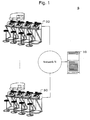
- Fig. 1 is a network configuration diagram of a gaming system S according to this embodiment of the present invention.
- a network N links a gaming server 10 for national on-line match-up type (or on-line competitive) mah-jong according to an embodiment of the present invention and gaming machine groups 30 for national on-line match-up type (or on-line competitive) mah-jong according to an embodiment of the present invention, the latter being installed in various facilities.
- the gaming server 10 has functions of: authenticating the players by logging into the gaming machine groups 30; managing the game played in remote locations via the network N; and managing personal attribute information containing the personal basic information and the game achievement history information, such as rank and 'yakuman' achievement, of the players.
- the network N is composed of a dedicated line based on the TCP/IP protocol.
- Each of gaming terminals 40A, 40B, 40C, etc. is assigned to each player so that the players play mah-jong.
- each player manages his or her own mah-jong tiles, which may be equivalent to cards in a card game, and input instructions of predetermined mah-jong actions such as 'tsumo', 'dapai,' 'chii,' 'pon,' 'kan,' and 'ron.'
- each gaming machine group 30 comprises four gaming terminals and is installed in each of the facilities.
- the present invention is not limited to this configuration. That is, an arbitrary number of gaming terminals may be installed in each of the facilities.
- the network N linking the gaming server 10 and the gaming machine groups 30 installed in the respective facilities is composed of a dedicated line.
- the present invention is not limited to this configuration. That is, the network N may be composed of a VPN (virtual private network) implemented on the Internet using a public network.
- VPN virtual private network
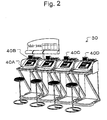
- Fig. 2 is a perspective view showing schematically one of the gaming machine groups 30 according to this embodiment of the present invention.
- the gaming machine group 30 comprises four separate gaming terminals 40A, 40B, 40C, and 40D.
- the gaming machine group 30 does not necessarily need to comprises four gaming terminals. Instead, only a single gaming terminal may be installed in a facility at each location and may be connected to the network N so as to provide the game.
- Fig. 3 is a perspective view showing schematically one of the separate gaming terminals 40A, 40B, 40C, and 40D constituting the gaming machine group 30 according to this embodiment of the present invention.
- the four gaming terminals are identical to each other. Thus, this figure shows a typical appearance of the gaming terminal 40A.
- the gaming terminal 40A comprises a display device 41 which is arranged so as to face the player and has the function of displaying an image necessary for the game.
- the surface of the display device is provided with a touch sensor 69 (see Fig. 10) for allowing the player to operate with the game by locating a position and measuring a timing of a touch on the display device.
- a speaker 75 is built in the gaming terminal 40A, so that sound generated causes excitement in the game through speaker grills 42 provided on both sides of the display device 41.
- a coin insertion slot 43 used for playing the game is provided on the player side of the gaming terminal 40A.
- a coin detection sensor 68 (see Fig: 10) built in the gaming terminal 40A detects a coin.
- An insertion opening 44 into which a rewritable magnetic card (see Fig. 20) for player authentication is inserted is provided on the player side of the gaming terminal 40A.
- the rewritable magnetic card is inserted into a card reader 70 (see Fig. 10) of the gaming terminal 40A, so that the authentication information recorded on the rewritable magnetic card is read.
- the card reader 70 reads information from the rewritable magnetic card, so as to identify the player.
- the present invention is not limited to this configuration. That is, any kind of recording medium, such as an IC chip built-in card, capable of recording the player's attribute information may be used.
- Fig. 4A is a block diagram showing the hardware of the gaming server 10 of the gaming system according to this embodiment of the present invention.
- the gaming server 10 comprises a BUS 12.
- the BUS 12 links: a CPU 13; a ROM 14; a RAM 15; a storage device 16 carrying a database for storing later-described personal attribute information (a personal basic information table, a personal rank table, and a personal 'yakuman' achievement table); a communications I/F device 17 for controlling connection with the network N; and a random number generator 18.
- the BUS 12 further links: a game management unit 19 for forming (or grouping) a player group of four players playing a mah-jong game in the gaming system S according to an embodiment of the present invention and for managing the player group; a tile deal management unit 20 for managing 'haipai' (distributing of tiles), 'tsumo' (self-drawing a tile), and 'sutepai' (discarding a tile) in the game in cooperation with the random number generator 18 under control of the CPU 13; a game agent function unit 21 for allowing the gaming server 10 to serve as a virtual player (or agent) playing the game when the game management unit 19 cannot form a group of four players, that is, when the number of players participating in the game is fewer than four which may be the requirement of the game; a special event generation unit 22 for retrieving the personal attribute information of the players participating in a game, at the beginning of the game so as to determine an event to be generated, on the basis of the personal attribute information; a player authentication unit 23 for authenticating the players when
- the CPU 13, the game management unit 19, the tile deal management unit 20, the game agent function unit 21, the special event generation unit 22, the player authentication unit 23, the personal achievement update unit 24, and the random number generator 18 may be integrated into a control device 25.
- Personal attribute information storing means is implemented by causing the control device 25 to operate according to a personal attribute information writing program so that personal attribute information is written into the database formed in the storage device 16.
- Special game shift means is implemented by: causing the control device 25 to operate according to a personal attribute information reading program so that the personal attribute information of the players participating in the game is read from the database formed in the storage device 16 and written into the RAM 15; then causing the control device 25 to operate according to a shift determination program so that whether the game in a normal mode is shifted to a special mode or not is determined on the basis of the features of the personal attribute information; and then causing the control device 25 to operate according to a game start signal transmission program if the shift to the special mode is to be carried out so that the game start signal is transmitted through the communications I/F device 17 to the gaming machine group 30.
- Player group generating means is implemented by: causing the control device 25 to operate according to a personal attribute information reading program so that the personal attribute information of the players participating in the game is read from the database formed in the storage device 16 and written into the RAM 15; and then causing the control device 25 to operate according to a player group generation program so that a player group is generated on the basis of features of the personal attribute information.
- the personal attribute information managed in the gaming system S is described below in reference to Figs. 5, 6, and 7.
- the gaming server 10 of the gaming system S authenticates each player participating in the game in the gaming machine group 30, and determines the personal attribute information of the player, so as to generate a special event.
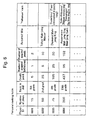
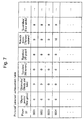
- Figs. 5, 6, and 7 are sample image diagrams showing the personal attribute information.
- Fig. 5 shows a personal basic information table.
- This table manages basic information solely, such as player IDs, passwords, names, handle names (nick names used in the game), addresses, birth dates, astrological signs, sex, and blood types of actual players.
- This table is used for identifying the player.
- player authentication is performed so that the table is referred to in the player authentication.
- This table is also referred to when it is determined whether a special event is to be generated or not at the beginning of a game.
- the personal basic information preferably contains as many types or kinds of attributes as possible.
- Fig. 6 shows a personal rank table for managing the history of the game achievement of each player.
- This table manages the game achievement solely, such as the number of plays of the game, rank (grades) in skill, acquired points, the number of acquired birthstones, the number of acquired jewels (other than birthstones), acquired titles, and 'yakuman' rank.
- This table is referred to when it is determined whether a special event is to be generated or not at the beginning of the game.
- Fig. 7 shows a personal 'yakuman' achievement table for managing the history of the 'yakuman' accomplishment in games each player has played.
- the number of 'yakuman' accomplishments is managed for each of the 'yakuman' combinations.
- the personal achievement update unit 24 of the gaming server 10 refers to this table, and thereby awards a title to a player having achieved the largest number of accomplishments for each of the 'yakuman' combinations, so as to register this information into the column of 'yakuman' rank in the personal rank table.
- the number of accomplishments of winning combinations other than the 'yakuman' combinations may be recorded so that the players' rank may be re-evaluated and updated.
- names of the players are displayed using their handle names (see Figs. 13 and 14).
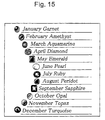
- the birthstones include twelve types of jewels: January/garnet, February/amethyst, March/aquamarine, April/diamond, May/emerald, June/pearl, July/ruby, August/peridot, September/sapphire, October/opal, November/topaz, and December/turquoise (see Fig. 15).
- the players compete for the number of acquired jewels. That is, when all the players constituting the player group have dan (rank or grade in the skill), the winner (the highest-scored player) of a game (a round of the game) takes a jewel from the loser (the lowest-scored player). Further, if 'yakuman' is accomplished, the player who has won the 'yakuman' takes jewels from all other players when the player completes the 'yakuman' by 'tsumo' (self drawing), while the player who has won the 'yakuman' takes jewels from another player who discards a tile which completes and causes the 'yakuman' of the player.
- the second kind is composed of points (credit points) acquired by each player.
- the credit points are awarded in the following manner on the basis of the final result of each score acquired by each player in the game: the highest-scored player gains +6 points, the second highest-scored player gains ⁇ 0 point, the third highest-scored player loses 2 points (or gains -2 points), and the lowest-scored player loses 4 points (or gains -4 points).
- the credit points can also be added by converting the birthstones into credit points. The conversion is made in the following manner. One birthstone of the player's own is converted into three points while other jewels are converted into points at the one-to-one rate. These credit points are added to the above-mentioned credit points.
- ranking is performed on the basis of the number of acquired jewels and the number of acquired points so that players who are ranked first in the acquired jewels and the number of acquired points, respectively, receive respective titles.
- the plurality of players when a plurality of players desire to make entries (e.g., insert coins so as to request player authentication) into the gaming terminals 40A, 40B, 40C, and 40D of the gaming machine group 30 in order to play a game at a certain time, and when the plurality of players participate in the game within a predetermined period of time from the certain time, the plurality of players are divided into player groups, each of which comprises a predetermined number of players appropriate to the game.
- the players may be divided into groups having four players, respectively, in the case of mah-jong so that the game played among each of the generated player groups is managed. That is, this unit generates player groups having respective players, each of whom plays the same game among the same player group. Thus, it is managed who plays which game from the beginning of the game to the end of the game.
- the tile deal management unit manages 'haipai' (dealing tiles) and 'tsumopai' (self-drawing a tile) in the same game. That is, in the specific game, the unit determines which tile is to be distributed to the player and which tile is to be drawn by the player.
- this unit allows the gaming server 10 to serve as a virtual player (or agent) playing the game.
- this unit serves as a virtual player in the specific game so as to perform predetermined mah-jong actions, such as 'tsumo,' 'dapai,' 'chii,' 'pon,' 'kan,' and 'riichi,' similar to those carried out by an ordinary player.
- this unit authenticates the player on the basis of whether or not the player's personal basic information has already been registered in the gaming server 10. This authentication is performed using a rewritable magnetic card.
- the information in the magnetic card is read by the card reader of the gaming terminal 40A, 40B, 40C, or 40D so that the player is identified on the basis of the combination of the player ID contained in the read-out personal basic information and a password input by the player through the touch panel.
- a new registration is performed so that a new magnetic card is issued.
- This embodiment uses a magnetic card.
- the present invention is not limited to this. That is, any kind of recording medium, such as an IC chip built-in card, capable of recording the personal basic information may be used.
- this unit determines whether or not an appropriate special event is to be generated. If a special event is to be generated, this unit determines which special event is to be generated, and then notifies the result of determination to the game management unit 19. On the basis of the notified result, the game management unit 19 manages the game. That is, using the player ID as a key, the game management unit 19 searches the personal basic information table of Fig. 5, the personal rank table of Fig. 6, and the personal 'yakuman' achievement table of Fig. 7 so as to read the player's attributes, the personal rank, and the 'yakuman' achievement into the RAM 15. Then, the game management unit 19 determines the agreement and the correspondence of the information so as to determine whether a special event is to be generated or not, and thereby executes the special event.
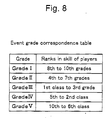
- the game management unit 19 refers to the personal basic information table of Fig. 5 and the personal rank table of Fig. 6, and thereby finds common features in the attributes of the four players. Then, the game management unit 19 determines a game title name on the basis of such personal attribute information, and then generates an event with the game. At that time, the game management unit 19 refers to an event grade correspondence table shown in Fig. 8, and thereby determines the grade of the event to be generated, on the basis of the ranks of the four players in the game.
- the grade of the event based on the ranks of the four players may be determined in various manners. For example, the grade may be determined on the basis of the lowest rank, the mean rank, or the highest rank.
- a title match entitled. "Diamond Master Cup” after the birthstone of April may be held.
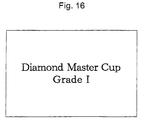
- the grade of this title match is determined on the basis of the data of the lowest rank of the four players in the game. For example, when the lowest rank of the four players is the eighth grade, this title match is entitled "Diamond Master Cup Grade I" (see Fig. 16), according to the event grade correspondence table.
- a game in which the players do not merely enjoy the game with unknown players, but also can obtain the pleasure of playing the game in a special mode, so that the sense of expectation is enhanced.
- a game may be provided in which a special event is generated on the basis of the personal attribute information of each of the plurality of players, so that the players obtain a sense of any connection to the other players via the network N.
- a special event may be generated when common features exist in various kinds of attributes, such as family name, personal name, sex, generation, blood type, and astrological signs (or star signs) of the four players who belong to the same group formed by the game management unit 19 and who thereby play the same game.
- attributes such as family name, personal name, sex, generation, blood type, and astrological signs (or star signs) of the four players who belong to the same group formed by the game management unit 19 and who thereby play the same game.
- a special event may be generated, for example, when the blood types of the four players are completely different from each other, that is, A, B, AB, and O, and hence when each player is a representative of the kind of the attribute.
- a game in which a special event is generated on the basis of the personal attribute originating from each of the plurality of players so that the players obtains a sense of a representative of a kind of attribute via the network N. This enhances the player's desire to participate in a game.
- the special event in the above-mentioned examples, four players are assumed to be present. However, even when a virtual player is generated by the function of the game agent function unit 21 under control of the CPU 13 of the gaming server 10, the special event may be generated by finding common features in the attributes of the other players.
- the special event generation unit determines that the special event described above is to be generated, the special event generation unit transmits a signal for the event to the game management unit 19.
- the game management unit 19 stores that the game is based on this event, and then transmits a signal for notifying that the game is based on this event, to the gaming terminals used for this game.
- This unit updates the information of the personal rank table and the personal 'yakuman' achievement table during the game or at the end of the game. More specifically, when a player accomplishes 'yakuman' during the game, this unit updates the information of the personal 'yakuman' achievement table. Further, at the end of the game, this unit performs the processes of reflecting the number of jewels acquired in the game, the number of jewels lost, the credit points converted from these numbers, the credit points acquired on the basis of the final score position, and the credit points lost, into the final result of the credit points.
- a birthstone is converted into three points and that each of the other jewels is converted into one point.
- the number of the credit points in the personal rank is updated in the following manner on the basis of the final score result with the game: the highest-scored player gains +6 points, the second highest-scored player gains ⁇ 0 point, the third highest-scored player loses 2 points (or gain - 2 points), and the lowest-scored player loses 4 points (or gains - 4 points).
- the game management unit 19 determines the national rank of the players and the prefectural rank of the players, so that a title "Mah-jong Saint” is awarded to the player ranked first in the national rank and that a title "Mah-jong Master” is awarded to the player ranked first prize in the prefectural rank. Then, the information of the acquired titles is updated in the personal rank. For example, the player ranked first prize in the credit points in Tokyo receives a title "Tokyo Mah-jong Master.”
- the rank of the players is updated (see Fig. 17).
- the player ranked first prize in the acquired number for each of the twelve birthstones is determined so as to receive the title "Mah-jong King.” Then, the information of the acquired titles is updated in the personal rank. For example, the player ranked first prize in the acquired number of diamonds receives a title "Diamond Mah-jong King" (see Fig. 17).
- the information of the personal 'yakuman' achievement table is searched for the player having achieved the largest number of accomplishments for each 'yakuman' combination, so that a title is awarded to each player. Then, the information of the 'yakuman' rank is renewed in the personal rank.
- this unit After the renewal of the personal rank table and the personal 'yakuman' achievement table, this unit displays various kinds of achievement on the display unit of each gaming terminal.
- the display includes the following three.
- JAPAN rank which is determined on the basis of the credit points of the players in each prefecture and which indicates the ranking position of each prefecture to which the players belong and the player, that is, “Mah-jong Master,” ranked first prize in each prefecture (see Fig. 18).
- 'yakuman' rank showing the rank in the number of accomplishments for each 'yakuman' combination.
- the player having achieved the largest number of accomplishments for each 'yakuman' combination in the country receives a title after the name of the 'yakuman' combination.
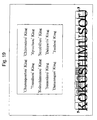
- the player having achieved the largest number of 'kokusimusou' (thirteen orphans) accomplishments receives a title "Kokusimusou King (see Fig. 19)."
- Fig. 14 shows an example of these kinds of rank of a player.
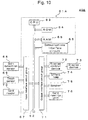
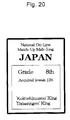
- the information of these kinds of rank is read from the rewritable magnetic card shown in Fig. 20 at the beginning of the game, and thereby always displayed on the game screen during the game (see Fig. 13).
- the rank of the players are performed on the basis of the game achievement, so that titles are awarded. This enhances the players' desire to participate in the game and the pleasure in the game itself, and thereby increases the players' sense of competition.
- Fig. 9 is a block diagram showing the hardware of the gaming machine group 30.
- the gaming machine group 30 comprises a plurality of separate gaming terminals 40A, 40B, etc.
- the gaming machine group 30 further comprises: a main control circuit 51 for controlling comprehensively these separate gaming terminals and for controlling the connection to the network N; and sub-control circuits 61A, 61B, etc. corresponding to the core control units of the separate gaming terminals 40A, 40B, etc.
- Fig. 10 is a block diagram showing the hardware of the gaming terminals 40A, 40B, etc. This hardware block diagram is, by way of example, described using the gaming terminal 40A as a representative type.
- the portion surrounded by a dashed line in Fig. 10 corresponds to the sub-control circuit 61A of the gaming terminal 40A which belongs to the gaming machine group 30.
- the gaming terminal 40A comprises a BUS 62.
- the BUS 62 links a CPU 63, a ROM 64, a RAM 65, and a communications interface circuit 66.
- the BUS 62 links a coin detection sensor 68, a touch sensor 69, and a card reader 70 via an input interface circuit group 67.
- the BUS 62 links a display control device 72, an effect lamp 74, a speaker 75, and a card rewrite unit 76 via an output interface circuit group 71.
- the display control device 72 is connected to a display device 73.
- the display device 73 implements a so-called touch panel screen in which all the operations for the game can be detected by the touch sensor 69 detecting that the player touches the operation display unit of the display device 73, so that signals are provided to the CPU 63, whereby the game proceeds.
- the gaming terminal 40A is assumed to be composed of a dedicated game apparatus according to an embodiment of the present invention.
- the present invention is not limited to this. That is, an apparatus such as a personal computer (a desk top type or a notebook type), a PDA (personal digital assistant), and a cell phone with a browsing function, which is connectable to a network (e.g., the Internet), may be used.
- the gaming terminal 40A does not have the function of managing the progress itself of the game (mah-jong, according to an embodiment of the present invention), and merely performs the operations of input and output for member authentication necessary for the player to participate in the game and for game operations necessary for advancing the game.
- the gaming terminal 40A provides merely the performance during the progress of the game so as to appeal to the senses of vision and hearing of the player through the display device and the speaker.
- Figs. 11 and 12 are flowcharts showing the process flow when a player is connected to the gaming server 10 through the gaming terminal 40A so as to play a game in the gaming system.
- the gaming terminal 40A transmits a player entry signal to the gaming server 10 (step S102).
- the gaming server 10 receives the player entry signal (step S103)
- the gaming server 10 refers to the personal basic information table in the database formed in the storage device 16 so as to determine whether or not the information of the player is already registered in the personal basic information table (step S104).
- the process of player acceptance is performed (step S105).
- the process of new player registration is performed (step S107).
- This process of new player registration is a general one, in which a new member is introduced through the gaming terminal 40A via the network N so that a player ID and a password is provided to each newly registered member. Then, member personal basic information, such as the items illustrated in the image diagram of the personal basic information table of Fig. 5, is collected.
- the player When the information has already been registered, the player inserts the member card into the card reader of the gaming terminal 40A so that the information recorded in the member card is read and that the process of member authentication is performed.
- the gaming terminal 40A transmits the information read-out from the member card and the password inputted by the player through the touch sensor 69, to the gaming server 10 (step S105), so that the gaming server 10 performs the process of member authentication (step S106).
- step S108 the process of forming a player group is performed.
- players having declared participation in a game within a predetermined period of time from a certain point of time are divided into player groups, each of which comprises four players in the case of mah-jong, for example. Then, the game is started among the player group.
- the game agent function unit 21 of the gaming server 10 serves as a player agent under control of the CPU 13 so that the game is started.
- step S109 it is determined whether or not the game corresponds to a special event (step S109).
- the special event generation unit 22 refers to the personal basic information table and the personal rank table in the database stored in the storage device 16, and thereby reads all the attributes and the achievement of the players into the RAM 15. Then, the special event generation unit 22 determines an event to be generated, on the basis of the read-out information and the event grade correspondence table of Fig. 8.
- various special events can be generated on the basis of the personal attribute information, such as the personal basic information and the personal rank information, of the players themselves, so that the winning player in the event can receive a title corresponding to the event.
- Fig. 13 is a diagram showing the situation of progress of the game.
- the gaming terminal 40A When the gaming terminal 40A receives the game start signal from the gaming server 10 (step S111), the gaming terminal 40A transmits signals for performing predetermined mah-jong operations (such as 'tsumo,' 'dapai,' 'chii,' 'pon,' 'kan,' and 'ron') and thereby executes the game, to the gaming server 10 (step S112).
- predetermined mah-jong operations such as 'tsumo,' 'dapai,' 'chii,' 'pon,' 'kan,' and 'ron'
- step S113 When receiving a game execution signal from the gaming terminal 40A (step S113), the gaming server 10 performs a predetermined operation corresponding to the signal, and then determines whether or not the game can be continued. When the game can be continued (Yes in step S114), the gaming server 10 transmits a game continuation signal to the gaming terminal 40A (step S116). On receiving this signal (step S115), the gaming terminal 40A continues to transmit a game execution signal to the gaming server 10 (step S112). In contrast, when the game cannot be continued (No in step S114), the game is terminated, and then the process of personal achievement update is performed (step S117). That is, the information of the personal rank table and the personal 'yakuman' achievement table is updated, and then the procedure advances to the next step.
- the gaming server 10 transmits a game end signal to the gaming terminal 40A (step S118).
- the gaming terminal 40A receives the game end signal (step S119)
- the gaming server 10 further transmits the up-to-date personal achievement information (step S120).
- the gaming terminal 40A displays the information on the display device 73 (step S122), and then rewrites the information into the magnetic card (see Fig. 20) (step S123).
- a game in which the players do not merely enjoy the game with unknown players, but also can obtain pleasure of playing the game in a special mode so that the sense of expectation is enhanced.
Landscapes
- Physics & Mathematics (AREA)
- General Physics & Mathematics (AREA)
- Pinball Game Machines (AREA)
- Management, Administration, Business Operations System, And Electronic Commerce (AREA)
- Display Devices Of Pinball Game Machines (AREA)
Applications Claiming Priority (2)
| Application Number | Priority Date | Filing Date | Title |
|---|---|---|---|
| JP2002382432 | 2002-12-27 | ||
| JP2002382432A JP4518739B2 (ja) | 2002-12-27 | 2002-12-27 | 遊技システム |
Publications (2)
| Publication Number | Publication Date |
|---|---|
| EP1434180A2 true EP1434180A2 (fr) | 2004-06-30 |
| EP1434180A3 EP1434180A3 (fr) | 2005-01-19 |
Family
ID=32463673
Family Applications (1)
| Application Number | Title | Priority Date | Filing Date |
|---|---|---|---|
| EP03029809A Ceased EP1434180A3 (fr) | 2002-12-27 | 2003-12-23 | Système de jeu fournissant un jeu |
Country Status (5)
| Country | Link |
|---|---|
| US (1) | US20040147298A1 (fr) |
| EP (1) | EP1434180A3 (fr) |
| JP (1) | JP4518739B2 (fr) |
| AU (1) | AU2003271299A1 (fr) |
| ZA (1) | ZA200309959B (fr) |
Families Citing this family (4)
| Publication number | Priority date | Publication date | Assignee | Title |
|---|---|---|---|---|
| JP4128587B2 (ja) * | 2006-01-19 | 2008-07-30 | 株式会社スクウェア・エニックス | ゲーム装置、ランキング情報作成方法、プログラム及び記録媒体 |
| US8231448B2 (en) | 2007-11-09 | 2012-07-31 | Igt | Gaming system and method for providing purchasable bonus opportunities |
| SG189588A1 (en) * | 2011-10-31 | 2013-05-31 | Galaxy City Holdings Ltd | A method for playing a game |
| US20180089959A1 (en) * | 2014-04-18 | 2018-03-29 | Chong Son NA | Network game system and method |
Family Cites Families (19)
| Publication number | Priority date | Publication date | Assignee | Title |
|---|---|---|---|---|
| US5429361A (en) * | 1991-09-23 | 1995-07-04 | Bally Gaming International, Inc. | Gaming machine information, communication and display system |
| US5586766A (en) * | 1994-05-13 | 1996-12-24 | Casinovations, Inc. | Blackjack game system and methods |
| US5779549A (en) * | 1996-04-22 | 1998-07-14 | Walker Assest Management Limited Parnership | Database driven online distributed tournament system |
| US5768382A (en) * | 1995-11-22 | 1998-06-16 | Walker Asset Management Limited Partnership | Remote-auditing of computer generated outcomes and authenticated biling and access control system using cryptographic and other protocols |
| AU1286997A (en) * | 1995-12-01 | 1997-06-19 | Midway Games, Inc. | Video game having more than one mode of play |
| EP0965084A1 (fr) * | 1996-03-21 | 1999-12-22 | MPATH Interactive Inc. | Systeme de mise en correspondance sur reseaux pour la selection de clients en fonction d'attributs de serveurs et de liaisons de communication |
| US5816918A (en) * | 1996-04-05 | 1998-10-06 | Rlt Acquistion, Inc. | Prize redemption system for games |
| US5876284A (en) * | 1996-05-13 | 1999-03-02 | Acres Gaming Incorporated | Method and apparatus for implementing a jackpot bonus on a network of gaming devices |
| BR9709011A (pt) * | 1996-05-21 | 1999-08-03 | De Souza Oswaldo Jose Levy | Jogo de azar programa de computador armazenado em um meio de armazenagem para prover um jogo de azar e método para |
| DE19701214C2 (de) * | 1997-01-16 | 2002-01-17 | Adp Gauselmann Gmbh | Verfahren zum Betreiben eines münzbetätigten Unterhaltungsautomaten |
| JPH11156046A (ja) * | 1997-11-28 | 1999-06-15 | Cosmo Ec Kk | 麻雀得点受払管理装置並びに記憶媒体 |
| US6224485B1 (en) * | 1998-05-01 | 2001-05-01 | Midway Amusement Games, Llc | High-score display system for a video game |
| US6267672B1 (en) * | 1998-10-21 | 2001-07-31 | Ayecon Entertainment, L.L.C. | Product sales enhancing internet game system |
| JP2000325528A (ja) * | 1999-03-18 | 2000-11-28 | Konami Co Ltd | ゲーム装置及び記録媒体 |
| US6174237B1 (en) * | 1999-05-21 | 2001-01-16 | John H. Stephenson | Method for a game of skill tournament |
| AUPQ726400A0 (en) * | 2000-05-03 | 2000-05-25 | Aristocrat Technologies Australia Pty Limited | Membership reward system |
| JP4192401B2 (ja) * | 2000-05-15 | 2008-12-10 | カシオ計算機株式会社 | 通信対戦システム及びサーバ装置 |
| GB0029734D0 (en) * | 2000-12-06 | 2001-01-17 | Kitsh Ltd | Interconnection of users via a communications network for competitive gaming |
| JP2002230137A (ja) * | 2001-01-30 | 2002-08-16 | Sharp Corp | コミュニティ形成支援装置、コミュニティ形成支援方法、そのプログラムおよびそのプログラムを記録した記録媒体 |
-
2002
- 2002-12-27 JP JP2002382432A patent/JP4518739B2/ja not_active Expired - Fee Related
-
2003
- 2003-12-23 AU AU2003271299A patent/AU2003271299A1/en not_active Abandoned
- 2003-12-23 ZA ZA200309959A patent/ZA200309959B/xx unknown
- 2003-12-23 EP EP03029809A patent/EP1434180A3/fr not_active Ceased
- 2003-12-23 US US10/743,326 patent/US20040147298A1/en not_active Abandoned
Also Published As
| Publication number | Publication date |
|---|---|
| US20040147298A1 (en) | 2004-07-29 |
| JP4518739B2 (ja) | 2010-08-04 |
| ZA200309959B (en) | 2004-05-26 |
| JP2004208969A (ja) | 2004-07-29 |
| EP1434180A3 (fr) | 2005-01-19 |
| AU2003271299A1 (en) | 2004-07-15 |
Similar Documents
| Publication | Publication Date | Title |
|---|---|---|
| US20050267610A1 (en) | Game system and game server | |
| AU733366B2 (en) | Wagering game based on ranking order of game participants | |
| US6712699B2 (en) | Apparatus and method for facilitating team play of slot machines | |
| US7364510B2 (en) | Apparatus and method for facilitating team play of slot machines | |
| US5957775A (en) | Wagering game based on ranking order of game participants | |
| JP4074651B2 (ja) | コンピュータベースの対話式リアルタイムカード選択ゲーム | |
| US6733390B2 (en) | Method and apparatus for team play of slot machines | |
| US6592456B2 (en) | Video poker system and method | |
| US7726655B2 (en) | Games of chance with player-specified elements | |
| CN101180106B (zh) | 计算机实现的模拟纸牌游戏 | |
| JP2004261202A (ja) | ゲームシステム及びゲームサーバ | |
| AU2009227907B2 (en) | Method and system for distributed syndicate gaming | |
| US20040242310A1 (en) | Bingo game using specified board and method of playing | |
| US9355520B2 (en) | Apparent skill games for use with predetermined outcomes | |
| WO2000015314A1 (fr) | Jeu de casino base sur les connaissances et procede associe | |
| US8485884B2 (en) | Reverse gaming systems and methods | |
| EP1434180A2 (fr) | Système de jeu fournissant un jeu | |
| JP2004229845A (ja) | ゲームシステム及びゲームサーバ | |
| ZA200505675B (en) | Game system and game server | |
| JP3916533B2 (ja) | 遊技設備 |
Legal Events
| Date | Code | Title | Description |
|---|---|---|---|
| PUAI | Public reference made under article 153(3) epc to a published international application that has entered the european phase |
Free format text: ORIGINAL CODE: 0009012 |
|
| AK | Designated contracting states |
Kind code of ref document: A2 Designated state(s): AT BE BG CH CY CZ DE DK EE ES FI FR GB GR HU IE IT LI LU MC NL PT RO SE SI SK TR |
|
| AX | Request for extension of the european patent |
Extension state: AL LT LV MK |
|
| PUAL | Search report despatched |
Free format text: ORIGINAL CODE: 0009013 |
|
| AK | Designated contracting states |
Kind code of ref document: A3 Designated state(s): AT BE BG CH CY CZ DE DK EE ES FI FR GB GR HU IE IT LI LU MC NL PT RO SE SI SK TR |
|
| AX | Request for extension of the european patent |
Extension state: AL LT LV MK |
|
| 17P | Request for examination filed |
Effective date: 20050629 |
|
| AKX | Designation fees paid |
Designated state(s): AT BE BG CH CY CZ DE DK EE ES FI FR GB GR HU IE IT LI LU MC NL PT RO SE SI SK TR |
|
| 17Q | First examination report despatched |
Effective date: 20060710 |
|
| STAA | Information on the status of an ep patent application or granted ep patent |
Free format text: STATUS: THE APPLICATION HAS BEEN REFUSED |
|
| 18R | Application refused |
Effective date: 20091026 |