EP1435391A1 - Procédé d'hydrolyse de l'amidon sans ajustement du pH - Google Patents
Procédé d'hydrolyse de l'amidon sans ajustement du pH Download PDFInfo
- Publication number
- EP1435391A1 EP1435391A1 EP03250023A EP03250023A EP1435391A1 EP 1435391 A1 EP1435391 A1 EP 1435391A1 EP 03250023 A EP03250023 A EP 03250023A EP 03250023 A EP03250023 A EP 03250023A EP 1435391 A1 EP1435391 A1 EP 1435391A1
- Authority
- EP
- European Patent Office
- Prior art keywords
- amylase
- starch
- liquefaction
- alpha
- saccharification
- Prior art date
- Legal status (The legal status is an assumption and is not a legal conclusion. Google has not performed a legal analysis and makes no representation as to the accuracy of the status listed.)
- Withdrawn
Links
Images




Classifications
-
- C—CHEMISTRY; METALLURGY
- C12—BIOCHEMISTRY; BEER; SPIRITS; WINE; VINEGAR; MICROBIOLOGY; ENZYMOLOGY; MUTATION OR GENETIC ENGINEERING
- C12N—MICROORGANISMS OR ENZYMES; COMPOSITIONS THEREOF; PROPAGATING, PRESERVING, OR MAINTAINING MICROORGANISMS; MUTATION OR GENETIC ENGINEERING; CULTURE MEDIA
- C12N9/00—Enzymes; Proenzymes; Compositions thereof; Processes for preparing, activating, inhibiting, separating or purifying enzymes
- C12N9/14—Hydrolases (3)
- C12N9/24—Hydrolases (3) acting on glycosyl compounds (3.2)
- C12N9/2402—Hydrolases (3) acting on glycosyl compounds (3.2) hydrolysing O- and S- glycosyl compounds (3.2.1)
- C12N9/2405—Glucanases
- C12N9/2408—Glucanases acting on alpha -1,4-glucosidic bonds
- C12N9/2411—Amylases
- C12N9/2414—Alpha-amylase (3.2.1.1.)
- C12N9/2417—Alpha-amylase (3.2.1.1.) from microbiological source
-
- C—CHEMISTRY; METALLURGY
- C12—BIOCHEMISTRY; BEER; SPIRITS; WINE; VINEGAR; MICROBIOLOGY; ENZYMOLOGY; MUTATION OR GENETIC ENGINEERING
- C12P—FERMENTATION OR ENZYME-USING PROCESSES TO SYNTHESISE A DESIRED CHEMICAL COMPOUND OR COMPOSITION OR TO SEPARATE OPTICAL ISOMERS FROM A RACEMIC MIXTURE
- C12P19/00—Preparation of compounds containing saccharide radicals
- C12P19/02—Monosaccharides
-
- C—CHEMISTRY; METALLURGY
- C12—BIOCHEMISTRY; BEER; SPIRITS; WINE; VINEGAR; MICROBIOLOGY; ENZYMOLOGY; MUTATION OR GENETIC ENGINEERING
- C12P—FERMENTATION OR ENZYME-USING PROCESSES TO SYNTHESISE A DESIRED CHEMICAL COMPOUND OR COMPOSITION OR TO SEPARATE OPTICAL ISOMERS FROM A RACEMIC MIXTURE
- C12P19/00—Preparation of compounds containing saccharide radicals
- C12P19/14—Preparation of compounds containing saccharide radicals produced by the action of a carbohydrase (EC 3.2.x), e.g. by alpha-amylase, e.g. by cellulase, hemicellulase
Definitions
- the invention relates to the processing of polysaccharides, such as starch, to produce starch hydrolysates. Specifically, the invention relates to starch hydrolysis processes that do not require a secondary liquefaction step or pH adjustments before and after liquefaction.
- Grains such as corn have long been used as a source of starch.
- One of the well-known methods of separating and purifying starch for use in industrial processes is the wet-milling process. This method has developed into a highly specific and integrated system designed to separate the major components of a grain kernel as completely as possible (see Stanley A. Watson, Starch: Chemistry & Technology , Vol. II, Industrial Aspects , Academic Press, New York, 1967, pp. 30-51).
- starch conversion processing consists of liquefaction of a granular starch slurry to produce dextrins and saccharification of the liquefied starch into dextrose. Additional processing may include purification and isomerization of dextrose to produce glucose or other sugars, such as fructose.
- the enzymatic liquefaction process involves treatment of the about pH 3.5 to 5.0 granular starch slurry with a base (such as calcium hydroxide, sodium hydroxide or sodium carbonate) to adjust the pH to between about 6.0 and 6.5, the optimum pH range of commonly used ⁇ -amylases, such as an ⁇ -amylase derived from Bacillus licheniformis .
- a base such as calcium hydroxide, sodium hydroxide or sodium carbonate
- the adjusted suspension may be pumped through a direct steam injection cooker (jet cooker) to raise the temperature to between about 105°-110°C for low temperature liquefaction.
- jet cooker direct steam injection cooker
- the pH adjustment occurs just after a jet cooker phase at a temperature of about 140-155° C.
- the cooked slurry is cooled to the secondary liquefaction temperature, the pH is adjusted to a range favorable to the selected ⁇ -amylase, and then the ⁇ -amylase is added.
- the starch suspension and added ⁇ -amylase may be held at a temperature of about 80-100°C to partially hydrolyze the starch granules, and this partially hydrolyzed starch suspension then is pumped through a jet cooker at temperatures in excess of about 105°C to thoroughly gelatinize any remaining granular structure.
- Secondary liquefaction at a pH of about 5.5 to 6.0 is carried out to allow the ⁇ -amylase to continue hydrolysis and reduce the dextrins produced during primary liquefaction.
- the secondary liquefaction step generally is carried out for about 90 to 120 minutes after cooling the primary liquefact to approximately 95° ⁇ 5°C. Processing time for liquefaction is selected to produce a DE of approximately 10-12.
- Dextrose equivalent (DE) is the industry standard for measuring the concentration of total reducing sugars, calculated as glucose on a dry weight basis. Unhydrolyzed granular starch has a DE of virtually zero, whereas the DE of glucose is defined as 100.
- Liquefaction temperatures depend upon the source of the ⁇ -amylase.
- Alpha-amylases produced by wild-type strains of B . licheniformis are preferred by the industry because they are thermostable under typical jet cooking temperatures.
- the ⁇ -amylases are thermostabilized with, for example, starch and calcium ions, and generally the starch slurry is adjusted to pH values above about 6 to protect against rapid inactivation at typical liquefaction temperatures. The high pH requirement results in undesirable by-products, e.g., maltulose which ultimately lowers glucose yields.
- the pH of the starch slurry suspension from the wet milling stage is about 3.8 to 4.8, and is adjusted upward by the addition of acid neutralizing chemicals, which are removed later by ion-exchange refining of the final starch conversion product. If the liquefact undergoes further processing, such as saccharification utilizing glucoamylase, a pH of 4.0-4.5 is required; therefore, the pH is adjusted again down from about pH 5.5-6.0.
- the present invention provides a novel single stage liquefaction process for starch using an acid-stable, thermostable ⁇ -amylase derived from a selected strain of Bacillus acidocaldarius that enables liquefaction without an adjustment of the pH.
- a novel, low temperature starch conversion process comprises a single liquefaction step using a novel acid-stable, thermostable ⁇ -amylase from a selected strain of Bacillus acidocaldarius .
- a high temperature starch conversion process comprises a single liquefaction step using a novel acid-stable, thermostable ⁇ -amylase from a selected strain of Bacillus acidocaldarius .
- novel starch conversion processes utilize fewer chemicals, enable fewer processing steps, operate at a single pH, and can take less time to produce a liquefact with a commercially acceptable DE value and suitable for further optional saccharification. Additionally, the processes produce fewer undesirable by-products during liquefaction, due at least in part to eliminating or reducing typical chemical additions and conducting liquefaction at a reduced pH.
- novel ⁇ -amylase is inactivated, consumed, or in some way altered by the end of one of the low temperature liquefaction process thereby enabling saccharification to proceed without the thermo-inactivation utilized in the other embodiments.
- the invention comprises the discovery that an acid-stable, thermostable ⁇ -amylase from a selected strain of Bacillus acidocaldarius enables the conversion of starch to glucose in a single liquefaction step without pH adjustment of the starch slurry, or in two liquefaction steps utilizing low dosages of the enzyme, and further enables optional saccharification steps to proceed without a pH adjustment to acceptable saccharification enzyme pH ranges. Additionally, in at least one embodiment of the invention, there is no need to inactivate the Bacillus acidocaldarius ⁇ -amylase prior to saccharification.
- Alpha-amylase means an enzyme which cleaves or hydrolyzes the internal ⁇ (1-4) glycosidic bonds in starch largely at random to produce ⁇ 1-2 bonds resulting in smaller molecular weight maltodextrin, e.g., in starch, high molecular weight amylopectin or amylose polymers are hydrolyzed to oligosaccharides.
- Suitable ⁇ -amylases are the naturally occurring ⁇ -amylases as well as recombinant or mutant amylases derived from Bacillus acidocaldarius .
- Granular starch or "starch granules” means a water-insoluble component of edible grains which remains after removal of the hull, fiber, protein, germ, and other soluble substances through the steeping, mechanical cracking, separations, screening, countercurrent rinsing and centrifugation steps typically used in a grain wet-milling process.
- Granular starch comprises intact starch granules containing almost exclusively packed starch molecules (i.e., amylopectin and amylose).
- the granular starch component comprises about 99% starch; the remaining 1% being comprised of protein, ash, fiber and trace components tightly associated with the granules.
- the packing structure of granular starch retards the ability of ⁇ -amylase to hydrolyze starch. Gelatinization of the starch is utilized to disrupt the granules to form a soluble starch solution and facilitate enzymatic hydrolysis.
- “Liquefaction” or “liquefy” means a process by which starch is converted to shorter chain and less viscous dextrins. Generally, this process involves gelatinization of starch simultaneously with or followed by the addition of ⁇ -amylase. In commercial processes, it is preferred that the granular starch is derived from a source comprising corn, wheat, milo, sorghum, rye potato etc. However, the present invention applies to any grain starch source which is useful in liquefaction, e.g., any other grain or vegetable source known to produce starch suitable for liquefaction.
- the temperature range of the liquefaction is generally any liquefaction temperature which is known to be effective in liquefying starch.
- the temperature of the starch is between about 80°C to about 115°C, or from about 100 to about 110°C, or from about 105 to about 108°C for low temperature liquefaction.
- High temperature liquefaction temperatures are between approximately 140-145° C.
- Saccharification means the conversion of the liquid product (liquefact), in this case, the hydrolysis of the soluble dextrins to dextrose monomers using enzymes such as glucoamylase. Saccharification products are, for example, glucose and other saccharides such as disaccharides and trisaccharides.
- Starch solution means the water-soluble gelatinized starch which results from heating granular starch. Upon heating of the granules to above about 72°C, granular starch dissociates to form an aqueous mixture of loose starch molecules. This mixture comprises, for example, about 75% amylopectin and 25% amylose in yellow dent corn, and forms a viscous solution in water. In commercial processes to form glucose or fructose, it is the starch solution, or starch slurry, which is liquefied to form a soluble dextrin solution.
- Step liquor means a liquid which is drawn from steeped grain kernels during the steeping process.
- the steep liquor contains a significant portion of the soluble components of the grain.
- the ⁇ -amylases suitable for practicing the present invention exhibit the characteristics of the KSTM #2037 ⁇ -amylase described in Japanese Patent Application No. JP10136979, filed on May 26, 1998, titled "Novel Acidic Alpha-amylase and Its Production, hereby incorporated by reference in its entirety.
- the microbial cells were removed by conventional means, leaving the extracellular enzyme in solution.
- the enzyme containing solution was then concentrated using ultrafiltration and freeze-dried.
- the activity of the resulting enzyme preparation was found to be 2170 ASAA units/g in Lot Number 1, and 2520 ASAA units/g in Lot Number 2.
- the ⁇ -amylase activity of the KSTM #2037 ⁇ -amylase was measured by determining the hydrolysis of soluble potato starch as described in JP10136979.
- 10 ml of 1% potato starch solution (pH 4.5 acetate buffer) in an 8 x 180 mm test tube is placed in a constant temperature bath maintained at 40°C for more than 5 minutes.
- One ml of properly diluted sample is added with agitation and the mixture is incubated for 10 minutes in the constant temperature bath.
- the enzyme reaction is interrupted by rapidly placing 1 ml of the reaction mixture into 10 ml of N/10 HCI.
- AASA S-S° S 10 x 100 x n
- a Acid Stable Alpha Amylase Unit is defined as that activity of enzyme which causes 1% blue value reduction of 1% potato starch solution at 40°C, for one minute.
- a unit of the diluted sample for purposes of this application generally is between approximately 2 and 5 ASAA.
- the novel ⁇ -amylase described above acts to hydrolyze starch substrate to form, mainly, maltopentaose and maltohexaose.
- Figure 8 illustrates a carbohydrate profile of the novel KSTM #2037 ⁇ -amylase, 2037, determined by BioRad HPX Column.
- Figure 1A illustrates a prior art low temperature starch conversion process
- Figure 1B illustrates a prior art high temperature starch conversion process
- a refined starch slurry having a pH between about 3.8 and 4.8 is transferred to a tank and pumped through a steam jet cooker to raise the temperature to about between 140-155°C for a minimum of 20 seconds.
- the heated mixture then enters the primary liquefaction reactor where it is held at about 140-155°C for approximately 10 minutes to allow hydrolysis and the production of dextrins and starch hydrolysates.
- the liquefact is then transferred through a flash cooler, and treated to raise the pH to between about 5.5-6.0 by adding calcium hydroxide and/or sodium hydroxide.
- An ⁇ -amylase optimally active at about pH 5.5-6.0 and derived from, for example, Bacillus licheniformis is added after the addition of the treating substances and the resulting suspension is sent to a secondary liquefaction reactor where the dextrins are reduced in size.
- the temperature in the secondary liquefaction reactor is generally about 93-95°C, and the holding time is about 60-120 minutes, or until a target DE is reached.
- the starch slurry is adjusted from about pH 3.5 to 5.0 to about pH 5.5 to 6.0 using calcium or sodium hydroxide.
- the slurry then is pumped through a steam jet cooker which utilizes a temperature of approximately 104-108°C in the jet cooker.
- the heated mixture then is held for about 5 minutes in the pressurized primary liquefaction reactor.
- the mixture passes through a flash cooler and into the secondary liquefaction reactor where it is maintained at about 90-100°C for approximately 60-120 minutes, or until the target DE is reached.
- the commercial ⁇ -amylases continue hydrolysis during a secondary liquefaction step to reduce the size of the dextrins, although a second addition of ⁇ -amylase may be added to further hydrolyze the starch.
- the resulting liquefact from such commercial procedures is expected to include, in the absence of further treatment, by-products at least as a result of the chemical additions.
- Maltulose is a by-product which is produced at liquefaction pH values greater than 6.0. Maltulose is known to lower glucose yields in subsequent saccharification procedures.
- the pH of the resulting liquefaction product is again adjusted by adding an acid such as hydrochloric acid, to lower the pH to between 4 to 4.5 prior to the addition of the enzyme used in optional saccharification.
- the pH adjustment is used to inactivate the conventional ⁇ -amylase to prevent the possibility of interference during saccharification and primarily to optimize the activity of the saccharification enzyme.
- the recognized industry standard for resulting dextrose equivalents (DE) following liquefaction is 10-12.
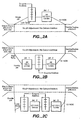
- FIGS. 2A, 2B, and 2C illustrate the novel liquefaction processes utilizing an ⁇ -amylase from Bacillus acidocaldarius constituting the present invention.
- the processes do not require (1) an initial pH adjustment of the starch slurry prior to addition of the KSTM #2037 ⁇ -amylase, (2) the initial addition of calcium salts; (3) in two of the processes, the secondary liquefaction step; and (4) the second pH adjustment prior to optional saccharification. All of the processes shown in Figs. 2A, 2B, and 2C are used to liquefy a starch slurry having about 30 - 40% ds and a pH of about 3.5 to 5.0.
- the KSTM #2037 ⁇ -amylase is added to the starch slurry and passed through a jet cooker maintained at about 105-110°C for about 5-8 minutes.
- This primary liquefaction step occurs without the addition of calcium, although calcium chloride may be added if desired, and typically results in a DE of about 10-12.
- the liquefaction product has a pH of approximately 4.0-4.5, which is suitable for saccharification enzymes. Additionally, there is no need to make a pH adjustment to inactivate the KTSM ⁇ -amylase which is inactive, deactivated, consumed or in some fashion altered so that it does not substantially affect the selected saccharification enzyme.
- the starch slurry first passes through a high temperature jet cooker for about 5-8 seconds at about 140-145°C.
- the high temperature slurry next passes through a flash cooler which reduces the temperature to approximately 95-98°C prior to addition of the KSTM #2037 ⁇ -amylase.
- Hydrolysis continues for approximately 60-90 minutes until a DE of 10-12 is reached.
- the enzymatic reaction then is thermally terminated by passing the liquefact through a second jet cooker maintained at about 107-110° C for several minutes prior to further processing.
- the double jet cooker liquefaction process achieves the targeted DE of about 10-12, and also does not require the addition of calcium chloride or pH adjustment for the saccharification enzyme prior to optional saccharification, as described above in connection with low temperature liquefaction.
- a portion of the KSTM #2037 ⁇ -amylase is added to the starch slurry prior to passing into a jet cooker for about 5-8 minutes at about 107-110°C.
- the liquefied starch is then flash cooled and sent to a tank at about 95-98°C where an additional dose of KSTM #2037 ⁇ -amylase is added.
- Hydrolysis continues until a DE of about 10-12 is reached, at which time the enzymatic reaction is terminated by passing the liquefact through a jet cooker maintained at about 107-110°C for 1-2 minutes prior to further processing.
- the double jet cooker liquefaction process described above enables lower dosages of the novel KSTM #2037 ⁇ -amylase as described in Example 6 below as compared to the dosages used in the single stage process shown in Figure 2A.
- the following examples performed starch liquefaction using a reactor composed of 50 feet of 0.24 inch diameter (0.21 inch i. d.) stainless steel tubing bent into an approximately 10 inch diameter coil that was 5.5 inches high.
- the coil was equipped with an 11.5 inch, in-line static mixer (Cole - Parmer #G-04669-60 ) mounted 4 feet from the anterior end of the coil.
- the posterior end of the coil was equipped with a Swagelok in-line adjustable pressure relief valve (#SS-4CA-5) set at a cracking pressure of about 20 psi.
- Starch slurry was fed to the coil at a rate of app.70 ml/min with a piston metering pump.
- the coil was heated by immersion in a glycerol-water bath heated to a temperature of approximately 103-120° C for low temperature liquefaction and approximately 140-155°C for high temperature liquefaction.
- the temperature of the water bath was maintained using a circulating heater/temperature controller (Fisher Scientific model 7305 ).
- thermostable ⁇ -amylases listed below, were compared with KSTM #2037 ⁇ -amylase, as described below.
- SPEZYMETM FRED ⁇ -amylase (10LU/g) and TermamylTM SC (5 LU/g) alpha-amylase each were added to the liquefied starch slurry pre-treated with 0.5 10N NaOH to adjust the pH to at least 5.6.
- KSTM #2037 ⁇ -amylase 5.0 ASAA units/g ds was added to an untreated liquefied starch slurry having a pH of 4.0. The three samples were held at 95°C and tested at 30 minute intervals until a target DE of 10 was obtained. Aliquots for subsequent testing were prepared as described above. The results following primary liquefaction are shown in Figure 4.
- the KSTM #2037 ⁇ -amylase (2.5 ASAA units/g. ds and 5.0ASAA units/g ds) also was tested at pH 3.5 using the above liquefaction procedure as described in U.S. Pat. No. 3,654,081, hereby incorporated by reference.
- the pH 3.5 starch slurry was prepared by suspending 9380 grams of corn starch in 14.2 liters of distilled water containing 50 ppm SO2 to produce a starch concentration of 35% dsb. The results were as follows: 0.5 hours, 8.4-9.0 DE; and 1.0 hours, 11.2-11.6 DE.
- KSTM #2037 ⁇ -amylase is inactivated, or at the least, altered in some fashion at the end of the low temperature liquefaction process of Fig. 2A so that the enzyme does not substantially interfere with, or influence, saccharification by glucoamylase or other such enzymes.
- KSTM #2037 ⁇ -amylase enzyme concentration of the KSTM #2037 ⁇ -amylase enzyme required to produce at least a 9-10 DE liquefact in the primary jet liquefaction step was studied.
- KSTM #2037 ⁇ -amylase was added to 650g of distilled water containing 50 ppm SO 2 at concentrations of 100 ASAA and 150 ASAA units/g ds of starch.
- Starch 350g from Cerestar, USA
- the pH of the slurry was then adjusted to pH 4.0.
- the slurry was passed through a bench cooker maintained at 107°C for 5 minutes then flashed to atmospheric pressure at 95°C for secondary liquefaction.
- varying pH values between about 3.5 and about 5.0 does not change the results in a secondary liquefaction step, namely the KSTM #2037 ⁇ -amylase does not continue to hydrolyze starch during a secondary liquefaction step.
- KSTM #2037 ⁇ -amylase was tested to determine the effect of calcium on the KSTM #2037 ⁇ -amylase during liquefaction at pH 4.0.
- Calcium generally enhances the stability of thermostable ⁇ -amylases derived from Bacillus licheniformis and Bacillus stearothermophilus used in the industrial starch process.
- the effect of calcium on the thermostability of KSTM #2037 ⁇ -amylase under 107° C low temperature jet cooking conditions of starch at pH 4.0 and 150 ASAA units/g is shown in Table 3. Effect of Added Calcium during Liquefaction of 35% dsb.
- thermostable alpha-amylase The high temperature jet-cooking process described in U.S. Pat. No. 3,654,081, hereby incorporated by reference, was used in this example to liquefy starch using thermostable alpha-amylase.
- a pH 3.5 starch slurry was prepared by suspending 9380 grams of corn starch in 14.2 liters of distilled water containing 50 ppm SO 2 to produce a starch concentration of 35% DSB. The starch slurry was then gelatinized in a pilot plant steam jet-cooker at 140°C with a 5 minute holding loop.
- the gelatinized starch was then flashed directly into a temperature-regulated vessel maintained at between 95°C-98°C, and KSTM #2037 alpha-amylase was added at a concentration of 2.5 ASAA units/g. dsb. Samples were taken at 30-minute intervals to determine DE production. The enzyme reaction was terminated by heating the liquefied starch at 110°C for 2 minutes. The results are shown below in Table 4. Dextrose Equivalent of the Liquefied Starch Liquefaction at 95°C pH DE Progression 2.5 ASAA units/g.dsb 30 min. 8.99 60 min. 11.22 110°C for 5 min.
- Enzyme inactivation step 13 Table 4 demonstrates that thermo-inactivation of the KSTM #2037 ⁇ -amylase should be performed prior to saccharification for processes which utilize liquefaction temperatures of less than and around 95° C.
- the increase in DE shown in the 110° C inactivation step represents the type of increase that was seen during the low temperature liquefaction process described above, Fig. 2A, and the enzyme is inactivated at the end of the 5 minute loop thereby halting any further increase in the DE level.
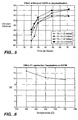
- KSTM #2037 ⁇ -amylase was tested to determine the effects of high liquefaction temperatures. The results shown in Figure 6 demonstrate that the KSTM #2037 ⁇ -amylase produced acceptable DE values of more than 9 to about 13 at temperatures between about 103° C and about at least 107° C.
- KSTM #2037 ⁇ -amylase at 15 ASAA units/g. ds was added to a 35% tsb starch slurry at pH 3.8-4.0. The mixture was passed through a jet cooker maintained at 107°C for 5 min. At a secondary liquefaction stage (95°C, pH 4.0) an additional amount of the KSTM #2037 ⁇ -amylase was added, namely 5 ASAA units/g. dsb. Liquefaction was then continued at 95°C and samples were taken at 30-min.
- Examples 1 through 7 demonstrate the liquefaction of a starch slurry at a pH between 3.5-5.0 with no added calcium using varying concentrations of KSTM #2037 ⁇ -amylase and conventional high and low starch processing temperatures.
- the data further demonstrate that the KSTM #2037 ⁇ -amylase produces acceptable DE amounts in a single low temperature primary liquefaction step at concentrations of about at least 140 ASAA units/g dsb, and in a high temperature single liquefaction step, at concentrations of about 1-10 ASAA units/g.
- the data also shows that the KSTM #2037 ⁇ -amylase may be added in one or more dosages in low temperature liquefaction, and that a first lower dosage of approximately 10 to 35 ASAA units/g followed by a second addition of about 1-10 ASAA units/g may be used to produce acceptable DE amounts in a secondary liquefaction step.
- a first lower dosage of approximately 10 to 35 ASAA units/g followed by a second addition of about 1-10 ASAA units/g may be used to produce acceptable DE amounts in a secondary liquefaction step.
- the enzyme is inactivated, thereby enabling processes such as saccharification to proceed without a further pH adjustment to inactive the enzyme.
- the liquefact is treated thermally to inactivate ⁇ -amylase if saccharification processes are to be carried out, and the pH need not be adjusted for the saccharification enzyme.
- the KSTM #2037 ⁇ -amylase hydrolyzed, liquefied starch sample collected and described in the low temperature liquefaction process described in Example 1 was saccharified using glucoamylase (OptidexTM L-400) and glucoamylase containing different concentrations of pullulanase (OptimaxTM ).
- KSTM #2037 liquefacts were saccharified with the following enzymes: "A" Set using 0.22 units/g of glucoamylase; "B” Set using a mixture of 0.22 units/g of glucoamylase and 0.069 acid stable pullulanase unit/g; "C” Set using a mixture of 0.22 units/g of glucoamylase and 0.147 acid stable pullulanase units/g; “D” Set using a mixture of 0.22 units/g of glucoamylase and 0.330 acid stable pullulanase units/g; and “E” Set using a mixture of 0.22 units of glucoamylase and 0.880 acid stable pullulanase units/g.
Landscapes
- Chemical & Material Sciences (AREA)
- Organic Chemistry (AREA)
- Life Sciences & Earth Sciences (AREA)
- Engineering & Computer Science (AREA)
- Health & Medical Sciences (AREA)
- Zoology (AREA)
- Wood Science & Technology (AREA)
- Genetics & Genomics (AREA)
- Bioinformatics & Cheminformatics (AREA)
- Biotechnology (AREA)
- Microbiology (AREA)
- Biochemistry (AREA)
- General Engineering & Computer Science (AREA)
- General Health & Medical Sciences (AREA)
- General Chemical & Material Sciences (AREA)
- Chemical Kinetics & Catalysis (AREA)
- Biomedical Technology (AREA)
- Molecular Biology (AREA)
- Medicinal Chemistry (AREA)
- Preparation Of Compounds By Using Micro-Organisms (AREA)
Priority Applications (3)
| Application Number | Priority Date | Filing Date | Title |
|---|---|---|---|
| US10/026,288 US20030134395A1 (en) | 2001-12-19 | 2001-12-19 | Process for hydrolyzing starch without pH adjustment |
| CA002415520A CA2415520A1 (fr) | 2001-12-19 | 2003-01-03 | Methode d'hydrolyse de l'amidon sans regulation du ph |
| EP03250023A EP1435391A1 (fr) | 2001-12-19 | 2003-01-06 | Procédé d'hydrolyse de l'amidon sans ajustement du pH |
Applications Claiming Priority (3)
| Application Number | Priority Date | Filing Date | Title |
|---|---|---|---|
| US10/026,288 US20030134395A1 (en) | 2001-12-19 | 2001-12-19 | Process for hydrolyzing starch without pH adjustment |
| CA002415520A CA2415520A1 (fr) | 2001-12-19 | 2003-01-03 | Methode d'hydrolyse de l'amidon sans regulation du ph |
| EP03250023A EP1435391A1 (fr) | 2001-12-19 | 2003-01-06 | Procédé d'hydrolyse de l'amidon sans ajustement du pH |
Publications (1)
| Publication Number | Publication Date |
|---|---|
| EP1435391A1 true EP1435391A1 (fr) | 2004-07-07 |
Family
ID=33032777
Family Applications (1)
| Application Number | Title | Priority Date | Filing Date |
|---|---|---|---|
| EP03250023A Withdrawn EP1435391A1 (fr) | 2001-12-19 | 2003-01-06 | Procédé d'hydrolyse de l'amidon sans ajustement du pH |
Country Status (3)
| Country | Link |
|---|---|
| US (1) | US20030134395A1 (fr) |
| EP (1) | EP1435391A1 (fr) |
| CA (1) | CA2415520A1 (fr) |
Families Citing this family (34)
| Publication number | Priority date | Publication date | Assignee | Title |
|---|---|---|---|---|
| ATE370664T1 (de) * | 2002-05-28 | 2007-09-15 | Cooperatie Avebe U A | Nahrungsmittelzusatz |
| AU2004219649A1 (en) * | 2003-03-10 | 2004-09-23 | Broin And Associates, Inc. | Method for producing ethanol using raw starch |
| US20050233030A1 (en) * | 2004-03-10 | 2005-10-20 | Broin And Associates, Inc. | Methods and systems for producing ethanol using raw starch and fractionation |
| DK1654355T3 (da) * | 2003-06-13 | 2010-08-09 | Danisco | Pseudomonas polypeptidvarianter med ikke-maltogen exoamylaseaktivitet og deres anvendelse til fremstilling af fødevarer |
| KR101286991B1 (ko) * | 2003-07-07 | 2013-07-23 | 듀폰 뉴트리션 바이오사이언시즈 에이피에스 | 엑소-특이성 아밀라아제 폴리펩티드, 그 폴리펩티드를코딩하는 핵산 및 그의 용도 |
| US8143048B2 (en) * | 2003-07-07 | 2012-03-27 | Danisco A/S | Exo-specific amylase polypeptides, nucleic acids encoding those polypeptides and uses thereof |
| US20050239181A1 (en) * | 2004-03-10 | 2005-10-27 | Broin And Associates, Inc. | Continuous process for producing ethanol using raw starch |
| CN104357424A (zh) * | 2004-07-07 | 2015-02-18 | 杜邦营养生物科学有限公司 | 多肽 |
| US20070037267A1 (en) * | 2005-05-02 | 2007-02-15 | Broin And Associates, Inc. | Methods and systems for producing ethanol using raw starch and fractionation |
| JP2008544751A (ja) * | 2005-07-07 | 2008-12-11 | ダニスコ エイ/エス | Pseudomonassaccharophilia由来の修飾アミラーゼ |
| US7919289B2 (en) | 2005-10-10 | 2011-04-05 | Poet Research, Inc. | Methods and systems for producing ethanol using raw starch and selecting plant material |
| US7727755B2 (en) * | 2005-11-02 | 2010-06-01 | Battelle Energy Alliance, Llc | Enzyme and methodology for the treatment of a biomass |
| US8969033B2 (en) * | 2005-11-02 | 2015-03-03 | Battelle Energy Alliance, Llc | Alteration and modulation of protein activity by varying post-translational modification |
| ES2644745T3 (es) * | 2006-06-19 | 2017-11-30 | Dupont Nutrition Biosciences Aps | Polipéptido |
| US9732330B2 (en) | 2008-01-25 | 2017-08-15 | Battelle Energy Alliance, Llc | Methods of combined bioprocessing and related microorganisms, thermophilic and/or acidophilic enzymes, and nucleic acids encoding said enzymes |
| US8492114B2 (en) | 2008-01-25 | 2013-07-23 | Battelle Energy Alliance, Llc | Methods of combined bioprocessing and related microorganisms, thermophilic and/or acidophilic enzymes, and nucleic acids encoding said enzymes |
| MX292528B (es) | 2008-01-25 | 2011-11-22 | Battelle Energy Alliance Llc | Beta-xilosidasas tolerantes al acido y termicas, genes que las codifican, organismos relacionados y metodos. |
| AU2009210489A1 (en) | 2008-01-31 | 2009-08-13 | Battelle Energy Alliance, Llc | Thermophilic and thermoacidophilic biopolymer- degrading genes and enzymes from Alicyclobacillus acidocaldarius and related organisms, methods |
| US8557557B2 (en) | 2008-01-31 | 2013-10-15 | Battelle Energy Alliance, Llc | Thermophilic and thermoacidophilic biopolymer-degrading genes and enzymes from Alicyclobacillus acidocaldarius and related organisms, methods |
| US8426185B2 (en) | 2008-01-31 | 2013-04-23 | Battelle Energy Alliance, Llc | Thermophilic and thermoacidophilic biopolymer-degrading genes and enzymes from Alicyclobacillus acidocaldarius and related organisms, methods |
| US8497110B2 (en) | 2008-01-31 | 2013-07-30 | Battelle Energy Alliance, Llc | Thermophilic and thermoacidophilic biopolymer-degrading genes and enzymes from alicyclobacillus acidocaldarius and related organisms, methods |
| WO2009137145A2 (fr) | 2008-02-22 | 2009-11-12 | Battelle Energy Alliance, Llc | Contrôle de la transcription chez alicyclobacillus acidocaldarius et gènes, protéines et procédés associés |
| AU2009251766A1 (en) * | 2008-02-26 | 2009-12-03 | Battelle Energy Alliance, Llc | Thermophilic and thermoacidophilic sugar transporter genes and enzymes from Alicyclobacillus acidocaldarius and related organisms |
| MX2010008249A (es) * | 2008-02-27 | 2010-11-12 | Battelle Energy Alliance Llc | Genes de glicosilacion termofilica y termoacidofilica y enzimas a partir de alicyclobacillus acidocaldarius y metodos, organismos relacionados. |
| MX2010009243A (es) * | 2008-02-28 | 2010-11-30 | Battelle Energy Alliance Llc | Genes de metabolismo termofilico y termoacidofilico y enzimas a partir de alicyclobacillus acidocaldarius, metodos y organismos relacionados. |
| US8450094B1 (en) | 2009-03-03 | 2013-05-28 | Poet Research, Inc. | System for management of yeast to facilitate the production of ethanol |
| WO2010102060A2 (fr) * | 2009-03-03 | 2010-09-10 | Poet Research, Inc. | Système de prétraitement d'une biomasse pour la production d'éthanol |
| US9068206B1 (en) | 2009-03-03 | 2015-06-30 | Poet Research, Inc. | System for treatment of biomass to facilitate the production of ethanol |
| HUE025623T2 (en) | 2009-03-03 | 2016-04-28 | Poet Res Inc | A method of fermenting biomass for ethanol production |
| US20110275135A1 (en) | 2010-05-05 | 2011-11-10 | Battelle Energy Alliance, Llc | Genetic elements, proteins, and associated methods including application of additional genetic information to gram (+) thermoacidophiles |
| US9315831B2 (en) * | 2012-03-30 | 2016-04-19 | Danisco Us Inc. | Direct starch to fermentable sugar as feedstock for the production of isoprene, isoprenoid precursor molecules, and/or isoprenoids |
| CN114592018B (zh) * | 2020-12-03 | 2024-09-03 | 江苏省奥谷生物科技有限公司 | 一种利用玉米淀粉加工废渣制备高麦芽糖浆和膳食纤维的生产方法 |
| CN117587084A (zh) * | 2023-11-29 | 2024-02-23 | 山东省鲁洲食品集团有限公司 | 一种可减少麦芽糖浆生产糖化过程pH下降的方法 |
| CN119410727B (zh) * | 2025-01-07 | 2025-05-06 | 山东天力药业有限公司 | 一种由淀粉制备葡萄糖的方法 |
Citations (2)
| Publication number | Priority date | Publication date | Assignee | Title |
|---|---|---|---|---|
| JPH0466084A (ja) * | 1990-07-04 | 1992-03-02 | Showa Denko Kk | 酸性アミラーゼ及びその製造法 |
| JPH10136979A (ja) * | 1996-11-13 | 1998-05-26 | Nagase Seikagaku Kogyo Kk | 新規酸性α−アミラーゼ及びその製造法 |
-
2001
- 2001-12-19 US US10/026,288 patent/US20030134395A1/en not_active Abandoned
-
2003
- 2003-01-03 CA CA002415520A patent/CA2415520A1/fr not_active Abandoned
- 2003-01-06 EP EP03250023A patent/EP1435391A1/fr not_active Withdrawn
Patent Citations (2)
| Publication number | Priority date | Publication date | Assignee | Title |
|---|---|---|---|---|
| JPH0466084A (ja) * | 1990-07-04 | 1992-03-02 | Showa Denko Kk | 酸性アミラーゼ及びその製造法 |
| JPH10136979A (ja) * | 1996-11-13 | 1998-05-26 | Nagase Seikagaku Kogyo Kk | 新規酸性α−アミラーゼ及びその製造法 |
Non-Patent Citations (3)
| Title |
|---|
| KANNO M: "A BACILLUS ACIDOCALDARIUS ALPHA-AMYLASE THAT IS HIGHLY STABLE TO HEAT UNDER ACIDIC CONDITIONS", AGRICULTURAL AND BIOLOGICAL CHEMISTRY, JAPAN SOC. FOR BIOSCIENCE, BIOTECHNOLOGY AND AGROCHEM. TOKYO, JP, vol. 50, no. 1, 1986, pages 23 - 31, XP002028773, ISSN: 0002-1369 * |
| PATENT ABSTRACTS OF JAPAN vol. 016, no. 269 (C - 0952) 17 June 1992 (1992-06-17) * |
| PATENT ABSTRACTS OF JAPAN vol. 1998, no. 10 31 August 1998 (1998-08-31) * |
Also Published As
| Publication number | Publication date |
|---|---|
| CA2415520A1 (fr) | 2004-07-03 |
| US20030134395A1 (en) | 2003-07-17 |
Similar Documents
| Publication | Publication Date | Title |
|---|---|---|
| EP1435391A1 (fr) | Procédé d'hydrolyse de l'amidon sans ajustement du pH | |
| US20080145900A1 (en) | Process for hydrolyzing starch without pH adjustment | |
| EP0464095B1 (fr) | Nouvelle alpha - amylase hyperthermostable | |
| JP5463146B2 (ja) | アルファ‐アミラーゼを有するフィターゼを用いるデンプン加水分解 | |
| RU2315811C2 (ru) | Способ обработки крахмала | |
| US5756714A (en) | Method for liquefying starch | |
| EP0140410B1 (fr) | Produit enzymatique et son application dans la saccharification de l'amidon | |
| EP2561083B1 (fr) | Utilisation d'une Humicola grisea glucoamylase dans un procédé SSF de pH neutre | |
| EP0856063B1 (fr) | Procede de liquefaction de l'amidon | |
| JPH0740939B2 (ja) | 粒状澱粉から直接グルコースを生成する方法、同方法に用いる酵素製剤 | |
| US20150037844A1 (en) | Liquefaction and saccharification of granular starch at high concentration | |
| US20150111259A1 (en) | Method for Making High Maltose Syrup | |
| EP2884853B1 (fr) | Variants de trichoderma reesei glucoamylase résistants à l'absence d'activité associée à l'oxydation et leur utilisation | |
| JP2014512829A (ja) | デンプンを液化及び糖化して高密度グルコースシロップを調製するための単一pHプロセス | |
| RU2706297C2 (ru) | Композиции для получения глюкозных сиропов | |
| Atichokudomchai et al. | Reaction pattern of a novel thermostable α-amylase | |
| US20150152458A1 (en) | Low temperature method for making high glucose syrup | |
| WO2018226569A1 (fr) | Utilisation de la bétaïne pour stabiliser et/ou augmenter l'activité d'enzymes dans des environnements stressants | |
| MacGregor | Limit dextrinase/pullulanase | |
| Zorov et al. | Hydrolysis of wheat flour with amylase preparations and individual enzymes |
Legal Events
| Date | Code | Title | Description |
|---|---|---|---|
| PUAI | Public reference made under article 153(3) epc to a published international application that has entered the european phase |
Free format text: ORIGINAL CODE: 0009012 |
|
| AK | Designated contracting states |
Kind code of ref document: A1 Designated state(s): AT BE BG CH CY CZ DE DK EE ES FI FR GB GR HU IE IT LI LU MC NL PT SE SI SK TR |
|
| AX | Request for extension of the european patent |
Extension state: AL LT LV MK RO |
|
| AKX | Designation fees paid |
Designated state(s): AT BE BG CH CY CZ DE DK EE ES FI FR GB GR HU IE IT LI LU MC NL PT SE SI SK TR |
|
| STAA | Information on the status of an ep patent application or granted ep patent |
Free format text: STATUS: THE APPLICATION IS DEEMED TO BE WITHDRAWN |
|
| 18D | Application deemed to be withdrawn |
Effective date: 20050108 |