EP1435700A2 - Optisches Übertragungssystem zur Optimierung der Vorspannung einer Laserdiode für ein SCM analoges optisches Signal - Google Patents
Optisches Übertragungssystem zur Optimierung der Vorspannung einer Laserdiode für ein SCM analoges optisches Signal Download PDFInfo
- Publication number
- EP1435700A2 EP1435700A2 EP04000022A EP04000022A EP1435700A2 EP 1435700 A2 EP1435700 A2 EP 1435700A2 EP 04000022 A EP04000022 A EP 04000022A EP 04000022 A EP04000022 A EP 04000022A EP 1435700 A2 EP1435700 A2 EP 1435700A2
- Authority
- EP
- European Patent Office
- Prior art keywords
- bias
- optical
- laser diode
- electric
- section
- Prior art date
- Legal status (The legal status is an assumption and is not a legal conclusion. Google has not performed a legal analysis and makes no representation as to the accuracy of the status listed.)
- Withdrawn
Links
Images


Classifications
-
- H—ELECTRICITY
- H04—ELECTRIC COMMUNICATION TECHNIQUE
- H04B—TRANSMISSION
- H04B10/00—Transmission systems employing electromagnetic waves other than radio-waves, e.g. infrared, visible or ultraviolet light, or employing corpuscular radiation, e.g. quantum communication
- H04B10/25—Arrangements specific to fibre transmission
-
- H—ELECTRICITY
- H04—ELECTRIC COMMUNICATION TECHNIQUE
- H04B—TRANSMISSION
- H04B10/00—Transmission systems employing electromagnetic waves other than radio-waves, e.g. infrared, visible or ultraviolet light, or employing corpuscular radiation, e.g. quantum communication
- H04B10/50—Transmitters
- H04B10/501—Structural aspects
- H04B10/503—Laser transmitters
- H04B10/504—Laser transmitters using direct modulation
-
- H—ELECTRICITY
- H04—ELECTRIC COMMUNICATION TECHNIQUE
- H04B—TRANSMISSION
- H04B10/00—Transmission systems employing electromagnetic waves other than radio-waves, e.g. infrared, visible or ultraviolet light, or employing corpuscular radiation, e.g. quantum communication
- H04B10/50—Transmitters
-
- H—ELECTRICITY
- H04—ELECTRIC COMMUNICATION TECHNIQUE
- H04B—TRANSMISSION
- H04B10/00—Transmission systems employing electromagnetic waves other than radio-waves, e.g. infrared, visible or ultraviolet light, or employing corpuscular radiation, e.g. quantum communication
- H04B10/50—Transmitters
- H04B10/58—Compensation for non-linear transmitter output
-
- H—ELECTRICITY
- H04—ELECTRIC COMMUNICATION TECHNIQUE
- H04B—TRANSMISSION
- H04B10/00—Transmission systems employing electromagnetic waves other than radio-waves, e.g. infrared, visible or ultraviolet light, or employing corpuscular radiation, e.g. quantum communication
- H04B10/60—Receivers
Definitions
- the present invention relates to a subcarrier multiplexing (SCM) analog optical transmission system, and more particularly to an SCM analog optical transmission system for optimizing the bias of a laser diode that converts an electric signal into an optical signal.
- SCM subcarrier multiplexing
- a composite second order (CSO) value is changed in accordance with the set bias of a laser diode for converting an electric signal into an optical signal to be transmitted.
- the CSO value acts as an even-order nonlinear noise component of a second order or higher with respect to a carrier signal and deteriorates a carrier-to-noise (CNR) ratio of the carrier signal.
- CNR carrier-to-noise
- the CSO tend to serve as noise factors in a signal distribution of a wide band, such as a spectrum of a cable television signal. Accordingly, in order to reduce the CSO in the SCM analog optical transmission, it is necessary to optimize the bias of the laser diode.
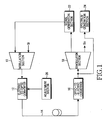
- FIG. 1 is a block diagram illustrating a conventional optical transmission system and includes a modulation section 10, an electric-to-optic converter 12, an adjustment section 26, a optic-to-electric converter 16, a demodulation section 18, a spectrum generation section 24, and an signal generation section 22.
- the modulation section 10 performs a subcarrier multi-modulation of baseband electric signals.
- pulse signals generated from the error testing section 22 are inputted to the modulation section 10.
- the electric-to-optic converter 12 converts the multi-modulated electric signals into optical signals according to the bias of a laser diode and transmits the optical signals through an optical line 14.
- the adjustment section 26 adjusts manually the bias of the laser diode, which converts the electric signals into the optical signals.
- the optic-to-electric converter 16 converts the optical signals transmitted through the optical line 14 into the electric signals.
- the demodulation section 18 demodulates the converted electric signals corresponding to the modulation operation of the modulation section 10.
- the spectrum generation section 24 monitors the carrier-to-noise ratio (CNR) from the electric signals converted by the optic-to-electric converter 16.
- CNR carrier-to-noise ratio
- the electric signals demodulated by the demodulation section 18 is fed to the signal generation section 22 to test bit error rate.
- the error testing section 22 in turn forwards the detected error rate to the modulation section 10.
- the signal generation section 22 tests the bit error rate in regard to the demodulated electric signal.
- the spectrum generation section 24 displays the electric signals converted by the optic-to-electric converter 16 as spectra.
- the present invention provides a SCM analog optical transmission system that can simply and easily optimize the bias of a laser diode.
- One aspect of the present invention to provide a SCM analog optical transmission system that can adjust the bias of a laser diode for optimization accurately.
- a SCM analog optical transmission system for optimizing a bias of a laser diode which includes: an optical transmitter for converting baseband electric signals into an optical signal using a laser diode, for converting the electric signals into the optical signal according to the set bias, and for outputting the optical signal through an optical fiber, an optical receiver for converting the optical signal transmitted from the optical transmitter into the baseband electric signals; a recovery unit for detecting an error generated according to the bias of the laser diode on the basis of the electric signals converted by the optical receiver; and, a bias adjuster for optimally adjusting the bias of the laser diode on the basis of a value of the error detected by the recovery unit.
- the optical transmitter includes a modulation section for modulating a plurality of baseband electric signals by combining the baseband electric signals with a subcarrier, a multiplexer for multiplexing the plurality of electric signals modulated by the modulation section into one electric signal, and an electric-to-optic converter for converting the electric signal multiplexed by the multiplexer into an optical signal on the basis of the bias of the laser diode set according to the control of the bias adjuster.
- the optical receiver includes a optic-to-electric converter for converting the optical signal transmitted from the electric-to-optic converter into an electric signal of a set level, a demultiplexer for demultiplexing the electric signal converted by the optic-to-electric converter into a plurality of electric signals, a demodulation section for demodulating the baseband electric signals by detecting the subcarrier from the plurality of demultiplexed electric signals, and a selection section for outputting the plurality of demultiplexed electric signals, selecting a digital electric signal modulated by the modulation section among the plurality of electric signals.
- the recovery unit includes a clock recovery section for recovering a sampling clock with respect to the digital electric signal outputted from the selection section, a data recovery section for recovering data of the electric signal outputted from the selection section through the restored sampling clock and an eye-open parameter, and an error detection section for detecting the error value for the bias of the laser diode with respect to the electric signal by comparing a certain signal distributed in the eye-open parameter with a specified phase value and voltage value with a threshold value fixedly set in the eye-open parameter.
- the recovery unit comprises a "VSC8123" chip.
- the bias adjuster includes a storage section for storing the error value for the electric signal detected by the error detection section, a control section for controlling an operation for adjusting the bias of the laser diode and calculating an optimum bias value of the laser diode on the basis of the error value stored in the storage section, and a digital-to-analog converter for optimally adjusting the bias of the laser diode by converting the optimum value into an analog signal.
- the bias of the laser diode can be more adjusted easily to an optimum value by detecting the error of the converted and transmit electric signal according to the bias of the laser diode, while optimizing the bias of the laser diode automatically on the basis of an intermediate value of a bias section in which an eye-opening area becomes maximum. Moreover, a more favorable optical signal can be created and restored by optimizing the bias of the laser diode automatically whenever an error value generated from the optical signal according to the bias of the laser diode is changed.
- FIG. 2 is a block diagram of an optical transmission system for optimizing the bias of a laser diode during an SCM analog optical transmission according to the embodiment of the present invention.
- the optical transmission system includes an optical transmitter 100, an optical receiver 120, a recovery unit 140, and a bias adjuster 160.
- the optical transmitter 100 converts a baseband electric signal into an optical signal using a laser diode (not illustrated) according to the set bias of the laser diode and then transmits the optical signal to the optical receiver 120 through an optical line 50.
- the optical receiver 120 converts the optical signal received from the optical transmitter 100 through the optical line 50 into the baseband electric signal.
- the recovery unit 140 detects an error generated according to the bias of the laser diode on the basis of the electric signal converted by the optical receiver 120.
- the bias adjuster 160 adjusts the bias of the laser diode optimally so that correct conversion of the electric signal into the optical signal can be achieved in the optical transmitter 100.
- the bias adjuster 160 calculates an intermediate value of a bias section in which an eye-opening area is maximum according to the error detected by the recovery unit 140, then adjusts the bias of the laser diode optimally based on the calculated intermediate value.
- the bias of the laser diode can be adjusted easily by detecting the error of the transmitted optical signal and then optimizing the bias of the laser diode automatically on the basis of the intermediate value of the bias section in which the eye-opening area becomes maximum (explained later).
- the optical receiver 120 receives the optical signal in which the bias of the laser diode is adjusted automatically in consideration of the optical signal transmission state of the optical line 50 (explained later), thus a more favorable optical signal can be received and restored.
- the optical transmitter 100 includes a modulation section 102, a multiplexer (MUX) 104, and an electric-to-optic converter 106.
- the modulation section 102 modulates a plurality of baseband electric signals by combining the baseband electric signals with a subcarrier.
- the multiplexer 104 multiplexes the plurality of electric signals modulated by the modulation section 102 into one electric signal.
- the electric-to-optic converter 106 converts the electric signal multiplexed by the multiplexer 104 into an optical signal on the basis of the bias of the laser diode set according to the control of the bias adjuster 160. Thereafter, the optical signal converted by the electric-to-optic converter 106 is transmitted to the optical receiver 120 through the optical line 50.
- the optical receiver 120 includes a optic-to-electric converter 122, a demultiplexer (DEMUX) 124, a demodulation section 126, and a selection section 128.
- the optic-to-electric converter 122 converts the optical signal received through the optical line 50 into an electric signal.
- the demultiplexer 124 demultiplexes the electric signal converted by the optic-to-electric converter 122 into a plurality of electric signals.
- the demodulation section 126 demodulates the baseband electric signals by detecting the subcarrier from the plurality of demultiplexed electric signals.
- the selection section 128 outputs the plurality of electric signals demodulated by the demodulation section 126, and selects a digital signal modulated by the modulation section 102 among the plurality of electric signals.
- the recovery unit 140 detects the error on the basis of the digital signal selected by and outputted from the selection section 102.
- the recovery unit 140 includes a clock recovery section 142, a data recovery section 144, and an error detection section 146.
- the clock recovery section 142 restores a sampling clock with respect to the baseband digital signal outputted from the selection section 128.
- the data recovery section 144 restores the electric signal data outputted from the selection section 128, by forming an eye-opening parameter having a voltage value and a phase value as its variable with respect to the electric signal outputted from the selection section 128and by comparing the size of the electric signal with a threshold value set in the eye-open parameter.
- eye-opening is for naming a shape of a wave-shaped figured displayed in an oscilloscope screen.
- an oscilloscope device typically employs acquisition channels to sample the input data, both of which an be varied in voltage and phase across the data eye
- the outputs of each channel can be compared, and any differences logged into a counter. Errors, which is the differences between the channels, can be counted over predetermined intervals so the final error count can be translated into an error rate.
- the other channel can be used to scan the data eye and determine the bit error rate relative to the in-service channel.
- the eye-opening area illustrates the operation of acquisition channels and its related bit error rate.
- the data recovery section 144 is comprised of an "in-service channel” that outputs the restored data as its output, and an "out-of-service channel” for detecting the error generated according to the bias error of the laser diode.
- the error detection section 146 detects the error with respect to the "in-service channel” as changing the voltage value and the phase value of the "out-of-service channel.” At this time, the error detection section 146 determines the error when the data value of the fixed "in-service channel" is different from that of the variable "out-of-service channel".
- a "VSC8123" chip of "VITESSE” Company may used as the recovery unit 140.
- the bias adjuster 160 includes a control section 162, a storage section 164, and a digital-to-analog converter (DAC) 166.
- the control section 162 controls the adjustment of the bias of the laser diode in the bias adjuster 160.
- the storage section 164 stores the error value of the electric signal detected by the error detection section 146.
- the DAC 166 adjusts the bias of the laser diode of the electric-to-optic converter 106 by converting the input digital signal into the analog signal and inputting the analog signal to the laser diode of the electric-to-optic converter 106.
- the control section 162 compares and analyzes the eye-opening area on the basis of the error value stored in the storage section 164.
- the eye opening has a larger area in a section in which the linearity of the laser diode is good. This eye-opening area is changed according to the bias applied to the laser diode. The intermediate point of the eye opening calculated by the control section 162 becomes the optimum value of the bias of the laser diode.
- control section 162 transmits to DAC 166 the intermediate point value of the bias section of the laser diode, in which the electric signal is converted into the optical signal having the maximum eye-opening area that is a digital signal and is obtained by the calculated error value.
- the DAC 166 converts the digital signal that corresponds to the intermediate point value into the analog signal and applies the analog signal converted corresponding to the intermediate point value to the electric-to-optic converter 106.
- the electric-to-optic converter 106 optimizes the bias of the laser diode according to the intermediate point value of the bias section of the laser diode that corresponds to the maximum eye opening.
- FIG. 3 is a view illustrating in detail the modulation section 102 of FIG. 2.
- the modulation section 102 includes n combining sections 102a, 102b, ... , 102n for modulating the baseband electric signals by combining n baseband electric signals with n subcarriers.
- the electric signals modulated by the n subcarriers are applied to the multiplexer 104 to be multiplexed into one electric signal.
- FIG. 4 is a view illustrating in detail the demodulation section 126 of FIG. 2.
- the demodulation section 126 includes n demodulation sections 126a, 126b, ... , 126n for demodulating the electric signals by detecting the subcarriers from n electric signals demultiplexed by the demultiplexer.
- the demodulated baseband electric signals are selectively outputted to the clock recovery section 142, the data recovery section 144, and the outside by the selection section 128.
- the bias optimization of the laser diode can be more easily performed by detecting the error generated according to the bias of the laser diode and automatically optimizing the bias of the laser diode on the basis of the intermediate value of the bias section in which the eye-opening area becomes maximum.
- the optical transmission system includes the optimization function of the bias of the laser diode, the modularity for the SCM analog optical transmission becomes possible.
- a more optimal optical signal can be created and restored by automatically and optimally adjusting the bias of the laser diode whenever the error values generated in the optical signal is changed.
Landscapes
- Physics & Mathematics (AREA)
- Electromagnetism (AREA)
- Engineering & Computer Science (AREA)
- Computer Networks & Wireless Communication (AREA)
- Signal Processing (AREA)
- Nonlinear Science (AREA)
- Optics & Photonics (AREA)
- Optical Communication System (AREA)
Applications Claiming Priority (2)
| Application Number | Priority Date | Filing Date | Title |
|---|---|---|---|
| KR2003000459 | 2003-01-04 | ||
| KR10-2003-0000459A KR100516662B1 (ko) | 2003-01-04 | 2003-01-04 | 에스씨엠 아날로그 광전송시 레이저다이오드의 바이어스를최적화하기 위한 광전송 시스템 |
Publications (2)
| Publication Number | Publication Date |
|---|---|
| EP1435700A2 true EP1435700A2 (de) | 2004-07-07 |
| EP1435700A3 EP1435700A3 (de) | 2007-11-14 |
Family
ID=32501480
Family Applications (1)
| Application Number | Title | Priority Date | Filing Date |
|---|---|---|---|
| EP04000022A Withdrawn EP1435700A3 (de) | 2003-01-04 | 2004-01-02 | Optisches Übertragungssystem zur Optimierung der Vorspannung einer Laserdiode für ein SCM analoges optisches Signal |
Country Status (4)
| Country | Link |
|---|---|
| US (1) | US7218863B2 (de) |
| EP (1) | EP1435700A3 (de) |
| JP (1) | JP4077795B2 (de) |
| KR (1) | KR100516662B1 (de) |
Families Citing this family (24)
| Publication number | Priority date | Publication date | Assignee | Title |
|---|---|---|---|---|
| TWI244349B (en) * | 2002-05-01 | 2005-11-21 | Interdigital Tech Corp | Point to multi-point services using high speed shared channels in wireless communication systems |
| CN100416968C (zh) * | 2005-12-12 | 2008-09-03 | 天津理工大学 | 基于单片机和组态的电容器投切监控系统 |
| JP4983178B2 (ja) * | 2006-09-15 | 2012-07-25 | 富士通株式会社 | 差動四位相偏移変調光受信回路 |
| WO2015001656A1 (ja) | 2013-07-04 | 2015-01-08 | 富士通株式会社 | 光信号処理装置、光信号処理方法及び光信号処理プログラム |
| KR102029148B1 (ko) * | 2013-09-02 | 2019-10-07 | 에스케이하이닉스 주식회사 | 반도체 장치 및 그의 동작 방법 |
| JP6304262B2 (ja) | 2013-12-13 | 2018-04-04 | 富士通株式会社 | マルチキャリア光伝送システム、マルチキャリア光伝送方法、光送信器、及び、光受信器 |
| EP3342068A1 (de) * | 2015-08-24 | 2018-07-04 | Telefonaktiebolaget LM Ericsson (PUBL) | Steuerung eines optischen senders in einem funk-über-faser-system |
| CN106572040B (zh) * | 2015-10-12 | 2020-04-21 | 富士通株式会社 | 发射端调制器的偏置漂移估计装置、补偿装置以及接收机 |
| US9912470B2 (en) * | 2016-03-28 | 2018-03-06 | Maxim Integrated Products, Inc. | System and method for wide-band adaptive equalization and eye opening monitoring with link quality detection |
| JP2020088814A (ja) | 2018-11-30 | 2020-06-04 | 富士通オプティカルコンポーネンツ株式会社 | 光伝送装置、光伝送システム及び光伝送方法 |
| US20210211201A9 (en) * | 2019-03-04 | 2021-07-08 | Infinera Corporation | Frequency division multiple access optical subcarriers |
| DE112021003211T5 (de) | 2020-06-11 | 2023-04-27 | Tektronix, Inc. | System und Verfahren für zyklische Schleifenbildwiedergaben eines mehrstufigen Signals für Messungen und maschinelles Lernen |
| DE112022000932T5 (de) * | 2021-02-03 | 2023-11-16 | Tektronix, Inc. | Augen-klassen-separator mit überlapp, zusammgesetzte und dynamisiche augen-trigger für menschen und maschinelles lernen |
| US12442852B2 (en) | 2022-03-30 | 2025-10-14 | Tektronix, Inc. | Tuning a device under test using parallel pipeline machine learning assistance |
| US11907090B2 (en) | 2021-08-12 | 2024-02-20 | Tektronix, Inc. | Machine learning for taps to accelerate TDECQ and other measurements |
| US20240235669A1 (en) * | 2021-03-24 | 2024-07-11 | Tektronix, Inc. | Systems and methods for tuning and measuring a device under test using machine learning |
| US11923896B2 (en) * | 2021-03-24 | 2024-03-05 | Tektronix, Inc. | Optical transceiver tuning using machine learning |
| US11923895B2 (en) | 2021-03-24 | 2024-03-05 | Tektronix, Inc. | Optical transmitter tuning using machine learning and reference parameters |
| US11940889B2 (en) | 2021-08-12 | 2024-03-26 | Tektronix, Inc. | Combined TDECQ measurement and transmitter tuning using machine learning |
| US12146914B2 (en) | 2021-05-18 | 2024-11-19 | Tektronix, Inc. | Bit error ratio estimation using machine learning |
| US12571841B2 (en) | 2021-06-04 | 2026-03-10 | Tektronix, Inc. | General digital signal processing waveform machine learning control application |
| US12416662B2 (en) | 2022-01-14 | 2025-09-16 | Tektronix, Inc. | Machine learning model training using de-noised data and model prediction with noise correction |
| US12596145B2 (en) | 2022-03-30 | 2026-04-07 | Tektronix, Inc. | Optical tuning test system using parallel oven pipelines with parallel instrument channels and machine learning assistance |
| US12687563B2 (en) | 2022-06-15 | 2026-07-21 | Tektronix, Inc. | Separating noise to increase machine learning prediction accuracy in a test and measurement system |
Family Cites Families (6)
| Publication number | Priority date | Publication date | Assignee | Title |
|---|---|---|---|---|
| US5343324A (en) * | 1991-11-15 | 1994-08-30 | Amoco Corporation | Bias control and method for electro-optic modulators |
| WO1995008879A1 (en) * | 1993-09-22 | 1995-03-30 | Massachussetts Institute Of Technology | Error-rate based laser drive control |
| JP3413304B2 (ja) | 1995-01-31 | 2003-06-03 | 富士通株式会社 | ハイブリッドscm光伝送装置 |
| KR100343141B1 (ko) * | 1999-12-29 | 2002-07-05 | 윤종용 | 전송 에러를 보상하는 광 전송 시스템 |
| JP3765967B2 (ja) * | 2000-06-30 | 2006-04-12 | 三菱電機株式会社 | 光送信装置およびこれに用いる光変調器のバイアス電圧制御方法 |
| US6687451B1 (en) * | 2000-09-27 | 2004-02-03 | Alcatel | Method and system for first-order RF amplitude and bias control of a modulator |
-
2003
- 2003-01-04 KR KR10-2003-0000459A patent/KR100516662B1/ko not_active Expired - Fee Related
- 2003-08-11 US US10/638,453 patent/US7218863B2/en not_active Expired - Fee Related
-
2004
- 2004-01-02 EP EP04000022A patent/EP1435700A3/de not_active Withdrawn
- 2004-01-05 JP JP2004000646A patent/JP4077795B2/ja not_active Expired - Fee Related
Also Published As
| Publication number | Publication date |
|---|---|
| US20040131365A1 (en) | 2004-07-08 |
| JP4077795B2 (ja) | 2008-04-23 |
| EP1435700A3 (de) | 2007-11-14 |
| JP2004215277A (ja) | 2004-07-29 |
| KR20040063054A (ko) | 2004-07-12 |
| US7218863B2 (en) | 2007-05-15 |
| KR100516662B1 (ko) | 2005-09-22 |
Similar Documents
| Publication | Publication Date | Title |
|---|---|---|
| US7218863B2 (en) | Optical transmission system for optimizing bias of laser diode for SCM analog optical signal | |
| JP3413304B2 (ja) | ハイブリッドscm光伝送装置 | |
| US5351148A (en) | Optical transmission system | |
| EP0901617B1 (de) | Messung der verzerrung in optischen übertragungssystemen durch augenmaskenmessung | |
| US7664403B2 (en) | Synchronizing nodes in an optical communications system utilizing frequency division multiplexing | |
| US7016308B1 (en) | Digital return path for hybrid fiber/coax network | |
| JP6613761B2 (ja) | 光伝送システム、波長可変光フィルタの制御装置及び制御方法 | |
| EP3043496A1 (de) | Vorrichtung und verfahren zur übertragung von mehrträgersignalen | |
| US20100135656A1 (en) | Optical orthogonal frequency division multiplexed communications with nonlinearity compensation | |
| US20050265730A1 (en) | Optical transmission system, and trasmitter, receiver and signal level adjustment method for use therein | |
| US7912370B2 (en) | Optical power measurement apparatus and optical power measurement method | |
| US20040218919A1 (en) | Method and apparatus for Q-factor monitoring using forward error correction coding | |
| US7321733B2 (en) | Split-band optical transmission system and optical transmission method used therein | |
| EP1239623B1 (de) | Optisches Wellenlängenmultiplexsignal Überwachungsgerät | |
| JP3974984B2 (ja) | マルチポイント光送信システム | |
| JP3338013B2 (ja) | 光伝送システム及びこのシステムに用いる光送信装置 | |
| WO2021007706A1 (en) | Method and apparatus for an optical transceiver | |
| US6697577B1 (en) | Method and apparatus for in-service optimization of the performance of an optical transmission system | |
| US7062172B2 (en) | Optical transmission system for frequency-multiplexed signal | |
| US6118774A (en) | Information signal communicating apparatus method and system | |
| JPH06303196A (ja) | 光伝送方式 | |
| US20040135993A1 (en) | Method for measuring the optical signal-to-noise ratios OSNR in a wavelength division multiplex (WDM) transmission system | |
| EP4224743A1 (de) | Leistungsüberwachungsvorrichtung, verfahren zur leistungsüberwachung eines optischen systems und optisches signalnetzwerk | |
| US20250119215A1 (en) | Optical signal relay apparatus and optical signal relay method | |
| JP2930011B2 (ja) | 光ネットワークシステム |
Legal Events
| Date | Code | Title | Description |
|---|---|---|---|
| PUAI | Public reference made under article 153(3) epc to a published international application that has entered the european phase |
Free format text: ORIGINAL CODE: 0009012 |
|
| 17P | Request for examination filed |
Effective date: 20040102 |
|
| AK | Designated contracting states |
Kind code of ref document: A2 Designated state(s): AT BE BG CH CY CZ DE DK EE ES FI FR GB GR HU IE IT LI LU MC NL PT RO SE SI SK TR |
|
| AX | Request for extension of the european patent |
Extension state: AL LT LV MK |
|
| PUAL | Search report despatched |
Free format text: ORIGINAL CODE: 0009013 |
|
| AK | Designated contracting states |
Kind code of ref document: A3 Designated state(s): AT BE BG CH CY CZ DE DK EE ES FI FR GB GR HU IE IT LI LU MC NL PT RO SE SI SK TR |
|
| AX | Request for extension of the european patent |
Extension state: AL LT LV MK |
|
| AKX | Designation fees paid |
Designated state(s): DE FR GB |
|
| 17Q | First examination report despatched |
Effective date: 20090427 |
|
| STAA | Information on the status of an ep patent application or granted ep patent |
Free format text: STATUS: THE APPLICATION IS DEEMED TO BE WITHDRAWN |
|
| 18D | Application deemed to be withdrawn |
Effective date: 20090908 |