EP1436420B1 - Systeme de bandelette reactive a tremper et methode d'essai pour detecter et/ou analyser des sequences d'acide nucleique specifiques - Google Patents
Systeme de bandelette reactive a tremper et methode d'essai pour detecter et/ou analyser des sequences d'acide nucleique specifiques Download PDFInfo
- Publication number
- EP1436420B1 EP1436420B1 EP02765125A EP02765125A EP1436420B1 EP 1436420 B1 EP1436420 B1 EP 1436420B1 EP 02765125 A EP02765125 A EP 02765125A EP 02765125 A EP02765125 A EP 02765125A EP 1436420 B1 EP1436420 B1 EP 1436420B1
- Authority
- EP
- European Patent Office
- Prior art keywords
- test strip
- nucleic acid
- oligonucleotide
- area
- assay system
- Prior art date
- Legal status (The legal status is an assumption and is not a legal conclusion. Google has not performed a legal analysis and makes no representation as to the accuracy of the status listed.)
- Expired - Lifetime
Links
- 238000012360 testing method Methods 0.000 title claims abstract description 90
- 238000003556 assay Methods 0.000 title claims abstract description 69
- 150000007523 nucleic acids Chemical group 0.000 title claims abstract description 43
- 238000001514 detection method Methods 0.000 title claims abstract description 36
- 238000000034 method Methods 0.000 title claims abstract description 26
- 238000009396 hybridization Methods 0.000 claims abstract description 45
- 238000007598 dipping method Methods 0.000 claims abstract description 44
- 108091034117 Oligonucleotide Proteins 0.000 claims abstract description 42
- 239000002245 particle Substances 0.000 claims abstract description 38
- PCHJSUWPFVWCPO-UHFFFAOYSA-N gold Chemical compound [Au] PCHJSUWPFVWCPO-UHFFFAOYSA-N 0.000 claims abstract description 32
- 108091028043 Nucleic acid sequence Proteins 0.000 claims abstract description 16
- 108010090804 Streptavidin Proteins 0.000 claims abstract description 15
- 238000011161 development Methods 0.000 claims abstract description 11
- JLCPHMBAVCMARE-UHFFFAOYSA-N [3-[[3-[[3-[[3-[[3-[[3-[[3-[[3-[[3-[[3-[[3-[[5-(2-amino-6-oxo-1H-purin-9-yl)-3-[[3-[[3-[[3-[[3-[[3-[[5-(2-amino-6-oxo-1H-purin-9-yl)-3-[[5-(2-amino-6-oxo-1H-purin-9-yl)-3-hydroxyoxolan-2-yl]methoxy-hydroxyphosphoryl]oxyoxolan-2-yl]methoxy-hydroxyphosphoryl]oxy-5-(5-methyl-2,4-dioxopyrimidin-1-yl)oxolan-2-yl]methoxy-hydroxyphosphoryl]oxy-5-(6-aminopurin-9-yl)oxolan-2-yl]methoxy-hydroxyphosphoryl]oxy-5-(6-aminopurin-9-yl)oxolan-2-yl]methoxy-hydroxyphosphoryl]oxy-5-(6-aminopurin-9-yl)oxolan-2-yl]methoxy-hydroxyphosphoryl]oxy-5-(6-aminopurin-9-yl)oxolan-2-yl]methoxy-hydroxyphosphoryl]oxyoxolan-2-yl]methoxy-hydroxyphosphoryl]oxy-5-(5-methyl-2,4-dioxopyrimidin-1-yl)oxolan-2-yl]methoxy-hydroxyphosphoryl]oxy-5-(4-amino-2-oxopyrimidin-1-yl)oxolan-2-yl]methoxy-hydroxyphosphoryl]oxy-5-(5-methyl-2,4-dioxopyrimidin-1-yl)oxolan-2-yl]methoxy-hydroxyphosphoryl]oxy-5-(5-methyl-2,4-dioxopyrimidin-1-yl)oxolan-2-yl]methoxy-hydroxyphosphoryl]oxy-5-(6-aminopurin-9-yl)oxolan-2-yl]methoxy-hydroxyphosphoryl]oxy-5-(6-aminopurin-9-yl)oxolan-2-yl]methoxy-hydroxyphosphoryl]oxy-5-(4-amino-2-oxopyrimidin-1-yl)oxolan-2-yl]methoxy-hydroxyphosphoryl]oxy-5-(4-amino-2-oxopyrimidin-1-yl)oxolan-2-yl]methoxy-hydroxyphosphoryl]oxy-5-(4-amino-2-oxopyrimidin-1-yl)oxolan-2-yl]methoxy-hydroxyphosphoryl]oxy-5-(6-aminopurin-9-yl)oxolan-2-yl]methoxy-hydroxyphosphoryl]oxy-5-(4-amino-2-oxopyrimidin-1-yl)oxolan-2-yl]methyl [5-(6-aminopurin-9-yl)-2-(hydroxymethyl)oxolan-3-yl] hydrogen phosphate Polymers Cc1cn(C2CC(OP(O)(=O)OCC3OC(CC3OP(O)(=O)OCC3OC(CC3O)n3cnc4c3nc(N)[nH]c4=O)n3cnc4c3nc(N)[nH]c4=O)C(COP(O)(=O)OC3CC(OC3COP(O)(=O)OC3CC(OC3COP(O)(=O)OC3CC(OC3COP(O)(=O)OC3CC(OC3COP(O)(=O)OC3CC(OC3COP(O)(=O)OC3CC(OC3COP(O)(=O)OC3CC(OC3COP(O)(=O)OC3CC(OC3COP(O)(=O)OC3CC(OC3COP(O)(=O)OC3CC(OC3COP(O)(=O)OC3CC(OC3COP(O)(=O)OC3CC(OC3COP(O)(=O)OC3CC(OC3COP(O)(=O)OC3CC(OC3COP(O)(=O)OC3CC(OC3COP(O)(=O)OC3CC(OC3COP(O)(=O)OC3CC(OC3CO)n3cnc4c(N)ncnc34)n3ccc(N)nc3=O)n3cnc4c(N)ncnc34)n3ccc(N)nc3=O)n3ccc(N)nc3=O)n3ccc(N)nc3=O)n3cnc4c(N)ncnc34)n3cnc4c(N)ncnc34)n3cc(C)c(=O)[nH]c3=O)n3cc(C)c(=O)[nH]c3=O)n3ccc(N)nc3=O)n3cc(C)c(=O)[nH]c3=O)n3cnc4c3nc(N)[nH]c4=O)n3cnc4c(N)ncnc34)n3cnc4c(N)ncnc34)n3cnc4c(N)ncnc34)n3cnc4c(N)ncnc34)O2)c(=O)[nH]c1=O JLCPHMBAVCMARE-UHFFFAOYSA-N 0.000 claims abstract description 6
- 230000003612 virological effect Effects 0.000 claims abstract description 5
- 230000000295 complement effect Effects 0.000 claims description 22
- PEDCQBHIVMGVHV-UHFFFAOYSA-N Glycerine Chemical compound OCC(O)CO PEDCQBHIVMGVHV-UHFFFAOYSA-N 0.000 claims description 21
- 239000003153 chemical reaction reagent Substances 0.000 claims description 20
- 239000002773 nucleotide Substances 0.000 claims description 20
- 125000003729 nucleotide group Chemical group 0.000 claims description 20
- RWQNBRDOKXIBIV-UHFFFAOYSA-N thymine Chemical compound CC1=CNC(=O)NC1=O RWQNBRDOKXIBIV-UHFFFAOYSA-N 0.000 claims description 20
- 238000011948 assay development Methods 0.000 claims description 17
- 108091003079 Bovine Serum Albumin Proteins 0.000 claims description 16
- 229940098773 bovine serum albumin Drugs 0.000 claims description 16
- YBJHBAHKTGYVGT-ZKWXMUAHSA-N (+)-Biotin Chemical compound N1C(=O)N[C@@H]2[C@H](CCCCC(=O)O)SC[C@@H]21 YBJHBAHKTGYVGT-ZKWXMUAHSA-N 0.000 claims description 14
- 239000000872 buffer Substances 0.000 claims description 14
- 108020004707 nucleic acids Proteins 0.000 claims description 13
- 102000039446 nucleic acids Human genes 0.000 claims description 13
- 239000007788 liquid Substances 0.000 claims description 11
- FAPWRFPIFSIZLT-UHFFFAOYSA-M Sodium chloride Chemical compound [Na+].[Cl-] FAPWRFPIFSIZLT-UHFFFAOYSA-M 0.000 claims description 8
- 229920001213 Polysorbate 20 Polymers 0.000 claims description 7
- 229960002685 biotin Drugs 0.000 claims description 7
- 235000020958 biotin Nutrition 0.000 claims description 7
- 239000011616 biotin Substances 0.000 claims description 7
- 239000000256 polyoxyethylene sorbitan monolaurate Substances 0.000 claims description 7
- 235000010486 polyoxyethylene sorbitan monolaurate Nutrition 0.000 claims description 7
- GFFGJBXGBJISGV-UHFFFAOYSA-N Adenine Chemical compound NC1=NC=NC2=C1N=CN2 GFFGJBXGBJISGV-UHFFFAOYSA-N 0.000 claims description 6
- 230000021615 conjugation Effects 0.000 claims description 6
- 239000010931 gold Substances 0.000 claims description 6
- 229910052737 gold Inorganic materials 0.000 claims description 6
- 238000010438 heat treatment Methods 0.000 claims description 6
- 239000000126 substance Substances 0.000 claims description 6
- 229940113082 thymine Drugs 0.000 claims description 6
- 239000003599 detergent Substances 0.000 claims description 4
- 239000002736 nonionic surfactant Substances 0.000 claims description 4
- 239000011780 sodium chloride Substances 0.000 claims description 4
- 229930006000 Sucrose Natural products 0.000 claims description 3
- CZMRCDWAGMRECN-UGDNZRGBSA-N Sucrose Chemical compound O[C@H]1[C@H](O)[C@@H](CO)O[C@@]1(CO)O[C@@H]1[C@H](O)[C@@H](O)[C@H](O)[C@@H](CO)O1 CZMRCDWAGMRECN-UGDNZRGBSA-N 0.000 claims description 3
- 201000010099 disease Diseases 0.000 claims description 3
- 208000037265 diseases, disorders, signs and symptoms Diseases 0.000 claims description 3
- 239000005720 sucrose Substances 0.000 claims description 3
- 229930024421 Adenine Natural products 0.000 claims description 2
- 108020000946 Bacterial DNA Proteins 0.000 claims description 2
- 108020005202 Viral DNA Proteins 0.000 claims description 2
- 229960000643 adenine Drugs 0.000 claims description 2
- 208000015181 infectious disease Diseases 0.000 claims description 2
- 208000035473 Communicable disease Diseases 0.000 claims 1
- 238000007605 air drying Methods 0.000 claims 1
- 238000007865 diluting Methods 0.000 claims 1
- 238000001035 drying Methods 0.000 claims 1
- 239000012528 membrane Substances 0.000 abstract description 34
- 238000006243 chemical reaction Methods 0.000 abstract description 23
- 230000003321 amplification Effects 0.000 abstract description 10
- 238000003199 nucleic acid amplification method Methods 0.000 abstract description 10
- 238000010276 construction Methods 0.000 abstract description 5
- 239000012491 analyte Substances 0.000 abstract description 4
- 230000001580 bacterial effect Effects 0.000 abstract 1
- 239000000523 sample Substances 0.000 description 56
- 238000003752 polymerase chain reaction Methods 0.000 description 39
- 239000000243 solution Substances 0.000 description 29
- 239000013615 primer Substances 0.000 description 16
- 108020004414 DNA Proteins 0.000 description 13
- 238000004458 analytical method Methods 0.000 description 10
- 230000035772 mutation Effects 0.000 description 8
- 230000035945 sensitivity Effects 0.000 description 8
- 108010008286 DNA nucleotidylexotransferase Proteins 0.000 description 7
- 102100029764 DNA-directed DNA/RNA polymerase mu Human genes 0.000 description 7
- 102000004190 Enzymes Human genes 0.000 description 6
- 108090000790 Enzymes Proteins 0.000 description 6
- 239000004793 Polystyrene Substances 0.000 description 5
- 238000002372 labelling Methods 0.000 description 5
- 239000000463 material Substances 0.000 description 5
- 239000000203 mixture Substances 0.000 description 5
- 229920002223 polystyrene Polymers 0.000 description 5
- 238000003745 diagnosis Methods 0.000 description 4
- 239000012634 fragment Substances 0.000 description 4
- 238000002844 melting Methods 0.000 description 4
- 230000008018 melting Effects 0.000 description 4
- 238000001823 molecular biology technique Methods 0.000 description 4
- 239000008363 phosphate buffer Substances 0.000 description 4
- 239000000020 Nitrocellulose Substances 0.000 description 3
- 108020005187 Oligonucleotide Probes Proteins 0.000 description 3
- 238000011534 incubation Methods 0.000 description 3
- 238000012125 lateral flow test Methods 0.000 description 3
- 229920001220 nitrocellulos Polymers 0.000 description 3
- 239000002751 oligonucleotide probe Substances 0.000 description 3
- SWGJCIMEBVHMTA-UHFFFAOYSA-K trisodium;6-oxido-4-sulfo-5-[(4-sulfonatonaphthalen-1-yl)diazenyl]naphthalene-2-sulfonate Chemical compound [Na+].[Na+].[Na+].C1=CC=C2C(N=NC3=C4C(=CC(=CC4=CC=C3O)S([O-])(=O)=O)S([O-])(=O)=O)=CC=C(S([O-])(=O)=O)C2=C1 SWGJCIMEBVHMTA-UHFFFAOYSA-K 0.000 description 3
- QKNYBSVHEMOAJP-UHFFFAOYSA-N 2-amino-2-(hydroxymethyl)propane-1,3-diol;hydron;chloride Chemical compound Cl.OCC(N)(CO)CO QKNYBSVHEMOAJP-UHFFFAOYSA-N 0.000 description 2
- 208000035143 Bacterial infection Diseases 0.000 description 2
- 229910021580 Cobalt(II) chloride Inorganic materials 0.000 description 2
- 229920000742 Cotton Polymers 0.000 description 2
- KCXVZYZYPLLWCC-UHFFFAOYSA-N EDTA Chemical compound OC(=O)CN(CC(O)=O)CCN(CC(O)=O)CC(O)=O KCXVZYZYPLLWCC-UHFFFAOYSA-N 0.000 description 2
- 108020004711 Nucleic Acid Probes Proteins 0.000 description 2
- OFOBLEOULBTSOW-UHFFFAOYSA-N Propanedioic acid Natural products OC(=O)CC(O)=O OFOBLEOULBTSOW-UHFFFAOYSA-N 0.000 description 2
- 239000002250 absorbent Substances 0.000 description 2
- 230000002745 absorbent Effects 0.000 description 2
- 208000022362 bacterial infectious disease Diseases 0.000 description 2
- 210000004369 blood Anatomy 0.000 description 2
- 239000008280 blood Substances 0.000 description 2
- SUYVUBYJARFZHO-RRKCRQDMSA-N dATP Chemical compound C1=NC=2C(N)=NC=NC=2N1[C@H]1C[C@H](O)[C@@H](COP(O)(=O)OP(O)(=O)OP(O)(O)=O)O1 SUYVUBYJARFZHO-RRKCRQDMSA-N 0.000 description 2
- SUYVUBYJARFZHO-UHFFFAOYSA-N dATP Natural products C1=NC=2C(N)=NC=NC=2N1C1CC(O)C(COP(O)(=O)OP(O)(=O)OP(O)(O)=O)O1 SUYVUBYJARFZHO-UHFFFAOYSA-N 0.000 description 2
- 239000012153 distilled water Substances 0.000 description 2
- 210000000987 immune system Anatomy 0.000 description 2
- VZCYOOQTPOCHFL-UPHRSURJSA-N maleic acid Chemical compound OC(=O)\C=C/C(O)=O VZCYOOQTPOCHFL-UPHRSURJSA-N 0.000 description 2
- 239000011976 maleic acid Substances 0.000 description 2
- 238000012986 modification Methods 0.000 description 2
- 230000004048 modification Effects 0.000 description 2
- 238000007857 nested PCR Methods 0.000 description 2
- 239000002853 nucleic acid probe Substances 0.000 description 2
- 239000011148 porous material Substances 0.000 description 2
- HJRIWDYVYNNCFY-UHFFFAOYSA-M potassium;dimethylarsinate Chemical compound [K+].C[As](C)([O-])=O HJRIWDYVYNNCFY-UHFFFAOYSA-M 0.000 description 2
- 244000062645 predators Species 0.000 description 2
- 150000003839 salts Chemical class 0.000 description 2
- VZCYOOQTPOCHFL-UHFFFAOYSA-N trans-butenedioic acid Natural products OC(=O)C=CC(O)=O VZCYOOQTPOCHFL-UHFFFAOYSA-N 0.000 description 2
- XLYOFNOQVPJJNP-UHFFFAOYSA-N water Chemical compound O XLYOFNOQVPJJNP-UHFFFAOYSA-N 0.000 description 2
- 229920000936 Agarose Polymers 0.000 description 1
- 108700028369 Alleles Proteins 0.000 description 1
- 241000894006 Bacteria Species 0.000 description 1
- 206010006187 Breast cancer Diseases 0.000 description 1
- 208000026310 Breast neoplasm Diseases 0.000 description 1
- 239000003155 DNA primer Substances 0.000 description 1
- 238000002965 ELISA Methods 0.000 description 1
- 229920001917 Ficoll Polymers 0.000 description 1
- 101000829171 Hypocrea virens (strain Gv29-8 / FGSC 10586) Effector TSP1 Proteins 0.000 description 1
- 208000026350 Inborn Genetic disease Diseases 0.000 description 1
- 206010028980 Neoplasm Diseases 0.000 description 1
- 239000004677 Nylon Substances 0.000 description 1
- 206010060862 Prostate cancer Diseases 0.000 description 1
- 208000000236 Prostatic Neoplasms Diseases 0.000 description 1
- 229920005654 Sephadex Polymers 0.000 description 1
- 239000012507 Sephadex™ Substances 0.000 description 1
- 208000019802 Sexually transmitted disease Diseases 0.000 description 1
- 239000013504 Triton X-100 Substances 0.000 description 1
- 229920004890 Triton X-100 Polymers 0.000 description 1
- 238000000246 agarose gel electrophoresis Methods 0.000 description 1
- 239000013566 allergen Substances 0.000 description 1
- 230000000721 bacterilogical effect Effects 0.000 description 1
- 239000003124 biologic agent Substances 0.000 description 1
- 239000012472 biological sample Substances 0.000 description 1
- 230000015572 biosynthetic process Effects 0.000 description 1
- 201000011510 cancer Diseases 0.000 description 1
- 238000003935 denaturing gradient gel electrophoresis Methods 0.000 description 1
- 230000014670 detection of bacterium Effects 0.000 description 1
- 230000010460 detection of virus Effects 0.000 description 1
- 229960000633 dextran sulfate Drugs 0.000 description 1
- 238000005516 engineering process Methods 0.000 description 1
- 230000007613 environmental effect Effects 0.000 description 1
- 208000016361 genetic disease Diseases 0.000 description 1
- 230000002068 genetic effect Effects 0.000 description 1
- 239000003365 glass fiber Substances 0.000 description 1
- 239000000383 hazardous chemical Substances 0.000 description 1
- 230000028993 immune response Effects 0.000 description 1
- 238000003018 immunoassay Methods 0.000 description 1
- 230000000155 isotopic effect Effects 0.000 description 1
- 238000004519 manufacturing process Methods 0.000 description 1
- 239000004005 microsphere Substances 0.000 description 1
- 238000007479 molecular analysis Methods 0.000 description 1
- 125000000449 nitro group Chemical group [O-][N+](*)=O 0.000 description 1
- 229920001778 nylon Polymers 0.000 description 1
- 230000003287 optical effect Effects 0.000 description 1
- 238000002264 polyacrylamide gel electrophoresis Methods 0.000 description 1
- 229920006393 polyether sulfone Polymers 0.000 description 1
- 229920000642 polymer Polymers 0.000 description 1
- 230000035935 pregnancy Effects 0.000 description 1
- 230000001737 promoting effect Effects 0.000 description 1
- 108090000623 proteins and genes Proteins 0.000 description 1
- 238000011160 research Methods 0.000 description 1
- 230000004044 response Effects 0.000 description 1
- 238000007894 restriction fragment length polymorphism technique Methods 0.000 description 1
- 210000003296 saliva Anatomy 0.000 description 1
- 239000007787 solid Substances 0.000 description 1
- 238000002560 therapeutic procedure Methods 0.000 description 1
- 239000003053 toxin Substances 0.000 description 1
- 231100000765 toxin Toxicity 0.000 description 1
- 108700012359 toxins Proteins 0.000 description 1
- 238000012546 transfer Methods 0.000 description 1
- 210000002700 urine Anatomy 0.000 description 1
Images

Classifications
-
- C—CHEMISTRY; METALLURGY
- C12—BIOCHEMISTRY; BEER; SPIRITS; WINE; VINEGAR; MICROBIOLOGY; ENZYMOLOGY; MUTATION OR GENETIC ENGINEERING
- C12Q—MEASURING OR TESTING PROCESSES INVOLVING ENZYMES, NUCLEIC ACIDS OR MICROORGANISMS; COMPOSITIONS OR TEST PAPERS THEREFOR; PROCESSES OF PREPARING SUCH COMPOSITIONS; CONDITION-RESPONSIVE CONTROL IN MICROBIOLOGICAL OR ENZYMOLOGICAL PROCESSES
- C12Q1/00—Measuring or testing processes involving enzymes, nucleic acids or microorganisms; Compositions therefor; Processes of preparing such compositions
- C12Q1/68—Measuring or testing processes involving enzymes, nucleic acids or microorganisms; Compositions therefor; Processes of preparing such compositions involving nucleic acids
- C12Q1/6813—Hybridisation assays
- C12Q1/6834—Enzymatic or biochemical coupling of nucleic acids to a solid phase
Definitions
- the present invention concerns an analytical device, specifically a dipping test strip assay system with dried reagents, as well as an assay method for the detection or/and determination of specific nucleic acid sequences of clinical significance with the use of said test strip.
- the present invention concerns an one step assay system which is particularly useful for sensitive rapid test diagnostic devices: a dipping test strip assay system with dried reagents, as well as the development of hybridization assays on said dipping test strip, with which it is possible to detect the presence or absence of a specific nucleic acid sequence in a biological sample, with great ease and speed.
- Dipping test strips are systems consisting of different kinds of materials and reagents, dried or immobilized on these materials, supported by a flexible polystyrene film, which is actually used as the base for the construction of the system.
- the system consists of at least four distinct/discernible areas: a) the area or part of the test strip which comes into contact with the sample or with the assay-development solution on the strip, b) the area or part of the test strip on which the reagent bearing or responsible for the visible signal is dried, c) the area or part of the test strip on which the signal is developed (membrane area), d) the area or part of the test strip with the task to withhold the excess of the liquid sample or liquid containing the analyte.
- the dipping test strip assay system of the present invention consists of the four distinct areas mentioned above and bears at area b): color microspheres, and at area c): immobilized reagents in two discernible zones (lanes or dots) indicating the presence or absence of the detected nucleic acid and confirming the completion [as well as the correct use and good condition of the dipping test strip] of the assay respectively.
- Techniques comprising agarose or polyacrylamide gel electrophoresis for example: SSCP, DGGE, RFLP are very sensitive but have certain disadvantages such as the demand for trained personnel, long total analysis time, and the use of harmful or irritating reagents.
- Hybridization techniques comprising direct or indirect immobilization of oligonucleotides to polystyrene ELISA microtiter plates, have all the previously mentioned advantages of sensitivity, specificity and robustness, with the addition of susceptibility to automation and capability of simultaneous analysis of multiple samples, but they have the disadvantage of being heterogeneous which actually means that the analysis requires multiple steps.
- Total analysis time is compared to that of the dot-blot and reverse dot-blot technique.
- the detection of viruses or bacteria at the DNA or RNA level has many advantages over the determination of the immunological response of the patient's immune system, such as diagnosis at an early stage of a virological/bacterial infection (even before the response of the immune system), detection of viral/bacterial DNA at low concentrations (low detection limit) with the sensitivity and specificity that characterize the Molecular Biology techniques, ability to monitor the effectiveness of a patients' therapy or treatment.
- the Molecular Biology techniques however, which are also currently used in the clinical laboratories worldwide for mutation detection, for the molecular diagnosis of genetic diseases, as well as the molecular diagnosis of cancer (breast cancer, prostate cancer etc), are inferior to dipstick and lateral flow tests as far as the speed and ease of use is concerned.
- the present invention provides a one step assay system (a dipping test strip), which employs Molecular Biology methods and techniques, specifically the hybridization of complementary nucleic acid sequences, and combines the advantages of the molecular analysis with the simplicity, speed of analysis, and the low cost of rapid tests.
- this is achieved by means of a dipping test strip assay system with dried reagents consisting of the four distinct areas: a), b), c) and d) mentioned above, characterized in that area b) bears dried colloidal gold particles conjugated to an oligonucleotide, and in that area c) bears the protein Streptavidin and an oligonucleotide of complementary sequence to the oligo conjugated on the gold particles of area b), that are immobilized in two discernible zones (lanes or dots).
- the present invention also provides a method for the construction of said dipping test strip system, as well as an assay method for the detection and/or determination of specific nucleic acid sequences by means of developing particular hybridization assays on said test strip system, characterised in that an oligonucleotide-probe is used one part of which is complementary to the sequence of nucleic acid to be detected and another part is of complementary sequence to the oligo conjugated on the gold particles, as well as in that a visible signal is produced, based on hybridization of complementary nucleic acid sequences, indicative of the presence or absence of said specific nucleic acid sequence at a detection site on a support (area c) where the protein streptavidin is immobilised, and a visible signal (based on hybridization) indicative upon the completion of the assay (the sample along with the colloidal gold particles have reached the detection point) is produced at a control site on a support (area c) characterized in that an oligonucleotide is immobilized on said site.
- the dipping test strip assay system with dried reagents of the present invention has many advantages.
- the assay is also characterized by specificity since the detection is based on hybridization of specific nucleic acid sequences. Moreover, the analysis time is drastically reduced from two or three hours required upon the quickest molecular biology techniques currently used to ten or twenty minutes, the analysis is very simple, and the former use of many hazardous materials and reagents is avoided.
- dipping test strip assay system is its capability for universal use for the detection of many different nucleic acid sequences, with also the flexibility of the development of alternative hybridization protocols on it, by a single modification regarding the use of the appropriate specific probe for each nucleic acid to be detected, which is described below.
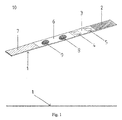
- FIG. 1 shows a schematic drawing illustrating the dipping test strip system with dried reagents (10), which is supported by a flexible polystyrene film (1) that is actually used as the base for the construction of the system.
- the system (10) consists of at least four distinct areas of different materials and with a specific function: a) the area or part of the test strip which comes into contact with the sample or with the assay-development solution on the strip (2), b) the area or part of the test strip on which the detection reagent bearing or responsible for the optical signal is dried (3), c) the area or part of the test strip on which the signal is developed (membrane area) (6), d) the area or part of the test strip with the task to withhold the excess of the liquid sample or liquid containing the analyte (7).
- the area (3) is constituted of glass fiber elaborated in a way that is capable of withholding the detection reagent dried upon, but also permitting it's release towards the membrane area when it is being rehydrated by the moving assay-development solution.
- the membrane area (6) comprises a nitrocellulose membrane or a suitably modified membrane to possess nitrocellulose functionality (nitro- groups on it's surface).
- Typical membranes that may be used in the system of the present invention are nitrocellulose membranes with pore sizes ranging from 5 ⁇ m to 8 ⁇ m or 12 ⁇ m, depending on the particular application, (e.g. Schleicher& Schuell AE 98, AE 99, AE 100), as well as the polyethersulfon modified membrane to have nitrocellulose functionality: Predator (Pall & Gelman) with pore size 0,45 ⁇ m.
- the area (7) (upper part of the system) is consisted of a strongly absorbent material comprising mainly cotton fiber.
- the protein Streptavidin (8) is immobilized on the membrane at a quantity of at least 0,5 ⁇ g (8333 fmol) diluted in a phosphate buffer 15mM pH 7,2 (streptavidin application solution), as well as an oligonucleotide (9) having length of at least 60 (sixty) bases and preferably between 60 and 100 bases the most, is also immobilized on the membrane in a way that forms either a dot or a lane and at a quantity of at least 500 fmol.
- the length of the oligonucleotide being immobilized is of substantial importance to the success of the immobilization.
- the immobilization of the protein Streptavidin on the membrane takes place at a distance of 1 cm (8) from the edge of the membrane that comes into contact with the part (3) of the strip, while the oligonucleotide is immobilized at a distance of 1,5 cm from the same edge of the membrane.
- the immobilization is carried out by the application of the reagent at the selected area of the membrane followed by baking in an oven of controlled temperature and humidity, at 70-80°C for a period of time ranging from 30 to 120 minutes depending on the type of the membrane being used.
- the assembly of the system of the strip on the flexible polystyrene film follows said immobilization.
- colloidal gold particles are applied and dried on area (3) of the strip assay system and more concretely at the lower half (5) of area (3) [towards the part of the strip that comes into contact with the assay-development solution], wherein said colloidal gold particles are conjugated to an oligonucleotide of certain length and concretely having the length of 60 (sixty) to 100 (a hundred) bases, and of complementary sequence to the oligo previously immobilized (9) on the membrane.
- the oligonucleotide to be conjugated to the colloidal gold particles is modified to possess an SH group at it's 5' end, and the conjugation is carried out by the method described by Mirkin C.A., Letsinger R.L., Mucic R.C., and Storhoff J.J., in Nature 382 , 607-609 (1996).
- the oligonucleotide is added to a quantity of colloidal gold particles and incubated at 4°C for 56 hours.
- the ratio (moles colloidal gold particles)/(moles oligonucleotide) maintained at the conjugation procedure is at least 1/500 and preferably between 1/500 and 1/1000.
- Said conjugated colloidal gold particles are dried on area (3) by baking at 40 °C for two hours or preferably by allowing the particles' application solution to air dry in an area of confined humidity.
- the application buffer of said conjugated particles about to be dried on area (3) of the test strip contains Bovine Serum Albumin (BSA) 5% w/v, Sucrose 5% w/v, and Tween 20 at a quantity between 0,01% and 0,1% w/v and preferably 0,05%w/v.
- BSA Bovine Serum Albumin
- the gold particles used in the present invention for conjugation with oligonucleotides may have a diameter of 20 nm or 30 nm or 40 nm.
- the sample suspected to contain the analyte (DNA) is applied, said DNA is previously denatured by heating at 95°C for 5min and prehybridized for at least 15-20 min with one or two oligonoucleotides-probes at a temperature depending on the Tm of the probes and at suitable conditions of ionic strength, pH and the appropriate buffer (J.Mol.Biol. 98 , 503 (1975), Proc.Natl.Acad Sci. USA 76 , 3683 (1979)).
- Said prehybridization is highly recommended because it increases the sensitivity of the hybridization assay on the strip and therefore the sensitivity of the detection with the use of the present invention.
- Fig.2 shows a schematic drawing illustrating the hybridization assay configurations related to appropriate hybridization protocols developed on said test strip system that are responsible for providing a visible signal indicative of the presence or absence of a specific nucleic acid sequence in a sample, according to the present invention.
- an oligonucleotide (12) having the length of 60 to 100 Thymine bases (T) is immobilised on area (9) of the membrane, as well as 0,5 ⁇ g at least of the protein Streptavidin (SA) (13) in a phosphate buffer 15mM pH 7,2 is also immobilized on area (8) of the membrane.
- the oligonucleotide, which is immobilized on the membrane may alternatively consist of a random sequence of at least 20 nucleotide bases, followed by a 40-80 bases sequence of Thymines (T) that is tailed at the 3' end of the oligo of random sequence with the use of the enzyme: terminal transferase.
- An oligo of 80-100 Adenines (A) (15) is conjugated on the surface of colloidal gold particles (14).
- the target DNA (16) is the product of a PCR reaction in which one of the primers is Biotinylated, so that one strand of the PCR product is Biotinylated at its 5' end.
- An oligo-probe (17) consisting of 20-24 bases of complementary sequence to a specific region of the Biotinylated PCR product is also needed, wherein said probe carries additionally 80-100 bases of Thymine (T) at it's 5' or 3' end.
- the probe (17) may carry such number (80-100) of Thymines (T) by having it synthesized in that way, or the 20-24mer may be tailed at it's 3' end with the use of the enzyme: terminal transferase.
- Heating at 95 °C for 5 min denatures the sample containing the PCR product to be detected, which is then prehybridized with the specific nucleic acid probe (17) for at least 15-20 min at a temperature depending on the Tm (melting point) of the probe and at suitable conditions of ionic strength, pH and buffer (J.Mol.Biol. 98 , 503 (1975), Proc.Natl.Acad Sci. USA 76 , 3683 (1979)).
- At least 1500-2000 fmol and preferably 1500-5000 fmol of probe (17) is used for hybridization with 5 ⁇ L (100-200 fmol/ ⁇ L) of Biotinylated PCR product.
- an oligonucleotide (12) having the length of 60 to 100 Thymine bases (T) is immobilised on area (9) of the membrane, as well as 0,5 ⁇ g at least of the protein Streptavidin (SA) (13) in a phosphate buffer 15mM pH 7,2 is also immobilized on area (8) of the membrane.
- the oligonucleotide, which is immobilized on the membrane may alternatively consist of a random sequence of at least 20 nucleotide bases, followed by a 40-80 bases sequence of Thymines (T) that is tailed at the 3' end of the oligo of random sequence with the use of the enzyme: terminal transferase.
- An oligo of 80-100 Adenines (A) (15) is conjugated on the surface of colloidal gold particles (14).
- the target DNA (19) is the product of a PCR reaction in which the specific primers used are not labeled, so that the reaction yields a PCR product that is not labeled.
- Two oligonucleotides-probes consisting of 20-24 bases of complementary sequence to two discernible areas of the same strand of the PCR product are also needed.
- One of said oligo-probes is labeled with Biotin (20) at its 3' or 5' end, while the other oligo-probe (21) carries additionally 80-100 bases of Thymine (T) at it's 5' or 3' end.
- the labeling of the probe (20) with Biotin may be either at its 5' or at its 3' end, said labeled probe may be synthesized in that particular way or labeling may take place at the 3' end of the 20-24mer by the use of the enzyme: terminal transferase and a Biotin-labeled nucleotide such as Biotin-14-dATP.
- the double stranded DNA-target (19) is denatured by heating at 95°C for 5 min and then prehybridized with the two specific nucleic acid probes (20,21) for at least 15-20 min at a temperature depending on the melting point (Tm) of the two probes and at suitable conditions of ionic strength, pH, and buffer (J.Mol.Biol.
- the protocols I and II can also be developed on the strip assay system of the present invention by mutual exchange of the oligonucleotides being immobilized on the membrane and the surface of the colloidal gold particles respectively.
- an oligonucleotide of 60-100 Adenines (A) can be immobilized on the membrane, while a complementary sequence oligonucleotide of 80-100 Thymines (T) is conjugated to the surface of the colloidal gold particles.
- the 20-24mers oligonucleotides-probes used in the hybridization assays of both protocols I and II must carry additionally 80-100 bases of Adenine (A) instead of Thymine (T) at their 5' or 3' end.
- the strip is immersed in a tube or vessel containing the hybridization solution that travels along the strip drawn by capillary forces and encounters the dried colloidal gold particles which it rehydrates and induces to the membrane area at first, and then to the upper part of the test strip that has the task to withhold the excess of the liquid sample.
- the constitution of the hybridization solution is such that it permits the hybridization of complementary nucleic acid sequences as well as the formation of the Biotin-Streptavidin bond.
- the hybridization solution contains a buffer pH 7,5-7,6, Bovine Serum Albumin (BSA) at least 5% w/v and preferably 5%-7% w/v, NaCl 150 mM, glycerol at least 15% v/v and preferably 15%-30% v/v, and a non-ionic surfactant or detergent at a quantity at least 0,1% v/v and preferably 0,1%-5% v/v.
- BSA Bovine Serum Albumin
- NaCl 150 mM NaCl 150 mM
- glycerol at least 15% v/v and preferably 15%-30% v/v
- a non-ionic surfactant or detergent at a quantity at least 0,1% v/v and preferably 0,1%-5% v/v.
- a suitable buffer is PBS pH 7,5 or maleic acid buffer pH 7,6 and a suitable non-ionic surfactant is Tween 20,or Triton X-100 or any other non-ionic detergent of the same category.
- the glycerol in the hybridization solution has double function: it increases the viscosity of the solution which then moves along the test strip driven by capillary forces more slowly allowing the hybridization to take place more effectively, thus affecting the success of the assay, and secondly it has the ability of promoting the hybridization efficiency.
- Other substances that promote the hybridization efficiency and can be used instead of glycerol or in addition to glycerol in the hybridization solution are polymers such as PVP (polyvinylopyrrolidone), Ficoll, Dextran Sulfate e.t.c. (Wahl et al, Proc. Natl. Acad. Sci. 76, 3683-3687, USA, 1979).
- the test strip assay system is deposited in a vessel containing the hybridization solution or assay development solution at room temperature and after 15 to 20 min the most a visible signal is generated and read out at the membrane area.
- the development of two red or purple-red lanes or dots [positions (8) and (9) on the strip] indicates a positive detection assay of the target-DNA in the sample and successful assay completion on the strip, while the development of only one lane or dot [position (9) on the strip] indicates a negative detection assay of the target-DNA and successful assay completion on the test strip.
- the dipping test strip assay system of the present invention can be converted to a lateral flow test system with a slight modification of the shape and the absorbent material of area (2) of the strip, which comes into contact with the sample or with the assay-development solution on the strip.
- strip test system of the present invention must take place with a volume of at least 5 ⁇ L PCR product and preferably between 5 ⁇ L-15 ⁇ L.
- Hybridization assay development on the dipping test strip according to the protocol I for the detection of the specific products of the ARMS PCR reaction which is used for the genetic diagnosis of the IVS-n110 point mutation in the b-globin gene causing beta-Thallasaemia, said PCR is performed with the use of genomic DNA as a template.
- the ARMS method is a variation of the PCR reaction permitting the specific amplification of a segment of an allele from an individual's genomic DNA.
- the ARMS method is based on the PCR primer's attribute according to which when the oligonucleotide primers have a mismatch at their 3' end, they cannot anneal to the template so that the selected DNA fragment can be amplified to yield a PCR product. Primers are designed to anneal to the normal and the mutated DNA sequence. Two amplification reactions are prepared for each sample. In each reaction a common primer is used labeled with Biotin at its 5' end, and another primer complementary to the region suspected to carry the mutation.
- the second primer differs as far as the 3' end is concerned, in each reaction regarding the same sample: at the first one it anneals to the normal sequence, while at the second to the mutated.
- both the normal and the mutated primer have one additional base-mismatch 3 or 4 nucleotides from their 3' end.
- two dipping test strips are required for the detection of the products of the two PCR reactions performed for each sample.
- the individual is heterozygous for the mutation.
- the result of the hybridization assay is positive on only one of the two strips for the same sample, and particularly when the detection is positive only for the product of the PCR reaction that amplifies the normal sequence, then the individual does not carry the mutation.
- the detection assay is positive only on one test strip for the same sample, and specifically the strip used for the product of the PCR reaction that amplifies the mutated sequence, then the individual is homozygous for said mutation.
- a 20mer oligonucleotide-probe (17) of complementary sequence to a region of the Biotinylated strand of the specific PCR product is used.
- Said probe carries additionally 80-100 Thymines (T) at it's 3' or 5' end.
- An oligonucleotide consisting of 100 Adenines (A), modified with an SH- group at it's 5' end, is conjugated on the surface of colloidal gold particles of diameter 40 nm by adding it at a quantity of the particles in a ratio of: (moles of gold particles)/(moles of oligonucleotide) 1/500, followed by incubation at 4 °C for 56 hours.
- A Adenines
- the conjugated colloidal gold particles' solution is concentrated ten fold and the particles are brought to a solution containing Bovine Serum Albumin (BSA) 5% w/v, Sucrose 5% w/v, 0,05% v/v Tween 20 and they are allowed to air dry after being deposited on area (5) of the test strip system.
- BSA Bovine Serum Albumin
- Approximately 9x10 9 -1,1x10 10 conjugated gold particles are dried on each dipping test strip system.
- the prehybridized PCR product is deposited at area (4) of the dipping test strip which is immersed in 300 ⁇ L of hybridization solution (or assay development solution) that contains PBS buffer pH 7,5-7,6, Bovine Serum Albumin (BSA) 5%, NaCl 150 mM, 20% glycerol and 0,5% Tween 20.
- hybridization solution or assay development solution
- BSA Bovine Serum Albumin
- the test strip assay system is deposited in a vessel containing the hybridization solution or assay development solution at room temperature and after 15 to 20 min the most a visible signal is generated and read out at the membrane area.
- the nested PCR reaction is used in order to significantly increase the PCR's sensitivity and specificity, particularly when the amplification of a rare sequence is desired (low-copy-number-nucleic acid template) and if a large number of cycles is used there is an increased risk of amplification of non specific products.
- Two consecutive amplification reactions take place with a different primer pair used in each reaction.
- the first PCR contains an external pair of primers used to amplify an about 300 bp fragment.
- the second PCR contains an internal pair of primers, which hybridize to the 300 bp fragment amplified by the first set of primers (external primers), and is used to amplify a 163 bp fragment.
- Two oligonucleotides-probes consisting of 20-24 bases of complementary sequence to two discernible areas of the same strand of the 163 bp PCR product are selected.
- One of said oligo-probes is labeled with Biotin (20) at its 3' end with the use of the enzyme: terminal transferase, while the other oligo-probe (21) is tailed with additional 80-100 Thymines (T) at it's 3' end with the use of said enzyme.
- a) Labeling with Biotin In an eppendorf a mixture is prepared containing 4 ⁇ L 5xTdT Bufffer (labeling buffer containing: 200 mmol/L potassium cacodylate, Tris-HCl 50 mmol/L, Bovine Serum Albumin 0,4 mg/mL, pH 7,2), 1 ⁇ L CoCl 2 25mmol/L, 1 ⁇ L probe (19) (100pmol/ ⁇ L), 1 ⁇ L dNTPs mix (without dATP) 10mM, 2,5 ⁇ L Biotin-14-dATP 0,4 mM, 1,2 ⁇ L terminal transferase (30 Units) and distilled water to final volume 20 ⁇ L.
- labeling buffer containing: 200 mmol/L potassium cacodylate, Tris-HCl 50 mmol/L, Bovine Serum Albumin 0,4 mg/mL, pH 7,2
- 1 ⁇ L CoCl 2 25mmol/L 1 ⁇ L probe (19) (100pmol/ ⁇ L)
- the mixture is incubated at 37°C for one hour.
- the reaction is terminated by the addition of 2,5 ⁇ L EDTA 0,4 M, and the tailed oligo-probe is purified from the excess of the reagents used with the use of a Sephadex G-25 column (CPG, USA).
- T Thymines
- 5xTdT Bufffer labeling buffer containing: 200 mmol/L potassium cacodylate, Tris-HCl 50 mmol/L, Bovine Serum Albumin 0,4 mg/mL, pH 7,2
- 1 ⁇ L CoCl 2 25mmol/L 1 ⁇ L probe (20) (100pmol/ ⁇ L)
- 1 ⁇ L dATP 10mM 1,2 ⁇ L terminal transferase (30 Units) and distilled water to final volume 20 ⁇ L.
- the mixture is incubated at 37°C for one hour. The reaction is terminated by the addition of 2,5 ⁇ L EDTA 0,4 M.
- Tm melting point
- the prehybridized PCR product is deposited at area (4) of the dipping test strip which is immersed in 300 ⁇ L of hybridization solution (or assay development solution) that contains PBS buffer pH 7,5-7,6, Bovine Serum Albumin (BSA) 5%, NaCl 150 mM, 20% glycerol and 0,5% Tween 20.
- hybridization solution or assay development solution
- BSA Bovine Serum Albumin
- the test strip assay system is deposited in a vessel containing the hybridization solution or assay development solution at room temperature and after 15 to 20 min the most a visible signal is generated and read out at the membrane area.
Landscapes
- Chemical & Material Sciences (AREA)
- Organic Chemistry (AREA)
- Life Sciences & Earth Sciences (AREA)
- Zoology (AREA)
- Wood Science & Technology (AREA)
- Proteomics, Peptides & Aminoacids (AREA)
- Health & Medical Sciences (AREA)
- Engineering & Computer Science (AREA)
- Microbiology (AREA)
- Immunology (AREA)
- Physics & Mathematics (AREA)
- Molecular Biology (AREA)
- Biotechnology (AREA)
- Biophysics (AREA)
- Analytical Chemistry (AREA)
- Biochemistry (AREA)
- Bioinformatics & Cheminformatics (AREA)
- General Engineering & Computer Science (AREA)
- General Health & Medical Sciences (AREA)
- Genetics & Genomics (AREA)
- Measuring Or Testing Involving Enzymes Or Micro-Organisms (AREA)
Claims (16)
- Système d'essai à bandelette réactive trempant pour la détermination qualitative et/ou quantitative en une étape d'une séquence d'acide nucléique particulière (16, 19) dans un échantillon liquide, comprenant:A) une bandelette réactive (1), laquelle bandelette réactive (1) a quatre aire distinctes:a) une première aire (2), laquelle fait contact avec ledit échantillon ou solution de développement de l'essai;b) une deuxième aire (3) sure laquelle est séchée une substance produisant un signal visible;c) une troisième aire (6) pour le développement du signal et le contrôle d'achèvement de l'essai, comprenant une première zone (8) contenant de la streptavidine immobilisée et une deuxième zone (9) contenant un oligonucléotide immobilisé; etd) une quatrième aire (7) pour retenir l'excès dudit échantillon liquide;caractérisé en ce queladite substance produisant un signal visible est constituée de particules d'or colloïdal (14) conjuguées à un oligonucléotide (15) d'une longueur spécifique et ayant une séquence nucléotidique déterminée et peut être solubilisée par l'échantillon liquide ou ladite solution de développement de l'essai;ledit oligonucléotide (12) immobilisé dans la deuxième zone (9) de ladite troisième aire (6) de la bandelette réactive (1) a une séquence nucléotidique complémentaire de la séquence nucléotidique dudit oligonucléotide (15) qui est conjugué audites particules d'or colloïdal (14);et en ce queledit d'essai à bandelette réactive trempant comprend en plus:B) un réactif distinct (17; 20, 21) consistant en un ou plusieurs oligonucléotides lesquelles s'hybrident spécifiquement avec ledit acide nucléique et confèrent audit acide nucléique hybridé l'aptitude de s'hybrider simultanément avec ledit oligonucléotide (15) qui est conjugué audites particules d'or colloïdal (14) et de s'attacher à ladite streptavidine immobilisée de la première zone (8) de ladite troisième aire (6).
- Système d'essai à bandelette réactive trempant selon la revendication 1, caractérisé en outre en ce que ladite substance produisant un signal est séchée sur la moitié inférieure (5) de ladite deuxième aire (3) de ladite bandelette réactive (1).
- Système d'essai à bandelette réactive trempant selon la revendication 1, caractérisé en ce que ledit acide nucléique analysé est biotinylé et ledit réactif (17; 20, 21) est constitué d' un oligonucléotide (17) comprenant une première partie ayant une séquence complémentaire d' une région de la séquence nucléotidique dudit acide nucléique biotinylé (16) et une deuxième partie ayant une séquence nucléotidique complémentaire d'une séquence nucléotidique définie dudit oligonucléotide (15) qui est conjugué audites particules d'or colloïdal (14).
- Système d'essai à bandelette réactive trempant selon la revendication 1, caractérisé en ce que ledit acide nucléique analysé n'est pas biotinylé et ledit réactif (17; 20, 21) comprend:un premier oligonucléotide (20) ayant une séquence complémentaire d'une région de la séquence nucléotidique dudit acide nucléique (19) et lié par une des ses extrémités à une molécule de biotine; etun deuxième oligonucléotide (21) comprenant une première partie ayant une séquence complémentaire d'une région de la séquence nucléotidique dudit acide nucléique (19) et une deuxième partie ayant une séquence nucléotidique complémentaire de la séquence nucléotidique définie dudit oligonucléotide (15) qui est conjugué audites particules d'or colloïdal (14).
- Système d'essai à bandelette réactive trempant selon une quelconque des revendications précédentes, caractérisé en ce que ladite séquence nucléotidique définie qui est conjuguée audites particules d'or colloïdal (14) a une longueur de 60 à 100 bases.
- Système d'essai à bandelette réactive trempant selon une quelconque des revendications précédentes, caractérisé en ce que ladite séquence nucléotidique définie qui est conjuguée audites particules d'or colloïdal (14) est constituée de 20 nucléotides quelconques suivis de 40-80 base de thymine.
- Système d'essai à bandelette réactive trempant selon une quelconque des revendications 1-6, caractérisé en ce que ladite séquence nucléotidique définie qui est conjuguée audites particules d'or colloïdal (14) est constituée de 20 nucléotides quelconques suivis de 40-80 bases d'adénine.
- Système d'essai à bandelette réactive trempant selon une quelconque des revendications précédentes, caractérisé en ce que ladite substance produisant un signal visible (14, 15) est séchée sur ladite deuxième aire (3) de ladite bandelette réactive (1) par (i) modification de l'extrémité 5' dudit oligonucléotide (15) à une séquence nucléotidique définie avec un groupement SH, (ii) addition dudit oligonucléotide à une solution de conjugaison contenant lesdites particules d'or colloïdal avec un rapport molaire (particules d'or colloïdal)/(oligonucléotide) au moins 1/500 et incubation pendant un temps suffisant pour l'accomplissement de la conjugaison entre ledit oligonucléotide et lesdites particules d'or, (iii) dispersion des dites particules conjuguées dans une solution et application de ladite solution sur ladite bandelette réactive à ladite deuxième aire (3), et (iv) séchage de ladite solution de particules conjuguées appliquée sur ladite deuxième aire (3) de ladite bandelette réactive (1) par étuvage ou par séchage dans l'air.
- Système d'essai à bandelette réactive trempant selon la revendication 8, caractérisé en outre en ce ladite solution appliquée sur ladite bandelette réactive à ladite deuxième aire (3) dans l'étape (iii) contient 5% p/v d'albumine de sérum de veau (BSA), 5% sucrose, 0,001%-0,1% v/v d'un surfactant non ionique ou d'un détergent comme Tween 20.
- Méthode pour la détermination qualitative et/ou quantitative en une étape d'une séquence d'acide nucléique particulière (16, 19) dans un échantillon liquide an utilisant un système d'essai à bandelette réactive trempant selon une quelconque des revendications précédentes, cette méthode comprenant:la dilution dudit échantillon liquide dans une solution de pré-hybridation dans laquelle est dissout ledit réactif distinct (17; 20, 21);le chauffage de ladite solution de pré-hybridation permettant à l'hybridation d'avoir lieu;l'application de ladite solution de pré-hybridation sur ladite bandelette réactive (1);l'immersion de ladite première aire (2) de ladite bandelette réactive (1) dans une solution d'hybridation ou dans une solution de développement de l'essai, etl'attente pendant un temps suffisant pour que la deuxième zone (9) de ladite troisième aire (6) de la bandelette réactive soit colorée, moment auquel la présence et/ou l'intensité ou l'absence de couleur à cette première zone (8) de ladite troisième aire (6) de la bandelette réactive indique la présence et/ou la quantité ou l'absence de ladite séquence d'acide nucléique (16, 19) dans un échantillon liquide.
- Méthode selon la revendication 10 et utilisant le système d'essai à bandelette réactive trempant selon une quelconque des revendications précédentes, caractérisée en outre en ce que ladite solution de pré-hybridation est appliquée sur la moitié supérieure (4) de ladite deuxième aire (3) de ladite bandelette réactive (1).
- Méthode selon l'une quelconque des revendications 10, 11 et utilisant le système d'essai à bandelette réactive trempant selon la revendication 3, caractérisé en ce que ledit acide nucléique (16) analysé a été préalablement biotinylé.
- Méthode selon l'une quelconque des revendications 10-12 caractérisé en outre en ce que ladite solution d'hybridation ou de développement de l'essai contient du tampon PBS à pH 7,5-7,6, de l'albumine de sérum de veau (BSA) 5%, au moins 150mM de NaCl, au moins 15% de glycérol et au moins 0,1% d' un surfactant non ionique ou d'un détergent comme Tween 20.
- Utilisation du système d' essai à bandelette réactive trempant selon l'une quelconque des revendications 1-9 ou de la méthode d'une quelconque des revendications 10-13 pour la détection et/ou la détermination de séquences d' acide nucléique spécifiques dans un échantillon, lesquelles sont indicatives d'une maladie.
- Utilisation selon la revendication 14, caractérisée en ce que lesdites séquences d'acide nucléique particulières sont de l'ADN viral ou bactérien et leur détection est indicative d'une maladie infectieuse.
- Utilisation selon la revendication 14, caractérisée en ce que lesdites séquences d'acide nucléique particulières sont des séquences d'ADN mutées et leur détection est indicative d'une maladie transmise génétiquement.
Applications Claiming Priority (3)
| Application Number | Priority Date | Filing Date | Title |
|---|---|---|---|
| GR2001100478 | 2001-10-16 | ||
| GR20010100478 | 2001-10-16 | ||
| PCT/GR2002/000052 WO2003033735A2 (fr) | 2001-10-16 | 2002-10-03 | Systeme de bandelette reactive a tremper et methode d'essai pour detecter et/ou analyser des sequences d'acide nucleique specifiques |
Publications (2)
| Publication Number | Publication Date |
|---|---|
| EP1436420A2 EP1436420A2 (fr) | 2004-07-14 |
| EP1436420B1 true EP1436420B1 (fr) | 2007-04-25 |
Family
ID=37616771
Family Applications (1)
| Application Number | Title | Priority Date | Filing Date |
|---|---|---|---|
| EP02765125A Expired - Lifetime EP1436420B1 (fr) | 2001-10-16 | 2002-10-03 | Systeme de bandelette reactive a tremper et methode d'essai pour detecter et/ou analyser des sequences d'acide nucleique specifiques |
Country Status (15)
| Country | Link |
|---|---|
| US (1) | US20050202427A1 (fr) |
| EP (1) | EP1436420B1 (fr) |
| AT (1) | ATE360708T1 (fr) |
| AU (1) | AU2002329496B2 (fr) |
| BR (1) | BR0206145A (fr) |
| CA (1) | CA2468802A1 (fr) |
| CY (1) | CY1106724T1 (fr) |
| DE (1) | DE60219813T2 (fr) |
| DK (1) | DK1436420T3 (fr) |
| ES (1) | ES2286276T3 (fr) |
| GR (1) | GR1003966B (fr) |
| NO (1) | NO20032697L (fr) |
| PT (1) | PT1436420E (fr) |
| WO (1) | WO2003033735A2 (fr) |
| YU (1) | YU48903A (fr) |
Families Citing this family (21)
| Publication number | Priority date | Publication date | Assignee | Title |
|---|---|---|---|---|
| GR1004393B (el) | 2002-11-07 | 2003-11-28 | ΑΥΤΟΜΑΤΟΙ ΑΝΑΛΥΤΕΣ ΚΑΙ ΔΙΑΓΝΩΣΤΙΚΑ ΑΝΤΙΔΡΑΣΤΗΡΙΑ MEDICON HELLAS ΑΝΩΝΥΜΗ ΕΤΑΙΡΕΙΑ δ.τ. MEDICON HELLAS S.A. | Μεθοδος ανιχνευσης ειδικων αλληλουχιων νουκλεικων οξεων σε ταινια ξηρων αντιδραστηριων |
| EP1623042B1 (fr) * | 2003-05-07 | 2011-04-06 | Coris Bioconcept SPRL | Dispositif oligo-chromatographique rapide et methode d'utilisation |
| EP1657550A1 (fr) * | 2004-11-10 | 2006-05-17 | Coris Bioconcept SPRL | Dispositif à double face pour chromatographie en phase liquide et méthode d'utilisation |
| DE602005026578D1 (de) * | 2004-12-29 | 2011-04-07 | Suzhou Yangze Delta Academy Of Bio X Science Ltd | Optimales verfahren zur amplifikation nach polymerasekettenreaktion |
| GB0503986D0 (en) * | 2005-02-26 | 2005-04-06 | Secr Defence | Reaction apparatus |
| US8980561B1 (en) * | 2006-08-22 | 2015-03-17 | Los Alamos National Security, Llc. | Nucleic acid detection system and method for detecting influenza |
| EP1933145B1 (fr) * | 2006-12-11 | 2011-09-28 | AraGen Biotechnology Co. Ltd. | Détection rapide immunochromatographique par amplification du signal d'or colloïdal |
| WO2009005552A2 (fr) * | 2007-03-29 | 2009-01-08 | Epitype Corporation | Procédés et compositions pour liaison polyvalentes et procédés de fabrication de tests de diagnostic rapides |
| GB0806041D0 (en) * | 2008-04-03 | 2008-05-14 | Genomica S A | Method for detection of herpesvirus in test sample |
| CN102128832A (zh) * | 2010-12-27 | 2011-07-20 | 江南大学 | 一种西瓜果斑病毒金标核酸试纸条及其制备和应用 |
| CN102183633B (zh) * | 2011-02-24 | 2013-05-15 | 南京基蛋生物科技有限公司 | 一种胶体金标记方法 |
| US9651549B2 (en) * | 2012-07-13 | 2017-05-16 | Genisphere, Llc | Lateral flow assays using DNA dendrimers |
| WO2014153394A1 (fr) | 2013-03-21 | 2014-09-25 | Genisphere, Llc | Administration cellulaire d'agents intercalants de l'adn |
| FR3012982B1 (fr) * | 2013-11-08 | 2015-12-25 | Espci Innov | Procede de stockage et de concentration d'un compose volatil |
| EP3218053B1 (fr) | 2014-11-13 | 2019-05-29 | The Alfred E. Mann Foundation for Scientific Research | Interface de dérivation percutanée |
| US9464969B2 (en) | 2014-11-20 | 2016-10-11 | Monolythix, Inc. | Monoliths |
| US10808278B2 (en) | 2015-03-03 | 2020-10-20 | University Of Miami | Kits and methods for pathogen detection |
| US10570439B2 (en) | 2015-08-18 | 2020-02-25 | Monolythix, Inc. | Sample concentration devices |
| IL260983B (en) | 2016-02-19 | 2022-07-01 | Genisphere Llc | Nucleic acid carriers and methods of medical use |
| CN108977501A (zh) * | 2018-08-13 | 2018-12-11 | 吉林农业科技学院 | 人参黑斑菌-单管巢式pcr-核酸传感器的制备及其检测方法 |
| ES2932995A1 (es) * | 2021-07-22 | 2023-01-30 | Ocupharm Diagnostics Sl | Sistema de detección de parásitos oculares |
Family Cites Families (7)
| Publication number | Priority date | Publication date | Assignee | Title |
|---|---|---|---|---|
| US4751177A (en) * | 1985-06-13 | 1988-06-14 | Amgen | Methods and kits for performing nucleic acid hybridization assays |
| WO1990001564A1 (fr) * | 1988-08-09 | 1990-02-22 | Microprobe Corporation | Procedes d'analyse a cibles multiples par hybridation d'acides nucleiques |
| DK0554355T3 (da) * | 1990-10-19 | 1998-05-11 | Microprobe Corp | Fremgangsmåder og farmaceutiske kits til anvendelse ved detektering af mikroorganismer forbundet med vaginalinfektioner |
| US6582921B2 (en) * | 1996-07-29 | 2003-06-24 | Nanosphere, Inc. | Nanoparticles having oligonucleotides attached thereto and uses thereof |
| US20010026944A1 (en) * | 1999-04-21 | 2001-10-04 | Roy Chung | Immunoassay system |
| DE60045739D1 (de) * | 1999-06-25 | 2011-04-28 | Nanosphere Inc | Nanopartikel mit gebundenen oligonukleotiden und deren verwendungen |
| US7101683B2 (en) * | 2001-06-26 | 2006-09-05 | Abbott Laboratories | Methods for the simultaneous detection of HCV antigens and HCV antibodies |
-
2001
- 2001-10-16 GR GR20010100478A patent/GR1003966B/el unknown
-
2002
- 2002-10-03 WO PCT/GR2002/000052 patent/WO2003033735A2/fr not_active Ceased
- 2002-10-03 DK DK02765125T patent/DK1436420T3/da active
- 2002-10-03 BR BR0206145-7A patent/BR0206145A/pt not_active IP Right Cessation
- 2002-10-03 AT AT02765125T patent/ATE360708T1/de active
- 2002-10-03 PT PT02765125T patent/PT1436420E/pt unknown
- 2002-10-03 DE DE60219813T patent/DE60219813T2/de not_active Expired - Lifetime
- 2002-10-03 US US10/496,735 patent/US20050202427A1/en not_active Abandoned
- 2002-10-03 CA CA002468802A patent/CA2468802A1/fr not_active Abandoned
- 2002-10-03 EP EP02765125A patent/EP1436420B1/fr not_active Expired - Lifetime
- 2002-10-03 AU AU2002329496A patent/AU2002329496B2/en not_active Ceased
- 2002-10-03 ES ES02765125T patent/ES2286276T3/es not_active Expired - Lifetime
- 2002-10-03 YU YU48903A patent/YU48903A/sh unknown
-
2003
- 2003-06-13 NO NO20032697A patent/NO20032697L/no not_active Application Discontinuation
-
2007
- 2007-07-13 CY CY20071100930T patent/CY1106724T1/el unknown
Non-Patent Citations (1)
| Title |
|---|
| None * |
Also Published As
| Publication number | Publication date |
|---|---|
| CY1106724T1 (el) | 2012-05-23 |
| CA2468802A1 (fr) | 2003-04-24 |
| NO20032697D0 (no) | 2003-06-13 |
| ATE360708T1 (de) | 2007-05-15 |
| GR1003966B (el) | 2002-08-06 |
| BR0206145A (pt) | 2004-01-13 |
| ES2286276T3 (es) | 2007-12-01 |
| EP1436420A2 (fr) | 2004-07-14 |
| WO2003033735A2 (fr) | 2003-04-24 |
| DE60219813T2 (de) | 2008-01-31 |
| DE60219813D1 (de) | 2007-06-06 |
| PT1436420E (pt) | 2007-09-12 |
| DK1436420T3 (da) | 2007-09-10 |
| US20050202427A1 (en) | 2005-09-15 |
| WO2003033735A3 (fr) | 2003-09-12 |
| AU2002329496B2 (en) | 2009-10-22 |
| NO20032697L (no) | 2003-07-15 |
| YU48903A (sh) | 2006-08-17 |
Similar Documents
| Publication | Publication Date | Title |
|---|---|---|
| EP1436420B1 (fr) | Systeme de bandelette reactive a tremper et methode d'essai pour detecter et/ou analyser des sequences d'acide nucleique specifiques | |
| AU2002329496A1 (en) | Test strip assay system and method for the detection of specific nucleic acid sequences | |
| US6090592A (en) | Method for performing amplification of nucleic acid on supports | |
| EP0784701B1 (fr) | Appareil et procede pour realiser une amplification d'acides nucleiques sur des supports | |
| JP4598722B2 (ja) | 特異的配列構成を有する核酸の検出法 | |
| US5627030A (en) | Method of amplification for increasing the sensitivity of detecting nucleic acid-probe target hybrids | |
| US5843650A (en) | Nucleic acid detection and amplification by chemical linkage of oligonucleotides | |
| US5869252A (en) | Method of multiplex ligase chain reaction | |
| JPH0813280B2 (ja) | 変異核酸の検出方法 | |
| JP2007506404A (ja) | 核酸分子を検出するための迅速な方法 | |
| EP0305145A2 (fr) | Méthodes et sondes pour détecter des acides nucléiques | |
| US20080254999A1 (en) | Linear nucleic acid and sequence therefor | |
| US6468751B1 (en) | Method and apparatus for performing amplification of nucleic acid on supports | |
| US7291457B2 (en) | Electrochemical detection of mismatch nucleic acids | |
| EP0622464A2 (fr) | Procédé de dosage d'acide nucléique | |
| EP1007733B1 (fr) | Appareil universel d'hybridation en phase solide | |
| US6306657B1 (en) | Polynucleotide probe and kit for amplifying signal detection in hybridization assays | |
| WO1989009281A1 (fr) | Procede d'amplification et de detection d'acide nucleique dans un liquide test | |
| EP1279743B1 (fr) | Détection des polymorphismes génétiques par amplification allèle spécifique en utilisant des amorces modifiées et hybridation subséquente | |
| US7118864B2 (en) | Amplifiable probe |
Legal Events
| Date | Code | Title | Description |
|---|---|---|---|
| PUAI | Public reference made under article 153(3) epc to a published international application that has entered the european phase |
Free format text: ORIGINAL CODE: 0009012 |
|
| 17P | Request for examination filed |
Effective date: 20030730 |
|
| AK | Designated contracting states |
Kind code of ref document: A2 Designated state(s): AT BE BG CH CY CZ DE DK EE ES FI FR GB GR IE IT LI LU MC NL PT SE SK TR |
|
| AX | Request for extension of the european patent |
Extension state: AL LT LV MK RO SI |
|
| GRAP | Despatch of communication of intention to grant a patent |
Free format text: ORIGINAL CODE: EPIDOSNIGR1 |
|
| GRAS | Grant fee paid |
Free format text: ORIGINAL CODE: EPIDOSNIGR3 |
|
| GRAA | (expected) grant |
Free format text: ORIGINAL CODE: 0009210 |
|
| AK | Designated contracting states |
Kind code of ref document: B1 Designated state(s): AT BE BG CH CY CZ DE DK EE ES FI FR GB GR IE IT LI LU MC NL PT SE SK TR |
|
| AX | Request for extension of the european patent |
Extension state: AL LT LV MK RO SI |
|
| REG | Reference to a national code |
Ref country code: GB Ref legal event code: FG4D |
|
| REG | Reference to a national code |
Ref country code: IE Ref legal event code: FG4D |
|
| REG | Reference to a national code |
Ref country code: CH Ref legal event code: EP |
|
| REF | Corresponds to: |
Ref document number: 60219813 Country of ref document: DE Date of ref document: 20070606 Kind code of ref document: P |
|
| REG | Reference to a national code |
Ref country code: SE Ref legal event code: TRGR |
|
| REG | Reference to a national code |
Ref country code: CH Ref legal event code: NV Representative=s name: ISLER & PEDRAZZINI AG |
|
| REG | Reference to a national code |
Ref country code: GR Ref legal event code: EP Ref document number: 20070402189 Country of ref document: GR |
|
| REG | Reference to a national code |
Ref country code: DK Ref legal event code: T3 |
|
| REG | Reference to a national code |
Ref country code: PT Ref legal event code: SC4A Free format text: AVAILABILITY OF NATIONAL TRANSLATION Effective date: 20070831 |
|
| REG | Reference to a national code |
Ref country code: CH Ref legal event code: PCAR Free format text: ISLER & PEDRAZZINI AG;POSTFACH 1772;8027 ZUERICH (CH) |
|
| PGFP | Annual fee paid to national office [announced via postgrant information from national office to epo] |
Ref country code: IE Payment date: 20070930 Year of fee payment: 6 |
|
| ET | Fr: translation filed | ||
| REG | Reference to a national code |
Ref country code: ES Ref legal event code: FG2A Ref document number: 2286276 Country of ref document: ES Kind code of ref document: T3 |
|
| PG25 | Lapsed in a contracting state [announced via postgrant information from national office to epo] |
Ref country code: CZ Free format text: LAPSE BECAUSE OF FAILURE TO SUBMIT A TRANSLATION OF THE DESCRIPTION OR TO PAY THE FEE WITHIN THE PRESCRIBED TIME-LIMIT Effective date: 20070425 |
|
| PGFP | Annual fee paid to national office [announced via postgrant information from national office to epo] |
Ref country code: BG Payment date: 20070927 Year of fee payment: 6 |
|
| PLBI | Opposition filed |
Free format text: ORIGINAL CODE: 0009260 |
|
| PG25 | Lapsed in a contracting state [announced via postgrant information from national office to epo] |
Ref country code: SK Free format text: LAPSE BECAUSE OF FAILURE TO SUBMIT A TRANSLATION OF THE DESCRIPTION OR TO PAY THE FEE WITHIN THE PRESCRIBED TIME-LIMIT Effective date: 20070425 |
|
| 26 | Opposition filed |
Opponent name: MEDICON HELLAS S.A. Effective date: 20080125 |
|
| PLAX | Notice of opposition and request to file observation + time limit sent |
Free format text: ORIGINAL CODE: EPIDOSNOBS2 |
|
| NLR1 | Nl: opposition has been filed with the epo |
Opponent name: MEDICON HELLAS S.A. |
|
| PGFP | Annual fee paid to national office [announced via postgrant information from national office to epo] |
Ref country code: CY Payment date: 20070917 Year of fee payment: 6 |
|
| PLAF | Information modified related to communication of a notice of opposition and request to file observations + time limit |
Free format text: ORIGINAL CODE: EPIDOSCOBS2 |
|
| PLAF | Information modified related to communication of a notice of opposition and request to file observations + time limit |
Free format text: ORIGINAL CODE: EPIDOSCOBS2 |
|
| PLBB | Reply of patent proprietor to notice(s) of opposition received |
Free format text: ORIGINAL CODE: EPIDOSNOBS3 |
|
| PG25 | Lapsed in a contracting state [announced via postgrant information from national office to epo] |
Ref country code: EE Free format text: LAPSE BECAUSE OF FAILURE TO SUBMIT A TRANSLATION OF THE DESCRIPTION OR TO PAY THE FEE WITHIN THE PRESCRIBED TIME-LIMIT Effective date: 20070425 |
|
| PGFP | Annual fee paid to national office [announced via postgrant information from national office to epo] |
Ref country code: LU Payment date: 20081104 Year of fee payment: 7 Ref country code: MC Payment date: 20081201 Year of fee payment: 7 |
|
| PGFP | Annual fee paid to national office [announced via postgrant information from national office to epo] |
Ref country code: FI Payment date: 20081013 Year of fee payment: 7 |
|
| PGFP | Annual fee paid to national office [announced via postgrant information from national office to epo] |
Ref country code: PT Payment date: 20090414 Year of fee payment: 8 |
|
| PG25 | Lapsed in a contracting state [announced via postgrant information from national office to epo] |
Ref country code: TR Free format text: LAPSE BECAUSE OF FAILURE TO SUBMIT A TRANSLATION OF THE DESCRIPTION OR TO PAY THE FEE WITHIN THE PRESCRIBED TIME-LIMIT Effective date: 20070425 |
|
| PG25 | Lapsed in a contracting state [announced via postgrant information from national office to epo] |
Ref country code: IE Free format text: LAPSE BECAUSE OF NON-PAYMENT OF DUE FEES Effective date: 20081003 Ref country code: CY Free format text: LAPSE BECAUSE OF NON-PAYMENT OF DUE FEES Effective date: 20081003 |
|
| PLCK | Communication despatched that opposition was rejected |
Free format text: ORIGINAL CODE: EPIDOSNREJ1 |
|
| PGFP | Annual fee paid to national office [announced via postgrant information from national office to epo] |
Ref country code: SE Payment date: 20091019 Year of fee payment: 8 |
|
| APBM | Appeal reference recorded |
Free format text: ORIGINAL CODE: EPIDOSNREFNO |
|
| APBP | Date of receipt of notice of appeal recorded |
Free format text: ORIGINAL CODE: EPIDOSNNOA2O |
|
| APAH | Appeal reference modified |
Free format text: ORIGINAL CODE: EPIDOSCREFNO |
|
| APBQ | Date of receipt of statement of grounds of appeal recorded |
Free format text: ORIGINAL CODE: EPIDOSNNOA3O |
|
| PG25 | Lapsed in a contracting state [announced via postgrant information from national office to epo] |
Ref country code: MC Free format text: LAPSE BECAUSE OF NON-PAYMENT OF DUE FEES Effective date: 20091031 |
|
| PG25 | Lapsed in a contracting state [announced via postgrant information from national office to epo] |
Ref country code: FI Free format text: LAPSE BECAUSE OF NON-PAYMENT OF DUE FEES Effective date: 20091003 |
|
| PGFP | Annual fee paid to national office [announced via postgrant information from national office to epo] |
Ref country code: NL Payment date: 20100430 Year of fee payment: 8 |
|
| PG25 | Lapsed in a contracting state [announced via postgrant information from national office to epo] |
Ref country code: BG Free format text: LAPSE BECAUSE OF NON-PAYMENT OF DUE FEES Effective date: 20081031 |
|
| PGFP | Annual fee paid to national office [announced via postgrant information from national office to epo] |
Ref country code: AT Payment date: 20101027 Year of fee payment: 9 |
|
| PGFP | Annual fee paid to national office [announced via postgrant information from national office to epo] |
Ref country code: CH Payment date: 20101103 Year of fee payment: 9 |
|
| PGFP | Annual fee paid to national office [announced via postgrant information from national office to epo] |
Ref country code: BE Payment date: 20101028 Year of fee payment: 9 |
|
| REG | Reference to a national code |
Ref country code: PT Ref legal event code: MM4A Free format text: LAPSE DUE TO NON-PAYMENT OF FEES Effective date: 20110404 |
|
| PG25 | Lapsed in a contracting state [announced via postgrant information from national office to epo] |
Ref country code: LU Free format text: LAPSE BECAUSE OF NON-PAYMENT OF DUE FEES Effective date: 20091003 |
|
| REG | Reference to a national code |
Ref country code: NL Ref legal event code: V1 Effective date: 20110501 |
|
| PGFP | Annual fee paid to national office [announced via postgrant information from national office to epo] |
Ref country code: ES Payment date: 20101008 Year of fee payment: 9 |
|
| PG25 | Lapsed in a contracting state [announced via postgrant information from national office to epo] |
Ref country code: PT Free format text: LAPSE BECAUSE OF NON-PAYMENT OF DUE FEES Effective date: 20110404 |
|
| PG25 | Lapsed in a contracting state [announced via postgrant information from national office to epo] |
Ref country code: NL Free format text: LAPSE BECAUSE OF NON-PAYMENT OF DUE FEES Effective date: 20110501 |
|
| PG25 | Lapsed in a contracting state [announced via postgrant information from national office to epo] |
Ref country code: SE Free format text: LAPSE BECAUSE OF NON-PAYMENT OF DUE FEES Effective date: 20101004 |
|
| PGFP | Annual fee paid to national office [announced via postgrant information from national office to epo] |
Ref country code: DK Payment date: 20111025 Year of fee payment: 10 |
|
| BERE | Be: lapsed |
Owner name: SOUFLA, GIANNOULA Effective date: 20111031 |
|
| REG | Reference to a national code |
Ref country code: CH Ref legal event code: PL |
|
| PG25 | Lapsed in a contracting state [announced via postgrant information from national office to epo] |
Ref country code: BE Free format text: LAPSE BECAUSE OF NON-PAYMENT OF DUE FEES Effective date: 20111031 Ref country code: CH Free format text: LAPSE BECAUSE OF NON-PAYMENT OF DUE FEES Effective date: 20111031 Ref country code: LI Free format text: LAPSE BECAUSE OF NON-PAYMENT OF DUE FEES Effective date: 20111031 |
|
| REG | Reference to a national code |
Ref country code: AT Ref legal event code: MM01 Ref document number: 360708 Country of ref document: AT Kind code of ref document: T Effective date: 20111003 |
|
| PG25 | Lapsed in a contracting state [announced via postgrant information from national office to epo] |
Ref country code: AT Free format text: LAPSE BECAUSE OF NON-PAYMENT OF DUE FEES Effective date: 20111003 |
|
| REG | Reference to a national code |
Ref country code: DK Ref legal event code: EBP |
|
| REG | Reference to a national code |
Ref country code: ES Ref legal event code: FD2A Effective date: 20130604 |
|
| PG25 | Lapsed in a contracting state [announced via postgrant information from national office to epo] |
Ref country code: ES Free format text: LAPSE BECAUSE OF NON-PAYMENT OF DUE FEES Effective date: 20111004 |
|
| PG25 | Lapsed in a contracting state [announced via postgrant information from national office to epo] |
Ref country code: DK Free format text: LAPSE BECAUSE OF NON-PAYMENT OF DUE FEES Effective date: 20121031 |
|
| APBU | Appeal procedure closed |
Free format text: ORIGINAL CODE: EPIDOSNNOA9O |
|
| PLBN | Opposition rejected |
Free format text: ORIGINAL CODE: 0009273 |
|
| STAA | Information on the status of an ep patent application or granted ep patent |
Free format text: STATUS: OPPOSITION REJECTED |
|
| 27O | Opposition rejected |
Effective date: 20140225 |
|
| REG | Reference to a national code |
Ref country code: DE Ref legal event code: R100 Ref document number: 60219813 Country of ref document: DE Effective date: 20140225 |
|
| PGFP | Annual fee paid to national office [announced via postgrant information from national office to epo] |
Ref country code: DE Payment date: 20141008 Year of fee payment: 13 |
|
| PGFP | Annual fee paid to national office [announced via postgrant information from national office to epo] |
Ref country code: IT Payment date: 20140923 Year of fee payment: 13 |
|
| REG | Reference to a national code |
Ref country code: FR Ref legal event code: PLFP Year of fee payment: 14 |
|
| REG | Reference to a national code |
Ref country code: DE Ref legal event code: R119 Ref document number: 60219813 Country of ref document: DE |
|
| PG25 | Lapsed in a contracting state [announced via postgrant information from national office to epo] |
Ref country code: DE Free format text: LAPSE BECAUSE OF NON-PAYMENT OF DUE FEES Effective date: 20160503 Ref country code: IT Free format text: LAPSE BECAUSE OF NON-PAYMENT OF DUE FEES Effective date: 20151003 |
|
| REG | Reference to a national code |
Ref country code: FR Ref legal event code: PLFP Year of fee payment: 15 |
|
| PGFP | Annual fee paid to national office [announced via postgrant information from national office to epo] |
Ref country code: FR Payment date: 20161005 Year of fee payment: 15 |
|
| PGFP | Annual fee paid to national office [announced via postgrant information from national office to epo] |
Ref country code: GB Payment date: 20161117 Year of fee payment: 15 |
|
| GBPC | Gb: european patent ceased through non-payment of renewal fee |
Effective date: 20171003 |
|
| REG | Reference to a national code |
Ref country code: FR Ref legal event code: ST Effective date: 20180629 |
|
| PG25 | Lapsed in a contracting state [announced via postgrant information from national office to epo] |
Ref country code: GB Free format text: LAPSE BECAUSE OF NON-PAYMENT OF DUE FEES Effective date: 20171003 |
|
| PG25 | Lapsed in a contracting state [announced via postgrant information from national office to epo] |
Ref country code: FR Free format text: LAPSE BECAUSE OF NON-PAYMENT OF DUE FEES Effective date: 20171031 |
|
| PGFP | Annual fee paid to national office [announced via postgrant information from national office to epo] |
Ref country code: GR Payment date: 20210916 Year of fee payment: 20 |