EP1437655A2 - Ordinateur et architecture de logiciels par concepts micro-noyaux et multiniveaus avec techniques components - Google Patents
Ordinateur et architecture de logiciels par concepts micro-noyaux et multiniveaus avec techniques components Download PDFInfo
- Publication number
- EP1437655A2 EP1437655A2 EP03102629A EP03102629A EP1437655A2 EP 1437655 A2 EP1437655 A2 EP 1437655A2 EP 03102629 A EP03102629 A EP 03102629A EP 03102629 A EP03102629 A EP 03102629A EP 1437655 A2 EP1437655 A2 EP 1437655A2
- Authority
- EP
- European Patent Office
- Prior art keywords
- server
- layer
- message
- client
- order
- Prior art date
- Legal status (The legal status is an assumption and is not a legal conclusion. Google has not performed a legal analysis and makes no representation as to the accuracy of the status listed.)
- Withdrawn
Links
Images




Classifications
-
- G—PHYSICS
- G06—COMPUTING OR CALCULATING; COUNTING
- G06F—ELECTRIC DIGITAL DATA PROCESSING
- G06F9/00—Arrangements for program control, e.g. control units
- G06F9/06—Arrangements for program control, e.g. control units using stored programs, i.e. using an internal store of processing equipment to receive or retain programs
- G06F9/46—Multiprogramming arrangements
- G06F9/54—Interprogram communication
- G06F9/544—Buffers; Shared memory; Pipes
-
- G—PHYSICS
- G06—COMPUTING OR CALCULATING; COUNTING
- G06F—ELECTRIC DIGITAL DATA PROCESSING
- G06F9/00—Arrangements for program control, e.g. control units
- G06F9/06—Arrangements for program control, e.g. control units using stored programs, i.e. using an internal store of processing equipment to receive or retain programs
- G06F9/46—Multiprogramming arrangements
- G06F9/54—Interprogram communication
- G06F9/546—Message passing systems or structures, e.g. queues
-
- H—ELECTRICITY
- H04—ELECTRIC COMMUNICATION TECHNIQUE
- H04L—TRANSMISSION OF DIGITAL INFORMATION, e.g. TELEGRAPHIC COMMUNICATION
- H04L67/00—Network arrangements or protocols for supporting network services or applications
- H04L67/01—Protocols
-
- H—ELECTRICITY
- H04—ELECTRIC COMMUNICATION TECHNIQUE
- H04L—TRANSMISSION OF DIGITAL INFORMATION, e.g. TELEGRAPHIC COMMUNICATION
- H04L67/00—Network arrangements or protocols for supporting network services or applications
- H04L67/01—Protocols
- H04L67/10—Protocols in which an application is distributed across nodes in the network
-
- H—ELECTRICITY
- H04—ELECTRIC COMMUNICATION TECHNIQUE
- H04L—TRANSMISSION OF DIGITAL INFORMATION, e.g. TELEGRAPHIC COMMUNICATION
- H04L9/00—Cryptographic mechanisms or cryptographic arrangements for secret or secure communications; Network security protocols
- H04L9/40—Network security protocols
-
- H—ELECTRICITY
- H04—ELECTRIC COMMUNICATION TECHNIQUE
- H04L—TRANSMISSION OF DIGITAL INFORMATION, e.g. TELEGRAPHIC COMMUNICATION
- H04L69/00—Network arrangements, protocols or services independent of the application payload and not provided for in the other groups of this subclass
- H04L69/30—Definitions, standards or architectural aspects of layered protocol stacks
- H04L69/32—Architecture of open systems interconnection [OSI] 7-layer type protocol stacks, e.g. the interfaces between the data link level and the physical level
- H04L69/322—Intralayer communication protocols among peer entities or protocol data unit [PDU] definitions
- H04L69/329—Intralayer communication protocols among peer entities or protocol data unit [PDU] definitions in the application layer [OSI layer 7]
Definitions
- the invention relates to the computer architecture for the Sequence of software applications and preferably a Method and system for control and / or organization an application process in a distributed system at least one client and at least one server where the system is organized according to a so-called multi-tier model and at least a first presentation layer, one comprises a second layer and a third data layer.
- the presentation layer represents the Database client and the data layer the database management System (DBMS).
- DBMS database management System
- the three layers communicate via interfaces by they make calls from "top to bottom” - from the first to to the third shift - edit.
- the respective responses are returned after processing as a so-called return Values passed from bottom to top.
- Thread active Part of the process of the calling component (a so-called Thread) of the first layer remains blocked until the result from the third shift, mostly that Result of a database query.
- This concept is used for operating systems and their processes, such as interprocess communication or File management strategies used. With regard to the It supports organization of application processes so far, however, not the decoupling required between the different layers.
- the object of the invention is therefore a software architecture for an application process to create the Advantages of the multi-tier concept and that of the micro kernel principle united.
- the second is according to the structure of the invention Layer or the middle tier only for routing of the server order and does not require a client-specific Knowledge.
- the server job which is generally in a request (to a database) and in a response (result of the database Query) is, according to the invention, a "question transaction" - starting from the client to the server - and in a “response transaction” - starting from the server the client - disassembled. These are physically different from each other decoupled so that the messages are completely asynchronous to each other being held.
- the Client of the first layer and the server of the second and / or third layer are configured to be the Client of the first layer and the server of the second and / or third layer.
- the server delivers a result after the order has been processed of the order to the calling client or another Destination address.
- the return address of the server order is in the Message included.
- the servers implement all services of the system.
- the message from a client from the first layer is always directly to a root component of the micro kernel second layer, which then sends the message to a processing component forwards.
- the micro kernel preferably comprises the second layer multiple subsystems, which in turn are in one or more components are divided. This advantageously leads to a high degree of modularity and makes the system so far flexible because the service of one server on several Components can be divided without the administrative burden in terms of addresses is increasing.
- One advantage is the transparent inter module communication.
- a developer involved does not have to take care of communication with other modules.
- the only comprehensive platform is the specification of the messages. This is colloquially oriented and does not require anything additional knowledge.
- the late routing makes the distributability and scalability the multi tier and micro kernel approaches improved. It is administrators with no knowledge of the inner workings of the Service server possible at any time, the distribution of Modify components across different servers.
- Another advantage of the message path is the potential use of identical commands for different service servers or with different data fields.
- New service servers may be added over time. These can then use all the services of the other servers via the existing infrastructure without the developers having to know the source texts in detail. By using the existing messages, they seamlessly adapt the innovations to the overall system.
- the binding interface specification in the form of a message is of the "string" type and is passed on through the arguments of the functions of the interfaces.
- a message is always passed in which the corresponding arguments of the function of the called interface are supplied by the caller. From the point of view of the caller, this means that message passing has been completed and completed.
- the content of the messages is the subject of the specification of the respective application. However, this must not only specify the content of the command and the data field, but also describe their syntax.
- the message has the following structure: "Category + Subsystem + Command Group + Command + timestamp + control panel + Origin + Source name + Name + target payload " Each string, separated by the plus sign, is a separate argument of the interface functions. This ensures that the string manipulations to obtain the information are reduced to a minimum.
- Figure 1 shows the basic, from the prior art well-known multi-tier model, which here consists of three layers (also called tiers) consists of: a first presentation layer 10, a second or middle layer 12 and a third data layer 13.
- the calls of the first in the second layer takes place in Microsoft-based systems via COM or DCOM interfaces.
- the responses take place via return values of the respective COM or DCOM Call.
- the second layer 12 is used to generate Database queries, e.g. SQL queries, and therefore must Know the structure of the third layer.
- the third layer 13 contains the data and a database management system.
- a disadvantage of this structure from the prior art is that an active part of a client process, a so-called Thread remains blocked until the database Access is complete. This leads to long waiting times and reduced performance of the overall system.
- the decoupling of the Processes between the respective tiers 10, 12, 13 also been maintained.
- the middle tier Layer 12 is different - namely according to a micro kernel Principle - organized.
- (modular) components used the at least parts of a server service realize.
- the micro kernel is more strict Client server architecture.
- the client C places an order in Form a message 14 and then ends the call. After that is the client C is free again and can process further processes.
- the order is processed by the selected subsystem without that the subsystem in question or middle layer 12 is still block because the job is to the executing subsystem was delivered. Is the requested subsystem with the processing the Message 14 finished, it is now in turn Questioner or Client C and calls a target subsystem exactly same way (e.g. the original questioner), in order to also send its results via a message passing.
- a target subsystem exactly same way (e.g. the original questioner), in order to also send its results via a message passing.
- the flexibility of the invention comes from the fact that Total communication from these two spurs / transactions exists, the question transaction and the Response transaction. There is only a logical one between the two Coupling.
- the response transaction usually goes to the original one Client Client C who issued the question transaction Has. However, it is also possible to initiate the response transaction to send another destination address.
- the routing is completely done by the micro kernel through the business logic, which is consistently implemented by components.
- the routing is carried out on the basis of a database, the routing database. It is even possible to adapt or expand the message passing during operation.
- a branch line / transaction must remain until the declared end.
- the division into a question / answer transaction creates two transactions. Their blocking time advantageously does not depend on the service requested, but only on technical conditions such as the network connections, the number of computers or the computing power.
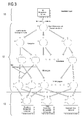
- FIG. 5 shows a flow chart which explains the basic sequence of the method according to the invention: The actions of client C, a program part and the server S that relate to the question transaction are shown on the left side of this figure, while the actions that relate to the answer transaction are shown on the right side.
- a client C now requires certain data from the data layer 13 and generates a message 14 with these current arguments. This message relates to the question transaction at this time.
- the client C then pushes the message 14 into the send queue of the client C, which is organized according to the FIFO (first-in, first-out) principle, and returns.
- the addressed program part now picks up the uppermost element of the queue and routes the message 14 with the coded routing information through the second layer from server S to server S to a receive FIFO of server S and then returns.
- the server S can read the message 14 or the question part from the receive queue and process it. This completes the first section of the server order according to the invention. Now the result has to be sent back to the original client C or another destination address.
- the server S in turn generates a message 14 according to the same principle, which in this case encodes the response transaction and places it in the send FIFO of the server server S, in order to then return.
- the program part can read out the response transaction from the send FIFO and use the routing information to route it further to the receive FIFO of the client C within the second layer 12 in order to then return.
- the client C now fetches the message 14 from the receive FIFO of the client C and acquires the time stamp that uniquely identifies the message 14. Using the time stamp in the millisecond range, he can clearly determine the associated question transaction and, so to speak, put the two-part structure (question-answer) together in a one-part (order). The entire job is now complete.
- a component client only calls a component server via its public interface.
- the program is then implemented by an attached and encapsulated component class.
- the term "public" in connection with the interface means that it experiences a definition that can be viewed globally in every computer, is uniquely identified and can also be queried across computer boundaries. This is achieved by using GUIDs (Globally Unique Identifier) for the interface, the component class, resources and much more.
- An interface or the interface represents a collection of functions with call parameters. These can basically take any type.
- "string” is used as the general standard type. This provides a generic type that allows message passing for all conceivable developments. This is achieved by calling a component via one of its functions, which then blocks until it ends.
- the given message is converted and interpreted within this function. Only after this has been done does it return the program flow to the caller.
- the message passing is realized by "textual messages". It is implemented by the text code that is native to the respective target platform. For Windows and many UNIX platforms, this is UNICODE.
- a message consists of several areas, which differ in that they either appear as their own argument, or are composed as follows to form a string with a defined separator: "Category.Subsystem.command group.command + data field".
- the data field generally consists of the following string areas: Source Name
- a message 14 is therefore always composed of a message path and token.
- the message path implements a hierarchy that defines a relational relationship that clearly enables routing from the root to the destination. As is usual with relational relationships, uniqueness only applies from left to right in the message path or from top to bottom.
- the message path denotes a destination that is identical to a subsystem.
- the token is delivered to this.
- This hierarchy identifies the keys of a routing database.
- the key category represents the first level of the hierarchy If he is identified, is in the second level by the key subsystem set another branch.
- the command group branches off as a third level and enables the last branch by the instruction in the token itself is set.
- Each level is represented by a component in Middle Tier 12 or Micro kernel implemented. Under an identified key are all the information stored for a call a software component are necessary. For every key there is a component. The entirety of these routing components provides the business logic in the micro kernel or middle Tier 12. These components only need to be developed once become. There are several tools available. In the case of MS Com there is Visual Basic or Visual C ++ and ATL.
- New commands are added by adding a new entry in the routing database is made.
- the realization then takes place completely in the two subsystems, the want to talk to each other via Messages 14.
- the starting point is a questioning subsystem graphics, which should implement a mask.
- This mask asks for all information that is necessary to display a certain number of hits.
- the graphics subsystem uses them to generate an SQL select string for the data field and connects it with a previously specified command to form a token "Get.Grafik.0.SELECT ", where "graphics" is the name of the sending subsystem and " 0 "is the content of the control field.
- the message path is now set: "Example.Visual.Holen”. This is also the subject of the previous specifications. These are independent of the architecture described here.
- Example.Visual.Holen.Get.Grafik.0.SELECT A root component of the micro kernel is called with these strings. This is the standard interprocess communication, which is always the same for all transitions between the layers or from a subsystem to the micro kernel. The same root component is always called, which is always the standard entry point of a call chain or stub as described below. It is also the so-called transaction root, which is where the transaction begins. Your first action is to interpret the message path.
- the "Example” category serves as a key in order to be able to request the call information for the next lower component from the routing database. This is then called up immediately, whereby the message path and the token are simply passed on.
- This component of the category level works on the same principle as the root component: interpretation of the message path ("Visual"), retrieval of the key from the routing database and extraction of the call information. The result is the call of a component from the lower level called the subsystem.
- This component now works on the same principle and calls a "fetch" component from the command group level. Overall, an order is converted into recursive calls to the respective server S.
- Each level can contain any number of components. Therefore, the call path is only clear from top to bottom and not the other way around.
- the command group level is the direct call layer of the subsystems. It contains the clients C of the subsystems and is the boundary of the middle tier (or micro kernel) 12 with one subsystem.
- the rest of the subsystem runs in at least one worker thread in order to have its own execution path. This enables the component class to be terminated immediately and the transaction to be successfully completed. Once in the data subsystem, the branch line or transaction is completed and the components involved also successfully terminate.
- each subsystem can become a top level and send a command to the bottom level via message passing.
- the graphics subsystem that used to be the question.
- the question went from graphics to data about a transaction and the answer is now to be sent from data to graphics. If this second transaction has also ended, the recordset of the result set should have arrived in the graphics subsystem in order to be visualized. Nowhere was it necessary to stipulate that the source subsystem must again be the final target system.
- this component can also be integrated as such as standard.
- the old application receives all messages from the other subsystems, even if they were developed much later and therefore more optimally coordinated. Because of the micro kernel, this old application does not have to be positioned in the rigid multi-tier structure. In this way, NetManager could get a middle layer before version 5.X, which it can use as an object broker (MTS, COM +).
- MTS object broker
- a component Due to the use of components is patching easy to do. A component is considered defective recognized, it is the only object changed and new compiled. The key point is that you care respects the unique characteristics of a component, their GUIDs not to change. It is inserted again by simply overwriting the access path in the component management (in Windows in the registry) or by Overwrite the component on the hard disk. if it ensures that they are not called at this moment this can also be done during operation.
- the receiving function can be represented with a C pseudo code as follows: , where BSTR is an MS COM-specific data type that represents a string of a certain length.
Landscapes
- Engineering & Computer Science (AREA)
- Software Systems (AREA)
- Theoretical Computer Science (AREA)
- Computer Networks & Wireless Communication (AREA)
- Signal Processing (AREA)
- Physics & Mathematics (AREA)
- General Engineering & Computer Science (AREA)
- General Physics & Mathematics (AREA)
- Computer Security & Cryptography (AREA)
- Computer And Data Communications (AREA)
- Information Retrieval, Db Structures And Fs Structures Therefor (AREA)
Applications Claiming Priority (2)
| Application Number | Priority Date | Filing Date | Title |
|---|---|---|---|
| DE10244459A DE10244459A1 (de) | 2002-09-24 | 2002-09-24 | Rechner- und/oder Software-Architektur unter Verwendung von Micro-Kernel- und Multi-Tier-Konzept mit Komponententechnik |
| DE10244459 | 2002-09-24 |
Publications (2)
| Publication Number | Publication Date |
|---|---|
| EP1437655A2 true EP1437655A2 (fr) | 2004-07-14 |
| EP1437655A3 EP1437655A3 (fr) | 2007-03-14 |
Family
ID=31969528
Family Applications (1)
| Application Number | Title | Priority Date | Filing Date |
|---|---|---|---|
| EP03102629A Withdrawn EP1437655A3 (fr) | 2002-09-24 | 2003-08-22 | Ordinateur et architecture de logiciels par concepts micro-noyaux et multiniveaus avec techniques components |
Country Status (3)
| Country | Link |
|---|---|
| US (1) | US20040139153A1 (fr) |
| EP (1) | EP1437655A3 (fr) |
| DE (1) | DE10244459A1 (fr) |
Families Citing this family (8)
| Publication number | Priority date | Publication date | Assignee | Title |
|---|---|---|---|---|
| US7970801B1 (en) * | 2004-01-21 | 2011-06-28 | Computer Associates Think, Inc. | Data packaging system and method |
| US7924844B1 (en) | 2004-01-21 | 2011-04-12 | Computer Associates Think, Inc. | System and method for communicating messages among components in a computing environment |
| US7953769B1 (en) * | 2004-01-21 | 2011-05-31 | Computer Associates Think, Inc. | XML data packaging system and method |
| US7516178B1 (en) | 2004-01-21 | 2009-04-07 | Computer Associates Think, Inc. | Communicating messages between components in a client/server environment using a object broker |
| US7769569B2 (en) * | 2004-09-02 | 2010-08-03 | Logiccon Design Automation Ltd. | Method and system for designing a structural level description of an electronic circuit |
| CN101296176B (zh) * | 2007-04-25 | 2010-12-22 | 阿里巴巴集团控股有限公司 | 一种基于群集的数据处理方法和装置 |
| US9043796B2 (en) * | 2011-04-07 | 2015-05-26 | Microsoft Technology Licensing, Llc | Asynchronous callback driven messaging request completion notification |
| CN110532072A (zh) * | 2019-07-24 | 2019-12-03 | 中国科学院计算技术研究所 | 基于微内核操作系统的分布式流式数据处理方法及系统 |
Family Cites Families (10)
| Publication number | Priority date | Publication date | Assignee | Title |
|---|---|---|---|---|
| US5544320A (en) * | 1993-01-08 | 1996-08-06 | Konrad; Allan M. | Remote information service access system based on a client-server-service model |
| CA2149445A1 (fr) * | 1994-07-27 | 1996-01-28 | Aziza Bushra Faruqi | Methode et dispositif de separation des informations de controle des transmissions pour systeme de traitement de donnees a micronoyau |
| US6266666B1 (en) * | 1997-09-08 | 2001-07-24 | Sybase, Inc. | Component transaction server for developing and deploying transaction- intensive business applications |
| US6134594A (en) * | 1997-10-28 | 2000-10-17 | Microsoft Corporation | Multi-user, multiple tier distributed application architecture with single-user access control of middle tier objects |
| US6205498B1 (en) * | 1998-04-01 | 2001-03-20 | Microsoft Corporation | Method and system for message transfer session management |
| US6912588B1 (en) * | 1998-04-02 | 2005-06-28 | Intel Corporation | System and method for managing client requests in client-server networks |
| US6009455A (en) * | 1998-04-20 | 1999-12-28 | Doyle; John F. | Distributed computation utilizing idle networked computers |
| US6286104B1 (en) * | 1999-08-04 | 2001-09-04 | Oracle Corporation | Authentication and authorization in a multi-tier relational database management system |
| US20020019844A1 (en) * | 2000-07-06 | 2002-02-14 | Kurowski Scott J. | Method and system for network-distributed computing |
| US8346848B2 (en) * | 2001-08-16 | 2013-01-01 | Juniper Networks, Inc. | System and method for maintaining statefulness during client-server interactions |
-
2002
- 2002-09-24 DE DE10244459A patent/DE10244459A1/de not_active Withdrawn
-
2003
- 2003-08-22 EP EP03102629A patent/EP1437655A3/fr not_active Withdrawn
- 2003-09-23 US US10/667,890 patent/US20040139153A1/en not_active Abandoned
Also Published As
| Publication number | Publication date |
|---|---|
| DE10244459A1 (de) | 2004-04-01 |
| EP1437655A3 (fr) | 2007-03-14 |
| US20040139153A1 (en) | 2004-07-15 |
Similar Documents
| Publication | Publication Date | Title |
|---|---|---|
| DE60132901T2 (de) | Internetzugriff zu geerbten anwendungen | |
| EP0825524B1 (fr) | Procédé pour nommer des objets | |
| DE69030524T2 (de) | Fernanwendungsschnittstelle | |
| DE69904190T2 (de) | Verfahren und programm zum verarbeiten der verwaltungsanfragen einer verteilten netzwerkanwendung in einer gruppierten rechnerumgebung | |
| DE69615978T2 (de) | Verfahren und Vorrichtung zum Verpackung und Entpackung von Daten in objectreferenzspezifischen Datenformaten anhand generischen Stubs | |
| EP0743595B1 (fr) | Système de communication avec des moyens pour l'echange de logiciel | |
| DE69329577T2 (de) | Verfahren und system für implementierung-unabhängige schnittstellenspezifikation | |
| DE69719620T2 (de) | Vorrichtung und Verfahren zur Bestimmung von Server-Cluster-Topologien | |
| DE69736586T2 (de) | Verfahren und Rechnerprogrammprodukt zur Verringerung von Interpufferdatenübertragungen zwischen getrennten Datenverarbeitungskomponenten | |
| DE68919976T2 (de) | Verfahren zur Herstellung von aktuellen Terminaladressen für Systemanwender die verteilte Anwendungsprogramme in einer SNA LU 6.2-Netzwerkumbegung verarbeiten. | |
| DE69724877T2 (de) | Verfahren und Vorrichtung zum Betrieb einer Aggregation von Serverrechnern mittels eines Doppelzweck-Proxy-Servers | |
| DE69832354T2 (de) | Netzwerkverwaltungsrahmenwerk | |
| DE69228621T2 (de) | Objektorientiertes verteiltes Rechnersystem | |
| DE60025043T2 (de) | Vorrichtung und verfahren mit verwendung von anwendungabhängigkeitsinformation für eine sicherungskopieherstellung in einem computersystem | |
| DE69734432T2 (de) | Verfahren und Vorrichtung zur Absendung von Clientverfahrenanrufen in einem Server Rechnersystem | |
| EP0825527B1 (fr) | Procédé pour l'interaction d'adresses entre deux unités | |
| EP0807883B1 (fr) | Système de communication avec moyen pour échanger des processus de logiciel | |
| DE69814697T2 (de) | Vorrichtung, methode und computer programm produkt für client/server rechner mit vom client auswählbarer lokalisierung von transaktionsobjekten | |
| DE10212634B4 (de) | Verfahren zum Betreiben eines Druckers und computerlesbares Medium mit Anweisungen zur Ausführung des Verfahrens | |
| DE10244459A1 (de) | Rechner- und/oder Software-Architektur unter Verwendung von Micro-Kernel- und Multi-Tier-Konzept mit Komponententechnik | |
| EP3028182A1 (fr) | Procédé et système de synchronisation de données | |
| DE19813883B4 (de) | Verfahren, Computerprogrammprodukt und Dokumentenmanagementsystem zum Zugriff auf Internet-Informationen für geschlossene Benutzergruppen | |
| EP0825525B1 (fr) | Procédé pour la création d'objets | |
| DE10152874B4 (de) | Kommunikationsanordnung und Verfahren zum Datenaustausch mit Adressierungsservice | |
| EP1331789B1 (fr) | Configuration centrale des appareils actifs dans un réseau |
Legal Events
| Date | Code | Title | Description |
|---|---|---|---|
| PUAI | Public reference made under article 153(3) epc to a published international application that has entered the european phase |
Free format text: ORIGINAL CODE: 0009012 |
|
| AK | Designated contracting states |
Kind code of ref document: A2 Designated state(s): AT BE BG CH CY CZ DE DK EE ES FI FR GB GR HU IE IT LI LU MC NL PT RO SE SI SK TR |
|
| AX | Request for extension of the european patent |
Extension state: AL LT LV MK |
|
| PUAL | Search report despatched |
Free format text: ORIGINAL CODE: 0009013 |
|
| RIC1 | Information provided on ipc code assigned before grant |
Ipc: G06F 9/54 20060101ALI20070131BHEP Ipc: G06F 9/46 20060101AFI20040525BHEP |
|
| AK | Designated contracting states |
Kind code of ref document: A3 Designated state(s): AT BE BG CH CY CZ DE DK EE ES FI FR GB GR HU IE IT LI LU MC NL PT RO SE SI SK TR |
|
| AX | Request for extension of the european patent |
Extension state: AL LT LV MK |
|
| RAP1 | Party data changed (applicant data changed or rights of an application transferred) |
Owner name: NOKIA SIEMENS NETWORKS GMBH & CO. KG |
|
| 17P | Request for examination filed |
Effective date: 20070914 |
|
| RAP3 | Party data changed (applicant data changed or rights of an application transferred) |
Owner name: NOKIA SIEMENS NETWORKS S.P.A. |
|
| AKX | Designation fees paid |
Designated state(s): AT CH DE GB IE LI |
|
| RAP3 | Party data changed (applicant data changed or rights of an application transferred) |
Owner name: NOKIA SIEMENS NETWORKS GMBH & CO. KG |
|
| 17Q | First examination report despatched |
Effective date: 20071220 |
|
| STAA | Information on the status of an ep patent application or granted ep patent |
Free format text: STATUS: THE APPLICATION IS DEEMED TO BE WITHDRAWN |
|
| 18D | Application deemed to be withdrawn |
Effective date: 20080503 |