EP1437894A2 - Verfahren und Vorrichtung für Rückwärtswiedergabe - Google Patents
Verfahren und Vorrichtung für Rückwärtswiedergabe Download PDFInfo
- Publication number
- EP1437894A2 EP1437894A2 EP03255327A EP03255327A EP1437894A2 EP 1437894 A2 EP1437894 A2 EP 1437894A2 EP 03255327 A EP03255327 A EP 03255327A EP 03255327 A EP03255327 A EP 03255327A EP 1437894 A2 EP1437894 A2 EP 1437894A2
- Authority
- EP
- European Patent Office
- Prior art keywords
- pictures
- predictive encoded
- forward predictive
- anchor
- frames
- Prior art date
- Legal status (The legal status is an assumption and is not a legal conclusion. Google has not performed a legal analysis and makes no representation as to the accuracy of the status listed.)
- Granted
Links
Images



Classifications
-
- H—ELECTRICITY
- H04—ELECTRIC COMMUNICATION TECHNIQUE
- H04N—PICTORIAL COMMUNICATION, e.g. TELEVISION
- H04N5/00—Details of television systems
- H04N5/76—Television signal recording
- H04N5/91—Television signal processing therefor
- H04N5/93—Regeneration of the television signal or of selected parts thereof
-
- H—ELECTRICITY
- H04—ELECTRIC COMMUNICATION TECHNIQUE
- H04N—PICTORIAL COMMUNICATION, e.g. TELEVISION
- H04N5/00—Details of television systems
- H04N5/76—Television signal recording
- H04N5/78—Television signal recording using magnetic recording
- H04N5/782—Television signal recording using magnetic recording on tape
- H04N5/783—Adaptations for reproducing at a rate different from the recording rate
-
- H—ELECTRICITY
- H04—ELECTRIC COMMUNICATION TECHNIQUE
- H04N—PICTORIAL COMMUNICATION, e.g. TELEVISION
- H04N19/00—Methods or arrangements for coding, decoding, compressing or decompressing digital video signals
- H04N19/10—Methods or arrangements for coding, decoding, compressing or decompressing digital video signals using adaptive coding
- H04N19/134—Methods or arrangements for coding, decoding, compressing or decompressing digital video signals using adaptive coding characterised by the element, parameter or criterion affecting or controlling the adaptive coding
- H04N19/157—Assigned coding mode, i.e. the coding mode being predefined or preselected to be further used for selection of another element or parameter
- H04N19/159—Prediction type, e.g. intra-frame, inter-frame or bidirectional frame prediction
-
- H—ELECTRICITY
- H04—ELECTRIC COMMUNICATION TECHNIQUE
- H04N—PICTORIAL COMMUNICATION, e.g. TELEVISION
- H04N19/00—Methods or arrangements for coding, decoding, compressing or decompressing digital video signals
- H04N19/40—Methods or arrangements for coding, decoding, compressing or decompressing digital video signals using video transcoding, i.e. partial or full decoding of a coded input stream followed by re-encoding of the decoded output stream
-
- H—ELECTRICITY
- H04—ELECTRIC COMMUNICATION TECHNIQUE
- H04N—PICTORIAL COMMUNICATION, e.g. TELEVISION
- H04N19/00—Methods or arrangements for coding, decoding, compressing or decompressing digital video signals
- H04N19/60—Methods or arrangements for coding, decoding, compressing or decompressing digital video signals using transform coding
- H04N19/61—Methods or arrangements for coding, decoding, compressing or decompressing digital video signals using transform coding in combination with predictive coding
-
- H—ELECTRICITY
- H04—ELECTRIC COMMUNICATION TECHNIQUE
- H04N—PICTORIAL COMMUNICATION, e.g. TELEVISION
- H04N21/00—Selective content distribution, e.g. interactive television or video on demand [VOD]
- H04N21/40—Client devices specifically adapted for the reception of or interaction with content, e.g. set-top-box [STB]; Operations thereof
- H04N21/43—Processing of content or additional data, e.g. demultiplexing additional data from a digital video stream; Elementary client operations, e.g. monitoring of home network or synchronising decoder's clock; Client middleware
- H04N21/432—Content retrieval operation from a local storage medium, e.g. hard-disk
- H04N21/4325—Content retrieval operation from a local storage medium, e.g. hard-disk by playing back content from the storage medium
-
- H—ELECTRICITY
- H04—ELECTRIC COMMUNICATION TECHNIQUE
- H04N—PICTORIAL COMMUNICATION, e.g. TELEVISION
- H04N21/00—Selective content distribution, e.g. interactive television or video on demand [VOD]
- H04N21/40—Client devices specifically adapted for the reception of or interaction with content, e.g. set-top-box [STB]; Operations thereof
- H04N21/43—Processing of content or additional data, e.g. demultiplexing additional data from a digital video stream; Elementary client operations, e.g. monitoring of home network or synchronising decoder's clock; Client middleware
- H04N21/44—Processing of video elementary streams, e.g. splicing a video clip retrieved from local storage with an incoming video stream or rendering scenes according to encoded video stream scene graphs
- H04N21/4402—Processing of video elementary streams, e.g. splicing a video clip retrieved from local storage with an incoming video stream or rendering scenes according to encoded video stream scene graphs involving reformatting operations of video signals for household redistribution, storage or real-time display
- H04N21/440218—Processing of video elementary streams, e.g. splicing a video clip retrieved from local storage with an incoming video stream or rendering scenes according to encoded video stream scene graphs involving reformatting operations of video signals for household redistribution, storage or real-time display by transcoding between formats or standards, e.g. from MPEG-2 to MPEG-4
-
- H—ELECTRICITY
- H04—ELECTRIC COMMUNICATION TECHNIQUE
- H04N—PICTORIAL COMMUNICATION, e.g. TELEVISION
- H04N9/00—Details of colour television systems
- H04N9/79—Processing of colour television signals in connection with recording
- H04N9/80—Transformation of the television signal for recording, e.g. modulation, frequency changing; Inverse transformation for playback
- H04N9/804—Transformation of the television signal for recording, e.g. modulation, frequency changing; Inverse transformation for playback involving pulse code modulation of the colour picture signal components
- H04N9/8042—Transformation of the television signal for recording, e.g. modulation, frequency changing; Inverse transformation for playback involving pulse code modulation of the colour picture signal components involving data reduction
Definitions
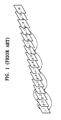
- Fig. 1 illustrates an example of an MPEG data stream.
- the video stream is divided into intra frames I, predictive frames P, and interpolated frames B.
- the I frames are a type of frame commonly referred to as an anchor frame.
- the P frames are a type of forward predictive encoded frame in that P frames are encoded based on a temporally preceding frame.
- the B frames are a type of bi-directionally encoded frame in that B frames are encoded based on a temporally preceding and succeeding frames.
- the frames from one I frame to the next are commonly referred to as a group of pictures or GOP.
- GOP group of pictures
- I frames are encoded independent of any other frames in the sequence. Accordingly, decoding an I frame does not require any other frame in this sequence.
- P frames are encoded using motion estimation, and are dependent on the preceding I or P frame in the sequence. Accordingly, with P frames, these frames cannot be decoded without the preceding I or P frame.
- B frames are encoded using the I or P frame preceding the B frame and the I or P frame succeeding the B frame as indicated by the arrows in Fig. 1. Accordingly, with B frames, these frames cannot be decoded without the preceding and succeeding I or P frames.
- Fig. 1 illustrates the display order of the frames in a GOP.
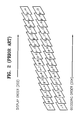
- Fig. 2 illustrates both the display and decoding orders 202 and 204 of the GOP illustrated in Fig. 1.
- the decoding order 204 the frames needed for decoding a subsequent P or B frame, are received by the decoder prior to receipt of that P or B frame.
- the decoded frames are temporarily stored in a memory and then read out in the display order 202 for display.
- Such a system works well for displaying the video data in a normal forward play mode, but there are instances where a user may want to play the video data in a reverse play mode. As will be appreciated, this adds a level of complexity in decoding B and P frames. For example, displaying frame B14 requires decompressing frames P13 and I16, but decompressing frame P13 requires decompressing frame P10, which requires decompressing frame P7, which requires decompressing frame P4, which requires decompressing frame I1.
- decoding a P frame during the reverse play mode requires decoding, in a reverse sequence, all the P frames until an I frame is reached.
- Fig. 3 illustrates a prior art MPEG decoder that supports a reverse play mode.
- an input device 302 stores an MPEG data stream.
- a decoder 304 decodes the compressed data stored in the input device 302.
- the decoder 304 outputs the decompressed data in the forward play display order for display on a display device 306.
- the decompressed data output from the decoder 304 is also stored by a frame buffer memory 308.
- the frame buffer memory 308 is accessed, and the decompressed data is read out in the reverse display order for display on the display device 306.
- the prior art system of Fig. 3 requires an extremely large frame buffer memory 308.
- Japanese Patent JP 2000-101969 discloses a similar system to that discussed above with respect to Fig. 3. However, in this Japanese patent document, only the I and P frames are stored in the frame buffer memory during forward play. During reverse play, the B frames are decompressed using the stored decompressed I and P frames, and the decompressed frames are played out in the reverse play order. As will be appreciated, if the number of frames in a GOP is large, then the frame buffer memory must still be quite large to permit reverse play.
- Japanese Patent JP 1997-037209 also discloses a system that supports the reverse play mode. In this system, only I frames are decoded and displayed in the reverse play mode. As a result, only partial frames are played in the reverse play mode, and the quality of the resulting display is of extremely poor quality.
- Fig. 4 illustrates a block diagram of another prior art system that supports the reverse play mode.
- the system illustrated in Fig. 4 is based on the disclosure in Japanese Patent JP 1994-033111.
- an input device 402 stores an MPEG data stream.
- a decoder 404 decodes the compressed data stored in the input device 402.
- the decoder 404 temporarily stores the decompressed data in a frame memory 406.
- the decoded frames are read out from the frame memory 406 in the display order and displayed on a display device 412.
- the decoded frames sent to the display device 412 are also received by an I frame encoder 410.
- the I frame encoder 410 encodes the decompressed frames in I frame format, and stores the I frames in a buffer memory 408.
- the frames stored in the buffer memory 408 are read out and decoded by the decoder 404.
- the decoded frames, read from the buffer memory 408 in reverse order, are then displayed on a display device 412.
- U.S. Patent No. 5,742,347 discloses another system for decoding and displaying an MPEG data stream in both forward play and reverse play modes.
- each decompressed P frame is re-encoded as an I frame and stored in a secondary storage device.
- the secondary storage device is accessed to decode and display P frames, and is also accessed to obtain the P frames needed for decoding B frames.
- the need to decode multiple P frames until an I frame is reached as discussed above with respect to Fig. 3 is not required, and because there is no motion estimation and compensation required for compressing a single frame into an I frame, the I frame encoding is performed efficiently.
- this technique still requires a relatively large secondary storage.
- I frame encoding is still required, even if all B frames are not encoded into I frames. Accordingly a demand to reduce the processing time including the encoding and decoding time and to make the secondary storage smaller still exists.
- a method and apparatus for reverse play according to the present invention offers a significant reduction in the amount of memory space required for performing reverse play of a compressed data stream.
- a subset of the forward predictive encoded pictures in the compressed data stream are re-encoded as anchor pictures after being decoded. Because less than all of the forward predictive encoded pictures are re-encoded as anchor pictures, less memory space is required during the reverse play operation.
- temporally adjacent anchor pictures form an independent group within a larger group of pictures.
- the independent group is independent in that the pictures outside that group are not required in order to perform the decoding operation of the pictures within the group. As such, less memory space is required during the decoding operation in order to decode and play the data in the reverse play mode.
- one embodiment of the present invention calls for performing the re-encoding operation separate and apart from any other operating modes of the invention.
- another embodiment of the present invention creates the re-encoded anchor pictures during the forward play operation.
- instead of storing each of the decoded pictures needed for decoding any one of the pictures in the independent group only the decoded pictures necessary for decoding an upcoming picture are stored in memory. This embodiment requires less memory space, but also requires decoding the same picture more than once during the decoding and playback operation.
- a greater reduction in the memory requirement is achieved by sub-sampling the decoded, forward predictive encoded pictures being re-encoded as anchor pictures.
- the forward predictive encoded pictures which do not undergo re-encoding as anchor pictures, are decoded and re-encoded based on the anchor pictures that precede them in the reverse play order when displayed in the reverse play mode.
- Fig. 1 illustrates a GOP according to the MPEG standard
- Fig. 2 illustrates the forward display order and the forward display decoding order for a GOP according to the MPEG standard
- Fig. 3 illustrates a block diagram of a prior art system that supports forward and reverse play modes
- Fig. 4 illustrates another block diagram of a prior art system that supports forward and reverse play modes
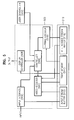
- Fig. 5 illustrates a block diagram of an architecture according to the present invention for employing the method for reverse play according to the present invention
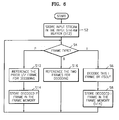
- Fig. 6 illustrates a flowchart showing the decoding process in the forward play mode according to the present invention
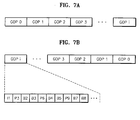
- Fig. 7A illustrates an MPEG stream at the GOP level
- Fig. 7B illustrates the GOP order in the reverse play mode, and the pictures within one of the GOP
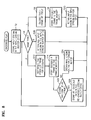
- Fig. 8 illustrates the P frame re-encoding process according to a first embodiment of the present invention
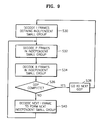
- Fig. 9 illustrates the decoding process for the reverse play mode according to the first embodiment of the present invention.
- Figs. 10A-10E illustrate an exemplary MPEG data stream, re-encoded MPEG data stream, reverse display order, reverse decoding order and frame memory contents, respectively, for reverse play according to the first embodiment of the present invention
- Figs. 11A and 11B illustrate the motion vectors before and after the decoding operation according to the first embodiment of the present invention
- Fig. 12 illustrates the re-encoding of P frames as anchor frames according to a second embodiment of the present invention
- Figs. 13A and 13B illustrate the reverse play decoding order and frame memory contents, respectively, for reverse play according to a third embodiment of the present invention
- Fig. 14 illustrates a block diagram of another embodiment of a system architecture according to the present invention for supporting a fourth embodiment of the method for reverse play according to the present invention
- Fig. 15 illustrates the re-encoded MPEG stream according to the fourth embodiment of the present invention.
- Figs. 16A and 16B illustrate the encoded MPEG data stream before and after processing according to a fifth embodiment of the present invention.
- Fig. 5 illustrates a block diagram of the system architecture for implementing the method for reverse play of an MPEG data stream according to the present invention.
- an input interface 502 inputs the MPEG data stream, and stores the MPEG data stream in an input stream buffer 512.
- a video decoder 504 decompresses (i.e., decodes) the MPEG data stream, and temporarily stores the decompressed data in a frame memory 514.
- the controller 506 also controls a display controller 508 to output the decompressed frames in a proper display order in either the forward or reverse display modes.
- the controller 506 further causes an I frame encoder 518 to encode selected, decoded P frames in the frame memory 514 into I frames, which are then stored in re-encoded stream buffer 516.
- the controller 506 controls the video decoder 504 to decode the I frames stored in the re-encoded stream buffer 516 as needed for display in the reverse play mode.
- the operation of the controller 506 is controlled in part by a user controller 520. Through user controller 520, a user indicates whether to stop, pause, forward play or reverse play a MPEG data stream.
- the controller 506 is a conventional microprocessor programmed to implement the methodology according to the present invention as discussed in greater detail below.
- the display controller 508 is any conventional display controller that reads data from a memory and converts that data to RF or digital signals for display.
- the input stream buffer 512, frame memory 514 and re-encoded stream buffer 516 can be separate memory devices, or can be embodied as a single memory device that is logically partitioned into the three different memories. Whether independent storage devices or a single storage device, the storage device(s) can be embodied as a conventional RAM, HDD, flash memory, etc.
- the input interface 502 stores the input MPEG data stream in the input stream buffer 512 in step S2.
- the video decoder 504 accesses the frames of compressed data stored in the input stream buffer 512.
- the video decoder 504 determines the frame type in step S4. If the frame type is I frame, the processing proceeds to step S6 wherein the I frame is decoded in a conventional manner; namely, no motion compensation is required. Subsequently, in step S8, the video decoder stores the decoded I frame in the frame memory 514.
- step S12 if the video decoder 504 determines the frame is a P frame, in the step S12 the video decoder 504 references the prior decoded I or P frame stored in the frame memory 514, and decodes the P frame in the conventional manner. The decoded P frame is then stored in the frame memory 514 in step S14.
- step S16 if the video decoder 504 determines that the frame is a B frame, then in step S16, the video decoder 504 accesses the temporally preceding and succeeding decompressed I or P frames stored in the frame memory 514 necessary for decoding the B frame, and decodes the B frame in the conventional manner. This process continues with subsequently decompressed frames being written over previously decompressed frames that have already been displayed and are no longer necessary for the decompression process.
- the display controller 508 under the control of the controller 506 accesses the decompressed frames in the forward play display order and generates a display output.
- Fig. 7A illustrates, at the GOP level, the original MPEG stream.
- Fig. 7B shows that in the reverse play mode, the GOP are read out in reverse order. However, as further shown in Fig. 7B, while the GOP are accessed or input in reverse order, the pictures within a GOP are still in the same decoding order as illustrated in Fig. 2. Accordingly, in the reverse play mode, the pictures forming a GOP must be decoded in a way to permit reversal of the display order of the pictures as compared to the display order illustrated in Fig. 2.
- FIG. 8 illustrates a re-encoding process for the reverse play operation
- Fig. 9 illustrates the decoding process for reverse play.
- Fig. 8 includes the same steps illustrated in Fig. 6 except that step S28 has replaced step S16, and new steps S20, S22, S24 and S26 have been added. Accordingly, like reference numerals have been used to designate like steps, and the description of these previously described steps will not be repeated for the sake of brevity. Instead, only the new steps will be described.
- step S8 after the decoded I frame is stored in the frame memory 514 in step S8, the encoded I frame is retained in the input stream buffer S20.
- step S4 if the video decoder 504 determines that a frame is a B frame, then in step S28, the encoded B frame is retained in the input stream buffer 512.
- the controller 506 in step S22 determines whether to have this P frame encoded as an I frame. According to the method of the present invention, a subset of the decoded P frames, where that subset includes less than all of the decoded P frames, are re-encoded as I frames. In an exemplary embodiment, the controller 506 skips, for a GOP, every n P frames before encoding a P frame, where n is an integer greater than or equal to 1. For example, with n equal to 1, the controller 506 in step S22 causes every other P frame to be encoded as an I frame by the I frame encoder 518.
- step S24 the compressed P frame is retained in the input stream buffer 512.
- the controller 506 determines that the P frame is to be re-encoded as an I frame
- the I frame encoder 518 accesses the decoded P frame from frame memory 514, re-encodes the decoded P frame as an I frame, and stores the encoded I frame in the re-encoded stream buffer 516 in step S26.
- Fig. 10A illustrates a portion of the MPEG data stream illustrated in Fig. 1.
- Fig. 10B illustrates the resulting re-encoded stream generated as a result of the process shown in Fig. 8 when the I frame encoder 518 is instructed by the controller 506 to re-encode every other P frame.
- the re-encoded stream 704 includes I frames I6 and I12 instead of P frames P6 and P12.
- step S30 the controller 506 causes the video decoder 504 to access, in the reverse display order, temporally adjacent encoded I frames in the GOP.
- the video decoder 504 accesses these I frames from the input stream buffer 512, decodes the I frames, and stores the decoded I frames in the frame memory 514.
- the two reverse display order temporally successively I frames form an independent small group. Between the successively decoded I frames are one or more P frames and four or more B frames.
- the controller 506 causes the video decoder 504 to decode each of the P frames in the independent small group.
- decoding P frames and B frames involves motion compensation based on a motion vector. These vectors like any vector have both a direction and a magnitude.
- the motion vector for a P frame such as P3 is a forward motion vector pointing to I frame I0, which precedes the P frame in the display order.
- I frame I0 follows the P frame P3 in the reverse display order.
- Figs. 10C-10E illustrate an example of this process.
- Fig. 10C illustrates the reverse display order of the GOP portion illustrated in Fig. 10A.
- Fig. 10D illustrates the decoding order of the frames illustrated in Fig. 10C during reverse play according to this embodiment of the present invention
- Fig. 10E illustrates the frames of the GOP stored in the frame memory 514 according to this embodiment.
- the I frames I12 and I6 are decoded and stored in the frame memory 514 to define an independent small group.
- the P frame P9 in the independent small group defined by I frames I12 and I6 is decoded and stored in the frame memory 514.
- step S34 the B frames in the independent small group are decoded.
- this involves decoding B frames B11, B10, B8 and B7 in the independent small group defined by I frames I12 and I6.
- Fig. 10D illustrates the decoding order of these B frames
- Fig. 10E illustrates the frames stored in the memory 514 during this process.
- step S36 the controller 506 determines whether a decoding process for the GOP has been completed. If the decoding process has been completed, then in step S38, the decoding process for the next GOP is initiated, and processing returns to step S30 for the next GOP. However, if processing of the GOP is not complete, then in step S40, the next I frame in the reverse display order is decoded to form the next independent small group. For example, with respect to Fig. 10C-10E, the next I frame in the reverse display order of this example is I frame I0. Accordingly, this I frame is decoded and stored in the frame memory 10E.
- Figs. 10C-10E illustrate the display order, decoding order and the frames stored in the frame memory 514 for this next independent small group.
- the controller 506 controls the display controller 508 to access the decoded frames from the frame memory 514 and generate the display output. Specifically, once a frame has been decoded, the display controller 508 is permitted to access and generate the display output for that frame. Furthermore as evidenced by the example shown in Fig. 10E, once a frame has been displayed by the display controller 508, and if that frame is no longer necessary for the decoding process, the frame is no longer retained in the frame memory 514.
- the frame memory space required for reverse play according to this embodiment of the present invention is the number of frames required for decoding a B frame (i.e., two) plus the number of P frames not encoded into an I frame in an independent small group plus one B frame.
- the method for reverse play according to the present invention requires a significantly smaller storage device. Additionally, because reverse play according to the present method does not result in skipped frames, excellent picture quality is achieved in the reverse play mode as well.
- the re-encoding process of the first embodiment described above with respect to Fig. 8 is performed as part of the decoding operation during the forward play mode as illustrated in Fig. 6. Namely, as the frames are decoded for forward play, the encoded I and B frames are retained in the input stream buffer 512, and the selected, decoded P frames are re-encoded as I frames and stored in the re-encoded stream buffer 516. This combined process is illustrated in Fig. 12. Because of each of the steps in Fig. 12 has been described above with respect to one of Figs. 6 and 8, a description of these steps will not be repeated for the sake of brevity.
- the reverse play mode when the reverse play mode is selected by the user through user controller 520, the re-encoding process of the first embodiment does not need to be performed. Instead, the reverse play mode begins with the decoding process discussed above with respect to Fig. 9, and reverse playback proceeds as discussed above with respect to the first embodiment.
- the method for reverse play according to the third embodiment of the present invention is the same as either the first or second embodiments of the present invention except that not all of the decoded frames needed for decoding of subsequent P or B frames are stored in the frame memory 514. As a result, less memory space is required for reverse play according to this embodiment, but additional decoding steps are necessary.
- FIG. 10E demonstrates that the third embodiment of the present invention requires storing less frames in the frame memory, but as a comparison of Fig. 13A with Fig. 10D demonstrates, this third embodiment requires additional decoding operations. Namely, an I frame picture in the group of pictures is decoded and stored in the frame memory 514 more than once during the reverse play of the GOP.
- Fig. 14 illustrates a block diagram of another architecture according to the present invention for implementing the method for reverse play according to the present invention.
- the embodiment of Fig. 14 is the same as that illustrated in Fig. 5 except that an over-sampling circuit 1002 and a sub-sampling circuit 1004 have been added.
- the over-sampling circuit 1002 is disposed between the video decoder 504 and the frame memory 514, and the sub-sampling circuit 1004 is disposed between the frame memory 514 and the I frame encoder 518.
- the P frames which are selected for re-encoding as I frames undergo a sub-sampling operation as performed by the sub-sampling circuit 1004.
- the sub-sampling circuit 1004 can be embodied as a conventional sampler. As a result of this sub-sampling operation, a smaller amount of data is re-encoded and stored in the re-encoded stream buffer 516.
- Fig. 15 illustrates the resulting re-encoded MPEG stream as a result of the sub-sampling operation.
- the decoded, sub-sampled I frames undergo an over-sampling operation performed by over-sampling circuit 1002 such that the decoded sub-sampled I frames are restored to their original size when stored in the frame memory 514. Having restored these frames to their original size permits their use in the subsequent decoding other B and P frames according to the embodiments of the present invention discussed above.
- a subset of the P frames in a GOP are re-encoded as I frames.
- the P frames which do not undergo re-encoding into I frames are decompressed and re-encoded as P frames; however, the re-encoding is based on the I frame (including P frames re-encoded as I frames) or P frame that will precede the P frame in the reverse display order.
- Fig. 16A illustrates that P frames P9 and P3 are encoded based on I frames I6 and I0, respectively, when the fifth embodiment of the present invention is not employed.
- employing the fifth embodiment causes the P frames P3 and P9 to be decompressed and re-encoded based on I frames I6 and I12, respectively. This greatly simplifies the decoding process according to the present invention especially when more than one P frame exists in an independent small group.
Landscapes
- Engineering & Computer Science (AREA)
- Multimedia (AREA)
- Signal Processing (AREA)
- Databases & Information Systems (AREA)
- Compression Or Coding Systems Of Tv Signals (AREA)
Applications Claiming Priority (2)
| Application Number | Priority Date | Filing Date | Title |
|---|---|---|---|
| US337857 | 1999-06-21 | ||
| US10/337,857 US7555042B2 (en) | 2003-01-08 | 2003-01-08 | Method and apparatus for reverse play |
Publications (3)
| Publication Number | Publication Date |
|---|---|
| EP1437894A2 true EP1437894A2 (de) | 2004-07-14 |
| EP1437894A3 EP1437894A3 (de) | 2007-11-07 |
| EP1437894B1 EP1437894B1 (de) | 2010-08-25 |
Family
ID=32507445
Family Applications (1)
| Application Number | Title | Priority Date | Filing Date |
|---|---|---|---|
| EP03255327A Expired - Lifetime EP1437894B1 (de) | 2003-01-08 | 2003-08-27 | Verfahren und Vorrichtung für Rückwärtswiedergabe |
Country Status (5)
| Country | Link |
|---|---|
| US (1) | US7555042B2 (de) |
| EP (1) | EP1437894B1 (de) |
| KR (1) | KR100546329B1 (de) |
| CN (1) | CN100574405C (de) |
| DE (1) | DE60333896D1 (de) |
Cited By (2)
| Publication number | Priority date | Publication date | Assignee | Title |
|---|---|---|---|---|
| EP1915862A4 (de) * | 2005-08-15 | 2010-09-01 | Nds Ltd | Video-spezialwiedergabesystem |
| WO2014001381A3 (en) * | 2012-06-28 | 2014-03-06 | Axis Ab | System and method for encoding video content using virtual intra-frames |
Families Citing this family (13)
| Publication number | Priority date | Publication date | Assignee | Title |
|---|---|---|---|---|
| US7284072B2 (en) * | 2003-08-13 | 2007-10-16 | Broadcom Corporation | DMA engine for fetching words in reverse order |
| US8249113B2 (en) * | 2004-03-19 | 2012-08-21 | Broadlogic Network Technologies, Inc. | Method and system for providing faster channel switching in a digital broadcast system |
| WO2006016418A1 (ja) * | 2004-08-11 | 2006-02-16 | Hitachi, Ltd. | 符号化ストリーム記録媒体、画像符号化装置、及び画像復号化装置 |
| US8594137B2 (en) * | 2007-02-20 | 2013-11-26 | Teradici Corporation | Apparatus and methods for image decoding |
| US8179976B2 (en) | 2008-01-11 | 2012-05-15 | Apple Inc. | Control of video decoder for reverse playback operation |
| US8634467B2 (en) * | 2008-05-06 | 2014-01-21 | Choy Sai Foundation L.L.C. | Flexible Wyner-Ziv video frame coding |
| CN101931808B (zh) * | 2010-07-26 | 2013-08-07 | 华为技术有限公司 | 文件逆序播放方法及装置 |
| US9247179B2 (en) | 2012-11-19 | 2016-01-26 | Nvidia Corporation | Reverse video playback in a data processing device |
| CN106303379B (zh) * | 2015-05-20 | 2019-08-30 | 杭州海康威视数字技术股份有限公司 | 一种视频文件逆序播放方法及系统 |
| CN106027871B (zh) * | 2016-07-19 | 2023-06-09 | 上海寅家电子科技股份有限公司 | 车载摄像头固定装置及具有其的车辆 |
| CN106331718A (zh) * | 2016-08-31 | 2017-01-11 | 浙江大华技术股份有限公司 | 一种视频倒放方法及装置 |
| US11582478B2 (en) * | 2020-09-08 | 2023-02-14 | Alibaba Group Holding Limited | Video encoding technique utilizing user guided information in cloud environment |
| US20250324132A1 (en) * | 2024-04-11 | 2025-10-16 | Airbnb, Inc. | Video coding and decoding |
Family Cites Families (15)
| Publication number | Priority date | Publication date | Assignee | Title |
|---|---|---|---|---|
| US5502570A (en) * | 1990-02-13 | 1996-03-26 | Canon Kabushiki Kaisha | Images reproducing method capable of skipping reproduction of collateral information during reproduction in a special mode |
| US5623344A (en) * | 1992-09-01 | 1997-04-22 | Hitachi America, Ltd. | Digital video recording device with trick play capability |
| US5805762A (en) * | 1993-01-13 | 1998-09-08 | Hitachi America, Ltd. | Video recording device compatible transmitter |
| US6115537A (en) * | 1994-02-18 | 2000-09-05 | Matsushita Electric Industrial Co., Ltd. | Digital signal recording and reproducing apparatus |
| EP0702493A1 (de) * | 1994-09-19 | 1996-03-20 | International Business Machines Corporation | Interaktive Video-Wiedergabe |
| JP3804070B2 (ja) * | 1994-12-28 | 2006-08-02 | ソニー株式会社 | データ伝送装置およびその方法 |
| JP3146937B2 (ja) | 1995-07-13 | 2001-03-19 | 日本ビクター株式会社 | 高能率符号化された動画像情報から早送り,早戻し画像を再生する再生方法 |
| JP3484834B2 (ja) * | 1995-07-28 | 2004-01-06 | ソニー株式会社 | データ符号化/復号化方法および装置 |
| JPH1013791A (ja) * | 1996-06-24 | 1998-01-16 | Matsushita Electric Ind Co Ltd | 映像信号復号化方法,及び映像信号復号化装置 |
| US5739862A (en) * | 1996-12-23 | 1998-04-14 | Tektronix, Inc. | Reverse playback of MPEG video |
| US6353700B1 (en) * | 1998-04-07 | 2002-03-05 | Womble Multimedia, Inc. | Method and apparatus for playing an MPEG data file backward |
| US6473558B1 (en) * | 1998-06-26 | 2002-10-29 | Lsi Logic Corporation | System and method for MPEG reverse play through dynamic assignment of anchor frames |
| JP4120055B2 (ja) | 1998-09-17 | 2008-07-16 | ソニー株式会社 | 再生装置及び再生方法 |
| US6557001B1 (en) * | 1998-11-23 | 2003-04-29 | Moonlight Cordless Ltd. | Method for enhancing video compression through automatic data analysis and profile selection |
| JP3840895B2 (ja) * | 2000-11-22 | 2006-11-01 | 日本電気株式会社 | 動画像符号化データ変換装置及びその方法 |
-
2003
- 2003-01-08 US US10/337,857 patent/US7555042B2/en not_active Expired - Lifetime
- 2003-06-03 KR KR1020030035602A patent/KR100546329B1/ko not_active Expired - Fee Related
- 2003-08-27 EP EP03255327A patent/EP1437894B1/de not_active Expired - Lifetime
- 2003-08-27 DE DE60333896T patent/DE60333896D1/de not_active Expired - Lifetime
- 2003-09-08 CN CNB031566510A patent/CN100574405C/zh not_active Expired - Lifetime
Cited By (8)
| Publication number | Priority date | Publication date | Assignee | Title |
|---|---|---|---|---|
| EP1915862A4 (de) * | 2005-08-15 | 2010-09-01 | Nds Ltd | Video-spezialwiedergabesystem |
| EP2421257A1 (de) * | 2005-08-15 | 2012-02-22 | NDS Limited | Video-Trickwiedergabesystem |
| EP2421258A1 (de) * | 2005-08-15 | 2012-02-22 | NDS Limited | Video-Trickwiedergabesystem |
| US8787737B2 (en) | 2005-08-15 | 2014-07-22 | Cisco Technology Inc. | Video trick mode system |
| US9390754B2 (en) | 2005-08-15 | 2016-07-12 | Cisco Technology Inc. | Video trick mode system |
| WO2014001381A3 (en) * | 2012-06-28 | 2014-03-06 | Axis Ab | System and method for encoding video content using virtual intra-frames |
| US9813732B2 (en) | 2012-06-28 | 2017-11-07 | Axis Ab | System and method for encoding video content using virtual intra-frames |
| US10009630B2 (en) | 2012-06-28 | 2018-06-26 | Axis Ab | System and method for encoding video content using virtual intra-frames |
Also Published As
| Publication number | Publication date |
|---|---|
| DE60333896D1 (de) | 2010-10-07 |
| US7555042B2 (en) | 2009-06-30 |
| EP1437894B1 (de) | 2010-08-25 |
| CN100574405C (zh) | 2009-12-23 |
| KR20040063750A (ko) | 2004-07-14 |
| US20040131118A1 (en) | 2004-07-08 |
| KR100546329B1 (ko) | 2006-01-26 |
| EP1437894A3 (de) | 2007-11-07 |
| CN1518358A (zh) | 2004-08-04 |
Similar Documents
| Publication | Publication Date | Title |
|---|---|---|
| US6141447A (en) | Compressed video transcoder | |
| JP2570384B2 (ja) | 動画像信号の符号化・復号化方式 | |
| EP1437894B1 (de) | Verfahren und Vorrichtung für Rückwärtswiedergabe | |
| US6301304B1 (en) | Architecture and method for inverse quantization of discrete cosine transform coefficients in MPEG decoders | |
| US20040196908A1 (en) | Generating a dummy bidirectional predictive field picture | |
| EP1009170A2 (de) | System, Verfahren und Vorrichtung für einen Videodecoder mit variablem Ausgang | |
| US5699474A (en) | Method and apparatus for decoding MPEG-type data reproduced from a recording medium during a high-speed reproduction operation | |
| KR20020027551A (ko) | 소비자 셋톱 저장응용을 위한 트랜스코딩 | |
| US5739862A (en) | Reverse playback of MPEG video | |
| JPH0851626A (ja) | 動画像信号の変換係数量子化方法及び装置、並びに動画像信号圧縮装置 | |
| US5903311A (en) | Run level pair buffering for fast variable length decoder circuit | |
| JPH09200695A (ja) | 高速再生のためのビデオデータの復号化方法及びその装置 | |
| JPH08280022A (ja) | 符号化ビデオ信号の復号化方法及び装置 | |
| EP1024668A1 (de) | Verfahren und Apparat zum Erfassen von Instruktionen zur Bewegungskompensation | |
| JP3078991B2 (ja) | 低遅延モード画像復号方法および装置 | |
| EP1009162A2 (de) | Digitales Audio/Videodecodersystem und -vorrichtung | |
| US6714681B1 (en) | Decoding apparatus and method | |
| JP3034173B2 (ja) | 画像信号処理装置 | |
| JP2898413B2 (ja) | 所要メモリ容量の低減化を伴う圧縮ビデオデータ流の復号化及び符号化のための方法 | |
| JPH11168729A (ja) | 画像復号化装置及び画像復号化方法 | |
| JP2002218472A (ja) | 可変画像レート復号化装置及び可変画像レート復号化方法 | |
| US6990147B2 (en) | Generating a non-progressive dummy bidirectional predictive picture | |
| US6904093B1 (en) | Horizontal/vertical scanning frequency converting apparatus in MPEG decoding block | |
| CN100461866C (zh) | 影像装置、影像处理系统及其方法 | |
| JP2006054760A (ja) | 画像処理装置及び画像処理方法 |
Legal Events
| Date | Code | Title | Description |
|---|---|---|---|
| PUAI | Public reference made under article 153(3) epc to a published international application that has entered the european phase |
Free format text: ORIGINAL CODE: 0009012 |
|
| 17P | Request for examination filed |
Effective date: 20030908 |
|
| AK | Designated contracting states |
Kind code of ref document: A2 Designated state(s): AT BE BG CH CY CZ DE DK EE ES FI FR GB GR HU IE IT LI LU MC NL PT RO SE SI SK TR |
|
| AX | Request for extension of the european patent |
Extension state: AL LT LV MK |
|
| RIN1 | Information on inventor provided before grant (corrected) |
Inventor name: NOH, KYUNG-HEON102-410 SHINMIJU APT. Inventor name: JEONG, SEH-WOONG Inventor name: PARK, JAE-HONG Inventor name: LIM, KYOUNG-MOOK1204-302SHINYEONGTONG HYUNDAI APT Inventor name: KIM, YOUNG-DUCK |
|
| PUAL | Search report despatched |
Free format text: ORIGINAL CODE: 0009013 |
|
| AK | Designated contracting states |
Kind code of ref document: A3 Designated state(s): AT BE BG CH CY CZ DE DK EE ES FI FR GB GR HU IE IT LI LU MC NL PT RO SE SI SK TR |
|
| AX | Request for extension of the european patent |
Extension state: AL LT LV MK |
|
| 17Q | First examination report despatched |
Effective date: 20080325 |
|
| AKX | Designation fees paid |
Designated state(s): DE FR GB NL |
|
| GRAP | Despatch of communication of intention to grant a patent |
Free format text: ORIGINAL CODE: EPIDOSNIGR1 |
|
| GRAC | Information related to communication of intention to grant a patent modified |
Free format text: ORIGINAL CODE: EPIDOSCIGR1 |
|
| GRAS | Grant fee paid |
Free format text: ORIGINAL CODE: EPIDOSNIGR3 |
|
| GRAA | (expected) grant |
Free format text: ORIGINAL CODE: 0009210 |
|
| AK | Designated contracting states |
Kind code of ref document: B1 Designated state(s): DE FR GB NL |
|
| REG | Reference to a national code |
Ref country code: GB Ref legal event code: FG4D |
|
| REF | Corresponds to: |
Ref document number: 60333896 Country of ref document: DE Date of ref document: 20101007 Kind code of ref document: P |
|
| REG | Reference to a national code |
Ref country code: NL Ref legal event code: VDEP Effective date: 20100825 |
|
| PG25 | Lapsed in a contracting state [announced via postgrant information from national office to epo] |
Ref country code: NL Free format text: LAPSE BECAUSE OF FAILURE TO SUBMIT A TRANSLATION OF THE DESCRIPTION OR TO PAY THE FEE WITHIN THE PRESCRIBED TIME-LIMIT Effective date: 20100825 |
|
| REG | Reference to a national code |
Ref country code: DE Ref legal event code: R119 Ref document number: 60333896 Country of ref document: DE Effective date: 20110301 |
|
| PLBE | No opposition filed within time limit |
Free format text: ORIGINAL CODE: 0009261 |
|
| STAA | Information on the status of an ep patent application or granted ep patent |
Free format text: STATUS: NO OPPOSITION FILED WITHIN TIME LIMIT |
|
| GBPC | Gb: european patent ceased through non-payment of renewal fee |
Effective date: 20101125 |
|
| PG25 | Lapsed in a contracting state [announced via postgrant information from national office to epo] |
Ref country code: FR Free format text: LAPSE BECAUSE OF NON-PAYMENT OF DUE FEES Effective date: 20101025 Ref country code: DE Free format text: LAPSE BECAUSE OF NON-PAYMENT OF DUE FEES Effective date: 20110301 |
|
| REG | Reference to a national code |
Ref country code: FR Ref legal event code: ST Effective date: 20110630 |
|
| 26N | No opposition filed |
Effective date: 20110526 |
|
| REG | Reference to a national code |
Ref country code: DE Ref legal event code: R097 Ref document number: 60333896 Country of ref document: DE Effective date: 20110526 |
|
| PG25 | Lapsed in a contracting state [announced via postgrant information from national office to epo] |
Ref country code: GB Free format text: LAPSE BECAUSE OF NON-PAYMENT OF DUE FEES Effective date: 20101125 |
|
| P01 | Opt-out of the competence of the unified patent court (upc) registered |
Effective date: 20230520 |