EP1440707A1 - Dispositif d'ionophorese - Google Patents
Dispositif d'ionophorese Download PDFInfo
- Publication number
- EP1440707A1 EP1440707A1 EP02728062A EP02728062A EP1440707A1 EP 1440707 A1 EP1440707 A1 EP 1440707A1 EP 02728062 A EP02728062 A EP 02728062A EP 02728062 A EP02728062 A EP 02728062A EP 1440707 A1 EP1440707 A1 EP 1440707A1
- Authority
- EP
- European Patent Office
- Prior art keywords
- iontophoresis
- electrode section
- membrane
- electrolyte
- retaining
- Prior art date
- Legal status (The legal status is an assumption and is not a legal conclusion. Google has not performed a legal analysis and makes no representation as to the accuracy of the status listed.)
- Withdrawn
Links
- 239000012528 membrane Substances 0.000 claims abstract description 204
- 239000003814 drug Substances 0.000 claims abstract description 152
- 229940079593 drug Drugs 0.000 claims abstract description 151
- 150000002500 ions Chemical class 0.000 claims abstract description 110
- 239000003014 ion exchange membrane Substances 0.000 claims abstract description 75
- 239000008151 electrolyte solution Substances 0.000 claims description 80
- JVTAAEKCZFNVCJ-UHFFFAOYSA-N lactic acid Chemical compound CC(O)C(O)=O JVTAAEKCZFNVCJ-UHFFFAOYSA-N 0.000 claims description 30
- 239000000126 substance Substances 0.000 claims description 29
- 239000007864 aqueous solution Substances 0.000 claims description 17
- 239000000243 solution Substances 0.000 claims description 16
- 239000004310 lactic acid Substances 0.000 claims description 15
- 235000014655 lactic acid Nutrition 0.000 claims description 15
- 229910000360 iron(III) sulfate Inorganic materials 0.000 claims description 12
- 239000001744 Sodium fumarate Substances 0.000 claims description 11
- MSJMDZAOKORVFC-SEPHDYHBSA-L disodium fumarate Chemical compound [Na+].[Na+].[O-]C(=O)\C=C\C([O-])=O MSJMDZAOKORVFC-SEPHDYHBSA-L 0.000 claims description 11
- BAUYGSIQEAFULO-UHFFFAOYSA-L iron(2+) sulfate (anhydrous) Chemical compound [Fe+2].[O-]S([O-])(=O)=O BAUYGSIQEAFULO-UHFFFAOYSA-L 0.000 claims description 11
- 229910000359 iron(II) sulfate Inorganic materials 0.000 claims description 11
- 229940005573 sodium fumarate Drugs 0.000 claims description 11
- 235000019294 sodium fumarate Nutrition 0.000 claims description 11
- RUTXIHLAWFEWGM-UHFFFAOYSA-H iron(3+) sulfate Chemical compound [Fe+3].[Fe+3].[O-]S([O-])(=O)=O.[O-]S([O-])(=O)=O.[O-]S([O-])(=O)=O RUTXIHLAWFEWGM-UHFFFAOYSA-H 0.000 claims description 10
- 239000011790 ferrous sulphate Substances 0.000 claims description 9
- 235000003891 ferrous sulphate Nutrition 0.000 claims description 9
- 229940021013 electrolyte solution Drugs 0.000 description 70
- 238000010276 construction Methods 0.000 description 33
- CIWBSHSKHKDKBQ-JLAZNSOCSA-N Ascorbic acid Chemical compound OC[C@H](O)[C@H]1OC(=O)C(O)=C1O CIWBSHSKHKDKBQ-JLAZNSOCSA-N 0.000 description 30
- XLYOFNOQVPJJNP-UHFFFAOYSA-N water Substances O XLYOFNOQVPJJNP-UHFFFAOYSA-N 0.000 description 28
- 239000000499 gel Substances 0.000 description 27
- 238000006243 chemical reaction Methods 0.000 description 22
- 239000004480 active ingredient Substances 0.000 description 18
- 239000007789 gas Substances 0.000 description 17
- PPASLZSBLFJQEF-RKJRWTFHSA-M sodium ascorbate Substances [Na+].OC[C@@H](O)[C@H]1OC(=O)C(O)=C1[O-] PPASLZSBLFJQEF-RKJRWTFHSA-M 0.000 description 17
- 235000010378 sodium ascorbate Nutrition 0.000 description 17
- 229960005055 sodium ascorbate Drugs 0.000 description 17
- 229910001415 sodium ion Inorganic materials 0.000 description 17
- PPASLZSBLFJQEF-RXSVEWSESA-M sodium-L-ascorbate Chemical compound [Na+].OC[C@H](O)[C@H]1OC(=O)C(O)=C1[O-] PPASLZSBLFJQEF-RXSVEWSESA-M 0.000 description 17
- 239000003011 anion exchange membrane Substances 0.000 description 16
- 238000005341 cation exchange Methods 0.000 description 16
- 238000000034 method Methods 0.000 description 16
- 239000000017 hydrogel Substances 0.000 description 15
- NIXOWILDQLNWCW-UHFFFAOYSA-N acrylic acid group Chemical group C(C=C)(=O)O NIXOWILDQLNWCW-UHFFFAOYSA-N 0.000 description 14
- 238000002474 experimental method Methods 0.000 description 14
- 238000005470 impregnation Methods 0.000 description 14
- 241000894007 species Species 0.000 description 14
- 235000010323 ascorbic acid Nutrition 0.000 description 13
- 239000011668 ascorbic acid Substances 0.000 description 13
- 229960005070 ascorbic acid Drugs 0.000 description 13
- 238000003487 electrochemical reaction Methods 0.000 description 13
- 239000003792 electrolyte Substances 0.000 description 13
- 238000005516 engineering process Methods 0.000 description 13
- FAPWRFPIFSIZLT-UHFFFAOYSA-M Sodium chloride Chemical compound [Na+].[Cl-] FAPWRFPIFSIZLT-UHFFFAOYSA-M 0.000 description 12
- 239000002504 physiological saline solution Substances 0.000 description 11
- 239000000047 product Substances 0.000 description 11
- 150000001875 compounds Chemical class 0.000 description 10
- 229920001577 copolymer Polymers 0.000 description 10
- -1 etc.) Substances 0.000 description 10
- 238000004519 manufacturing process Methods 0.000 description 10
- 230000000717 retained effect Effects 0.000 description 10
- NLHHRLWOUZZQLW-UHFFFAOYSA-N Acrylonitrile Chemical compound C=CC#N NLHHRLWOUZZQLW-UHFFFAOYSA-N 0.000 description 9
- 230000004048 modification Effects 0.000 description 9
- 238000012986 modification Methods 0.000 description 9
- VZCYOOQTPOCHFL-OWOJBTEDSA-N Fumaric acid Chemical compound OC(=O)\C=C\C(O)=O VZCYOOQTPOCHFL-OWOJBTEDSA-N 0.000 description 8
- 230000000694 effects Effects 0.000 description 8
- 239000010410 layer Substances 0.000 description 8
- 230000001603 reducing effect Effects 0.000 description 8
- 230000015572 biosynthetic process Effects 0.000 description 7
- 238000010586 diagram Methods 0.000 description 7
- 230000033116 oxidation-reduction process Effects 0.000 description 7
- 229920002635 polyurethane Polymers 0.000 description 7
- 239000004814 polyurethane Substances 0.000 description 7
- 230000005684 electric field Effects 0.000 description 6
- 230000001590 oxidative effect Effects 0.000 description 6
- 239000011780 sodium chloride Substances 0.000 description 6
- 230000037317 transdermal delivery Effects 0.000 description 6
- KZBUYRJDOAKODT-UHFFFAOYSA-N Chlorine Chemical compound ClCl KZBUYRJDOAKODT-UHFFFAOYSA-N 0.000 description 5
- UFHFLCQGNIYNRP-UHFFFAOYSA-N Hydrogen Chemical compound [H][H] UFHFLCQGNIYNRP-UHFFFAOYSA-N 0.000 description 5
- 239000002585 base Substances 0.000 description 5
- 230000007062 hydrolysis Effects 0.000 description 5
- 238000006460 hydrolysis reaction Methods 0.000 description 5
- 210000004877 mucosa Anatomy 0.000 description 5
- 150000007524 organic acids Chemical class 0.000 description 5
- 230000035699 permeability Effects 0.000 description 5
- 230000008569 process Effects 0.000 description 5
- 230000009467 reduction Effects 0.000 description 5
- 150000003839 salts Chemical class 0.000 description 5
- 238000011282 treatment Methods 0.000 description 5
- 201000004624 Dermatitis Diseases 0.000 description 4
- 239000004743 Polypropylene Substances 0.000 description 4
- 150000001450 anions Chemical class 0.000 description 4
- QVGXLLKOCUKJST-UHFFFAOYSA-N atomic oxygen Chemical compound [O] QVGXLLKOCUKJST-UHFFFAOYSA-N 0.000 description 4
- 239000000460 chlorine Substances 0.000 description 4
- 229910052801 chlorine Inorganic materials 0.000 description 4
- 230000002939 deleterious effect Effects 0.000 description 4
- 238000011161 development Methods 0.000 description 4
- 230000018109 developmental process Effects 0.000 description 4
- 238000012377 drug delivery Methods 0.000 description 4
- 239000001530 fumaric acid Substances 0.000 description 4
- 235000011087 fumaric acid Nutrition 0.000 description 4
- 229940093915 gynecological organic acid Drugs 0.000 description 4
- 230000006872 improvement Effects 0.000 description 4
- 230000005012 migration Effects 0.000 description 4
- 238000013508 migration Methods 0.000 description 4
- 239000000178 monomer Substances 0.000 description 4
- 235000005985 organic acids Nutrition 0.000 description 4
- 239000001301 oxygen Substances 0.000 description 4
- 229910052760 oxygen Inorganic materials 0.000 description 4
- BASFCYQUMIYNBI-UHFFFAOYSA-N platinum Chemical compound [Pt] BASFCYQUMIYNBI-UHFFFAOYSA-N 0.000 description 4
- 239000007787 solid Substances 0.000 description 4
- VZCYOOQTPOCHFL-UHFFFAOYSA-N trans-butenedioic acid Natural products OC(=O)C=CC(O)=O VZCYOOQTPOCHFL-UHFFFAOYSA-N 0.000 description 4
- MUBZPKHOEPUJKR-UHFFFAOYSA-N Oxalic acid Chemical compound OC(=O)C(O)=O MUBZPKHOEPUJKR-UHFFFAOYSA-N 0.000 description 3
- HEMHJVSKTPXQMS-UHFFFAOYSA-M Sodium hydroxide Chemical compound [OH-].[Na+] HEMHJVSKTPXQMS-UHFFFAOYSA-M 0.000 description 3
- 239000000853 adhesive Substances 0.000 description 3
- 230000001070 adhesive effect Effects 0.000 description 3
- 239000003125 aqueous solvent Substances 0.000 description 3
- 230000008859 change Effects 0.000 description 3
- 239000003153 chemical reaction reagent Substances 0.000 description 3
- 230000005611 electricity Effects 0.000 description 3
- 238000003411 electrode reaction Methods 0.000 description 3
- 238000005868 electrolysis reaction Methods 0.000 description 3
- 230000006870 function Effects 0.000 description 3
- 239000001257 hydrogen Substances 0.000 description 3
- 229910052739 hydrogen Inorganic materials 0.000 description 3
- 239000004615 ingredient Substances 0.000 description 3
- 230000020477 pH reduction Effects 0.000 description 3
- 229920000642 polymer Polymers 0.000 description 3
- 229920001451 polypropylene glycol Polymers 0.000 description 3
- HKZLPVFGJNLROG-UHFFFAOYSA-M silver monochloride Chemical compound [Cl-].[Ag+] HKZLPVFGJNLROG-UHFFFAOYSA-M 0.000 description 3
- 239000007784 solid electrolyte Substances 0.000 description 3
- 239000004925 Acrylic resin Substances 0.000 description 2
- 229920000178 Acrylic resin Polymers 0.000 description 2
- VEXZGXHMUGYJMC-UHFFFAOYSA-M Chloride anion Chemical compound [Cl-] VEXZGXHMUGYJMC-UHFFFAOYSA-M 0.000 description 2
- ZZZCUOFIHGPKAK-UHFFFAOYSA-N D-erythro-ascorbic acid Natural products OCC1OC(=O)C(O)=C1O ZZZCUOFIHGPKAK-UHFFFAOYSA-N 0.000 description 2
- CWYNVVGOOAEACU-UHFFFAOYSA-N Fe2+ Chemical compound [Fe+2] CWYNVVGOOAEACU-UHFFFAOYSA-N 0.000 description 2
- VTLYFUHAOXGGBS-UHFFFAOYSA-N Fe3+ Chemical compound [Fe+3] VTLYFUHAOXGGBS-UHFFFAOYSA-N 0.000 description 2
- VEXZGXHMUGYJMC-UHFFFAOYSA-N Hydrochloric acid Chemical compound Cl VEXZGXHMUGYJMC-UHFFFAOYSA-N 0.000 description 2
- 239000002202 Polyethylene glycol Substances 0.000 description 2
- HCBIBCJNVBAKAB-UHFFFAOYSA-N Procaine hydrochloride Chemical compound Cl.CCN(CC)CCOC(=O)C1=CC=C(N)C=C1 HCBIBCJNVBAKAB-UHFFFAOYSA-N 0.000 description 2
- BQCADISMDOOEFD-UHFFFAOYSA-N Silver Chemical compound [Ag] BQCADISMDOOEFD-UHFFFAOYSA-N 0.000 description 2
- 229910021607 Silver chloride Inorganic materials 0.000 description 2
- QAOWNCQODCNURD-UHFFFAOYSA-N Sulfuric acid Chemical compound OS(O)(=O)=O QAOWNCQODCNURD-UHFFFAOYSA-N 0.000 description 2
- 229930003268 Vitamin C Natural products 0.000 description 2
- 230000002378 acidificating effect Effects 0.000 description 2
- 229910052783 alkali metal Inorganic materials 0.000 description 2
- 239000003242 anti bacterial agent Substances 0.000 description 2
- 229940088710 antibiotic agent Drugs 0.000 description 2
- 150000001768 cations Chemical class 0.000 description 2
- 230000000052 comparative effect Effects 0.000 description 2
- 239000004020 conductor Substances 0.000 description 2
- RTZKZFJDLAIYFH-UHFFFAOYSA-N ether Substances CCOCC RTZKZFJDLAIYFH-UHFFFAOYSA-N 0.000 description 2
- 229910001447 ferric ion Inorganic materials 0.000 description 2
- 229910001448 ferrous ion Inorganic materials 0.000 description 2
- OVBPIULPVIDEAO-LBPRGKRZSA-N folic acid Chemical compound C=1N=C2NC(N)=NC(=O)C2=NC=1CNC1=CC=C(C(=O)N[C@@H](CCC(O)=O)C(O)=O)C=C1 OVBPIULPVIDEAO-LBPRGKRZSA-N 0.000 description 2
- JYGXADMDTFJGBT-VWUMJDOOSA-N hydrocortisone Chemical compound O=C1CC[C@]2(C)[C@H]3[C@@H](O)C[C@](C)([C@@](CC4)(O)C(=O)CO)[C@@H]4[C@@H]3CCC2=C1 JYGXADMDTFJGBT-VWUMJDOOSA-N 0.000 description 2
- 230000003301 hydrolyzing effect Effects 0.000 description 2
- QWPPOHNGKGFGJK-UHFFFAOYSA-N hypochlorous acid Chemical compound ClO QWPPOHNGKGFGJK-UHFFFAOYSA-N 0.000 description 2
- 238000005342 ion exchange Methods 0.000 description 2
- 229960004393 lidocaine hydrochloride Drugs 0.000 description 2
- YECIFGHRMFEPJK-UHFFFAOYSA-N lidocaine hydrochloride monohydrate Chemical compound O.[Cl-].CC[NH+](CC)CC(=O)NC1=C(C)C=CC=C1C YECIFGHRMFEPJK-UHFFFAOYSA-N 0.000 description 2
- KWGKDLIKAYFUFQ-UHFFFAOYSA-M lithium chloride Chemical compound [Li+].[Cl-] KWGKDLIKAYFUFQ-UHFFFAOYSA-M 0.000 description 2
- 239000003589 local anesthetic agent Substances 0.000 description 2
- 238000012423 maintenance Methods 0.000 description 2
- 238000005259 measurement Methods 0.000 description 2
- 239000000203 mixture Substances 0.000 description 2
- 238000012544 monitoring process Methods 0.000 description 2
- 239000007800 oxidant agent Substances 0.000 description 2
- 230000003647 oxidation Effects 0.000 description 2
- 238000007254 oxidation reaction Methods 0.000 description 2
- 229910052697 platinum Inorganic materials 0.000 description 2
- 229920001223 polyethylene glycol Polymers 0.000 description 2
- 229960001309 procaine hydrochloride Drugs 0.000 description 2
- BOLDJAUMGUJJKM-LSDHHAIUSA-N renifolin D Natural products CC(=C)[C@@H]1Cc2c(O)c(O)ccc2[C@H]1CC(=O)c3ccc(O)cc3O BOLDJAUMGUJJKM-LSDHHAIUSA-N 0.000 description 2
- 229910052709 silver Inorganic materials 0.000 description 2
- 239000004332 silver Substances 0.000 description 2
- 239000011734 sodium Substances 0.000 description 2
- KDYFGRWQOYBRFD-UHFFFAOYSA-N succinic acid Chemical compound OC(=O)CCC(O)=O KDYFGRWQOYBRFD-UHFFFAOYSA-N 0.000 description 2
- 210000004243 sweat Anatomy 0.000 description 2
- 230000001225 therapeutic effect Effects 0.000 description 2
- 230000036962 time dependent Effects 0.000 description 2
- 235000019154 vitamin C Nutrition 0.000 description 2
- 239000011718 vitamin C Substances 0.000 description 2
- 125000004178 (C1-C4) alkyl group Chemical group 0.000 description 1
- BJEPYKJPYRNKOW-REOHCLBHSA-N (S)-malic acid Chemical compound OC(=O)[C@@H](O)CC(O)=O BJEPYKJPYRNKOW-REOHCLBHSA-N 0.000 description 1
- DBCAQXHNJOFNGC-UHFFFAOYSA-N 4-bromo-1,1,1-trifluorobutane Chemical compound FC(F)(F)CCCBr DBCAQXHNJOFNGC-UHFFFAOYSA-N 0.000 description 1
- 101000767534 Arabidopsis thaliana Chorismate mutase 2 Proteins 0.000 description 1
- OKTJSMMVPCPJKN-UHFFFAOYSA-N Carbon Chemical compound [C] OKTJSMMVPCPJKN-UHFFFAOYSA-N 0.000 description 1
- SBJKKFFYIZUCET-JLAZNSOCSA-N Dehydro-L-ascorbic acid Chemical compound OC[C@H](O)[C@H]1OC(=O)C(=O)C1=O SBJKKFFYIZUCET-JLAZNSOCSA-N 0.000 description 1
- SBJKKFFYIZUCET-UHFFFAOYSA-N Dehydroascorbic acid Natural products OCC(O)C1OC(=O)C(=O)C1=O SBJKKFFYIZUCET-UHFFFAOYSA-N 0.000 description 1
- MYMOFIZGZYHOMD-UHFFFAOYSA-N Dioxygen Chemical compound O=O MYMOFIZGZYHOMD-UHFFFAOYSA-N 0.000 description 1
- 206010069808 Electrical burn Diseases 0.000 description 1
- 229930182566 Gentamicin Chemical class 0.000 description 1
- CEAZRRDELHUEMR-URQXQFDESA-N Gentamicin Chemical class O1[C@H](C(C)NC)CC[C@@H](N)[C@H]1O[C@H]1[C@H](O)[C@@H](O[C@@H]2[C@@H]([C@@H](NC)[C@@](C)(O)CO2)O)[C@H](N)C[C@@H]1N CEAZRRDELHUEMR-URQXQFDESA-N 0.000 description 1
- WOBHKFSMXKNTIM-UHFFFAOYSA-N Hydroxyethyl methacrylate Chemical compound CC(=C)C(=O)OCCO WOBHKFSMXKNTIM-UHFFFAOYSA-N 0.000 description 1
- DGAQECJNVWCQMB-PUAWFVPOSA-M Ilexoside XXIX Chemical compound C[C@@H]1CC[C@@]2(CC[C@@]3(C(=CC[C@H]4[C@]3(CC[C@@H]5[C@@]4(CC[C@@H](C5(C)C)OS(=O)(=O)[O-])C)C)[C@@H]2[C@]1(C)O)C)C(=O)O[C@H]6[C@@H]([C@H]([C@@H]([C@H](O6)CO)O)O)O.[Na+] DGAQECJNVWCQMB-PUAWFVPOSA-M 0.000 description 1
- 206010061218 Inflammation Diseases 0.000 description 1
- HBBGRARXTFLTSG-UHFFFAOYSA-N Lithium ion Chemical compound [Li+] HBBGRARXTFLTSG-UHFFFAOYSA-N 0.000 description 1
- 241001465754 Metazoa Species 0.000 description 1
- OVBPIULPVIDEAO-UHFFFAOYSA-N N-Pteroyl-L-glutaminsaeure Natural products C=1N=C2NC(N)=NC(=O)C2=NC=1CNC1=CC=C(C(=O)NC(CCC(O)=O)C(O)=O)C=C1 OVBPIULPVIDEAO-UHFFFAOYSA-N 0.000 description 1
- 101000986989 Naja kaouthia Acidic phospholipase A2 CM-II Proteins 0.000 description 1
- 229930182555 Penicillin Natural products 0.000 description 1
- RVGRUAULSDPKGF-UHFFFAOYSA-N Poloxamer Chemical compound C1CO1.CC1CO1 RVGRUAULSDPKGF-UHFFFAOYSA-N 0.000 description 1
- 229920000463 Poly(ethylene glycol)-block-poly(propylene glycol)-block-poly(ethylene glycol) Polymers 0.000 description 1
- 239000004721 Polyphenylene oxide Substances 0.000 description 1
- 206010040880 Skin irritation Diseases 0.000 description 1
- 101000915835 Solanum lycopersicum 1-aminocyclopropane-1-carboxylate synthase 3 Proteins 0.000 description 1
- PPBRXRYQALVLMV-UHFFFAOYSA-N Styrene Natural products C=CC1=CC=CC=C1 PPBRXRYQALVLMV-UHFFFAOYSA-N 0.000 description 1
- 239000004098 Tetracycline Substances 0.000 description 1
- 150000007513 acids Chemical class 0.000 description 1
- 230000002411 adverse Effects 0.000 description 1
- BJEPYKJPYRNKOW-UHFFFAOYSA-N alpha-hydroxysuccinic acid Natural products OC(=O)C(O)CC(O)=O BJEPYKJPYRNKOW-UHFFFAOYSA-N 0.000 description 1
- 230000004075 alteration Effects 0.000 description 1
- 238000005349 anion exchange Methods 0.000 description 1
- 230000008901 benefit Effects 0.000 description 1
- 210000005252 bulbus oculi Anatomy 0.000 description 1
- 238000004364 calculation method Methods 0.000 description 1
- 229910052799 carbon Inorganic materials 0.000 description 1
- BVKZGUZCCUSVTD-UHFFFAOYSA-N carbonic acid Chemical compound OC(O)=O BVKZGUZCCUSVTD-UHFFFAOYSA-N 0.000 description 1
- 239000002800 charge carrier Substances 0.000 description 1
- 229960005091 chloramphenicol Drugs 0.000 description 1
- WIIZWVCIJKGZOK-RKDXNWHRSA-N chloramphenicol Chemical compound ClC(Cl)C(=O)N[C@H](CO)[C@H](O)C1=CC=C([N+]([O-])=O)C=C1 WIIZWVCIJKGZOK-RKDXNWHRSA-N 0.000 description 1
- 239000013065 commercial product Substances 0.000 description 1
- 210000004087 cornea Anatomy 0.000 description 1
- 230000007797 corrosion Effects 0.000 description 1
- 238000005260 corrosion Methods 0.000 description 1
- 239000008406 cosmetic ingredient Substances 0.000 description 1
- 235000020960 dehydroascorbic acid Nutrition 0.000 description 1
- 239000011615 dehydroascorbic acid Substances 0.000 description 1
- 238000000151 deposition Methods 0.000 description 1
- UREBDLICKHMUKA-CXSFZGCWSA-N dexamethasone Chemical compound C1CC2=CC(=O)C=C[C@]2(C)[C@]2(F)[C@@H]1[C@@H]1C[C@@H](C)[C@@](C(=O)CO)(O)[C@@]1(C)C[C@@H]2O UREBDLICKHMUKA-CXSFZGCWSA-N 0.000 description 1
- 125000005442 diisocyanate group Chemical group 0.000 description 1
- 238000010790 dilution Methods 0.000 description 1
- 239000012895 dilution Substances 0.000 description 1
- 229910001882 dioxygen Inorganic materials 0.000 description 1
- 239000002270 dispersing agent Substances 0.000 description 1
- 239000002612 dispersion medium Substances 0.000 description 1
- 238000010494 dissociation reaction Methods 0.000 description 1
- 230000005593 dissociations Effects 0.000 description 1
- 230000008030 elimination Effects 0.000 description 1
- 238000003379 elimination reaction Methods 0.000 description 1
- STVZJERGLQHEKB-UHFFFAOYSA-N ethylene glycol dimethacrylate Substances CC(=C)C(=O)OCCOC(=O)C(C)=C STVZJERGLQHEKB-UHFFFAOYSA-N 0.000 description 1
- 239000010419 fine particle Substances 0.000 description 1
- 229960000304 folic acid Drugs 0.000 description 1
- 235000019152 folic acid Nutrition 0.000 description 1
- 239000011724 folic acid Substances 0.000 description 1
- 239000004083 gastrointestinal agent Substances 0.000 description 1
- 229940127227 gastrointestinal drug Drugs 0.000 description 1
- 229960002518 gentamicin Drugs 0.000 description 1
- 230000012447 hatching Effects 0.000 description 1
- 230000036541 health Effects 0.000 description 1
- 229960000890 hydrocortisone Drugs 0.000 description 1
- 230000004054 inflammatory process Effects 0.000 description 1
- 150000002484 inorganic compounds Chemical class 0.000 description 1
- 229910010272 inorganic material Inorganic materials 0.000 description 1
- 230000007794 irritation Effects 0.000 description 1
- SBUJHOSQTJFQJX-NOAMYHISSA-N kanamycin Chemical class O[C@@H]1[C@@H](O)[C@H](O)[C@@H](CN)O[C@@H]1O[C@H]1[C@H](O)[C@@H](O[C@@H]2[C@@H]([C@@H](N)[C@H](O)[C@@H](CO)O2)O)[C@H](N)C[C@@H]1N SBUJHOSQTJFQJX-NOAMYHISSA-N 0.000 description 1
- 239000007788 liquid Substances 0.000 description 1
- 229910001416 lithium ion Inorganic materials 0.000 description 1
- 239000001630 malic acid Substances 0.000 description 1
- 235000011090 malic acid Nutrition 0.000 description 1
- 239000000463 material Substances 0.000 description 1
- 230000007246 mechanism Effects 0.000 description 1
- 239000002609 medium Substances 0.000 description 1
- 230000002503 metabolic effect Effects 0.000 description 1
- 229910052751 metal Inorganic materials 0.000 description 1
- 239000002184 metal Substances 0.000 description 1
- 229960005181 morphine Drugs 0.000 description 1
- BQJCRHHNABKAKU-KBQPJGBKSA-N morphine Natural products O([C@H]1[C@H](C=C[C@H]23)O)C4=C5[C@@]12CCN(C)[C@@H]3CC5=CC=C4O BQJCRHHNABKAKU-KBQPJGBKSA-N 0.000 description 1
- 229960005195 morphine hydrochloride Drugs 0.000 description 1
- XELXKCKNPPSFNN-BJWPBXOKSA-N morphine hydrochloride trihydrate Chemical compound O.O.O.Cl.O([C@H]1[C@H](C=C[C@H]23)O)C4=C5[C@@]12CCN(C)[C@@H]3CC5=CC=C4O XELXKCKNPPSFNN-BJWPBXOKSA-N 0.000 description 1
- 239000003158 myorelaxant agent Substances 0.000 description 1
- VMGAPWLDMVPYIA-HIDZBRGKSA-N n'-amino-n-iminomethanimidamide Chemical compound N\N=C\N=N VMGAPWLDMVPYIA-HIDZBRGKSA-N 0.000 description 1
- 239000004745 nonwoven fabric Substances 0.000 description 1
- 235000006408 oxalic acid Nutrition 0.000 description 1
- 125000004430 oxygen atom Chemical group O* 0.000 description 1
- 230000021962 pH elevation Effects 0.000 description 1
- 229960003379 pancuronium bromide Drugs 0.000 description 1
- NPIJXCQZLFKBMV-YTGGZNJNSA-L pancuronium bromide Chemical compound [Br-].[Br-].C[N+]1([C@@H]2[C@@H](OC(C)=O)C[C@@H]3CC[C@H]4[C@@H]5C[C@@H]([C@@H]([C@]5(CC[C@@H]4[C@@]3(C)C2)C)OC(=O)C)[N+]2(C)CCCCC2)CCCCC1 NPIJXCQZLFKBMV-YTGGZNJNSA-L 0.000 description 1
- 238000005192 partition Methods 0.000 description 1
- 230000035515 penetration Effects 0.000 description 1
- 150000002960 penicillins Chemical class 0.000 description 1
- 229920003023 plastic Polymers 0.000 description 1
- 239000004033 plastic Substances 0.000 description 1
- 229920002239 polyacrylonitrile Polymers 0.000 description 1
- 229920000570 polyether Polymers 0.000 description 1
- 238000001556 precipitation Methods 0.000 description 1
- 229960005205 prednisolone Drugs 0.000 description 1
- OIGNJSKKLXVSLS-VWUMJDOOSA-N prednisolone Chemical compound O=C1C=C[C@]2(C)[C@H]3[C@@H](O)C[C@](C)([C@@](CC4)(O)C(=O)CO)[C@@H]4[C@@H]3CCC2=C1 OIGNJSKKLXVSLS-VWUMJDOOSA-N 0.000 description 1
- 230000002265 prevention Effects 0.000 description 1
- 238000004080 punching Methods 0.000 description 1
- 238000011160 research Methods 0.000 description 1
- 238000012827 research and development Methods 0.000 description 1
- 239000011347 resin Substances 0.000 description 1
- 229920005989 resin Polymers 0.000 description 1
- 238000007789 sealing Methods 0.000 description 1
- 239000002356 single layer Substances 0.000 description 1
- 229940125706 skeletal muscle relaxant agent Drugs 0.000 description 1
- 230000036556 skin irritation Effects 0.000 description 1
- 231100000475 skin irritation Toxicity 0.000 description 1
- 229910052708 sodium Inorganic materials 0.000 description 1
- 159000000000 sodium salts Chemical class 0.000 description 1
- RPACBEVZENYWOL-XFULWGLBSA-M sodium;(2r)-2-[6-(4-chlorophenoxy)hexyl]oxirane-2-carboxylate Chemical compound [Na+].C=1C=C(Cl)C=CC=1OCCCCCC[C@]1(C(=O)[O-])CO1 RPACBEVZENYWOL-XFULWGLBSA-M 0.000 description 1
- 238000000638 solvent extraction Methods 0.000 description 1
- 238000001694 spray drying Methods 0.000 description 1
- 238000003892 spreading Methods 0.000 description 1
- 230000007480 spreading Effects 0.000 description 1
- 239000001384 succinic acid Substances 0.000 description 1
- 235000011044 succinic acid Nutrition 0.000 description 1
- 150000003467 sulfuric acid derivatives Chemical class 0.000 description 1
- 229960002180 tetracycline Drugs 0.000 description 1
- 229930101283 tetracycline Natural products 0.000 description 1
- 235000019364 tetracycline Nutrition 0.000 description 1
- 150000003522 tetracyclines Chemical class 0.000 description 1
- 238000013271 transdermal drug delivery Methods 0.000 description 1
- 229940088594 vitamin Drugs 0.000 description 1
- 229930003231 vitamin Natural products 0.000 description 1
- 235000013343 vitamin Nutrition 0.000 description 1
- 239000011782 vitamin Substances 0.000 description 1
- 239000011800 void material Substances 0.000 description 1
Images



Classifications
-
- A—HUMAN NECESSITIES
- A61—MEDICAL OR VETERINARY SCIENCE; HYGIENE
- A61N—ELECTROTHERAPY; MAGNETOTHERAPY; RADIATION THERAPY; ULTRASOUND THERAPY
- A61N1/00—Electrotherapy; Circuits therefor
- A61N1/18—Applying electric currents by contact electrodes
- A61N1/20—Applying electric currents by contact electrodes continuous direct currents
- A61N1/30—Apparatus for iontophoresis, i.e. transfer of media in ionic state by an electromotoric force into the body, or cataphoresis
-
- A—HUMAN NECESSITIES
- A61—MEDICAL OR VETERINARY SCIENCE; HYGIENE
- A61N—ELECTROTHERAPY; MAGNETOTHERAPY; RADIATION THERAPY; ULTRASOUND THERAPY
- A61N1/00—Electrotherapy; Circuits therefor
- A61N1/18—Applying electric currents by contact electrodes
- A61N1/20—Applying electric currents by contact electrodes continuous direct currents
- A61N1/30—Apparatus for iontophoresis, i.e. transfer of media in ionic state by an electromotoric force into the body, or cataphoresis
- A61N1/303—Constructional details
-
- A—HUMAN NECESSITIES
- A61—MEDICAL OR VETERINARY SCIENCE; HYGIENE
- A61N—ELECTROTHERAPY; MAGNETOTHERAPY; RADIATION THERAPY; ULTRASOUND THERAPY
- A61N1/00—Electrotherapy; Circuits therefor
- A61N1/02—Details
- A61N1/04—Electrodes
- A61N1/0404—Electrodes for external use
- A61N1/0408—Use-related aspects
- A61N1/0428—Specially adapted for iontophoresis, e.g. AC, DC or including drug reservoirs
- A61N1/0444—Membrane
Definitions
- This invention relates to a device useful for transdermal administration (transdermal drug delivery) of various ionic drugs (ionic substances having desired medicinal efficacy) by iontophoresis (hereinafter called iontophoresis device).
- this invention relates to an iontophoresis device of high added value, which is constructed in such ways that an iontophoresis electrode section (active electrode section) and a ground electrode section (inactive electrode section) are constructed to assure a stably energized state (constant current and/or constant voltage) over a long period of time, and that a drug (active) ingredient of an ionic drug charged positive (+) or negative (-) at the iontophoresis electrode section is efficiently carried (driven) toward the skin (or the mucosa).
- ionic drug ionic chemical substance placed at a desired part of the skin or mucosa (hereinafter simply called the skin) into the body through the skin by giving the skin an electromotive force sufficient to drive such ionic drug
- iontophoresis ion introduction method or ion delivery treatment
- iontophoresis performs desired medical treatment by driving (carrying) an ionizable or ionic drug, which has been applied on the skin, under predetermined electromotive force to deliver the same into the skin.
- positively charged ions are driven (carried) into the skin on the side of an anode in an electric system of an iontophoresis device.
- Negatively charged ions are driven (carried) into the skin on the side of a cathode in the electric system of the iontophoresis device.
- Local anesthetic drugs procaine hydrochloride, lidocaine hydrochloride, etc.
- gastrointestinal drugs calnitine chloride, etc.
- skeletal muscle relaxants pancuronium bromide, etc.
- antibiotics tetracycline derivatives, kanamycin derivatives, gentamicin derivatives.
- Vitamins (hereinafter abbreviated as V) (VB 2 , VB 12 , VC, VE, folic acid, etc.), adrenocorticosteroids (hydrocortisone water soluble drugs, dexamethazone water soluble drugs, prednisolone water soluble drugs, etc.), and antibiotics (penicillins water soluble drugs, chloramphenicol water soluble drugs).
- V Vitamins
- adrenocorticosteroids hydrocortisone water soluble drugs, dexamethazone water soluble drugs, prednisolone water soluble drugs, etc.
- antibiotics penicillins water soluble drugs, chloramphenicol water soluble drugs.
- the technology disclosed in the prior art 2 which uses electrolyte, also has an undesirable facet that the efficiency of transport (transference number) of charged ions of the active ingredient in the ionic drug is apparently lowered, because it increases the concentration of other additional ion species in the system.
- the prior arts 1 through 3 disclose a single layer structure using a single ion exchange membrane
- the prior art 4 discloses a double layer structure using two ion exchange membranes.
- the prior art 4 is different from the other prior arts 1 through 3.
- the present invention as will be described in detail below uses a double layer structure like the prior art 4.
- the present invention is based on a technical concept totally different from prior art 4, as it has distinct features that one or more ion exchange membranes are also arranged in the ground electrode section that ion exchange membranes are arranged as many as three or four in total in the iontophoresis device, and, moreover, that both electrode sections have been reconstructed so as to keep the transference number of charged drug ions at a high level and significantly improve the ease (convenience) of handling.
- ion exchange membrane(s) As described above, use of ion exchange membrane(s) has been known in transdermal administration of an ionic drug by iontophoresis.
- an iontophoresis electrode section comprising an iontophoresis electrode plate (active electrode plate) connected to a power source of the same polarity as charged ions of the active ingredient in the ionic drug, as disclosed, for example, in Japanese Language Laid-open Publication (PCT) No.
- PCT Japanese Language Laid-open Publication
- the iontophoresis devices previously proposed by the present inventors as mentioned above are based on the finding that the above-described drawbacks associated with the conventional iontophoresis electrode section (active electrode section) can be solved by adopting the construction between the iontophoresis electrode plate and the ionic drug designed in such ways that, with respect to the iontophoresis electrode plate,
- the iontophoresis devices previously proposed by the present inventors as mentioned above still have room for improvement when they are considered from the viewpoint of efficiency of delivery of an ionic drug into the skin, in other words, from the viewpoint of highly efficient transport (transference number) of the ionic drug and also from the operator's (user's) viewpoint of convenience (maintainability of the device, ease of parts replacement, and handling ease), although they are excellent devices from the viewpoint of avoiding damage to the skin caused by electrochemical reactions at both of the electrode sections (the iontophoresis electrode section and the ground electrode section).
- One objective of the present invention is, therefore, to provide an iontophoresis device of high added value, which assures a high transference number in the transdermal delivery of an ionic drug and highly increased convenience, on the basis of the iontophoresis devices previously proposed by the present inventors as mentioned above.
- the present inventors have conducted a research with a view of providing the iontophoresis devices as having been previously proposed by the present inventors with higher added values. As a result, it has been found that a higher transference number (high transference efficiency of ion species) and better convenience can be assured when:
- the iontophoresis device according to the present invention has been achieved based on the above-described findings.
- the present invention can provide an iontophoresis device having high performance (high transference number of ionic drugs), high convenience (maintainability of the device, ease in parts replacement, and handling ease), a compact construction, and high added value.
- the first aspect of the present invention relates to an iontophoresis device useful for administering an ionic drug by iontophoresis, the iontophoresis device having an iontophoresis electrode section (active electrode section) and a ground electrode section (inactive electrode section) both of which are to be connected to a power source, wherein:
- the second aspect of the present invention relates to an iontophoresis device, which is a modification of the first aspect of the present invention, wherein:
- the present invention features that:
- the present invention also relates to a iontophoresis device wherein
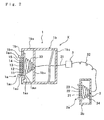
- FIG. 1 to FIG. 3 are views illustrating the first embodiment of the iontophoresis device (X) according to the present invention.
- FIG. 1 is the overall perspective view
- FIG. 2 is the fragmentary cross-sectional view.
- the iontophoresis device (X) according to the present invention comprises, as main elements (members), an iontophoresis electrode section (1), a ground electrode section (2) and a power source (battery) (3).
- FIG. 3 is the basic construction diagram (fragmentary cross-sectional view) of both of the electrode sections, namely, the iontophoresis electrode section (1) and the ground electrode section (2) when administration of an ionic drug is conducted under below-described conditions by the iontophoresis device (X) according to the present invention as illustrated in FIG. 1 and FIG. 2.
- FIG. 3 designates a site of the skin, and FIG. 3 also illustrates an administration method of an ionic drug (drug delivery) by new iontophoresis which can be practiced by the iontophoresis device (X) according to the present invention.
- FIG. 1 to FIG. 3 the reference numerals in these drawings correspond to the reference numerals of the individual elements of the iontophoresis device described above under the Means for Solving the Problems.
- the element (1)-1 in the iontophoresis device (X) is designated as 11 in the drawings.
- Most characteristic features of the iontophoresis device (X) according to the present invention are to provide an iontophoresis device of high added value by increasing the quantity of ions migrated under given electromotive force, the quantity being well known to depend upon the concentration, mobility and valence of ions, because the objective of this type of iontophoresis is to drive (deliver) an ionic drug into the body through the skin (or mucosa) under predetermined electromotive force, in other words, by paying significant attention for the achievement of a high transference number and also by paying attention to the elimination of factors of drawbacks (negative factors) such as electrochemical reactions at the respective electrodes, specifically skin inflammation due to the electrochemical reactions, and further by paying attention for improvements in handling ease and convenience of the device.
- electrochemical reactions specifically certain oxidizing reaction (positive electrode) and reducing reaction (negative electrode) unavoidably occur around the electrodes.
- the iontophoresis device (X) according to the present invention has adopted, especially as the construction of the respective electrode sections, the construction that the individual elements (members) are constructed into layers as illustrated in FIG. 2 and FIG. 3.
- the individual elements (members) (11 through 15) of the iontophoresis electrode section (1) and the individual elements (members) (21 through 23) of the ground electrode section (2) are all constructed into layers such as plate members, membrane bodies and ion exchange membranes.
- the properties of the membrane bodies namely, the electrode plates, electrolyte-solution-retaining membranes, ionic-drug-retaining membrane, anion and cation exchange membranes in the present invention are set as described above when As - Na + is transdermally delivered as the ionic drug.
- the electrode plate (11) in the iontophoresis electrode section (1) is a negative (-) electrode while the electrode plate (21) in the ground electrode section (2) is a positive (+) electrode.
- numeral 1 indicates the iontophoresis electrode section (active electrode section), numeral 2 the ground electrode section (inactive electrode section), numeral 3 the power source, and numeral 4 the skin (or the mucosa).
- the iontophoresis electrode section active electrode section
- the ground electrode section (2) is constructed of:
- the electrolyte-solution-retaining membranes (12,22) in both of the electrode sections (1,2) are not limited to those impregnated with the above-mentioned electrolyte solution composed of 1 M lactic acid and 1 M sodium fumarate as an electrolyte solution. They may also be made of those impregnated using physiological saline (for example, 0.9% aqueous solution of NaCl) or those impregnated with a compound, which has an oxidation-reduction potential lower than the oxidation-reduction potential of water and can be more readily oxidized or reduced compared with the electrolytic reaction of water (oxidizing and reducing reactions of water), as an electrolyte solution.
- physiological saline for example, 0.9% aqueous solution of NaCl
- a compound which has an oxidation-reduction potential lower than the oxidation-reduction potential of water and can be more readily oxidized or reduced compared with the electrolytic reaction of water (oxidizing and reducing reactions of water), as an electrolyte
- the electrolyte-solution-retaining membranes (12,22) in both of the electrode sections (1,2) may also be made of membranes retaining an ionic drug (for example, As - Na + as mentioned above) as a readily oxidizable or reducible compound in such a state that the membranes are impregnated with the ionic drug, because, as an electrolyte solution, the oxidation-reduction potential of the ionic drug is generally lower than that of water.
- an ionic drug for example, As - Na + as mentioned above
- the oxidation-reduction potential of the ionic drug is generally lower than that of water.
- the construction of a more specific iontophoresis device (X) for practicing the new administration method of an ionic drug will be described in the order of the specific construction of the iontophoresis electrode section (active electrode section) (1) and the specific construction of the ground electrode section (inactive electrode section) (2).
- the electrode plate (11) in the iontophoresis electrode section (active electrode section) (1) can be composed of a desired electrode plate.
- the electrode plate (21) in the ground electrode section (inactive electrode section) (2) can also be composed of a desired electrode plate.
- inert electrodes made of a conductive material such as carbon or platinum.
- patch-type Red DotTM monitoring electrodes products of 3M Health Care Limited, which were used upon investigating possible reactions of the skin at both of the electrode sections (1,2) by using the iontophoresis device according to the present invention as will be described subsequently, are also useful.
- active electrodes known in the field of iontophoresis may also be adopted as the electrode plates (11,21) instead of the above-described inert electrodes.
- an active ingredient of an ionic drug becomes positive (+) ions
- morphine hydrochloride or lithium chloride is used as an ionic drug
- chlorine as counter ions are negative ions
- illustrative of the above-mentioned active electrodes are silver electrodes which react as positive (+) plates with these counter ions.
- the silver electrode readily reacts with chlorine ions (Cl - ) so that insoluble AgCl is formed in accordance with the formula: Ag + Cl - ⁇ AgCl + e - .
- An advantage available from the use of the above-described active electrodes resides in that the electrolytic reaction of water can be prevented because the standard potential of the above reaction is lower than the standard potential of the electrolytic reaction of water at the positive (+) electrode. It is, hence, possible to avoid sudden acidification based on H + ions at the anode (positive electrode) and also sudden alkalization based on OH - ions at the cathode (negative electrode).
- the iontophoresis device (X) according to the present invention, however, because plural, at least, three ion exchange membranes different in ion selective permeability are used in the iontophoresis system as described above and an insoluble substance (insoluble fine particles) such as silver chloride (AgCl) formed at the active electrode may impair the properties of the ion exchange membranes in some instances, the care must be taken in their use.
- an insoluble substance such as silver chloride (AgCl) formed at the active electrode may impair the properties of the ion exchange membranes in some instances, the care must be taken in their use.
- the iontophoresis device (X) uses the plural ion exchange membranes different in ion selective permeability, it is preferred for the reason mentioned above to use inert electrodes instead of using more costly special electrodes such as active electrodes.
- the electrolyte-solution-retaining membrane (12) in the iontophoresis electrode section (1) in the present invention is composed of a thin membrane body with an electrolyte solution retained therein in such a state that the membrane is impregnated with the electrolyte solution.
- this thin membrane body is of the same kind as a thin membrane body employed as the below-described ionic-drug-retaining membrane with an ionic drug retained therein in such a state that the membrane is impregnated with the ionic drug and therefore, its details will be described subsequently.
- electrolyte solution any desired electrolyte solution can be used. However, those which may cause trouble on the human skin through electrode reactions should be avoided.
- organic acids and their salts which exist in the human metabolic cycle, are preferred from the viewpoint of harmlessness to the body.
- lactic acid, fumaric acid and the like are preferred.
- an aqueous solution of 1 M lactic acid and 1 M sodium fumarate (Na salt) at a ratio of 1:1 is preferred.
- This electrolyte solution is soluble relatively well in water, and allows a current to flow well through it. When a current is caused to flow as a constant current, its electrical resistance is low, and no substantial pH change takes place at the electrodes.
- electrolytes examples include:
- gas bubbles may be produced at both of the negative and positive electrodes and may act as a resistance to inhibit a constant-current power supply device as an accessory to the iontophoresis device (X), although the physiological saline has high conductivity. Further, since chlorine gas is produced from the positive electrode so that the solution tends to become acidic (formation of HCl), full measures must, therefore, be taken to avoid damage to the skin.
- the electrolyte solution kept in contact with the negative (-) electrode plate (11) in the iontophoresis electrode section (1) in the present invention may preferably be composed of one including a readily reducible compound.
- the electrolyte solution kept in contact with the positive (+) electrode plate (21) in the ground electrode section (2) according to the present invention may preferably be composed of one including a readily oxidizable compound.
- the positions of arrangement of the electrolyte solutions, in which the readily oxidizable compound and the readily reducible compound are added, respectively, should be set corresponding to the electrochemical reactions at the respective electrode plates, namely, the reducing reaction at the negative (-) electrode and the oxidizing reaction at the positive (+) electrode.
- the readily oxidizable and reducible compounds added to the electrolyte solutions are preferably those excellent in biosafety, economy (low price and good availability), etc.
- Illustrative are inorganic compounds such as ferrous sulfate and ferric sulfate; medicaments such as ascorbic acid (vitamin C) and sodium ascorbate; acidic compounds existing on the skin, such as lactic acid; and organic acids such as oxalic acid, malic acid, succinic acid and fumaric acid and/or salts thereof
- the above-described equiratio aqueous solution of 1 M lactic acid and 1 M sodium fumarate is preferred as the electrolyte solutions.
- ferric sulfate ferric ions are readily reduced into ferrous ions at the negative electrode.
- ferrous ions are readily oxidized into ferric ions at the positive electrode.
- the drawbacks associated with the hydrolytic reaction of water can be eliminated. Coupled with the specific embodiments of arrangement of the ion exchange membranes in the present invention, the iontophoresis device (X) having excellent performance is provided.
- oxygen or hydrogen is produced when water is oxidized or reduced.
- ferrous sulfate, ferric sulfate, ascorbic acid or the sodium salt thereof is added as an example to the electrode compartment solutions (electrolyte solutions).
- sodium ascorbate sodium ascorbate is used, for example, sodium ascorbate is oxidatively decomposed at the positive (+) electrode, where an oxidizing reaction takes place, instead of production of oxygen.
- sodium ascorbate is reductively decomposed instead of occurrence of hydrogen.
- any substance can obviously be used as the sacrificial substance in the present invention insofar as it undergoes oxidation or reduction and inhibits the electrolytic reaction of water.
- sodium ascorbate When sodium ascorbate is used as the sacrificial substance, sodium ascorbate changes into:
- the iontophoresis electrode section (1) in the present invention makes the combined use of the cation exchange membrane (13) and the anion exchange membrane (15) as illustrated in FIG. 3.
- NEOSEPTA CM-1, CM-2, CMX, CMS, CMB or the like
- anion exchange membrane selective to ions of the same type as the ion species (As - ) of the active ingredient in the ionic drug (As - Na + ) in the present invention, it is possible to use NEOSEPTA (AM-1, AM-3, AMX, AHA, ACH, ACS, ACS-3 or the like) (product of TOKUYAMA CORPORATION).
- the ionic drug (As - Na + ) retaining membrane (14) in the iontophoresis electrode section (1) in the present invention is composed of a thin membrane body with the ionic drug retained therein in such a state that the membrane body is impregnated with the ionic drug.
- ionic drugs are usable in the present invention as the ionic drug without any limitations. Typical examples of this type of ionic drugs are as mentioned above.
- the thin membrane bodies will hereinafter be described in detail.
- the iontophoresis device (X) there are operation conditions (current value, voltage value) set from the viewpoint of safety to the human skin.
- the same kind of the thin membrane body as that which makes up the ionic-drug-retaining membrane (14) is used.
- iontophoresis transdermal delivery
- constant current conditions or constant voltage conditions.
- a description will hereinafter be made from the viewpoint of performing iontophoresis under constant current conditions, but the present invention is not limited to iontophoresis under such constant current conditions.
- operation conditions with the above-mentioned safety of the iontophoresis device (X) taken into consideration comprise:
- the thin membrane bodies In order to efficiently deliver the ionic drug under the above-described conditions, it is important for the thin membrane bodies to have sufficient ability to retain the ionic drug in such a state that the thin membrane bodies are impregnated with the ionic drug and also to have sufficient ability to cause the impregnatedly retaining ionic drug to move toward the skin under the above-described electric field conditions, in other words, ability to cause ion species of the impregnatedly retaining ionic drug to move toward the skin, and in still other words, ion-electroconductive (ion-conductive) ability.
- the ionic-drug-retaining membrane (thin membrane body) in the present invention should be equipped with desired impregnatedly-retaining ability for the ionic drug and also with ability to cause ion species of a desired active ingredient to move toward the skin (hereinafter called ion electroconductivity or ion conductivity).
- the present inventors found that a high transference number (high drug-delivering ability) as great as 70 to 80%, for example, can be obtained when the degree of impregnation of the ionic-drug-retaining membrane (14) with a solution of the ionic drug is in a range of 30 to 40% in the layered construction of the membrane bodies in the iontophoresis electrode section (1), in other words, in the three-layer structure of the cation exchange membrane (13), the ionic-drug-retaining membrane (14) and the anion exchange membrane (15).
- the above-described transference number of 70 to 80% is a value of an extremely high level compared with those available from the conventional iontophoresis technologies.
- the measurement of a degree of impregnation should be conducted immediately after impregnation to avoid time-dependent influence.
- the measurement of a transference number should be conducted by arranging the ionic-drug-retaining membrane, which has been impregnated with the ionic drug, between the ion exchange membranes (13) and (15) while concurrently assembling the other members such that time-dependent changes can be avoided as much as possible.
- the above-described degree of impregnation with the solution of the ionic drug and the transference number of the ionic drug are used as indexes in the present invention. These are because no index for objectively and totally evaluating the ability of the thin membrane body to be impregnated with the ionic drug, the ability of the thin membrane to retain the ionic drug and the ability of the thin membrane body to make ion species of the active ingredient in the ionic drug, which is retained in the thin membrane body in such a state that the thin membrane body is impregnated with the ionic drug, to move toward the skin (ability of ion electroconductivity or ion conductivity).
- indexes which can be used as substitutes for the degree of impregnation and the transference number as indexes of the properties of the thin membrane body there are microporosity and transference number.
- a hydrogel body of acrylic resin (acrylic hydrogel membrane) can be exemplified for its high biosafety, as typified by the use of the acrylic resin as contact lenses.
- This acrylic hydrogel membrane is a gel body (of an intermediate form between liquid and solid) having a three-dimensional network structure (crosslinked structure), and a mixture obtained by adding water as a dispersant and an electrolyte substance (NaCl or the like) to the acrylic hydrogel membrane allows a current to flow through it as a result of migration of dissociated ions of the electrolyte substance.
- the mixture obtained by impregnating the acrylic hydrogel membrane (which can be considered to be a microporous gel membrane) with an aqueous solution of the electrolyte substance can be considered to become a high-molecular adhesive material equipped with ion conductivity (ion electroconductivity).
- the acrylic hydrogel membrane becomes conductive to ions (electroconductive to ions) as a result of penetration of the dispersing medium and dissociated ion species into the three-dimensional network of high-molecular chains in the acrylic hydrogel membrane and migration of the ion species through the network structure in an electrical field.
- the above-described correlation between the degree of impregnation of the acrylic hydrogel membrane and the transference number can be easily adjusted by controlling the size of the three-dimensional network structure and the kinds and proportions of monomers making up the resin.
- an acrylic hydrogel membrane having a degree of impregnation of 30 to 40% and a transference number of 70 to 80% can be prepared from 2-hydroxyethyl methacrylate and ethylene glycol dimethacrylate (monomer ratio: 98-99.5 to 0.5-2).
- acrylic hydrogel membranes microporous gel membranes
- the degree of impregnation and the transference number have been confirmed to be substantially the same within the usual thickness range of the acrylic hydrogel membrane (microporous gel membrane) for use in the present invention, that is, in a range of from 0.1 mm to 1.0 mm.
- ionic-drug-retaining membrane (14) for use in the present invention there is a segmented polyurethane gel membrane (GELLODETM, product of Takiron Co., Ltd.).
- This membrane is a segmented polyurethane gel membrane, which contains polyethylene glycol (PEG) and polypropylene glycol (PPG) as segments and has been produced from these monomers and diisocyanate.
- PEG polyethylene glycol
- PPG polypropylene glycol
- the segmented polyurethane gel membrane has a three-dimensional structure crosslinked by urethane bonds, and its degree of impregnation, transference number and adhesive force can be easily adjusted by controlling the size of openings in the network and the proportions of the monomers, as in the case of the above-described acrylic hydrogel membrane.
- segmented polyurethane gel membrane (microporous gel membrane) added with water as a dispersion medium and an electrolyte substance (an alkali metal salt or the like), oxygen atoms of ether bonds in a segment-forming polyether and the alkali metal salt forms a complex and, when electricity is applied, an ion of the metal salt moves to the oxygen in the next void ether bond so that conductivity (ion electroconductivity) is exhibited.
- the segmented polyurethane gel membrane (microporous gel membrane) is used as a gel pad for ultrasonic diagnostics by making use of its conductive (ion electroconductive) property.
- the segmented polyurethane gel membrane (microporous gel membrane) is free of irritation to the skin and is a substance having high safety, because use of PEG-PPG-PEG copolymer, which make up the segments, as a cosmetic ingredient has been approved.
- an ion-conductive microporous sheet for the formation of a gel-like solid electrolyte for example, as a gel-like solid electrolyte sheet in a solid cell (secondary cell) is useful.
- Ion-conductive microporous sheets of this type are disclosed, for example, in JP-A-11273452, and are basically formed of a microporous polymer having a porosity of from 20 to 80% and composed primarily of an acrylonitrile polymer.
- the microporous polymer is an acrylonitrile copolymer composed of 50 mole % or more (preferably 70 to 98 mole %) of acrylonitrile and having a porosity of from 20 to 80%.
- the acrylonitrile-based, gel-like solid electrolyte sheet (solid cell) is prepared by impregnating an acrylonitrile-based copolymer sheet, which is soluble in a non-aqueous solvent and has a porosity of 20 to 80%, with an electrolyte-containing non-aqueous solvent to form the copolymer sheet into a gel.
- Gel bodies include gel-like bodies and hard membrane-like bodies.
- the acrylonitrile-based copolymer sheet soluble in the non-aqueous solvent can preferably be composed of an acrylonitrile/C 1 -C 4 alkyl (meth)acrylate copolymer, acrylonitrile/vinyl acetate copolymer, acrylonitrile/styrene copolymer, acrylonitrile/vinylidene chloride copolymer or the like.
- copolymer sheet into a microporous sheet conventional processes can be adopted including the wet (dry) paper making process, the needle punching process as a production process of non-woven fabric, the water jet process, and formation of a melt-extruded sheet into a microporous body by stretching or solvent extraction.
- gel bodies including gel-like bodies and hard membrane bodies each of which retains an ionic drug in a three-dimensional network of polymer chains and can achieve the above-described degree of impregnation and transference number are useful as thin membrane bodies, and each of which can serve as a base for the ionic-drug-retaining membrane (14) in the present invention.
- optimal conditions can be determined from the viewpoint of a degree of impregnation, an impregnation speed and the like. For example, impregnation conditions of 40°C and 30 minutes may be chosen.
- various thin membrane bodies each of which is useful as a base for the ionic-drug-retaining membrane (14) can be used for the thin membrane body which serves as a base for the electrolyte retaining membrane (12).
- These thin membrane bodies permit, in an electrical field efficient migration of ion species dissociated in the electrolyte solution with which the membrane body is impregnated.
- the ionic drug can be transdermally delivered stably over a longer period of time at a higher transference number, and higher biosafety can be obtained.
- the iontophoresis electrode section (1) stable energization properties can be obtained over a long period of time.
- the ionic drug can be efficiently delivered into the body stably for a long period of time through the skin (4) (drug delivery). It is also possible to prevent formation of a harmful substance through electrolysis in the electrode section, that is, to achieve a high level of biosafety.
- the present invention has also adopted, in relation to the overall construction of the device, a novel technical construction for the ground electrode section (2), which is different from the conventional technical construction, from the viewpoint of permitting stable administration of an ionic drug for a long period of time at a high transference number (high efficiency) by iontophoresis and also obtaining a high level of biosafety.
- the ground electrode section (2) of the iontophoresis device (X) is constructed of the electrode plate (21) of a polarity opposite to the electrode plate (11) in the iontophoresis electrode section (1), the electrolyte-solution-retaining membrane (22) arranged on the front side of the electrode plate (21), and the ion exchange membrane (23) arranged on the front side of the electrolyte-solution-retaining membrane (22), that is, on the side of the skin (4) and selective to ions opposite to charged ions of the ionic drug.
- the ion exchange membrane (23) is indispensably arranged in the ground electrode section(2) so as to heighten biosafety.
- the electrolyte solution in the electrolyte-solution-retaining membrane (22) of the ground electrode section(2) may be composed of one containing a substance, the oxidation-reduction potential of which is lower than the oxidation-reduction potential of water, like the above-described electrolyte solution in the electrolyte-solution-retaining membrane (12) of the iontophoresis electrode section (1), from the viewpoint of biosafety and stable operation for a long period of time.
- the iontophoresis device (X) is provided with high added value by arranging the ion exchange membrane (23) in the ground electrode section (2) and also by forming the electrolyte solution with the above-described readily oxidizable or reducible substance added therein.
- the electrode plate (21) in the ground electrode section (2) of the iontophoresis device (X) becomes positive (+)
- the electrolyte solution in the electrolyte-solution-retaining membrane (22) is composed of same 1:1 mixed aqueous solution of 1M lactic acid and 1 M sodium fumarate as in the iontophoresis electrode section (1)
- the ion exchange membrane (23) is composed of a cation exchange membrane.
- the electrolyte solution in the electrolyte-solution-retaining membrane (22) of the ground electrode section (2) can be composed of physiological saline which as mentioned above, contains a readily oxidizable or reducible substance, for example, ferric sulfate, ferric sulfate containing ferrous sulfate (an equimolar solution of both sulfates), ascorbic acid or sodium ascorbate.
- physiological saline which as mentioned above, contains a readily oxidizable or reducible substance, for example, ferric sulfate, ferric sulfate containing ferrous sulfate (an equimolar solution of both sulfates), ascorbic acid or sodium ascorbate.
- the administration method of the ionic drug by iontophoresis which was explained with reference to the iontophoresis device (X) shown in FIG. 3, was in the case of sodium ascorbate (As - Na + ) that the active ingredient of the ionic drug is charged negative (-) as described above.
- Examples of ionic drugs of this type whose active ingredients are charged positive (+) include procaine hydrochloride and lidocaine hydrochloride as local anesthetic drugs.
- the polarities of the individual electrode plates (11,21) and the ion exchange properties of the ion exchange membranes (13,15,23) must be made opposite in this case to the corresponding polarities and ion exchange properties in the above-described case in which sodium ascorbate (As - Na + ) was administered.
- any power source can be used as desired in the present invention.
- a cell a constant-voltage generator, a constant-current generator (galvanostat), a constant-voltage and constant-current generator, or the like can be used as the power source (3).
- FIG. 4 shows the modification of the iontophoresis device (X) according to the first embodiment illustrated in FIG. 3, which specifically uses two ion exchange membranes, i.e., a cation exchange membrane (23) and an anion exchange membrane (25) on the side of a ground electrode section (2).
- reference numeral (24) indicates an electrolyte-solution-retaining membrane which is similar to the electrolyte-solution-retaining membrane (22) in the ground electrode section (2) depicted in FIG. 3.
- the modification illustrated in FIG. 4 is effective in preventing the skin troubles which may otherwise occur through the electrochemical reaction on the side of the ground electrode section (2).
- This modification therefore, has extremely high biosafety.
- the iontophoresis device (X) can transdermally deliver an ionic drug at an extremely high transference number or at high efficiency.
- FIG. 5 is the schematic diagram of the experimenting equipment equivalent to the iontophoresis device (X) shown in FIG. 4.
- the elements (13 to 15) in the iontophoresis electrode section (1) and the elements (23 to 25) in the ground electrode section(2) were put into integral structures, respectively, and assembled in the experiment equipment.
- the above-described formation of the members into the integral structures can be effected by a conductive adhesive, heat sealing or the like.
- the amount (micron mol) of ascorbic acid in the skin-simulating bath (A) subsequent to each predetermined energized time was investigated.
- iontophoresis device of the construction shown in FIG. 4
- iontophoresis experiments transdermal delivery experiments
- base membranes for ionic-drug-retaining membranes and electrolyte-solution-retaining membranes the above-described acrylic hydrogel membranes (microporous gel membranes) (products of the Sun Contact Lens Co., Ltd.) were used.
- An iontophoresis electrode section (1) connected to a galvanostat (constant-current generator) was constructed by bringing into close contact an anion exchange membrane (15), an ionic-drug-retaining membrane (14) impregnated with sodium ascorbate (100 mM), a cation exchange membrane (13), an electrolyte-solution-retaining membrane (12) impregnated with an electrolyte solution composed of an equiratio solution of I M lactic acid and 1 M sodium fumarate, and an electrode plate (11) in this order as viewed from the side of a skin-contacting surface.
- a ground electrode section (2) was constructed by bringing into close contact a cation exchange membrane (23), an electrolyte-solution-retaining membrane (24) impregnated with the above-described electrolyte solution, an anion exchange membrane (25), an electrolyte-solution-retaining membrane (22) impregnated with the above-described electrolyte solution, and an electrode plate (21) in this order as viewed from the side of a skin-contacting surface.
- a patch-type Red Dot monitoring electrode commercial product, was used as the electrode plate (21) of the ground electrode section (2). Incidentally, this electrode also served to exhibit the function of the electrolyte-solution-retaining membrane (22). Further, a conductive gel (Aquasonic 100, product of Parker Laboratories, Inc.) was coated on a surface of the ion exchange membrane (23), at said surface the ground electrode section (2) to be brought into contact with the skin surface, to improve the conductivity.
- a color developer reagent which intensifies the development of a color with time under the reducing action effect of ascorbic acid and causes precipitation of formazan (red color), was intradermally injected beforehand. Depending upon the extent of color development, the iontophoresis effect on ascorbic acid was determined.
- the color developer reagent was a solution prepared by dissolving 2,3,5-triphenyltetrazorium chloride (C 19 H 15 ClN 4 ; hereinafter abbreviated as TTC) at a concentration of 2% in a 0.9% aqueous solution of NaCl.
- TTC 2,3,5-triphenyltetrazorium chloride
- This color developer reagent has a property that, when subjected to reducing action, it couples with two molecules of hydrogen and forms a formazan compound (vivid crimson) to change its color.
- the current applied in this experiment was set at 0.3 mA (constant current).
- ion non-exchange PP membranes were used instead of the ion exchange membranes.
- the PP membranes were polypropylene-made, microporous partitions (AN Filter, AN06, product of Nihon Millipore K.K.), and had no ion selective permeability.
- iontophoresis device (X) which is useful for administering an ionic drug by iontophoresis, especially from the viewpoint of the elements of the device (equipment) (hardware construction).
- FIG. 1 to FIG. 2 illustrate the first embodiment of the iontophoresis device (X) according to the present invention, in which FIG. 1 is the perspective view of the entire device and FIG. 2 is a partly cut-off cross-sectional view.
- the iontophoresis device (X) according to the first embodiment of the present invention comprises the following three elements:
- the ground electrode section (2) is constructed as a discrete unit relative to the iontophoresis electrode section (1).
- the expression constructed as a discrete unit as used above means that as illustrated in the drawings, the iontophoresis electrode section (1) and the ground electrode section (2) are not integral.
- the iontophoresis device (X) has, for example, such a structure that an iontophoretically treated patient holds the ground electrode section (2) or brings the ground electrode section (2) into contact with a desired skin surface, other than a treated site to establish grounding.
- the iontophoresis device (X) according to the first embodiment of the present invention shown in FIG. 1 to FIG. 2 was constructed under the premise that sodium ascorbate (As - Na + ) is administered as an ionic drug.
- the reference numerals of the respective elements (the electrode plates, the electrolyte-solution-retaining membranes, the ionic-drug-retaining membrane, and the ion exchange membranes) arranged inside the iontophoresis device (X) shown in FIG. 1 to FIG. 2 indicate the same elements described above with reference to FIG. 3.
- the iontophoresis electrode section (1) in the iontophoresis device (X) according to the first embodiment of the present invention is constructed of the following two elements as illustrated in FIG. 1 to FIG. 2:
- the end section (1a) is constructed such that it can be detachably mounted on a front portion (1b 1 ) of the grip section (1b), and within the end section (1a), the elements designated by reference numerals (11 to 15) are held or accommodated.
- the elements (1a,1b) can be made of nonconductive plastics, for example.
- the cylindrical end section (1a) is composed of a front portion (1a 1 ), a main portion (1a 2 ), and a lock portion (1a 3 ) kept in engagement with the grip section (1b).
- the front portion (1a 1 ) has an opening (1a 11 ) and is constructed such that the anion exchange membrane (15) is exposed in the opening.
- the cylindrical grip section (1b) is composed of the front portion (1b 1 ), a main portion (1b 2 ), and a rear end portion (1b 3 ).
- the front portion (1b 1 ) has an opening (1b 11 ) of substantially the same diameter as the main portion (1a 2 ) of the end section(1a) and is constructed to define lock holes (1b 12 ) for guiding the lock portion (1a 3 ) such that the lock portion (1a 3 ) of the cylindrical end section (1a) is locked on the front portion (1b 1 ).
- the cylindrical grip section (1b) is constructed to have a spring holding wall (1b 4 ) for fixedly supporting a spring member (33) accommodated within the cylindrical grip section (1b) and made of a conductive material.
- the spring holding wall (1b 4 ) is constructed such that, as illustrated in FIG. 2, a free end of a cable (31) from the power source (3) and the spring member (33) are electrically connected.
- Detachable mutual locking of both of the elements (1a,1b) can be achieved by the lock portion (1a 3 ) of the cylindrical end section (1a) and the lock holes (1b 12 ) of the cylindrical grip section (1b). Described specifically, the lock portion (1a 3 ) is inserted into the lock holes (1b 12 ), respectively, and the cylindrical end section (1a) is turned clockwise or counterclockwise to lock them together. Incidentally, they are stably and detachably locked together because spring force is exerted by the spring member (33) on the cylindrical end section (1a) (to urge the same).
- the ground electrode section (2) in the iontophoresis device (X) according to the first embodiment of the present invention is constructed of the following two elements as illustrated in FIG. 1 to FIG. 2:
- Both of the elements (2a,2b) are constructed such that the end section (2a) can be detachably mounted on the main section (2b) by a similar mechanism as in the elements (1a,1b) in the iontophoresis electrode section (1).
- the elements (21,22,23) are accommodated inside the small-diameter, cylindrical end section (2a) as depicted in FIG. 2. Further, a conductive spring member (34) is accommodated inside the large-diameter, cylindrical main section (2b). An end portion of the spring member (34) is fixedly supported on a bottom part of the large-diameter, cylindrical main section (2b) and is also connected with an end portion of a cable (32) from the power source (3). Its opposite end portion, on the other hand, urges the element (21), namely, the electrode plate (21) in the ground electrode (2) under spring force, and also urges the cylindrical end section (2a) under spring force such that the locking between the cylindrical end section (2a) and the main section (2b) can be assured.
- the power source (3) may be replaced by a cell, and this cell may be accommodated within the internal space of the large-diameter, cylindrical grip section (1b).
- FIG. 6 is the view illustrating the second embodiment of the iontophoresis device according to the present invention, and corresponds to the small-diameter, cylindrical end section (1a) in FIG. 2 which pertains to the first embodiment.
- the second embodiment adopts a different construction of the small-diameter cylindrical end section (1a) from that of the first embodiment (see FIG. 2), in which a small-diameter cylindrical end section (1a) is constructed to arrange a bottom cover (1a 4 ), which is equipped with a thread groove or slide guide grooves, on a rear end part of a main portion (1a 2 ) of the front end section (1a).
- the main portion (1a 2 ) is provided on an inner wall of the rear end part thereof with groove(s) corresponding to the thread groove or slide guide grooves in the bottom cover (1a 4 ), and by these grooves, the bottom cover (1a 4 ) is fixed to the main portion (1a 2 ).
- the urging force applied by the spring member (33) can be adjusted.
- FIG. 7 is the view illustrating the third embodiment of the iontophoresis device according to the present invention, and corresponds to the front part of the small-diameter, cylindrical end section (1a) in FIG. 2 which pertains to the first embodiment.
- a characteristic feature of the third embodiment is that an ionic-drug-retaining membrane (14) is extended outward so as to form a concentric circular part as well beyond the outer circumference of a circular anion exchange membrane (15).
- a gel membrane having good adhesion to the skin for example, GELLODE (trade name, product of Takiron Co., Ltd.), specifically the segmented polyurethane gel membrane having PEG-PPG segments or the like as a membrane (microporous gel membrane), which serves as a base of the ionic-drug-retaining membrane (14), has a merit in that adhesion of the anion exchange membrane (15) to the skin surface can be assured.
- GELLODE trade name, product of Takiron Co., Ltd.
- the third embodiment is a modification of the above-described first embodiment, it can be used as a modification of the second embodiment.
- FIG. 8 to FIG. 9 illustrate the iontophoresis device (X) according to the fourth embodiment of the present invention, in which FIG. 8 is its cross-sectional view and FIG. 9 is its front view.
- an elongated, cylindrical main section (1b) serves as a grip section, and the above-described elements (11 to 15), spring member (33) and power source (3) are accommodated inside the main section(1b).
- a ground electrode section (2) is constructed in substantially the same structure as the cylindrical end section (1a) in the second embodiment (see FIG. 6).
- the elements (21 to 23) accommodated inside the cylindrical end section (1a) of the ground electrode section (2) are different from the elements (11 to 15) in the second embodiment because this part becomes the ground electrode section (2) in the fourth embodiment.
- the operator (user) of the iontophoresis device (X) is no longer required to establish grounding by holding the ground electrode section (2), unlike the first to third embodiments, and therefore, the fourth embodiment brings about improved convenience.
- ground electrode section (2) can effectively establish grounding because it is arranged at a position close to the iontophoresis electrode section (1).
- the subassembly into such kits makes it possible to achieve a reduction in the size of the device, prevention of treatment errors (because the elements have been sub-assembled into kits), or the like.
- the iontophoresis device according to the present invention can transdermally deliver an ionic drug at high efficiency under stable energized conditions for a long period of time.
- the iontophoresis device according to the present invention is also excellent in safety, because ion exchange membranes are arranged on the side of the active electrode section and also on the side of the ground electrode section not only from the viewpoint of transference number of the ionic drug but also from the viewpoint of assuring high safety to the skin.
- both of the electrode sections are constructed of thin membrane bodies in their entirety. Subassembly or the like of these thin membrane bodies into kits is effective for forming the device into a smaller size and also for making the device excellent in ease in replacing its members (parts), in preventing treatment errors and also in handling.
Landscapes
- Health & Medical Sciences (AREA)
- Engineering & Computer Science (AREA)
- Biomedical Technology (AREA)
- Nuclear Medicine, Radiotherapy & Molecular Imaging (AREA)
- Radiology & Medical Imaging (AREA)
- Life Sciences & Earth Sciences (AREA)
- Animal Behavior & Ethology (AREA)
- General Health & Medical Sciences (AREA)
- Public Health (AREA)
- Veterinary Medicine (AREA)
- Bioinformatics & Cheminformatics (AREA)
- Electrotherapy Devices (AREA)
- Medicinal Preparation (AREA)
Applications Claiming Priority (3)
| Application Number | Priority Date | Filing Date | Title |
|---|---|---|---|
| JP2001335293 | 2001-10-31 | ||
| JP2001335293 | 2001-10-31 | ||
| PCT/JP2002/004696 WO2003037425A1 (fr) | 2001-10-31 | 2002-05-15 | Dispositif d'ionophorese |
Publications (2)
| Publication Number | Publication Date |
|---|---|
| EP1440707A1 true EP1440707A1 (fr) | 2004-07-28 |
| EP1440707A4 EP1440707A4 (fr) | 2006-05-24 |
Family
ID=19150297
Family Applications (1)
| Application Number | Title | Priority Date | Filing Date |
|---|---|---|---|
| EP02728062A Withdrawn EP1440707A4 (fr) | 2001-10-31 | 2002-05-15 | Dispositif d'ionophorese |
Country Status (21)
| Country | Link |
|---|---|
| US (1) | US7398121B2 (fr) |
| EP (1) | EP1440707A4 (fr) |
| JP (1) | JPWO2003037425A1 (fr) |
| KR (1) | KR100548796B1 (fr) |
| CN (1) | CN100415320C (fr) |
| AU (1) | AU2002258186B2 (fr) |
| BG (1) | BG108737A (fr) |
| BR (1) | BR0213762A (fr) |
| CA (1) | CA2464155A1 (fr) |
| CZ (1) | CZ2004656A3 (fr) |
| EE (1) | EE200400090A (fr) |
| HU (1) | HUP0500882A2 (fr) |
| IL (2) | IL161529A0 (fr) |
| MX (1) | MXPA04004153A (fr) |
| NO (1) | NO20041747L (fr) |
| NZ (1) | NZ532402A (fr) |
| PL (1) | PL205827B1 (fr) |
| RU (1) | RU2269366C2 (fr) |
| SK (1) | SK2312004A3 (fr) |
| WO (1) | WO2003037425A1 (fr) |
| ZA (1) | ZA200403222B (fr) |
Cited By (18)
| Publication number | Priority date | Publication date | Assignee | Title |
|---|---|---|---|---|
| WO2006055729A1 (fr) * | 2004-11-16 | 2006-05-26 | Transcutaneous Technologies Inc. | Dispositif iontophoretique et procede pour adminstrer des agents ameliorant la reponse immunitaire et des compositions |
| WO2007038028A1 (fr) * | 2005-09-28 | 2007-04-05 | Tti Ellebeau, Inc. | Appareil de iontophorèse et procédé pour délivrer des agents actifs aux interfaces biologiques |
| WO2007041300A3 (fr) * | 2005-09-30 | 2007-05-31 | Transcutaneous Tech Inc | Procede et appareil d'iontophorese pour l'administration systemique d'agents actifs |
| WO2007041001A3 (fr) * | 2005-09-30 | 2007-08-16 | Transcutaneous Tech Inc | Dispositif de synchronisation et procede d'utilisation d'un dispositif d'iontophorese utilises pour administrer des agents actifs sur des interfaces biologiques |
| EP1941928A4 (fr) * | 2005-09-30 | 2008-12-24 | Tti Ellebeau Inc | Structure d'electrode pour iontophorese utilisee pour administrer un medicament contenu dans une microparticule et dispositif d'iontophorese utilisant cette structure |
| EP1944057A4 (fr) * | 2005-09-30 | 2009-02-18 | Tti Ellebeau Inc | Appareil d'iontophorese capable de regler la dose et l'heure d'administration d'un inducteur de sommeil et d'un agent analeptique |
| US7574256B2 (en) | 2005-09-30 | 2009-08-11 | Tti Ellebeau, Inc. | Iontophoretic device and method of delivery of active agents to biological interface |
| US7590444B2 (en) | 2004-12-09 | 2009-09-15 | Tti Ellebeau, Inc. | Iontophoresis device |
| EP1913969A4 (fr) * | 2005-08-08 | 2009-12-02 | Tti Ellebeau Inc | Appareil à iontophorèse |
| US7660626B2 (en) | 2005-02-03 | 2010-02-09 | Tti Ellebeau, Inc. | Iontophoresis device |
| US7720622B2 (en) | 2006-09-05 | 2010-05-18 | Tti Ellebeau, Inc. | Non-destructive systems, devices, and methods for evaluating iontophoresis drug delivery devices |
| EP1820533A4 (fr) * | 2004-12-09 | 2010-12-01 | Tti Ellebeau Inc | Appareil iontophorétique |
| US7848801B2 (en) | 2005-12-30 | 2010-12-07 | Tti Ellebeau, Inc. | Iontophoretic systems, devices, and methods of delivery of active agents to biological interface |
| US7998745B2 (en) | 2006-09-05 | 2011-08-16 | Tti Ellebeau, Inc. | Impedance systems, devices, and methods for evaluating iontophoretic properties of compounds |
| US8062783B2 (en) | 2006-12-01 | 2011-11-22 | Tti Ellebeau, Inc. | Systems, devices, and methods for powering and/or controlling devices, for instance transdermal delivery devices |
| US8295922B2 (en) | 2005-08-08 | 2012-10-23 | Tti Ellebeau, Inc. | Iontophoresis device |
| US8386030B2 (en) | 2005-08-08 | 2013-02-26 | Tti Ellebeau, Inc. | Iontophoresis device |
| WO2024144921A1 (fr) * | 2022-12-30 | 2024-07-04 | Dexcom, Inc. | Dispositifs et procédés de détection d'analytes et d'administration d'agents thérapeutiques |
Families Citing this family (92)
| Publication number | Priority date | Publication date | Assignee | Title |
|---|---|---|---|---|
| EE200400090A (et) | 2001-10-31 | 2004-10-15 | R&R Ventures Incorporation | Ionoforeesiseade |
| DE10205373B4 (de) * | 2002-02-09 | 2007-07-19 | Aloys Wobben | Brandschutz |
| JP2004202057A (ja) * | 2002-12-26 | 2004-07-22 | Tokuyama Corp | イオン性薬剤封入袋状物 |
| US8197666B2 (en) * | 2003-11-28 | 2012-06-12 | Maria Roiner | Method and apparatus for the manufacture of one or more gases |
| US20060095001A1 (en) * | 2004-10-29 | 2006-05-04 | Transcutaneous Technologies Inc. | Electrode and iontophoresis device |
| JP4728631B2 (ja) * | 2004-11-30 | 2011-07-20 | Tti・エルビュー株式会社 | イオントフォレーシス装置 |
| CA2595990A1 (fr) | 2005-02-03 | 2006-08-10 | Transcutaneous Technologies Inc. | Appareil de iontophorese |
| JP4793806B2 (ja) | 2005-03-22 | 2011-10-12 | Tti・エルビュー株式会社 | イオントフォレーシス装置 |
| JP2006296511A (ja) * | 2005-04-15 | 2006-11-02 | Transcutaneous Technologies Inc | 外用剤、外用剤の塗布方法、イオントフォレーシス装置及び経皮パッチ |
| JP2006334164A (ja) * | 2005-06-02 | 2006-12-14 | Transcutaneous Technologies Inc | イオントフォレーシス装置及びその制御方法 |
| JP2006346368A (ja) * | 2005-06-20 | 2006-12-28 | Transcutaneous Technologies Inc | イオントフォレーシス装置及びその製造方法 |
| JP2007000342A (ja) * | 2005-06-23 | 2007-01-11 | Transcutaneous Technologies Inc | 複数薬剤の投与量および投与時期を制御するイオントフォレーシス装置 |
| US20070027426A1 (en) * | 2005-06-24 | 2007-02-01 | Transcutaneous Technologies Inc. | Iontophoresis device to deliver active agents to biological interfaces |
| JPWO2007010900A1 (ja) * | 2005-07-15 | 2009-01-29 | Tti・エルビュー株式会社 | 貼付位置表示機能付き経皮吸収用パッチ及びイオントフォレーシス装置 |
| JP2007037868A (ja) * | 2005-08-05 | 2007-02-15 | Transcutaneous Technologies Inc | 経皮投与装置及びその制御方法 |
| JPWO2007020974A1 (ja) * | 2005-08-17 | 2009-02-26 | Tti・エルビュー株式会社 | イオントフォレーシス装置 |
| US20070060860A1 (en) * | 2005-08-18 | 2007-03-15 | Transcutaneous Technologies Inc. | Iontophoresis device |
| US20070088331A1 (en) * | 2005-08-18 | 2007-04-19 | Transcutaneous Technologies Inc. | Method and apparatus for managing active agent usage, and active agent injecting device |
| US20070088332A1 (en) * | 2005-08-22 | 2007-04-19 | Transcutaneous Technologies Inc. | Iontophoresis device |
| US20090254018A1 (en) * | 2005-08-24 | 2009-10-08 | Mizuo Nakayama | Electrode assembly for freezing-type iontophoresis device |
| WO2007026672A1 (fr) * | 2005-08-29 | 2007-03-08 | Transcu Ltd. | Composition d’électrolyte universelle pour l'ionophorèse |
| WO2007029611A1 (fr) * | 2005-09-06 | 2007-03-15 | Tti Ellebeau, Inc. | Dispositif d’iontophorèse |
| JP4907135B2 (ja) * | 2005-09-14 | 2012-03-28 | Tti・エルビュー株式会社 | イオントフォレーシス装置 |
| US20070112294A1 (en) * | 2005-09-14 | 2007-05-17 | Transcutaneous Technologies Inc. | Iontophoresis device |
| BRPI0616046A2 (pt) * | 2005-09-14 | 2011-06-07 | Tti Ellebeau Inc | dispositivo para iontoforese e dispositivo de fonte de energia elétrica para um dispositivo para iontoforese |
| KR20080047600A (ko) * | 2005-09-15 | 2008-05-29 | 티티아이 엘뷰 가부시키가이샤 | 로드형 이온토포레시스 장치 |
| KR20080056200A (ko) * | 2005-09-16 | 2008-06-20 | 티티아이 엘뷰 가부시키가이샤 | 카테터형 이온토포레시스 장치 |
| US20070071807A1 (en) * | 2005-09-28 | 2007-03-29 | Hidero Akiyama | Capsule-type drug-releasing device and capsule-type drug-releasing device system |
| JPWO2007037324A1 (ja) * | 2005-09-28 | 2009-04-09 | Tti・エルビュー株式会社 | 乾燥型イオントフォレーシス用電極構造体 |
| EP1928542A1 (fr) * | 2005-09-30 | 2008-06-11 | Tti Ellebeau, Inc. | Procede et systeme de detection de dysfonctionnements dans un dispositif de iontophorese qui apporte des agents actifs a des interfaces biologiques |
| US20090299265A1 (en) * | 2005-09-30 | 2009-12-03 | Tti Ellebeau, Inc. | Electrode Assembly for Iontophoresis Having Shape-Memory Separator and Iontophoresis Device Using the Same |
| JP2009509677A (ja) * | 2005-09-30 | 2009-03-12 | Tti・エルビュー株式会社 | 小胞封入活性物質のイオントフォレーシス送達 |
| KR20080066712A (ko) * | 2005-09-30 | 2008-07-16 | 티티아이 엘뷰 가부시키가이샤 | 관능화된 미세바늘 경피 약물 전달 시스템, 장치 및 방법 |
| AU2006299520A1 (en) * | 2005-09-30 | 2007-04-12 | Tti Ellebeau, Inc. | Iontophoresis device to deliver multiple active agents to biological interfaces |
| JP2009509659A (ja) * | 2005-09-30 | 2009-03-12 | Tti・エルビュー株式会社 | 生体界面への活性物質の送達のイオントフォレーシス装置及び方法 |
| US20070078375A1 (en) * | 2005-09-30 | 2007-04-05 | Transcutaneous Technologies Inc. | Iontophoretic delivery of active agents conjugated to nanoparticles |
| US20070135754A1 (en) * | 2005-09-30 | 2007-06-14 | Hidero Akiyama | Electrode assembly for iontophoresis for administering active agent enclosed in nanoparticle and iontophoresis device using the same |
| US20070232983A1 (en) * | 2005-09-30 | 2007-10-04 | Smith Gregory A | Handheld apparatus to deliver active agents to biological interfaces |
| WO2007041526A2 (fr) * | 2005-09-30 | 2007-04-12 | Transcutaneous Technologies Inc. | Appareil de ionophorese et procede d'apport d'antibiotiques vers des interfaces biologiques |
| US20070197955A1 (en) * | 2005-10-12 | 2007-08-23 | Transcutaneous Technologies Inc. | Mucous membrane adhesion-type iontophoresis device |
| EP1944058A4 (fr) | 2005-10-12 | 2009-12-30 | Tti Ellebeau Inc | Appareil d'iontophorèse fixé à une muqueuse |
| JP4732871B2 (ja) * | 2005-11-25 | 2011-07-27 | Tti・エルビュー株式会社 | イオントフォレーシス装置 |
| US20080033338A1 (en) * | 2005-12-28 | 2008-02-07 | Smith Gregory A | Electroosmotic pump apparatus and method to deliver active agents to biological interfaces |
| US20080033398A1 (en) * | 2005-12-29 | 2008-02-07 | Transcutaneous Technologies Inc. | Device and method for enhancing immune response by electrical stimulation |
| EP1965858A2 (fr) * | 2005-12-30 | 2008-09-10 | Tti Ellebeau, Inc. | Système et procédé de commande à distance d'un dispositif d'iontophorèse |
| JP2007260082A (ja) * | 2006-03-28 | 2007-10-11 | Transcutaneous Technologies Inc | イオントフォレーシス装置 |
| JP2007260107A (ja) * | 2006-03-28 | 2007-10-11 | Transcutaneous Technologies Inc | イオントフォレーシス装置 |
| WO2007111366A1 (fr) * | 2006-03-29 | 2007-10-04 | Tti Ellebeau, Inc. | Appareil iontophorétique |
| JPWO2007111365A1 (ja) * | 2006-03-29 | 2009-08-13 | Tti・エルビュー株式会社 | カテーテル型イオントフォレーシス装置 |
| KR20090008276A (ko) | 2006-03-29 | 2009-01-21 | 티티아이 엘뷰 가부시키가이샤 | 이온토포레시스 장치 |
| US20080004564A1 (en) * | 2006-03-30 | 2008-01-03 | Transcutaneous Technologies Inc. | Controlled release membrane and methods of use |
| WO2007119593A1 (fr) * | 2006-03-31 | 2007-10-25 | Tti Ellebeau, Inc. | Appareil d'ionophorese |
| WO2007123131A1 (fr) * | 2006-04-18 | 2007-11-01 | Tti Ellebeau, Inc. | Système d'ionophorèse |
| JP2009542685A (ja) * | 2006-07-05 | 2009-12-03 | Tti・エルビュー株式会社 | 自己組織性樹脂状高分子を有する送達装置及びその使用方法 |
| US8577469B2 (en) * | 2006-07-12 | 2013-11-05 | Rainbow Medical Ltd. | Iontophoretic and electroosmotic disc treatment |
| MX2009002084A (es) * | 2006-08-30 | 2009-03-10 | Tti Ellebeau Inc | Dispositivo de iontoforesis. |
| CN101528300A (zh) * | 2006-09-05 | 2009-09-09 | Tti优而美株式会社 | 使用感应电源的透皮药物输送系统、装置和方法 |
| WO2008044705A1 (fr) | 2006-10-10 | 2008-04-17 | Tti Ellebeau, Inc. | dispositif d'ionophorèse de type dent artificielLE |
| US20080193514A1 (en) | 2006-11-02 | 2008-08-14 | Transcu Ltd. | Compostions and methods for iontophoresis delivery of active ingredients through hair follicles |
| US20080154230A1 (en) * | 2006-12-20 | 2008-06-26 | Janardhanan Anand Subramony | Anode for electrotransport of cationic drug |
| WO2008087803A1 (fr) | 2007-01-16 | 2008-07-24 | Hokkaido University | Préparation liposomale pour une iontophorèse incluant un composant anti-oxydant encapsulé |
| WO2008116143A2 (fr) * | 2007-03-22 | 2008-09-25 | Transport Pharmaceuticals, Inc. | Électrolyse de l'eau pour faciliter l'administration de médicament par iontophorèse |
| AU2008254748A1 (en) * | 2007-05-18 | 2008-11-27 | Tti Ellebeau, Inc. | Transdermal delivery devices assuring an improved release of an active principle through a biological interface |
| JP2010187707A (ja) * | 2007-06-12 | 2010-09-02 | Hokkaido Univ | インスリンを封入したイオントフォレーシス用リポソーム製剤 |
| US20100069877A1 (en) * | 2008-09-10 | 2010-03-18 | Smith Gregory A | Apparatus and method to dispense hpc-based viscous liquids into porous substrates, e.g., continuous web-based process |
| KR101674904B1 (ko) | 2009-02-26 | 2016-11-10 | 더 유니버시티 오브 노쓰 캐롤라이나 엣 채플 힐 | 중재형 약물전달 시스템과 그 방법 |
| TW201121604A (en) * | 2009-06-09 | 2011-07-01 | Tti Ellebeau Inc | Long life high capacity electrode, device, and method of manufacture |
| US20100331812A1 (en) * | 2009-06-29 | 2010-12-30 | Nitric Biotherapeutics, Inc. | Pharmaceutical Formulations for Iontophoretic Delivery of an Immunomodulator |
| EP2953628B1 (fr) | 2013-02-11 | 2018-10-10 | Glycanova AS | Creme a base de basidiomycetes pour le traitement des maladies cutanees |
| US9731122B2 (en) | 2013-04-29 | 2017-08-15 | Rainbow Medical Ltd. | Electroosmotic tissue treatment |
| MX2017009193A (es) | 2015-01-22 | 2017-12-12 | Eyegate Pharmaceuticals Inc | Lente de contacto iontoforetica. |
| CN107405483A (zh) * | 2015-03-09 | 2017-11-28 | 皇家飞利浦有限公司 | 离子电渗的设备、装置和方法 |
| US9616221B2 (en) | 2015-07-08 | 2017-04-11 | Rainbow Medical Ltd. | Electrical treatment of Alzheimer's disease |
| US10898716B2 (en) | 2015-10-29 | 2021-01-26 | Rainbow Medical Ltd. | Electrical substance clearance from the brain |
| US9724515B2 (en) | 2015-10-29 | 2017-08-08 | Rainbow Medical Ltd. | Electrical substance clearance from the brain for treatment of Alzheimer's disease |
| FR3043332B1 (fr) * | 2015-11-06 | 2019-05-10 | Seb S.A. | Dispositif d'application d'un produit a distribuer sur la peau d'un utilisateur par iontophorese |
| US9770591B2 (en) | 2015-12-29 | 2017-09-26 | Rainbow Medical Ltd. | Disc therapy |
| US9950156B2 (en) | 2016-09-13 | 2018-04-24 | Rainbow Medical Ltd. | Disc therapy |
| US10518085B2 (en) | 2015-12-29 | 2019-12-31 | Rainbow Medical Ltd. | Disc therapy |
| US11484706B2 (en) | 2015-12-29 | 2022-11-01 | Discure Technologies Ltd | Disc therapy |
| WO2017119519A1 (fr) * | 2016-01-05 | 2017-07-13 | 바이오센서연구소 주식회사 | Dispositif d'iontophorèse pour l'administration d'un médicament et son procédé de fabrication |
| KR101642248B1 (ko) * | 2016-03-03 | 2016-07-22 | (주)아모레퍼시픽 | 피부 미용기기 |
| US10569086B2 (en) | 2017-01-11 | 2020-02-25 | Rainbow Medical Ltd. | Electrical microglial cell activation |
| US10758722B2 (en) | 2017-05-03 | 2020-09-01 | Rainbow Medical Ltd. | Electrical treatment of Parkinson's disease |
| RU2705104C2 (ru) * | 2017-10-17 | 2019-11-05 | Федеральное Государственное Бюджетное Образовательное Учреждение Высшего Образования "Дагестанский Государственный Технический Университет" (Дгту) | Термоэлектрическое устройство для проведения электрофоретических лечебных процедур |
| US11202905B2 (en) | 2018-03-14 | 2021-12-21 | Rainbow Medical Ltd. | Electrical substance clearance from the brain |
| US11123197B2 (en) | 2019-09-03 | 2021-09-21 | Rainbow Medical Ltd. | Hydropneumatic artificial intervertebral disc |
| US10881858B1 (en) | 2019-09-18 | 2021-01-05 | Rainbow Medical Ltd. | Electrical substance clearance from the brain |
| US11298530B1 (en) | 2021-05-03 | 2022-04-12 | Discure Technologies Ltd. | Synergistic therapies for intervertebral disc degeneration |
| US11344721B1 (en) | 2021-08-16 | 2022-05-31 | Rainbow Medical Ltd. | Cartilage treatment |
| US11413455B1 (en) | 2022-02-08 | 2022-08-16 | Rainbow Medical Ltd. | Electrical treatment of Alzheimer's disease |
| US12208267B1 (en) | 2024-04-19 | 2025-01-28 | Yossi Gross | Blood flow enhancement therapy system |
Family Cites Families (52)
| Publication number | Priority date | Publication date | Assignee | Title |
|---|---|---|---|---|
| US5135477A (en) | 1984-10-29 | 1992-08-04 | Medtronic, Inc. | Iontophoretic drug delivery |
| US4744787A (en) | 1984-10-29 | 1988-05-17 | Medtronic, Inc. | Iontophoresis apparatus and methods of producing same |
| US4747819A (en) | 1984-10-29 | 1988-05-31 | Medtronic, Inc. | Iontophoretic drug delivery |
| US4722726A (en) | 1986-02-12 | 1988-02-02 | Key Pharmaceuticals, Inc. | Method and apparatus for iontophoretic drug delivery |
| SU1327890A1 (ru) * | 1986-03-14 | 1987-08-07 | Запорожский Областной Отдел Здравоохранения | Устройство дл электрофореза полых органов |
| US4752285B1 (en) | 1986-03-19 | 1995-08-22 | Univ Utah Res Found | Methods and apparatus for iontophoresis application of medicaments |
| HU195922B (en) | 1986-05-13 | 1989-03-28 | Csaba Rona | Device for carrying out iontophoresis |
| US4731049A (en) | 1987-01-30 | 1988-03-15 | Ionics, Incorporated | Cell for electrically controlled transdermal drug delivery |
| US4865582A (en) | 1987-06-05 | 1989-09-12 | Drug Delivery Systems Inc. | Disposable transdermal drug applicators |
| US5496266A (en) * | 1990-04-30 | 1996-03-05 | Alza Corporation | Device and method of iontophoretic drug delivery |
| US4927408A (en) * | 1988-10-03 | 1990-05-22 | Alza Corporation | Electrotransport transdermal system |
| CA2001444C (fr) | 1988-10-28 | 2000-07-25 | Darrel F. Untereker | Electrode d'iontophorese |
| JP2845509B2 (ja) | 1989-09-08 | 1999-01-13 | 久光製薬株式会社 | イオントフォレーゼ用インタフェース |
| AU647109B2 (en) * | 1989-10-23 | 1994-03-17 | Theratech, Inc.(Incorporated under the laws of the State of Delaware) | Iontophoresis device and method using a rate-controlling membrane |
| US5084008A (en) | 1989-12-22 | 1992-01-28 | Medtronic, Inc. | Iontophoresis electrode |
| US5162043A (en) | 1990-03-30 | 1992-11-10 | Alza Corporation | Iontophoretic delivery device |
| US5084006A (en) | 1990-03-30 | 1992-01-28 | Alza Corporation | Iontopheretic delivery device |
| AU1586692A (en) | 1991-03-11 | 1992-10-06 | Alza Corporation | Iontophoretic delivery device and method of making same |
| JP3040517B2 (ja) | 1991-03-27 | 2000-05-15 | アール アンド アール ベンチャーズ株式会社 | 電気泳動による薬剤浸透装置 |
| US5405317A (en) | 1991-05-03 | 1995-04-11 | Alza Corporation | Iontophoretic delivery device |
| DE4136442A1 (de) | 1991-11-06 | 1993-05-13 | Henkel Kgaa | Verfahren zum entfetten und reinigen metallischer oberflaechen und vorrichtung zu dessen durchfuehrung |
| JP2818075B2 (ja) | 1992-05-27 | 1998-10-30 | 久光製薬株式会社 | イオントフォレーシス用インタフェース |
| ATE159179T1 (de) | 1992-06-02 | 1997-11-15 | Alza Corp | Vorrichtung zur iontophoretischen verabreichung von medikamenten |
| JP2542792B2 (ja) | 1992-11-05 | 1996-10-09 | ベクトン・ディッキンソン・アンド・カンパニー | ユ―ザ作動型のイオン導入式装置 |
| BR9302945A (pt) | 1993-07-21 | 1995-03-01 | Johnson & Johnson | Dispositivo para a separação seletiva de cerdas de uma escova de dentes e dispositivo para o corte seletivo de cerdas de uma escova de dentes |
| US6377847B1 (en) | 1993-09-30 | 2002-04-23 | Vyteris, Inc. | Iontophoretic drug delivery device and reservoir and method of making same |
| US5871460A (en) | 1994-04-08 | 1999-02-16 | Alza Corporation | Electrotransport system with ion exchange material providing enhanced drug delivery |
| JP4090072B2 (ja) | 1994-07-13 | 2008-05-28 | アルザ・コーポレーション | 経皮電気的移送式作用剤投与を促進するための組成物と方法 |
| US5840056A (en) | 1995-06-15 | 1998-11-24 | Empi, Inc. | Iontophoresis electrode |
| US5788666A (en) | 1995-06-15 | 1998-08-04 | Empi, Inc. | Iontophoresis electrode |
| EP0813887A3 (fr) * | 1996-06-20 | 1999-11-03 | Hisamitsu Pharmaceutical Co. Inc. | Appareil d'ionophorèse |
| US5941843A (en) | 1996-07-12 | 1999-08-24 | Empi, Inc. | Iontophoresis electrode |
| FR2755372B1 (fr) | 1996-11-07 | 1998-12-24 | Elf Aquitaine | Dispositif d'ionophorese comportant au moins un ensemble electrode a membrane, pour l'administration transcutanee de principes actifs a un sujet |
| US6047208A (en) * | 1997-08-27 | 2000-04-04 | Becton, Dickinson And Company | Iontophoretic controller |
| JP4154017B2 (ja) | 1997-12-30 | 2008-09-24 | 久光製薬株式会社 | イオントフォレーシス装置および薬物ユニット |
| JPH11239621A (ja) | 1998-02-25 | 1999-09-07 | Hisamitsu Pharmaceut Co Inc | イオントフォレーシス装置 |
| JP4099852B2 (ja) | 1998-03-25 | 2008-06-11 | ソニー株式会社 | ゲル状固体電解質形成用多孔質シ−ト及びそれを用いたゲル状固体電解質シ−ト |
| JP4361153B2 (ja) | 1999-02-10 | 2009-11-11 | Tti・エルビュー株式会社 | イオントフォレーゼ装置 |
| JP2000229129A (ja) * | 1999-02-12 | 2000-08-22 | R & R Ventures Kk | イオントフォレーゼによるイオン性薬剤の投与法 |
| JP2000237327A (ja) | 1999-02-19 | 2000-09-05 | R & R Ventures Kk | イオントフォレーゼによるイオン性薬剤の投与法 |
| JP4361155B2 (ja) * | 1999-02-19 | 2009-11-11 | Tti・エルビュー株式会社 | イオントフォレーゼ装置 |
| JP2000237328A (ja) * | 1999-02-22 | 2000-09-05 | R & R Ventures Kk | イオントフォレーゼ装置 |
| JP2000237329A (ja) | 1999-02-22 | 2000-09-05 | R & R Ventures Kk | イオントフォレーゼによるイオン性薬剤の投与法 |
| JP2000288097A (ja) | 1999-04-06 | 2000-10-17 | R & R Ventures Kk | イオントフォレーゼ装置 |
| JP2000288098A (ja) | 1999-04-06 | 2000-10-17 | R & R Ventures Kk | イオントフォレーゼ装置 |
| WO2000061218A1 (fr) * | 1999-04-12 | 2000-10-19 | Hisamitsu Pharmaceutical Co., Inc. | Dispositif d'iontophorese et procede d'application de courant |
| JP2000316991A (ja) | 1999-05-13 | 2000-11-21 | Hisamitsu Pharmaceut Co Inc | イオントフォレーシス装置の電極構造体及びその製造方法 |
| US6553255B1 (en) | 2000-10-27 | 2003-04-22 | Aciont Inc. | Use of background electrolytes to minimize flux variability during iontophoresis |
| US6731977B2 (en) | 2001-01-22 | 2004-05-04 | Iomed, Inc. | Iontophoretic electrode with improved current distribution |
| US20030065285A1 (en) | 2001-07-23 | 2003-04-03 | Higuchi William I. | Method and apparatus for increasing flux during reverse iontophoresis |
| EE200400090A (et) | 2001-10-31 | 2004-10-15 | R&R Ventures Incorporation | Ionoforeesiseade |
| US20040167459A1 (en) | 2003-02-21 | 2004-08-26 | Higuchi William I. | Methods and systems for controlling and/or increasing iontophoretic flux |
-
2002
- 2002-05-15 EE EEP200400090A patent/EE200400090A/xx unknown
- 2002-05-15 AU AU2002258186A patent/AU2002258186B2/en not_active Ceased
- 2002-05-15 BR BR0213762-3A patent/BR0213762A/pt not_active IP Right Cessation
- 2002-05-15 IL IL16152902A patent/IL161529A0/xx unknown
- 2002-05-15 WO PCT/JP2002/004696 patent/WO2003037425A1/fr not_active Ceased
- 2002-05-15 US US10/488,970 patent/US7398121B2/en not_active Expired - Fee Related
- 2002-05-15 EP EP02728062A patent/EP1440707A4/fr not_active Withdrawn
- 2002-05-15 CZ CZ2004656A patent/CZ2004656A3/cs unknown
- 2002-05-15 SK SK2312004A patent/SK2312004A3/sk unknown
- 2002-05-15 HU HU0500882A patent/HUP0500882A2/hu unknown
- 2002-05-15 JP JP2003539764A patent/JPWO2003037425A1/ja active Pending
- 2002-05-15 CA CA002464155A patent/CA2464155A1/fr not_active Abandoned
- 2002-05-15 NZ NZ532402A patent/NZ532402A/en unknown
- 2002-05-15 PL PL369236A patent/PL205827B1/pl not_active IP Right Cessation
- 2002-05-15 RU RU2004113374/14A patent/RU2269366C2/ru not_active IP Right Cessation
- 2002-05-15 CN CNB028213963A patent/CN100415320C/zh not_active Expired - Fee Related
- 2002-05-15 KR KR1020047006496A patent/KR100548796B1/ko not_active Expired - Fee Related
- 2002-05-15 MX MXPA04004153A patent/MXPA04004153A/es active IP Right Grant
-
2004
- 2004-04-20 IL IL161529A patent/IL161529A/en not_active IP Right Cessation
- 2004-04-29 NO NO20041747A patent/NO20041747L/no not_active Application Discontinuation
- 2004-04-29 ZA ZA200403222A patent/ZA200403222B/en unknown
- 2004-05-31 BG BG108737A patent/BG108737A/bg unknown
Cited By (18)
| Publication number | Priority date | Publication date | Assignee | Title |
|---|---|---|---|---|
| WO2006055729A1 (fr) * | 2004-11-16 | 2006-05-26 | Transcutaneous Technologies Inc. | Dispositif iontophoretique et procede pour adminstrer des agents ameliorant la reponse immunitaire et des compositions |
| EP1820533A4 (fr) * | 2004-12-09 | 2010-12-01 | Tti Ellebeau Inc | Appareil iontophorétique |
| US7590444B2 (en) | 2004-12-09 | 2009-09-15 | Tti Ellebeau, Inc. | Iontophoresis device |
| US7660626B2 (en) | 2005-02-03 | 2010-02-09 | Tti Ellebeau, Inc. | Iontophoresis device |
| EP1913969A4 (fr) * | 2005-08-08 | 2009-12-02 | Tti Ellebeau Inc | Appareil à iontophorèse |
| US8386030B2 (en) | 2005-08-08 | 2013-02-26 | Tti Ellebeau, Inc. | Iontophoresis device |
| US8295922B2 (en) | 2005-08-08 | 2012-10-23 | Tti Ellebeau, Inc. | Iontophoresis device |
| WO2007038028A1 (fr) * | 2005-09-28 | 2007-04-05 | Tti Ellebeau, Inc. | Appareil de iontophorèse et procédé pour délivrer des agents actifs aux interfaces biologiques |
| EP1941928A4 (fr) * | 2005-09-30 | 2008-12-24 | Tti Ellebeau Inc | Structure d'electrode pour iontophorese utilisee pour administrer un medicament contenu dans une microparticule et dispositif d'iontophorese utilisant cette structure |
| US7574256B2 (en) | 2005-09-30 | 2009-08-11 | Tti Ellebeau, Inc. | Iontophoretic device and method of delivery of active agents to biological interface |
| EP1944057A4 (fr) * | 2005-09-30 | 2009-02-18 | Tti Ellebeau Inc | Appareil d'iontophorese capable de regler la dose et l'heure d'administration d'un inducteur de sommeil et d'un agent analeptique |
| WO2007041001A3 (fr) * | 2005-09-30 | 2007-08-16 | Transcutaneous Tech Inc | Dispositif de synchronisation et procede d'utilisation d'un dispositif d'iontophorese utilises pour administrer des agents actifs sur des interfaces biologiques |
| WO2007041300A3 (fr) * | 2005-09-30 | 2007-05-31 | Transcutaneous Tech Inc | Procede et appareil d'iontophorese pour l'administration systemique d'agents actifs |
| US7848801B2 (en) | 2005-12-30 | 2010-12-07 | Tti Ellebeau, Inc. | Iontophoretic systems, devices, and methods of delivery of active agents to biological interface |
| US7720622B2 (en) | 2006-09-05 | 2010-05-18 | Tti Ellebeau, Inc. | Non-destructive systems, devices, and methods for evaluating iontophoresis drug delivery devices |
| US7998745B2 (en) | 2006-09-05 | 2011-08-16 | Tti Ellebeau, Inc. | Impedance systems, devices, and methods for evaluating iontophoretic properties of compounds |
| US8062783B2 (en) | 2006-12-01 | 2011-11-22 | Tti Ellebeau, Inc. | Systems, devices, and methods for powering and/or controlling devices, for instance transdermal delivery devices |
| WO2024144921A1 (fr) * | 2022-12-30 | 2024-07-04 | Dexcom, Inc. | Dispositifs et procédés de détection d'analytes et d'administration d'agents thérapeutiques |
Also Published As
| Publication number | Publication date |
|---|---|
| US20050070840A1 (en) | 2005-03-31 |
| CN100415320C (zh) | 2008-09-03 |
| ZA200403222B (en) | 2005-06-27 |
| NZ532402A (en) | 2005-11-25 |
| AU2002258186B2 (en) | 2005-07-14 |
| US7398121B2 (en) | 2008-07-08 |
| NO20041747L (no) | 2004-04-29 |
| PL369236A1 (en) | 2005-04-18 |
| CN1578687A (zh) | 2005-02-09 |
| HUP0500882A2 (hu) | 2005-12-28 |
| SK2312004A3 (en) | 2004-10-05 |
| BR0213762A (pt) | 2004-10-19 |
| MXPA04004153A (es) | 2005-03-31 |
| RU2269366C2 (ru) | 2006-02-10 |
| KR20040098622A (ko) | 2004-11-20 |
| WO2003037425A1 (fr) | 2003-05-08 |
| JPWO2003037425A1 (ja) | 2005-02-17 |
| CA2464155A1 (fr) | 2003-05-08 |
| RU2004113374A (ru) | 2005-03-27 |
| IL161529A0 (en) | 2004-09-27 |
| PL205827B1 (pl) | 2010-05-31 |
| CZ2004656A3 (cs) | 2005-01-12 |
| IL161529A (en) | 2008-11-03 |
| KR100548796B1 (ko) | 2006-02-06 |
| BG108737A (bg) | 2005-06-30 |
| EE200400090A (et) | 2004-10-15 |
| EP1440707A4 (fr) | 2006-05-24 |
Similar Documents
| Publication | Publication Date | Title |
|---|---|---|
| US7398121B2 (en) | Iontophoresis device | |
| US5591124A (en) | Method and apparatus for controlled environment electrotransport | |
| US6289241B1 (en) | Method and apparatus for controlled environment electrotransport | |
| JP4361153B2 (ja) | イオントフォレーゼ装置 | |
| EP0400118B1 (fr) | Electrode d'iontophorese | |
| KR102347311B1 (ko) | 역전기투석과 산화-환원 반응을 이용한 장치 및 그를 사용하여 약물을 전달하는 방법 | |
| JP2000229129A (ja) | イオントフォレーゼによるイオン性薬剤の投与法 | |
| JP2000237327A (ja) | イオントフォレーゼによるイオン性薬剤の投与法 | |
| JP4361155B2 (ja) | イオントフォレーゼ装置 | |
| JP2000288098A (ja) | イオントフォレーゼ装置 | |
| JP2000288097A (ja) | イオントフォレーゼ装置 | |
| JPS61149168A (ja) | イオン導入薬剤供給電極アセンブリ | |
| CA2001446C (fr) | Electrode d'iontophorese | |
| US20090301882A1 (en) | Iontophoresis device | |
| EP1932562A1 (fr) | Appareil d'iontophorèse | |
| WO2007088897A1 (fr) | Systeme de iontophorese de type cartouche | |
| IE79045B1 (en) | Apparatus for controlled iontophoresis | |
| HK1110816B (en) | Ion-tophoretic apparatus |
Legal Events
| Date | Code | Title | Description |
|---|---|---|---|
| PUAI | Public reference made under article 153(3) epc to a published international application that has entered the european phase |
Free format text: ORIGINAL CODE: 0009012 |
|
| 17P | Request for examination filed |
Effective date: 20040420 |
|
| AK | Designated contracting states |
Kind code of ref document: A1 Designated state(s): AT BE CH CY DE DK ES FI FR GB GR IE IT LI LU MC NL PT SE TR |
|
| AX | Request for extension of the european patent |
Extension state: AL LT LV MK RO SI |
|
| RAP1 | Party data changed (applicant data changed or rights of an application transferred) |
Owner name: TRANSCUTANEOUS TECHNOLOGIES INC. |
|
| RIN1 | Information on inventor provided before grant (corrected) |
Inventor name: KOBAYASHI, YORIKO Inventor name: ITO, YOSHIHIRO Inventor name: KANAMURA, KIYOSHI Inventor name: TORISAWA, SAKAE Inventor name: MATSUMURA, AKIHIKOC/O TRANSCUTANEOUS TECHN. INC. |
|
| A4 | Supplementary search report drawn up and despatched |
Effective date: 20060412 |
|
| 17Q | First examination report despatched |
Effective date: 20060912 |
|
| RAP1 | Party data changed (applicant data changed or rights of an application transferred) |
Owner name: TTI ELLEBEAU, INC. |
|
| RAP1 | Party data changed (applicant data changed or rights of an application transferred) |
Owner name: TTI ELLEBEAU, INC. |
|
| STAA | Information on the status of an ep patent application or granted ep patent |
Free format text: STATUS: THE APPLICATION IS DEEMED TO BE WITHDRAWN |
|
| 18D | Application deemed to be withdrawn |
Effective date: 20101201 |