EP1441059B1 - Procédé de traitement de textiles dans un sèche-linge domestique - Google Patents
Procédé de traitement de textiles dans un sèche-linge domestique Download PDFInfo
- Publication number
- EP1441059B1 EP1441059B1 EP03026289A EP03026289A EP1441059B1 EP 1441059 B1 EP1441059 B1 EP 1441059B1 EP 03026289 A EP03026289 A EP 03026289A EP 03026289 A EP03026289 A EP 03026289A EP 1441059 B1 EP1441059 B1 EP 1441059B1
- Authority
- EP
- European Patent Office
- Prior art keywords
- laundry
- steam generator
- water
- steam
- domestic
- Prior art date
- Legal status (The legal status is an assumption and is not a legal conclusion. Google has not performed a legal analysis and makes no representation as to the accuracy of the status listed.)
- Expired - Lifetime
Links
- 238000000034 method Methods 0.000 title claims description 41
- 230000008569 process Effects 0.000 title description 8
- 239000004744 fabric Substances 0.000 title 1
- XLYOFNOQVPJJNP-UHFFFAOYSA-N water Substances O XLYOFNOQVPJJNP-UHFFFAOYSA-N 0.000 claims description 70
- 239000000654 additive Substances 0.000 claims description 7
- 238000001035 drying Methods 0.000 claims description 7
- 238000009833 condensation Methods 0.000 claims description 6
- 230000005494 condensation Effects 0.000 claims description 6
- 239000000645 desinfectant Substances 0.000 claims description 6
- 230000001105 regulatory effect Effects 0.000 claims description 6
- 239000003795 chemical substances by application Substances 0.000 claims description 4
- 239000003205 fragrance Substances 0.000 claims description 4
- 230000000996 additive effect Effects 0.000 claims description 2
- 230000000630 rising effect Effects 0.000 claims 3
- 239000003599 detergent Substances 0.000 claims 2
- 238000001704 evaporation Methods 0.000 claims 1
- 230000008020 evaporation Effects 0.000 claims 1
- 230000015572 biosynthetic process Effects 0.000 description 10
- 238000005755 formation reaction Methods 0.000 description 10
- 239000004753 textile Substances 0.000 description 9
- 239000007788 liquid Substances 0.000 description 8
- 238000005406 washing Methods 0.000 description 8
- 238000010438 heat treatment Methods 0.000 description 5
- 235000019645 odor Nutrition 0.000 description 5
- 238000010409 ironing Methods 0.000 description 4
- 239000003595 mist Substances 0.000 description 4
- 238000010025 steaming Methods 0.000 description 4
- 238000004140 cleaning Methods 0.000 description 2
- 239000012459 cleaning agent Substances 0.000 description 2
- 230000002349 favourable effect Effects 0.000 description 2
- 239000012530 fluid Substances 0.000 description 2
- 238000004519 manufacturing process Methods 0.000 description 2
- 239000000203 mixture Substances 0.000 description 2
- 239000002304 perfume Substances 0.000 description 2
- 239000007921 spray Substances 0.000 description 2
- 230000001954 sterilising effect Effects 0.000 description 2
- 238000004659 sterilization and disinfection Methods 0.000 description 2
- 230000037303 wrinkles Effects 0.000 description 2
- 230000009471 action Effects 0.000 description 1
- 230000008901 benefit Effects 0.000 description 1
- 239000011230 binding agent Substances 0.000 description 1
- 238000007664 blowing Methods 0.000 description 1
- 230000008859 change Effects 0.000 description 1
- 238000001816 cooling Methods 0.000 description 1
- 238000009826 distribution Methods 0.000 description 1
- 230000004941 influx Effects 0.000 description 1
- 239000004615 ingredient Substances 0.000 description 1
- 238000009413 insulation Methods 0.000 description 1
- 238000012544 monitoring process Methods 0.000 description 1
- 238000005507 spraying Methods 0.000 description 1
- 238000010186 staining Methods 0.000 description 1
- 239000000126 substance Substances 0.000 description 1
- 239000008399 tap water Substances 0.000 description 1
- 235000020679 tap water Nutrition 0.000 description 1
- 230000002123 temporal effect Effects 0.000 description 1
- 238000007740 vapor deposition Methods 0.000 description 1
Images
Classifications
-
- D—TEXTILES; PAPER
- D06—TREATMENT OF TEXTILES OR THE LIKE; LAUNDERING; FLEXIBLE MATERIALS NOT OTHERWISE PROVIDED FOR
- D06F—LAUNDERING, DRYING, IRONING, PRESSING OR FOLDING TEXTILE ARTICLES
- D06F58/00—Domestic laundry dryers
- D06F58/20—General details of domestic laundry dryers
- D06F58/203—Laundry conditioning arrangements
-
- D—TEXTILES; PAPER
- D06—TREATMENT OF TEXTILES OR THE LIKE; LAUNDERING; FLEXIBLE MATERIALS NOT OTHERWISE PROVIDED FOR
- D06F—LAUNDERING, DRYING, IRONING, PRESSING OR FOLDING TEXTILE ARTICLES
- D06F58/00—Domestic laundry dryers
- D06F58/32—Control of operations performed in domestic laundry dryers
- D06F58/34—Control of operations performed in domestic laundry dryers characterised by the purpose or target of the control
- D06F58/36—Control of operational steps, e.g. for optimisation or improvement of operational steps depending on the condition of the laundry
- D06F58/44—Control of operational steps, e.g. for optimisation or improvement of operational steps depending on the condition of the laundry of conditioning or finishing, e.g. for smoothing or removing creases
-
- D—TEXTILES; PAPER
- D06—TREATMENT OF TEXTILES OR THE LIKE; LAUNDERING; FLEXIBLE MATERIALS NOT OTHERWISE PROVIDED FOR
- D06F—LAUNDERING, DRYING, IRONING, PRESSING OR FOLDING TEXTILE ARTICLES
- D06F2101/00—User input for the control of domestic laundry washing machines, washer-dryers or laundry dryers
- D06F2101/16—Target humidity for the drying process, e.g. very-dry cycles
-
- D—TEXTILES; PAPER
- D06—TREATMENT OF TEXTILES OR THE LIKE; LAUNDERING; FLEXIBLE MATERIALS NOT OTHERWISE PROVIDED FOR
- D06F—LAUNDERING, DRYING, IRONING, PRESSING OR FOLDING TEXTILE ARTICLES
- D06F2103/00—Parameters monitored or detected for the control of domestic laundry washing machines, washer-dryers or laundry dryers
-
- D—TEXTILES; PAPER
- D06—TREATMENT OF TEXTILES OR THE LIKE; LAUNDERING; FLEXIBLE MATERIALS NOT OTHERWISE PROVIDED FOR
- D06F—LAUNDERING, DRYING, IRONING, PRESSING OR FOLDING TEXTILE ARTICLES
- D06F2103/00—Parameters monitored or detected for the control of domestic laundry washing machines, washer-dryers or laundry dryers
- D06F2103/02—Characteristics of laundry or load
- D06F2103/08—Humidity
-
- D—TEXTILES; PAPER
- D06—TREATMENT OF TEXTILES OR THE LIKE; LAUNDERING; FLEXIBLE MATERIALS NOT OTHERWISE PROVIDED FOR
- D06F—LAUNDERING, DRYING, IRONING, PRESSING OR FOLDING TEXTILE ARTICLES
- D06F2105/00—Systems or parameters controlled or affected by the control systems of washing machines, washer-dryers or laundry dryers
- D06F2105/02—Water supply
-
- D—TEXTILES; PAPER
- D06—TREATMENT OF TEXTILES OR THE LIKE; LAUNDERING; FLEXIBLE MATERIALS NOT OTHERWISE PROVIDED FOR
- D06F—LAUNDERING, DRYING, IRONING, PRESSING OR FOLDING TEXTILE ARTICLES
- D06F2105/00—Systems or parameters controlled or affected by the control systems of washing machines, washer-dryers or laundry dryers
- D06F2105/38—Conditioning or finishing, e.g. control of perfume injection
- D06F2105/40—Conditioning or finishing, e.g. control of perfume injection using water or steam
Definitions
- the invention relates to a method for treating laundry in a household tumble dryer, and a household tumble dryer, according to the preamble of claims 1 and 21.
- a tumble dryer is known in which by means of an external gas supply line consisting of mist and steam mixture is passed into a laundry treatment room.
- the known laundry dryer requires the provision of an external mist and steam generating device.
- the introduced into the laundry treatment room mixture of mist and steam is relatively cold. It is not very clean. Finally, drops form, which can lead to the formation of stains on the textiles.
- From the DE 37 27 570 is a method for eliminating odors from textiles known.
- textiles received in a cabinet are subjected to dry steam and odor-binding agents.
- a device for generating the dry steam is also provided outside the cabinet here.
- the known household machines in particular tumble, after the completion of the drying program, the dried laundry so long in their interior until it is removed for further processing, such as ironing, by an operator.
- further processing such as ironing
- the from the US 3,242,584 B known household tumble dryer has a rotatably mounted drum in the back to dry hot air is blown.
- a vapor deposition device is additionally integrated, to which tap water can be supplied from outside via a fluid connection.
- the steaming device is metered via an inlet valve liquid supplied in a certain amount.
- a pressure valve is arranged, with which the line between the steaming device and the nozzle can be released suddenly.
- the valves are closed and the heating of the liquid begins.
- the valve is opened to the nozzle and superheated steam flows into the drum where it causes the laundry to briefly heat up and remove the residual moisture from the laundry.
- the supplied liquid vapor and the evaporated water are discharged from the tumble dryer in the exhaust air process.
- the EP 1 275 767 A1 discloses a washing machine with a steaming function in which water is introduced into a washing tub up to the height of the heating rods for heating wash water.
- the water is heated to at least 40 ° C, so that steam rises and penetrates from the washing tub into the washing drum.
- the steam is evenly distributed on the laundry, causing wrinkles in the laundry smooth.
- a sterilization of the drum and the washing tub is achieved by the steam.
- the US 3,869,815 discloses a laundry treating device in the housing of which the garments to be treated are hung up and then steamed to remove wrinkles of the clothes.
- the steam generator is supplied with water via a public water connection. A certain amount of water is added directly to the steam generator heated to over 200 ° C. and evaporated there. Via lines the hot steam is led into the housing to the clothing.
- WO 2004/059070 A1 suggests a clothes dryer and odor removal method using vapor or mist generated from a liquid.
- a steam generator comprising a shell is arranged in the process air duct which directs the process air to the interior of the drum. From a tank, the liquid is supplied by opening a valve. The shell is preceded by the process air heater, so that the circulating process air heats and vaporizes the liquid in the shell.
- the object of the invention is to eliminate the disadvantages of the prior art.
- a method and a household appliance such as a household tumble dryer, are given, with which a simple and effective removal of unwanted odors can be achieved and a uniform moistening of the laundry, without worsening the washing result by, for example, staining.
- a superheated steam can be made available, which can be supplied directly to the laundry directly after the production.
- This is advantageously made possible by the fact that the production takes place directly in the household tumble drier, whereby extremely short transport paths for the steam are available, so that no condensation formations, and thus drop formations can take place.
- Heat loss of the steam is reduced by the short line lengths to a minimum, so that the steam can also be fed under control with a desired temperature of the laundry.
- the temperature of the steam practically does not change on the way from the steam generator to the laundry, since the transport routes are extremely short. It thus eliminates the costly provision of an external steam generating device. It does not come to undesirable condensation and thus the formation of droplets in the hot steam line.
- the steam generator and a water supply device are controlled such that the steam generator until a working temperature of at least 100 ° C, preferably 120 - 200 ° C, a predetermined amount of water is supplied. With this measure, it is further ensured that the hot steam generated is drip-free.
- the water only enters the steam generator when it has been heated to a sufficient working temperature necessary for complete steam generation: and / or the amount of water supplied is regulated as a function of the working temperature or the electrical power consumed by the steam generator so that the water is completely is evaporated. It is avoided by means of the regulation, the supply of a large amount of water. A formation of water droplets in the superheated steam is thus prevented.
- the laundry is applied at intervals with drip-free superheated steam.
- the application of drip-free superheated steam is particularly effective. It is quickly achieved a removal of odors from the laundry. The formation of stains is avoided.
- the intermittent exposure to superheated steam causes a particularly intensive refreshing and sterilization of odor-laden laundry.
- a water supply to the steam generator can be done by interval opening of a valve and / or operating a pump.
- a supply tank of the water supply device is arranged above the steam generator.
- the hot steam generated in the steam generator is passed through a, preferably thermally insulated, riser into a treatment chamber surrounded by the laundry drum.
- the provision of insulation counteracts undesired cooling of the superheated steam and thus condensation or formation of drops. Any condensate formed on the wall of the pipe flows back in the direction of the steam generator because of the slope of the pipe. It is a blowing of contaminated with drops superheated steam avoided in the treatment room.
- perfume, disinfectant, cleaning agent and / or descaling agent is added to the water or the superheated steam. This achieves a particularly effective cleaning of odor-stressed textiles. If the additives mentioned above are already added to the water, it must be ensured that they evaporate without residue. Additives which do not evaporate without residue are expediently added to the superheated steam.
- the water is taken from a tank that is integrated in the household tumble dryer.
- This can advantageously be a tank in which, for example, the condensate which is produced during a drying process of a household laundry drier is collected.
- the laundry is charged with a predetermined amount of superheated steam, thereby it is possible that the laundry can be moistened with a predetermined desired degree of moisture over the inventive method.
- the operating time of the steam generator can be determined, so that a predetermined amount of moisture reaches the laundry.
- the laundry with hot steam is applied until it has a predetermined degree of moisture.
- the method according to the invention is further developed such that the degree of moisture of the laundry is monitored by a sensor device.
- the sensor device is a sensor device which is present in a household laundry dryer in order to carry out the monitoring of the residual moisture during the drying process. According to the invention, the method thus uses such a sensor unit.
- the laundry is acted upon with temporal interruptions with superheated steam, so that the laundry has entirely in its interior a predetermined degree of moisture.
- the laundry can be redeployed by rotating the drum.
- the application of superheated steam can be interrupted in time be advantageously, the drum can be rotated, so that at the time of interruptions, the drum rotates and the laundry is rearranged.
- the influx of the superheated steam is directed into the drum, opposite to an air flowing into the drum.
- the operator is able to set the moisture level of the laundry to be present after the end of the process according to the invention via an operating unit.
- the setting is similar to a drying process on the same control unit of the household tumble dryer.
- the household laundry dryer has an integrated steam generator and a water supply with a tank for receiving the water required for moistening the laundry.
- the apparatus according to the invention has a superheated steam line for supplying the steam from the steam generator to the laundry drum, wherein the laundry is moistened according to the method of the present invention.
- the device for carrying out the method according to the invention has a control that is controllable such that in the steam generator until a working temperature of at least 100 ° C, a predetermined amount of water can be supplied.
- a working temperature preferably from 120 ° C to 200 ° C works.
- the steam generating device can be advantageously controlled by a water supply device, which is designed for example as a valve, possibly with an additional pump. It is particularly advantageous to thermally isolate the supply lines for the steam in order to prevent condensation.
- a water supply device which is designed for example as a valve, possibly with an additional pump. It is particularly advantageous to thermally isolate the supply lines for the steam in order to prevent condensation.
- the household laundry drier according to the invention it advantageously has means for adding substances to the steam, such as, for example, fragrances, disinfectants or other ingredients described in the claims.
- the household tumble dryer is designed as a condensation dryer, with a tank in which the condensate is collected. This is advantageously kept at the same time as long that it can be used to moisten the laundry.
- a device is provided which prevents complete emptying, so that there is always sufficient water available for moistening laundry.
- a household laundry drier is furthermore provided, in which a device for intermittently loading the textiles with drip-free superheated steam is provided. This enables efficient and easy cleaning of odor-stressed textiles.
- a drop-free superheated steam is understood to be a superheated steam which is free of macroscopically visible drops which can lead to the formation of stains.
- the device for intermittently charging the textiles with superheated steam expediently has a steam generator and a water supply device.
- the steam generator and the water supply device can be regulated by means of a control such that the steam generator until a working temperature of at least 100 ° C, preferably 120 to 200 ° C, a predetermined amount of water is supplied.
- the amount of water supplied is expediently controllable as a function of the operating temperature or the absorbed electrical power of the steam generator so that the water is completely evaporated.
- the Wasserzu Lectures on a valve and / or a pump which / which is controlled to supply the steam generator with water by means of the control / are.
- the water supply device furthermore has a tank on which vorteillaft above the steam generator is arranged.
- the tank may be connected to a condensate tank of the household tumble drier for water supply.
- the condensate tank of the household tumble dryer can be used as a tank.
- the steam generator is within a housing of the household laundry dryer, conveniently on one Caseback, mounted. In this case, the steam generator can be easily supplied with water, which is supplied from an attached gravitational tank.
- a, preferably thermally insulated, riser connect the steam generator with a surrounding of the laundry drum treatment room.
- the provision of such Riser prevents the formation of unwanted condensates. In the case of the formation of condensates, these flow back into the steam generator.
- a device for supplying an additive, preferably perfume, disinfectant, cleaning agent and / or descaling agent to the water or to superheated steam can be provided. Such a device may have a separate container.
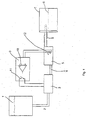
- a water tank 1 is connected via a supply line 2 to a pump 3.
- the pump 3 is connected on the pressure side via a pressure line 4 to a steam generator 5.
- a thermally insulated superheated steam line 6 leads to a treatment chamber 8 surrounded by a laundry drum 7.
- a pump control 9 is provided with a control circuit 10, by means of which the pump 3 can be switched on at intervals via a switching contact 11.
- the steam generator 5 is provided with a thermocouple 12 which is connected to the pump control 9 for measuring the temperature.
- the function of the pump control 9 is the following: First, the steam generator 5 is electrically heated. The heating of the steam generator 5 can be program-controlled. The temperature prevailing in the steam generator 5 is continuously measured by means of the thermocouple 12. Once the steam generator 5 has reached a predetermined operating temperature, for example, 140 ° C, the switching contact 11 is closed by means of the pump control circuit 10. As a result, water is injected into the steam generator 5 by means of the pump 3. Because of the preheating of the steam generator 5 ensures that the injected water completely evaporated. Once the temperature in the steam generator 5 drops below a predetermined minimum temperature, the switching contact 11 is opened by means of the pump control circuit 10 and a further supply of water in the steam generator 5 is interrupted.
- the hot steam generated in the steam generator 5 passes through the, preferably designed as a riser, steam line 6 in the treatment room 8.
- Additives such as fragrances, disinfectants and the like.
- fragrances, disinfectants and the like For example, be added to the recorded in the water tank 1 water.
- the proposed household tumble dryer can be cleaned in a simple and efficient way odorous textiles. It is not necessary in this case to wash the textiles. This achieves a saving of resources.
- the pump control is additionally acted upon by a signal of a humidity sensor 20.
- the humidity sensor 20 is connected via signal lines 21 to the pump control 9.
- the mode of action of the humidity sensor 20 is the one that the pump control no longer controls the pump when the laundry in the treatment chamber 8 has the desired moisture.
Landscapes
- Engineering & Computer Science (AREA)
- Textile Engineering (AREA)
- Detail Structures Of Washing Machines And Dryers (AREA)
Claims (28)
- Procédé pour le traitement du linge dans un sèche-linge domestique,
le linge étant introduit dans une chambre de traitement (8) entourée par un tambour (7) monté rotatif,
le linge étant sollicité avec de la vapeur chaude, qui est générée dans un générateur de vapeur (5) intégré dans le sèche-linge domestique,
le générateur de vapeur (5) recevant, par l'intermédiaire d'un dispositif d'acheminement d'eau, l'eau nécessaire pour la vaporisation,
caractérisé en ce que
le dispositif d'acheminement d'eau comporte une cuve (1) recevant l'eau destinée à alimenter le générateur de vapeur (5), ladite cuve (1) étant intégrée dans le sèche-linge domestique, et
la vapeur chaude, générée dans le générateur de vapeur (5), est acheminée via une conduite d'amenée de vapeur (6) à isolation thermique dans la chambre de traitement (8) entourée par le tambour (7). - Procédé selon la revendication 1, caractérisé en ce que le linge est sollicité, de préférence par intermittence, par la vapeur chaude ne contenant pas de gouttes.
- Procédé selon l'une quelconque des revendications précédentes, selon lequel le générateur de vapeur (5) et un dispositif d'acheminement d'eau (1, 2, 3, 4) sont réglés de telle sorte qu'une quantité prédéfinie d'eau est acheminée au générateur de vapeur uniquement lorsqu'une température de travail d'au moins 100°C, de préférence de 120 à 200°C est atteinte.
- Procédé selon l'une quelconque des revendications précédentes, selon lequel la quantité d'eau acheminée au générateur de vapeur (5) est commandée en fonction de la température de travail ou de la puissance électrique consommée par le générateur de vapeur (5), de telle sorte que l'eau est intégralement vaporisée.
- Procédé selon l'une quelconque des revendications précédentes, selon lequel l'eau est acheminée vers le générateur de vapeur (5) sous l'effet de l'ouverture intermittente d'une vanne et/ou de l'actionnement intermittent d'une pompe (3).
- Procédé selon l'une quelconque des revendications précédentes, selon lequel une matière odoriférante, un agent germicide, un produit de nettoyage et/ou un anticalcaire sont ajoutés à l'eau ou à la vapeur chaude.
- Procédé selon l'une quelconque des revendications précédentes, caractérisé en ce que le linge est sollicité par de l'air chaud.
- Procédé selon l'une quelconque des revendications précédentes, caractérisé en ce que le générateur de vapeur (5) est alimenté en eau de manière commandée, l'eau étant prélevée dans la cuve (1).
- Procédé selon l'une quelconque des revendications précédentes, caractérisé en ce qu'un condensat, formé pendant le processus de séchage du sèche-linge domestique, est collecté dans la cuve (1).
- Procédé selon une ou plusieurs des revendications précédentes, caractérisé en ce que le linge est sollicité par une quantité prédéfinie de vapeur chaude.
- Procédé selon la revendication 10, caractérisé en ce que la quantité prédéfinie de vapeur est déterminée par un temps de fonctionnement prédéfini du générateur de vapeur (5).
- Procédé selon une ou plusieurs des revendications précédentes, caractérisé en ce que le linge est sollicité par la vapeur chaude jusqu'à ce que le linge possède un degré d'humidité prédéfini.
- Procédé selon une ou plusieurs des revendications précédentes, caractérisé en ce que le degré d'humidité du linge est contrôlé par un système de capteurs.
- Procédé selon la revendication 13, caractérisé en ce que le système de capteurs, qui est utilisé dans le sèche-linge domestique pour surveiller l'humidité restante lors du séchage, est le système de capteurs utilisé.
- Procédé selon une ou plusieurs des revendications précédentes, caractérisé en ce que le linge est sollicité par la vapeur chaude avec des interruptions dans le temps.
- Procédé selon la revendication 15, caractérisé en ce que le tambour (7) est entraîné en rotation pendant les interruptions.
- Procédé selon une ou plusieurs des revendications précédentes, caractérisé en ce que le linge, pendant qu'il est sollicité par la vapeur chaude, est brassé sous l'effet de la rotation du tambour (7).
- Procédé selon une ou plusieurs des revendications précédentes, caractérisé en ce que la vapeur chaude est introduite en sens opposé à l'afflux d'air dans le tambour (7).
- Procédé selon une ou plusieurs des revendications précédentes, caractérisé en ce que le degré d'humidité du linge, qui doit être présent à la fin du processus, peut être réglé par l'utilisateur du sèche-linge domestique par l'intermédiaire d'une unité de commande.
- Procédé selon la revendication 19, caractérisé en ce que le réglage est effectué par l'intermédiaire de la même unité de commande que celle commandant le processus de séchage du linge lavé.
- Sèche-linge domestique comportant
un tambour (7) monté rotatif,
un générateur de vapeur (5) intégré, et
un dispositif d'acheminement d'eau (1, 2, 3, 4), caractérisé en ce que
le dispositif d'acheminement d'eau comporte une cuve (1) pour recevoir l'eau alimentant le générateur de vapeur (5), ladite cuve (1) étant intégrée dans le sèche-linge domestique, et
le générateur de vapeur (5) comporte une conduite d'amenée de vapeur (6) à isolation thermique pour acheminer la vapeur du générateur de vapeur au tambour (7). - Sèche-linge domestique selon la revendication 21, dans lequel le générateur de vapeur (5) et le dispositif d'acheminement d'eau (1, 2, 3, 4) peuvent être réglés au moyen d'un dispositif de réglage (9, 10, 11), de telle sorte qu'une quantité prédéfinie d'eau est acheminée vers le générateur de vapeur (5) uniquement lorsqu'une température de travail d'au moins 100°C, de préférence de 120°C à 200°C est atteinte.
- Sèche-linge domestique selon la revendication 21 ou 22, dans lequel la quantité d'eau acheminée peut être réglée au moyen du dispositif de réglage (9, 10, 11) en fonction de la température de travail ou de la puissance électrique consommée par le générateur de vapeur (5), de telle sorte que l'eau est intégralement vaporisée.
- Sèche-linge domestique selon l'une quelconque des revendications 21 à 23, dans lequel le dispositif d'acheminement d'eau comporte une vanne et/ou une pompe (3) qui, pour alimenter en eau le générateur de vapeur (5), peut/peuvent être commandée(s) au moyen du dispositif de réglage (9, 10, 11).
- Sèche-linge domestique selon l'une quelconque des revendications 21 à 24, dans lequel la conduite d'amenée de vapeur (6) à isolation thermique du générateur de vapeur (5) est reliée à une chambre de traitement (8) entourée par le tambour (7).
- Sèche-linge domestique selon l'une quelconque des revendications 21 à 25, dans lequel il est prévu un dispositif pour acheminer dans l'eau ou dans la vapeur chaude un additif, tel qu'une matière odoriférante, un agent germicide, un produit de nettoyage et/ou un anticalcaire.
- Sèche-linge domestique selon une ou plusieurs des revendications 21 à 26, caractérisé en ce que le sèche-linge domestique est un sèche-linge à condensation et la cuve (1) peut être remplie avec le condensat du sèche-linge domestique.
- Sèche-linge domestique selon la revendication 27, caractérisé en ce que le réservoir destiné à recevoir le condensat est en même temps la cuve (1).
Priority Applications (3)
| Application Number | Priority Date | Filing Date | Title |
|---|---|---|---|
| EP10183156A EP2295628B1 (fr) | 2003-01-25 | 2003-11-15 | Procédé de traitement de linge dans un appareil électroménager et appareil électroménager, notamment un sèche-linge domestique |
| EP10183124A EP2287386B1 (fr) | 2003-01-25 | 2003-11-15 | Procédé de traitement de linge dans un appareil électroménager et appareil électroménager, notamment un sèche-linge domestique |
| EP10183142.8A EP2295627B2 (fr) | 2003-01-25 | 2003-11-15 | Procédé de traitement de linge dans un appareil électroménager et appareil électroménager, notamment un sèche-linge domestique |
Applications Claiming Priority (4)
| Application Number | Priority Date | Filing Date | Title |
|---|---|---|---|
| DE10302971 | 2003-01-25 | ||
| DE10302971 | 2003-01-25 | ||
| DE10332656A DE10332656A1 (de) | 2003-01-25 | 2003-07-18 | Verfahren zur Behandlung von Textilien in einem Haushaltswäschetrockner |
| DE10332656 | 2003-07-18 |
Related Child Applications (5)
| Application Number | Title | Priority Date | Filing Date |
|---|---|---|---|
| EP10183156A Division EP2295628B1 (fr) | 2003-01-25 | 2003-11-15 | Procédé de traitement de linge dans un appareil électroménager et appareil électroménager, notamment un sèche-linge domestique |
| EP10183142.8A Division EP2295627B2 (fr) | 2003-01-25 | 2003-11-15 | Procédé de traitement de linge dans un appareil électroménager et appareil électroménager, notamment un sèche-linge domestique |
| EP10183142.8 Division-Into | 2010-09-30 | ||
| EP10183124.6 Division-Into | 2010-09-30 | ||
| EP10183156.8 Division-Into | 2010-09-30 |
Publications (2)
| Publication Number | Publication Date |
|---|---|
| EP1441059A1 EP1441059A1 (fr) | 2004-07-28 |
| EP1441059B1 true EP1441059B1 (fr) | 2012-01-18 |
Family
ID=32598099
Family Applications (1)
| Application Number | Title | Priority Date | Filing Date |
|---|---|---|---|
| EP03026289A Expired - Lifetime EP1441059B1 (fr) | 2003-01-25 | 2003-11-15 | Procédé de traitement de textiles dans un sèche-linge domestique |
Country Status (1)
| Country | Link |
|---|---|
| EP (1) | EP1441059B1 (fr) |
Cited By (3)
| Publication number | Priority date | Publication date | Assignee | Title |
|---|---|---|---|---|
| US8393183B2 (en) | 2007-05-07 | 2013-03-12 | Whirlpool Corporation | Fabric treatment appliance control panel and associated steam operations |
| US8555675B2 (en) | 2007-08-31 | 2013-10-15 | Whirlpool Corporation | Fabric treatment appliance with steam backflow device |
| US8555676B2 (en) | 2007-08-31 | 2013-10-15 | Whirlpool Corporation | Fabric treatment appliance with steam backflow device |
Families Citing this family (47)
| Publication number | Priority date | Publication date | Assignee | Title |
|---|---|---|---|---|
| US8844160B2 (en) | 1997-04-29 | 2014-09-30 | Whirlpool Corporation | Modular fabric revitalizing system |
| EP1529875A3 (fr) | 2003-11-04 | 2017-05-17 | LG Electronics, Inc. | Machine à laver et procédé de commande correspondant |
| KR20050112232A (ko) * | 2004-05-25 | 2005-11-30 | 삼성전자주식회사 | 탈취수단을 구비한 세탁기 및 그 제어방법 |
| KR100595263B1 (ko) | 2004-11-10 | 2006-07-03 | 엘지전자 주식회사 | 건조 장치의 리프레쉬 모드 제어 방법 |
| US7418789B2 (en) | 2004-11-10 | 2008-09-02 | Lg Electronics Inc. | Combination dryer and method thereof |
| KR100662369B1 (ko) | 2004-11-30 | 2007-01-02 | 엘지전자 주식회사 | 열풍공급용 옷걸이가 구비된 복합식 건조장치 |
| KR20060061974A (ko) * | 2004-12-02 | 2006-06-09 | 삼성전자주식회사 | 의류의 구김제거장치 및 그 방법 |
| KR100672501B1 (ko) | 2004-12-09 | 2007-01-24 | 엘지전자 주식회사 | 세탁 장치의 운전 제어 방법 |
| KR100672502B1 (ko) | 2004-12-09 | 2007-01-24 | 엘지전자 주식회사 | 세탁 장치의 운전 제어 방법 |
| EP2034082B1 (fr) | 2005-03-16 | 2012-08-22 | LG Electronics Inc. | Machine à laver à la vapeur et son procédé de commande |
| EP1871946A4 (fr) * | 2005-04-22 | 2013-10-30 | Lg Electronics Inc | Machine de laverie et sa methode de gestion |
| ATE439465T1 (de) | 2005-05-31 | 2009-08-15 | Lg Electronics Inc | Waschmaschine |
| KR100833857B1 (ko) | 2005-05-31 | 2008-06-02 | 엘지전자 주식회사 | 세탁 장치 |
| US7921578B2 (en) | 2005-12-30 | 2011-04-12 | Whirlpool Corporation | Nebulizer system for a fabric treatment appliance |
| US7735345B2 (en) | 2005-12-30 | 2010-06-15 | Whirlpool Corporation | Automatic fabric treatment appliance with a manual fabric treatment station |
| US7665227B2 (en) | 2005-12-30 | 2010-02-23 | Whirlpool Corporation | Fabric revitalizing method using low absorbency pads |
| DE102006003416A1 (de) * | 2006-01-24 | 2007-07-26 | BSH Bosch und Siemens Hausgeräte GmbH | Haushalt-Waschmaschine mit einer drehbar gelagerten Wäschetrommel und Verfahren zum Deodorieren von Kleidung in einer solchen Waschmaschine |
| DE102007007354B4 (de) | 2006-02-20 | 2013-10-10 | Lg Electronics Inc. | Wäschetrockner und Verfahren zur Steuerung |
| US7941885B2 (en) | 2006-06-09 | 2011-05-17 | Whirlpool Corporation | Steam washing machine operation method having dry spin pre-wash |
| US7765628B2 (en) | 2006-06-09 | 2010-08-03 | Whirlpool Corporation | Steam washing machine operation method having a dual speed spin pre-wash |
| US7627920B2 (en) | 2006-06-09 | 2009-12-08 | Whirlpool Corporation | Method of operating a washing machine using steam |
| DE112007001116B4 (de) * | 2006-06-12 | 2013-11-14 | Lg Electronics Inc. | Bekleidungstrockner und Verfahren zum Steuern desselben |
| KR100830514B1 (ko) * | 2006-06-12 | 2008-05-21 | 엘지전자 주식회사 | 건조기 및 그 제어방법 |
| KR101328918B1 (ko) * | 2006-07-10 | 2013-11-14 | 엘지전자 주식회사 | 세탁장치 및 그 운전방법 |
| DE602007009242D1 (de) * | 2006-07-18 | 2010-10-28 | Lg Electronics Inc | Wäschetrockner |
| EP2061923B1 (fr) * | 2006-08-02 | 2018-01-03 | LG Electronics Inc. | Machine à laver |
| US7841219B2 (en) | 2006-08-15 | 2010-11-30 | Whirlpool Corporation | Fabric treating appliance utilizing steam |
| US7886392B2 (en) | 2006-08-15 | 2011-02-15 | Whirlpool Corporation | Method of sanitizing a fabric load with steam in a fabric treatment appliance |
| US7681418B2 (en) | 2006-08-15 | 2010-03-23 | Whirlpool Corporation | Water supply control for a steam generator of a fabric treatment appliance using a temperature sensor |
| US7707859B2 (en) | 2006-08-15 | 2010-05-04 | Whirlpool Corporation | Water supply control for a steam generator of a fabric treatment appliance |
| US7665332B2 (en) | 2006-08-15 | 2010-02-23 | Whirlpool Corporation | Steam fabric treatment appliance with exhaust |
| KR101328920B1 (ko) * | 2006-09-18 | 2013-11-14 | 엘지전자 주식회사 | 건조기 |
| KR100735707B1 (ko) * | 2006-09-29 | 2007-07-06 | 엘지전자 주식회사 | 건조기 및 그 제어방법 |
| US7753009B2 (en) | 2006-10-19 | 2010-07-13 | Whirlpool Corporation | Washer with bio prevention cycle |
| ATE482309T1 (de) | 2007-04-25 | 2010-10-15 | Lg Electronics Inc | Kleiderbehandlungsvorrichtung |
| PL2014821T3 (pl) * | 2007-07-13 | 2011-07-29 | Electrolux Home Products Corp Nv | Domowa suszarka |
| KR101498027B1 (ko) * | 2008-04-01 | 2015-03-03 | 엘지전자 주식회사 | 의류처리장치 및 의류처리장치의 제어방법 |
| CN102257206B (zh) | 2007-08-03 | 2014-06-18 | Lg电子株式会社 | 衣服处置装置及其控制方法 |
| US8037565B2 (en) | 2007-08-31 | 2011-10-18 | Whirlpool Corporation | Method for detecting abnormality in a fabric treatment appliance having a steam generator |
| US7861343B2 (en) | 2007-08-31 | 2011-01-04 | Whirlpool Corporation | Method for operating a steam generator in a fabric treatment appliance |
| US7905119B2 (en) | 2007-08-31 | 2011-03-15 | Whirlpool Corporation | Fabric treatment appliance with steam generator having a variable thermal output |
| US7690062B2 (en) | 2007-08-31 | 2010-04-06 | Whirlpool Corporation | Method for cleaning a steam generator |
| US7918109B2 (en) | 2007-08-31 | 2011-04-05 | Whirlpool Corporation | Fabric Treatment appliance with steam generator having a variable thermal output |
| US7966683B2 (en) | 2007-08-31 | 2011-06-28 | Whirlpool Corporation | Method for operating a steam generator in a fabric treatment appliance |
| JP2013208251A (ja) * | 2012-03-30 | 2013-10-10 | Panasonic Corp | 衣類処理装置 |
| JP2013208248A (ja) * | 2012-03-30 | 2013-10-10 | Panasonic Corp | 衣類処理装置 |
| CN112127100B (zh) * | 2020-09-08 | 2023-12-01 | 珠海格力电器股份有限公司 | 香味投放装置、衣物增香方法及洗衣设备 |
Citations (1)
| Publication number | Priority date | Publication date | Assignee | Title |
|---|---|---|---|---|
| WO2004059070A1 (fr) * | 2002-12-20 | 2004-07-15 | BSH Bosch und Siemens Hausgeräte GmbH | Seche-linge et procede pour eliminer des odeurs de textiles |
Family Cites Families (6)
| Publication number | Priority date | Publication date | Assignee | Title |
|---|---|---|---|---|
| US3242584A (en) * | 1963-04-29 | 1966-03-29 | Gen Motors Corp | Domestic clothes drying appliance |
| US3670425A (en) * | 1971-02-11 | 1972-06-20 | Rose Ellen Benjamin | Clothes rejuvenator |
| DE3408136A1 (de) * | 1984-03-06 | 1985-09-19 | Passat-Maschinenbau Gmbh, 7100 Heilbronn | Verfahren und vorrichtung zum behandeln von textilien |
| US4519145A (en) * | 1984-03-12 | 1985-05-28 | Magic Chef, Inc. | Electrostatic and moisture control system for automatic clothes dryers |
| DE3727570A1 (de) * | 1987-08-19 | 1989-03-02 | Joachim Plate | Verfahren zur beseitigung von geruechen aus textilien und webgut |
| CH695383A5 (de) * | 2001-07-10 | 2006-04-28 | V Zug Ag | Wäschetrockner oder Waschautomat mit Bedampfungsvorrichtung. |
-
2003
- 2003-11-15 EP EP03026289A patent/EP1441059B1/fr not_active Expired - Lifetime
Patent Citations (1)
| Publication number | Priority date | Publication date | Assignee | Title |
|---|---|---|---|---|
| WO2004059070A1 (fr) * | 2002-12-20 | 2004-07-15 | BSH Bosch und Siemens Hausgeräte GmbH | Seche-linge et procede pour eliminer des odeurs de textiles |
Cited By (3)
| Publication number | Priority date | Publication date | Assignee | Title |
|---|---|---|---|---|
| US8393183B2 (en) | 2007-05-07 | 2013-03-12 | Whirlpool Corporation | Fabric treatment appliance control panel and associated steam operations |
| US8555675B2 (en) | 2007-08-31 | 2013-10-15 | Whirlpool Corporation | Fabric treatment appliance with steam backflow device |
| US8555676B2 (en) | 2007-08-31 | 2013-10-15 | Whirlpool Corporation | Fabric treatment appliance with steam backflow device |
Also Published As
| Publication number | Publication date |
|---|---|
| EP1441059A1 (fr) | 2004-07-28 |
Similar Documents
| Publication | Publication Date | Title |
|---|---|---|
| EP1441059B1 (fr) | Procédé de traitement de textiles dans un sèche-linge domestique | |
| EP2287386B1 (fr) | Procédé de traitement de linge dans un appareil électroménager et appareil électroménager, notamment un sèche-linge domestique | |
| DE112006000091B4 (de) | Wäschemaschine und Verfahren zu deren Betrieb | |
| EP2427595B1 (fr) | Appareil de traitement du linge presentant un generateur de vapeur et procede de traitement d'un article a laver | |
| DE102009042903B4 (de) | Wäschetrockner mit Duftzuführungseinrichtung unter Verwendung eines Vibrators | |
| DE102008035789B4 (de) | Dampferzeuger | |
| CN101629381B (zh) | 用于控制干衣机的芳香物质喷雾的方法 | |
| EP1275767A1 (fr) | Sèche-linge ou machine à laver automatique avec dispositif de vaporisation | |
| EP1431443A1 (fr) | Sèche-linge et utilisation d'un atomiseur à ultrasons | |
| DE10260151A1 (de) | Wäschetrockner und Verfahren zur Geruchsentfernung aus Textilien | |
| DE102012213934A1 (de) | Waschmaschine mit Vorrichtung zur Erzeugung von Wassertropfen sowie Verfahren zu ihrem Betrieb | |
| EP2603629B1 (fr) | Procédé pour éliminer des odeurs des vêtements dans un sèche-linge et un sèche-linge pour celui-ci | |
| DE102012103660A1 (de) | Wäschetrockner und Verfahren zum Einstellen der Verdünnung einer Behandlungslösung nach der Chargengröße | |
| DE112008002090T5 (de) | Kleidungs-Behandlungsvorrichtung und Verfahren zur Steuerung derselben | |
| DE102007060853A1 (de) | Wäschetrocknungsgerät und Verfahren zum Trocknen von Wäsche | |
| EP1738677A2 (fr) | Lave-vaisselle avec générateur de vapeur et procédé pour son opération | |
| EP2766518B1 (fr) | Appareil ménager à circulation d'eau comportant un dispositif de nébulisation ainsi que procédé pour son fonctionnement | |
| DE102021207441B3 (de) | Verfahren zum Betrieb einer Waschmaschine und Waschmaschine | |
| DE102014209732A1 (de) | Reinigen wasserführender Komponenten eines Haushaltsgeräts | |
| DE102014217121A1 (de) | Wäschepflegegerät mit einer Zuführeinrichtung | |
| DE102015107500A1 (de) | Verfahren zum Waschen und/oder Trocknen von Wäsche in einem Waschtrockner | |
| EP3201385B1 (fr) | Appareil électroménager pourvu d'un système d'introduction de fluide | |
| DE102013102581B4 (de) | Verfahren zum Einbringen eines Zusatzstoffes in die Trommel eines Wäschetrockners | |
| BE1030894B1 (de) | Vorrichtung und Verfahren zur Behandlung eines Einzeltextils | |
| DE2450024A1 (de) | Verfahren zum trocknen von waesche mittels eines haushalt-waeschetrockners |
Legal Events
| Date | Code | Title | Description |
|---|---|---|---|
| PUAI | Public reference made under article 153(3) epc to a published international application that has entered the european phase |
Free format text: ORIGINAL CODE: 0009012 |
|
| AK | Designated contracting states |
Kind code of ref document: A1 Designated state(s): AT BE BG CH CY CZ DE DK EE ES FI FR GB GR HU IE IT LI LU MC NL PT RO SE SI SK TR |
|
| AX | Request for extension of the european patent |
Extension state: AL LT LV MK |
|
| 17P | Request for examination filed |
Effective date: 20040603 |
|
| AKX | Designation fees paid |
Designated state(s): DE FR GB IT |
|
| RAP1 | Party data changed (applicant data changed or rights of an application transferred) |
Owner name: ELECTROLUX HOME PRODUCTS CORPORATION N.V. |
|
| RAP1 | Party data changed (applicant data changed or rights of an application transferred) |
Owner name: ELECTROLUX HOME PRODUCTS CORPORATION N.V. |
|
| GRAP | Despatch of communication of intention to grant a patent |
Free format text: ORIGINAL CODE: EPIDOSNIGR1 |
|
| GRAC | Information related to communication of intention to grant a patent modified |
Free format text: ORIGINAL CODE: EPIDOSCIGR1 |
|
| GRAS | Grant fee paid |
Free format text: ORIGINAL CODE: EPIDOSNIGR3 |
|
| GRAA | (expected) grant |
Free format text: ORIGINAL CODE: 0009210 |
|
| AK | Designated contracting states |
Kind code of ref document: B1 Designated state(s): DE FR GB IT |
|
| REG | Reference to a national code |
Ref country code: GB Ref legal event code: FG4D Free format text: NOT ENGLISH |
|
| REG | Reference to a national code |
Ref country code: DE Ref legal event code: R096 Ref document number: 50314182 Country of ref document: DE Effective date: 20120315 |
|
| PLBE | No opposition filed within time limit |
Free format text: ORIGINAL CODE: 0009261 |
|
| STAA | Information on the status of an ep patent application or granted ep patent |
Free format text: STATUS: NO OPPOSITION FILED WITHIN TIME LIMIT |
|
| 26N | No opposition filed |
Effective date: 20121019 |
|
| REG | Reference to a national code |
Ref country code: DE Ref legal event code: R097 Ref document number: 50314182 Country of ref document: DE Effective date: 20121019 |
|
| REG | Reference to a national code |
Ref country code: FR Ref legal event code: PLFP Year of fee payment: 13 |
|
| REG | Reference to a national code |
Ref country code: FR Ref legal event code: PLFP Year of fee payment: 14 |
|
| REG | Reference to a national code |
Ref country code: FR Ref legal event code: PLFP Year of fee payment: 15 |
|
| PGFP | Annual fee paid to national office [announced via postgrant information from national office to epo] |
Ref country code: DE Payment date: 20201119 Year of fee payment: 18 Ref country code: IT Payment date: 20201124 Year of fee payment: 18 Ref country code: GB Payment date: 20201120 Year of fee payment: 18 Ref country code: FR Payment date: 20201120 Year of fee payment: 18 |
|
| REG | Reference to a national code |
Ref country code: DE Ref legal event code: R119 Ref document number: 50314182 Country of ref document: DE |
|
| GBPC | Gb: european patent ceased through non-payment of renewal fee |
Effective date: 20211115 |
|
| PG25 | Lapsed in a contracting state [announced via postgrant information from national office to epo] |
Ref country code: GB Free format text: LAPSE BECAUSE OF NON-PAYMENT OF DUE FEES Effective date: 20211115 Ref country code: DE Free format text: LAPSE BECAUSE OF NON-PAYMENT OF DUE FEES Effective date: 20220601 |
|
| PG25 | Lapsed in a contracting state [announced via postgrant information from national office to epo] |
Ref country code: FR Free format text: LAPSE BECAUSE OF NON-PAYMENT OF DUE FEES Effective date: 20211130 |
|
| PG25 | Lapsed in a contracting state [announced via postgrant information from national office to epo] |
Ref country code: IT Free format text: LAPSE BECAUSE OF NON-PAYMENT OF DUE FEES Effective date: 20211115 |