EP1442014B1 - Herstellung von retinoiden - Google Patents
Herstellung von retinoiden Download PDFInfo
- Publication number
- EP1442014B1 EP1442014B1 EP02779506A EP02779506A EP1442014B1 EP 1442014 B1 EP1442014 B1 EP 1442014B1 EP 02779506 A EP02779506 A EP 02779506A EP 02779506 A EP02779506 A EP 02779506A EP 1442014 B1 EP1442014 B1 EP 1442014B1
- Authority
- EP
- European Patent Office
- Prior art keywords
- formula
- alkyl
- derivative
- retinal
- acid
- Prior art date
- Legal status (The legal status is an assumption and is not a legal conclusion. Google has not performed a legal analysis and makes no representation as to the accuracy of the status listed.)
- Expired - Lifetime
Links
- 238000004519 manufacturing process Methods 0.000 title claims abstract description 12
- 150000001875 compounds Chemical class 0.000 claims abstract description 86
- 238000000034 method Methods 0.000 claims abstract description 70
- 230000002207 retinal effect Effects 0.000 claims abstract description 39
- QIGBRXMKCJKVMJ-UHFFFAOYSA-N Hydroquinone Chemical compound OC1=CC=C(O)C=C1 QIGBRXMKCJKVMJ-UHFFFAOYSA-N 0.000 claims abstract description 38
- 239000000203 mixture Substances 0.000 claims abstract description 37
- 239000002253 acid Substances 0.000 claims abstract description 25
- 230000015572 biosynthetic process Effects 0.000 claims abstract description 24
- FPIPGXGPPPQFEQ-OVSJKPMPSA-N all-trans-retinol Chemical compound OC\C=C(/C)\C=C\C=C(/C)\C=C\C1=C(C)CCCC1(C)C FPIPGXGPPPQFEQ-OVSJKPMPSA-N 0.000 claims abstract description 19
- KAKZBPTYRLMSJV-UHFFFAOYSA-N Butadiene Chemical class C=CC=C KAKZBPTYRLMSJV-UHFFFAOYSA-N 0.000 claims abstract description 15
- FPIPGXGPPPQFEQ-UHFFFAOYSA-N 13-cis retinol Natural products OCC=C(C)C=CC=C(C)C=CC1=C(C)CCCC1(C)C FPIPGXGPPPQFEQ-UHFFFAOYSA-N 0.000 claims abstract description 10
- 230000002378 acidificating effect Effects 0.000 claims abstract description 10
- 239000003054 catalyst Substances 0.000 claims abstract description 10
- 229910052751 metal Inorganic materials 0.000 claims abstract description 6
- 239000002184 metal Substances 0.000 claims abstract description 6
- VBRPATNPOOHKOF-UHFFFAOYSA-N 1,3,3-trimethyl-2-pent-4-en-1-ynylcyclohexene Chemical class CC1=C(C#CCC=C)C(C)(C)CCC1 VBRPATNPOOHKOF-UHFFFAOYSA-N 0.000 claims abstract description 5
- QPZSEXPGYPZJTN-UHFFFAOYSA-N 1,3,3-trimethyl-2-penta-1,4-dienylcyclohexene Chemical class CC1=C(C=CCC=C)C(C)(C)CCC1 QPZSEXPGYPZJTN-UHFFFAOYSA-N 0.000 claims abstract description 5
- OPCBOZPVSVXKFI-UHFFFAOYSA-N 1,5,5-trimethyl-6-pent-4-enylidenecyclohexene Chemical class CC1=CCCC(C)(C)C1=CCCC=C OPCBOZPVSVXKFI-UHFFFAOYSA-N 0.000 claims abstract description 5
- LWWWYGJHLHEITJ-UHFFFAOYSA-N 1,5,5-trimethyl-6-penta-1,4-dienylcyclohexene Chemical class CC1=CCCC(C)(C)C1C=CCC=C LWWWYGJHLHEITJ-UHFFFAOYSA-N 0.000 claims abstract description 5
- 235000019169 all-trans-retinol Nutrition 0.000 claims abstract description 5
- 239000011717 all-trans-retinol Substances 0.000 claims abstract description 5
- HYYJILCKVXLAOV-UHFFFAOYSA-N 1,5,5-trimethyl-6-pent-4-en-1-ynylcyclohexene Chemical class CC1=CCCC(C)(C)C1C#CCC=C HYYJILCKVXLAOV-UHFFFAOYSA-N 0.000 claims abstract description 4
- VLKZOEOYAKHREP-UHFFFAOYSA-N n-Hexane Chemical compound CCCCCC VLKZOEOYAKHREP-UHFFFAOYSA-N 0.000 claims description 108
- -1 5-substituted 1,4-pentadiene Chemical class 0.000 claims description 52
- 125000004169 (C1-C6) alkyl group Chemical group 0.000 claims description 48
- RTZKZFJDLAIYFH-UHFFFAOYSA-N Diethyl ether Chemical compound CCOCC RTZKZFJDLAIYFH-UHFFFAOYSA-N 0.000 claims description 47
- XEKOWRVHYACXOJ-UHFFFAOYSA-N Ethyl acetate Chemical compound CCOC(C)=O XEKOWRVHYACXOJ-UHFFFAOYSA-N 0.000 claims description 36
- YXFVVABEGXRONW-UHFFFAOYSA-N Toluene Chemical compound CC1=CC=CC=C1 YXFVVABEGXRONW-UHFFFAOYSA-N 0.000 claims description 33
- 239000002904 solvent Substances 0.000 claims description 33
- 239000002585 base Substances 0.000 claims description 30
- WYURNTSHIVDZCO-UHFFFAOYSA-N Tetrahydrofuran Chemical compound C1CCOC1 WYURNTSHIVDZCO-UHFFFAOYSA-N 0.000 claims description 28
- WEVYAHXRMPXWCK-UHFFFAOYSA-N Acetonitrile Chemical compound CC#N WEVYAHXRMPXWCK-UHFFFAOYSA-N 0.000 claims description 24
- 238000003379 elimination reaction Methods 0.000 claims description 22
- YMWUJEATGCHHMB-UHFFFAOYSA-N Dichloromethane Chemical compound ClCCl YMWUJEATGCHHMB-UHFFFAOYSA-N 0.000 claims description 21
- 125000004191 (C1-C6) alkoxy group Chemical group 0.000 claims description 15
- 125000004391 aryl sulfonyl group Chemical group 0.000 claims description 15
- 239000003960 organic solvent Substances 0.000 claims description 15
- 125000002915 carbonyl group Chemical group [*:2]C([*:1])=O 0.000 claims description 14
- 230000008030 elimination Effects 0.000 claims description 14
- YLQBMQCUIZJEEH-UHFFFAOYSA-N tetrahydrofuran Natural products C=1C=COC=1 YLQBMQCUIZJEEH-UHFFFAOYSA-N 0.000 claims description 14
- 150000001338 aliphatic hydrocarbons Chemical class 0.000 claims description 13
- RAHZWNYVWXNFOC-UHFFFAOYSA-N Sulphur dioxide Chemical group O=S=O RAHZWNYVWXNFOC-UHFFFAOYSA-N 0.000 claims description 12
- 125000002887 hydroxy group Chemical group [H]O* 0.000 claims description 11
- 125000001181 organosilyl group Chemical group [SiH3]* 0.000 claims description 11
- HEDRZPFGACZZDS-UHFFFAOYSA-N Chloroform Chemical compound ClC(Cl)Cl HEDRZPFGACZZDS-UHFFFAOYSA-N 0.000 claims description 10
- OFBQJSOFQDEBGM-UHFFFAOYSA-N Pentane Chemical compound CCCCC OFBQJSOFQDEBGM-UHFFFAOYSA-N 0.000 claims description 10
- JIAARYAFYJHUJI-UHFFFAOYSA-L zinc dichloride Chemical compound [Cl-].[Cl-].[Zn+2] JIAARYAFYJHUJI-UHFFFAOYSA-L 0.000 claims description 10
- GQHTUMJGOHRCHB-UHFFFAOYSA-N 2,3,4,6,7,8,9,10-octahydropyrimido[1,2-a]azepine Chemical compound C1CCCCN2CCCN=C21 GQHTUMJGOHRCHB-UHFFFAOYSA-N 0.000 claims description 9
- VEXZGXHMUGYJMC-UHFFFAOYSA-N Hydrochloric acid Chemical compound Cl VEXZGXHMUGYJMC-UHFFFAOYSA-N 0.000 claims description 9
- 125000001931 aliphatic group Chemical group 0.000 claims description 9
- 239000000460 chlorine Substances 0.000 claims description 9
- 125000002924 primary amino group Chemical group [H]N([H])* 0.000 claims description 9
- KZMGYPLQYOPHEL-UHFFFAOYSA-N Boron trifluoride etherate Chemical compound FB(F)F.CCOCC KZMGYPLQYOPHEL-UHFFFAOYSA-N 0.000 claims description 8
- WKBOTKDWSSQWDR-UHFFFAOYSA-N Bromine atom Chemical compound [Br] WKBOTKDWSSQWDR-UHFFFAOYSA-N 0.000 claims description 8
- ZAMOUSCENKQFHK-UHFFFAOYSA-N Chlorine atom Chemical compound [Cl] ZAMOUSCENKQFHK-UHFFFAOYSA-N 0.000 claims description 8
- JUJWROOIHBZHMG-UHFFFAOYSA-N Pyridine Chemical compound C1=CC=NC=C1 JUJWROOIHBZHMG-UHFFFAOYSA-N 0.000 claims description 8
- 150000004945 aromatic hydrocarbons Chemical class 0.000 claims description 8
- GDTBXPJZTBHREO-UHFFFAOYSA-N bromine Substances BrBr GDTBXPJZTBHREO-UHFFFAOYSA-N 0.000 claims description 8
- 229910052794 bromium Inorganic materials 0.000 claims description 8
- 229910052801 chlorine Inorganic materials 0.000 claims description 8
- 125000004986 diarylamino group Chemical group 0.000 claims description 8
- RBTARNINKXHZNM-UHFFFAOYSA-K iron trichloride Chemical compound Cl[Fe](Cl)Cl RBTARNINKXHZNM-UHFFFAOYSA-K 0.000 claims description 8
- 238000002955 isolation Methods 0.000 claims description 8
- 125000006700 (C1-C6) alkylthio group Chemical group 0.000 claims description 7
- 125000006619 (C1-C6) dialkylamino group Chemical group 0.000 claims description 7
- 125000003435 aroyl group Chemical group 0.000 claims description 7
- 125000005333 aroyloxy group Chemical group 0.000 claims description 7
- 125000005279 aryl sulfonyloxy group Chemical group 0.000 claims description 7
- 125000005110 aryl thio group Chemical group 0.000 claims description 7
- 125000004104 aryloxy group Chemical group 0.000 claims description 7
- 125000005499 phosphonyl group Chemical group 0.000 claims description 7
- 125000004469 siloxy group Chemical group [SiH3]O* 0.000 claims description 7
- JOXIMZWYDAKGHI-UHFFFAOYSA-N toluene-4-sulfonic acid Chemical compound CC1=CC=C(S(O)(=O)=O)C=C1 JOXIMZWYDAKGHI-UHFFFAOYSA-N 0.000 claims description 7
- QAOWNCQODCNURD-UHFFFAOYSA-N Sulfuric acid Chemical compound OS(O)(=O)=O QAOWNCQODCNURD-UHFFFAOYSA-N 0.000 claims description 6
- 150000004292 cyclic ethers Chemical class 0.000 claims description 6
- 239000001117 sulphuric acid Substances 0.000 claims description 6
- 235000011149 sulphuric acid Nutrition 0.000 claims description 6
- BMYNFMYTOJXKLE-UHFFFAOYSA-N 3-azaniumyl-2-hydroxypropanoate Chemical compound NCC(O)C(O)=O BMYNFMYTOJXKLE-UHFFFAOYSA-N 0.000 claims description 5
- 238000002425 crystallisation Methods 0.000 claims description 5
- 230000008025 crystallization Effects 0.000 claims description 5
- XMBWDFGMSWQBCA-UHFFFAOYSA-N hydrogen iodide Chemical compound I XMBWDFGMSWQBCA-UHFFFAOYSA-N 0.000 claims description 5
- 239000011592 zinc chloride Substances 0.000 claims description 5
- 235000005074 zinc chloride Nutrition 0.000 claims description 5
- 229910021578 Iron(III) chloride Inorganic materials 0.000 claims description 4
- 239000002841 Lewis acid Substances 0.000 claims description 4
- AFVFQIVMOAPDHO-UHFFFAOYSA-N Methanesulfonic acid Chemical compound CS(O)(=O)=O AFVFQIVMOAPDHO-UHFFFAOYSA-N 0.000 claims description 4
- DTQVDTLACAAQTR-UHFFFAOYSA-N Trifluoroacetic acid Chemical compound OC(=O)C(F)(F)F DTQVDTLACAAQTR-UHFFFAOYSA-N 0.000 claims description 4
- 150000007517 lewis acids Chemical class 0.000 claims description 4
- VLTRZXGMWDSKGL-UHFFFAOYSA-N perchloric acid Chemical compound OCl(=O)(=O)=O VLTRZXGMWDSKGL-UHFFFAOYSA-N 0.000 claims description 4
- UMJSCPRVCHMLSP-UHFFFAOYSA-N pyridine Natural products COC1=CC=CN=C1 UMJSCPRVCHMLSP-UHFFFAOYSA-N 0.000 claims description 4
- ITMCEJHCFYSIIV-UHFFFAOYSA-N triflic acid Chemical compound OS(=O)(=O)C(F)(F)F ITMCEJHCFYSIIV-UHFFFAOYSA-N 0.000 claims description 4
- VNDYJBBGRKZCSX-UHFFFAOYSA-L zinc bromide Chemical compound Br[Zn]Br VNDYJBBGRKZCSX-UHFFFAOYSA-L 0.000 claims description 4
- PMJHHCWVYXUKFD-SNAWJCMRSA-N (E)-1,3-pentadiene Chemical class C\C=C\C=C PMJHHCWVYXUKFD-SNAWJCMRSA-N 0.000 claims description 3
- BZLVMXJERCGZMT-UHFFFAOYSA-N Methyl tert-butyl ether Chemical compound COC(C)(C)C BZLVMXJERCGZMT-UHFFFAOYSA-N 0.000 claims description 3
- 229910052783 alkali metal Inorganic materials 0.000 claims description 3
- 150000001340 alkali metals Chemical class 0.000 claims description 3
- 230000003197 catalytic effect Effects 0.000 claims description 3
- 229910052500 inorganic mineral Inorganic materials 0.000 claims description 3
- 235000010755 mineral Nutrition 0.000 claims description 3
- 239000011707 mineral Substances 0.000 claims description 3
- 238000000746 purification Methods 0.000 claims description 3
- 229910021627 Tin(IV) chloride Inorganic materials 0.000 claims description 2
- 239000001257 hydrogen Substances 0.000 claims description 2
- 229910052739 hydrogen Inorganic materials 0.000 claims description 2
- MHCFAGZWMAWTNR-UHFFFAOYSA-M lithium perchlorate Chemical compound [Li+].[O-]Cl(=O)(=O)=O MHCFAGZWMAWTNR-UHFFFAOYSA-M 0.000 claims description 2
- 229910001486 lithium perchlorate Inorganic materials 0.000 claims description 2
- QJGQUHMNIGDVPM-UHFFFAOYSA-N nitrogen group Chemical group [N] QJGQUHMNIGDVPM-UHFFFAOYSA-N 0.000 claims description 2
- QDRKDTQENPPHOJ-UHFFFAOYSA-N sodium ethoxide Chemical compound [Na+].CC[O-] QDRKDTQENPPHOJ-UHFFFAOYSA-N 0.000 claims description 2
- HPGGPRDJHPYFRM-UHFFFAOYSA-J tin(iv) chloride Chemical compound Cl[Sn](Cl)(Cl)Cl HPGGPRDJHPYFRM-UHFFFAOYSA-J 0.000 claims description 2
- XJDNKRIXUMDJCW-UHFFFAOYSA-J titanium tetrachloride Chemical compound Cl[Ti](Cl)(Cl)Cl XJDNKRIXUMDJCW-UHFFFAOYSA-J 0.000 claims description 2
- 125000005270 trialkylamine group Chemical group 0.000 claims description 2
- FTVLMFQEYACZNP-UHFFFAOYSA-N trimethylsilyl trifluoromethanesulfonate Chemical compound C[Si](C)(C)OS(=O)(=O)C(F)(F)F FTVLMFQEYACZNP-UHFFFAOYSA-N 0.000 claims description 2
- 150000003751 zinc Chemical class 0.000 claims description 2
- 229940102001 zinc bromide Drugs 0.000 claims description 2
- CITILBVTAYEWKR-UHFFFAOYSA-L zinc trifluoromethanesulfonate Chemical compound [Zn+2].[O-]S(=O)(=O)C(F)(F)F.[O-]S(=O)(=O)C(F)(F)F CITILBVTAYEWKR-UHFFFAOYSA-L 0.000 claims description 2
- GETQZCLCWQTVFV-UHFFFAOYSA-N trimethylamine Chemical compound CN(C)C GETQZCLCWQTVFV-UHFFFAOYSA-N 0.000 claims 2
- 238000007171 acid catalysis Methods 0.000 claims 1
- 125000004435 hydrogen atom Chemical class [H]* 0.000 claims 1
- BDHFUVZGWQCTTF-UHFFFAOYSA-N sulfonic acid Chemical compound OS(=O)=O BDHFUVZGWQCTTF-UHFFFAOYSA-N 0.000 claims 1
- 238000002360 preparation method Methods 0.000 abstract description 21
- 239000002243 precursor Substances 0.000 abstract description 17
- 239000007858 starting material Substances 0.000 abstract description 10
- 238000003786 synthesis reaction Methods 0.000 abstract description 7
- 229960003471 retinol Drugs 0.000 abstract description 4
- 235000020944 retinol Nutrition 0.000 abstract description 4
- 239000011607 retinol Substances 0.000 abstract description 4
- 239000000126 substance Substances 0.000 abstract description 3
- 239000000654 additive Substances 0.000 abstract description 2
- 210000000987 immune system Anatomy 0.000 abstract description 2
- 150000002266 vitamin A derivatives Chemical class 0.000 abstract description 2
- 230000036642 wellbeing Effects 0.000 abstract description 2
- 239000011604 retinal Substances 0.000 description 44
- 238000006243 chemical reaction Methods 0.000 description 40
- HEDRZPFGACZZDS-MICDWDOJSA-N Trichloro(2H)methane Chemical compound [2H]C(Cl)(Cl)Cl HEDRZPFGACZZDS-MICDWDOJSA-N 0.000 description 34
- 239000000243 solution Substances 0.000 description 25
- 235000020945 retinal Nutrition 0.000 description 23
- NCYCYZXNIZJOKI-UHFFFAOYSA-N vitamin A aldehyde Natural products O=CC=C(C)C=CC=C(C)C=CC1=C(C)CCCC1(C)C NCYCYZXNIZJOKI-UHFFFAOYSA-N 0.000 description 23
- 238000005160 1H NMR spectroscopy Methods 0.000 description 18
- XKRFYHLGVUSROY-UHFFFAOYSA-N Argon Chemical compound [Ar] XKRFYHLGVUSROY-UHFFFAOYSA-N 0.000 description 18
- XLYOFNOQVPJJNP-UHFFFAOYSA-N water Substances O XLYOFNOQVPJJNP-UHFFFAOYSA-N 0.000 description 18
- ZMANZCXQSJIPKH-UHFFFAOYSA-N Triethylamine Chemical compound CCN(CC)CC ZMANZCXQSJIPKH-UHFFFAOYSA-N 0.000 description 15
- 239000011541 reaction mixture Substances 0.000 description 15
- QTBSBXVTEAMEQO-UHFFFAOYSA-N Acetic acid Chemical compound CC(O)=O QTBSBXVTEAMEQO-UHFFFAOYSA-N 0.000 description 14
- LFQSCWFLJHTTHZ-UHFFFAOYSA-N Ethanol Chemical compound CCO LFQSCWFLJHTTHZ-UHFFFAOYSA-N 0.000 description 13
- 239000000047 product Substances 0.000 description 12
- 238000004128 high performance liquid chromatography Methods 0.000 description 11
- PMZURENOXWZQFD-UHFFFAOYSA-L Sodium Sulfate Chemical compound [Na+].[Na+].[O-]S([O-])(=O)=O PMZURENOXWZQFD-UHFFFAOYSA-L 0.000 description 10
- 238000007792 addition Methods 0.000 description 10
- CSCPPACGZOOCGX-UHFFFAOYSA-N Acetone Chemical compound CC(C)=O CSCPPACGZOOCGX-UHFFFAOYSA-N 0.000 description 9
- UHOVQNZJYSORNB-UHFFFAOYSA-N Benzene Chemical compound C1=CC=CC=C1 UHOVQNZJYSORNB-UHFFFAOYSA-N 0.000 description 9
- HEMHJVSKTPXQMS-UHFFFAOYSA-M Sodium hydroxide Chemical compound [OH-].[Na+] HEMHJVSKTPXQMS-UHFFFAOYSA-M 0.000 description 9
- 229910052786 argon Inorganic materials 0.000 description 9
- 239000012074 organic phase Substances 0.000 description 9
- 238000003756 stirring Methods 0.000 description 9
- VYPSYNLAJGMNEJ-UHFFFAOYSA-N Silicium dioxide Chemical compound O=[Si]=O VYPSYNLAJGMNEJ-UHFFFAOYSA-N 0.000 description 8
- 238000006722 reduction reaction Methods 0.000 description 8
- 239000012300 argon atmosphere Substances 0.000 description 7
- 238000003776 cleavage reaction Methods 0.000 description 7
- 125000002485 formyl group Chemical group [H]C(*)=O 0.000 description 7
- 230000007017 scission Effects 0.000 description 7
- WFDIJRYMOXRFFG-UHFFFAOYSA-N Acetic anhydride Chemical compound CC(=O)OC(C)=O WFDIJRYMOXRFFG-UHFFFAOYSA-N 0.000 description 6
- FAPWRFPIFSIZLT-UHFFFAOYSA-M Sodium chloride Chemical compound [Na+].[Cl-] FAPWRFPIFSIZLT-UHFFFAOYSA-M 0.000 description 6
- 239000003377 acid catalyst Substances 0.000 description 6
- 239000012043 crude product Substances 0.000 description 6
- 238000002309 gasification Methods 0.000 description 6
- 239000000741 silica gel Substances 0.000 description 6
- 229910002027 silica gel Inorganic materials 0.000 description 6
- PSQYTAPXSHCGMF-BQYQJAHWSA-N β-ionone Chemical compound CC(=O)\C=C\C1=C(C)CCCC1(C)C PSQYTAPXSHCGMF-BQYQJAHWSA-N 0.000 description 6
- QGTBEURZGSLOFK-UHFFFAOYSA-N 2-ethynyl-1,3,3-trimethylcyclohexene Chemical compound CC1=C(C#C)C(C)(C)CCC1 QGTBEURZGSLOFK-UHFFFAOYSA-N 0.000 description 5
- 229960000583 acetic acid Drugs 0.000 description 5
- 150000007513 acids Chemical class 0.000 description 5
- 239000012267 brine Substances 0.000 description 5
- 244000309464 bull Species 0.000 description 5
- 239000003795 chemical substances by application Substances 0.000 description 5
- 238000004440 column chromatography Methods 0.000 description 5
- 238000006482 condensation reaction Methods 0.000 description 5
- 238000001914 filtration Methods 0.000 description 5
- 230000007062 hydrolysis Effects 0.000 description 5
- 238000006460 hydrolysis reaction Methods 0.000 description 5
- 229910052740 iodine Inorganic materials 0.000 description 5
- 150000002576 ketones Chemical class 0.000 description 5
- MZRVEZGGRBJDDB-UHFFFAOYSA-N n-Butyllithium Substances [Li]CCCC MZRVEZGGRBJDDB-UHFFFAOYSA-N 0.000 description 5
- 229910052938 sodium sulfate Inorganic materials 0.000 description 5
- 235000011152 sodium sulphate Nutrition 0.000 description 5
- HPALAKNZSZLMCH-UHFFFAOYSA-M sodium;chloride;hydrate Chemical compound O.[Na+].[Cl-] HPALAKNZSZLMCH-UHFFFAOYSA-M 0.000 description 5
- 239000000725 suspension Substances 0.000 description 5
- ZATUVIWOXWXSTG-ZFDSPDROSA-N (1z,4e)-1-ethoxy-3-methyl-5-(2,6,6-trimethylcyclohexen-1-yl)penta-1,4-dien-3-ol Chemical compound CCO\C=C/C(C)(O)\C=C\C1=C(C)CCCC1(C)C ZATUVIWOXWXSTG-ZFDSPDROSA-N 0.000 description 4
- 230000005526 G1 to G0 transition Effects 0.000 description 4
- WHXSMMKQMYFTQS-UHFFFAOYSA-N Lithium Chemical compound [Li] WHXSMMKQMYFTQS-UHFFFAOYSA-N 0.000 description 4
- CSNNHWWHGAXBCP-UHFFFAOYSA-L Magnesium sulfate Chemical compound [Mg+2].[O-][S+2]([O-])([O-])[O-] CSNNHWWHGAXBCP-UHFFFAOYSA-L 0.000 description 4
- PCLIMKBDDGJMGD-UHFFFAOYSA-N N-bromosuccinimide Chemical compound BrN1C(=O)CCC1=O PCLIMKBDDGJMGD-UHFFFAOYSA-N 0.000 description 4
- UIIMBOGNXHQVGW-UHFFFAOYSA-M Sodium bicarbonate Chemical compound [Na+].OC([O-])=O UIIMBOGNXHQVGW-UHFFFAOYSA-M 0.000 description 4
- WPYMKLBDIGXBTP-UHFFFAOYSA-N benzoic acid Chemical compound OC(=O)C1=CC=CC=C1 WPYMKLBDIGXBTP-UHFFFAOYSA-N 0.000 description 4
- 229920001971 elastomer Polymers 0.000 description 4
- 238000005984 hydrogenation reaction Methods 0.000 description 4
- 229910052708 sodium Inorganic materials 0.000 description 4
- 239000011734 sodium Substances 0.000 description 4
- SFEOKXHPFMOVRM-UHFFFAOYSA-N (+)-(S)-gamma-ionone Natural products CC(=O)C=CC1C(=C)CCCC1(C)C SFEOKXHPFMOVRM-UHFFFAOYSA-N 0.000 description 3
- XGLKQJIJIYUSJS-RJECPTDASA-N (1E,4E)-1-chloro-3-methyl-5-(2,6,6-trimethylcyclohexen-1-yl)penta-1,4-dien-3-ol Chemical compound CC1=C(\C=C\C(C)(O)\C=C\Cl)C(C)(C)CCC1 XGLKQJIJIYUSJS-RJECPTDASA-N 0.000 description 3
- DTATXKHAJFDHQB-XYOKQWHBSA-N (4e)-4-(2,2,6-trimethylcyclohexylidene)butan-2-one Chemical compound CC1CCCC(C)(C)\C1=C\CC(C)=O DTATXKHAJFDHQB-XYOKQWHBSA-N 0.000 description 3
- ZMXDDKWLCZADIW-UHFFFAOYSA-N N,N-Dimethylformamide Chemical compound CN(C)C=O ZMXDDKWLCZADIW-UHFFFAOYSA-N 0.000 description 3
- WTSXKZMQSNJLBQ-KDSKZURDSA-N [(1Z,4E)-3-hydroxy-3-methyl-5-(2,6,6-trimethylcyclohexen-1-yl)penta-1,4-dienyl] benzoate Chemical compound CC1(C)CCCC(C)=C1\C=C\C(C)(O)\C=C/OC(=O)C1=CC=CC=C1 WTSXKZMQSNJLBQ-KDSKZURDSA-N 0.000 description 3
- 150000001299 aldehydes Chemical class 0.000 description 3
- UZFLPKAIBPNNCA-BQYQJAHWSA-N alpha-ionone Chemical compound CC(=O)\C=C\C1C(C)=CCCC1(C)C UZFLPKAIBPNNCA-BQYQJAHWSA-N 0.000 description 3
- UZFLPKAIBPNNCA-UHFFFAOYSA-N alpha-ionone Natural products CC(=O)C=CC1C(C)=CCCC1(C)C UZFLPKAIBPNNCA-UHFFFAOYSA-N 0.000 description 3
- 235000021466 carotenoid Nutrition 0.000 description 3
- 150000001747 carotenoids Chemical class 0.000 description 3
- 238000004587 chromatography analysis Methods 0.000 description 3
- 239000013078 crystal Substances 0.000 description 3
- 125000001495 ethyl group Chemical group [H]C([H])([H])C([H])([H])* 0.000 description 3
- 238000006317 isomerization reaction Methods 0.000 description 3
- 229910052744 lithium Inorganic materials 0.000 description 3
- 239000000463 material Substances 0.000 description 3
- 125000002496 methyl group Chemical group [H]C([H])([H])* 0.000 description 3
- 125000002524 organometallic group Chemical group 0.000 description 3
- 230000020477 pH reduction Effects 0.000 description 3
- YXNPCHMPEUSHPT-ZFDSPDROSA-N (1Z,4E)-1-ethoxy-3-methyl-5-(2,6,6-trimethylcyclohex-2-en-1-yl)penta-1,4-dien-3-ol Chemical compound CCO\C=C/C(C)(O)\C=C\C1C(C)=CCCC1(C)C YXNPCHMPEUSHPT-ZFDSPDROSA-N 0.000 description 2
- RYHBNJHYFVUHQT-UHFFFAOYSA-N 1,4-Dioxane Chemical compound C1COCCO1 RYHBNJHYFVUHQT-UHFFFAOYSA-N 0.000 description 2
- NTUJRJFASYIGAM-UHFFFAOYSA-N 1-chloro-3-methyl-5-(2,6,6-trimethylcyclohexen-1-yl)pent-1-en-4-yn-3-ol Chemical compound CC1=C(C#CC(C)(O)C=CCl)C(C)(C)CCC1 NTUJRJFASYIGAM-UHFFFAOYSA-N 0.000 description 2
- OUBMQNAJZGOZNP-FJDRKQEFSA-N 2-[(1E,4Z)-5-ethoxy-3-methoxy-3-methylpenta-1,4-dienyl]-1,3,3-trimethylcyclohexene Chemical compound CCO\C=C/C(C)(OC)\C=C\C1=C(C)CCCC1(C)C OUBMQNAJZGOZNP-FJDRKQEFSA-N 0.000 description 2
- NGNBDVOYPDDBFK-UHFFFAOYSA-N 2-[2,4-di(pentan-2-yl)phenoxy]acetyl chloride Chemical compound CCCC(C)C1=CC=C(OCC(Cl)=O)C(C(C)CCC)=C1 NGNBDVOYPDDBFK-UHFFFAOYSA-N 0.000 description 2
- VHYFNPMBLIVWCW-UHFFFAOYSA-N 4-Dimethylaminopyridine Chemical compound CN(C)C1=CC=NC=C1 VHYFNPMBLIVWCW-UHFFFAOYSA-N 0.000 description 2
- 150000000703 Cerium Chemical class 0.000 description 2
- XDTMQSROBMDMFD-UHFFFAOYSA-N Cyclohexane Chemical compound C1CCCCC1 XDTMQSROBMDMFD-UHFFFAOYSA-N 0.000 description 2
- XTHFKEDIFFGKHM-UHFFFAOYSA-N Dimethoxyethane Chemical compound COCCOC XTHFKEDIFFGKHM-UHFFFAOYSA-N 0.000 description 2
- CPELXLSAUQHCOX-UHFFFAOYSA-N Hydrogen bromide Chemical compound Br CPELXLSAUQHCOX-UHFFFAOYSA-N 0.000 description 2
- DGAQECJNVWCQMB-PUAWFVPOSA-M Ilexoside XXIX Chemical compound C[C@@H]1CC[C@@]2(CC[C@@]3(C(=CC[C@H]4[C@]3(CC[C@@H]5[C@@]4(CC[C@@H](C5(C)C)OS(=O)(=O)[O-])C)C)[C@@H]2[C@]1(C)O)C)C(=O)O[C@H]6[C@@H]([C@H]([C@@H]([C@H](O6)CO)O)O)O.[Na+] DGAQECJNVWCQMB-PUAWFVPOSA-M 0.000 description 2
- KFZMGEQAYNKOFK-UHFFFAOYSA-N Isopropanol Chemical compound CC(C)O KFZMGEQAYNKOFK-UHFFFAOYSA-N 0.000 description 2
- JRNVZBWKYDBUCA-UHFFFAOYSA-N N-chlorosuccinimide Chemical compound ClN1C(=O)CCC1=O JRNVZBWKYDBUCA-UHFFFAOYSA-N 0.000 description 2
- NBIIXXVUZAFLBC-UHFFFAOYSA-N Phosphoric acid Chemical compound OP(O)(O)=O NBIIXXVUZAFLBC-UHFFFAOYSA-N 0.000 description 2
- SMWDFEZZVXVKRB-UHFFFAOYSA-N Quinoline Chemical compound N1=CC=CC2=CC=CC=C21 SMWDFEZZVXVKRB-UHFFFAOYSA-N 0.000 description 2
- NCYCYZXNIZJOKI-OVSJKPMPSA-N Retinaldehyde Chemical compound O=C\C=C(/C)\C=C\C=C(/C)\C=C\C1=C(C)CCCC1(C)C NCYCYZXNIZJOKI-OVSJKPMPSA-N 0.000 description 2
- MONAMCBQWACAAF-KDSKZURDSA-N [(1Z,4E)-1-ethoxy-3-methyl-5-(2,6,6-trimethylcyclohexen-1-yl)penta-1,4-dien-3-yl]oxy-trimethylsilane Chemical compound CCO\C=C/C(C)(O[Si](C)(C)C)\C=C\C1=C(C)CCCC1(C)C MONAMCBQWACAAF-KDSKZURDSA-N 0.000 description 2
- AAIJQJKPWORDRA-NPALGEPZSA-N [(1Z,4E)-3-methoxy-3-methyl-5-(2,6,6-trimethylcyclohexen-1-yl)penta-1,4-dienyl] benzoate Chemical compound CC=1CCCC(C)(C)C=1/C=C/C(C)(OC)\C=C/OC(=O)C1=CC=CC=C1 AAIJQJKPWORDRA-NPALGEPZSA-N 0.000 description 2
- 239000008346 aqueous phase Substances 0.000 description 2
- 125000003118 aryl group Chemical group 0.000 description 2
- 125000005708 carbonyloxy group Chemical group [*:2]OC([*:1])=O 0.000 description 2
- MVPPADPHJFYWMZ-UHFFFAOYSA-N chlorobenzene Chemical compound ClC1=CC=CC=C1 MVPPADPHJFYWMZ-UHFFFAOYSA-N 0.000 description 2
- IJOOHPMOJXWVHK-UHFFFAOYSA-N chlorotrimethylsilane Chemical compound C[Si](C)(C)Cl IJOOHPMOJXWVHK-UHFFFAOYSA-N 0.000 description 2
- 238000001816 cooling Methods 0.000 description 2
- 239000002274 desiccant Substances 0.000 description 2
- 230000001627 detrimental effect Effects 0.000 description 2
- 238000001704 evaporation Methods 0.000 description 2
- 238000000605 extraction Methods 0.000 description 2
- 150000004678 hydrides Chemical class 0.000 description 2
- AMXOYNBUYSYVKV-UHFFFAOYSA-M lithium bromide Chemical compound [Li+].[Br-] AMXOYNBUYSYVKV-UHFFFAOYSA-M 0.000 description 2
- UBJFKNSINUCEAL-UHFFFAOYSA-N lithium;2-methylpropane Chemical compound [Li+].C[C-](C)C UBJFKNSINUCEAL-UHFFFAOYSA-N 0.000 description 2
- 229910052943 magnesium sulfate Inorganic materials 0.000 description 2
- 235000019341 magnesium sulphate Nutrition 0.000 description 2
- 239000012071 phase Substances 0.000 description 2
- 239000012264 purified product Substances 0.000 description 2
- 229960000342 retinol acetate Drugs 0.000 description 2
- 239000011770 retinyl acetate Substances 0.000 description 2
- 229910052707 ruthenium Inorganic materials 0.000 description 2
- 150000003839 salts Chemical class 0.000 description 2
- 239000011780 sodium chloride Substances 0.000 description 2
- 239000012258 stirred mixture Substances 0.000 description 2
- RIOQSEWOXXDEQQ-UHFFFAOYSA-N triphenylphosphine Chemical compound C1=CC=CC=C1P(C=1C=CC=CC=1)C1=CC=CC=C1 RIOQSEWOXXDEQQ-UHFFFAOYSA-N 0.000 description 2
- CEQACJSYZXQWRM-SNAWJCMRSA-N (1e)-1-methoxy-3-methylbuta-1,3-diene Chemical compound CO\C=C\C(C)=C CEQACJSYZXQWRM-SNAWJCMRSA-N 0.000 description 1
- NTUJRJFASYIGAM-ZHACJKMWSA-N (e)-1-chloro-3-methyl-5-(2,6,6-trimethylcyclohexen-1-yl)pent-1-en-4-yn-3-ol Chemical compound CC1=C(C#CC(C)(O)\C=C\Cl)C(C)(C)CCC1 NTUJRJFASYIGAM-ZHACJKMWSA-N 0.000 description 1
- NDGRVUREWSEVSY-PKNBQFBNSA-N (e)-3-methyl-1-(2,6,6-trimethylcyclohexen-1-yl)pent-1-en-4-yn-3-ol Chemical compound CC1=C(\C=C\C(C)(O)C#C)C(C)(C)CCC1 NDGRVUREWSEVSY-PKNBQFBNSA-N 0.000 description 1
- KVPYFWNOYQAWFW-XDCPIPGDSA-N (z)-1-ethoxy-3-methyl-5-(2,6,6-trimethylcyclohex-2-en-1-ylidene)pent-1-en-3-ol Chemical compound CCO\C=C/C(C)(O)CC=C1C(C)=CCCC1(C)C KVPYFWNOYQAWFW-XDCPIPGDSA-N 0.000 description 1
- WSLDOOZREJYCGB-UHFFFAOYSA-N 1,2-Dichloroethane Chemical compound ClCCCl WSLDOOZREJYCGB-UHFFFAOYSA-N 0.000 description 1
- 125000001637 1-naphthyl group Chemical group [H]C1=C([H])C([H])=C2C(*)=C([H])C([H])=C([H])C2=C1[H] 0.000 description 1
- OUDHOJZFDWBDHJ-ZRDIBKRKSA-N 2-[(e)-3-methoxy-3-methylpent-1-en-4-ynyl]-1,3,3-trimethylcyclohexene Chemical compound COC(C)(C#C)\C=C\C1=C(C)CCCC1(C)C OUDHOJZFDWBDHJ-ZRDIBKRKSA-N 0.000 description 1
- 125000001622 2-naphthyl group Chemical group [H]C1=C([H])C([H])=C2C([H])=C(*)C([H])=C([H])C2=C1[H] 0.000 description 1
- PKQIDSVLSKFZQC-UHFFFAOYSA-N 3-oxobutanal Chemical compound CC(=O)CC=O PKQIDSVLSKFZQC-UHFFFAOYSA-N 0.000 description 1
- HTPABEPAZTWGPP-UHFFFAOYSA-N 4-chlorobut-3-en-2-one Chemical compound CC(=O)C=CCl HTPABEPAZTWGPP-UHFFFAOYSA-N 0.000 description 1
- ZCYVEMRRCGMTRW-UHFFFAOYSA-N 7553-56-2 Chemical compound [I] ZCYVEMRRCGMTRW-UHFFFAOYSA-N 0.000 description 1
- 239000005711 Benzoic acid Substances 0.000 description 1
- CURLTUGMZLYLDI-UHFFFAOYSA-N Carbon dioxide Chemical compound O=C=O CURLTUGMZLYLDI-UHFFFAOYSA-N 0.000 description 1
- 229910052684 Cerium Inorganic materials 0.000 description 1
- 229910004664 Cerium(III) chloride Inorganic materials 0.000 description 1
- VEXZGXHMUGYJMC-UHFFFAOYSA-M Chloride anion Chemical compound [Cl-] VEXZGXHMUGYJMC-UHFFFAOYSA-M 0.000 description 1
- VGGSQFUCUMXWEO-UHFFFAOYSA-N Ethene Chemical class C=C VGGSQFUCUMXWEO-UHFFFAOYSA-N 0.000 description 1
- 238000007241 Hunsdiecker-Borodin reaction Methods 0.000 description 1
- UFHFLCQGNIYNRP-UHFFFAOYSA-N Hydrogen Chemical compound [H][H] UFHFLCQGNIYNRP-UHFFFAOYSA-N 0.000 description 1
- 238000005684 Liebig rearrangement reaction Methods 0.000 description 1
- FYYHWMGAXLPEAU-UHFFFAOYSA-N Magnesium Chemical compound [Mg] FYYHWMGAXLPEAU-UHFFFAOYSA-N 0.000 description 1
- CTQNGGLPUBDAKN-UHFFFAOYSA-N O-Xylene Chemical compound CC1=CC=CC=C1C CTQNGGLPUBDAKN-UHFFFAOYSA-N 0.000 description 1
- 229910019142 PO4 Inorganic materials 0.000 description 1
- KDLHZDBZIXYQEI-UHFFFAOYSA-N Palladium Chemical compound [Pd] KDLHZDBZIXYQEI-UHFFFAOYSA-N 0.000 description 1
- KJTLSVCANCCWHF-UHFFFAOYSA-N Ruthenium Chemical compound [Ru] KJTLSVCANCCWHF-UHFFFAOYSA-N 0.000 description 1
- KEAYESYHFKHZAL-UHFFFAOYSA-N Sodium Chemical compound [Na] KEAYESYHFKHZAL-UHFFFAOYSA-N 0.000 description 1
- VMHLLURERBWHNL-UHFFFAOYSA-M Sodium acetate Chemical compound [Na+].CC([O-])=O VMHLLURERBWHNL-UHFFFAOYSA-M 0.000 description 1
- FPIPGXGPPPQFEQ-BOOMUCAASA-N Vitamin A Natural products OC/C=C(/C)\C=C\C=C(\C)/C=C/C1=C(C)CCCC1(C)C FPIPGXGPPPQFEQ-BOOMUCAASA-N 0.000 description 1
- JEDZLBFUGJTJGQ-UHFFFAOYSA-N [Na].COCCO[AlH]OCCOC Chemical compound [Na].COCCO[AlH]OCCOC JEDZLBFUGJTJGQ-UHFFFAOYSA-N 0.000 description 1
- 125000002777 acetyl group Chemical group [H]C([H])([H])C(*)=O 0.000 description 1
- 230000021736 acetylation Effects 0.000 description 1
- 238000006640 acetylation reaction Methods 0.000 description 1
- 150000000475 acetylene derivatives Chemical class 0.000 description 1
- 230000010933 acylation Effects 0.000 description 1
- 238000005917 acylation reaction Methods 0.000 description 1
- 238000007259 addition reaction Methods 0.000 description 1
- 150000001298 alcohols Chemical class 0.000 description 1
- 150000001335 aliphatic alkanes Chemical class 0.000 description 1
- 239000003513 alkali Substances 0.000 description 1
- 125000005234 alkyl aluminium group Chemical group 0.000 description 1
- 125000000217 alkyl group Chemical group 0.000 description 1
- 150000004791 alkyl magnesium halides Chemical class 0.000 description 1
- 150000004645 aluminates Chemical class 0.000 description 1
- 229910000091 aluminium hydride Inorganic materials 0.000 description 1
- PNEYBMLMFCGWSK-UHFFFAOYSA-N aluminium oxide Inorganic materials [O-2].[O-2].[O-2].[Al+3].[Al+3] PNEYBMLMFCGWSK-UHFFFAOYSA-N 0.000 description 1
- 229910000147 aluminium phosphate Inorganic materials 0.000 description 1
- 150000001408 amides Chemical class 0.000 description 1
- 229910021529 ammonia Inorganic materials 0.000 description 1
- 239000000010 aprotic solvent Substances 0.000 description 1
- 239000007864 aqueous solution Substances 0.000 description 1
- 235000010233 benzoic acid Nutrition 0.000 description 1
- 125000003236 benzoyl group Chemical group [H]C1=C([H])C([H])=C(C([H])=C1[H])C(*)=O 0.000 description 1
- 238000009835 boiling Methods 0.000 description 1
- 150000001639 boron compounds Chemical class 0.000 description 1
- 239000007853 buffer solution Substances 0.000 description 1
- PVEOYINWKBTPIZ-UHFFFAOYSA-N but-3-enoic acid Chemical class OC(=O)CC=C PVEOYINWKBTPIZ-UHFFFAOYSA-N 0.000 description 1
- 125000000484 butyl group Chemical group [H]C([*])([H])C([H])([H])C([H])([H])C([H])([H])[H] 0.000 description 1
- 229910052799 carbon Inorganic materials 0.000 description 1
- 125000004432 carbon atom Chemical group C* 0.000 description 1
- 235000011089 carbon dioxide Nutrition 0.000 description 1
- JYYOBHFYCIDXHH-UHFFFAOYSA-N carbonic acid;hydrate Chemical compound O.OC(O)=O JYYOBHFYCIDXHH-UHFFFAOYSA-N 0.000 description 1
- 150000001244 carboxylic acid anhydrides Chemical class 0.000 description 1
- 150000001735 carboxylic acids Chemical class 0.000 description 1
- 238000009903 catalytic hydrogenation reaction Methods 0.000 description 1
- 238000006555 catalytic reaction Methods 0.000 description 1
- 238000010531 catalytic reduction reaction Methods 0.000 description 1
- VYLVYHXQOHJDJL-UHFFFAOYSA-K cerium trichloride Chemical compound Cl[Ce](Cl)Cl VYLVYHXQOHJDJL-UHFFFAOYSA-K 0.000 description 1
- 239000007795 chemical reaction product Substances 0.000 description 1
- 239000003638 chemical reducing agent Substances 0.000 description 1
- DQTRYXANLKJLPK-UHFFFAOYSA-N chlorophosphonous acid Chemical compound OP(O)Cl DQTRYXANLKJLPK-UHFFFAOYSA-N 0.000 description 1
- 238000011097 chromatography purification Methods 0.000 description 1
- 238000009833 condensation Methods 0.000 description 1
- 230000005494 condensation Effects 0.000 description 1
- 238000007796 conventional method Methods 0.000 description 1
- 238000006731 degradation reaction Methods 0.000 description 1
- 230000005595 deprotonation Effects 0.000 description 1
- 238000010537 deprotonation reaction Methods 0.000 description 1
- 150000001983 dialkylethers Chemical class 0.000 description 1
- VAYGXNSJCAHWJZ-UHFFFAOYSA-N dimethyl sulfate Chemical compound COS(=O)(=O)OC VAYGXNSJCAHWJZ-UHFFFAOYSA-N 0.000 description 1
- 239000002612 dispersion medium Substances 0.000 description 1
- 238000001035 drying Methods 0.000 description 1
- 230000000694 effects Effects 0.000 description 1
- 239000000839 emulsion Substances 0.000 description 1
- 125000001301 ethoxy group Chemical group [H]C([H])([H])C([H])([H])O* 0.000 description 1
- 230000008020 evaporation Effects 0.000 description 1
- 239000012362 glacial acetic acid Substances 0.000 description 1
- QFWPJPIVLCBXFJ-UHFFFAOYSA-N glymidine Chemical compound N1=CC(OCCOC)=CN=C1NS(=O)(=O)C1=CC=CC=C1 QFWPJPIVLCBXFJ-UHFFFAOYSA-N 0.000 description 1
- 150000004795 grignard reagents Chemical class 0.000 description 1
- 230000002140 halogenating effect Effects 0.000 description 1
- 230000026030 halogenation Effects 0.000 description 1
- 238000005658 halogenation reaction Methods 0.000 description 1
- 125000000623 heterocyclic group Chemical group 0.000 description 1
- 239000005457 ice water Substances 0.000 description 1
- 238000011065 in-situ storage Methods 0.000 description 1
- 239000013067 intermediate product Substances 0.000 description 1
- 239000011630 iodine Substances 0.000 description 1
- XEEYBQQBJWHFJM-UHFFFAOYSA-N iron Substances [Fe] XEEYBQQBJWHFJM-UHFFFAOYSA-N 0.000 description 1
- 125000001449 isopropyl group Chemical group [H]C([H])([H])C([H])(*)C([H])([H])[H] 0.000 description 1
- 239000007788 liquid Substances 0.000 description 1
- AFRJJFRNGGLMDW-UHFFFAOYSA-N lithium amide Chemical compound [Li+].[NH2-] AFRJJFRNGGLMDW-UHFFFAOYSA-N 0.000 description 1
- 229910000103 lithium hydride Inorganic materials 0.000 description 1
- 229910001496 lithium tetrafluoroborate Inorganic materials 0.000 description 1
- WGOPGODQLGJZGL-UHFFFAOYSA-N lithium;butane Chemical compound [Li+].CC[CH-]C WGOPGODQLGJZGL-UHFFFAOYSA-N 0.000 description 1
- 239000011777 magnesium Substances 0.000 description 1
- 229910052749 magnesium Inorganic materials 0.000 description 1
- 238000012423 maintenance Methods 0.000 description 1
- 239000002609 medium Substances 0.000 description 1
- 229910052987 metal hydride Inorganic materials 0.000 description 1
- 150000004681 metal hydrides Chemical class 0.000 description 1
- 125000000956 methoxy group Chemical group [H]C([H])([H])O* 0.000 description 1
- 125000001160 methoxycarbonyl group Chemical group [H]C([H])([H])OC(*)=O 0.000 description 1
- DVSDBMFJEQPWNO-UHFFFAOYSA-N methyllithium Chemical compound C[Li] DVSDBMFJEQPWNO-UHFFFAOYSA-N 0.000 description 1
- 150000007522 mineralic acids Chemical class 0.000 description 1
- PSHKMPUSSFXUIA-UHFFFAOYSA-N n,n-dimethylpyridin-2-amine Chemical compound CN(C)C1=CC=CC=N1 PSHKMPUSSFXUIA-UHFFFAOYSA-N 0.000 description 1
- SYSQUGFVNFXIIT-UHFFFAOYSA-N n-[4-(1,3-benzoxazol-2-yl)phenyl]-4-nitrobenzenesulfonamide Chemical class C1=CC([N+](=O)[O-])=CC=C1S(=O)(=O)NC1=CC=C(C=2OC3=CC=CC=C3N=2)C=C1 SYSQUGFVNFXIIT-UHFFFAOYSA-N 0.000 description 1
- 125000001280 n-hexyl group Chemical group C(CCCCC)* 0.000 description 1
- 125000001971 neopentyl group Chemical group [H]C([*])([H])C(C([H])([H])[H])(C([H])([H])[H])C([H])([H])[H] 0.000 description 1
- 150000007524 organic acids Chemical class 0.000 description 1
- 238000010653 organometallic reaction Methods 0.000 description 1
- 230000003647 oxidation Effects 0.000 description 1
- 238000007254 oxidation reaction Methods 0.000 description 1
- 125000001037 p-tolyl group Chemical group [H]C1=C([H])C(=C([H])C([H])=C1*)C([H])([H])[H] 0.000 description 1
- LKOBTUTURSPCEE-UHFFFAOYSA-N pent-1-en-4-yne Chemical class C=CCC#C LKOBTUTURSPCEE-UHFFFAOYSA-N 0.000 description 1
- YWAKXRMUMFPDSH-UHFFFAOYSA-N pentene Chemical compound CCCC=C YWAKXRMUMFPDSH-UHFFFAOYSA-N 0.000 description 1
- 239000003208 petroleum Substances 0.000 description 1
- 125000001997 phenyl group Chemical group [H]C1=C([H])C([H])=C(*)C([H])=C1[H] 0.000 description 1
- NHKJPPKXDNZFBJ-UHFFFAOYSA-N phenyllithium Chemical compound [Li]C1=CC=CC=C1 NHKJPPKXDNZFBJ-UHFFFAOYSA-N 0.000 description 1
- NBIIXXVUZAFLBC-UHFFFAOYSA-K phosphate Chemical compound [O-]P([O-])([O-])=O NBIIXXVUZAFLBC-UHFFFAOYSA-K 0.000 description 1
- 239000010452 phosphate Substances 0.000 description 1
- OJMIONKXNSYLSR-UHFFFAOYSA-N phosphorous acid Chemical compound OP(O)O OJMIONKXNSYLSR-UHFFFAOYSA-N 0.000 description 1
- 239000003880 polar aprotic solvent Substances 0.000 description 1
- NTTOTNSKUYCDAV-UHFFFAOYSA-N potassium hydride Chemical compound [KH] NTTOTNSKUYCDAV-UHFFFAOYSA-N 0.000 description 1
- 229910000105 potassium hydride Inorganic materials 0.000 description 1
- 239000002244 precipitate Substances 0.000 description 1
- 230000001737 promoting effect Effects 0.000 description 1
- 239000003586 protic polar solvent Substances 0.000 description 1
- 239000000376 reactant Substances 0.000 description 1
- 230000035484 reaction time Effects 0.000 description 1
- QGNJRVVDBSJHIZ-QHLGVNSISA-N retinyl acetate Chemical compound CC(=O)OC\C=C(/C)\C=C\C=C(/C)\C=C\C1=C(C)CCCC1(C)C QGNJRVVDBSJHIZ-QHLGVNSISA-N 0.000 description 1
- 235000019173 retinyl acetate Nutrition 0.000 description 1
- 239000010948 rhodium Substances 0.000 description 1
- 229920006395 saturated elastomer Polymers 0.000 description 1
- 238000000926 separation method Methods 0.000 description 1
- 239000000377 silicon dioxide Substances 0.000 description 1
- 239000001632 sodium acetate Substances 0.000 description 1
- 235000017281 sodium acetate Nutrition 0.000 description 1
- ODZPKZBBUMBTMG-UHFFFAOYSA-N sodium amide Chemical compound [NH2-].[Na+] ODZPKZBBUMBTMG-UHFFFAOYSA-N 0.000 description 1
- 235000017557 sodium bicarbonate Nutrition 0.000 description 1
- 229910000030 sodium bicarbonate Inorganic materials 0.000 description 1
- 239000012419 sodium bis(2-methoxyethoxy)aluminum hydride Substances 0.000 description 1
- 239000012279 sodium borohydride Substances 0.000 description 1
- 229910000033 sodium borohydride Inorganic materials 0.000 description 1
- 239000012312 sodium hydride Substances 0.000 description 1
- 229910000104 sodium hydride Inorganic materials 0.000 description 1
- 230000009466 transformation Effects 0.000 description 1
- TXBMCLDHFRIQLA-UHFFFAOYSA-N trimethyl(3-methylbuta-1,3-dienoxy)silane Chemical compound CC(=C)C=CO[Si](C)(C)C TXBMCLDHFRIQLA-UHFFFAOYSA-N 0.000 description 1
- 239000005051 trimethylchlorosilane Substances 0.000 description 1
- 235000019155 vitamin A Nutrition 0.000 description 1
- 239000011719 vitamin A Substances 0.000 description 1
- 229940045997 vitamin a Drugs 0.000 description 1
- 239000008096 xylene Substances 0.000 description 1
- 150000003755 zirconium compounds Chemical class 0.000 description 1
Classifications
-
- C—CHEMISTRY; METALLURGY
- C07—ORGANIC CHEMISTRY
- C07C—ACYCLIC OR CARBOCYCLIC COMPOUNDS
- C07C403/00—Derivatives of cyclohexane or of a cyclohexene or of cyclohexadiene, having a side-chain containing an acyclic unsaturated part of at least four carbon atoms, this part being directly attached to the cyclohexane or cyclohexene or cyclohexadiene rings, e.g. vitamin A, beta-carotene, beta-ionone
- C07C403/14—Derivatives of cyclohexane or of a cyclohexene or of cyclohexadiene, having a side-chain containing an acyclic unsaturated part of at least four carbon atoms, this part being directly attached to the cyclohexane or cyclohexene or cyclohexadiene rings, e.g. vitamin A, beta-carotene, beta-ionone having side-chains substituted by doubly-bound oxygen atoms
-
- C—CHEMISTRY; METALLURGY
- C07—ORGANIC CHEMISTRY
- C07C—ACYCLIC OR CARBOCYCLIC COMPOUNDS
- C07C403/00—Derivatives of cyclohexane or of a cyclohexene or of cyclohexadiene, having a side-chain containing an acyclic unsaturated part of at least four carbon atoms, this part being directly attached to the cyclohexane or cyclohexene or cyclohexadiene rings, e.g. vitamin A, beta-carotene, beta-ionone
- C07C403/04—Derivatives of cyclohexane or of a cyclohexene or of cyclohexadiene, having a side-chain containing an acyclic unsaturated part of at least four carbon atoms, this part being directly attached to the cyclohexane or cyclohexene or cyclohexadiene rings, e.g. vitamin A, beta-carotene, beta-ionone having side-chains substituted by halogen atoms
-
- C—CHEMISTRY; METALLURGY
- C07—ORGANIC CHEMISTRY
- C07C—ACYCLIC OR CARBOCYCLIC COMPOUNDS
- C07C403/00—Derivatives of cyclohexane or of a cyclohexene or of cyclohexadiene, having a side-chain containing an acyclic unsaturated part of at least four carbon atoms, this part being directly attached to the cyclohexane or cyclohexene or cyclohexadiene rings, e.g. vitamin A, beta-carotene, beta-ionone
- C07C403/06—Derivatives of cyclohexane or of a cyclohexene or of cyclohexadiene, having a side-chain containing an acyclic unsaturated part of at least four carbon atoms, this part being directly attached to the cyclohexane or cyclohexene or cyclohexadiene rings, e.g. vitamin A, beta-carotene, beta-ionone having side-chains substituted by singly-bound oxygen atoms
- C07C403/08—Derivatives of cyclohexane or of a cyclohexene or of cyclohexadiene, having a side-chain containing an acyclic unsaturated part of at least four carbon atoms, this part being directly attached to the cyclohexane or cyclohexene or cyclohexadiene rings, e.g. vitamin A, beta-carotene, beta-ionone having side-chains substituted by singly-bound oxygen atoms by hydroxy groups
-
- C—CHEMISTRY; METALLURGY
- C07—ORGANIC CHEMISTRY
- C07C—ACYCLIC OR CARBOCYCLIC COMPOUNDS
- C07C403/00—Derivatives of cyclohexane or of a cyclohexene or of cyclohexadiene, having a side-chain containing an acyclic unsaturated part of at least four carbon atoms, this part being directly attached to the cyclohexane or cyclohexene or cyclohexadiene rings, e.g. vitamin A, beta-carotene, beta-ionone
- C07C403/06—Derivatives of cyclohexane or of a cyclohexene or of cyclohexadiene, having a side-chain containing an acyclic unsaturated part of at least four carbon atoms, this part being directly attached to the cyclohexane or cyclohexene or cyclohexadiene rings, e.g. vitamin A, beta-carotene, beta-ionone having side-chains substituted by singly-bound oxygen atoms
- C07C403/10—Derivatives of cyclohexane or of a cyclohexene or of cyclohexadiene, having a side-chain containing an acyclic unsaturated part of at least four carbon atoms, this part being directly attached to the cyclohexane or cyclohexene or cyclohexadiene rings, e.g. vitamin A, beta-carotene, beta-ionone having side-chains substituted by singly-bound oxygen atoms by etherified hydroxy groups
-
- C—CHEMISTRY; METALLURGY
- C07—ORGANIC CHEMISTRY
- C07C—ACYCLIC OR CARBOCYCLIC COMPOUNDS
- C07C403/00—Derivatives of cyclohexane or of a cyclohexene or of cyclohexadiene, having a side-chain containing an acyclic unsaturated part of at least four carbon atoms, this part being directly attached to the cyclohexane or cyclohexene or cyclohexadiene rings, e.g. vitamin A, beta-carotene, beta-ionone
- C07C403/06—Derivatives of cyclohexane or of a cyclohexene or of cyclohexadiene, having a side-chain containing an acyclic unsaturated part of at least four carbon atoms, this part being directly attached to the cyclohexane or cyclohexene or cyclohexadiene rings, e.g. vitamin A, beta-carotene, beta-ionone having side-chains substituted by singly-bound oxygen atoms
- C07C403/12—Derivatives of cyclohexane or of a cyclohexene or of cyclohexadiene, having a side-chain containing an acyclic unsaturated part of at least four carbon atoms, this part being directly attached to the cyclohexane or cyclohexene or cyclohexadiene rings, e.g. vitamin A, beta-carotene, beta-ionone having side-chains substituted by singly-bound oxygen atoms by esterified hydroxy groups
-
- C—CHEMISTRY; METALLURGY
- C07—ORGANIC CHEMISTRY
- C07C—ACYCLIC OR CARBOCYCLIC COMPOUNDS
- C07C403/00—Derivatives of cyclohexane or of a cyclohexene or of cyclohexadiene, having a side-chain containing an acyclic unsaturated part of at least four carbon atoms, this part being directly attached to the cyclohexane or cyclohexene or cyclohexadiene rings, e.g. vitamin A, beta-carotene, beta-ionone
- C07C403/22—Derivatives of cyclohexane or of a cyclohexene or of cyclohexadiene, having a side-chain containing an acyclic unsaturated part of at least four carbon atoms, this part being directly attached to the cyclohexane or cyclohexene or cyclohexadiene rings, e.g. vitamin A, beta-carotene, beta-ionone having side-chains substituted by sulfur atoms
-
- C—CHEMISTRY; METALLURGY
- C07—ORGANIC CHEMISTRY
- C07B—GENERAL METHODS OF ORGANIC CHEMISTRY; APPARATUS THEREFOR
- C07B2200/00—Indexing scheme relating to specific properties of organic compounds
- C07B2200/09—Geometrical isomers
-
- C—CHEMISTRY; METALLURGY
- C07—ORGANIC CHEMISTRY
- C07C—ACYCLIC OR CARBOCYCLIC COMPOUNDS
- C07C2601/00—Systems containing only non-condensed rings
- C07C2601/12—Systems containing only non-condensed rings with a six-membered ring
- C07C2601/16—Systems containing only non-condensed rings with a six-membered ring the ring being unsaturated
Definitions
- the present invention is concerned with a process for the manufacture of vitamin A aldehyde (retinal), a valuable intermediate in the synthesis of further vitamin A compounds (retinoids).
- the retinoids particularly vitamin A alcohol (retinol)
- retinol are known to be valuable substances which promote the well-being of humans, inter alia in respect of vision, the immune system and growth, and for this reason are often used as components of multivitamin preparations and as additives for certain food- and feedstuffs.
- the present invention further concerns novel starting materials in the aforementioned process and further process steps leading to (all-E)-vitamin A acetate.
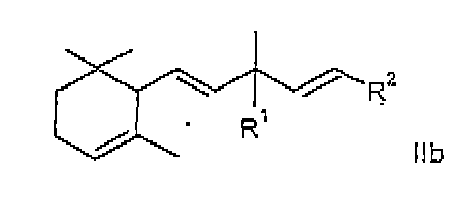
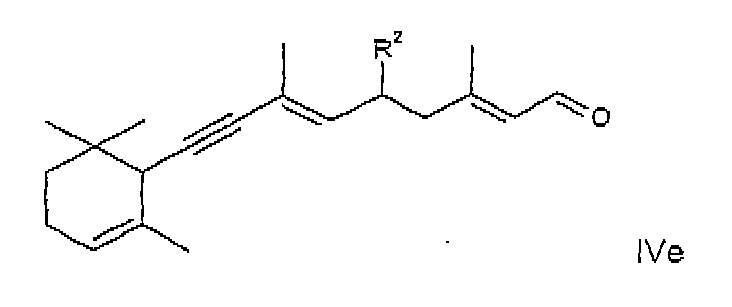
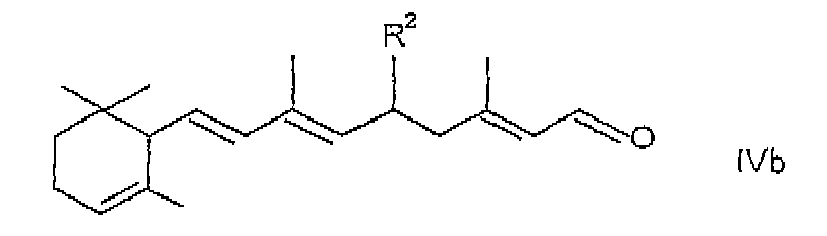
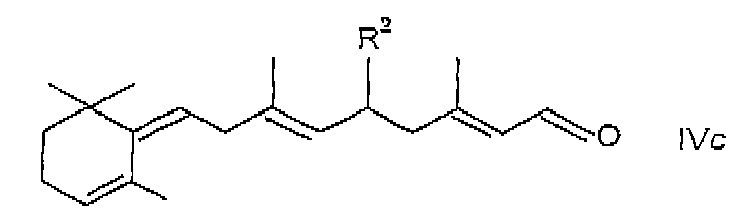
- a process for the manufacture of retinal of the formula which comprises reacting a 5-(2,6,6-trimethyl-cyclohex-1-enyl)-1,4-pentadiene derivative of the general formula or a 5-(2,6,6-trimethyl-cyclohex-2-enyl)-1,4-pentadiene derivative of the general formula or a 5-(2,6,6-trimethyl-2-cyclohexen-1-ylidene)-1-pentene derivative of the general formula or a 5-(2,6,6-trimethyl-cyclohex-1-enyl)-penta-1-en-4-yne derivative of the general formula or a 5-(2,6,6-trimethyl-cyclohex-2-enyl)-penta-1-en-4-yne derivative of the general formula wherein
- C 1-6 -alkyl embraces (from C 3 ) straight-chain or branched alkyl groups with up to six carbon atoms, such as methyl, ethyl, isopropyl, tert. butyl, neopentyl and n-hexyl. This applies equally to the C 1-6 -alkyl part of such groups as “C 1-6 -alkoxy” and "C 1-6 -alkylthio", and to all the bracketed C 1-6 -alkyl and C 1-6 -alkoxy groups. Where more than one C 1-6 -alkyl group is present in a group signified by R 2 ,'R 3 or R 4 , e.g.
- C 1-6 -alkyl groups may be the same or different.
- Aryl as such or as the aryl (or “ar) part of "aryloxy”, “arylthio”, “aroyloxy”, “arylsulphonyloxy”, “arylsulphonyl”, “N-aryl-(C 1-6 -alkyl)amino", diarylamino", "aroyl” or “diarylphosphonyl” means phenyl, 1-naphthyl or 2-naphthyl, or a conventionally substituted such group, e.g. p-tolyl.
- This first process step is conveniently carried out by reacting the 5-substituted pent(adi)en(yn)e derivative of the formula IIa, IIb, IIc, IId or IIe with the 1,3-butadiene derivative of the formula III in an organic solvent at temperatures in the range of about -70°C to about +60°C, preferably in the temperature range of about -30°C to room temperature, and in the presence of a Lewis or Brönsted acid as the catalyst.
- Suitable organic solvents are, in general, polar or non-polar aprotic solvents. Such solvents are, for example, lower halogenated aliphatic hydrocarbons, e.g.
- methylene chloride and chloroform lower aliphatic and cyclic ethers, e.g. diethyl ether, tert. butyl methyl ether and tetrahydrofuran; lower aliphatic nitriles, e.g. acetonitrile; lower aliphatic esters, e.g. ethyl acetate; lower aliphatic hydrocarbons, e.g. pentane and hexane; as well as aromatic hydrocarbons, e.g. toluene.
- the preferred solvent is acetonitrile, optionally in combination with further aforementioned solvents.
- the ratio by volume of acetonitrile to such other solvent is preferably about 1 : 1 to about 1 : 0.5.
- Lewis acids which can be used are zinc chloride, zinc chloride dietherate, zinc bromide, zinc di(trifluoromethanesulphonate), titanium tetrachloride, tin tetrachloride, boron trifluoride etherate, iron(III) chloride, trimethylsilyl triflate as well as lithium perchlorate, and examples of Brönsted acids which can be used are p-toluenesulphonic acid, methanesulphonic acid, trifluoromethanesulphonic acid, sulphuric acid as well as trifluoroacetic acid.
- the Lewis acids especially the aforementioned zinc salts, boron trifluoride etherate and iron(III) chloride
- the acid catalysts are in general used in catalytic (below stoichiomeric) amounts, conveniently in an amount which is 0.5 to 30 mol percent based on the amount of 5-substituted pent(adi)en(yn)e derivative used, the mol percent range preferably being from 1% to 15%.
- an acid preferably slightly dilute aqueous acetic acid, for example featuring a ratio by volume acetic acid: water of about 9:1, may be added to the reaction mixture and the mixture is subsequently stirred for a period, for example about 30 minutes to about 2 hours, conveniently in the temperature range of about -10°C to about 30°C.
- This incorporated acidification/hydrolysis step ensures that the desired intermediate of the formula IVa, IVb, IVc, IVd or IVe is finally produced from the reaction of the pent(adi)en(yn)e derivative of the formula IIa, IIb, IIc, IId or IIe with the 1,3-butadiene derivative of the formula III.
- the acidification/hydrolysis step is generally unnecessary, however, when the latter derivative features R 4 as tri(C 1-6 -alkyl)silyl. In any event the acidification/hydrolysis step is useful to remove excess butadiene derivative from the mixture after reaction and before the isolation of the product of the formula IVa, IVb, IVc, IVd or IVe.
- the product of the formula IVa, IVb, IVc, IVd or IVe can then be isolated from the reaction mixture and, if desired, purified in a manner known per se.
- the mixture is combined with water and the whole is extracted with a water-immiscible organic solvent, such as, for example, a lower alkane, dialkyl ether or aliphatic ester, e.g. hexane, tert. butyl methyl ether or, respectively, ethyl acetate, and the organic phase is washed with water and/or sodium bicarbonate solution and/or saturated aqueous sodium chloride solution, dried and concentrated.
- a water-immiscible organic solvent such as, for example, a lower alkane, dialkyl ether or aliphatic ester, e.g. hexane, tert. butyl methyl ether or, respectively, ethyl acetate
- the so-isolated and at least to some extent washed crude product can then, if desired, be purified further, for example by column chromatography, e.g. using silica as the stationary phase and an eluting agent such as hexane, ethyl acetate, toluene or a mixture of one or more of these.
- column chromatography e.g. using silica as the stationary phase and an eluting agent such as hexane, ethyl acetate, toluene or a mixture of one or more of these.
- 1,8-diazabicyclo[5.4.0]undec-7-ene is very often used as the base in an amount of about 1 to 2 equivalents per equivalent of aldehyde used.
- carotenoids see, inter alia, Bull. Chem. Soc. Japan 50 , 1161 et seq. (1977), ibid. 51 , 2077 et seq. (1978), Chem. Lett. 1975, 1201 et seq. and German Offenlegungsschrift 2,701,489] and of vitamin A [see, inter alia, Chem. Lett. 1975, 1201 et seq. and J. Gen. Chem.
- the elimination of the compound R 2 H can also be carried out with several equivalent amounts of a base for each equivalent of the compound of the formula IVa, IVb, IVc, IVd or IVe.
- the process step in this case is conveniently carried out by submitting the compound of the formula IVa, IVb, IVc, IVd or IVe, dissolved in a suitable organic solvent, to treatment with a base with elimination of the compound R 2 H.
- suitable organic solvents are, in general, protic or aprotic solvents or mixtures thereof, such as, for example, alcohols, e.g. ethanol and isopropanol, and alcohol mixtures; lower halogenated, preferably chlorinated, aliphatic hydrocarbons, e.g.
- the base can be inorganic or organic, and these are suitably, in general, strong bases, especially those alkali metal alcoholates which are stronger bases, e.g. sodium ethylate, and nitrogen-containing bases, such as 1,8-diazabicyclo[5.4.0]undec-7-ene, trialkylamines, e.g. triethylamine, and pyridine.
- bases especially those alkali metal alcoholates which are stronger bases, e.g. sodium ethylate, and nitrogen-containing bases, such as 1,8-diazabicyclo[5.4.0]undec-7-ene, trialkylamines, e.g. triethylamine, and pyridine.
- there is conveniently used at least one equivalent of base per equivalent of the compound of the formula IVa, IVb, IVc, IVd or IVe preferably about 1 to about 2 equivalents of base.
- a solution of the sodium alkoxide in the alkanol is prepared in advance or this solution is prepared freshly from metallic sodium and the alkanol.
- the bringing together of the alkanolic solution of the sodium alkoxide with the solution or suspension of the compound of the formula IVa, IVb, IVc, IVd or IVe in the (same) alkanol, preferably likewise prepared in advance, can be effected in either sequence.
- the reaction mixture is then stirred, suitably in the temperature range of about -20°C to about 120°C, preferably at temperatures of about 0°C to about 70°C.
- the reaction is conveniently effected at normal pressure or with a slight excess pressure (in order to achieve the desired temperature). In general, however, the pressure is not critical. Under these conditions the elimination reaction is normally completed within a few hours, especially after about 30 minutes to about 4 hours.
- suitable acids are, in general, strong mineral acids, such as, for example, hydrochloric acid, hydrobromic acid, hydriodic acid, sulphuric acid and perchloric acid, and sulphonic acids, such as, for example, methanesulphonic acid, trifluoromethanesulphonic acid and p-toluenesulphonic acid.
- the mineral acids can be aqueous and, depending on the acid, can have a concentration of about 10 to about 50%. Hydrochloric acid (especially about 10 to 37%), hydrobromic acid (especially about 25 to 63%) or hydriodic acid (e.g. 47%) is the most suitable.
- a catalytic amount i.e. up to a maximum of 1 equivalent per equivalent of the compound of the formula IVa, IVb, IVc, IVd or IVe, preferably about 0.1 to about 1 equivalent.
- the acid-induced elimination is effected in a solvent in which the compound of the formula IVa, IVb, IVc, IVd or IVe has a good solubility and is dissolved therein(a so-called "homogeneous cleavage") or in a solvent in which this is not the case, i.e. in which the compound of the formula IVa, IVb, IVc, IVd or IVe is instead in suspension ("heterogeneous cleavage").
- Suitable solvents for the homogenous cleavage are especially halogenated aliphatic hydrocarbons, e.g. methylene chloride, chloroform and 1,2-dichloroethane, and aromatic hydrocarbons, e.g. benzene and toluene.
- Suitable solvents (dispersion media) for the heterogeneous cleavage are lower aliphatic nitriles, ketones and carboxylic acids, e.g. acetonitrile, acetone and, respectively, acetic acid, preferably acetonitrile and acetone.
- the elimination is conveniently effected in the temperature range of about -20°C to about +50°C, preferably in the range of about 0°C to room temperature.
- the reaction time depends in each case on the reaction temperature and can amount to several hours, the elimination reaction normally being completed at the latest after about 5 hours.
- the product of the formula I, I', I", Va or Vb can be isolated from the reaction mixture in a manner known per se, normally by cooling the reaction mixture, conveniently to room temperature or even to about 0°C, optional addition of water and extraction with a water-immiscible organic solvent.
- a solvent there is suitably used a lower aliphatic hydrocarbon, e.g. pentane or hexane; an aromatic hydrocarbon, e.g. toluene; or a lower aliphatic ester, e.g. ethyl acetate.
- the product can be purified further, if necessary or desired, by column chromatography or another conventional method for purifying retinal or an isomer or derivative thereof.
- the product at this stage of the process i.e. after the elimination of the moiety R 2 H from the compound of the formula IVd or IVe, as appropriate, is the compound of the formula Va or Vb, respectively.
- the next stage is the hydrogenation to produce retinal or the compound of the formula I', respectively.
- Said hydrogenation can be effected under catalytic hydrogenation conditions known per se, e.g. those conditions used in the analogous procedures described in Houben-Weyl, Methoden der organischen Chemie, Vol.
- the catalyst is conveniently a "poisoned" one of the Lindlar type, preferably 5% palladium on calcium carbonate poisoned with 3.5% lead, and the temperature and pressure are suitably in the range from about 5°C to about 50°C and about 1 to about 5 bar (about 0.1 to about 0.5 MPa), respectively.
- the solvent there is suitably employed an organic solvent of relatively low polarity, e.g. an alkanol or an aliphatic ester, preferably ethyl acetate.
- the (poisoned) catalyst can be advantageously modified by addition of a nitrogen-containing compound, such as quinoline.
- the pertinent isolated and optionally purified product being retinal or the product of the formula I' or I", as appropriate, is normally present as an isomeric mixture, in particular as a mixture of four isomers in respect of the 9- and 13- double bonds, said isomeric mixture being designated conventionally as the (9 E/Z, 13 E/Z) isomer.
- the so-produced retinal predominantly in the (9 E/Z, 13 E/Z)-isomeric form, can then be isomerized to the generally desired isomeric form of retinal, (all-E)-retinal.
- the isomerization can be effected under conventional isomerizing conditions, and a particularly preferred method involves the acid-catalysed formation of an adduct of (principally) (all-E)-retinal with hydroquinone from the retinal produced as defined and described above, and initially in the essentially (9 E/Z, 13 E/Z)-isomeric form, and the hydroquinone in an organic solvent in which the adduct itself is sparingly soluble, thereby affording the desired (all-E)-retinal - hydroquinone adduct in crystalline form.
- This adduct formation represents a further aspect of the present invention.
- the acid catalyst there is suitably used hydrochloric acid (especially about 37%), hydrobromic acid (48%) or hydriodic acid (47%), p-toluenesulphonic acid or elemental iodine.
- the molar ratio of retinal starting material: hydroquinone is suitably about 1 : 0.5, and the two components are conventionally brought together in an organic solvent in which the adduct itself is sparingly soluble, such as a lower aliphatic hydrocarbon, e.g. pentane or hexane; or a lower aliphatic ether, e.g. diethyl ether.
- the preferred solvent is diethyl ether or a mixture of said ether and hexane.
- the crystallization of the (all-E)-retinal - hydroquinone adduct generally occurs after a relatively short time, e.g. about one hour.
- the crystalline adduct can then be readily removed from the liquid medium by filtration and if desired washed, e.g. with a solvent usable for the formation and as mentioned above, and dried, preferably at room temperature under reduced pressure.
- Such conventional methodology for the formation and isolation of the (all-E)-retinal - hydroquinone is described for example in USP 3,013,081 and French Patent Publications 1,288,975 and 1,291,622.
- the solvent used for the acid-induced R 2 H elimination reaction if not one in which the adduct would readily dissolve, such as a halogenated aliphatic hydrocarbon, must be replaced, on completion of the elimination reaction, by one in which the adduct is insoluble or sparingly soluble.
- a replacement solvent is suitably a lower aliphatic hydrocarbon, e.g. pentane or hexane, or a lower aliphatic ether, e.g. diethyl ether, i.e. a solvent indicated above as being suitable for the "separate" adduct formation.
- the solvent replacement is suitably effected by evaporating off the "unsuitable” one under reduced pressure and adding the suitable one. Thereafter the hydroquinone is added and the procedure for crystallization and isolation of the resulting crystalline (all-E)-retinal - hydroquinone adduct effected as described above for the "separate” adduct formation.
- the so-obtained (all-E)-retinal- hydroquinone adduct can be converted to the further useful end product vitamin A alcohol (retinol) in the predominantly (all-E)-isomeric form by methods known per se, for example by direct catalytic reduction with hydrogen using a ruthenium catalyst, as described in J. Molec. Catalysis 79 , 117-131(1993), ibid. 66 , L 27-L 31 (1991) and USP 4,906,795.
- This reduction can also be effected with sodium borohydride, as described in Chem. Lett. 1975,1201 et seq., which also indicates how retinol can be converted to vitamin A acetate by acetylation with acetic anhydride in pyridine.
- an ethereal solvent e.g. a lower aliphatic ether, e.g. diethyl ether or dimethoxyethane, or a cyclic ether, e.g. tetrahydrofuran
- low reaction temperatures e.g. about -100°C to about 0°C, particularly about -70°C to about -40°C (see Organometallics in Synthesis, A Manual, Ed. M. Schlosser, p. 126, 1994 John Wiley & Sons Ltd.).
- a lower aliphatic ether e.g. diethyl ether or dimethoxyethane
- a cyclic ether e.g. tetrahydrofuran.
- the reaction is preferably effected at temperature of about -70°C to about -40°C.
- sec. butyllithium about equimolar amounts of the two reactants
- tert. butyllithium in about double the molar amount relative to the amount of ethylene derivative employed
- the ultimately produced 5-substituted pent(adi)ene derivative is conveniently isolated from the mixture after completed reaction by addition of water thereto and extraction with a water-immiscible organic solvent, particularly an aprotic such solvent, such as a lower aliphatic hydrocarbon, e.g. hexane; an aromatic hydrocarbon, e.g. toluene; a lower halogenated aliphatic hydrocarbon, e.g. methylene chloride or chloroform; a lower aliphatic or cyclic ether, e.g. diethyl ether, tetrahydrofuran or dioxan; or a halogenated aromatic hydrocarbon, e.g. chlorobenzene.
- aprotic such solvent such as a lower aliphatic hydrocarbon, e.g. hexane; an aromatic hydrocarbon, e.g. toluene; a lower halogenated aliphatic hydrocarbon, e.g.
- the appropriate desired 5-substituted 1-alkoxy-3-methyl-3-hydroxy-pent(adi)ene of the formula IIa, IIb or IIc is generally obtainable in good purity and in practically quantitative yield. It does not normally have to be purified further before use in the process of the present invention involving reaction with the 1,3-butadiene derivative of the formula III.
- precursors of the formulae VIa, VIb and VIc as also the precursors of the formulae Xa, Xb and Xc, are known compounds.
- Literature references concerning these precursors include, for example, in respect of precursor VIa: German Patent Publication (DE) 2,731,284; precursor VIb: Can. J. Chem. 46 , 3041 et seq. (1968); and precursors VIc and Xc: PCT Patent Publication WO 00/002854 A1 and Bull. Soc. Chim. Fr. 132 , 696 et seq. (1995).
- the precursors of the formulae Xa and Xb are commercially available.
- the remaining precursors of the formulae VIa', VIb' and VIc' can be produced from the respective precursors of the formulae VIa, VIb and VIc by the following methods, according to the nature of the group R 3 :
- the precursors of the formulae VIIa, VIIb and VIIc can be produced from ⁇ -ionone, ⁇ -ionone and retro-ionone (compounds of the formulae Xa, Xb and Xc respectively, given above) by a haloform degradation reaction, in particular with bromine in aqueous sodium hydroxide according to the method described on pages 325-326 in Carotenoids Volume 2: Synthesis, Ed. G. Britton, S. Liaaen-Jensen and H.
- the alternative novel starting materials for the process of the present invention i.e. the 5-substituted penta-1-en-4-yne derivatives of the formulae IId and IIe, can be produced from the known 1-ethynyl-2,6,6-trimethyl-cyclohex-1-ene or -2-ene, respectively, of the formula [(see USP 2,775,626 and Tetrahedron 55 , 15071-15098 (1999), and Swiss Patent Specification 651,287, respectively, for the production of each 1-ethynyl-2,6,6-trimethyl-cyclohexene itself] by condensation reaction under deprotonating strongly basic and anhydrous conditions with a ketone of the formula IX, given above, in an inert organic solvent.
- a base which is customary for the deprotonation of acetylenes especially a lithium-, sodium- or magnesium-containing base.
- bases are lithium-organic compounds such as methyllithium, butyllithium or phenyllithium, Grignard reagents such as alkylmagnesium halides and dialkylmagnesium, amides such as lithium amide and sodium amide, and hydrides such as lithium hydride and sodium hydride, the preferred base being an alkyllithium or an alkylmagnesium chloride.
- the solvent there is suitably used an aliphatic or cyclic ether, e.g.
- the preferred solvent for the reaction is tetrahydrofuran.
- the ketone of formula IX is preferably used in an equivalent amount or slight excess, e.g. 1.1 to 1.3 equivalents per equivalent of the 1-ethynyl-2,6,6-trimethyl-cyclohexene of the formula XIIa or XIIb. However, a larger excess is not necessarily detrimental to the outcome of the condensation reaction.
- an inorganic lithium or cerium salt which is known to slightly increase the yield of the reaction.
- examples of such salts are lithium halides, cerium halides and lithium tetrafluoroborate, cerium trichloride and lithium bromide being the preferred salts.
- the amount of lithium or cerium salt is not critical and can amount to, for example, about 0.5 to about 2.0 equivalents per equivalent of the amount of the compound of the formula XIIa or XIIb.
- the condensation is suitably effected at temperatures from about -80°C to about 10°C, preferably from about -70°C to about -50°C.
- the condensation reaction affords those 5-substituted penta-1-en-4-yne derivatives of the formulae IId and IIe wherein R 1 signifies hydroxyl.
- the remaining 5-substituted penta-1-en-4-yne derivatives of the formulae IId and IIe i.e.
- R 1 signifies a group OR 3
- R 1 signifies a group OR 3
- R 1 can be produced from the former derivatives by analogous methods for producing the precursors of the formulae VIa', VIb' and VIc' from the respective precursors of the formulae VIa, VIb and VIc, as indicated hereinabove by mention of pertinent references for the hydroxyl -> OR 3 group transformation.
- This condensation reaction affords, as indicated above, the starting 5-substituted penta-1-en-4-yne derivative of the formula IId or IIe for direct use in the process of the present invention, i.e. for reacting with the 1,3-butadiene derivative of the formula III.
- the derivative can be converted to the other employable starting material, viz. the 5-substituted 1,4-pentadiene derivative of the formula IIa or IIb, respectively, by selective reduction with a complex metal hydride, preferably a hydrido-aluminate, most preferably sodium bis(2-methoxyethoxy)aluminium hydride, under conditions described in the literature, e.g.
- the reduction is preferably carried out at temperatures from about -50 °C to about 30 °C, more preferably at temperatures from about -10 °C to about 0°C, and at atmospheric pressure.
- the reducing agent can be used in an about equivalent amount, or preferably in excess amount, relative to the amount of starting 5-substituted penta-1-en-4-yne derivative of the formula IId or IIe.
- An amount which is at least about 1.1 equivalents, for example 1.2 to 1.4 equivalents, per equivalent of said derivative is preferred. However, a larger excess is not necessarily detrimental to the outcome of the selective reduction.
- the hydrolysis of the aluminium-complex, formed as the intermediate in the above-described selective reduction, to the desired 5-substituted 1,4-pentadiene derivative of the formula IIa or IIb can be effected in a manner known per se, for example, by treatment with water in the presence of an organic or inorganic acid such as p-toluenesulphonic acid, or more preferably in the presence of an alkali, such as in sodium hydroxide solution.
- the temperature and pressure are not critical. However, in general, the hydrolysis is carried out at atmospheric pressure and room temperature or a lower temperature, preferably at temperatures from about 0 °C to room temperature.
- the 1,3-butadiene derivatives of the formula III used as starting materials in the first step of the process of the present invention are either known compounds or can be produced analogously to the known compounds, for example according to the methods described in Bull. Soc. Chim. Fr. 130 (2), 200-205 (1993), Tetr. Lett. 22 (29), 2833-2836 (1989) and ibid. 26 (47), 8591-8594 (1995).
- the cooling means was removed and 200 ml of ice/water were added to the flask contents within about 10 minutes. After the mixture had reached a temperature of 0°C it was poured into 250 ml of hexane, and the whole was washed successively with three 200 ml quantities of water and two 200 ml quantities of saturated sodium chloride solution. Then the combined aqueous phases were extracted with 250 ml of hexane. The combined hexane phases were dried over anhydrous sodium sulphate and after removal of the drying agent by filtration concentrated at 35°C under a reduced pressure of 100-200 mbar (10-20 kPa), followed by a concentration at room temperature under high vacuum to remove the final traces of solvent.
- the solution was treated with 13 ml of 28% aqueous sodium hydroxide solution at 0-5 °C for 10 minutes.
- the resulting emulsion was diluted with 110 ml of water and extracted twice with 50 ml of hexane.
- the combined organic phases were extracted with five 50 ml quantities of water and 50 ml of brine, and dried over magnesium sulphate.
Landscapes
- Chemical & Material Sciences (AREA)
- Organic Chemistry (AREA)
- Organic Low-Molecular-Weight Compounds And Preparation Thereof (AREA)
- Acyclic And Carbocyclic Compounds In Medicinal Compositions (AREA)
Claims (12)
- Verfahren zur Herstellung von Retinal der Formel




 R1 für Hydroxyl oder eine Gruppe OR3 steht,R2 für Chlor, Brom, C1-6-Alkoxy, C1-6-Alkylthio, Aryloxy, Arylthio, (C1-6-Alkyl)carbonyloxy, Aroyloxy, Tri(C1-6-alkyl)silyloxy, Di(C1-6-alkyl) phosphonyloxy, (C1-6-Alkyl)sulfonyloxy, Arylsulfonyloxy, (C1-6-Alkyl)sulfonyl, Arylsulfonyl, Di(C1-6-alkyl)amino, N-Aryl-(C1-6-alkyl)amino oder Diarylamino steht undR3 für C1-6-Alkyl, (C1-6-Alkyl)carbonyl, Aroyl, (C1-6-Alkoxy)carbonyl, Tri(C1-6-alkyl)silyl, Di-(C1-6-alkyl)phosphonyl, Diarylphosphonyl (C1-6-Alkyl)sulfonyl oder Arylsulfonyl steht,in Gegenwart einer Lewis- oder Brönsted-Säure mit einem 1,3-Butadien-Derivat der allgemeinen Formel


zur Eliminierung der Einheit R2H basischen oder sauren Bedingungen unterwirft und so aus der Verbindung der Formel IVa Retinal der Formel I bzw. aus der Verbindung der Formel IVb die Verbindung der Formel


- Verfahren zur Herstellung von Retinal der Formel


 R1 für Hydroxyl oder eine Gruppe OR3 steht,R2 für Chlor, Brom, C1-6-Alkoxy, C1-6-Alkylthio, Aryloxy, Arylthio, (C1-6-Alkyl)carbonyloxy, Aroyloxy, Tri(C1-6-alkyl)silyloxy, Di(C1-6-alkyl)phosphonyloxy, (C1-6-Alkyl) sulfonyloxy, Arylsulfonyloxy, (C1-6-Alkyl)sulfonyl, Arylsulfonyl, Di (C1-6-alkyl) amino, N-Aryl- (C1-6-alkyl)amino oder Diarylamino steht undR3 für Wasserstoff, C1-6-Alkyl, (C1-6-Alkyl) carbonyl, Aroyl, (C1-6-Alkoxy)carbonyl, Tri (C1-6-alkyl) silyl, Di (C1-6-alkyl) phosphonyl, Diarylphosphonyl, (C1-6-Alkyl)sulfonyl oder Arylsulfonyl steht,in Gegenwart einer Lewis- oder Brönsted-Säure mit einem 1,3-Butadien-Derivat der allgemeinen Formel

zur Eliminierung der Einheit R2H basischen oder sauren Bedingungen unterwirft und so Retinal der Formel I bzw. aus der Verbindung der Formel IVb die Verbindung der Formel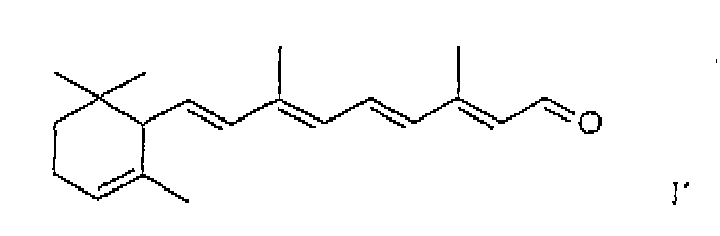

- Verfahren nach Anspruch 1 oder 2, bei dem man als Lewis-Säure Zinkchlorid, Zinkchloriddietherat, Zinkbromid, Zinkdi (trifluormethansulfonat), Titantetrachlorid, Zinntetrachlorid, Bortrifluoridetherat, Eisen (III)-chlorid, Trimethylsilyltriflat oder Lithiumperchlorat und als Brönsted-Säure p-Toluolsulfonsäure, Methansulfonsäure, Trifluormethansulfonsäure, Schwefelsäure oder Trifluoressigsäure verwendet.
- Verfahren nach Anspruch 3, bei dem man eine Lewis-Säure verwendet, bei der es sich um eines der genannten Zinksalze, Bortrifluoridetherat oder Eisen(111)-chlorid handelt.
- Verfahren nach einem der Ansprüche 1 bis 4, bei dem man die Lewis- oder Brönsted-Säure in einer katalytisch wirksamen Menge von 0,5 bis 30 Molprozent und vorzugsweise 1 bis 15 Molprozent, bezogen auf die Einsatzmenge des 5-substituierten Pant(adi)en(in)-Derivats der Formel IIa, IIb, IIc, IId bzw. IIe, verwendet.
- Verfahren nach einem der Ansprüche 1 bis 5, bei dem man 1,1 bis 2,5 Äquivalente und vorzugsweise 1,1 bis 1,8 Äquivalente 1,3-Butadien-Derivat der Formel III pro Äquivalent 5-substituiertes Pent(adi)en(in)-Derivat der Formel IIa, IIb, IIc, IId bzw. IIe verwendet.
- Verfahren nach einem der Ansprüche 1 bis 6, bei dem man die Umsetzung des 5-substituierten Pent(adi)en(in)-Derivats der Formel IIa, IIb, IIc, IId bzw. IIe mit dem 1,3-Butadien-Derivat der Formel III in einem organischen Lösungsmittel bei Temperaturen im Bereich von etwa -70°C bis etwa +60°c und vorzugsweise im Temperaturbereich von etwa -30°C bis Raumtemperatur durchführt, wobei man als organisches Lösungsmittel einen niederen halogenierten aliphatischen Kohlenwasserstoff, z.B. Methylenchlorid oder Chloroform; einen niederen aliphatischen oder cyclischen Ether, z.B. Diethylether, tert.-Butylmethylether oder Tetrahydrofuran; ein niederes aliphatisches Nitril, z.B. Acetonitril; einen niederen aliphatischen Ester, z.B. Essigsäureethylester; einen niederen aliphatischen Kohlenwasserstoff, z.B. Pentan oder Hexan; oder einen aromatischen Kohlenwasserstoff, z.B. Toluol, verwendet.
- verfahren nach einem der Ansprüche 1 bis 7, bei dem man bei der Eliminierung der Verbindung R2H aus der Verbindung der Formel IVa, IVb, IVc, IVd bzw. Ive als Base ein Alkalimetallalkoholat, z.B. Natriumethylat, oder eine stickstoffhaltige Base, wie 1,8-Diazabicyclo[5.4.0]undec-7-en, ein Trialkylamin, z.B. Trimethylamin, oder Pyridin, oder als Säure eine starke Mineralsäure, z.B. Salzsäure, Bromwasserstoffsäure, Iodwasserstoffsäure, Schwefelsäure oder Perchlorsäure, oder eine Sulfonsäure, z.B. Methansulfonsäure, Trifluormethansulfonsäure oder p-Toluolsulfonsäure, verwendet.
- Verfahren nach einem der Ansprüche 1 bis 8, bei dem man das so hergestellte Retinal als Isomerengemisch, normalerweise (9E/z, 13E/z)-Retinal, durch die säurekatalysierte Bildung eines Addukts von (all-E)-Retinal mit Hydrochinon zu (all-E)-Retinal isomerisiert, wobei man die Bildung unter Säurekatalyse und in einem organischen Lösungsmittel, in dem das Addukt selbst schlecht löslich ist, durchführt, wobei das gewünschte (all-E)-Retinal-Hydrochinon-Addukt in kristalliner Form anfällt.
- Verfahren nach Anspruch 9, bei dem man in dem Fall, daß die R2H-Elimininierung (zweiter Verfahrensschritt) aus der Verbindung der Formel IVa, IVb bzw. IVc mit Säure induziert wird und die säurekatalysierte Bildung des Retinal-Hydrochinon-Addukts vorgesehen ist, den zweiten Verfahrensschritt und die Bildung des Retinal-Hydrochinon-Addukts kombiniert, wodurch eine intermediäre Isolierung und fakultative Reinigung des Retinals vor der Adduktbildung vermieden wird, wobei man das für die säureinduzierte R2H-Eliminierungsreaktion verwendete Lösungsmittel, sofern es sich nicht um eines handelt, in dem das Addukt sich leicht lösen würde, nach Abschluß der Eliminierungsreaktion durch ein Lösungsmittel ersetzt, in dem das Addukt unlöslich oder schlecht löslich ist, dann das Hydrochinon zugibt und das Verfahren zur Bildung und Kristallisation des (all-E)-Retinal-Hydrochinon-Addukts durchführt.
- Verfahren nach Anspruch 9 oder 10, bei dem man das so erhaltene (all-E)-Retinal-Hydrochinon-Addukt nach einer an sich bekannten Methode in überwiegend in Form des (all-E)-Isomers vorliegenden Vitamin-A-alkohol umwandelt.
- 5-Substituiertes Pent (adi) en (in)-Derivat der allgemeinen Formel

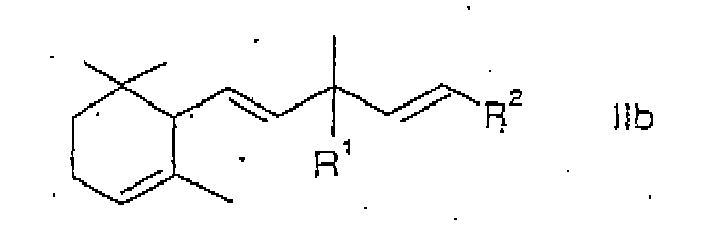


 R1 für Hydroxyl oder eine Gruppe OR3 steht,R2 für Chlor, Brom, C1-6-Alkoxy, C1-6-Alkylthio, Aryloxy, Arylthio, (C1-6-Alkyl)carbonyloxy, Aroyloxy, Tri(C1-6-alkyl)silyloxy, Di(C1-6-alkyl)phosphonyloxy, (C1-6-Alkyl)sulfonyloxy, Arylsulfonyloxy, (C1-6-Alkyl)sulfonyl, Arylsulfonyl, Di(C1-6-alkyl) amino, N-Aryl- (C1-6-alkyl) amino oder Diarylamino steht undR3 für C1-6-Alkyl, (C1-6-Alkyl) carbonyl, Aroyl, (C1-6-Alkoxy)carbonyl, Tri(C1-6-alkyl)silyl, Di-(C1-6-alkyl)phosphonyl, Diarylphosphonyl, (C1-6-Alkyl)sulfonyl oder Arylsulfonyl steht,mit der Maßgabe, daß im Fall der Pentadien-Derivate der Formel IIa R2 nicht für Arylsulfonyl stehen kann, wenn R1 für Hydroxyl steht.
Priority Applications (1)
| Application Number | Priority Date | Filing Date | Title |
|---|---|---|---|
| EP02779506A EP1442014B1 (de) | 2001-10-31 | 2002-10-24 | Herstellung von retinoiden |
Applications Claiming Priority (4)
| Application Number | Priority Date | Filing Date | Title |
|---|---|---|---|
| EP01125965 | 2001-10-31 | ||
| EP01125965 | 2001-10-31 | ||
| EP02779506A EP1442014B1 (de) | 2001-10-31 | 2002-10-24 | Herstellung von retinoiden |
| PCT/EP2002/011878 WO2003037856A1 (en) | 2001-10-31 | 2002-10-24 | Manufacture of retinoids |
Publications (2)
| Publication Number | Publication Date |
|---|---|
| EP1442014A1 EP1442014A1 (de) | 2004-08-04 |
| EP1442014B1 true EP1442014B1 (de) | 2007-03-21 |
Family
ID=8179126
Family Applications (1)
| Application Number | Title | Priority Date | Filing Date |
|---|---|---|---|
| EP02779506A Expired - Lifetime EP1442014B1 (de) | 2001-10-31 | 2002-10-24 | Herstellung von retinoiden |
Country Status (9)
| Country | Link |
|---|---|
| US (1) | US7067703B2 (de) |
| EP (1) | EP1442014B1 (de) |
| KR (1) | KR100939397B1 (de) |
| CN (1) | CN1261411C (de) |
| AT (1) | ATE357431T1 (de) |
| DE (1) | DE60219053T2 (de) |
| ES (1) | ES2282480T3 (de) |
| RU (1) | RU2318805C2 (de) |
| WO (1) | WO2003037856A1 (de) |
Families Citing this family (11)
| Publication number | Priority date | Publication date | Assignee | Title |
|---|---|---|---|---|
| ES2200699B1 (es) | 2002-07-12 | 2005-10-01 | Ragactives, S.L | Procedimiento para la separacion de r(-) y s(+)-5-(2-((2-(etoxifenoxi)etil)amino)propil-2-metoxibenceno-sulfonamida. |
| FR2894577B1 (fr) * | 2005-12-14 | 2008-02-22 | Fabre Pierre Dermo Cosmetique | Nouveaux composes polyinsatures, leur procede de preparation et les compositions les contenant. |
| RU2417983C1 (ru) * | 2009-10-30 | 2011-05-10 | Российская Федерация, От Имени Которой Выступает Министерство Образования И Науки Российской Федерации | Способ получения 11-цис-изомера ретиналя |
| WO2020127160A1 (en) * | 2018-12-20 | 2020-06-25 | Dsm Ip Assets B.V. | SPECIFIC α,β-UNSATURATED CARBOXYLATES |
| EP3898584A1 (de) * | 2018-12-20 | 2021-10-27 | DSM IP Assets B.V. | Verbessertes verfahren zur herstellung von spezifischen alpha,beta-ungesättigten carboxylaten |
| JP7456079B2 (ja) | 2019-04-15 | 2024-03-27 | ディーエスエム アイピー アセッツ ビー.ブイ. | レチナールを製造する新規な方法 |
| JP2023506144A (ja) * | 2019-12-23 | 2023-02-15 | ディーエスエム アイピー アセッツ ビー.ブイ. | 脱水素化方法 |
| WO2021197890A1 (en) * | 2020-03-31 | 2021-10-07 | Dsm Ip Assets B.V. | Process for production of vitamin a |
| JP2023520137A (ja) * | 2020-03-31 | 2023-05-16 | ディーエスエム アイピー アセッツ ビー.ブイ. | テルペノイド中間体の生成方法 |
| CN115698028B (zh) * | 2020-06-19 | 2025-02-18 | 帝斯曼知识产权资产管理有限公司 | 用于生产特定α,β-不饱和羧酸酯的改进方法 |
| CN114907246B (zh) * | 2021-02-08 | 2024-02-06 | 复旦大学 | 一种维生素a及其衍生物与其氘代化合物的全合成方法 |
Family Cites Families (12)
| Publication number | Priority date | Publication date | Assignee | Title |
|---|---|---|---|---|
| CA677178A (en) * | 1963-12-31 | Eiter Karl | Process for the production of 6-(2',6',6'-trimethylcyclohexenyl-1')-4-methyl-hexa-3,5-diene-1-yne | |
| SU93422A1 (ru) * | 1951-07-05 | 1951-11-30 | Г.С. Гусакова | Способ получени соединени 5-метил-7(1', 2', 3'-триметилциклогексен-2'-ил-2') гептатриен (2, 4, 6) карбоновой кислоты |
| US2834813A (en) * | 1953-04-21 | 1958-05-13 | Ortho Pharma Corp | Synthesis of vitamin a |
| US2945876A (en) * | 1957-09-04 | 1960-07-19 | Nopco Chem Co | Vitamin a intermediates and process for obtaining same |
| US3013081A (en) | 1958-04-03 | 1961-12-12 | Celanese Corp | Purification of ketones |
| FR1291622A (fr) * | 1961-03-14 | 1962-04-27 | Aec Chim Organ Biolog | Procédé de conversion d'un mélange de rétinènes isomères en aldéhyde de la vitamine a trans, trans-2, 6 |
| GB1381437A (en) * | 1972-04-24 | 1975-01-22 | Scm Corp | Process for preparing vitamin |
| FR2622580B1 (fr) * | 1987-10-29 | 1990-01-19 | Centre Nat Rech Scient | Procede de preparation du retinal |
| FR2710911B1 (fr) | 1993-10-07 | 1995-12-01 | Rhone Poulenc Nutrition Animal | Nouveaux intermédiaires de préparation de la vitamine A et des caroténoïdes et leur procédé de préparation. |
| US5929288A (en) * | 1996-06-28 | 1999-07-27 | Roche Vitamins Inc. | Process for manufacturing polyene aldehydes |
| FR2780970B1 (fr) | 1998-07-10 | 2000-08-18 | Rhone Poulenc Nutrition Animal | Procede de preparation de la vitamine a |
| DE59912915D1 (de) | 1998-08-05 | 2006-01-19 | Dsm Ip Assets Bv | Herstellung von 4,4'-Diketo-carotinoiden |
-
2002
- 2002-10-24 ES ES02779506T patent/ES2282480T3/es not_active Expired - Lifetime
- 2002-10-24 WO PCT/EP2002/011878 patent/WO2003037856A1/en not_active Ceased
- 2002-10-24 EP EP02779506A patent/EP1442014B1/de not_active Expired - Lifetime
- 2002-10-24 RU RU2004116696/04A patent/RU2318805C2/ru not_active IP Right Cessation
- 2002-10-24 AT AT02779506T patent/ATE357431T1/de not_active IP Right Cessation
- 2002-10-24 US US10/494,079 patent/US7067703B2/en not_active Expired - Fee Related
- 2002-10-24 KR KR1020047006343A patent/KR100939397B1/ko not_active Expired - Fee Related
- 2002-10-24 CN CNB028218841A patent/CN1261411C/zh not_active Expired - Fee Related
- 2002-10-24 DE DE60219053T patent/DE60219053T2/de not_active Expired - Lifetime
Also Published As
| Publication number | Publication date |
|---|---|
| DE60219053D1 (de) | 2007-05-03 |
| RU2004116696A (ru) | 2005-05-27 |
| RU2318805C2 (ru) | 2008-03-10 |
| ATE357431T1 (de) | 2007-04-15 |
| CN1261411C (zh) | 2006-06-28 |
| CN1582273A (zh) | 2005-02-16 |
| WO2003037856A1 (en) | 2003-05-08 |
| KR20050039711A (ko) | 2005-04-29 |
| ES2282480T3 (es) | 2007-10-16 |
| US20050014976A1 (en) | 2005-01-20 |
| KR100939397B1 (ko) | 2010-01-28 |
| EP1442014A1 (de) | 2004-08-04 |
| DE60219053T2 (de) | 2007-12-13 |
| US7067703B2 (en) | 2006-06-27 |
Similar Documents
| Publication | Publication Date | Title |
|---|---|---|
| US4105855A (en) | Manufacture of symmetrical carotenoids | |
| FAULKNER | Stereoselective synthesis of trisubstituted olefins | |
| US4952716A (en) | Ethynylcyclohexene compounds | |
| CA2127047C (en) | Preparation of astaxanthin, novel intermediates therefor and the preparation thereof | |
| EP1442014B1 (de) | Herstellung von retinoiden | |
| DK175169B1 (da) | Carotenoid-mellemprodukter, fremgangsmåde til fremstilling deraf samt brug af mellemprodukterne i fremstillingen af carotenoider | |
| Cella | Reductive alkylation/arylation of arylcarbinols and ketones with organosilicon compounds | |
| US6727381B2 (en) | Process for producing vitamin A ester | |
| EP0187259A2 (de) | Verfahren zur Herstellung von Vitamin A oder seinen Carbonsäureestern und Zwischenprodukte und ihre Verwendung in diesem Verfahren | |
| US5227507A (en) | Ethynylcyclohexene compounds and processes for manufacture thereof | |
| US6201155B1 (en) | Process for making 4,4′-diketo-carotenoids | |
| EP3505506B1 (de) | Verfahren zur herstellung von 3,7-dimethyl-7-octenol und verfahren zur herstellung einer 3,7-dimethyl-7-octenylcarboxylatverbindung | |
| EP4324819A2 (de) | Zwischenprodukte für die vitamin-a-synthese | |
| US6423873B1 (en) | Process for preparing phosphonium salts | |
| CN103619813B (zh) | 用于维生素A或β-胡萝卜素合成的新的中间体 | |
| Grovenstein Jr et al. | Carbanions. XII. p-Biphenylyl migration in reactions of 1-chloro-2-p-biphenylylethane-1, 1-d2 with alkali metals | |
| CA2272439C (en) | A process for the preparation of 13-cis-retinoic acid | |
| EP2248794A1 (de) | Verfahren zur herstellung von dialkohol, verfahren zur herstellung einer allylhalid-verbindung und allylchloridverbindung | |
| Azim et al. | Synthesis of all‐trans‐beta‐carotene retinoids and derivatives labelled with 14C | |
| US5563297A (en) | Intermediates for the preparation of vitamin A and carotenoids and process for their preparation | |
| EP4588911A1 (de) | Verfahren zur herstellung von alpha-farnesen und 4-substituierten 3-methyl-1,3-butadien-verbindungen mit verwandter struktur und synthetische zwischenverbindung daraus | |
| KR20050054857A (ko) | 모노할로게노비닐 화합물로부터 비타민 d 유도체를획득하는 방법 | |
| EP4588912A1 (de) | Verfahren zur herstellung von beta-farnesen und 2-(3-alkenyl)-1,3-butadien-verbindung mit verwandter struktur und synthetisches zwischenprodukt davon | |
| CN111484510A (zh) | 一种(2,6,6-三甲基-1-环己烯基)乙醛的制备方法 | |
| JPH043388B2 (de) |
Legal Events
| Date | Code | Title | Description |
|---|---|---|---|
| PUAI | Public reference made under article 153(3) epc to a published international application that has entered the european phase |
Free format text: ORIGINAL CODE: 0009012 |
|
| 17P | Request for examination filed |
Effective date: 20040601 |
|
| AK | Designated contracting states |
Kind code of ref document: A1 Designated state(s): AT BE BG CH CY CZ DE DK EE ES FI FR GB GR IE IT LI LU MC NL PT SE SK TR |
|
| AX | Request for extension of the european patent |
Extension state: AL LT LV MK RO SI |
|
| GRAP | Despatch of communication of intention to grant a patent |
Free format text: ORIGINAL CODE: EPIDOSNIGR1 |
|
| GRAS | Grant fee paid |
Free format text: ORIGINAL CODE: EPIDOSNIGR3 |
|
| GRAA | (expected) grant |
Free format text: ORIGINAL CODE: 0009210 |
|
| AK | Designated contracting states |
Kind code of ref document: B1 Designated state(s): AT BE BG CH CY CZ DE DK EE ES FI FR GB GR IE IT LI LU MC NL PT SE SK TR |
|
| PG25 | Lapsed in a contracting state [announced via postgrant information from national office to epo] |
Ref country code: FI Free format text: LAPSE BECAUSE OF FAILURE TO SUBMIT A TRANSLATION OF THE DESCRIPTION OR TO PAY THE FEE WITHIN THE PRESCRIBED TIME-LIMIT Effective date: 20070321 Ref country code: NL Free format text: LAPSE BECAUSE OF FAILURE TO SUBMIT A TRANSLATION OF THE DESCRIPTION OR TO PAY THE FEE WITHIN THE PRESCRIBED TIME-LIMIT Effective date: 20070321 Ref country code: AT Free format text: LAPSE BECAUSE OF FAILURE TO SUBMIT A TRANSLATION OF THE DESCRIPTION OR TO PAY THE FEE WITHIN THE PRESCRIBED TIME-LIMIT Effective date: 20070321 Ref country code: BE Free format text: LAPSE BECAUSE OF FAILURE TO SUBMIT A TRANSLATION OF THE DESCRIPTION OR TO PAY THE FEE WITHIN THE PRESCRIBED TIME-LIMIT Effective date: 20070321 |
|
| REG | Reference to a national code |
Ref country code: GB Ref legal event code: FG4D |
|
| REG | Reference to a national code |
Ref country code: CH Ref legal event code: EP |
|
| REF | Corresponds to: |
Ref document number: 60219053 Country of ref document: DE Date of ref document: 20070503 Kind code of ref document: P |
|
| REG | Reference to a national code |
Ref country code: IE Ref legal event code: FG4D |
|
| PG25 | Lapsed in a contracting state [announced via postgrant information from national office to epo] |
Ref country code: SE Free format text: LAPSE BECAUSE OF FAILURE TO SUBMIT A TRANSLATION OF THE DESCRIPTION OR TO PAY THE FEE WITHIN THE PRESCRIBED TIME-LIMIT Effective date: 20070621 |
|
| ET | Fr: translation filed | ||
| PG25 | Lapsed in a contracting state [announced via postgrant information from national office to epo] |
Ref country code: PT Free format text: LAPSE BECAUSE OF FAILURE TO SUBMIT A TRANSLATION OF THE DESCRIPTION OR TO PAY THE FEE WITHIN THE PRESCRIBED TIME-LIMIT Effective date: 20070821 |
|
| NLV1 | Nl: lapsed or annulled due to failure to fulfill the requirements of art. 29p and 29m of the patents act | ||
| REG | Reference to a national code |
Ref country code: ES Ref legal event code: FG2A Ref document number: 2282480 Country of ref document: ES Kind code of ref document: T3 |
|
| PG25 | Lapsed in a contracting state [announced via postgrant information from national office to epo] |
Ref country code: SK Free format text: LAPSE BECAUSE OF FAILURE TO SUBMIT A TRANSLATION OF THE DESCRIPTION OR TO PAY THE FEE WITHIN THE PRESCRIBED TIME-LIMIT Effective date: 20070321 |
|
| PG25 | Lapsed in a contracting state [announced via postgrant information from national office to epo] |
Ref country code: CZ Free format text: LAPSE BECAUSE OF FAILURE TO SUBMIT A TRANSLATION OF THE DESCRIPTION OR TO PAY THE FEE WITHIN THE PRESCRIBED TIME-LIMIT Effective date: 20070321 |
|
| PLBE | No opposition filed within time limit |
Free format text: ORIGINAL CODE: 0009261 |
|
| STAA | Information on the status of an ep patent application or granted ep patent |
Free format text: STATUS: NO OPPOSITION FILED WITHIN TIME LIMIT |
|
| PG25 | Lapsed in a contracting state [announced via postgrant information from national office to epo] |
Ref country code: DK Free format text: LAPSE BECAUSE OF FAILURE TO SUBMIT A TRANSLATION OF THE DESCRIPTION OR TO PAY THE FEE WITHIN THE PRESCRIBED TIME-LIMIT Effective date: 20070321 |
|
| 26N | No opposition filed |
Effective date: 20071227 |
|
| PG25 | Lapsed in a contracting state [announced via postgrant information from national office to epo] |
Ref country code: GR Free format text: LAPSE BECAUSE OF FAILURE TO SUBMIT A TRANSLATION OF THE DESCRIPTION OR TO PAY THE FEE WITHIN THE PRESCRIBED TIME-LIMIT Effective date: 20070622 |
|
| PG25 | Lapsed in a contracting state [announced via postgrant information from national office to epo] |
Ref country code: MC Free format text: LAPSE BECAUSE OF NON-PAYMENT OF DUE FEES Effective date: 20071031 |
|
| PG25 | Lapsed in a contracting state [announced via postgrant information from national office to epo] |
Ref country code: IE Free format text: LAPSE BECAUSE OF NON-PAYMENT OF DUE FEES Effective date: 20071024 |
|
| PG25 | Lapsed in a contracting state [announced via postgrant information from national office to epo] |
Ref country code: EE Free format text: LAPSE BECAUSE OF FAILURE TO SUBMIT A TRANSLATION OF THE DESCRIPTION OR TO PAY THE FEE WITHIN THE PRESCRIBED TIME-LIMIT Effective date: 20070321 |
|
| PG25 | Lapsed in a contracting state [announced via postgrant information from national office to epo] |
Ref country code: CY Free format text: LAPSE BECAUSE OF FAILURE TO SUBMIT A TRANSLATION OF THE DESCRIPTION OR TO PAY THE FEE WITHIN THE PRESCRIBED TIME-LIMIT Effective date: 20070321 |
|
| PG25 | Lapsed in a contracting state [announced via postgrant information from national office to epo] |
Ref country code: BG Free format text: LAPSE BECAUSE OF FAILURE TO SUBMIT A TRANSLATION OF THE DESCRIPTION OR TO PAY THE FEE WITHIN THE PRESCRIBED TIME-LIMIT Effective date: 20070621 Ref country code: LU Free format text: LAPSE BECAUSE OF NON-PAYMENT OF DUE FEES Effective date: 20071024 |
|
| PG25 | Lapsed in a contracting state [announced via postgrant information from national office to epo] |
Ref country code: TR Free format text: LAPSE BECAUSE OF FAILURE TO SUBMIT A TRANSLATION OF THE DESCRIPTION OR TO PAY THE FEE WITHIN THE PRESCRIBED TIME-LIMIT Effective date: 20070321 |
|
| PGFP | Annual fee paid to national office [announced via postgrant information from national office to epo] |
Ref country code: ES Payment date: 20140911 Year of fee payment: 13 |
|
| PGFP | Annual fee paid to national office [announced via postgrant information from national office to epo] |
Ref country code: GB Payment date: 20141022 Year of fee payment: 13 Ref country code: FR Payment date: 20141008 Year of fee payment: 13 |
|
| PGFP | Annual fee paid to national office [announced via postgrant information from national office to epo] |
Ref country code: IT Payment date: 20141022 Year of fee payment: 13 |
|
| GBPC | Gb: european patent ceased through non-payment of renewal fee |
Effective date: 20151024 |
|
| PG25 | Lapsed in a contracting state [announced via postgrant information from national office to epo] |
Ref country code: GB Free format text: LAPSE BECAUSE OF NON-PAYMENT OF DUE FEES Effective date: 20151024 Ref country code: IT Free format text: LAPSE BECAUSE OF NON-PAYMENT OF DUE FEES Effective date: 20151024 |
|
| REG | Reference to a national code |
Ref country code: FR Ref legal event code: ST Effective date: 20160630 |
|
| PG25 | Lapsed in a contracting state [announced via postgrant information from national office to epo] |
Ref country code: FR Free format text: LAPSE BECAUSE OF NON-PAYMENT OF DUE FEES Effective date: 20151102 |
|
| REG | Reference to a national code |
Ref country code: ES Ref legal event code: FD2A Effective date: 20161125 |
|
| PG25 | Lapsed in a contracting state [announced via postgrant information from national office to epo] |
Ref country code: ES Free format text: LAPSE BECAUSE OF NON-PAYMENT OF DUE FEES Effective date: 20151025 |
|
| PGFP | Annual fee paid to national office [announced via postgrant information from national office to epo] |
Ref country code: DE Payment date: 20191008 Year of fee payment: 18 |
|
| PGFP | Annual fee paid to national office [announced via postgrant information from national office to epo] |
Ref country code: CH Payment date: 20191015 Year of fee payment: 18 |
|
| REG | Reference to a national code |
Ref country code: DE Ref legal event code: R119 Ref document number: 60219053 Country of ref document: DE |
|
| REG | Reference to a national code |
Ref country code: CH Ref legal event code: PL |
|
| PG25 | Lapsed in a contracting state [announced via postgrant information from national office to epo] |
Ref country code: DE Free format text: LAPSE BECAUSE OF NON-PAYMENT OF DUE FEES Effective date: 20210501 |
|
| PG25 | Lapsed in a contracting state [announced via postgrant information from national office to epo] |
Ref country code: CH Free format text: LAPSE BECAUSE OF NON-PAYMENT OF DUE FEES Effective date: 20201031 Ref country code: LI Free format text: LAPSE BECAUSE OF NON-PAYMENT OF DUE FEES Effective date: 20201031 |