EP1443211B1 - Einschlussanordnung für Taumelscheibe - Google Patents
Einschlussanordnung für Taumelscheibe Download PDFInfo
- Publication number
- EP1443211B1 EP1443211B1 EP04001761A EP04001761A EP1443211B1 EP 1443211 B1 EP1443211 B1 EP 1443211B1 EP 04001761 A EP04001761 A EP 04001761A EP 04001761 A EP04001761 A EP 04001761A EP 1443211 B1 EP1443211 B1 EP 1443211B1
- Authority
- EP
- European Patent Office
- Prior art keywords
- swash plate
- containment assembly
- drive shaft
- housing
- disposed
- Prior art date
- Legal status (The legal status is an assumption and is not a legal conclusion. Google has not performed a legal analysis and makes no representation as to the accuracy of the status listed.)
- Expired - Lifetime
Links
Images



Classifications
-
- F—MECHANICAL ENGINEERING; LIGHTING; HEATING; WEAPONS; BLASTING
- F04—POSITIVE - DISPLACEMENT MACHINES FOR LIQUIDS; PUMPS FOR LIQUIDS OR ELASTIC FLUIDS
- F04B—POSITIVE-DISPLACEMENT MACHINES FOR LIQUIDS; PUMPS
- F04B27/00—Multi-cylinder pumps specially adapted for elastic fluids and characterised by number or arrangement of cylinders
- F04B27/08—Multi-cylinder pumps specially adapted for elastic fluids and characterised by number or arrangement of cylinders having cylinders coaxial with, or parallel or inclined to, main shaft axis
- F04B27/10—Multi-cylinder pumps specially adapted for elastic fluids and characterised by number or arrangement of cylinders having cylinders coaxial with, or parallel or inclined to, main shaft axis having stationary cylinders
- F04B27/1036—Component parts, details, e.g. sealings, lubrication
- F04B27/1054—Actuating elements
- F04B27/1072—Pivot mechanisms
-
- A—HUMAN NECESSITIES
- A01—AGRICULTURE; FORESTRY; ANIMAL HUSBANDRY; HUNTING; TRAPPING; FISHING
- A01K—ANIMAL HUSBANDRY; AVICULTURE; APICULTURE; PISCICULTURE; FISHING; REARING OR BREEDING ANIMALS, NOT OTHERWISE PROVIDED FOR; NEW BREEDS OF ANIMALS
- A01K1/00—Housing animals; Equipment therefor
- A01K1/02—Pigsties; Dog-kennels; Rabbit-hutches or the like
-
- E—FIXED CONSTRUCTIONS
- E02—HYDRAULIC ENGINEERING; FOUNDATIONS; SOIL SHIFTING
- E02D—FOUNDATIONS; EXCAVATIONS; EMBANKMENTS; UNDERGROUND OR UNDERWATER STRUCTURES
- E02D27/00—Foundations as substructures
- E02D27/01—Flat foundations
- E02D27/016—Flat foundations made mainly from prefabricated concrete elements
-
- E—FIXED CONSTRUCTIONS
- E02—HYDRAULIC ENGINEERING; FOUNDATIONS; SOIL SHIFTING
- E02D—FOUNDATIONS; EXCAVATIONS; EMBANKMENTS; UNDERGROUND OR UNDERWATER STRUCTURES
- E02D2200/00—Geometrical or physical properties
- E02D2200/16—Shapes
- E02D2200/165—Shapes polygonal
-
- E—FIXED CONSTRUCTIONS
- E02—HYDRAULIC ENGINEERING; FOUNDATIONS; SOIL SHIFTING
- E02D—FOUNDATIONS; EXCAVATIONS; EMBANKMENTS; UNDERGROUND OR UNDERWATER STRUCTURES
- E02D2600/00—Miscellaneous
- E02D2600/20—Miscellaneous comprising details of connection between elements
Definitions
- the present invention relates to an apparatus for containing a swash plate. More specifically, the invention relates to a gimbal arm assembly for preventing a swash plate in a piston compressor from rotating with a drive shaft in the compressor.
- Swash plate axial piston compressors for generating compressed air for a variety of devices in motor vehicles are generally known. These compressors typically include a drive shaft, a cylinder block surrounding the drive shaft, which cylinder block has cylinder bores formed therein, and a plurality of pistons slidably disposed in the cylinder bores, wherein the pistons are successively reciprocated in the cylinder bores by a rotation of the drive shaft so that a suction stroke and a discharge stroke are alternately executed in each of the cylinder bores.
- One such device is disclosed in U.S. Patent No.
- Document US 5,105,728 discloses a variable-displacement compressor with a driven swash plate.
- a thrust bearing is interposed between the swash plate and a piston support being subjected to a reciproking movement.
- a support pin is fixedly secured to the piston support extending radially of the piston support.
- a slide ball and a pair of semi-cylindrical shoes each having a semi-spherical surface in contact with the slight ball are rotabably and slidably mounted on the support pin.
- the slide shoes are reciprocally movable along an axial groove formed in the inner peripheral surface of the front housing so as to prevent the piston support from rotating about its axis, thus preventing the piston support from rotating together with the main shaft.
- U.S. Patent No. 5,095,807 discloses an axial piston machine of the swash plate type comprising an adjusting means in the form of a rod that can be displaced towards the bottom of a housing by a drive.
- the adjusting means is mounted in a nose on the side of the swash-plate.
- An adjustment of the axial piston pump to reduced displacement up to zero is done by forcibly urging the adjusting means towards to the housing bottom.
- the invention comprises a swash plate containment assembly, including a housing, a drive shaft disposed in the housing, a swash plate mounted on the drive shaft, which drive shaft is rotatable therein, a gimbal arm having a first end connected to the swash plate via a first rotatable joint and a second end connected to the housing via a second rotatable joint.
- the invention comprises a swash plate containment assembly, including a housing, a cylinder block connected to the housing, which cylinder block has at least one bore therein, at least one piston disposed in the at least one bore and slidable therein, a drive shaft disposed in the housing and cylinder block, a swash plate mounted on the drive shaft, and a gimbal arm having a first end connected to the swash plate via a first rotatable joint and a second end connected to the housing via a second rotatable joint.
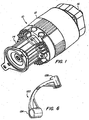
- Figure 1 is an isometric view of the axial piston compressor provided with a gimbal arm in accordance with the invention.
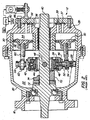
- Figure 2 is an exposed side view of a compressor known in the prior art.
- Figure 3 is an exposed side view of a compressor known in the prior art.
- Figure 4 is an exposed, perspective view of the compressor of Figure 1.
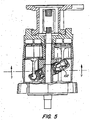
- Figure 5 is an exposed, plan view of the compressor of Figure 4.
- Figure 6 is an isometric view of the gimbal arm shown in the compressor of Figures 4-5.
- Figure 7 is an exposed elevational view of the compressor of Figures 4-5.
- Figure 8 is an enlarged view of a portion of Figure 7.
- Figure 9 is an enlarged view of another portion of Figure 7.
- FIG. 1 The basic components of one embodiment of an axial piston compressor 10 in accordance with the invention are illustrated in Figure 1.
- the terms “top,” “bottom,” “upper,” “lower,” “front” and “rear” refer to the objects referenced when in the orientation illustrated in the drawings, which orientation is not necessary for achieving the objects of the invention.
- the compressor 10 includes a main body 12, a rear mounting cover 14, and a front mounting flange 16.
- the compressor 10 When in use, the compressor 10 is installed on a vehicle, such as an over-the-road truck, and generates compressed air for the vehicle's pressure system, which typically includes a tank (not shown) that supplies the compressed air to various accessories, such as, for example, the brake system.
- This production of the compressed air begins by receiving air, which may or may not be delivered from a turbocharger (not shown), in response to a reduction of the air pressure in the air system to or below a reference pressure.
- the main body 12 includes a stationary housing 20 defining a crank chamber 22 therein, a swash plate 24 disposed in the crank chamber 22, and a stationary cylinder block 26 connected to the housing 20.
- a plurality of pistons 30 are coupled to the swash plate 24, and the cylinder block 26 has a plurality of bores 32 that receive the pistons 30.
- the pistons 30 are reciprocally displaceable within the bores 32 in order to provide for suction and compression strokes.
- a space 34 in the bores 32 above the pistons 30 is in fluid communication with the air system via a plurality of intake ports 36 and discharge ports 38. Accordingly, the air pressure in the space 34 corresponds to air pressure in the air system ensuring a state of pressure equilibrium for the compressor 10, as further explained below.
- the compressor has a head plate (not shown) provided with a plurality of check valves 39, 37 preventing the back-feeding of the air to be discharged.
- the check valves may be of the reed or poppet varieties, allowing air to flow along a path from a high-pressure area to a low-pressure area.
- a solenoid 86 can close the discharge port 38 upon an on-demand signal from a driver.
- the pressure in the spaces 34 above the pistons 30 rapidly rises, enabling the compressor 10 to reach a state of equilibrium within a short period of time. Opening of the solenoid 86 allows the compressor 10 to return to a normal mode of operation.
- the vehicle is provided with a central processing unit 90 for receiving a signal that is generated by a pressure sensor 92 after air pressure in the air system has reached a predetermined upper threshold. Once this signal is processed, the solenoid 86 is actuated to block the discharge port 38.
- the central processing unit 90 which is typically a computer, is able to process a signal indicating the overall load on the vehicle's engine. Thus, if a signal indicative of the load exceeds a certain threshold, the processing unit 90 generates a pilot signal actuating the solenoid 86, which closes the discharge port 38. In this case, the compressor rapidly achieves a state of equilibrium, as explained above, and stops compressing air.
- the bores 32 and pistons 30 are coated with wear-resistant materials.
- the pistons 30 may, for example, be coated with a material selected from the group including a PTFE material filled with bronze and Molybdenum Disulfide and a PTFE material filled with graphite and PPS, and an anodized aluminum coating (close to 60RC hardness) may be applied to the surfaces of the bores 32. Accordingly, with the appropriate selection of coating materials, along with the controllable motion of the pistons 30, lubrication between the pistons 30 and the walls of the cylinder block 26 is not necessary.
- the swash plate 24 and cylinder block 26 each have a hole in the center thereof, which, collectively, form a channel in which a drive shaft 40 is disposed.
- the entire swash plate 24 is pivotal with respect to the shaft 40.
- a mechanism for translating pivotal displacement of the swash plate 24 to reciprocal axial displacement of the pistons 30 includes a plurality of ball links, each of which is comprised of a rod 52 and a ball element 54.
- the rods 52 which are spaced angularly equidistantly from one another along an outer periphery of the swash plate 24 and extend radially therefrom, are bolts having a thread 56 on one end and a nut 58 on the opposite end.
- the ball element 54 has a spherical outer surface slidably engaging a piston rod 60, which extends parallel to the rotating shaft 40, for synchronous axial displacement while allowing the piston rod 60 and ball element 54 to be angularly displaced relative to one another.
- each piston rod 60 has a flange 62, the inner surface of which cooperates with an outer extremity of the ball element 54. Accordingly, as the swash plate 24 is angularly displaced from a position perpendicular to the drive shaft 40, the cooperating surfaces of the ball element 54 and flange 62 slide relative to one another. Such relative displacement allows the piston rod 60 and ball element 54 to move axially together, while the ball element 54 rotates within the flange 62 in response to the angular motion of the swash plate 24.
- the cooperating surfaces of the ball element 54 and flange 62 are depicted as annular, in certain embodiments, other shapes may be used, provided these elements move synchronously while being angularly displaced relative to one another.
- the pistons 30 are idle in a state of pressure equilibrium when a piston-generated force acting upon a swash plate 24 and corresponding to the air pressure in the space 34 above the pistons 30 is equal and oppositely directed to a thrust generated by an actuator 70 against the swash plate 24.
- This state of equilibrium occurs when the swash plate 24 is in a substantially perpendicular position with respect to the axis of a drive shaft 40.
- the thrust from the actuator 70 exceeds the lowered piston-generated force to angularly displace the swash plate 24 from its perpendicular position.
- the pistons 30 begin to reciprocally move in the bores 32, as will be further explained below.
- the more the air pressure in the air system drops the larger the angular displacement of the swash plate 24 and the longer the strokes of the pistons 30.
- the swash plate 24 pivots about a pin 48 upon a thrust exerted by the actuator 70.
- the actuator 70 includes a resilient element 72, such as, for example, Belleville washers, and a cam collar 74.
- the washers 72 are connected to the cam collar 74, which has a slanted cam surface with respect to the shaft 40, an extended part of which is always in contact with the swash plate 24.
- the swash plate 24 is always under pressure existing above the pistons 30, and thus, in order to maintain the swash plate 24 in a position perpendicular to the shaft 40 during the state of equilibrium, the cam collar 74 must continuously preload the swash plate 24.
- the actuator 70 is shown rotatably mounted on the shaft 40, in certain embodiments, the actuator 70 can be mounted on the housing 20. Further, in certain embodiments, other types of resilient elements, such as different types of compression springs 78, such as, for example, bellows, are used instead of the Belleville washers described above.
- the actuator includes a servo piston (not shown), which is actuated in response to a pilot signal representing the reference value of the air system's pressure and generated by an external source once the pressure falls down to or below a threshold.
- the servo piston which is attached to a mechanical link such as a fork, displaces the cam collar 74 to exert a thrust to pivotally displace the swash plate 24.
- the drive shaft 40 is rotatably disposed in the swash plate 24, rather than integrally formed therewith or fixedly connected thereto, the shaft 40 continues to rotate even when the pistons 30 are idle and the compressor 10 is not compressing air
- accessories coupled to the shaft 40 such as, for example, a fuel pump, continue to function.
- a swash plate 24 having an outer part 42 connected to a rotatable inner part 44 via a bearing assembly 46.
- the inner part 42 is mounted on the shaft 40 via the pin 48, such that the inner part 44 rotates with the shaft 40.
- the outer part 42 of the swash plate 24 can be restrained from rotating with the shaft 40.
- a gimbal arm 100 (shown in more detail in Figure 6) is simultaneously connected to the swash plate 24 by a first rotatable joint 102 and to the housing 20 via a second rotatable joint 104.
- the rotational axis of the first rotatable joint 102 is located at a ninety degree angle from the rotational axis of the second rotatable joint 104 relative to the rotational axis of the drive shaft 40.
- the swash plate 24 is free to pivot about the pin 48 in any radial direction, and thus, the swash plate 24 is never restrained from pivoting as the actuator 70 continually exerts a thrust upon the swash plate 24 throughout the course of a full three hundred and sixty degree rotation.
- the gimbal arm 100 is able to rotate along only these two rotational axes, it does not rotate along the rotational axis that is perpendicular to these two axes - i.e. the rotational axis of the drive shaft 40.
- the gimbal arm 100 prevents the swash plate from rotating along the rotational axis of the drive shaft 40, and thus, restrains the swash plate 24 from rotating with the shaft 40.
- the rotatable joints 102, 104 each include at least one roller bearing 106, 110 and a journal 120, 122 disposed therein.
- the oil needed to facilitate the rotation of the gimbal arm 100 which oil is located within the roller bearing 106, 110, is isolated from the rest of the compressor 10, thereby decreasing the likelihood of oil contamination of the compressed air ultimately supplied to various vehicle accessories.
- a plurality of roller bearings 106, 108 are used for each rotatable joint 102, 104.
- the ends of the gimbal arm 100 include inner and outer journal caps 124, 126, respectively, in which the journals 122, 120 are disposed, to which they are connected, or of which they form an integral part.
- a cavity 130 in the housing 20 or swash plate 24 may include the roller bearings 106, 108 and thus, the journal 120 is rotatably disposed in the cavity 130 to create the joint 104.
- the journal cap 124 may include the roller bearings 110, 112.
- the journal 122 which is coupled with, connected to, or an integral part of, the swash plate 24 or housing 20, is rotatably disposed in the journal cap 124.
Landscapes
- Engineering & Computer Science (AREA)
- Life Sciences & Earth Sciences (AREA)
- General Engineering & Computer Science (AREA)
- Environmental Sciences (AREA)
- Mechanical Engineering (AREA)
- General Life Sciences & Earth Sciences (AREA)
- Biodiversity & Conservation Biology (AREA)
- Animal Husbandry (AREA)
- Zoology (AREA)
- Mining & Mineral Resources (AREA)
- Paleontology (AREA)
- Civil Engineering (AREA)
- Structural Engineering (AREA)
- Compressors, Vaccum Pumps And Other Relevant Systems (AREA)
- Compressor (AREA)
- Applications Or Details Of Rotary Compressors (AREA)
Claims (15)
- Baugruppe mit:einem Gehäuse (20);einer Antriebswetie (40), die in dem Gehäuse (20) angeordnet ist;einer Taumelscheibe (24), die mit oder auf der Antriebswelle (20) montiert ist;durch gekennzeichnet, dassein kardanischer Arm (100) vorgesehen ist, der ein erstes Ende, welches mit der Taumelscheibe über ein erstes Drehgelenk (102) verbunden ist, und ein zweites Ende, welches mit dem Gehäuse über ein zweites Drehgelenk (104) verbunden ist, besitzt.
- Baugruppe nach Anspruch 1, dadurch gekennzeichnet, dass
ein Zylinder-Block mit dem Gehäuse verbunden ist, wobei der Zylinder-Block zumindest eine Bohrung besitzt; und
zumindest ein Kolben vorgesehen ist, der in der zumindest eine Bohrung unter Ermöglichung einer gleitenden Bewegung angeordnet ist, und
die Antriebswelle in dem Gehäuse und Zylinder-Block angeordnet ist. - Baugruppe nach Anspruch 1 oder 2, dadurch gekennzeichnet, dass die Taumelscheibe ein rotierendes Element, welches mit der Antriebswelle rotiert, sowie ein nicht rotierendes Element, welches durch den kardanischen Arm an einer Rotation mit der Antriebswelle gehindert ist, aufweist.
- Baugruppe nach Anspruch 3, dadurch gekennzeichnet, dass das rotierende Element mit dem nicht rotierenden Element über ein Lager gekoppelt ist.
- Baugruppe nach Anspruch 1 oder 2, dadurch gekennzeichnet, dass die Rotationsachse des ersten Drehgelenks senkrecht zu der Rotationsachse des zweiten Drehgelenks orientiert ist.
- Baugruppe nach Anspruch 1 oder 2, dadurch gekennzeichnet, dass das erste Drehgelenk und/oder zweite Drehgelenk aufweist;
ein Wälzlager oder Rollenlager und
einen Lagerzapfen oder eine Lagerhülse, der oder die mit dem Wälzlager oder Rollenlager gekoppelt ist. - Baugruppe nach Anspruch 6, dadurch gekennzeichnet, dass die Taumelscheibe eine Vertiefung besitzt, in der der Lagerzapfen oder die Lagerhülse angeordnet ist.
- Baugruppe nach Anspruch 7, dadurch gekennzeichnet, dass das Wälzlager oder Rollenlager in der Vertiefung angeordnet ist.
- Baugruppe nach Anspruch 6, dadurch gekennzeichnet, dass das Gehäuse eine Vertiefung besitzt, in der der Lagerzapfen oder die Lagerhülse angeordnet ist.
- Baugruppe nach Anspruch 9, dadurch gekennzeichnet, dass das Wälzlager oder Rollenlager in der Vertiefung angeordnet ist.
- Baugruppe nach Anspruch 6, dadurch gekennzeichnet, dass das erste Ende des kardanischen Armes eine innere Lagerzapfen-Kappe oder Lagerhülsen-Kappe besitzt, in der der Lagerzapfen oder die Lagerhülse angeordnet ist.
- Baugruppe nach Anspruch 11, dadurch gekennzeichnet, dass das Wälzlager oder Rollenlager in der Kappe angeordnet ist.
- Baugruppe nach Anspruch 6, dadurch gekennzeichnet, dass das zweite Ende des kardanischen Armes eine äußere Lagerzapfen-Kappe oder Lagerhülsen-Kappe besitzt, in der der Lagerzapfen oder die Lagerhülse angeordnet ist.
- Baugruppe nach Anspruch 13, dadurch gekennzeichnet, dass das Wälzlager oder Rollenlager in der Kappe angeordnet ist.
- Baugruppe nach Anspruch 2, dadurch gekennzeichnet, dass weiterhin ein Aktuator vorgesehen ist, der die Taumelscheibe derart kontaktiert, dass der Aktuator in einer ersten Position eine Kraft auf die Taumelscheibe ausübt, die geeignet ist, um die Taumelscheibe in einer Position senkrecht zu der Antriebswelle zu halten, so dass der zumindest eine Kolben untätig bleibt, und in einer zweiten Position eine Kraft auf die Taumelscheibe ausübt, die geeignet ist, um die Taumelscheibe zu verschwenken, wodurch eine hin- und hergehende Bewegung des zumindest einen Kolbens verursacht wird.
Applications Claiming Priority (2)
| Application Number | Priority Date | Filing Date | Title |
|---|---|---|---|
| US10/353,249 US6883416B2 (en) | 2003-01-28 | 2003-01-28 | Swash plate containment assembly |
| US353249 | 2003-01-28 |
Publications (2)
| Publication Number | Publication Date |
|---|---|
| EP1443211A1 EP1443211A1 (de) | 2004-08-04 |
| EP1443211B1 true EP1443211B1 (de) | 2006-04-12 |
Family
ID=32655520
Family Applications (1)
| Application Number | Title | Priority Date | Filing Date |
|---|---|---|---|
| EP04001761A Expired - Lifetime EP1443211B1 (de) | 2003-01-28 | 2004-01-28 | Einschlussanordnung für Taumelscheibe |
Country Status (8)
| Country | Link |
|---|---|
| US (1) | US6883416B2 (de) |
| EP (1) | EP1443211B1 (de) |
| JP (1) | JP2004232639A (de) |
| KR (1) | KR100733518B1 (de) |
| AU (1) | AU2004200342B2 (de) |
| BR (1) | BRPI0400471A (de) |
| DE (1) | DE602004000611T2 (de) |
| MX (1) | MXPA04000862A (de) |
Families Citing this family (8)
| Publication number | Priority date | Publication date | Assignee | Title |
|---|---|---|---|---|
| US7153105B2 (en) * | 2003-04-24 | 2006-12-26 | Haldex Brake Corporation | Compressor with swash plate housing inlet port |
| US9109446B1 (en) * | 2011-02-07 | 2015-08-18 | Ameriband, Llc | Continuously variable displacement engine |
| US10041405B1 (en) * | 2011-02-07 | 2018-08-07 | Ameriband, Llc | Continuously variable displacement engine |
| US9896933B1 (en) * | 2011-02-07 | 2018-02-20 | Ameriband, Llc | Continuously variable displacement engine |
| US9540932B1 (en) * | 2011-02-07 | 2017-01-10 | Ameriband, Llc | Continuously variable displacement engine |
| US9051927B2 (en) * | 2012-02-17 | 2015-06-09 | Briggs & Stratton Corporation | Water pump having two operating conditions |
| US9581057B1 (en) | 2014-08-20 | 2017-02-28 | Ameriband, Llc | Valve actuator system capable of operating multiple valves with a single cam |
| CN108302001B (zh) * | 2018-03-12 | 2023-09-22 | 西北工业大学 | 一种柱塞泵 |
Family Cites Families (13)
| Publication number | Priority date | Publication date | Assignee | Title |
|---|---|---|---|---|
| GB185295A (en) | 1921-07-25 | 1922-09-07 | Arthur Bollinckx | Pump of variable capacity |
| US1910054A (en) * | 1926-08-30 | 1933-05-23 | Automotive Engineering Corp | Power transmission |
| US3230893A (en) | 1961-05-31 | 1966-01-25 | Sundstrand Corp | Swashplate pump |
| US3319874A (en) * | 1964-12-16 | 1967-05-16 | J A W Q Box | Variable displacement-variable clearance device |
| US4152946A (en) * | 1975-07-22 | 1979-05-08 | Vadetec Corporation | Transmission devices |
| US4497284A (en) * | 1982-08-30 | 1985-02-05 | Schramm Buford J | Barrel type engine with plural two-cycle cylinders and pressurized induction |
| JPS6353196A (ja) * | 1986-08-21 | 1988-03-07 | Agency Of Ind Science & Technol | 可変ピツチプロペラのピツチ調節装置 |
| JP2892718B2 (ja) | 1989-11-17 | 1999-05-17 | 株式会社日立製作所 | 可変容量形圧縮機 |
| DE3942189C1 (de) | 1989-12-20 | 1991-09-05 | Hydromatik Gmbh, 7915 Elchingen, De | |
| US5027755A (en) * | 1990-05-24 | 1991-07-02 | Henry Jr Weston W | Wobble plate internal combustion engine |
| JP3080278B2 (ja) | 1992-10-05 | 2000-08-21 | 株式会社豊田自動織機製作所 | 往復動型圧縮機 |
| KR19980072896A (ko) * | 1997-03-10 | 1998-11-05 | 김욱한 | 가변용량형 압축기의 윤활 구조 |
| US6439857B1 (en) | 2001-03-12 | 2002-08-27 | Haldex Brake Corporation | Axial piston compressor |
-
2003
- 2003-01-28 US US10/353,249 patent/US6883416B2/en not_active Expired - Fee Related
-
2004
- 2004-01-27 KR KR1020040005126A patent/KR100733518B1/ko not_active Expired - Fee Related
- 2004-01-28 AU AU2004200342A patent/AU2004200342B2/en not_active Ceased
- 2004-01-28 EP EP04001761A patent/EP1443211B1/de not_active Expired - Lifetime
- 2004-01-28 JP JP2004020178A patent/JP2004232639A/ja active Pending
- 2004-01-28 MX MXPA04000862A patent/MXPA04000862A/es not_active Application Discontinuation
- 2004-01-28 BR BR0400471-0A patent/BRPI0400471A/pt not_active IP Right Cessation
- 2004-01-28 DE DE602004000611T patent/DE602004000611T2/de not_active Expired - Lifetime
Also Published As
| Publication number | Publication date |
|---|---|
| JP2004232639A (ja) | 2004-08-19 |
| AU2004200342B2 (en) | 2006-03-02 |
| BRPI0400471A (pt) | 2005-05-17 |
| MXPA04000862A (es) | 2005-07-01 |
| DE602004000611T2 (de) | 2007-05-10 |
| KR100733518B1 (ko) | 2007-06-28 |
| US6883416B2 (en) | 2005-04-26 |
| US20040144246A1 (en) | 2004-07-29 |
| EP1443211A1 (de) | 2004-08-04 |
| DE602004000611D1 (de) | 2006-05-24 |
| AU2004200342A1 (en) | 2004-08-12 |
| KR20040069283A (ko) | 2004-08-05 |
Similar Documents
| Publication | Publication Date | Title |
|---|---|---|
| US6439857B1 (en) | Axial piston compressor | |
| EP1443211B1 (de) | Einschlussanordnung für Taumelscheibe | |
| EP0867617A2 (de) | Schiefscheibenverdichter mit veränderlicher Förderleistung | |
| EP0952340A2 (de) | Kolben für einen Taumelscheibenkompressor für Kältemittel | |
| EP1510694B1 (de) | Ventilanordnung für eine Pumpe | |
| EP1471253A2 (de) | Schmiervorrichtung für Taumelscheibenverdichter | |
| EP0844389B1 (de) | Schrägscheibenverdichter | |
| US20050061143A1 (en) | Modular swash plate compressor | |
| US5771775A (en) | Device for guiding a piston | |
| JPH1054350A (ja) | 可変容量圧縮機 | |
| JP3640088B2 (ja) | 斜板式圧縮機 | |
| JP2001032768A (ja) | 可変容量型斜板式圧縮機 | |
| JP3028687B2 (ja) | 可変容量型圧縮機 | |
| JPH1089246A (ja) | 圧縮機 | |
| HK1092199A (en) | Modular swash plate compressor | |
| JP2001234855A (ja) | 可変容量型斜板式圧縮機 |
Legal Events
| Date | Code | Title | Description |
|---|---|---|---|
| PUAI | Public reference made under article 153(3) epc to a published international application that has entered the european phase |
Free format text: ORIGINAL CODE: 0009012 |
|
| AK | Designated contracting states |
Kind code of ref document: A1 Designated state(s): AT BE BG CH CY CZ DE DK EE ES FI FR GB GR HU IE IT LI LU MC NL PT RO SE SI SK TR |
|
| AX | Request for extension of the european patent |
Extension state: AL LT LV MK |
|
| 17P | Request for examination filed |
Effective date: 20050107 |
|
| AKX | Designation fees paid |
Designated state(s): DE FR IT |
|
| 17Q | First examination report despatched |
Effective date: 20050704 |
|
| GRAP | Despatch of communication of intention to grant a patent |
Free format text: ORIGINAL CODE: EPIDOSNIGR1 |
|
| GRAS | Grant fee paid |
Free format text: ORIGINAL CODE: EPIDOSNIGR3 |
|
| GRAA | (expected) grant |
Free format text: ORIGINAL CODE: 0009210 |
|
| AK | Designated contracting states |
Kind code of ref document: B1 Designated state(s): DE FR IT |
|
| PG25 | Lapsed in a contracting state [announced via postgrant information from national office to epo] |
Ref country code: IT Free format text: LAPSE BECAUSE OF FAILURE TO SUBMIT A TRANSLATION OF THE DESCRIPTION OR TO PAY THE FEE WITHIN THE PRESCRIBED TIME-LIMIT;WARNING: LAPSES OF ITALIAN PATENTS WITH EFFECTIVE DATE BEFORE 2007 MAY HAVE OCCURRED AT ANY TIME BEFORE 2007. THE CORRECT EFFECTIVE DATE MAY BE DIFFERENT FROM THE ONE RECORDED. Effective date: 20060412 |
|
| REF | Corresponds to: |
Ref document number: 602004000611 Country of ref document: DE Date of ref document: 20060524 Kind code of ref document: P |
|
| ET | Fr: translation filed | ||
| PLBE | No opposition filed within time limit |
Free format text: ORIGINAL CODE: 0009261 |
|
| STAA | Information on the status of an ep patent application or granted ep patent |
Free format text: STATUS: NO OPPOSITION FILED WITHIN TIME LIMIT |
|
| 26N | No opposition filed |
Effective date: 20070115 |
|
| REG | Reference to a national code |
Ref country code: FR Ref legal event code: ST Effective date: 20070930 |
|
| REG | Reference to a national code |
Ref country code: FR Ref legal event code: D3 |
|
| PGFP | Annual fee paid to national office [announced via postgrant information from national office to epo] |
Ref country code: FR Payment date: 20071213 Year of fee payment: 5 |
|
| PGFP | Annual fee paid to national office [announced via postgrant information from national office to epo] |
Ref country code: IT Payment date: 20080128 Year of fee payment: 5 |
|
| REG | Reference to a national code |
Ref country code: FR Ref legal event code: ST Effective date: 20091030 |
|
| PG25 | Lapsed in a contracting state [announced via postgrant information from national office to epo] |
Ref country code: FR Free format text: LAPSE BECAUSE OF NON-PAYMENT OF DUE FEES Effective date: 20090202 |
|
| PGFP | Annual fee paid to national office [announced via postgrant information from national office to epo] |
Ref country code: DE Payment date: 20190129 Year of fee payment: 16 |
|
| REG | Reference to a national code |
Ref country code: DE Ref legal event code: R119 Ref document number: 602004000611 Country of ref document: DE |
|
| PG25 | Lapsed in a contracting state [announced via postgrant information from national office to epo] |
Ref country code: DE Free format text: LAPSE BECAUSE OF NON-PAYMENT OF DUE FEES Effective date: 20200801 |