EP1446406B1 - Composes de naphthopyranne photochromiques pour articles ophtalmiques - Google Patents
Composes de naphthopyranne photochromiques pour articles ophtalmiques Download PDFInfo
- Publication number
- EP1446406B1 EP1446406B1 EP02792287A EP02792287A EP1446406B1 EP 1446406 B1 EP1446406 B1 EP 1446406B1 EP 02792287 A EP02792287 A EP 02792287A EP 02792287 A EP02792287 A EP 02792287A EP 1446406 B1 EP1446406 B1 EP 1446406B1
- Authority
- EP
- European Patent Office
- Prior art keywords
- group
- alkyl
- linear
- branched
- groups
- Prior art date
- Legal status (The legal status is an assumption and is not a legal conclusion. Google has not performed a legal analysis and makes no representation as to the accuracy of the status listed.)
- Expired - Lifetime
Links
- 0 Cc1c(c*(*)c*2)c2c(C(S=*I(*)(=C)=*2)=C2I2[C@](*)O)c2c1C=CI(*)(*)O Chemical compound Cc1c(c*(*)c*2)c2c(C(S=*I(*)(=C)=*2)=C2I2[C@](*)O)c2c1C=CI(*)(*)O 0.000 description 3
Classifications
-
- C—CHEMISTRY; METALLURGY
- C07—ORGANIC CHEMISTRY
- C07D—HETEROCYCLIC COMPOUNDS
- C07D493/00—Heterocyclic compounds containing oxygen atoms as the only ring hetero atoms in the condensed system
- C07D493/02—Heterocyclic compounds containing oxygen atoms as the only ring hetero atoms in the condensed system in which the condensed system contains two hetero rings
- C07D493/04—Ortho-condensed systems
Definitions
- the present invention relates to novel naphthopyran-type compounds that have, in particular, photochromic properties.
- the invention also relates to photochromic compositions and photochromic ophthalmic articles (goggles, lenses and eye-shields, for example) that contain these naphthopyrans.
- the invention also covers the preparation of these novel naphthopyrans.
- the photochromic compounds are capable of changing color under the influence of a first poly- or mono-chromatic light (UV for example) and of returning to their initial color when the luminous irradiation ceases, or under the influence of temperature and/or poly- or mono-chromatic light different from the first light.
- the invention particularly relates to indeno-naphthopyrans having a heterocyclic group fused to the naphthalene core.
- Photochromism generally concerns the ability of a compound to reversibly change color under different light conditions.
- One particular type of photochromic phenomenon concerns the reversible change in color of a compound from an original color to a different color when the compound is exposed to a source of ultraviolet radiation, such as solar radiation or light radiated from a mercury or xenon lamp.
- the photochromic compound fades to the original color within a period of time after the photochromic compound is isolated from the ultraviolet radiation, such as by placing the compound in a dark room.
- Photochromic compounds find applications in various fields, such as for the manufacture of ophthalmic lenses, contact lenses, solar protection glasses, goggles; sun screens, filters, camera optics, photographic apparatus optics or other optical devices and observation devices, glazing, decorative objects, currency elements and even for information storage by optical inscription (coding).
- photochromic compounds such as naphthopyrans
- photochromic compounds are incorporated into plastic ophthalmic lenses to effect color changes in the lenses when the lenses are exposed to particular lighting conditions.
- different photochromic compounds may be blended together to create a color_ effect that is different from respective color effects of the individual photochromic compounds.
- a first photochromic compound that turns orange or red when activated by light and a second photochromic compound that turns blue when activated by light may be blended together to form a photochromic mixture that produces a shade of gray when activated by light.
- a photochromic lens that comprises one or more photochromic compounds is usually required to have:
- obtaining a neutral, gray or brown tint may necessitate the use of at least two photochromes of different colors, i.e., two separate compounds having distinct maximal absorption wavelengths in the visible region of the electromagnetic spectrum.
- the use of combinations of photochromic compounds imposes other requirements on both the individual photochromic compounds and the groups of photochromic compounds.
- the coloration and discoloration kinetics of the (two or more) combined active photochromic compounds must be essentially identical. The same applies for their stability with time, and also for their compatibility with a single plastic or inorganic support.
- 5,645,767 and 5,955,520 describe photochromic inden[2,1-f]naphtho[1,2-b]pyrans showing activated colors ranging from orange to blue-gray: Those photochromic materials are characterized by a major absorption of visible light in the 580 - 620 nm range coupled with a minor absorption in the 420 - 500 nm range.
- U.S. Patents Nos. 6,146,554 discloses indeno-naphthopyrans having a green activated color by fusing a benzene ring to the indene core: The green color is perceived when having a major absorption of visible light in the 580 - 620 nm range coupled with another major absorption of roughly equal intensity in 400 - 480 nm range.
- U.S. Patents No. 6,225,466 discloses indeno-naphthopyrans having a spiro-ring attached to the indene core. More specifically, U.S. Patent No.
- 6,296,785 describes indeno[2,1-f]naphtho[1,2- b]pyrans having alkoxy substituents specifically at 6- and 7-position:
- the compounds have two absorption bands in the visible spectrum.
- Band A which occurs in 420 - 500 nm region, is generally of greater intensity than Band B, which occurs in 500 - 650 nm region.
- Various other substituent groups are defined, in terms of type and position, in the patent and encompass a wide, art-accepted range of combinations of substituents intended to control the wavelength and/or intensity of the visible absorbance bands.
- the patent claims that the use of certain individual compounds in the invention eliminates the need for combining two or more compounds to obtain neutral colors such as gray or brown.
- a novel family of molecules is described having particularly advantageous photochromic properties, such as, two distinct and equal intensity absorption bands in the 430 - 460 nm range and 550 - 580 nm range of the visible spectrum.
- This novel type of compounds either exhibits acceptable purple-gray to green-gray tint by itself or blends well in association with yellow photochromes to give brown tint.
- a naphthopyran having a central nucleus of the formula: wherein F is a 5- to 7-member saturated heterocyclic ring group having only one heteroatom which is oxygen, its 2,3 or 3,2 positions fused to the g, h, or i side, and R 1 and R 2 are selected from aliphatic groups, aromatic groups and heterocyclic groups.
- This naphthopyran may preferably have R 1 is selected from the group consisting of a hydrogen, a linear or branched alkyl group of 1 to 12 carbon atoms, a cycloalkyl group of 3 to 12 carbon atoms, an aryl group of 6 to 24 ring carbon atoms or a heteroaryl group of 4 to 24 carbon atoms and at least one hetero ring atom selected from sulfur, oxygen and nitrogen; and wherein R 1 and R 2 together form an adamantyl, norbornyl, fluorenylidene, di(C1-C6)alkylanthracenylidene or spiro(C5 - C6)cycloalkylanthracenylidene group.
- Another aspect of the invention is a naphthopyran having the central nucleus of the formula:
- naphthopyran compounds of the following formula (I) are described and enabled: in which:
- R 3 and R 4 may together form a 3- to 7-member optionally substituted spiro-cyclic ring which can comprise at least one heteroatom selected from oxygen, sulfur, and nitrogen, and/or at least one substituent selected from the group consisting of a C1 to C6 alkyl group which is linear or branched, a C1 to C6 alkoxy group which is linear or branched, and an amine group of formula as defined in R 1 and R 2 for amine groups.
- the spiro-ring may be annelated with one or two aromatic groups.
- spiro-carbocyclic ring substituents include spirofluoreno, spirocyclopropyl, spirocyclobutyl, spirocyclopentyl, spirocyclohexyl, spiroindan-1-yl, spiroindan-2-yl, etc.
- spiro-heterocyclic group include spiroxantheno and compounds which may be represented by the expression (-O-(C2-C5 alkanediyl)-O), e.g., spiro-1,3-dioxolane-2, spiro-1,3-dioxane-2, etc. or spirolactones such as butyrolactone, propiolactone etc.
- R 5 and R 6 may independently represent:
- n 2
- two adjacent R 5 together form a 5- to 7-member aromatic or non-aromatic ring which can comprise at least one heteroatom selected from oxygen, sulfur, and nitrogen, and/or at least one substituent selected from the group consisting of a C1 to C6 alkyl group which is linear, branched, or cyclic, a C1 to C6 alkoxy group which is linear or branched, and an amine group of formula -NH 2 , NHR 8 , or as defined in R 1 and R 2 for amine groups, said aromatic or non-aromatic ring can be optionally annelated with a benzene group, a polyether, polyamide, polycarbonate, polycarbamate, polyurea or polyester residue, or a group with polymerizable residue, n is an integer from 0 to 4, and m is an integer from 0 to 2; each R 7 group can be the same or different, independently representing a hydrogen, a halogen, and notably fluorine, chlorine or bromine,
- a central nucleus of a provided formula has a similar meaning.
- the term indicates that the formula, even though atoms are shown in the formula, may be substituted with any chemical units as long as the underlying bond structure of the formula is not altered.
- the term a central nucleus of the formula there may be any substitution at such positions as 1, 2, 5, 6, 7, 8, 9, 10, 11, 12, or 13 as long as the structure of F is not destroyed and the bond structure shown (e.g., the double bonds) are not converted to single bonds (e.g., by attempting to provide two substituents at the 6-position, which would require elimination of the double bond between positions 5 and 6.
- the term a compound of the formula except for description of the term 'group' in definitions, no unspecified substitution is allowed.
- 'group' or 'central nucleus' refers to the capability of the structure to have substitution or not on the chemical unit or not.
- the term 'group' refers to any chemical structure, while the term 'central nucleus' refers specifically to a ring structure as the core chemical moiety.
- an 'alkyl group' includes unsubstituted n-alkyl, iso-alkyl, methyl ethyl, octyl, iso-octyl, docecyl, and the like, and substituted alkyl such as hydroxymethyl, 1-chloroethyl, 2-cyano-butyl, 3-ethyl-4-hexyl, omega-carboxy-pentyl, and the like.
- substituted alkyl such as hydroxymethyl, 1-chloroethyl, 2-cyano-butyl, 3-ethyl-4-hexyl, omega-carboxy-pentyl, and the like.
- central nucleus' such as in the central nucleus of a naphthyl
- any substituent may be present on the central nucleus of the naphthyl group, such as 1-methyl-, 2-chloro-, 2,4-dimethoxy-, 2,2'-dimethoxy-, and the like.
- no substitution is allowed beyond that of the described formula.
- groups should be considered that comprise and/or form at least one function which can be polymerized and/or crosslinked, which group are preferably selected from the following list: alkenyl, advantageously vinyl, methacryloyl, acryloyl, acryloxyalkyl, methacryloxyalkyl or epoxy.
- the photochromic compounds according to the invention can be monomers, of different types or not, that can react with each other or with other comonomers to form homopolymers and/or copolymers that bear a photochromic functionality and possess mechanical properties of macromolecules. It follows that one of the objects of the present invention consists of these homopolymers or copolymers comprising (co)monomers and/or of crosslinked compounds, that, at least in part, consist ofphotochromic compounds (I) according to the invention.
- the above-mentioned compounds (I) can be crosslinking agents that have one or more reactive functions capable of allowing the formation of bridges between chains of polymers of photochromic nature or not.
- the crosslinked compounds that can be obtained in this manner also are a part of the present invention.
- preferred photochromic are those which have the formula (Ia), (Ib), and (Ic) below: in which:
- These compounds present particularly advantageous photochromic properties, such as, having strong coloration ability with two distinct, equal intensity absorption bands in the visible range.
- These compounds are also preferably stable and compatible with matrices made of at least one organic polymer or mineral material (e.g., inert inorganic binder), both in the form included in the matrix and in the form of a coating.
- the compounds according to the invention are colorless or slightly colored in the initial state and they rapidly develop an intense coloration under UV light (365 nm) or a luminous source of the solar type. They recover to their initial color at an acceptable rate when the irradiation stops.
- the compounds of the invention can be obtained by the condensation of a derivative of 1-naphthol that is suitably substituted and a derivative of propargyl alcohol.
- the condensation can be carried out in organic solvents, particularly nonpolar solvents such as toluene, xylene or tetrahydrofuran and, optionally, in the presence of a catalyst, acid catalysts, and especially acid catalysts such as fluorinated organic acid catalysts, p-toluenesulfonic acid, chloroacetic acid or acid aluminic acid):
- the synthetic routes to naphthopyrans (V) from proper derivatives of 1-naphthol such as (III) and (IV) are classical and have been described in the above-mentioned references of the prior art.
- the propargyl alcohols are either commercially available or easily synthesized by the reaction of lithium acetylide or ethynyl (magnesium bromide) with the corresponding ketones R 1 C(O)R 2 .
- the ketones are also either commercially available or easily synthesized by the classical methods, for example, the Friedel-Crafts reaction from an acid chloride.
- the oxo-transformation to R 3 and R 4 can be done either before the pyran formation or after the pyran formation.
- the transformations to variety of different groups, including spiro-cyclic groups, are achieved by methods familiar to ones in the art. Examples can be found in literature, such as US Patent Nos. 6,146,554,6,225,466, and 6,296,785.
- the starting compound (IV) can be prepared from the Claisen rearrangement of the corresponding allyl phenyl ether followed by acid-catalyzed cyclization reaction.
- a photochromic solution can be obtained by dissolving the compound in an organic solvent, such as toluene, dichloromethane, tetrahydrofuran or ethanol.
- the solutions obtained are generally colorless and transparent. When exposed to sunlight, they develop a strong coloration and they recover the color of this state when placed in an environment with lesser exposure to solar radiation or, in other words, when they are no longer exposed to UV radiation.
- a very low concentration of products is sufficient to obtain an intense coloration.
- the most interesting applications are those in which the photochrome is dispersed uniformly within or on the surface of a polymer, copolymer or mixture of polymers.
- the implementation methods that can be considered are of a great variety.
- diffusion is carried out at a temperature of 50-200°C for a duration of 15 minutes to several hours, depending on the nature of the polymer matrix.
- Another implementation technique consists in mixing the photochrome in a formulation of polymerizable materials, in depositing this mixture on a surface or in a mold and in then carrying out the polymerization.
- These implementation techniques and others are described in the article by Crano et al. "Spiroxazines and their use in photochromic lenses," published in Applied Photochromic Polymer Systems, Publishers Blackie and Son Ltd., 1992.
- another aspect of the invention consists of the (co)polymers grafted with at least one of the photochromes described above.
- alkyl, cycloalkyl, aryl or arylalkyl poly(mono-, di-, tri-, tetra)acrylate or poly(mono-, di-, tri-, tetra) methacrylate, optionally halogenated or comprising at least ether and/or ester and/or carbonate and/or carbamate and/or thiocarbamate and/or urea and/or amide group
- polystyrene polycarbonate (e.g., bisphenol A polycarbonate, polycarbonate of diallyl diethylene glycol), polyepoxy, polyurethane, polythiourethane, polysiloxane, polyacrylonitrile, polyamide, aliphatic or aromatic polyester, vinyl polymers, cellulose acetate, cellulose triacetate, cellulose acetate-propionate or polyvinylbutyral, copoly
- the quantity of photochrome used in various articles depends on the desired degree of darkening. In particular, it is used in a quantity of 0.001-20 wt % of the total weight of the layer in which the photochrome is included.
- the photochromic compounds according to the invention can be used alone or in a mixture with other products to form a composition that can be in solid or liquid form, for example, in a solution or in a dispersion, as has already been mentioned above.
- These compositions, which constitute another object of the invention can comprise one or more compounds (I) according to the invention and other complementary photochromic compounds which allow the attaining of dark colorations, for example, gray or brown, which the public desires in applications such as ophthalmic or sun-protection eyewear.
- photochromic compounds can be those known to a person skilled in the art and described in the literature, for example, other naphthopyrans, benzopyrans, chromenes (U.S. Pat. Nos. 3,567,605, 5,238,981, World Patent No. 9,422,850, European Patent No. 562,915), spiropyrans or naphthospiropyrans (U.S. Pat. No. 5,238,981) and spiroxazines (CRANO et al., "Applied Photochromic Polymer Systems," Publishers Blackie & Son Ltd., 1992, Chapter 2).
- compositions according to the invention can also comprise:
- the present invention also relates to ophthalmic articles, such as articles of ophthalmic or sun protection eyewear-articles, or eye shields comprising at least one compound according to the invention and/or at least one (co)polymer formed, at least in part, of repeating units derived from compounds having formula (I) and/or at least one composition comprising compounds (I) according to the invention, as defined above, and/or at least one matrix, as defined above, made of an organic polymer material or a mineral material or a mineral-organic hybrid material incorporating at least one compound of the invention.
- ophthalmic articles such as articles of ophthalmic or sun protection eyewear-articles, or eye shields comprising at least one compound according to the invention and/or at least one (co)polymer formed, at least in part, of repeating units derived from compounds having formula (I) and/or at least one composition comprising compounds (I) according to the invention, as defined above, and/or at least one matrix, as defined above, made of an organic polymer material or
- the articles to which the present invention applies more particularly are photochromic ophthalmic or sun-protection lenses, glass paneling (glasses for buildings, for locomotion devices, automobiles), optical devices, decorative articles, sun-protection articles, information storage, etc.
- Step 1 To a reaction flask containing 2,3-dihydrobenzofuran (13.5 grams) and benzoyl chloride (16.6 grams) in 170 milliliters (mL) of methylene chloride were added anhydrous aluminum chloride (18.0 grams) under nitrogen blanket over 40 minutes. The reaction temperature was controlled at around 25°C with an ice/water bath. The reaction mixture was stirred at room temperature overnight. The resulting mixture was poured into 150 mL of ice/water and stirred vigorously for 30 minutes. The organic layer was separated, washed with water, dried over magnesium sulfate. The methylene chloride solvent was removed by rotary evaporation to give 25 grams of thick pink oil. It is used 'as is' in the next step.
- Step 2 The product from Step 1 (25 g), dimethyl succinate (21.0 g), and potassium t-butoxide (16.5 g) were mixed in 250 ml of toluene. The mixture was refluxed for 2 hours under nitrogen blanket. After it was cooled to room temperature, 200 ml of water was added and mixed well. The aqueous phase was separated, acidified with 5N HCl, and extracted with 3 x 100 ml of ethyl acetate. The combined extracts were washed once with water, dried over magnesium sulfate. The solvent was remove under reduced pressure to give 40.5g of honey-like crude half-ester product. It was known that the crude product contains some aliphatic oil contaminants from the ethyl acetate solvent. It is used without purification.
- Step 3 The crude half-ester from Step 2 (40 g) was added to reaction flask containing 180 ml of acetic anhydride and 23 g of anhydrous potassium acetate. The mixture was refluxed for 1.5 hours, cooled, filtered. The solid in the filtration funnel was washed thoroughly with ethyl acetate. The combined filtrate was concentrated to just dry under vacuum. The dark solid was re-dissolved in ethyl acetate and washed with water, dried over magnesium sulfate. The organic solution was concentrated under reduced pressure. The residual was subjected to a silica column with ethyl acetate/hexane 1:4 as elutant.
- Step 4 The light yellow solid product from Step 3 (8.7 grams) was added to a reaction flask containing 75 mL of water, 25 ml of 5N sodium hydroxide, and 50 mL of methanol. The mixture was refluxed overnight and cooled to give a clear brown solution. It acidified with 5N hydrochloric acid. The precipitate was collected with filtration, and washed with water for 3 times. A beige powder (6.8 g) was obtained after drying the precipitate in a vacuum oven. An NMR spectrum showed the product to have a structure consistent with 2,3-dihydro-5-phenyl-6-carboxyl-8-hydroxy-naphtho[2,3-b]furan.
- Step 5 The product from Step 4 (4.8 grams), 20 mL of toluene and 6.0 grams of p-toluenesulfonic acid were added to a reaction flask fitted with a Dean-Stark trap. The resulting mixture was heated to reflux for 5 hours. A deep red solid precipitate formed. The mixture was cooled and 100 ml of water was added. The solid was collected by vacuum filtration, re-dissolved in 500ml of ethyl acetate, washed with 5% sodium carbonate solution, and thoroughly washed with water. The organic phase was concentrated with rotary evaporation to give a mixture. It was vacuum filtered to yield 3.0 grams of a violet product. An NMR spectrum showed the product to have a structure consistent with 2,3-dihydro-10-oxo-12-hydroxy-indeno[3,2-a]naphtho[2,3-
- Step 6 The product from Step 5 (0.50 grams) was added to a reaction flask containing 1-(4-methoxyphenyl)-1-phenyl-2-propyn-1-ol (0.86 grams), 50 mL of - toluene. After the mixture started to reflux, catalytic amount of p-toluenesulfonic acid was added. The reaction mixture was refluxed overnight, cooled, filtered. The organic filtrate was concentrated by rotary evaporation. The residue was allowed to crystallized overnight, and digested with cold acetone to yield 0.5 grams of red product.
- Step 7 The product from Step 6 (0.5 grams) was dissolved in anhydrous tetrahydrofuran (50 mL) in a reaction flask under nitrogen blanket. Phenyl magnesium bromide (1.0 mL of a 3M ether solution) was added dropwise while cooling with an ice/water bath. The reaction solution was then stirred at room temperature for 30 minutes. The reaction mixture was poured into 100 grams of ice/saturated ammonium chloride solution. The layers were separated and the organic layer was concentrated by rotary evaporation. The residue was chromatographed on silica gel using a 4:1 v/v mixture of hexane and ethyl acetate as the elutant.
- Each of the invention compounds is dissolved in chloroform at a concentration of 0.1%.
- the UV-visible absorptions (optical path of 1 cm) are then measured before and after exposure to a 365 nm UV source for 1 minutes.
- the photochromic properties: ⁇ UV (absorption wavelength closet to visible spectrum before activated), ⁇ max of the two principle absorption bands, and relative induced optical intensity, RIOD, (intensity ratio between band 1 and band 2) of these compounds are compared with corresponding compounds of prior arts as in Tables 1, 2, and 3 below.
- Example 4 of the invention is used to show that the relative induced optical intensity does not vary significantly in different solvents.
- Table 4 Solvent ⁇ Vis,1 (nm) ⁇ Vis,2 (nm) RIOD Acetone 450 578 1.01 Chloroform 450 576 1.00 CR-39 452 580 1.00 Urethane 442 573 1.02
- the naphthopyrans of the invention have two distinct absorption peaks, their bands cover majority of the visible spectrum. They display high intensity when activated by solar radiation. Relative intensity between the two bands stays close to unity regardless the substituent groups and solvents. In addition, it has been observed that they exhibit high sensitivity to solar radiation due to high UV ⁇ max .
Landscapes
- Chemical & Material Sciences (AREA)
- Organic Chemistry (AREA)
- Compositions Of Macromolecular Compounds (AREA)
- Optical Filters (AREA)
- Eyeglasses (AREA)
- Pharmaceuticals Containing Other Organic And Inorganic Compounds (AREA)
Abstract
Claims (11)
- Composé de naphtopyrane photochromique possédant un noyau central de formule :

R1 et R2 sont choisis parmi des groupes aliphatiques, des groupes aromatiques, et des groupes hétérocycliques. - Composé de naphtopyrane photochromique selon la revendication 1 dans lequel R1 et R2 sont choisis parmi des groupes aliphatiques et des groupes aromatiques.
- Composé de naphtopyrane photochromique selon la revendication 1 dans lequel R1 et R2 sont choisis parmi des groupes alkyle, des groupes phényle et des groupes naphtyle.
- Composé de naphtopyrane photochromique selon l'une quelconque des revendications précédentes dans lequel F comprend un groupe dihydrofurane.
- Composé de naphtopyrane photochromique selon la revendication 1 dans lequel la position 13 possède des substituants R3 et R4, où R3 et R4 représentent individuellement
un atome d'hydrogène,
un groupe hydroxy,
un atome d'halogène,
un groupe alkyle, alcényle, ou alcynyle en C1 à C6 linéaire, ramifié, cyclique,
un groupe alcoxy ou alcénoxy en C1 à C6 linéaire, ramifié, ou cyclique,
un groupe amino :
un groupe aryle ou hétéroaryle choisi dans le groupe consistant en phényle, naphtyle, phénanthryle, pyrényle, quinolyle, isoquinolyle, benzofuranyle, thiényle, benzothiényle, dibenzofuranyle, dibenzothiényle, carbazolyle, indolyle,
un phényle monosubstitué possédant un substituant en position para qui est un groupe de liaison, -(CH2)t- ou -O-(CH2)t-, dans lequel t est le nombre entier 1, 2, 3, 4, 5, ou 6, connecté à un groupe aryle, qui est un élément d'un autre composé naphtopyrane photochromique,
un groupe aralkyle ou hétéroaralkyle, dont la partie alkyle est linéaire ou ramifiée, comprenant 1 à 4 atomes de carbone,
un groupe -C(O)R11, -OC(O)R11, ou COOR11, dans lequel R11 est un atome d'hydrogène, hydroxy, alkyle en C1 à C6 linéaire ou ramifié, alcoxy en C1 à C6 linéaire ou ramifié, phényle, phényle monosubstitué, naphtyle, naphtyle monosubstitué, amino, monoalkyl (C1 - C6) amino, dialkyl (C1-C6) amino, par exemple, N,N-diméthyl amino, N-méthyl-N-propyl amino, morpholino, pipéridino ou pyrrolidyle, lesdits substituants d'amino étant choisis dans le groupe consistant en alkyle en C1 à C6, phényle, benzyle et naphtyle, et lesdits substituants de benzyle et phényle étant alkyle en C1 à C6 ou alcoxy en C1 à C6,
un groupe -OR12, dans lequel R12 est un acyle en C1 à C6, un groupe aralkyle ou hétéroaralkyle possédant une partie alkyle en C1 à C3, un groupe cycloalkyle (C3 à C7), un groupe alkyle (C2 à C4) ou bien R12 est le groupe -CH(R13)R14, dans lequel R13 est un atome d'hydrogène ou alkyle en C1 à C3 et R14 est -CN, -CF3, ou -COOR15, dans lequel R15 est un atome d'hydrogène ou alkyle, aralkyle ou hétéroaralkyle linéaire, ramifié, ou cyclique,
un groupe -CH(R16)2 dans lequel R16 est -CN ou -COOR15,
un groupe -CH(R15)R17, dans lequel R17 est -COOR11 -C(O)R18 ou -CH2OR19, dans lequel R18 est un atome d'hydrogène, un groupe alkyle linéaire, ramifié ou cyclique, ou un groupe aryle, un groupe amino de formule
un résidu polyéther, polyamide, polycarbonate, polycarbamate, polyurée, polyester, ou un groupe terminé par un résidu polymérisable ;
ou R3 et R4 peuvent former ensemble un noyau spiro-cyclique comportant 3 à 7 chaînons qui peut comprendre au moins un hétéroatome choisi parmi l'oxygène, le soufre et l'azote. - Composé de naphtopyrane photochromique selon la revendication 5 dans lequel(a) dans la position 5 et/ou 8, un groupe R6 représente
un atome d'hydrogène,
un atome d'halogène,
un groupe alkyle linéaire ou ramifié qui comprend 1 à 12 atomes de carbone,
un groupe cycloalkyle comprenant 3 à 12 atomes de carbone,
un groupe alcoxy linéaire ou ramifié comprenant 1 à 12 atomes de carbone,
un groupe haloalkyle, halocycloalkyle, ou haloalcoxy correspondant respectivement aux groupes alkyle, cycloalkyle, alcoxy ci-dessus, qui sont substitués par au moins un atome d'halogène, choisi parmi fluor, chlore et brome,
un groupe alcényle ou alcynyle linéaire ou ramifié comprenant 1 à 12 atomes de carbone, de préférence un groupe vinyle ou allyle,
un groupe alcénoxy ou alcynoxy linéaire ou ramifié comprenant 1 à 12 atomes de carbone, de préférence un groupe allyloxy,
un groupe aryle ou hétéroaryle possédant la même définition que celle donnée ci-dessus pour les groupes aryle et hétéroaryle dans les définitions de R3, R4,
un groupe aralkyle ou hétéroaralkyle, le groupe alkyle, qui est linéaire ou ramifié, comprenant 1 à 4 atomes de carbone, et les groupes aryle et hétéroaryle possédant les mêmes définitions que celles données ci-dessus pour R3, R4,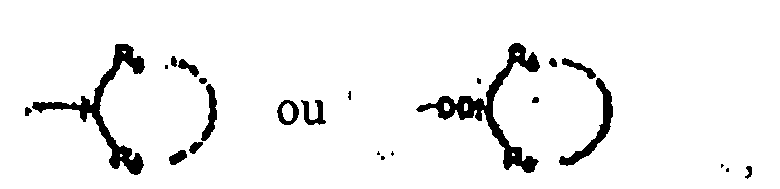
un groupe -C(R15)2R11, -OCOR15, ou -COOR15, dans lequel R11 et R15 sont définis ci-dessus dans R3 et R4, un groupe méthacryloyle ou un groupe acryloyle, un groupe époxy possédant la formule :
un résidu polyéther, polyamide, polycarbonate, polycarbamate, polyurée ou polyester, ou un groupe possédant un résidu polymérisable,(b) dans les positions 9, 10, 11, et 12, se trouvent au plus 4 groupes R5, chacun étant le même que R6, défini ci-dessus ; ou(c) deux R5 adjacents forment ensemble un noyau aromatique ou non aromatique comportant 5 à 7 chaînons et qui peut comprendre au moins un hétéroatome choisi parmi l'oxygène, le soufre, et l'azote, et/ou au moins un substituant choisi dans le groupe consistant en un groupe alkyle en C1 à C6 qui est linéaire, ramifié, ou cyclique, un groupe alcoxy en C1 à C6 qui est linéaire ou ramifié, et un groupe amino de formule -NH2, -NHR8 ou tel que défini dans R3 et R4 pour des groupes amino, ledit noyau aromatique ou non aromatique pouvant être éventuellement fusionné avec un groupe benzène. - Composé de naphtopyrane photochromique selon la revendication 6 dans lequel R1 et/ou R2 représentent un groupe phényle substitué en para, lesdits substituants du groupe phényle substitué en para étant choisis parmi un atome d'hydrogène, alkyle, alcoxy, dialkylamino, diarylamino, ou R1 et R2 forment ensemble un groupe adamantyle ou un groupe norbomyle ou un groupe anthracénylidène.
- Composé de naphtopyrane photochromique selon la revendication 1 possédant une formule choisie parmi (1a), (1b) et (1c) ci-dessous :

R1 et/ou R2 représentent indépendamment des groupes aryle ou hétéroaryle éventuellement substitués dont la structure de base est choisie parmi des groupes phényle, naphtyle, biphényle, pyridyle, furyle, benzofuryle, dibenzofuryle, N-alkyl (C1 - C6)carbazole, thiényle, benzothiényle, dibenzothiényle, julolidinyle ; R1 et/ou R2 représentant avantageusement un groupe phényle substitué en para, lesdits substituants étant choisis parmi l'atome d'hydrogène, alkyle, alcoxy, dialkylamino, diarylamino, ou bien R1 et R2 forment ensemble un groupe adamantyle ou un groupe norbomyle ou un groupe anthracénylidène ;
R3 et R4 sont identiques ou différents, et peuvent représenter indépendamment l'atome d'hydrogène, hydroxy, un atome d'halogène, un groupe alkyle linéaire, ramifié, ou cyclique qui comprend 1 à 6 atomes de carbone,
un groupe -OR20, dans lequel R20 est alkyl (C1 à C3), phényl(C1 à C3)alkyle, mono(C1 à C3)alkylphényl(C1 à C3)alkyle, mono(C1 à C3)alcoxyphényl(C1 à C3)akyle, (C1 à C3)alcoxy(C2 à C4)alkyle, fluoro(C1 à C4)alkyle, ou chloro(C1 à C3)alkyle,
un groupe phényle ou benzyle éventuellement substitué, lesdits substituants étant des mono-, di- ou tri-substituants, et choisis parmi le groupe R20,
un groupe -C(R21)2X, dans lequel X est hydroxy, alcoxy, benzoyloxy, acyloxy en C1 à C6, un groupe ester : -COOR11, un groupe amine ou amide : -NH2, -NHR8, -N(R8)2, -CONH2, -CONHR8, -CON(R8)2, R21 est l'atome d'hydrogène, alkyle en C1 à C6, phényle ou naphtyle avec des substituants alkyle en C1 à C6 ou alcoxy en C1 à C6,
un résidu polyéther ou polyurée,
ou R3 et R4 forment ensemble un noyau spiro-cyclique éventuellement substitué comportant 5 à 7 chaînons et qui peut comprendre au moins un hétéroatome choisi parmi l'oxygène, le soufre, et l'azote, et/ou au moins un substituant choisi dans le groupe consistant en un groupe alkyle en C1 à C6 qui est linéaire ou ramifié, un groupe alcoxy en C1 à C6 qui est linéaire ou ramifié, et un groupe amine de formule -NH2, - NHR8
les R7, qui sont identiques ou différents, représentent indépendamment un atome d'hydrogène,
un groupe alkyle linéaire ou ramifié qui comprend 1 à 6 atomes de carbone,
un groupe cycloalkyle comprenant 3 à 7 atomes de carbone,
un groupe alcoxy linéaire ou ramifié comprenant 1 à 6 atomes de carbone,
un groupe haloalkyle, halocycloalkyle, ou haloalcoxy correspondant respectivement aux groupes alkyle, cycloalkyle, alcoxy ci-dessus, qui sont substitués par au moins un atome d'halogène,
un groupe alcényle ou alcynyle linéaire ou ramifié comprenant 1 à 12 atomes de carbone,
un groupe alcénoxy ou alcynoxy linéaire ou ramifié comprenant 1 à 12 atomes de carbone,
n est un nombre entier de 0 à 2. - Article photochromique comprenant une couche de polymère contenant une quantité photochromique d'un composé de naphtopyrane photochromique selon les revendications 1, 2 ou 3.
- Article photochromique comprenant une couche de polymère contenant une quantité photochromique d'un composé de naphtopyrane photochromique selon la revendication 4.
- Article photochromique comprenant une couche de polymère contenant une quantité photochromique d'un composé de naphtopyrane photochromique selon les revendications 5, 6, 7 ou 8.
Applications Claiming Priority (3)
| Application Number | Priority Date | Filing Date | Title |
|---|---|---|---|
| US38350 | 2001-11-20 | ||
| US10/038,350 US7008568B2 (en) | 2001-11-20 | 2001-11-20 | Photochromic naphthopyran compounds: compositions and articles containing those naphthopyran compounds |
| PCT/US2002/037469 WO2003044022A2 (fr) | 2001-11-20 | 2002-11-20 | Composes de naphthopyranne photochromiques : compositions et articles renfermant ces composes de naphthopyranne |
Publications (2)
| Publication Number | Publication Date |
|---|---|
| EP1446406A2 EP1446406A2 (fr) | 2004-08-18 |
| EP1446406B1 true EP1446406B1 (fr) | 2006-03-29 |
Family
ID=21899429
Family Applications (1)
| Application Number | Title | Priority Date | Filing Date |
|---|---|---|---|
| EP02792287A Expired - Lifetime EP1446406B1 (fr) | 2001-11-20 | 2002-11-20 | Composes de naphthopyranne photochromiques pour articles ophtalmiques |
Country Status (5)
| Country | Link |
|---|---|
| US (1) | US7008568B2 (fr) |
| EP (1) | EP1446406B1 (fr) |
| AU (1) | AU2002357749A1 (fr) |
| DE (1) | DE60210332D1 (fr) |
| WO (1) | WO2003044022A2 (fr) |
Families Citing this family (28)
| Publication number | Priority date | Publication date | Assignee | Title |
|---|---|---|---|---|
| US7077985B2 (en) * | 2000-05-30 | 2006-07-18 | Vision-Ease Lens | Injection molding of lens |
| JP2004315728A (ja) * | 2003-04-18 | 2004-11-11 | Yamanashi Tlo:Kk | フォトクロミック化合物およびフォトクロミック組成物並びにこれを用いたフォトクロミック表示素子 |
| US8518546B2 (en) | 2003-07-01 | 2013-08-27 | Transitions Optical, Inc. | Photochromic compounds and compositions |
| US20110140056A1 (en) | 2003-07-01 | 2011-06-16 | Transitions Optical, Inc. | Indeno-fused ring compounds |
| US8698117B2 (en) | 2003-07-01 | 2014-04-15 | Transitions Optical, Inc. | Indeno-fused ring compounds |
| US8545984B2 (en) | 2003-07-01 | 2013-10-01 | Transitions Optical, Inc. | Photochromic compounds and compositions |
| US8211338B2 (en) | 2003-07-01 | 2012-07-03 | Transitions Optical, Inc | Photochromic compounds |
| US7858001B2 (en) * | 2003-09-09 | 2010-12-28 | Insight Equity A.P.X., L.P. | Photochromic lens |
| ES2544317T3 (es) | 2003-09-09 | 2015-08-28 | Insight Equity A.P.X., Lp | Laminado de poliuretano fotocrómico |
| EP1874984A2 (fr) | 2005-03-04 | 2008-01-09 | Vision-Ease Lens, Inc. | Methode de formation de tranches laminees polymeres comprenant differents materiaux de film |
| US8647538B2 (en) | 2005-04-08 | 2014-02-11 | Transitions Optical, Inc. | Photochromic compounds having at least two photochromic moieties |
| US9028728B2 (en) | 2005-04-08 | 2015-05-12 | Transitions Optical, Inc. | Photochromic materials that include indeno-fused naphthopyrans |
| US9139552B2 (en) | 2005-04-08 | 2015-09-22 | Transitions Optical, Inc. | Indeno-fused naphthopyrans having ethylenically unsaturated groups |
| US9052438B2 (en) | 2005-04-08 | 2015-06-09 | Johnson & Johnson Vision Care, Inc. | Ophthalmic devices comprising photochromic materials with reactive substituents |
| US7556750B2 (en) * | 2005-04-08 | 2009-07-07 | Transitions Optical, Inc. | Photochromic materials with reactive substituents |
| US20060228557A1 (en) * | 2005-04-08 | 2006-10-12 | Beon-Kyu Kim | Photochromic materials having extended pi-conjugated systems and compositions and articles including the same |
| US7907346B2 (en) * | 2007-03-16 | 2011-03-15 | Transitions Optical, Inc. | Photochromic materials and photochromic compositions and articles including the same |
| WO2009121149A1 (fr) * | 2008-04-03 | 2009-10-08 | Advanced Polymerik Pty Ltd | Photochrome stabilisé |
| EP2447267A4 (fr) * | 2009-06-25 | 2012-11-21 | Tokuyama Corp | Composé de chromène |
| JP5570510B2 (ja) * | 2009-07-21 | 2014-08-13 | 株式会社トクヤマ | クロメン化合物 |
| MX2012001414A (es) | 2009-08-04 | 2012-03-26 | Tokuyama Corp | Compuesto de cromeno. |
| US20120161089A1 (en) | 2009-08-28 | 2012-06-28 | Toshiaki Takahashi | Chromene compound |
| BR112012006058A2 (pt) | 2009-09-18 | 2015-09-08 | Tokuyama Corp | composto, composição fotocrômica curável, e, artigo óptico. |
| US9034219B2 (en) | 2010-12-16 | 2015-05-19 | Transitions Optical, Inc. | Photochromic compounds and compositions |
| US8920928B2 (en) | 2010-12-16 | 2014-12-30 | Transitions Optical, Inc. | Photochromic compounds and compositions |
| AU2012226807B2 (en) | 2011-03-08 | 2016-05-19 | Tokuyama Corporation | Chromene compound |
| ES2578007T3 (es) * | 2012-07-12 | 2016-07-20 | Rodenstock Gmbh | Fluorenopiranos fotocrómicos con anillación Dibenzo[b,d]-pirano |
| JP7696427B2 (ja) * | 2021-06-11 | 2025-06-20 | ホヤ レンズ タイランド リミテッド | フォトクロミック化合物、フォトクロミック組成物、フォトクロミック物品及び眼鏡 |
Family Cites Families (24)
| Publication number | Priority date | Publication date | Assignee | Title |
|---|---|---|---|---|
| US3567605A (en) | 1966-03-30 | 1971-03-02 | Ralph S Becker | Photochemical process |
| US3627690A (en) | 1969-10-01 | 1971-12-14 | Itek Corp | Photochromic naphthopyran compositions |
| GB8611837D0 (en) | 1986-05-15 | 1986-06-25 | Plessey Co Plc | Photochromic spiropyran compounds |
| US5200116A (en) | 1990-07-23 | 1993-04-06 | Ppg Industries, Inc. | Photochromic chromene compounds |
| US5238981A (en) | 1992-02-24 | 1993-08-24 | Transitions Optical, Inc. | Photochromic naphthopyrans |
| SE9202791L (sv) | 1992-09-28 | 1994-03-29 | Electrolux Ab | Distanselement mellan membranytor för en fluidrenare och förfarande för framställning därav |
| WO1994020869A1 (fr) | 1993-03-12 | 1994-09-15 | Ppg Industries, Inc. | Nouveaux benzopyrannes |
| GB9316857D0 (en) | 1993-08-13 | 1993-09-29 | Pilkington Plc | Photochromic compounds |
| US5651923A (en) | 1993-12-09 | 1997-07-29 | Transitions Optical, Inc. | Substituted naphthopyrans |
| US5458814A (en) | 1993-12-09 | 1995-10-17 | Transitions Optical, Inc. | Substituted naphthopyrans |
| US5451344A (en) | 1994-04-08 | 1995-09-19 | Transitions Optical, Inc. | Photochromic naphthopyran compounds |
| IL115803A (en) | 1994-11-03 | 2000-02-17 | Ppg Industries Inc | Indeno-naphthopyran derivatives useful for photochromic articles |
| US5645767A (en) | 1994-11-03 | 1997-07-08 | Transitions Optical, Inc. | Photochromic indeno-fused naphthopyrans |
| US5723072A (en) * | 1996-06-17 | 1998-03-03 | Ppg Industries, Inc. | Photochromic heterocyclic fused indenonaphthopyrans |
| US5698141A (en) | 1996-06-17 | 1997-12-16 | Ppg Industries, Inc. | Photochromic heterocyclic fused indenonaphthopyrans |
| US5811503A (en) * | 1996-11-27 | 1998-09-22 | Ppg Industries, Inc. | Polymerizable composition |
| US6018059A (en) | 1996-12-23 | 2000-01-25 | Corning Incorporated | (Benzofuran) naphthopyrans, the compositions and (co)polymer matrices containing them |
| WO1999015518A1 (fr) | 1997-09-22 | 1999-04-01 | Optische Werke G. Rodenstock | Colorants de naphtopyrane photochromiques, leur procede de production, leur utilisation, ainsi qu'objet photochromique |
| US6555028B2 (en) * | 1998-09-11 | 2003-04-29 | Transitions Optical, Inc. | Polymeric matrix compatibilized naphthopyrans |
| US6348604B1 (en) | 1999-09-17 | 2002-02-19 | Ppg Industries Ohio, Inc. | Photochromic naphthopyrans |
| DE50009644D1 (de) * | 1999-11-10 | 2005-04-07 | Rodenstock Gmbh | Heterocyclisch annellierte indenochromenderivate |
| JP4157245B2 (ja) | 2000-02-21 | 2008-10-01 | 株式会社トクヤマ | クロメン化合物 |
| US6736998B2 (en) * | 2000-12-29 | 2004-05-18 | Transitions Optical, Inc. | Indeno-fused photochromic naphthopyrans |
| US6858732B2 (en) * | 2002-03-01 | 2005-02-22 | Vision-Ease Lens, Inc. | Photochromic benzodioxine fused naphthopyran compounds, compositions and articles containing those naphthopyran compounds |
-
2001
- 2001-11-20 US US10/038,350 patent/US7008568B2/en not_active Expired - Lifetime
-
2002
- 2002-11-20 EP EP02792287A patent/EP1446406B1/fr not_active Expired - Lifetime
- 2002-11-20 AU AU2002357749A patent/AU2002357749A1/en not_active Abandoned
- 2002-11-20 DE DE60210332T patent/DE60210332D1/de not_active Expired - Lifetime
- 2002-11-20 WO PCT/US2002/037469 patent/WO2003044022A2/fr not_active Ceased
Also Published As
| Publication number | Publication date |
|---|---|
| WO2003044022A2 (fr) | 2003-05-30 |
| DE60210332D1 (en) | 2006-05-18 |
| US20030146419A1 (en) | 2003-08-07 |
| AU2002357749A8 (en) | 2003-06-10 |
| AU2002357749A1 (en) | 2003-06-10 |
| WO2003044022A3 (fr) | 2004-01-22 |
| US7008568B2 (en) | 2006-03-07 |
| EP1446406A2 (fr) | 2004-08-18 |
Similar Documents
| Publication | Publication Date | Title |
|---|---|---|
| EP1446406B1 (fr) | Composes de naphthopyranne photochromiques pour articles ophtalmiques | |
| US5514817A (en) | Substituted phenanthropyrans | |
| US5552090A (en) | Photochromic naphthopyran compounds | |
| US5429774A (en) | Benzopyran compounds | |
| EP0755527A4 (fr) | Composes de naphthopyranne photochromiques | |
| EP1226145B1 (fr) | Naphtopyranes a heterocycle en position 5,6, leur preparation, et compositions et matrices les contenant | |
| US20040092743A1 (en) | Heterocyclically annellated indenochromene derivatives | |
| US6608215B2 (en) | Oxygen-containing heterocyclic fused naphthopyrans | |
| EP1185534B1 (fr) | Benzopyranes, anneles en position c7-c8 avec un heterocycle aromatique et compositions et matrices de (co)polymers les renfermant | |
| EP1558603B1 (fr) | Naphthopyranes fusion nees heterocycliques contenant de l'oxygene | |
| US6398987B1 (en) | Naphthopyrans having a perfluoroalkyl substituent in position 5, preparation and compositions and matrices containing them | |
| EP1114043B1 (fr) | Naphtopyranes accoles en c 6?-c 7?, leur preparation et compositions et matrices (co)polymeres les contenant | |
| US6858732B2 (en) | Photochromic benzodioxine fused naphthopyran compounds, compositions and articles containing those naphthopyran compounds | |
| JP2011504512A (ja) | ホトクロミックベンゾピラン |
Legal Events
| Date | Code | Title | Description |
|---|---|---|---|
| PUAI | Public reference made under article 153(3) epc to a published international application that has entered the european phase |
Free format text: ORIGINAL CODE: 0009012 |
|
| 17P | Request for examination filed |
Effective date: 20040519 |
|
| AK | Designated contracting states |
Kind code of ref document: A2 Designated state(s): AT BE BG CH CY CZ DE DK EE ES FI FR GB GR IE IT LI LU MC NL PT SE SK TR |
|
| AX | Request for extension of the european patent |
Extension state: AL LT LV MK RO SI |
|
| 17Q | First examination report despatched |
Effective date: 20041008 |
|
| GRAP | Despatch of communication of intention to grant a patent |
Free format text: ORIGINAL CODE: EPIDOSNIGR1 |
|
| GRAS | Grant fee paid |
Free format text: ORIGINAL CODE: EPIDOSNIGR3 |
|
| GRAA | (expected) grant |
Free format text: ORIGINAL CODE: 0009210 |
|
| AK | Designated contracting states |
Kind code of ref document: B1 Designated state(s): DE ES FR GB IT |
|
| PG25 | Lapsed in a contracting state [announced via postgrant information from national office to epo] |
Ref country code: IT Free format text: LAPSE BECAUSE OF FAILURE TO SUBMIT A TRANSLATION OF THE DESCRIPTION OR TO PAY THE FEE WITHIN THE PRESCRIBED TIME-LIMIT;WARNING: LAPSES OF ITALIAN PATENTS WITH EFFECTIVE DATE BEFORE 2007 MAY HAVE OCCURRED AT ANY TIME BEFORE 2007. THE CORRECT EFFECTIVE DATE MAY BE DIFFERENT FROM THE ONE RECORDED. Effective date: 20060329 |
|
| REG | Reference to a national code |
Ref country code: GB Ref legal event code: FG4D |
|
| REF | Corresponds to: |
Ref document number: 60210332 Country of ref document: DE Date of ref document: 20060518 Kind code of ref document: P |
|
| PG25 | Lapsed in a contracting state [announced via postgrant information from national office to epo] |
Ref country code: DE Free format text: LAPSE BECAUSE OF FAILURE TO SUBMIT A TRANSLATION OF THE DESCRIPTION OR TO PAY THE FEE WITHIN THE PRESCRIBED TIME-LIMIT Effective date: 20060630 |
|
| PG25 | Lapsed in a contracting state [announced via postgrant information from national office to epo] |
Ref country code: ES Free format text: LAPSE BECAUSE OF FAILURE TO SUBMIT A TRANSLATION OF THE DESCRIPTION OR TO PAY THE FEE WITHIN THE PRESCRIBED TIME-LIMIT Effective date: 20060710 |
|
| PLBE | No opposition filed within time limit |
Free format text: ORIGINAL CODE: 0009261 |
|
| STAA | Information on the status of an ep patent application or granted ep patent |
Free format text: STATUS: NO OPPOSITION FILED WITHIN TIME LIMIT |
|
| 26N | No opposition filed |
Effective date: 20070102 |
|
| EN | Fr: translation not filed | ||
| GBPC | Gb: european patent ceased through non-payment of renewal fee |
Effective date: 20061120 |
|
| PG25 | Lapsed in a contracting state [announced via postgrant information from national office to epo] |
Ref country code: GB Free format text: LAPSE BECAUSE OF NON-PAYMENT OF DUE FEES Effective date: 20061120 |
|
| PG25 | Lapsed in a contracting state [announced via postgrant information from national office to epo] |
Ref country code: FR Free format text: LAPSE BECAUSE OF FAILURE TO SUBMIT A TRANSLATION OF THE DESCRIPTION OR TO PAY THE FEE WITHIN THE PRESCRIBED TIME-LIMIT Effective date: 20070309 |
|
| PG25 | Lapsed in a contracting state [announced via postgrant information from national office to epo] |
Ref country code: FR Free format text: LAPSE BECAUSE OF FAILURE TO SUBMIT A TRANSLATION OF THE DESCRIPTION OR TO PAY THE FEE WITHIN THE PRESCRIBED TIME-LIMIT Effective date: 20060329 |