EP1447659A2 - Kernstrahlungsmessgerät zum Bestimmen der Eigenschaft eines schichtförmigen Materials mit Kompensation von Änderungen der Schichtposition und der Ausrichtung - Google Patents
Kernstrahlungsmessgerät zum Bestimmen der Eigenschaft eines schichtförmigen Materials mit Kompensation von Änderungen der Schichtposition und der Ausrichtung Download PDFInfo
- Publication number
- EP1447659A2 EP1447659A2 EP04100402A EP04100402A EP1447659A2 EP 1447659 A2 EP1447659 A2 EP 1447659A2 EP 04100402 A EP04100402 A EP 04100402A EP 04100402 A EP04100402 A EP 04100402A EP 1447659 A2 EP1447659 A2 EP 1447659A2
- Authority
- EP
- European Patent Office
- Prior art keywords
- radiation
- material sheet
- radiation source
- detector array
- processor
- Prior art date
- Legal status (The legal status is an assumption and is not a legal conclusion. Google has not performed a legal analysis and makes no representation as to the accuracy of the status listed.)
- Ceased
Links
- 239000000463 material Substances 0.000 title claims abstract description 114
- 230000005855 radiation Effects 0.000 claims abstract description 138
- 238000001514 detection method Methods 0.000 claims abstract description 18
- 238000000034 method Methods 0.000 claims description 14
- 238000004364 calculation method Methods 0.000 claims description 6
- 230000001939 inductive effect Effects 0.000 claims description 5
- 230000007723 transport mechanism Effects 0.000 claims 1
- 230000000694 effects Effects 0.000 description 9
- 238000005259 measurement Methods 0.000 description 6
- 230000008901 benefit Effects 0.000 description 5
- 239000002245 particle Substances 0.000 description 5
- 230000007246 mechanism Effects 0.000 description 4
- 238000012937 correction Methods 0.000 description 3
- 238000009826 distribution Methods 0.000 description 3
- 239000011159 matrix material Substances 0.000 description 3
- 239000013598 vector Substances 0.000 description 3
- 230000007423 decrease Effects 0.000 description 2
- 230000001419 dependent effect Effects 0.000 description 2
- 239000006185 dispersion Substances 0.000 description 2
- 239000000203 mixture Substances 0.000 description 2
- 230000002285 radioactive effect Effects 0.000 description 2
- 230000035945 sensitivity Effects 0.000 description 2
- 230000005461 Bremsstrahlung Effects 0.000 description 1
- 230000006978 adaptation Effects 0.000 description 1
- 238000013459 approach Methods 0.000 description 1
- 230000005540 biological transmission Effects 0.000 description 1
- 230000000903 blocking effect Effects 0.000 description 1
- 230000003247 decreasing effect Effects 0.000 description 1
- 238000013461 design Methods 0.000 description 1
- 238000010586 diagram Methods 0.000 description 1
- 230000003116 impacting effect Effects 0.000 description 1
- 238000004519 manufacturing process Methods 0.000 description 1
- 230000008569 process Effects 0.000 description 1
- 230000005258 radioactive decay Effects 0.000 description 1
- 238000005070 sampling Methods 0.000 description 1
- 238000007493 shaping process Methods 0.000 description 1
- 230000007480 spreading Effects 0.000 description 1
- 238000003892 spreading Methods 0.000 description 1
- 230000000638 stimulation Effects 0.000 description 1
Images




Classifications
-
- G—PHYSICS
- G01—MEASURING; TESTING
- G01N—INVESTIGATING OR ANALYSING MATERIALS BY DETERMINING THEIR CHEMICAL OR PHYSICAL PROPERTIES
- G01N23/00—Investigating or analysing materials by the use of wave or particle radiation, e.g. X-rays or neutrons, not covered by groups G01N3/00 – G01N17/00, G01N21/00 or G01N22/00
- G01N23/02—Investigating or analysing materials by the use of wave or particle radiation, e.g. X-rays or neutrons, not covered by groups G01N3/00 – G01N17/00, G01N21/00 or G01N22/00 by transmitting the radiation through the material
- G01N23/06—Investigating or analysing materials by the use of wave or particle radiation, e.g. X-rays or neutrons, not covered by groups G01N3/00 – G01N17/00, G01N21/00 or G01N22/00 by transmitting the radiation through the material and measuring the absorption
- G01N23/16—Investigating or analysing materials by the use of wave or particle radiation, e.g. X-rays or neutrons, not covered by groups G01N3/00 – G01N17/00, G01N21/00 or G01N22/00 by transmitting the radiation through the material and measuring the absorption the material being a moving sheet or film
Definitions
- the present invention relates to a nuclear gauge for measuring a characteristic of a sheet material, and, more particularly, to a nuclear gauge for measuring a characteristic of a moving sheet material with sheet position compensation and alignment compensation.
- Nuclear gauges are used for measuring thicknesses of a moving sheet material, in a non-contact manner, by detecting the amount of radiation that passes through the sheet material and/or the dispersion of the radioactive emission by the sheet material.
- the scattering effect that the sheet material imparts to the radiation beam is often compensated for by shaping the radiation beam in an attempt to achieve insensitivity to gap size variations and flutter of the sheet material as it moves through the gauge.
- Flutter compensation is typically done with collimators on both the radiation source and the radiation receiver to thereby exclude rays that are deviated by a large angle due to the influence of the sheet material.
- Radiation source and receiver collimation is adjusted to minimize the sensitivity of the detector to flutter of the sheet material. This method usually works over only a limited range and different measurement ranges require different geometries to compensate for flutter of the sheet material. This method of compensation results in a reduce signal to noise ratio as the detection properties are limited to compensate for the flutter of the sheet material.
- Compensation of gap variations is often done by blocking the center of the radiation beam being directed to the detector with a radiation absorbing disk.
- This disk which is often called an R 2 disk, results in decreased sensitivity to gap size variation but only over a narrow range.
- the present invention provides a material sheet position detector which utilizes the detected position to compensate for the effect of a variation in the position of the material sheet on the radiation scattering in a nuclear gauge.
- the invention comprises, in one form thereof, a material sheet attribute detection system, the material sheet having a first side and a second side, the system includes a radiation source located proximate to the first side of the material sheet, the radiation source emitting radiation toward the material sheet, a radiation detection array located proximate to the second side of the material sheet, the radiation detection array producing at least one signal based on the radiation detected from the radiation source and a processor utilizing the at least one signal to determine a position of the material sheet.
- the invention comprises, in another form thereof, a method of measuring attributes of a moving material sheet including the steps of positioning a radiation source on one side of the material sheet and a detector array on an other side of the material sheet, receiving information from the detector array and calculating a position of the material sheet between the radiation source and the detector array using the information.
- An advantage of the present invention is that the nuclear gauge for measuring a characteristic of a sheet material can obtain the basis weight of the sheet material in spite of misalignment of the radiation source and the detector.
- Another advantage of the nuclear gauge of the present invention is that the position of the sheet material is detected based entirely upon information received from the radiation detector.
- Still another advantage is that the nuclear gauge of the present invention compensates for the position of the material sheet to then calculate the basis weight of the material sheet.
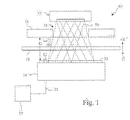
- a nuclear gauge 10 also known as a material sheet attribute detection system, of the present invention including a radiation source 12, a source aperture 14, a detector array 16, a material sheet 18 and a processor 20.
- Radiation source 12 is a element which generates radioactive particles or radiation energy due to radioactive decay or by way of energy stimulation. Radiation source 12 may be surrounded by a radiation absorbing or reflecting material with an opening on one side to thereby mainly emit radiation from one side of radiation source 12. Radiation source 12 may, for example, emit primarily beta particles or x-rays.
- Source aperture 14 includes an aperture 24 through which radiation emitted by radiation source 12 may pass through. Source aperture 14 is made from a material which will absorb or reflect radiation from radiation source 12. Aperture 24 can be closed and opened under command of processor 20 or another control mechanism.
- Detector array 16 is connected to processor 20 by way of communications link 22.
- Detector array 16 includes a detector window 28, and multiple individual detectors arrayed in a geometric pattern such as sensors S11, S12, S13, S21, S22, S23, S31, S32, and S33.
- Detector array 16 communicates to processor 20 the amount of radiation detected by each of sensors S11-S33.
- Detector array 16 is positioned in substantial alignment with radiation source 12 to thereby centrally locate sensor S22, so as to be substantially centered in radiation beam 26.
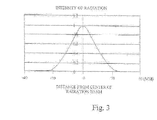
- the peak intensity of the radiation as represented in Fig. 3, is substantially directed toward sensor S22.
- Detector window 28 is substantially transparent to the radiation.
- Information or a signal from detector array 16 to processor 20 may be in the form of an analog signal or digital information, which may be in the form of a digital count that is representative of the amount of radiation detected by each of sensors S11-S33 from radiation source 12.
- Material sheet 18 is suspended between detector array 16 and the combination radiation source 12 and source aperture 14. Gap G, between source aperture 14 and detector window 28, is sufficiently wide that material sheet 18 does not touch either source aperture 14 or detector window 28.
- Material sheet 18 is typically a moving sheet of material such as paper, cardboard or a plastic. As material sheet 18 travels in a direction normal to radiation beam 26, a flutter movement in the +Z and -Z directions occurs. Sheet flutter in the ⁇ Z directions is caused by the geometries of moving material sheet 18 and may be induced by the velocity of material sheet 18, air currents, temperature and tensions on the sheet, etc. Such flutter movements can distort measurements of typical nuclear gauges.
- Processor 20 communicates with detector array 16 by way of communications link 22. Information and/or signals from detector array 16 are received by processor 20 and such information or signals is processed to remove lateral misalignment between radiation source 12 and detector array 16 in an X and Y direction. Also, processor 20 determines the varying position of material sheet 18 in gap G. Processor 20 may be connected to other control aspects of nuclear gauge 10 and display and record data from the operation thereof. In addition, processor 20 calculates the basis weight of material sheet 18 and detects variations therein as material sheet 18 travels through nuclear gauge 10.
- Radiation beam 26 is emitted from radiation source 12 through aperture 24 impacting material sheet 18 and at least some of the particles or radiation from radiation source 12 reaches detector array 16.
- Radiation beam 26 may be in the form of an energy and/or particle beam from radiation source 12 which travels in a substantially straight manner being somewhat directionally distorted by its encounter with material sheet 18.
- the amount of and manner of the distortion of radiation beam 26, as it interacts with material sheet 18, is dependent on many factors including the composition of material sheet 18, the relative thickness of material sheet 18, the Z positioning of material sheet 18 and the size of gap G.
- Figs. 4-6 there are shown variations in the location of radiation source 12 relative to source aperture 14.
- Fig. 4 there is shown a relatively focused radiation beam 26 entering aperture 24, traveling in a non-distorted manner to material sheet 18, where radiation beam 26 is somewhat effected by material sheet 18 causing a dispersion of radiation beam 26 over a wider area, represented here by incident beam width L1.
- incident beam width L1 As can be deduced from Fig. 4, movement of material sheet 18 in a +Z direction will cause the spreading of radiation beam 26 thereby widening incident beam width L1.
- incident beam width L1 decreases as its detected on detector array 16.
- incident beam width L1 decreases as its detected on detector array 16.
- incident beam width L1 decreases as its detected on detector array 16.
- Fig. 5 there is shown radiation source 12 positioned relatively close to source aperture 14 and aperture 24 is wider than is shown in Fig. 4, thereby allowing a more angularly dispersed radiation beam 26 to interact on a wider area of material sheet 18.
- This sort of geometry causes a somewhat narrowing of the radiation beam after it goes through material sheet 18.
- Radiation beam 26, as it impacts detector array 16, is distributed over incident beam width L2, which is somewhat narrower than the angle at which radiation beam 26 passes through source aperture 14.
- incident beam width L2 As material sheet 18 moves or flutters in gap G, variations of incident beam width L2 occur, for example, as material sheet 18 moves in a +Z direction, incident beam width L2 decreases in size. Conversely, movement of material sheet 18 in the -Z direction causes incident beam width L2 to increase in dimension.
- Fig. 6 there is shown a compromise in the positioning of radiation source 12 and the size of aperture 24 so as to minimize the angular distortion of radiation beam 26 as it encounters material sheet 18, so that fluctuations in incident beam width L3 due to the variation in the position, in the ⁇ Z direction, of material sheet 18 is reduced.
- the geometries of nuclear gauge 10, as shown in Figs. 4-6 are all sensitive to the flutter of material sheet 18 and to variations in lateral alignment in the gap position.
- Fig. 6 is a compromise that minimizes the effect of the flutter of material sheet 18, variations in the thickness and composition of material sheet 18 negatively effect the benefits of this compromise, in that such variations alter the deflection of radiation beam 26, thereby reducing the effectiveness of this sort of compromise.
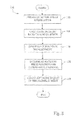
- process 100 which is an embodiment of a method of the present invention.
- the radiation detected by each of sensors S11-S33 are individually transferred to processor 20 by way of communications link 22.
- These communications can take the form of a digital transmission of a count detected by each of sensors S11-S33 as a digitized representation of the amount of particles or energy falling on sensors S11-S33 or as analog signals from sensors S11-S33.
- the information or signals received by processor 20 are then individually quantized for each of sensors S11-S33.
- a calculation is done to determine the beam width of the incident radiation on detector array 16.
- the assumption is that the radiation from radiation source 12 is substantially centered on sensor S22 with the peak of the radiation intensity, as illustrated in Fig. 3, substantially directed to the center of sensor S22.
- the geometries of the sensors allow two calculations to be made of the relative strength of the radiation as it impacts sensors located farther from sensor S22.
- an effective detected radiation at a radius from S22 can be calculated.
- An additional calculation utilizing sensors S11, S13, S31 and S33 provide a second relative radiation intensity at another average radius from the presumed center of the radiation intensity.
- the number of and positioning geometry of the sensors allows multiple calculation to establish the intensity and distribution of the radiation incident on detector array 16.
- the compensation for lateral misalignment at step 106 is accomplished by a portion of the denominator of the ratios R1 and R2, as shown above.
- ratios R1 and R2 depend on the size of gap G and the effect that the sheet position has on radiation beam 26. If gap G is fixed or determined by a measurement, then the values of ratios R1 and R2 can be used to determine the position of material sheet 18 and to thereby compensate the signals from detector array 16 for the effects that the variations, in the position of material sheet 18, can inflect in the signals.
- ratios R1 and R2 also depend on the basis weight of material sheet 18. With very low basis weights the effect of material sheet 18 is small. With the increasing basis weight of material sheet 18 the beam shape, but not the overall intensity, will rapidly approach an asymptotic value becoming only slightly dependent on basis weight for higher values. For extremely high basis weights, with a beta radiation source, the beam shape appears to start becoming wider. This effect is caused by the high amount of bremsstrahlung x-rays that are emitted when most of the beta radiation is absorbed.
- Fig. 7 The dependence of ratio R1 on the size of gap G and the position of material sheet 18 in a Z direction, is illustrated in Fig. 7 wherein there is illustrated the effect of different gap sizes and the position of material sheet 18 relative to source aperture 14. With a fixed or known distance for gap G it can be seen that the present invention can determine the position of material sheet 18 between radiation source 12 and detector array 16.
- R0 is the sum of the signals from all detector elements divided by the value of that same sum with nothing in the measurement gap. R0 is used to make the position measurement independent of the basis weight of material sheet 18. In this case third power polynomials are used to do this correction, but other similar functions may be utilized.
- the superscript T denotes a transposed matrix C is a 1x4 vector with the following elements: 1 (R1/R10-1) (R2/R20-1) (Z-Z0)
- the basis weight of material sheet 18 is calculated.
- radiation source 12 is from an x-ray source that essentially matrices A, C and D are equal to zero. Further, for the use of beta radiation, matrices A, C and D are needed to particularly compensate for variations in gap and paper position.
- a nuclear gauge 50 including a frame 52, a carriage 54, a carriage 56 and a drive mechanism 58.
- Drive mechanism 58 is interconnected to carriages 54 and 56 to move carriages 54 and 56 in a coordinated manner to keep radiation source 12 and source aperture 14 substantially aligned with detector array 16. Movements of carriages 54 and 56 are controlled in a bi-directional manner and are caused to move across material sheet 18 as material sheet 18 moves in a direction normal to Fig. 9.
- Nuclear gauge 50 thereby scans across the width of moving material sheet 18 obtaining information on a sampling basis as material sheet 18 moves through nuclear gauge 50.
- gap detection apparatus 60 and 62 also known as inductive devices 60 and 62, are positioned respectively on carriages 54 and 56.
- Inductive devices 60 and 62 are positioned to measure gap G and produce a gap signal which is proportional to the measured value.
- the gap signal is communicated to processor 20 thereby allowing processor 20 to utilize the aforementioned method to compensate for variations in gap G.
- Drive mechanism 58 moves carriages 54 and 56 along a substantial length of frame 52 along which there are unavoidable manufacturing variations, which induce some misalignment between radiation source 12 and detector array 16. These misalignments are compensated for by the present invention as described above.
- inductive devices 60 and 62 may be located directly on source aperture 14 and detector array 16 as shown in Fig. 1.
Landscapes
- Physics & Mathematics (AREA)
- Health & Medical Sciences (AREA)
- Life Sciences & Earth Sciences (AREA)
- Chemical & Material Sciences (AREA)
- Analytical Chemistry (AREA)
- Biochemistry (AREA)
- General Health & Medical Sciences (AREA)
- General Physics & Mathematics (AREA)
- Immunology (AREA)
- Pathology (AREA)
- Length-Measuring Devices Using Wave Or Particle Radiation (AREA)
- Measurement Of Radiation (AREA)
- Analysing Materials By The Use Of Radiation (AREA)
Applications Claiming Priority (2)
| Application Number | Priority Date | Filing Date | Title |
|---|---|---|---|
| US365339 | 2003-02-12 | ||
| US10/365,339 US6995372B2 (en) | 2003-02-12 | 2003-02-12 | Nuclear gauge for measuring a characteristic of a sheet material with sheet position and alignment compensation |
Publications (2)
| Publication Number | Publication Date |
|---|---|
| EP1447659A2 true EP1447659A2 (de) | 2004-08-18 |
| EP1447659A3 EP1447659A3 (de) | 2005-01-26 |
Family
ID=32681709
Family Applications (1)
| Application Number | Title | Priority Date | Filing Date |
|---|---|---|---|
| EP04100402A Ceased EP1447659A3 (de) | 2003-02-12 | 2004-02-04 | Kernstrahlungsmessgerät zum Bestimmen der Eigenschaft eines schichtförmigen Materials mit Kompensation von Änderungen der Schichtposition und der Ausrichtung |
Country Status (2)
| Country | Link |
|---|---|
| US (1) | US6995372B2 (de) |
| EP (1) | EP1447659A3 (de) |
Cited By (3)
| Publication number | Priority date | Publication date | Assignee | Title |
|---|---|---|---|---|
| WO2005012888A1 (en) * | 2003-07-28 | 2005-02-10 | Abb Inc. | System and method for measuring characteristics like the basis weight of a web using beta rays with correction as regards the composition of composition of the web |
| WO2006027090A1 (de) * | 2004-09-08 | 2006-03-16 | Mahlo Gmbh & Co. Kg | Vorrichtung und verfahren zum bestimmen des flächengewichtes einer geförderten materialprobe |
| CN104634796A (zh) * | 2014-12-11 | 2015-05-20 | 清华大学 | 用于集装箱或车辆检查系统的对准系统和对准方法 |
Family Cites Families (10)
| Publication number | Priority date | Publication date | Assignee | Title |
|---|---|---|---|---|
| US3373286A (en) * | 1964-09-18 | 1968-03-12 | Industrial Nucleonics Corp | Device for measuring the characteristics of a material moving on a conveyor with means for minimizing the effect of flutter |
| US4276480A (en) | 1979-09-28 | 1981-06-30 | Accuray Corporation | Sensor position independent material property determination using radiant energy |
| FI76435C (fi) | 1982-05-17 | 1988-10-10 | Measurex Corp | Maetanordning foer maetning av ett arkmaterial. |
| US5010766A (en) | 1989-11-30 | 1991-04-30 | Impact Systems, Inc. | Error compensation for measuring gauges |
| US5118940A (en) * | 1991-02-25 | 1992-06-02 | Jefferson Smurfit Corporation | Paper basis weight detector |
| US5233195A (en) | 1992-02-25 | 1993-08-03 | Abb Process Automation, Inc. | Methods and apparatus for measuring characteristics of moving webs |
| DE59308548D1 (de) * | 1993-06-07 | 1998-06-18 | Honeywell Ag | Vorrichtung zur Flächengewichtsmessung |
| US5714763A (en) * | 1996-03-25 | 1998-02-03 | Measurex Corporation | Method and apparatus for optical alignment of a measuring head in an X-Y plane |
| US6133578A (en) | 1998-07-07 | 2000-10-17 | Impact Systems, Inc. | Nuclear gauge for measuring a characteristic of moving sheet material and alignment compensation |
| DE19913929A1 (de) * | 1999-03-26 | 2000-09-28 | Voith Sulzer Papiertech Patent | Vorrichtung und Verfahren zum Bestimmen von Eigenschaften einer Materialbahn |
-
2003
- 2003-02-12 US US10/365,339 patent/US6995372B2/en not_active Expired - Fee Related
-
2004
- 2004-02-04 EP EP04100402A patent/EP1447659A3/de not_active Ceased
Cited By (5)
| Publication number | Priority date | Publication date | Assignee | Title |
|---|---|---|---|---|
| WO2005012888A1 (en) * | 2003-07-28 | 2005-02-10 | Abb Inc. | System and method for measuring characteristics like the basis weight of a web using beta rays with correction as regards the composition of composition of the web |
| US7005639B2 (en) | 2003-07-28 | 2006-02-28 | Abb Inc. | System and method of composition correction for beta gauges |
| WO2006027090A1 (de) * | 2004-09-08 | 2006-03-16 | Mahlo Gmbh & Co. Kg | Vorrichtung und verfahren zum bestimmen des flächengewichtes einer geförderten materialprobe |
| CN104634796A (zh) * | 2014-12-11 | 2015-05-20 | 清华大学 | 用于集装箱或车辆检查系统的对准系统和对准方法 |
| US9910184B2 (en) | 2014-12-11 | 2018-03-06 | Tsinghua University | Alignment system and method for container or vehicle inspection system |
Also Published As
| Publication number | Publication date |
|---|---|
| US6995372B2 (en) | 2006-02-07 |
| US20040155196A1 (en) | 2004-08-12 |
| EP1447659A3 (de) | 2005-01-26 |
Similar Documents
| Publication | Publication Date | Title |
|---|---|---|
| US6839406B2 (en) | Apparatus and method for detecting items in objects | |
| US6542578B2 (en) | Apparatus for determining the crystalline and polycrystalline materials of an item | |
| CA1076712A (en) | Self-compensating x-ray or gamma ray thickness gauge | |
| US6483894B2 (en) | Apparatus and method for adjusting a collimator | |
| EP3397953B1 (de) | Referenzdetektor zur korrektur von fluktuationen in der dosis und energie von röntgenstrahlenquellen | |
| US5714763A (en) | Method and apparatus for optical alignment of a measuring head in an X-Y plane | |
| US4678915A (en) | System and process for measuring and correcting the values of a parameter of a sheet material | |
| US9612213B2 (en) | Automatic z-correction for basis weight sensors | |
| WO1991019189A1 (en) | An apparatus and method for nondestructively determining the dimensional changes of an object as a function of temperature | |
| JP2000039408A (ja) | 移動する製紙材料のウェブの特性を測定する装置、およびマルチセグメントのプレ―ナ形検出器 | |
| US6995372B2 (en) | Nuclear gauge for measuring a characteristic of a sheet material with sheet position and alignment compensation | |
| CA2122067A1 (fr) | Procede et dispositif d'etalonnage pour un ensemble de mesure du profil transversal d'epaisseur d'un produit plat | |
| US7242747B2 (en) | Method for determining a gsm substance and/or a chemical composition of a conveyed material sample, and a device for this purpose | |
| JPH09502014A (ja) | 単位面積当りの重量を測定する装置 | |
| EP1660873B1 (de) | System und verfahren zur messung von eigenschaften, wie flächengewicht einer bahn, unter verwendung von betastrahlen mit korrektur bezüglich der zusammensetzung der bahn | |
| EP1486784B1 (de) | Sensor mit Selbstkompensation der Ausrichtung | |
| JP4983366B2 (ja) | シート物理量測定装置 | |
| JPH05149775A (ja) | 放射線応用測定装置 | |
| JPH06167327A (ja) | キャンバ測定方法 | |
| JPH11281339A (ja) | コンプトン散乱による板厚測定装置 | |
| JPH0626917A (ja) | 坪量測定装置 | |
| JP2501819Y2 (ja) | 放射線応用測定装置 | |
| JPH0219753A (ja) | 放射線応用測定装置 | |
| JPH05232237A (ja) | 放射線応用測定装置 | |
| JPH03167447A (ja) | 放射線応用測定装置 |
Legal Events
| Date | Code | Title | Description |
|---|---|---|---|
| PUAI | Public reference made under article 153(3) epc to a published international application that has entered the european phase |
Free format text: ORIGINAL CODE: 0009012 |
|
| AK | Designated contracting states |
Kind code of ref document: A2 Designated state(s): AT BE BG CH CY CZ DE DK EE ES FI FR GB GR HU IE IT LI LU MC NL PT RO SE SI SK TR |
|
| AX | Request for extension of the european patent |
Extension state: AL LT LV MK |
|
| PUAL | Search report despatched |
Free format text: ORIGINAL CODE: 0009013 |
|
| AK | Designated contracting states |
Kind code of ref document: A3 Designated state(s): AT BE BG CH CY CZ DE DK EE ES FI FR GB GR HU IE IT LI LU MC NL PT RO SE SI SK TR |
|
| AX | Request for extension of the european patent |
Extension state: AL LT LV MK |
|
| RIC1 | Information provided on ipc code assigned before grant |
Ipc: 7G 01G 9/00 B Ipc: 7G 01N 23/16 A |
|
| 17P | Request for examination filed |
Effective date: 20050726 |
|
| AKX | Designation fees paid |
Designated state(s): AT BE BG CH CY CZ DE DK EE ES FI FR GB GR HU IE IT LI LU MC NL PT RO SE SI SK TR |
|
| RAP1 | Party data changed (applicant data changed or rights of an application transferred) |
Owner name: VOITH PATENT GMBH |
|
| STAA | Information on the status of an ep patent application or granted ep patent |
Free format text: STATUS: THE APPLICATION HAS BEEN REFUSED |
|
| 18R | Application refused |
Effective date: 20091202 |