EP1447758A2 - Auf dem Kontext basierende Anzeigetechnik - Google Patents
Auf dem Kontext basierende Anzeigetechnik Download PDFInfo
- Publication number
- EP1447758A2 EP1447758A2 EP04250749A EP04250749A EP1447758A2 EP 1447758 A2 EP1447758 A2 EP 1447758A2 EP 04250749 A EP04250749 A EP 04250749A EP 04250749 A EP04250749 A EP 04250749A EP 1447758 A2 EP1447758 A2 EP 1447758A2
- Authority
- EP
- European Patent Office
- Prior art keywords
- icon
- icons
- matrix
- processor
- database
- Prior art date
- Legal status (The legal status is an assumption and is not a legal conclusion. Google has not performed a legal analysis and makes no representation as to the accuracy of the status listed.)
- Withdrawn
Links
Images




Classifications
-
- G—PHYSICS
- G06—COMPUTING OR CALCULATING; COUNTING
- G06F—ELECTRIC DIGITAL DATA PROCESSING
- G06F16/00—Information retrieval; Database structures therefor; File system structures therefor
- G06F16/90—Details of database functions independent of the retrieved data types
- G06F16/903—Querying
- G06F16/9038—Presentation of query results
-
- G—PHYSICS
- G06—COMPUTING OR CALCULATING; COUNTING
- G06F—ELECTRIC DIGITAL DATA PROCESSING
- G06F16/00—Information retrieval; Database structures therefor; File system structures therefor
- G06F16/20—Information retrieval; Database structures therefor; File system structures therefor of structured data, e.g. relational data
- G06F16/24—Querying
- G06F16/242—Query formulation
- G06F16/2428—Query predicate definition using graphical user interfaces, including menus and forms
-
- G—PHYSICS
- G06—COMPUTING OR CALCULATING; COUNTING
- G06F—ELECTRIC DIGITAL DATA PROCESSING
- G06F16/00—Information retrieval; Database structures therefor; File system structures therefor
- G06F16/20—Information retrieval; Database structures therefor; File system structures therefor of structured data, e.g. relational data
- G06F16/24—Querying
- G06F16/245—Query processing
- G06F16/2457—Query processing with adaptation to user needs
- G06F16/24575—Query processing with adaptation to user needs using context
-
- G—PHYSICS
- G06—COMPUTING OR CALCULATING; COUNTING
- G06F—ELECTRIC DIGITAL DATA PROCESSING
- G06F16/00—Information retrieval; Database structures therefor; File system structures therefor
- G06F16/90—Details of database functions independent of the retrieved data types
- G06F16/904—Browsing; Visualisation therefor
Definitions
- Computer databases are increasingly being used to store information. Unfortunately, it can often be difficult for a user to quickly obtain information relating to the content stored in a database.
- Typical database user interfaces require a user to enter a search string and, after a search of the database has been performed, a list of elements that contain the search string is displayed to the user.
- the search process can be time-consuming and a user may be forced to perform several searches before obtaining a small enough list of elements that can be read by the user.
- the user has no way of knowing how the particular elements are distributed within the database. Stated another way, list-based result presentations do not . provide the user with context of the elements within the database, i.e., the interrelated conditions in which the elements in the database exist. For example, the user may not know that there is a relatively large number of elements listed under one subject and a relatively small number of elements listed under another related subject Without this information, the user is unable to optimize the search process.
- One aspect of the present invention provides a graphical user interface for rapidly viewing and searching a database or other collection of digital assets.
- the graphical user interface is implemented through a computer system, including a display and a user selection device.
- Information about the database is displayed in a matrix form presented to the user in at least one matrix area on the display.
- the matrix preferably includes a number of cells.
- the matrix also includes row headings and column headings, the row headings preferably indicating one attribute of the elements and the column headings preferably indicating another attribute of the elements.
- Within each cell is displayed one or more icons, such as a small square, dot or other symbol, corresponding to an element of information in the database.
- the database elements may be text excerpts, graphic files or other media.
- the icons displayed within the matrix cells may have visually perceptible attributes to indicate, for example, whether or not a user has already viewed a particular excerpt in the database.
- the number of icons within each cell visually indicates to the user the number of database elements that correspond to a particular combination of element attributes. Because a large number of cells and constituent icons may be presented in this manner, a user of the display is provided with an overall context of the elements in the database, which context is helpful in aiding the user's understanding of the contents of the database. As a user activates the user selection device to move a graphic pointer over a particular icon, data or information associated with an element corresponding to the icon is quickly shown on the display.
- the associated data or information may comprise text or other information intrinsic to the element as well as text or other information from elements related to the selected element.
- the user interface also preferably includes a search function, which permits the user to enter a search string and, in response, the icons corresponding to database elements containing the search string are modified in a visually perceptible manner to indicate to the user which database elements are responsive to the user's search.
- a content translator preferably retrieves content from various sources, which may communicate with the translator over a local or wide area network, such as the Internet.
- the sources may include a news feed and a general database.
- the content translator generates an element database, which preferably contains elements that all have a common format
- a content editor may also be provided to permit a user to edit or create content to be added to the element database.
- a compilation translator processes the element database to create an element library.
- a compiler/linker compiles the element library and source code to create an executable file which, when executed, provides a user interface for rapidly viewing and searching a database. Because the element library is compiled with the source code, retrieval and searching of desired elements in the database may occur much more rapidly than would otherwise be attainable with prior-art compilation systems and methods.
- the user interface preferably includes a heads-up display (HUD) feature that is used to display an element on top of the matrix without obscuring the matrix itself.
- HUD heads-up display
- the user may vary the HUD's opacity from perfectly opaque through translucent to perfectly transparent.
- the HUD allows the user to see both an element's information and the context in which that element occurs.
- the user interface may include a rectangular "fish eye" magnification function that allows the user to smoothly magnify one part of the matrix while shrinking ⁇ yet not obscuring ⁇ other parts of the matrix. Magnification allows the user to focus on one part of the matrix while retaining the context in which it appears.
- Other techniques in addition to variations in opacity or magnification may be used to adjust the perceived dimensions of certain portions of the matrix.
- the user interface preferably includes two search functions.
- the user may select one or more aspects of information from elements related to the current element, thereby highlighting all of the elements that share that aspect
- an element that represents a motion picture might include a plot summary (which is intrinsic to the element) and a list of cast members (which is not). The cast members serve to relate motion pictures to one another.
- This particular search might take the form of selecting a cast member, which would highlight on the display all of the motion pictures in which that cast member has appeared Selecting one of the motion pictures might in turn highlight all of the actors who appeared in it Because it supports following the network of connections that relate elements to one another, this type of search is called "navigation.”
- the second type of search entails locating an element or elements without necessarily knowing any of its connecting elements.
- This type of search uses the intrinsic properties of an element ⁇ in the present embodiment, an actor or a movie ⁇ to locate that element
- a search for "Kevin Bacon” might discover the element representing the actor "Kevin Bacon.”
- a search for the words “bugs bunny” might locate all of the movies in which ''bugs bunny" appears in the title or summary.
- this type of search is called a "keyword search.” Because the overall context of the database is visible regardless of the operations performed by users, the present invention allows users to gain greater understanding of the contents of a database.
- Computer 100 includes a central processor 110, a system memory 112 and a system bus 114 that couples various system components including the system memory 112 to the central processor unit 110.
- System bus 114 may be any of several types of bus structures including a memory bus or memory controller, a peripheral bus, and a local bus using any of a variety of bus architectures.
- the structure of system memory 112 is well known to those skilled in the art and may include a basic input/output system (BIOS) stored in a read only memory (ROM) and one or more program modules such as operating systems, application programs and program data stored in random access memory (RAM).
- BIOS basic input/output system
- ROM read only memory
- RAM random access memory
- Computer 100 may also include a variety of interface units and drives for reading and writing data.
- computer 100 includes a hard disk interface 116 and a removable memory interface 120 respectively coupling a hard disk drive 118 and a removable memory drive 122 to system bus 114.
- removable memory drives include magnetic disk drives and optical disk drives.
- the drives and their associated computer-readable media, such as a floppy disk 124 provide nonvolatile storage of computer readable instructions, data structures, program modules and other data for computer 100.
- a single hard disk drive 118 and a single removable memory drive 122 are shown for illustration purposes only and with the understanding that computer 100 may include several of such drives.
- computer 100 may include drives for interfacing with other types of computer readable media.
- FIG. 1 shows a serial port interface 126 coupling a keyboard 128 and a pointing device 130 to system bus 114.
- Pointing device 128 may be implemented with a mouse, track ball, pen device, or similar device.
- one or more other input devices such as a joystick, game pad, satellite dish, scanner, touch sensitive screen or the like may be connected to computer 100.
- Computer 100 may include additional interfaces for connecting devices to system bus 114.
- Figure 1 shows a universal serial bus (USB) interface 132 coupling a video or digital camera 134 to system bus 114.
- An IEEE 1394 interface 136 may be used to couple additional devices to computer 100.
- interface 136 may be configured to operate with particular manufacturer interfaces such as FireWire developed by Apple Computer and i.Link developed by Sony.
- Input devices may also be coupled to system bus 114 through a parallel port, a game port, a PCI board or any other interface used to couple an input device to a computer.
- Sound can be recorded and reproduced with a microphone 144 and a speaker 166.
- a sound card 148 may be used to couple microphone 144 and speaker 146 to system bus 114.
- the device connections shown in Figure 1 are for illustration purposes only and that several of the peripheral devices could be coupled to system bus 114 via alternative interfaces
- video camera 134 could be connected to IEEE 1394 interface 136 and pointing device 130 could be connected to USB interface 132.
- a wide area network (WAN) 154 such as the Internet, can also be accessed by computer 100.
- Figure 1 shows a modem unit 156 connected to serial port interface 126 and to WAN 154.
- Modem unit 156 may be located within or external to computer 100 and may be any type of conventional modem such as a cable modem or a satellite modem.
- LAN 152 may also be used to connect to WAN 154.
- Figure 1 shows a router 158 that may connect LAN 152 to WAN 154 in a conventional manner.
- network connections shown are exemplary and other ways of establishing a communications link between the computers can be used.
- the existence of any of various well-known protocols, such as TCP/IP, Frame Relay, Ethernet, FTP, HTTP and the like, is presumed, and computer 100 can be operated in a client-server configuration to permit a user to retrieve web pages from a web-based server.
- any of various conventional web browsers can be used to display and manipulate data on web pages.
- the operation of computer 100 can be controlled by a variety of different program modules.
- program modules are routines, programs, objects, components, data structures, etc., that perform particular tasks or implement particular abstract data types.
- the present invention may also be practiced with other computer system configurations, including hand-held devices, multiprocessor systems, microprocessor-based or programmable consumer electronics, network PCs, minicomputers, mainframe computers, personal digital assistants and the like.
- the invention may also be practiced in distributed computing environments where tasks are performed by remote processing devices that are linked through a communications network.
- program modules may be located in both local and remote memory storage devices.
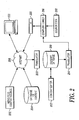
- the present invention may be used with a variety of different news feeds, databases, web sites or other sources of content.
- the content transmitted by news feed 202 and database 204 may be in a variety of different formats and may include a variety of different computer coding.
- news feed 202 may transmit a story that is marked up with a markup language such as HTML, while database 204 may transmit a story in WordPerfect format
- Translator 208 receives the content transmitted from news feed 202 and database 204 and produces excerpts that may be stored in an excerpt database 210.
- Translator 208 operates in a conventional manner that is well-known to those skilled in the art.
- translator 208 may perform functions such as stripping computer code, truncating articles, identifying fields such as title and author and removing double carnage returns. While Figure 2 shows a single translator 208, a separate translator may be included for each source of content. Of course, some sources of content may use the same translator.
- a content editor 212 may also be used to edit content in database 210.
- content editor 212 may be implemented with a database editor such as Microsoft Access.
- content editor 212 can be used to enter information that is particularly relevant to employees of enterprise, such as confidential enterprise information.
- all of the excerpts included in database 210 have a common format Fields such as the t itle, d ate, source and a uthor of each excerpt may be identified.
- the fields may be identified by listing them in a predetermined order, including the fields between appropriate tags of a markup language or any other manner that identifies each field.
- each excerpt may be formatted to not exceeda predetermined length.
- a compilation translator 214 retrieves excerpts from excerpt database 210 and creates a large file or files containing a large number of excerpts.
- compilation translator 214 creates a C++ library file that essentially contains a data structure of a large number of excerpts. The use of the resulting library file will be described in detail below.
- a compiler/linker 216 receives a library file created by translator 214 and source code 218.
- Compiler/linker 216 may be installed on a computer (not shown) and the computer may be programmed to retrieve the library file in response to a command from a user or without a command from the user.
- Source code 218 may be a C++ program that contains computer executable instructions for creating a matrix database.
- Source code 218 may be configured to operate with a variety of different library files so that the configuration of source code 218 is independent of the library file created by translator 214.
- Compiler/linker 216 may create an executable file in a conventional well-known manner.
- the executable file may be transmitted to a router 220 and then to wide area network 206. Finally, the executable file may be transmitted from wide area network 206 to a computer terminal 222. Of course, the executable file does not have to be transmitted through wide area network 206.
- computer terminal 222 may be connected to compiler/linker 216 by a local area network (LAN).
- the output of compiler/linker 216 may also be stored on a computer readable medium, such as a floppy disk, that may be used to transfer computer executable instructions to computer terminal 222.
- a single executable file allows for faster searching by a user. There is no need for the executable file to read a linked library and index the library before performing a search.
- the matrix database stored on computer terminal 222 may be updated periodically. There are number of different methods that may be used to update the matrix database.
- computer terminal 222 is programmed to periodically obtain new matrix databases from WAN 206. The determination as to when to update the matrix database may be based on factors such as the time since the last update and the amount o f content that has been accessed by a user. In an alternative embodiment, the user may be provided with an option of manually requesting an updated matrix database from WAN 206.
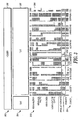
- Figure 3 shows a graphical user interface that can be used to select content in accordance with one embodiment of the invention.
- a list of content sources are shown in column 302 and a list of topics are shown in row 304.
- other indices such as publish date and author could be mapped to the axes.
- a user may use arrow keys or a pointing device, such as a mouse, to position a cursor over one of the squares shown in grid 306.
- Each square shown in grid 306 represents different pieces of content, such as an excerpt of an article.
- one of the advantages of the present invention is that it allows the user to see a representation of all of the data included in the database and the distribution of data in that database, i.e., the context of the element of the database.
- block 308 includes four entries, which informs the user that there are four articles relating to the topic eCommerce from the source Product Reports.
- the color of each of the entries included within a block may also convey information to the user. For example, one color or shade may represent an article that has not been read by a user and another color or shade may represent articles that have been read by the user.
- translator 208 identifies predetermined fields for each article, such as the title, author and date of publication.
- the interface shown in Figure 3 places the identified fields in predetermined locations.
- the source of the article may be positioned in a source location 310
- the date of publication may be located in a date location 312
- the title may be positioned in the title location 314.
- the actual excerpt may be displayed in an excerpt section 316.
- the user may press a key or select a button with a pointing device to expand the excerpt over the section where grid 306 is shown.
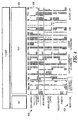
- Figure 4 illustrates how the present invention can be used to search a database.
- the user can enter a search string in a search entry section 402.
- the entries in grid 306 may change color to indicate whether or not the corresponding excerpt contains such a string.
- the light colored boxes correspond to articles that contain words with the letters "ele.”
- the sections of excerpt 404 that contain the letters "ele" may be highlighted
- the user is able to retrieve an instant indication of the number of articles that contain the search string.
- One of the advantages of this type of interface is that it allows the user to instantly determine whether or not additional letters should be entered to narrow the search.
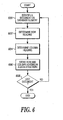
- Figure 6 illustrates an exemplary method of generating the data for the matrix.
- This method can be automated if, for example, the documents or other database elements are indexed Suitable indexes include, but are not limited, to field tags or field deliminators/symbols. Otherwise, the method can be manually implemented. Irrespective of whether the method is automated or manually implemented, an artisan can use the same steps.
- a document is identified in step 600.
- a determination is made in step 602 as to the appropriate row heading for the document. This row heading could, for example, correspond to the source of the document.
- Any data structure, database system, array, or pointer-based system could be used to store the row and column-heading categorizations for the documents or database elements.
- a sample data structure could be the C++ data structure shown below.
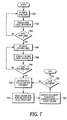
- Figure 7 illustrates an exemplary method of displaying the matrix.
- the array of row labels or headings for the matrix could be displayed on the screen This could occur in step 700 by retrieving the first row label (i.e. RowLabels[0]) from the array storing the row labels.
- the row label could then be displayed in step 702.
- the process could repeat until either all row labels are displayed or insufficient room remains on the screen to display all row labels.
- the first column label i.e. ColumnLabels[0]
- the column label would be displayed in step 708 and the process could repeat until all column labels are displayed or insufficient room remains on the screen to display all column labels 710.
- the row and column labels might only be displayed when a mouse or user-selection device is located over a corresponding document. For example, when a user positions a cursor over the icon for the "Directing Integration: Directories for the Masses," the "Arch & Sys Dev" column label and/or in the "Analyst Reports" row label might only be displayed Or, the row labels might always be displayed, and only column label would be displayed that corresponds to the document icon over which the cursor is currently position. Any variation of these is contemplated and within the scope of the invention.
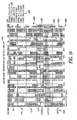
- a matrix 1000 comprising a plurality of cells 1002, each cell comprising zero or more icons 1004, is illustrated. As described above, each row of cells has a row label or heading 1008 associated therewith, and each column of cells likewise has a column label or heading 1008 associated therewith.
- the particular forms of the matrix 1000, cells 1002 and icons 1004 are a matter of design choice and the present invention is not limited in this regard. Nevertheless, in a presently preferred embodiment, the matrix 1000 comprises a rectangular array of rectangular cells 1002.
- movies database 806 While these are in and of themselves relatively simple illustrations of the information contained in movies database 806, they also constitute a representative and easily-apprehended characterization of all of the movie data in movies database 806. As such, they serve as an excellent "backdrop" or context on which to show the results of various kinds of queries.
- each icon is displayed without any textual identifying indicia.
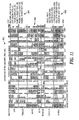
- data or information 1010, 1012 regarding the database element (movie) corresponding to the currently selected icon may be displayed in addition to the matrix 1000.
- information regarding the cast 1010 of a given movie may be displayed along with the title 10 12 of the movie.
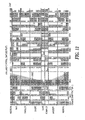
- FIG 12 A further example of highlighting is illustrated in Figure 12 where even greater use of so-called "heads-up" display capability of the present invention is employed.
- a textual listing 1102 of the search results is provided along with highlighted icons 1104 corresponding to the search results.
- the matrix 1200 is "dimmed” to a low level of color saturation while translucent text (in this case, the selected movie's plot summary) is superimposed without entirely obscuring the icons beneath.
- translucent text in this case, the selected movie's plot summary
- FIG. 13 Yet another technique for focusing attention on a certain portion of the matrix while retaining the overall context of the displayed elements is illustrated in Figure 13.
- various elements of the graphical user interface are "warped" such that a selected portion of the matrix appears magnified.
- a selected cell 1302 is appears magnified as well as the icons inside it.
- all of the other cells in the matrix have been warped (either vertically or horizontally) to make room for it.
- the warped cells preserve their icons, thereby letting the system simultaneously provide both detail (i.e., the icons in the magnified cell) and context (i.e., all of the other icons in the matrix) of the database.
- the other techniques described above for focusing attention to individual icons such as changes in opacity or size, may be employed in addition to the magnification technique shown in Figure 13.
Landscapes
- Engineering & Computer Science (AREA)
- Theoretical Computer Science (AREA)
- Databases & Information Systems (AREA)
- Physics & Mathematics (AREA)
- Data Mining & Analysis (AREA)
- General Engineering & Computer Science (AREA)
- General Physics & Mathematics (AREA)
- Computational Linguistics (AREA)
- Human Computer Interaction (AREA)
- Mathematical Physics (AREA)
- User Interface Of Digital Computer (AREA)
Applications Claiming Priority (2)
| Application Number | Priority Date | Filing Date | Title |
|---|---|---|---|
| US361988 | 1999-07-28 | ||
| US10/361,988 US20040139100A1 (en) | 2001-04-02 | 2003-02-11 | Context-based display technique |
Publications (2)
| Publication Number | Publication Date |
|---|---|
| EP1447758A2 true EP1447758A2 (de) | 2004-08-18 |
| EP1447758A3 EP1447758A3 (de) | 2006-03-22 |
Family
ID=32681681
Family Applications (1)
| Application Number | Title | Priority Date | Filing Date |
|---|---|---|---|
| EP04250749A Withdrawn EP1447758A3 (de) | 2003-02-11 | 2004-02-11 | Auf dem Kontext basierende Anzeigetechnik |
Country Status (2)
| Country | Link |
|---|---|
| US (1) | US20040139100A1 (de) |
| EP (1) | EP1447758A3 (de) |
Cited By (5)
| Publication number | Priority date | Publication date | Assignee | Title |
|---|---|---|---|---|
| WO2006037654A1 (en) | 2004-10-08 | 2006-04-13 | Accenture Global Services Gmbh | Context-based display technique with hierarchical display format |
| WO2006053266A3 (en) * | 2004-11-10 | 2007-02-01 | Apple Computer | Highlighting items for search results |
| WO2007026150A2 (en) | 2005-08-30 | 2007-03-08 | Affle Limited | Online search system, method and computer program |
| WO2010106049A2 (en) | 2009-03-17 | 2010-09-23 | Fachhochschule Der Wirtschaft | Method and device for the context-driven integration of context-variable systems into process sequences |
| US8086489B2 (en) * | 2005-04-26 | 2011-12-27 | Affle Limited | Method and apparatus to provide information and consumer-acceptable advertising via data communications clients |
Families Citing this family (14)
| Publication number | Priority date | Publication date | Assignee | Title |
|---|---|---|---|---|
| US20050108749A1 (en) * | 2003-11-17 | 2005-05-19 | Sony Corporation, A Japanese Corporation | Automatic content display apparatus and method |
| US20050108755A1 (en) * | 2003-11-17 | 2005-05-19 | Sony Corporation, A Japanese Corporation | Multi-source programming guide apparatus and method |
| US8024755B2 (en) * | 2003-11-17 | 2011-09-20 | Sony Corporation | Interactive program guide with preferred items list apparatus and method |
| US20050108750A1 (en) * | 2003-11-17 | 2005-05-19 | Sony Corporation, A Japanese Corporation | Candidate data selection and display apparatus and method |
| US7315988B2 (en) * | 2004-02-02 | 2008-01-01 | International Business Machines Corporation | System and method for using short captions to map user interfaces |
| US7516414B2 (en) * | 2004-02-02 | 2009-04-07 | International Business Machines Corporation | System and method for tab order mapping of user interfaces |
| US7853585B2 (en) * | 2005-03-17 | 2010-12-14 | International Business Machines Corporation | Monitoring performance of a data processing system |
| US8327297B2 (en) * | 2005-12-16 | 2012-12-04 | Aol Inc. | User interface system for handheld devices |
| US8073830B2 (en) * | 2006-03-31 | 2011-12-06 | Google Inc. | Expanded text excerpts |
| US8693842B2 (en) | 2011-07-29 | 2014-04-08 | Xerox Corporation | Systems and methods for enriching audio/video recordings |
| US20140372419A1 (en) * | 2013-06-13 | 2014-12-18 | Microsoft Corporation | Tile-centric user interface for query-based representative content of search result documents |
| US20160026341A1 (en) * | 2014-07-22 | 2016-01-28 | Igor Kraev | Matrix interface for enabling access to digital content |
| US10377212B2 (en) * | 2017-08-11 | 2019-08-13 | The Boeing Company | Dynamic anti-glare system for a windshield of a vehicle |
| EP3935521A4 (de) * | 2019-03-05 | 2022-10-19 | Services Pétroliers Schlumberger | Kuratierung und graphische darstellung unstrukturierter daten basierend auf analytik |
Family Cites Families (11)
| Publication number | Priority date | Publication date | Assignee | Title |
|---|---|---|---|---|
| US5742271A (en) * | 1993-11-11 | 1998-04-21 | Seiko Epson Corporaiton | Matrix type display device, electronic system including the same and method of driving such a display device |
| US5544354A (en) * | 1994-07-18 | 1996-08-06 | Ikonic Interactive, Inc. | Multimedia matrix architecture user interface |
| US5650800A (en) * | 1995-05-15 | 1997-07-22 | Inelec Corporation | Remote sensor network using distributed intelligent modules with interactive display |
| US6327395B1 (en) * | 1996-12-20 | 2001-12-04 | Xerox Parc | Glyph address carpet methods and apparatus for providing location information in a multidimensional address space |
| US6594406B1 (en) * | 1996-12-20 | 2003-07-15 | Xerox Corporation | Multi-level selection methods and apparatus using context identification for embedded data graphical user interfaces |
| JPH11203402A (ja) * | 1998-01-16 | 1999-07-30 | Canon Inc | 画像処理装置及び画像処理方法 |
| JP2000048087A (ja) * | 1998-07-15 | 2000-02-18 | Internatl Business Mach Corp <Ibm> | ビュー合成システム |
| US7047242B1 (en) * | 1999-03-31 | 2006-05-16 | Verizon Laboratories Inc. | Weighted term ranking for on-line query tool |
| US6826559B1 (en) * | 1999-03-31 | 2004-11-30 | Verizon Laboratories Inc. | Hybrid category mapping for on-line query tool |
| US8341194B2 (en) * | 2001-04-02 | 2012-12-25 | Accenture Global Services Limited | Matrix-based user interface and system for creating the same |
| US7209906B2 (en) * | 2002-01-14 | 2007-04-24 | International Business Machines Corporation | System and method for implementing a metrics engine for tracking relationships over time |
-
2003
- 2003-02-11 US US10/361,988 patent/US20040139100A1/en not_active Abandoned
-
2004
- 2004-02-11 EP EP04250749A patent/EP1447758A3/de not_active Withdrawn
Cited By (19)
| Publication number | Priority date | Publication date | Assignee | Title |
|---|---|---|---|---|
| US7457818B2 (en) | 2001-04-02 | 2008-11-25 | Accenture Global Services Gmbh | Context-based display technique with hierarchical display format |
| US7054878B2 (en) | 2001-04-02 | 2006-05-30 | Accenture Global Services Gmbh | Context-based display technique with hierarchical display format |
| WO2006037654A1 (en) | 2004-10-08 | 2006-04-13 | Accenture Global Services Gmbh | Context-based display technique with hierarchical display format |
| US10635683B2 (en) | 2004-11-10 | 2020-04-28 | Apple Inc. | Highlighting items for search results |
| US11500890B2 (en) | 2004-11-10 | 2022-11-15 | Apple Inc. | Highlighting icons for search results |
| US12182146B2 (en) | 2004-11-10 | 2024-12-31 | Apple Inc. | Highlighting icons for search results |
| US8607162B2 (en) | 2004-11-10 | 2013-12-10 | Apple Inc. | Searching for commands and other elements of a user interface |
| US9659069B2 (en) | 2004-11-10 | 2017-05-23 | Apple Inc. | Highlighting items for search results |
| US8677274B2 (en) | 2004-11-10 | 2014-03-18 | Apple Inc. | Highlighting items for search results |
| US7979796B2 (en) | 2004-11-10 | 2011-07-12 | Apple Inc. | Searching for commands and other elements of a user interface |
| CN101057239B (zh) * | 2004-11-10 | 2012-04-25 | 苹果公司 | 增亮用于搜索结果的项的方法和装置 |
| WO2006053266A3 (en) * | 2004-11-10 | 2007-02-01 | Apple Computer | Highlighting items for search results |
| US8086489B2 (en) * | 2005-04-26 | 2011-12-27 | Affle Limited | Method and apparatus to provide information and consumer-acceptable advertising via data communications clients |
| US8452745B2 (en) | 2005-08-30 | 2013-05-28 | Affle Holdings Pte. Ltd. | Online search system, method and computer program |
| WO2007026150A3 (en) * | 2005-08-30 | 2007-05-24 | Affle Ltd | Online search system, method and computer program |
| WO2007026150A2 (en) | 2005-08-30 | 2007-03-08 | Affle Limited | Online search system, method and computer program |
| DE102009013213B4 (de) * | 2009-03-17 | 2011-06-22 | eck*cellent IT GmbH, 38122 | Verfahren und Vorrichtung zur kontext-getriebenen Integration kontext-variabler Systeme in Prozessabläufe |
| DE102009013213A1 (de) | 2009-03-17 | 2011-01-05 | Eck*Cellent It Gmbh | Verfahren und Vorrichtung zur kontext-getriebenen Integration kontext-variabler Systeme in Prozessabläufe |
| WO2010106049A2 (en) | 2009-03-17 | 2010-09-23 | Fachhochschule Der Wirtschaft | Method and device for the context-driven integration of context-variable systems into process sequences |
Also Published As
| Publication number | Publication date |
|---|---|
| EP1447758A3 (de) | 2006-03-22 |
| US20040139100A1 (en) | 2004-07-15 |
Similar Documents
| Publication | Publication Date | Title |
|---|---|---|
| US7457818B2 (en) | Context-based display technique with hierarchical display format | |
| EP1447758A2 (de) | Auf dem Kontext basierende Anzeigetechnik | |
| US7770123B1 (en) | Method for dynamically generating a “table of contents” view of a HTML-based information system | |
| US10706091B2 (en) | User driven computerized selection, categorization, and layout of live content components | |
| US6897885B1 (en) | Invisible link visualization method and system in a hyperbolic space | |
| US7721192B2 (en) | User interface for a resource search tool | |
| US7840524B2 (en) | Method and apparatus for indexing, searching and displaying data | |
| KR100953806B1 (ko) | 어플리케이션 및 사용자에게 공지되는 사용자 인터페이스엘리먼트들을 형성하기 위한 시스템 및 방법 | |
| EP0317479B1 (de) | Flexible mitlaufende Informationseinrichtung und -methode für Datenverarbeitungseinheiten | |
| US6085187A (en) | Method and apparatus for navigating multiple inheritance concept hierarchies | |
| KR100341339B1 (ko) | 디스플레이 스크린 크기 및 윈도우 크기와 관련된 웹 페이지 적응 시스템 | |
| US6584469B1 (en) | Automatically initiating a knowledge portal query from within a displayed document | |
| US6262729B1 (en) | Method and apparatus for binding user interface objects to application objects | |
| US5615325A (en) | Graphical viewer for heirarchical datasets | |
| US8799323B2 (en) | Method and apparatus for displaying data stored in linked nodes | |
| US5675753A (en) | Method and system for presenting an electronic user-interface specification | |
| US20010047373A1 (en) | Publication file conversion and display | |
| US20130262968A1 (en) | Apparatus and method for efficiently reviewing patent documents | |
| US20050278698A1 (en) | Multi-window based graphical user interface (GUI) for web applications | |
| US6433797B1 (en) | Method and apparatus for generating a tab list menu in a hierarchical menu structure | |
| US6567801B1 (en) | Automatically initiating a knowledge portal query from within a displayed document | |
| US7519617B2 (en) | Dynamic personalized information organizer | |
| US8341194B2 (en) | Matrix-based user interface and system for creating the same | |
| EP0926610A1 (de) | Umwandlung und Anzeige von Publikationsdateien | |
| Rowley | Human/computer interface design in Windows-based CD-ROMs: an early review |
Legal Events
| Date | Code | Title | Description |
|---|---|---|---|
| PUAI | Public reference made under article 153(3) epc to a published international application that has entered the european phase |
Free format text: ORIGINAL CODE: 0009012 |
|
| AK | Designated contracting states |
Kind code of ref document: A2 Designated state(s): AT BE BG CH CY CZ DE DK EE ES FI FR GB GR HU IE IT LI LU MC NL PT RO SE SI SK TR |
|
| AX | Request for extension of the european patent |
Extension state: AL LT LV MK |
|
| RAP1 | Party data changed (applicant data changed or rights of an application transferred) |
Owner name: ACCENTURE GLOBAL SERVICES GMBH |
|
| PUAL | Search report despatched |
Free format text: ORIGINAL CODE: 0009013 |
|
| AK | Designated contracting states |
Kind code of ref document: A3 Designated state(s): AT BE BG CH CY CZ DE DK EE ES FI FR GB GR HU IE IT LI LU MC NL PT RO SE SI SK TR |
|
| AX | Request for extension of the european patent |
Extension state: AL LT LV MK |
|
| 17P | Request for examination filed |
Effective date: 20060911 |
|
| AKX | Designation fees paid |
Designated state(s): AT BE BG CH CY CZ DE DK EE ES FI FR GB GR HU IE IT LI LU MC NL PT RO SE SI SK TR |
|
| 17Q | First examination report despatched |
Effective date: 20070523 |
|
| STAA | Information on the status of an ep patent application or granted ep patent |
Free format text: STATUS: THE APPLICATION IS DEEMED TO BE WITHDRAWN |
|
| 18D | Application deemed to be withdrawn |
Effective date: 20071003 |