EP1447833A2 - Méthode d' analyse de données spectrométriques. - Google Patents
Méthode d' analyse de données spectrométriques. Download PDFInfo
- Publication number
- EP1447833A2 EP1447833A2 EP03025752A EP03025752A EP1447833A2 EP 1447833 A2 EP1447833 A2 EP 1447833A2 EP 03025752 A EP03025752 A EP 03025752A EP 03025752 A EP03025752 A EP 03025752A EP 1447833 A2 EP1447833 A2 EP 1447833A2
- Authority
- EP
- European Patent Office
- Prior art keywords
- ion
- dissociation
- displaying
- precursor ion
- data
- Prior art date
- Legal status (The legal status is an assumption and is not a legal conclusion. Google has not performed a legal analysis and makes no representation as to the accuracy of the status listed.)
- Withdrawn
Links
Images








Classifications
-
- H—ELECTRICITY
- H01—ELECTRIC ELEMENTS
- H01J—ELECTRIC DISCHARGE TUBES OR DISCHARGE LAMPS
- H01J49/00—Particle spectrometers or separator tubes
- H01J49/26—Mass spectrometers or separator tubes
-
- H—ELECTRICITY
- H01—ELECTRIC ELEMENTS
- H01J—ELECTRIC DISCHARGE TUBES OR DISCHARGE LAMPS
- H01J49/00—Particle spectrometers or separator tubes
- H01J49/0027—Methods for using particle spectrometers
- H01J49/0036—Step by step routines describing the handling of the data generated during a measurement
-
- H—ELECTRICITY
- H01—ELECTRIC ELEMENTS
- H01J—ELECTRIC DISCHARGE TUBES OR DISCHARGE LAMPS
- H01J49/00—Particle spectrometers or separator tubes
- H01J49/004—Combinations of spectrometers, tandem spectrometers, e.g. MS/MS, MSn
Definitions
- the present invention relates to a system for analyzing mass spectrometric data, a system for analyzing structure of a compound and a computer program executing a computer for the system.
- a spectrometer having a function of tandem mass spectrometry has prevailed recently, which analyzes a sample (a parent ion) after the first dissociation and continues mass spectrometry for dissociated ions after the second or more dissociation.
- An objective for utilizing a tandem mass spectrometer is to improve the accuracy of identifying a sample by analyzing mass spectrometric data obtained by a mass spectrometer.
- An analysis of multiple-stage dissociation which analyzes mass spectrometric data of a parent ion (MS data), another mass spectrometric data (MS.sup.2 data) of dissociated ions of the parent ion and the other mass spectrometric data (MS.sup.3) obtained by further dissociating the dissociated ions, can improve the accuracy of estimation for structure of the parent ion.
- the Japanese Published Patent Application 8-124519 discloses a method for determining a candidate for parent ion.
- the method has the steps of: picking up candidates for an ion species, which have peaks correlating respectively with those of mass spectrum of the ion species, referring to a database of peaks; picking up candidates for a desorptive base which have desorptive masses correlating with those of the ion species, referring to a database of desorptive bases; and determining a candidate for the parent ion referring to a database which stores regulations applied to construction of the parent ion from dissociated ions and desorptive bases.
- a tandem mass spectrometric data includes up to MS.sup.2 but not MS.sup.3 or more.
- the object of the present invention is to make it feasible to identify a parent ion or estimate structure thereof accurately, by utilizing mass spectrometric data MS.sup.N (N ⁇ 3) for which a database is not available.
- the present invention is able not only to provide structure of a parent ion and dissociated ions accurately but also to display it by executing molecular orbital analysis and molecular dynamic calculation for mass spectrometric data (MS data, MS.sup.2 data and MS.sup.N data N ⁇ 3), which is obtained by multiple-stage dissociation of the parent ion.
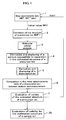
- FIG.1 is a general flow chart showing a flow for analysis of mass spectrometric data according to the first embodiment.
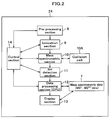
- Mass spectrometric data 1 is obtained by measurement with an apparatus 24 for mass spectrometry shown in FIG.2.
- a sample to be analyzed undergoes pre-processing by a pre-processing section 8 such as a liquid chromatograph and is ionized in an ionization section 9, being separated in a mass spectrometric section 10 according to the mass to charge ratios m/Z of ions.
- the symbols represent; m for ion mass and Z for charge number.
- the separated ion is detected by an ion detection section 11, the data of which is reduced and processed in a data processing section 12.
- the mass spectrometric data 1 is displayed on a display section 13.
- a control section 14 controls a sequence of mass spectrometry, which ranges over ionization of a sample, transferring and entering the ion beam of sample in the mass spectrometric section 10, execution of mass separation, detection of ion and processing of data.
- Mass spectrometry is categorized into two methods generally. One is called MS method, which analyzes an ionized sample directly. The other method called tandem mass spectrometry analyzes dissociated ions produced by dissociating a specific sample ion (a parent ion) selected according to the masses. Tandem mass spectrometry has a function of multiple-stage dissociation and mass spectrometry (MS.sup.N), in which a precursor ion having a specific mass to charge ratio is selected out of dissociated ions and mass spectrometry is conducted for further dissociated ions produced by dissociating the precursor ion.
- MS.sup.N multiple-stage dissociation and mass spectrometry
- steps for tandem mass spectrometry is described as follows: measuring mass spectrometric data for a parent ion (MS.sup.1); dissociating the parent ion and measuring mass spectrometric data for dissociated ions (MS.sup.2); further dissociating a precursor ion selected out of the MS.sup.2 data and measuring mass spectrometric data for further dissociated ions (MS.sup.3); and continuing dissociation and mass spectrometry in the same manner (MS.sup.N N ⁇ 3).
- this method Since this method is able to obtain the information on molecular structure of a precursor ion representative of pre-dissociation status at each stage of dissociation, it provides an efficient tool for estimating structure of the precursor ion. The more detailed the information is, the better the accuracy of estimation will be.
- Method for dissociating a precursor ion is categorized into two types: one is Collision Induced Dissociation (CID) in which dissociation of an ion is made by collision with a buffer gas such as helium gas and the other is photo dissociation method with irradiation of light.
- CID Collision Induced Dissociation
- the present embodiment is described using collision induced dissociation as an example.
- a collision cell 10A shown in FIG.2, which is required for a neutral gas such as helium gas for causing collision induced dissociation, is sometimes separated from the mass spectrometric section 10. It may also be possible to cause collision induced dissociation within the mass spectrometric section 10 by filling a neutral gas therein. In this case the collision cell 10A can be obviated.
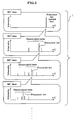
- FIG.3 shows an example of mass spectrum data, which is obtained by multiple-stage dissociation and mass spectrometry for a parent ion.
- Mass spectrometry is performed for the parent ion after collision induced dissociation and MS.sup.2 mass spectrum data of dissociated ions is obtained.
- MS.sup.2 data mass peaks observed in MS.sup.2 data, the highest one is picked up and a mass to charge ratio (hereinafter referred to as m/Z) corresponding thereto is selected as an m/Z value for determining a precursor ion.
- m/Z mass to charge ratio
- the precursor ion undergoes collision induced dissociation and mass spectrometric data is obtained, which is called MS.sup.3 data.
- a method according to the present invention for analyzing a parent ion as well as a precursor ion is described, which utilizes mass spectrometric data 1 (MS.sup.N N ⁇ 3) obtained by multi-stage dissociation and mass spectrometry for the parent ion.
- an initial estimation of structure is made for a parent ion.
- One of the following may be applied to the initial estimation.
- One is intuitional estimation made by a user.
- Another one is rough estimation made by a user based on mass spectrometric data (MS.sup.1 and MS.sup.2 data) for a parent ion and dissociated ions thereof as shown by a dotted line in FIG.1.
- the other one is estimation derived by processing with software which lists up candidates for the structure of a parent ion, such as a step 16 for estimation using database search, statistical processing or numerical matching shown in FIG.4, based on the mass spectrometric data (MS.sup.1 and MS.sup.2 data).
- the data search which is able to provide relatively higher accuracy of estimation among the techniques in the conventional estimation method of step 16, has limitation for accuracy in estimating the structure of a parent ion, because the database used for data search does not include mass spectrometric data MS.sup.N (N ⁇ 3).
- the numerical matching which has difficulty in distinguishing amino acids having the same mass number, does not provide high accuracy, either.
- the present invention which introduces a step 3 for molecular orbital analysis shown in an analysis flow of FIG.1, calculates thermal, chemical and energy related characteristics for the candidates for structure of a parent ion estimated by the conventional estimation method of step 16.
- the parent ion is a high polymer such as a peptide or sugar chain
- the thermal, chemical and energy related characteristics are calculated after optimization made by a step 15 of molecular orbital calculation shown in a flow of FIG.4 for the structure of parent ion.
- a portion susceptible to separation within estimated structure of a precursor ion is displayed at a step 4 based on the thermal, chemical and energy related characteristics.
- Dissociated ions to be produced which are estimated based on the thermal, chemical and energy related characteristics, are derived and displayed at a step 5.
- step 6 comparison is made between the data of dissociated ions obtained by a molecular orbital analysis at the step 3 and the mass spectrometric data of actual dissociated ions. Subsequently, the validity of estimated structure of precursor ion is evaluated at a step 7.
- the steps are repeated according to the number of mass spectrometric data when N is equal to or greater than 3 for MS.sup.N data (MS.sup.N N ⁇ 3). In this way, the estimated structure of a parent ion is finally evaluated accurately at a step 8 by analyzing MS.sup.N data N ⁇ 3.
- FIG.5 is a diagram showing analytical results obtained by tandem mass spectrometry for a peptide (Angiotensin III).
- a section 21 for ion trap mass spectrometry is used in the measurement in place of a mass spectrometric section 10, as shown in FIG.6.
- a precursor ion is trapped which is selected according to the masses.
- the precursor ion is dissociated colliding repeatedly with a neutral gas filled in the section 21.
- the dissociated ions are separated according to the masses in the section 21 and therefore mass spectrometric data 1 is obtained for the precursor ion (including the parent ion) and dissociated ions.
- the section 21, which serves as both collision cell 10A and mass spectrometric section 10 allows downsizing of an apparatus 24 for mass spectrometry
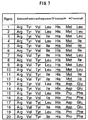
- FIG.7 shows an example of the analysis, which lists up similar sequences in terms of structure. Since leucine (Leu) and isoleucine (Ile) of amino acids have the same mass number but different structure, the method fails to distinguish them and provides almost same ranking for them as shown in FIG.7.
- the correct amino acid sequence for a peptide is given ranking of 20, which suggests that the method introducing initial estimation has limitation of accuracy in estimating the structure of a parent ion.
- a molecular orbit such as a highest occupied molecular orbit (HOMO) or lowest unoccupied molecular orbit (LUMO) is calculated for thermal, chemical and energy related characteristics, based on which the condition of bonding of a whole molecule is determined.
- HOMO which is representative of a molecular orbit which is filled with electrons most densely
- LUMO which is representative of a molecular orbit filled with electrons most scarcely, is an important factor to be helpful for analyzing a reaction which occurs in a somewhat higher energy level than that of a thermochemical one.
- HOMO is calculated for each candidate of structure and the rate of coincidence between a location HOMO appears and an actual location a precursor ion actually dissociates. Subsequently, another round of ranking is made according to the calculation, the results of which are shown in the right-end column of FIG.8. On the table the correct amino acid sequence is ranked first. It may be possible to select another type of identification such as percentage of reliability or reliability levels with symbols A, B and C as a method for displaying at a step 7 for evaluating the validity of estimated structure of a parent ion, instead of ranking described above.
- the method according to the present embodiment which is able to analyze susceptibility to separation of dissociated ions, namely intensity of MS spectrum for the dissociated ions, enables high accuracy in estimating the structure of a parent ion.
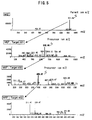
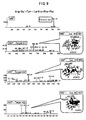
- the results of HOMO calculation for a precursor ion at each dissociation stage is shown in FIG.9 for the correct amino acid sequence.
- the method has a step 17 able to display estimated structure three-dimensionally on a list shown in FIG.8 on request by a user, it will be helpful for analyzing the validity of estimated structure.
- the step 17 also has a function for displaying the structure of a precursor ion and a location of HOMO appearance at each dissociation stage, it will be more beneficial for a user to understand ranking.
- the present embodiment which is able to estimate structure of a dissociated ion and a precursor ion for mass spectrometric data (MS.sup.N N ⁇ 3) for which a database is not available introducing thermal, chemical and energy related calculation, can evaluate the validity of structure estimated in advance for a parent ion. In this way, it provides a tool for estimating structure of a parent ion or a precursor ion at each dissociation stage accurately.
- a computer program which executes the analytical steps in a system for analyzing mass spectrometric data according to the present invention, may be installed in a data processing section 12 of an apparatus 24 for mass spectrometry so that an analysis of mass spectrometric data can be performed on-site.
- the computer program may be installed in a separate computer.
- FIGS.10 - 12 A second embodiment of the present invention is described referring to FIGS.10 - 12.
- the second embodiment has a feature that a parameter associated with strength of bonding, activation energy and dissociation energy are calculated and displayed, in addition to a molecular orbit calculated by a step 3 for molecular orbital analysis as thermal, chemical and energy related characteristics.
- a parent ion experiences collision induced dissociation with a neutral gas such as helium gas
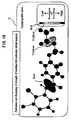
- the parent ion transits to an activated state as shown in FIG. 10, which is considered to be a stable state of dissociated ion.
- FIG.10 shows the energy required for transition to an activated state (activation energy) calculated by the step 3 for a sedative called recerpine.
- the activation energy differs from a dissociated ion species to another and it is considered that a dissociated ion having smaller activation energy is more easily dissociated.
- the activation energy of a dissociated ion having a mass-to-charge ratio m/Z of 397 amu is about 4 eV and that of the other dissociated ion having m/Z of 448 amu is about 6 eV.
- the results of molecular orbital analysis at the step 3 indicate that the dissociated ion having m/Z of 397 amu is more easily dissociated.
- Measured MS data for recerpine having m/Z of 609 amu and MS.sup.2 data for the dissociated ions thereof are shown in FIG.11.
- the results obtained by molecular orbital analysis meet the measured data well.
- the measured data demonstrates that the intensity of spectrum signal of a dissociated ion having m/Z of 397 amu is higher than that of the other dissociated ion having m/Z of 448 amu, in other words the former is more easily dissociated than the latter.
- a molecular orbital analysis at the step 3, which calculates activation energy can provide an accurate estimation for a dissociated ion.
- FIGS.12 and 13 show an example of parameter associated with strength of bonding calculated by the step 3 as thermal, chemical and energy related characteristics.
- the parameter is defined as relative strength of bonding between a pair of atoms in a molecule.
- FIG.12 shows an example of the parameter for an agricultural chemical called ETOBENZANID. It is considered that the smaller a parameter, the more easily dissociation occurs. Compared with the measured MS.sup.2 data for ETOBENZANID, it is known from the results of analysis shown in FIG.12 that dissociation occurs at bonding having a smaller parameter. In this way, calculation of activation energy at the step 3 can provide accurate estimation for dissociated ions.
- a third embodiment of the present invention is described referring to FIGS.14 - 17.
- the methods include, displaying of ranking shown in FIG.14, displaying of distribution shown in FIG.15, displaying color gradation shown in FIG.16 and displaying of symbols shown in FIG.17.
- a combination with the methods shown in the first embodiment referring to FIG.9 such as displaying of molecular orbit with distribution or coloring, or displaying of a portion susceptible to separation estimated from a molecular orbit with symbols.
- a fourth embodiment of the present invention is described referring to FIG.18.
- the step 3 provides a portion where a positive ion such as proton (H.sup.+), Na.sup.+ or Li.sup.+ is attached most easily.
- the step 3 provides a portion where a proton is separated most easily.
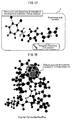
- FIG.18 shows an example of displaying of a portion, in which a proton (H.sup.+) is attached most easily.
- the present embodiment which is able to estimate the structure of a parent ion in ionized condition and incorporate the effect on dissociation process, allows a more accurate determination of dissociated ion.
- a fifth embodiment of the present invention is described referring to FIGS.19 and 20.
- a method of the present embodiment searches a database for a sample, which contains a precursor ion of each dissociation stage in the structure thereof, and displays the structure of sample for parent ions, which are finally ranked high according to thermal, chemical and energy related characteristics obtained by a molecular orbital analysis at a step 3.
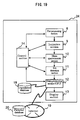
- An apparatus for mass spectrometry of the present embodiment is shown in FIG.19.
- a data processing section 12 determines accurately the structure of a precursor ion at each dissociation stage and the structure of a parent ion before dissociation (the amino acid sequence of a peptide) according to mass spectrometric data after data reduction.
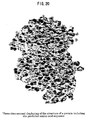
- the data processing section 12 retrieves an unpublished database 18 or published database 20 on an internet 19 for a protein which contains the precursor ion and parent ion in the sequence thereof, displaying an overall structure of corresponding protein as shown in FIG.20.
- FIG.20 shows a protein three-dimensionally, which is one of proteins hit by database search that include an amino acid sequence ranked first place finally by a molecular orbital analysis. It may be possible to display specifically a portion of the three dimensional structure which corresponds to the amino acid sequence by identifying with color. In this way, it is helpful for a user to conduct a functional analysis since the placement and function of amino acid sequence relative to the overall structure of a protein are clarified.
- the present embodiment allows searching of three-dimensional structure by database search using published or unpublished database for larger molecules such as protein and sugar chain, which include structure of parent ions of high ranking determined by a molecule orbital analysis at a step 3.
- the present embodiment enables displaying of the three-dimensional structure of a drug based on the results of mass spectrometry at low cost and high speed, thereby contributing greatly to efficient development of a drug.
- FIG.21 is a block diagram illustrating an apparatus for mass spectrometry.
- the wave length of a light is adjusted according to the energy required for dissociation. For example, laser light is used for dissociation with high energy but infra red light is used for that with low energy. It is thus necessary to add a light source 29, which irradiates light for a mass spectrometric section 10. It is known that photo dissociation provides better dissociation efficiency than collision induced dissociation using a neutral gas.
- the present embodiment which increases the intensity of MS.sup.N spectrum data, improves the accuracy in analyzing the structure of a precursor ion and a parent ion.
- a seventh embodiment of the present invention is described referring to FIGS.22 - 24.
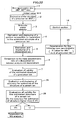
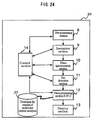
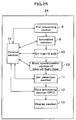
- an evaluation of accuracy for estimation of structure of a parent ion is executed at a step 25 after an evaluation of validity for the estimated structure of a precursor ion at a step 7.
- an evaluation of validity for the estimated overall structure of a parent ion is conducted at a step 28.
- An N value for MS.sup.N for the following dissociation analysis and a mass to charge ratio m/Z of a precursor ion are determined at a step 26.
- a command for the following analysis is sent to a control section 14.
- FIG.23 shows an example of a peptide dissociated in multiple stages.
- the accuracy associated with estimation of amino acid sequence is generally low since only the mass to charge ratio of a parent ion is obtained.
- An accuracy SIGMA estimated from the MS spectrum data is displayed in gradation on the upper part of a sheet. Light and dark represent low and high accuracy, respectively. It is possible to use an accuracy obtained by a molecular orbital analysis at a step 3 for the accuracy SIGMA.
- a bar showing an accuracy of estimation for amino acid sequence in FIG.23 corresponds to a function conducted at a step 25 for evaluation and displaying of accuracy for estimation of the structure of a parent ion.
- amino acid sequences occupying both ends have higher accuracy receiving support from the dissociated ion data, as shown by the bar in the upper part of diagram.
- a precursor ion for the following dissociation analysis is selected.
- a precursor ion may be selected automatically from the results of analysis for estimation accuracy of amino acid sequence. Also a user may select a precursor ion according to estimated accuracy displayed by a bar.
- a judgment is made on whether the accuracy of estimation for the structure of a whole parent ion is high or low and a decision is made on whether or not the following mass spectrometry should be conducted.
- a precursor ion which has an m/Z of 402 amu, is selected for the following MS.sup.3 analysis and a command notifying the selection is sent to a control section 14 of an apparatus 24 for mass spectrometry.
- a mass spectrometric section 10 executes measurement after receiving a command from the control section 14.
- the mass spectrometric section 10 conveys measurement results, MS.sup.N data 1, to a data processing section 12 via the control section 14.
- the data is analyzed at the data processing section 12. Steps of analysis conducted in the data processing section 12 are shown in FIG.22. The analysis is repeated until the accuracy of estimation for amino acid sequence reaches high in terms of an overall sequence (the structure of a parent ion) as shown by MS.sup.3 data in FIG.23.
- an m/Z having the highest mass peak is usually selected as an m/Z for a precursor ion in the following dissociation analysis.
- the present embodiment which is able to select an ion having lower accuracy of estimation for amino acid sequence as a precursor ion, can provide an efficient tool for analyzing the structure of a parent ion.
- a molecular orbital analysis is executed at a step 3 to analyze accuracy of estimation for structure every time mass spectrometry is conducted, it is necessary to speed up the calculation.
- a database 27 storing the results of molecular orbital analysis may be helpful, which are prepared for candidates for structure estimated in advance.
- the present embodiment which is able to determine and control mass spectrometry in parallel with analyzing accurately the structure of an ion, can provide a tool which is capable of executing mass spectrometry with multiple-stage dissociation for a parent ion. It is also possible to relieve a user from load resulting from decision making for the following analysis in a complicated flow of multiple-stage mass spectrometry.
- FIG.25 An eighth embodiment of the present invention is described referring to FIG.25.
- the embodiment has a feature that an ion trap 22 is adopted for a collision cell and a section 23 of mass spectrometry of time-of-flight type (also referred to as TOF) is adopted for a section of mass spectrometry.
- a Q pole 22 made of four-rod electrode can be adopted for a collision cell.
- An ion trap has a disadvantage that the upper limit for measurement of mass-to-charge ratio m/Z of a high polymer does not have flexibility.
- the section 23 with TOF spectrometry which is more suitable for analysis of high polymers, achieves better accuracy.
- a method for analyzing mass spectrometric data of the present invention can be applied to an apparatus for mass spectrometry, which is prepared for the analysis of protein, peptide, sugar chain and the like. It is possible to estimate the structure of a parent ion accurately with molecular orbital analysis according to the data obtained by an apparatus for mass spectrometry of the present embodiment.
- a ninth embodiment of the present invention is described referring to FIG.26.
- the embodiment is tailored to analyze amino acids, leucine (L) and isoleucine (I) having the same mass number, which bring difficulty in identifying them based on mass spectrometric data of dissociated ions obtained by collision introduced dissociation of a precursor ion with low energy.
- the embodiment has a feature that if L or I is included in an amino acid sequence, which is estimated based on mass number data of mass spectrometric data (MS.sup.N N ⁇ 2) for dissociated ions, an estimation is made distinguishing L from I based on data of mass peak intensity.
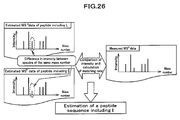
- FIG.26 shows a method of estimating the structure of a precursor ion according to the present embodiment.
- the amino acids L and I having the same mass number have different side chains, affecting the degree of susceptibility to separation of whole peptide bonding.
- a difference in intensity of the mass peaks of dissociated ions thus exists, to which no attention has been paid because the difference is usually small.
- the present embodiment directs attention to the difference to distinguish L from I.
- a method for implementing it is that one of molecular orbital calculation and molecular dynamic calculation is performed for L and I separately and susceptibility to dissociation is compared according to the calculation results. Subsequently, L and I are distinguished according to an intensity ratio of mass peak and comparison with the results of calculation.
- FIG.26 A tenth embodiment is described referring to FIG.26.
- the embodiment is tailored to analyze an amino acid sequence which includes an amino acid having the same or similar mass number of a pair of amino acids.
- the embodiment has a feature that whether the amino acid sequence includes a pair of amino acids or a single amino acid is analyzed according to the measured mass spectrometric data (MS.sup.N N ⁇ 2), especially data of mass peak intensity.
- FIG.27 is a list of amino acids, each of which has the same or similar mass number with a pair of amino acids.
- a pair of amino acids has been regarded as a single amino acid mistakenly when the amino acids are firmly bonded.
- the difference in structure between a pair of amino acid and a single amino acid has affect on susceptibility to separation of a peptide bonding.
- a method of the present embodiment is generally the same as that shown in FIG.26.
- a difference in intensity of mass peak of a dissociated ion differs between a pair of amino acids and a single amino acid.
- the present embodiment which directs attention to the difference, distinguishes the pair of amino acids from single amino acid.
- the susceptibility to dissociation is compared between them based on a molecular orbital calculation or molecular dynamic calculation conducted for the pair of amino acids and single amino acid, respectively.
- estimation for the structure of an ion is conducted distinguishing the pair of amino acids from single amino acid according to an intensity ratio of mass peak and comparison with the results of calculation.
- An eleventh embodiment is described.
- the embodiment is tailored for analyzing a modified peptide after translation and a modified portion after translation such as a sugar chain. It is difficult to estimate a monosaccharide based on mass number data of mass spectrometric data (MS.sup.N N ⁇ 2) of dissociated ions because a sugar chain is composed of isomeric monosaccharides having the same mass number (glucose, mannose, galactose and the like). An isomer having the same mass number which differs in structure has affect on susceptibility to separation of a peptide bonding.
- the embodiment has a feature that if there are isomeric candidates of the same mass number, the isomers are distinguished according to the measured mass spectrometric data (MS.sup.N N ⁇ 2), especially data of mass peak intensity.
- a method of the present embodiment is generally the same as that shown in FIG.26. Namely, the method takes into account the fact that differences in intensity of mass peak of dissociated ions exist among the isomeric candidates.
- the present embodiment which directs attention to the difference, identifies each isomer.
- the susceptibility to dissociation is compared among them based on a molecular orbital calculation or molecular dynamic calculation conducted for all the isomers. Subsequently, estimation for the structure of an ion is conducted distinguishing isomers according to an intensity ratio of mass peak and comparison with the results of calculation.
Landscapes
- Chemical & Material Sciences (AREA)
- Analytical Chemistry (AREA)
- Other Investigation Or Analysis Of Materials By Electrical Means (AREA)
- Electron Tubes For Measurement (AREA)
Applications Claiming Priority (2)
| Application Number | Priority Date | Filing Date | Title |
|---|---|---|---|
| JP2003035928A JP3817523B2 (ja) | 2003-02-14 | 2003-02-14 | 質量分析データ解析システム |
| JP2003035928 | 2003-02-14 |
Publications (2)
| Publication Number | Publication Date |
|---|---|
| EP1447833A2 true EP1447833A2 (fr) | 2004-08-18 |
| EP1447833A3 EP1447833A3 (fr) | 2006-08-09 |
Family
ID=32677624
Family Applications (1)
| Application Number | Title | Priority Date | Filing Date |
|---|---|---|---|
| EP03025752A Withdrawn EP1447833A3 (fr) | 2003-02-14 | 2003-11-10 | Méthode d' analyse de données spectrométriques. |
Country Status (3)
| Country | Link |
|---|---|
| US (1) | US6914239B2 (fr) |
| EP (1) | EP1447833A3 (fr) |
| JP (1) | JP3817523B2 (fr) |
Cited By (4)
| Publication number | Priority date | Publication date | Assignee | Title |
|---|---|---|---|---|
| CN101918826B (zh) * | 2007-12-20 | 2013-06-05 | 株式会社岛津制作所 | 质量分析系统 |
| US8735806B2 (en) | 2006-11-15 | 2014-05-27 | Shimadzu Corporation | Mass-analyzing method and mass spectrometer |
| US8884218B2 (en) | 2011-01-31 | 2014-11-11 | Shimadzu Corporation | Method and systems for mass spectrometry for identification and structural analysis of unknown substance |
| WO2015009049A1 (fr) * | 2013-07-18 | 2015-01-22 | 주식회사 엘지화학 | Procédé d'analyse comparative quantitative de distributions des orbitales moléculaires en fonction de l'état de charge, et système l'utilisant |
Families Citing this family (24)
| Publication number | Priority date | Publication date | Assignee | Title |
|---|---|---|---|---|
| JP3743717B2 (ja) * | 2002-06-25 | 2006-02-08 | 株式会社日立製作所 | 質量分析データの解析方法および質量分析データの解析装置および質量分析データの解析プログラムならびにソリューション提供システム |
| US7473892B2 (en) * | 2003-08-13 | 2009-01-06 | Hitachi High-Technologies Corporation | Mass spectrometer system |
| JP4191094B2 (ja) * | 2004-06-08 | 2008-12-03 | 株式会社山武 | マススペクトル解析装置、マススペクトル解析方法及びマススペクトル解析プログラム |
| JP2006145519A (ja) * | 2004-10-18 | 2006-06-08 | Mitsubishi Chemicals Corp | 糖鎖構造解析方法 |
| WO2006043405A1 (fr) * | 2004-10-18 | 2006-04-27 | Mitsubishi Chemical Corporation | Procede d’analyse de la structure d’une chaine de sucre |
| JP4620446B2 (ja) * | 2004-12-24 | 2011-01-26 | 株式会社日立ハイテクノロジーズ | 質量分析方法、質量分析システム、診断システム、検査システム及び質量分析プログラム |
| JP2006292683A (ja) * | 2005-04-14 | 2006-10-26 | National Institute Of Advanced Industrial & Technology | ケラタン硫酸由来オリゴ糖の同定方法 |
| DE102005018273B4 (de) * | 2005-04-20 | 2007-11-15 | Bruker Daltonik Gmbh | Rückgesteuerte Tandem-Massenspektrometrie |
| JP4843250B2 (ja) * | 2005-05-13 | 2011-12-21 | 株式会社日立ハイテクノロジーズ | 質量分析を用いた物質の同定方法 |
| JP2007010509A (ja) * | 2005-06-30 | 2007-01-18 | Nec Corp | 解析支援システムおよび解析支援方法 |
| JP4855780B2 (ja) * | 2006-01-12 | 2012-01-18 | 国立大学法人奈良女子大学 | 質量分析を用いたペプチド同定方法及び同定装置 |
| JP4808542B2 (ja) * | 2006-04-27 | 2011-11-02 | 公益財団法人野口研究所 | 糖鎖異性体を分離同定する質量分析法 |
| US8180576B2 (en) * | 2006-05-11 | 2012-05-15 | Shimadzu Corporation | Data processor for mass spectrometer |
| JP4839248B2 (ja) * | 2007-03-16 | 2011-12-21 | 株式会社日立ハイテクノロジーズ | 質量分析システム |
| US8417466B2 (en) * | 2007-10-22 | 2013-04-09 | Shimadzu Corporation | Mass analysis data processing apparatus |
| JP5239535B2 (ja) * | 2008-06-17 | 2013-07-17 | 三菱化学株式会社 | 糖鎖構造解析方法 |
| JP5664667B2 (ja) * | 2011-01-11 | 2015-02-04 | 株式会社島津製作所 | 質量分析データ解析方法、質量分析データ解析装置、及び質量分析データ解析用プログラム |
| EP2666114A4 (fr) * | 2011-01-21 | 2017-04-26 | Massdefect Technologies, LLC | Acquisition dépendante des données, facilitée par une soustraction d'arrière-plan |
| US9062700B2 (en) | 2012-06-29 | 2015-06-23 | Saint-Gobain Performance Plastics Rencol Limited | Tolerance ring with component engagement structures |
| JP6229529B2 (ja) * | 2014-02-19 | 2017-11-15 | 株式会社島津製作所 | イオントラップ質量分析装置及びイオントラップ質量分析方法 |
| CN107077592B (zh) * | 2014-03-28 | 2021-02-19 | 威斯康星校友研究基金会 | 高分辨率气相色谱-质谱数据与单位分辨率参考数据库的改进谱图匹配的高质量精确度滤波 |
| CN105842330B (zh) * | 2015-09-09 | 2018-06-05 | 张华俊 | 一种质谱检测及解析方法 |
| JP7266997B2 (ja) * | 2018-11-30 | 2023-05-01 | 日本電子株式会社 | 化学構造推定装置及び方法 |
| US10937525B2 (en) | 2019-06-24 | 2021-03-02 | BioTune Computations LLC | System that generates pharmacokinetic analyses of oligonucleotide total effects from full-scan mass spectra |
Family Cites Families (9)
| Publication number | Priority date | Publication date | Assignee | Title |
|---|---|---|---|---|
| US4978852A (en) * | 1988-09-08 | 1990-12-18 | Cornell Research Foundation, Inc. | Hadamard transform measurement of MSN Fourier-transform mass spectra |
| US5538897A (en) * | 1994-03-14 | 1996-07-23 | University Of Washington | Use of mass spectrometry fragmentation patterns of peptides to identify amino acid sequences in databases |
| JPH08124519A (ja) * | 1994-10-21 | 1996-05-17 | Shimadzu Corp | Ms/ms質量分析装置用データ処理装置 |
| WO2000077824A1 (fr) * | 1999-06-14 | 2000-12-21 | Jeol Usa, Inc. | Spectrometre de masse permettant d'effectuer une analyse structurelle moleculaire a l'aide d'une dissociation induite par une surface |
| AU2001286059A1 (en) * | 2000-09-08 | 2002-03-22 | Oxford Glycosciences (Uk) Ltd. | Automated identification of peptides |
| US6962818B2 (en) * | 2000-10-19 | 2005-11-08 | Target Discovery | Mass defect labeling for the determination of oligomer sequences |
| JP3743717B2 (ja) * | 2002-06-25 | 2006-02-08 | 株式会社日立製作所 | 質量分析データの解析方法および質量分析データの解析装置および質量分析データの解析プログラムならびにソリューション提供システム |
| AU2003262824B2 (en) * | 2002-08-22 | 2007-08-23 | Applied Biosystems Inc. | Method for characterizing biomolecules utilizing a result driven strategy |
| JP3885020B2 (ja) * | 2002-12-09 | 2007-02-21 | 株式会社日立製作所 | 化合物構造解析システム,質量分析データ解析方法,質量分析データ解析装置及び質量分析データ解析プログラム |
-
2003
- 2003-02-14 JP JP2003035928A patent/JP3817523B2/ja not_active Expired - Fee Related
- 2003-11-10 US US10/705,612 patent/US6914239B2/en not_active Expired - Lifetime
- 2003-11-10 EP EP03025752A patent/EP1447833A3/fr not_active Withdrawn
Non-Patent Citations (4)
| Title |
|---|
| LOEW G ET AL: "Application of molecular orbital theory to the interpretation of mass spectra. Study of substituent effect on a series of acetophenones", OMS. ORGANIC MASS SPECTROMETRY, WILEY, CHICHESTER, GB, vol. 11, 1 January 1976 (1976-01-01), pages 1158 - 1167, XP007918201, ISSN: 0030-493X, [retrieved on 20050407] * |
| LOEW G ET AL: "Applications of molecular orbital theory to the interpretation of mass spectra. Prediction of primary fragmentation sites in organic molecules", OMS. ORGANIC MASS SPECTROMETRY, WILEY, CHICHESTER, GB, vol. 7, 1 January 1973 (1973-01-01), pages 1241 - 1251, XP007918203 * |
| MARTINUSSEN-RUNDE O J ET AL: "Molecular orbital theory in mass spectrometry: ab initio calculations in 2-methylpropene and the 2-methylpropene radical-cation", PROCEEDINGS OF THE ROYAL SOCIETY OF LONDON. SERIES A,MATHEMATICAL AND PHYSICAL SCIENCES, ROYAL SOCIETY OF LONDON, LONDON, GB, vol. 350, 1 October 1976 (1976-10-01), pages 553 - 564, XP008135390, ISSN: 0080-4630, Retrieved from the Internet <URL:http://rspa.royalsocietypublishing.org/content/350/1663/553.full.pdf+htm> DOI: 10.1098/RSPA.1976.0124 * |
| WATKINS P J F JARDINE I ZHOU J X G: "Mass spectrometry software for biochemical analysis in electrospray and fast atom bombardment modes", BIOCHEMICAL SOCIETY TRANSACTIONS, PORTLAND PRESS LTD, GB, vol. 19, 1 January 1991 (1991-01-01), pages 957 - 962, XP002959674, ISSN: 0300-5127 * |
Cited By (4)
| Publication number | Priority date | Publication date | Assignee | Title |
|---|---|---|---|---|
| US8735806B2 (en) | 2006-11-15 | 2014-05-27 | Shimadzu Corporation | Mass-analyzing method and mass spectrometer |
| CN101918826B (zh) * | 2007-12-20 | 2013-06-05 | 株式会社岛津制作所 | 质量分析系统 |
| US8884218B2 (en) | 2011-01-31 | 2014-11-11 | Shimadzu Corporation | Method and systems for mass spectrometry for identification and structural analysis of unknown substance |
| WO2015009049A1 (fr) * | 2013-07-18 | 2015-01-22 | 주식회사 엘지화학 | Procédé d'analyse comparative quantitative de distributions des orbitales moléculaires en fonction de l'état de charge, et système l'utilisant |
Also Published As
| Publication number | Publication date |
|---|---|
| JP3817523B2 (ja) | 2006-09-06 |
| JP2004245699A (ja) | 2004-09-02 |
| US6914239B2 (en) | 2005-07-05 |
| EP1447833A3 (fr) | 2006-08-09 |
| US20040181347A1 (en) | 2004-09-16 |
Similar Documents
| Publication | Publication Date | Title |
|---|---|---|
| US6914239B2 (en) | System for analyzing mass spectrometric data | |
| JP3743717B2 (ja) | 質量分析データの解析方法および質量分析データの解析装置および質量分析データの解析プログラムならびにソリューション提供システム | |
| US6957159B2 (en) | System for analyzing compound structure | |
| JP3766391B2 (ja) | 質量分析スペクトルの解析システム | |
| US8530831B1 (en) | Probability-based mass spectrometry data acquisition | |
| CN101313215B (zh) | 质量分析装置 | |
| JP4644560B2 (ja) | 質量分析システム | |
| JP5979306B2 (ja) | 質量分析装置 | |
| US7126113B2 (en) | Mass spectrometry system | |
| JP2004251830A (ja) | 質量分析計データ処理装置およびデータ処理方法 | |
| US9702882B2 (en) | Method and system for analyzing mass spectrometry data | |
| JP2008170260A (ja) | 質量分析システム | |
| JP4393206B2 (ja) | 質量分析装置用データ処理装置 | |
| JP5696592B2 (ja) | 質量分析データ解析方法及び解析装置 | |
| US7956320B2 (en) | Data processor for mass spectrometer | |
| JP2007121134A (ja) | タンデム質量分析システム | |
| JP2008170346A (ja) | 質量分析システム | |
| JP4839248B2 (ja) | 質量分析システム |
Legal Events
| Date | Code | Title | Description |
|---|---|---|---|
| PUAI | Public reference made under article 153(3) epc to a published international application that has entered the european phase |
Free format text: ORIGINAL CODE: 0009012 |
|
| AK | Designated contracting states |
Kind code of ref document: A2 Designated state(s): AT BE BG CH CY CZ DE DK EE ES FI FR GB GR HU IE IT LI LU MC NL PT RO SE SI SK TR |
|
| AX | Request for extension of the european patent |
Extension state: AL LT LV MK |
|
| 17P | Request for examination filed |
Effective date: 20060331 |
|
| PUAL | Search report despatched |
Free format text: ORIGINAL CODE: 0009013 |
|
| AK | Designated contracting states |
Kind code of ref document: A3 Designated state(s): AT BE BG CH CY CZ DE DK EE ES FI FR GB GR HU IE IT LI LU MC NL PT RO SE SI SK TR |
|
| AX | Request for extension of the european patent |
Extension state: AL LT LV MK |
|
| AKX | Designation fees paid |
Designated state(s): DE GB |
|
| 17Q | First examination report despatched |
Effective date: 20110420 |
|
| STAA | Information on the status of an ep patent application or granted ep patent |
Free format text: STATUS: THE APPLICATION IS DEEMED TO BE WITHDRAWN |
|
| 18D | Application deemed to be withdrawn |
Effective date: 20110831 |