EP1449964A1 - Wiederherstellung des Reflexionsvermögen eines Oberflächenmarkierungsmaterials mit reflektierenden Perlen - Google Patents
Wiederherstellung des Reflexionsvermögen eines Oberflächenmarkierungsmaterials mit reflektierenden Perlen Download PDFInfo
- Publication number
- EP1449964A1 EP1449964A1 EP03075511A EP03075511A EP1449964A1 EP 1449964 A1 EP1449964 A1 EP 1449964A1 EP 03075511 A EP03075511 A EP 03075511A EP 03075511 A EP03075511 A EP 03075511A EP 1449964 A1 EP1449964 A1 EP 1449964A1
- Authority
- EP
- European Patent Office
- Prior art keywords
- weight
- composition
- reflective beads
- polishing
- liquid
- Prior art date
- Legal status (The legal status is an assumption and is not a legal conclusion. Google has not performed a legal analysis and makes no representation as to the accuracy of the status listed.)
- Withdrawn
Links
Images
Classifications
-
- B—PERFORMING OPERATIONS; TRANSPORTING
- B08—CLEANING
- B08B—CLEANING IN GENERAL; PREVENTION OF FOULING IN GENERAL
- B08B1/00—Cleaning by methods involving the use of tools
- B08B1/30—Cleaning by methods involving the use of tools by movement of cleaning members over a surface
- B08B1/32—Cleaning by methods involving the use of tools by movement of cleaning members over a surface using rotary cleaning members
- B08B1/34—Cleaning by methods involving the use of tools by movement of cleaning members over a surface using rotary cleaning members rotating about an axis parallel to the surface
Definitions
- a method and a device for re-establishing the reflectiveness of a surface marking material with reflective beads therein, such as a road surface marking material, as well as the use of compositions to perform the re-establishment.
- the preferred embodiment disclosed comprises the steps to dissolve the top layer of the matrix material in which the beads are contained by means of a liquid and mechanical affecting of the material, followed by a water flushing to remove the remains of said first liquid material and the resolved matrix material.
- the uncovered beads are then polished by applying a second liquid to emulsify the remaining matrix material left on the beads and polish by means of rotation brushes, where after the emulsion is removed by suction.
- Reflective surface marking materials are used to for surface markings on e.g. roads and runways.
- a very popular type of material comprises reflective beads, such as glass beads, contained in a solidifying matrix material, typically containing a binder of one or more types of resin, so that the markings may be laid in a liquid form that solidifies to a solid marking that is reflective.
- the reflectiveness of the beads in the surface deteriorates over time due to wear on the markings, and the beads become dirty and scratched or are crushed. Ordinary wash of the road markings improves the reflectiveness some, but today the markings are replaced when the reflectiveness is below an acceptable level.
- the old markings are peeled off the road surface, optionally after a heating to soften the marking material, and new markings are laid instead.
- the replacement operation is costly to perform and constitutes a significant part of the maintenance costs of roads, as the marking material is worn down relatively fast.
- the reflectiveness of a surface material comprising reflective beads contained in a solidified matrix material is re-established by dissolving a top layer of the matrix material by applying a first liquid material to the surface material, uncovering the reflective beads of the surface material by applying a first mechanically affect to the surface material, and by polishing the uncovered reflective beads.
- new reflective beads are present and polished in the top surface of the surface marking material.
- the polishing of the uncovered surface of the surface marking material so as to polish the uncovered reflective beads has proven to be essential to obtain the desired reflectiveness.
- the reflectiveness of the surface marking material may be re-established 2-4 times before it is necessary to replace the material, and the lifetime of the marking is thus prolonged to 3-5 times the original one.
- Preferred embodiments of the invention and various improvements of the basic invention are disclosed and discussed below.
- the present invention relates in a first aspect to a method of re-establishing the reflectiveness of a surface marking material comprising reflective beads contained in a solidified matrix material.
- the reflective beads are typically glass beads with a diameter of about 0.5 mm, and the matrix material typically comprises solidifying resin or a similar material.
- the method comprises the steps of dissolving a top layer of the matrix material by applying a first liquid material to the surface material, uncovering reflective beads of the surface material by applying a first mechanically affect to the surface of the material, and polishing the uncovered reflective beads.
- the first liquid material has properties that together with the mechanical affect of the surface of the material cause the effect that the top layer of the material is dissolved.
- the result of the polishing is improved and the use of an optional second liquid material to facilitate the polishing of the reflective beads, which is another advantageous step that may be included, is reduced.
- the desired feature of the optional second liquid is that it acts as soap or a degreasing agent that emulsifies the remains of the matrix material left on the reflective beads so that they may be removed to leave the beads with a clean and reflective surface.
- the first mechanically affect may by provided by means of cylindrical brushing means rotated about its longitudinal axis being substantially parallel to the plane of the surface material.
- the remain of said second liquid material with the material removed by the polishing contained therein should be substantially removed from the marking after the polishing. This is preferably performed by means of applying suction subsequent to said polishing so that the environment is not subjected to the liquid with its contain of environmentally hostile substances.
- the polishing may advantageously be provided by means of two cylindrical brushes counter-rotating towards each other, i.e. the bristles are moving towards each other at the surface of the marking material, about their longitudinal and substantially parallel axes, which are substantially parallel to the plane of the surface material.
- the axis should be substantially perpendicular to the direction in which the device performing the present method is moved, so that dirt from the surface next to the marking material is not dragged onto the marking material by the brushes.
- the matrix material to which the present method is applied comprises preferably at least 10% by weight of resin, more preferred up to 20% by weight of resin and most preferred up to 30% by weight of resin.
- the resin is preferably a mixture of resins in which one or more artificial resins are used, in particular aliphatic hydrocarbon resin, but also e.g. natural resins and polyamide resin may be employed.
- the matrix material to which the present method is applied comprises preferably at least 20% by weight of reflective beads.
- a preferred composition of the first liquid material comprises at least 20% by weight of 2-Methoxy-methylethoxy-propanol, from 10 to 40% by weight of 1-Methoxy-2-propanol and up to 20% by weight of n-Methyl-2-pyrrolidon. More preferred, the first liquid material is a composition comprising at least 30% by weight of 2-Methoxy-methylethoxy-propanol. Alternatively or additionally, the first liquid material is a composition comprising from 20 to 30% by weight of 1-Methoxy-2-propanol.
- the first liquid material may comprise up to 10% by weight of n-Methyl-2-pyrrolidon, and in a further preferred embodiment, the first liquid material comprises at least 4% by weight and preferably at least 7% by weight of n-Methyl-2-pyrrolidon.
- a preferred composition of the second liquid material comprises up to 25% by weight of non-ionic surfactants and up to 10% by weight of aliphatic hydrocarbons. The remaining part of the composition is typically water.
- the composition comprises up to 15% by weight of non-ionic surfactants and in a further preferred embodiment, it comprises at least 7% by weight, preferably at least 10% by weight, of non-ionic surfactants.
- the composition of the second liquid material comprises up to 5% by weight of aliphatic hydrocarbons, and in another yet further embodiment, the composition comprises at least 2% by weight, preferably at least 3.5% by weight, of aliphatic hydrocarbons.
- the present invention relates in a second aspect to the use of a composition comprising at least 20% by weight of 2-Methoxy-methylethoxy-propanol, from 10 to 40% by weight of 1-Methoxy-2-propanol and up to 20% by weight of n-Methyl-2-pyrrolidon for dissolving a top layer of a solidified matrix material comprising reflective beads, e.g. the types disclosed previously, so as to enable uncovering of reflective beads.
- composition according to the second aspect comprises in a preferred embodiment at least 30% by weight of 2-Methoxy-methylethoxy-propanol, and in a further preferred embodiment from 20 to 30% by weight of 1-Methoxy-2-propanol.
- the composition comprises up to 10% by weight of n-Methyl-2-pyrrolidon, and in another preferred embodiment, the composition comprises at least 4% by weight and preferably at least 7% by weight of n-Methyl-2-pyrrolidon.
- the present invention relates to the use of a composition comprising up to 25% by weight of non-ionic surfactants and up to 10% by weight of aliphatic hydrocarbons for facilitating polishing of reflective beads uncovered from a solidified matrix material, e.g. of the type disclosed previously and comprising said reflective beads.
- composition according to said third aspect of the invention may comprise up to 15% by weight of non-ionic surfactants, and in a preferred embodiment at least 7% by weight, preferably at least 10% by weight, of non-ionic surfactants.
- the composition comprises up to 5% by weight of aliphatic hydrocarbons, and in another preferred embodiment, the composition comprises at least 2% by weight, preferably at least 3.5% by weight, of aliphatic hydrocarbons.
- the present invention relates in a fourth aspect to a device for re-establishing the reflectiveness of a road surface marking material and designed for being mounting on a vehicle having a main direction of movement, the device comprising, arranged in a row starting from the front end of the vehicle, an applicator for applying a first liquid to a line of the surface material, brush means to uncover reflective beads of the surface material by applying a first mechanically affect to the surface material, a second applicator for applying a second liquid to the line of the surface material, and polishing means to polish the uncovered reflective beads.
- the device comprises a water applicator arranged between the brush means and the second applicator, the water applicator being adapted for flushing the road marking with water, so as to at least partly remove the remains of said first liquid material and the dissolved matrix material prior to the polishing of the uncovered reflective beads.
- a particularly suitable water applicator comprises a number of rotating high-pressure nozzles to eject water at a speed that effects a thorough flushing of the surface of the marking material.
- the brush means may comprise cylindrical brushing means and means for rotating the brushing means about its longitudinal axis being substantially parallel to the plane of the surface material.
- the polishing means may preferably comprise two cylindrical brushes counter-rotating towards each other about their longitudinal and substantially parallel axes, which are substantially parallel to the plane of the surface material.
- the device comprises suction means arranged after the polishing means to remove remains of said second liquid material subsequent to said polishing.
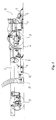
- FIG. 1 is a side view of the device mounted to the side of a vehicle. The vehicle will move from left to right during operation of the device.
- the side of a vehicle 1 is partly shown with its wheels 3 supported on the road 2.
- a first nozzle 5 for applying a first liquid composition to a marking on the road 2.
- a cylindrical brush 6 with steel fibre bristles follows the nozzle 5.
- the brush 6 is depicted from the end and is rotated in the counter-clockwise direction as indicated by the arrow by means of drive means.
- the axis of rotation of the brush 6 is parallel to the road 2 and substantially perpendicular to the direction of movement of the vehicle 1. Thereby, it is prevented that dirt from the road surface 2 next to the marking will be transferred to the marking by the brush and contaminate the marking and the first liquid.
- the dissolved marking material and the first liquid is substantially flushed from the marking by means of water from the rotating high-pressure water nozzles 7 arranged after the brush 6.
- a second nozzle 8 is arranged for applying a second liquid to the marking material and a set of counter-rotating brushes 9, 10 are arranged to polish the reflective beads that have been uncovered.
- the first brush 9 has steel fibre bristles and the second brush 10 has Tampico fibre bristles, and they rotate towards each other, i.e. the bristles move towards each other at the surface of the marking material.
- the axes of rotation are perpendicular to the direction in which the vehicle 1 moves, so that dirt from the road surface 2 next to the marking material is not dragged onto the marking material by the brushes 9, 10.
- a suction head 11 is arranged after the brushes 9, 10 to remove the second liquid with the remainder of the matrix material emulsified in it.
- a typical road surface marking material is a composition of 1-10% by weight of mineral oil, 10-30% by weight of binder material, 20-70% by weight of reflective glass beads, 0.5-15% by weight of titanium dioxide and 30-60% by weight of mineral filler. The ratio of the different compounds is adjusted to obtain the required features for a specific use of the surface marking material.
- the binder material is a mixture of artificial resins or a mixture of artificial and natural resins, of which an aliphatic hydrocarbon resin constitutes the major part.
- the reflective glass beads are made from a soda lime glass, of which the main components are 70-73 % by weight of silicon dioxide, 13-15% by weight of sodium oxide and 7-11% by weight of calcium oxide. The diameter of the beads is mainly in the range of 0.425 to 0.85 mm. Further pigment may be added besides titanium dioxide to obtain a desired colour different from white of the marking material.
- the operation of the device is as follows: The vehicle 1 moves along the road surface marking with a velocity of about 5 km/h, and the first nozzle 5 applies a layer of a first liquid to the surface marking.
- the first liquid is a composition of at least 30% by weight of 2-Methoxy-methylethoxy-propanol, from 20 to 30% by weight of 1-Methoxy-2-propanol, up to 10% by weight of n-Methyl-2-pyrrolidon and less than 2.5% by weight of D-Limonen, the last ingredients is mainly added for providing a pleasant odour of the composition.
- the first liquid dissolves the binder component of the marking material and makes it possible for the brush 6 to loosen a top layer thereof.
- the main part of the mixture of the first liquid and the dissolved and loosened marking material is removed from the road marking by the rotating high-pressure water nozzles 7, and the water neutralises the active components of the first liquid so that the impact on the environment is substantially eliminated.
- a second liquid is sprayed onto the road marking by means of the second nozzle 8.
- the second liquid has emulsifying properties such as soap or a degreasing agent that emulsifies the remains of the matrix material left on the reflective beads so that they may be removed to leave the beads with a clean and reflective surface.
- the second liquid used in the present embodiment is a composition comprising up to 15% by weight of non-ionic surfactants, up to 5% by weight of aliphatic hydrocarbons and water.
- the newly uncovered surface of the marking material is polished by the two rotating brushes 9, 10 whereby the thin layer of material on the beads is loosened and emulsified by the second liquid.
- This emulsion is finally removed from the road marking by the suction head 11, leaving the surface of the reflective beads clean.
- the suction head 11 removes in the same operation, due to the wideness of the head, most of the dissolved surface marking material that was flushed from the road marking by the rotating high-pressure water nozzles 7.
- Further suction heads may be arranged along the sides of or after the water nozzles 7 to remove the dissolved surface marking material more efficiently.
- the described operation restores or re-establishes the reflectiveness of the surface marking material with reflective beads.
Landscapes
- Road Signs Or Road Markings (AREA)
Priority Applications (1)
| Application Number | Priority Date | Filing Date | Title |
|---|---|---|---|
| EP03075511A EP1449964A1 (de) | 2003-02-21 | 2003-02-21 | Wiederherstellung des Reflexionsvermögen eines Oberflächenmarkierungsmaterials mit reflektierenden Perlen |
Applications Claiming Priority (1)
| Application Number | Priority Date | Filing Date | Title |
|---|---|---|---|
| EP03075511A EP1449964A1 (de) | 2003-02-21 | 2003-02-21 | Wiederherstellung des Reflexionsvermögen eines Oberflächenmarkierungsmaterials mit reflektierenden Perlen |
Publications (1)
| Publication Number | Publication Date |
|---|---|
| EP1449964A1 true EP1449964A1 (de) | 2004-08-25 |
Family
ID=32731578
Family Applications (1)
| Application Number | Title | Priority Date | Filing Date |
|---|---|---|---|
| EP03075511A Withdrawn EP1449964A1 (de) | 2003-02-21 | 2003-02-21 | Wiederherstellung des Reflexionsvermögen eines Oberflächenmarkierungsmaterials mit reflektierenden Perlen |
Country Status (1)
| Country | Link |
|---|---|
| EP (1) | EP1449964A1 (de) |
Citations (5)
| Publication number | Priority date | Publication date | Assignee | Title |
|---|---|---|---|---|
| US3197798A (en) * | 1963-01-28 | 1965-08-03 | Tennant Co G H | Scrubbing machine |
| GB1104379A (en) * | 1964-08-22 | 1968-02-28 | Beck Koller & Co England Ltd | Process and production of bodies containing reflecting and refracting elements |
| US3753777A (en) * | 1971-10-13 | 1973-08-21 | Tennant Co | Surface cleaning method |
| US5609678A (en) * | 1993-04-20 | 1997-03-11 | American Color Company | Paint solvent with glycol ether, oxidizing oil, propylene glycol or propylene carbonate, and NMP or isoalkane |
| WO2001030873A1 (en) * | 1999-10-27 | 2001-05-03 | 3M Innovative Properties Company | Fluorochemical sulfonamide surfactants |
-
2003
- 2003-02-21 EP EP03075511A patent/EP1449964A1/de not_active Withdrawn
Patent Citations (5)
| Publication number | Priority date | Publication date | Assignee | Title |
|---|---|---|---|---|
| US3197798A (en) * | 1963-01-28 | 1965-08-03 | Tennant Co G H | Scrubbing machine |
| GB1104379A (en) * | 1964-08-22 | 1968-02-28 | Beck Koller & Co England Ltd | Process and production of bodies containing reflecting and refracting elements |
| US3753777A (en) * | 1971-10-13 | 1973-08-21 | Tennant Co | Surface cleaning method |
| US5609678A (en) * | 1993-04-20 | 1997-03-11 | American Color Company | Paint solvent with glycol ether, oxidizing oil, propylene glycol or propylene carbonate, and NMP or isoalkane |
| WO2001030873A1 (en) * | 1999-10-27 | 2001-05-03 | 3M Innovative Properties Company | Fluorochemical sulfonamide surfactants |
Similar Documents
| Publication | Publication Date | Title |
|---|---|---|
| US20190270176A1 (en) | Concrete Cleaning and Polishing Method and Solution | |
| US7503963B2 (en) | Cleaning and polishing wax composition | |
| CN104017502A (zh) | 汽车养护剂及其制备方法 | |
| EP2236247B1 (de) | Verfahren zum Anbringen einer weiche Kunststoffzusammensetzung zum Polieren und zum Auftragen von Oberflächenschutzmaterial | |
| US11471998B2 (en) | Tools for polishing and refinishing concrete and methods for using the same | |
| US20070174980A1 (en) | Paint removal system for artificial grass | |
| CN1076252C (zh) | 用于金属和玻璃纤维的清洗和抛光物及其制备和使用方法 | |
| CN101422880A (zh) | 修补抛光高光塑料表面的抛光头及其方法 | |
| DE4019588C2 (de) | ||
| CN110499830A (zh) | 一种建筑内外装修防水层施工方法 | |
| US20120288623A1 (en) | Method for plastic restoration and kit therefor | |
| JP6006529B2 (ja) | 外壁用タイル面の汚れ除去方法 | |
| US20070272223A1 (en) | Method for maintaining a polished concrete floor | |
| US20040157758A1 (en) | Method for cleaning and protecting siliceous surfaces using co-polymer compounds | |
| JP2000282011A (ja) | バフ研摩用組成物 | |
| EP1935957A1 (de) | Poliermittel | |
| JP2000325875A (ja) | 自動車塗装表面の処理方法 | |
| GB2185455A (en) | A cleaning device for a windscreen wiper blade | |
| JPH0841444A (ja) | 塗装面等の研磨用組成物とこれを用いた研磨方法 | |
| JP2008194124A (ja) | フロアーポリッシュ組成物皮膜の剥離方法 | |
| CN222205970U (zh) | 一种市政路桥移动维护处理装置 | |
| CN1275910C (zh) | 水晶渗硅水磨石及其生产工艺 | |
| KR20120066704A (ko) | 자동차표면광택 복원방법 | |
| EP1700903B1 (de) | Verfahren zum Entfernen von Flecken verursacht durch Korrosion durch säurehaltige Lebensmittel von Marmoroberflächen | |
| EP1429647B1 (de) | Verfahren zur sanierung von beschichteten fussböden und sanierungspad |
Legal Events
| Date | Code | Title | Description |
|---|---|---|---|
| PUAI | Public reference made under article 153(3) epc to a published international application that has entered the european phase |
Free format text: ORIGINAL CODE: 0009012 |
|
| AK | Designated contracting states |
Kind code of ref document: A1 Designated state(s): AT BE BG CH CY CZ DE DK EE ES FI FR GB GR HU IE IT LI LU MC NL PT SE SI SK TR |
|
| AX | Request for extension of the european patent |
Extension state: AL LT LV MK RO |
|
| AKX | Designation fees paid | ||
| REG | Reference to a national code |
Ref country code: DE Ref legal event code: 8566 |
|
| STAA | Information on the status of an ep patent application or granted ep patent |
Free format text: STATUS: THE APPLICATION IS DEEMED TO BE WITHDRAWN |
|
| 18D | Application deemed to be withdrawn |
Effective date: 20050226 |