EP1450546A2 - Verfahren und Vorrichtung zur Isolierung von Anruferidentifizierung oder Anrufüberwachungs-schnittstellenschaltung - Google Patents
Verfahren und Vorrichtung zur Isolierung von Anruferidentifizierung oder Anrufüberwachungs-schnittstellenschaltung Download PDFInfo
- Publication number
- EP1450546A2 EP1450546A2 EP04003839A EP04003839A EP1450546A2 EP 1450546 A2 EP1450546 A2 EP 1450546A2 EP 04003839 A EP04003839 A EP 04003839A EP 04003839 A EP04003839 A EP 04003839A EP 1450546 A2 EP1450546 A2 EP 1450546A2
- Authority
- EP
- European Patent Office
- Prior art keywords
- current
- circuit
- signal
- common mode
- transconductance amplifier
- Prior art date
- Legal status (The legal status is an assumption and is not a legal conclusion. Google has not performed a legal analysis and makes no representation as to the accuracy of the status listed.)
- Withdrawn
Links
Images


Classifications
-
- H—ELECTRICITY
- H04—ELECTRIC COMMUNICATION TECHNIQUE
- H04M—TELEPHONIC COMMUNICATION
- H04M1/00—Substation equipment, e.g. for use by subscribers
- H04M1/57—Arrangements for indicating or recording the number of the calling subscriber at the called subscriber's set
- H04M1/573—Line monitoring circuits for detecting caller identification
Definitions
- the present invention is directed toward an improved method for receiving signals across an isolation barrier, in particular, a pre-amplifier suitable for use with a pulse width modulation (PWM) type analog-to-digital (A/D) converter suitable for on-hook (Type 1) Caller ID and other telephone line monitor functions.
- PWM pulse width modulation
- A/D analog-to-digital
- On-Hook telephone line monitoring is a useful function most commonly used for (Type 1) Caller ID but also for other functions, such as call monitoring, Voice/FAX steering, and line-in-use detection.
- Caller ID is a common auxiliary function available on world-wide telephone systems.
- a key component of circuitry used to decode Caller ID and other line monitoring functions is a line interface that can receive signals from the telephone line while on-hook.
- the Caller ID signal is a 1200 bit per second frequency shift key (FSK) signal using 1200Hz, Mark and 2200Hz, Space.
- the Caller ID is sent as a burst of several hundred bits down the telephone line from the Central Office approximately one-half second after the first ring signal. In other national systems, the signal is sometimes sent before the first ring, but after an alerting line polarity reversal.
- the purpose of the on-hook Caller ID signal is to alert the user to the caller's number before answering.
- on-hook interface circuits which are suitable for Caller ID, can also be used to provide other useful telephone line monitor functions, such as on-hook monitoring of call traffic, voice/FAX steering, and line-in-use detection.
- Call monitoring allows a computerized system to log telephone calls sent and received on a phone line, typically for security, billing, or call history information.
- Voice/FAX steering allows a FAX machine to pick-up a call answered by an answering machine or human by detecting either a FAX calling tone or a specific touch tone code.
- Line-in-use allows a telephone device, typically a FAX machine or a modem, to determine if the line is already in use before attempting to go off-hook. The line-in-use function is especially important for automatic dialing devices sharing a phone line with human users.
- DAAs data access arrangements
- Isolated interfaces are used in many modems, FAX machines, and satellite TV boxes.
- non-isolated interfaces are used between the phone line and the Caller ID demodulation circuitry, usually the whole circuit board and case are isolated and power is provided either by battery, telephone line power, or a low voltage output isolated wall transformer.
- non-isolated interfaces are battery powered Caller ID displays, many answering machines, and cordless telephones.
- This invention is directed toward isolated Caller ID and line monitor interfaces and a pulse width modulation (PWM) analog-to-digital (A/D) converter suitable for these functions.
- PWM pulse width modulation
- A/D analog-to-digital
- Caller ID and line monitor interface circuits need to meet regulatory on-hook DC and AC impedance requirements. Differential DC resistance needs to be over 5 Meg ohms to meet US FCC part 68 and AC impedance should exceed 80K ohm to minimize loading. These impedance limits also generally satisfy most world wide telephone regulatory requirements.
- the minimum caller ID signal is 12mV and the maximum is 476mV RMS.
- to demodulate the Caller ID signal requires a signal to noise of about 15dB within the signal bandwidth of about 2KHz, so this means that the equivalent input noise at the A/D converter or Caller ID demodulator should be less than 2mV. This defines a dynamic range of the A/D converter or demodulator of 48dB.
- the Caller ID circuit should still function with a common mode line AC line signal of 120V RMS, which is 96dB higher than the equivalent input noise of 2mV.
- a Caller ID system with a linear 9 bit A/D and using digital signal processor (DSP) filter algorithms can eliminate line frequency components as long as they don't exceed the maximum signal level of the A/D, though these solutions are typically more expensive than an automatic gain control (AGC) or zero crossing Caller ID demodulator that assumes that the Caller ID signal is always larger than any interferer signal.
- AGC automatic gain control
- common mode line voltage rejection needs to exceed 90dB.
- the common mode rejection needs to exceed 55dB to prevent overload.
- a capacitor resistor network requires the use of high voltage capacitors with break down voltages of over 1.5KV in order to withstand regulatory voltage isolation requirements. Such capacitors are significantly more expensive than standard low voltage capacitors. If the capacitors in the network are not accurately matched, then common mode rejection is poor. Although a 1% mismatch would produce a 40dB rejection, a 1% mismatch error is statistically unlikely with 1% components. Typically, 1% components will match within less than 0.3% producing a common mode rejection of at least 50dB. In order to further reduce the effects of line voltage, one technique is to roll off the audio response of the network below the Caller ID lower band limit around 600Hz by using small input capacitors, which typically have ten times higher impedance at 60Hz than at 600Hz.
- this input roll off technique can reduce common mode line voltage typically by 70dB (20db roll off + 50dB balance attenuation).
- 70dB 20db roll off + 50dB balance attenuation
- 1.5KV 1% matched capacitors are not available as high volume components. They can be produced as custom products but at 10 to 100 times the cost of equivalent value low voltage, low tolerance capacitors.
- DC can be used to determine if the line is on-hook, off-hook, or completely dead.
- detecting line polarity reversal is useful to alert Caller ID processing circuitry to an incoming Caller ID signal.
- the line polarity reversal can sometimes be detected on AC coupled interfaces as a transient, a simple off-hook or dial pulse can also produce the same transient. This ambiguity can most easily be resolved with absolute DC polarity information.
- IC resistors R1 and R4 are included inside the integrated circuit (IC) for cost reduction and component reduction reasons, then the gain accuracy of the input degrades. This is because the absolute tolerance of IC resistors is usually about +-20%. This, coupled with a typically capacitor tolerance values of +-10%, results in a significant gain tolerance variation in excess of +-30% that may require somewhat larger dynamic range requirements on the A/D converter and the inability to set accurate detect thresholds.
- the present invention provides a telephone line interface circuit according to claim 1, a method for interfacing to a telephone line according to claim 8 and a telephone line interface device according to claim 21.
- the dependent claims define preferred or advantageous embodiments of the circuit, the method and the device, respectively.
- a caller ID circuit using resistors as a caller ID interface to a telephone line pair includes a differential transconductance amplifier coupled to the telephone line pair using resistors and a common mode canceling transconductance amplifier coupled to the telephone line pair using the resistors.
- This embodiment also includes a gyrator transconductance amplifier coupled to the differential transconductance amplifier and the common mode canceling transconductance amplifier and configured to output an output current corresponding to a caller ID signal present at the telephone line pair.
- the resistors are accurate resistors.
- the circuit further includes an analog to digital converter (ADC) coupled to the gyrator transconductance amplifier, where the ADC converts the output current from the gyrator transconductance amplifier into a pulse-width-modulated (PWM) signal.
- ADC analog to digital converter
- An embodiment of a method, according to the present invention, for interfacing to a telephone line calls for developing currents at circuit nodes T and R that are proportional to an input common mode voltage between Tip and Ring terminals of the telephone line and canceling a common mode signal at circuit nodes T and R by generating a differential pair of common mode current signals from a common mode signal present at circuit node T.
- the method also calls for generating a set of current signals that are proportional to a difference signal current at circuit node R that is representative of a differential voltage between Tip and Ring.
- the method further recites generating a direct current (DC) canceling current from a first one of the set of current signals that are proportional to a difference signal current at circuit node R and adding the DC canceling current to circuit node T.
- DC direct current
- the method also sets forth providing a frequency response pole having a predetermined cut-off frequency.
- the method includes generating a DC current and polarity signal proportional to the voltage between Tip and Ring from another one of the set of current signals that are proportional to a difference signal current at circuit node R.
- the method involves converting the DC current and polarity signal to a pulse-width-modulation (PWM) encoded signal.
- PWM pulse-width-modulation
- One aspect of the present invention demonstrates how to produce a Caller ID and line monitor interface that overcomes some of the disadvantages of the prior art,and can be implemented in low cost IC technology including complementary metal-oxide semiconductor (CMOS) technology that is typically used to implement A/D and digital signal processing while using minimum cost external components.
- CMOS complementary metal-oxide semiconductor
- a Caller ID and call monitor interface pre-amplifier and analog signal processor that uses low cost resistors in the interface without expensive high voltage high tolerance capacitors and a pre-amp analog signal processor design using transconductance amplifiers that can be implemented on low cost CMOS processes on which the Caller ID A/D and DSP processor is also fabricated. Also, disclosed is a PWM A/D converter that has advantages when used with the pre-amplifier.
- the telephone line isolation barrier interface consists of high resistance (e.g. multiple Mega ohm value) 1% tolerance resistors. These resistors carry sufficient signal to the pre-amp to meet the maximum noise requirements for demodulation of a minimum Caller ID signal while also meeting regulatory and functional isolation requirements.
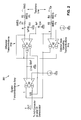
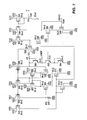
- Fig. 2 shows an embodiment of the front end pre-amplifier analog signal processor, according to one aspect of the present invention, that generates a signal suitable for output to an A/D converter or Caller ID demodulator. It generally consists of three transconductance amplifiers with multiple outputs which implement 4 major signal processing functions: 1) canceling of common mode currents passing through isolation resistors R1-R4; 2) differential to single ended conversion of the differences currents, the line voltage signal, passing through the isolation resistors; 3) removal of most of the difference currents arising from the line DC voltage, rolling off the AC response below 600Hz by 6dB per octave; and 4) reintroduction of a small fraction of the DC line current signal back into the output so as to allow measurement of the DC line voltage and polarity.
- Fig. 3 is a frequency response graph that illustrates the differential frequency response of the pre-amplifier.
- isolation characteristics are determined by safety requirements and functional requirements. Regulatory requirements are usually very comprehensive with regard to safety, but also include some functional requirements mostly in regard to functional harm to the telephone network. However, not all real functional requirements are included in the regulatory requirements or even recommended standards not required.
- the input resistors R1-R4 of Figure 2 provide high levels of both DC and AC electrical isolation.
- the input resistors from each side of the telephone line (e.g. the TIP and RING) to the pre-amp input have a total series resistance value of 12Meg ohm.
- each of the two input legs are formed by multiple resistors of the same value.
- Multiple low cost, 1% resistors are used in this embodiment for two reasons: 1) to improve matching; and 2) to improve breakdown voltage both functionally and to meet safety regulatory construction requirements for isolation required by European EN60950 and other national standards.
- Use of the high resistance resistors satisfies safety leakage requirements that specify less than 0.25 mA for even the most stringent standards of leakage current with normal line AC line voltage across the isolation barrier.
- High resistance value (e.g. multiple Mega ohm size) resistors are necessary when using small low cost 1% resistors in order to survive excess thermal heating during the standard 1 minute 1000 VAC breakdown test voltage for US systems or 1500 VAC test voltage for European systems.
- the combined parallel resistance of R1-R4 between telephone line and pre-amp input is 6 Mega ohms. If 1500V RMS is applied across this, then the thermal dissipation will be V 2 /R or 375 mW. If four low cost 1206 size resistors are used, then each will dissipate 94 mW, less than their normal 125mW specified long term limit.
- EN60950 For European or other national systems, which have 220VAC mains, EN60950 specifies isolation construction limits in terms of minimum creepage distances of 2.5mm and may require two devices in series, which pass the test voltage. Consequently, for European and other national systems, more than two resistors in series may be required to meet these requirements. Despite this, 1% 1206 surface mount resistors are extremely low cost, typically selling for less than $0.004 each in high volume.
- the input resistor network develops currents into input nodes R and T that are exactly proportional to the input common mode voltage between Tip and Ring and pre-amp voltage reference V1 and differential voltage between Tip and Ring.
- the common mode signal is removed by the transconductance amplifier A2, which has dual balanced outputs: one that is connected to T and the other that is connected to R.
- the inverting input of amplifier A2 is tied to T, while the non-inverting input is tied to a voltage reference that is chosen by the designer to be optimal for headroom and other transconductance amplifier characteristics for the desired application, such as drive current levels, noise, and technology.
- node T Due to the negative feedback current from the output of amplifier A2 to the inverting node T, the current arising from the voltage developed across R3 and R4 due to the voltage between Tip and node T, node T is served to the same voltage as the reference voltage V1 on the positive input.
- the other output adds the same common mode current to the node R input in order to cancel the common mode current going into node R arising from the same common mode voltage on the Tip line and developed across resistors R1 and R2.
- the non-zero remaining current going into node R is the difference current going into nodes T and R and is proportional to the differential voltage between Tip and Ring.
- the difference current on node R is converted to a single ended output current by transconductance amplifier A1, which has 3 current outputs.
- One of the current outputs is used to cancel the difference current into the R input. Since multiple outputs of a transconductance amplifier track each other, but the output gains may be set to different values, the other two outputs provide currents proportional to the difference signal current representative of the differential voltage between Tip and Ring independent of the common voltage.
- One signal output may be directed to a receiving A/D converter or Caller ID demodulator and its gain can be scaled as needed.
- the third output is used by a gyrator feedback circuit that includes gyrator transconductance amplifier A3.
- Transconductance amplifiers A1 and A2 typically only need low transconductance gains.
- amplifier A1 has a gain of about 500 micro Siemens for its main output and a gain of 2 milli Siemens for the output driving capacitor C1.
- Amplifier A2 typically has a gain of 750 micro Siemens.
- Amplifier A2 is typically the largest noise contributor because of the large output common mode current swings in excess of 20uA. Consequently, amplifier A2 includes large source degeneration resistors in the output mirrors (e.g. the mirrors that generate current at nodes T and R) that reduce gate noise voltage contributions of the mirror MOS transistors.
- Transconductance amplifier A3 in conjunction with capacitor C1 form a gyrator circuit that removes most of the DC component from the differential signal present at node R.
- Amplifier A3 has two outputs, one that provides a DC canceling current into node T and the other that provides a DC current and polarity proportional to the voltage between Tip and Ring, which may be sent to a DC signal processing circuit that may be the same A/D converter as used for the Caller ID or Line Monitor, in which case the signal is combined with the AC output signal from A1.
- this gyrator DC output may be directed to a separate, simpler, DC and polarity A/D processor.
- the gyrator circuit works by providing current feedback that removes the difference current into nodes R and T.
- the feedback gain is indirectly proportional to frequency. Above the cut off comer, usually set around 600Hz (as illustrated in Figure 3), the gyrator provides very little canceling current or has loop gain of less than unity. At frequencies below the 600Hz comer, the total pre-amp gain is reduced.
- the roll off comer frequency is proportional to the open loop transconductance gain of amplifier A3 and the output ratio of the amplifier A1 output that drives C1 to the feedback output into R, but inversely proportional to the capacitance value of capacitor C 1.
- the gain of gyrator transconductance amplifier A3 may be relatively quite low even with a fairly small external discrete capacitor of 33nF.
- the main output of amplifier A3, which drives node T has a gain of about 20 micro Siemens.
- it can be designed to accept a large input voltage range, such as 2V or more, on capacitor C1.
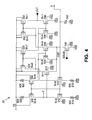
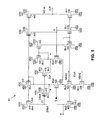
- the above pre-amplifier structure is significantly simplified by using transconductance amplifiers, since the dominant feedback stability roll off pole on all three transconductance amplifiers is achieved by capacitance to ground on their inverting inputs. These inputs already have capacitance to ground either from input/output (I/O) pin capacitance, typically several pF, or from the gyrator capacitor C1. Adding more capacitance to these inputs does not generally create any more poles in the response. Also, the current output may be very accurate, e.g. to within 1%, since it is set by the input resistor tolerances, which are typically better than 1%, and the IC matching tolerances, which are also typically much better than 1%.
- I/O input/output
- the current output may be very accurate, e.g. to within 1%, since it is set by the input resistor tolerances, which are typically better than 1%, and the IC matching tolerances, which are also typically much better than 1%.
- capacitor C1 it may be desirable for capacitor C1 to be an external component, since 33nF is typically too large of a capacitance value to be practically implemented in silicon processes. Also, use of an external capacitor C1 allows designers to adjust the roll off corner frequency of the circuit. However, it may also be desirable to eliminate the need for the external capacitor as a cost and IC pin reduction.
- capacitor C1 it is also possible to scale capacitor C1 down by a 1000 fold to 33pF by scaling the transconductance output from amplifier A1 by 1000 fold using well known current mirror gain reduction circuit techniques.
- the resulting bias currents are so low, e.g. less than 100pA, that significant errors can arise both from leakage and from modeling errors of both MOS and Bipolar transistors in their linear regions.
- the currents are so low through the mirror, the mirror can become extremely slow causing stability problems by adding significant response poles.
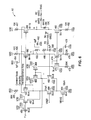
- a low value IC capacitor for capacitor C1 of the magnitude of approximately 33pF by using a low duty cycle driven switch 712 between the output of amplifier A1 and capacitor C1.
- the switch may be driven at multiples of the basic audio sampling rate and with a duty cycle of about 1/1000.
- Small CMOS switches have extremely low leakage and charges on a 33pF capacitor can be maintained for seconds if the voltage on capacitor C1 drives only MOS input amplifiers and the switch junction is very small, typically less than 1 square micron. Leakage across a minimum geometry MOS switch on modem high speed process is typically only about 1pA even with a large voltage across the switch.
- the voltage across the switch can be very low, e.g. less than 10mV, making leakage across the switch even less likely.
- the switch 712 When the switch 712 is turned on, its on resistance is on the order of 10K. However, this resistance has little effect on the time constant of the circuit since it is driven by a much higher impedance current source from the output of transconductance amplifier A1.
- This output when not connected to capacitor C1, is connected to a voltage buffer 710 that follows the voltage on capacitor C1 so that the capacitance on the output of the transconductance amplifier is at the same potential as capacitor C1 in order to minimize charge transfer when switching.
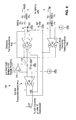
- FIG. 9 is a functional block and transistor circuit diagram illustrating one embodiment of a circuit in accordance with another aspect of the present invention for converting a signal to pulse-width-modulation encoding.
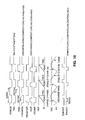
- Figure 10 is a waveform diagram illustrating a function of an embodiment of the control logic of Figure 9. The basic function of the PWM A/D Converter illustrated in Figure 9 is to convert the current output from Caller ID or Line Monitor PREAMP embodiments of Figures 2 or 8 to PWM.
- Non-overlapping control signals are needed in order for the circuit to function correctly so that there is correct charge distribution to and from capacitances C1, C2, C3 and C4 of Figure 9 (capacitors 824, 834, 822, and 812, respectively).
- two digital signals are non-overlapping if they are not going from high-to-low or from low-to-high at the same time. In other words, if the first signal goes from high-to-low, then the second signal does not go from low-to-high until the first one is no longer low (typical delay is around ⁇ 1ns), then the signals are non-overlapping.
- the PING signal is equal to PWMCLK and the PONG signal is an inverted PING signal.
- PING and PONG are non-overlapping signals:
- the PREAMPON signal is high if the COMPOUT signal is low and the PING signal is high.
- the PREAMPOFF signal is an inverted PREAMPON signal.
- PREAMPON and PREAMPOFF are non-overlapping signals.
- CHUP is high if COMPOUT is low and PONG is high.
- NOCHUP is inverted CHUP.
- CHUP and NOCHUP are non-overlapping signals.
- Each of the switches shown in Figure 9 is ON when its corresponding controlling signal is high and OFF when the controlling signal is low.
- control logic circuit 840 which is a digital circuit configured to generate control signals PING, PONG, CHUP, NOCHUP, PREAMPON, PREAMPOFF and PWMOUT from the input signals PWMCLK and COMPOUT.
- control logic 840 is a digital circuit configured to generate control signals PING, PONG, CHUP, NOCHUP, PREAMPON, PREAMPOFF and PWMOUT from the input signals PWMCLK and COMPOUT.
- the circuit shown in Figure 9 can be viewed as being divided into two parts.
- the first part is the calibrating loop generating the reference current Iref and the second part is the actual conversion of PREAMP output current into the PWM.
- the loop generating the reference current Iref consists of capacitor 824 (capacitance C1), operational amplifier 820, and capacitor 822 (C3), switches SW8, SW9, operational amplifier 810, transistor 814 (MN3), resistor 816 (R1), transistors 802 (MP1) and 804 (MP2) and switches SW1, SW2, and SW11.
- capacitor 824 capacitor C1
- operational amplifier 820 operational amplifier 820
- capacitor 822 C3
- switches SW8, SW9 operational amplifier 810
- transistor 814 MN3
- resistor 816 resistor 816
- MP1 transistors 802
- MP2 MP1 and 804
- switches SW1, SW2, and SW11 switches SW1, SW2, and SW11.
- the general purpose of this part of the circuit of Figure 9 is to create a reference current Iref that has low dependence on process and temperature.
- VN5 the voltage at node N5
- the current Iref is changed.
- the capacitor 824 (C1) is always discharged to 0V.
- the equilibrium point is reached when the current Iref is such that voltage at node N1 (VN1) reaches the voltage Vref at the end of PONG phase.
- current Irefhalf Iref/2
- COMPOUT from comparator 836 output goes low causing the digital signal PREAMPON to go high thereby connecting PREAMP output current Iin (SW3 is ON).
- the capacitor 834 (C2) is discharged down with current Iin+Irefhalf.
- the input current Iin may be converted into the time interval Tpwmon.
- Tpong, Tpwmclk and Iref are constants in a given system.
- the present invention reduces the dependence of the A/D converter gain on process and temperature variations. By keeping the gain variations small, the dynamic range of the system is increased.
- a total variation of Iref in the range of +- 5 to +-10% can be achieved as opposed to about a range of +-30% to +-50% variations (depending on technology) when the Iref is generated in conventional ways (e.g. using on- chip components) by voltage over resistor.
- the present invention is able to use resistors in a caller ID circuit interface to interface to the tip and ring of a telephone line pair.
- Accurate resistors are cheaper and, in many applications, work better than capacitors in resistor capacitor networks and can satisfy regulatory and functional requirements, which is contrary to conventional wisdom regarding isolation techniques.
- resistors can give much better common mode rejection than a conventional RC network.
- the use of a current output for the caller ID signal may be used for PWM conversion.
Landscapes
- Engineering & Computer Science (AREA)
- Signal Processing (AREA)
- Amplifiers (AREA)
- Telephone Function (AREA)
Applications Claiming Priority (2)
| Application Number | Priority Date | Filing Date | Title |
|---|---|---|---|
| US44851803P | 2003-02-20 | 2003-02-20 | |
| US448518P | 2003-02-20 |
Publications (2)
| Publication Number | Publication Date |
|---|---|
| EP1450546A2 true EP1450546A2 (de) | 2004-08-25 |
| EP1450546A3 EP1450546A3 (de) | 2005-10-19 |
Family
ID=32736524
Family Applications (1)
| Application Number | Title | Priority Date | Filing Date |
|---|---|---|---|
| EP04003839A Withdrawn EP1450546A3 (de) | 2003-02-20 | 2004-02-20 | Verfahren und Vorrichtung zur Isolierung von Anruferidentifizierung oder Anrufüberwachungs-schnittstellenschaltung |
Country Status (1)
| Country | Link |
|---|---|
| EP (1) | EP1450546A3 (de) |
Family Cites Families (4)
| Publication number | Priority date | Publication date | Assignee | Title |
|---|---|---|---|---|
| KR100205542B1 (ko) * | 1996-12-18 | 1999-07-01 | 윤종용 | 디지털 방식의 송신자-아이디 수신기 및 이를 구비한 유무선 송수신 장치 |
| US6144326A (en) * | 1997-04-22 | 2000-11-07 | Silicon Laboratories, Inc. | Digital isolation system with ADC offset calibration |
| US6298133B1 (en) * | 1997-04-22 | 2001-10-02 | Silicon Laboratories, Inc. | Telephone line interface architecture using ringer inputs for caller ID data |
| US6407603B2 (en) * | 1999-09-20 | 2002-06-18 | Lockheed Martin Corporation | Analog voltage isolation circuit |
-
2004
- 2004-02-20 EP EP04003839A patent/EP1450546A3/de not_active Withdrawn
Also Published As
| Publication number | Publication date |
|---|---|
| EP1450546A3 (de) | 2005-10-19 |
Similar Documents
| Publication | Publication Date | Title |
|---|---|---|
| US5602912A (en) | Telephone hybrid circuit | |
| US12294335B2 (en) | Receiver front end for digital isolators | |
| US5500894A (en) | Telephone line interface with AC and DC transconductance loops | |
| US7961047B2 (en) | Switching amplifier | |
| US6922469B2 (en) | Separation of ring detection functions across isolation barrier for minimum power | |
| US10942217B2 (en) | Calibration of digital isolators | |
| US10840861B1 (en) | Receiver intermediate variable gain stage for isolator products | |
| US11750157B2 (en) | Common-mode leakage error calibration for current sensing in a Class-D stage using a pilot tone | |
| EP1183858B1 (de) | Architektur und schnittstelle für slic | |
| KR101472469B1 (ko) | Dc 오프셋을 실시간으로 제거하는 dc 오프셋 보상 회로및 상기 dc 오프셋 보상 회로를 포함하는 수신 시스템 | |
| US6298133B1 (en) | Telephone line interface architecture using ringer inputs for caller ID data | |
| US6198816B1 (en) | Capacitively coupled ring detector with power provided across isolation barrier | |
| CA2077522C (en) | Battery feed circuit for supplying feed current to telephone set | |
| US6160885A (en) | Caller ID circuit powered through hookswitch devices | |
| JPH0786513B2 (ja) | データ受信装置 | |
| US5801552A (en) | Voltage detector circuit | |
| US6456712B1 (en) | Separation of ring detection functions across isolation barrier for minimum power | |
| US6104794A (en) | Architecture for minimum loop current during ringing and caller ID | |
| KR100526642B1 (ko) | 저항기네트워크에의해공통모드전압거절을가진싱글엔드형신호로차동신호를변환하기위한전자회로 | |
| US20040184598A1 (en) | Method and apparatus for isolation in a Caller ID or call monitor interface circuit | |
| EP1450546A2 (de) | Verfahren und Vorrichtung zur Isolierung von Anruferidentifizierung oder Anrufüberwachungs-schnittstellenschaltung | |
| JPH05145627A (ja) | リングトリツプ検出回路 | |
| US20220109435A1 (en) | Peak Detector | |
| US7218713B1 (en) | Telephone line interface for DAA circuitry | |
| US5760728A (en) | Input stage for an analog-to-digital converter and method of operation thereof |
Legal Events
| Date | Code | Title | Description |
|---|---|---|---|
| PUAI | Public reference made under article 153(3) epc to a published international application that has entered the european phase |
Free format text: ORIGINAL CODE: 0009012 |
|
| AK | Designated contracting states |
Kind code of ref document: A2 Designated state(s): AT BE BG CH CY CZ DE DK EE ES FI FR GB GR HU IE IT LI LU MC NL PT RO SE SI SK TR |
|
| AX | Request for extension of the european patent |
Extension state: AL LT LV MK |
|
| PUAL | Search report despatched |
Free format text: ORIGINAL CODE: 0009013 |
|
| AK | Designated contracting states |
Kind code of ref document: A3 Designated state(s): AT BE BG CH CY CZ DE DK EE ES FI FR GB GR HU IE IT LI LU MC NL PT RO SE SI SK TR |
|
| AX | Request for extension of the european patent |
Extension state: AL LT LV MK |
|
| 17P | Request for examination filed |
Effective date: 20060301 |
|
| AKX | Designation fees paid |
Designated state(s): DE FR GB |
|
| 17Q | First examination report despatched |
Effective date: 20071128 |
|
| STAA | Information on the status of an ep patent application or granted ep patent |
Free format text: STATUS: THE APPLICATION IS DEEMED TO BE WITHDRAWN |
|
| 18D | Application deemed to be withdrawn |
Effective date: 20080409 |