EP1452555A1 - Procede de purification continue de sulfure de polyarylene - Google Patents
Procede de purification continue de sulfure de polyarylene Download PDFInfo
- Publication number
- EP1452555A1 EP1452555A1 EP02785981A EP02785981A EP1452555A1 EP 1452555 A1 EP1452555 A1 EP 1452555A1 EP 02785981 A EP02785981 A EP 02785981A EP 02785981 A EP02785981 A EP 02785981A EP 1452555 A1 EP1452555 A1 EP 1452555A1
- Authority
- EP
- European Patent Office
- Prior art keywords
- washing
- polyarylene sulfide
- particles
- liquid
- slurry
- Prior art date
- Legal status (The legal status is an assumption and is not a legal conclusion. Google has not performed a legal analysis and makes no representation as to the accuracy of the status listed.)
- Granted
Links
Images
Classifications
-
- C—CHEMISTRY; METALLURGY
- C08—ORGANIC MACROMOLECULAR COMPOUNDS; THEIR PREPARATION OR CHEMICAL WORKING-UP; COMPOSITIONS BASED THEREON
- C08G—MACROMOLECULAR COMPOUNDS OBTAINED OTHERWISE THAN BY REACTIONS ONLY INVOLVING UNSATURATED CARBON-TO-CARBON BONDS
- C08G75/00—Macromolecular compounds obtained by reactions forming a linkage containing sulfur with or without nitrogen, oxygen, or carbon in the main chain of the macromolecule
- C08G75/02—Polythioethers
- C08G75/0204—Polyarylenethioethers
- C08G75/0277—Post-polymerisation treatment
- C08G75/0281—Recovery or purification
-
- C—CHEMISTRY; METALLURGY
- C08—ORGANIC MACROMOLECULAR COMPOUNDS; THEIR PREPARATION OR CHEMICAL WORKING-UP; COMPOSITIONS BASED THEREON
- C08G—MACROMOLECULAR COMPOUNDS OBTAINED OTHERWISE THAN BY REACTIONS ONLY INVOLVING UNSATURATED CARBON-TO-CARBON BONDS
- C08G75/00—Macromolecular compounds obtained by reactions forming a linkage containing sulfur with or without nitrogen, oxygen, or carbon in the main chain of the macromolecule
- C08G75/02—Polythioethers
- C08G75/0204—Polyarylenethioethers
- C08G75/0209—Polyarylenethioethers derived from monomers containing one aromatic ring
- C08G75/0213—Polyarylenethioethers derived from monomers containing one aromatic ring containing elements other than carbon, hydrogen or sulfur
-
- C—CHEMISTRY; METALLURGY
- C08—ORGANIC MACROMOLECULAR COMPOUNDS; THEIR PREPARATION OR CHEMICAL WORKING-UP; COMPOSITIONS BASED THEREON
- C08G—MACROMOLECULAR COMPOUNDS OBTAINED OTHERWISE THAN BY REACTIONS ONLY INVOLVING UNSATURATED CARBON-TO-CARBON BONDS
- C08G75/00—Macromolecular compounds obtained by reactions forming a linkage containing sulfur with or without nitrogen, oxygen, or carbon in the main chain of the macromolecule
- C08G75/02—Polythioethers
- C08G75/0204—Polyarylenethioethers
- C08G75/025—Preparatory processes
- C08G75/0254—Preparatory processes using metal sulfides
Definitions
- the present invention relates to a process for treating a slurry containing at least two types of solid particles, particularly a process for effectively washing a polymerizate slurry containing polyarylene sulfide particles obtained by reacting an alkali sulfide source and an aromatic dihalide compound in a polar organic solvent, or an effective process for treating such a polymerizate slurry.
- a polyarylene sulfide [PAS] resin as represented by polyphenylene sulfide is an engineering plastic excellent in heat resistance, chemical resistance, non-flammability, electrical properties and mechanical properties, and is widely used as materials for fiber, films, injection molding and extrusion.
- the production of a PAS resin through a process of reacting an aromatic dihalide compound and an alkali metal sulfide in an organic polar solvent, such as N-methylpyrrolidone (NMP), is described, e.g., in Japanese Patent Publication (JP-B) 52-12240.
- a polymerization system in a high-temperature state is withdrawn by flushing into a vessel under a normal or reduced pressure, and is then subjected to recovery of the solvent, washing and drying to recover the resin, thereby finally obtaining a powdery resin product having particle sizes of from several ⁇ m to 50 ⁇ m.
- the powdery resin in a dry state is liable to be scattered as dust and is difficult to handle because of a small bulk density.
- the powdery resin is liable to show inferior production efficiency because of a lowering in throughput at the time of melt-extrusion.
- a PAS resin is generally provided with a level of melt-viscosity necessary for processing through so-called hot cross-linking in a step after the drying, so that the PAS resin is liable to exhibit inferior mechanical or physical properties than linear polymers.
- JP-A59-49232 has disclosed a process for processing particulate PPS, and in its Examples, the polymerizate is discharged into water, and precipitated polymer beads are recovered and subjected to a repetition of washing with warm water.
- JP-A 61-255933 has disclosed a process for treating a polymerizate slurry obtained in the polymerization step and containing a particulate PAS.
- the treating process includes: (1) a step wherein a polymerizate slurry containing polyarylene sulfide particles, by-produced crystalline and dissolved alkali chloride and arylene sulfide oligomers together with the liquid component principally comprising N-methylpyrrolidone, is subjected to sieving for separation into polyarylene sulfide particles and a slurry containing crystallized alkali chloride, (2) a step wherein the slurry containing crystallized alkali chloride is subjected to solid-liquid separation to recover crystallized alkali chloride, while the liquid component is distilled to recover N-methylpyrrolidone, (3) a step of washing the polyarylene sulfide particles with an organic solvent, such a's acetone, and water, and (4) a
- JP-A4-139215 has disclosed a process for washing polyarylene sulfide, wherein polyarylene sulfide particles recovered by sieving from a polymerizate slurry are successively washed with an organic solvent, such as acetone, having a lower boiling point than water miscible with water and polar organic solvent in the polymerizate slurry, and then with water.
- an organic solvent such as acetone
- an objective polymerizate slurry containing polyarylene sulfide particles obtained by reaction of an alkali sulfide source and an aromatic dihalide' compound in a polar organic solvent contains not only polyarylene sulfide particles having an average particle size on the order of 200-2000 ⁇ m, as a principal object of recovery, but also a polar organic solvent, by-produced alkali metal salt fine particles, dissolved alkali metal salt and arylene sulfide oligomer.
- Such a large number of components in the polymerizate slurry provide an essential difficulty in separation and recovery of product PAS particles, and particularly many problems are encountered in the above-mentioned separation-recovery process including the sieving or filtration as an essential step.
- the above-mentioned processes disclosed by JP-A 61-255933 and JP-A4-139215 both include a step of sieving the polymerizate slurry by using a sieve having a mesh-opening of ca.105 ⁇ m so as to recover PAS particles on the sieve while transferring the by-produced alkali metal salt fine particles to the filtrate liquid. It is inevitable to lose PAS particles having particle sizes passing through the sieve mesh-opening, and if the mesh-opening is decreased so as to reduce the loss, the separation between the PAS particles and the alkali metal salt fine particles becomes difficult and requires an excessively long time for the filtration, thus making the process commercially unfeasible. Further, the processes are also accompanied with much difficulty in recovery of the polar organic solvent that is a costly reaction solvent from the filtrate liquid containing the by-produced alkali metal salt fine particles.
- a principal object of the present invention is to provide a process which does not include a commercially problematic sieving step as an essential step but can effectively recover PAS particles from a polymerizate slurry as mentioned above.
- Another object of the present invention is to provide a process for treating a PAS polymerizate slurry which also takes into account effective recovery of a polar organic solvent that is a costly reaction solvent, and allows effective separation and removal of by-produced alkali metal salt.
- Another object of the present invention is to provide a process for effectively washing PAS particles with a reduced amount of washing liquid.
- a further object of the present invention is' to provide an effective process for treating a slurry containing at least two types of solid particles, like a PAS polymerizate slurry as mentioned above.
- a process for continuously washing PAS comprising: a washing step of subjecting a polymerizate slurry to continuous countercurrent contact with a washing liquid; said polymerizate slurry containing PAS particles, a by-produced alkali metal salt and a polar organic solvent and obtained through a reaction of an alkali sulfide source and an aromatic dihalide compound in the polar organic solvent.
- the above-mentioned washing process or PAS polymerizate slurry-treatment process including countercurrent contact with a washing liquid is not only industrially excellent in that it allows continuous processing of the polymerizate slurry but also capable of reducing the loss of PAS fine particles as encountered in recovery by sieving separation from by-produced alkali metal salt fine particles.
- the continuous process for washing polyarylene sulfide according to the present invention it becomes possible to achieve efficient recovery of the costly polar organic solvent and efficient removal by separation of the by-produced alkali metal salt.
- a process for treating a slurry comprising: subjecting a slurry comprising a dispersion liquid medium and at least two types of solid particles dispersed in the liquid medium to sequential washing steps including: a first washing step of washing the slurry by countercurrent contact with a first washing liquid which does not dissolve any of the solid particles but is miscible with the dispersion liquid medium, and a second washing step of bringing the washed at least two types of solid particles into contact with a second washing liquid which selectively dissolves a part of the at least two types of solid particles and is also miscible with the first washing liquid.
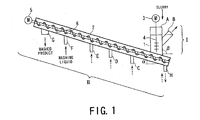
- FIG. 1 is a schematic illustration of an embodiment of washing apparatus suitable for practicing a process of the present invention.
- the washing apparatus is roughly divided into a downward tube section I and an upward tube section II for flowing PAS particles downwards and upwards, respectively.
- the downward tube section I and the upward tube section II comprise hollow tubes 1 and 2, respectively.
- Inside the downward tube 1 is disposed a stirrer 4 driven by a motor 3, and inside the upward tube 2 is disposed a screw 6 driven by a motor 5 for carrying or scooping up the PAS particles.
- the apparatus is provided with a supply port and a discharge port at positions arbitrarily selected from A to H.
- a supply port for a material to be washed is provided at A.
- F a principal supply port for a washing liquid
- G a discharge port for washed PAS particles
- B a discharge port for a washing waste liquid
- C D and E, optionally provided auxiliary supply ports for washing liquids
- H an optionally provided temporary discharge port.
- An auxiliary supply port can also be provided between the PAS particle-discharge port G and the principal washing liquid-supply port F, or/and to the downward tube section I.
- the downward tube 1 is vertical and the upward tube 2 is inclined in the embodiment of Figure 1, but each of them can be either vertical or inclined.
- the particles descend and the washing liquid ascends to cause countercurrent contact or sedimentation between them.
- the upward tube 2 particles inclusive of the PAS particles are carried up by the screw 6 while being washed with the washing liquid.
- the upward tube 2 may be inclined with respect to the horizontal plane at an angle ⁇ , which may be appropriately selected from a range of generally 1-90 deg., preferably 5-60 deg., further preferably 15-45 deg.
- the downward tube 1 can also be inclined with respect to the horizontal plane at an angle ⁇ appropriately selected from a range of 1-90 deg., preferably 5-90 deg., for the purpose of moderation of the sedimentation velocity, improving the washing efficiency, or providing a compact apparatus in combination with the upward tube 2.
- the apparatus of Figure 1 may generally be operated as an open system under the atmospheric pressure, but can be placed under an elevated or reduced pressure.
- PAS polymerizate slurry supplied through the port A is first described.
- PAS polymerizate slurry to be processed or treated by the present invention is a polymerizate slurry containing polyarylene sulfide particles, a by-produced alkali metal salt and a polar organic solvent and obtained through a reaction of an alkali sulfide source and an aromatic dihalide compound in the polar organic solvent.
- Na 2 S or NaHS (+ NaOH) is used as the alkali sulfide source
- p-dichlorobenzene is used as the aromatic dihalide compound
- NMP is used as the polar organic solvent, to provide a PAS polymerizate slurry containing, in addition to product PPS particles, crystalline NaCl, dissolved NaCl, phenylene sulfide oligomer and paradichlorobenzene, together with the solvent NMP and water.
- a polymerizate slurry is supplied from the supply port A and water is supplied as a washing liquid from the principal washing liquid-supply port F, whereby washed PAS particles are discharged out of the discharge port G, and an aqueous waste fluid containing NMP, dissolved NaCl, dissolved phenylene sulfide oligomer and paradichlorobenzene, is discharged out of the discharge port B.
- solid matter principally comprising PAS particles, crystalline NaCl, etc., in the PAS polymerizate slurry supplied from the supply port A is caused to flow down or descend preferably under mild stirring by means of stirring blades 4 through the downward tube 1 to reach the bottom of the tube 1, from which the solid matter is scooped up by a screw 6 rotated in the upward tube 2 while it is caused to countercurrently contact water supplied from the supply port F and the accompanying crystalline alkali metal salt is washed out therefrom.
- the solid matter is separated from water during further ascending in the tube 2 to be discharged out of the discharge port G and is dried thereafter to provide PAS particles.
- water as the washing liquid supplied from the supply port F dissolves the crystalline alkali metal salt accompanying the PAS particles and is' accompanied with the dissolved alkali metal salt while extracting the polar organic solvent absorbed with the polyarylene sulfide particles. Then, the water is discharged out of the port B together with the polar organic solvent and arylene sulfide oligomer in the polymerizate slurry.
- the washing waste fluid is separated into respective components according to an ordinary method, such as distillation.
- This embodiment generally utilizes the effective scrubbing function alone of the countercurrent washing apparatus of Figure 1.
- the PAS particles discharged out of the port G can receive a sufficient washing effect, but this embodiment involves a difficulty that the presence of the alkali metal salt such as NaCl, dissolved in the washing waste fluid makes difficult the distillation for separating the respective components in the waste fluid.
- two units of the washing apparatus shown in Figure 1 are disposed in series, and the polymerizate slurry is subjected to a two-stage washing process.
- the polymerizate slurry is supplied from the port A, and from the port F is supplied a washing liquid comprising a polar organic solvent (e.g., acetone or methanol, hereinafter represented by acetone) which is miscible with water and the polar organic solvent (hereinafter represented by NMP) in the polymerizate slurry and has a lower boiling point than water, whereby NMP is principally extracted and washed out from the particulate PAS (hereinafter represented by PPS) to discharge a wet cake of PPS particles accompanied with the crystalline alkali metal salt(hereinafter represented by NaCl) out of the port G.
- PPS particulate PAS
- NaCl crystalline alkali metal salt
- a second washing unit also having a structure substantially similar as the one shown in Figure 1, the wet cake of PPS particles discharged out of the port G and accompanied with the crystalline NaCl is supplied from the port A, and water is supplied from the port F as a washing liquid.
- the accompanying crystalline NaCl is removed by dissolution and the absorbed acetone is removed by extraction, respectively with water, from the PPS particles, whereby a wet cake of PPS particles substantially wetted with water alone is discharged out of the port G and then dried to provide product PPS particles.
- washing waste fluid comprising water, recovered acetone and dissolved NaCl as major components. If this washing waste fluid is subjected to distillation, acetone is recovered from the column top, and from the column bottom is discharged aqueous NaCl solution which can be discharged as it is without further solid-liquid separation.
- the washing waste fluid discharged out of the port B of the first washing unit comprises acetone, water and NMP as major components and a very small amount of dissolved NaCl, and therefore can be subjected to distillation without a substantial lowering in efficiency. More specifically, in the distillation column, acetone, water and NMP are distilled out respectively from top parts, and a small amount of NMP containing high-boiling point matter is withdrawn as bottom residue liquid at appropriate time from the bottom.
- a third washing unit also having a structure substantially similar as the one shown in Figure 1, is used to treat with an acid the wet cake of PPS particles discharged out of the port G of the second washing unit in Second embodiment described above.
- the acid treatment is effective for increasing crystallization temperature and crystallization speed as preferable features of product PPS particles as described in JP-A62-48728 and JP-A7-118389.
- the wet cake of PPS particles discharged out of the port G of the second washing unit is supplied from the port A of the third washing unit.
- a solution of an acid e.g., an inorganic acid, such as hydrochloric acid, sulfuric acid or phosphoric acid; a salt of strong acid and weak base, such as ammonium chloride; or an organic acid, such as acetic acid or formic acid
- an acid e.g., an inorganic acid, such as hydrochloric acid, sulfuric acid or phosphoric acid; a salt of strong acid and weak base, such as ammonium chloride; or an organic acid, such as acetic acid or formic acid
- water or a solvent mixture of water as a major ingredient with a water-miscible solvent, such as alcohol and from a port F is supplied water, respectively as washing liquids.
- the PPS particles supplied from the port A are treated with the acid introduced through the port C while descending through the downward tube 1 and ascending in a section up to the supply port C of the upward tube 2, and are washed with water introduced through the port F while further ascending through the upward tube 2, followed by water draining on further ascending and discharging out of the port G as a wet cake, which is then dried to be recovered as the product of acid-treated PPS particles.
- the washing liquid from the discharge port B is a diluted acid that can be introduced into an acid recovery section or can be discharged out of the system as it is because it is substantially harmless.
- each washing unit is enlarged like a hopper.
- This modification is effective for facilitating the introduction of feed materials and the separation of the feed and the washing waste fluid, and may also be applied to the washing apparatus shown in Figure 1.
- the polymerizate slurry is supplied from the port A, and the PPS particles therein are successively washed with acetone supplied from the port C, water supplied from the port D, acid supplied from the port E and water supplied from the port F, and after water draining, are discharged out of the port G as a wet cake containing substantially water alone, followed by drying, to be recovered as an acid-treated particulate PPS product.
- a washing waste fluid containing dissolved NaCl and NMP in addition to washing liquids including water, acetone and acid is discharged out of the port B.
- This embodiment therefore leaves a difficulty in recovering acetone and NMP.
- first and second washing units each having a substantially similar structure as shown in Figure 1. More specifically, in the first washing unit according to this embodiment, acetone is supplied from the principal washing liquid supply port F, and the operation and function of the first washing unit are quite identical to those of the first washing unit in Third embodiment.
- the washed PAS particles accompanied with NaCl and discharged out of the port G of the first washing unit are supplied to the second washing unit, wherein the PAS particles are successively washed with water, acid and water supplied from the ports C, D (or E) and F, respectively, to be discharge out of the port G, followed by drying, to provide an acid-treated particulate PAS product.
- a washing waste fluid comprising water, acid and acetone is discharged out of the port B of the second washing unit, and the washing waste fluid can be easily separated by distillation so as to recover acetone from the column top and discharge acidic water from the column bottom.
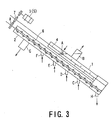
- the apparatus of Figure 1 can be volumetrically compacted into an apparatus shown in Figure 3, wherein like parts are denoted by identical symbols and numerals as in Figure 1.
- a downward tube 1 is inclined and disposed adjacent to an upward tube 2, whereby the apparatus can be made compact as a whole.
- a stirrer 4 and a screw 6 are driven by a common motor 3 via pulleys 7 and 8, respectively, but of course can be arranged to be driven with separate motors.
- the feed slurry is introduced into the washing apparatus from the supply port A.
- Several effects are attained by introducing the feed slurry from a lower part of the upward tube 2 compared with the case of introduction from the supply port A. More specifically, (1) it is possible to solve a problem that particles settled at the bottom of the downward tube section I are agglomerated with each other to cause a localized flow of the washing liquid.
- the slurry introduced from the port C, D or H is immediately subjected to stirring by the screw 6, so that the washing liquid and the slurry can be mixed in a short time to quickly wet the surface of the PAS particles with the washing liquid.
- the stirrer 4 in the downward tube section I is unnecessitated, so that the downward tube 1 can be simplified, e.g., made smaller in size.
- washing liquid e.g., acetone
- the feed PAS polymerizate slurry in advance.
- the surface of the particles in the feed slurry wetted with the washing liquid such as acetone, whereby the difference in specific gravity between the solid and the liquid can be enlarge and the liquid viscosity can be lowered.
- the initial speed of sedimentation of the particles after the introduction of the polymerizate slurry to the supply port of the washing apparatus of Figure 1 becomes faster in case where acetone is blended with the polymerizate slurry than in the case of no blending, whereby the overall sedimentation speed until the completion of the sedimentation after the introduction of the polymerizate slurry into the downward tube can be increased in the case of blending of acetone with the polymerizate slurry.
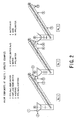
- the solid-liquid separation may for example be accomplished by introducing the polymerizate slurry into the port A of an apparatus having a structure as shown in Figure A without particularly introducing a washing liquid to obtain a polymerizate slurry of a reduced polar organic solvent content, and again introducing the polymerizate slurry to a supply port A, etc., of a washing apparatus as shown in Figure 1.
- ordinary means such as sieving or centrifugation, in addition to the above.
- the proportion of the polar organic solvent in the slurry is reduced, whereby (1) the difference in specific gravity between solid and liquid is increased to provide a larger sedimentation speed of the particles, so that the diameter of the downward tube can be reduced. (2) The amount of used washing liquid, such as acetone, can be reduced.
- a washing solvent, such as acetone is relatively expensive and is therefore recovered by distillation, etc., of which the cost can be reduced according to this embodiment.
- a 200 liter-autoclave(reaction vessel) was charged with 60 kg of NMP and 38 kg of sodium sulfide penta-hydrate containing 46.30 wt.% of sodium sulfide (Na 2 S), and after aeration with nitrogen gas, gradually elevated to a temperature of 200 °C under stirring within 3.5 hours to distil out 16.5 kg of water and 11 kg of NMP while 5.0 mols of H 2 S was removed by vaporization. Accordingly, the effective amount of Na 2 S remaining in the vessel after the dehydration step was 220.4 mols. The amount of the vaporized H 2 S corresponded to 2.22 mol% of the charged Na 2 S.
- p-DCB paradichlorobenzene
- the above-obtained polymerizate slurry was continuously processed by an apparatus having a structure essentially as shown in Figure 1.
- the apparatus included a downward tube 1 comprising a vertical hollow tube having an enlarged top portion and a straight tube portion of 70 mm in inner diameter giving a total length of ca. 1 m, and a stirrer 4 was rotated at 8 rpm.
- a screw 6 had a length of 2 m, an outer diameter of 65 mm, a shaft diameter of 24 mm and a pitch of 60 mm and was rotated at 8 rpm.
- the above-described polymerizate slurry was continuously supplied at a rate of 510 g/min from a port A, and acetone was introduced at a rate of 220 g/min. from a port F disposed at a position of ca.500 mm from the upper end of the upward tube 2.
- 100 kg of the polymerizate slurry (containing 16.4 kg of PPS, 17.8 kg of NaCl and 56.9 kg of NMP) was processed for washing, whereby 15.8 kg of PPS and 17.3 kg of NaCl were recovered in a wet cake state (PPS recovery rate: 96 %, NaCl recovery rate: 97%) from a port G disposed at a position of ca.
- the wet cake contained 34.7 wt.% of PPS, 38.0 wt.% of NaCl, 0.15 wt.% of NMP, 0.06 wt.% of p-DCB and the remainder principally comprising acetone.
- a washing waste fluid was discharged from a port B disposed at a position of ca. 900 mm from the upper end of the downward tube 1 and was found to be free from PPS particles of over 150 ⁇ m.
- 1.2 kg of wet cake remained on the filter paper including 0.3 kg of by-produced crystalline alkali metal salt and 0.5 kg of PPS.
- the above aqueous slurry was supplied at a rate of 540 g/min. from the port A and water was supplied at a rate of 250 g/min. from the port F, respectively continuously.
- PPS 15 kg, NaCl: 16.4 kg
- 14.9 kg of PPS was recovered in a wet cake state from the port G.
- PPS recovery rate 99 %
- the weight of water used for the washing was 3.1 times that of the polymer giving a total amount of water of 6.9 times the weight of the polymer together with the 3.8 times amount of water used for the re-slurrying.
- the wet cake contained 31.2 wt.% of PPS, 0.5 wt.% of acetone and the remainder principally comprising water.
- the wet cake thus obtained was dried for 13 hours in an oven at 105°C.
- the dried particles exhibited an NMP concentration of 200 ppm, an Na + concentration of 1300 ppm and a polymer crystallization temperature on temperature decrease of 185 °C.
- the amount of PPS recovered through the two times of continuous washing operation was 95 % of PPS contained in the polymerizate slurry.
- the screw 6 was rotated at 10 rpm for the processing. More specifically, the wet cake was supplied at a rate of 260 g/min (polymer: 81 g/min.) from the port A, water was supplied at 200 g/min. from the port F, and 80 wt.% concentration-acetic acid was supplied at a flow rate of 0.75 g/min. (so as to provide a proportion of 0.3 wt.% of the washing water) from the port C, respectively continuously.
- the water used was 2.5 times the polymer, and the acetic acid was used in 0.74 g per 100 g of the polymer.
- the wet cake was dried for 13 hours in an oven at 105 °C to provide a polymer exhibiting a crystallization temperature on temperature decrease of 248 °C.
- the above-obtained polymerizate slurry in 2700 g (PPS: 443 g, NaCl: 481 g and NMP: 1536 g) was first sieved through a screen having a mesh opening of 150 ⁇ m to separate and recover a particulate polymer, whereby a wet cake was obtained in 1000 g, which contained 40 wt.% of PPS.
- a wet cake was obtained in 1000 g, which contained 40 wt.% of PPS.
- 2000 g of acetone was added, and the mixture was stirred at room temperature and then subjected to sieving in a similar manner.
- the resultant cake after the sieving contained 50 wt.% of PPS.
- the same operation was repeated further two times for washing of the polymer.
- the total amount of acetone used amounted to 15 times that of the polymer.
- the wet cake obtained after the washing with acetone contained 0.2 wt.% of NMP.
- the wet cake was then subjected to 5 times of washing with water in a similar manner of operation as in the above-mentioned washing with acetone.
- the total amount of water thus used was 10000 g that was 22.6 times the polymer weight.
- the wet cake after water draining was dried for 13 hours in an oven at 105 °C .
- 400 g of PPS was recovered (PPS recovery rate: 90 %).
- the dried particles exhibited an NMP concentration of 220 ppm, an Na + concentration of 1700 ppm, and a polymer crystallization temperature on temperature decrease of 185 °C.
- the filtrate liquid after the acetone washing was subjected to solid-liquid separation by using a No.5A filter paper instead of the screen, thereby obtaining 330 g of a wet cake, which contained 220 g of by-produced crystalline alkali metal salt and 40 g of PPS.
- a wet cake which contained 220 g of by-produced crystalline alkali metal salt and 40 g of PPS.
- 1000 g of acetone was added, and the mixture was stirred and then drained.
- the solid matter obtained after the draining exhibited an NMP content of 5000 ppm attached thereto.
- the total amount of acetone was ca.17.5 times, and that of water was 25 times.
- Example 1-1 The same polymerizate slurry as used in Example 1-1 was continuously processed by an apparatus having a structure similar to the one shown in Figure 1.
- the apparatus included a downward tube 1 which was composed of a straight tube alone with no stirrer therein and disposed as a hollow vertical tube having an inner diameter of 70 mm and an overall length of 1 m.
- the polymerizate slurry was supplied directly to a lower end (at a position of H in Figure 1) of the upward tube having a scooping screw therein.
- the polymerizate slurry was supplied at 250 g/min., and acetone was supplied at 200 g/min. from a position of F (ca.1000 mm from the upper end of the upward tube 2) in Figure 1.
- 100 kg of the polymerizate slurry (containing 16.4 kg of PPS, 17.8 kg of NaCl and 56.9 kg of NMP) was processed for washing, whereby 528.8 kg of wet cake was obtained from a discharge port G at a position of ca.100 mm from the upper end of the upward tube 2.
- the wet cake contained 15.7 kg of PPS, 17.3 kg NaCl, 0.076 kg of NMP, 0.015 kg of p-DCB and the remainder principally comprising acetone.
- the PPS recovery rate was 96 %, and NaCl recovery rate 97 %.
- the weight of acetone used for the washing was 4.9 times the PPS weight.
- a washing waste fluid was discharged from the port B and was formed to contain 0.7 kg of PPS and 0.5 kg of NaCl.
- Example 2 The same polymerizate slurry as used in Example 2 in 100 kg (containing 16.4 kg of PPS, 17.8 kg of NaCl and 56.9 kg of NMP) was preliminarily blended with 40 kg of acetone as a washing solvent, and the mixture was continuously supplied at a rate of 350 g/min. from the top port A of the downward tube 1 in the apparatus of Figure 1. Acetone was also supplied at a rate of 100 g/min. from the port F in Figure 1. The other conditions were the same as in Example 2.
- a similar polymerizate slurry was preliminarily blended with a portion of acetone as a washing liquid and then continuously processed in the apparatus shown in Figure 1. In this instance, however, no acetone was supplied as a countercurrently flowing washing solvent, whereby the apparatus was used as a solid-liquid separation apparatus.
- the wet cake was found to contain 28.3 wt.% of PPS, 23.0 wt.% of NaCl, 20.3 wt.% of NMP, 0.14 wt.% of p-DCB, and the remainder principally of acetone.
- PAS polyarylene sulfide
- PAS polymerizate slurry which (a) does not include a commercially problematic sieving step as an essential step and (b) is capable of effectively washing PAS particles with a small amount of washing liquid and also envisages the effective recovery of a polar organic solvent that is an expensive solvent and the effective removal of by-produced alkali metal salt.
Landscapes
- Chemical & Material Sciences (AREA)
- Health & Medical Sciences (AREA)
- Chemical Kinetics & Catalysis (AREA)
- Medicinal Chemistry (AREA)
- Polymers & Plastics (AREA)
- Organic Chemistry (AREA)
- General Chemical & Material Sciences (AREA)
- Polymers With Sulfur, Phosphorus Or Metals In The Main Chain (AREA)
- Treatments Of Macromolecular Shaped Articles (AREA)
Applications Claiming Priority (3)
| Application Number | Priority Date | Filing Date | Title |
|---|---|---|---|
| JP2001368579 | 2001-12-03 | ||
| JP2001368579 | 2001-12-03 | ||
| PCT/JP2002/012513 WO2003048231A1 (fr) | 2001-12-03 | 2002-11-29 | Procede de purification continue de sulfure de polyarylene |
Publications (3)
| Publication Number | Publication Date |
|---|---|
| EP1452555A1 true EP1452555A1 (fr) | 2004-09-01 |
| EP1452555A4 EP1452555A4 (fr) | 2005-04-13 |
| EP1452555B1 EP1452555B1 (fr) | 2009-06-10 |
Family
ID=19178152
Family Applications (1)
| Application Number | Title | Priority Date | Filing Date |
|---|---|---|---|
| EP02785981A Expired - Lifetime EP1452555B1 (fr) | 2001-12-03 | 2002-11-29 | Procede de purification continue de sulfure de polyarylene |
Country Status (8)
| Country | Link |
|---|---|
| US (1) | US7094867B2 (fr) |
| EP (1) | EP1452555B1 (fr) |
| JP (1) | JP4919581B2 (fr) |
| CN (1) | CN1294182C (fr) |
| AT (1) | ATE433472T1 (fr) |
| AU (1) | AU2002354130A1 (fr) |
| DE (1) | DE60232602D1 (fr) |
| WO (1) | WO2003048231A1 (fr) |
Cited By (3)
| Publication number | Priority date | Publication date | Assignee | Title |
|---|---|---|---|---|
| EP1788010A4 (fr) * | 2004-09-06 | 2008-01-16 | Kureha Corp | Procédé servant à produire du sulfure de polyarylène |
| WO2010138586A3 (fr) * | 2009-05-26 | 2011-02-24 | Solutia Inc. | Lavage en continu du polyvinylbutyral |
| EP2594598A4 (fr) * | 2010-07-13 | 2016-09-07 | Kureha Corp | Procédé pour la production de poly(sulfure d'arylène) et dispositif pour le produire |
Families Citing this family (35)
| Publication number | Priority date | Publication date | Assignee | Title |
|---|---|---|---|---|
| US7276625B2 (en) * | 2002-10-15 | 2007-10-02 | Eastman Chemical Company | Process for production of a carboxylic acid/diol mixture suitable for use in polyester production |
| US7132566B2 (en) * | 2003-09-22 | 2006-11-07 | Eastman Chemical Company | Process for the purification of a crude carboxylic acid slurry |
| US7074954B2 (en) * | 2002-12-09 | 2006-07-11 | Eastman Chemical Company | Process for the oxidative purification of terephthalic acid |
| US7161027B2 (en) | 2002-12-09 | 2007-01-09 | Eastman Chemical Company | Process for the oxidative purification of terephthalic acid |
| BR0316462A (pt) * | 2002-12-09 | 2005-10-11 | Eastman Chem Co | Processos para reduzir uma suspensão de ácido carboxìlico purificado, para purificar um produto de oxidação em estágios, para produzir um produto de ácido carboxìlico purificado, e, suspensão de ácido carboxìlico purificado |
| JP4310279B2 (ja) * | 2002-12-27 | 2009-08-05 | 株式会社クレハ | ポリアリーレンスルフィドの製造方法及び洗浄方法、並びに洗浄に使用した有機溶媒の精製方法 |
| US7193109B2 (en) * | 2003-03-06 | 2007-03-20 | Eastman Chemical Company | Process for production of a carboxylic acid/diol mixture suitable for use in polyester production |
| US20050059709A1 (en) * | 2003-09-15 | 2005-03-17 | Meythaler Jay M. | Treatment of a neuropathy with rapid release aminopyridine |
| US7214760B2 (en) * | 2004-01-15 | 2007-05-08 | Eastman Chemical Company | Process for production of a carboxylic acid/diol mixture suitable for use in polyester production |
| CN1896119B (zh) * | 2005-07-13 | 2011-05-11 | 自贡鸿鹤化工股份有限公司 | 从合成聚苯硫醚树脂料浆中回收聚苯硫醚树脂的方法 |
| US20070179312A1 (en) * | 2006-02-02 | 2007-08-02 | O'meadhra Ruairi Seosamh | Process for the purification of a crude carboxylic axid slurry |
| US8614350B2 (en) | 2008-01-15 | 2013-12-24 | Eastman Chemical Company | Carboxylic acid production process employing solvent from esterification of lignocellulosic material |
| US8455680B2 (en) | 2008-01-15 | 2013-06-04 | Eastman Chemical Company | Carboxylic acid production process employing solvent from esterification of lignocellulosic material |
| JP6044303B2 (ja) * | 2012-11-30 | 2016-12-14 | 東レ株式会社 | 環式ポリアリーレンスルフィドの回収方法 |
| WO2015047718A1 (fr) | 2013-09-25 | 2015-04-02 | Ticona Llc | Procédé multi-étapes pour la formation de sulfures de polyarylène |
| JP2016536376A (ja) | 2013-09-25 | 2016-11-24 | ティコナ・エルエルシー | 低ハロゲン含量のポリアリーレンスルフィドを形成する方法 |
| JP6684206B2 (ja) | 2013-09-25 | 2020-04-22 | ティコナ・エルエルシー | ポリアリーレンスルフィドの形成中における塩副生成物の分離 |
| JP6797687B2 (ja) | 2013-09-25 | 2020-12-09 | ティコナ・エルエルシー | ポリアリーレンスルフィド結晶化方法 |
| US9604156B2 (en) | 2013-09-25 | 2017-03-28 | Ticona Llc | Method and system for separation of a polymer from multiple compounds |
| US9617387B2 (en) | 2013-09-25 | 2017-04-11 | Ticona Llc | Scrubbing process for polyarylene sulfide formation |
| WO2015166838A1 (fr) | 2014-04-30 | 2015-11-05 | 株式会社クレハ | Procédé de production de polysulfure d'arylène, et appareil pour sa production |
| WO2016133739A1 (fr) | 2015-02-19 | 2016-08-25 | Ticona Llc | Procédé de formation d'un poly(sulfure d'arylène) de poids moléculaire élevé |
| WO2016133740A1 (fr) | 2015-02-19 | 2016-08-25 | Ticona Llc | Procédé de précipitation de poly(sulfure d'arylène) |
| JP6803844B2 (ja) | 2015-02-19 | 2020-12-23 | ティコナ・エルエルシー | 低粘度のポリアリーレンスルフィドを形成する方法 |
| WO2016153610A1 (fr) | 2015-03-25 | 2016-09-29 | Ticona Llc | Technique pour former un poly(sulfure d'arylène) à haute viscosité à l'état fondu |
| JPWO2020032171A1 (ja) * | 2018-08-10 | 2020-09-17 | Dic株式会社 | ポリアリーレンスルフィドの精製方法および製造方法 |
| US11407861B2 (en) | 2019-06-28 | 2022-08-09 | Ticona Llc | Method for forming a polyarylene sulfide |
| CN110527089B (zh) * | 2019-07-31 | 2022-02-18 | 长治市霍家工业有限公司 | 一种生产高纯度聚苯硫醚树脂的纯化方法 |
| KR102704860B1 (ko) * | 2019-10-22 | 2024-09-09 | 주식회사 엘지화학 | 가교형 폴리아릴렌 설파이드의 제조방법 |
| CN114729123B (zh) * | 2019-12-11 | 2024-09-27 | Dic株式会社 | 聚芳硫醚、其纯化方法和制造方法 |
| CN115279734A (zh) | 2019-12-20 | 2022-11-01 | 提克纳有限责任公司 | 形成聚芳硫醚的方法 |
| CN113680128B (zh) * | 2021-07-27 | 2023-06-06 | 山东明化新材料有限公司 | 一种聚芳硫醚树脂的连续洗涤净化系统及净化方法 |
| US12018129B2 (en) | 2021-09-08 | 2024-06-25 | Ticona Llc | Extraction technique for recovering an organic solvent from a polyarylene sulfide waste sludge |
| JP2024535216A (ja) | 2021-09-08 | 2024-09-30 | ティコナ・エルエルシー | ポリアリーレンスルフィド廃棄汚泥から有機溶媒を回収するための逆溶媒技術 |
| CN116493329B (zh) * | 2023-03-13 | 2026-01-02 | 铜陵瑞嘉特种材料有限公司 | 一种聚苯硫醚树脂洗涤装置及其应用 |
Family Cites Families (14)
| Publication number | Priority date | Publication date | Assignee | Title |
|---|---|---|---|---|
| US4110401A (en) * | 1977-07-11 | 1978-08-29 | Amax Inc. | Solid-liquid separation of laterite slurries |
| US4163837A (en) | 1977-11-16 | 1979-08-07 | Phillips Petroleum Company | Multiple loci counter-current washing |
| JPS5925803A (ja) | 1982-08-03 | 1984-02-09 | Mitsui Toatsu Chem Inc | 向流洗浄塔および合成樹脂スラリ−の洗浄方法 |
| DE3433978A1 (de) | 1984-09-15 | 1986-03-27 | Bayer Ag, 5090 Leverkusen | Verfahren zur isolierung von polyarylensulfiden |
| US5814210A (en) * | 1988-01-27 | 1998-09-29 | Virginia Tech Intellectual Properties, Inc. | Apparatus and process for the separation of hydrophobic and hydrophilic particles using microbubble column flotation together with a process and apparatus for generation of microbubbles |
| JP2707118B2 (ja) * | 1988-10-11 | 1998-01-28 | 株式会社トープレン | 高分子量ポリフェニレンサルファイド樹脂の製造方法 |
| JPH0386287A (ja) | 1989-08-28 | 1991-04-11 | Idemitsu Petrochem Co Ltd | 粉粒状樹脂の洗浄方法およびその洗浄装置 |
| US5128068A (en) * | 1990-05-25 | 1992-07-07 | Westinghouse Electric Corp. | Method and apparatus for cleaning contaminated particulate material |
| NL9001526A (nl) * | 1990-07-05 | 1992-02-03 | Akzo Nv | Werkwijze voor de bereiding van polyaryleensulfide met een laag gehalte aan alkalimetaal. |
| JPH04139215A (ja) | 1990-09-28 | 1992-05-13 | Idemitsu Petrochem Co Ltd | ポリアリーレンスルフィドの洗浄方法 |
| DE4102745A1 (de) * | 1991-01-30 | 1992-08-06 | Henkel Kgaa | Pulverfoermige tensidmischung |
| DE19915705C2 (de) | 1999-04-08 | 2002-09-12 | Ticona Gmbh | Verfahren zur Abtrennung von Feststoffen aus Polymerlösungen |
| US6331608B1 (en) * | 1999-09-13 | 2001-12-18 | Phillips Petroleum Company | Process for producing poly(arylene sulfide) |
| JP2001261830A (ja) | 2000-03-23 | 2001-09-26 | Idemitsu Petrochem Co Ltd | ポリアリーレンスルフィドの精製方法 |
-
2002
- 2002-11-29 DE DE60232602T patent/DE60232602D1/de not_active Expired - Lifetime
- 2002-11-29 CN CNB028240375A patent/CN1294182C/zh not_active Expired - Fee Related
- 2002-11-29 AT AT02785981T patent/ATE433472T1/de not_active IP Right Cessation
- 2002-11-29 US US10/497,525 patent/US7094867B2/en not_active Expired - Lifetime
- 2002-11-29 AU AU2002354130A patent/AU2002354130A1/en not_active Abandoned
- 2002-11-29 JP JP2003549416A patent/JP4919581B2/ja not_active Expired - Fee Related
- 2002-11-29 EP EP02785981A patent/EP1452555B1/fr not_active Expired - Lifetime
- 2002-11-29 WO PCT/JP2002/012513 patent/WO2003048231A1/fr not_active Ceased
Cited By (6)
| Publication number | Priority date | Publication date | Assignee | Title |
|---|---|---|---|---|
| EP1788010A4 (fr) * | 2004-09-06 | 2008-01-16 | Kureha Corp | Procédé servant à produire du sulfure de polyarylène |
| CN100575392C (zh) * | 2004-09-06 | 2009-12-30 | 株式会社吴羽 | 聚芳撑硫醚的制造方法 |
| US8211997B2 (en) | 2004-09-06 | 2012-07-03 | Kureha Corporation | Process for producing polyarylene sulfide |
| WO2010138586A3 (fr) * | 2009-05-26 | 2011-02-24 | Solutia Inc. | Lavage en continu du polyvinylbutyral |
| US8304516B2 (en) | 2009-05-26 | 2012-11-06 | Solutia Inc. | Continuous washing of poly(vinyl butyral) |
| EP2594598A4 (fr) * | 2010-07-13 | 2016-09-07 | Kureha Corp | Procédé pour la production de poly(sulfure d'arylène) et dispositif pour le produire |
Also Published As
| Publication number | Publication date |
|---|---|
| DE60232602D1 (de) | 2009-07-23 |
| JP4919581B2 (ja) | 2012-04-18 |
| JPWO2003048231A1 (ja) | 2005-04-14 |
| US7094867B2 (en) | 2006-08-22 |
| US20050087215A1 (en) | 2005-04-28 |
| EP1452555A4 (fr) | 2005-04-13 |
| ATE433472T1 (de) | 2009-06-15 |
| CN1294182C (zh) | 2007-01-10 |
| AU2002354130A1 (en) | 2003-06-17 |
| WO2003048231A1 (fr) | 2003-06-12 |
| EP1452555B1 (fr) | 2009-06-10 |
| CN1599767A (zh) | 2005-03-23 |
Similar Documents
| Publication | Publication Date | Title |
|---|---|---|
| EP1452555B1 (fr) | Procede de purification continue de sulfure de polyarylene | |
| EP1788010B1 (fr) | Procédé servant à produire du sulfure de polyarylène | |
| KR101747618B1 (ko) | 폴리아릴렌 설파이드의 제조방법 및 폴리아릴렌 설파이드의 제조장치 | |
| KR101468825B1 (ko) | 폴리아릴렌술피드의 제조 방법 및 제조 장치 | |
| EP0259984B1 (fr) | Procédé de préparation de poly(sulfures d'arylène) | |
| EP1059321B1 (fr) | Procédé pour la préparation de polysulfure d'arylène | |
| JPS6333775B2 (fr) | ||
| US7317072B2 (en) | Process for the production of polyarylene sulfide resins | |
| JPH01246127A (ja) | 塩化リチウムの回収方法 | |
| CN1292012A (zh) | 制备含硫聚合物的方法 | |
| JP2543673B2 (ja) | ハンドリング性のすぐれたポリアリ―レンスルフィドの製造法 | |
| JPH0717751B2 (ja) | 高分子量ポリアリ−レンスルフイドの製造法 | |
| JP3699777B2 (ja) | ポリアリーレンスルフィドの製造方法 | |
| JP3528865B2 (ja) | ポリアリーレンスルフィドの製造方法 | |
| US6955714B2 (en) | Collecting facility of high melting point component in gas and collecting facility of dihalogenated aromatic compound in gas | |
| JPH07207027A (ja) | ポリアリーレンスルフィドの製造方法 | |
| JPH07278304A (ja) | ポリアリーレンスルフィドの製造方法 |
Legal Events
| Date | Code | Title | Description |
|---|---|---|---|
| PUAI | Public reference made under article 153(3) epc to a published international application that has entered the european phase |
Free format text: ORIGINAL CODE: 0009012 |
|
| 17P | Request for examination filed |
Effective date: 20040609 |
|
| AK | Designated contracting states |
Kind code of ref document: A1 Designated state(s): AT BE BG CH CY CZ DE DK EE ES FI FR GB GR IE IT LI LU MC NL PT SE SK TR |
|
| AX | Request for extension of the european patent |
Extension state: AL LT LV MK RO SI |
|
| A4 | Supplementary search report drawn up and despatched |
Effective date: 20050301 |
|
| DA4 | Supplementary search report drawn up and despatched (deleted) | ||
| RA4 | Supplementary search report drawn up and despatched (corrected) |
Effective date: 20050607 |
|
| RAP1 | Party data changed (applicant data changed or rights of an application transferred) |
Owner name: KUREHA CORPORATION |
|
| 17Q | First examination report despatched |
Effective date: 20051129 |
|
| 17Q | First examination report despatched |
Effective date: 20051129 |
|
| GRAP | Despatch of communication of intention to grant a patent |
Free format text: ORIGINAL CODE: EPIDOSNIGR1 |
|
| GRAS | Grant fee paid |
Free format text: ORIGINAL CODE: EPIDOSNIGR3 |
|
| GRAA | (expected) grant |
Free format text: ORIGINAL CODE: 0009210 |
|
| AK | Designated contracting states |
Kind code of ref document: B1 Designated state(s): AT BE BG CH CY CZ DE DK EE ES FI FR GB GR IE IT LI LU MC NL PT SE SK TR |
|
| REG | Reference to a national code |
Ref country code: GB Ref legal event code: FG4D |
|
| REG | Reference to a national code |
Ref country code: CH Ref legal event code: EP |
|
| REG | Reference to a national code |
Ref country code: IE Ref legal event code: FG4D |
|
| REF | Corresponds to: |
Ref document number: 60232602 Country of ref document: DE Date of ref document: 20090723 Kind code of ref document: P |
|
| PG25 | Lapsed in a contracting state [announced via postgrant information from national office to epo] |
Ref country code: FI Free format text: LAPSE BECAUSE OF FAILURE TO SUBMIT A TRANSLATION OF THE DESCRIPTION OR TO PAY THE FEE WITHIN THE PRESCRIBED TIME-LIMIT Effective date: 20090610 Ref country code: AT Free format text: LAPSE BECAUSE OF FAILURE TO SUBMIT A TRANSLATION OF THE DESCRIPTION OR TO PAY THE FEE WITHIN THE PRESCRIBED TIME-LIMIT Effective date: 20090610 |
|
| NLV1 | Nl: lapsed or annulled due to failure to fulfill the requirements of art. 29p and 29m of the patents act | ||
| PG25 | Lapsed in a contracting state [announced via postgrant information from national office to epo] |
Ref country code: NL Free format text: LAPSE BECAUSE OF FAILURE TO SUBMIT A TRANSLATION OF THE DESCRIPTION OR TO PAY THE FEE WITHIN THE PRESCRIBED TIME-LIMIT Effective date: 20090610 Ref country code: SE Free format text: LAPSE BECAUSE OF FAILURE TO SUBMIT A TRANSLATION OF THE DESCRIPTION OR TO PAY THE FEE WITHIN THE PRESCRIBED TIME-LIMIT Effective date: 20090910 |
|
| PG25 | Lapsed in a contracting state [announced via postgrant information from national office to epo] |
Ref country code: CZ Free format text: LAPSE BECAUSE OF FAILURE TO SUBMIT A TRANSLATION OF THE DESCRIPTION OR TO PAY THE FEE WITHIN THE PRESCRIBED TIME-LIMIT Effective date: 20090610 Ref country code: EE Free format text: LAPSE BECAUSE OF FAILURE TO SUBMIT A TRANSLATION OF THE DESCRIPTION OR TO PAY THE FEE WITHIN THE PRESCRIBED TIME-LIMIT Effective date: 20090610 Ref country code: ES Free format text: LAPSE BECAUSE OF FAILURE TO SUBMIT A TRANSLATION OF THE DESCRIPTION OR TO PAY THE FEE WITHIN THE PRESCRIBED TIME-LIMIT Effective date: 20090921 |
|
| PG25 | Lapsed in a contracting state [announced via postgrant information from national office to epo] |
Ref country code: BE Free format text: LAPSE BECAUSE OF FAILURE TO SUBMIT A TRANSLATION OF THE DESCRIPTION OR TO PAY THE FEE WITHIN THE PRESCRIBED TIME-LIMIT Effective date: 20090610 Ref country code: SK Free format text: LAPSE BECAUSE OF FAILURE TO SUBMIT A TRANSLATION OF THE DESCRIPTION OR TO PAY THE FEE WITHIN THE PRESCRIBED TIME-LIMIT Effective date: 20090610 |
|
| PG25 | Lapsed in a contracting state [announced via postgrant information from national office to epo] |
Ref country code: BG Free format text: LAPSE BECAUSE OF FAILURE TO SUBMIT A TRANSLATION OF THE DESCRIPTION OR TO PAY THE FEE WITHIN THE PRESCRIBED TIME-LIMIT Effective date: 20090910 Ref country code: PT Free format text: LAPSE BECAUSE OF FAILURE TO SUBMIT A TRANSLATION OF THE DESCRIPTION OR TO PAY THE FEE WITHIN THE PRESCRIBED TIME-LIMIT Effective date: 20091010 |
|
| PLBE | No opposition filed within time limit |
Free format text: ORIGINAL CODE: 0009261 |
|
| STAA | Information on the status of an ep patent application or granted ep patent |
Free format text: STATUS: NO OPPOSITION FILED WITHIN TIME LIMIT |
|
| PG25 | Lapsed in a contracting state [announced via postgrant information from national office to epo] |
Ref country code: DK Free format text: LAPSE BECAUSE OF FAILURE TO SUBMIT A TRANSLATION OF THE DESCRIPTION OR TO PAY THE FEE WITHIN THE PRESCRIBED TIME-LIMIT Effective date: 20090610 |
|
| 26N | No opposition filed |
Effective date: 20100311 |
|
| PG25 | Lapsed in a contracting state [announced via postgrant information from national office to epo] |
Ref country code: MC Free format text: LAPSE BECAUSE OF NON-PAYMENT OF DUE FEES Effective date: 20091130 |
|
| REG | Reference to a national code |
Ref country code: CH Ref legal event code: PL |
|
| PG25 | Lapsed in a contracting state [announced via postgrant information from national office to epo] |
Ref country code: GR Free format text: LAPSE BECAUSE OF FAILURE TO SUBMIT A TRANSLATION OF THE DESCRIPTION OR TO PAY THE FEE WITHIN THE PRESCRIBED TIME-LIMIT Effective date: 20090911 Ref country code: IE Free format text: LAPSE BECAUSE OF NON-PAYMENT OF DUE FEES Effective date: 20091129 Ref country code: CH Free format text: LAPSE BECAUSE OF NON-PAYMENT OF DUE FEES Effective date: 20091130 Ref country code: LI Free format text: LAPSE BECAUSE OF NON-PAYMENT OF DUE FEES Effective date: 20091130 |
|
| PGFP | Annual fee paid to national office [announced via postgrant information from national office to epo] |
Ref country code: IT Payment date: 20101120 Year of fee payment: 9 Ref country code: GB Payment date: 20101124 Year of fee payment: 9 |
|
| PG25 | Lapsed in a contracting state [announced via postgrant information from national office to epo] |
Ref country code: LU Free format text: LAPSE BECAUSE OF NON-PAYMENT OF DUE FEES Effective date: 20091129 |
|
| PG25 | Lapsed in a contracting state [announced via postgrant information from national office to epo] |
Ref country code: TR Free format text: LAPSE BECAUSE OF FAILURE TO SUBMIT A TRANSLATION OF THE DESCRIPTION OR TO PAY THE FEE WITHIN THE PRESCRIBED TIME-LIMIT Effective date: 20090610 |
|
| PG25 | Lapsed in a contracting state [announced via postgrant information from national office to epo] |
Ref country code: CY Free format text: LAPSE BECAUSE OF FAILURE TO SUBMIT A TRANSLATION OF THE DESCRIPTION OR TO PAY THE FEE WITHIN THE PRESCRIBED TIME-LIMIT Effective date: 20090610 |
|
| PGFP | Annual fee paid to national office [announced via postgrant information from national office to epo] |
Ref country code: FR Payment date: 20111118 Year of fee payment: 10 |
|
| GBPC | Gb: european patent ceased through non-payment of renewal fee |
Effective date: 20121129 |
|
| REG | Reference to a national code |
Ref country code: FR Ref legal event code: ST Effective date: 20130731 |
|
| PG25 | Lapsed in a contracting state [announced via postgrant information from national office to epo] |
Ref country code: IT Free format text: LAPSE BECAUSE OF NON-PAYMENT OF DUE FEES Effective date: 20121129 |
|
| PG25 | Lapsed in a contracting state [announced via postgrant information from national office to epo] |
Ref country code: GB Free format text: LAPSE BECAUSE OF NON-PAYMENT OF DUE FEES Effective date: 20121129 Ref country code: FR Free format text: LAPSE BECAUSE OF NON-PAYMENT OF DUE FEES Effective date: 20121130 |
|
| PGFP | Annual fee paid to national office [announced via postgrant information from national office to epo] |
Ref country code: DE Payment date: 20161121 Year of fee payment: 15 |
|
| REG | Reference to a national code |
Ref country code: DE Ref legal event code: R119 Ref document number: 60232602 Country of ref document: DE |
|
| PG25 | Lapsed in a contracting state [announced via postgrant information from national office to epo] |
Ref country code: DE Free format text: LAPSE BECAUSE OF NON-PAYMENT OF DUE FEES Effective date: 20180602 |