EP1452633B1 - Fibre synthetique frisee a la machine presentant une aptitude a la frisure latente en trois dimensions, et procede de production associe - Google Patents
Fibre synthetique frisee a la machine presentant une aptitude a la frisure latente en trois dimensions, et procede de production associe Download PDFInfo
- Publication number
- EP1452633B1 EP1452633B1 EP02780134A EP02780134A EP1452633B1 EP 1452633 B1 EP1452633 B1 EP 1452633B1 EP 02780134 A EP02780134 A EP 02780134A EP 02780134 A EP02780134 A EP 02780134A EP 1452633 B1 EP1452633 B1 EP 1452633B1
- Authority
- EP
- European Patent Office
- Prior art keywords
- fibers
- synthetic resin
- melting point
- machine
- fiber
- Prior art date
- Legal status (The legal status is an assumption and is not a legal conclusion. Google has not performed a legal analysis and makes no representation as to the accuracy of the status listed.)
- Expired - Lifetime
Links
- 229920002994 synthetic fiber Polymers 0.000 title claims abstract description 77
- 239000012209 synthetic fiber Substances 0.000 title claims abstract description 75
- 238000004519 manufacturing process Methods 0.000 title claims description 41
- 239000000835 fiber Substances 0.000 claims abstract description 571
- 238000000034 method Methods 0.000 claims abstract description 47
- 238000002788 crimping Methods 0.000 claims abstract description 39
- 229920003002 synthetic resin Polymers 0.000 claims description 170
- 239000000057 synthetic resin Substances 0.000 claims description 170
- 238000002844 melting Methods 0.000 claims description 164
- -1 poly(alkylene terephthalate Chemical compound 0.000 claims description 118
- 239000004745 nonwoven fabric Substances 0.000 claims description 108
- 230000008018 melting Effects 0.000 claims description 92
- 229920000139 polyethylene terephthalate Polymers 0.000 claims description 82
- 239000005020 polyethylene terephthalate Substances 0.000 claims description 82
- 238000010438 heat treatment Methods 0.000 claims description 70
- 229920000728 polyester Polymers 0.000 claims description 40
- XLYOFNOQVPJJNP-UHFFFAOYSA-N water Substances O XLYOFNOQVPJJNP-UHFFFAOYSA-N 0.000 claims description 34
- 238000001816 cooling Methods 0.000 claims description 27
- 229920000098 polyolefin Polymers 0.000 claims description 25
- 229920001169 thermoplastic Polymers 0.000 claims description 25
- 239000004416 thermosoftening plastic Substances 0.000 claims description 25
- 238000005520 cutting process Methods 0.000 claims description 23
- 238000002074 melt spinning Methods 0.000 claims description 22
- 239000002253 acid Substances 0.000 claims description 19
- 229920005989 resin Polymers 0.000 claims description 13
- 239000011347 resin Substances 0.000 claims description 13
- 239000000126 substance Substances 0.000 claims description 12
- 239000003795 chemical substances by application Substances 0.000 claims description 11
- 150000008064 anhydrides Chemical class 0.000 claims description 7
- 238000007664 blowing Methods 0.000 claims description 7
- 150000001735 carboxylic acids Chemical class 0.000 claims description 7
- 230000000379 polymerizing effect Effects 0.000 claims description 6
- 229920002725 thermoplastic elastomer Polymers 0.000 claims description 6
- 229920001225 polyester resin Polymers 0.000 claims description 4
- 239000004645 polyester resin Substances 0.000 claims description 4
- 229920005672 polyolefin resin Polymers 0.000 claims description 4
- 150000007513 acids Chemical class 0.000 claims description 3
- 239000002131 composite material Substances 0.000 abstract 1
- 239000000306 component Substances 0.000 description 70
- LYCAIKOWRPUZTN-UHFFFAOYSA-N Ethylene glycol Chemical compound OCCO LYCAIKOWRPUZTN-UHFFFAOYSA-N 0.000 description 31
- 208000012886 Vertigo Diseases 0.000 description 31
- 238000009987 spinning Methods 0.000 description 31
- 229920001059 synthetic polymer Polymers 0.000 description 31
- 230000035882 stress Effects 0.000 description 28
- 229920000642 polymer Polymers 0.000 description 27
- 239000008188 pellet Substances 0.000 description 23
- 230000015572 biosynthetic process Effects 0.000 description 21
- 238000001125 extrusion Methods 0.000 description 20
- QQVIHTHCMHWDBS-UHFFFAOYSA-N isophthalic acid Chemical compound OC(=O)C1=CC=CC(C(O)=O)=C1 QQVIHTHCMHWDBS-UHFFFAOYSA-N 0.000 description 20
- WERYXYBDKMZEQL-UHFFFAOYSA-N butane-1,4-diol Chemical compound OCCCCO WERYXYBDKMZEQL-UHFFFAOYSA-N 0.000 description 14
- 238000007602 hot air drying Methods 0.000 description 14
- GWTCIAGIKURVBJ-UHFFFAOYSA-L dipotassium;dodecyl phosphate Chemical compound [K+].[K+].CCCCCCCCCCCCOP([O-])([O-])=O GWTCIAGIKURVBJ-UHFFFAOYSA-L 0.000 description 13
- 229940033623 potassium lauryl phosphate Drugs 0.000 description 13
- KKEYFWRCBNTPAC-UHFFFAOYSA-N Terephthalic acid Chemical compound OC(=O)C1=CC=C(C(O)=O)C=C1 KKEYFWRCBNTPAC-UHFFFAOYSA-N 0.000 description 12
- MTHSVFCYNBDYFN-UHFFFAOYSA-N diethylene glycol Chemical compound OCCOCCO MTHSVFCYNBDYFN-UHFFFAOYSA-N 0.000 description 12
- 229920001707 polybutylene terephthalate Polymers 0.000 description 12
- 239000011230 binding agent Substances 0.000 description 11
- 230000006835 compression Effects 0.000 description 11
- 238000007906 compression Methods 0.000 description 11
- 150000002009 diols Chemical class 0.000 description 11
- 238000002156 mixing Methods 0.000 description 11
- 239000000178 monomer Substances 0.000 description 11
- 239000004698 Polyethylene Substances 0.000 description 10
- 229920001903 high density polyethylene Polymers 0.000 description 10
- 239000004700 high-density polyethylene Substances 0.000 description 10
- 239000000203 mixture Substances 0.000 description 10
- 229920001296 polysiloxane Polymers 0.000 description 10
- 239000000839 emulsion Substances 0.000 description 9
- 230000000052 comparative effect Effects 0.000 description 8
- 229920001577 copolymer Polymers 0.000 description 8
- 239000008358 core component Substances 0.000 description 8
- 230000000694 effects Effects 0.000 description 8
- 239000004744 fabric Substances 0.000 description 8
- 125000000391 vinyl group Chemical group [H]C([*])=C([H])[H] 0.000 description 7
- 229920002554 vinyl polymer Polymers 0.000 description 7
- MUBZPKHOEPUJKR-UHFFFAOYSA-N Oxalic acid Chemical compound OC(=O)C(O)=O MUBZPKHOEPUJKR-UHFFFAOYSA-N 0.000 description 6
- 239000004743 Polypropylene Substances 0.000 description 6
- WNLRTRBMVRJNCN-UHFFFAOYSA-N adipic acid Chemical compound OC(=O)CCCCC(O)=O WNLRTRBMVRJNCN-UHFFFAOYSA-N 0.000 description 6
- 229920000573 polyethylene Polymers 0.000 description 6
- 229920001155 polypropylene Polymers 0.000 description 6
- CXMXRPHRNRROMY-UHFFFAOYSA-N sebacic acid Chemical compound OC(=O)CCCCCCCCC(O)=O CXMXRPHRNRROMY-UHFFFAOYSA-N 0.000 description 6
- 238000012360 testing method Methods 0.000 description 6
- 150000001732 carboxylic acid derivatives Chemical class 0.000 description 5
- 229920001971 elastomer Polymers 0.000 description 5
- 239000000806 elastomer Substances 0.000 description 5
- WGCNASOHLSPBMP-UHFFFAOYSA-N hydroxyacetaldehyde Natural products OCC=O WGCNASOHLSPBMP-UHFFFAOYSA-N 0.000 description 5
- 230000001771 impaired effect Effects 0.000 description 5
- YPFDHNVEDLHUCE-UHFFFAOYSA-N 1,3-propanediol Substances OCCCO YPFDHNVEDLHUCE-UHFFFAOYSA-N 0.000 description 4
- OFOBLEOULBTSOW-UHFFFAOYSA-N Malonic acid Chemical compound OC(=O)CC(O)=O OFOBLEOULBTSOW-UHFFFAOYSA-N 0.000 description 4
- 150000001244 carboxylic acid anhydrides Chemical class 0.000 description 4
- 238000005259 measurement Methods 0.000 description 4
- 238000011084 recovery Methods 0.000 description 4
- UHOVQNZJYSORNB-UHFFFAOYSA-N Benzene Chemical compound C1=CC=CC=C1 UHOVQNZJYSORNB-UHFFFAOYSA-N 0.000 description 3
- CERQOIWHTDAKMF-UHFFFAOYSA-N Methacrylic acid Chemical compound CC(=C)C(O)=O CERQOIWHTDAKMF-UHFFFAOYSA-N 0.000 description 3
- OKKJLVBELUTLKV-UHFFFAOYSA-N Methanol Chemical compound OC OKKJLVBELUTLKV-UHFFFAOYSA-N 0.000 description 3
- FQORROGUIFBEFC-UHFFFAOYSA-N OC(=O)C1=CC([Na])=CC(C(O)=O)=C1S(O)(=O)=O Chemical compound OC(=O)C1=CC([Na])=CC(C(O)=O)=C1S(O)(=O)=O FQORROGUIFBEFC-UHFFFAOYSA-N 0.000 description 3
- 239000000654 additive Substances 0.000 description 3
- 239000001361 adipic acid Substances 0.000 description 3
- 235000011037 adipic acid Nutrition 0.000 description 3
- 150000001336 alkenes Chemical class 0.000 description 3
- 150000001408 amides Chemical class 0.000 description 3
- 150000001875 compounds Chemical class 0.000 description 3
- 230000021615 conjugation Effects 0.000 description 3
- 230000003247 decreasing effect Effects 0.000 description 3
- 150000001991 dicarboxylic acids Chemical class 0.000 description 3
- XXMIOPMDWAUFGU-UHFFFAOYSA-N hexane-1,6-diol Chemical compound OCCCCCCO XXMIOPMDWAUFGU-UHFFFAOYSA-N 0.000 description 3
- 239000012510 hollow fiber Substances 0.000 description 3
- 229920001519 homopolymer Polymers 0.000 description 3
- 229920000092 linear low density polyethylene Polymers 0.000 description 3
- 239000004707 linear low-density polyethylene Substances 0.000 description 3
- FPYJFEHAWHCUMM-UHFFFAOYSA-N maleic anhydride Chemical compound O=C1OC(=O)C=C1 FPYJFEHAWHCUMM-UHFFFAOYSA-N 0.000 description 3
- 239000000155 melt Substances 0.000 description 3
- 229920001223 polyethylene glycol Polymers 0.000 description 3
- 229920002215 polytrimethylene terephthalate Polymers 0.000 description 3
- 229920002635 polyurethane Polymers 0.000 description 3
- 239000004814 polyurethane Substances 0.000 description 3
- 238000012545 processing Methods 0.000 description 3
- 239000007787 solid Substances 0.000 description 3
- 230000008646 thermal stress Effects 0.000 description 3
- DNIAPMSPPWPWGF-VKHMYHEASA-N (+)-propylene glycol Chemical compound C[C@H](O)CO DNIAPMSPPWPWGF-VKHMYHEASA-N 0.000 description 2
- PXGZQGDTEZPERC-UHFFFAOYSA-N 1,4-cyclohexanedicarboxylic acid Chemical compound OC(=O)C1CCC(C(O)=O)CC1 PXGZQGDTEZPERC-UHFFFAOYSA-N 0.000 description 2
- NIXOWILDQLNWCW-UHFFFAOYSA-N 2-Propenoic acid Natural products OC(=O)C=C NIXOWILDQLNWCW-UHFFFAOYSA-N 0.000 description 2
- ISPYQTSUDJAMAB-UHFFFAOYSA-N 2-chlorophenol Chemical compound OC1=CC=CC=C1Cl ISPYQTSUDJAMAB-UHFFFAOYSA-N 0.000 description 2
- UPMLOUAZCHDJJD-UHFFFAOYSA-N 4,4'-Diphenylmethane Diisocyanate Chemical compound C1=CC(N=C=O)=CC=C1CC1=CC=C(N=C=O)C=C1 UPMLOUAZCHDJJD-UHFFFAOYSA-N 0.000 description 2
- 239000004970 Chain extender Substances 0.000 description 2
- IAYPIBMASNFSPL-UHFFFAOYSA-N Ethylene oxide Chemical compound C1CO1 IAYPIBMASNFSPL-UHFFFAOYSA-N 0.000 description 2
- ALQSHHUCVQOPAS-UHFFFAOYSA-N Pentane-1,5-diol Chemical compound OCCCCCO ALQSHHUCVQOPAS-UHFFFAOYSA-N 0.000 description 2
- 239000004721 Polyphenylene oxide Substances 0.000 description 2
- PPBRXRYQALVLMV-UHFFFAOYSA-N Styrene Chemical compound C=CC1=CC=CC=C1 PPBRXRYQALVLMV-UHFFFAOYSA-N 0.000 description 2
- WYURNTSHIVDZCO-UHFFFAOYSA-N Tetrahydrofuran Chemical compound C1CCOC1 WYURNTSHIVDZCO-UHFFFAOYSA-N 0.000 description 2
- YIMQCDZDWXUDCA-UHFFFAOYSA-N [4-(hydroxymethyl)cyclohexyl]methanol Chemical compound OCC1CCC(CO)CC1 YIMQCDZDWXUDCA-UHFFFAOYSA-N 0.000 description 2
- 239000006096 absorbing agent Substances 0.000 description 2
- 230000002411 adverse Effects 0.000 description 2
- 239000003242 anti bacterial agent Substances 0.000 description 2
- 229920001400 block copolymer Polymers 0.000 description 2
- 238000006243 chemical reaction Methods 0.000 description 2
- 239000002781 deodorant agent Substances 0.000 description 2
- 238000000113 differential scanning calorimetry Methods 0.000 description 2
- 238000001938 differential scanning calorimetry curve Methods 0.000 description 2
- 125000005442 diisocyanate group Chemical group 0.000 description 2
- POULHZVOKOAJMA-UHFFFAOYSA-N dodecanoic acid Chemical compound CCCCCCCCCCCC(O)=O POULHZVOKOAJMA-UHFFFAOYSA-N 0.000 description 2
- 150000002148 esters Chemical class 0.000 description 2
- 238000010559 graft polymerization reaction Methods 0.000 description 2
- 239000007788 liquid Substances 0.000 description 2
- 229920001684 low density polyethylene Polymers 0.000 description 2
- 239000004702 low-density polyethylene Substances 0.000 description 2
- 229910052751 metal Inorganic materials 0.000 description 2
- 239000002184 metal Substances 0.000 description 2
- NUKZAGXMHTUAFE-UHFFFAOYSA-N methyl hexanoate Chemical compound CCCCCC(=O)OC NUKZAGXMHTUAFE-UHFFFAOYSA-N 0.000 description 2
- RXOHFPCZGPKIRD-UHFFFAOYSA-N naphthalene-2,6-dicarboxylic acid Chemical compound C1=C(C(O)=O)C=CC2=CC(C(=O)O)=CC=C21 RXOHFPCZGPKIRD-UHFFFAOYSA-N 0.000 description 2
- SLCVBVWXLSEKPL-UHFFFAOYSA-N neopentyl glycol Chemical compound OCC(C)(C)CO SLCVBVWXLSEKPL-UHFFFAOYSA-N 0.000 description 2
- BDJRBEYXGGNYIS-UHFFFAOYSA-N nonanedioic acid Chemical compound OC(=O)CCCCCCCC(O)=O BDJRBEYXGGNYIS-UHFFFAOYSA-N 0.000 description 2
- 235000006408 oxalic acid Nutrition 0.000 description 2
- XNGIFLGASWRNHJ-UHFFFAOYSA-N phthalic acid Chemical compound OC(=O)C1=CC=CC=C1C(O)=O XNGIFLGASWRNHJ-UHFFFAOYSA-N 0.000 description 2
- 239000000049 pigment Substances 0.000 description 2
- 229920000233 poly(alkylene oxides) Polymers 0.000 description 2
- 229920001748 polybutylene Polymers 0.000 description 2
- 229920000570 polyether Polymers 0.000 description 2
- 229920005862 polyol Polymers 0.000 description 2
- 150000003077 polyols Chemical class 0.000 description 2
- 229920000166 polytrimethylene carbonate Polymers 0.000 description 2
- 239000004711 α-olefin Substances 0.000 description 2
- FKTHNVSLHLHISI-UHFFFAOYSA-N 1,2-bis(isocyanatomethyl)benzene Chemical compound O=C=NCC1=CC=CC=C1CN=C=O FKTHNVSLHLHISI-UHFFFAOYSA-N 0.000 description 1
- SMZOUWXMTYCWNB-UHFFFAOYSA-N 2-(2-methoxy-5-methylphenyl)ethanamine Chemical compound COC1=CC=C(C)C=C1CCN SMZOUWXMTYCWNB-UHFFFAOYSA-N 0.000 description 1
- JKNCOURZONDCGV-UHFFFAOYSA-N 2-(dimethylamino)ethyl 2-methylprop-2-enoate Chemical compound CN(C)CCOC(=O)C(C)=C JKNCOURZONDCGV-UHFFFAOYSA-N 0.000 description 1
- WMRCTEPOPAZMMN-UHFFFAOYSA-N 2-undecylpropanedioic acid Chemical compound CCCCCCCCCCCC(C(O)=O)C(O)=O WMRCTEPOPAZMMN-UHFFFAOYSA-N 0.000 description 1
- LLLVZDVNHNWSDS-UHFFFAOYSA-N 4-methylidene-3,5-dioxabicyclo[5.2.2]undeca-1(9),7,10-triene-2,6-dione Chemical compound C1(C2=CC=C(C(=O)OC(=C)O1)C=C2)=O LLLVZDVNHNWSDS-UHFFFAOYSA-N 0.000 description 1
- QTBSBXVTEAMEQO-UHFFFAOYSA-M Acetate Chemical compound CC([O-])=O QTBSBXVTEAMEQO-UHFFFAOYSA-M 0.000 description 1
- 239000004953 Aliphatic polyamide Substances 0.000 description 1
- KYXHKHDZJSDWEF-LHLOQNFPSA-N CCCCCCC1=C(CCCCCC)C(\C=C\CCCCCCCC(O)=O)C(CCCCCCCC(O)=O)CC1 Chemical compound CCCCCCC1=C(CCCCCC)C(\C=C\CCCCCCCC(O)=O)C(CCCCCCCC(O)=O)CC1 KYXHKHDZJSDWEF-LHLOQNFPSA-N 0.000 description 1
- ULFSNQUHLQGAMF-UHFFFAOYSA-N COC(=O)C1=CC([Na])=CC(C(=O)OC)=C1S(O)(=O)=O Chemical compound COC(=O)C1=CC([Na])=CC(C(=O)OC)=C1S(O)(=O)=O ULFSNQUHLQGAMF-UHFFFAOYSA-N 0.000 description 1
- 229920000742 Cotton Polymers 0.000 description 1
- VGGSQFUCUMXWEO-UHFFFAOYSA-N Ethene Chemical compound C=C VGGSQFUCUMXWEO-UHFFFAOYSA-N 0.000 description 1
- 239000005977 Ethylene Substances 0.000 description 1
- 239000005057 Hexamethylene diisocyanate Substances 0.000 description 1
- WOBHKFSMXKNTIM-UHFFFAOYSA-N Hydroxyethyl methacrylate Chemical compound CC(=C)C(=O)OCCO WOBHKFSMXKNTIM-UHFFFAOYSA-N 0.000 description 1
- 239000005058 Isophorone diisocyanate Substances 0.000 description 1
- VVQNEPGJFQJSBK-UHFFFAOYSA-N Methyl methacrylate Chemical compound COC(=O)C(C)=C VVQNEPGJFQJSBK-UHFFFAOYSA-N 0.000 description 1
- KQOJIXMGPZDWER-UHFFFAOYSA-N OCCOC(=O)c1cc([Na])cc(C(=O)OCCO)c1S(O)(=O)=O Chemical compound OCCOC(=O)c1cc([Na])cc(C(=O)OCCO)c1S(O)(=O)=O KQOJIXMGPZDWER-UHFFFAOYSA-N 0.000 description 1
- 239000004952 Polyamide Substances 0.000 description 1
- GOOHAUXETOMSMM-UHFFFAOYSA-N Propylene oxide Chemical compound CC1CO1 GOOHAUXETOMSMM-UHFFFAOYSA-N 0.000 description 1
- 229920000297 Rayon Polymers 0.000 description 1
- KDYFGRWQOYBRFD-UHFFFAOYSA-N Succinic acid Natural products OC(=O)CCC(O)=O KDYFGRWQOYBRFD-UHFFFAOYSA-N 0.000 description 1
- XSTXAVWGXDQKEL-UHFFFAOYSA-N Trichloroethylene Chemical compound ClC=C(Cl)Cl XSTXAVWGXDQKEL-UHFFFAOYSA-N 0.000 description 1
- ORLQHILJRHBSAY-UHFFFAOYSA-N [1-(hydroxymethyl)cyclohexyl]methanol Chemical compound OCC1(CO)CCCCC1 ORLQHILJRHBSAY-UHFFFAOYSA-N 0.000 description 1
- 238000010521 absorption reaction Methods 0.000 description 1
- 229920003231 aliphatic polyamide Polymers 0.000 description 1
- XYLMUPLGERFSHI-UHFFFAOYSA-N alpha-Methylstyrene Chemical compound CC(=C)C1=CC=CC=C1 XYLMUPLGERFSHI-UHFFFAOYSA-N 0.000 description 1
- 150000001414 amino alcohols Chemical class 0.000 description 1
- 239000003963 antioxidant agent Substances 0.000 description 1
- 125000003118 aryl group Chemical group 0.000 description 1
- WPYMKLBDIGXBTP-UHFFFAOYSA-N benzoic acid Chemical class OC(=O)C1=CC=CC=C1 WPYMKLBDIGXBTP-UHFFFAOYSA-N 0.000 description 1
- HIFVAOIJYDXIJG-UHFFFAOYSA-N benzylbenzene;isocyanic acid Chemical class N=C=O.N=C=O.C=1C=CC=CC=1CC1=CC=CC=C1 HIFVAOIJYDXIJG-UHFFFAOYSA-N 0.000 description 1
- KDYFGRWQOYBRFD-NUQCWPJISA-N butanedioic acid Chemical compound O[14C](=O)CC[14C](O)=O KDYFGRWQOYBRFD-NUQCWPJISA-N 0.000 description 1
- 239000003054 catalyst Substances 0.000 description 1
- 239000000919 ceramic Substances 0.000 description 1
- PMMYEEVYMWASQN-IMJSIDKUSA-N cis-4-Hydroxy-L-proline Chemical compound O[C@@H]1CN[C@H](C(O)=O)C1 PMMYEEVYMWASQN-IMJSIDKUSA-N 0.000 description 1
- 239000003086 colorant Substances 0.000 description 1
- 239000000470 constituent Substances 0.000 description 1
- 238000010276 construction Methods 0.000 description 1
- 238000007796 conventional method Methods 0.000 description 1
- 239000000112 cooling gas Substances 0.000 description 1
- 238000007334 copolymerization reaction Methods 0.000 description 1
- FOTKYAAJKYLFFN-UHFFFAOYSA-N decane-1,10-diol Chemical compound OCCCCCCCCCCO FOTKYAAJKYLFFN-UHFFFAOYSA-N 0.000 description 1
- 238000011161 development Methods 0.000 description 1
- LHLUQDDQLCJCFU-UHFFFAOYSA-L disodium;1-sulfocyclohexa-3,5-diene-1,3-dicarboxylate Chemical compound [Na+].[Na+].OS(=O)(=O)C1(C([O-])=O)CC(C([O-])=O)=CC=C1 LHLUQDDQLCJCFU-UHFFFAOYSA-L 0.000 description 1
- 238000009826 distribution Methods 0.000 description 1
- 238000001035 drying Methods 0.000 description 1
- SUPCQIBBMFXVTL-UHFFFAOYSA-N ethyl 2-methylprop-2-enoate Chemical compound CCOC(=O)C(C)=C SUPCQIBBMFXVTL-UHFFFAOYSA-N 0.000 description 1
- 238000000605 extraction Methods 0.000 description 1
- 239000003063 flame retardant Substances 0.000 description 1
- 125000001153 fluoro group Chemical group F* 0.000 description 1
- 239000007789 gas Substances 0.000 description 1
- 150000002334 glycols Chemical class 0.000 description 1
- 230000020169 heat generation Effects 0.000 description 1
- RRAMGCGOFNQTLD-UHFFFAOYSA-N hexamethylene diisocyanate Chemical compound O=C=NCCCCCCN=C=O RRAMGCGOFNQTLD-UHFFFAOYSA-N 0.000 description 1
- 239000003999 initiator Substances 0.000 description 1
- NIMLQBUJDJZYEJ-UHFFFAOYSA-N isophorone diisocyanate Chemical compound CC1(C)CC(N=C=O)CC(C)(CN=C=O)C1 NIMLQBUJDJZYEJ-UHFFFAOYSA-N 0.000 description 1
- 239000000314 lubricant Substances 0.000 description 1
- VZCYOOQTPOCHFL-UPHRSURJSA-N maleic acid Chemical compound OC(=O)\C=C/C(O)=O VZCYOOQTPOCHFL-UPHRSURJSA-N 0.000 description 1
- 239000011976 maleic acid Substances 0.000 description 1
- 239000000463 material Substances 0.000 description 1
- 229920001179 medium density polyethylene Polymers 0.000 description 1
- 239000004701 medium-density polyethylene Substances 0.000 description 1
- 125000005395 methacrylic acid group Chemical group 0.000 description 1
- KYTZHLUVELPASH-UHFFFAOYSA-N naphthalene-1,2-dicarboxylic acid Chemical compound C1=CC=CC2=C(C(O)=O)C(C(=O)O)=CC=C21 KYTZHLUVELPASH-UHFFFAOYSA-N 0.000 description 1
- WPUMVKJOWWJPRK-UHFFFAOYSA-N naphthalene-2,7-dicarboxylic acid Chemical compound C1=CC(C(O)=O)=CC2=CC(C(=O)O)=CC=C21 WPUMVKJOWWJPRK-UHFFFAOYSA-N 0.000 description 1
- OTLDLKLSNZMTTA-UHFFFAOYSA-N octahydro-1h-4,7-methanoindene-1,5-diyldimethanol Chemical compound C1C2C3C(CO)CCC3C1C(CO)C2 OTLDLKLSNZMTTA-UHFFFAOYSA-N 0.000 description 1
- JRZJOMJEPLMPRA-UHFFFAOYSA-N olefin Natural products CCCCCCCC=C JRZJOMJEPLMPRA-UHFFFAOYSA-N 0.000 description 1
- AHHWIHXENZJRFG-UHFFFAOYSA-N oxetane Chemical compound C1COC1 AHHWIHXENZJRFG-UHFFFAOYSA-N 0.000 description 1
- 230000002093 peripheral effect Effects 0.000 description 1
- 230000000704 physical effect Effects 0.000 description 1
- 229920001515 polyalkylene glycol Polymers 0.000 description 1
- 229920002647 polyamide Polymers 0.000 description 1
- 229920001610 polycaprolactone Polymers 0.000 description 1
- 238000002360 preparation method Methods 0.000 description 1
- QQONPFPTGQHPMA-UHFFFAOYSA-N propylene Natural products CC=C QQONPFPTGQHPMA-UHFFFAOYSA-N 0.000 description 1
- 125000004805 propylene group Chemical group [H]C([H])([H])C([H])([*:1])C([H])([H])[*:2] 0.000 description 1
- 229920005604 random copolymer Polymers 0.000 description 1
- 239000002964 rayon Substances 0.000 description 1
- 150000003839 salts Chemical class 0.000 description 1
- 238000000926 separation method Methods 0.000 description 1
- 238000009751 slip forming Methods 0.000 description 1
- 239000002904 solvent Substances 0.000 description 1
- 238000003860 storage Methods 0.000 description 1
- 150000003440 styrenes Chemical class 0.000 description 1
- 125000000020 sulfo group Chemical group O=S(=O)([*])O[H] 0.000 description 1
- YLQBMQCUIZJEEH-UHFFFAOYSA-N tetrahydrofuran Natural products C=1C=COC=1 YLQBMQCUIZJEEH-UHFFFAOYSA-N 0.000 description 1
- DVKJHBMWWAPEIU-UHFFFAOYSA-N toluene 2,4-diisocyanate Chemical compound CC1=CC=C(N=C=O)C=C1N=C=O DVKJHBMWWAPEIU-UHFFFAOYSA-N 0.000 description 1
- VZCYOOQTPOCHFL-UHFFFAOYSA-N trans-butenedioic acid Natural products OC(=O)C=CC(O)=O VZCYOOQTPOCHFL-UHFFFAOYSA-N 0.000 description 1
- 238000012546 transfer Methods 0.000 description 1
- 230000007704 transition Effects 0.000 description 1
- 238000004804 winding Methods 0.000 description 1
Images
Classifications
-
- D—TEXTILES; PAPER
- D01—NATURAL OR MAN-MADE THREADS OR FIBRES; SPINNING
- D01F—CHEMICAL FEATURES IN THE MANUFACTURE OF ARTIFICIAL FILAMENTS, THREADS, FIBRES, BRISTLES OR RIBBONS; APPARATUS SPECIALLY ADAPTED FOR THE MANUFACTURE OF CARBON FILAMENTS
- D01F8/00—Conjugated, i.e. bi- or multicomponent, artificial filaments or the like; Manufacture thereof
- D01F8/04—Conjugated, i.e. bi- or multicomponent, artificial filaments or the like; Manufacture thereof from synthetic polymers
- D01F8/14—Conjugated, i.e. bi- or multicomponent, artificial filaments or the like; Manufacture thereof from synthetic polymers with at least one polyester as constituent
-
- D—TEXTILES; PAPER
- D02—YARNS; MECHANICAL FINISHING OF YARNS OR ROPES; WARPING OR BEAMING
- D02G—CRIMPING OR CURLING FIBRES, FILAMENTS, THREADS, OR YARNS; YARNS OR THREADS
- D02G1/00—Producing crimped or curled fibres, filaments, yarns, or threads, giving them latent characteristics
- D02G1/18—Producing crimped or curled fibres, filaments, yarns, or threads, giving them latent characteristics by combining fibres, filaments, or yarns, having different shrinkage characteristics
-
- Y—GENERAL TAGGING OF NEW TECHNOLOGICAL DEVELOPMENTS; GENERAL TAGGING OF CROSS-SECTIONAL TECHNOLOGIES SPANNING OVER SEVERAL SECTIONS OF THE IPC; TECHNICAL SUBJECTS COVERED BY FORMER USPC CROSS-REFERENCE ART COLLECTIONS [XRACs] AND DIGESTS
- Y10—TECHNICAL SUBJECTS COVERED BY FORMER USPC
- Y10T—TECHNICAL SUBJECTS COVERED BY FORMER US CLASSIFICATION
- Y10T428/00—Stock material or miscellaneous articles
- Y10T428/29—Coated or structually defined flake, particle, cell, strand, strand portion, rod, filament, macroscopic fiber or mass thereof
-
- Y—GENERAL TAGGING OF NEW TECHNOLOGICAL DEVELOPMENTS; GENERAL TAGGING OF CROSS-SECTIONAL TECHNOLOGIES SPANNING OVER SEVERAL SECTIONS OF THE IPC; TECHNICAL SUBJECTS COVERED BY FORMER USPC CROSS-REFERENCE ART COLLECTIONS [XRACs] AND DIGESTS
- Y10—TECHNICAL SUBJECTS COVERED BY FORMER USPC
- Y10T—TECHNICAL SUBJECTS COVERED BY FORMER US CLASSIFICATION
- Y10T428/00—Stock material or miscellaneous articles
- Y10T428/29—Coated or structually defined flake, particle, cell, strand, strand portion, rod, filament, macroscopic fiber or mass thereof
- Y10T428/2913—Rod, strand, filament or fiber
Definitions
- the machine-crimped synthetic fibers having latent three-dimensional crimpability can form three-dimensional crimped synthetic fibers excellent in bulkiness and uniformity by heat treatment, are useful for producing, for example, air-laid nonwoven fabrics, and include heat-bonding conjugate synthetic fibers.
- Nonwoven fabrics produced by the air-laid method are characterized in that the fabrics show no difference between the orientation in the longitudinal direction and that in the transverse direction and are uniform in comparison with nonwoven fabrics produced by the conventional card method; the nonwoven fabrics are also characterized in that the fabrics easily manifest high bulkiness in comparison with nonwoven fabrics produced by the paper-making method.
- the amount of nonwoven fabrics produced by the air-laid method has therefore been significantly increased in recent years.
- in order to impart high bulkiness to fibers used for air-laid nonwoven fabrics manifested crimps in a two dimensional zig-zag pattern or a spiral pattern are imparted to the fibers, as disclosed in Japanese Unexamined Patent Publication (Kokai) No. 11-81116 .
- Japanese Unexamined Patent Publication (Kokai) No. 2000-328415 discloses the use of heat-bonding conjugate fibers having a fiber length of from 3 to 40 mm and a relatively large thickness of from 33 to 89 dtex (30 to 80 denier), and also having two-dimensional zig-zag crimps or three-dimensional steric manifested crimps for air-laid nonwoven fabrics.
- conjugate fibers which have a thickness of 30 dtex or more and the sheath and core components of which are both formed from poly(ethylene terephthalate)-based polyester are known to have their own high rigidity and improve the repulsion property of the air-laid nonwoven fabrics.
- poly(ethylene terephthalate)-based polyester conjugate fibers having such a relatively large thickness often have many stuck masses in the sheath component, and have the problem that the manufacture of air-laid nonwoven fabrics having a uniform and beautiful appearance, therefrom, is difficult.
- Japanese Patent Publication No. 8209451 discloses a conjugate fiber, mechanically crimped at a rate of 12 or less crimps/25mm and cut to form short-cut fibers of the conjugated yarn. Then the woven, knitted or nonwoven fabric is subjected to crimp-developing treatment to reveal spiral crimps of 40 or more crimps/25mm at 130°C.
- An object of the present invention is to provide machine-crimped synthetic fibers having latent three-dimensional crimpability that manifests uniform and plenty of three-dimensional crimps by simple heat treatment, a process for producing the same, and fiber products containing three-dimensionally crimped synthetic fibers that are obtained by manifesting the latent crimpability of the machine-crimped synthetic fibers.
- a further object of the present invention is to provide machine-crimped synthetic fibers having latent three-dimensional crimpability that manifests many uniform three-dimensional crimps by simple heat treatment, suitable for forming nonwoven fabrics by the air-laid method and capable of imparting high bulkiness, compression elasticity and a good appearance to the nonwoven fabrics, a process for producing the same, and fiber products containing three-dimensionally crimped synthetic fibers that are obtained by manifesting the latent crimpability of the machine-crimped synthetic fibers.
- the machine-crimped synthetic fibers that have latent crimpability to manifest three-dimensional crimps comprise as a major component at least one thermoplastic synthetic resin, have an individual fiber thickness of from 0.5 to 200 dtex and a fiber length of from 3 to 20 mm, and show a number of individual fiber crimps of from 1 to 13/25 mm and a crimp ratio of from 2 to 20% imparted by mechanical crimping, each of the machine-crimped fibers having two portions disproportional in thermal shrinkability on both respective sides of an imaginary interface dividing the fiber into two along the longitudinal axis, the fiber being disproportionately shrunk on both sides thereof when heat treated at temperatures of from 60 to 200°C due to the presence of the disproportional two portions, whereby the machine-crimped synthetic fibers are made to show a number of three dimensional crimps of from 15 to 80/25 mm and a crimp ratio of from 25 to 90%, and wherein the machine-crimped synthetic fibers show a thermal
- the machine-crimped fibers each may have at least one hollow portion continuously extending along the longitudinal direction.
- the machine-crimped fibers each may contain, as a major component, a single type of thermoplastic synthetic resin and have two portions on both respective sides of the imaginary interface disproportional in the orientation degree and/or the crystalline degree.
- the thermoplastic synthetic resin may contain, as a major component, a single type of polyester that contains alkylene terephthalate units as major repeating units.
- the machine-crimped fibers each may comprise two fiber segments containing two respective thermoplastic synthetic resins as major components differing from each other in thermal shrinkability, and the two fiber segments may be mutually bonded together to form an eccentric core-sheath structure along the longitudinal axis of the fiber and asymmetric with respect to the imaginary interface, whereby the conjugate fibers are formed.
- the machine-crimped fibers each may comprise two fiber segments containing two respective thermoplastic synthetic resins as major components differing from each other in thermal shrinkability, and the two fiber segments may be mutually bonded together to form a side-by-side conjugate structure along the longitudinal axis of the fiber with the imaginary interface forming a bonding plane, whereby the conjugate fibers are formed.
- the two types of synthetic resins for forming the eccentric core-sheath or side-by-side conjugate fibers are each preferably selected from polyester resins having alkylene phthalate units as major repeating units and showing a melting point of 200°C or more.
- the two types of fiber segments forming the eccentric core-sheath conjugate structure are preferably composed of a low-melting point synthetic resin and a high-melting point synthetic resin differing from each other in the melting point by 20°C or more, the fiber segment that is composed of the low-melting point synthetic resin forming the sheath portion of the eccentric core-sheath conjugate structure, and the fiber segment that is composed of the high-melting point synthetic resin forming the core portion thereof.
- the two types of fiber segments forming the side-by-side conjugate structure are preferably composed of a low-melting point synthetic resin and a high-melting point synthetic resin differing from each other in the melting point by 20°C or more.
- the low-melting point synthetic resin of the eccentric core-sheath or side-by-side conjugate fibers is preferably selected from polyolefins
- the high-melting point synthetic resin is preferably selected from polyesters containing alkylene phthalate units as major repeating units.
- an isophthalic acid-copolymerized poly(alkylene terephthalate) having a melting point of from 50 to 200°C is preferably used as the low-melting point synthetic resin of the eccentric core-sheath or side-by-side conjugate fibers, and a poly(alkylene terephthalate) having a melting point higher than that of the low-melting point synthetic resin by 20°C or more is preferably used as the high-melting point synthetic resin.
- the low-melting point synthetic resin of the eccentric core-sheath or side-by-side conjugate fibers is selected from thermoplastic elastomers having a melting point of from 80 to 200°C.
- the low-melting point synthetic resin of the eccentric core-sheath or side-by-side conjugate fibers is preferably selected from modified polyolefin resins obtained by graft polymerizing a polyolefin with a graft agent containing at least one substance selected from ethylenic unsaturated carboxylic acids and anhydrides thereof.
- a production process (1) of the machine-crimped synthetic fibers of the present invention is a process for producing the machine-crimped synthetic fibers according to claim 1 that have latent three-dimensional crimpability to manifest a number of crimps of from 15 to 80/25 mm and a crimp ratio of from 25 to 90% when subjected to crimp manifestation heat treatment at temperatures of from 60 to 200°C, the process comprising:
- the synthetic resin molten body in the melt spinning stage may be extruded through a spinneret for forming hollow filaments into a hollow filamentary form.
- the thermoplastic synthetic resin provided to the melt spinning stage preferably comprises as a major component a polyester containing alkylene terephthalate units as major repeating units.
- a production process (2) according to the present invention is a process for producing the machine-crimped synthetic fibers according to claim 1 that have latent three-dimensional crimpability to manifest a number of crimps of from 15 to 80/25 mm and a crimp ratio of from 25 to 90% when subjected to crimp manifestation heat treatment at temperatures of from 60 to 200°C, the process comprising:
- the production process (3) is a process for producing the machine-crimped synthetic fibers according to claim 1 that have latent three-dimensional crimpability to manifest a number of crimps of from 15 to 80/25 mm and a crimp ratio of from 25 to 90% when subjected to crimp manifestation heat treatment at temperatures of from 60 to 200°C, the process comprising:
- the two types of synthetic resins each may have alkylene phthalate units as major repeating units and may be selected from polyester resins having a melting point of 200°C or more.
- the two types of synthetic resins for producing the eccentric core-sheath conjugate fibers are preferably composed of a low-melting point synthetic resin and a high-melting point synthetic resin, respectively, differing from each other in the melting point by 20°C or more, the sheath portion of the eccentric core-sheath conjugate fibers is preferably formed from the low-melting point synthetic resin, and the core portion thereof is preferably formed from the high-melting point synthetic resin.
- the two types of synthetic resins for producing the side-by-side conjugate fibers are preferably a low-melting point synthetic resin and a high-melting point synthetic resin, respectively, differing from each other in the melting point by 20°C or more.
- the low-melting point synthetic resin is preferably selected from polyolefins
- the high-melting point synthetic resin is preferably selected from polyesters containing alkylene phthalate units as major repeating units.
- an isophthalic acid-copolymerized poly(alkylene terephthalate) having a melting point of from 50 to 200°C is preferably used as the low-melting point synthetic resin, and a poly(alkylene terephthalate) having a melting point higher than that of the low-melting point synthetic resin by 20°C or more is preferably used as the high-melting point synthetic resin.
- the low-melting point synthetic resin is preferably selected from a thermoplastic elastomers having a melting point of from 80 to 200°C.
- the low-melting point synthetic resin is preferably selected from modified polyolefin resins obtained by graft polymerizing a polyolefin with a graft agent containing at least one substance selected from ethylenic unsaturated carboxylic acids and anhydrides of the acids.
- a hot bonding conjugate fibers may be produced by the following procedure wherein the melt spinning stage, a poly(ethylene terephthalate) resin molten body is fed to the spinneret for forming the eccentric core-sheath conjugate fibers as a synthetic resin for forming the core portion, at temperatures of from 265 to 280°C, an isophthalic acid-copolymerized poly(alkylene terephthalate) resin molten body having a melting or softening point of from 50 to 220°C is fed thereto as a synthetic resin for forming the sheath portion, at temperatures of from 180 to 230°C, and the conjugate filamentary molten flow thus extruded is uniformly cooled and solidified with a cooling wind adjusted to temperatures of from 15 to 40°C.
- heat-bonding conjugate fibers may be produced by the following procedure wherein the core portion of the undrawn eccentric core-sheath conjugate filaments is formed from a poly(ethylene terephthalate) resin, the sheath portion is formed from an isophthalic acid-copolymerized poly(alkylene terephthalate) resin having a melting or softening point of from 50 to 220°C, the total draw ratio to be applied to the undrawn conjugate filaments in the drawing stage is set at from 0.70 to 0.95 times the maximum draw ratio of the undrawn conjugate filaments in hot water at 45°C, the undrawn conjugate filaments are first drawn until the draw ratio reaches from 0.60 to 0.90 times the total draw ratio in hot water at temperatures of from 70 to 80°C, and then the filaments are drawn until the draw in hot water at a temperature of from 70 to 80°C ratio reaches the total draw ratio designed.
- a bulky fiber product according to the present invention contains three-dimensionally crimped synthetic fibers obtained by manifesting the latent crimpability of the machine-crimped synthetic fibers according to the present invention.
- An air-laid nonwoven fabric according to the present invention contains three-dimensionally crimped synthetic fibers obtained by manifesting the latent crimpability of the machine-crimped synthetic fibers according to the present invention.
- Machine-crimped synthetic fibers that have latent crimpability to manifest three-dimensional crimps comprise, as a major component, at least one thermoplastic synthetic resin, have an individual fiber thickness of from 0.5 to 200 dtex, preferably 1 to 100 dtex, and a fiber length of from 3 to 20 mm, preferably 5 to 15 mm, and show a number of individual fiber crimps of from 1 to 13/25 mm, preferably 2 to 10/25 mm, and a crimp ratio of from 2 to 20%, preferably 5 to 15%, imparted by mechanical crimping, each of the machine-crimped fibers having two portions disproportional in thermal shrinkability on both respective sides of an imaginary interface dividing the fiber into two along the longitudinal axis, the fiber being disproportionately shrunk on both sides thereof when heat treated at temperatures of from 60 to 200°C due to the presence of the disproportional two portions, whereby the machine-crimped synthetic fibers are made to show a number of crimps of from 15
- the crimps of the machine-crimped fibers of the present invention are approximately two dimensionally formed.
- Such mechanical crimps are imparted with a mechanical crimping apparatus such as a gear crimping apparatus and a stuffer box crimping apparatus.
- manifestation of the latent crimpability by heat treatment of the machine-crimped fibers is carried out while the fibers are in a relaxed state; the fibers are each asymmetrically shrunk on both sides of one imaginary interface (the interface may be either a flat surface or a curved surface) that divides the fiber into two along the longitudinal axis, whereby spiral three-dimensional crimps are manifested.
- the spiral diameter of the spiral three-dimensional crimps manifested by heat treatment becomes so small that the bulkiness of the fiber product containing the fibers thus obtained in which crimps are manifested such as air-laid nonwoven fabrics becomes insufficient.
- the individual fiber thickness exceeds 200 dtex, the aspect ratio (fiber length/individual fiber thickness ratio) of the fibers becomes so small that the fiber-to-fiber density in the machine-crimped fiber product becomes excessive.
- free manifestation of the three-dimensional crimps by heat treatment is hindered, and the bulkiness of the thus obtained fiber product in which three-dimensional crimps are manifested (such as air-laid nonwoven fabrics) becomes inadequate.
- the fiber length of the machine-crimped fibers is less than 3 mm, the mechanical strength of the machine-crimped fiber product thus obtained becomes insufficient, and the bulkiness effect of the three-dimensional crimped fiber product after heat treatment becomes inadequate.
- the fiber length exceeds 20 mm, entanglement among the machine-crimped fibers becomes significant. Consequently, for example, in the air-lay fiber opening stage of the machine-crimped fibers, fiber opening of the fibers becomes poor, and the uniformity of the distribution of the machine-crimped fibers in the air-laid nonwoven fabrics thus obtained becomes insufficient.
- the present inventors therefore have succeeded in imparting a good individual fiber separating property such as a fiber opening (air lay opening) property to the latent three-dimensional crimpable machine-crimped synthetic fibers, and applying high bulkiness to the fiber products in which three-dimensional crimps are manifested by making the manifested crimp shape of the machine-crimped fibers prior to heat treatment approximately two-dimensional crimps with a number of crimps of from 1 to 13/25 mm and a crimp ratio of from 2 to 20%.
- a good individual fiber separating property such as a fiber opening (air lay opening) property
- mechanical crimps include zig-zag type crimps the tips of which are crooked at sharp angles and ⁇ type crimps that form bent curved lines, and signify crimps that are formed approximately in a flat surface, namely, two-dimensional crimps.
- the machine-crimped synthetic fibers of the present invention must have latent crimpability that manifests spiral three-dimensional crimps by heat treatment at temperatures of from 60 to 200°C.
- the fibers have latent a crimpability that starts to manifest itself at temperatures lower than 60°C, three-dimensional crimps are manifested by a fretting heat in the production stage of fiber products, for example, in the web-forming stage by the air-laid method.
- the problem that the fiber opening property and/or fiber dispersibility by airflow is deteriorated, arises.
- latent crimpable fibers cannot manifest three-dimensional crimps adequately at ordinary processing temperatures, for example, at heat treatment temperatures in the air-laid stage. Sufficient bulkiness therefore cannot be applied to desired fiber products such as air-laid nonwoven fabrics.
- the present inventors have found that when the temperature at which the machine-crimped fibers show a thermal shrinkage stress peak is from 60 to 180°C, a more enhanced heat treatment effect can be manifested.
- thermal shrinkage stress used herein is a shrinkage stress measured with a conventional shrinkage stress measurement apparatus by preparing a ring test piece from a test yarn 5 cm long of the machine-crimped fibers, holding both end portions of the yarn test piece with two measuring and holding portions opposite to each other and heating at a heating rate of 120 sec/300°C with an initial load of 0.09 cN/dtex.
- the temperature at which the shrinkage stress becomes maximum is defined as a thermal shrinkage stress peak temperature.
- the thermal shrinkage stress peak temperature is preferably from 70 to 160°C.
- the machine-crimped synthetic fibers having three-dimensional crimpability contain as a major component a synthetic polymer, and the fibers alone may be used for producing bulky fiber products such as air-laid nonwoven fabrics.
- the machine-crimped synthetic fibers may also be blended with natural fibers such as pulp or cotton, regenerated fibers such as rayon, semisynthetic fibers such as acetate and/or synthetic polymer fibers having crimpability and/or shrinkage physical properties different from those of fibers mentioned above, and used for producing bulky fabrics such as air-laid nonwoven fabrics.
- the machine-crimped fibers having latent three-dimensional crimpability of the present invention may be formed from a single synthetic resin, or they may be conjugate fibers formed from two types of synthetic resins. Moreover, each of the former and the latter fibers may not have properties as a binder, or may be used as heat-bonding fibers having binding properties.
- the type, construction and properties of synthetic polymers to be used for the machine-crimped fibers of the present invention must be appropriately designed according to the application and use thereof.
- a polyester having an alkylene terephthalate as a major component is preferably used as a synthetic polymer to form the fibers.
- a polyester having an alkylene terephthalate as a major component signifies a polyester in which 80% by mole or more of monomers forming the synthetic polymer are alkylene terephthalate, and includes poly(alkylene terephthalates) such as poly(ethylene terephthalate), poly(trimethylene terephthalate) and poly(butylene terephthalate).
- the polyester may also contain one or two or more of other dicarboxylic acid components, oxycarboxylic acid components and diol components as copolymerization units.
- examples of the other dicarboxylic acid components include aromatic dicarboxylic acids such as diphenyldicarboxylic acid and naphthalenedicarboxylic acid or ester-forming derivatives of the aromatic dicarboxylic acids, metal sulfo group-containing aromatic carboxylic acid derivatives such as dimethyl 5-sodiosulfoisophthalate and bis(2-hydroxyethyl) 5-sodiosulfoisophthalate, and fatty dicarboxylic acids such as oxalic acid, adipic acid, sebacic acid and dodecanedicarboxylic acid or ester-forming derivatives of the fatty dicarboxylic acids.
- examples of the oxycarboxylic acid components for copolymerized polyesters include p-oxybenzoic acid, p- ⁇ -oxyethoxybenzoic acid or ester-forming derivatives of the above oxycarboxylic acids.
- diol components for copolymerized polyesters include fatty diols such as ethylene glycol, diethylene glycol, 1,3-propanediol, 1,4-butanediol, 1,6-hexanediol and neopentyl glycol, and polyalkylene glycols such as 1,4-bis( ⁇ -oxyethoxy)benzene, poly(ethylene glycol), poly(trimethylene glycol) and poly(butylene glycol).
- fatty diols such as ethylene glycol, diethylene glycol, 1,3-propanediol, 1,4-butanediol, 1,6-hexanediol and neopentyl glycol
- polyalkylene glycols such as 1,4-bis( ⁇ -oxyethoxy)benzene, poly(ethylene glycol), poly(trimethylene glycol) and poly(butylene glycol).
- An appropriate alkylene terephthalate is selected according to the object of use from the above polyesters and copolymerized polyesters, and fibers having an individual fiber thickness, a fiber length, manifested machine-crimped properties and latent crimpability that satisfy the requirements of the present invention are prepared.
- the machine-crimped synthetic fibers having latent three-dimensional crimpability of the present invention can be produced by the following process.
- one embodiment of a process for producing the latent three-dimensional crimpable machine-crimped fibers of the present invention is a process for producing the machine-crimped synthetic fibers according to the present invention that have latent three-dimensional crimpability to manifest a number of crimps of from 15 to 80/25 mm and a crimp ratio of from 25 to 90% when subjected to crimp manifestation heat treatment at temperatures of from 60 to 200°C, the process comprising:
- a pelletized synthetic resin such as a pelletized polyester is dried by a conventional method, and melt spun with a melt spinning apparatus equipped with a screw extruder, etc.
- the extruded filamentary synthetic resin molten flow is subjected to asymmetric cooling to form undrawn filaments, whereby orientation anisotropy is imparted to the resultant undrawn filaments in the direction transverse to the longitudinal direction thereof.
- the undrawn filaments in a stretched or relaxed state are bundled without giving a heat history at temperatures above the heat treatment temperature mentioned above.
- a gas at temperatures of from 10 to 40°C is blown onto a filamentary synthetic resin molten flow at a site 1 to 50 mm below the spinneret in one direction making an angle of from +20 to -20° with a plane vertical to the proceeding direction of the filamentary flow to cool and solidify the filamentary molten flow.
- the undrawn filaments thus obtained are wound at a rate of from 500 to 3,000 m/min.
- the undrawn filaments are drawn, and finish oil is optionally applied.
- the filaments are then machine crimped, and cut into fiber pieces having a fiber length of from 3 to 20 mm.
- the type and amount of the applied finish oil is selected and designed according to the use and desired properties of the machine-crimped fibers.
- the above drawing is preferably neck drawing at temperatures of from 10 to 80°C (at temperatures up to the above heat treatment temperature).
- the filaments are drawn at temperatures exceeding 80°C, or heat treated at high temperatures exceeding 80°C while the filaments are in a stretched or relaxed state, the orientation anisotropy is sometimes impaired or the filaments sometimes manifest no predetermined three-dimensional crimps. Attention must therefore be paid to not produce such phenomena.
- the filaments subsequent to drawing may be heat treated for a short period of time in order to adjust a number of crimps and a crimp ratio to be determined by the following machine crimping.
- the draw ratio in the neck drawing is preferably set at up to 0.9 times the maximum cold draw ratio of the undrawn filaments.
- the cold draw ratio of the undrawn filaments signifies a value obtained in the following manner. A sample of undrawn filaments taken within 5 minutes directly after spinning are drawn in an air atmosphere at 25°C at a relative humidity of 65% at a rate of 5 cm/sec with a chuck-to-chuck distance set at 10 cm. The chuck-to-chuck distance (cm) measured when the sample is no longer elongated is divided by the initial chuck-to-chuck distance (10 cm) to give the value.
- the cooling gas flow rate is preferably 0.4 m/sec, more preferably 0.8 m/sec or more.
- the cross-sectional shape of the machine-crimped fibers may be either solid or hollow.
- the fibers may have a shape-modified solid cross-sectional shape or a shape-modified hollow cross-sectional shape such as a triangle shape or a star shape.
- the fibers are preferably made hollow ones. The above hollow fibers and/or shape-modified ones can be obtained by melt spinning with known spinnerets.
- the machine-crimped synthetic fibers of the present invention may be conjugate ones formed from two types of fiber segments different from each other in heat shrinkability.
- the two types of fiber segments extend in a fibrous form along the longitudinal axis of the conjugate fibers, and are united together to form conjugate fibers.
- the machine-crimped fibers each comprise two fiber segments containing two respective thermoplastic synthetic resins as major components differing from each other in thermal shrinkability, and the two fiber segments are mutually bonded together to form an eccentric core-sheath structure along the longitudinal axis of the fiber and asymmetric with respect to the imaginary interface, whereby the conjugate fibers are formed.
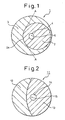
- an eccentric core-sheath conjugate fiber 1 of the present invention is formed from a core segment 2 and a sheath segment 3 formed from two respective synthetic resins differing from each other in thermal shrinkability.
- the core segment 2 is eccentrically arranged in the sheath segment 3, and a hollow portion 4 is formed in the core segment 2.
- the center of the hollow portion 4 may be situated either at a center 6 of the cross section of the conjugate fiber 1 or off the center 6 (eccentrically).
- the conjugate fiber shown in Fig. 1 exhibits heat shrinkability disproportionally on both sides of an imaginary interface A-A parallel to the longitudinal axis of the conjugate fiber.
- the imaginary interface A-A includes a portion 2a of a peripheral surface of the core segment 2 near the center 6 of the conjugate fiber 1.
- the entire core segment 2 is situated on the right side of the imaginary interface AA, and most of the sheath segment 3 is situated on the left side thereof.
- heat treatment of the conjugate fiber spirally crimps the fiber with the right side portion of the fiber containing the core segment 2 placed inside the fiber.
- heat treatment of the conjugate fiber spirally crimps the fiber with the left side portion of the fiber containing the thick portion of the sheath segment 3 placed inside the fiber.
- the machine-crimped fibers each comprise two fiber segments containing two respective thermoplastic synthetic resins as major components differing from each other in thermal shrinkability, and the two fiber segments are mutually bonded together to form a side-by-side conjugate structure along the longitudinal axis of the fiber with the imaginary interface forming a bonding plane, whereby the conjugate fibers are formed.
- Fig. 2 shows the cross section of one example of such a side-by-side conjugate fiber.
- a side-by-side conjugate fiber 11 is formed from two fiber segments 12, 13 differing from each other in heat shrinkability, and a hollow portion 14 may optionally be formed at least in the segment 12 or 13.
- the hollow portion 14 is formed in the segment 13.
- a center 15 in the hollow portion 14 may agree with the center of the conjugate fiber 11, or may be off the center (eccentric). Because the conjugate fiber shown in Fig. 2 exhibits heat shrinkability disproportional on both sides of a bonded interface between the segment 12 and the segment 13, heat treatment of the conjugate fiber spirally crimps the fiber with the segment having higher shrinkability placed inside the fiber.
- the machine-crimped fibers with latent three-dimensional crimpability of the invention can be produced from two types of synthetic resins differing from each other in heat shrinkability.
- production process (2) is a process for producing the machine-crimped synthetic fibers according to the present invention that have latent three-dimensional crimpability to manifest a number of crimps of from 15 to 80/25 mm and a crimp ratio of from 25 to 90% when subjected to crimp manifestation heat treatment at temperatures of from 60 to 200°C, the process comprising:
- the production process (3) is a process for producing the machine-crimped synthetic fibers according to the present invention that have latent three-dimensional crimpability to manifest a number of crimps of from 15 to 80/25 mm and a crimp ratio of from 25 to 90% when subjected to crimp manifestation heat treatment at temperatures of from 60 to 200°C, the process comprising:
- two types of synthetic resins are each dried under conditions suitable for each resin.
- the two types of dried synthetic resins in pellets are melted with two conjugate spinning apparatuses, respectively, each equipped with a melting and mixing apparatus of synthetic polymer such as a screw extruder.
- the two types of molten bodies thus obtained are conjugated and extruded in an eccentric core-sheath manner or a side-by-side manner with a conjugate spinneret for forming eccentric core-sheath or side-by-side conjugate fibers.
- the conjugate filamentary molten flow thus extruded is taken up at a rate of, for example, from 150 to 3,000 m/min while being air cooled with a cooling wind so that the fibers are subjected to necessary drawing and machine crimping.
- Finish oil for imparting desired properties to the fibers is optionally applied to the fibers.
- the fibers are then cut into fiber pieces having a predetermined fiber length.
- drawing conducted between winding and application of finish oil may also be neck drawing at temperatures of from 10 to 80°C.
- machine crimping can be conducted with a gear crimping machine or a stuffer box crimping machine.
- the fibers In the stages of drawing and crimping, a heat history that exerts adverse effects on the three-dimensional crimpability must not be given to the fibers.
- the fibers when the fibers are drawn at temperatures exceeding 80°C or heat treated at temperatures as high as greater than 80°C while being in a stretched or relaxed state, the asymmetry of the orientation degree is decreased, and desired three-dimensional crimping is not manifested sometimes.
- the fibers may be heat treated for a short period of time as long as adverse effects are not exerted on the three-dimensional crimpability.
- preferred examples of the synthetic resins that form two fiber segments forming the conjugate fibers include, in addition to polyesters containing as major components alkylene terephthalate, a polypropylene, a high-density polyethylene, a medium-density polyethylene, a low-density polyethylene, a linear low-density polyethylene, a crystalline polypropylene-based copolymer prepared from propylene and ⁇ -olefin (including ethylene), polyolefins including copolymers of an olefin and at least two substances selected from an ethylenic unsaturated carboxylic acid, an anhydride, an ester and a metal salt (saponified product) of an ethylenic unsaturated carboxylic acid, a polyamide, a fluoro resin and a mixture of these synthetic polymers.
- a suitable combination of two types of synthetic polymers is preferably selected according to the application.
- polyesters containing alkylene terephthalate having a melting point of 200°C or more are preferably used as polymers used for the principal fibers.
- use of the principal fibers obtained therefrom and binder fibers in a blend can allow the properties of the principal fibers to remain without melting.
- One typical example is a combination of two types of polyesters containing alkylene terephthalate as major components and each showing an intrinsic viscosity differing from that of the other polyester by 0.1 dl/g or more measured at 35°C in o-chlorophenol: for example, a combination of (poly(alkylene terephthalate))/(poly(alkylene terephthalate) copolymerized with 20% by mole or less of isophthalic acid and/or 5-sodiosulfoisophthalic acid).
- a combination of a low-melting point synthetic polymer and a high-melting point synthetic polymer with a melting point difference of 20°C or more, preferably from 30 to 200°C are preferably used.
- a melting point difference of 20°C or more between the two polymers a fiber segment containing the high-melting point synthetic polymer as a principal component remains as a fiber-forming component without melting during heat-bonding treatment, and the bulkiness of the nonwoven fabric is maintained.
- the fiber segment having a low melting point synthetic polymer as a major component must be continuously formed in the longitudinal direction of the fibers along at least a portion of the conjugate fiber surface.
- core segment content in terms of mass is less than 20% by mass, adjustment of the latent three-dimensional crimpability to an appropriate level becomes difficult.
- a still preferred range of the core segment content in terms of mass is as follows: core/sheath ratio of from 70/30 to 30/70.
- conjugate fibers wherein an isophthalic acid-copolymerized poly(alkylene terephthalate) having a melting or softening point of from 50 to 200°C is used as a low-melting point synthetic polymer, and a poly(alkylene terephthalate) is used as a high-melting point synthetic polymer, necessary mechanical crimps (number of crimps and crimp ratio) can be imparted to the fibers more surely, and heat treatment of the fibers can manifest more excellent three-dimensional crimps.
- the isophthalic acid-copolymerized poly(alkylene terephthalate) used as a low-melting point synthetic polymer may be crystalline or amorphous.
- the melting or softening point is preferably from 50 to 200°C.
- fretting heat causes the heat-bonding conjugate fibers to manifest three-dimensional crimps, or the binder fibers are bonded together due to fretting heat.
- the melting or softening point exceeds 200°C, the low-melting point fiber segments thus obtained show an excessively high melting point as a binder, and heat treatment hardly causes the conjugate fibers to manifest three-dimensional crimps.
- Typical examples of the above isophthalic acid-copolymerized poly(alkylene terephthalate) include a poly(ethylene terephthalate) copolymer prepared by copolymerizing with from 20 to 60% by mole of isophthalic acid as an acid component, a poly(trimethylene terephthalate) copolymer prepared by copolymerizing with from 5 to 60% by mole of isophthalic acid as an acid component, a poly(butylene terephthalate) copolymer prepared by copolymerizing with from 3 to 55% by mole of isophthalic acid as an acid component, and a poly(hexamethylene terephthalate) copolymer prepared by copolymerizing with from 1 to 20% by mole of isophthalic acid as an acid component.
- a poly(ethylene terephthalate) copolymer prepared by copolymerizing with from 20 to 60% by mole of isophthalic acid as an acid component
- alkylene terephthalate may further be copolymerized with an additional acid component containing at least one of the substances such as 2,6-naphthalenedicarboxylic acid, 5-sodiosulfoisophthalic acid, adipic acid, sebacic acid, azelaic acid, dodecanoic acid and 1,4-cyclohexanedicarboxylic acid and/or an additional diol component containing at least one of the substances such as ethylene glycol, 1,3-propanediol, 1,4-butanediol, 1,5-pentanediol, 1,6-hexanediol, diethylene glycol, 1,4-cyclohexanediol and 1,4-cyclohexanedimethanol.
- an additional acid component containing at least one of the substances such as 2,6-naphthalenedicarboxylic acid, 5-sodiosulfoisophthalic acid, adipic acid,
- thermoplastic elastomer having a melting point of from 80 to 200°C as a constituent of a heat-bonding fiber segment can be easily subjected to various processing stages such as an air-laid processing stage, and can form fiber products such as webs having more excellent uniformity and appearance.
- Polyurethane-based elastomers polyester-based elastomers, and the like can be used as the thermoplastic elastomers.
- the polyurethane-based elastomers include polymers obtained by the reaction of (1) a low-melting point polyol having a molecular weight of from about 500 to 6,000 such as a dihydroxypolyether, a dihydroxypolyester, a dihydroxypolycarbonate or a dihydroxypolester amide, (2) an organic diisocyanate having a molecular weight of 500 or less such as p,p'-diphenylmethane diisocyanate, tolylene diisocyanate, isophorone diisocyanate, hydrogenated diphenylmethane diisocyanate, xylylene diisocyanate, 2,6-diisocyanate methyl caproate or hexamethylene diisocyanate, and (3) a chain extender having a molecular weight of 500 or less such as a glycol
- polyurethane prepared by using poly(tetramethylene glycol), poly- ⁇ -caprolactone or poly(butylene adipate) as a polyol is particularly preferred.
- poly(tetramethylene glycol), poly- ⁇ -caprolactone or poly(butylene adipate) is particularly preferred.
- use of p,p'-diphenylmethane diisocyanate as an organic diisocyanate is preferred.
- Use of p,p'-bishydroxyethoxybenzene and/or 1,4-butanediol as a chain extender is preferred.
- polyester-based elastomers examples include polyether ester block copolymers prepared by copolymerizing a thermoplastic polyester as a hard segment and a poly(alkylene oxide) glycol as a soft segment. More specifically, three-component copolymers formed from (1) at least one dicarboxylic acid selected from aromatic dicarboxylic acids such as terephthalic acid, isophthalic acid, phthalic acid, naphthalene-2,6-dicarboxylic acid, naphthalene-2,7-dicarboxylic acid, diphenyl-4,4'-dicarboxylic acid, diphenoxyethanedicarboxylic acid and sodium 3-sulfoisophthalate, alicyclic dicarboxylic acids such as 1,4-cyclohexanedicarboxylic acid, aliphatic dicarboxylic acids such as succinic acid, oxalic acid, adipic acid, sebacic acid, dodecandicar
- conjugate fibers of the present invention containing as a heat-bonding component a modified polyolefin that is formed by graft polymerizing a synthetic polymer having high surface friction such as a polyolefin with unsaturated compounds including at least one compound selected from unsaturated carboxylic acids and unsaturated carboxylic acid anhydrides having a melting point of from 80 to 200°C show good processability, for example, air-laid processability.
- fiber products such as webs having excellent uniformity and appearance can be produced.
- modified polyolefin in which a polyolefin is graft polymerized with ethylenic unsaturated compounds (hereinafter referred to as vinyl monomers) including at least one substance selected from ethylenic unsaturated carboxylic acids and ethylenic unsaturated carboxylic acid anhydrides having a melting point of from 80 to 200°C include monomers including at least one substance selected from ethylenic unsaturated carboxylic acids and the anhydrides thereof, specifically, monomers including as an essential modifying major component an unsaturated carboxylic acid or the anhydride thereof selected from maleic anhydride, maleic acid, acrylic acid, methacrylic acid and the like, and additional vinyl monomers other than the substances mentioned above.
- vinyl monomers ethylenic unsaturated compounds
- examples of the additional vinyl monomer are general purpose monomers excellent in radical polymerizability including styrenes such as styrene and ⁇ -methylstyrene, methacrylic esters such as methyl methacrylate, ethyl methacrylate, 2-hydroxyethyl methacrylate and dimethylaminoethyl methacrylate, and similar acrylic esters.
- a graft polymerization amount of the vinyl monomers in the modified polyolefin is preferably from 0.05 to 2 moles per kg of the polyolefin used as a backbone polymer.
- a total graft molecular amount of an unsaturated carboxylic acid or an unsaturated carboxylic anhydride as a modifying principal component is preferably from 0.03 to 2 moles/kg.
- Graft polymerizing the backbone polymer with such vinyl monomers can be carried out by a conventional procedure.
- the polyolefin is mixed with an unsaturated carboxylic acid or an unsaturated carboxylic anhydride and optionally an additional vinyl monomer so that side chains composed of a random copolymer can be introduced.
- the polyolefin is successively graft polymerized with at least two types of vinyl monomers so that side chains composed of a block copolymer can be introduced.
- Examples of the backbone polymer of the modified polyolefins include polyethylene, polypropylene and polybutene-1.
- Examples of the polyethylene include a high-density polyethylene, a linear low-density polyethylene and a low-density polyethylene.
- the backbone polymers are homopolymers or copolymers with another ⁇ -olefin, having a density of from 0.90 to 0.97 g/cm 3 , and have a melting point of from about 100 to 135°C.
- the polypropylene is a crystalline polymer having a melting point of from 130 to 170°C, and includes a homopolymer or a copolymer with other olefins.
- the polybutene-1 is a crystalline polymer having a melting point of from 110 to 130°C, and includes a homopolymer or a copolymer with other olefins.
- polyethylene is preferably used in view of the melting point range and easiness of graft reaction.
- a single type of a modified polyolfin or a mixture of at least two types of the above-modified polyolefins may be used as the modified polyolefin.
- a mixture of at least one type of a modified polyolefin and at least one type of a backbone polymer may be used as the modified polyolefin.
- a molten poly(ethylene terephthalate) resin as a core-forming synthetic resin is fed to the spinneret for forming the eccentric core-sheath conjugate fibers at temperatures of from 265 to 280°C in the melt spinning stage, and a molten isophthalic acid-copolymerized poly(alkylene terephthalate) resin having a melting or softening point of from 50 to 220°C is fed thereto at temperatures of from 180 to 230°C; the conjugate filamentary molten flow thus extruded is uniformly cooled with a cooling wind adjusted to temperatures of from 15 to 40°C to be solidified.
- the process is carried out as follows: the core portion of the undrawn eccentric core-sheath conjugate filaments is formed from a poly(ethylene terephthalate) resin; the sheath portion is formed from an isophthalic acid-copolymerized poly(alkylene terephthalate) resin having a melting or softening point of from 50 to 220°C; the total draw ratio to be applied to the undrawn conjugate filaments in the drawing stage is set at from 0.70 to 0.95 times the maximum draw ratio of the undrawn conjugate filaments in hot water at 45°C; the undrawn conjugate filaments are first drawn until the draw ratio reaches from 0.60 to 0.90 times the total draw ratio in hot water at temperatures of from 70 to 80°C; and then the filaments are drawn in hot water at temperatures of from 60 to 80°C until the draw ratio reaches the total draw ratio designed.
- the machine-crimped conjugate fibers obtained by the above embodiment of the production method (2) in the present invention are useful as heat-bonding polyester conjugate fibers. After drawing the conjugate filaments until the draw ratio reaches from 0.60 to 0.90 times the total draw ratio, the conjugate filaments are drawn in hot water at temperatures of from 60 to 80°C until the draw ratio reaches the total draw ratio to give the polyester heat-bonding conjugate fibers of the present invention.
- the heat-bonding polyester conjugate fibers explained above are core-sheath conjugate fibers wherein the core component is composed of a poly(ethylene terephthalate) (hereinafter referred to as PET), and the sheath component is composed of an isophthalic acid-copolymerized poly(alkylene terephthalate) (hereinafter referred to as I-PET) having a melting or softening point of from 50 to 220°C.
- PET poly(ethylene terephthalate)
- I-PET isophthalic acid-copolymerized poly(alkylene terephthalate) having a melting or softening point of from 50 to 220°C.
- the core component of the core-sheath conjugate fibers is formed from a polyolefin such as a polypropylene or an aliphatic polyamide, or such a poly(alkylene terephthalate) having a longer chain diol component than a PET as poly(trimethylene terephthalate) and poly(butylene terephthalate), adequate bulkiness and a repulsion property cannot be imparted to the nonwoven fabrics formed by the air-laid method.
- conjugate fibers prepared from a poly(alkylene naphthalate) such as polyethylene-2,6-naphthalene show high rigidity.
- fabrics obtained therefrom such as nonwoven fabrics have a good repulsion property, the fabrics have a high melt viscosity, and stuck fiber bundles produced in the course of melt spinning lower the grade of the web formation.
- the PET herein designates a polyester comprising ethylene terephthalate repeating units as major repeating units in an amount of 85% by mole or more, preferably 95% by mole or more.
- the PET may contain a small amount of copolymerized components other than a terephthalic acid component and an ethylene glycol component as long as the effects of the present invention are not impaired.
- a PET showing an intrinsic viscosity of from 0.50 to 0.70 is preferred in view of the melt-spinnability.
- PET may contain known additives such as pigments, delustering agents, antibacterial agents, deodorants, fluorescent brighteners and ultraviolet-ray absorbers as long as the effects of the invention are not impaired.
- an I-PET that is a heat-bonding component of the sheath component may either be crystalline or amorphous, it is preferred that the I-PET has a melting or softening point of from 50 to 200°C, preferably from 60 to 200°C.
- the I-PET has a melting or softening point of less than 50°C, stuck fiber bundles produced due to sticking of fibers during spinning cannot be decreased, sometimes.
- the I-PET has a melting point higher than 220°C, the fibers cannot be used as heat-bonding fibers for, for example, air-laid nonwoven fabrics, sometimes, because the fibers manifest no heat-bonding functions.
- I-PET Typical examples of I-PET mentioned above are as described above.
- the dry thermal shrinkage ratio of the heat-bonding polyester conjugate fibers at 80°C is preferably from 5 to 15%, more preferably from 6 to 10%.
- measurements of L 0 and L 1 are made while an initial load of 0.040 cN/dtex is being applied.
- the thermal shrinkage stress peak temperature of the heat-bonding polyester conjugate fibers of the present invention is preferably from 65 to 85°C, more preferably from 70 to 80°C.
- the thermal shrinkage stress peak temperature is less than 65°C, high atmospheric temperature during storage or fretting heat during the air-laid stage sometimes allows the latent crimps of the fibers to manifest. As a result, the dispersibility of the fibers becomes poor, and the uniformity of the web formation is sometimes impaired.
- the thermal shrinkage peak temperature exceeds 85°C, the latent crimp manifestation during heat treatment becomes poor, and sufficient bulkiness and a satisfactory repulsion property of the nonwoven fabric cannot be obtained sometimes.
- the heat-bonding polyester conjugate fibers of the above embodiment do not contain stuck fiber bundles in an amount exceeding 0.03% by weight.
- the stuck fiber bundles herein refer to at least two conjugate fiber filaments in a melt-stuck state.
- the percentage by weight of stuck fiber bundles contained in the conjugate fibers is defined as a content of stuck fiber bundles.
- the heat-bonding polyester conjugate fibers in the above embodiment can be produced by the following procedure. That is, a pelletized PET and a pelletized I-PET are each dried, and separately melted with a conjugate spinning apparatus equipped with two screw extruders. The molten PET and I-PET are introduced into a spinning block, and conjugated in an eccentric core-sheath structure and extruded through a spinning pack into which an eccentric core-sheath type conjugate spinneret is incorporated.
- the molten PET and I-PET be introduced into the spinning pack while the molten PET and I-PET are being held at temperatures of from 265 to 280°C and from 180 to 230°C, respectively.
- the temperature of the molten PET exceeds 280°C or that of the molten I-PET exceeds 230°C, the filamentary flow of the extruded molten polymers is inadequately cooled, sometimes. Consequently, many stuck fiber bundles are generated, sometimes.
- the temperature of the molten PET is less than 265°C, the melting viscosity of the polymer flow drastically increases, and spinning sometimes becomes difficult.
- the temperature of the molten I-PET is less than 180°C, the molten polymer temperature becomes so low, at the extrusion face of the spinneret, that spinning becomes difficult sometimes.
- the extruded filamentary polymer is preferably cooled and solidified with cooling air held at temperatures of from 15 to 40°C.
- the cooling air temperature is less than 15°C, the spinneret face temperature sometimes becomes insufficient.
- the cooling air temperature is 40°C or more, sticking of the fibers takes place sometimes due to insufficient cooling.
- filaments that are not solidified sufficiently are cooled with a liquid such as water, cohesion of filaments sometimes takes place due to the surface tension of the liquid, and sticking of the filaments is promoted. Use of air cooling is therefore preferred.
- a finish oil emulsion is applied thereto.
- the filaments are then taken up at a rate of from 150 to 3,000 m/min to give undrawn conjugate fibers.
- An aqueous emulsion of a polyether polyester copolymer containing as major components poly(ethylene glycol) and poly(ethylene terephthalate isophthalate) segments can be preferably used as the finish oil emulsion.
- the undrawn conjugate fibers thus obtained are successively drawn in a hot water bath of a drawing apparatus equipped with a hot water drawing bath.
- the draw ratio in terms of a total draw ratio (hereinafter referred to as TDR) in the embodiment is preferably from 0.7 to 0.95 times the maximum draw ratio in hot water at 45°C (hereinafter referred to as HDR) of the undrawn yarn.
- the HDR herein is a value obtained by the following procedure. An undrawn filament sampled within 5 minutes directly after spinning is held between chucks with a chuck-to-chuck distance set at 10 cm in hot water at 45°C, and drawn at a rate of 5 cm/sec so that the sample filament does not slip. The chuck-to-chuck distance (cm) obtained when the filament is no longer elongated, is divided by the initial chuck-to-chuck distance (10 cm) to give the HDR value.
- the conjugate fibers show a low shrinkage stress, and sufficient latent crimpability cannot be imparted thereto. As a result, crimp manifestation subsequent to heat treatment sometimes becomes insufficient.
- TDR exceeds 0.95 times HDR, the dry thermal shrinkage ratio at 80°C of the conjugate fibers becomes less than 5%. As a result, heat generation of three-dimensional crimping caused by heat treatment of the conjugate fibers becomes insufficient, and the bulkiness of desired fiber products such as nonwoven fabrics sometimes becomes inadequate.
- a first stage drawing is carried out in hot water at temperatures of from 70 to 80°C until the draw ratio reaches from 0.6 to 0.90 times the TDR, and then a second stage drawing is carried out in hot water at temperatures of from 60 to 80°C until the draw ratio reaches the TDR.
- the hot water temperature of the drawing bath is less than 70°C, single filament breakage of the undrawn filaments takes place in the drawing bath to produce many stuck filament bundles sometimes.
- the thermal stress peak temperature of the conjugate fibers exceeds 85°C, and the latent crimp manifestation sometimes becomes insufficient.
- the first stage draw ratio is less than 0.6 times the TDR, the shrinkage stress of the conjugate fibers becomes low, and the latent crimp manifestation sometimes becomes insufficient.
- the first stage draw ratio exceeds 0.90 times the TDR, the dry thermal shrinkage ratio at 80°C of the conjugate fibers becomes less than 5%, and sufficient three-dimensional crimpability cannot be obtained sometimes.
- the second stage drawing is preferably conducted in hot water at temperatures of from 60 to 80°C until the draw ratio reaches a TDR designed.
- the hot water temperature is less than 60°C, the dry thermal shrinkage ratio at 80% of the conjugate fibers thus obtained exceeds 15%, and the bonding strength of the conjugate fibers sometimes becomes insufficient because the number of crimps manifested after heat treatment becomes excessive.
- the hot water temperature exceeds 80°C, the thermal stress peak temperature exceeds 85°C, and the latent crimping manifestation sometimes becomes poor.
- Suitable finish oil is applied to the conjugate fibers subsequent to finishing drawing in accordance with desired properties, particularly in accordance with the processability.
- the conjugate fibers are then dried, relaxation heat treated, treated with a machine crimping apparatus such as a crimper so that the number of crimps and the shrinkage ratio are adjusted to from 1 to 13/25 mm and from 2 to 20%, respectively, and cut into fiber pieces having a fiber length of from 3 to 20 mm.
- the machine-crimped fibers having latent three-dimensional crimpability of the present invention are processed to give desired fiber products.
- Air-laid nonwoven fabrics are preferred as the fiber products.
- the fiber products containing machine-crimped fibers of the present invention, preferably nonwoven fabrics formed by the air-laid method are heat treated to manifest latent three-dimensional crimps of the machine-crimped fibers while the fibers are substantially in a strainless state, that is, the machine-crimped fibers of the present invention are in a relaxed state.
- a hot air circulation system with dry heat, a wet heat system with heated steam, or the like system can be used for the relaxation heat treatment.
- a shrink drier and a heat treating machine with a suction band system that can blow hot air on both sides of the fiber products to be treated are preferably used for the heat treatment by a hot air circulation system.
- the heat treatment temperature in the relaxation heat treatment of the fiber product is set at temperatures lower by from 5 to 30°C than the melting point of the polymer contained in the machine-crimped fibers and having the lowest melting point of polymers therein.
- the set temperature and the melting point of the low-melting point polymer are less than 5°C, the machine-crimped crimped fibers manifest latent crimpability.
- the low-melting point polymer is melted sometimes, and the fiber product such as nonwoven fabrics becomes entirely stiff.
- the machine-crimped conjugate fibers of the invention are subjected to relaxation heat treatment at low temperatures exceeding the melting point of the low-melting point polymer by 30°C, the manifested crimps of the fibers sometimes become insufficient, and the bulkiness of the fiber products such as nonwoven fabrics sometimes become inadequate.
- the heat treatment temperature is preferably set at temperatures exceeding the melting point of the low-melting point synthetic polymer contained in the conjugate fibers by 10°C or more, and at temperatures lower than the high-melting point synthetic polymer.
- the fibers When the heat treatment temperature exceeds the melting point of the low-melting point synthetic polymer in the conjugate fibers by less than 10°C, the fibers sometimes do not manifest properties as binder fibers. Moreover, when the heat treatment temperature exceeds the melting point of the high-melting point synthetic polymer, the entire binder fibers are sometimes melted. As a result, the feeling of the fiber products such as nonwoven fabrics sometimes becomes stiff, or the bulkiness thereof sometimes becomes insufficient.
- machine-crimped fibers of the present invention may contain, as long as the properties thereof are not impaired, one or more of additives such as catalysts, anticoloring agents, heat-resistant agents, flame retardants, delustering agents, fluorescent brighteners, coloring agents, lubricants, antioxidants, ultraviolet-ray absorbers, hydrophilic agents, water-repelling agents, antibacterial agents, deodorants, aromatic agents and functional ceramics.
- additives such as catalysts, anticoloring agents, heat-resistant agents, flame retardants, delustering agents, fluorescent brighteners, coloring agents, lubricants, antioxidants, ultraviolet-ray absorbers, hydrophilic agents, water-repelling agents, antibacterial agents, deodorants, aromatic agents and functional ceramics.
- Synthetic polymers, fibers and fiber products used in Examples 1 to 6 and Comparative Examples 1 to 3 described below were subjected to the following tests.
- the intrinsic viscosity of a polyester is measured at 35°C while o-chlorophenol is used as a solvent.
- the melt flow rate of a synthetic polymer is measured in accordance with JIS K 7210.
- the melting point of a synthetic polymer is represented by a heat absorption peak temperature in a DSC curve obtained with a differential scanning calorimetry (DSC) in accordance with JIS K 7121.
- the softening point of a synthetic polymer is restricted to a synthetic polymer having no crystalline melting point, and is represented by a transition temperature in a DSC curve obtained by differential scanning calorimetry in accordance with JIS K 7121.
- Individual fibers are sampled from a sample filament tow prior to cutting to into fiber pieces having a given fiber length, and the number of crimps and crimp ratio are measured in accordance with JIS L 1015 7.12.
- a filament tow heat treated without cutting is separated into individual fibers; the individual fibers are heat treated at 160°C for 2 minutes (at 180°C for 2 minutes when the fibers are binder ones and are not bonded by heat treatment at 160°C for 2 minutes) with a hot-air drying apparatus, and cooled to room temperature, and the number of crimps and crimp ratio are measured by the above method.
- the number of three-dimensional crimps one cycle of a spiral is counted as two crimps.
- the thickness of a sample fiber is measured in accordance with JIS L 1015 7.5.1 A.
- the fiber length of a sample fiber is measured in accordance with JIS L 1015 7.4.1 C.
- a fiber sample having a given fiber weight is extracted for 10 minutes in a methanol bath at 30°C with a bath ratio of 1:20.
- the sample weight subsequent to extraction is measured.
- the deposit ratio of finish oil of the sample fibers is represented by a value obtained by dividing the measured sample weight by the initial sample weight.
- a fiber sample is provided to a shrinkage stress measurement apparatus manufactured by KANEBO, LTD.
- a ring-like yarn 5 cm long is prepared, and both ends of the yarn are held by a measurement holding portion.
- the yarn is heated at a rate of 120 sec/300°C with an initial load of 0.09 cN/dtex.
- the thermal shrinkage stress peak temperature of the fiber is represented by a temperature at which the shrinkage stress of the sample yarn becomes maximum.
- the average thickness of a nonwoven fabric sample obtained by heat treating an air-laid web that is prepared by the process described below and that has basis weight of 35 g/m 2 is measured, and the bulkiness of the nonwoven fabric is represented by the average thickness.
- an air-laid web having basis weight of 35 g/m 2 is prepared from the sample fibers under the following conditions: a number of drum revolutions of 200 rpm; a number of needle roll revolutions of 900 rpm; and a web transfer speed of 30 m/min. Air-laid web samples each having a size of 25 cm x 25 cm are cut out of the air-laid web.
- the samples are heat treated at 160°C for 2 minutes (when the binder fibers are not bonded by heat treatment at 160°C for 2 minutes, the samples are heat treated at 180°C for 2 minutes).
- the thickness of the 5 air-laid nonwoven fabric samples is measured, and the average value is calculated.
- the air-laid nonwoven fabric prepared in (j) mentioned above is cut into a strip-like form having a width of 3 cm in the proceeding direction of the web production, and a length of 60 cm in the width direction of the production.
- the strip-like fabric is cut to give 20 samples each having a size of 3 cm x 3 cm.
- the weight of each of the 20 samples is measured, and the uniformity of the web formation is represented by the variation coefficient (standard deviation/average value). When the variation coefficient is smaller, the web formation is more uniform. Moreover, whether the air-laid web samples have fiber opening or not on the surface is observed.
- PET Polyethylene terephthalate
- a cooling air at 25°C was blown at a rate of 1.2 m/sec onto the extruded filamentary molten flow at a site 15 mm below the spinneret face from one side of the molten flow at an angle vertical to the proceeding direction of the molten flow.
- the resultant cooled and solidified undrawn filaments were taken up at a rate of 1,150 m/min to give undrawn PET filaments.
- a plurality of undrawn filaments thus obtained were paralleled to form a tow of 500,000 dtex.
- the tow was subjected to a hot-water drawing stage including two drawing stages. In the first drawing stage, the tow was drawn at a draw ratio of 1.9 at a drawing temperature of 70°C; in the second drawing srawing stage, the tow was further drawn at a draw ratio of 1.05 at a drawing temperature of 90°C. The tow was totally drawn at a draw ratio of 2.0.
- Spinning oil prepared by mixing potassium laurylphosphate and polyoxyethylene-modified silicone in a mass ratio of 80:20 was applied to the drawn filaments in an amount of 0.20% by mass.
- the filament tow was machine crimped with a gear-crimping machine to have a number of crimps of 2/25 mm and a crimp ratio of 5%, and then the crimped filament tow was cut into a fiber length of 5 mm.
- the machine-crimped fibers thus obtained had an individual fiber thickness of 4.0 dtex, and a hollow ratio of 33%.
- the machine-crimped hollow polyester fibers thus obtained are hereinafter referred to as the fibers (A).
- the fibers (A) were heat treated at 160°C for 2 minutes to manifest spiral three-dimensional crimps having a number of crimps of 18/25 mm and a crimp ratio of 35%. Moreover, the fibers (A) showed a thermal shrinkage stress peak temperature of 95°C.
- concentric core-sheath conjugate fibers were prepared in the following manner.
- co-PET amorphous copolymerized poly(ethylene terephthalate)
- co-PET amorphous copolymerized poly(ethylene terephthalate)
- acid components that were composed of a terephthalic acid component and an isophthalic acid component in a molecular ratio of 60:40 and diol components that were composed of ethylene glycol and diethylene glycol in a molecular ratio of 95:5, and having an intrinsic viscosity [ ⁇ ] of 0.56 and a softening point T s of 64°C was used as a sheath component.
- Concentric core-sheath conjugate fibers having a core/sheath mass ratio of 50/50 were prepared from the core component and the sheath component.
- the conjugate fibers (hereinafter referred to as fibers (B)) were solid, and had an individual fiber thickness of 2.2 dtex, a fiber length of 5 mm, and mechanical crimps with a number of crimps of 11/25 mm and a crimp ratio of 12%.
- fibers (B) Similarly to the fibers (A), spinning oil prepared by mixing potassium laurylphosphate and polyoxyethylene-modified silicone in a mass ratio of 80:20 was applied to the fibers (B) in an amount of 0.25% by weight. When the fibers (B) were heat treated at 160°C for 2 minutes, the fibers (B) manifested two-dimensional crimps, and showed a number of crimps of 10/25 mm and a crimp ratio of 15%. However, no distinct spiral three-dimensional crimps were observed. The fibers (B) showed a thermal shrinkage stress peak temperature of 110°C.
- the fibers (A) as a major component for forming a web and the fibers (B) as a heat-bonding component therefor were blended in a fibers (A)/fibers (B) mass ratio of 85/15 with basis weight of 35 g/m 2 .
- the mixture was formed into a web by the air-laid method.
- the web was heat treated at 160°C for 2 minutes without tension in a hot-air drying apparatus to give an air-laid nonwoven fabric having basis weight of 35 g/m 2 .
- the formation uniformity of the nonwoven fabric was 0.03, and no unopened fiber mass was observed.
- the nonwoven fabric had a thickness representing bulkiness of 9 mm, and manifested sufficient bulkiness.
- a bulky web was prepared in a similar manner as in Example 1 except that in the preparation of fibers (A), the fibers were cut into fiber pieces having a length of 5 mm without machine crimping and relaxation heat treated at 135°C.
- the fibers manifested spiral three-dimensional crimps, and had a number of crimps of 11.2/25 mm and a crimp ratio of 33%.
- the fibers thus obtained were PET fibers (hereinafter referred to as fibers (C)), had an individual fiber thickness of 4.5 dtex and a hollow ratio of 32%, and showed no thermal shrinkage stress peak temperature.
- the fibers (C) were heat treated at 160°C for 2 minutes, the fibers (C) manifested spiral three-dimensional crimps having a number of crimps of 19/25 mm and a crimp ratio of 34%.
- the fibers (C) and the fibers (B) in Example 1 were blended in a mass ratio of 85:15.
- the mixture was formed into a web by the air-laid method.
- the web was then heat treated at 160°C for 2 minutes in a hot-air drying apparatus to give an air-laid web having basis weight of 35 g/m 2 .
- the air-laid nonwoven fabric had a bulkiness of 7 mm, the formation uniformity was unpreferably 0.24. Moreover, many unopened fiber masses were observed on the nonwoven fabric surface.
- PET pellets having an intrinsic viscosity [ ⁇ ] of 0.40 and a melting point T m of 256°C and 5-sodiosulfoisophthalic acid (2.6 mole)-copolymerized poly(ethylene terephthalate) (hereinafter referred to as CD-PET) pellets having a melting point (Tm) of 253°C were each dried at 170°C for 7 hours.
- the PET pellets and the CD-PET pellets were each melted at 295°C with a conjugate apparatus equipped with two screw extruders.
- Both molten bodies were introduced into a spin block held at 280°C, conjugated so that the PET segment and the CD-PET segment were bonded together in a side-by-side manner through a spinning pack for forming hollow side-by-side conjugate fibers having an incorporated spinneret that was prepared by perforating 600 extrusion orifices for hollow side-by-side conjugate fibers, and extruded in a filamentary form at a total extrusion rate of 350 g/min.
- a cooling air at 30°C was blown at a rate of 0.5 m/sec onto the extruded filamentary molten flow at a site 30 mm below the spinneret face from one side of the molten flow at an angle vertical to the proceeding direction of the molten flow.
- the resultant cooled and solidified undrawn filaments were taken up at a rate of 1,100 m/min to give PET/CD-PET (conjugate mass ratio of 50/50) undrawn conjugate filaments.
- the undrawn filaments thus obtained were paralleled to form a tow of 500,000 dtex.
- the tow was subjected to hot-water drawing at a drawing temperature of 70°C to be drawn at a draw ratio of 2.9.
- Spinning oil prepared by mixing potassium laurylphosphate and polyoxyethylene-modified silicone in a weight ratio of 80:20 was applied to the drawn filaments in an amount of 0.20% by weight.
- the filament tow was machine crimped with a crimper to have two-dimensional zig-zag crimps with a number of crimps of 11/25 mm and a crimp ratio of 11%.
- fibers (D) conjugate fibers having an individual fiber thickness of 1.8 dtex and a fiber cross-sectional shape (hollow ratio of 3%) as shown in Fig. 2 .
- the fibers (D) were heat treated at 160°C for 2 minutes to manifest spiral three-dimensional crimps having a number of crimps of 50/25 mm and a crimp ratio of 45%. Moreover, the fibers (D) showed a thermal shrinkage stress peak temperature of 135°C.
- the fibers (D) as a major component for forming a web and the fibers (B) as a heat-bonding component therefor were blended in a fibers (D)/fibers (B) mass ratio of 85/15.
- the mixture was formed into a web having basis weight of 35 g/m 2 by the air-laid method.
- the web was heat treated at 160°C for 2 minutes in a hot-air drying apparatus to give an air-laid nonwoven fabric having basis weight of 35 g/m 2 .
- the formation uniformity of the nonwoven fabric was 0.02, and no unopened fiber mass was observed.
- the nonwoven fabric had a nonwoven fabric bulkiness of 8 mm, and manifested sufficient bulkiness.
- An air-laid nonwoven fabric was prepared in the same manner as in Example 1 except that fibers (E) were prepared by crimping the fibers with a crimper so that two-dimensional zig-zag crimps having a number of crimps of 18/25 mm and a crimp ratio of 23% were imparted.
- the fibers (E) were heat treated at 160°C for 2 minutes, the fibers (E) manifested spiral three-dimensional crimps having a number of crimps of 50/25 mm and a crimp ratio of 45%.
- the fibers (E) and fibers (B) were blended in a mass ratio of 85:15, and the mixture was subjected to air-laid forming to give a web.
- the web was heat treated at 160°C for two minutes in a hot-air drying apparatus to give an air-laid nonwoven fabric having basis weight of 35 g/m 2 .
- the air-laid nonwoven fabric had a nonwoven fabric bulkiness of 5 mm. That is, the nonwoven fabric manifested no sufficient bulkiness.
- the formation uniformity was 0.13, and many unopened fiber masses were observed on the web surface.
- a nonwoven fabric was prepared in the same manner as in Example 2 except that PET pellets having an intrinsic viscosity [ ⁇ ] of 0.64 and a melting point T m of 256°C were used in place of the PET having an intrinsic viscosity [ ⁇ ] of 0.40 and a melting point T m of 256°C.
- Conjugate fibers (F) having manifested two-dimensional zig-zag crimps with a number of crimps of 11/25 mm and a crimp ratio of 11%, an individual fiber thickness of 2.0 dtex and a fiber cross section (hollow ratio of 3%) as shown in Fig. 2 were prepared.
- the fibers (F) When the fibers (F) were heat treated at 160°C for 2 minutes, the fibers (F) manifested spiral three-dimensional crimps having a number of crimps of 22/25 mm and a crimp ratio of 15%. Moreover, the fibers (F) showed a thermal shrinkage stress peak temperature of 155°C.
- the fibers (F) and fibers (B) were blended in a mass ratio of 85:15, and the mixture was subjected to air-laid forming to give a web having basis weight of 35 g/m 2 .
- the web was heat treated at 160°C for two minutes in a hot-air drying apparatus to give an air-laid nonwoven fabric having basis weight of 35 g/m 2 .
- the air-laid nonwoven fabric had a formation uniformity of 0.02, and showed a uniform surface.
- the nonwoven fabric had a nonwoven fabric bulkiness of 3 mm, and substantially manifested no bulkiness.
- PET pellets having an intrinsic viscosity [ ⁇ ] of 0.64 and a melting point T m of 256°C were dried at 170°C for 7 hours.
- High density polyethylene (hereinafter referred to as HDPE) pellets having a melt flow rate (MFR) of 20 g/10 min and a melting point T m of 135°C were prepared.
- the dried PET pellets were fed to one of the extruders, and melted at 290°C.
- the HDPE pellets were fed to the other extruder without drying, and melted at 250°C.
- the extruded two molten flows were introduced into a spin block held at 280°C, conjugated so that the PET formed cores and the HDPE formed sheaths through a spin pack for forming hollow eccentric core-sheath conjugate fibers having an incorporated spinneret that was prepared by perforating 600 extrusion orifices for forming hollow eccentric core-sheath conjugate fibers, and extruded in a filamentary form at a total extrusion rate of 440 g/min.
- Cooling air at 30°C was blown at a rate of 0.5 m/sec onto the extruded filamentary molten flow at a site 40 mm below the spinneret face from one side of the conjugate filament flow at an angle vertical to the proceeding direction of the flow to cool and solidify the filaments.
- the resultant spun filaments were taken up at a rate of 1,100 m/min to give PET/HDPE (conjugate mass ratio of 50/50) undrawn hollow conjugate filaments.
- the undrawn hollow conjugate filaments thus obtained were doubled to form a tow of 400,000 dtex.
- the tow was subjected to hot-water drawing at a drawing temperature of 70°C to be drawn at a draw ratio of 3.0.
- Spinning oil prepared by mixing potassium laurylphosphate and polyoxyethylene-modified silicone in a mass ratio of 80:20 was applied to the tow in an amount of 0.25% by weight.
- the tow was machine crimped with a crimper to have two-dimensional zig-zag crimps with a number of crimps of 11/25 mm and a crimp ratio of 11%.
- fibers (G) without relaxation thermal shrinkage treatment conjugate fibers (hereinafter referred to as fibers (G)) having an individual fiber thickness of 2.4 dtex and a fiber cross-sectional shape (hollow ratio of 2%) as shown in Fig. 1 .
- the fibers (G) were heat treated at 160°C for 2 minutes to manifest spiral three-dimensional crimps having a number of crimps of 35/25 mm and a crimp ratio of 40%. Moreover, the fibers (G) showed a thermal shrinkage stress peak temperature of 95°C.
- the fibers (G) alone were air-laid formed into a web having basis weight of 35 g/m 2 .
- the web was heat treated at 160°C for 2 minutes in a hot-air drying apparatus to give an air-laid nonwoven fabric having basis weight of 35 g/m 2 .
- the formation uniformity of the nonwoven fabric was 0.02, and no unopened fiber mass was observed.
- the nonwoven fabric had a web bulkiness of 7 mm, and manifested sufficient bulkiness.
- PET pellets having an intrinsic viscosity [ ⁇ ] of 0.64 and a melting point T m of 256°C were dried at 170°C for 7 hours.
- co-PET pellets having an intrinsic viscosity [ ⁇ ] of 0.56 and a softening point T s of 64°C were dried under a reduced pressure of 1.3 kPa for 24 hours.
- the dried PET pellets were fed to one of the extruders, and melted at 290°C, and co-PET pellets were fed to the other extruder, and melted at 230°C.
- the extruded two molten flows were introduced into a spin block held at 280°C, conjugated so that the PET formed cores and the co-PET formed sheaths through a spin pack for forming hollow eccentric core-sheath conjugate fibers having an incorporated spinneret that was prepared by perforating 600 extrusion orifices for forming hollow eccentric core-sheath conjugate fibers, and extruded in a filamentary form at a total extrusion rate of 440 g/min.
- a cooling air at 30°C was blown at a rate of 0.5 m/sec onto the extruded conjugate filamentary molten flow at a site 40 mm below the spinneret face from one side of the conjugate filament flow at an angle vertical to the proceeding direction of the flow to cool and solidify the filaments.
- the resultant spun filaments were taken up at a rate of 1,100 m/min to give PET/co-PET (conjugate mass ratio of 50/50) undrawn conjugate filaments.
- a plurality of the undrawn filaments thus obtained were doubled to form a tow of 500,000 dtex.
- the tow was subjected to hot-water drawing at a drawing temperature of 70°C to be drawn at a draw ratio of 3.5.
- Spinning oil prepared by mixing potassium laurylphosphate and polyoxyethylene-modified silicone in a weight ratio of 80:20 was applied to the drawn filaments in an amount of 0.25% by weight.
- the filament tow was machine crimped with a crimper to have two-dimensional zig-zag crimps with a number of crimps of 11/25 mm and a crimp ratio of 11%.
- fibers (H) without relaxation thermal shrinkage treatment hollow conjugate fibers (hereinafter referred to as fibers (H)) having an individual fiber thickness of 1.9 dtex and a fiber cross-sectional shape (hollow ratio of 2%) as shown in Fig. 1 .
- the fibers (H) were heat treated at 160°C for 2 minutes to manifest spiral three-dimensional crimps having a number of crimps of 43/25 mm and a crimp ratio of 45%. Moreover, the fibers (H) showed a thermal shrinkage stress peak temperature of 82°C.
- the fibers (H) alone were air-laid formed into a web having basis weight of 35 g/m 2 .
- the web was heat treated at 160°C for 2 minutes in a hot-air drying apparatus to give an air-laid nonwoven fabric having basis weight of 35 g/m 2 .
- the formation uniformity of the air-laid nonwoven fabric was 0.07, and no unopened fiber mass was observed.
- the nonwoven fabric had a web bulkiness of 7 mm, and manifested sufficient bulkiness.
- Poly(butylene terephthalate)(hereinafter referred to as PBT) pellets having an intrinsic viscosity [ ⁇ ] of 0.85 and a melting point T m of 220°C were dried at 150°C for 7 hours.
- polyester elastomer (hereinafter referred to as EL-PBT) pellets composed of 60% by weight of a hard segment to be explained below and 40% by weight of a soft segment that was formed from a poly(tetramethylene oxide) glycol with a weight average molecular weight of 1500 and having an intrinsic viscosity [ ⁇ ] of 1.15 and a melting point T m of 153°C were dried at 110°C for 12 hours.
- the hard segment was formed from an acid component that was a mixture of a terephthalic acid component and an isophthalic acid component in a molecular ratio of 70:30 and a diol component that was 1,4-butanediol.
- the dried PBT pellets were melt extruded at 270°C with one of the extruders, and EL-PBT pellets were melt extruded at 230°C with the other extruder.
- the extruded two molten flows were introduced into a spin block held at 270°C, conjugated so that the PBT formed cores and the EL-PBT formed sheaths through a spin pack for forming hollow eccentric core-sheath conjugate fibers having an incorporated spinneret that was prepared by perforating 600 extrusion orifices for forming hollow eccentric core-sheath conjugate fibers, and extruded in a filamentary form at a total extrusion rate of 440 g/min.
- Cooling air at 30°C was blown at a rate of 0.5 m/sec onto the extruded conjugate filamentary molten flow at a site 40 mm below the spinneret face from one side of the conjugate filament flow at an angle vertical to the proceeding direction of the flow to cool and solidify the filaments.
- the resultant spun filaments were taken up at a rate of 1,100 m/min to give PBT/EL-PBT (conjugate mass ratio of 50/50) undrawn conjugate filaments.
- the undrawn conjugate filaments thus obtained were doubled to form a tow of 500,000 dtex.
- the tow was subjected to hot-water drawing at a drawing temperature of 70°C to be drawn at a draw ratio of 2.8.
- Spinning oil prepared by mixing potassium laurylphosphate and polyoxyethylene-modified silicone in a weight ratio of 80:20 was applied to the drawn filaments in an amount of 0.23% by weight.
- the filament tow was machine crimped with a crimper to have two-dimensional zig-zag crimps with a number of crimps of 12/25 mm and a crimp ratio of 7%.
- fibers (I) without relaxation thermal shrinkage treatment conjugate fibers (hereinafter referred to as fibers (I)) having an individual fiber thickness of 3.0 dtex and a fiber cross-sectional shape (hollow ratio of 2%) as shown in Fig. 1 .
- the fibers (I) were heat treated at 180°C for 2 minutes to manifest spiral three-dimensional crimps having a number of crimps of 28/25 mm and a crimp ratio of 35%. Moreover, the fibers (I) showed a thermal shrinkage stress peak temperature of 95°C.
- the fibers (I) alone were air-laid formed into a web having basis weight of 35 g/m 2 .
- the web was heat treated at 180°C for 2 minutes in a hot-air drying apparatus to give an air-laid nonwoven fabric having basis weight of 35 g/m 2 .
- the formation uniformity of the nonwoven fabric was 0.05, and no unopened fiber mass was observed.
- the nonwoven fabric had a web bulkiness of 6 mm, and manifested sufficient bulkiness.
- PET pellets having an intrinsic viscosity [ ⁇ ] of 0.64 and a melting point T m of 256°C were dried at 170°C for 7 hours.
- the dried PET pellets were melted and extruded at 290°C with one of the extruders, and M-PE pellets were melted and extruded at 230°C with the other extruder.
- the extruded two molten flows were introduced into a spin block held at 280°C, conjugated so that the PET formed cores and the M-PE formed sheaths through a spin pack for forming hollow eccentric core-sheath conjugate fibers having an incorporated spinneret that was prepared by perforating 600 extrusion orifices for forming hollow eccentric core-sheath conjugate fibers, and extruded in a filamentary form at a total extrusion rate of 440 g/min.
- Cooling air at 30°C was blown at a rate of 0.5 m/sec onto the extruded conjugate filamentary molten flow at a site 40 mm below the spinneret face from one side of the conjugate filament flow at an angle vertical to the proceeding direction of the flow to cool and solidify the filaments.
- the resultant spun filaments were taken up at a rate of 1,100 m/min to give PET/M-PE (conjugate mass ratio of 50/50) undrawn conjugate filaments.
- the undrawn filaments thus obtained were paralleled to form a tow of 500,000 dtex.
- the tow was subjected to hot-water drawing at a drawing temperature of 70°C to be drawn at a draw ratio of 3.0.
- Spinning oil prepared by mixing potassium laurylphosphate and polyoxyethylene-modified silicone in a weight ratio of 80:20 was applied to the drawn filaments in an amount of 0.35% by weight.
- the filament tow was machine crimped with a crimper to have two-dimensional zig-zag crimps with a number of crimps of 10/25 mm and a crimp ratio of 7.5%.
- fibers (J) without relaxation thermal shrinkage treatment conjugate fibers (hereinafter referred to as fibers (J)) having an individual fiber thickness of 2.7 dtex and a fiber cross-sectional shape (hollow ratio of 2%) as shown in Fig. 1 .
- the fibers (J) were heat treated at 160°C for 2 minutes to manifest spiral three-dimensional crimps having a number of crimps of 43/25 mm and a crimp ratio of 45%. Moreover, the fibers (J) showed a thermal shrinkage stress peak temperature of 85°C.
- the fibers (J) alone were air-laid formed into a web having basis weight of 35 g/m 2 .
- the web was heat treated at 160°C for 2 minutes in a hot-air drying apparatus to give an air-laid nonwoven fabric having basis weight of 35 g/m 2 .
- the formation uniformity of the air-laid nonwoven fabric was 0.07, and no unopened fiber mass was observed.
- the nonwoven fabric had a web bulkiness of 7 mm, and manifested sufficient bulkiness.
- a tow of about 2,200 dtex is separated from the filament tow prior to cutting the tow into fiber pieces having a given fiber length.
- Reference lines with a spacing of L 0 are marked on the tow while an initial load of 0.040 cN/dtex is being applied.
- the tow is subsequently heat treated at 80°C for 20 minutes in a hot-air drying apparatus without load, and cooled to room temperature.
- Stuck fiber bundles contained in a fiber sample in an amount of 10 g is visually detected.
- the weight percentage of the detected stuck fiber bundles based on the sample weight is measured, and the content of stuck fiber bundles of the fiber sample is represented by the measured value.
- Individual fibers are sampled from a filament tow prior to cutting into fiber pieces having a given fiber length, and the number of crimps and crimp ratio are measured in accordance with JIS L 1015 7.12.
- the three-dimensional crimps of sample fibers subsequent to heat treatment are measured as explained below.
- a filament tow is separated into individual fibers; the individual fibers are heat treated at 90°C for 1 minute in a hot-air drying apparatus, and cooled to room temperature, and the number of crimps and crimp ratio are measured by the same method as mentioned above. For the number of three-dimensional crimps, one cycle of a spiral is counted as two crimps.
- An air-laid web having basis weight of 50 g/m 2 is heat treated at 150°C for 2 minutes.
- a sample having a size of 10 cm x 10 cm is cut out of the nonwoven fabric thus obtained, and the sample is further cut at intervals of 2 cm in both the longitudinal direction and the transverse direction to give 25 samples each having a size of 2 cm x 2 cm.
- the 25 samples are each weighed, and the variation coefficient (standard deviation/average value) is defined as the formation uniformity of the web. A smaller variation coefficient of a web signifies that the formation of the web is more uniform.
- An air-laid web having basis weight of 50 g/m 2 is heat treated at 150°C for 2 minutes, and the average thickness of the nonwoven fabric thus obtained is measured.
- a nonwoven fabric having a larger thickness indicates that the bulkiness of the fibers forming the nonwoven fabric is larger.
- An air-laid web having basis weight of 50 g/m 2 is heat treated at 150°C for 2 minutes in a hot-air drying apparatus.
- the compression ratio of the nonwoven fabric thus obtained is measured in accordance with JIS L 1097 5.3. A higher compression ratio of a web indicates that the repulsion property of the web is more significant.
- an air-laid web is formed by the following simple method.
- a heat-bonding conjugate fiber sample is placed on a screen of 5 mesh, passed through the screen by gently blowing air onto the sample to drop and accumulate on a poly(ethylene terephthalate) net of 16 mesh the back surface of which is open to the air.
- the molten PET at 275°C as a core component and the molten I-PET at 225°C as a sheath component were introduced into a spin pack having a spinneret for forming eccentric core-sheath conjugate fibers.
- the two molten polymer flows were conjugated in a conjugation ratio (core/sheath volume ratio) of 50/50, and extruded at 280°C at a total extrusion rate of 680 g/min through the spinneret prepared by perforating 70 extrusion orifices.
- the spun conjugate fibers were cooled with a cooling air, and an aqueous emulsion as spinning oil containing 0.3% by weight of potassium laurylphosphate was applied to the fibers in an emulsion deposit ratio of 15% by weight using an oiling roller.
- the resultant fibers were taken up at a spinning rate of 500 m/min to give undrawn eccentric core-sheath conjugate fibers.
- the HDR of the fibers was 4.4.
- the undrawn conjugate fibers were bundled to form a tow of 165,000 dtex (150,000 denier).
- Spinning oil prepared by mixing potassium laurylphosphate and polyoxyethylene-modified silicone in a weight ratio of 80:20 was applied to the tow in an amount of 0.25% by weight as a pure component.
- the conjugate filament tow was then crimped at 35°C with a push-on type crimper, dried and relaxation heat treated at 50°C, and cut into fiber pieces having a length of 5 mm to give heat-bonding conjugate fibers having an individual fiber thickness of 52 detx.
- the heat-bonding conjugate fibers had a number of mechanical crimps of 4/25 mm and a crimp ratio of 7%.
- Table 1 shows the properties of the heat-bonding conjugate fibers thus obtained, and the grade and properties of a nonwoven fabric obtained therefrom.
- a nonwoven fabric was prepared in the same manner as in Example 7 except that the drawing temperature in the second stage was changed to 69°C.
- Table 1 shows the properties of the heat-bonding conjugate fibers thus obtained, and the grade and properties of a nonwoven fabric obtained therefrom.
- a nonwoven fabric was prepared in the same manner as in Example 1 except that the total extrusion rate was changed to 915 g/min in order to make the thickness 70 dtex.
- Table 1 shows the properties of the heat-bonding conjugate fibers thus obtained, and the grade and properties of a nonwoven fabric obtained therefrom.
- a nonwoven fabric was prepared in the same manner as in Example 1 except that the drawing temperature in the second stage was changed to 90°C.
- Table 1 shows the properties of the heat-bonding conjugate fibers thus obtained, and the grade and properties of a nonwoven fabric obtained therefrom.
- Table 1 shows the properties of the heat-bonding conjugate fibers thus obtained, and the grade and properties of a nonwoven fabric obtained therefrom.
- the molten PET at 275°C as a core component and the molten I-PET at 215°C as a sheath component were introduced into a spin pack having a spinneret for forming eccentric core-sheath conjugate fibers.
- the two molten polymer flows were conjugated in a conjugation ratio (core/sheath volume ratio) of 50/50, and extruded at a spinneret temperature of 280°C at a total extrusion rate of 680 g/min into a conjugate filamentary shape through the spinneret prepared by perforating 70 extrusion orifices.
- the spun conjugate filamentary flow was cooled with a cooling air at 30°C, and an aqueous emulsion as spinning oil containing 0.3% by weight of potassium laurylphosphate was applied to the filaments in an emulsion deposit ratio of 15% by weight using an oiling roller.
- the resultant filaments were taken up at a spinning rate of 500 m/min to give undrawn core-sheath conjugate filaments.
- the HDR of the filaments was 4.7.
- the undrawn filaments were bundled to form a filament tow of 165,000 dtex (150,000 denier).
- Spinning oil prepared by mixing potassium laurylphosphate and polyoxyethylene-modified silicone in a weight ratio of 80:20 was applied to the drawn filament tow in an amount of 0.25% by weight as a pure component.
- the drawn filament tow was then naturally cooled to 35°C, crimped with a push-on type crimper, dried and relaxation heat treated at 105°C, and cut into fiber pieces having a length of 5 mm to give heat-bonding conjugate fibers having an individual fiber thickness of 56 detx.
- the heat-bonding conjugate fibers had a number of mechanical crimps of 4.1/25 mm and a crimp ratio of 15%.
- Table 1 shows the properties of the heat-bonding conjugate fibers thus obtained, and the grade and properties of a nonwoven fabric obtained therefrom.
- a PET having an intrinsic viscosity [ ⁇ ] of 0.64 and a melting point T m of 256°C and a high-density polyethylene (HDPE) having a melt index of 20g/10 min, melting point (Tm) of 131°C and a true density of 0.95/cm 3 were each dried, and melted with an eccentric core-sheath conjugate melt spinning apparatus equipped with two screw extruders.
- HDPE high-density polyethylene
- the molten PET at 290°C as a core component and the molten HDPE at 250°C as a sheath component were introduced into a spin pack having a spinneret for forming eccentric core-sheath conjugate fibers.
- the two molten polymer flows were conjugated in a conjugation ratio (core/sheath volume ratio) of 50/50, and extruded at a spinneret temperature of 280°C at an extrusion rate of 660 g/min into a conjugate filamentary shape through the spinneret prepared by perforating 70 extrusion orifices.
- the spun conjugate filamentary flow was cooled with a cooling air at 30°C, and an aqueous emulsion as spinning oil containing 0.3% by weight of potassium laurylphosphate was applied to the filaments in an emulsion deposit ratio of 15% by weight using an oiling roller.
- the resultant filaments were taken up at a spinning rate of 500 m/min to give undrawn eccentric core-sheath conjugate filaments.
- the HDR of the filaments was 4.85.
- the undrawn conjugate filaments were bundled to form a filament tow of a total thickness of 132,000 dtex (120,000 denier).
- Spinning oil prepared by mixing potassium laurylphosphate and polyoxyethylene-modified silicone in a weight ratio of was applied to the tow in an amount of 0.25% by weight.
- the drawn filament tow was then crimped with a push-on type crimper at 40°C, dried and relaxation heat treated at 105°C, and cut into fiber pieces having a fiber length of 5 mm to give heat-bonding conjugate fibers having an individual fiber thickness of 56 dtex.
- the heat-bonding conjugate fibers had a number of mechanical crimps of 4.3/25 mm and a crimp ratio of 18%.
- Table 1 shows the properties of the heat-bonding conjugate fibers thus obtained, and the grade and properties of a nonwoven fabric obtained therefrom.
- Table 1 Ex. 7 Ex. 8 Ex. 9 C. Ex. 4 C.Ex. 5 Ex. 10 C.Ex. 6 Thickness (dtex) 52 52 70 52 52 56 56 Fiber length (mm) 5 5 5 5 5 5 5 5 Dry thermal shrinkage ratio at 80°C 7.5 10.8 7.8 1.9 3.5 11.2 0.5 Thermal stress peak temp. (°C) 81 74 83 105 85 72 130 Content of sticked fibers 0 0 0 0.01 0 0.01 0 Number of crimps after heat treatment (1/25 mm) 16.0 25.0 14.5 5.1 4.6 22.5 N.M.
- the machine-crimped synthetic fibers having a latent three-dimensional crimpability according to the present invention do not produce poor fiber opening in the production stages of fiber products such as the web formation stage of air-laid nonwoven fabrics. Moreover, heat treatment of the resultant fiber products manifests three-dimensional crimps, and the bulkiness of the fiber products can be significantly and uniformly increased.
- machine-crimped synthetic fibers having latent three-dimensional crimpability are eccentric core-sheath conjugate fibers having a heat-bonding synthetic resin component
- heat treatment of the fiber products manifests three-dimensional crimps, and causes the crimped fibers to be heat bonded together in the portions where the fibers cross each other.
- the compression repulsion property of the fiber products and air-laid nonwoven fabrics thus obtained can be significantly improved.
Landscapes
- Engineering & Computer Science (AREA)
- Textile Engineering (AREA)
- Chemical & Material Sciences (AREA)
- Chemical Kinetics & Catalysis (AREA)
- General Chemical & Material Sciences (AREA)
- Mechanical Engineering (AREA)
- Multicomponent Fibers (AREA)
- Yarns And Mechanical Finishing Of Yarns Or Ropes (AREA)
- Nonwoven Fabrics (AREA)
- Preliminary Treatment Of Fibers (AREA)
- Braiding, Manufacturing Of Bobbin-Net Or Lace, And Manufacturing Of Nets By Knotting (AREA)
- Manufacture Of Alloys Or Alloy Compounds (AREA)
Claims (29)
- Fibres synthétiques frisées à la machine qui présentent une aptitude à la frisure latente pour afficher des frisures en trois dimensions, comprenant comme composant majeur au moins une résine synthétique thermoplastique, ayant une épaisseur de fibre individuelle comprise entre 0,5 dtex et 200 dtex et une longueur de fibre comprise entre 3 mm et 20 mm, et présentant un nombre de frisures de fibre individuelles compris entre 1/25 mm et 13/25 mm et un taux de frisure compris entre 2 % et 20 % imprimé par un frisage mécanique,
chacune des fibres frisées à la machine comprenant deux parties disproportionnées quant à l'aptitude au retrait thermique sur les deux côtés respectifs d'une interface imaginaire qui divise la fibre en deux le long de l'axe longitudinal, la fibre étant rétractée de façon disproportionnée sur les deux côtés de celle-ci lorsqu'elle est traitée thermiquement à des températures comprises entre 60°C et 200°C à cause de la présence des deux parties disproportionnées, dans lesquelles les fibres synthétiques frisées à la machine sont formées de manière à présenter un nombre de frisures en trois dimensions compris entre 15/25 mm et 80/25 mm et un taux de frisure compris entre 25 % et 90 %,
dans lequel les fibres frisées à la machine présentent un pic de contrainte due au retrait thermique qui se situe à l'intérieur des températures comprises entre 60°C et 180°C. - Fibres synthétiques frisées à la machine selon la revendication 1, dans lesquelles les fibres frisées à la machine comprennent chacune au moins une partie creuse qui s'étend de façon continue le long de la direction longitudinale.
- Fibres synthétiques frisées à la machine selon la revendication 1, dans lesquelles les fibres frisées à la machine contiennent chacune, comme composant majeur, un seul type de résine synthétique thermoplastique et comprennent deux parties sur des côtés respectifs de l'interface imaginaire qui sont disproportionnées quant à leur degré d'orientation et/ou degré cristallin.
- Fibres synthétiques frisées à la machine selon la revendication 1, dans lesquelles la résine synthétique thermoplastique contient, comme composant majeur, un seul type de polyester qui contient des unités d'alkylène téréphtalate comme unités répétitives majeures.
- Fibres synthétiques frisées à la machine selon la revendication 1, dans lesquelles les fibres frisées à la machine comprennent chacune deux segments de fibre contenant deux résines synthétiques thermoplastiques respectives comme composants majeurs qui diffèrent l'une de l'autre quant à leur capacité de retrait thermique, et les deux segments de fibre sont liés mutuellement l'un à l'autre pour former une structure excentrique de noyau - gaine le long de l'axe longitudinal de la fibre et asymétrique par rapport à l'interface imaginaire, formant ainsi les fibres conjuguées.
- Fibres synthétiques frisées à la machine selon la revendication 1, dans lesquelles les fibres frisées à la machine comprennent chacune deux segments de fibre contenant deux résines synthétiques thermoplastiques respectives comme composants majeurs qui diffèrent l'une de l'autre quant à leur capacité de retrait thermique, et les deux segments de fibre sont liés mutuellement l'un à l'autre pour former une structure conjuguée côte à côte le long de l'axe longitudinal de la fibre avec l'interface imaginaire qui forme un plan de liaison, formant ainsi les fibres conjuguées.
- Fibres synthétiques frisées à la machine selon la revendication 5 ou 6, dans lesquelles les deux types de résines synthétiques sont sélectionnés chacun parmi des résines de polyester comprenant des unités d'alkylène phtalate comme unités répétitives majeures et présentant un point de fusion de 200°C, ou plus.
- Fibres synthétiques frisées à la machine selon la revendication 5, dans lesquelles les deux types de segments de fibre qui forment la structure excentrique conjuguée de noyau - gaine sont composés d'une résine synthétique à bas point de fusion et d'une résine synthétique à haut point de fusion qui diffèrent l'une de l'autre quant au point de fusion de 20°C, ou plus, le segment de fibre composé de la résine synthétique à bas point de fusion formant la partie de gaine de la structure excentrique conjuguée de noyau - gaine, et le segment de fibre composé de la résine synthétique à haut point de fusion formant la partie de noyau de celle-ci.
- Fibres synthétiques frisées à la machine selon la revendication 6, dans lesquelles les deux types de segments de fibre qui forment la structure conjuguée côte à côte sont composés d'une résine synthétique à bas point de fusion et d'une résine synthétique à haut point de fusion qui diffèrent l'une de l'autre quant au point de fusion de 20°C, ou plus.
- Fibres synthétiques frisées à la machine selon la revendication 8 ou 9, dans lesquelles la résine synthétique à bas point de fusion est sélectionnée parmi des polyoléfines, et la résine synthétique à haut point de fusion est sélectionnée parmi des polyesters contenant des unités d'alkylène phtalate comme unités répétitives majeures.
- Fibres synthétiques frisées à la machine selon la revendication 8 ou 9, dans lesquelles un poly(alkylène téréphtalate) copolymérisé à l'acide isophtalique présentant un point de fusion compris entre 50°C et 200°C est utilisé comme résine synthétique à bas point de fusion, et un poly(alkylène téréphtalate) présentant un point de fusion supérieur à celui de la résine synthétique à bas point de fusion de 20°C, ou plus, est utilisé comme résine synthétique à haut point de fusion.
- Fibres synthétiques frisées à la machine selon la revendication 8 ou 9, dans lesquelles la résine synthétique à bas point de fusion est sélectionnée parmi des élastomères thermoplastiques qui présentent un point de fusion compris entre 80°C et 200°C.
- Fibres synthétiques frisées à la machine selon la revendication 8 ou 9, dans lesquelles la résine synthétique à bas point de fusion est sélectionnée parmi des résines de polyoléfine modifiées obtenues par polymérisation avec greffage d'une polyoléfine avec un agent de greffage contenant au moins une substance sélectionnée parmi des acides carboxyliques insaturés éthyléniques et des anhydrides de ceux-ci.
- Procédé de production des fibres synthétiques frisées à la machine selon la revendication 1 qui présentent une aptitude à la frisure latente en trois dimensions pour afficher un nombre de frisures compris entre 15/25 mm et 80/25 mm et un taux de frisure compris entre 25 % et 90 % lorsqu'elles sont soumises à un traitement thermique d'affichage de frisures à des températures comprises entre 60°C et 200°C,
le procédé comprenant:une étape de filage par fusion pour produire des filaments de résine synthétique non étirés qui comprend, pendant le refroidissement et la solidification via la greffe d'un écoulement en fusion de résine synthétique filamentaire préparé en faisant fondre un seul type de résine synthétique thermoplastique et en extrudant le corps en fusion à travers une filière en un écoulement filamentaire, le soufflage d'un courant d'air froid en direction d'un seul côté de l'écoulement en fusion de résine synthétique filamentaire dans la direction transversale à l'écoulement en fusion, où les deux côtés de l'interface imaginaire de chaque filament le long de l'axe longitudinal et transversal à la direction de soufflage du courant d'air froid sont rendus disproportionnés quant à leur degré d'orientation et/ou degré cristallin;une étape d'étirage pour produire des filaments de résine synthétique étirés ayant une épaisseur comprise entre 0,5 dtex et 200 dtex qui comprend l'étirage des filaments de résine synthétique non étirés à des températures inférieures aux températures de traitement thermique pour afficher les frisures;une étape de frisure à la machine qui comprend la frisure à la machine des filaments de résine synthétique étirés afin d'imprimer un certain nombre de frisures compris entre 1/25 mm et 13/25 mm et un taux de frisure compris entre 2 % et 20 % aux filaments de résine synthétique étirés; etune étape de coupe qui comprend la coupe des filaments conjugués de résine synthétique frisés à la machine en pièces de fibre qui présentent une longueur de frisure comprise entre 3 mm et 20 mm. - Procédé de production selon la revendication 14, dans lequel le corps en fusion de résine synthétique lors de l'étape de filage par fusion est extrudé à travers une filière pour former des filaments creux ayant une forme filamentaire creuse.
- Procédé de production selon la revendication 14, dans lequel la résine synthétique thermoplastique fournie lors de l'étape de filage par fusion comprend comme composant majeur un polyester contenant des unités d'alkylène téréphtalate comme unités répétitives majeures.
- Procédé de production des fibres synthétiques frisées à la machine selon la revendication 1 qui présentent une aptitude à la frisure latente en trois dimensions pour afficher un nombre de frisures compris entre 15/25 mm et 80/25 mm et un taux de frisure compris entre 25 % et 90 % lorsqu'elles sont soumises à un traitement thermique d'affichage de frisures à des températures comprises entre 60°C et 200°C,
le procédé comprenant:une étape de filage par fusion pour produire des filaments excentriques conjugués non étirés du type à noyau - gaine en résine synthétique, qui comprend la fusion séparée de deux types de résines synthétiques thermoplastiques qui diffèrent l'une de l'autre quant à leur aptitude au retrait thermique, l'extrusion des deux corps en fusion à travers une filière pour former des fibres excentriques conjuguées du type à noyau - gaine ayant une forme filamentaire conjuguée, et le refroidissement et la solidification via un étirage de l'écoulement en fusion de résine synthétique filamentaire conjuguée extrudée;une étape d'étirage pour produire des filaments de résine synthétique étirés ayant une épaisseur comprise entre 0,5 dtex et 200 dtex qui comprend l'étirage des filaments conjugués de résine synthétique non étirés à des températures inférieures aux températures de traitement thermique pour afficher les frisures;une étape de frisure à la machine qui comprend la frisure à la machine des filaments de résine synthétique étirés afin d'imprimer un certain nombre de frisures compris entre 1/25 mm et 13/25 mm et un taux de frisure compris entre 2 % et 20 % aux filaments de résine synthétique étirés; etune étape de coupe qui comprend la coupe des filaments conjugués de résine synthétique frisés à la machine en pièces de fibre qui présentent une longueur de frisure comprise entre 3 mm et 20 mm. - Procédé de production des fibres synthétiques frisées à la machine selon la revendication 1 qui présentent une aptitude à la frisure latente en trois dimensions pour afficher un nombre de frisures compris entre 15/25 mm et 80/25 mm et un taux de frisure compris entre 25 % et 90 % lorsqu'elles sont soumises à un traitement thermique d'affichage de frisures à des températures comprises entre 60°C et 200°C,
le procédé comprenant:une étape de filage par fusion pour produire des filaments excentriques conjugués non étirés du type à noyau - gaine en résine synthétique qui comprend la fusion séparée de deux types de résines synthétiques thermoplastiques qui diffèrent l'une de l'autre quant à leur aptitude au retrait thermique, l'extrusion des deux corps en fusion à travers une filière pour former des fibres excentriques conjuguées du type côte à côte ayant une forme filamentaire conjuguée, et le refroidissement et la solidification via un étirage de l'écoulement en fusion de résine synthétique filamentaire conjuguée extrudée;une étape d'étirage pour produire des filaments de résine synthétique étirés ayant une épaisseur comprise entre 0,5 dtex et 200 dtex qui comprend l'étirage des filaments conjugués de résine synthétique non étirés à des températures inférieures aux températures de traitement thermique pour afficher les frisures;une étape de frisure à la machine qui comprend la frisure à la machine des filaments de résine synthétique étirés afin d'imprimer un certain nombre de frisures compris entre 1/25 mm et 13/25 mm et un taux de frisure compris entre 2 % et 20 % aux filaments de résine synthétique étirés; etune étape de coupe qui comprend la coupe des filaments conjugués de résine synthétique frisés à la machine en pièces de fibre qui présentent une longueur de frisure comprise entre 3 mm et 20 mm. - Procédé de production selon la revendication 17 ou 18, dans lequel les deux types de résines synthétiques comprennent chacun des unités d'alkylène phtalate comme unités répétitives majeures et sont sélectionnées parmi des résines de polyester qui présentent un point de fusion de 200°C, ou plus.
- Procédé de production selon la revendication 17, dans lequel les deux types de résines synthétiques pour produire les fibres excentriques conjuguées à noyau - gaine sont composés d'une résine synthétique à bas point de fusion et d'une résine synthétique à haut point de fusion, respectivement, qui diffèrent l'une de l'autre quant au point de fusion de 20°C, ou plus, la partie de gaine des fibres excentriques conjuguées à noyau - gaine étant formée à partir de la résine synthétique à bas point de fusion, et la partie de noyau de celles-ci étant formée à partir de la résine synthétique à haut point de fusion.
- Procédé de production selon la revendication 18, dans lequel les deux types de résines synthétiques pour produire les fibres conjuguées du type côte à côte sont une résine synthétique à bas point de fusion et une résine synthétique à haut point de fusion, respectivement, qui diffèrent l'une de l'autre quant au point de fusion de 20°C, ou plus.
- Procédé de production selon la revendication 20 ou 21, dans lequel la résine synthétique à bas point de fusion est sélectionnée parmi des polyoléfines, et la résine synthétique à haut point de fusion est sélectionnée parmi des polyesters contenant des unités d'alkylène phtalate comme unités répétitives majeures.
- Procédé de production selon la revendication 20 ou 21, dans lequel un poly(alkylène téréphtalate) copolymérisé à l'acide isophtalique présentant un point de fusion compris entre 50°C et 200°C est utilisé comme résine synthétique à bas point de fusion, et un poly(alkylène téréphtalate) présentant un point de fusion supérieur à celui de la résine synthétique à bas point de fusion de 20°C, ou plus, est utilisé comme résine synthétique à haut point de fusion.
- Procédé de production selon la revendication 20 ou 21, dans lequel la résine synthétique à bas point de fusion est sélectionnée parmi des élastomères thermoplastiques qui présentent un point de fusion compris entre 80°C et 200°C.
- Procédé de production selon la revendication 20 ou 21, dans lequel la résine synthétique à bas point de fusion est sélectionnée parmi des résines de polyoléfine modifiées obtenues par polymérisation avec greffage d'une polyoléfine avec un agent de greffage contenant au moins une substance sélectionnée parmi des acides carboxyliques insaturés éthyléniques et des anhydrides des acides.
- Procédé de production selon la revendication 17, dans lequel, lors de l'étape de filage par fusion, un corps en fusion de résine de poly(éthylène téréphtalate) est amené à la filière pour former les fibres excentriques conjuguées du type à noyau - gaine comme résine synthétique pour former la partie de noyau, à des températures comprises entre 265°C et 280°C, un corps en fusion de résine de poly(alkylène téréphtalate) copolymérisé à l'acide isophtalique présentant un point de fusion ou de ramollissement compris entre 50°C et 220°C est amené comme résine synthétique pour former la partie de gaine, à des températures comprises entre 180°C et 230°C, et l'écoulement en fusion filamentaire conjugué ainsi extrudé est uniformément refroidi et solidifié avec de l'air de refroidissement qui est réglé à des températures comprises entre 15°C et 40°C.
- Procédé de production selon la revendication 17, dans lequel la partie de noyau des filaments excentriques conjugués étirés à noyau - gaine est formée à partir d'une résine de poly(éthylène téréphtalate), la partie de gaine est formée à partir d'une résine de poly(alkylène téréphtalate) copolymérisé à l'acide isophtalique présentant un point de fusion ou de ramollissement compris entre 50°C et 220°C, le rapport d'étirage total à appliquer aux filaments conjugués non étirés lors de l'étape d'étirage est compris entre 0,70 et 0,95 fois le rapport d'étirage maximum des filaments conjugués non étirés dans une eau chaude à 45°C, les filaments conjugués non étirés étant d'abord étirés jusqu'à ce que le rapport d'étirage atteigne de 0,60 à 0,90 fois le rapport d'étirage total dans l'eau chaude à des températures comprises entre 70°C et 80°C, et ensuite les filaments sont étirés dans une eau chaude à des températures comprises entre 60°C et 80°C jusqu'à ce que le rapport d'étirage atteigne le rapport d'étirage total déterminé.
- Produit à grosses fibres contenant des fibres synthétiques frisées en trois dimensions obtenues en affichant l'aptitude à la frisure latente des fibres synthétiques frisées à la machine selon l'une quelconque des revendications 1 à 13.
- Tissu non tissé air-laid contenant des fibres synthétiques frisées en trois dimensions obtenues en affichant l'aptitude à la frisure latente des fibres synthétiques frisées à la machine selon l'une quelconque des revendications 1 à 13.
Applications Claiming Priority (5)
| Application Number | Priority Date | Filing Date | Title |
|---|---|---|---|
| JP2001366123A JP2003166127A (ja) | 2001-11-30 | 2001-11-30 | ポリエステル熱接着性複合繊維とその製造方法 |
| JP2001366123 | 2001-11-30 | ||
| JP2001368319 | 2001-12-03 | ||
| JP2001368319A JP2003171860A (ja) | 2001-12-03 | 2001-12-03 | エアレイド不織布用繊維 |
| PCT/JP2002/012244 WO2003046266A1 (fr) | 2001-11-30 | 2002-11-22 | Fibre synthetique frisee machine presentant une aptitude a la frisure latente en trois dimensions, et procede de production associe |
Publications (3)
| Publication Number | Publication Date |
|---|---|
| EP1452633A1 EP1452633A1 (fr) | 2004-09-01 |
| EP1452633A4 EP1452633A4 (fr) | 2005-09-28 |
| EP1452633B1 true EP1452633B1 (fr) | 2009-10-28 |
Family
ID=26624783
Family Applications (1)
| Application Number | Title | Priority Date | Filing Date |
|---|---|---|---|
| EP02780134A Expired - Lifetime EP1452633B1 (fr) | 2001-11-30 | 2002-11-22 | Fibre synthetique frisee a la machine presentant une aptitude a la frisure latente en trois dimensions, et procede de production associe |
Country Status (11)
| Country | Link |
|---|---|
| US (2) | US20040234757A1 (fr) |
| EP (1) | EP1452633B1 (fr) |
| KR (1) | KR100954704B1 (fr) |
| CN (1) | CN100419144C (fr) |
| AT (1) | ATE447058T1 (fr) |
| AU (1) | AU2002343830A1 (fr) |
| DE (1) | DE60234210D1 (fr) |
| DK (1) | DK1452633T3 (fr) |
| MX (1) | MXPA03006494A (fr) |
| TW (1) | TWI248994B (fr) |
| WO (1) | WO2003046266A1 (fr) |
Families Citing this family (36)
| Publication number | Priority date | Publication date | Assignee | Title |
|---|---|---|---|---|
| JP4154356B2 (ja) | 2003-06-11 | 2008-09-24 | キヤノン株式会社 | 電子放出素子、電子源、画像表示装置及びテレビ |
| JP4205500B2 (ja) * | 2003-06-26 | 2009-01-07 | ソロテックス株式会社 | 中空ポリトリメチレンテレフタレート系複合短繊維およびその製造方法 |
| JP4468086B2 (ja) * | 2004-06-28 | 2010-05-26 | ポリプラスチックス株式会社 | ポリオキシメチレン樹脂製複合繊維 |
| DE102005015550C5 (de) * | 2005-04-04 | 2013-02-07 | Carl Freudenberg Kg | Verwendung eines thermisch gebundenen Vliesstoffs |
| DE102005052857A1 (de) * | 2005-11-07 | 2007-05-10 | Saurer Gmbh & Co. Kg | Verfahren zur Herstellung von Kern-Mantel-Stapelfasern mit einer dreidimensionalen Kräuselung sowie eine derartige Kern-Mantel-Stapelfaser |
| DE102006034730A1 (de) * | 2006-07-27 | 2008-01-31 | Carl Freudenberg Kg | Aufgussbeutel |
| JP5557365B2 (ja) * | 2006-08-11 | 2014-07-23 | Esファイバービジョンズ株式会社 | 繊維束及びウェブ |
| WO2008041384A1 (fr) | 2006-10-03 | 2008-04-10 | Daiwabo Co., Ltd. | Fibre composite de crêpage et masse fibreuse comprenant cette dernière |
| CN101230498B (zh) * | 2007-01-22 | 2011-04-13 | 中国纺织科学研究院 | 一种三维卷曲纤维 |
| JP5037964B2 (ja) * | 2007-02-13 | 2012-10-03 | Esファイバービジョンズ株式会社 | 湿式不織布用繊維 |
| WO2009063889A1 (fr) | 2007-11-12 | 2009-05-22 | Mitsui Chemicals, Inc. | Fibres longues, composites, creuses et excentriques, tissu non tissé à fibres longues réalisé à partir de celles-ci, et utilisation de ce tissu |
| US20090169884A1 (en) * | 2007-12-28 | 2009-07-02 | L'air Liquide Societe Anonyme Pour L'etude Et L'exploitation Des Procedes Georges Claude | Hollow organic/inorganic composite fiber , hollow ceramic fiber, and methods of making the same |
| JP5233053B2 (ja) | 2008-05-19 | 2013-07-10 | Esファイバービジョンズ株式会社 | エアレイド不織布製造用複合繊維及び高密度エアレイド不織布の製造方法 |
| US8268041B2 (en) | 2008-06-30 | 2012-09-18 | L'air Liquide Societe Anonyme Pour L'etude Et L'exploitation Des Procedes Georges Claude | Hollow organic/inorganic composite fibers, sintered fibers, methods of making such fibers, gas separation modules incorporating such fibers, and methods of using such modules |
| US20120128975A1 (en) * | 2008-09-30 | 2012-05-24 | Kb Seiren, Ltd. | Conjugate fibers for stockings |
| JP5396855B2 (ja) | 2008-12-26 | 2014-01-22 | Esファイバービジョンズ株式会社 | 繊維束 |
| JP5436558B2 (ja) * | 2009-07-17 | 2014-03-05 | ダイワボウホールディングス株式会社 | 捲縮性複合繊維、及びこれを用いた繊維集合物と繊維製品 |
| KR101866594B1 (ko) * | 2010-10-27 | 2018-06-11 | 데이진 프론티아 가부시키가이샤 | 바이오매스 유래 폴리에스테르 단섬유를 포함하는 습식 부직포 |
| JP5741225B2 (ja) * | 2011-06-01 | 2015-07-01 | Jnc株式会社 | 熱融着性複合繊維とそれを用いた不織布 |
| CN104342802B (zh) * | 2013-07-25 | 2017-10-31 | 东丽纤维研究所(中国)有限公司 | 一种双组份复合型弹性纤维 |
| KR101703348B1 (ko) * | 2015-04-08 | 2017-02-09 | 주식회사 휴비스 | 이형단면 복합섬유 및 이를 이용한 섬유집합체 |
| WO2016003189A1 (fr) * | 2014-07-02 | 2016-01-07 | (주) 휴비스 | Fibre conjuguée de liaison thermique pour liant non tissé |
| CN104451926B (zh) * | 2014-12-23 | 2016-11-30 | 浙江依爱夫游戏装文化产业有限公司 | 复合抗菌纤维 |
| TW201739603A (zh) * | 2016-01-27 | 2017-11-16 | 歐拓管理股份公司 | 用於汽車引擎室的吸音襯及具有其之吸音飾板部件 |
| CN106192496B (zh) * | 2016-08-13 | 2019-09-03 | 浙江东一海洋集团有限公司 | 渔用纲索专用绳材及其制备工艺和用于拖网上空纲的应用 |
| CN106245120A (zh) * | 2016-10-21 | 2016-12-21 | 上海工程技术大学 | 一种静电纺丝制备复合层纳米纤维的出丝装置 |
| CN108239795A (zh) * | 2016-12-23 | 2018-07-03 | 东丽纤维研究所(中国)有限公司 | 一种中空立体卷曲长纤维 |
| TWI675135B (zh) * | 2017-12-28 | 2019-10-21 | 三芳化學工業股份有限公司 | 複合型纖維及其製造方法 |
| MY204346A (en) * | 2018-01-24 | 2024-08-24 | Mitsui Chemicals Asahi Life Mat Co Ltd | Composite long-fiber non-woven fabric using eccentric sheath/core composite fibers at one or both surfaces |
| US12104288B2 (en) * | 2018-02-21 | 2024-10-01 | 3M Innovative Properties Company | Core-sheath filaments and methods of printing an adhesive |
| CN109112722A (zh) * | 2018-09-03 | 2019-01-01 | 山东斯维特新材料科技有限公司 | 一种高蓬松度无纺布的制备方法 |
| CN113056580B (zh) * | 2018-11-27 | 2023-06-30 | 帝人富瑞特株式会社 | 布帛和纤维制品 |
| CN110016732A (zh) * | 2019-03-15 | 2019-07-16 | 东华大学 | 一种三维卷曲低熔点聚酯纤维及其制备方法 |
| TWI803790B (zh) * | 2020-11-24 | 2023-06-01 | 遠東新世紀股份有限公司 | 鞘芯型熱黏合纖維及不織布 |
| CN114182391A (zh) * | 2022-01-20 | 2022-03-15 | 无锡盛烨特邦新材料科技有限公司 | 一种加弹皮芯中空多微孔无捻复合长丝及其生产方法、应用 |
| CN115679477A (zh) * | 2022-11-24 | 2023-02-03 | 江苏江南高纤股份有限公司 | 一种皮芯型复合纤维及其制备方法 |
Family Cites Families (19)
| Publication number | Priority date | Publication date | Assignee | Title |
|---|---|---|---|---|
| GB1123139A (en) * | 1967-05-19 | 1968-08-14 | Schwarza Chemiefaser | Multi-component filaments and fibres |
| JPS4714766B1 (fr) * | 1969-06-30 | 1972-05-02 | ||
| US4414276A (en) * | 1980-07-29 | 1983-11-08 | Teijin Limited | Novel assembly of composite fibers |
| JPS61146808A (ja) * | 1984-12-18 | 1986-07-04 | Teijin Ltd | 潜在嵩高性マルチフイラメント及びその製造法 |
| JP2598688B2 (ja) * | 1988-08-12 | 1997-04-09 | 大和紡績株式会社 | 潜在捲縮性複合繊維及びその製造方法 |
| JPH02182963A (ja) * | 1989-01-06 | 1990-07-17 | Asahi Chem Ind Co Ltd | 熱収縮性長繊維不織シート及びその製法 |
| JPH02300318A (ja) * | 1989-05-12 | 1990-12-12 | Teijin Ltd | 伸縮性ポリエステル複合繊維 |
| JP2512579B2 (ja) * | 1990-02-16 | 1996-07-03 | 株式会社クラレ | 嵩高紙の製造方法 |
| JP2581826B2 (ja) * | 1990-04-13 | 1997-02-12 | 帝人株式会社 | 遠赤外線放射性ポリエステル複合繊維 |
| JP3204344B2 (ja) * | 1993-04-23 | 2001-09-04 | 東洋紡績株式会社 | エラストマ−系熱接着複合繊維とその製法 |
| JP3516754B2 (ja) | 1995-01-27 | 2004-04-05 | 株式会社クラレ | ポリエステル複合繊維 |
| JPH08230062A (ja) * | 1995-02-23 | 1996-09-10 | Mitsui Petrochem Ind Ltd | 剛性を有する吸収性成形体及びその製法 |
| WO1997023670A1 (fr) * | 1995-12-25 | 1997-07-03 | Teijin Limited | Fibre conjuguee thermosoudable et structure spherique en fibres de ce type a haut module |
| JPH09228218A (ja) * | 1996-02-28 | 1997-09-02 | Nippon Ester Co Ltd | ポリエステル系弾性固綿の製造方法 |
| JPH09228154A (ja) * | 1996-02-28 | 1997-09-02 | Nippon Ester Co Ltd | 潜在捲縮性ポリエステル複合繊維の製造方法 |
| JP3680418B2 (ja) * | 1996-04-26 | 2005-08-10 | 東洋紡績株式会社 | 複合繊維及びその製造法 |
| JP3446875B2 (ja) * | 1997-11-26 | 2003-09-16 | 東洋紡績株式会社 | 複合ポリエステル繊維 |
| JP3704249B2 (ja) * | 1999-03-05 | 2005-10-12 | 帝人ファイバー株式会社 | 親水性繊維 |
| US6372343B1 (en) * | 2000-01-07 | 2002-04-16 | Teijin Limited | Crimped polyester fiber and fibrous structure comprising the same |
-
2002
- 2002-11-22 DE DE60234210T patent/DE60234210D1/de not_active Expired - Lifetime
- 2002-11-22 CN CNB028042999A patent/CN100419144C/zh not_active Expired - Fee Related
- 2002-11-22 MX MXPA03006494A patent/MXPA03006494A/es active IP Right Grant
- 2002-11-22 DK DK02780134T patent/DK1452633T3/da active
- 2002-11-22 WO PCT/JP2002/012244 patent/WO2003046266A1/fr not_active Ceased
- 2002-11-22 KR KR1020037010018A patent/KR100954704B1/ko not_active Expired - Fee Related
- 2002-11-22 US US10/470,342 patent/US20040234757A1/en not_active Abandoned
- 2002-11-22 AU AU2002343830A patent/AU2002343830A1/en not_active Abandoned
- 2002-11-22 EP EP02780134A patent/EP1452633B1/fr not_active Expired - Lifetime
- 2002-11-22 AT AT02780134T patent/ATE447058T1/de not_active IP Right Cessation
- 2002-11-29 TW TW091134819A patent/TWI248994B/zh not_active IP Right Cessation
-
2006
- 2006-04-17 US US11/404,826 patent/US20060182964A1/en not_active Abandoned
Also Published As
| Publication number | Publication date |
|---|---|
| MXPA03006494A (es) | 2003-10-15 |
| DK1452633T3 (da) | 2009-12-14 |
| TW200304968A (en) | 2003-10-16 |
| CN1489650A (zh) | 2004-04-14 |
| US20060182964A1 (en) | 2006-08-17 |
| DE60234210D1 (de) | 2009-12-10 |
| KR20040054607A (ko) | 2004-06-25 |
| US20040234757A1 (en) | 2004-11-25 |
| KR100954704B1 (ko) | 2010-04-23 |
| HK1065077A1 (en) | 2005-02-08 |
| EP1452633A1 (fr) | 2004-09-01 |
| ATE447058T1 (de) | 2009-11-15 |
| AU2002343830A1 (en) | 2003-06-10 |
| HK1062699A1 (zh) | 2004-11-19 |
| CN100419144C (zh) | 2008-09-17 |
| WO2003046266A1 (fr) | 2003-06-05 |
| EP1452633A4 (fr) | 2005-09-28 |
| TWI248994B (en) | 2006-02-11 |
Similar Documents
| Publication | Publication Date | Title |
|---|---|---|
| US20060182964A1 (en) | Process for producing nonwoven fabric | |
| JP4065592B2 (ja) | 高中空ポリエステル繊維、これを用いてなる織編物、パイル繊維製品及び不織布構造体並びに中空ポリエステル繊維の製造方法 | |
| EP1516079B1 (fr) | Fibres polyester et non-tisse constitue de ces fibres | |
| US5677057A (en) | Heat-bonding conjugated fibers and highly elastic fiber balls comprising the same | |
| US20090243141A1 (en) | Manufacturing method of polyester fiber for airlaid nonwoven fabrics | |
| JP3680418B2 (ja) | 複合繊維及びその製造法 | |
| JP2003003334A (ja) | 捲縮性複合繊維とその製造方法およびこれを用いた不織布 | |
| CN101379236B (zh) | 气流成网无纺布用聚酯纤维的制造方法 | |
| JP3925176B2 (ja) | ポリエステル樹脂組成物 | |
| JP2003171860A (ja) | エアレイド不織布用繊維 | |
| JP4438181B2 (ja) | 潜在捲縮性複合繊維及びそれを用いた不織布 | |
| JP7674131B2 (ja) | 異型断面繊維および中綿 | |
| HK1065077B (en) | Machine crimped synthetic fiber having latent three-dimensional crimpability and method for production thereof | |
| JP2703294B2 (ja) | ポリエステル複合繊維、該繊維を含有する不織布および該不織布の製造方法 | |
| EP1074644A1 (fr) | Fibres à plusieurs composants avec résilience et étoffes textiles les utilisant | |
| JP4487973B2 (ja) | ポリエステル樹脂組成物 | |
| JP7197326B2 (ja) | 中空異形捲縮長繊維 | |
| JP4310170B2 (ja) | エアレイド不織布用熱接着性複合繊維 | |
| WO2004048653A1 (fr) | Filament bicomposant polyester | |
| JP2013155462A (ja) | 熱可塑性エラストマーからなるエアレイド不織布用繊維およびエアレイド不織布 | |
| HK1117206A (en) | Machine crimped synthetic fiber having latent three-dimensional crimpability and method for producing the same | |
| HK1062699B (en) | Machine crimped synthetic fiber having latent three-dimensional crimpability and method for production thereof | |
| JP2000328348A (ja) | 分割型複合繊維及びこれを用いた繊維成形体 | |
| JP2002088580A (ja) | 分割繊維及びこれを用いた繊維成形体 | |
| JPH0126314B2 (fr) |
Legal Events
| Date | Code | Title | Description |
|---|---|---|---|
| PUAI | Public reference made under article 153(3) epc to a published international application that has entered the european phase |
Free format text: ORIGINAL CODE: 0009012 |
|
| 17P | Request for examination filed |
Effective date: 20030724 |
|
| AK | Designated contracting states |
Kind code of ref document: A1 Designated state(s): AT BE BG CH CY CZ DE DK EE ES FI FR GB GR IE IT LI LU MC NL PT SE SK TR |
|
| REG | Reference to a national code |
Ref country code: HK Ref legal event code: DE Ref document number: 1065077 Country of ref document: HK |
|
| A4 | Supplementary search report drawn up and despatched |
Effective date: 20050818 |
|
| 17Q | First examination report despatched |
Effective date: 20080201 |
|
| RTI1 | Title (correction) |
Free format text: MACHINE CRIMPED SYNTHETIC FIBER HAVING LATENT THREE-DIMENSIONAL CRIMPABILITY AND METHOD FOR PRODUCTION THEREOF |
|
| GRAP | Despatch of communication of intention to grant a patent |
Free format text: ORIGINAL CODE: EPIDOSNIGR1 |
|
| GRAS | Grant fee paid |
Free format text: ORIGINAL CODE: EPIDOSNIGR3 |
|
| GRAA | (expected) grant |
Free format text: ORIGINAL CODE: 0009210 |
|
| AK | Designated contracting states |
Kind code of ref document: B1 Designated state(s): AT BE BG CH CY CZ DE DK EE ES FI FR GB GR IE IT LI LU MC NL PT SE SK TR |
|
| REG | Reference to a national code |
Ref country code: GB Ref legal event code: FG4D |
|
| REG | Reference to a national code |
Ref country code: CH Ref legal event code: NV Representative=s name: BUGNION S.A. Ref country code: CH Ref legal event code: EP |
|
| REG | Reference to a national code |
Ref country code: IE Ref legal event code: FG4D |
|
| REF | Corresponds to: |
Ref document number: 60234210 Country of ref document: DE Date of ref document: 20091210 Kind code of ref document: P |
|
| REG | Reference to a national code |
Ref country code: DK Ref legal event code: T3 |
|
| PGFP | Annual fee paid to national office [announced via postgrant information from national office to epo] |
Ref country code: CH Payment date: 20091201 Year of fee payment: 8 |
|
| REG | Reference to a national code |
Ref country code: SE Ref legal event code: TRGR |
|
| REG | Reference to a national code |
Ref country code: HK Ref legal event code: GR Ref document number: 1065077 Country of ref document: HK |
|
| PG25 | Lapsed in a contracting state [announced via postgrant information from national office to epo] |
Ref country code: PT Free format text: LAPSE BECAUSE OF FAILURE TO SUBMIT A TRANSLATION OF THE DESCRIPTION OR TO PAY THE FEE WITHIN THE PRESCRIBED TIME-LIMIT Effective date: 20100301 Ref country code: FI Free format text: LAPSE BECAUSE OF FAILURE TO SUBMIT A TRANSLATION OF THE DESCRIPTION OR TO PAY THE FEE WITHIN THE PRESCRIBED TIME-LIMIT Effective date: 20091028 Ref country code: ES Free format text: LAPSE BECAUSE OF FAILURE TO SUBMIT A TRANSLATION OF THE DESCRIPTION OR TO PAY THE FEE WITHIN THE PRESCRIBED TIME-LIMIT Effective date: 20100208 |
|
| PG25 | Lapsed in a contracting state [announced via postgrant information from national office to epo] |
Ref country code: CY Free format text: LAPSE BECAUSE OF FAILURE TO SUBMIT A TRANSLATION OF THE DESCRIPTION OR TO PAY THE FEE WITHIN THE PRESCRIBED TIME-LIMIT Effective date: 20091028 |
|
| PG25 | Lapsed in a contracting state [announced via postgrant information from national office to epo] |
Ref country code: MC Free format text: LAPSE BECAUSE OF NON-PAYMENT OF DUE FEES Effective date: 20091130 Ref country code: AT Free format text: LAPSE BECAUSE OF FAILURE TO SUBMIT A TRANSLATION OF THE DESCRIPTION OR TO PAY THE FEE WITHIN THE PRESCRIBED TIME-LIMIT Effective date: 20091028 |
|
| PGFP | Annual fee paid to national office [announced via postgrant information from national office to epo] |
Ref country code: BE Payment date: 20091207 Year of fee payment: 8 |
|
| PG25 | Lapsed in a contracting state [announced via postgrant information from national office to epo] |
Ref country code: EE Free format text: LAPSE BECAUSE OF FAILURE TO SUBMIT A TRANSLATION OF THE DESCRIPTION OR TO PAY THE FEE WITHIN THE PRESCRIBED TIME-LIMIT Effective date: 20091028 Ref country code: BG Free format text: LAPSE BECAUSE OF FAILURE TO SUBMIT A TRANSLATION OF THE DESCRIPTION OR TO PAY THE FEE WITHIN THE PRESCRIBED TIME-LIMIT Effective date: 20100128 |
|
| PG25 | Lapsed in a contracting state [announced via postgrant information from national office to epo] |
Ref country code: CZ Free format text: LAPSE BECAUSE OF FAILURE TO SUBMIT A TRANSLATION OF THE DESCRIPTION OR TO PAY THE FEE WITHIN THE PRESCRIBED TIME-LIMIT Effective date: 20091028 Ref country code: SK Free format text: LAPSE BECAUSE OF FAILURE TO SUBMIT A TRANSLATION OF THE DESCRIPTION OR TO PAY THE FEE WITHIN THE PRESCRIBED TIME-LIMIT Effective date: 20091028 |
|
| PLBE | No opposition filed within time limit |
Free format text: ORIGINAL CODE: 0009261 |
|
| STAA | Information on the status of an ep patent application or granted ep patent |
Free format text: STATUS: NO OPPOSITION FILED WITHIN TIME LIMIT |
|
| 26N | No opposition filed |
Effective date: 20100729 |
|
| PG25 | Lapsed in a contracting state [announced via postgrant information from national office to epo] |
Ref country code: GR Free format text: LAPSE BECAUSE OF FAILURE TO SUBMIT A TRANSLATION OF THE DESCRIPTION OR TO PAY THE FEE WITHIN THE PRESCRIBED TIME-LIMIT Effective date: 20100129 Ref country code: IE Free format text: LAPSE BECAUSE OF NON-PAYMENT OF DUE FEES Effective date: 20091122 |
|
| PG25 | Lapsed in a contracting state [announced via postgrant information from national office to epo] |
Ref country code: IT Free format text: LAPSE BECAUSE OF NON-PAYMENT OF DUE FEES Effective date: 20091122 |
|
| PG25 | Lapsed in a contracting state [announced via postgrant information from national office to epo] |
Ref country code: LU Free format text: LAPSE BECAUSE OF NON-PAYMENT OF DUE FEES Effective date: 20091122 |
|
| BERE | Be: lapsed |
Owner name: TEIJIN LTD Effective date: 20101130 |
|
| REG | Reference to a national code |
Ref country code: CH Ref legal event code: PL |
|
| PG25 | Lapsed in a contracting state [announced via postgrant information from national office to epo] |
Ref country code: CH Free format text: LAPSE BECAUSE OF NON-PAYMENT OF DUE FEES Effective date: 20101130 Ref country code: LI Free format text: LAPSE BECAUSE OF NON-PAYMENT OF DUE FEES Effective date: 20101130 |
|
| PGRI | Patent reinstated in contracting state [announced from national office to epo] |
Ref country code: IT Effective date: 20110616 |
|
| PG25 | Lapsed in a contracting state [announced via postgrant information from national office to epo] |
Ref country code: BE Free format text: LAPSE BECAUSE OF NON-PAYMENT OF DUE FEES Effective date: 20101130 Ref country code: TR Free format text: LAPSE BECAUSE OF FAILURE TO SUBMIT A TRANSLATION OF THE DESCRIPTION OR TO PAY THE FEE WITHIN THE PRESCRIBED TIME-LIMIT Effective date: 20091028 |
|
| PGFP | Annual fee paid to national office [announced via postgrant information from national office to epo] |
Ref country code: DK Payment date: 20131120 Year of fee payment: 12 |
|
| PGFP | Annual fee paid to national office [announced via postgrant information from national office to epo] |
Ref country code: GB Payment date: 20131120 Year of fee payment: 12 Ref country code: FR Payment date: 20131120 Year of fee payment: 12 Ref country code: DE Payment date: 20131121 Year of fee payment: 12 Ref country code: SE Payment date: 20131121 Year of fee payment: 12 |
|
| PGFP | Annual fee paid to national office [announced via postgrant information from national office to epo] |
Ref country code: NL Payment date: 20131121 Year of fee payment: 12 Ref country code: IT Payment date: 20131125 Year of fee payment: 12 |
|
| REG | Reference to a national code |
Ref country code: DE Ref legal event code: R119 Ref document number: 60234210 Country of ref document: DE |
|
| REG | Reference to a national code |
Ref country code: NL Ref legal event code: V1 Effective date: 20150601 |
|
| REG | Reference to a national code |
Ref country code: DK Ref legal event code: EBP Effective date: 20141130 |
|
| REG | Reference to a national code |
Ref country code: SE Ref legal event code: EUG |
|
| GBPC | Gb: european patent ceased through non-payment of renewal fee |
Effective date: 20141122 |
|
| PG25 | Lapsed in a contracting state [announced via postgrant information from national office to epo] |
Ref country code: SE Free format text: LAPSE BECAUSE OF NON-PAYMENT OF DUE FEES Effective date: 20141123 |
|
| REG | Reference to a national code |
Ref country code: FR Ref legal event code: ST Effective date: 20150731 |
|
| PG25 | Lapsed in a contracting state [announced via postgrant information from national office to epo] |
Ref country code: NL Free format text: LAPSE BECAUSE OF NON-PAYMENT OF DUE FEES Effective date: 20150601 |
|
| PG25 | Lapsed in a contracting state [announced via postgrant information from national office to epo] |
Ref country code: GB Free format text: LAPSE BECAUSE OF NON-PAYMENT OF DUE FEES Effective date: 20141122 Ref country code: DE Free format text: LAPSE BECAUSE OF NON-PAYMENT OF DUE FEES Effective date: 20150602 Ref country code: DK Free format text: LAPSE BECAUSE OF NON-PAYMENT OF DUE FEES Effective date: 20141130 |
|
| PG25 | Lapsed in a contracting state [announced via postgrant information from national office to epo] |
Ref country code: FR Free format text: LAPSE BECAUSE OF NON-PAYMENT OF DUE FEES Effective date: 20141201 |
|
| PG25 | Lapsed in a contracting state [announced via postgrant information from national office to epo] |
Ref country code: IT Free format text: LAPSE BECAUSE OF NON-PAYMENT OF DUE FEES Effective date: 20141122 |