EP1452889A1 - Verfahren zur Messung lokaler Änlichkeiten zwischen mehrerer Kuben enthaltend seismischen Spuren - Google Patents
Verfahren zur Messung lokaler Änlichkeiten zwischen mehrerer Kuben enthaltend seismischen Spuren Download PDFInfo
- Publication number
- EP1452889A1 EP1452889A1 EP04290160A EP04290160A EP1452889A1 EP 1452889 A1 EP1452889 A1 EP 1452889A1 EP 04290160 A EP04290160 A EP 04290160A EP 04290160 A EP04290160 A EP 04290160A EP 1452889 A1 EP1452889 A1 EP 1452889A1
- Authority
- EP
- European Patent Office
- Prior art keywords
- cubes
- seismic
- neighborhood
- coherence
- extracted
- Prior art date
- Legal status (The legal status is an assumption and is not a legal conclusion. Google has not performed a legal analysis and makes no representation as to the accuracy of the status listed.)
- Granted
Links
- 238000000034 method Methods 0.000 title claims abstract description 46
- 238000004458 analytical method Methods 0.000 claims abstract description 15
- 238000000605 extraction Methods 0.000 abstract description 2
- 238000013459 approach Methods 0.000 description 14
- 238000004364 calculation method Methods 0.000 description 9
- 230000001427 coherent effect Effects 0.000 description 8
- 239000013598 vector Substances 0.000 description 6
- 238000009826 distribution Methods 0.000 description 5
- 239000011159 matrix material Substances 0.000 description 5
- 239000000284 extract Substances 0.000 description 3
- 230000005465 channeling Effects 0.000 description 2
- 238000005056 compaction Methods 0.000 description 2
- 238000000265 homogenisation Methods 0.000 description 2
- 238000004519 manufacturing process Methods 0.000 description 2
- 238000005259 measurement Methods 0.000 description 2
- 238000010606 normalization Methods 0.000 description 2
- 230000002123 temporal effect Effects 0.000 description 2
- 206010011878 Deafness Diseases 0.000 description 1
- 208000035126 Facies Diseases 0.000 description 1
- 241000135309 Processus Species 0.000 description 1
- 238000010793 Steam injection (oil industry) Methods 0.000 description 1
- 230000015572 biosynthetic process Effects 0.000 description 1
- 230000001186 cumulative effect Effects 0.000 description 1
- 238000000354 decomposition reaction Methods 0.000 description 1
- 230000003247 decreasing effect Effects 0.000 description 1
- 238000001914 filtration Methods 0.000 description 1
- 239000012530 fluid Substances 0.000 description 1
- 230000009545 invasion Effects 0.000 description 1
- 238000013507 mapping Methods 0.000 description 1
- 230000035699 permeability Effects 0.000 description 1
- 238000000513 principal component analysis Methods 0.000 description 1
- 238000011084 recovery Methods 0.000 description 1
- 230000003252 repetitive effect Effects 0.000 description 1
- 238000011160 research Methods 0.000 description 1
- 230000000717 retained effect Effects 0.000 description 1
- 238000003786 synthesis reaction Methods 0.000 description 1
- 238000012549 training Methods 0.000 description 1
Images







Classifications
-
- G—PHYSICS
- G01—MEASURING; TESTING
- G01V—GEOPHYSICS; GRAVITATIONAL MEASUREMENTS; DETECTING MASSES OR OBJECTS; TAGS
- G01V1/00—Seismology; Seismic or acoustic prospecting or detecting
- G01V1/28—Processing seismic data, e.g. for interpretation or for event detection
- G01V1/32—Transforming one recording into another or one representation into another
Definitions
- the present invention relates to a method for measuring local similarities between several cubes of 3D seismic traces before summation obtained from a volume subterranean zone, or following repetitive surveys (4D), by example. It is thus a local measure of coherence which translates, in the first place, the resemblance of one seismic cube to another, while taking into account the similarity local within the same cube.
- a first algorithm described by: Bahorich, M., and Farmer, S. (1995), "The coherence cube", The Leading Edge, 14 , 10, 1053-1058, consists in calculating the cross correlation between each trace of a seismic cube with its two neighbors in line, with its two neighbors in CDP ( multiple coverage), and then combine the two results after normalizing them with trace energy. Consistency is only estimated from three traces, which makes the calculation very fast but also not robust if the data is noisy.
- the coherence value then corresponds to the ratio between this eigenvalue and the sum of all the eigenvalues of the covariance matrix, or trace of the covariance matrix, which is nothing else than the total variance of the seismic traces of the window of the covariance matrix. 'analysis.
- ACPG Generalized Principal Component Analysis
- This method essentially involves training by combination of seismic variables, synthetic variables in very large numbers lower, which is obtained by constructing an orthogonal vector base in each of the sets of analysis constituted by the data of each of the families, from where follows the formation of an orthonormal vector base describing these sets analysis, and the use of this orthonormal vector base (new attributes) for filter and describe the so-called seismic events.
- the projections of the synthetic variables on the different cubes in the neighborhood of the current point represent a part of the group information corresponding. This share of information or variance is known. Since then, several approaches can be considered for the calculation of the coherence attribute from the calculated correlation values between the synthetic variables and their projections on the cubes in the vicinity of the current point.
- the value of k is determined, for example, as being the smallest number of synthetic variables to reach a variance threshold explained by the projections of the synthetic variables on each of the cubes, this threshold being previously chosen.
- a number of variables is chosen according to their correlations with attribute groups associated with the neighborhood volume of the current point.
- the coherence value assigned to the current point is equal to the weighted sum of the squares of the correlations between the synthetic variables considered and their projections on the cubes in the neighborhood of the current point.
- a threshold is set on the percentage of variance explained by the projections of the synthetic variables on the cubes, in the neighborhood of the current point, which must be taken into account.
- the consistency value is then equal to the weighted sum of the squares of the correlations between the variables and their projections on the cubes in the neighborhood of the current point, of so that the number of synthetic variables taken into account achieves this threshold.
- the volume neighborhood can be extracted from trace cubes seismic data obtained at the end of a 3D seismic survey, each corresponding to the same angle of incidence or the same offset or offset, or after campaigns seismic exploration of the area.
- the volume neighborhood can also be extracted from cubes of residues obtained either at the result of a pre-summation stratigraphic inversion of either residue cubes obtained after stratigraphic inversion after summation. It can also be extracts from inverted cubes (before or after summation) and residue cubes.
- the method is particularly advantageous in that it makes it possible to define a new attribute measuring a local resemblance between several seismic cubes extracts from a neighborhood around a point. It allows to take into account the aspect multicube seismic data and further measures the variability of a seismic cube to the other than the variability within a single cube.
- the ACPG is a technique for implementing evidence what is common and what is different between p groups of variables or seismic attributes, and to quickly determine if all groups are linearly identical.
- trace cubes can for example, seismic surveys after summation, repeated in time on the same geographical area (4D cubic earth), or cubes 3D seismic before summation iso angle or iso- "offsets" (offsets).
- Each set as well extracted in the neighborhood of the current point corresponds to a group of seismic attributes these attributes being simply, for example, the series of amplitude values corresponding to the different values of the trace in the time window studied.
- the total number of attributes is therefore equal to p times the vertical dimension of the neighborhood considered.
- the square of the correlation between the synthetic variable Z (j) and its projection on a group of attributes is then calculated (FIG. 2).
- the square of the correlation corresponds, in fact, to the square cosine of the angle ⁇ between the two vectors respectively representing the synthetic variable and its projection. It gives an indication of the degree of proximity between these two vectors, and therefore between the synthetic variable Z (j) and the corresponding group: a value of 1 will indicate that the synthetic variable and its projection are merged, whereas a distant value of 1 will give an indication of their distance.
- the square cosines of the angles between all the Z (j) and their projections are equal to 1.
- the squares of the correlations are more or less distant from 1 for a certain number of Z (j) ; they are all the more remote for many of them because the groups of attributes will be different.
- the projections of each of the Z (j) on the different groups represent a part of the information of the corresponding group. This part of variance can be known and calculated. Therefore, several approaches can be envisaged for calculating the coherence attribute from these correlation values.
- the number of synthetic variables considered in the calculation of the correlations is identical for each group and the weight attributed to each correlation is the same.
- the sum, weighted by the variances, of the squares of the correlations between the Z (j) considered and their projections on the groups is calculated.
- the squares of the correlations between a vector Z (j) and its projections on the different groups may indeed all be equal to 1, whereas the explained portion of variance is small.
- Weighting by the variance then makes it possible to take into account the compaction capacity of the synthetic variables extracted from the ACPG in the calculation of the coherence, and to avoid attributing too much value if, in reality, the cubes of traces studied. are only alike for a small part.
- the weight p i, j assigned to each correlation is equal to the variance explained by the projection of the synthetic variable Z (j) on the corresponding group i, divided by the sum of all the variances. This "normalization" ensures that the sum of the weights is equal to 1.
- the weight p i, j given to each correlation is then equal to the variance explained by the projection of the synthetic variable Z (j) on the group i divided by p times the variance threshold chosen. This "normalization" thus makes it possible to have a sum of the weights equal to 1.
- Two parameters characterizing the size of the analysis neighborhood around the point current are to be determined: the number of neighborhood traces and the vertical dimension (in time or in depth) traces. If a small number of traces are taken into account, for example nine tracks per neighborhood, the result will appear spatially more noisy than if each neighborhood consists of more traces, for example 25. On the other hand, the larger the vertical dimension, the more we can expect the result in coherence is smoothed vertically. In addition, the variability may increase, the threshold of variance to be fixed in the calculation of the consistency attribute according to the third method will be different depending on the vertical dimension of the analysis window. Similarly, the compaction capacity of synthetic variables can be expected to be all the more so because the size of the window is small.
- the analysis of the cubes outside the tank is intended to study in which the seismic signal is repeated from one campaign to the next, whereas the analysis of seismic cubes located at the reservoir allows to study the variations of the seismic over time induced by the exploitation of the reservoir.
- Consistency cubes according to the other two methods were also calculated from the same seismic cubes.
- Figure 6 shows the line 10 extracted from the coherence cubes calculated according to the first method with a threshold set at 99% (a), according to the third method with a threshold at 99% (b), at 90% (c), according to the second method with the first synthetic variable (d), the first two synthetic variables (e).
- Section (c) shows higher consistency values than section (b): the variance part additional consideration seems to correspond to a share of information less common local, thus pulling down the coherence.
- Section (e) is similar to section (b) and section (d) is similar to section (c); that, in the majority of cases, locally, two synthetic variables are sufficient to summarize all the information.
- the cubes located outside the tank are not totally coherent: this may be due to either a process homogenization of imperfect amplitudes, or to a certain influence of the exploitation of the reservoir on the amplitudes.
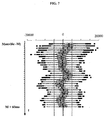
- Figure 7 shows the distributions of amplitude differences between two successive campaigns several years apart, within the time window studied.
- the median or average values should be centered on 0, and distributions should be small. But he it is clear that this assumption is only correct between 8 and 24 ms in the example considered. Elsewhere, the distributions oscillate around 0, with a median value maximum reached around 30 ms. This overall measure of the differences amplitude confirms the more local result obtained with the coherence attribute.
- a coherence attribute was then calculated within the reservoir according to the first method.
- the variance threshold was set at 99%.
- the neighborhood dimension of the current point for calculating the consistency is 25 traces, 4ms each.
- the area tank corresponds to a thickness of 20ms.
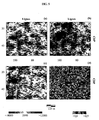
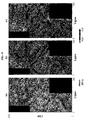
- Figure 8 shows the three seismic campaigns, as well as the cube of associated coherence.
- the areas showing the lowest consistency values seem to be at the base of the reservoir, in the southern two-thirds.
- the large areas of very low coherence values at the base coincide with the presence of three of the four wells for steam injection and oil recovery, as well as to the southern part below these wells, which would suggest an invasion of the steam injected into this area.
- the zone of very low coherence at the roof is located at the end of the four wells: again, this zone may correspond to a rise of steam at the end of the well.
- the northernmost well coincides with a slightly more consistent beyond line 80.
- This well is located at the limit with the area considered less good reservoir; the injected steam could further influence the part further south of this well.
- Figure 10 shows the time plan located 12ms under the roof of the tank extracted coherence cubes calculated according to the two other approaches: for the first method taking into account a single synthetic variable (a), two variables (b) for the second method by setting a 90% variance threshold (c), 95% (d), and 99% (e). Both cards (a) and (b) are very similar to each other, but also very similar respectively to maps (d) and (e). Adding a second synthetic variable, as for the case out of tank, does not seem to change the interpretation that could be made. Overall, it seems that two variables synthetic data are sufficient to explain almost all of the initial variance of each groups of attributes analyzed. Similarly, taking into account variance between maps (d) and (e) does not change the coherences obtained, except for small details.
- Figure 11 shows a 3D view of the coherence cube obtained with two synthetic variables and grouping the coherence values strictly lower than 0.8. It is clear that the northern third is unchanged, as well as the northeastern corner. Of even only two-thirds to the south seem to change.
- the methodology can also be applied to seismic before summation: in this case, it is necessary to determine if there are coherent areas in the data AVO from multiple 3D seismic cubes iso-angles or iso offsets.
- the data used consists of the five iso-angle cubes covering a oil reservoir (channel with sandstone deposits).
- the thickness of the studied sequence is 38ms.
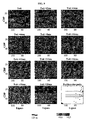
- Figure 12 shows three of the five iso-angle cubes used (cubes 0 ° -6 °, 12 ° -18 ° and 24 ° -30 °) as well as the coherence cube obtained. On this last cube, the zones more consistent appear in orange and red, and the least consistent areas in green and blue. The borders of a channeling structure appear clearly under the form of coherent areas.
- the least coherent areas seem to emphasize seismically more deaf or seismic zones for which the markers are not found cube angle to another.
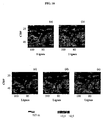
- Figure 14 shows the line passing through a W2 well, extracted from the cubes 0 ° -6 °, 12 ° -18 ° and 24 ° -30 °, as well as the same line extracted from the cube of consistency.
- the areas corresponding to the channels are relatively well marked by low values of coherence in their upper part, and higher values in their lower part.
- the consistent areas correspond to markers of strong amplitude found on the different cubes angles.
- the AVO consistency attribute therefore shows the degree of consistency of the cubes seismic data extracted in the neighborhood of the points and considered according to the angle.
- inconsistent areas can be interpreted as noise seismic, or as specific lithological facies transparent from the point of view seismic (that is, not showing reflectors), or as strong variations in the amplitude as a function of the angle (due, for example, to the fluid content). It is therefore interesting to take into account this attribute of consistency in the interpretation of tanks, in addition to other attributes.
Landscapes
- Engineering & Computer Science (AREA)
- Remote Sensing (AREA)
- Physics & Mathematics (AREA)
- Life Sciences & Earth Sciences (AREA)
- Acoustics & Sound (AREA)
- Environmental & Geological Engineering (AREA)
- Geology (AREA)
- General Life Sciences & Earth Sciences (AREA)
- General Physics & Mathematics (AREA)
- Geophysics (AREA)
- Geophysics And Detection Of Objects (AREA)
Applications Claiming Priority (2)
| Application Number | Priority Date | Filing Date | Title |
|---|---|---|---|
| FR0301291A FR2850759B1 (fr) | 2003-02-04 | 2003-02-04 | Methode pour mesurer les similarites locales entre plusieurs cubes de traces sismiques |
| FR0301291 | 2003-02-04 |
Publications (2)
| Publication Number | Publication Date |
|---|---|
| EP1452889A1 true EP1452889A1 (de) | 2004-09-01 |
| EP1452889B1 EP1452889B1 (de) | 2012-03-14 |
Family
ID=32696357
Family Applications (1)
| Application Number | Title | Priority Date | Filing Date |
|---|---|---|---|
| EP04290160A Expired - Lifetime EP1452889B1 (de) | 2003-02-04 | 2004-01-21 | Verfahren zur Messung lokaler Änlichkeiten zwischen mehreren Kuben die seismische Spuren enthalten |
Country Status (5)
| Country | Link |
|---|---|
| US (1) | US7020558B2 (de) |
| EP (1) | EP1452889B1 (de) |
| AT (1) | ATE549647T1 (de) |
| CA (1) | CA2456596C (de) |
| FR (1) | FR2850759B1 (de) |
Cited By (3)
| Publication number | Priority date | Publication date | Assignee | Title |
|---|---|---|---|---|
| EP2141515A1 (de) | 2008-07-03 | 2010-01-06 | Ifp | Methode zur gemeinsamen Inversion von seismischen Daten, die auf unterschiedlichen Zeitskalen abgebildet sind |
| WO2023038831A1 (en) * | 2021-09-13 | 2023-03-16 | Saudi Arabian Oil Company | Systems and methods for detecting seismic discontinuities by coherence estimation |
| US11906679B2 (en) | 2021-09-13 | 2024-02-20 | Saudi Arabian Oil Company | Systems and methods for detecting seismic discontinuities by coherence estimation |
Families Citing this family (11)
| Publication number | Priority date | Publication date | Assignee | Title |
|---|---|---|---|---|
| FR2831962B1 (fr) * | 2001-11-08 | 2004-06-25 | Geophysique Cie Gle | Procede de traitement sismique, notamment pour la compensation de birefringence sur des traces sismiques |
| FR2854247B1 (fr) * | 2003-04-28 | 2005-07-29 | Geophysique Cie Gle | Procede de traitement de cubes sismiques correspondant pour une meme zone au sol, a differentes valeurs de deports source/recepteur et/ou d'angles d'incidence |
| US7554883B2 (en) * | 2004-10-11 | 2009-06-30 | Landmark Graphics Corporation | Fault filter for seismic discontinuity data |
| US9110194B2 (en) * | 2009-09-14 | 2015-08-18 | Exxonmobil Upstream Research Company | System and method for providing a time-based representation of data |
| BR112014008363A2 (pt) * | 2011-11-07 | 2017-04-18 | Landmark Graphics Corp | método e sistema de geração de imagem sísmica |
| US9645268B2 (en) | 2012-06-25 | 2017-05-09 | Schlumberger Technology Corporation | Seismic orthogonal decomposition attribute |
| CN108369289A (zh) * | 2015-12-18 | 2018-08-03 | 埃克森美孚上游研究公司 | 使用全波场反演点扩展函数分析设计地球物理勘测的方法 |
| CN108072900B (zh) * | 2018-02-01 | 2019-12-10 | 中国石油天然气集团有限公司 | 一种道集记录处理方法、装置及计算机存储介质 |
| US11500118B2 (en) | 2019-03-08 | 2022-11-15 | International Business Machines Corporation | Seismic data representation and comparison |
| CN114152983B (zh) * | 2020-09-08 | 2024-05-07 | 中国石油化工股份有限公司 | 地震子波提取方法、系统、存储介质以及电子设备 |
| CN115267908A (zh) * | 2022-08-04 | 2022-11-01 | 中海石油(中国)有限公司深圳分公司 | 余弦相似度地震属性计算方法、装置、电子设备及介质 |
Family Cites Families (7)
| Publication number | Priority date | Publication date | Assignee | Title |
|---|---|---|---|---|
| DE19904347C2 (de) * | 1999-02-03 | 2002-08-14 | Henning Trappe | Verfahren zur seismischen Datenverarbeitung |
| US6223126B1 (en) * | 1999-10-20 | 2001-04-24 | Phillips Petroleum Company | Multi-attribute seismic waveform classification |
| FR2808336B1 (fr) * | 2000-04-26 | 2002-06-07 | Elf Exploration Prod | Methode d'interpretation chrono-stratigraphique d'une section ou d'un bloc sismique |
| AU2001271490B2 (en) * | 2000-06-30 | 2005-08-04 | Exxonmobil Upstream Research Company | Method for imaging discontinuities in seismic data using dip-steering |
| US6597994B2 (en) * | 2000-12-22 | 2003-07-22 | Conoco Inc. | Seismic processing system and method to determine the edges of seismic data events |
| FR2826734B1 (fr) * | 2001-06-29 | 2004-01-16 | Geophysique Cie Gle | Perfectionnements aux techniques de pointe de surface |
| DE10142785C2 (de) * | 2001-08-31 | 2003-07-03 | Henning Trappe | Verfahren zur Bestimmung lokaler Ähnlichkeit aus seismischen 3D-Meßdaten |
-
2003
- 2003-02-04 FR FR0301291A patent/FR2850759B1/fr not_active Expired - Fee Related
-
2004
- 2004-01-21 AT AT04290160T patent/ATE549647T1/de active
- 2004-01-21 EP EP04290160A patent/EP1452889B1/de not_active Expired - Lifetime
- 2004-02-02 CA CA2456596A patent/CA2456596C/fr not_active Expired - Fee Related
- 2004-02-04 US US10/770,602 patent/US7020558B2/en not_active Expired - Lifetime
Non-Patent Citations (5)
| Title |
|---|
| ADAM GERSZTENKORN AND KURT J. MARFURT: "Eigenstructure-based coherence computations as an aid to 3-D structural and stratigraphic mapping", GEOPHYSICS, vol. 64, no. 5, September 1999 (1999-09-01) - October 1999 (1999-10-01), pages 1468 - 1479, XP002257907 * |
| BAHORICH, M. AND FARMER, S.: "The coherence cube", THE LEADING EDGE, vol. 14, no. 10, October 1995 (1995-10-01), pages 1053 - 1058, XP002257906 * |
| CHOPRA S ET AL: "FAULT INTERPRETATION-THE COHERENCE CUBE AND BEYOND", OIL AND GAS JOURNAL, PENNWELL PUBLISHING CO. TULSA, US, vol. 98, no. 31, 31 July 2000 (2000-07-31), pages 71 - 74, XP001008962, ISSN: 0030-1388 * |
| CHOPRA S ET AL: "INTEGRATING COHERENCE CUBE IMAGING AND SEISMIC INVERSION", THE LEADING EDGE, SOCIETY OF EXPLORATION GEOPHYSICISTS, US, vol. 20, no. 4, April 2001 (2001-04-01), pages 354,356,360,362, XP001039192, ISSN: 1070-485X * |
| MARFURT K J ET AL: "3-D seismic attributes using a semblance-based coherency algorithm", GEOPHYSICS, SOCIETY OF EXPLORATION GEOPHYSICISTS. TULSA, US, vol. 63, no. 4, July 1998 (1998-07-01), pages 1150 - 1165, XP002195379, ISSN: 0016-8033 * |
Cited By (3)
| Publication number | Priority date | Publication date | Assignee | Title |
|---|---|---|---|---|
| EP2141515A1 (de) | 2008-07-03 | 2010-01-06 | Ifp | Methode zur gemeinsamen Inversion von seismischen Daten, die auf unterschiedlichen Zeitskalen abgebildet sind |
| WO2023038831A1 (en) * | 2021-09-13 | 2023-03-16 | Saudi Arabian Oil Company | Systems and methods for detecting seismic discontinuities by coherence estimation |
| US11906679B2 (en) | 2021-09-13 | 2024-02-20 | Saudi Arabian Oil Company | Systems and methods for detecting seismic discontinuities by coherence estimation |
Also Published As
| Publication number | Publication date |
|---|---|
| EP1452889B1 (de) | 2012-03-14 |
| CA2456596A1 (fr) | 2004-08-04 |
| US20040220744A1 (en) | 2004-11-04 |
| FR2850759B1 (fr) | 2005-03-11 |
| US7020558B2 (en) | 2006-03-28 |
| ATE549647T1 (de) | 2012-03-15 |
| FR2850759A1 (fr) | 2004-08-06 |
| CA2456596C (fr) | 2013-04-16 |
Similar Documents
| Publication | Publication Date | Title |
|---|---|---|
| EP2761329B1 (de) | Verfahren zur überprüfung eines trainingsbildes zur geostatistischen mehrpunktmodellierung des untergrundes | |
| EP0789849B1 (de) | Verfahren zur darstellung des verlaufs mindestens eines bohrlochs in einem raum-zeitlichen bereich | |
| CA2670384C (fr) | Methode d'inversion conjointe de donnees sismiques representees sur des echelles de temps differentes | |
| EP1452889B1 (de) | Verfahren zur Messung lokaler Änlichkeiten zwischen mehreren Kuben die seismische Spuren enthalten | |
| EP2369369B1 (de) | Methode zur Überwachung eines geologischen Gasreservoirs durch stratigraphische Inversion seismischer Daten | |
| EP3570074A1 (de) | Verfahren zur detektion von geologischen objekten auf einem bild | |
| EP3721265B1 (de) | Systeme und verfahren zur verfeinerung von geschätzten parameterwerten in der seismischen bildgebung | |
| FR2654515A1 (fr) | Methode d'evaluation lithologique a partir de donnees sismiques. | |
| FR2824917A1 (fr) | Systeme pour l'estimation de variations azimutales dans des donnees sismiques | |
| WO1990013831A1 (fr) | Procede de pointe automatique et d'aide a l'interpretation, en particulier de section sismique, par des techniques d'analyse d'images | |
| EP1253443B1 (de) | Verfahren zur Erleichterung der Zeitüberwachung der Evolution eines unterirdischen Gebiets mit einer vergleichenden Auswertung von verschiedenen seismischen Datensätzen | |
| EP1707993A1 (de) | Methode und Computerprogramm zur Bestimmung von Diskontinuitäten | |
| FR2753800A1 (fr) | Procede et appareil pour exploiter des paires de donnees collectees au cours d'une operation sismique, lesquelles representent des caracteristiques d'une formation terrestre et pour generer un enregistrement de sortie | |
| CA2464799C (fr) | Methode pour determiner un modele de vitesse d'ondes sismiques dans une formation souterraine heterogene | |
| RU2126984C1 (ru) | Способ определения глубинно-скоростных параметров среды и построения ее изображения по сейсмическим данным - система prime | |
| CN118151241A (zh) | 薄层砂体的发育情况确定方法、装置、设备及存储介质 | |
| Dong et al. | Transformer for seismic image super-resolution | |
| EP1540377B1 (de) | Verfahren zum komprimieren und filtrieren von geophysischen ereignissen zwecks extrahierung von bodenartdaten | |
| Countiss | Frequency-enhanced imaging of stratigraphically complex, thin-bed reservoirs: A case study from South Marsh Island Block 128 Field | |
| Khan et al. | Transfer Learning: A key approach to fault prediction and extraction in deep learning | |
| EP1398649A1 (de) | Verfahren zur Feststellung eines Bohrloches | |
| Baville | Stratigraphic correlation uncertainty: On the impact of the sediment transport direction in computer-assisted multi-well correlation | |
| Rimaila et al. | Correlation of Geological Time Lines by Reducing Uncertainties to Regions—A Global Seismic Interpretation Workflow | |
| Norgard et al. | PS Multi-Attribute Seismic Wheeler Volume Workflows, Illuminating Stratigraphy, Geomorphology, and Prospectivity within a Mezardere Slope Fan Exploration Model, Thrace Basin, Turkey | |
| FR2844362A1 (fr) | Methode pour compacter et filtrer des evenements sismiques dans le but d'en extraire des informations sur la nature du sous-sol |
Legal Events
| Date | Code | Title | Description |
|---|---|---|---|
| PUAI | Public reference made under article 153(3) epc to a published international application that has entered the european phase |
Free format text: ORIGINAL CODE: 0009012 |
|
| AK | Designated contracting states |
Kind code of ref document: A1 Designated state(s): AT BE BG CH CY CZ DE DK EE ES FI FR GB GR HU IE IT LI LU MC NL PT RO SE SI SK TR |
|
| AX | Request for extension of the european patent |
Extension state: AL LT LV MK |
|
| 17P | Request for examination filed |
Effective date: 20050301 |
|
| AKX | Designation fees paid |
Designated state(s): AT BE BG CH CY CZ DE DK EE ES FI FR GB GR HU IE IT LI LU MC NL PT RO SE SI SK TR |
|
| GRAP | Despatch of communication of intention to grant a patent |
Free format text: ORIGINAL CODE: EPIDOSNIGR1 |
|
| GRAS | Grant fee paid |
Free format text: ORIGINAL CODE: EPIDOSNIGR3 |
|
| GRAA | (expected) grant |
Free format text: ORIGINAL CODE: 0009210 |
|
| AK | Designated contracting states |
Kind code of ref document: B1 Designated state(s): AT BE BG CH CY CZ DE DK EE ES FI FR GB GR HU IE IT LI LU MC NL PT RO SE SI SK TR |
|
| REG | Reference to a national code |
Ref country code: GB Ref legal event code: FG4D Free format text: NOT ENGLISH |
|
| REG | Reference to a national code |
Ref country code: CH Ref legal event code: EP Ref country code: AT Ref legal event code: REF Ref document number: 549647 Country of ref document: AT Kind code of ref document: T Effective date: 20120315 |
|
| REG | Reference to a national code |
Ref country code: IE Ref legal event code: FG4D Free format text: LANGUAGE OF EP DOCUMENT: FRENCH |
|
| REG | Reference to a national code |
Ref country code: DE Ref legal event code: R096 Ref document number: 602004036878 Country of ref document: DE Effective date: 20120510 |
|
| REG | Reference to a national code |
Ref country code: NL Ref legal event code: VDEP Effective date: 20120314 |
|
| PG25 | Lapsed in a contracting state [announced via postgrant information from national office to epo] |
Ref country code: GR Free format text: LAPSE BECAUSE OF FAILURE TO SUBMIT A TRANSLATION OF THE DESCRIPTION OR TO PAY THE FEE WITHIN THE PRESCRIBED TIME-LIMIT Effective date: 20120615 Ref country code: FI Free format text: LAPSE BECAUSE OF FAILURE TO SUBMIT A TRANSLATION OF THE DESCRIPTION OR TO PAY THE FEE WITHIN THE PRESCRIBED TIME-LIMIT Effective date: 20120314 |
|
| REG | Reference to a national code |
Ref country code: AT Ref legal event code: MK05 Ref document number: 549647 Country of ref document: AT Kind code of ref document: T Effective date: 20120314 |
|
| PG25 | Lapsed in a contracting state [announced via postgrant information from national office to epo] |
Ref country code: CY Free format text: LAPSE BECAUSE OF FAILURE TO SUBMIT A TRANSLATION OF THE DESCRIPTION OR TO PAY THE FEE WITHIN THE PRESCRIBED TIME-LIMIT Effective date: 20120314 |
|
| PG25 | Lapsed in a contracting state [announced via postgrant information from national office to epo] |
Ref country code: RO Free format text: LAPSE BECAUSE OF FAILURE TO SUBMIT A TRANSLATION OF THE DESCRIPTION OR TO PAY THE FEE WITHIN THE PRESCRIBED TIME-LIMIT Effective date: 20120314 Ref country code: SI Free format text: LAPSE BECAUSE OF FAILURE TO SUBMIT A TRANSLATION OF THE DESCRIPTION OR TO PAY THE FEE WITHIN THE PRESCRIBED TIME-LIMIT Effective date: 20120314 Ref country code: CZ Free format text: LAPSE BECAUSE OF FAILURE TO SUBMIT A TRANSLATION OF THE DESCRIPTION OR TO PAY THE FEE WITHIN THE PRESCRIBED TIME-LIMIT Effective date: 20120314 Ref country code: SE Free format text: LAPSE BECAUSE OF FAILURE TO SUBMIT A TRANSLATION OF THE DESCRIPTION OR TO PAY THE FEE WITHIN THE PRESCRIBED TIME-LIMIT Effective date: 20120314 Ref country code: EE Free format text: LAPSE BECAUSE OF FAILURE TO SUBMIT A TRANSLATION OF THE DESCRIPTION OR TO PAY THE FEE WITHIN THE PRESCRIBED TIME-LIMIT Effective date: 20120314 |
|
| PG25 | Lapsed in a contracting state [announced via postgrant information from national office to epo] |
Ref country code: SK Free format text: LAPSE BECAUSE OF FAILURE TO SUBMIT A TRANSLATION OF THE DESCRIPTION OR TO PAY THE FEE WITHIN THE PRESCRIBED TIME-LIMIT Effective date: 20120314 Ref country code: PT Free format text: LAPSE BECAUSE OF FAILURE TO SUBMIT A TRANSLATION OF THE DESCRIPTION OR TO PAY THE FEE WITHIN THE PRESCRIBED TIME-LIMIT Effective date: 20120716 |
|
| PLBE | No opposition filed within time limit |
Free format text: ORIGINAL CODE: 0009261 |
|
| STAA | Information on the status of an ep patent application or granted ep patent |
Free format text: STATUS: NO OPPOSITION FILED WITHIN TIME LIMIT |
|
| PG25 | Lapsed in a contracting state [announced via postgrant information from national office to epo] |
Ref country code: NL Free format text: LAPSE BECAUSE OF FAILURE TO SUBMIT A TRANSLATION OF THE DESCRIPTION OR TO PAY THE FEE WITHIN THE PRESCRIBED TIME-LIMIT Effective date: 20120314 Ref country code: DK Free format text: LAPSE BECAUSE OF FAILURE TO SUBMIT A TRANSLATION OF THE DESCRIPTION OR TO PAY THE FEE WITHIN THE PRESCRIBED TIME-LIMIT Effective date: 20120314 Ref country code: AT Free format text: LAPSE BECAUSE OF FAILURE TO SUBMIT A TRANSLATION OF THE DESCRIPTION OR TO PAY THE FEE WITHIN THE PRESCRIBED TIME-LIMIT Effective date: 20120314 |
|
| 26N | No opposition filed |
Effective date: 20121217 |
|
| PG25 | Lapsed in a contracting state [announced via postgrant information from national office to epo] |
Ref country code: IT Free format text: LAPSE BECAUSE OF FAILURE TO SUBMIT A TRANSLATION OF THE DESCRIPTION OR TO PAY THE FEE WITHIN THE PRESCRIBED TIME-LIMIT Effective date: 20120314 |
|
| REG | Reference to a national code |
Ref country code: DE Ref legal event code: R097 Ref document number: 602004036878 Country of ref document: DE Effective date: 20121217 |
|
| PG25 | Lapsed in a contracting state [announced via postgrant information from national office to epo] |
Ref country code: ES Free format text: LAPSE BECAUSE OF FAILURE TO SUBMIT A TRANSLATION OF THE DESCRIPTION OR TO PAY THE FEE WITHIN THE PRESCRIBED TIME-LIMIT Effective date: 20120625 |
|
| BERE | Be: lapsed |
Owner name: INSTITUT FRANCAIS DU PETROLE Effective date: 20130131 |
|
| PG25 | Lapsed in a contracting state [announced via postgrant information from national office to epo] |
Ref country code: BG Free format text: LAPSE BECAUSE OF FAILURE TO SUBMIT A TRANSLATION OF THE DESCRIPTION OR TO PAY THE FEE WITHIN THE PRESCRIBED TIME-LIMIT Effective date: 20120614 |
|
| PG25 | Lapsed in a contracting state [announced via postgrant information from national office to epo] |
Ref country code: MC Free format text: LAPSE BECAUSE OF NON-PAYMENT OF DUE FEES Effective date: 20130131 |
|
| REG | Reference to a national code |
Ref country code: CH Ref legal event code: PL |
|
| REG | Reference to a national code |
Ref country code: IE Ref legal event code: MM4A |
|
| PG25 | Lapsed in a contracting state [announced via postgrant information from national office to epo] |
Ref country code: LI Free format text: LAPSE BECAUSE OF NON-PAYMENT OF DUE FEES Effective date: 20130131 Ref country code: CH Free format text: LAPSE BECAUSE OF NON-PAYMENT OF DUE FEES Effective date: 20130131 Ref country code: DE Free format text: LAPSE BECAUSE OF NON-PAYMENT OF DUE FEES Effective date: 20130801 Ref country code: BE Free format text: LAPSE BECAUSE OF NON-PAYMENT OF DUE FEES Effective date: 20130131 |
|
| REG | Reference to a national code |
Ref country code: DE Ref legal event code: R119 Ref document number: 602004036878 Country of ref document: DE Effective date: 20130801 |
|
| PG25 | Lapsed in a contracting state [announced via postgrant information from national office to epo] |
Ref country code: IE Free format text: LAPSE BECAUSE OF NON-PAYMENT OF DUE FEES Effective date: 20130121 |
|
| PG25 | Lapsed in a contracting state [announced via postgrant information from national office to epo] |
Ref country code: TR Free format text: LAPSE BECAUSE OF FAILURE TO SUBMIT A TRANSLATION OF THE DESCRIPTION OR TO PAY THE FEE WITHIN THE PRESCRIBED TIME-LIMIT Effective date: 20120314 |
|
| PG25 | Lapsed in a contracting state [announced via postgrant information from national office to epo] |
Ref country code: HU Free format text: LAPSE BECAUSE OF FAILURE TO SUBMIT A TRANSLATION OF THE DESCRIPTION OR TO PAY THE FEE WITHIN THE PRESCRIBED TIME-LIMIT; INVALID AB INITIO Effective date: 20040121 Ref country code: LU Free format text: LAPSE BECAUSE OF NON-PAYMENT OF DUE FEES Effective date: 20130121 |
|
| REG | Reference to a national code |
Ref country code: FR Ref legal event code: PLFP Year of fee payment: 13 |
|
| REG | Reference to a national code |
Ref country code: FR Ref legal event code: PLFP Year of fee payment: 14 |
|
| REG | Reference to a national code |
Ref country code: FR Ref legal event code: PLFP Year of fee payment: 15 |
|
| PGFP | Annual fee paid to national office [announced via postgrant information from national office to epo] |
Ref country code: GB Payment date: 20180122 Year of fee payment: 15 |
|
| PGFP | Annual fee paid to national office [announced via postgrant information from national office to epo] |
Ref country code: FR Payment date: 20180126 Year of fee payment: 15 |
|
| GBPC | Gb: european patent ceased through non-payment of renewal fee |
Effective date: 20190121 |
|
| PG25 | Lapsed in a contracting state [announced via postgrant information from national office to epo] |
Ref country code: FR Free format text: LAPSE BECAUSE OF NON-PAYMENT OF DUE FEES Effective date: 20190131 |
|
| PG25 | Lapsed in a contracting state [announced via postgrant information from national office to epo] |
Ref country code: GB Free format text: LAPSE BECAUSE OF NON-PAYMENT OF DUE FEES Effective date: 20190121 |