EP1453090A2 - Herstellungsverfahren für ein Halbleiterbauelement - Google Patents
Herstellungsverfahren für ein Halbleiterbauelement Download PDFInfo
- Publication number
- EP1453090A2 EP1453090A2 EP04004219A EP04004219A EP1453090A2 EP 1453090 A2 EP1453090 A2 EP 1453090A2 EP 04004219 A EP04004219 A EP 04004219A EP 04004219 A EP04004219 A EP 04004219A EP 1453090 A2 EP1453090 A2 EP 1453090A2
- Authority
- EP
- European Patent Office
- Prior art keywords
- semiconductor wafer
- etching
- semiconductor
- semiconductor device
- wet
- Prior art date
- Legal status (The legal status is an assumption and is not a legal conclusion. Google has not performed a legal analysis and makes no representation as to the accuracy of the status listed.)
- Withdrawn
Links
Images




Classifications
-
- H—ELECTRICITY
- H10—SEMICONDUCTOR DEVICES; ELECTRIC SOLID-STATE DEVICES NOT OTHERWISE PROVIDED FOR
- H10P—GENERIC PROCESSES OR APPARATUS FOR THE MANUFACTURE OR TREATMENT OF DEVICES COVERED BY CLASS H10
- H10P54/00—Cutting or separating of wafers, substrates or parts of devices
-
- E—FIXED CONSTRUCTIONS
- E06—DOORS, WINDOWS, SHUTTERS, OR ROLLER BLINDS IN GENERAL; LADDERS
- E06B—FIXED OR MOVABLE CLOSURES FOR OPENINGS IN BUILDINGS, VEHICLES, FENCES OR LIKE ENCLOSURES IN GENERAL, e.g. DOORS, WINDOWS, BLINDS, GATES
- E06B3/00—Window sashes, door leaves, or like elements for closing wall or like openings; Layout of fixed or moving closures, e.g. windows in wall or like openings; Features of rigidly-mounted outer frames relating to the mounting of wing frames
- E06B3/96—Corner joints or edge joints for windows, doors, or the like frames or wings
- E06B3/964—Corner joints or edge joints for windows, doors, or the like frames or wings using separate connection pieces, e.g. T-connection pieces
- E06B3/968—Corner joints or edge joints for windows, doors, or the like frames or wings using separate connection pieces, e.g. T-connection pieces characterised by the way the connecting pieces are fixed in or on the frame members
- E06B3/9687—Corner joints or edge joints for windows, doors, or the like frames or wings using separate connection pieces, e.g. T-connection pieces characterised by the way the connecting pieces are fixed in or on the frame members with screws blocking the connecting piece inside or on the frame member
- E06B3/9688—Mitre joints
-
- E—FIXED CONSTRUCTIONS
- E06—DOORS, WINDOWS, SHUTTERS, OR ROLLER BLINDS IN GENERAL; LADDERS
- E06B—FIXED OR MOVABLE CLOSURES FOR OPENINGS IN BUILDINGS, VEHICLES, FENCES OR LIKE ENCLOSURES IN GENERAL, e.g. DOORS, WINDOWS, BLINDS, GATES
- E06B3/00—Window sashes, door leaves, or like elements for closing wall or like openings; Layout of fixed or moving closures, e.g. windows in wall or like openings; Features of rigidly-mounted outer frames relating to the mounting of wing frames
- E06B3/96—Corner joints or edge joints for windows, doors, or the like frames or wings
- E06B3/964—Corner joints or edge joints for windows, doors, or the like frames or wings using separate connection pieces, e.g. T-connection pieces
- E06B3/9647—Corner joints or edge joints for windows, doors, or the like frames or wings using separate connection pieces, e.g. T-connection pieces the connecting piece being part of or otherwise linked to the window or door fittings
- E06B3/9648—Mitre joints
-
- H—ELECTRICITY
- H10—SEMICONDUCTOR DEVICES; ELECTRIC SOLID-STATE DEVICES NOT OTHERWISE PROVIDED FOR
- H10W—GENERIC PACKAGES, INTERCONNECTIONS, CONNECTORS OR OTHER CONSTRUCTIONAL DETAILS OF DEVICES COVERED BY CLASS H10
- H10W20/00—Interconnections in chips, wafers or substrates
- H10W20/40—Interconnections external to wafers or substrates, e.g. back-end-of-line [BEOL] metallisations or vias connecting to gate electrodes
-
- H—ELECTRICITY
- H10—SEMICONDUCTOR DEVICES; ELECTRIC SOLID-STATE DEVICES NOT OTHERWISE PROVIDED FOR
- H10W—GENERIC PACKAGES, INTERCONNECTIONS, CONNECTORS OR OTHER CONSTRUCTIONAL DETAILS OF DEVICES COVERED BY CLASS H10
- H10W70/00—Package substrates; Interposers; Redistribution layers [RDL]
- H10W70/60—Insulating or insulated package substrates; Interposers; Redistribution layers
- H10W70/62—Insulating or insulated package substrates; Interposers; Redistribution layers characterised by their interconnections
- H10W70/63—Vias, e.g. via plugs
- H10W70/635—Through-vias
-
- H—ELECTRICITY
- H10—SEMICONDUCTOR DEVICES; ELECTRIC SOLID-STATE DEVICES NOT OTHERWISE PROVIDED FOR
- H10W—GENERIC PACKAGES, INTERCONNECTIONS, CONNECTORS OR OTHER CONSTRUCTIONAL DETAILS OF DEVICES COVERED BY CLASS H10
- H10W74/00—Encapsulations, e.g. protective coatings
- H10W74/10—Encapsulations, e.g. protective coatings characterised by their shape or disposition
- H10W74/111—Encapsulations, e.g. protective coatings characterised by their shape or disposition the semiconductor body being completely enclosed
- H10W74/129—Encapsulations, e.g. protective coatings characterised by their shape or disposition the semiconductor body being completely enclosed forming a chip-scale package [CSP]
-
- H—ELECTRICITY
- H10—SEMICONDUCTOR DEVICES; ELECTRIC SOLID-STATE DEVICES NOT OTHERWISE PROVIDED FOR
- H10W—GENERIC PACKAGES, INTERCONNECTIONS, CONNECTORS OR OTHER CONSTRUCTIONAL DETAILS OF DEVICES COVERED BY CLASS H10
- H10W70/00—Package substrates; Interposers; Redistribution layers [RDL]
- H10W70/60—Insulating or insulated package substrates; Interposers; Redistribution layers
- H10W70/62—Insulating or insulated package substrates; Interposers; Redistribution layers characterised by their interconnections
- H10W70/65—Shapes or dispositions of interconnections
- H10W70/654—Top-view layouts
- H10W70/656—Fan-in layouts
-
- H—ELECTRICITY
- H10—SEMICONDUCTOR DEVICES; ELECTRIC SOLID-STATE DEVICES NOT OTHERWISE PROVIDED FOR
- H10W—GENERIC PACKAGES, INTERCONNECTIONS, CONNECTORS OR OTHER CONSTRUCTIONAL DETAILS OF DEVICES COVERED BY CLASS H10
- H10W72/00—Interconnections or connectors in packages
- H10W72/01—Manufacture or treatment
- H10W72/013—Manufacture or treatment of die-attach connectors
- H10W72/01331—Manufacture or treatment of die-attach connectors using blanket deposition
-
- H—ELECTRICITY
- H10—SEMICONDUCTOR DEVICES; ELECTRIC SOLID-STATE DEVICES NOT OTHERWISE PROVIDED FOR
- H10W—GENERIC PACKAGES, INTERCONNECTIONS, CONNECTORS OR OTHER CONSTRUCTIONAL DETAILS OF DEVICES COVERED BY CLASS H10
- H10W72/00—Interconnections or connectors in packages
- H10W72/071—Connecting or disconnecting
- H10W72/072—Connecting or disconnecting of bump connectors
- H10W72/07251—Connecting or disconnecting of bump connectors characterised by changes in properties of the bump connectors during connecting
-
- H—ELECTRICITY
- H10—SEMICONDUCTOR DEVICES; ELECTRIC SOLID-STATE DEVICES NOT OTHERWISE PROVIDED FOR
- H10W—GENERIC PACKAGES, INTERCONNECTIONS, CONNECTORS OR OTHER CONSTRUCTIONAL DETAILS OF DEVICES COVERED BY CLASS H10
- H10W72/00—Interconnections or connectors in packages
- H10W72/20—Bump connectors, e.g. solder bumps or copper pillars; Dummy bumps; Thermal bumps
-
- H—ELECTRICITY
- H10—SEMICONDUCTOR DEVICES; ELECTRIC SOLID-STATE DEVICES NOT OTHERWISE PROVIDED FOR
- H10W—GENERIC PACKAGES, INTERCONNECTIONS, CONNECTORS OR OTHER CONSTRUCTIONAL DETAILS OF DEVICES COVERED BY CLASS H10
- H10W72/00—Interconnections or connectors in packages
- H10W72/90—Bond pads, in general
- H10W72/921—Structures or relative sizes of bond pads
- H10W72/923—Bond pads having multiple stacked layers
-
- H—ELECTRICITY
- H10—SEMICONDUCTOR DEVICES; ELECTRIC SOLID-STATE DEVICES NOT OTHERWISE PROVIDED FOR
- H10W—GENERIC PACKAGES, INTERCONNECTIONS, CONNECTORS OR OTHER CONSTRUCTIONAL DETAILS OF DEVICES COVERED BY CLASS H10
- H10W72/00—Interconnections or connectors in packages
- H10W72/90—Bond pads, in general
- H10W72/941—Dispositions of bond pads
- H10W72/9415—Dispositions of bond pads relative to the surface, e.g. recessed, protruding
Definitions
- This invention relates to a manufacturing method of a CSP (Chip Size Package) type semiconductor device.
- the CSP receives attention in recent years as a three-dimensional mounting technology as well as a new packaging technology.
- the CSP means a small package having about the same outside dimensions as those of a semiconductor die packaged in it.
- a BGA type semiconductor device has been known as a type of CSP.
- a plurality of ball-shaped conductive terminals made of metal such as solder is arrayed in a grid pattern on one principal surface of a package of the BGA type semiconductor device and is electrically connected with the semiconductor die mounted on the other side of the package.
- the semiconductor die When the BGA type semiconductor device is mounted on electronic equipment, the semiconductor die is electrically connected with an external circuit on a printed circuit board by compression bonding of each of the conductive terminals to each of wiring patterns on the printed circuit board.
- Such a BGA type semiconductor device has advantages in providing a large number of conductive terminals and in size reduction over other CSP type semiconductor devices such as an SOP (Small Outline Package) and a QFP (Quad Flat Package), which have lead pins protruding from their sides.
- the BGA type semiconductor device is used as an image sensor chip for a digital camera incorporated into a mobile telephone, for example.
- Figs. 9A and 9B show an outline structure of a conventional BGA type semiconductor device.
- Fig. 9A is an oblique perspective figure showing a top side of the BGA type semiconductor device.
- Fig. 9B is an oblique perspective figure showing a back side of the BGA type semiconductor device.
- a semiconductor die 101 is sealed between a first glass substrate 104a and a second glass substrate 104b through epoxy resins 105a and 105b in the BGA type semiconductor device 100.
- a plurality of ball-shaped conductive terminals (hereafter referred to as conductive terminals) 111 is arrayed in a grid pattern on a principal surface of the second glass substrate 104b, that is, on a back surface of the BGA type semiconductor device 100.
- the conductive terminals 111 are connected to the semiconductor die 101 through a plurality of second wirings 109.
- the plurality of second wirings 109 is connected with first wirings pulled out from inside of the semiconductor die 101, making each of the conductive terminals 111 electrically connected with the semiconductor die 101.
- Fig. 10 shows a cross-sectional view of the BGA type semiconductor devices 100 divided along dicing lines into individual dice.
- the first wiring 103 is provided on an insulation film 102 on a top surface of the semiconductor die 101.
- the semiconductor die 101 is bonded to the first glass substrate 104a with the resin 105a.
- a back surface of the semiconductor die 101 is bonded to the second glass substrate 104b with the resin 105b.
- One end of the first wiring 103 is connected to the second wiring 109.
- the second wiring 109 extends from the end of the first wiring 103 to a surface of the second glass substrate 104b.
- the ball-shaped conductive terminal 111 is formed on the second wiring 109 extended onto the second glass substrate 104b.
- Providing of a glass substrate on the surfaces of the semiconductor die is laborious and adds to the size and costs of the semiconductor device.
- the two glass substrates make up most of the total thickness of the semiconductor device.
- the invention provides a method of manufacturing a semiconductor device.
- the method includes bonding a supporting substrate to a first surface of a semiconductor wafer on which a semiconductor element is formed, and back-grinding a second surface of the semiconductor wafer. The second surface is opposite to the first surface.
- the method also includes reducing a roughness of the back-ground second surface by etching the back-ground second surface.
- the invention provide another method of manufacturing a semiconductor device.
- the method includes bonding a supporting substrate to a first surface of a semiconductor wafer on which a semiconductor element is formed, and forming a groove in the semiconductor wafer by etching a second surface of the semiconductor wafer.
- the second surface is opposite to the first surface.
- the method also includes rounding a corner of the groove by etching the second surface.
- the invention allows to reduce a thickness of the semiconductor wafer by providing the supporting substrate on the first surface of the semiconductor wafer and by back-grinding the semiconductor wafer on its second surface.
- the semiconductor wafer is thereafter wet-etched to reduce roughness on the second surface produced during the back-grinding.
- the invention provides to etch the second surface of the semiconductor wafer in order to form the groove. Thereafter, the semiconductor wafer is wet-etched to reduce roughness caused by the etching and to round the corner of the groove.
- the wet-etching according to the invention improves coverage of an insulation film, wiring and protection film and enhances yield and reliability of the semiconductor device. This amounts to a reduction of costs and to an improvement of reliability in the semiconductor according to the invention.
- the glass substrates are bonded to both surfaces of the semiconductor die 101 in the BGA type semiconductor device 100 described above.
- the second glass substrate 104b is bonded to the surface on which no semiconductor element is formed, in other words, the surface over which the conductive terminals are disposed. That is to say, there is no need for bonding the second glass substrate as long as the second wiring 109 is insulated from the semiconductor die 101.
- thickness of the two glass substrates makes up most of total thickness of the semiconductor device 100.
- the glass substrate is bonded only to the surface of the semiconductor die 101 on which a semiconductor element is formed, so that cost and size of the semiconductor device 100 are reduced.
- An example of such a semiconductor device will be described using Fig. 8 which is a cross-sectional view of the semiconductor device according to this invention.
- the semiconductor device similar to the semiconductor device 100 is made by forming an insulation film 7 on the semiconductor die 1 instead of bonding the second glass substrate, and forming a cushioning pad 8, a second wiring 9, a protection film 10 and a conductive terminal 11 over the insulation film 7.
- the surface opposite to the surface to which a glass substrate 4 is bonded, that is, a back surface of the semiconductor device is ground by back-grinding, prior to forming the insulation film 7.
- a semiconductor wafer, in which a plurality of the semiconductor dice is included, is ground with a whetstone in the back-grinding.
- the back-grinding transfers bumps and dips on the whetstone to the surface of the wafer and causes scratches extending several microns in depth and length.
- the back-grinding scarcely causes a problem in the case of the semiconductor device 100 shown in Fig. 10, since the bumps and dips on the surface of the wafer due to the scratches are covered by the resin 105b.
- an insulation film 7 is formed on the back-ground surface of the wafer in order to provide insulation between the die and the second wiring. Because the insulation film 7 is formed with a CVD (Chemical Vapor Deposition) apparatus, the bumps and dips on the surface of the wafer are transferred to the insulation film 7 and the surface of the insulation film 7 is formed uneven. This causes poor coverage of photoresist films used in patterning the insulation film 7 and the second wiring 9. The poor coverage of the photoresist film used in patterning the insulation film 7 may cause pinholes or cracks, making a contributing factor to deteriorate yield and reliability of the semiconductor device.
- CVD Chemical Vapor Deposition
- This invention is directed to solve the problems addressed above, and offers a method to resolve the problems due to the bumps and dips on the surface of the back-ground semiconductor wafer, the bumps and dips on the surface of the etched semiconductor wafer and the sharp edges at the corners left after forming the grooves.
- a semiconductor wafer 1a which will form semiconductor dice 1 in later process steps, is provided as shown in Fig. 1.
- the semiconductor dice 1 are CCD image sensor chips, for example, and are manufactured by a semiconductor wafer processing.
- a pair of first wirings 3 separated by a predetermined spacing is formed on a first surface of the semiconductor wafer through an insulation film 2 near a border (referred to as a dicing line or a scribe line) S for dividing the wafer 1a into individual semiconductor dice 1.
- Each of the pair of first wirings 3 makes a pad extended from a bonding pad in the semiconductor die 1 to proximity of the border S. That is, each of the pair of first wirings 3 is a pad for external connection, and is electrically connected with a circuit in the semiconductor die 1, which is not shown in the figure.
- a supporting plate is bonded with an adhesive to the first surface of the semiconductor wafer 1a on which the first wirings 3 are formed.
- a transparent epoxy resin 5 is used as the adhesive and a transparent glass substrate 4 is used as the supporting plate in this embodiment.
- an opaque plastic supporting plate may be bonded using a suitable adhesive.
- a second surface of the semiconductor wafer 1a opposite to the first surface to which the glass substrate 4 is bonded is back-ground to reduce a thickness of the wafer, as shown in Fig. 2.
- the thickness of the back-ground wafer is about 230 ⁇ m.
- the second surface of the semiconductor wafer 1a is wet-etched using a chemical solution having high selection ratio between an etch rate of silicon (hereafter referred to as Si) which is a material forming the semiconductor wafer 1a and an etch rate of silicon dioxide (hereafter referred to as SiO 2 ) which is a material forming the glass substrate 4.
- Si etch rate of silicon
- SiO 2 silicon dioxide
- the semiconductor wafer 1a is reduced in thickness by 5 to 30 ⁇ m by the wet-etching to obtain a surface with reduced bumps and dips, as shown in an encircled portion b (a surface after etching) in Fig. 2.
- Any etching solution may be used in the wet-etching, as long as it has high selection ratio between the etch rate of Si and the etch rate of SiO 2 .
- a mixed solution composed of 2.5% of hydrofluoric acid, 50% of nitric acid, 10% of acetic acid and 37.5% of water is used as the wet-etching solution in this embodiment.
- a first method is to reduce the bumps and dips on the second surface by wet-etching which includes dripping the chemical solution on the semiconductor wafer 1a with the glass substrate 4 bonded to it while holding the wafer so that the back-ground second surface of the semiconductor wafer 1a faces upward and spreading the chemical solution all over the second surface of the semiconductor wafer 1a by spinning the semiconductor wafer 1a around its center. This is similar to spin coating of a resist material.
- the roughness on the second surface is further reduced by reversing direction of rotation of the semiconductor wafer 1a to spread the chemical solution more equally all over the second surface of the semiconductor wafer 1a.
- a second method is to reduce the roughness on the second surface by wet-etching performed by dipping the semiconductor wafer 1a into the chemical solution.
- the roughness on the second surface is more uniformly reduced by the second method than by the first method described above, because the chemical solution pervades all the second surface of the semiconductor wafer 1a more uniformly by the second method thean the first method.
- a third method is to reduce the roughness on the back-ground second surface of the semiconductor wafer 1a by CMP (Chemical Mechanical Polishing).
- the roughness on the second surface of the semiconductor wafer 1a may be reduced by dry-etching the back-ground second surface of the semiconductor wafer while holding it upward.
- a photoresist film (not shown in the figure) which has an opening along the border S is formed on the second surface of the semiconductor wafer 1a opposite to the first surface to which the glass substrate 4 is bonded, as shown in Fig. 3.
- Isotropic etching of the semiconductor wafer 1a using the photoresist film as a mask forms a tapered groove along the border S to expose the insulation film 2.
- the semiconductor wafer 1a is divided into individual dice 1 by the isotropic etching, the semiconductor dice 1 are held together with the glass substrate 4, keeping the separated dice 1 together as one unit.
- isotropic etching may be performed by either dry-etching or wet-etching.
- Bumps and dips as well as residues and foreign particles from the etching are left on the second surface of the semiconductor wafer 1a after forming the groove.
- the semiconductor dice have sharp edges at corners of the groove as shown in circles denoted as c and d in Fig. 3.
- Chemical solution similar to one used in the wet-etching after the back-grinding may be used in the wet-etching after forming the groove. Following methods are applicable to the wet-etching after forming the groove.
- a first method of wet-etching after forming the groove is dripping the chemical solution on the semiconductor wafer 1a while holding the surface with the groove upward and spreading the chemical solution all over the surface with the groove of the semiconductor wafer 1a by spinning the semiconductor wafer 1a.
- uniformity of the etching over the surface with the groove is improved by reversing direction of rotation of the semiconductor wafer 1a to spread the chemical solution more equally all over the surface with the groove of the semiconductor wafer 1a.
- a second method of the wet-etching after forming the groove is dipping the semiconductor wafer 1a into the chemical solution.
- the uniformity of etching over the surface with the groove is improved by the second method, because the chemical solution pervades the entire surface with the groove of the semiconductor wafer 1a more uniformly by the dipping than the wet-etching by the first method described above.
- dry-etching may be applied to the surface with the groove of the semiconductor wafer 1a after forming the groove to round the sharp edges at the corners of the groove.
- the insulation film 7 is formed on the surface of the semiconductor wafer 1a opposite to the surface to which the glass substrate 4 is bonded, as shown in Fig. 5.
- a silane-based oxide film of 3 ⁇ m in thickness is formed in this embodiment.
- a photoresist film (not shown) is applied on the insulation film 7 and patterning in the insulation film 7 is made to expose a portion of a bottom surface of each of the first wirings 3, as shown in Fig. 6. That is, the insulation film 7 and the insulation film 2 are etched off using the photoresist film as a mask to expose the portion of the bottom surface of each of the first wirings 3.
- flexible cushioning pads 8 are formed at locations above which the conductive terminals 11 are to be formed.
- the cushioning pads 8 have function to absorb power applied through the conductive terminals 11 and relax stress when the conductive terminals 11 are bonded. However this embodiment does not necessarily require the cushioning pads 8.
- the second wiring 9 is formed on the surface opposite to the surface to which the glass substrate 4 is bonded.
- the first wirings 3 are electrically connected with the second wiring 9.
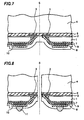
- a photoresist film (not shown) is applied on the surface opposite to the surface to which the glass substrate 4 is bonded and pattering is made to form an opening in the photoresist film along the border S, as shown in Fig. 7.
- Etching is performed using the photoresist film as a mask to remove a portion of the second wiring 9 along the border S.
- electroless plating is made on the surface opposite to the surface to which the glass substrate 4 is bonded so that Ni-Au plating (not shown) is applied on the second wirings 9.
- the protection film 10 is formed on the surface opposite to the surface to which the glass substrate 4 is bonded.
- the surface opposite to the surface to which the glass substrate 4 is bonded is held upward, a thermosetting organic resin is dropped on it and the organic resin is spread over the surface by spinning the semiconductor wafer 1a utilizing centrifugal force.
- the protection film 10 is formed on a surface of the second wirings 9.
- Portions of the protection film 10 at locations where the conductive terminals 11 are to be formed are removed by etching using a photoresist film (not shown) as a mask, as shown in Fig. 8. Then the conductive terminals 11 are formed on the second wirings 9 at the locations exposed by the etching (locations corresponding to the cushioning pads 8). Finally, the protection film 10, the resin 5 and the glass substrate 4 are cut along the border S to complete the BGA type semiconductor device.
- the embodiment described above is directed to the BGA type semiconductor device having the ball-shaped conductive terminals 11.
- this embodiment is not limited to the BGA type semiconductor device and may be applied to a semiconductor device which does not have the ball-shaped conductive terminals such as an LGA (Land Grid Array) type semiconductor device, for example.
- LGA Land Grid Array
Landscapes
- Engineering & Computer Science (AREA)
- Civil Engineering (AREA)
- Structural Engineering (AREA)
- Mechanical Treatment Of Semiconductor (AREA)
- Dicing (AREA)
- Solid State Image Pick-Up Elements (AREA)
Applications Claiming Priority (4)
| Application Number | Priority Date | Filing Date | Title |
|---|---|---|---|
| JP2003046755 | 2003-02-25 | ||
| JP2003046755 | 2003-02-25 | ||
| JP2004026534A JP4544876B2 (ja) | 2003-02-25 | 2004-02-03 | 半導体装置の製造方法 |
| JP2004026534 | 2004-02-03 |
Publications (2)
| Publication Number | Publication Date |
|---|---|
| EP1453090A2 true EP1453090A2 (de) | 2004-09-01 |
| EP1453090A3 EP1453090A3 (de) | 2008-06-04 |
Family
ID=32775226
Family Applications (1)
| Application Number | Title | Priority Date | Filing Date |
|---|---|---|---|
| EP04004219A Withdrawn EP1453090A3 (de) | 2003-02-25 | 2004-02-25 | Herstellungsverfahren für ein Halbleiterbauelement |
Country Status (6)
| Country | Link |
|---|---|
| US (2) | US7371693B2 (de) |
| EP (1) | EP1453090A3 (de) |
| JP (1) | JP4544876B2 (de) |
| KR (1) | KR100661042B1 (de) |
| CN (1) | CN100355036C (de) |
| TW (1) | TWI233669B (de) |
Cited By (2)
| Publication number | Priority date | Publication date | Assignee | Title |
|---|---|---|---|---|
| GB2459301A (en) * | 2008-04-18 | 2009-10-21 | Xsil Technology Ltd | A method of dicing wafers to give high die strength |
| CN101355058B (zh) * | 2007-07-27 | 2010-09-22 | 三洋电机株式会社 | 半导体装置及其制造方法 |
Families Citing this family (27)
| Publication number | Priority date | Publication date | Assignee | Title |
|---|---|---|---|---|
| JP4401066B2 (ja) * | 2002-11-19 | 2010-01-20 | 三洋電機株式会社 | 半導体集積装置及びその製造方法 |
| JP4322181B2 (ja) * | 2004-07-29 | 2009-08-26 | 三洋電機株式会社 | 半導体装置の製造方法 |
| US7049208B2 (en) * | 2004-10-11 | 2006-05-23 | Intel Corporation | Method of manufacturing of thin based substrate |
| US7371676B2 (en) | 2005-04-08 | 2008-05-13 | Micron Technology, Inc. | Method for fabricating semiconductor components with through wire interconnects |
| US7393770B2 (en) * | 2005-05-19 | 2008-07-01 | Micron Technology, Inc. | Backside method for fabricating semiconductor components with conductive interconnects |
| JP4544143B2 (ja) * | 2005-06-17 | 2010-09-15 | セイコーエプソン株式会社 | 半導体装置の製造方法、半導体装置、回路基板及び電子機器 |
| JP2007012995A (ja) * | 2005-07-01 | 2007-01-18 | Toshiba Corp | 超小型カメラモジュール及びその製造方法 |
| US20080217715A1 (en) * | 2005-10-11 | 2008-09-11 | Park Tae-Seok | Wafer Level Package Using Silicon Via Contacts for Cmos Image Sensor and Method of Fabricating the Same |
| US7307348B2 (en) * | 2005-12-07 | 2007-12-11 | Micron Technology, Inc. | Semiconductor components having through wire interconnects (TWI) |
| TW200737506A (en) * | 2006-03-07 | 2007-10-01 | Sanyo Electric Co | Semiconductor device and manufacturing method of the same |
| US7659612B2 (en) | 2006-04-24 | 2010-02-09 | Micron Technology, Inc. | Semiconductor components having encapsulated through wire interconnects (TWI) |
| US7405139B2 (en) * | 2006-08-03 | 2008-07-29 | International Business Machines Corporation | Prevention of backside cracks in semiconductor chips or wafers using backside film or backside wet etch |
| TWI367557B (en) * | 2006-08-11 | 2012-07-01 | Sanyo Electric Co | Semiconductor device and manufaturing method thereof |
| JP4773307B2 (ja) * | 2006-09-15 | 2011-09-14 | Okiセミコンダクタ株式会社 | 半導体装置の製造方法 |
| JP5010247B2 (ja) * | 2006-11-20 | 2012-08-29 | オンセミコンダクター・トレーディング・リミテッド | 半導体装置及びその製造方法 |
| JP2009099838A (ja) * | 2007-10-18 | 2009-05-07 | Nec Electronics Corp | 半導体装置およびその製造方法 |
| US8710665B2 (en) * | 2008-10-06 | 2014-04-29 | Infineon Technologies Ag | Electronic component, a semiconductor wafer and a method for producing an electronic component |
| JP2010103300A (ja) * | 2008-10-23 | 2010-05-06 | Sanyo Electric Co Ltd | 半導体装置及びその製造方法 |
| JP5638605B2 (ja) | 2009-06-25 | 2014-12-10 | アイメックImec | 生体適合性パッケージング |
| US8212340B2 (en) * | 2009-07-13 | 2012-07-03 | Advanced Semiconductor Engineering, Inc. | Chip package and manufacturing method thereof |
| JP2012189396A (ja) * | 2011-03-09 | 2012-10-04 | Mitsubishi Electric Corp | Icチップ、半導体部品、検査用プローブ、ハンディマルチテスター、及び通信装置 |
| JP6265594B2 (ja) | 2012-12-21 | 2018-01-24 | ラピスセミコンダクタ株式会社 | 半導体装置の製造方法、及び半導体装置 |
| KR101440308B1 (ko) * | 2013-02-21 | 2014-09-18 | 옵토팩 주식회사 | 반도체 장치 및 그 제조 방법 |
| US11114402B2 (en) * | 2018-02-23 | 2021-09-07 | Semiconductor Components Industries, Llc | Semiconductor device with backmetal and related methods |
| CN113016067B (zh) | 2018-11-15 | 2024-02-02 | 罗姆股份有限公司 | 半导体器件 |
| JP7056685B2 (ja) * | 2020-05-27 | 2022-04-19 | 信越半導体株式会社 | シリコンウェーハのエッチング方法 |
| CN112053936B (zh) * | 2020-09-22 | 2024-06-11 | 粤芯半导体技术股份有限公司 | 晶圆背面粗糙化控制方法以及功率器件制造方法 |
Family Cites Families (32)
| Publication number | Priority date | Publication date | Assignee | Title |
|---|---|---|---|---|
| JPS54110783A (en) * | 1978-02-20 | 1979-08-30 | Hitachi Ltd | Semiconductor substrate and its manufacture |
| JPS59201425A (ja) * | 1983-04-28 | 1984-11-15 | Toshiba Corp | ウエハ−の裏面加工方法 |
| US4612408A (en) * | 1984-10-22 | 1986-09-16 | Sera Solar Corporation | Electrically isolated semiconductor integrated photodiode circuits and method |
| JP2610703B2 (ja) * | 1990-09-05 | 1997-05-14 | 住友電気工業株式会社 | 半導体素子の製造方法 |
| JPH0715897B2 (ja) * | 1991-11-20 | 1995-02-22 | 株式会社エンヤシステム | ウエ−ハ端面エッチング方法及び装置 |
| US5268065A (en) * | 1992-12-21 | 1993-12-07 | Motorola, Inc. | Method for thinning a semiconductor wafer |
| US5729038A (en) * | 1995-12-15 | 1998-03-17 | Harris Corporation | Silicon-glass bonded wafers |
| US5719085A (en) * | 1995-09-29 | 1998-02-17 | Intel Corporation | Shallow trench isolation technique |
| US6448153B2 (en) * | 1996-10-29 | 2002-09-10 | Tru-Si Technologies, Inc. | Thinning and dicing of semiconductor wafers using dry etch, and obtaining semiconductor chips with rounded bottom edges and corners |
| US6498074B2 (en) * | 1996-10-29 | 2002-12-24 | Tru-Si Technologies, Inc. | Thinning and dicing of semiconductor wafers using dry etch, and obtaining semiconductor chips with rounded bottom edges and corners |
| IL123207A0 (en) * | 1998-02-06 | 1998-09-24 | Shellcase Ltd | Integrated circuit device |
| KR100289403B1 (ko) | 1998-05-11 | 2001-06-01 | 김영환 | 반도체패키지제조방법 |
| JP4103255B2 (ja) * | 1999-07-02 | 2008-06-18 | ソニー株式会社 | 半導体デバイスチップ及び半導体デバイスの製造方法 |
| US6326689B1 (en) * | 1999-07-26 | 2001-12-04 | Stmicroelectronics, Inc. | Backside contact for touchchip |
| JP2001144123A (ja) * | 1999-09-02 | 2001-05-25 | Matsushita Electric Ind Co Ltd | 半導体装置の製造方法および半導体装置 |
| US6350664B1 (en) * | 1999-09-02 | 2002-02-26 | Matsushita Electric Industrial Co., Ltd. | Semiconductor device and method of manufacturing the same |
| JP3368876B2 (ja) * | 1999-11-05 | 2003-01-20 | 株式会社東京精密 | 半導体チップ製造方法 |
| IL133453A0 (en) * | 1999-12-10 | 2001-04-30 | Shellcase Ltd | Methods for producing packaged integrated circuit devices and packaged integrated circuit devices produced thereby |
| JP2001185519A (ja) * | 1999-12-24 | 2001-07-06 | Hitachi Ltd | 半導体装置及びその製造方法 |
| US6498387B1 (en) * | 2000-02-15 | 2002-12-24 | Wen-Ken Yang | Wafer level package and the process of the same |
| US6720522B2 (en) * | 2000-10-26 | 2004-04-13 | Kabushiki Kaisha Toshiba | Apparatus and method for laser beam machining, and method for manufacturing semiconductor devices using laser beam machining |
| JP3660294B2 (ja) * | 2000-10-26 | 2005-06-15 | 株式会社東芝 | 半導体装置の製造方法 |
| GB2368971B (en) * | 2000-11-11 | 2005-01-05 | Pure Wafer Ltd | Process for Reclaimimg Wafer Substrates |
| US6506681B2 (en) * | 2000-12-06 | 2003-01-14 | Micron Technology, Inc. | Thin flip—chip method |
| JP2002217194A (ja) * | 2001-01-15 | 2002-08-02 | Hitachi Ltd | 半導体装置 |
| US6534379B1 (en) * | 2001-03-26 | 2003-03-18 | Advanced Micro Devices, Inc. | Linerless shallow trench isolation method |
| JP4669162B2 (ja) * | 2001-06-28 | 2011-04-13 | 株式会社ディスコ | 半導体ウェーハの分割システム及び分割方法 |
| US20030089950A1 (en) * | 2001-11-15 | 2003-05-15 | Kuech Thomas F. | Bonding of silicon and silicon-germanium to insulating substrates |
| AU2003236002A1 (en) * | 2002-04-11 | 2003-10-20 | Disco Corporation | Method for manufacturing semiconductor chip |
| DE60218643D1 (de) * | 2002-06-28 | 2007-04-19 | St Microelectronics Srl | Herstellungsverfahren für Gräben mit schrägem Profil und gerundeten Oberkanten |
| US20040169176A1 (en) * | 2003-02-28 | 2004-09-02 | Peterson Paul E. | Methods of forming thin film transistors and related systems |
| US20060231829A1 (en) * | 2005-04-13 | 2006-10-19 | Xerox Corporation | TFT gate dielectric with crosslinked polymer |
-
2004
- 2004-02-03 JP JP2004026534A patent/JP4544876B2/ja not_active Expired - Fee Related
- 2004-02-23 TW TW093104415A patent/TWI233669B/zh not_active IP Right Cessation
- 2004-02-24 US US10/784,888 patent/US7371693B2/en not_active Expired - Lifetime
- 2004-02-24 KR KR1020040012208A patent/KR100661042B1/ko not_active Expired - Fee Related
- 2004-02-25 CN CNB200410006626XA patent/CN100355036C/zh not_active Expired - Lifetime
- 2004-02-25 EP EP04004219A patent/EP1453090A3/de not_active Withdrawn
-
2008
- 2008-03-19 US US12/051,502 patent/US7981807B2/en not_active Expired - Lifetime
Cited By (3)
| Publication number | Priority date | Publication date | Assignee | Title |
|---|---|---|---|---|
| CN101355058B (zh) * | 2007-07-27 | 2010-09-22 | 三洋电机株式会社 | 半导体装置及其制造方法 |
| GB2459301A (en) * | 2008-04-18 | 2009-10-21 | Xsil Technology Ltd | A method of dicing wafers to give high die strength |
| GB2459301B (en) * | 2008-04-18 | 2011-09-14 | Xsil Technology Ltd | A method of dicing wafers to give high die strength |
Also Published As
| Publication number | Publication date |
|---|---|
| KR20040076623A (ko) | 2004-09-01 |
| CN100355036C (zh) | 2007-12-12 |
| US20040229445A1 (en) | 2004-11-18 |
| US7981807B2 (en) | 2011-07-19 |
| JP2004282035A (ja) | 2004-10-07 |
| JP4544876B2 (ja) | 2010-09-15 |
| TWI233669B (en) | 2005-06-01 |
| CN1591789A (zh) | 2005-03-09 |
| KR100661042B1 (ko) | 2006-12-26 |
| US7371693B2 (en) | 2008-05-13 |
| EP1453090A3 (de) | 2008-06-04 |
| TW200425428A (en) | 2004-11-16 |
| US20080171421A1 (en) | 2008-07-17 |
Similar Documents
| Publication | Publication Date | Title |
|---|---|---|
| US7981807B2 (en) | Manufacturing method of semiconductor device with smoothing | |
| US7919875B2 (en) | Semiconductor device with recess portion over pad electrode | |
| KR100938970B1 (ko) | 반도체 장치 및 그 제조 방법 | |
| US7662670B2 (en) | Manufacturing method of semiconductor device | |
| US7271466B2 (en) | Semiconductor device with sidewall wiring | |
| US20180151507A1 (en) | Alignment Pattern for Package Singulation | |
| JP3459234B2 (ja) | 半導体装置およびその製造方法 | |
| JP3189799B2 (ja) | 半導体装置の製造方法 | |
| EP1478021A1 (de) | Halbleiteranordnung und entsprechendes Herstellungsverfahren | |
| JP3291289B2 (ja) | 電子部品の製造方法 | |
| JP4334397B2 (ja) | 半導体装置及びその製造方法 | |
| CN100470781C (zh) | 半导体装置及其制造方法 | |
| KR100561638B1 (ko) | 재배열 금속배선기술을 적용한 패키징 제조방법 | |
| JP2004273561A (ja) | 半導体装置及びその製造方法 | |
| CN101174572B (zh) | 半导体装置及其制造方法 | |
| JPH11135557A (ja) | 半導体装置の切断分離方法 | |
| JP2005101411A (ja) | 半導体装置及びその製造方法 | |
| JP2006179709A (ja) | 半導体装置の製造方法 | |
| JP2004327748A (ja) | 半導体装置及びその製造方法 |
Legal Events
| Date | Code | Title | Description |
|---|---|---|---|
| PUAI | Public reference made under article 153(3) epc to a published international application that has entered the european phase |
Free format text: ORIGINAL CODE: 0009012 |
|
| AK | Designated contracting states |
Kind code of ref document: A2 Designated state(s): AT BE BG CH CY CZ DE DK EE ES FI FR GB GR HU IE IT LI LU MC NL PT RO SE SI SK TR |
|
| AX | Request for extension of the european patent |
Extension state: AL LT LV MK |
|
| PUAL | Search report despatched |
Free format text: ORIGINAL CODE: 0009013 |
|
| AK | Designated contracting states |
Kind code of ref document: A3 Designated state(s): AT BE BG CH CY CZ DE DK EE ES FI FR GB GR HU IE IT LI LU MC NL PT RO SE SI SK TR |
|
| AX | Request for extension of the european patent |
Extension state: AL LT LV MK |
|
| 17P | Request for examination filed |
Effective date: 20081204 |
|
| AKX | Designation fees paid |
Designated state(s): DE FI FR GB |
|
| 17Q | First examination report despatched |
Effective date: 20110503 |
|
| STAA | Information on the status of an ep patent application or granted ep patent |
Free format text: STATUS: THE APPLICATION IS DEEMED TO BE WITHDRAWN |
|
| 18D | Application deemed to be withdrawn |
Effective date: 20140902 |