EP1453894B1 - Film polymere cassant et sceau d'inviolabilite produit a partir de celui-ci - Google Patents
Film polymere cassant et sceau d'inviolabilite produit a partir de celui-ci Download PDFInfo
- Publication number
- EP1453894B1 EP1453894B1 EP20020783281 EP02783281A EP1453894B1 EP 1453894 B1 EP1453894 B1 EP 1453894B1 EP 20020783281 EP20020783281 EP 20020783281 EP 02783281 A EP02783281 A EP 02783281A EP 1453894 B1 EP1453894 B1 EP 1453894B1
- Authority
- EP
- European Patent Office
- Prior art keywords
- film
- process according
- temperature
- range
- acid
- Prior art date
- Legal status (The legal status is an assumption and is not a legal conclusion. Google has not performed a legal analysis and makes no representation as to the accuracy of the status listed.)
- Expired - Lifetime
Links
- 238000000034 method Methods 0.000 claims abstract description 46
- OFOBLEOULBTSOW-UHFFFAOYSA-N Malonic acid Chemical compound OC(=O)CC(O)=O OFOBLEOULBTSOW-UHFFFAOYSA-N 0.000 claims abstract description 30
- 238000010438 heat treatment Methods 0.000 claims abstract description 30
- 125000003118 aryl group Chemical group 0.000 claims abstract description 23
- 229920001634 Copolyester Polymers 0.000 claims abstract description 19
- 238000009998 heat setting Methods 0.000 claims abstract description 17
- 238000004519 manufacturing process Methods 0.000 claims abstract description 14
- 239000002253 acid Substances 0.000 claims abstract description 13
- 150000002009 diols Chemical class 0.000 claims abstract description 13
- 125000001273 sulfonato group Chemical group [O-]S(*)(=O)=O 0.000 claims abstract description 11
- 230000006378 damage Effects 0.000 claims abstract description 10
- 238000002844 melting Methods 0.000 claims abstract description 8
- 230000008018 melting Effects 0.000 claims abstract description 8
- 239000010410 layer Substances 0.000 claims description 39
- LYCAIKOWRPUZTN-UHFFFAOYSA-N Ethylene glycol Chemical compound OCCO LYCAIKOWRPUZTN-UHFFFAOYSA-N 0.000 claims description 20
- KKEYFWRCBNTPAC-UHFFFAOYSA-N Terephthalic acid Chemical compound OC(=O)C1=CC=C(C(O)=O)C=C1 KKEYFWRCBNTPAC-UHFFFAOYSA-N 0.000 claims description 14
- 239000012790 adhesive layer Substances 0.000 claims description 10
- QQVIHTHCMHWDBS-UHFFFAOYSA-N isophthalic acid Chemical group OC(=O)C1=CC=CC(C(O)=O)=C1 QQVIHTHCMHWDBS-UHFFFAOYSA-N 0.000 claims description 8
- 229910052708 sodium Inorganic materials 0.000 claims description 8
- 239000011734 sodium Substances 0.000 claims description 8
- YZTJKOLMWJNVFH-UHFFFAOYSA-N 2-sulfobenzene-1,3-dicarboxylic acid Chemical compound OC(=O)C1=CC=CC(C(O)=O)=C1S(O)(=O)=O YZTJKOLMWJNVFH-UHFFFAOYSA-N 0.000 claims description 6
- 230000000977 initiatory effect Effects 0.000 claims description 6
- 230000005855 radiation Effects 0.000 claims description 5
- 150000003460 sulfonic acids Chemical class 0.000 claims description 3
- PUPZLCDOIYMWBV-UHFFFAOYSA-N (+/-)-1,3-Butanediol Chemical compound CC(O)CCO PUPZLCDOIYMWBV-UHFFFAOYSA-N 0.000 claims description 2
- 229910052784 alkaline earth metal Inorganic materials 0.000 claims description 2
- 239000002245 particle Substances 0.000 description 23
- 239000000945 filler Substances 0.000 description 19
- 229920000642 polymer Polymers 0.000 description 16
- GWEVSGVZZGPLCZ-UHFFFAOYSA-N Titan oxide Chemical compound O=[Ti]=O GWEVSGVZZGPLCZ-UHFFFAOYSA-N 0.000 description 14
- 239000011256 inorganic filler Substances 0.000 description 12
- 229910003475 inorganic filler Inorganic materials 0.000 description 11
- 238000012360 testing method Methods 0.000 description 11
- VYPSYNLAJGMNEJ-UHFFFAOYSA-N Silicium dioxide Chemical compound O=[Si]=O VYPSYNLAJGMNEJ-UHFFFAOYSA-N 0.000 description 8
- 238000000576 coating method Methods 0.000 description 8
- 229920000728 polyester Polymers 0.000 description 8
- 239000000853 adhesive Substances 0.000 description 7
- 239000011248 coating agent Substances 0.000 description 7
- 230000003287 optical effect Effects 0.000 description 7
- 230000001070 adhesive effect Effects 0.000 description 6
- TZCXTZWJZNENPQ-UHFFFAOYSA-L barium sulfate Chemical compound [Ba+2].[O-]S([O-])(=O)=O TZCXTZWJZNENPQ-UHFFFAOYSA-L 0.000 description 6
- 239000000203 mixture Substances 0.000 description 6
- 229920006267 polyester film Polymers 0.000 description 6
- 229920005989 resin Polymers 0.000 description 6
- 239000011347 resin Substances 0.000 description 6
- 239000004408 titanium dioxide Substances 0.000 description 5
- XLYOFNOQVPJJNP-UHFFFAOYSA-N water Substances O XLYOFNOQVPJJNP-UHFFFAOYSA-N 0.000 description 5
- 239000003795 chemical substances by application Substances 0.000 description 4
- 239000000975 dye Substances 0.000 description 4
- -1 ethylene glycol Chemical compound 0.000 description 4
- XNGIFLGASWRNHJ-UHFFFAOYSA-N phthalic acid Chemical compound OC(=O)C1=CC=CC=C1C(O)=O XNGIFLGASWRNHJ-UHFFFAOYSA-N 0.000 description 4
- 229920000139 polyethylene terephthalate Polymers 0.000 description 4
- 239000005020 polyethylene terephthalate Substances 0.000 description 4
- 239000000377 silicon dioxide Substances 0.000 description 4
- 238000010998 test method Methods 0.000 description 4
- 230000005540 biological transmission Effects 0.000 description 3
- 230000015572 biosynthetic process Effects 0.000 description 3
- 229920001577 copolymer Polymers 0.000 description 3
- 238000009826 distribution Methods 0.000 description 3
- 230000001747 exhibiting effect Effects 0.000 description 3
- 230000009477 glass transition Effects 0.000 description 3
- NLYAJNPCOHFWQQ-UHFFFAOYSA-N kaolin Chemical compound O.O.O=[Al]O[Si](=O)O[Si](=O)O[Al]=O NLYAJNPCOHFWQQ-UHFFFAOYSA-N 0.000 description 3
- 239000000463 material Substances 0.000 description 3
- 229910052751 metal Inorganic materials 0.000 description 3
- 239000002184 metal Substances 0.000 description 3
- 238000004806 packaging method and process Methods 0.000 description 3
- 239000002344 surface layer Substances 0.000 description 3
- 238000009966 trimming Methods 0.000 description 3
- QTBSBXVTEAMEQO-UHFFFAOYSA-M Acetate Chemical compound CC([O-])=O QTBSBXVTEAMEQO-UHFFFAOYSA-M 0.000 description 2
- 229920002799 BoPET Polymers 0.000 description 2
- 229910000968 Chilled casting Inorganic materials 0.000 description 2
- DGAQECJNVWCQMB-PUAWFVPOSA-M Ilexoside XXIX Chemical compound C[C@@H]1CC[C@@]2(CC[C@@]3(C(=CC[C@H]4[C@]3(CC[C@@H]5[C@@]4(CC[C@@H](C5(C)C)OS(=O)(=O)[O-])C)C)[C@@H]2[C@]1(C)O)C)C(=O)O[C@H]6[C@@H]([C@H]([C@@H]([C@H](O6)CO)O)O)O.[Na+] DGAQECJNVWCQMB-PUAWFVPOSA-M 0.000 description 2
- NBIIXXVUZAFLBC-UHFFFAOYSA-N Phosphoric acid Chemical compound OP(O)(O)=O NBIIXXVUZAFLBC-UHFFFAOYSA-N 0.000 description 2
- WNLRTRBMVRJNCN-UHFFFAOYSA-N adipic acid Chemical compound OC(=O)CCCCC(O)=O WNLRTRBMVRJNCN-UHFFFAOYSA-N 0.000 description 2
- 125000001931 aliphatic group Chemical group 0.000 description 2
- 238000004458 analytical method Methods 0.000 description 2
- ADCOVFLJGNWWNZ-UHFFFAOYSA-N antimony trioxide Chemical compound O=[Sb]O[Sb]=O ADCOVFLJGNWWNZ-UHFFFAOYSA-N 0.000 description 2
- WERYXYBDKMZEQL-UHFFFAOYSA-N butane-1,4-diol Chemical compound OCCCCO WERYXYBDKMZEQL-UHFFFAOYSA-N 0.000 description 2
- 210000004027 cell Anatomy 0.000 description 2
- 210000003850 cellular structure Anatomy 0.000 description 2
- 230000001186 cumulative effect Effects 0.000 description 2
- 238000007405 data analysis Methods 0.000 description 2
- 230000007423 decrease Effects 0.000 description 2
- 238000005886 esterification reaction Methods 0.000 description 2
- 238000001125 extrusion Methods 0.000 description 2
- 238000010348 incorporation Methods 0.000 description 2
- 239000000976 ink Substances 0.000 description 2
- 238000002156 mixing Methods 0.000 description 2
- 239000003607 modifier Substances 0.000 description 2
- WPUMVKJOWWJPRK-UHFFFAOYSA-N naphthalene-2,7-dicarboxylic acid Chemical compound C1=CC(C(O)=O)=CC2=CC(C(=O)O)=CC=C21 WPUMVKJOWWJPRK-UHFFFAOYSA-N 0.000 description 2
- BDJRBEYXGGNYIS-UHFFFAOYSA-N nonanedioic acid Chemical compound OC(=O)CCCCCCCC(O)=O BDJRBEYXGGNYIS-UHFFFAOYSA-N 0.000 description 2
- 239000000049 pigment Substances 0.000 description 2
- 238000006068 polycondensation reaction Methods 0.000 description 2
- CXMXRPHRNRROMY-UHFFFAOYSA-N sebacic acid Chemical compound OC(=O)CCCCCCCCC(O)=O CXMXRPHRNRROMY-UHFFFAOYSA-N 0.000 description 2
- 238000007873 sieving Methods 0.000 description 2
- 239000003381 stabilizer Substances 0.000 description 2
- 239000004094 surface-active agent Substances 0.000 description 2
- VXUYXOFXAQZZMF-UHFFFAOYSA-N titanium(IV) isopropoxide Chemical compound CC(C)O[Ti](OC(C)C)(OC(C)C)OC(C)C VXUYXOFXAQZZMF-UHFFFAOYSA-N 0.000 description 2
- DNIAPMSPPWPWGF-VKHMYHEASA-N (+)-propylene glycol Chemical compound C[C@H](O)CO DNIAPMSPPWPWGF-VKHMYHEASA-N 0.000 description 1
- YPFDHNVEDLHUCE-UHFFFAOYSA-N 1,3-propanediol Substances OCCCO YPFDHNVEDLHUCE-UHFFFAOYSA-N 0.000 description 1
- PXGZQGDTEZPERC-UHFFFAOYSA-N 1,4-cyclohexanedicarboxylic acid Chemical compound OC(=O)C1CCC(C(O)=O)CC1 PXGZQGDTEZPERC-UHFFFAOYSA-N 0.000 description 1
- NEQFBGHQPUXOFH-UHFFFAOYSA-N 4-(4-carboxyphenyl)benzoic acid Chemical compound C1=CC(C(=O)O)=CC=C1C1=CC=C(C(O)=O)C=C1 NEQFBGHQPUXOFH-UHFFFAOYSA-N 0.000 description 1
- OYPRJOBELJOOCE-UHFFFAOYSA-N Calcium Chemical compound [Ca] OYPRJOBELJOOCE-UHFFFAOYSA-N 0.000 description 1
- 229920002153 Hydroxypropyl cellulose Polymers 0.000 description 1
- WHXSMMKQMYFTQS-UHFFFAOYSA-N Lithium Chemical compound [Li] WHXSMMKQMYFTQS-UHFFFAOYSA-N 0.000 description 1
- 229920000877 Melamine resin Polymers 0.000 description 1
- ZLMJMSJWJFRBEC-UHFFFAOYSA-N Potassium Chemical compound [K] ZLMJMSJWJFRBEC-UHFFFAOYSA-N 0.000 description 1
- VMHLLURERBWHNL-UHFFFAOYSA-M Sodium acetate Chemical compound [Na+].CC([O-])=O VMHLLURERBWHNL-UHFFFAOYSA-M 0.000 description 1
- KDYFGRWQOYBRFD-UHFFFAOYSA-N Succinic acid Natural products OC(=O)CCC(O)=O KDYFGRWQOYBRFD-UHFFFAOYSA-N 0.000 description 1
- YIMQCDZDWXUDCA-UHFFFAOYSA-N [4-(hydroxymethyl)cyclohexyl]methanol Chemical compound OCC1CCC(CO)CC1 YIMQCDZDWXUDCA-UHFFFAOYSA-N 0.000 description 1
- 239000002250 absorbent Substances 0.000 description 1
- 230000002745 absorbent Effects 0.000 description 1
- 239000006096 absorbing agent Substances 0.000 description 1
- 238000010521 absorption reaction Methods 0.000 description 1
- NIXOWILDQLNWCW-UHFFFAOYSA-N acrylic acid group Chemical group C(C=C)(=O)O NIXOWILDQLNWCW-UHFFFAOYSA-N 0.000 description 1
- 239000000654 additive Substances 0.000 description 1
- 239000001361 adipic acid Substances 0.000 description 1
- 235000011037 adipic acid Nutrition 0.000 description 1
- 125000000217 alkyl group Chemical group 0.000 description 1
- PNEYBMLMFCGWSK-UHFFFAOYSA-N aluminium oxide Inorganic materials [O-2].[O-2].[O-2].[Al+3].[Al+3] PNEYBMLMFCGWSK-UHFFFAOYSA-N 0.000 description 1
- 229910000147 aluminium phosphate Inorganic materials 0.000 description 1
- 150000003863 ammonium salts Chemical class 0.000 description 1
- 239000003963 antioxidant agent Substances 0.000 description 1
- 235000006708 antioxidants Nutrition 0.000 description 1
- 238000013459 approach Methods 0.000 description 1
- 229910052788 barium Inorganic materials 0.000 description 1
- DSAJWYNOEDNPEQ-UHFFFAOYSA-N barium atom Chemical compound [Ba] DSAJWYNOEDNPEQ-UHFFFAOYSA-N 0.000 description 1
- 239000002981 blocking agent Substances 0.000 description 1
- 239000001045 blue dye Substances 0.000 description 1
- KDYFGRWQOYBRFD-NUQCWPJISA-N butanedioic acid Chemical compound O[14C](=O)CC[14C](O)=O KDYFGRWQOYBRFD-NUQCWPJISA-N 0.000 description 1
- 229910052791 calcium Inorganic materials 0.000 description 1
- 239000011575 calcium Substances 0.000 description 1
- 125000004432 carbon atom Chemical group C* 0.000 description 1
- 150000004649 carbonic acid derivatives Chemical class 0.000 description 1
- 239000003054 catalyst Substances 0.000 description 1
- 239000001913 cellulose Substances 0.000 description 1
- 229920002678 cellulose Polymers 0.000 description 1
- 229940011182 cobalt acetate Drugs 0.000 description 1
- QAHREYKOYSIQPH-UHFFFAOYSA-L cobalt(II) acetate Chemical compound [Co+2].CC([O-])=O.CC([O-])=O QAHREYKOYSIQPH-UHFFFAOYSA-L 0.000 description 1
- 238000013329 compounding Methods 0.000 description 1
- 150000001875 compounds Chemical class 0.000 description 1
- 230000003750 conditioning effect Effects 0.000 description 1
- 238000007796 conventional method Methods 0.000 description 1
- 238000001816 cooling Methods 0.000 description 1
- 239000007822 coupling agent Substances 0.000 description 1
- 238000004132 cross linking Methods 0.000 description 1
- 239000013078 crystal Substances 0.000 description 1
- 150000005690 diesters Chemical class 0.000 description 1
- 239000002270 dispersing agent Substances 0.000 description 1
- 239000006185 dispersion Substances 0.000 description 1
- 239000003814 drug Substances 0.000 description 1
- 238000002296 dynamic light scattering Methods 0.000 description 1
- 238000005516 engineering process Methods 0.000 description 1
- 230000032050 esterification Effects 0.000 description 1
- 239000003063 flame retardant Substances 0.000 description 1
- IVJISJACKSSFGE-UHFFFAOYSA-N formaldehyde;1,3,5-triazine-2,4,6-triamine Chemical compound O=C.NC1=NC(N)=NC(N)=N1 IVJISJACKSSFGE-UHFFFAOYSA-N 0.000 description 1
- 239000000499 gel Substances 0.000 description 1
- 239000008187 granular material Substances 0.000 description 1
- WGCNASOHLSPBMP-UHFFFAOYSA-N hydroxyacetaldehyde Natural products OCC=O WGCNASOHLSPBMP-UHFFFAOYSA-N 0.000 description 1
- 239000001863 hydroxypropyl cellulose Substances 0.000 description 1
- 235000010977 hydroxypropyl cellulose Nutrition 0.000 description 1
- 238000002347 injection Methods 0.000 description 1
- 239000007924 injection Substances 0.000 description 1
- 239000001023 inorganic pigment Substances 0.000 description 1
- 229910052744 lithium Inorganic materials 0.000 description 1
- 239000000314 lubricant Substances 0.000 description 1
- 229910052752 metalloid Inorganic materials 0.000 description 1
- 150000002738 metalloids Chemical class 0.000 description 1
- 150000002762 monocarboxylic acid derivatives Chemical class 0.000 description 1
- SLCVBVWXLSEKPL-UHFFFAOYSA-N neopentyl glycol Chemical compound OCC(C)(C)CO SLCVBVWXLSEKPL-UHFFFAOYSA-N 0.000 description 1
- 239000008188 pellet Substances 0.000 description 1
- 230000000704 physical effect Effects 0.000 description 1
- IUGYQRQAERSCNH-UHFFFAOYSA-N pivalic acid Chemical compound CC(C)(C)C(O)=O IUGYQRQAERSCNH-UHFFFAOYSA-N 0.000 description 1
- 229920002959 polymer blend Polymers 0.000 description 1
- 229920006254 polymer film Polymers 0.000 description 1
- 229920000166 polytrimethylene carbonate Polymers 0.000 description 1
- 229920002635 polyurethane Polymers 0.000 description 1
- 239000004814 polyurethane Substances 0.000 description 1
- 229910052700 potassium Inorganic materials 0.000 description 1
- 239000011591 potassium Substances 0.000 description 1
- 239000000843 powder Substances 0.000 description 1
- 230000001681 protective effect Effects 0.000 description 1
- 239000000376 reactant Substances 0.000 description 1
- 150000003839 salts Chemical class 0.000 description 1
- 238000004062 sedimentation Methods 0.000 description 1
- 238000000926 separation method Methods 0.000 description 1
- 239000002002 slurry Substances 0.000 description 1
- 239000000344 soap Substances 0.000 description 1
- 239000001632 sodium acetate Substances 0.000 description 1
- 235000017281 sodium acetate Nutrition 0.000 description 1
- 239000002904 solvent Substances 0.000 description 1
- 230000003068 static effect Effects 0.000 description 1
- 238000001370 static light scattering Methods 0.000 description 1
- 125000000542 sulfonic acid group Chemical group 0.000 description 1
- 150000003467 sulfuric acid derivatives Chemical class 0.000 description 1
- 229920001169 thermoplastic Polymers 0.000 description 1
- 239000004416 thermosoftening plastic Substances 0.000 description 1
- 239000004034 viscosity adjusting agent Substances 0.000 description 1
- 238000004804 winding Methods 0.000 description 1
- 238000004876 x-ray fluorescence Methods 0.000 description 1
Images
Classifications
-
- C—CHEMISTRY; METALLURGY
- C08—ORGANIC MACROMOLECULAR COMPOUNDS; THEIR PREPARATION OR CHEMICAL WORKING-UP; COMPOSITIONS BASED THEREON
- C08J—WORKING-UP; GENERAL PROCESSES OF COMPOUNDING; AFTER-TREATMENT NOT COVERED BY SUBCLASSES C08B, C08C, C08F, C08G or C08H
- C08J5/00—Manufacture of articles or shaped materials containing macromolecular substances
- C08J5/18—Manufacture of films or sheets
-
- C—CHEMISTRY; METALLURGY
- C08—ORGANIC MACROMOLECULAR COMPOUNDS; THEIR PREPARATION OR CHEMICAL WORKING-UP; COMPOSITIONS BASED THEREON
- C08G—MACROMOLECULAR COMPOUNDS OBTAINED OTHERWISE THAN BY REACTIONS ONLY INVOLVING UNSATURATED CARBON-TO-CARBON BONDS
- C08G63/00—Macromolecular compounds obtained by reactions forming a carboxylic ester link in the main chain of the macromolecule
-
- C—CHEMISTRY; METALLURGY
- C08—ORGANIC MACROMOLECULAR COMPOUNDS; THEIR PREPARATION OR CHEMICAL WORKING-UP; COMPOSITIONS BASED THEREON
- C08G—MACROMOLECULAR COMPOUNDS OBTAINED OTHERWISE THAN BY REACTIONS ONLY INVOLVING UNSATURATED CARBON-TO-CARBON BONDS
- C08G63/00—Macromolecular compounds obtained by reactions forming a carboxylic ester link in the main chain of the macromolecule
- C08G63/68—Polyesters containing atoms other than carbon, hydrogen and oxygen
- C08G63/688—Polyesters containing atoms other than carbon, hydrogen and oxygen containing sulfur
-
- C—CHEMISTRY; METALLURGY
- C08—ORGANIC MACROMOLECULAR COMPOUNDS; THEIR PREPARATION OR CHEMICAL WORKING-UP; COMPOSITIONS BASED THEREON
- C08G—MACROMOLECULAR COMPOUNDS OBTAINED OTHERWISE THAN BY REACTIONS ONLY INVOLVING UNSATURATED CARBON-TO-CARBON BONDS
- C08G63/00—Macromolecular compounds obtained by reactions forming a carboxylic ester link in the main chain of the macromolecule
- C08G63/68—Polyesters containing atoms other than carbon, hydrogen and oxygen
- C08G63/688—Polyesters containing atoms other than carbon, hydrogen and oxygen containing sulfur
- C08G63/6884—Polyesters containing atoms other than carbon, hydrogen and oxygen containing sulfur derived from polycarboxylic acids and polyhydroxy compounds
- C08G63/6886—Dicarboxylic acids and dihydroxy compounds
-
- C—CHEMISTRY; METALLURGY
- C08—ORGANIC MACROMOLECULAR COMPOUNDS; THEIR PREPARATION OR CHEMICAL WORKING-UP; COMPOSITIONS BASED THEREON
- C08J—WORKING-UP; GENERAL PROCESSES OF COMPOUNDING; AFTER-TREATMENT NOT COVERED BY SUBCLASSES C08B, C08C, C08F, C08G or C08H
- C08J2367/00—Characterised by the use of polyesters obtained by reactions forming a carboxylic ester link in the main chain; Derivatives of such polymers
- C08J2367/02—Polyesters derived from dicarboxylic acids and dihydroxy compounds
-
- Y—GENERAL TAGGING OF NEW TECHNOLOGICAL DEVELOPMENTS; GENERAL TAGGING OF CROSS-SECTIONAL TECHNOLOGIES SPANNING OVER SEVERAL SECTIONS OF THE IPC; TECHNICAL SUBJECTS COVERED BY FORMER USPC CROSS-REFERENCE ART COLLECTIONS [XRACs] AND DIGESTS
- Y10—TECHNICAL SUBJECTS COVERED BY FORMER USPC
- Y10T—TECHNICAL SUBJECTS COVERED BY FORMER US CLASSIFICATION
- Y10T156/00—Adhesive bonding and miscellaneous chemical manufacture
- Y10T156/10—Methods of surface bonding and/or assembly therefor
-
- Y—GENERAL TAGGING OF NEW TECHNOLOGICAL DEVELOPMENTS; GENERAL TAGGING OF CROSS-SECTIONAL TECHNOLOGIES SPANNING OVER SEVERAL SECTIONS OF THE IPC; TECHNICAL SUBJECTS COVERED BY FORMER USPC CROSS-REFERENCE ART COLLECTIONS [XRACs] AND DIGESTS
- Y10—TECHNICAL SUBJECTS COVERED BY FORMER USPC
- Y10T—TECHNICAL SUBJECTS COVERED BY FORMER US CLASSIFICATION
- Y10T428/00—Stock material or miscellaneous articles
- Y10T428/28—Web or sheet containing structurally defined element or component and having an adhesive outermost layer
-
- Y—GENERAL TAGGING OF NEW TECHNOLOGICAL DEVELOPMENTS; GENERAL TAGGING OF CROSS-SECTIONAL TECHNOLOGIES SPANNING OVER SEVERAL SECTIONS OF THE IPC; TECHNICAL SUBJECTS COVERED BY FORMER USPC CROSS-REFERENCE ART COLLECTIONS [XRACs] AND DIGESTS
- Y10—TECHNICAL SUBJECTS COVERED BY FORMER USPC
- Y10T—TECHNICAL SUBJECTS COVERED BY FORMER US CLASSIFICATION
- Y10T428/00—Stock material or miscellaneous articles
- Y10T428/28—Web or sheet containing structurally defined element or component and having an adhesive outermost layer
- Y10T428/2813—Heat or solvent activated or sealable
-
- Y—GENERAL TAGGING OF NEW TECHNOLOGICAL DEVELOPMENTS; GENERAL TAGGING OF CROSS-SECTIONAL TECHNOLOGIES SPANNING OVER SEVERAL SECTIONS OF THE IPC; TECHNICAL SUBJECTS COVERED BY FORMER USPC CROSS-REFERENCE ART COLLECTIONS [XRACs] AND DIGESTS
- Y10—TECHNICAL SUBJECTS COVERED BY FORMER USPC
- Y10T—TECHNICAL SUBJECTS COVERED BY FORMER US CLASSIFICATION
- Y10T428/00—Stock material or miscellaneous articles
- Y10T428/28—Web or sheet containing structurally defined element or component and having an adhesive outermost layer
- Y10T428/2813—Heat or solvent activated or sealable
- Y10T428/2817—Heat sealable
-
- Y—GENERAL TAGGING OF NEW TECHNOLOGICAL DEVELOPMENTS; GENERAL TAGGING OF CROSS-SECTIONAL TECHNOLOGIES SPANNING OVER SEVERAL SECTIONS OF THE IPC; TECHNICAL SUBJECTS COVERED BY FORMER USPC CROSS-REFERENCE ART COLLECTIONS [XRACs] AND DIGESTS
- Y10—TECHNICAL SUBJECTS COVERED BY FORMER USPC
- Y10T—TECHNICAL SUBJECTS COVERED BY FORMER US CLASSIFICATION
- Y10T428/00—Stock material or miscellaneous articles
- Y10T428/28—Web or sheet containing structurally defined element or component and having an adhesive outermost layer
- Y10T428/2813—Heat or solvent activated or sealable
- Y10T428/2817—Heat sealable
- Y10T428/2826—Synthetic resin or polymer
-
- Y—GENERAL TAGGING OF NEW TECHNOLOGICAL DEVELOPMENTS; GENERAL TAGGING OF CROSS-SECTIONAL TECHNOLOGIES SPANNING OVER SEVERAL SECTIONS OF THE IPC; TECHNICAL SUBJECTS COVERED BY FORMER USPC CROSS-REFERENCE ART COLLECTIONS [XRACs] AND DIGESTS
- Y10—TECHNICAL SUBJECTS COVERED BY FORMER USPC
- Y10T—TECHNICAL SUBJECTS COVERED BY FORMER US CLASSIFICATION
- Y10T428/00—Stock material or miscellaneous articles
- Y10T428/31504—Composite [nonstructural laminate]
- Y10T428/31786—Of polyester [e.g., alkyd, etc.]
Definitions
- This invention relates to a brittle polymeric film which may be used as a film for anti-counterfeit or security labels (also known as "tamper-evident" labels).
- a particular area of application for such labels is in the packaging of consumer products, such as compact disks, computer software and pharmaceuticals; in "overlaminating" films; and in document protection.
- Such labels should be sufficiently brittle so that the labels fracture if an attempt is made to remove the label from the object to which it is adhered.
- a problem for retailers and consumers is the tampering with the packaging of an article. In some cases the packaged materials are altered and repackaged. It is desirable to have a label which would show that the article within the packaging had not been opened and/or altered.
- a suitably brittle label could indicate when a label or a package containing the label has been altered. This feature prevents the certifying label being removed from a product of guaranteed authenticity and subsequently being reattached to a counterfeit. It also prevents a protective film from being removed from an underlying document or image so as to tamper with the document or image.
- Acetate films having a low tear resistance have successfully been manufactured but have a tendency to absorb water and are not resistant to solvents such as water.
- Polyester films are superior to acetate films in terms of water absorption and water resistance.
- JP-A-1229042 discloses a readily tearable film comprising a copolyester of ethylene glycol, terephthalic acid, a metal sulphonate group-containing aromatic dicarboxylic acid and either an aliphatic dicarboxylic acid or an aromatic dicarboxylic acid other than terephthalic acid, the film having a tear propagation resistance in at least one direction of 300g/mm or less.
- US-4746556 discloses a tamper-evident label comprising a surface layer, an easily breakable layer laminated to the surface layer, a first peel-off layer formed on the surface of the easily breakable layer, a second peel-off layer formed on a part of the main surface of the easily breakable layer, a covering layer and an adhesive layer.
- the surface layer is peeled off the easily breakable layer and cannot be re-adhered.
- US-5042842 discloses multi-layer labels, such as those used for preventing or detecting tampering and counterfeiting, which has a base layer with a permanent adhesive coated on a lower surface. Indicia or markings are applied to the bottom surface of the top layer and the top layer is laminated to the upper surface of the base layer. The top layer is laminated to the upper surface of the base layer by permanent patterned adhesive. A portion of each of the upper surface of the base layer and the bottom surface of the top layer are free of adhesive.
- WO-A-98/01291 discloses a multi-layer tamper-evident label comprising a first and second layer of polymeric film, wherein the lower surface of the first layer contacts the upper surface of the second layer at a separation interface; a heat-sealable layer wherein the lower surface of the heat-sealable layer is bonded to the upper surface of the first layer; and an adhesive layer wherein the upper surface of the adhesive layer is bonded to lower surface of the second layer.
- machine direction is the direction of travel along the film production line and corresponds to the lengthways dimension of the film.
- transverse direction is the direction orthogonal to the direction of travel of the film during manufacture and corresponds to the widthways dimension of the film.
- the present invention provides a polymeric film comprising a copolyester having an acid component and a diol component, said acid component comprising a dicarboxylic acid and a sulfomonomer containing a sulfonate group attached to the aromatic nucleus of an aromatic dicarboxylic acid, wherein said film has an ultimate tensile strength at destruction (UTD), as measured herein, in the range of from about 2 kgf/mm 2 to about 15 kgf/mm 2 in the machine direction, and from about 2.5 kgf/mm 2 to about 17 kgf/mm 2 in the transverse direction.
- UTD ultimate tensile strength at destruction
- the sulfomonomer is present in the range of from about 1 to about 10 mol%, preferably in the range of from about 2 to about 10 mol%, and more preferably in the range from about 2 to about 6%, based on the weight of the copolyester.
- the sulfonate group of the sulfomonomer is a sulfonic acid salt, preferably a sulfonic acid salt of a Group I or Group II metal, preferably lithium, sodium or potassium, more preferably sodium.
- Ammonium salts may also be used.
- the aromatic dicarboxylic acid of the sulfomonomer may be selected from any suitable aromatic dicarboxylic acid, e.g. terephthalic acid, isophthalic acid, phthalic acid, 2,5-, 2,6-or 2,7-naphthalenedicarboxylic acid. However, preferably the aromatic dicarboxylic acid of the sulfomonomer is isophthalic acid.
- Preferred sulfomonomers are 5-sodium sulpho isophthalic acid and 4-sodium sulpho isophthalic acid.
- the film comprises at least about 95%, and preferably substantially 100% by weight of said copolyester relative to the total amount of polymer in the film.
- the polymeric film is a self-supporting film by which is meant a self-supporting structure capable of independent existence in the absence of a supporting base.
- the thickness of the polyester film may vary over a wide range but preferably is within the range from 1 to 350 ⁇ m, more preferably 5 to 100 ⁇ m, and especially 12 to 75 ⁇ m.
- any suitable dicarboxylic acid, or its lower alkyl (up to 6 carbon atoms) diester, can be used as the dicarboxylic acid component in the present invention, e.g. terephthalic acid, isophthalic acid, phthalic acid, 2,5-, 2,6- or 2,7-naphthalenedicarboxylic acid, succinic acid, sebacic acid, adipic acid, azelaic acid, 4,4'-diphenyldicarboxylic acid, hexahydroterephthalic acid or 1,2-bis-p-carboxyphenoxyethane (optionally with a monocarboxylic acid such as pivalic acid).
- terephthalic acid isophthalic acid
- phthalic acid 2,5-, 2,6- or 2,7-naphthalenedicarboxylic acid
- succinic acid sebacic acid
- adipic acid azelaic acid
- 4,4'-diphenyldicarboxylic acid hex
- One or more dicarboxylic acid(s) can be used, but preferably one dicarboxylic acid is used.
- the dicarboxylic acid is aromatic.
- Terephthalic acid is the preferred aromatic dicarboxylic acid.
- the acid component of the copolyester consists essentially of said dicarboxylic acid and said sulfomonomer containing a sulfonate group attached to the aromatic nucleus of an aromatic dicarboxylic acid.
- the diol component may comprise one or more diol(s), but preferably comprises only one diol.
- the diol component is preferably selected from an aliphatic or cycloaliphatic diols, e.g. ethylene glycol, 1,3-propanediol, 1,4-butanediol, neopentyl glycol and 1,4-cyclohexanedimethanol.
- the polyester film is oriented, for example uniaxially oriented, but more preferably biaxially oriented by drawing in two mutually perpendicular directions in the plane of the film to achieve a satisfactory combination of mechanical and physical properties. Stretching of the film is typically performed at a temperature in the range from 70 to 125°C, for example as described in GB-A-838708 . Formation of the film may be effected by any process known in the art for producing an oriented polyester film, for example a tubular or a flat-film process.
- simultaneous biaxial orientation may be effected by extruding a thermoplastics polymeric tube which is subsequently quenched, reheated and then expanded by internal gas pressure to induce transverse orientation, and withdrawn at a rate which will induce longitudinal orientation.
- a film-forming polyester is extruded through a slot die and rapidly quenched upon a chilled casting drum to ensure that the polyester is quenched to the amorphous state.
- Orientation is then effected by stretching the quenched extrudate in at least one direction at a temperature above the glass transition temperature of the polyester.
- Sequential orientation may be effected by stretching a flat, quenched extrudate first in one direction and then in the other mutually perpendicular direction.
- Stretching is effected to an extent determined by the nature of the film-forming polyester, for example polyethylene terephthalate is usually stretched so that the dimension of the oriented film is from 2 to 5 and more preferably 2.5 to 4 times its original dimension in the or each direction of stretching. Greater draw ratios (for example, up to about 8 times) may be used if the film is oriented in only one direction. The film need not be stretched equally in the machine and transverse directions.
- the stretched film is dimensionally stabilised by heat-setting under dimensional restraint at a temperature above the glass transition temperature of the film-forming polyester but below the melting temperature thereof. Increasing the temperature of the heat-setting step increases the brittleness of the film.
- the actual heat set temperature and time will vary depending on the composition of the film but, in general, the heat set temperature is between about 135° to 250°C, typically in the range of from about 190°C to about 230°C, particularly in the range of from about 200°C to about 220°C.
- heat-setting should be conducted by raising the temperature of the stretched film to a temperature T 1 in a first heating zone such that (T M - T 1 ) is in the range of from about 5 to about 30°C, preferably in the range of from about 10 to about 20°C, and then raising the temperature of the film to a temperature T 2 in a second heating zone such that (T M -T 2 ) is in the range of from about 0 to about 10°C, wherein T M is the peak melting temperature of the polymeric film; and wherein T 2 is greater than T 1 .
- the brittleness of the film is determined primarily by the maximum temperature reached by the film during heat-setting, such that a higher temperature confers greater brittleness.
- the film web starts to melt and becomes unstable. For instance, the film web may start to sag, particularly in the transverse direction. To overcome this problem, the time spent at the higher temperature of the second heating zone should be minimised.
- the times which a transverse section of the film spends in the first and second heating zones are defined by t 1 and t 2 , respectively, such that the ratio of t 1 to t 2 is at least 2:1, preferably at least 5:1, more preferably at least 8:1, and more preferably at least 15:1.
- the ratio of t 1 to t 2 is less than 65:1, preferably less than 50:1.
- the ratio of t 1 to t 2 is the range of about 8:1 to about 50:1.
- the ratio of the length of the first heating zone L 1 to the length of the second heating zone L 2 is at least 2:1, preferably at least 5:1, more preferably at least 8:1, and more preferably at least 15:1.
- the ratio of L 1 to L 2 is less than 65:1, preferably less than 50:1.
- the ratio of L 1 to L 2 is the range of about 8:1 to about 50:1.
- the temperature rise in the second heating zone should be effected rapidly.
- the desired temperature of heat-setting is generally reached in a substantially asymptotic manner.
- the temperature rise in the second heat-setting zone is achieved in a linear or substantially linear manner. In practice, this is effected by providing a greater intensity of heating in the second heating zone.
- the second heating zone is heated by infrared radiation.
- the temperature rise in the first heating zone may be effected in a substantially asymptotic manner, for instance the first heating zone may be heated by one or more conventional air convection heater(s).
- the film is then cooled.
- the cooled film is then passed to the next stage in the process, which is to trim the film edges which had been held by stenter clips in the ovens.
- This edge-trimming procedure is well-known in film manufacture and, in conventional processes, is performed at ambient temperatures.
- the edge-trimming of the brittle film of the present invention presents particular problems since it has a tendency to fracture or shatter when cut by the edge-trimming knives. It has been found that raising the temperature of the film edges immediately prior to contact with the edge trim knives overcomes this problem. The rise in film temperature need only be effected at the edges of the film, specifically in the regions where the edge-trim knives contact the film, and does not need to be effected across the whole width of the film web.
- hot-air blowers may be located immediately prior to the edge trim knives in order to locally heat the edges of the film to a temperature at which it is possible to cut the brittle film without fracture of the film web.
- the temperature of the film at this point was raised to approx 50 to 220°C, preferably 50 to 200°C, preferably 100 to 200°C.
- a process for the production of a polymeric film comprising a copolyester having an acid component and a diol component, said acid component comprising a dicarboxylic acid and a sulfomonomer containing a sulfonate group attached to the aromatic nucleus of an aromatic dicarboxylic acid, said process comprising the steps of:
- a polymeric film comprising a copolyester having an acid component and a diol component, said acid component comprising a dicarboxylic acid and a sulfomonomer containing a sulfonate group attached to the aromatic nucleus of an aromatic dicarboxylic acid, obtainable by a process comprising the steps of:
- the brittleness of the polymeric film is measured primarily in terms of the tensile strength.
- the test procedure is set out in ASTM D882-88, which provides values of ultimate tensile strength (UTS) and elongation at break (ETB).
- UTS ultimate tensile strength
- ETB elongation at break
- ASTM D882-88 elongation at break
- the equipment conventionally used to measure UTS and ETB records the stress and strain values at the point when the test sample stops tearing and actually breaks, rather than the stress and strain values at the onset of tearing.
- the conventional performance and subsequent data analysis of the D882-88 test procedure provides an artificially low UTS value and a high ETB value for the films described herein.
- the data analysis was modified by measuring the stress and strain at the point when the film starts to destruct, i.e. when the film starts to tear.
- the polymeric film produced by the process described herein preferably exhibits a UTD in the machine direction in the range of from about 2 kgf/mm 2 to about 15 kgf/mm 2 , preferably from about 6.5 kgf/mm 2 to about 8.0 kgf/mm 2 .
- the polymeric film described herein preferably exhibits a UTD in the transverse direction in the range of from about 2.5 kgf/mm 2 to about 17 kgf/mm 2 , preferably from about 7.5 kgf/mm 2 to about 9.0 kgf/mm 2 .
- the polymeric film described herein preferably exhibits an ETD in the machine direction in the range of from about 15% to about 180%, preferably from about 80% to about 140%.
- the polymeric film described herein preferably exhibits an ETD in the transverse direction in the range of from about 5% to about 160%, preferably from about 80% to about 140%.
- the polymeric film preferably has a tear initiation value, measured according to ASTM D1004-66, in the range of from about 1.0 kg to about 3.0 kg, preferably from about 1.6 to about 2.4 kg in the machine direction, and from about 1.3kg to about 2.8kg, preferably from about 1.8kg to about 2.3kg in the transverse direction.
- the polymeric film preferably has an Unrestrained Linear Thermal Shrinkage (190°C for 5 minutes), measured as described herein, in the range of from about -1.5% to about 3.0%, preferably in the range of from about -0.5% to about 1.0% in the machine direction, and in the range of from about 0% to about 5.0%, preferably in the range of from about 1.5% to about 3.0% in the transverse direction. Negative shrinkage values indicate expansion rather than shrinkage.
- the polymeric film according to the invention may conveniently contain any of the additives conventionally employed in the manufacture of polymeric films.
- agents such as dyes, pigments, voiding agents, lubricants, anti-oxidants, anti-blocking agents, surface active agents, slip aids, gloss improvers, prodegradents, flame retardants, UV absorbers, viscosity modifiers and dispersion stabilisers may be incorporated as appropriate.
- the film may comprise a particulate filler.
- the filler may, for example, be a particulate inorganic filler or an incompatible resin filler or a mixture of two or more such fillers.
- an “incompatible resin” is meant a resin which either does not melt, or which is substantially immiscible with the polymer, at the highest temperature encountered during extrusion and fabrication of the layer.
- the presence of an incompatible resin usually results in a voided layer, by which is meant that the layer comprises a cellular structure containing at least a proportion of discrete, closed cells.
- a dispersing agent may also be incorporated to improve dispersibility of the incompatible resin filler in the layer polymer, in accordance with conventional practice well-known in the art.
- Particulate inorganic fillers include conventional inorganic pigments and fillers, and particularly metal or metalloid oxides, such as alumina, silica (especially precipitated or diatomaceons silica and silica gels) and titania, calcined china clay and alkaline metal salts, such as the carbonates and sulphates of calcium and barium.
- the particulate inorganic fillers may be of the voiding or non-voiding type. By voiding is meant comprising a cellular structure containing at least a proportion of discrete, closed cells. Barium sulphate is an example of a filler which results in the formation of voids.
- Titanium dioxide may be of the voiding or non-voiding type, dependant upon the particular type of titanium dioxide employed.
- Suitable particulate inorganic fillers may be homogeneous and consist essentially of a single filler material or compound, such as titanium dioxide or barium sulphate alone. Alternatively, at least a proportion of the filler may be heterogeneous, the primary filler material being associated with an additional modifying component.
- the primary filler particle may be treated with a surface modifier, such as a pigment, soap, surfactant coupling agent or other modifier to promote or alter the degree to which the filler is compatible with the film polymer.
- Preferred particulate inorganic fillers include titanium dioxide, silica or barium sulphate, or a mixture thereof.
- the preferred titanium dioxide particles may be of anatase or rutile crystal form.
- the particulate inorganic filler should be finely-divided, particularly for films required to have high opacity or high whiteness.
- the volume distributed median particle diameter (equivalent spherical diameter corresponding to 50% of the volume of all the particles, read on the cumulative distribution curve relating volume % to the diameter of the particles - often referred to as the "D(v,0.5)" value) thereof is preferably in the range from 0.01 to ⁇ m, more preferably 0.05 to 1.5 ⁇ m, and particularly 0.15 to 1.2 ⁇ m.
- the size distribution of the inorganic filler particles is also an important parameter, for example the presence of excessively large particles can result in the film exhibiting unsightly 'speckle', i.e. where the presence of individual filler particles in the film can be discerned with the naked eye. It is preferred that none of the inorganic filler particles should have an actual particle size exceeding 30 ⁇ m. Particles exceeding such a size may be removed by sieving processes which are known in the art. However, sieving operations are not always totally successful in eliminating all particles greater than a chosen size. In practice, therefore, the size of 99.9% by number of the inorganic filler particles should not exceed 30 ⁇ m, preferably should not exceed 20 ⁇ m, and more preferably should not exceed 15 ⁇ m. Preferably at least 90%, more preferably at least 95% by volume of the inorganic filler particles are within the range of the volume distributed median particle diameter ⁇ 0.8 ⁇ m, and particularly ⁇ 0.5 ⁇ m.
- Particle size of the filler particles may be measured by electron microscope, coulter counter, sedimentation analysis and static or dynamic light scattering. Techniques based on laser light diffraction are preferred.
- the median particle size may be determined by plotting a cumulative distribution curve representing the percentage of particle volume below chosen particle sizes and measuring the 50th percentile.
- the volume distributed median particle diameter of the filler particles is suitably measured using a Malvem Instruments Mastersizer MS 15 Particle Sizer after dispersing the filler in ethylene glycol in a high shear (eg Chemcoll) mixer.
- the films of the present invention may be optically clear, translucent or opaque.
- the film of the present invention is optically clear, preferably having haze (percentage of scattered visible light) of ⁇ 20%, preferably ⁇ 17%, more preferably ⁇ 6%, more preferably ⁇ 3.5 % and particularly ⁇ 2%, measured according to the standard ASTM D 1003-61.
- the haze may be in the range of 9% to 20%, particularly 12% to 17%.
- filler is typically present in only small amounts, generally less than 3%, preferably less than 2%, preferably less than 0.5% and preferably less than 0.2% by weight of the film polymer.
- the film is opaque and highly filled, preferably exhibiting a Transmission Optical Density (TOD) in the range from 0.2 to 1.75, more preferably 0.25 to 1.5, more preferably from 0.35 to 1.25 and particularly 0.45 to 1.00.
- TOD Transmission Optical Density
- the aforementioned ranges are particularly applicable to a 60 ⁇ m layer.
- the film is conveniently rendered opaque by incorporation into the polymer blend of an effective amount of an opacifying agent.
- Suitable opacifying agents include an incompatible resin filler, a particulate inorganic filler or a mixture of two or more such fillers, as hereinbefore described.
- the amount of filler present in an opaque film is preferably in the range from 1% to 30%, more preferably 3% to 20%, particularly 4% to 15%, and especially 5% to 10% by weight, based on the weight of the film polymer.
- the film comprises an optical brightener.
- An optical brightener may be included at any stage of the polymer or polymer film production.
- the optical brightener is added to the glycol, or alternatively by subsequent addition to the polyester prior to the formation of the polyester film, e.g. by injection during extrusion.
- the optical brightener is preferably added in amounts in the range from 50 to 1500 ppm, more preferably 100 to 1000 ppm, particularly 200 to 600 ppm, and especially 250 to 350 ppm by weight, relative to the weight of the polyester.
- Suitable optical brighteners include those available commercially under the trade names "Uvitex” MES, "Uvitex” OB, "Leucopur” EGM and "Eastobrite” OB-1.
- the components of the composition of the film may be mixed together in a conventional manner. For example, by mixing with the monomeric reactants from which the layer polymer is derived, or the components may be mixed with the polymer by tumble or dry blending or by compounding in an extruder, followed by cooling and, usually, comminution into granules or chips. Masterbatching technology may also be employed.
- Particularly improved aesthetic appearance of the film occurs when the external surface of the polyester film is matt, preferably exhibiting a 60° gloss value, measured as herein described, of less than 60%, more preferably in the range from 5% to 55%, particularly 20% to 50%, and especially 35% to 45%.
- the surface of a white layer preferably exhibits a whiteness index, measured as herein described, in the range from 80 to 120, more preferably 85 to 110, particularly 90 to 105, and especially 95 to 100 units.
- the surface of a white film according to the present invention preferably has the following CIE laboratory colour co-ordinate values for L*, a* and b*, measured as herein described.
- the L* value is suitably greater than 85, preferably in the range from 90 to 100, more preferably 93 to 99, and particularly 95 to 98.
- the a* value is preferably in the range from -2 to 3, more preferably -1 to 2, particularly 0 to 1.5, and especially 0.3 to 0.9.
- the b* value is preferably in the range from -10 to 0, more preferably -10 to -3, particularly -9 to-5, and especially -8 to -7.
- the colour co-ordinate values may be modified by the incorporation of suitable dyes, such as a blue and/or magenta dye(s), into the film-forming polymer.
- suitable dyes such as a blue and/or magenta dye(s)
- a blue dye may be used, preferably at a concentration in the range from 10 to 1000 ppm, more preferably 30 to 500 ppm, particularly 50 to 200 ppm, and especially 100 to 150 ppm, relative to the weight of the polymer.
- a magenta dye may be employed, preferably at a concentration in the range from 2 to 200 ppm, more preferably 4 to 100 ppm, particularly 7 to 50 ppm, and especially 10 to 15 ppm, relative to the weight of the polymer.
- the film of the present invention may also comprise an ink-receptive coating and, optionally, a primer layer between the ink-receptive coating and the copolyester film described above.
- the ink-receptive coating improves the adhesion of ink to the film and increases the range of inks that can be readily applied to the surface.
- the ink-receptive coating may be any such coating well-known to those skilled in the art.
- the ink-receptive coating may comprise an acrylic component and optionally a cross-linking component (e.g. melamine formaldehyde).
- Other ink-receptive coatings well-known in the art comprise cellulose derivatives, such as hydroxypropylcellulose, or other water absorbent polymers.
- Suitable ink-receptive layers and their use are described in, for example, WO-A-97/37849 , WO-A-96/26840 and EP-A-0429179 , the disclosures of which are incorporated herein by reference.
- Receiving layers suitable for receiving an image formed by a conventional electrostatic copying technique for example a technique using a thermally fusible toner powder, are described in EP-A-0408197 the disclosure of which is incorporated herein by reference.
- the polymeric film of the invention may also be metallised by conventional techniques well known in the art, such as disclosed in EP-A-0348062 the disclosure of which is incorporated by reference.
- the polymeric film is therefore able to carry information such as, but not limited to, bar codes, holograms, electro-magnetic readable devices, and print.
- a security label comprising a polymeric film as described herein which optionally further comprises an adhesive layer which has sufficient adhesive strength to secure the security label to the object to be protected.
- the adhesive layer may comprise any suitable adhesive known to those skilled in the art, such as a polyurethane-based adhesive.
- the adhesive layer may be, for example, pressure sensitive ("self-adhesive") or thermally-activated.
- the label optionally comprises a primer layer or coating between the adhesive layer and the polymeric film described herein in order to promote adhesion of the adhesive layer to the film.
- the label may also comprise a further layer, adjacent the adhesive layer, comprising a "peel-apart" release film to assist in transporting the film to the point of application without spoiling.
- the release film may be any such film well-known to those skilled in the art.
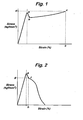
- the UTD (ultimate tensile, strength at destruction) and ETD (elongation at destruction) are represented as points (g) and (h) in Figure 2 , respectively.
- the copolyester was processed to give biaxially oriented film.
- Dried pellets of co-polymer were extruded through a slot die and rapidly quenched on a chilled casting drum so as to produce an amorphous extrudate.
- Orientation was then effected by stretching the amorphous extrudate in a 2-stage process, first in the longitudinal direction and then in the transverse direction. Stretching the film in the longitudinal direction was accomplished between slow and fast rotating rolls, the temperature of the slow rolls being approx 67°C, after which the film was irradiated with infrared radiation to above its glass transition temperature.
- the film was heated in the pre-heat zone of the stenter oven to about 85°C and then passed to the stretching zone of the stenter oven at a temperature of about 110°C for the transverse stretching step.
- the degree of stretch employed in the longitudinal direction was approximately 3.3 times and the degree of stretch in the transverse direction was approximately 3.6 times the original length.
- the biaxially-oriented film was heat-set under dimensional restraint by passing the stretched film through the crystallising section of the stenter oven which comprised a series of three inter-connecting ovens wherein the temperature of the film was raised to 205°C.
- the first two ovens were approx 3.05m in length and the third oven was approx 3.40m in length.
- the film was irradiated with infrared radiation.
- the width of the film web was approx 1110mm, and the line speed was approx 9.8m/min.
- the IR radiation section of the heat-setting ovens corresponds to the second heating zone described herein; the remaining portion of the heat-setting ovens corresponds to the first heating zone described herein.
- the film was cooled in air and then passed to the next stage in the process, which is to trim the film edges which had been held by stenter clips in the ovens.
- the temperature of the film immediately prior to contact with the edge trim knives was raised. This was effected by locating hot-air blowers immediately prior to the edge trim knives in order to locally heat the edges of the film to a temperature at which it is possible to cut the brittle film without fracture of the film web.
- the temperature of the film at this point was raised to approx 50 to 220°C, preferably 100 to 200°C.
- the final thickness of the film was approx 50 ⁇ m.
- the film was analysed using the test procedures described herein, with the results shown in the table below. For each test, a sample from the centre of the film was utilised.
- UTD (kg/mm 2 )
- ETD (%) Tear Initiation (kg)
- Shrinkage (%)* Haze MD TD MD TD MD TD MD TD 6.53 8.01 86.1 106.3 1.61 1.85 -0.28 2.32 16.4 * 190°C for 5 minutes
Landscapes
- Chemical & Material Sciences (AREA)
- Engineering & Computer Science (AREA)
- Manufacturing & Machinery (AREA)
- Health & Medical Sciences (AREA)
- Chemical Kinetics & Catalysis (AREA)
- Medicinal Chemistry (AREA)
- Polymers & Plastics (AREA)
- Organic Chemistry (AREA)
- Materials Engineering (AREA)
- Manufacture Of Macromolecular Shaped Articles (AREA)
- Shaping By String And By Release Of Stress In Plastics And The Like (AREA)
- Polyesters Or Polycarbonates (AREA)
Abstract
Claims (24)
- Procédé de préparation d'un film polymère comprenant un copolyester ayant un composant acide et un composant diol, ledit composant acide comprenant un acide dicarboxylique et un sulfomonomère contenant un groupe sulfonate fixé au noyau aromatique d'un acide dicarboxylique aromatique, ledit procédé comprenant les étapes consistant à :(i) extruder à l'état fondu une couche dudit copolyester ;(ii) étirer l'extrudat dans au moins une direction ;(iii) solidifier thermiquement le film en portant la température du film étiré à une température du film étiré T1 dans une première zone de chauffage de telle sorte que (TM - T1) soit située dans l'intervalle de 5 à 30 °C, puis en portant la température du film à une température T2 dans une deuxième zone de chauffage, de telle sorte que (TM - T2) soit située dans l'intervalle de 0 à 10 °C ;
TM étant la température de pic de fusion du film polymère ;
T2 étant supérieure à T1 ; et
les temps passés par une section transversale du film dans les première et deuxième zones de chauffage étant définis par t1 et t2, respectivement, de telle sorte que le rapport de t1 à t2 soit d'au moins 2 : 1. - Procédé selon la revendication 1, dans lequel le rapport de t1 à t2 est inférieur à 65 : 1.
- Procédé selon la revendication 1 ou 2, dans lequel le rapport de t1 à t2 est situé dans l'intervalle de 8 : 1 à 50 : 1.
- Procédé selon l'une quelconque des revendications à 3, dans lequel l'élévation de température dans la deuxième zone de chauffage est effectuée de manière linéaire ou sensiblement linéaire.
- Procédé selon la revendication 4, dans lequel l'élévation de température dans la première zone de chauffage est effectuée de manière sensiblement asymptotique.
- Procédé selon l'une quelconque des revendications 1 à 5, dans lequel la première zone de chauffage est chauffée par convection d'air et la deuxième zone de chauffage est chauffée par rayonnement infrarouge.
- Procédé selon l'une quelconque des revendications précédentes, comprenant en outre, après le mode opératoire de solidification thermique, l'étape consistant à porter le film à une température élevée dans l'intervalle de 50 à 200 °C, puis à éliminer les deux parties de bord du film, ladite température élevée étant une température à laquelle il est possible de couper le film cassant sans fracture de la nappe de film.
- Procédé selon la revendication 7, dans lequel ladite température élevée est située dans l'intervalle de 100 à 200 °C.
- Procédé selon l'une quelconque des revendications précédentes, dans lequel ledit diol est un diol aliphatique.
- Procédé selon l'une quelconque des revendications précédentes, dans lequel ledit diol est l'éthylèneglycol.
- Procédé selon l'une quelconque des revendications précédentes, dans lequel ledit acide dicarboxylique est un acide dicarboxylique aromatique.
- Procédé selon l'une quelconque des revendications précédentes, dans lequel ledit acide dicarboxylique est l'acide téréphtalique.
- Procédé selon l'une quelconque des revendications précédentes, dans lequel la quantité dudit sulfomonomère est de 2 à 10 % en mole sur la base du poids du copolyester.
- Procédé selon l'une quelconque des revendications précédentes, dans lequel la quantité dudit sulfomonomère est de 2 à 6 % en mole sur la base du poids du copolyester.
- Procédé selon l'une quelconque des revendications précédentes, dans lequel ledit groupe sulfonate est un sel d'acide sulfonique.
- Procédé selon l'une quelconque des revendications précédentes, dans lequel ledit groupe sulfonate est un sel d'acide sulfonique d'un métal du groupe I ou du groupe II.
- Procédé selon l'une quelconque des revendications précédentes, dans lequel l'acide dicarboxylique aromatique dudit sulfomonomère est l'acide isophtalique.
- Procédé selon l'une quelconque des revendications précédentes, dans lequel ledit sulfomonomère est l'acide sulfo-isophtalique de 5-sodium ou l'acide sulfo-isophtalique de 4-sodium.
- Procédé selon l'une quelconque des revendications précédentes, dans lequel ledit film a une résistance à la traction finale à la destruction (UTD), telle que mesurée de la manière exposée dans la norme ASTM D882-88 modifiée en mesurant la contrainte et la déformation au point auquel le film commence à se détruire, située dans l'intervalle de 2 kgf/mm2 à 15 kgf/mm2 dans la direction machine, et de 2,5 kgf/mm2 à 17 kgf/mm2 dans la direction transversale.
- Procédé selon l'une quelconque des revendications précédentes, dans lequel ledit film a une valeur d'initiation de déchirement, telle que mesurée conformément à la forme ASTM D1004-66, située dans l'intervalle de 1,0 kg à 3,0 kg dans la direction machine, et de 1,3 kg à 2,8 kg dans la direction transversale.
- Film polymère comprenant un copolyester ayant un composant acide et un composant diol, ledit composant acide comprenant un acide dicarboxylique et un sulfomonomère contenant un groupe sulfonate fixé au noyau aromatique d'un acide dicarboxylique aromatique, ledit film ayant une résistance à la traction finale à la destruction (UTD), telle que mesurée de la manière exposée dans la norme ASTM D882-88 modifiée en mesurant la contrainte et la déformation au point auquel le film commence à se détruire, située dans l'intervalle de 2 kgf/mm2 à 15 kgf/mm2 dans la direction machine, et de 2,5 kgf/mm2 à 17 kgf/mm2 dans la direction transversale, et ayant une valeur d'initiation de déchirement, telle que mesurée conformément à la norme ASTM D 1004-66, située dans l'intervalle de 1,0 kg à 3,0 kg dans la direction machine, et de 1,3 kg à 2,8 kg dans la direction transversale.
- Film polymère selon la revendication 21, dans lequel ledit copolyester est tel que défini dans l'une quelconque des revendications 9 à 18.
- Marqueur de sécurité comprenant un film polymère tel qu'exposé dans l'une quelconque des revendications 21 et 22, et comprenant en outre une couche adhésive.
- Utilisation d'un film polymère selon l'une quelconque des revendications 21 et 22 comme marqueur anti-contrefaçon ou de sécurité.
Applications Claiming Priority (3)
| Application Number | Priority Date | Filing Date | Title |
|---|---|---|---|
| GB0129728A GB0129728D0 (en) | 2001-12-12 | 2001-12-12 | Plymeric film |
| GB0129728 | 2001-12-12 | ||
| PCT/GB2002/005511 WO2003050168A1 (fr) | 2001-12-12 | 2002-12-06 | Film polymere cassant et sceau d'inviolabilite produit a partir de celui-ci |
Publications (2)
| Publication Number | Publication Date |
|---|---|
| EP1453894A1 EP1453894A1 (fr) | 2004-09-08 |
| EP1453894B1 true EP1453894B1 (fr) | 2008-11-12 |
Family
ID=9927484
Family Applications (1)
| Application Number | Title | Priority Date | Filing Date |
|---|---|---|---|
| EP20020783281 Expired - Lifetime EP1453894B1 (fr) | 2001-12-12 | 2002-12-06 | Film polymere cassant et sceau d'inviolabilite produit a partir de celui-ci |
Country Status (10)
| Country | Link |
|---|---|
| US (2) | US7718104B2 (fr) |
| EP (1) | EP1453894B1 (fr) |
| JP (1) | JP4108606B2 (fr) |
| KR (1) | KR100999277B1 (fr) |
| CN (1) | CN1279091C (fr) |
| AU (1) | AU2002347345A1 (fr) |
| DE (1) | DE60229874D1 (fr) |
| GB (1) | GB0129728D0 (fr) |
| TW (1) | TWI274766B (fr) |
| WO (1) | WO2003050168A1 (fr) |
Families Citing this family (15)
| Publication number | Priority date | Publication date | Assignee | Title |
|---|---|---|---|---|
| GB0129728D0 (en) | 2001-12-12 | 2002-01-30 | Dupont Teijin Films Us Ltd | Plymeric film |
| US20040260034A1 (en) | 2003-06-19 | 2004-12-23 | Haile William Alston | Water-dispersible fibers and fibrous articles |
| US7892993B2 (en) * | 2003-06-19 | 2011-02-22 | Eastman Chemical Company | Water-dispersible and multicomponent fibers from sulfopolyesters |
| US8513147B2 (en) * | 2003-06-19 | 2013-08-20 | Eastman Chemical Company | Nonwovens produced from multicomponent fibers |
| US20080064621A1 (en) * | 2006-09-07 | 2008-03-13 | Daniel Alan Jervis | Optically brightened aqueous compositions |
| US8512519B2 (en) * | 2009-04-24 | 2013-08-20 | Eastman Chemical Company | Sulfopolyesters for paper strength and process |
| US20120183861A1 (en) | 2010-10-21 | 2012-07-19 | Eastman Chemical Company | Sulfopolyester binders |
| US8906200B2 (en) | 2012-01-31 | 2014-12-09 | Eastman Chemical Company | Processes to produce short cut microfibers |
| US9303357B2 (en) | 2013-04-19 | 2016-04-05 | Eastman Chemical Company | Paper and nonwoven articles comprising synthetic microfiber binders |
| US9598802B2 (en) | 2013-12-17 | 2017-03-21 | Eastman Chemical Company | Ultrafiltration process for producing a sulfopolyester concentrate |
| US9605126B2 (en) | 2013-12-17 | 2017-03-28 | Eastman Chemical Company | Ultrafiltration process for the recovery of concentrated sulfopolyester dispersion |
| US10040617B2 (en) | 2016-04-28 | 2018-08-07 | Fres-Co System Usa, Inc. | Flexible package with tamper-evident anti-counterfeiting label and method of making the same |
| WO2018124830A1 (fr) * | 2016-12-30 | 2018-07-05 | 코오롱인더스트리 주식회사 | Film à base de polyester thermorétractable, procédé de fabrication associé et étiquette le comprenant |
| PL3450163T3 (pl) * | 2017-08-30 | 2020-03-31 | Evonik Röhm Gmbh | Łamliwe folie akrylowe i zawierające je etykiety zabezpieczające przed fałszerstwem |
| DE102017216789A1 (de) | 2017-09-22 | 2019-03-28 | Tesa Se | Laserbeschriftbare Folie |
Family Cites Families (56)
| Publication number | Priority date | Publication date | Assignee | Title |
|---|---|---|---|---|
| IT577841A (fr) | 1956-09-12 | |||
| US2968067A (en) * | 1959-02-02 | 1961-01-17 | Du Pont | Process for making oriented films |
| GB1162677A (en) * | 1965-11-26 | 1969-08-27 | Agfa Gevaert Nv | Process for making Isotropic Polymeric Film |
| US3563942A (en) | 1967-11-29 | 1971-02-16 | Du Pont | Aqueous dispersion of copolyesters modified with a sulfonated aromatic compound |
| JPS587447A (ja) | 1981-07-06 | 1983-01-17 | Mitsubishi Rayon Co Ltd | 金属メツキ用ポリエステル樹脂組成物 |
| US4539256A (en) * | 1982-09-09 | 1985-09-03 | Minnesota Mining And Manufacturing Co. | Microporous sheet material, method of making and articles made therewith |
| US4525419A (en) * | 1983-05-16 | 1985-06-25 | American Hoechst Corporation | Copolyester primed plastic film |
| US4585687A (en) * | 1983-05-16 | 1986-04-29 | American Hoechst Corporation | Copolyester primed polyester film |
| US4476189A (en) | 1983-05-16 | 1984-10-09 | American Hoechst Corporation | Copolyester primed polyester film |
| US4605591A (en) * | 1983-10-27 | 1986-08-12 | Toyo Boseki Kabushiki Kaisha | Thermoplastic resin film laminate and production thereof |
| US4493872A (en) * | 1983-12-05 | 1985-01-15 | American Hoechst Corporation | Polyester film coated with metal adhesion promoting copolyester |
| JPS6151323A (ja) * | 1984-08-22 | 1986-03-13 | Toray Ind Inc | 液晶表示用一軸伸ポリエステルフイルムの製造方法 |
| GB8429772D0 (en) | 1984-11-26 | 1985-01-03 | Ici Plc | Polymeric films |
| GB2173150B (en) | 1985-03-28 | 1989-06-21 | Daimatsu Kagaku Kogyo Kk | An easily breakable sticking material |
| US4746566A (en) * | 1987-05-06 | 1988-05-24 | E. I. Dupont De Nemours And Company | Optically anisotropic melt forming aromatic copolyesters based on t-butyl-4-hydroxybenzoic acid |
| JPS63286346A (ja) | 1987-05-19 | 1988-11-24 | Toyobo Co Ltd | 易接着性フイルム |
| JPS63290730A (ja) | 1987-05-23 | 1988-11-28 | Toyobo Co Ltd | 蒸着フイルム |
| JPH01229042A (ja) | 1988-03-08 | 1989-09-12 | Toray Ind Inc | 易切断性ポリエステルフィルム |
| GB8912896D0 (en) | 1988-06-22 | 1989-07-26 | Ici Plc | Polymeric films |
| JPH0242475A (ja) | 1988-08-02 | 1990-02-13 | Toray Ind Inc | ラベル |
| JPH07119279B2 (ja) * | 1988-12-28 | 1995-12-20 | 鐘紡株式会社 | ポリエステル共重合体及び該ポリエステル共重合体を下引層として有するポリエステルフィルム |
| GB8916030D0 (en) | 1989-07-13 | 1989-08-31 | Ici Plc | Imagable copy film |
| KR960013068B1 (ko) * | 1989-10-16 | 1996-09-30 | 도오요오 보오세끼 가부시끼가이샤 | 열가소성 수지필름 및 그의 제조방법 |
| GB8925095D0 (en) | 1989-11-07 | 1989-12-28 | Ici Plc | Polymeric film |
| US5097004A (en) * | 1990-05-11 | 1992-03-17 | E. I. Du Pont De Nemours And Company | Novel polyesters and their use in compostable products such as disposable diapers |
| US5053482A (en) * | 1990-05-11 | 1991-10-01 | E. I. Du Pont De Nemours And Company | Novel polyesters and their use in compostable products such as disposable diapers |
| US5097005A (en) * | 1990-05-11 | 1992-03-17 | E. I. Du Pont De Nemours And Company | Novel copolyesters and their use in compostable products such as disposable diapers |
| US5171308A (en) * | 1990-05-11 | 1992-12-15 | E. I. Du Pont De Nemours And Company | Polyesters and their use in compostable products such as disposable diapers |
| US5042842A (en) * | 1990-06-26 | 1991-08-27 | Avery International Corporation | High security label |
| JP3082246B2 (ja) | 1990-12-21 | 2000-08-28 | 東レ株式会社 | 写真感光材料用ポリエステルフィルム及び写真感光材料 |
| JP2982311B2 (ja) | 1991-01-09 | 1999-11-22 | 東レ株式会社 | 帯電防止性ポリエステルフイルム |
| US5300572A (en) * | 1991-06-14 | 1994-04-05 | Polyplastics Co., Ltd. | Moldable polyester resin compositions and molded articles formed of the same |
| US5380587A (en) | 1992-10-20 | 1995-01-10 | Mobil Oil Corporation | Multilayer film structure |
| DE69323877T2 (de) | 1992-11-06 | 1999-07-29 | Daicel Chemical Industries, Ltd., Sakai, Osaka | Leicht reissbare folie und deren herstellungsverfahren |
| JPH06145376A (ja) | 1992-11-09 | 1994-05-24 | Toray Ind Inc | ポリエステルフィルムおよび写真感光材料 |
| JP3401687B2 (ja) | 1993-07-21 | 2003-04-28 | コニカ株式会社 | 写真用支持体 |
| JP3727033B2 (ja) | 1994-06-20 | 2005-12-14 | 三菱化学ポリエステルフィルム株式会社 | 昇華型感熱転写用ポリエステルフィルム |
| DE4440858A1 (de) * | 1994-11-15 | 1996-05-23 | Basf Ag | Biologisch abbaubare Polymere, Verfahren zu deren Herstellung sowie deren Verwendung zur Herstellung bioabbaubarer Formkörper |
| JPH11502476A (ja) | 1995-02-28 | 1999-03-02 | ミネソタ・マイニング・アンド・マニュファクチャリング・カンパニー | インク受容吸収性コーティング |
| US5660925A (en) * | 1995-12-07 | 1997-08-26 | Minnesota Mining And Manufacturing Company | Tamper-indicating and authenticating label |
| JP3671082B2 (ja) * | 1995-12-28 | 2005-07-13 | 出光興産株式会社 | 熱可塑性樹脂フィルムの熱処理方法 |
| GB9607401D0 (en) | 1996-04-10 | 1996-06-12 | Ici Plc | Multilayer card |
| US5876816A (en) * | 1996-07-10 | 1999-03-02 | Avery Dennison Corporation | Tamper evident labels and methods of producing the same |
| EP0874015B1 (fr) | 1997-04-25 | 2004-02-25 | Teijin Limited | Procédé de production d'un polyester aromatique |
| US6436531B1 (en) * | 1998-07-20 | 2002-08-20 | 3M Innovative Properties Company | Polymer blends and tapes therefrom |
| DE19849661A1 (de) | 1998-10-29 | 2000-05-04 | Mitsubishi Polyester Film Gmbh | Koextrudierte, biaxial orientierte Polyesterfolie für die Metallisierung, Verfahren zu ihrer Herstellung und ihre Verwendung |
| JP4020283B2 (ja) * | 1999-03-19 | 2007-12-12 | 富士フイルム株式会社 | 二軸延伸ポリエステルフィルムの製造方法 |
| DE10002178A1 (de) * | 2000-01-20 | 2001-07-26 | Mitsubishi Polyester Film Gmbh | Matte, UV-stabile, koextrudierte Polyesterfolie, Verfahren zu ihrer Herstellung und ihre Verwendung |
| DE10022437A1 (de) * | 2000-05-09 | 2001-11-15 | Basf Ag | Biologisch abbaubare Sicherheitsfolien |
| US6824849B2 (en) * | 2000-08-07 | 2004-11-30 | 3M Innovative Properties Company | Laser-cuttable multi-layer sheet material |
| JP4965054B2 (ja) * | 2000-09-07 | 2012-07-04 | ミツビシ ポリエステル フィルム インク | ヒートシール塗膜および塗布フィルム |
| JP2002171846A (ja) * | 2000-09-29 | 2002-06-18 | Sekisui Chem Co Ltd | 生分解性農業用フィルム |
| US6368710B1 (en) * | 2000-12-19 | 2002-04-09 | E. I. Du Pont De Nemours And Company | Sulfonated aliphatic-aromatic copolyesters |
| GB0129728D0 (en) | 2001-12-12 | 2002-01-30 | Dupont Teijin Films Us Ltd | Plymeric film |
| JP4248843B2 (ja) | 2002-10-18 | 2009-04-02 | オリンパス株式会社 | 超音波画像処理装置 |
| JP4220329B2 (ja) | 2003-04-11 | 2009-02-04 | 旭化成ケミカルズ株式会社 | ポリオレフィン微多孔膜及びその製造方法 |
-
2001
- 2001-12-12 GB GB0129728A patent/GB0129728D0/en not_active Ceased
-
2002
- 2002-12-06 AU AU2002347345A patent/AU2002347345A1/en not_active Abandoned
- 2002-12-06 WO PCT/GB2002/005511 patent/WO2003050168A1/fr not_active Ceased
- 2002-12-06 JP JP2003551190A patent/JP4108606B2/ja not_active Expired - Lifetime
- 2002-12-06 EP EP20020783281 patent/EP1453894B1/fr not_active Expired - Lifetime
- 2002-12-06 CN CNB028247787A patent/CN1279091C/zh not_active Expired - Fee Related
- 2002-12-06 KR KR1020047009023A patent/KR100999277B1/ko not_active Expired - Fee Related
- 2002-12-06 US US10/496,733 patent/US7718104B2/en not_active Expired - Fee Related
- 2002-12-06 DE DE60229874T patent/DE60229874D1/de not_active Expired - Lifetime
- 2002-12-12 TW TW91135963A patent/TWI274766B/zh not_active IP Right Cessation
-
2010
- 2010-02-23 US US12/710,858 patent/US8530045B2/en not_active Expired - Fee Related
Also Published As
| Publication number | Publication date |
|---|---|
| AU2002347345A1 (en) | 2003-06-23 |
| CN1602331A (zh) | 2005-03-30 |
| KR20040066160A (ko) | 2004-07-23 |
| JP2005511839A (ja) | 2005-04-28 |
| TW200307001A (en) | 2003-12-01 |
| US20050258563A1 (en) | 2005-11-24 |
| CN1279091C (zh) | 2006-10-11 |
| US8530045B2 (en) | 2013-09-10 |
| US7718104B2 (en) | 2010-05-18 |
| US20100212804A1 (en) | 2010-08-26 |
| WO2003050168A1 (fr) | 2003-06-19 |
| DE60229874D1 (de) | 2008-12-24 |
| KR100999277B1 (ko) | 2010-12-07 |
| JP4108606B2 (ja) | 2008-06-25 |
| EP1453894A1 (fr) | 2004-09-08 |
| GB0129728D0 (en) | 2002-01-30 |
| TWI274766B (en) | 2007-03-01 |
Similar Documents
| Publication | Publication Date | Title |
|---|---|---|
| US8530045B2 (en) | Brittle polymeric film and tamper evident labels made therefrom | |
| EP3634746B1 (fr) | Ensemble film multicouche approprié pour une utilisation dans une carte multicouche | |
| US7211306B2 (en) | Peelable polyester film with self-venting, process for its production and its use | |
| US7189451B2 (en) | Multilayer, matt, thermoformable, IR-reflective polyester film | |
| US7833617B2 (en) | Multilayer, white, laser-cuttable polyester film | |
| EP1518909B1 (fr) | Film de polyester | |
| US6872446B2 (en) | White, biaxially oriented film made from a crystallizable thermoplastic with high whiteness and with additional functionality | |
| JP2001288350A (ja) | 高白色度二軸延伸ポリエステルフィルム | |
| KR20010091911A (ko) | 시클로올레핀 공중합체를 함유하는 이축배향 폴리에스테르필름, 그 용도 및 그 제조방법 | |
| KR20010085666A (ko) | 사이클로올레핀 공중합체를 함유하는 백색의 이축 배향된난연성 폴리에스테르 필름, 이의 용도 및 이의 제조방법 | |
| KR20000005330A (ko) | 다층 카드 | |
| JP2003532562A (ja) | 二軸延伸白色フィルムおよびその製造方法ならびにその使用 | |
| JP2003528747A (ja) | シール性および難燃性を有する透明ポリエステルフィルム及びその使用ならびにその製造方法 | |
| JP4386386B2 (ja) | 易引裂性積層ポリエステルフィルム | |
| JP4923385B2 (ja) | ポリエステルフィルム | |
| JP2007169546A (ja) | 熱収縮性ポリエステル系フィルム及び熱収縮性ラベル | |
| JP2792123B2 (ja) | 白色ポリエステルフィルム | |
| KR19990031350A (ko) | 열접착성 폴리에스테르 필름 및 그 제조방법 | |
| JPH03132331A (ja) | 白色ポリエステルフィルム及びその製造方法 | |
| JP2003082128A (ja) | 熱収縮性ポリエステル系フィルム | |
| KR100244027B1 (ko) | 열접착성 폴리에스테르 필름 및 그 제조방법 | |
| KR0173021B1 (ko) | 백색 고분자 필름 및 그 제조방법 | |
| GB2610625A (en) | Multi-layer card and film assembly | |
| JP2001247702A (ja) | 空洞含有ポリエステル系フィルム | |
| JP2000154259A (ja) | 樹脂成形体、延伸成形物、フィルム |
Legal Events
| Date | Code | Title | Description |
|---|---|---|---|
| PUAI | Public reference made under article 153(3) epc to a published international application that has entered the european phase |
Free format text: ORIGINAL CODE: 0009012 |
|
| 17P | Request for examination filed |
Effective date: 20040427 |
|
| AK | Designated contracting states |
Kind code of ref document: A1 Designated state(s): AT BE BG CH CY CZ DE DK EE ES FI FR GB GR IE IT LI LU MC NL PT SE SI SK TR |
|
| AX | Request for extension of the european patent |
Extension state: AL LT LV MK RO |
|
| 17Q | First examination report despatched |
Effective date: 20060519 |
|
| RTI1 | Title (correction) |
Free format text: BRITTLE POLYMERIC FILM AND TAMPER-EVIDENT LABELS MADE THEREFROM |
|
| GRAP | Despatch of communication of intention to grant a patent |
Free format text: ORIGINAL CODE: EPIDOSNIGR1 |
|
| GRAS | Grant fee paid |
Free format text: ORIGINAL CODE: EPIDOSNIGR3 |
|
| GRAA | (expected) grant |
Free format text: ORIGINAL CODE: 0009210 |
|
| AK | Designated contracting states |
Kind code of ref document: B1 Designated state(s): DE FR GB IT |
|
| REG | Reference to a national code |
Ref country code: GB Ref legal event code: FG4D |
|
| REF | Corresponds to: |
Ref document number: 60229874 Country of ref document: DE Date of ref document: 20081224 Kind code of ref document: P |
|
| PLBE | No opposition filed within time limit |
Free format text: ORIGINAL CODE: 0009261 |
|
| STAA | Information on the status of an ep patent application or granted ep patent |
Free format text: STATUS: NO OPPOSITION FILED WITHIN TIME LIMIT |
|
| 26N | No opposition filed |
Effective date: 20090813 |
|
| REG | Reference to a national code |
Ref country code: FR Ref legal event code: PLFP Year of fee payment: 14 |
|
| REG | Reference to a national code |
Ref country code: FR Ref legal event code: PLFP Year of fee payment: 15 |
|
| REG | Reference to a national code |
Ref country code: FR Ref legal event code: PLFP Year of fee payment: 16 |
|
| PGFP | Annual fee paid to national office [announced via postgrant information from national office to epo] |
Ref country code: DE Payment date: 20181120 Year of fee payment: 17 |
|
| PGFP | Annual fee paid to national office [announced via postgrant information from national office to epo] |
Ref country code: GB Payment date: 20181205 Year of fee payment: 17 Ref country code: FR Payment date: 20181120 Year of fee payment: 17 |
|
| PGFP | Annual fee paid to national office [announced via postgrant information from national office to epo] |
Ref country code: IT Payment date: 20181220 Year of fee payment: 17 |
|
| REG | Reference to a national code |
Ref country code: DE Ref legal event code: R119 Ref document number: 60229874 Country of ref document: DE |
|
| GBPC | Gb: european patent ceased through non-payment of renewal fee |
Effective date: 20191206 |
|
| PG25 | Lapsed in a contracting state [announced via postgrant information from national office to epo] |
Ref country code: GB Free format text: LAPSE BECAUSE OF NON-PAYMENT OF DUE FEES Effective date: 20191206 Ref country code: DE Free format text: LAPSE BECAUSE OF NON-PAYMENT OF DUE FEES Effective date: 20200701 Ref country code: IT Free format text: LAPSE BECAUSE OF NON-PAYMENT OF DUE FEES Effective date: 20191206 Ref country code: FR Free format text: LAPSE BECAUSE OF NON-PAYMENT OF DUE FEES Effective date: 20191231 |