EP1456837B1 - Procede et dispositif de reconnaissance vocale - Google Patents
Procede et dispositif de reconnaissance vocale Download PDFInfo
- Publication number
- EP1456837B1 EP1456837B1 EP01988071A EP01988071A EP1456837B1 EP 1456837 B1 EP1456837 B1 EP 1456837B1 EP 01988071 A EP01988071 A EP 01988071A EP 01988071 A EP01988071 A EP 01988071A EP 1456837 B1 EP1456837 B1 EP 1456837B1
- Authority
- EP
- European Patent Office
- Prior art keywords
- word
- pause
- time interval
- limit value
- parameters
- Prior art date
- Legal status (The legal status is an assumption and is not a legal conclusion. Google has not performed a legal analysis and makes no representation as to the accuracy of the status listed.)
- Expired - Lifetime
Links
- 238000000034 method Methods 0.000 title claims description 45
- 230000007704 transition Effects 0.000 claims description 9
- 238000007781 pre-processing Methods 0.000 claims description 6
- 230000006978 adaptation Effects 0.000 description 5
- 238000001514 detection method Methods 0.000 description 4
- 239000000945 filler Substances 0.000 description 4
- 238000012935 Averaging Methods 0.000 description 3
- 230000006399 behavior Effects 0.000 description 3
- 230000011218 segmentation Effects 0.000 description 3
- 230000003595 spectral effect Effects 0.000 description 3
- 230000001419 dependent effect Effects 0.000 description 2
- 238000001914 filtration Methods 0.000 description 2
- 230000006870 function Effects 0.000 description 2
- 230000002123 temporal effect Effects 0.000 description 2
- 239000013598 vector Substances 0.000 description 2
- 230000000007 visual effect Effects 0.000 description 2
- 230000003247 decreasing effect Effects 0.000 description 1
- 238000011161 development Methods 0.000 description 1
- 230000018109 developmental process Effects 0.000 description 1
- 238000010586 diagram Methods 0.000 description 1
- 230000007613 environmental effect Effects 0.000 description 1
- 238000007562 laser obscuration time method Methods 0.000 description 1
Images

Classifications
-
- G—PHYSICS
- G10—MUSICAL INSTRUMENTS; ACOUSTICS
- G10L—SPEECH ANALYSIS TECHNIQUES OR SPEECH SYNTHESIS; SPEECH RECOGNITION; SPEECH OR VOICE PROCESSING TECHNIQUES; SPEECH OR AUDIO CODING OR DECODING
- G10L25/00—Speech or voice analysis techniques not restricted to a single one of groups G10L15/00 - G10L21/00
- G10L25/78—Detection of presence or absence of voice signals
- G10L25/87—Detection of discrete points within a voice signal
-
- G—PHYSICS
- G10—MUSICAL INSTRUMENTS; ACOUSTICS
- G10L—SPEECH ANALYSIS TECHNIQUES OR SPEECH SYNTHESIS; SPEECH RECOGNITION; SPEECH OR VOICE PROCESSING TECHNIQUES; SPEECH OR AUDIO CODING OR DECODING
- G10L15/00—Speech recognition
- G10L15/22—Procedures used during a speech recognition process, e.g. man-machine dialogue
Definitions
- the invention relates to a method and a device for speech recognition.
- the invention relates to a method according to the preamble of claim 1, as well as a device according to the preamble of claim 10.
- Speech recognition methods are well known. Thus, in addition to single-word recognition methods, there are also methods for recognizing word groups.
- a phrase consists of a series of consecutive single words. The single words are found in areas of speech in a speech signal. These areas are separated by pauses, that is, time intervals without speech, which are also referred to as areas of non-speech. Such pauses can be time intervals of very small, almost inaudible duration or even longer time intervals.
- each of the words such as numerals, letters, or so-called keywords, is assigned a reference by comparing each of the words with those references stored in advance. To control the detection can then be made according to the assignment of an audible or visual display.
- First methods for speech recognition in mobile phones were based on single word recognition.
- a user types a word such as ⁇ Stefan> or ⁇ choose> spoken.
- This spoken word is then assigned a stored reference in a pattern comparator and according to this assignment takes place for checking an audible or visual display. If the speech recognition is successful, that is to say the user confirms the reproduced reference as the reference corresponding to the spoken word, then the mobile number activates the call number assigned to the word or rather the reference ⁇ Stefan> or the function assigned to the word ⁇ select> is executed.
- EP 0389514 discloses a method for recognizing word groups. From a user of a mobile phone, from a sequence of numbers, such as ⁇ one-two-three-four-five-six-seven>, the phrases ⁇ one-two-three> and ⁇ four> and ⁇ five-six> and ⁇ seven> with a variable number of words formed by the user inserting breaks between the phrases ⁇ ..> with a predetermined pause length. At each pause, the length of which exceeds this fixed pause length, a pause signal is generated. As a result of this pause signal, the references associated with the spoken words are then audibly or visually displayed to the user.
- a sequence of numbers such as ⁇ one-two-three-four-five-six-seven>
- the individual fluency of a rather inexperienced user will be different from that of an experienced, skilled user.
- the inexperienced user groups a telephone number into phrases of two digits each, with longer pauses between the phrases.
- the experienced user will enter the individual digits of the telephone number rather faster, with many digits in just a few phrases and with shorter pauses between them in the mobile phone.
- a skilled user for example, use a mobile phone with the method known from EP 0389514 and the predetermined pause length for triggering the pause signal is set relatively high, he may have to wait too long until the display or playback of the recognized words he follows.
- the inexperienced user will insert the relatively long pauses between the phrases, possibly triggering a pause signal and thus triggering a rendition, although he did not intend to do so at that time. That means both the Inexperienced as well as the experienced user must adapt with their fluency to the boundary conditions of speech recognition, such as the pre-defined pause length. Thus, both user groups are restricted in their individual flow of speech.
- the present invention is therefore based on the object of specifying both a method and a device which make it possible to adapt the time of reproduction of the recognized words to the individual speech flow of the respective user.
- the invention is therefore based on the idea that in a method or device for recognizing words and pauses from a speech signal, the limit value at which a pause exceeds a certain length is changed depending on parameters determined from the speech signal. This means that, depending on these parameters, and thus on the user's flow of speech, the limit is increased or decreased, and thus the time of the result from the pattern comparator is given either after a longer or a rather shorter pause length.
- the advantage of the invention consists in the fact that a user of the method and the device according to the invention by the playback or Display of the recognition result is not inhibited in its individual flow of speech. Rather, the playback is adapted to the behavior of the user, that is, his fluency. Thereby a user is disturbed less or not at all in his individual flow of speech, since the result of the speech recognition is reproduced or displayed at a time which is determined by the speech flow of the user.
- the method according to the invention is carried out in a series of successive word groups for each of the word groups.
- the user will speak one telephone number in several groups of words one after the other, so that it is advantageous to adapt the limit and thus the time of the playback for the subsequent groups of words to the knowledge about the user's flow of speech at least from the last spoken group of words.
- the acoustic playback in the pause after the last spoken phrase, ie before the user speaks the next phrase done.
- the experienced user who makes shorter breaks does not have to wait long for playback.
- the inexperienced user who makes longer breaks within a group of words, will not get unintentional playback. This could happen if the duration of these longer pauses within the phrase exceeds the limit.
- the inventive device can be used in portable devices such as mobile phones.
- the user is offered the possibility that the mobile phone his fluency customized.
- the mobile phone his fluency customized.
- he can divide a telephone number into phrases depending on his environment, as he would usually also speak this telephone number.
- the use of the device according to the invention in a central voice recognition device for voice dialing within a telecommunications network allows the user to optimize the connection costs incurred by him. Again, the time of playback of the recognition result can be adapted to the flow of speech of a user. For example, the skilled user who speaks quickly will receive an audible reproduction of the recognition result by adapting the display of the recognition result to his fluency in a shorter time. This makes the full voice dialing process faster, reducing the cost of the telephone connection to the user.
- FIG. 1 shows essential components of a voice recognition device in a mobile telephone.
- the words and pauses detection device 100 is connected to an input unit 200 including a microphone 210 for inputting a speech signal and an analog-to-digital converter 220.
- the apparatus 100 has as a central unit a pattern comparator 120 which operates according to a known speech recognition method.
- Device 100 includes preprocessing means 110 which convert the speech signal from input unit 200 into a parametric description
- a controller 140 is connected to pattern comparator 120, vocabulary memory 130 and preprocessing means 110.
- Device 100 is further provided with an output unit 300, to either acoustically or visually display the result of the pattern comparator 120 to the user of the mobile phone
- the preprocessing means 110, pattern recognizer 120, vocabulary memory 130, and controller 140, which correspond to the essential functions within the apparatus 100 and illustrated in FIG usually in the form of algorithms can be summarized in any form For example, it is conceivable that 110, 120, 130, 140 are combined in a single processor or that only 120, 130, 140 are combined in one processor.
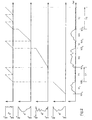
- a search field of a pattern comparator 120 is shown in FIG.
- the references R j shown on the vertical axis, which are referred to below as word references R 1 , R 2 , R 3 , and pause references R p , are typically language models trained in advance and then stored in the storage unit 120.
- the word reference R 1 may correspond to the previously trained digit or rather the word ⁇ one>, the word reference R 2 to the word ⁇ two>, and the word reference R 3 to the word ⁇ fifty-two>.
- the pause reference Rp represents a pre-trained model for non-speech, such as a pause of a certain length and under normal environmental conditions.
- the word references R 1 , R 2 , R 3 may be speaker dependent or speaker independent and are generated according to well-known methods.
- the stored word references R 1 , R 2 , R 3 with word beginning RA 1 , RA 2 , RA 3 and word end RE 1 , RE 2 , RE 3 , in the case of speaker-independent recognition, approximately the speech behavior of an average speaker again. This is essentially determined by speech rate or articulation. From the speech signal input via the input unit 200, parameters are determined.
- means for preprocessing 110 which convert the digitized by the A / D converter 220 speech signal into so-called feature vectors.
- By continuous comparison of these feature vectors with the stored word references R 1 , R 2 , R 3 , and the pause reference R p in the pattern comparator 120 is a temporal segmentation of the speech signal into areas of speech and areas of non-speech which are characterized by the parameters.
- the parameters denote, for example, the transitions between areas with speech and areas with non-speech.
- These areas of speech and non-speech, the speech signal illustrated in FIG. 2 on the horizontal axis can be distinguished, for example, by the energy, the amplitude or the spectral properties of the speech signal in these areas.
- This assumption will always apply when the method is used, for example, in environments such as offices.
- the distinction between the different regions of the speech signal by means of their spectral properties is preferred when the method is used, for example, in the car. Because here, as a rule, even in the case of non-speech, the energy due to the background noise is so high that no distinction can be made into areas with speech and non-speech by means of the energy of the speech signal.
- a range of speech corresponding to the spoken word W 1 ⁇ one> is assigned the stored word reference R 1 ⁇ one>, and another range of speech corresponding to the spoken word ⁇ fifty-two> corresponds to the reference ⁇ fifty-two>.
- the stored word references R 1 , R 2 , R 3 represent the speech behavior of an average user, by comparing the time interval (WE 1 - WA 1 ) of a spoken word W 1 with the time interval (RE 1 - RA 1 ) of the associated Word reference R 1 , the user is characterized as an experienced or rather inexperienced speaker.
- the method according to the invention can be particularly easily implemented in already known methods Implement devices. This is particularly easy, without significant effort, an adjustment of the time of playback reaches the flow of speech of the user.
- the result of the pattern comparator 120 is forwarded to the control device 140, which then depends on the above-described ratio of time interval of spoken word and the time interval of the associated stored reference the threshold value TG, and thus the time of playback changed.
- the limit value TG is increased if, at least for a word W 1 , W 2 , W 3 from the word group, the time interval between its word start and word end is greater than the time interval between word start and word end of the reference R j associated with the word is. Accordingly, the limit value is lowered if at least for a word W 1 , W 2 , W 3 from the word group, the time interval between word start and word end is less than the time interval between word start and word end of the associated reference R j .
- the areas with speech from the speech signal words W i was assigned. Accordingly, the non-speech areas can be determined from the pauses T i between words W i .
- the energy of the speech signal will be very small under normal conditions, such as those in offices. This energy will be essentially determined by background noise. As already described, this results in a temporal segmentation of the speech signal into areas with speech and those with non-speech.
- the word beginnings WA i and word ends WE i are then, as already described, associated with the words W i corresponding references R j and thus, for example, a time interval T 2 of non-language determined from the speech signal, which is determined by the word end WE 2 of the last word W 2 and the word start WA 3 of the next word W 3 .
- the limit value TG is increased if the time interval between the word end of a word and the word beginning of the subsequent word is greater than a pause time interval TP, at least for a break T i from the word group.
- the limit value TG is lowered if the time interval between the word end of a word and the word beginning of the subsequent word is smaller than a pause time interval TP, at least for a break T i from the word group. It should be noted that the last pause, in FIG. 2 that the pause T 3 , is not used for the method according to the invention, since as a rule TG can always be greater or at most equal to TP. This would always determine a break greater than TP within a word group, and the limit value TG should be increased accordingly.
- pause references Rp with the word beginning RA p and the word end RE p , which is a pause with a length and under normal ambient noise.
- This pause reference Rp can also be stored in the memory unit 130.
- so-called pause fillers not shown, such as ⁇ erhh> or ⁇ mmmmh> are known, which can also be stored as references R j in the vocabulary memory 130. These can then also be used to detect non-language areas.
- the areas with non-speech T 1 , T 2 , T 3 of the speech signal are assigned such stored pause references Rp or pause filler references.
- the length or duration of the individual pauses T 1 , T 2 , T 3 will then be determined by determining the number of assignments to the above-described references for pause R p or pause filler over the duration of the pause T i .
- the time interval of each of the pauses T 1 , T 2 , T 3 can then be determined very simply by the respective number of assigned pause references Rp and / or pause filler references.
- the embodiment of the method according to the invention described here can be implemented particularly easily in existing speech recognition devices, since the basic method of assigning pause references R p to pause intervals is already used in already known speech recognizers in order to determine the point in time when a pause exceeds the threshold value TG.
- the user can be very easily characterized as a practiced or rather inexperienced speaker, with which then an adaptation of the threshold value TG is possible and thus an adaptation to the flow of speech of the user takes place.
- a detector VAD in the connection between A / D converter 220 and the preprocessing means 110, a detector VAD, shown in phantom in Fig. 1, for detecting the parameters of the speech signal, such as the transitions between areas of speech and non-speech intended.
- the detector VAD is connected to the control device 140.
- the detector VAD detects, by the continuous Determining the signal energy of the speech signal directly from the speech signal the parameters, ie the times of transitions between speech and non-speech.
- the detector VAD is realized in the form of already known algorithms and can form a unit with the device 100.
- a pre-segmentation of the speech signal into areas with speech and non-speech is achieved. These pre-segmented areas of the non-speech are then compared, for example in the control device 140 with a fixed pause time interval TP and according to the ratio between pause time interval TP and the duration of the break, the threshold value TG is adapted for playback according to the method already described. As a result, the adaptation of the limit value TG can be realized without the following pattern recognizer.
- the device 100 is preferably provided in a central unit of the telecommunications network, and Input unit 200 and the output unit 300 represent the network connection between this central unit and a terminal of a user.
Landscapes
- Engineering & Computer Science (AREA)
- Computational Linguistics (AREA)
- Health & Medical Sciences (AREA)
- Audiology, Speech & Language Pathology (AREA)
- Human Computer Interaction (AREA)
- Physics & Mathematics (AREA)
- Acoustics & Sound (AREA)
- Multimedia (AREA)
- Signal Processing (AREA)
- Telephonic Communication Services (AREA)
- Telephone Function (AREA)
Claims (17)
- Procédé de reconnaissance de mots et de pauses dans un signal vocal, dans lequel- les mots (Wi) et pauses (Ti) énoncés en une séquence sont assemblés comme appartenant à un groupe de mots, dès que une des pauses (Ti) dépasse une valeur limite (TG),- des références (Rj) mémorisées sont affectées au signal vocal du groupe de mots, et- lorsque la valeur limite (TG) est dépassée, un affichage du résultat de l'affectation a lieucaractérisé en ce que- des paramètres sont déterminés à partir du signal vocal, lesquels correspondent à des moments de transition entre des portions comportant du discours et des portions ne comportant pas de discours et- la valeur limite (TG) est modifiée en fonction de ces paramètres.
- Procédé selon la revendication 1,
caractérisé en ce que- les moments de transition sont le début de mot (WAi) et la fin de mot (WEi) des mots (Wi) du groupe de mots. - Procédé selon les revendications 1 et 2,
caractérisé en ce que- les paramètres des références (Rj) sont le début de mot (RAj) et la fin de mot (REj) des références mémorisées (Rj). - Procédé selon la revendication 3,
caractérisé en ce que- la valeur limite (TG) augmente lorsque, pour au moins un mot (Wi) du groupe de mots, l'intervalle de temps entre le début de mot (WAi) et la fin de mot (WEi) est plus grand que l'intervalle de temps entre le début de mot (RAj) et la fin de mot (REj) de la référence (Rj) affectée, et- la valeur limite (TG) diminue, lorsque, pour au moins un mot (Wi) du groupe de mots, l'intervalle de temps entre le début de mot (WAi) et la fin de mot (WEi) est plus petit que l'intervalle de temps entre le début de mot (RAj) et la fin de mot (REj) de la référence (Rj) affectée. - Procédé selon la revendication 2,
caractérisé en ce que- la valeur limite (TG) augmente, lorsque, pour au moins une pause (Ti) du groupe de mots, l'intervalle de temps entre la fin de mot (WEi) d'un mot (Wi) et le début de mot (WAi+1) du mot suivant (Wi+1) est plus grand qu'un intervalle de temps de pause (TP), et- la valeur limite (TG) diminue, lorsque, pour au moins une pause (Ti) du groupe de mots, l'intervalle de temps entre la fin de mot (WEi) d'un mot (Wi) et le début de mot (WAi+1) du mot suivant (Wi+1) est plus petit qu'un intervalle de temps de pause (TP). - Procédé selon la revendication 5,
caractérisé en ce que- l'intervalle de temps de pause (TP) est un multiple d'un modèle de pause de référence (Rp), moyennant quoi le modèle de pause de référence (Rp) est déterminé par le paramètre de début de mot (RAj) et de fin de mot (REj) d'une référence mémorisée (Rj). - Procédé selon les revendications 1 à 6,
caractérisé en ce que- les moments de transition sont le début de pause (TAi) et la fin de pause (TEi) des pauses (Ti) du groupe de mots. - Procédé selon la revendication 7,
caractérisé en ce que- la valeur limite (TG) augmente, lorsque, pour au moins une pause (Ti) du groupe de mots, l'intervalle de temps entre le début de pause (TAi) et la fin de pause (TEi) est plus grand qu'un intervalle de temps de pause (TP), et- la valeur limite (TG) diminue, lorsque, pour au moins une pause (Ti) du groupe de mots, l'intervalle de temps entre le début de pause (TAi) et la fin de pause (TEi) est plus petit qu'un intervalle de temps de pause (TP). - Procédé de reconnaissance de mots et de pauses selon une des revendications 1 à 8,
caractérisé en ce que- dans une séquence de groupes de mots se suivant, le procédé est mis en oeuvre pour chaque groupe de mots. - Dispositif de reconnaissance de mots et de pauses dans un signal vocal, dans lequel les mots sont assemblés comme appartenant à un groupe de mots, dès qu'une des pauses dépasse une valeur limite temporelle (TG) ; comportant un comparateur de modèle (120) qui est prévu pour affecter au signal vocal du groupe de mots au moins une référence mémorisée dans une unité de mémoire (130) et qui peut être relié à une unité d'entrée (200) pour entrer le signal vocal et à une unité de sortie (300) pour afficher le résultat de l'affectation,
caractérisé en ce que
un dispositif de commande (140) est prévu, afin de modifier la valeur limite (TG) en fonction de paramètres du signal vocal, moyennant quoi les paramètres correspondent aux moments de transition entre des portions comportant du discours et des portions ne comportant pas de discours. - Dispositif selon la revendication 10,
caractérisé en ce que
des moyens de prétraitement (110) sont prévus, lesquels convertissent des mots entrés comme des signaux vocaux dans une unité d'entrée (200) en une description paramétrique des mots afin de les entrer dans le comparateur de modèle (120). - Dispositif selon la revendication 10 ou 11,
caractérisé en ce que- le comparateur de modèle (120) affecte au signal vocal des références, en comparant les paramètres (WAi, WEi) des mots (Wi) énoncés avec des paramètres (RAj, Rej) des références (Rj) et- le dispositif de commande (140) modifie la valeur limite (TG) en fonction du rapport entre les paramètres d'au moins un des mots énoncés et les paramètres de la référence associée. - Dispositif selon les revendications 10 à 12,
caractérisé en ce que- un détecteur VAD est prévu, afin d'établir dans le signal vocal les paramètres, qui correspondent aux moments de transition entre les portions comportant du discours et les portions ne comportant pas de discours. - Dispositif selon la revendication 13,
caractérisé en ce que- le dispositif de commande (140) détermine à partir des paramètres du signal vocal des portions étant des pauses et modifie la valeur limite (TG) en fonction du rapport entre au moins une des pauses et un des intervalles de temps de pause (TP) mémorisés dans le dispositif de commande. - Terminal portable comportant un dispositif selon une des revendications 10 à 14.
- Terminal portable selon la revendication 15, moyennant quoi le terminal portable est un téléphone mobile.
- Dispositif central de reconnaissance vocale d'un réseau de télécommunication, comportant un dispositif selon une des revendications 10 à 14.
Priority Applications (1)
| Application Number | Priority Date | Filing Date | Title |
|---|---|---|---|
| AT01988071T ATE321331T1 (de) | 2001-12-21 | 2001-12-21 | Verfahren und vorrichtung zur spracherkennung |
Applications Claiming Priority (1)
| Application Number | Priority Date | Filing Date | Title |
|---|---|---|---|
| PCT/EP2001/015274 WO2003054856A1 (fr) | 2001-12-21 | 2001-12-21 | Procede et dispositif de reconnaissance vocale |
Publications (2)
| Publication Number | Publication Date |
|---|---|
| EP1456837A1 EP1456837A1 (fr) | 2004-09-15 |
| EP1456837B1 true EP1456837B1 (fr) | 2006-03-22 |
Family
ID=8164755
Family Applications (1)
| Application Number | Title | Priority Date | Filing Date |
|---|---|---|---|
| EP01988071A Expired - Lifetime EP1456837B1 (fr) | 2001-12-21 | 2001-12-21 | Procede et dispositif de reconnaissance vocale |
Country Status (5)
| Country | Link |
|---|---|
| US (1) | US7366667B2 (fr) |
| EP (1) | EP1456837B1 (fr) |
| AU (1) | AU2002240872A1 (fr) |
| DE (1) | DE50109323D1 (fr) |
| WO (1) | WO2003054856A1 (fr) |
Families Citing this family (15)
| Publication number | Priority date | Publication date | Assignee | Title |
|---|---|---|---|---|
| JP2006507530A (ja) * | 2002-11-22 | 2006-03-02 | コーニンクレッカ フィリップス エレクトロニクス エヌ ヴィ | 音声認識装置及び方法 |
| US20060235685A1 (en) * | 2005-04-15 | 2006-10-19 | Nokia Corporation | Framework for voice conversion |
| US20080161057A1 (en) * | 2005-04-15 | 2008-07-03 | Nokia Corporation | Voice conversion in ring tones and other features for a communication device |
| DE102005019028B4 (de) * | 2005-04-23 | 2020-11-12 | Volkswagen Ag | Telefonsystem und Verfahren zum Betreiben eines Telefonsystems für ein Kraftfahrzeug |
| JP4672686B2 (ja) * | 2007-02-16 | 2011-04-20 | 株式会社デンソー | 音声認識装置及びナビゲーション装置 |
| US20080221882A1 (en) * | 2007-03-06 | 2008-09-11 | Bundock Donald S | System for excluding unwanted data from a voice recording |
| TR201006031A2 (tr) * | 2010-07-22 | 2011-10-21 | Sestek Ses Ve İleti̇şi̇m Bi̇lgi̇sayar Teknoloji̇leri̇ Sanayi̇ Ti̇caret Anoni̇m Şi̇rketi̇ | Otomatik dikte sistemlerinde konuşma sentezi ile teyit yöntemi ve bu yöntemin uygulanması için sistem |
| JP5725028B2 (ja) * | 2010-08-10 | 2015-05-27 | 日本電気株式会社 | 音声区間判定装置、音声区間判定方法および音声区間判定プログラム |
| US20120189140A1 (en) * | 2011-01-21 | 2012-07-26 | Apple Inc. | Audio-sharing network |
| US9043204B2 (en) * | 2012-09-12 | 2015-05-26 | International Business Machines Corporation | Thought recollection and speech assistance device |
| US9311932B2 (en) | 2014-01-23 | 2016-04-12 | International Business Machines Corporation | Adaptive pause detection in speech recognition |
| US9607613B2 (en) | 2014-04-23 | 2017-03-28 | Google Inc. | Speech endpointing based on word comparisons |
| US10929754B2 (en) | 2017-06-06 | 2021-02-23 | Google Llc | Unified endpointer using multitask and multidomain learning |
| CN110520925B (zh) | 2017-06-06 | 2020-12-15 | 谷歌有限责任公司 | 询问结束检测 |
| RU2761940C1 (ru) | 2018-12-18 | 2021-12-14 | Общество С Ограниченной Ответственностью "Яндекс" | Способы и электронные устройства для идентификации пользовательского высказывания по цифровому аудиосигналу |
Family Cites Families (9)
| Publication number | Priority date | Publication date | Assignee | Title |
|---|---|---|---|---|
| US4336421A (en) * | 1980-04-08 | 1982-06-22 | Threshold Technology, Inc. | Apparatus and method for recognizing spoken words |
| US4870686A (en) | 1987-10-19 | 1989-09-26 | Motorola, Inc. | Method for entering digit sequences by voice command |
| ATE190167T1 (de) * | 1994-09-20 | 2000-03-15 | Philips Corp Intellectual Pty | System zum ermitteln von wörtern aus einem sprachsignal |
| DE19508711A1 (de) * | 1995-03-10 | 1996-09-12 | Siemens Ag | Verfahren zur Erkennung einer Signalpause zwischen zwei Mustern, welche in einem zeitvarianten Meßsignal vorhanden sind |
| EP0956552B1 (fr) * | 1995-12-04 | 2002-07-17 | Jared C. Bernstein | Procede et dispositif permettant d'obtenir des informations combinees a partir de signaux vocaux pour une interaction adaptative dans l'enseignement et le controle |
| US6076056A (en) * | 1997-09-19 | 2000-06-13 | Microsoft Corporation | Speech recognition system for recognizing continuous and isolated speech |
| US6285980B1 (en) * | 1998-11-02 | 2001-09-04 | Lucent Technologies Inc. | Context sharing of similarities in context dependent word models |
| DE19941227A1 (de) | 1999-08-30 | 2001-03-08 | Philips Corp Intellectual Pty | Verfahren und Anordnung zur Spracherkennung |
| US20020042709A1 (en) * | 2000-09-29 | 2002-04-11 | Rainer Klisch | Method and device for analyzing a spoken sequence of numbers |
-
2001
- 2001-12-21 AU AU2002240872A patent/AU2002240872A1/en not_active Abandoned
- 2001-12-21 WO PCT/EP2001/015274 patent/WO2003054856A1/fr not_active Ceased
- 2001-12-21 EP EP01988071A patent/EP1456837B1/fr not_active Expired - Lifetime
- 2001-12-21 DE DE50109323T patent/DE50109323D1/de not_active Expired - Lifetime
- 2001-12-21 US US10/496,769 patent/US7366667B2/en not_active Expired - Lifetime
Also Published As
| Publication number | Publication date |
|---|---|
| AU2002240872A1 (en) | 2003-07-09 |
| DE50109323D1 (de) | 2006-05-11 |
| EP1456837A1 (fr) | 2004-09-15 |
| US7366667B2 (en) | 2008-04-29 |
| US20050038652A1 (en) | 2005-02-17 |
| WO2003054856A1 (fr) | 2003-07-03 |
Similar Documents
| Publication | Publication Date | Title |
|---|---|---|
| DE69324629T2 (de) | Verfahren und Vorrichtung zur Spracherkennung | |
| DE60024506T2 (de) | Verfahren zur mehrstufigen Spracherkennung und Funkübertragungsvorrichtung zur Steuerung durch Sprache | |
| DE69032777T2 (de) | Spracherkennung unter Anwendung von Stichwörtern und Nichtstichwörter-Modellierung | |
| EP1456837B1 (fr) | Procede et dispositif de reconnaissance vocale | |
| DE69426969T2 (de) | Spracherkennung mit bewerteter Entscheidung | |
| DE60124559T2 (de) | Einrichtung und verfahren zur spracherkennung | |
| DE69229816T2 (de) | Einrichtung und Verfahren für Sprachmusteridentifizierung | |
| DE69919842T2 (de) | Sprachmodell basierend auf der spracherkennungshistorie | |
| DE69725802T2 (de) | Vorfilterung mittels lexikalischer Bäumen für die Spracherkennung | |
| DE60212725T2 (de) | Verfahren zur automatischen spracherkennung | |
| EP1264301B1 (fr) | Procede pour reconnaitre les enonces verbaux de locuteurs non natifs dans un systeme de traitement de la parole | |
| DE60204504T2 (de) | Schlüsselworterkennung in einem verrauschten Signal | |
| EP0994461A2 (fr) | Procédé de reconnaissance automatique d'une expression vocale épellée | |
| EP1649450A1 (fr) | Procede de reconnaissance vocale et appareil de communication | |
| DE60034772T2 (de) | Zurückweisungsverfahren in der spracherkennung | |
| EP1077448B1 (fr) | Reconnaissance de la parole prenant en compte les fluctuations du volume sonore | |
| EP3430615B1 (fr) | Moyen de déplacement, système et procédé d'ajustement d'une longueur d'une pause vocale autorisée lors d'une entrée vocale | |
| DE102010040553A1 (de) | Spracherkennungsverfahren | |
| EP0703569B1 (fr) | Dispositif de détection de mots à partir d'un signal vocal | |
| WO2001086634A1 (fr) | Procede pour produire une banque de donnees vocales pour un lexique cible pour l'apprentissage d'un systeme de reconnaissance vocale | |
| WO1993002448A1 (fr) | Procede et dispositif pour la reconnaissance de mots isoles du langage parle | |
| EP0817167B1 (fr) | Procédé de reconnaissance de la parole et dispositif de mise en oeuvre du procédé | |
| DE10308611A1 (de) | Ermittlung der Verwechslungsgefahr von Vokabulareinträgen bei der phonembasierten Spracherkennung | |
| EP1704561A1 (fr) | Procede et dispositif pour traiter un signal vocal pour la reconnaissance vocale robuste | |
| EP0834859B1 (fr) | Procédé de détermination d'un modèle acoustique pour un mot |
Legal Events
| Date | Code | Title | Description |
|---|---|---|---|
| PUAI | Public reference made under article 153(3) epc to a published international application that has entered the european phase |
Free format text: ORIGINAL CODE: 0009012 |
|
| 17P | Request for examination filed |
Effective date: 20040615 |
|
| AK | Designated contracting states |
Kind code of ref document: A1 Designated state(s): AT BE CH CY DE DK ES FI FR GB GR IE IT LI LU MC NL PT SE TR |
|
| AX | Request for extension of the european patent |
Extension state: AL LT LV MK RO SI |
|
| RIN1 | Information on inventor provided before grant (corrected) |
Inventor name: DOBLER, STEFAN |
|
| GRAP | Despatch of communication of intention to grant a patent |
Free format text: ORIGINAL CODE: EPIDOSNIGR1 |
|
| GRAS | Grant fee paid |
Free format text: ORIGINAL CODE: EPIDOSNIGR3 |
|
| GRAA | (expected) grant |
Free format text: ORIGINAL CODE: 0009210 |
|
| AK | Designated contracting states |
Kind code of ref document: B1 Designated state(s): AT BE CH CY DE DK ES FI FR GB GR IE IT LI LU MC NL PT SE TR |
|
| PG25 | Lapsed in a contracting state [announced via postgrant information from national office to epo] |
Ref country code: IT Free format text: LAPSE BECAUSE OF FAILURE TO SUBMIT A TRANSLATION OF THE DESCRIPTION OR TO PAY THE FEE WITHIN THE PRE;WARNING: LAPSES OF ITALIAN PATENTS WITH EFFECTIVE DATE BEFORE 2007 MAY HAVE OCCURRED AT ANY TIME BEFORE 2007. THE CORRECT EFFECTIVE DATE MAY BE DIFFERENT FROM THE ONE RECORDED.SCRIBED TIME-LIMIT Effective date: 20060322 Ref country code: NL Free format text: LAPSE BECAUSE OF FAILURE TO SUBMIT A TRANSLATION OF THE DESCRIPTION OR TO PAY THE FEE WITHIN THE PRESCRIBED TIME-LIMIT Effective date: 20060322 Ref country code: IE Free format text: LAPSE BECAUSE OF FAILURE TO SUBMIT A TRANSLATION OF THE DESCRIPTION OR TO PAY THE FEE WITHIN THE PRESCRIBED TIME-LIMIT Effective date: 20060322 |
|
| REG | Reference to a national code |
Ref country code: GB Ref legal event code: FG4D Free format text: NOT ENGLISH |
|
| REG | Reference to a national code |
Ref country code: CH Ref legal event code: EP |
|
| REG | Reference to a national code |
Ref country code: IE Ref legal event code: FG4D Free format text: LANGUAGE OF EP DOCUMENT: GERMAN |
|
| REF | Corresponds to: |
Ref document number: 50109323 Country of ref document: DE Date of ref document: 20060511 Kind code of ref document: P |
|
| PG25 | Lapsed in a contracting state [announced via postgrant information from national office to epo] |
Ref country code: SE Free format text: LAPSE BECAUSE OF FAILURE TO SUBMIT A TRANSLATION OF THE DESCRIPTION OR TO PAY THE FEE WITHIN THE PRESCRIBED TIME-LIMIT Effective date: 20060622 Ref country code: DK Free format text: LAPSE BECAUSE OF FAILURE TO SUBMIT A TRANSLATION OF THE DESCRIPTION OR TO PAY THE FEE WITHIN THE PRESCRIBED TIME-LIMIT Effective date: 20060622 |
|
| PG25 | Lapsed in a contracting state [announced via postgrant information from national office to epo] |
Ref country code: ES Free format text: LAPSE BECAUSE OF FAILURE TO SUBMIT A TRANSLATION OF THE DESCRIPTION OR TO PAY THE FEE WITHIN THE PRESCRIBED TIME-LIMIT Effective date: 20060703 |
|
| PG25 | Lapsed in a contracting state [announced via postgrant information from national office to epo] |
Ref country code: PT Free format text: LAPSE BECAUSE OF FAILURE TO SUBMIT A TRANSLATION OF THE DESCRIPTION OR TO PAY THE FEE WITHIN THE PRESCRIBED TIME-LIMIT Effective date: 20060822 |
|
| NLV1 | Nl: lapsed or annulled due to failure to fulfill the requirements of art. 29p and 29m of the patents act | ||
| ET | Fr: translation filed | ||
| REG | Reference to a national code |
Ref country code: IE Ref legal event code: FD4D |
|
| GBT | Gb: translation of ep patent filed (gb section 77(6)(a)/1977) |
Effective date: 20061031 |
|
| PG25 | Lapsed in a contracting state [announced via postgrant information from national office to epo] |
Ref country code: LI Free format text: LAPSE BECAUSE OF NON-PAYMENT OF DUE FEES Effective date: 20061231 Ref country code: CH Free format text: LAPSE BECAUSE OF NON-PAYMENT OF DUE FEES Effective date: 20061231 Ref country code: BE Free format text: LAPSE BECAUSE OF NON-PAYMENT OF DUE FEES Effective date: 20061231 Ref country code: MC Free format text: LAPSE BECAUSE OF NON-PAYMENT OF DUE FEES Effective date: 20061231 |
|
| PLBE | No opposition filed within time limit |
Free format text: ORIGINAL CODE: 0009261 |
|
| STAA | Information on the status of an ep patent application or granted ep patent |
Free format text: STATUS: NO OPPOSITION FILED WITHIN TIME LIMIT |
|
| 26N | No opposition filed |
Effective date: 20061227 |
|
| REG | Reference to a national code |
Ref country code: CH Ref legal event code: PL |
|
| BERE | Be: lapsed |
Owner name: TELEFONAKTIEBOLAGET LM ERICSSON (PUBL) Effective date: 20061231 |
|
| PG25 | Lapsed in a contracting state [announced via postgrant information from national office to epo] |
Ref country code: AT Free format text: LAPSE BECAUSE OF NON-PAYMENT OF DUE FEES Effective date: 20061221 |
|
| PG25 | Lapsed in a contracting state [announced via postgrant information from national office to epo] |
Ref country code: GR Free format text: LAPSE BECAUSE OF FAILURE TO SUBMIT A TRANSLATION OF THE DESCRIPTION OR TO PAY THE FEE WITHIN THE PRESCRIBED TIME-LIMIT Effective date: 20060623 |
|
| PG25 | Lapsed in a contracting state [announced via postgrant information from national office to epo] |
Ref country code: FI Free format text: LAPSE BECAUSE OF FAILURE TO SUBMIT A TRANSLATION OF THE DESCRIPTION OR TO PAY THE FEE WITHIN THE PRESCRIBED TIME-LIMIT Effective date: 20060322 |
|
| PG25 | Lapsed in a contracting state [announced via postgrant information from national office to epo] |
Ref country code: LU Free format text: LAPSE BECAUSE OF NON-PAYMENT OF DUE FEES Effective date: 20061221 Ref country code: TR Free format text: LAPSE BECAUSE OF FAILURE TO SUBMIT A TRANSLATION OF THE DESCRIPTION OR TO PAY THE FEE WITHIN THE PRESCRIBED TIME-LIMIT Effective date: 20060322 |
|
| PG25 | Lapsed in a contracting state [announced via postgrant information from national office to epo] |
Ref country code: CY Free format text: LAPSE BECAUSE OF FAILURE TO SUBMIT A TRANSLATION OF THE DESCRIPTION OR TO PAY THE FEE WITHIN THE PRESCRIBED TIME-LIMIT Effective date: 20060322 |
|
| REG | Reference to a national code |
Ref country code: FR Ref legal event code: PLFP Year of fee payment: 15 |
|
| REG | Reference to a national code |
Ref country code: FR Ref legal event code: PLFP Year of fee payment: 16 |
|
| REG | Reference to a national code |
Ref country code: FR Ref legal event code: PLFP Year of fee payment: 17 |
|
| PGFP | Annual fee paid to national office [announced via postgrant information from national office to epo] |
Ref country code: FR Payment date: 20201227 Year of fee payment: 20 Ref country code: GB Payment date: 20201228 Year of fee payment: 20 |
|
| PGFP | Annual fee paid to national office [announced via postgrant information from national office to epo] |
Ref country code: DE Payment date: 20201229 Year of fee payment: 20 |
|
| REG | Reference to a national code |
Ref country code: DE Ref legal event code: R071 Ref document number: 50109323 Country of ref document: DE |
|
| REG | Reference to a national code |
Ref country code: GB Ref legal event code: PE20 Expiry date: 20211220 |
|
| PG25 | Lapsed in a contracting state [announced via postgrant information from national office to epo] |
Ref country code: GB Free format text: LAPSE BECAUSE OF EXPIRATION OF PROTECTION Effective date: 20211220 |