EP1457794A2 - Verfahren zur bildung eines optischen wellenleiters - Google Patents
Verfahren zur bildung eines optischen wellenleiters Download PDFInfo
- Publication number
- EP1457794A2 EP1457794A2 EP02788755A EP02788755A EP1457794A2 EP 1457794 A2 EP1457794 A2 EP 1457794A2 EP 02788755 A EP02788755 A EP 02788755A EP 02788755 A EP02788755 A EP 02788755A EP 1457794 A2 EP1457794 A2 EP 1457794A2
- Authority
- EP
- European Patent Office
- Prior art keywords
- weight
- glass substrate
- optical waveguide
- glass
- copper
- Prior art date
- Legal status (The legal status is an assumption and is not a legal conclusion. Google has not performed a legal analysis and makes no representation as to the accuracy of the status listed.)
- Granted
Links
Images

Classifications
-
- C—CHEMISTRY; METALLURGY
- C03—GLASS; MINERAL OR SLAG WOOL
- C03C—CHEMICAL COMPOSITION OF GLASSES, GLAZES OR VITREOUS ENAMELS; SURFACE TREATMENT OF GLASS; SURFACE TREATMENT OF FIBRES OR FILAMENTS MADE FROM GLASS, MINERALS OR SLAGS; JOINING GLASS TO GLASS OR OTHER MATERIALS
- C03C3/00—Glass compositions
- C03C3/04—Glass compositions containing silica
- C03C3/076—Glass compositions containing silica with 40% to 90% silica, by weight
- C03C3/11—Glass compositions containing silica with 40% to 90% silica, by weight containing halogen or nitrogen
-
- C—CHEMISTRY; METALLURGY
- C03—GLASS; MINERAL OR SLAG WOOL
- C03C—CHEMICAL COMPOSITION OF GLASSES, GLAZES OR VITREOUS ENAMELS; SURFACE TREATMENT OF GLASS; SURFACE TREATMENT OF FIBRES OR FILAMENTS MADE FROM GLASS, MINERALS OR SLAGS; JOINING GLASS TO GLASS OR OTHER MATERIALS
- C03C21/00—Treatment of glass, not in the form of fibres or filaments, by diffusing ions or metals in the surface
- C03C21/001—Treatment of glass, not in the form of fibres or filaments, by diffusing ions or metals in the surface in liquid phase, e.g. molten salts, solutions
- C03C21/005—Treatment of glass, not in the form of fibres or filaments, by diffusing ions or metals in the surface in liquid phase, e.g. molten salts, solutions to introduce in the glass such metals or metallic ions as Ag, Cu
-
- C—CHEMISTRY; METALLURGY
- C03—GLASS; MINERAL OR SLAG WOOL
- C03C—CHEMICAL COMPOSITION OF GLASSES, GLAZES OR VITREOUS ENAMELS; SURFACE TREATMENT OF GLASS; SURFACE TREATMENT OF FIBRES OR FILAMENTS MADE FROM GLASS, MINERALS OR SLAGS; JOINING GLASS TO GLASS OR OTHER MATERIALS
- C03C21/00—Treatment of glass, not in the form of fibres or filaments, by diffusing ions or metals in the surface
- C03C21/008—Treatment of glass, not in the form of fibres or filaments, by diffusing ions or metals in the surface in solid phase, e.g. using pastes, powders
-
- G—PHYSICS
- G02—OPTICS
- G02B—OPTICAL ELEMENTS, SYSTEMS OR APPARATUS
- G02B6/00—Light guides; Structural details of arrangements comprising light guides and other optical elements, e.g. couplings
- G02B6/10—Light guides; Structural details of arrangements comprising light guides and other optical elements, e.g. couplings of the optical waveguide type
- G02B6/12—Light guides; Structural details of arrangements comprising light guides and other optical elements, e.g. couplings of the optical waveguide type of the integrated circuit kind
- G02B6/13—Integrated optical circuits characterised by the manufacturing method
Definitions
- the present invention relates to a method for forming an optical waveguide and to an optical waveguide obtained by the method.
- Methods for producing an optical waveguide are roughly classified into thin film deposition methods and ion exchange methods.
- the thin film deposition method is a method of depositing an optical waveguide layer having silica as a principal component on a substrate made of silicon, etc.
- sputtering methods, CVD methods, flame deposition methods and the like are known.
- all these methods need high vacuum equipment for the production of waveguides and use complicated production processes, therefore resulting in increased costs.
- dangerous gases such as SiH 4 , SiCl 4 or the like, may be used, entailing high costs.
- the flame deposition method has disadvantages in that exposure to the high temperatures of about 1200°C to about 1300°C in the production process tends to degrade the substrate, and in addition causes internal stress in the substrate, increasing the polarization dependence of guided light, as well as other problems.
- the ion exchange method is a method of using a multi-component glass which contains Na + ions as a substrate and immersing the glass substrate in a molten salt containing K + ions, Tl + ions, Ag + ions, etc. to exchange Na + ions in the glass for K + ions, Tl + ions, Ag + ions or the like in the molten salt. Further, during the ion exchange, an electric field may be applied to increase the ion exchange rate, ion diffusion rate, etc. This method can raise the refractive index of the portion where ion exchange has been carried out, forming an optical waveguide layer.
- the ion exchange method does not need a high vacuum, and the temperature of a molten salt is usually in the range of about 250°C to about 400°C.
- the production facilities are low-cost.
- the temperature of ion exchange is influenced by the melting temperature of the molten salt.
- the ions introduced by the ion exchange method are monovalent cations, the ions used at present are limited to K + , Tl + , Ag + , etc., in almost all cases.
- these ions only serve to increase the refractive index of a waveguide portion. Therefore, an optical waveguide produced by introducing these ions only confines light in the waveguide layer and propagates the light from one side of the waveguide to the other. It is difficult to provide a waveguide with active optical functions, such as optical amplification, switching, etc.
- the production of a waveguide having optically active functionality can be achieved by dispersing the ions, chemical species, etc. which can emit light with high efficiency or have the capability of changing the index of refraction with the intensity of light, that is, a high optical nonlinearity. Then, the emission of light enables optical amplification by induced radiation, and optical nonlinearity enables optical switching.
- the ion with such characteristics is the copper(I) ion
- chemical species with such characteristics are copper(I) halide fine particles, copper(I) oxide fine particles, copper metal fine particles, etc.
- These are chemical species formed from monovalent copper ions or metallic copper produced by the reduction of copper ions; therefore, introducing monovalent copper ions into glass for the production of a waveguide makes it possible to provide the above-mentioned optically active waveguide.
- a principal object of the present invention is to provide a novel method for producing an optical waveguide, whereby Cu + ions can be selectively dispersed in a glass substrate with excellent controllability, without the need for a high vacuum as in the thin film deposition method and without using a molten salt.
- the present inventors conducted extensive research in order to achieve the above-mentioned object. As a result, it was found that according to a method of applying a paste containing a copper compound and an organic resin suspended in an organic solvent to a substrate made of a glass material containing an alkali metal and then performing heat treatment, the copper ions contained in the paste are diffused into the glass substrate as Cu + ions simply by heating at a relatively low temperature of about 500°C without the need for a reducing atmosphere. Further, it was found that according to such a method, a waveguide having active optical functions such as optical amplification, switching, etc. can be produced. Based on this finding, the invention has been accomplished.
- the present invention relates to a method for forming an optical waveguide and to an optical waveguide obtainable by the method.
- the method of the present invention is a method for forming an optical waveguide in a glass substrate. This method requires the use of a glass substrate which is made of glass containing an alkali metal as a component of the glass.
- alkali metal used in the glass substrate examples include Li, Na, K, Rb, Cs, etc., and among these, Li, Na, K, etc. are preferable.
- the alkali metals may exist in an ionic state, or may exist as an oxide.
- the alkali metals may exist singly or may coexist in combination of two or more.
- the glass substrate usually has an alkali metal content of at least about 2% by weight, preferably at least about 5% by weight, and more preferably at least about 10% by weight, calculated on an oxide basis.
- the maximum alkali metal content is not restricted, the glass substrate usually has a maximum alkali metal content of about 40% by weight, preferably about 30% by weight, and more preferably about 20% by weight, calculated on an oxide basis.
- any glass containing an alkali metal can be used without limitation.
- silicate glass, borosilicate glass, phosphate glass, etc. can be used.
- composition of these glasses is not limited. Any glass containing the above-mentioned alkali metal and having a composition known as silicate glass, borosilicate glass, phosphate glass, etc. can be used. Examples of such glass are silicate glass containing about 70% to about 74% by weight of SiO 2 , about 13% to about 16 % by weight of at least one component selected from the group consisting of Li 2 O, Na 2 O and K 2 O, about 10% to about 13% by weight of at least one component selected from the group consisting of CaO, MgO and BaO, and about 1.5% to about 2.5% by weight of Al 2 O 3 , calculated on an oxide basis; borosilicate glass containing about 60% to about 80% by weight of SiO 2 , about 10% to about 28% by weight of B 2 O 3 , about 5% to about 10% by weight of at least one component selected from the group consisting of Li 2 O, Na 2 O and K 2 O, and up to about 5% by weight of Al 2 O 3 , calculated on an oxide basis;
- a paste containing a copper compound is applied to the glass substrate containing an alkali metal, and heat treatment is performed at a temperature lower than the softening temperature of the glass substrate.
- the paste to be used is one that is obtained by dispersing a copper compound and an organic resin in an organic solvent. Any such paste can be used as long as the paste has a viscosity that allows its application to a glass substrate and contains a copper compound capable of diffusing copper ions by heat treatment.
- the copper compound contained in the paste is diffused into the glass substrate as Cu + ions in exchange for the alkali metal in the glass substrate by applying such a paste to the glass substrate and performing heat treatment.
- the copper contained in the paste is diffused as monovalent ions presumably because the organic resin contained in the paste is carbonized to produce a reducing atmosphere, by which monovalent copper ions are formed.
- the copper compound contained'in the paste may be any monovalent copper compound or any divalent copper compound.
- the copper compound include CuSO 4 , CuF 2 , CuCl, CuCl 2 , CuBr, CuBr 2 , Cu 2 O, CuO, Cu(NO 3 ) 2 , CuS, etc.
- Such copper compounds can be used singly or in combination of two or more.
- the organic resin contained in the paste are the resins that are decomposed at the heat treatment temperature. It is preferable that such a resin be easily removed by washing with water, and examples of the resin to be used include cellulosic resins, acrylic resins, petroleum resins, etc. Such organic resins can be used singly or in combination of two or more.
- the organic solvent used in the paste is preferably a solvent which volatilizes easily when being dried, and more specifically a solvent which is a liquid at room temperature and volatilizes at a temperature of about 50°C to about 200°C.
- a solvent which is a liquid at room temperature and volatilizes at a temperature of about 50°C to about 200°C.
- examples of such a solvent include alcohols such as methanol, ethanol, etc.; dimethyl ether; ketones such as acetone, etc.; and so on.
- the organic solvents can be used singly or in combination of two or more.
- the paste usually has a copper compound content of about 20% to about 70% by weight, and preferably about 30% to about 55% by weight; an organic resin content of about 10% to about 30% by weight, and preferably about 15% to about 25% by weight; and an organic solvent content of about 3% to about 20% by weight, and preferably about 5% to about 10% by weight, based on the total weight of the paste.
- additives may be further added to the paste.
- Na 2 SO 4 , K 2 SO 4 , NaNO 3 , KNO 3 , NaCl, NaBr, KCl, KBr, etc. can be used, for example, to lower the melting point of the paste or for other purposes.
- These additives are added to the paste so that the content of the additives in the paste is preferably up to about 20% by weight, and more preferably up to about 15% by weight.
- the method of applying the paste to a glass substrate is not restricted, and known application methods can be suitably employed. For example, methods such as spin coating, spray coating, dip coating, etc. can be used.
- the application thickness of the paste is not restricted and varies according to the type, amount, etc. of copper compound contained in the paste, the paste is usually applied to a thickness of about 0.5 mm to about 1.5 mm.
- the resulting paste film is usually dried prior to heat treatment.
- the drying conditions are not restricted as long as the film is dried so that the solvent component is adequately removed.
- the film can be efficiently dried by heating at a temperature of about 150°C to about 300°C for about 30 minutes to about 1 hour.
- the heat treatment temperature is in the range of about 450°C to about 700°C, and preferably in the range of about 500°C to about 600°C, being set at a temperature lower than the softening temperature of the glass substrate.
- the heat treatment time is usually about 6 to about 48 hours, and preferably about 12 to about 24 hours.
- the atmosphere for heat treatment is not limited and may be any atmosphere including oxygen-containing atmospheres, inert atmospheres, reducing atmospheres, etc. Usually the heat treatment is carried out in an oxygen-containing atmosphere as in air, which is advantageous in that a reducing atmosphere is not needed.
- Heat treatment by the above-mentioned method allows copper ions to diffuse as Cu + ions into a glass substrate.
- the diffused copper ions exist as Cu + ions, Cu 2 O, copper metal fine particles, etc., depending on the treatment conditions.
- the portions containing these differ in refractive index from the rest of the glass substrate, thus forming an optical waveguide.
- the substrate After heat treatment, the substrate is usually allowed to cool to room temperature, and the paste residue remaining on the substrate is washed away with water.
- the glass substrate is a borosilicate glass substrate containing, calculated on an oxide basis, 40% to 82% by weight of SiO 2 ; 12% to 50% by weight of B 2 O 3 ; 2% to 25% by weight of at least one component selected from the group consisting of Na 2 O, K 2 O, Li 2 O, Rb 2 O and Cs 2 O; up to 25% by weight of at least one component selected from the group consisting of MgO, CaO, BaO, ZnO, SrO and PbO; up to 20% by weight of at least one component selected from the group consisting of Al 2 O 3 , La 2 O 3 , Y 2 O 3 , Ta 2 O 3 and Gd 2 O 3 ; up to 10% by weight of at least one component selected from the group consisting of Nb 2 O 5 and ZrO 2 , up to 5% by weight of at least one component selected from the group consisting of As 2 O 3 , Sb 2 O 3 and
- the method of the present invention can form a slab optical waveguide by applying a paste containing a copper compound all over a glass substrate and performing heat treatment.
- a channel optical waveguide can be formed by keeping a template such as a metal sheet having the intended pattern in contact with the glass substrate when applying the paste containing the copper compound.
- a channel optical waveguide can be formed by patterning a glass substrate surface using an inorganic film according to the photolithographic method, applying the paste containing the copper compound to the exposed portion of the glass substrate, and heat-treating.
- metals such as Al, Ti, Ag, Cr, etc. or oxides such as SiO 2 , etc. are deposited on a glass substrate by vapor deposition to form an inorganic film.
- the thickness of the deposited inorganic film is not restricted, the film is formed to a thickness of preferably about 0.25 ⁇ m to about 1 ⁇ m, and more preferably about 0.25 ⁇ m to about 0.5 ⁇ m.
- a photoresist agent is applied to the film.
- Usable photoresist agents include organic photoresist agents in wide use that are commercially available.
- the method for applying the photoresist agent is not restricted, and methods such as spin coating, spray coating, dip coating, etc. can be used.
- a patterned metal sheet is placed on the photoresist agent. Being exposed to ultraviolet light and developed, the photoresist agent forms a pattern. Thereafter, the inorganic film of the exposed portion is removed by etching, etc. according to the pattern, and the photoresist agent is removed. Thus the inorganic film forms a patterned film on the glass substrate surface. Subsequently, the paste containing the copper compound is applied over the inorganic film with the exposed portion of the glass substrate being pasted, and heat treatment is performed under the above-mentioned conditions, so that a channel optical waveguide can be formed.
- the optical waveguide formed by the method of the present invention is one that is formed by the diffusion of monovalent copper ions into a glass substrate.
- the copper ions diffused in the glass substrate exist in forms such as copper(I) oxide fine particles, Cu + , copper(I) halide fine particles, copper metal fine particles, etc. These components are capable of emitting light with high efficiency or have the capability of changing the refractive index with the intensity of light, that is, a high optical nonlinearity.
- the diffused copper ions exist as copper(I) halide fine particles, copper(I) oxide fine particles, copper metal fine particles, etc.
- the diffused copper ions exist as copper(I) halide fine particles, Cu + , etc., they can provide highly efficient light emission.
- the emission of light allows optical amplification by induced radiation, and optical nonlinearity allows optical switching.
- the optical waveguide formed by the present method is very useful as a waveguide having active optical functionality.
- the method of the present invention can form an optical waveguide simply by applying a paste containing a copper compound and heating in air, etc.
- This method does not require a high vacuum as in the thin film deposition method, so that an optical waveguide can be formed at low cost without a complicated production process. Because the method does not use a molten salt, strict control of a molten salt is not needed, and degradation of the substrate by the use of a molten salt does not occur.
- Cu + ions can be selectively dispersed in a glass substrate with excellent controllability without the need for a reducing atmosphere, so that a waveguide having active optical functions such as optical amplification, switching, etc. can be easily formed.
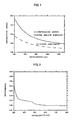
- Fig. 1 is a graph showing the refractive indices of the glass substrate portion (1) and the waveguide layer portion (2) of the slab optical waveguide formed using glass substrate No. 1 in Example 1.
- Fig. 2 is a graph showing the absorbance of the optical waveguide formed in Example 2.
- Fig. 3 is a graph showing the absorbance of the optical waveguide formed using glass substrate No. 2 in Example 3.
- Fig. 4 is a graph showing the absorbance of the optical waveguide formed using glass substrate No. 1 in Example 4.
- optical waveguides were formed according to the procedure described below.
- a paste of 55% by weight of CuSO 4 , 10% by weight of Na 2 SO 4 , 15% by weight of acrylic resin, 10% by weight of cellulosic resin, and 10% by weight of alcohol was applied all over one side of each glass substrate to a thickness of 1 mm.
- the pasted glass substrates were dried at 200°C for 30 minutes, and were thereafter heat-treated in air at 510°C for 48 hours.
- Fig. 1 shows the refractive indices of the glass substrate portion (1) and the copper halide portion (2) of glass substrate No. 1.
- a metal sheet having a gap formed with a width of 300 ⁇ m was placed on one side of the glass substrate, and a paste of 55% by weight of CuSO 4 , 10% by weight of Na 2 SO 4 , 15% by weight of acrylic resin, 10% by weight of cellulosic resin, and 10% by weight of alcohol was applied over the metal sheet to a thickness of 1 mm.
- the pasted glass substrate was dried at 200°C for 30 minutes, and was thereafter heat-treated in air at 510°C for 48 hours.
- Fig. 2 shows the absorbance of the thin line portion, where Cu 2 O diffused.
- optical waveguides were formed according to the following procedure.
- a metal sheet having a gap formed with a width of 300 ⁇ m was placed on one side of each glass substrate, and a paste of 55% by weight of CuSO 4 , 10% by weight of Na 2 SO 4 , 15% by weight of acrylic resin, 10% by weight of cellulosic resin, and 10% by weight of alcohol was applied over the metal sheet to a thickness of 1 mm.
- the pasted glass substrates were dried at 200°C for 30 minutes, and were thereafter heat-treated in air at 510°C for 48 hours.
- Fig. 3 shows the absorbance of the thin line portion, where copper(I) halides diffused, using borosilicate glass composition No. 2.
- optical waveguides were formed according to the following procedure.
- SiO 2 was vapor-deposited on the surface of each glass substrate to a thickness of about 0.5 ⁇ m by the sputtering method, and a commercially available positive photoresist agent (product of Tokyo Ohka Kogyo Co., Ltd., OFPR-8600) was applied thereon in a thickness of about 1.1 ⁇ m, using a spin coater.
- a commercially available positive photoresist agent product of Tokyo Ohka Kogyo Co., Ltd., OFPR-8600
- a metal sheet having a gap formed with a width of 300 ⁇ m was placed on each glass substrate, and was exposed to ultraviolet radiation using an ultraviolet laser (output wavelength: 355 nm). Thereafter, the metal sheet was removed, and the photoresist agent of the portion exposed to ultraviolet light was removed using a developer. Furthermore, in order to remove the SiO 2 film of the developed portion, etching was performed using hydrofluoric acid, and the glass substrate surface was exposed.
- the photoresist film was removed, and a paste of 55% by weight of CuSO 4 , 10% by weight of Na 2 SO 4 , 15% by weight of acrylic resin, 10% by weight of cellulosic resin, and 10% by weight of alcohol was applied over the inorganic film to a thickness of 1 mm, with the exposed portion of the glass substrate being pasted.
- the pasted glass substrates were dried at 200°C for 30 minutes, and were thereafter heat-treated in air at 510°C for 48 hours.
- Fig. 4 shows the absorbance of the thin line portion, where copper(I) halides diffused, using borosilicate glass composition No. 1.
Landscapes
- Chemical & Material Sciences (AREA)
- Engineering & Computer Science (AREA)
- Geochemistry & Mineralogy (AREA)
- Life Sciences & Earth Sciences (AREA)
- Chemical Kinetics & Catalysis (AREA)
- General Chemical & Material Sciences (AREA)
- Materials Engineering (AREA)
- Organic Chemistry (AREA)
- Physics & Mathematics (AREA)
- General Physics & Mathematics (AREA)
- Optics & Photonics (AREA)
- Microelectronics & Electronic Packaging (AREA)
- Glass Compositions (AREA)
- Optical Integrated Circuits (AREA)
- Surface Treatment Of Glass (AREA)
Applications Claiming Priority (3)
| Application Number | Priority Date | Filing Date | Title |
|---|---|---|---|
| JP2001387520 | 2001-12-20 | ||
| JP2001387520 | 2001-12-20 | ||
| PCT/JP2002/012841 WO2003054597A1 (fr) | 2001-12-20 | 2002-12-09 | Procede de formation de guide d'onde optique |
Publications (3)
| Publication Number | Publication Date |
|---|---|
| EP1457794A2 true EP1457794A2 (de) | 2004-09-15 |
| EP1457794A4 EP1457794A4 (de) | 2006-09-06 |
| EP1457794B1 EP1457794B1 (de) | 2009-10-21 |
Family
ID=19188075
Family Applications (1)
| Application Number | Title | Priority Date | Filing Date |
|---|---|---|---|
| EP02788755A Expired - Lifetime EP1457794B1 (de) | 2001-12-20 | 2002-12-09 | Verfahren zur bildung eines optischen wellenleiters |
Country Status (4)
| Country | Link |
|---|---|
| US (1) | US7095935B2 (de) |
| EP (1) | EP1457794B1 (de) |
| JP (1) | JP3834590B2 (de) |
| DE (1) | DE60234122D1 (de) |
Cited By (4)
| Publication number | Priority date | Publication date | Assignee | Title |
|---|---|---|---|---|
| FR2929415A1 (fr) * | 2008-03-27 | 2009-10-02 | Saint Gobain | Procede de fabrication d'elements optiques plans et elements obtenus |
| EP1719740A4 (de) * | 2004-02-20 | 2010-12-29 | Isuzu Glass Co Ltd | Verfahren zur herstellung einer optischen vorrichtung |
| JP2011084461A (ja) * | 2009-09-15 | 2011-04-28 | Nippon Electric Glass Co Ltd | 抵抗体形成用ガラス組成物 |
| EP1925951A4 (de) * | 2005-08-08 | 2013-07-17 | Isuzu Glass Co Ltd | Verfahren zum herstellen eines optischen gradientenindexelements mit infrarotabsorptionsfähigkeit |
Families Citing this family (7)
| Publication number | Priority date | Publication date | Assignee | Title |
|---|---|---|---|---|
| US7573645B2 (en) * | 2004-02-20 | 2009-08-11 | Isuzu Glass Co., Ltd. | Method for manufacturing optical element of refractive index distribution type |
| JP4756856B2 (ja) * | 2004-12-15 | 2011-08-24 | AvanStrate株式会社 | ガラス組成物およびその製造方法 |
| JP5067747B2 (ja) * | 2005-08-08 | 2012-11-07 | 独立行政法人産業技術総合研究所 | 光線指向性化ガラス基板及びそれを用いた照明装置 |
| JP2008247626A (ja) * | 2007-03-29 | 2008-10-16 | Isuzu Seiko Glass Kk | 紫外線吸収能を有する屈折率分布型光学素子の製造方法 |
| US7508214B2 (en) * | 2007-05-21 | 2009-03-24 | Medrad, Inc. | Transmit-mode phased array coils for reduced SAR and artifact issues |
| US10197732B2 (en) * | 2016-08-26 | 2019-02-05 | Corning Optical Communications LLC | Methods for forming ion-exchanged waveguides in glass substrates |
| US11009662B2 (en) * | 2017-09-05 | 2021-05-18 | Facebook Technologies, Llc | Manufacturing a graded index profile for waveguide display applications |
Family Cites Families (15)
| Publication number | Priority date | Publication date | Assignee | Title |
|---|---|---|---|---|
| GB980749A (en) * | 1962-05-24 | 1965-01-20 | Corning Glass Works | Method of marking volumetric glassware |
| US3489546A (en) * | 1966-04-04 | 1970-01-13 | Anchor Hocking Glass Corp | Strengthening of oxidized soda-lime glass articles |
| US3511681A (en) * | 1968-01-15 | 1970-05-12 | Corning Glass Works | Decoration for ceramic articles |
| US3873408A (en) * | 1969-10-06 | 1975-03-25 | Bausch & Lomb | Method of producing a refractive index gradient in glass |
| DE2231563C2 (de) * | 1972-06-28 | 1974-07-18 | Jenaer Glaswerk Schott & Gen., 6500 Mainz | Verfahren zur Herstellung von intensiv braun bis rotbraun gefärbten Glasgegenständen aus Borosilikatglas kleiner Wärmedehnung mittels Silberdiffusionsfarbe |
| JPS5319208B2 (de) * | 1972-11-27 | 1978-06-20 | ||
| NL7216461A (de) * | 1972-12-05 | 1974-06-07 | ||
| JPS5431418A (en) * | 1977-08-12 | 1979-03-08 | Gen Electric | Process for coloring glass products with copper |
| DE3840071A1 (de) * | 1988-11-28 | 1990-05-31 | Schott Glaswerke | Verfahren zum ionenaustausch an glas oder glaskeramik |
| JPH0624801A (ja) | 1992-07-10 | 1994-02-01 | Asahi Glass Co Ltd | 非線形光学ガラスの製造方法 |
| DE69311680T2 (de) * | 1992-08-20 | 1997-10-02 | Mitsuboshi Belting Ltd | Glasartiger Werkstoff mit ultrafeinen dispergierten Teilchen und Verfahren zu seiner Herstellung |
| JP2535303B2 (ja) | 1992-09-24 | 1996-09-18 | 三ツ星ベルト株式会社 | 超微粒子分散ガラス状物とその製造方法 |
| JPH09192594A (ja) * | 1996-01-16 | 1997-07-29 | N E Chemcat Corp | 耐候性膜の形成方法およびこれに用いるラスター組成物 |
| KR100450323B1 (ko) * | 1997-11-04 | 2005-01-17 | 삼성전자주식회사 | 광증폭용 gegas계 유리 조성물 |
| JP2000024514A (ja) | 1998-07-10 | 2000-01-25 | Tadahide Iwashita | 有機物分解光触媒とその製造方法 |
-
2002
- 2002-12-09 DE DE60234122T patent/DE60234122D1/de not_active Expired - Lifetime
- 2002-12-09 US US10/499,419 patent/US7095935B2/en not_active Expired - Fee Related
- 2002-12-09 JP JP2003555249A patent/JP3834590B2/ja not_active Expired - Lifetime
- 2002-12-09 EP EP02788755A patent/EP1457794B1/de not_active Expired - Lifetime
Cited By (6)
| Publication number | Priority date | Publication date | Assignee | Title |
|---|---|---|---|---|
| EP1719740A4 (de) * | 2004-02-20 | 2010-12-29 | Isuzu Glass Co Ltd | Verfahren zur herstellung einer optischen vorrichtung |
| EP1925951A4 (de) * | 2005-08-08 | 2013-07-17 | Isuzu Glass Co Ltd | Verfahren zum herstellen eines optischen gradientenindexelements mit infrarotabsorptionsfähigkeit |
| FR2929415A1 (fr) * | 2008-03-27 | 2009-10-02 | Saint Gobain | Procede de fabrication d'elements optiques plans et elements obtenus |
| WO2009125133A3 (fr) * | 2008-03-27 | 2010-04-22 | Saint-Gobain Glass France | Procede de fabrication d'elements optiques plans et elements obtenus |
| CN102046547A (zh) * | 2008-03-27 | 2011-05-04 | 法国圣戈班玻璃厂 | 用于制备平面光学元件的方法和获得的元件 |
| JP2011084461A (ja) * | 2009-09-15 | 2011-04-28 | Nippon Electric Glass Co Ltd | 抵抗体形成用ガラス組成物 |
Also Published As
| Publication number | Publication date |
|---|---|
| EP1457794B1 (de) | 2009-10-21 |
| EP1457794A4 (de) | 2006-09-06 |
| WO2003054597A2 (en) | 2003-07-03 |
| JPWO2003054597A1 (ja) | 2005-04-28 |
| JP3834590B2 (ja) | 2006-10-18 |
| US20050152657A1 (en) | 2005-07-14 |
| WO2003054597A3 (fr) | 2003-08-28 |
| DE60234122D1 (de) | 2009-12-03 |
| US7095935B2 (en) | 2006-08-22 |
Similar Documents
| Publication | Publication Date | Title |
|---|---|---|
| US20030024274A1 (en) | Method of manufacturing a planar waveguide using ion exchange method | |
| US4913717A (en) | Method for fabricating buried waveguides | |
| US7095935B2 (en) | Method for forming optical waveguide | |
| FR2730990B1 (fr) | Substrat transparent a revetement anti-reflets | |
| KR20100130201A (ko) | 플랫 광학 요소 제조 방법, 및 얻어진 요소 | |
| JPS6259556A (ja) | 特殊基材ガラスからCs+イオンでイオン交換することにより製造される光導波管 | |
| KR20030024863A (ko) | 고함량의 은을 갖는 보로실리케이트 유리 | |
| CN111253087B (zh) | 一种局部增强型玻璃制品及其加工方法 | |
| US6818577B2 (en) | Optical waveguide element and method for preparation thereof | |
| EP1721874B1 (de) | Verfahren zur herstellung eines optischen elements vom brechungsindexverteilungstyp | |
| US20250355178A1 (en) | Glass substrate and optical integrated device | |
| WO2004099096A2 (fr) | Composition de verre silico-sodo-calcique, notamment pour la realisation de substrats. | |
| JP2004102210A (ja) | ガラス、光導波路製造方法および光導波路 | |
| JPS63169601A (ja) | 屈折率分布型光学素子 | |
| Pantchev et al. | Field‐assisted ion exchange in glass: The effect of masking films | |
| JPS624335B2 (de) | ||
| JP2007523038A (ja) | 金属被膜を受け取るように意図され、そのような被膜により起こりやすい着色に耐性のあるガラスプレート | |
| JP2025101491A (ja) | ガラス及びその製造方法 | |
| JP3031066B2 (ja) | 酸化膜の製造方法及び光導波路の製造方法 | |
| JPH0462644B2 (de) | ||
| JPH05307125A (ja) | 光導波路の製造方法 | |
| JP2002321938A (ja) | 光増幅ガラスおよび光増幅導波路製造方法 | |
| JPH02262110A (ja) | 埋込型光導波路の製造方法 | |
| JPH11228157A (ja) | シリコン酸化膜の形成方法 | |
| JP2002228865A (ja) | イオン交換方法及びそれによる光導波路デバイスの製造方法 |
Legal Events
| Date | Code | Title | Description |
|---|---|---|---|
| PUAI | Public reference made under article 153(3) epc to a published international application that has entered the european phase |
Free format text: ORIGINAL CODE: 0009012 |
|
| 17P | Request for examination filed |
Effective date: 20040617 |
|
| AK | Designated contracting states |
Kind code of ref document: A2 Designated state(s): AT BE BG CH CY CZ DE DK EE ES FI FR GB GR IE IT LI LU MC NL PT SE SI SK TR |
|
| RIN1 | Information on inventor provided before grant (corrected) |
Inventor name: TAKADA, MINORU,C/O ISUZU GLASS CO., LTD. Inventor name: YAZAWA, TETSUO,C/O KANSAI CENTER Inventor name: SUETSUGU, TATSUYA,C/O ISUZU GLASS CO., LTD. Inventor name: KADONO, KOHEI,C/O KANSAI CENTER Inventor name: EINISHI, TOSHIHIKO,C/O ISUZU GLASS CO., LTD. Inventor name: KOMINAMI, NORIMASA,C/O ISUZU GLASS CO., LTD. Inventor name: OHTANI, TAKESHI,C/O ISUZU GLASS CO., LTD. Inventor name: YOKOI, HIROAKI,C/O ISUZU GLASS CO., LTD. Inventor name: TARUMI, TAKASHI,C/O ISUZU GLASS CO., LTD. |
|
| A4 | Supplementary search report drawn up and despatched |
Effective date: 20060803 |
|
| RIC1 | Information provided on ipc code assigned before grant |
Ipc: G02B 6/12 20060101AFI20030710BHEP Ipc: C03C 17/44 20060101ALI20060728BHEP Ipc: C03C 3/11 20060101ALI20060728BHEP |
|
| 17Q | First examination report despatched |
Effective date: 20070524 |
|
| GRAP | Despatch of communication of intention to grant a patent |
Free format text: ORIGINAL CODE: EPIDOSNIGR1 |
|
| GRAS | Grant fee paid |
Free format text: ORIGINAL CODE: EPIDOSNIGR3 |
|
| GRAA | (expected) grant |
Free format text: ORIGINAL CODE: 0009210 |
|
| AK | Designated contracting states |
Kind code of ref document: B1 Designated state(s): DE FR GB NL |
|
| REG | Reference to a national code |
Ref country code: GB Ref legal event code: FG4D |
|
| REF | Corresponds to: |
Ref document number: 60234122 Country of ref document: DE Date of ref document: 20091203 Kind code of ref document: P |
|
| PLBE | No opposition filed within time limit |
Free format text: ORIGINAL CODE: 0009261 |
|
| STAA | Information on the status of an ep patent application or granted ep patent |
Free format text: STATUS: NO OPPOSITION FILED WITHIN TIME LIMIT |
|
| 26N | No opposition filed |
Effective date: 20100722 |
|
| PGFP | Annual fee paid to national office [announced via postgrant information from national office to epo] |
Ref country code: GB Payment date: 20101208 Year of fee payment: 9 |
|
| PGFP | Annual fee paid to national office [announced via postgrant information from national office to epo] |
Ref country code: FR Payment date: 20111215 Year of fee payment: 10 |
|
| PGFP | Annual fee paid to national office [announced via postgrant information from national office to epo] |
Ref country code: NL Payment date: 20120102 Year of fee payment: 10 |
|
| PGFP | Annual fee paid to national office [announced via postgrant information from national office to epo] |
Ref country code: DE Payment date: 20121228 Year of fee payment: 11 |
|
| REG | Reference to a national code |
Ref country code: NL Ref legal event code: V1 Effective date: 20130701 |
|
| GBPC | Gb: european patent ceased through non-payment of renewal fee |
Effective date: 20121209 |
|
| REG | Reference to a national code |
Ref country code: FR Ref legal event code: ST Effective date: 20130830 |
|
| PG25 | Lapsed in a contracting state [announced via postgrant information from national office to epo] |
Ref country code: NL Free format text: LAPSE BECAUSE OF NON-PAYMENT OF DUE FEES Effective date: 20130701 |
|
| PG25 | Lapsed in a contracting state [announced via postgrant information from national office to epo] |
Ref country code: GB Free format text: LAPSE BECAUSE OF NON-PAYMENT OF DUE FEES Effective date: 20121209 Ref country code: FR Free format text: LAPSE BECAUSE OF NON-PAYMENT OF DUE FEES Effective date: 20130102 |
|
| REG | Reference to a national code |
Ref country code: DE Ref legal event code: R119 Ref document number: 60234122 Country of ref document: DE |
|
| REG | Reference to a national code |
Ref country code: DE Ref legal event code: R119 Ref document number: 60234122 Country of ref document: DE Effective date: 20140701 |
|
| PG25 | Lapsed in a contracting state [announced via postgrant information from national office to epo] |
Ref country code: DE Free format text: LAPSE BECAUSE OF NON-PAYMENT OF DUE FEES Effective date: 20140701 |