EP1460418A1 - Sauerstoff-Detektionssystem und Fahrzeugsteuerunssystem mit einem solchen Sauerstoff-Detektionssystem - Google Patents
Sauerstoff-Detektionssystem und Fahrzeugsteuerunssystem mit einem solchen Sauerstoff-Detektionssystem Download PDFInfo
- Publication number
- EP1460418A1 EP1460418A1 EP04290740A EP04290740A EP1460418A1 EP 1460418 A1 EP1460418 A1 EP 1460418A1 EP 04290740 A EP04290740 A EP 04290740A EP 04290740 A EP04290740 A EP 04290740A EP 1460418 A1 EP1460418 A1 EP 1460418A1
- Authority
- EP
- European Patent Office
- Prior art keywords
- anomaly
- oxygen
- signal
- sensor
- cell
- Prior art date
- Legal status (The legal status is an assumption and is not a legal conclusion. Google has not performed a legal analysis and makes no representation as to the accuracy of the status listed.)
- Granted
Links
- 238000001514 detection method Methods 0.000 title claims abstract description 218
- QVGXLLKOCUKJST-UHFFFAOYSA-N atomic oxygen Chemical compound [O] QVGXLLKOCUKJST-UHFFFAOYSA-N 0.000 title claims abstract description 179
- 239000001301 oxygen Substances 0.000 title claims abstract description 179
- 229910052760 oxygen Inorganic materials 0.000 title claims abstract description 179
- 238000005259 measurement Methods 0.000 claims abstract description 98
- 230000004048 modification Effects 0.000 claims abstract description 48
- 238000012986 modification Methods 0.000 claims abstract description 48
- 239000000446 fuel Substances 0.000 claims description 32
- 230000002547 anomalous effect Effects 0.000 claims description 30
- 239000007789 gas Substances 0.000 claims description 23
- 230000008859 change Effects 0.000 claims description 8
- 238000010438 heat treatment Methods 0.000 claims description 4
- 238000010586 diagram Methods 0.000 description 11
- 238000009792 diffusion process Methods 0.000 description 5
- 230000006870 function Effects 0.000 description 5
- 241001125929 Trisopterus luscus Species 0.000 description 4
- BASFCYQUMIYNBI-UHFFFAOYSA-N platinum Chemical compound [Pt] BASFCYQUMIYNBI-UHFFFAOYSA-N 0.000 description 4
- 238000002485 combustion reaction Methods 0.000 description 3
- 238000012545 processing Methods 0.000 description 3
- 239000007784 solid electrolyte Substances 0.000 description 3
- 239000003990 capacitor Substances 0.000 description 2
- 239000000919 ceramic Substances 0.000 description 2
- 238000006243 chemical reaction Methods 0.000 description 2
- 238000000034 method Methods 0.000 description 2
- 229910002077 partially stabilized zirconia Inorganic materials 0.000 description 2
- 229910052697 platinum Inorganic materials 0.000 description 2
- PNEYBMLMFCGWSK-UHFFFAOYSA-N aluminium oxide Inorganic materials [O-2].[O-2].[O-2].[Al+3].[Al+3] PNEYBMLMFCGWSK-UHFFFAOYSA-N 0.000 description 1
- 230000003321 amplification Effects 0.000 description 1
- 238000013459 approach Methods 0.000 description 1
- 238000012790 confirmation Methods 0.000 description 1
- 238000003745 diagnosis Methods 0.000 description 1
- 230000000694 effects Effects 0.000 description 1
- 230000007257 malfunction Effects 0.000 description 1
- 239000000463 material Substances 0.000 description 1
- 238000003199 nucleic acid amplification method Methods 0.000 description 1
- 230000008569 process Effects 0.000 description 1
- 230000009467 reduction Effects 0.000 description 1
- 230000002787 reinforcement Effects 0.000 description 1
Images





Classifications
-
- G—PHYSICS
- G01—MEASURING; TESTING
- G01N—INVESTIGATING OR ANALYSING MATERIALS BY DETERMINING THEIR CHEMICAL OR PHYSICAL PROPERTIES
- G01N27/00—Investigating or analysing materials by the use of electric, electrochemical, or magnetic means
- G01N27/26—Investigating or analysing materials by the use of electric, electrochemical, or magnetic means by investigating electrochemical variables; by using electrolysis or electrophoresis
- G01N27/416—Systems
- G01N27/417—Systems using cells, i.e. more than one cell and probes with solid electrolytes
- G01N27/4175—Calibrating or checking the analyser
-
- F—MECHANICAL ENGINEERING; LIGHTING; HEATING; WEAPONS; BLASTING
- F02—COMBUSTION ENGINES; HOT-GAS OR COMBUSTION-PRODUCT ENGINE PLANTS
- F02D—CONTROLLING COMBUSTION ENGINES
- F02D41/00—Electrical control of supply of combustible mixture or its constituents
- F02D41/02—Circuit arrangements for generating control signals
- F02D41/14—Introducing closed-loop corrections
- F02D41/1438—Introducing closed-loop corrections using means for determining characteristics of the combustion gases; Sensors therefor
- F02D41/1493—Details
- F02D41/1495—Detection of abnormalities in the air/fuel ratio feedback system
Definitions
- the present invention relates to an oxygen concentration detection system and to a vehicle control system which includes the same so as to detect the air-fuel ratio of an internal combustion engine such as a gasoline engine or a diesel engine. More particularly, the present invention relates to an oxygen concentration detection system which can report anomalous conditions of a plurality of types without an increase in the number of signal lines, as well as to a vehicle control system including the same.
- an oxygen sensor is disposed in an exhaust system, and the quantity of fuel supplied to the engine is feedback-controlled in accordance with the sensor output such that the air fuel ratio approaches a target value, whereby CO, NO x , HC, etc. in exhaust gas are reduced.
- Know oxygen sensors used in such feedback control include a ⁇ sensor whose output abruptly changes in the vicinity of the theoretical air fuel ratio, and a full range air-fuel-ratio sensor whose output continuously changes from a lean region to a rich region.
- the full range air-fuel-ratio sensor is advantageous in that it can improve the accuracy of the feedback control as compared with that of the ⁇ sensor.
- the full range air-fuel-ratio sensor includes two opposed cells formed of an oxygen-ion conductive solid electrolyte.
- One of the cells is a pump cell which pumps oxygen out of a clearance (measurement chamber) between the cells and pumps oxygen into the clearance.
- the other cell is an oxygen-partial-pressure detection cell which produces a voltage corresponding to the difference between a reference oxygen concentration and the oxygen concentration in the measurement chamber. These cells are controlled by means of a control circuit.
- the pump cell is operated such that the output of the oxygen-partial-pressure detection cell is maintained constant, and the oxygen concentration is detected on the basis of the magnitude of current flowing though the pump cell.
- the operation principle of the full range air-fuel-ratio sensor is described in detail in Japanese Patent Application Laid-Open ( kokai ) No. 62-148849 of the present inventors.
- an anomaly detection method for an air-fuel-ratio sensor adapted to detect whether or not the air-fuel-ratio sensor operates normally is disclosed, for example, in Japanese Patent Application Laid-Open ( kokai ) No. 3-272452, also of the present inventors, entitled "Anomaly Diagnosis Method for Air-Fuel-Ratio Sensor".
- JPA No. 3-272452 since an anomaly is judged on the basis of a variation range of voltage of an oxygen detection cell, the cell is judged to be anomalous even when the voltage temporarily exceeds the range as a result of, for example, noise in the control circuit. Therefore, the anomaly judgment may be erroneous.
- a signal line for reporting the occurrence of an anomaly may be added. In this case, the wiring becomes complex, and an input port or the like must be added on the side where a report of occurrence of anomaly is received, leading to increased cost.
- only one signal line is provided for reporting the occurrence of an anomaly, only simple information can be provided.
- the present invention provides an oxygen concentration detection system 100 which comprises an oxygen sensor 1.
- the oxygen sensor 1 comprises a sensor element 10 including a combination of an oxygen pump cell 14 and an oxygen-partial-pressure detection cell 24; and a control circuit 50 connected to the sensor element 10 via wiring lines 41, 42, and 43 adapted to control the oxygen pump cell 14 such that the output voltage of the oxygen-partial-pressure detection cell 24 is maintained at a predetermined value.
- the control circuit 50 may also perform other functions.
- the oxygen sensor 1 detects concentration of oxygen contained in a gas to be measured having an oxygen concentration within a predetermined range.
- the oxygen concentration detection system 100 outputs measurement signals 81 of a plurality of types, including a first signal 81b corresponding to a magnitude of current flowing through the oxygen pump cell 14, a seond signal 81 c corresponding to an electric potential of the oxygen-partial-pressure detection cell 24, and a third signal 81a corresponding to a resistance of the oxygen-partial-pressure detection cell 24.
- the oxygen concentration detection system 100 is characterized by comprising: anomaly detection means 58 for detecting a sensor anomaly by determining whether or not at least one of respective levels of signals 581, 582, and 583 which represent electric potentials at different portions of the sensor element 10, the wiring lines 41, 42, and 43, and the control circuit 50 falls within a predetermined range; modification means 58d for issuing a first instruction when the anomaly detection means 58 does not detect any anomaly, the first instruction indicating non-detection of anomaly, and for issuing a second instruction when the anomaly detection means 58 detects a sensor anomaly, the second instruction corresponding to the detected anomaly; and output means 83 for through-outputting the measurement signals 81 when the modification means 58d outputs the first instruction signal and for outputting at least a selected one of the measurement signals 81 when the modification means 58d outputs the second instruction signal, the selected measurement signal being modified to have a level outside the corresponding range within which the level of the selected measurement signal varies in a normal state.
- the oxygen concentration detection system when normal signals are output to the plurality of signal lines, the oxygen concentration detection system reports that the voltages of the signals are normal voltages falling within predetermined respective ranges, and when an anomaly occurs, the oxygen concentration detection system reports the occurrence of an anomaly by changing the voltage of a selected signal to fall outside the corresponding range.
- This configuration eliminates the necessity of providing an additional signal line for reporting an anomalous state, reduces the degree of complication, and enhances reliability.
- This configuration also enables judgment of an anomaly state to be performed simultaneously with confirmation of validity of a signal of a relevant signal line, whereby the load imposed on an engine control unit (ECU) can be reduced.
- ECU engine control unit
- the oxygen sensor is judged to be anomalous when one of the signal lines outputs a voltage which is not output in a normal state; and the type of anomaly can be transmitted by combining the levels of the respective signal lines in various manners.
- the degree of complication of routing of wiring lines can be reduced, and detection failure, which would otherwise occur due to breakage, etc., of an added signal line, does not occur.
- the existing signals and an anomaly detection signal do not overlap in terms of output range, no problem arises in detection of air fuel ratio.
- the present invention provides an oxygen concentration detection system 100 wherein the anomaly detection means 58 detects an anomaly of at least one of the oxygen pump cell 14, the oxygen-partial-pressure detection cell 24, the control circuit 50, and the wiring lines 41, 42, and 43.
- an anomaly of the oxygen concentration detection system can be detected, while a portion(s) of the sensor element, the control circuit, and the signal wiring lines is specified.
- the present invention provides an oxygen concentration detection system 100 wherein line signals including signal 83c (VCC5) having a level falling outside the predetermined range within which the level of the measurement signal varies in a normal state is output by use of a signal line 81a,81b and/or 81c through which the measurement signal 81 of a level falling within the predetermined range is output.
- line signals including signal 83c (VCC5) having a level falling outside the predetermined range within which the level of the measurement signal varies in a normal state is output by use of a signal line 81a,81b and/or 81c through which the measurement signal 81 of a level falling within the predetermined range is output.
- the signal having a level falling outside the predetermined range within which the level of the measurement signal varies in a normal state; i.e., an error signal, is output as an anomalous detection signal, by use of a signal line for a measurement signal, such that an additional signal line is not required.
- the present invention provides an oxygen concentration detection system 100 wherein the output means 83 includes switches 83a and 83b for switching their connection states in accordance with an instruction from the modification means 58d, and a constant voltage source 83d, wherein when the second instruction indicative of anomaly is output from the modification means 58d, the constant voltage power source 83d is connected, through a switching operation of the switches, to a signal line to which a selected one of the measurement signals 81 is output, to thereby change the level of the selected measurement signal to a level falling outside the predetermined range within which the level of the measurement signal varies in a normal state.
- a constant voltage source for generating a voltage serving as an anomaly detection signal is disposed in the control circuit, and switches are provided for selectively outputting a normal signal or the anomaly detection signal on the basis of the instruction from the modification means, whereby a signal indicative of an anomaly can be easily output, and a complicated amplification circuit for output switching is not required.
- the present invention provides an oxygen concentration detection system 100 wherein when a sensor anomaly occurs, the anomaly detection means 58 determines that the level of one of the signals 581, 582, and 583 which represent electric potentials at different portions of the sensor element 10, the wiring lines 41, 42, and 43, and the control circuit 50 falls outside the corresponding predetermined range, and outputs a predetermined anomaly detection signal 58a1, 58b1, 58c1 in accordance with the type and/or level of the signal whose level falls outside the predetermined range.
- the modification means 58d issues, in accordance with the anomaly detection signal 58a1, 58b1, 58c1 output from the anomaly detection means 58, a control signal 58e for specifying a signal which is to be output at a level falling outside the corresponding range within which the level of the signal varies in a normal state.
- the output means 83 outputs, on the basis of the control signal 58e output from the modification means 58d, at least one of the measurement signals 81 specified by the modification means 58d, at a predetermined level falling outside the corresponding range within which the level of the signal varies in a normal state, whereby the location and/or state of the anomaly of the sensor element 10 is reported.
- a predetermined output(s) from the sensor element is converted to a predetermined voltage signal, and anomaly detection is performed by use of the signal.
- the measurement signal is replaced with an anomaly detection signal having a predetermined level, whereby an anomalous state is reported. Therefore, an anomalous location and/or state of an anomaly of the sensor element is quickly transferred into the ECU, whereby the state of an anomaly can be quickly detected.
- the present invention provides an oxygen concentration detection system 100 wherein the anomaly detection means 58, the modification means 58d, and the output means 83 are provided in the control circuit 50 of the sensor element 10.
- the anomaly detection means, the modification means, and the output means are provided in the sensor control circuit of the sensor element, the circuit and processes within the ECU can be simplified.
- the oxygen sensor 1 includes a heater 61 for heating the sensor element 10; and a heater control circuit 60 for controlling electric power supplied to the heater 61 such that the sensor element 10 is maintained at a predetermined temperature.
- the oxygen sensor includes a heater and a heater control circuit therefor, the oxygen sensor can be quickly activated, and in particular, at startup of an engine, the oxygen sensor can be quickly heated to the predetermined temperature. In addition, an anomaly of the sensor can be quickly detected after startup of the engine.
- the present invention provides an oxygen concentration detection system 100 wherein when an anomaly is detected in the signals 581, 582, and 583 representing the electric potentials at the different locations, the output means 83 changes the level of a measurement signal corresponding to the resistance of the oxygen-partial-pressure detection cell 24 to a level falling outside the predetermined range in which the level of the measurement signal varies in a normal state.
- the switch which effects changeover between a normal signal and an anomaly detection signal in accordance with an instruction from the modification means is provided only in the signal line for outputting the measurement signal corresponding to the resistance of the oxygen-partial-pressure detection cell.
- the number of switches can be reduced to one, thereby simplifying the control circuit.
- the present invention provides a vehicle control system 900, comprising an oxygen sensor 1 which comprises a sensor element 10 including a combination of an oxygen pump cell 14 and an oxygen-partial-pressure detection cell 24; a control circuit 50 connected to the sensor element 10 via wiring lines 41, 42, and 43 and adapted to control the oxygen pump cell 14 such that the output voltage of the oxygen-partial-pressure detection cell 24 is maintained at a predetermined value.
- the control circuit 50 may also perform additional functions.
- the oxygen sensor 1 detects the concentration of oxygen contained in a gas to be measured having an oxygen concentration within a predetermined range.
- the vehicle control system 900 further comprises: anomaly detection means 58 for detecting sensor anomaly by determining whether or not at least one of respective levels of signals 581, 582, and 583 which represent electric potentials at different portions of the sensor element 10, the wiring lines 41, 42, and 43, and the control circuit 50 falls within a predetermined range; modification means 58d for issuing a first instruction when the anomaly detection means 58 does not detect any anomaly, a first instruction showing non-detection of an anomaly, and for issuing a second instruction when the anomaly detection means 58 detects a sensor anomaly, a second instruction corresponding to the detected anomaly; output means 83 for through-outputting the measurement signals 81 when the modification means 58d outputs the first instruction signal and for outputting at least a selected one of the measurement signals 81 when the modification means 58d outputs the second instruction signal, the selected measurement signal being modified to have a level outside the corresponding range within which the level of the selected measurement signal varies in a normal state; and anomaly judgment means
- anomaly judgment means is incorporated in the vehicle control system, an additional signal line is not required, and the degree of complication of routing of wire lines can be reduced. Moreover, since the existing signals and the anomaly detection signals do not overlap in terms of output range, no problem arises in detection of air fuel ratio. Furthermore, there is no interference stemming from noise, etc., and thus, anomaly judgment for the vehicle control system can be performed with high accuracy.
- the present invention provides a vehicle control system 900, wherein the anomalous judgment means 80 stores the relationship between levels of the measurement signals 81 and type and locations of anomalies; and the anomalous judgment means 80 judges the type and location of an anomaly of a sensor on the basis of levels of the measurement signals 81 and the stored relationship.
- the type and location of an anomaly of the sensor can be quickly judged.
- the anomaly detection means 58 detects an anomaly of at least one of the oxygen pump cell 14, the oxygen-partial-pressure detection cell 24, the control circuit 50, and the wiring lines 41, 42, and 43; and the anomaly judgment means 80 judges an anomaly of the sensor on the basis of the levels of the measurement signals 81.
- an anomaly of the vehicle control system can be detected, while a portion(s) of the sensor element, the control circuit, and the wiring lines is specified.
- the present invention provides a vehicle control system 900, characterized by comprising an oxygen sensor 1 comprising a sensor element 10 including a combination of an oxygen pump cell 14 and an oxygen-partial-pressure detection cell 24; a control circuit 50 connected to the sensor element 10 via wiring lines 41, 42, and 43 and adapted to control the oxygen pump cell 14 such that the output voltage of the oxygen-partial-pressure detection cell 24 is maintained at a predetermined value.
- the control circuit 50 may also carry out other functions.
- the oxygen sensor 1 detects the concentration of oxygen contained in a gas to be measured having an oxygen concentration within a predetermined range.
- the vehicle control system 900 further comprises: storage means 90 for storing the relationship between types and locations of anomalies and the levels of measurement signals 81 of a plurality of types, including a first signal 81b corresponding to a magnitude of current flowing through the oxygen pump cell 14, a second signal 81 c corresponding to an electric potential of the oxygen-partial-pressure detection cell 24, and a third signal 81a corresponding to a resistance of the oxygen-partial-pressure detection cell 24; and anomaly judgment means 80 for determining a type and/or location of an anomaly of the sensor, on the basis of levels of the measurement signals 81 and the stored relationship, when the air fuel ratio of an engine is controlled to a lean side and the second signal 81c corresponding to an electric potential of the oxygen-partial-pressure detection cell 24 is equal to or lower than a predetermined voltage.
- the control circuit, or the wiring lines since an anomaly of the sensor element, the control circuit, or the wiring lines is detected when the air fuel ratio of the engine is on the lean side, a portion which constitutes the oxygen pump cell can be judged to be anomalous when the current flowing through the oxygen pump cell does not reach a theoretical or designed level to be attained.
- the present invention provides a vehicle control system 900, wherein the location and/or state of an anomaly of the vehicle control system is determined on the basis of the output level of the third signal 81a corresponding to the resistance of the oxygen-partial-pressure detection cell 24.
- breakage of a wiring line at a portion which constitutes the oxygen-partial-pressure detection cell can be detected on the basis of the output level of the signal 81 a corresponding to the resistance of the oxygen-partial-pressure detection cell 24.
- the present invention provides a vehicle control system 900, wherein the operation of performing anomaly judgment when the air fuel ratio of the engine is controlled to the lean side is an operation which causes the anomaly judgment means 80 to perform anomaly judgment on the basis of the levels of the measurement signals 81 when the oxygen sensor 1 is exposed to an ambient atmosphere.
- the anomaly judgment means 80 can clearly judge, on the basis of the levels of the signals 81, whether or not a portion constituting the oxygen pump cell is anomalous, because when the oxygen sensor is exposed to an ambient atmosphere (oxygen concentration: about 20.9%), the magnitude of current flowing through the oxygen pump cell is theoretically at a maximum and is constant.
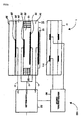
- Fig. 1 is a schematic diagram illustrating an oxygen concentration detection system 100 having an oxygen sensor with a heater and control circuits therefor, incorporating anomaly detection means according to the invention.
- Fig. 2 is a detailed circuit diagram of a vehicle control system 900 comprising the oxygen concentration detection system having an anomaly detection means according to the invention.
- Fig. 3 is a table showing electric potential levels at the terminals of the oxygen concentration detection system of Fig. 2 and types of judgment thereof in lean and non-lean regions.
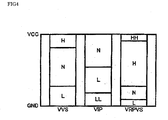
- Fig. 4 is a diagram which illustrates ranges of electric potentials at the terminals of Fig. 2.
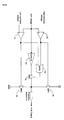
- Fig. 5 is a diagram of a circuit for selectively outputting three output signals (High, Normal, Low), which are applied to the control circuit of Fig. 2.
- Fig. 6 is a diagram illustrating another circuit configuration of an anomaly detection means and modification (or switching) means, which may be used in the oxygen concentration detection system of Fig. 2.
- Fig. 7 is a table showing the relationship between signals input to the circuit shown in Fig. 6 and signals output from the circuit.
- Fig. 8 is a general diagram illustrating a flow for anomaly judgment in the oxygen concentration detection system according to the invention.
- a plurality of error signals are output through a plurality of signal lines, through which at least two types of measurement signals, among the above-described plurality of types of measurement signals, are output; and on a side where the plurality of error signals are received, the location and/or state of an anomaly of the oxygen sensor can be determined from a combination of the error signals.
- the oxygen concentration detection system according to the present invention is applied to a vehicle control system which includes an engine and an engine controller.
- the oxygen concentration detection system is configured such that for a wiring line connecting the oxygen sensor element and its control circuit, anomalous conditions of at least three types; i.e., battery-side short circuit, ground-side short circuit, and breakage of the wiring line, can be identified.
- the oxygen concentration detection system includes an oxygen sensor constituted by a combination of an oxygen pump cell and an oxygen-partial-pressure detection cell, and is applied to an air-fuel-ratio measurement system 100 wherein the above-described control circuit controls the oxygen pump cell such that the output voltage of the oxygen-partial-pressure detection cell is maintained at a predetermined value.
- the oxygen concentration detection system uses, as a signal for anomaly detection, a signal representing current flowing through the oxygen pump cell.
- the oxygen concentration detection system uses, as a signal for anomaly detection, an internal resistance signal obtained through conversion of the internal resistance of the oxygen-partial-pressure detection cell to a voltage.
- the concentration detection cell signal can be used as a signal output from the control circuit for anomaly detection.
- the oxygen concentration detection system is applied to a vehicle control system which includes an engine and an engine controller, and the engine controller detects an anomalous state of the air-fuel-ratio detection system when the air fuel ratio of the engine is controlled to the lean side.
- analog signal is a signal which represents a continuous value.
- that term encompasses a digital signal which selectively represents three or more discrete values.
- the signal may represents a value of an arbitrary form such as a voltage value or current value.
- the measurement signals having levels within predetermined respective ranges are through-output with their levels maintained or amplified in accordance with their levels.
- Fig. 1 shows an example sensor element 10 for use in an oxygen concentration detection system 100 according to an embodiment of the present invention.
- This sensor element 10 is disposed in an exhaust gas system of an internal combustion engine.
- the sensor element 10 consists of two cells: an oxygen pump cell 14 and an oxygen-partial pressure detection cell 24 joined together, and is connected to a sensor control circuit 50 via three wiring lines 41, 42, and 43.
- the sensor control circuit 50 mainly performs measurement of the concentration of oxygen contained in exhaust gas and measurement of the temperature of the sensor element 10.
- the sensor control circuit 50 has a function of detecting an anomaly of the three wiring lines 41, 42, and 43 connected to the two cells of the sensor element 10.
- a heater 61 is mounted to the sensor element 10 via a ceramic joining material, and is controlled by means of a heater control circuit 60.
- An insulating body of the heater 61 is formed of ceramic such as alumina, and heater wiring 61a is disposed in the body in order to heat the sensor element 10.
- the heater control circuit 60 supplies electric power to the heater 61 such that the temperature of the sensor element 10 controlled by means of the sensor control circuit 50 is maintained at a target value.
- the sensor element 10 is constructed by stacking a oxygen pump cell 14, a porous diffusion layer 18, an oxygen-partial-pressure detection cell 24, and a reinforcement plate 30.
- the pump cell 14 is formed into a plate-like shape from wholly or partially stabilized zirconia, which is an oxygen-ion conductive solid electrolyte; and porous electrodes 12 and 16 mainly formed of platinum are provided on opposite surfaces thereof. As described below, current flows between the porous electrodes 12 and 16 in accordance with a change in oxygen concentration of an exhaust gas.
- the porous electrode 12 on the top surface exposed to a gas under measurement (measurement gas) will be called an Ip+ electrode, whereas the porous electrode 16 on the bottom surface will be called an Ip- electrode.
- the wiring line 43 is connected to the Ip+ electrode, and the wiring line 42 is connected to the Ip- electrode.
- the oxygen-partial-pressure detection cell 24 is also formed of wholly or partially stabilized zirconia; and porous electrodes 22 and 28 mainly formed of platinum are provided on opposite surfaces thereof.
- a clearance 20 surrounded by the porous diffusion layer 18 is formed between the pump cell 14 and the oxygen-partial-pressure detection cell 24.
- the clearance 20 communicates with a measurement gas atmosphere via the porous diffusion layer 18.
- electromotive force is generated between the porous electrodes 22 and 28 in accordance with a change in oxygen concentration of exhaust gas.
- the porous electrode 22, disposed on the side toward the clearance 20, will be called a Vs- electrode, whereas the porous electrode 28, disposed on the side toward a reference oxygen chamber 26, will be called a Vs+ electrode.
- Reference oxygen within the reference oxygen chamber 26 is generated by causing a very small current (ICP current) to flow from the porous electrode 22 to the porous electrode 28 to thereby pump oxygen within the exhaust gas at a constant rate.
- the wiring line 41 is connected to the Vs+ electrode
- the wiring line 42 is connected to the Vs- electrode.
- the wiring line 42 is connected to both the Ip- electrode and the Vs- electrode.
- Exhaust gas which is a measurement gas, diffuses into the clearance 20 through the porous diffusion layer 18.
- a potential difference of about 450 mV arises between the Vs+ electrode 28 and the Vs- electrode 22 of the oxygen-partial-pressure detection cell 24 stemming from the difference in oxygen concentration between the clearance 20 and the reference oxygen chamber 26, in which a constant oxygen concentration is maintained.
- the atmosphere within the clearance 20 is controlled such that its oxygen concentration always corresponds to the theoretical air fuel ratio.
- the sensor control circuit 50 adjusts the current Ip flowing through the oxygen pump cell 14 such that the electromotive force Vs of the oxygen-partial-pressure detection cell 24 becomes 450 mV, to thereby pump oxygen. In this state, the current Ip flowing through the pump cell 14 is measured, whereby the air fuel ratio of the measurement gas can be determined.
- the current Ip flowing through the oxygen pump cell 14 of the sensor element 10 is adjusted such that the electromotive force Vs of the oxygen-partial-pressure detection cell 24 becomes 450 mV. Therefore, by utilizing the flow characteristics of the Ip current of the sensor element 10 controlled by the sensor control circuit 50, anomaly detection for the wiring lines 41, 42, and 43 of the sensor element 10, as described below, becomes possible.
- Fig. 2 is a diagram illustrating the configuration of the control circuit for the sensor element shown in Fig. 1.
- the sensor control circuit 50 mainly consists of an Ip driver 51 constituted by an operational amplifier; a PID control circuit 52; an operational amplifier 53; an Rpvs measurement circuit 54 for measurement of an internal resistance of the oxygen-partial pressure detection cell; and a self diagnostic circuit 58.
- the sensor control circuit 50 may be constituted by use of ordinary electric components and incorporated directly into an engine controller 8. Alternatively, only the sensor control circuit 50 may be integrated into a single integrated circuit; i.e., an ASIC (Application Specific IC).
- ASIC Application Specific IC
- Output terminals (output means) VIP, VVS, and VRPVS of the sensor control circuit 50 are connected to respective analog input terminals of a processing unit (CPU) 90 provided within an engine control unit (ECU) 8.
- CPU processing unit
- ECU engine control unit
- the sensor control circuit 50 can be configured to output a P/START signal to the VRPVS terminal (the VIP terminal and the VVS terminal in some cases) as a superposition signal. Specifically, in accordance with the level of the P/START signal whose level changes depending on whether the sensor is normal or anomalous, the output terminals VIP, VVS, and VRPVS output voltages representing measurement values or a voltage indicative of an anomaly of the sensor. More specifically, when the sensor is normal, a voltage in proportion to the magnitude of the later described Rpvs is through-output from the VRPVS terminal.
- a voltage in proportion to the magnitude of current flowing between the Ip+ and Ip- electrodes of the oxygen pump cell 14 is through-output from the VIP terminal, and a voltage in proportion to the voltage difference between the Vs+ and Vs- electrodes of the oxygen-partial pressure detection cell 24 is through-output from the VVS terminal.
- a predetermined voltage is selectively output from a predetermined terminal, through modification of the level of the corresponding signal to a level that the signal does not assume in an ordinary state.
- the Ip driver 51 is an operational amplifier for supplying Ip current to the sensor element 10.
- a Vcent terminal is connected to the inverted input terminal of the operational amplifier, and a reference voltage (3.6 V in the present embodiment) is supplied to the non-inverted input terminal of the operational amplifier.
- An IP+ terminal is connected to the output terminal of the operational amplifier.
- the oxygen pump cell 14 of the sensor element 10 is connected between the Vcent terminal and the IP+ terminal. Since the Ip driver 51 forms a negative feedback circuit, the Ip current is controlled such that the electric potential at the Vcent terminal is always maintained at the reference voltage (3.6 V).
- the Ip driver 51 cooperates with the PID control circuit 52 so as to maintain the voltage of the Vcent terminal at 3.6 V (reference voltage), whereby the pump current (Ip current) is controlled such that the electromotive force Vs coincides with a control target.
- the PID control circuit 52 constitutes a PID calculation circuit in cooperation with resistors and capacitors connected to a P1 terminal 521, a P2 terminal 522, and a P3 terminal 523, which are input/output terminals.
- the PID control circuit 52 performs PID calculation for a deviation ⁇ Vs of the electromotive force Vs of the oxygen-partial-pressure detection cell 24 with respect to the Vs control target (450 mV), and outputs a resultant voltage to a Pout terminal 524.
- the electromotive force Vs of the oxygen-partial-pressure detection cell 24 is higher than 450 mV, the oxygen concentration in the clearance 20 is lower than that in a theoretical air fuel ratio; i.e., the air fuel ratio of the measurement gas is on the rich side, where fuel supply is excessive, with respect to the theoretical air fuel ratio.
- the voltage obtained from the deviation ⁇ Vs through PID calculation and output from the Pout terminal 524 changes so as to induce an Ip current for causing the pump cell 14 to pump in oxygen so as to eliminate a shortfall of oxygen.
- the electromotive force Vs of the oxygen-partial-pressure detection cell 24 is lower than 450 mV, the oxygen concentration in the clearance 20 is higher than that in the theoretical air fuel ratio; i.e., the air fuel ratio of the measurement gas is on the lean side, where fuel supply is insufficient, with respect to the theoretical air fuel ratio.
- the voltage obtained from the deviation ⁇ Vs through PID calculation and output from the Pout terminal 524 changes so as to induce an Ip current for causing the pump cell 14 to pump out excessive oxygen.
- a constant current source of -15 ⁇ A is connected to a COM terminal, to which the wiring line 42 is connected, in order to eliminate error in an Ip output signal.
- a constant current source of +15 ⁇ A is connected to a VS+ terminal in order to supply Icp current to the oxygen-partial-pressure detection cell 24, to thereby create an oxygen reference. Therefore, the constant current source of -15 ⁇ A is connected to the COM terminal in order to subtract 15 ⁇ A from the current flowing into the PID control circuit 52, to thereby eliminate calculation error stemming from the Icp current.
- the operational amplifier 53 connected between the VS+ terminal and the PID control circuit 52 forms a voltage follower circuit.
- the PID control circuit 52 has a high impedance as viewed from the VS+ terminal, whereby the current supplied from the +15 ⁇ A constant current source is prevented from flowing into the PID control circuit 52.
- the Rpvs measurement circuit 54 is adapted to measure the temperature of the sensor element 10 on the basis of the internal resistance Rpvs of the oxygen-partial-pressure detection cell 24, and is constituted by an operational amplifier, resistors, capacitors, etc.
- the Rpvs measurement circuit 54 supplies a predetermined measurement current to the oxygen-partial-pressure detection cell 24 at predetermined intervals, to thereby cause a voltage change which corresponds to the internal resistance of the oxygen-partial-pressure detection cell 24, which resistance has a correlation with the element temperature.
- the thus-obtained change in the voltage between the opposite ends of the oxygen-partial-pressure detection cell 24 is multiplied by a constant to thereby obtain a VRpvs voltage (within a range of 0 to 4.5 V in the present embodiment).
- the Rpvs measurement circuit 54 supplies measurement current to the oxygen-partial-pressure detection cell 24
- the connection between the PID control circuit 52 and the operational amplifier 53 is broken by means of a switch 541 provided therebetween, to thereby prevent the voltage change stemming from the measurement current from causing a change in the output of the PID control circuit 52.
- the Rpvs measurement circuit 54 measures the internal resistance of the oxygen-partial-pressure detection cell 24; i.e., the temperature of the sensor element.
- the self diagnostic circuit 58 for detection sensor anomaly and terminals for outputting signals indicative of sensor anomaly will be described.
- sensor anomaly include wire breakage, a short circuit between the wiring and a battery power line, and failure of the sensor element.
- the self diagnostic circuit (anomaly detection means and modification means) 58 includes window comparators 58a and 58b, a comparator 58c, an OR circuit 58d, and an amplifier 59a.
- the self diagnostic circuit 58 can detect anomaly of, for example, the sensor element 10, and the three wiring lines 41, 42, and 43 connected to the two cells of the sensor element 10.
- the self diagnostic circuit 58 detects a sensor anomaly
- the self diagnostic circuit 58 outputs a P/START signal 58e whose level differs from the level in the ordinary state.
- a signal indicative of a sensor anomaly is output from the VRPVS terminal, which outputs a VRPVS signal.
- the window comparator 58a which is one of the anomaly detection means, judges whether or not the electric potential at the VS+ terminal falls within a predetermined range.
- the electric potential at the VS+ terminal is maintained at a value (4.05 V, in the present embodiment) which corresponds to the sum of the reference voltage (3.6 V) at the COM terminal and the electromotive force Vs (450 mV) of the oxygen-partial-pressure detection cell 24.
- the upper limit and lower limit of the window comparator 58a are set on the basis of the sum of the reference voltage and the electric potential in the ordinary state.
- the window comparator 58b which is one of the anomaly detection means, judges whether the electric potential at the COM terminal falls within a predetermined range.
- the electric potential at the COM terminal is controlled by the Ip driver 51 to coincide with the reference voltage (3.6 V) at all times.
- the upper limit and lower limit of the window comparator 58b are set on the basis of the electric potential in the ordinary state. Therefore, when the electric potential at the COM terminal exceeds the upper limit (5.5 V in the present embodiment) or falls below the lower limit (2.5 V in the present embodiment), an anomaly is judged to have occurred, and a signal of a predetermined level is output from the window comparator 58b.
- the comparator 58c which is one of the anomaly detection means, judges whether the electric potential at any of the VS+ terminal, the IP+ terminal, the Vcent terminal, the COM terminal, and the Pout terminal of the sensor control circuit 50 exceeds the drive voltage (8 V in the present embodiment) of the sensor control circuit 50.
- These terminals are monitored by the comparator 58c, the upper limit of which is set in consideration of voltage variation of the drive power source and other relevant factors.
- the terminal is judged to have been short-circuited to the battery power line BATT, resulting in occurrence of anomaly, and a signal of a predetermined level is output from the comparator 58c.
- the output signals of these three comparators 58a, 58b, and 58c are fed to the OR circuit 58d, and the logical OR result of these output signals is output from the OR circuit 58d as the P/START signal 58e. Therefore, the P/START signal 58e assumes different levels depending on whether the sensor is normal or anomalous. For example, the P/START signal 58e assumes a "O" level when the sensor is normal, and a "1" level when the sensor is anomalous.
- the P/START signal 58e is supplied to a first switch 83a and a second switch 83b as a control signal, in order to turn on and off these switches as shown in Fig. 2 in accordance with the level of the P/START signal 58e.
- the input terminal of the amplifier 59a is connected to the output terminal of the Rpvs measurement circuit 54, and the VRPVS terminal is connected to the output terminal of the amplifier 59a.
- the first and second switches 83a and 83b Through switching of the first and second switches 83a and 83b, when the sensor is normal, the second switch 83b is maintained on and the first switch 83a is maintained off, whereby the electric potential at the output terminal of the amplifier 59a appears at the VRPVS terminal as is; i.e., a voltage within a predetermined range (a range of 0 to 4.5 V in the present embodiment) is through-output from the VRPVS terminal (may be output after being amplified).
- the second switch 83b is turned off and the first switch 83a is turned on, whereby an electric potential of VCC5 appears at the VRPVS terminal; i.e., a predetermined voltage (5 V in the present embodiment) is output from the VRPVS terminal, through modification of the level of the signal to a level which the signal does not assume when the sensor is normal.
- a predetermined voltage 5 V in the present embodiment
- the CPU 90 having an analog port connected to the VRPVS terminal detects that the VRPVS terminal has an electrical potential (5 V in the present embodiment) which the signal does not assume when the sensor is normal, and thus judges that an anomaly has occurred in the sensor.
- the VIP terminal and the VVS terminal connected to the outputs of amplifiers 59b and 59c, respectively, each outputs a voltage which varies depending on the status of the sensor anomaly.
- Anomaly detection is preferably executed when the air fuel ratio is controlled to the lean side, in particular when exhaust gas is equivalent to the ambient atmosphere.
- Ip and Vs may vary greatly in some cases.
- the ECU 8 including the CPU 90 can make final determination whether or not the sensor is anomalous.
- a signal having a level that is indicative of sensor anomaly is output from the VRPVS terminal. This eliminates the necessity of providing an additional signal line for transmitting a signal indicative of sensor anomaly. Accordingly, an increase in the degree of complication of routing of signal lines, stemming from provision of additional signal lines, is prevented, and the risk of breakage of wiring lines is lowered.
- a signal indicative of sensor anomaly is output from the VRPVS terminal.
- a signal may be output from other terminals.
- a single type of signal is output from the VRPVS terminal.
- a signal whose level changes depending on the location and/or status of sensor anomaly may be output from the VRPVS terminal, from the VRPVS terminal and other terminals, or from other terminals.
- FIGs. 3 to 7 are diagrams illustrating an example in which the manner of outputting signals is changed in accordance with the type of and location of sensor anomaly by use of the oxygen concentration detection system shown in Fig 2.
- the voltage at the VIP terminal is lower than a normal value. This is due to voltage reduction at the VIP terminal (so as to be lower than the range as set in Fig. 4) by the oxygen pump cell 14 that pumps oxygen from outside to inside when the air fuel ratio is shifted to the rich region. This means that when the air fuel ratio is not in a fuel-lean region, the mode of the anomaly judgment is limited.
- VVS lead terminal and VRPVS lead terminal show normal electric potentials while the VIP lead terminal shows a lower voltage (the L value in Fig. 4). This combination indicates the state of wire breakage, judging that the IP+ lead terminal is open.
- a vehicle control system 900 has an anomaly detection system (or rather error detection means or failure detection means) in which, data regarding the threshold-judgment information based on VVS voltage, VIP voltage, and VRPVS voltage are previously stored, for instance, in a CPU 90.
- the signals outputted from a self diagnostic circuit 58 through an output means 83 are inputted into the CPU 90, and they are compared with the threshold-judgment information so as to detect anomalous conditions or locations such as a battery-side short circuit, a ground-side short circuit, and breakage of wiring lines, anomaly of the sensor element, anomaly of the control circuit including the VS+ terminal, the IP+ terminal and COM terminal. Since occurrence of the above anomaly can be clearly determined from these respective voltages, the oxygen concentration detection system 100 and the vehicle control system 900 incorporating the anomaly detection means 58 according to the invention, can detect a failure or anomaly mode as it occurs.
- the ECU which receives the outputs, can identify the specifics of the anomaly by interpreting the combination, without the necessity of increasing the number of signal lines.
- Fig. 5(a) is a diagram showing the configurations of Vs-cell-signal anomaly detection means 67 and Vs-cell-signal modification means 68 to which output means for Vs cell signal (corresponding 81c of Fig.2) is connected.
- Fig.5(b) is a diagram showing the configuration of Ip-cell signal anomaly detection means 67b and Ip-cell signal modification means 68b to which output means for Ip-cell signal (corresponding to 81 b of Fig.2) is connected..
- the voltage of the VS+ terminal is fed to Vs-cell-signal anomaly detection means 67, which outputs different control signals for the case where the VS+ terminal voltage falls within a normal range, the case where the VS+ terminal voltage falls below a predetermined range, and the case where the VS+ terminal voltage is above the predetermined range.
- the voltage of the Ip terminal is fed to IP cell-signal anomaly detection means 68b, which outputs different control signals for the case where the VIP terminal voltage falls within a normal range, the case where the VIP terminal voltage falls below a predetermined range, and the case where the VIP terminal voltage is above the predetermined range.
- Vs-cell-signal modification means 68 outputs from the VVS+ terminal (to Vs-cell-signal output means 81 of Fig.2) a voltage corresponding to the VS+ terminal voltage (through-output, however, the signal may first be amplified) when the VS+ terminal voltage falls within the normal range, a voltage corresponding to Low of Fig. 4 when the VS+ terminal voltage falls below the predetermined range, and a voltage corresponding to High of Fig. 4 when the VS+ terminal voltage is above the predetermined range.
- the control signals output from the Ip-cell- signal anomaly detection means 67b function and operation similar to those explained above occurs through the Ip-cell-signal modification means 68b.
- Fig. 6 is a diagram for explaining the circuit for selectively outputting three output signals (High, Normal, Low), which is applied to the control circuit shown in Fig. 2.
- Fig. 7 is a table showing the relationship between signals input to the circuit shown in Fig. 6 and signal output from the circuit.
- the Vs-cell-signal anomaly detection means 67 includes a first comparator 70, a second comparator 71, and a NOR circuit 72.
- the Vs-cell-signal modification means 68 includes a first analog switch 74, a second analog switch 75, and a third analog switch 76.
- the first comparator 70 outputs High when the Vs+ voltage falls within an anomalous range above the normal range.
- the second comparator 71 outputs High when the Vs+ voltage falls within an anomalous range below the normal range.
- Vs+ voltage Vs+ signal
- Low is output from the first comparator 70 and the second comparator 71, whereby High is output from the NOR circuit 72.
- the first analog switch 74 is turned on, and thus the Vs+ voltage amplified by an amplifier 73 is output from a predetermined terminal (output means) as is.
- High is output from the first comparator 70, and Low is output from the second comparator 71, whereby only the second analog switch 75 is turned on, and a predetermined voltage (5 V in the present embodiment) is output from the predetermined terminal (output means) as is.
- Vs+ voltage Vs+ signal
- Low is output from the first comparator 70
- High is output from the second comparator 71, whereby only the third analog switch 76 is turned on, and 0 V voltage is output from the predetermined terminal (output means) as is.
- the circuit of Fig. 6 for processing the VS signal may be used as a circuit for processing other signals.
- the present invention is not limited to the above-described embodiments, and the above-described embodiments may be modified in various manners, within the scope of the invention, in accordance with purposes and applications.
- the anomaly to be detected is not limited to those in which the electric potential at each terminal exceeds a predetermined range, and an anomaly can be detected on the basis of other conditions, such as when two terminals assume the same potential because of inter-line short circuit, or other causes.
- a full range air-fuel-ratio sensor including two cells formed of oxygen-ion conductive solid electrolyte is used as a sensor for air fuel ratio detection.
- an oxygen sensor including a single cell may be used.
- an error signal for reporting the occurrence of an anomaly in an oxygen sensor is transmitted a signal line which is generally used for transmitting various measurement signals output from the oxygen sensor. Therefore, provision of an additional signal line is not required for reporting the occurrence of an anomaly of the oxygen sensor, and thus the number of signal lines can be reduced.
- the oxygen concentration detection system 200 and the vehicle control system having the same comprises an oxygen sensor 201 having a sensor element 210 with a heater 261 for heating the sensor element 210; a sensor control circuit 250 for controlling the oxygen sensor 201; a anomaly detection means 258 for detecting anomaly of the oxygen sensor 201 based on that at least one of electric potentials at the sensor and/or control circuits 250, 260 is outside a predetermined respective electric potential range; a modification or switching means 258d for issuing a first instruction when the anomaly detection means 258 does not detect any anomaly, the first instruction showing non-detection of anomaly, and for issuing a second instruction when the anomaly detection means 258 detects a sensor anomaly, the second instruction corresponding to the detected anomaly; and output means 283 for through-outputting the measurement signal 281 when the modification or switching means 258d outputs the first instruction signal and for outputting at least a selected one of the measurement signals 281 when the modification or switching means
- An important feature of the oxygen concentration detection system 200 is that an anomaly detection through anomaly detection means 280 is performed based on at least one (preferably plurality) of signals including measurement signals 281 sent from the sensor 201 and/or those from the control circuits 250,260, and then anomaly is reported by a voltage modified by the signal switching means 258d (or rather signal modification means) through output means 283 to anomaly means 280, said voltage thus modified being outside (not within) a respective normal range of the measurement signals 281.
- the signal modification (or rather signal switching means) 258d no additional signal line or terminal is necessary in the sensor 201 and/or the control circuits 250,260 for anomaly detection.
- the oxygen concentration detection system 200 comprises judgment means 280 for judging anomaly (or rather failure or error) of the oxygen concentration detection system 200 based on the plurality of signals including measurement signals 281 of the oxygen sensor 201.
- the anomaly judgment is conducted under consultation with memory means 290 in which data is stored.
- the data stored in the memory means 290 are specific conditions based on which, kinds of anomaly (or malfunction) and locations where anomaly has occurred in the oxygen concentration detection system 200 can be determined.
- An accurate judgment is attained when the oxygen concentration detection system 200 incorporating such anomaly detection means performs anomaly judgment based on combination of levels of the measurement signals 281, which are compared with the data predetermined and stored in the memory means 290 in which threshold levels and their corresponding judgment as referred in the table of Fig.3 is preliminarily memorized.
Landscapes
- Engineering & Computer Science (AREA)
- Chemical & Material Sciences (AREA)
- Health & Medical Sciences (AREA)
- Life Sciences & Earth Sciences (AREA)
- General Physics & Mathematics (AREA)
- Molecular Biology (AREA)
- Physics & Mathematics (AREA)
- Analytical Chemistry (AREA)
- Biochemistry (AREA)
- General Health & Medical Sciences (AREA)
- Chemical Kinetics & Catalysis (AREA)
- Immunology (AREA)
- Pathology (AREA)
- Electrochemistry (AREA)
- Combustion & Propulsion (AREA)
- Mechanical Engineering (AREA)
- General Engineering & Computer Science (AREA)
- Combined Controls Of Internal Combustion Engines (AREA)
- Electrical Control Of Air Or Fuel Supplied To Internal-Combustion Engine (AREA)
- Investigating Or Analyzing Materials By The Use Of Fluid Adsorption Or Reactions (AREA)
- Air-Conditioning For Vehicles (AREA)
Priority Applications (1)
| Application Number | Priority Date | Filing Date | Title |
|---|---|---|---|
| EP07123076.7A EP1898212B1 (de) | 2003-03-18 | 2004-03-18 | Sauerstoffkonzentrationserkennungssystem |
Applications Claiming Priority (2)
| Application Number | Priority Date | Filing Date | Title |
|---|---|---|---|
| JP2003074362 | 2003-03-18 | ||
| JP2003074362 | 2003-03-18 |
Related Child Applications (1)
| Application Number | Title | Priority Date | Filing Date |
|---|---|---|---|
| EP07123076.7A Division EP1898212B1 (de) | 2003-03-18 | 2004-03-18 | Sauerstoffkonzentrationserkennungssystem |
Publications (2)
| Publication Number | Publication Date |
|---|---|
| EP1460418A1 true EP1460418A1 (de) | 2004-09-22 |
| EP1460418B1 EP1460418B1 (de) | 2009-12-16 |
Family
ID=32821322
Family Applications (2)
| Application Number | Title | Priority Date | Filing Date |
|---|---|---|---|
| EP04290740A Expired - Lifetime EP1460418B1 (de) | 2003-03-18 | 2004-03-18 | Sauerstoff-Detektionssystem und Fahrzeugsteuerungssystem mit einem solchen Sauerstoff-Detektionssystem |
| EP07123076.7A Expired - Lifetime EP1898212B1 (de) | 2003-03-18 | 2004-03-18 | Sauerstoffkonzentrationserkennungssystem |
Family Applications After (1)
| Application Number | Title | Priority Date | Filing Date |
|---|---|---|---|
| EP07123076.7A Expired - Lifetime EP1898212B1 (de) | 2003-03-18 | 2004-03-18 | Sauerstoffkonzentrationserkennungssystem |
Country Status (3)
| Country | Link |
|---|---|
| US (1) | US7416649B2 (de) |
| EP (2) | EP1460418B1 (de) |
| DE (1) | DE602004024610D1 (de) |
Cited By (5)
| Publication number | Priority date | Publication date | Assignee | Title |
|---|---|---|---|---|
| EP1707960A1 (de) | 2005-03-31 | 2006-10-04 | NGK Spark Plug Company Limited | Steuereinheit für einen Gassensor |
| WO2009130266A1 (de) * | 2008-04-24 | 2009-10-29 | Continental Automotive Gmbh | Ansteuerschaltung für einen elektrochemischen gassensor und verfahren zum einstellen eines elektrochemischen gassensors |
| EP3064937A1 (de) * | 2015-03-06 | 2016-09-07 | Elster GmbH | Betriebsverfahren für eine Breitbandlambdasonde |
| EP2461158A4 (de) * | 2009-10-13 | 2016-10-26 | Ngk Spark Plug Co | Sensorsteuervorrichtung und sensorsteuerverfahren |
| CN108138678A (zh) * | 2015-10-27 | 2018-06-08 | 罗伯特·博世有限公司 | 用于用气体传感器来求取测量气体中的气体浓度的方法 |
Families Citing this family (17)
| Publication number | Priority date | Publication date | Assignee | Title |
|---|---|---|---|---|
| JP2005331339A (ja) * | 2004-05-19 | 2005-12-02 | National Institute Of Advanced Industrial & Technology | 酸素分圧制御装置及び酸素分圧制御用固体電解質の回復方法 |
| JP4646129B2 (ja) * | 2004-12-28 | 2011-03-09 | 日本特殊陶業株式会社 | ガス濃度測定装置の異常診断方法及びガス濃度測定装置の異常診断装置 |
| US7850840B2 (en) | 2005-02-16 | 2010-12-14 | Ngk Spark Plug Co., Ltd. | Method of diagnosing malfunction in gas concentration detecting unit and malfunction diagnostic apparatus thereof |
| JP4704957B2 (ja) * | 2006-05-26 | 2011-06-22 | 日本特殊陶業株式会社 | ガスセンサシステムの異常診断方法、及び、ガスセンサシステム |
| JP4325684B2 (ja) * | 2007-02-20 | 2009-09-02 | 株式会社デンソー | センサ制御装置、及び印加電圧特性の調整方法 |
| US8413517B2 (en) * | 2010-03-10 | 2013-04-09 | Ford Global Technologies, Llc | Fuel cell system and heated pressure sensor |
| JP2011237407A (ja) * | 2010-04-15 | 2011-11-24 | Ngk Spark Plug Co Ltd | 可燃性ガス検出装置および可燃性ガス検出素子の制御方法 |
| DE102011004073A1 (de) * | 2011-02-14 | 2012-08-16 | Continental Automotive Gmbh | Verfahren und Vorrichtung zur Diagnose der elektrischen Kontaktierung eines Abgassensors |
| ITBO20120111A1 (it) * | 2012-03-06 | 2013-09-07 | Magneti Marelli Spa | Metodo di controllo di una trasmissione manuale automatica provvista di un dispositivo di blocco di parcheggio |
| JP6214975B2 (ja) * | 2013-09-10 | 2017-10-18 | 日本特殊陶業株式会社 | 負荷駆動装置及びセンサ制御装置 |
| JP6294801B2 (ja) | 2014-10-01 | 2018-03-14 | 日本特殊陶業株式会社 | ガスセンサシステム |
| JP6276172B2 (ja) * | 2014-12-03 | 2018-02-07 | 日本特殊陶業株式会社 | 負荷駆動装置 |
| DE102015206939A1 (de) * | 2015-04-17 | 2016-10-20 | Bayerische Motoren Werke Aktiengesellschaft | Verfahren zur Steuerung eines kryogenen Druckbehälters |
| JP6362643B2 (ja) * | 2016-07-19 | 2018-07-25 | 株式会社デンソーテン | 空燃比センサの制御装置および異常検出方法 |
| US10443526B2 (en) * | 2016-09-14 | 2019-10-15 | Denso Corporation | Air-fuel ratio sensing device |
| JP7178408B2 (ja) * | 2018-05-23 | 2022-11-25 | パナソニック インテレクチュアル プロパティ コーポレーション オブ アメリカ | 異常検出装置、異常検出システム及び制御方法 |
| CN116660352B (zh) * | 2023-05-29 | 2026-04-24 | 刘建松 | 一种免标定、免维护的氧化锆分析仪 |
Citations (5)
| Publication number | Priority date | Publication date | Assignee | Title |
|---|---|---|---|---|
| JPH03272452A (ja) * | 1990-03-22 | 1991-12-04 | Ngk Spark Plug Co Ltd | 空燃比センサの異常診断方法 |
| US5298865A (en) * | 1991-04-24 | 1994-03-29 | Robert Bosch Gmbh | Connecting circuit for connecting a lambda probe to a control apparatus of an internal combustion engine and test method for said circuit |
| EP1134580A1 (de) * | 2000-03-15 | 2001-09-19 | MAGNETI MARELLI S.p.A. | Methode und Schaltkreis zum Überwachen und Diagnostizieren eines Sauerstoffsensors |
| US20020175086A1 (en) * | 2001-05-22 | 2002-11-28 | Mitsubishi Denki Kabushiki Kaisha | O2-Sensor fault diagnosis apparatus and method therefor |
| JP2003097342A (ja) * | 2001-09-19 | 2003-04-03 | Ngk Spark Plug Co Ltd | 空燃比システムの異常検出システム |
Family Cites Families (8)
| Publication number | Priority date | Publication date | Assignee | Title |
|---|---|---|---|---|
| JPS62148849A (ja) | 1985-09-27 | 1987-07-02 | Ngk Spark Plug Co Ltd | 空燃比センサ− |
| GB2183042B (en) | 1985-09-27 | 1989-09-20 | Ngk Spark Plug Co | Air/fuel ratio sensor |
| JPH073404B2 (ja) * | 1986-03-27 | 1995-01-18 | 本田技研工業株式会社 | 酸素濃度センサの異常検出方法 |
| JP2768021B2 (ja) | 1991-02-18 | 1998-06-25 | 三菱マテリアル株式会社 | 半導体装置用ボンディングワイヤおよびその製造方法 |
| JP3711582B2 (ja) * | 1995-03-31 | 2005-11-02 | 株式会社デンソー | 酸素濃度検出装置 |
| EP0841478B1 (de) * | 1996-11-06 | 2003-04-09 | NGK Spark Plug Co. Ltd. | Verfahren und Vorrichtung zum Feststellen der Verschlechterung des Betriebs einer Lambda-Sonde mit grossem Messbereich |
| JP4520652B2 (ja) | 2001-02-27 | 2010-08-11 | 日本特殊陶業株式会社 | 空燃比センサの異常検出方法 |
| JP2003074362A (ja) | 2002-04-04 | 2003-03-12 | Honda Motor Co Ltd | エンジン発電機 |
-
2004
- 2004-03-18 EP EP04290740A patent/EP1460418B1/de not_active Expired - Lifetime
- 2004-03-18 EP EP07123076.7A patent/EP1898212B1/de not_active Expired - Lifetime
- 2004-03-18 US US10/802,716 patent/US7416649B2/en active Active
- 2004-03-18 DE DE602004024610T patent/DE602004024610D1/de not_active Expired - Lifetime
Patent Citations (5)
| Publication number | Priority date | Publication date | Assignee | Title |
|---|---|---|---|---|
| JPH03272452A (ja) * | 1990-03-22 | 1991-12-04 | Ngk Spark Plug Co Ltd | 空燃比センサの異常診断方法 |
| US5298865A (en) * | 1991-04-24 | 1994-03-29 | Robert Bosch Gmbh | Connecting circuit for connecting a lambda probe to a control apparatus of an internal combustion engine and test method for said circuit |
| EP1134580A1 (de) * | 2000-03-15 | 2001-09-19 | MAGNETI MARELLI S.p.A. | Methode und Schaltkreis zum Überwachen und Diagnostizieren eines Sauerstoffsensors |
| US20020175086A1 (en) * | 2001-05-22 | 2002-11-28 | Mitsubishi Denki Kabushiki Kaisha | O2-Sensor fault diagnosis apparatus and method therefor |
| JP2003097342A (ja) * | 2001-09-19 | 2003-04-03 | Ngk Spark Plug Co Ltd | 空燃比システムの異常検出システム |
Non-Patent Citations (2)
| Title |
|---|
| PATENT ABSTRACTS OF JAPAN vol. 016, no. 092 (P - 1321) 6 March 1992 (1992-03-06) * |
| PATENT ABSTRACTS OF JAPAN vol. 2003, no. 08 6 August 2003 (2003-08-06) * |
Cited By (6)
| Publication number | Priority date | Publication date | Assignee | Title |
|---|---|---|---|---|
| EP1707960A1 (de) | 2005-03-31 | 2006-10-04 | NGK Spark Plug Company Limited | Steuereinheit für einen Gassensor |
| US7481094B2 (en) | 2005-03-31 | 2009-01-27 | Ngk Spark Plug Co., Ltd. | Gas sensor control unit |
| WO2009130266A1 (de) * | 2008-04-24 | 2009-10-29 | Continental Automotive Gmbh | Ansteuerschaltung für einen elektrochemischen gassensor und verfahren zum einstellen eines elektrochemischen gassensors |
| EP2461158A4 (de) * | 2009-10-13 | 2016-10-26 | Ngk Spark Plug Co | Sensorsteuervorrichtung und sensorsteuerverfahren |
| EP3064937A1 (de) * | 2015-03-06 | 2016-09-07 | Elster GmbH | Betriebsverfahren für eine Breitbandlambdasonde |
| CN108138678A (zh) * | 2015-10-27 | 2018-06-08 | 罗伯特·博世有限公司 | 用于用气体传感器来求取测量气体中的气体浓度的方法 |
Also Published As
| Publication number | Publication date |
|---|---|
| EP1898212A2 (de) | 2008-03-12 |
| US7416649B2 (en) | 2008-08-26 |
| DE602004024610D1 (de) | 2010-01-28 |
| EP1898212A3 (de) | 2011-11-30 |
| EP1898212B1 (de) | 2015-03-04 |
| EP1460418B1 (de) | 2009-12-16 |
| US20040222094A1 (en) | 2004-11-11 |
Similar Documents
| Publication | Publication Date | Title |
|---|---|---|
| EP1460418B1 (de) | Sauerstoff-Detektionssystem und Fahrzeugsteuerungssystem mit einem solchen Sauerstoff-Detektionssystem | |
| EP1707950B1 (de) | Gasdetektionsgerät, Gassensorsteuerkreis zur Verwendung für ein Gasdetektionsgerät und Prüfverfahren für ein Gasdetektionsgerät | |
| JP4646129B2 (ja) | ガス濃度測定装置の異常診断方法及びガス濃度測定装置の異常診断装置 | |
| US7656303B2 (en) | Gas sensor system with failure diagnostic function and failure diagnosis method for gas sensor system | |
| US8268147B2 (en) | Gas sensor control device and method | |
| EP0887640B1 (de) | Gassensor | |
| US20040238378A1 (en) | Nox measurement device, nox sensor self-diagnosis device, and self-diagnosis method thereof | |
| JP4005273B2 (ja) | ガス濃度検出装置 | |
| JPH037267B2 (de) | ||
| JP4485718B2 (ja) | 空燃比システムの異常検出システム | |
| US5804700A (en) | Device and method for self-diagnosis in air-to-fuel ratio sensor | |
| JP4433009B2 (ja) | センサ制御装置 | |
| JP5096395B2 (ja) | 異常診断方法、及びガス濃度測定装置 | |
| JP4699658B2 (ja) | 空燃比システムの異常検出システム | |
| JP4028503B2 (ja) | 酸素濃度検出システム及びそれを有する車両システム | |
| CN100587484C (zh) | 用于诊断气体浓度测量装置异常性的方法和装置 | |
| US7582197B2 (en) | Gas concentration measuring apparatus with failure monitor | |
| US7850840B2 (en) | Method of diagnosing malfunction in gas concentration detecting unit and malfunction diagnostic apparatus thereof | |
| JP4520652B2 (ja) | 空燃比センサの異常検出方法 | |
| JP4569701B2 (ja) | ガス濃度検出装置 | |
| JP2005291991A (ja) | ガス濃度検出装置 | |
| JP4570094B2 (ja) | ガス検出装置及びこのガス検出装置に用いるガスセンサ制御回路 | |
| JP4787903B2 (ja) | センサ制御回路の保護方法 |
Legal Events
| Date | Code | Title | Description |
|---|---|---|---|
| PUAI | Public reference made under article 153(3) epc to a published international application that has entered the european phase |
Free format text: ORIGINAL CODE: 0009012 |
|
| AK | Designated contracting states |
Kind code of ref document: A1 Designated state(s): AT BE BG CH CY CZ DE DK EE ES FI FR GB GR HU IE IT LI LU MC NL PL PT RO SE SI SK TR |
|
| AX | Request for extension of the european patent |
Extension state: AL LT LV MK |
|
| 17P | Request for examination filed |
Effective date: 20050317 |
|
| AKX | Designation fees paid |
Designated state(s): DE FR |
|
| 17Q | First examination report despatched |
Effective date: 20070417 |
|
| GRAP | Despatch of communication of intention to grant a patent |
Free format text: ORIGINAL CODE: EPIDOSNIGR1 |
|
| GRAS | Grant fee paid |
Free format text: ORIGINAL CODE: EPIDOSNIGR3 |
|
| GRAA | (expected) grant |
Free format text: ORIGINAL CODE: 0009210 |
|
| AK | Designated contracting states |
Kind code of ref document: B1 Designated state(s): DE FR |
|
| REF | Corresponds to: |
Ref document number: 602004024610 Country of ref document: DE Date of ref document: 20100128 Kind code of ref document: P |
|
| PLBE | No opposition filed within time limit |
Free format text: ORIGINAL CODE: 0009261 |
|
| STAA | Information on the status of an ep patent application or granted ep patent |
Free format text: STATUS: NO OPPOSITION FILED WITHIN TIME LIMIT |
|
| 26N | No opposition filed |
Effective date: 20100917 |
|
| REG | Reference to a national code |
Ref country code: FR Ref legal event code: PLFP Year of fee payment: 13 |
|
| REG | Reference to a national code |
Ref country code: FR Ref legal event code: PLFP Year of fee payment: 14 |
|
| PGFP | Annual fee paid to national office [announced via postgrant information from national office to epo] |
Ref country code: DE Payment date: 20170314 Year of fee payment: 14 Ref country code: FR Payment date: 20170213 Year of fee payment: 14 |
|
| REG | Reference to a national code |
Ref country code: DE Ref legal event code: R119 Ref document number: 602004024610 Country of ref document: DE |
|
| PG25 | Lapsed in a contracting state [announced via postgrant information from national office to epo] |
Ref country code: DE Free format text: LAPSE BECAUSE OF NON-PAYMENT OF DUE FEES Effective date: 20181002 |
|
| PG25 | Lapsed in a contracting state [announced via postgrant information from national office to epo] |
Ref country code: FR Free format text: LAPSE BECAUSE OF NON-PAYMENT OF DUE FEES Effective date: 20180331 |