EP1464391A2 - Methode zur Herstellung von Harzen mit daran befestigten Liganden, wobei die verbindende funktionelle Gruppe Sulfid, Sulfoxid, Sulfon oder Sulfonat umfasst - Google Patents
Methode zur Herstellung von Harzen mit daran befestigten Liganden, wobei die verbindende funktionelle Gruppe Sulfid, Sulfoxid, Sulfon oder Sulfonat umfasst Download PDFInfo
- Publication number
- EP1464391A2 EP1464391A2 EP04015823A EP04015823A EP1464391A2 EP 1464391 A2 EP1464391 A2 EP 1464391A2 EP 04015823 A EP04015823 A EP 04015823A EP 04015823 A EP04015823 A EP 04015823A EP 1464391 A2 EP1464391 A2 EP 1464391A2
- Authority
- EP
- European Patent Office
- Prior art keywords
- matrix
- allyl
- mmoles
- group
- reaction
- Prior art date
- Legal status (The legal status is an assumption and is not a legal conclusion. Google has not performed a legal analysis and makes no representation as to the accuracy of the status listed.)
- Withdrawn
Links
- 239000003446 ligand Substances 0.000 title claims abstract description 97
- 238000000034 method Methods 0.000 title claims abstract description 92
- 239000011347 resin Substances 0.000 title claims abstract description 68
- 229920005989 resin Polymers 0.000 title claims abstract description 68
- UCKMPCXJQFINFW-UHFFFAOYSA-N Sulphide Chemical compound [S-2] UCKMPCXJQFINFW-UHFFFAOYSA-N 0.000 title claims abstract description 15
- 150000003457 sulfones Chemical class 0.000 title claims abstract description 13
- 150000003462 sulfoxides Chemical class 0.000 title claims abstract description 12
- 125000005647 linker group Chemical group 0.000 title claims abstract description 11
- 125000001273 sulfonato group Chemical group [O-]S(*)(=O)=O 0.000 title claims abstract description 11
- 238000002360 preparation method Methods 0.000 title abstract description 10
- 239000011159 matrix material Substances 0.000 claims abstract description 123
- 150000001875 compounds Chemical class 0.000 claims abstract description 57
- 150000003254 radicals Chemical class 0.000 claims abstract description 38
- LSNNMFCWUKXFEE-UHFFFAOYSA-N Sulfurous acid Chemical class OS(O)=O LSNNMFCWUKXFEE-UHFFFAOYSA-N 0.000 claims abstract description 14
- 125000003903 2-propenyl group Chemical group [H]C([*])([H])C([H])=C([H])[H] 0.000 claims description 75
- STMDPCBYJCIZOD-UHFFFAOYSA-N 2-(2,4-dinitroanilino)-4-methylpentanoic acid Chemical compound CC(C)CC(C(O)=O)NC1=CC=C([N+]([O-])=O)C=C1[N+]([O-])=O STMDPCBYJCIZOD-UHFFFAOYSA-N 0.000 claims description 51
- 229920002678 cellulose Polymers 0.000 claims description 20
- 239000001913 cellulose Substances 0.000 claims description 20
- 125000000524 functional group Chemical group 0.000 claims description 19
- -1 thiol compound Chemical class 0.000 claims description 18
- 239000007787 solid Substances 0.000 claims description 16
- VYPSYNLAJGMNEJ-UHFFFAOYSA-N Silicium dioxide Chemical compound O=[Si]=O VYPSYNLAJGMNEJ-UHFFFAOYSA-N 0.000 claims description 14
- 125000003178 carboxy group Chemical group [H]OC(*)=O 0.000 claims description 9
- 125000002887 hydroxy group Chemical group [H]O* 0.000 claims description 8
- 150000001336 alkenes Chemical group 0.000 claims description 7
- 239000000377 silicon dioxide Substances 0.000 claims description 7
- PNEYBMLMFCGWSK-UHFFFAOYSA-N aluminium oxide Inorganic materials [O-2].[O-2].[O-2].[Al+3].[Al+3] PNEYBMLMFCGWSK-UHFFFAOYSA-N 0.000 claims description 4
- 229920000936 Agarose Polymers 0.000 claims description 3
- 229920002307 Dextran Polymers 0.000 claims description 3
- ZRALSGWEFCBTJO-UHFFFAOYSA-N Guanidine Chemical group NC(N)=N ZRALSGWEFCBTJO-UHFFFAOYSA-N 0.000 claims description 3
- 239000004793 Polystyrene Substances 0.000 claims description 3
- 229920002401 polyacrylamide Polymers 0.000 claims description 3
- 229920000058 polyacrylate Polymers 0.000 claims description 3
- 229920002223 polystyrene Polymers 0.000 claims description 3
- 125000002924 primary amino group Chemical group [H]N([H])* 0.000 claims description 3
- 239000010457 zeolite Substances 0.000 claims description 3
- 229910019142 PO4 Inorganic materials 0.000 claims description 2
- QAOWNCQODCNURD-UHFFFAOYSA-L Sulfate Chemical compound [O-]S([O-])(=O)=O QAOWNCQODCNURD-UHFFFAOYSA-L 0.000 claims description 2
- 230000001590 oxidative effect Effects 0.000 claims description 2
- NBIIXXVUZAFLBC-UHFFFAOYSA-K phosphate Chemical compound [O-]P([O-])([O-])=O NBIIXXVUZAFLBC-UHFFFAOYSA-K 0.000 claims description 2
- 239000010452 phosphate Substances 0.000 claims description 2
- JRZJOMJEPLMPRA-UHFFFAOYSA-N olefin Natural products CCCCCCCC=C JRZJOMJEPLMPRA-UHFFFAOYSA-N 0.000 claims 6
- 229910003480 inorganic solid Inorganic materials 0.000 claims 4
- 125000001072 heteroaryl group Chemical group 0.000 claims 1
- 238000006243 chemical reaction Methods 0.000 abstract description 119
- 125000003396 thiol group Chemical group [H]S* 0.000 abstract description 13
- 238000007348 radical reaction Methods 0.000 abstract description 7
- 230000003647 oxidation Effects 0.000 abstract description 6
- 238000007254 oxidation reaction Methods 0.000 abstract description 6
- HEMHJVSKTPXQMS-UHFFFAOYSA-M Sodium hydroxide Chemical compound [OH-].[Na+] HEMHJVSKTPXQMS-UHFFFAOYSA-M 0.000 description 159
- CWERGRDVMFNCDR-UHFFFAOYSA-N thioglycolic acid Chemical compound OC(=O)CS CWERGRDVMFNCDR-UHFFFAOYSA-N 0.000 description 133
- 238000007792 addition Methods 0.000 description 129
- 238000004448 titration Methods 0.000 description 122
- 230000004913 activation Effects 0.000 description 99
- 238000001994 activation Methods 0.000 description 99
- IAZDPXIOMUYVGZ-UHFFFAOYSA-N Dimethylsulphoxide Chemical compound CS(C)=O IAZDPXIOMUYVGZ-UHFFFAOYSA-N 0.000 description 88
- XLYOFNOQVPJJNP-UHFFFAOYSA-N water Substances O XLYOFNOQVPJJNP-UHFFFAOYSA-N 0.000 description 79
- BHELZAPQIKSEDF-UHFFFAOYSA-N allyl bromide Chemical compound BrCC=C BHELZAPQIKSEDF-UHFFFAOYSA-N 0.000 description 77
- RWSXRVCMGQZWBV-WDSKDSINSA-N glutathione Chemical compound OC(=O)[C@@H](N)CCC(=O)N[C@@H](CS)C(=O)NCC(O)=O RWSXRVCMGQZWBV-WDSKDSINSA-N 0.000 description 62
- UFULAYFCSOUIOV-UHFFFAOYSA-N cysteamine Chemical compound NCCS UFULAYFCSOUIOV-UHFFFAOYSA-N 0.000 description 40
- 229960003151 mercaptamine Drugs 0.000 description 40
- BDAGIHXWWSANSR-UHFFFAOYSA-N methanoic acid Natural products OC=O BDAGIHXWWSANSR-UHFFFAOYSA-N 0.000 description 36
- 150000003573 thiols Chemical class 0.000 description 35
- DKIDEFUBRARXTE-UHFFFAOYSA-N 3-mercaptopropanoic acid Chemical compound OC(=O)CCS DKIDEFUBRARXTE-UHFFFAOYSA-N 0.000 description 34
- 229960003180 glutathione Drugs 0.000 description 31
- JGJLWPGRMCADHB-UHFFFAOYSA-N hypobromite Inorganic materials Br[O-] JGJLWPGRMCADHB-UHFFFAOYSA-N 0.000 description 30
- LFQSCWFLJHTTHZ-UHFFFAOYSA-N Ethanol Chemical compound CCO LFQSCWFLJHTTHZ-UHFFFAOYSA-N 0.000 description 29
- 239000000243 solution Substances 0.000 description 29
- 108010024636 Glutathione Proteins 0.000 description 28
- 239000003153 chemical reaction reagent Substances 0.000 description 25
- CSCPPACGZOOCGX-UHFFFAOYSA-N Acetone Chemical compound CC(C)=O CSCPPACGZOOCGX-UHFFFAOYSA-N 0.000 description 24
- LSNNMFCWUKXFEE-UHFFFAOYSA-M Bisulfite Chemical compound OS([O-])=O LSNNMFCWUKXFEE-UHFFFAOYSA-M 0.000 description 24
- 239000000203 mixture Substances 0.000 description 22
- GEHJYWRUCIMESM-UHFFFAOYSA-L sodium sulfite Chemical compound [Na+].[Na+].[O-]S([O-])=O GEHJYWRUCIMESM-UHFFFAOYSA-L 0.000 description 22
- RMVRSNDYEFQCLF-UHFFFAOYSA-N thiophenol Chemical compound SC1=CC=CC=C1 RMVRSNDYEFQCLF-UHFFFAOYSA-N 0.000 description 21
- QTBSBXVTEAMEQO-UHFFFAOYSA-N Acetic acid Chemical compound CC(O)=O QTBSBXVTEAMEQO-UHFFFAOYSA-N 0.000 description 20
- VEXZGXHMUGYJMC-UHFFFAOYSA-N Hydrochloric acid Chemical compound Cl VEXZGXHMUGYJMC-UHFFFAOYSA-N 0.000 description 20
- 235000019253 formic acid Nutrition 0.000 description 19
- DGVVWUTYPXICAM-UHFFFAOYSA-N β‐Mercaptoethanol Chemical compound OCCS DGVVWUTYPXICAM-UHFFFAOYSA-N 0.000 description 19
- OSWFIVFLDKOXQC-UHFFFAOYSA-N 4-(3-methoxyphenyl)aniline Chemical compound COC1=CC=CC(C=2C=CC(N)=CC=2)=C1 OSWFIVFLDKOXQC-UHFFFAOYSA-N 0.000 description 18
- GDTBXPJZTBHREO-UHFFFAOYSA-N bromine Substances BrBr GDTBXPJZTBHREO-UHFFFAOYSA-N 0.000 description 17
- 239000003054 catalyst Substances 0.000 description 16
- 229960002433 cysteine Drugs 0.000 description 16
- XUJNEKJLAYXESH-UHFFFAOYSA-N cysteine Natural products SCC(N)C(O)=O XUJNEKJLAYXESH-UHFFFAOYSA-N 0.000 description 16
- 235000018417 cysteine Nutrition 0.000 description 16
- 230000000694 effects Effects 0.000 description 16
- 239000011541 reaction mixture Substances 0.000 description 16
- 239000000523 sample Substances 0.000 description 16
- WKBOTKDWSSQWDR-UHFFFAOYSA-N Bromine atom Chemical compound [Br] WKBOTKDWSSQWDR-UHFFFAOYSA-N 0.000 description 15
- 229910052794 bromium Inorganic materials 0.000 description 15
- XUJNEKJLAYXESH-REOHCLBHSA-N L-Cysteine Chemical compound SC[C@H](N)C(O)=O XUJNEKJLAYXESH-REOHCLBHSA-N 0.000 description 14
- ROOXNKNUYICQNP-UHFFFAOYSA-N ammonium peroxydisulfate Substances [NH4+].[NH4+].[O-]S(=O)(=O)OOS([O-])(=O)=O ROOXNKNUYICQNP-UHFFFAOYSA-N 0.000 description 14
- 229910001870 ammonium persulfate Inorganic materials 0.000 description 14
- NJRXVEJTAYWCQJ-UHFFFAOYSA-N thiomalic acid Chemical compound OC(=O)CC(S)C(O)=O NJRXVEJTAYWCQJ-UHFFFAOYSA-N 0.000 description 14
- BDAGIHXWWSANSR-UHFFFAOYSA-M Formate Chemical compound [O-]C=O BDAGIHXWWSANSR-UHFFFAOYSA-M 0.000 description 13
- RQPZNWPYLFFXCP-UHFFFAOYSA-L barium dihydroxide Chemical compound [OH-].[OH-].[Ba+2] RQPZNWPYLFFXCP-UHFFFAOYSA-L 0.000 description 13
- 238000002156 mixing Methods 0.000 description 13
- DAPOMFMFTBUAKL-UHFFFAOYSA-N 2-ethylpyridine-3-thiol Chemical compound CCC1=NC=CC=C1S DAPOMFMFTBUAKL-UHFFFAOYSA-N 0.000 description 12
- 238000001179 sorption measurement Methods 0.000 description 12
- 235000010265 sodium sulphite Nutrition 0.000 description 11
- VAZSKTXWXKYQJF-UHFFFAOYSA-N ammonium persulfate Chemical compound [NH4+].[NH4+].[O-]S(=O)OOS([O-])=O VAZSKTXWXKYQJF-UHFFFAOYSA-N 0.000 description 10
- BDHFUVZGWQCTTF-UHFFFAOYSA-M sulfonate Chemical compound [O-]S(=O)=O BDHFUVZGWQCTTF-UHFFFAOYSA-M 0.000 description 10
- MUBZPKHOEPUJKR-UHFFFAOYSA-N Oxalic acid Chemical compound OC(=O)C(O)=O MUBZPKHOEPUJKR-UHFFFAOYSA-N 0.000 description 9
- 229920002684 Sepharose Polymers 0.000 description 9
- 125000003277 amino group Chemical group 0.000 description 9
- 230000008901 benefit Effects 0.000 description 9
- 239000000463 material Substances 0.000 description 9
- 230000009257 reactivity Effects 0.000 description 9
- HZAXFHJVJLSVMW-UHFFFAOYSA-N 2-Aminoethan-1-ol Chemical compound NCCO HZAXFHJVJLSVMW-UHFFFAOYSA-N 0.000 description 8
- QTBSBXVTEAMEQO-UHFFFAOYSA-M Acetate Chemical compound CC([O-])=O QTBSBXVTEAMEQO-UHFFFAOYSA-M 0.000 description 8
- 239000002253 acid Substances 0.000 description 8
- DUYAAUVXQSMXQP-UHFFFAOYSA-N ethanethioic S-acid Chemical compound CC(S)=O DUYAAUVXQSMXQP-UHFFFAOYSA-N 0.000 description 8
- 229910052760 oxygen Inorganic materials 0.000 description 8
- NWVVVBRKAWDGAB-UHFFFAOYSA-N p-methoxyphenol Chemical compound COC1=CC=C(O)C=C1 NWVVVBRKAWDGAB-UHFFFAOYSA-N 0.000 description 8
- 230000008569 process Effects 0.000 description 8
- HRZFUMHJMZEROT-UHFFFAOYSA-L sodium disulfite Chemical compound [Na+].[Na+].[O-]S(=O)S([O-])(=O)=O HRZFUMHJMZEROT-UHFFFAOYSA-L 0.000 description 8
- 229940001584 sodium metabisulfite Drugs 0.000 description 8
- 235000010262 sodium metabisulphite Nutrition 0.000 description 8
- 239000002904 solvent Substances 0.000 description 8
- 235000011054 acetic acid Nutrition 0.000 description 7
- 229960000583 acetic acid Drugs 0.000 description 7
- 150000001412 amines Chemical class 0.000 description 7
- QVGXLLKOCUKJST-UHFFFAOYSA-N atomic oxygen Chemical compound [O] QVGXLLKOCUKJST-UHFFFAOYSA-N 0.000 description 7
- VHJLVAABSRFDPM-QWWZWVQMSA-N dithiothreitol Chemical compound SC[C@@H](O)[C@H](O)CS VHJLVAABSRFDPM-QWWZWVQMSA-N 0.000 description 7
- DNJIEGIFACGWOD-UHFFFAOYSA-N ethyl mercaptane Natural products CCS DNJIEGIFACGWOD-UHFFFAOYSA-N 0.000 description 7
- 239000001301 oxygen Substances 0.000 description 7
- 150000002978 peroxides Chemical class 0.000 description 7
- VBAOEVKQBLGWTH-UHFFFAOYSA-N 2-pyridin-4-ylethanethiol Chemical compound SCCC1=CC=NC=C1 VBAOEVKQBLGWTH-UHFFFAOYSA-N 0.000 description 6
- BRLQWZUYTZBJKN-UHFFFAOYSA-N Epichlorohydrin Chemical compound ClCC1CO1 BRLQWZUYTZBJKN-UHFFFAOYSA-N 0.000 description 6
- OKKJLVBELUTLKV-UHFFFAOYSA-N Methanol Chemical compound OC OKKJLVBELUTLKV-UHFFFAOYSA-N 0.000 description 6
- FAPWRFPIFSIZLT-UHFFFAOYSA-M Sodium chloride Chemical compound [Na+].[Cl-] FAPWRFPIFSIZLT-UHFFFAOYSA-M 0.000 description 6
- 230000015572 biosynthetic process Effects 0.000 description 6
- 238000005859 coupling reaction Methods 0.000 description 6
- 238000010790 dilution Methods 0.000 description 6
- 239000012895 dilution Substances 0.000 description 6
- 150000004820 halides Chemical class 0.000 description 6
- 239000003960 organic solvent Substances 0.000 description 6
- 238000007342 radical addition reaction Methods 0.000 description 6
- 230000002829 reductive effect Effects 0.000 description 6
- 239000000126 substance Substances 0.000 description 6
- 238000006467 substitution reaction Methods 0.000 description 6
- LWIHDJKSTIGBAC-UHFFFAOYSA-K tripotassium phosphate Chemical compound [K+].[K+].[K+].[O-]P([O-])([O-])=O LWIHDJKSTIGBAC-UHFFFAOYSA-K 0.000 description 6
- MHAJPDPJQMAIIY-UHFFFAOYSA-N Hydrogen peroxide Chemical compound OO MHAJPDPJQMAIIY-UHFFFAOYSA-N 0.000 description 5
- NBIIXXVUZAFLBC-UHFFFAOYSA-N Phosphoric acid Chemical compound OP(O)(O)=O NBIIXXVUZAFLBC-UHFFFAOYSA-N 0.000 description 5
- 238000002835 absorbance Methods 0.000 description 5
- 230000002378 acidificating effect Effects 0.000 description 5
- 238000007259 addition reaction Methods 0.000 description 5
- AXCZMVOFGPJBDE-UHFFFAOYSA-L calcium dihydroxide Chemical compound [OH-].[OH-].[Ca+2] AXCZMVOFGPJBDE-UHFFFAOYSA-L 0.000 description 5
- 239000000920 calcium hydroxide Substances 0.000 description 5
- 229910001861 calcium hydroxide Inorganic materials 0.000 description 5
- 230000008878 coupling Effects 0.000 description 5
- 238000010168 coupling process Methods 0.000 description 5
- 238000003795 desorption Methods 0.000 description 5
- 239000011521 glass Substances 0.000 description 5
- 239000012071 phase Substances 0.000 description 5
- 229920000642 polymer Polymers 0.000 description 5
- 239000000047 product Substances 0.000 description 5
- 230000035484 reaction time Effects 0.000 description 5
- OZAIFHULBGXAKX-UHFFFAOYSA-N 2-(2-cyanopropan-2-yldiazenyl)-2-methylpropanenitrile Chemical compound N#CC(C)(C)N=NC(C)(C)C#N OZAIFHULBGXAKX-UHFFFAOYSA-N 0.000 description 4
- YEJRWHAVMIAJKC-UHFFFAOYSA-N 4-Butyrolactone Chemical compound O=C1CCCO1 YEJRWHAVMIAJKC-UHFFFAOYSA-N 0.000 description 4
- XSQUKJJJFZCRTK-UHFFFAOYSA-N Urea Chemical compound NC(N)=O XSQUKJJJFZCRTK-UHFFFAOYSA-N 0.000 description 4
- 125000003118 aryl group Chemical group 0.000 description 4
- 239000002585 base Substances 0.000 description 4
- 230000003197 catalytic effect Effects 0.000 description 4
- 238000007796 conventional method Methods 0.000 description 4
- 238000004132 cross linking Methods 0.000 description 4
- 238000002474 experimental method Methods 0.000 description 4
- 125000001183 hydrocarbyl group Chemical group 0.000 description 4
- 230000003993 interaction Effects 0.000 description 4
- 239000000543 intermediate Substances 0.000 description 4
- 239000002609 medium Substances 0.000 description 4
- SUVIGLJNEAMWEG-UHFFFAOYSA-N propane-1-thiol Chemical compound CCCS SUVIGLJNEAMWEG-UHFFFAOYSA-N 0.000 description 4
- 235000018102 proteins Nutrition 0.000 description 4
- 108090000623 proteins and genes Proteins 0.000 description 4
- 102000004169 proteins and genes Human genes 0.000 description 4
- 238000000926 separation method Methods 0.000 description 4
- 238000007086 side reaction Methods 0.000 description 4
- 239000002002 slurry Substances 0.000 description 4
- 238000007614 solvation Methods 0.000 description 4
- 238000003786 synthesis reaction Methods 0.000 description 4
- NBOMNTLFRHMDEZ-UHFFFAOYSA-N thiosalicylic acid Chemical compound OC(=O)C1=CC=CC=C1S NBOMNTLFRHMDEZ-UHFFFAOYSA-N 0.000 description 4
- 229940103494 thiosalicylic acid Drugs 0.000 description 4
- UMGDCJDMYOKAJW-UHFFFAOYSA-N thiourea Chemical compound NC(N)=S UMGDCJDMYOKAJW-UHFFFAOYSA-N 0.000 description 4
- 125000000391 vinyl group Chemical group [H]C([*])=C([H])[H] 0.000 description 4
- RYHBNJHYFVUHQT-UHFFFAOYSA-N 1,4-Dioxane Chemical compound C1COCCO1 RYHBNJHYFVUHQT-UHFFFAOYSA-N 0.000 description 3
- FHTDDANQIMVWKZ-UHFFFAOYSA-N 1h-pyridine-4-thione Chemical compound SC1=CC=NC=C1 FHTDDANQIMVWKZ-UHFFFAOYSA-N 0.000 description 3
- HIXDQWDOVZUNNA-UHFFFAOYSA-N 2-(3,4-dimethoxyphenyl)-5-hydroxy-7-methoxychromen-4-one Chemical compound C=1C(OC)=CC(O)=C(C(C=2)=O)C=1OC=2C1=CC=C(OC)C(OC)=C1 HIXDQWDOVZUNNA-UHFFFAOYSA-N 0.000 description 3
- CFPHMAVQAJGVPV-UHFFFAOYSA-N 2-sulfanylbutanoic acid Chemical compound CCC(S)C(O)=O CFPHMAVQAJGVPV-UHFFFAOYSA-N 0.000 description 3
- JSGPBRQYMLFVJQ-UHFFFAOYSA-N 2-sulfanylhexanoic acid Chemical compound CCCCC(S)C(O)=O JSGPBRQYMLFVJQ-UHFFFAOYSA-N 0.000 description 3
- 239000004342 Benzoyl peroxide Substances 0.000 description 3
- OMPJBNCRMGITSC-UHFFFAOYSA-N Benzoylperoxide Chemical compound C=1C=CC=CC=1C(=O)OOC(=O)C1=CC=CC=C1 OMPJBNCRMGITSC-UHFFFAOYSA-N 0.000 description 3
- OKTJSMMVPCPJKN-UHFFFAOYSA-N Carbon Chemical compound [C] OKTJSMMVPCPJKN-UHFFFAOYSA-N 0.000 description 3
- 230000005526 G1 to G0 transition Effects 0.000 description 3
- KFZMGEQAYNKOFK-UHFFFAOYSA-N Isopropanol Chemical compound CC(C)O KFZMGEQAYNKOFK-UHFFFAOYSA-N 0.000 description 3
- 239000008351 acetate buffer Substances 0.000 description 3
- 238000013459 approach Methods 0.000 description 3
- 239000007864 aqueous solution Substances 0.000 description 3
- 238000003556 assay Methods 0.000 description 3
- 125000004429 atom Chemical group 0.000 description 3
- 229910001863 barium hydroxide Inorganic materials 0.000 description 3
- 235000019400 benzoyl peroxide Nutrition 0.000 description 3
- 230000031709 bromination Effects 0.000 description 3
- 238000005893 bromination reaction Methods 0.000 description 3
- 238000006555 catalytic reaction Methods 0.000 description 3
- 150000001768 cations Chemical class 0.000 description 3
- 230000008859 change Effects 0.000 description 3
- 238000004587 chromatography analysis Methods 0.000 description 3
- 239000003431 cross linking reagent Substances 0.000 description 3
- RTZKZFJDLAIYFH-UHFFFAOYSA-N ether Substances CCOCC RTZKZFJDLAIYFH-UHFFFAOYSA-N 0.000 description 3
- 125000000623 heterocyclic group Chemical group 0.000 description 3
- XLYOFNOQVPJJNP-UHFFFAOYSA-M hydroxide Chemical compound [OH-] XLYOFNOQVPJJNP-UHFFFAOYSA-M 0.000 description 3
- 239000012535 impurity Substances 0.000 description 3
- 238000010348 incorporation Methods 0.000 description 3
- 239000003112 inhibitor Substances 0.000 description 3
- 239000003999 initiator Substances 0.000 description 3
- 230000004048 modification Effects 0.000 description 3
- 238000012986 modification Methods 0.000 description 3
- 235000006408 oxalic acid Nutrition 0.000 description 3
- 238000010979 pH adjustment Methods 0.000 description 3
- 108090000765 processed proteins & peptides Proteins 0.000 description 3
- 125000004076 pyridyl group Chemical group 0.000 description 3
- 239000011780 sodium chloride Substances 0.000 description 3
- 239000007790 solid phase Substances 0.000 description 3
- MYRTYDVEIRVNKP-UHFFFAOYSA-N 1,2-Divinylbenzene Chemical compound C=CC1=CC=CC=C1C=C MYRTYDVEIRVNKP-UHFFFAOYSA-N 0.000 description 2
- YHMYGUUIMTVXNW-UHFFFAOYSA-N 1,3-dihydrobenzimidazole-2-thione Chemical compound C1=CC=C2NC(S)=NC2=C1 YHMYGUUIMTVXNW-UHFFFAOYSA-N 0.000 description 2
- LMDZBCPBFSXMTL-UHFFFAOYSA-N 1-ethyl-3-(3-dimethylaminopropyl)carbodiimide Chemical compound CCN=C=NCCCN(C)C LMDZBCPBFSXMTL-UHFFFAOYSA-N 0.000 description 2
- PMNLUUOXGOOLSP-UHFFFAOYSA-N 2-mercaptopropanoic acid Chemical compound CC(S)C(O)=O PMNLUUOXGOOLSP-UHFFFAOYSA-N 0.000 description 2
- KFDVPJUYSDEJTH-UHFFFAOYSA-N 4-ethenylpyridine Chemical compound C=CC1=CC=NC=C1 KFDVPJUYSDEJTH-UHFFFAOYSA-N 0.000 description 2
- ZCYVEMRRCGMTRW-UHFFFAOYSA-N 7553-56-2 Chemical compound [I] ZCYVEMRRCGMTRW-UHFFFAOYSA-N 0.000 description 2
- IJGRMHOSHXDMSA-UHFFFAOYSA-N Atomic nitrogen Chemical compound N#N IJGRMHOSHXDMSA-UHFFFAOYSA-N 0.000 description 2
- CPELXLSAUQHCOX-UHFFFAOYSA-M Bromide Chemical compound [Br-] CPELXLSAUQHCOX-UHFFFAOYSA-M 0.000 description 2
- ZAMOUSCENKQFHK-UHFFFAOYSA-N Chlorine atom Chemical compound [Cl] ZAMOUSCENKQFHK-UHFFFAOYSA-N 0.000 description 2
- 108090000790 Enzymes Proteins 0.000 description 2
- 102000004190 Enzymes Human genes 0.000 description 2
- IAYPIBMASNFSPL-UHFFFAOYSA-N Ethylene oxide Chemical compound C1CO1 IAYPIBMASNFSPL-UHFFFAOYSA-N 0.000 description 2
- YNAVUWVOSKDBBP-UHFFFAOYSA-N Morpholine Chemical compound C1COCCN1 YNAVUWVOSKDBBP-UHFFFAOYSA-N 0.000 description 2
- NQRYJNQNLNOLGT-UHFFFAOYSA-N Piperidine Chemical compound C1CCNCC1 NQRYJNQNLNOLGT-UHFFFAOYSA-N 0.000 description 2
- PPBRXRYQALVLMV-UHFFFAOYSA-N Styrene Chemical compound C=CC1=CC=CC=C1 PPBRXRYQALVLMV-UHFFFAOYSA-N 0.000 description 2
- NINIDFKCEFEMDL-UHFFFAOYSA-N Sulfur Chemical compound [S] NINIDFKCEFEMDL-UHFFFAOYSA-N 0.000 description 2
- 102000004142 Trypsin Human genes 0.000 description 2
- 108090000631 Trypsin Proteins 0.000 description 2
- 238000001042 affinity chromatography Methods 0.000 description 2
- 125000001931 aliphatic group Chemical group 0.000 description 2
- 239000003513 alkali Substances 0.000 description 2
- 229910000147 aluminium phosphate Inorganic materials 0.000 description 2
- 238000004458 analytical method Methods 0.000 description 2
- 239000012736 aqueous medium Substances 0.000 description 2
- ZUDYPQRUOYEARG-UHFFFAOYSA-L barium(2+);dihydroxide;octahydrate Chemical compound O.O.O.O.O.O.O.O.[OH-].[OH-].[Ba+2] ZUDYPQRUOYEARG-UHFFFAOYSA-L 0.000 description 2
- 239000000872 buffer Substances 0.000 description 2
- 229930188620 butyrolactone Natural products 0.000 description 2
- 150000001720 carbohydrates Chemical class 0.000 description 2
- 230000001413 cellular effect Effects 0.000 description 2
- 239000007795 chemical reaction product Substances 0.000 description 2
- 239000000460 chlorine Substances 0.000 description 2
- 229910052801 chlorine Inorganic materials 0.000 description 2
- 238000013375 chromatographic separation Methods 0.000 description 2
- 239000013068 control sample Substances 0.000 description 2
- 229920001577 copolymer Polymers 0.000 description 2
- 238000012937 correction Methods 0.000 description 2
- 239000006184 cosolvent Substances 0.000 description 2
- 238000004042 decolorization Methods 0.000 description 2
- 238000010828 elution Methods 0.000 description 2
- 239000012530 fluid Substances 0.000 description 2
- 239000011953 free-radical catalyst Substances 0.000 description 2
- 125000005842 heteroatom Chemical group 0.000 description 2
- 230000007062 hydrolysis Effects 0.000 description 2
- 238000006460 hydrolysis reaction Methods 0.000 description 2
- 230000002209 hydrophobic effect Effects 0.000 description 2
- 230000006872 improvement Effects 0.000 description 2
- 229910052740 iodine Inorganic materials 0.000 description 2
- 239000011630 iodine Substances 0.000 description 2
- 230000007246 mechanism Effects 0.000 description 2
- 239000002207 metabolite Substances 0.000 description 2
- 150000002924 oxiranes Chemical group 0.000 description 2
- 229910000160 potassium phosphate Inorganic materials 0.000 description 2
- 235000011009 potassium phosphates Nutrition 0.000 description 2
- 238000011002 quantification Methods 0.000 description 2
- 150000003839 salts Chemical class 0.000 description 2
- 229920006395 saturated elastomer Polymers 0.000 description 2
- 235000010267 sodium hydrogen sulphite Nutrition 0.000 description 2
- 239000011877 solvent mixture Substances 0.000 description 2
- 238000010561 standard procedure Methods 0.000 description 2
- 238000003756 stirring Methods 0.000 description 2
- 229910052717 sulfur Inorganic materials 0.000 description 2
- 239000000725 suspension Substances 0.000 description 2
- SMJRBWINMFUUDS-UHFFFAOYSA-M thien-2-ylacetate Chemical compound [O-]C(=O)CC1=CC=CS1 SMJRBWINMFUUDS-UHFFFAOYSA-M 0.000 description 2
- YNJBWRMUSHSURL-UHFFFAOYSA-N trichloroacetic acid Chemical compound OC(=O)C(Cl)(Cl)Cl YNJBWRMUSHSURL-UHFFFAOYSA-N 0.000 description 2
- 229910000404 tripotassium phosphate Inorganic materials 0.000 description 2
- 239000012588 trypsin Substances 0.000 description 2
- 229920002554 vinyl polymer Polymers 0.000 description 2
- QIJRTFXNRTXDIP-UHFFFAOYSA-N (1-carboxy-2-sulfanylethyl)azanium;chloride;hydrate Chemical compound O.Cl.SCC(N)C(O)=O QIJRTFXNRTXDIP-UHFFFAOYSA-N 0.000 description 1
- RFCQDOVPMUSZMN-UHFFFAOYSA-N 2-Naphthalenethiol Chemical compound C1=CC=CC2=CC(S)=CC=C21 RFCQDOVPMUSZMN-UHFFFAOYSA-N 0.000 description 1
- JKMHFZQWWAIEOD-UHFFFAOYSA-N 2-[4-(2-hydroxyethyl)piperazin-1-yl]ethanesulfonic acid Chemical compound OCC[NH+]1CCN(CCS([O-])(=O)=O)CC1 JKMHFZQWWAIEOD-UHFFFAOYSA-N 0.000 description 1
- OGMADIBCHLQMIP-UHFFFAOYSA-N 2-aminoethanethiol;hydron;chloride Chemical compound Cl.NCCS OGMADIBCHLQMIP-UHFFFAOYSA-N 0.000 description 1
- 229940006193 2-mercaptoethanesulfonic acid Drugs 0.000 description 1
- NJUDGWVAKJCALG-UHFFFAOYSA-N 2-pyridin-2-ylethanethiol Chemical compound SCCC1=CC=CC=N1 NJUDGWVAKJCALG-UHFFFAOYSA-N 0.000 description 1
- AXSMNPPSEOLAGB-UHFFFAOYSA-N 2-pyridin-4-ylethanethiol;hydrochloride Chemical class Cl.SCCC1=CC=NC=C1 AXSMNPPSEOLAGB-UHFFFAOYSA-N 0.000 description 1
- KGIGUEBEKRSTEW-UHFFFAOYSA-N 2-vinylpyridine Chemical compound C=CC1=CC=CC=N1 KGIGUEBEKRSTEW-UHFFFAOYSA-N 0.000 description 1
- NHQDETIJWKXCTC-UHFFFAOYSA-N 3-chloroperbenzoic acid Chemical compound OOC(=O)C1=CC=CC(Cl)=C1 NHQDETIJWKXCTC-UHFFFAOYSA-N 0.000 description 1
- OBDVFOBWBHMJDG-UHFFFAOYSA-N 3-mercapto-1-propanesulfonic acid Chemical compound OS(=O)(=O)CCCS OBDVFOBWBHMJDG-UHFFFAOYSA-N 0.000 description 1
- WPANETAWYGDRLL-UHFFFAOYSA-N 4-aminobenzenecarboximidamide Chemical compound NC(=N)C1=CC=C(N)C=C1 WPANETAWYGDRLL-UHFFFAOYSA-N 0.000 description 1
- DTRIDVOOPAQEEL-UHFFFAOYSA-N 4-sulfanylbutanoic acid Chemical compound OC(=O)CCCS DTRIDVOOPAQEEL-UHFFFAOYSA-N 0.000 description 1
- BXAVKNRWVKUTLY-UHFFFAOYSA-N 4-sulfanylphenol Chemical compound OC1=CC=C(S)C=C1 BXAVKNRWVKUTLY-UHFFFAOYSA-N 0.000 description 1
- NVRVNSHHLPQGCU-UHFFFAOYSA-N 6-bromohexanoic acid Chemical compound OC(=O)CCCCCBr NVRVNSHHLPQGCU-UHFFFAOYSA-N 0.000 description 1
- CMNQZZPAVNBESS-UHFFFAOYSA-N 6-sulfanylhexanoic acid Chemical compound OC(=O)CCCCCS CMNQZZPAVNBESS-UHFFFAOYSA-N 0.000 description 1
- 239000004382 Amylase Substances 0.000 description 1
- 102000013142 Amylases Human genes 0.000 description 1
- 108010065511 Amylases Proteins 0.000 description 1
- 0 BC(C(N)O*)(C(CC(C)*)(N)N)NC Chemical compound BC(C(N)O*)(C(CC(C)*)(N)N)NC 0.000 description 1
- KXDHJXZQYSOELW-UHFFFAOYSA-M Carbamate Chemical compound NC([O-])=O KXDHJXZQYSOELW-UHFFFAOYSA-M 0.000 description 1
- KZBUYRJDOAKODT-UHFFFAOYSA-N Chlorine Chemical compound ClCl KZBUYRJDOAKODT-UHFFFAOYSA-N 0.000 description 1
- 229920000742 Cotton Polymers 0.000 description 1
- 239000004971 Cross linker Substances 0.000 description 1
- VGGSQFUCUMXWEO-UHFFFAOYSA-N Ethene Chemical compound C=C VGGSQFUCUMXWEO-UHFFFAOYSA-N 0.000 description 1
- QUSNBJAOOMFDIB-UHFFFAOYSA-N Ethylamine Chemical class CCN QUSNBJAOOMFDIB-UHFFFAOYSA-N 0.000 description 1
- 239000005977 Ethylene Substances 0.000 description 1
- 239000007995 HEPES buffer Substances 0.000 description 1
- UFHFLCQGNIYNRP-UHFFFAOYSA-N Hydrogen Chemical compound [H][H] UFHFLCQGNIYNRP-UHFFFAOYSA-N 0.000 description 1
- 238000012773 Laboratory assay Methods 0.000 description 1
- CSNNHWWHGAXBCP-UHFFFAOYSA-L Magnesium sulfate Chemical compound [Mg+2].[O-][S+2]([O-])([O-])[O-] CSNNHWWHGAXBCP-UHFFFAOYSA-L 0.000 description 1
- 108091034117 Oligonucleotide Proteins 0.000 description 1
- 239000002202 Polyethylene glycol Substances 0.000 description 1
- PMZURENOXWZQFD-UHFFFAOYSA-L Sodium Sulfate Chemical compound [Na+].[Na+].[O-]S([O-])(=O)=O PMZURENOXWZQFD-UHFFFAOYSA-L 0.000 description 1
- UIIMBOGNXHQVGW-UHFFFAOYSA-M Sodium bicarbonate Chemical class [Na+].OC([O-])=O UIIMBOGNXHQVGW-UHFFFAOYSA-M 0.000 description 1
- DWAQJAXMDSEUJJ-UHFFFAOYSA-M Sodium bisulfite Chemical compound [Na+].OS([O-])=O DWAQJAXMDSEUJJ-UHFFFAOYSA-M 0.000 description 1
- 108090000787 Subtilisin Proteins 0.000 description 1
- 150000001243 acetic acids Chemical class 0.000 description 1
- 150000007513 acids Chemical class 0.000 description 1
- 230000003213 activating effect Effects 0.000 description 1
- 230000006978 adaptation Effects 0.000 description 1
- 125000002723 alicyclic group Chemical group 0.000 description 1
- 150000001408 amides Chemical class 0.000 description 1
- 235000019418 amylase Nutrition 0.000 description 1
- 125000000129 anionic group Chemical group 0.000 description 1
- 230000003466 anti-cipated effect Effects 0.000 description 1
- 239000003963 antioxidant agent Substances 0.000 description 1
- 230000003078 antioxidant effect Effects 0.000 description 1
- 235000006708 antioxidants Nutrition 0.000 description 1
- 125000003710 aryl alkyl group Chemical group 0.000 description 1
- DSAJWYNOEDNPEQ-UHFFFAOYSA-N barium atom Chemical compound [Ba] DSAJWYNOEDNPEQ-UHFFFAOYSA-N 0.000 description 1
- 230000000903 blocking effect Effects 0.000 description 1
- 125000001246 bromo group Chemical group Br* 0.000 description 1
- 230000003139 buffering effect Effects 0.000 description 1
- 239000004202 carbamide Substances 0.000 description 1
- 125000002837 carbocyclic group Chemical group 0.000 description 1
- 229910052799 carbon Inorganic materials 0.000 description 1
- 125000004432 carbon atom Chemical group C* 0.000 description 1
- 125000002843 carboxylic acid group Chemical group 0.000 description 1
- 125000002091 cationic group Chemical group 0.000 description 1
- 238000005119 centrifugation Methods 0.000 description 1
- ZNEWHQLOPFWXOF-UHFFFAOYSA-N coenzyme M Chemical compound OS(=O)(=O)CCS ZNEWHQLOPFWXOF-UHFFFAOYSA-N 0.000 description 1
- 230000000295 complement effect Effects 0.000 description 1
- 230000009260 cross reactivity Effects 0.000 description 1
- 125000000151 cysteine group Chemical group N[C@@H](CS)C(=O)* 0.000 description 1
- 229960001305 cysteine hydrochloride Drugs 0.000 description 1
- 238000000354 decomposition reaction Methods 0.000 description 1
- 230000002939 deleterious effect Effects 0.000 description 1
- 125000001142 dicarboxylic acid group Chemical group 0.000 description 1
- FDPIMTJIUBPUKL-UHFFFAOYSA-N dimethylacetone Natural products CCC(=O)CC FDPIMTJIUBPUKL-UHFFFAOYSA-N 0.000 description 1
- 150000002009 diols Chemical class 0.000 description 1
- 238000004090 dissolution Methods 0.000 description 1
- 238000004821 distillation Methods 0.000 description 1
- 238000009826 distribution Methods 0.000 description 1
- GKIPXFAANLTWBM-UHFFFAOYSA-N epibromohydrin Chemical compound BrCC1CO1 GKIPXFAANLTWBM-UHFFFAOYSA-N 0.000 description 1
- 230000007717 exclusion Effects 0.000 description 1
- 238000000605 extraction Methods 0.000 description 1
- 238000001914 filtration Methods 0.000 description 1
- 150000004674 formic acids Chemical class 0.000 description 1
- 125000002485 formyl group Chemical class [H]C(*)=O 0.000 description 1
- 239000003517 fume Substances 0.000 description 1
- 125000002541 furyl group Chemical group 0.000 description 1
- 239000007789 gas Substances 0.000 description 1
- 239000012362 glacial acetic acid Substances 0.000 description 1
- 125000003055 glycidyl group Chemical group C(C1CO1)* 0.000 description 1
- LHGVFZTZFXWLCP-UHFFFAOYSA-N guaiacol Chemical compound COC1=CC=CC=C1O LHGVFZTZFXWLCP-UHFFFAOYSA-N 0.000 description 1
- 229910052736 halogen Inorganic materials 0.000 description 1
- 150000002367 halogens Chemical class 0.000 description 1
- 150000003944 halohydrins Chemical class 0.000 description 1
- 239000001257 hydrogen Substances 0.000 description 1
- 229910052739 hydrogen Inorganic materials 0.000 description 1
- 150000004679 hydroxides Chemical class 0.000 description 1
- 150000002475 indoles Chemical class 0.000 description 1
- 125000003406 indolizinyl group Chemical group C=1(C=CN2C=CC=CC12)* 0.000 description 1
- 230000002401 inhibitory effect Effects 0.000 description 1
- 230000005764 inhibitory process Effects 0.000 description 1
- 238000013383 initial experiment Methods 0.000 description 1
- 230000000977 initiatory effect Effects 0.000 description 1
- 229910010272 inorganic material Inorganic materials 0.000 description 1
- 239000011147 inorganic material Substances 0.000 description 1
- 239000002198 insoluble material Substances 0.000 description 1
- 238000004255 ion exchange chromatography Methods 0.000 description 1
- NLYAJNPCOHFWQQ-UHFFFAOYSA-N kaolin Chemical compound O.O.O=[Al]O[Si](=O)O[Si](=O)O[Al]=O NLYAJNPCOHFWQQ-UHFFFAOYSA-N 0.000 description 1
- 229920002521 macromolecule Polymers 0.000 description 1
- 238000004519 manufacturing process Methods 0.000 description 1
- 230000000873 masking effect Effects 0.000 description 1
- 238000005259 measurement Methods 0.000 description 1
- LULAYUGMBFYYEX-UHFFFAOYSA-N metachloroperbenzoic acid Natural products OC(=O)C1=CC=CC(Cl)=C1 LULAYUGMBFYYEX-UHFFFAOYSA-N 0.000 description 1
- 229910052751 metal Inorganic materials 0.000 description 1
- 239000002184 metal Substances 0.000 description 1
- 239000000178 monomer Substances 0.000 description 1
- IHYNKGRWCDKNEG-UHFFFAOYSA-N n-(4-bromophenyl)-2,6-dihydroxybenzamide Chemical compound OC1=CC=CC(O)=C1C(=O)NC1=CC=C(Br)C=C1 IHYNKGRWCDKNEG-UHFFFAOYSA-N 0.000 description 1
- 230000007935 neutral effect Effects 0.000 description 1
- 229910052757 nitrogen Inorganic materials 0.000 description 1
- 230000001473 noxious effect Effects 0.000 description 1
- 238000005935 nucleophilic addition reaction Methods 0.000 description 1
- 238000010534 nucleophilic substitution reaction Methods 0.000 description 1
- 239000002773 nucleotide Substances 0.000 description 1
- 125000003729 nucleotide group Chemical group 0.000 description 1
- 229920001542 oligosaccharide Polymers 0.000 description 1
- 150000002482 oligosaccharides Chemical class 0.000 description 1
- 238000005457 optimization Methods 0.000 description 1
- 150000007524 organic acids Chemical class 0.000 description 1
- 239000011368 organic material Substances 0.000 description 1
- 229920000620 organic polymer Polymers 0.000 description 1
- 239000007800 oxidant agent Substances 0.000 description 1
- 230000000737 periodic effect Effects 0.000 description 1
- 229920003023 plastic Polymers 0.000 description 1
- 239000004033 plastic Substances 0.000 description 1
- 229920001223 polyethylene glycol Polymers 0.000 description 1
- 102000004196 processed proteins & peptides Human genes 0.000 description 1
- 230000002035 prolonged effect Effects 0.000 description 1
- 238000000746 purification Methods 0.000 description 1
- KOUKXHPPRFNWPP-UHFFFAOYSA-N pyrazine-2,5-dicarboxylic acid;hydrate Chemical compound O.OC(=O)C1=CN=C(C(O)=O)C=N1 KOUKXHPPRFNWPP-UHFFFAOYSA-N 0.000 description 1
- 125000002943 quinolinyl group Chemical group N1=C(C=CC2=CC=CC=C12)* 0.000 description 1
- 125000001567 quinoxalinyl group Chemical group N1=C(C=NC2=CC=CC=C12)* 0.000 description 1
- 230000005855 radiation Effects 0.000 description 1
- 230000002285 radioactive effect Effects 0.000 description 1
- 238000011084 recovery Methods 0.000 description 1
- 230000009467 reduction Effects 0.000 description 1
- 239000004627 regenerated cellulose Substances 0.000 description 1
- 230000002441 reversible effect Effects 0.000 description 1
- 239000012266 salt solution Substances 0.000 description 1
- 238000013341 scale-up Methods 0.000 description 1
- QZRSVBDWRWTHMT-UHFFFAOYSA-M silver;3-carboxy-3,5-dihydroxy-5-oxopentanoate Chemical compound [Ag+].OC(=O)CC(O)(C([O-])=O)CC(O)=O QZRSVBDWRWTHMT-UHFFFAOYSA-M 0.000 description 1
- 238000007613 slurry method Methods 0.000 description 1
- 239000001632 sodium acetate Substances 0.000 description 1
- 235000017281 sodium acetate Nutrition 0.000 description 1
- 229910052938 sodium sulfate Inorganic materials 0.000 description 1
- 235000011152 sodium sulphate Nutrition 0.000 description 1
- 238000002336 sorption--desorption measurement Methods 0.000 description 1
- 230000002269 spontaneous effect Effects 0.000 description 1
- 230000003335 steric effect Effects 0.000 description 1
- 150000003431 steroids Chemical class 0.000 description 1
- 239000011550 stock solution Substances 0.000 description 1
- 239000000758 substrate Substances 0.000 description 1
- 239000003774 sulfhydryl reagent Substances 0.000 description 1
- 239000011593 sulfur Substances 0.000 description 1
- 238000001308 synthesis method Methods 0.000 description 1
- 230000002194 synthesizing effect Effects 0.000 description 1
- 150000007970 thio esters Chemical class 0.000 description 1
- DUYAAUVXQSMXQP-UHFFFAOYSA-M thioacetate Chemical compound CC([S-])=O DUYAAUVXQSMXQP-UHFFFAOYSA-M 0.000 description 1
- 125000000101 thioether group Chemical group 0.000 description 1
- 150000003568 thioethers Chemical class 0.000 description 1
- 238000000954 titration curve Methods 0.000 description 1
- 230000001988 toxicity Effects 0.000 description 1
- 231100000419 toxicity Toxicity 0.000 description 1
- 230000000007 visual effect Effects 0.000 description 1
- 238000010792 warming Methods 0.000 description 1
- 238000005303 weighing Methods 0.000 description 1
Images


Classifications
-
- B—PERFORMING OPERATIONS; TRANSPORTING
- B01—PHYSICAL OR CHEMICAL PROCESSES OR APPARATUS IN GENERAL
- B01J—CHEMICAL OR PHYSICAL PROCESSES, e.g. CATALYSIS OR COLLOID CHEMISTRY; THEIR RELEVANT APPARATUS
- B01J20/00—Solid sorbent compositions or filter aid compositions; Sorbents for chromatography; Processes for preparing, regenerating or reactivating thereof
- B01J20/02—Solid sorbent compositions or filter aid compositions; Sorbents for chromatography; Processes for preparing, regenerating or reactivating thereof comprising inorganic material
- B01J20/06—Solid sorbent compositions or filter aid compositions; Sorbents for chromatography; Processes for preparing, regenerating or reactivating thereof comprising inorganic material comprising oxides or hydroxides of metals not provided for in group B01J20/04
- B01J20/08—Solid sorbent compositions or filter aid compositions; Sorbents for chromatography; Processes for preparing, regenerating or reactivating thereof comprising inorganic material comprising oxides or hydroxides of metals not provided for in group B01J20/04 comprising aluminium oxide or hydroxide; comprising bauxite
-
- B—PERFORMING OPERATIONS; TRANSPORTING
- B01—PHYSICAL OR CHEMICAL PROCESSES OR APPARATUS IN GENERAL
- B01J—CHEMICAL OR PHYSICAL PROCESSES, e.g. CATALYSIS OR COLLOID CHEMISTRY; THEIR RELEVANT APPARATUS
- B01J20/00—Solid sorbent compositions or filter aid compositions; Sorbents for chromatography; Processes for preparing, regenerating or reactivating thereof
- B01J20/02—Solid sorbent compositions or filter aid compositions; Sorbents for chromatography; Processes for preparing, regenerating or reactivating thereof comprising inorganic material
- B01J20/10—Solid sorbent compositions or filter aid compositions; Sorbents for chromatography; Processes for preparing, regenerating or reactivating thereof comprising inorganic material comprising silica or silicate
- B01J20/103—Solid sorbent compositions or filter aid compositions; Sorbents for chromatography; Processes for preparing, regenerating or reactivating thereof comprising inorganic material comprising silica or silicate comprising silica
-
- B—PERFORMING OPERATIONS; TRANSPORTING
- B01—PHYSICAL OR CHEMICAL PROCESSES OR APPARATUS IN GENERAL
- B01J—CHEMICAL OR PHYSICAL PROCESSES, e.g. CATALYSIS OR COLLOID CHEMISTRY; THEIR RELEVANT APPARATUS
- B01J20/00—Solid sorbent compositions or filter aid compositions; Sorbents for chromatography; Processes for preparing, regenerating or reactivating thereof
- B01J20/02—Solid sorbent compositions or filter aid compositions; Sorbents for chromatography; Processes for preparing, regenerating or reactivating thereof comprising inorganic material
- B01J20/10—Solid sorbent compositions or filter aid compositions; Sorbents for chromatography; Processes for preparing, regenerating or reactivating thereof comprising inorganic material comprising silica or silicate
- B01J20/16—Alumino-silicates
- B01J20/165—Natural alumino-silicates, e.g. zeolites
-
- B—PERFORMING OPERATIONS; TRANSPORTING
- B01—PHYSICAL OR CHEMICAL PROCESSES OR APPARATUS IN GENERAL
- B01J—CHEMICAL OR PHYSICAL PROCESSES, e.g. CATALYSIS OR COLLOID CHEMISTRY; THEIR RELEVANT APPARATUS
- B01J20/00—Solid sorbent compositions or filter aid compositions; Sorbents for chromatography; Processes for preparing, regenerating or reactivating thereof
- B01J20/281—Sorbents specially adapted for preparative, analytical or investigative chromatography
- B01J20/286—Phases chemically bonded to a substrate, e.g. to silica or to polymers
-
- B—PERFORMING OPERATIONS; TRANSPORTING
- B01—PHYSICAL OR CHEMICAL PROCESSES OR APPARATUS IN GENERAL
- B01J—CHEMICAL OR PHYSICAL PROCESSES, e.g. CATALYSIS OR COLLOID CHEMISTRY; THEIR RELEVANT APPARATUS
- B01J20/00—Solid sorbent compositions or filter aid compositions; Sorbents for chromatography; Processes for preparing, regenerating or reactivating thereof
- B01J20/281—Sorbents specially adapted for preparative, analytical or investigative chromatography
- B01J20/286—Phases chemically bonded to a substrate, e.g. to silica or to polymers
- B01J20/289—Phases chemically bonded to a substrate, e.g. to silica or to polymers bonded via a spacer
-
- B—PERFORMING OPERATIONS; TRANSPORTING
- B01—PHYSICAL OR CHEMICAL PROCESSES OR APPARATUS IN GENERAL
- B01J—CHEMICAL OR PHYSICAL PROCESSES, e.g. CATALYSIS OR COLLOID CHEMISTRY; THEIR RELEVANT APPARATUS
- B01J20/00—Solid sorbent compositions or filter aid compositions; Sorbents for chromatography; Processes for preparing, regenerating or reactivating thereof
- B01J20/30—Processes for preparing, regenerating, or reactivating
- B01J20/32—Impregnating or coating ; Solid sorbent compositions obtained from processes involving impregnating or coating
- B01J20/3202—Impregnating or coating ; Solid sorbent compositions obtained from processes involving impregnating or coating characterised by the carrier, support or substrate used for impregnation or coating
- B01J20/3204—Inorganic carriers, supports or substrates
-
- B—PERFORMING OPERATIONS; TRANSPORTING
- B01—PHYSICAL OR CHEMICAL PROCESSES OR APPARATUS IN GENERAL
- B01J—CHEMICAL OR PHYSICAL PROCESSES, e.g. CATALYSIS OR COLLOID CHEMISTRY; THEIR RELEVANT APPARATUS
- B01J20/00—Solid sorbent compositions or filter aid compositions; Sorbents for chromatography; Processes for preparing, regenerating or reactivating thereof
- B01J20/30—Processes for preparing, regenerating, or reactivating
- B01J20/32—Impregnating or coating ; Solid sorbent compositions obtained from processes involving impregnating or coating
- B01J20/3202—Impregnating or coating ; Solid sorbent compositions obtained from processes involving impregnating or coating characterised by the carrier, support or substrate used for impregnation or coating
- B01J20/3206—Organic carriers, supports or substrates
- B01J20/3208—Polymeric carriers, supports or substrates
- B01J20/321—Polymeric carriers, supports or substrates consisting of a polymer obtained by reactions involving only carbon to carbon unsaturated bonds
-
- B—PERFORMING OPERATIONS; TRANSPORTING
- B01—PHYSICAL OR CHEMICAL PROCESSES OR APPARATUS IN GENERAL
- B01J—CHEMICAL OR PHYSICAL PROCESSES, e.g. CATALYSIS OR COLLOID CHEMISTRY; THEIR RELEVANT APPARATUS
- B01J20/00—Solid sorbent compositions or filter aid compositions; Sorbents for chromatography; Processes for preparing, regenerating or reactivating thereof
- B01J20/30—Processes for preparing, regenerating, or reactivating
- B01J20/32—Impregnating or coating ; Solid sorbent compositions obtained from processes involving impregnating or coating
- B01J20/3202—Impregnating or coating ; Solid sorbent compositions obtained from processes involving impregnating or coating characterised by the carrier, support or substrate used for impregnation or coating
- B01J20/3206—Organic carriers, supports or substrates
- B01J20/3208—Polymeric carriers, supports or substrates
- B01J20/3212—Polymeric carriers, supports or substrates consisting of a polymer obtained by reactions otherwise than involving only carbon to carbon unsaturated bonds
-
- B—PERFORMING OPERATIONS; TRANSPORTING
- B01—PHYSICAL OR CHEMICAL PROCESSES OR APPARATUS IN GENERAL
- B01J—CHEMICAL OR PHYSICAL PROCESSES, e.g. CATALYSIS OR COLLOID CHEMISTRY; THEIR RELEVANT APPARATUS
- B01J20/00—Solid sorbent compositions or filter aid compositions; Sorbents for chromatography; Processes for preparing, regenerating or reactivating thereof
- B01J20/30—Processes for preparing, regenerating, or reactivating
- B01J20/32—Impregnating or coating ; Solid sorbent compositions obtained from processes involving impregnating or coating
- B01J20/3214—Impregnating or coating ; Solid sorbent compositions obtained from processes involving impregnating or coating characterised by the method for obtaining this coating or impregnating
- B01J20/3217—Resulting in a chemical bond between the coating or impregnating layer and the carrier, support or substrate, e.g. a covalent bond
-
- B—PERFORMING OPERATIONS; TRANSPORTING
- B01—PHYSICAL OR CHEMICAL PROCESSES OR APPARATUS IN GENERAL
- B01J—CHEMICAL OR PHYSICAL PROCESSES, e.g. CATALYSIS OR COLLOID CHEMISTRY; THEIR RELEVANT APPARATUS
- B01J20/00—Solid sorbent compositions or filter aid compositions; Sorbents for chromatography; Processes for preparing, regenerating or reactivating thereof
- B01J20/30—Processes for preparing, regenerating, or reactivating
- B01J20/32—Impregnating or coating ; Solid sorbent compositions obtained from processes involving impregnating or coating
- B01J20/3214—Impregnating or coating ; Solid sorbent compositions obtained from processes involving impregnating or coating characterised by the method for obtaining this coating or impregnating
- B01J20/3217—Resulting in a chemical bond between the coating or impregnating layer and the carrier, support or substrate, e.g. a covalent bond
- B01J20/3219—Resulting in a chemical bond between the coating or impregnating layer and the carrier, support or substrate, e.g. a covalent bond involving a particular spacer or linking group, e.g. for attaching an active group
-
- B—PERFORMING OPERATIONS; TRANSPORTING
- B01—PHYSICAL OR CHEMICAL PROCESSES OR APPARATUS IN GENERAL
- B01J—CHEMICAL OR PHYSICAL PROCESSES, e.g. CATALYSIS OR COLLOID CHEMISTRY; THEIR RELEVANT APPARATUS
- B01J20/00—Solid sorbent compositions or filter aid compositions; Sorbents for chromatography; Processes for preparing, regenerating or reactivating thereof
- B01J20/30—Processes for preparing, regenerating, or reactivating
- B01J20/32—Impregnating or coating ; Solid sorbent compositions obtained from processes involving impregnating or coating
- B01J20/3231—Impregnating or coating ; Solid sorbent compositions obtained from processes involving impregnating or coating characterised by the coating or impregnating layer
- B01J20/3242—Layers with a functional group, e.g. an affinity material, a ligand, a reactant or a complexing group
- B01J20/3244—Non-macromolecular compounds
- B01J20/3246—Non-macromolecular compounds having a well defined chemical structure
- B01J20/3248—Non-macromolecular compounds having a well defined chemical structure the functional group or the linking, spacer or anchoring group as a whole comprising at least one type of heteroatom selected from a nitrogen, oxygen or sulfur, these atoms not being part of the carrier as such
-
- B—PERFORMING OPERATIONS; TRANSPORTING
- B01—PHYSICAL OR CHEMICAL PROCESSES OR APPARATUS IN GENERAL
- B01J—CHEMICAL OR PHYSICAL PROCESSES, e.g. CATALYSIS OR COLLOID CHEMISTRY; THEIR RELEVANT APPARATUS
- B01J20/00—Solid sorbent compositions or filter aid compositions; Sorbents for chromatography; Processes for preparing, regenerating or reactivating thereof
- B01J20/30—Processes for preparing, regenerating, or reactivating
- B01J20/32—Impregnating or coating ; Solid sorbent compositions obtained from processes involving impregnating or coating
- B01J20/3231—Impregnating or coating ; Solid sorbent compositions obtained from processes involving impregnating or coating characterised by the coating or impregnating layer
- B01J20/3242—Layers with a functional group, e.g. an affinity material, a ligand, a reactant or a complexing group
- B01J20/3244—Non-macromolecular compounds
- B01J20/3246—Non-macromolecular compounds having a well defined chemical structure
- B01J20/3248—Non-macromolecular compounds having a well defined chemical structure the functional group or the linking, spacer or anchoring group as a whole comprising at least one type of heteroatom selected from a nitrogen, oxygen or sulfur, these atoms not being part of the carrier as such
- B01J20/3251—Non-macromolecular compounds having a well defined chemical structure the functional group or the linking, spacer or anchoring group as a whole comprising at least one type of heteroatom selected from a nitrogen, oxygen or sulfur, these atoms not being part of the carrier as such comprising at least two different types of heteroatoms selected from nitrogen, oxygen or sulphur
-
- B—PERFORMING OPERATIONS; TRANSPORTING
- B01—PHYSICAL OR CHEMICAL PROCESSES OR APPARATUS IN GENERAL
- B01J—CHEMICAL OR PHYSICAL PROCESSES, e.g. CATALYSIS OR COLLOID CHEMISTRY; THEIR RELEVANT APPARATUS
- B01J20/00—Solid sorbent compositions or filter aid compositions; Sorbents for chromatography; Processes for preparing, regenerating or reactivating thereof
- B01J20/30—Processes for preparing, regenerating, or reactivating
- B01J20/32—Impregnating or coating ; Solid sorbent compositions obtained from processes involving impregnating or coating
- B01J20/3231—Impregnating or coating ; Solid sorbent compositions obtained from processes involving impregnating or coating characterised by the coating or impregnating layer
- B01J20/3242—Layers with a functional group, e.g. an affinity material, a ligand, a reactant or a complexing group
- B01J20/3244—Non-macromolecular compounds
- B01J20/3246—Non-macromolecular compounds having a well defined chemical structure
- B01J20/3248—Non-macromolecular compounds having a well defined chemical structure the functional group or the linking, spacer or anchoring group as a whole comprising at least one type of heteroatom selected from a nitrogen, oxygen or sulfur, these atoms not being part of the carrier as such
- B01J20/3255—Non-macromolecular compounds having a well defined chemical structure the functional group or the linking, spacer or anchoring group as a whole comprising at least one type of heteroatom selected from a nitrogen, oxygen or sulfur, these atoms not being part of the carrier as such comprising a cyclic structure containing at least one of the heteroatoms nitrogen, oxygen or sulfur, e.g. heterocyclic or heteroaromatic structures
-
- B—PERFORMING OPERATIONS; TRANSPORTING
- B01—PHYSICAL OR CHEMICAL PROCESSES OR APPARATUS IN GENERAL
- B01J—CHEMICAL OR PHYSICAL PROCESSES, e.g. CATALYSIS OR COLLOID CHEMISTRY; THEIR RELEVANT APPARATUS
- B01J2220/00—Aspects relating to sorbent materials
- B01J2220/50—Aspects relating to the use of sorbent or filter aid materials
- B01J2220/54—Sorbents specially adapted for analytical or investigative chromatography
Definitions
- This invention is directed, in part, to methods for the preparation of resins comprising a support matrix having ligands capable of binding a target compound covalently attached thereto through a linking group comprising sulfide, sulfoxide, or sulfone functionality.
- a support matrix comprising ethylenically unsaturated functionality is converted to sulfide linkage by contact with a thiol group under free radical reaction conditions and subsequent optional oxidation of the sulfide to the sulfone or sulfoxide functionality.
- This invention is directed further, in part, to methods for the preparation of resins comprising a support matrix having ligands capable of binding a target compound covalently attached thereto through a linking group which ligands terminate in a sulfonate group.
- a support matrix comprising ethylenically unsaturated functionality is contacted with a bisulfite salt under free radical conditions to provide for a terminal sulfonate group.
- chromatographic separation of compounds In the chromatographic separation of compounds, a two phase system is employed, one mobile and the other stationary. Separation occurs by repeated sorption and desorption processes of the compounds during passage of the mobile phase through the stationary phase. Compounds separate according to their distribution coefficients. The more strongly a compound is adsorbed, the more it distributes to the stationary phase and the slower it moves with respect to the mobile phase.
- the stationary phase comprises a solid phase matrix.
- the solid phase matrix can comprise either inorganic materials such as silica, alumina, zeolites, etc. or organic materials such as cellulose, agarose, dextran, polyacrylates, polystyrene, polyacrylamide, etc.
- modifications include the covalent attachment of ligands to the surface of the matrix which ligands are selected to enhance the sorption of target compounds to the solid stationary matrix during the sorption stage. Sorption of the target compound to the modified matrix can become so strong that desorption of this compound from the modified matrix requires desorption conditions which are different from the sorption conditions.
- the ligands used to modify the matrix are further selected to enhance the desorption of target compounds from the solid stationary matrix during the desorption stage. 1,2
- Covalent ligand attachment is typically achieved by use of reactive functionalities on the solid support matrix such as hydroxyl, carboxyl, thiol, amino groups, and the like.
- reactive functionalities such as hydroxyl, carboxyl, thiol, amino groups, and the like.
- Conventional chemistry permits the formation of covalent amine, ether, thio ether, amide, carbamate, urea, carboxyl ester bonds with such functionalities.
- linking arms are preferably 3 or more atoms in length in order that the linking arm can physically remove the ligand from the matrix thereby permitting the target compound to interact with the ligand with minimal interference from the matrix.
- the use of such linking arms in resin synthesis requires, however, the use of a bi- or higher-functional reagent having at least one functional group capable of reacting with a functional group on the surface of the matrix to form a covalent bond therewith and at least one functional group capable of reacting with a functional group on the ligand to form a covalent bond therewith.
- bifunctional reagents are, however, not without its difficulties.
- side reactions of the other functional group can reduce the activation level (i.e., the number of reactive groups per gram of matrix) because these side reactions can reduce or eliminate the ability of the other functional group to react with the ligand.
- the activation level i.e., the number of reactive groups per gram of matrix
- This phenomena is the unintended reaction of the second functional group with a complementary functional group on the matrix which not only eliminates the ability of the ligand to bind therewith but also leads to cross-linking of the matrices.
- these side reactions can have a deleterious effect on the chromatographic properties of the resin such as reduced porosity of the resin.
- One method of minimizing this problem is to use bifunctional reagents wherein one of the functional groups is either masked or requires activation into its reactive form wherein the demasking or activation is not conducted until after covalent coupling of the first functional group to the solid support matrix.
- Examples of this approach include the reaction of allyl bromide with a solid support matrix to covalently couple the allyl group to the matrix followed by activation of the allyl group via, for example, bromine/water to form a reactive bromohydrin, oxirane or vicinal dibromide functional group. 5,6,9 Other activation methods recited include halide activation via chlorine/water, iodine/water, Cl 2 , Br 2 or I 2 .
- halide activating conditions provides for intermediates which lack specificity in terms of chemical reactivity. That is to say that the resulting halohydrin, oxirane or vicinal dihalide are not selectively reactive with only limited reagents. Rather, these functional groups exhibit broad reactivities with, for example, amino groups, thiol groups, hydroxy groups, etc. Moreover, bromine water possesses significant toxicity which inhibits its widespread commercial use.
- This invention is directed, in part, to the discovery that ethylenically unsaturated functionality pendent to a support matrix can be covalently bound to a thiol group without the need for activation of the ethylenically unsaturated group.
- direct covalent binding of the thiol group to the ethylenically unsaturated group is achieved under free radical conditions.
- covalent coupling is achieved using a RSH thiol reagent where R is a ligand capable of binding a target compound to provide for sulfide linkage of the ligand to the support matrix through a linking arm.
- oxidation of the sulfide linkage can be conducted to provide for the sulfone and sulfoxide linking groups.
- this embodiment of the invention provides for a method for preparing chromatographic resins comprising a support matrix having ligands capable of binding a target compound covalently attached thereto through a linking group comprising sulfide, sulfoxide, or sulfone functionality which method comprises:
- this embodiment of the invention provides for a method for preparing chromatographic resins comprising a support matrix having ligands capable of binding a target compound covalently attached thereto through a linking group wherein said ligands comprise a terminal sulfonate functionality which method comprises:
- This invention is directed to methods for the preparation of resins comprising a support matrix having ligands capable of binding a target compound covalently attached thereto through a linking group which ligands either comprise linking arms having sulfide, sulfoxide, or sulfone functionality or which ligands terminate in sulfonate functionality.
- resin refers to a material capable of chromatographically separating a target compound from a mixture of compounds which resin comprises a support matrix, a ligand capable of binding a target compound when coupled to the matrix and a linker arm for covalently attaching the ligand to the support matrix.
- ligand/linking arm multiple copies of the ligand/linking arm are found on the support matrix and the resin can be represented by the formula below: support matrix -[linking arm-ligand] m where the terms support matrix, linking arm and ligand are as defined below, m is the ligand density on the matrix, n is the activation level of the support matrix (i.e., the number of ethylenically unsaturated groups in the resin) and m ⁇ n .
- ligand density, m can be less than the activation level n due to incomplete reaction.
- support matrix refers to a backbone material of the resin which material contains reactive functionality permitting the covalent attachment of linking arm/ligand pendent thereto.
- the backbone material can be inorganic (e.g., silica, alumina, etc.) or organic. When the backbone material is organic, it is preferably a polymer and suitable organic polymers are well known in the art.
- the support matrix is preferably a polymeric material which can be either insoluble or soluble in the mobile phase and is sometimes referred to herein as a solid support matrix.
- the support matrix is a solid, insoluble material.
- Solid support matrices suitable for use in the resins described herein include, by way of example, cellulose, regenerated cellulose, agarose, silica, coated silica, dextran, polymers (such as polyacrylates, polystyrene, polyacrylamide, polymethacrylamide including commercially available polymers such as Fractogel), copolymers such as copolymers of styrene and divinylbenzene), mixtures thereof and the like. Also, co-, ter- and higher polymers can be used provided that at least one of the monomers contains or can be derivatized to contain a reactive functionality in the resulting polymer. Soluble support matrices for use in the resins described herein include, by way of example, polyethylene glycol.
- Reactive functionalities of the support matrix permitting covalent attachment of the ligand are well known in the art. Such groups include hydroxyl, thiol, amino and the like. Conventional chemistry permits use of these functional groups to covalently attach ligands thereto. Additionally, conventional chemistry permits the introduction of these groups on the support matrix.
- linking arm refers to the group covalently linking the ligand to the support matrix.
- the linking arm is the saturated form of the ethylenically unsaturated entity employed in the free radical reaction with the thiol containing ligand or the bisulfite salt.
- the vinyl containing entity is an allyl group
- covalent linking of the ligand to the support matrix provides for a -CH 2 CH 2 CH 2 -linking arm.
- Support matrices containing ethylenically unsaturated groups pendent thereto are well known in the art and are described, for example, by Lindgren 5,6 , Hjerten, et al. 7 , and Rickumson 8 .
- the linking arm preferably contains at least about 3 atoms in length and more preferably from about 3 to 15 atoms in length.
- ligand or "thiol containing ligand” refers to a compound comprising a thiol functionality reactive with an ethylenically unsaturated group pendent to the support matrix under free radical conditions which ligand, when bound to the support matrix, is capable of binding target compounds during the sorption stage of chromatography. Binding of the target compound by the ligand attached to the support matrix can be achieved by any of the conventional means well documented in the art including, by way of example, hydrophobic interactions, hydrophilic interactions, ionic interactions, bioaffinity (e.g., enzyme/substrate), etc.
- the particular ligand is selected relative to the binding means desired and the ability of the ligand to react with ethylenically unsaturated groups under free radical conditions; both of which criteria are well within the skill of the art. All that is required is that the selected ligand comprise a thiol group reactive with an ethylenically unsaturated group pendent to the support matrix.
- the ability of the thiol group of a ligand to bind to the ethylenically unsaturated group of the support matrix can be readily ascertained by simply mixing the reagents under free radical conditions and determining whether coupling occurs.
- Reactive thiol containing ligands Thiol containing ligands which are reactive with an ethylenically unsaturated group pendent to the support matrix under free radical conditions are referred to as "reactive thiol containing ligands".
- the thiol containing ligand comprises one or more additional functional groups selected from the group consisting of amino, hydrocarbylamino, dihydrocarbylamino, hydroxyl, carboxyl, sulfate, phosphate, heterocyclic, and carbamidine functionality.
- the thiol containing ligand comprises only a hydrocarbyl group, i.e., R'-SH where R' is hydrocarbyl.
- thiol containing ligands suitable for use herein include, by way of example only, mercaptoacetic acid, mercaptoethylpyridine, glutathione, cysteamine, mercaptobutyric acid, dithiothreitol, 2-mercaptoethanesulfonic acid, 2-mercaptoethanol, 4-mercaptophenol, 3-mercapto-1-propanesulfonic acid, 2-mercaptopropionic acid, cysteine, 3-mercaptopropionic acid, mercaptosuccinic acid, 2-naphthalenethiol, etc.
- Other thiol containing compounds useful in the methods described herein are described by, for example, Reid 13 .
- thiol containing ligands which are not especially reactive under mild free radical conditions with an ethylenically unsaturated group pendent to the support matrix include propanethiol, 4-mercaptopyridine, mercaptobenzimidazole and the ethylamide derivative of mercaptopropionic acid.
- propanethiol 4-mercaptopyridine
- mercaptobenzimidazole mercaptobenzimidazole
- ethylamide derivative of mercaptopropionic acid For the purposes of this invention, such compounds are not reactive thiol containing ligands.
- bisulfite salt refers to [HSO 3 - ] p M salts where M is a cation and p is the valence of M.
- hydrocarbyl denotes an organic radical composed of carbon and hydrogen which may be aliphatic, alicyclic, aromatic or combinations thereof (e.g., arylalkyl).
- the hydrocarbyl group is free of aliphatic unsaturation, i.e., ethylene and acetylenic unsaturation.
- heterocyclic refers to a carbocyclic group having a single ring or multiple condensed rings which can be either aromatic (e.g., pyridyl, furyl, naphthpyridinyl, quinoxalyl, quinolinyl, indolizinyl or benzo[b]thienyl) or non-aromatic (morpholine, piperidine, etc.) and having at least one hetero atom, such as N, O or S, within at least one ring.
- aromatic e.g., pyridyl, furyl, naphthpyridinyl, quinoxalyl, quinolinyl, indolizinyl or benzo[b]thienyl
- non-aromatic morpholine, piperidine, etc.
- heterocyclic groups will comprise from 4 to 20 carbon atoms and from 1 to 3 hetero atoms.
- target compound refers to the particular compound or compounds one wishes to isolate from an aqueous solution.
- the target compound can be a protein, a peptide, a nucleotide, an oligonucleotide, a saccharide, an oligosaccharide, a carbohydrate, a steroid, a cyclic aromatic compound, a diol, an indole derivative, a pharmaceutical chemical compound or intermediate thereof, a primary or secondary cellular metabolite, and the like.
- the particular target compound is not critical. However, in a preferred embodiment, the target compound is selected from the group consisting of a protein or a peptide, a primary or secondary cellular metabolite, and a pharmaceutical chemical intermediate.
- the ethylenically unsaturated group is an allyl group.
- free radical conditions refers to conditions where a free radical reaction can proceed. Such conditions do not include the use of anti-oxidant materials known to inhibit or terminate free radical reactions. Rather conventional reaction conditions are used which conditions may include the use of one or more free radical initiators such as oxygen, irradiation (e.g. ultraviolet light, radioactive elements (e.g., 60 Co), etc.) chemical initiators such as peroxides, etc. Additionally, acidic conditions can be used. Free radical conditions also include reaction systems where no free radical catalysts are added but where sufficient dissolved oxygen, traces of peroxides, etc. exist in the reaction system that a free radical reaction will proceed.
- free radical initiators such as oxygen, irradiation (e.g. ultraviolet light, radioactive elements (e.g., 60 Co), etc.) chemical initiators such as peroxides, etc. Additionally, acidic conditions can be used. Free radical conditions also include reaction systems where no free radical catalysts are added but where sufficient dissolved oxygen, traces of peroxides, etc. exist in the reaction system
- free radical conditions include the use of an aqueous or at least partially aqueous solution.
- halogen refers to chlorine, bromine and iodine.
- a support matrix having ligands capable of binding a target compound covalently attached thereto through a linking group comprising sulfide functionality is effected by reaction of an ethylenically unsaturated functionality pendent to the support matrix with a reactive thiol containing ligand under free radical conditions.
- the reaction of thiols with ethylenically unsaturated groups is well documented for solution phase chemistry. 10-12
- these known methods can be conducted on the supports wherein the ethylenically unsaturated support is covalently bound to the support thereby providing methods for synthesizing the resins of this invention.
- the reaction can employ, for example, allyl glycidyl ether, allyl halide or propargyl halide via conventional methods in the presence of a base to provide a support matrix having an ethylenically unsaturated entity pendent thereto.
- the halide or glycidyl group reacts with matrix hydroxyl groups at alkaline pH. Under these conditions the allyl group is expected to have limited reactivity with the matrix or water used in the reaction solution. Therefore high activation levels are possible without formation of crosslinks and/or hydrolysis of covalently attached active groups.
- the reaction is conducted in water.
- an aqueous solution comprising a small amount of a miscible organic solvent such as dimethyl sulfoxide (DMSO), methanol, ethanol, acetone and the like can be used.
- a miscible organic solvent such as dimethyl sulfoxide (DMSO), methanol, ethanol, acetone and the like.
- the miscible organic solvent is DMSO and more preferably the DMSO is employed at from above 0 to about 50 percent (v/v) based on the total amount of water employed.
- a free radical initiating catalyst can be employed.
- catalysts include water soluble compounds such as ammonium persulfate or alcohol soluble catalysts such as azobisisobutyronitrile (AIBN).
- AIBN azobisisobutyronitrile
- Such catalysts are typically employed at from about 0.1 to about 5 mol percent based on the greater of the total moles of thiol or ethylenic groups in the reaction mixture.
- the reaction is preferably conducted at from about 15° to 80°C, although preferably at from 20°C to 70°C.
- the specific reaction temperature and reaction time will be dictated by the reagents, whether a free radical catalyst is employed, etc. which can be readily determined by the skilled artisan.
- the reactions are preferably conducted at moderately acidic pHs such as from about 2.5 to about 6.2.
- the pH of the reaction should be monitored to ensure adequate reactivity of the thiol containing ligand to the ethylenically unsaturated functional group.
- pH 3-4 4-mercaptoethylpyridine is very reactive with ethylenically unsaturated functional groups; whereas as pH 2, the reaction does not proceed.
- mildly acidic pHs is particularly advantageous for support matrices such as silica which is unstable in alkali.
- the resulting supports can be recovered by conventional methods including, by way of example, filtration, centrifugation, etc.
- R is a bisulfite salt
- the resulting compound is a sulfonate .
- which reaction is represented as follows: where support and n are as defined above, M is a cation and p is the valence of M.
- the cationic charge of M is, of course, balanced by the anionic charge of support-(CH 2 CH 2 CH 2 -SO 3 - ) such that if M has a charge of +2, then only 1/2 a mole of M is present per mole of support-(CH 2 CH 2 CH 2 -SO 3 - ).
- Suitable salts include metal cations of groups Ia, IIa, IIIa, IVa, Va, VIa, VIIa, VIII, Ib, IIb and IIIb of the periodic table (as set forth by Cotton & Wilkinson, Advanced Inorganic Chemistry , 3rd Ed., Interscience Publishers, Division of John Wiley & Sons, New York, New York, USA (1972)).
- the resulting sulfide can optionally be oxidized to the sulfoxide or the sulfone by conventional oxidation using, for example, oxidants such as hydrogen peroxide, meta-chloroperbenzoic acid, bromine water, and the like.
- the methods of this invention provide for resins suitable for the chromatographic separation of a target compound or set of target compound from a mixture comprising the target compound or compounds. Separation of the target compound or compounds is achieved by sorption processes wherein the target compound or compounds have a different binding affinity to the resin as compared to at least one of the other components found in the mixture.
- the resins described herein can also be employed in the recovery of the target compound or compounds.
- the ligands employed on the resin are selected such that binding of the target compound or compounds is reversible either under the conditions employed during the sorption process or by altering the sorption process conditions such that the target compound or compounds no longer bind with the same affinity to the resin. Examples of this latter process are described in Burton et al. 1,2 which discloses the use of ligands wherein a charge can be induced on the ligand by change in pH which inducable charge can be used to affect sorption/desorption properties of the resin.
- the methods of this invention provide numerous advantages over conventional coupling reactions of ethylenically unsaturated functionality using, for example, bromine/water followed by ligand attachment through bromide chemistry.
- One significant advantage found in the methods described herein is that free radical addition is specific for thiol containing compounds with no cross-reactivity with amine, carboxyl and hydroxyl groups.
- the ligands employed in this invention can contain hydroxyl, amine, carboxyl groups without leading to non-specific attachment reactions on the matrix or leading to cross-linking.
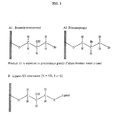
- Another advantage is that ligand coupling is accomplished with one less step than such conventional methods and the use of essentially no exogenous catalysts (although such catalysts can be employed). Also, the use of bromine or bromine/water is eliminated. This latter aspect is significant insofar as FIG. 2 illustrates that side reactions with bromine or bromine/water (or other halides) will lead to a certain level of halide incorporation into the matrix whereas the processes described herein will not. Accordingly, the methods described herein provide for a level of halide in the resulting resin of less than about 0.2% (per gram dry).
- Still another advantage achieved by the methods described herein is that covalent attachment of several ligands is more efficient via the free radical process described herein as opposed to such conventional processes while still obtaining very high ligand densities.
- allyl glycidyl ether, thiolacetic acid, mercaptoacetic acid, thiosalicylic acid, cysteamine ⁇ HCl, and 3-mercaptopropionic acid were obtained from Janssen Chimica, Geel, Belgium; 4-mercaptopyridine, mercaptosuccinic acid, and thiophenol were obtained from Aldrich-Chemie, Steinheim, Germany or Aldrich Chemical Co., Milwaukee, Wisconsin, USA; glutathione and butyrolactone were obtained from Sigma Chemical Co., St.
- Perloza resins were from Tessek, Ltd., Prague, Czech Republic or from ICS, Prague, Czech Republic. Sepharose resins was from Pharmacia, Uppsala, Sweden. Perloza resins can also be obtained from Lovochemie, Lovosice, Czech Republic.
- DMSO% DMSO used (mL)/g resin.
- weights of matrix given in grams refers to suction dry weights whereas weights given in grams (dry) refer to oven dried weights ( ⁇ 110°C for 1 to 2 hours, cooled in a dry environment). It is understood that suction dry weights for matrices are still water solvated materials.
- 4-Mercaptoethylpyridine ⁇ HCl was prepared from 4-vinyl pyridine and thiolacetic acid by an adaptation of the method described by Vinton 14 for preparation of 2-mercaptoethylpyridine.
- 4-vinyl pyridine (95%, 250 mL) was prechilled to -30°C (methanol/ice bath) and thiolacetic acid (170 mL) was added dropwise over a period of about 1 hour.
- the solution froze after 5-10 minutes and the addition rate was increased to raise the temperature to 15-25°C and allow efficient stirring. Further addition was controlled to maintain reaction temperature between 15-25°C and not exceeding 30°C.
- the reaction was stirred for a further 1 hour to room temperature and then overnight.
- the product was mixed with ether and extracted with saturated sodium bicarbonate solution 3 times (note on the third extraction no gas was evolved).
- the ether layer was washed once with saturated salt solution, treated with activated charcoal to reduce color and dried over anhydrous magnesium sulfate. It was then filtered and evaporated under vacuum with a bath temp about 30°C.
- the resulting oil was stirred for at least 4 hours with 800 mL of 6 M HCl and then the acid layer reduced under vacuum.
- the dried solid was slurried with isopropyl alcohol, filtered and dried to give 328 g (theoretical 387 g) of creamy white 4-mercapto-ethylpyridine hydrochloride (85%), m.p. 190-191°C (lit.
- This example outlines for illustrative purposes only various methods used for the preparation of ethylenically unsaturated groups pendant to a support matrix. It describes, for example, the activation of two different support matrices with two different allyl reagents under varying reaction conditions. The effects of allyl reagent concentration, solvent type, reaction temperatures and time are also examined and the resulting ligand densities are compared using various titration methods.
- Reactions at room temperature were mixed mechanically by addition of the resin to an Ika Vibra-mix shaker unless otherwise indicated. Reactions at elevated temperature were incubated in a water bath without external mixing. Glass vials (25 mL) were used routinely for matrix samples up to 15 g. Glass jars, up to 1250 mL capacity, were used for larger reaction mixtures. Perloza 100 fine was used for activation reactions unless otherwise indicated. Perloza was washed with water or solvent exchanged to the solvent mixture used for activation and suction-dried in a sintered glass funnel. Activation mixtures were identified by the volume of allyl reagent (mL) per 100 g suction-dried matrix, expressed as a percentage.
- allyl bromide activation is as follows. Perloza cellulose (MT 100 fine) was washed with 5 volumes of water (MilliQ grade) and suction dried. A 10 quantity of the matrix was mixed with 0.8 mL allyl bromide (redistilled), 0.8 g barium hydroxide octahydrate. 2 mL DMSO and 1 mL water for 48 hours at room temperature. The activated matrix was washed with 5 volumes of a 10% DMSO/90 % water mixture, 5 volumes of 0.1 M HCl and 10 volumes of water. Allyl group concentration was determined by the bromine water method described in Example III below.
- sodium hydroxide solutions were replaced by barium hydroxide (2 g), calcium hydroxide (0.5 g) or potassium phosphate (3 g) per mL allyl bromide used. Barium hydroxide was also used for a 10% activation of 75% DMSO solvated Perloza and a 25% activation of water solvated Perloza, both at room temperature for 24 hours.
- the standard reaction (24 hour) mixture was 10 g water solvated Perloza, 1.5 mL solvent, 0.7 mL allyl bromide and 2.4 mL of 3.75 M NaOH. Solvents used were: DMSO, dioxane, acetone, ethanol and water. A second DMSO sample was reacted for 7 hours. A further DMSO reaction used 1.4 g Ba(OH) 2 and 2 mL water instead of NaOH solution.
- Water solvated Perloza (10 g), with or without 1.5 mL DMSO, was mixed with 0.7 mL allyl bromide and 3 mL of 3M NaOH, 4.5 mL of 2 M NaOH or 5 mL of 2 M NaOH.
- the preferred conditions for a 7% activation used 4.5 mL of 2 M NaOH (no DMSO).
- a "stock 7%" activated Perloza was prepared by reaction of 100 g Perloza with 7 mL allyl bromide and 45 mL of 2 M NaOH.
- the volume of NaOH used was maintained between 0.4 to 0.45 mL of solution/g Perloza.
- the NaOH molarity was varied such that 12.5 to 13 mMoles of hydroxide were used per mL (approximately 12 mMoles) of allyl bromide.
- a second stock 10% activation of uncrosslinked Perloza (75 g) used 7.5 mL allyl bromide and 32 mL of 3 M NaOH.
- Sepharose 6B (10 g) was reacted with 0.5 mL allyl bromide, 0.1 mL ECH (crosslinker) and 6 mL of 1.7 M NaOH for 48 hours at room temperature. Another sample of Sepharose 6B was reacted likewise, except that 1 mL allyl bromide and 6 mL of 2.5 M NaOH were used. Sepharose CL6B was reacted with 0.6 mL allyl bromide and 4.5 mL of 2 M NaOH for 18 hours at room temperature.
- allyl glycidyl ether activation is as follows. Perloza cellulose (Perloza MT 100 fine beaded cellulose) was washed with 5 volumes of water (MilliQ grade water) and 3 volumes of 0.3 M NaOH and suction dried. A 40 g quantity of the matrix was mixed with 12 mL of 99 + % allyl glycidyl ether by vigorous shaking. The mixture was left at room temperature for 48 hours with occasional shaking. The activated matrix was washed with 10 volumes of water and suspended in 3 volumes of water. Bromine water (1%) was added slowly over 5 minutes until the mixture no longer decolorized the bromine water. The brominated resin was washed with 10 volumes of water.
- Allyl group concentration on the resins was determined by the amount of bromine water decolorized.
- the concentration of reactive bromine groups on the resin (1 g sample suspended in 9 mL water) was determined by substitution with 0.5 g sodium sulfite (4 hours, 60°C), followed by 0.1 M NaOH titration to pH 8. Similar reactions were carried out using different reaction times, temperatures, and reagent percentages.
- Reaction mixtures containing an organic solvent were prepared similarly, except that the Perloza (10 g) was pretreated with a mixture of 0.3 M NaOH and solvent.
- the solvent mixtures used were 1:2 (acetone/0.3 M NaOH) and 1:1 (DMSO/0.3 M NaOH). These reaction mixtures had superior "fluid" properties to aqueous ones and were mixed by mechanical shaking.
- Another aqueous activation was prepared without pretreatment by mixing water solvated Perloza (8 g) with 2 mL of 1.5 M NaOH and 1.2 mL allyl glycidyl ether. This product was a more "fluid" slurry.
- a stock allyl glycidyl ether Perloza was prepared in analogous fashion by repeat aqueous slurry activation of 50 g cellulose using 15% allyl glycidyl ether followed by 12 % allyl glycidyl ether (and 10 mL of 2 M NaOH on each occasion). Reagents and products of the first reaction were washed out (in a sintered glass funnel) with water before the second addition of reagent and NaOH.
- the relationship between the ratio of reagent to cellulose and the resulting activation level for 1:6 DMSO:water solvated cellulose was determined using 5, 10 and 15% allyi bromide and Ba(OH) 2 .
- the activation levels were 0.99, 1.42 and 1.97 mMoles/g (dry) respectively.
- the titration values increased in a roughly linear fashion. See, for example, Table 1 below. There was no indication of reduced reactivity of cellulose at increasing levels of activation. This was consistent with the extremely high activation levels obtained previously.
- allyl bromide activation levels were determined by mercaptopropionic acid addition and titration (titration methods described below). Correlation with bromine water titration values (Table 1) was reasonable and the variations due to visual assessment of titration endpoint and falling bromine content over time were avoided. By contrast sulfonate titration values gave a low estimate of activation level, especially at high allyl bromide percentages.
- the mercaptopropionic acid titration method was used henceforth for routine assay of activation levels until mercaptopropionic acid was replaced by mercaptoacetic acid.
- a 7 hour reaction sample had an activation level of approximately 70% of the 24 hour reaction sample. Because an extra 1.5 mL of water was used for the aqueous sample, the difference between the aqueous and DMSO/acetone activation level may be simply attributed to the increased water:cellulose rather than the reaction being enhanced by organic solvents.
- Allyl glycidyl ether was initially reacted with Perloza solvated with 0.3 M NaOH, by analogy to the optimal hydroxide concentration reported by Sundberg and Porath 4 for bisepoxide activation.
- Reaction mixtures were prepared as thick suspensions by mixing allyl glycidyl ether with suction dried (NaOH solvated) cellulose.
- the standard amount of allyl glycidyl ether used was 0.3 mL/g (30%). Reaction at 60°C was complete by 5 hours.
- the (unassayed) bromine water titration of 1.7 mL/g suction-dried Perloza was unchanged after a further 19 hours reaction.
- acetone or DMSO is believed to improve the "fluidity" of the reaction mixture allowing efficient mixing by rotation or shaking.
- Extra 0.3 M NaOH (2 mL per 8 g or Perloza) was required for similar mixing of 100% aqueous samples.
- a 48 hour activation by this method with 15% allyl glycidyl ether resulted in an activation level of 0.113 mMoles/g.
- Stock allyl glycidyl ether (27%) was prepared by this aqueous slurry method, using 15% allyl glycidyl ether followed by a second activation step with 12% allyl glycidyl ether. The activation level was 0.153 mMoles/g.
- the extent of allyl incorporation on the matrix was initially quantified using 2 % bromine water titration and subsequently a mercaptoacid titration of the allyl groups was developed.
- Bromine water titration was by incremental addition (using 100 ⁇ L, 200 ⁇ L, or 1 mL Gilson pipettes) of calibrated (approximately 2%) bromine water to a 0.5 - 2 g sample of activated matrix. The smallest increments (50 ⁇ L) were used once the rate of bromine decolorization had slowed noticeably, usually after 60-75% of the total addition. The endpoint was determined visually. Titration was usually complete in 2-5 minutes.
- Bromine water was calibrated by two methods:
- Bromine water quantification was improved by using the spectrophotometric assay of the bromine water immediately before titration. This bromine water titration was still less than ideal for a routine laboratory assay because of accuracy limitations and noxious fumes associated with use of bromine water.
- Activated matrix (1 g) was mixed with 100 ⁇ L of mercaptoacetic acid (MAA) 6r mercaptopropionic acid (MPA) and 1-5 mL water. The mixture was incubated for 4-16 hours at 60°C or for 24-48 hours at room temperature (MAA only). Samples were transferred to a sintered glass funnel and excess reagent washed out with 20 mL water, 20 mL 0.1 M NaOH and 10x20 mL water. Titration of carboxylic acid groups provided the level of allyl incorporation onto the matrix.
- MAA mercaptoacetic acid
- MPA 6r mercaptopropionic acid
- allyl Perloza and allyl glycidyl ether Perloza refer to water solvated, suction-dried Perloza unless otherwise indicated.
- Examples 4-10 demonstrate facile attachment of a wide range of thiols and bisulfite ions to allyl matrices by specific free radical addition thereby permitting a wide range of different ligands to be attached to these matrices which, in turn, allows for facile target compound separation. Additionally, in contrast to prior art methods, specificity of the free radical addition was demonstrated by the absence of reaction with an amine (ethanolamine) under these conditions.
- Unmodified Perloza was also reacted with mercaptopropionic acid and mercaptoacetic acid by this method and served as a control.
- mercaptosuccinic acid was reacted- with allyl Perloza (prepared as above) and water (1:1) for 16 hours at 60°C or for 64 hours at room temperature.
- Mercaptosuccinic acid (0.15 g/g matrix) was dissolved in the reaction mixture.
- the efficiency of mercaptosuccinic acid addition was improved by reaction at room temperature for 60 hours.
- Stock 7% allyl bromide activated Perloza (mercaptoacetic acid titration of 0.174/g) was used.
- the titration value for mercaptosuccinic acid was 0.313 meq/g (0.157 mMoles/g, 90%) to pH 8.
- the thiol group of mercaptosuccinic acid is secondary (steric restriction more likely), a very high addition level was thus obtained.
- the titration value was not found to increase significantly above pH 8 (0.317 meq/g to pH 9).
- the mercaptosuccinic acid derivative could be used for ion exchange chromatography. Specific ionic interactions may occur with the dicarboxylic acid moiety.
- glutathione free acid form
- Glutathione was also reacted (at 60°C) with Perloza, using 0.2 M H 3 PO 4 instead of water.
- Titration to pH 11 would also include the amino group of glutathione. This presumed that the second carboxyl group of glutathione would be associated with the amino group in the carboxylate ion form at the start of titration. Allowing for dilution effects (a blank titration to pH 11 was 0.017 mMoles/g), when titrating between pH 10 and 11, an addition level of 0.093 mMoles/g (70% of mercaptoacetic acid) was calculated.
- the efficiency of glutathione addition was improved by reaction at room temperature for 60 hours.
- Stock 7% allyl bromide activated Perloza (mercaptoacetic acid titration of 0.174/g) was used.
- the titration for the glutathione resin was 0.136 and 0.300 meq/g to pH 7 and 11 respectively.
- the addition level was calculated to be 0.142 mMoles/g (82 %) after subtraction of the blank titration value.
- the high efficiency of glutathione addition at room temperature suggested that this method could be used for immobilization of other thiol containing peptides and possibly proteins, without requiring elevated temperature.
- Free radical addition of glutathione represents a very simple method for production of glutathione affinity resins. Unreacted allyl groups are readily blocked using mercaptoethanol.
- the addition level of glutathione might also be increased if a higher molar excess (than 3) were used.
- thiol ligand does not add to ethylenic unsaturation exemplified by an allyl group, it is not a reactive thiol ligand for the purposes of this invention.
- the slightly lower level of addition of glutathione and mercaptosuccinic acid as compared to mercaptoacetic acid might be due to inhibition by the amine group (GSH), greater ionization of the diacidic ligands (compared to mercaptoacetic acid), steric effects or simply poorer reactivity.
- the addition level of glutathione might also be increased if a higher molar excess (than 3) were used.
- mercaptoethanol 100 ⁇ L was at 60°C (16 hours) or room temperature (24 or 48 hours).
- Dithiothreitol addition was conducted by mixing allyl Perloza (2 g, 0.16 mMoles/g) with a 4 molar excess (0.17 g) of dithiothreitol for 48 hours at room temperature.
- the mercaptoacetic acid back titration result for dithiothreitol addition was 0.062 mMoles/g which corresponds to approximately 0.1 mMoles/g of dithiothreitol attached to the resin.
- the addition reaction can be modified by using a smaller reaction volume.
- solutions containing equal parts (by weight) of sodium metabisulfite and sodium sulfite were used. Initially, the total sulfite plus bisulfite salt percentage was 32 % and 1 mL of "bisulfite" solution was used per g matrix. Later reactions used a 40% sulfite solution (0.7-1.0 mL/g matrix). Up to half of this solution (0.2-0.5 mL/g) was used to prewash the matrix, which was then suction-dried, while the other 0.5 mL/g was used for the reaction mixture. All larger scale reactions (20-250 g allyl Perloza) were carried out by this method. It was also used for a control reaction with unmodified Perloza.
- the first addition reactions used unbuffered cysteine hydrochloride. Reaction was for 16 hours at 60°C using allyl glycidyl ether activated Perloza (1 g), 0.08 g cysteine ⁇ HCl and 5 mL water. Subsequently, cysteine (5 molar excess, +/- 50 ⁇ L formic acid) was used rather than its hydrochloride. Trichloroacetic acid, oxalic acid or acetic acid were also used instead of formic acid (1 mole/mole of cysteine). Acetic and formic acids were also used in larger amounts (5 or 10 molar equivalents).
- Cysteamine and 4-mercaptoethylpyridine hydrochlorides (5 molar excess) were neutralized with a 1 molar equivalent of (7.5 M) NaOH and reacidified with a 2-5 molar excess of an organic acid.
- acetic acid was used and the solutions were reacted with allyl glycidyl ether Perloza for 16 hours at 60°C. These are referred to as cysteamine/acetate and 4-mercaptoethylpyridine/acetate addition mixtures.
- Formic acid was used for subsequent additions (cysteamine/formate and 4-mercaptoethylpyridine/formate mixtures).
- a control sample of 10% stock allyl bromide Perloza and cysteamine ⁇ HCl was also reacted for 144 hours at 70°C. The same temperature was used for addition (96 hours) of a 10 molar excess of cysteine/formic acid to stock 10% allyl bromide Perloza (1.7 g). Control reactions (96 hours, 60°C) with allyl Perloza used ethanolamine (+/- 1 molar equivalent of formic acid). A control reaction was also carried out using unmodified Perloza and cysteamine/formate.
- the MEP acetate solution was mixed with 3 g allyl Perloza (0.203 mMoles/g; 1.45 mMoles/g dry) in a 30 mL beaker, sealed with plastic wrap and irradiated (lamp at 15-20 cm from the top of the beaker) for 3 hours. Some warming of the reaction mixture occurred but it was estimated to be only to between 30 and 40°C.
- the resulting resin had a pyridyl titration level of 0.24 mMoles/g (1.36 mMoles/g dry).
- cysteine ⁇ HCl was replaced by cysteine (a 5 molar excess, 0.1 g), used with or without a one molar excess of formic acid.
- the addition in the presence of formic acid was more successful (0.063 compared to 0.012 mMoles/g).
- Cysteamine/formic acid addition resulted in a titration of 0.035 mMoles/g on another allyl glycidyl ether matrix (0.082 mMoles/g by mercaptoacetic acid titration).
- cysteamine refers to cysteamine/formate mixtures except for one sample using cysteamine ⁇ HCl.
- Stock 7% allyl bromide Perloza was used for cysteamine additions at 60°C, stock 10% allyl bromide Perloza for addition at 70°C unless otherwise indicated.
- glutathione has a surplus of acidic over amine groups (solutions used had a pH of 2) and the nitrogen most adjacent to the thiol group is part of a neutral amide bond.
- Allyl glycidyl ether activated Perloza was reacted with thiolacetic acid (100 ⁇ L) and 5 mL water for 24 hours at room temperature or 16 hours at 60°C. Another room temperature reaction used ethanol solvation rather than water.
- the allyl glycidyl ether activated Perloza was washed with 5 volumes each of 50% and 100% ethanol, suction-dried, and mixed with thiolacetic acid and 5 mL of ethanol.
- Water solvated allyl bromide Perloza (7% stock) was used for addition of thiolacetic acid (0.2 mL), together with 2 mL each of water and ethanol, for 90 hours at room temperature.
- Thiophenol (0.2 mL) was mixed with 7% stock allyl bromide Perloza (1 g), 2 mL water and 3 mL acetone or ethanol, for 90 hours at room temperature.
- Thiolacetate resins were washed with 20 volumes of water. Thiophenol resins were washed with 10 volumes each of ethanol, 0.1 M NaOH and water. Unreacted allyl groups were determined by mercaptoacetic acid "back" titration.
- Mercaptoethylpyridine (MEP) Perloza prepared as above, (with a normal pyridyl titration curve, start pH of 6.8) was used according to the method of Burton et al.' for adsorption of crude subtilisin and amylase and elution by a pH change. Both enzymes were loaded at pH 7.5 (20 mM HEPES + 0.5 M NaCl) and eluted at pH 5.2 (20 mM acetate). Chromatographic properties were indistinguishable from those of MEP resins produced by allyl activation, bromination and nucleophilic substitution.
Landscapes
- Chemical & Material Sciences (AREA)
- Analytical Chemistry (AREA)
- Organic Chemistry (AREA)
- Chemical Kinetics & Catalysis (AREA)
- Inorganic Chemistry (AREA)
- Solid-Sorbent Or Filter-Aiding Compositions (AREA)
- Addition Polymer Or Copolymer, Post-Treatments, Or Chemical Modifications (AREA)
- Polymers With Sulfur, Phosphorus Or Metals In The Main Chain (AREA)
- Treatment Of Liquids With Adsorbents In General (AREA)
- Organic Low-Molecular-Weight Compounds And Preparation Thereof (AREA)
- Graft Or Block Polymers (AREA)
- Processing And Handling Of Plastics And Other Materials For Molding In General (AREA)
- Polyesters Or Polycarbonates (AREA)
- Medicines That Contain Protein Lipid Enzymes And Other Medicines (AREA)
- Macromolecular Compounds Obtained By Forming Nitrogen-Containing Linkages In General (AREA)
Applications Claiming Priority (3)
| Application Number | Priority Date | Filing Date | Title |
|---|---|---|---|
| US584423 | 1984-02-28 | ||
| US08/584,423 US5789578A (en) | 1996-01-11 | 1996-01-11 | Methods for the preparation of resins with ligands attached thereto through a linking group comprising sulfide, sulfoxide or sulfone functionality |
| EP97901278A EP0891223B1 (de) | 1996-01-11 | 1997-01-10 | Methode zur herstellung von harzen mit daran befestigten liganden, wobei die verbindende funktionelle gruppe sulfid, sulfoxid oder sulfon umfasst |
Related Parent Applications (1)
| Application Number | Title | Priority Date | Filing Date |
|---|---|---|---|
| EP97901278A Division EP0891223B1 (de) | 1996-01-11 | 1997-01-10 | Methode zur herstellung von harzen mit daran befestigten liganden, wobei die verbindende funktionelle gruppe sulfid, sulfoxid oder sulfon umfasst |
Publications (2)
| Publication Number | Publication Date |
|---|---|
| EP1464391A2 true EP1464391A2 (de) | 2004-10-06 |
| EP1464391A3 EP1464391A3 (de) | 2004-12-29 |
Family
ID=24337265
Family Applications (2)
| Application Number | Title | Priority Date | Filing Date |
|---|---|---|---|
| EP04015823A Withdrawn EP1464391A3 (de) | 1996-01-11 | 1997-01-10 | Methode zur Herstellung von Harzen mit daran befestigten Liganden, wobei die verbindende funktionelle Gruppe Sulfid, Sulfoxid, Sulfon oder Sulfonat umfasst |
| EP97901278A Expired - Lifetime EP0891223B1 (de) | 1996-01-11 | 1997-01-10 | Methode zur herstellung von harzen mit daran befestigten liganden, wobei die verbindende funktionelle gruppe sulfid, sulfoxid oder sulfon umfasst |
Family Applications After (1)
| Application Number | Title | Priority Date | Filing Date |
|---|---|---|---|
| EP97901278A Expired - Lifetime EP0891223B1 (de) | 1996-01-11 | 1997-01-10 | Methode zur herstellung von harzen mit daran befestigten liganden, wobei die verbindende funktionelle gruppe sulfid, sulfoxid oder sulfon umfasst |
Country Status (12)
| Country | Link |
|---|---|
| US (1) | US5789578A (de) |
| EP (2) | EP1464391A3 (de) |
| JP (1) | JP3970928B2 (de) |
| AT (1) | ATE279977T1 (de) |
| AU (1) | AU722740B2 (de) |
| CA (1) | CA2240064C (de) |
| DE (1) | DE69731287T2 (de) |
| DK (1) | DK0891223T3 (de) |
| ES (1) | ES2227666T3 (de) |
| NZ (1) | NZ326487A (de) |
| PT (1) | PT891223E (de) |
| WO (1) | WO1997025139A1 (de) |
Cited By (2)
| Publication number | Priority date | Publication date | Assignee | Title |
|---|---|---|---|---|
| WO2007027139A1 (en) * | 2005-08-31 | 2007-03-08 | Ge Healthcare Bio-Sciences Ab | Manufacture of chromatography matrices |
| CN110144019A (zh) * | 2018-02-10 | 2019-08-20 | 合肥博思科创医药科技有限公司 | 一种舒更葡糖钠粗品的精制纯化方法 |
Families Citing this family (37)
| Publication number | Priority date | Publication date | Assignee | Title |
|---|---|---|---|---|
| US5998606A (en) * | 1997-11-10 | 1999-12-07 | Grandics; Peter | Mn(IV)-mediated crosslinking and functionalization of chromatography media |
| US7001745B1 (en) * | 1998-09-30 | 2006-02-21 | New England Biolabs, Inc. | Intein mediated peptide ligation |
| EP1178838B1 (de) | 1999-05-14 | 2004-09-29 | The Regents of the University of California | Makromolekular träger auf basis von dextran fur arzneimittel und diagnosticum abgabe |
| US6623655B1 (en) | 2000-04-24 | 2003-09-23 | Sigma-Aldrich Co. | Metal chelating compositions |
| SE0003358D0 (sv) * | 2000-09-19 | 2000-09-19 | Amersham Pharm Biotech Ab | Charged carrier material and its use |
| SE0004808D0 (sv) * | 2000-12-20 | 2000-12-20 | Apbiotech Ab | Method for the purification of an enzyme |
| GB2377447B (en) * | 2001-04-18 | 2003-06-25 | Amersham Biosciences Ab | Isolation of dna molecules |
| SE0103084D0 (sv) * | 2001-09-14 | 2001-09-14 | Amersham Pharm Biotech Ab | Generation of ion exchange media |
| JP2005539223A (ja) * | 2002-09-13 | 2005-12-22 | ポール コーポレイション | クロマトグラフィーの吸着剤およびバイオチップアレイのための混合モード固体基材の調製および使用 |
| JP4801598B2 (ja) * | 2004-01-20 | 2011-10-26 | ポール・コーポレーション | 生理的イオン強度でタンパク質を吸着させるためのクロマトグラフィー材料 |
| WO2007058599A1 (en) * | 2005-11-21 | 2007-05-24 | Ge Healthcare Bio-Sciences Ab | Manufacture of a chromatography matrix |
| US8431748B2 (en) * | 2006-01-16 | 2013-04-30 | Bwe I Malmo Ab | Low protonation constant hydroxy acids |
| WO2008008872A2 (en) | 2006-07-14 | 2008-01-17 | Wisconsin Alumni Research Foundation | Adsorptive membranes for trapping viruses |
| WO2009126603A1 (en) | 2008-04-08 | 2009-10-15 | Bio-Rad Laboratories, Inc. | Chromatography purification of antibodies |
| US20100196272A1 (en) | 2009-01-30 | 2010-08-05 | Neoprobe Corporation | Compositions for radiolabeling diethylenetriaminepentaacetic acid (dtpa)-dextran |
| WO2011090428A1 (en) * | 2010-01-19 | 2011-07-28 | Organoclick Ab | Heterogeneous thiol-ene click modifications of solid polysaccharide-based materials |
| AU2012236099A1 (en) | 2011-03-31 | 2013-10-03 | Moderna Therapeutics, Inc. | Delivery and formulation of engineered nucleic acids |
| US8802448B2 (en) * | 2011-07-27 | 2014-08-12 | Pall Corporation | Mixed mode ligands |
| WO2013051715A1 (ja) * | 2011-10-07 | 2013-04-11 | 東ソー株式会社 | パラジウム分離剤、並びにその製造方法及び用途 |
| WO2013151665A2 (en) | 2012-04-02 | 2013-10-10 | modeRNA Therapeutics | Modified polynucleotides for the production of proteins associated with human disease |
| US9283287B2 (en) | 2012-04-02 | 2016-03-15 | Moderna Therapeutics, Inc. | Modified polynucleotides for the production of nuclear proteins |
| WO2014152031A1 (en) * | 2013-03-15 | 2014-09-25 | Moderna Therapeutics, Inc. | Ribonucleic acid purification |
| US10590161B2 (en) | 2013-03-15 | 2020-03-17 | Modernatx, Inc. | Ion exchange purification of mRNA |
| WO2014152027A1 (en) | 2013-03-15 | 2014-09-25 | Moderna Therapeutics, Inc. | Manufacturing methods for production of rna transcripts |
| EP2971165A4 (de) | 2013-03-15 | 2016-11-23 | Moderna Therapeutics Inc | Entfernung von dna-fragmenten in mrna-herstellungsverfahren |
| CA2917348A1 (en) | 2013-07-11 | 2015-01-15 | Moderna Therapeutics, Inc. | Compositions comprising synthetic polynucleotides encoding crispr related proteins and synthetic sgrnas and methods of use |
| EP3052511A4 (de) | 2013-10-02 | 2017-05-31 | Moderna Therapeutics, Inc. | Polynukleotidmoleküle und verwendungen davon |
| JP5825612B2 (ja) * | 2013-11-14 | 2015-12-02 | 学校法人兵庫医科大学 | 新規固相担体 |
| WO2015196128A2 (en) | 2014-06-19 | 2015-12-23 | Moderna Therapeutics, Inc. | Alternative nucleic acid molecules and uses thereof |
| US10407683B2 (en) | 2014-07-16 | 2019-09-10 | Modernatx, Inc. | Circular polynucleotides |
| JP6602533B2 (ja) * | 2014-09-02 | 2019-11-06 | Jsr株式会社 | 担体の製造方法、担体、クロマトグラフィーカラム、及び目的物質の精製方法 |
| WO2017049286A1 (en) | 2015-09-17 | 2017-03-23 | Moderna Therapeutics, Inc. | Polynucleotides containing a morpholino linker |
| EP3350333B2 (de) | 2015-09-17 | 2025-08-06 | ModernaTX, Inc. | Polynukleotide mit stabilisierendem schwanzbereich |
| WO2017223176A1 (en) | 2016-06-24 | 2017-12-28 | Modernatx, Inc. | Methods and apparatus for filtration |
| US10315185B2 (en) * | 2016-07-14 | 2019-06-11 | University Of Oregon | Polyfunctional sorbent materials |
| JP2024024315A (ja) * | 2022-08-09 | 2024-02-22 | 学校法人同志社 | 新規化合物及びその製造方法 |
| CN118106042A (zh) * | 2024-03-25 | 2024-05-31 | 浙江大学衢州研究院 | 一种磺酸基阳离子交换介质的制备方法 |
Family Cites Families (18)
| Publication number | Priority date | Publication date | Assignee | Title |
|---|---|---|---|---|
| US2607776A (en) * | 1945-12-27 | 1952-08-19 | Du Pont | Mercaptoethyl pyridines and method of preparing same |
| SE420733B (sv) * | 1974-05-30 | 1981-10-26 | Exploaterings Ab Tbf | Gelprodukt, innehallande tiosulfatgrupper samt sett for framstellning derav |
| SE448631B (sv) * | 1978-04-28 | 1987-03-09 | Toyo Jozo Kk | Disulfidforening av en berare med s-s-utbytesreaktivitet |
| US4415678A (en) * | 1981-10-02 | 1983-11-15 | The Dow Chemical Company | Removal of sulfate ions from brine using amorphous polymeric zirconium oxide formed within a macroporous polymer matrix |
| US4415428A (en) * | 1982-01-27 | 1983-11-15 | Fmc Corporation | Support for electrophoresis and method of producing same |
| CA1206666A (en) * | 1982-02-19 | 1986-06-24 | Samuel Nochumson | Copolymer of acrylamide and polysaccharide resin as electrophoretic gel medium |
| SE470261B (sv) * | 1984-05-17 | 1993-12-20 | Jerker Porath | Adsorbent för separation och immobilisering av proteiner, sätt att framställa ett adsorbent, samt dess användning för biopolymer fraktionering |
| SE458525B (sv) * | 1985-05-23 | 1989-04-10 | Pharmacia Ab | Foerfarande foer tvaerbindning av en poroes agar- eller agarosgel |
| FR2605237B1 (fr) * | 1986-10-20 | 1990-10-12 | Centre Nat Rech Scient | Support pour la purification et la separation des proteines, procede de preparation et application en chromatographie |
| CA1320718C (en) * | 1987-06-08 | 1993-07-27 | Richard Frederick Hammen | Chromatographic material |
| US4904632A (en) * | 1987-06-19 | 1990-02-27 | Pesek Joseph J | Surface-modified chromatographic separation material |
| IL89047A0 (en) * | 1989-01-24 | 1989-08-15 | Yeda Res & Dev | Thiophilic adsorbents |
| GB8902761D0 (en) * | 1989-02-08 | 1989-03-30 | Ici Plc | Cation echange membranes |
| JPH0778081B2 (ja) * | 1990-07-19 | 1995-08-23 | 静岡大学長 | 機能化高分子の合成方法 |
| SE468814B (sv) * | 1991-07-22 | 1993-03-22 | Inovata Ab | Foerfarande foer att binda en foerening innehaallande en nukleofil grupp till en amin -och/eller hydroxigrupphaltig polymer |
| DE9300912U1 (de) * | 1993-01-23 | 1993-04-29 | Macherey, Nagel GmbH & Co. Handelsgesellschaft, 52355 Düren | Trennmaterial für die Chromatographie |
| US5502022A (en) * | 1994-05-16 | 1996-03-26 | Biosepra, Inc. | Chromatography adsorbents utilizing mercapto heterocyclic ligands |
| US20040214157A1 (en) * | 1994-06-29 | 2004-10-28 | Simon C. Burton | Chromatographic resins and methods for using same |
-
1996
- 1996-01-11 US US08/584,423 patent/US5789578A/en not_active Expired - Lifetime
-
1997
- 1997-01-10 CA CA002240064A patent/CA2240064C/en not_active Expired - Lifetime
- 1997-01-10 WO PCT/NZ1997/000002 patent/WO1997025139A1/en not_active Ceased
- 1997-01-10 NZ NZ326487A patent/NZ326487A/xx not_active IP Right Cessation
- 1997-01-10 ES ES97901278T patent/ES2227666T3/es not_active Expired - Lifetime
- 1997-01-10 PT PT97901278T patent/PT891223E/pt unknown
- 1997-01-10 EP EP04015823A patent/EP1464391A3/de not_active Withdrawn
- 1997-01-10 AU AU14577/97A patent/AU722740B2/en not_active Expired
- 1997-01-10 AT AT97901278T patent/ATE279977T1/de active
- 1997-01-10 DK DK97901278T patent/DK0891223T3/da active
- 1997-01-10 DE DE69731287T patent/DE69731287T2/de not_active Expired - Lifetime
- 1997-01-10 EP EP97901278A patent/EP0891223B1/de not_active Expired - Lifetime
- 1997-01-10 JP JP52511097A patent/JP3970928B2/ja not_active Expired - Lifetime
Non-Patent Citations (1)
| Title |
|---|
| None * |
Cited By (4)
| Publication number | Priority date | Publication date | Assignee | Title |
|---|---|---|---|---|
| WO2007027139A1 (en) * | 2005-08-31 | 2007-03-08 | Ge Healthcare Bio-Sciences Ab | Manufacture of chromatography matrices |
| AU2006285453B2 (en) * | 2005-08-31 | 2010-11-04 | Ge Healthcare Bio-Sciences Ab | Manufacture of chromatography matrices |
| US8858800B2 (en) | 2005-08-31 | 2014-10-14 | Ge Healthcare Bio-Sciences Ab | Manufacture of chromatography matrices |
| CN110144019A (zh) * | 2018-02-10 | 2019-08-20 | 合肥博思科创医药科技有限公司 | 一种舒更葡糖钠粗品的精制纯化方法 |
Also Published As
| Publication number | Publication date |
|---|---|
| EP1464391A3 (de) | 2004-12-29 |
| PT891223E (pt) | 2005-02-28 |
| DE69731287D1 (de) | 2004-11-25 |
| EP0891223A1 (de) | 1999-01-20 |
| JP3970928B2 (ja) | 2007-09-05 |
| EP0891223B1 (de) | 2004-10-20 |
| WO1997025139A1 (en) | 1997-07-17 |
| ES2227666T3 (es) | 2005-04-01 |
| ATE279977T1 (de) | 2004-11-15 |
| AU1457797A (en) | 1997-08-01 |
| DE69731287T2 (de) | 2005-10-13 |
| JP2000502951A (ja) | 2000-03-14 |
| US5789578A (en) | 1998-08-04 |
| CA2240064C (en) | 2005-08-02 |
| AU722740B2 (en) | 2000-08-10 |
| CA2240064A1 (en) | 1997-07-17 |
| NZ326487A (en) | 1999-11-29 |
| EP0891223A4 (de) | 1999-07-28 |
| DK0891223T3 (da) | 2005-02-14 |
Similar Documents
| Publication | Publication Date | Title |
|---|---|---|
| AU722740B2 (en) | Methods for the preparation of resins with ligands attached thereto through a linking group comprising sulfide, sulfoxide, sulfone or sulfonate functionality | |
| US4048416A (en) | Thiopolymers, their derivatives and methods for their preparation and use | |
| US5092992A (en) | Polyethyleneimine matrixes for affinity chromatography | |
| US3956179A (en) | Process for the chemical modification of surfaces of inorganic solids | |
| JPH044018B2 (de) | ||
| US4837348A (en) | Bonded phase chromatographic supports | |
| US7988858B2 (en) | Method for generating metal chelating affinity ligands | |
| US5085779A (en) | Polyethyleneimine matrixes for affinity chromatography | |
| ES2929099T3 (es) | Material de soporte funcionalizado y métodos de fabricación y uso de material de soporte funcionalizado | |
| CN100595206C (zh) | 一种制备金属螯合亲合配体的方法 | |
| EP0180563A2 (de) | Amphipatisches Gelprodukt für chromatographische und gewöhnliche Adsorption | |
| JP4044048B2 (ja) | エナンチオ選択的カチオン交換材料 | |
| US9067195B2 (en) | Process for making improved chromatography media and method of use | |
| US4886755A (en) | Preparation of polymeric thiol gels for covalent bonding of biologically active ligands | |
| CA1332598C (en) | Polyethyleneimine matrixes for affinity chromatography | |
| EP0570381B1 (de) | Verfahren zur immobilisierung von thiolverbindungen über aktivierung von polymeren, aktivierte polymere und nach diesem verfahren erhaltene produkte | |
| EP0184361B1 (de) | Verfahren zur Aktivierung eines polymeren Trägers | |
| KR950004134B1 (ko) | 어피니티 크로마토그라피용 폴리에틸렌이민 매트릭스 | |
| JP7441209B2 (ja) | チオール基含有化合物の担持方法 | |
| Jackson et al. | Sulfur-containing resins from polyepichlorohydrin for mercury adsorption | |
| Gorecki et al. | [31] Lipoyl disulfide reducing polymers | |
| IE63044B1 (en) | Polyethyleneimine matrixes for affinity chromatography | |
| NZ229613A (en) | Polyethyleneamine matrix for chromatography |
Legal Events
| Date | Code | Title | Description |
|---|---|---|---|
| PUAI | Public reference made under article 153(3) epc to a published international application that has entered the european phase |
Free format text: ORIGINAL CODE: 0009012 |
|
| 17P | Request for examination filed |
Effective date: 20040726 |
|
| AC | Divisional application: reference to earlier application |
Ref document number: 0891223 Country of ref document: EP Kind code of ref document: P |
|
| AK | Designated contracting states |
Kind code of ref document: A2 Designated state(s): AT BE CH DE DK ES FI FR GB GR IE IT LI NL PT SE |
|
| PUAL | Search report despatched |
Free format text: ORIGINAL CODE: 0009013 |
|
| AK | Designated contracting states |
Kind code of ref document: A3 Designated state(s): AT BE CH DE DK ES FI FR GB GR IE IT LI NL PT SE |
|
| AKX | Designation fees paid |
Designated state(s): AT BE CH DE DK ES FI FR GB GR IE IT LI NL PT SE |
|
| 17Q | First examination report despatched |
Effective date: 20061215 |
|
| STAA | Information on the status of an ep patent application or granted ep patent |
Free format text: STATUS: THE APPLICATION HAS BEEN WITHDRAWN |
|
| 18W | Application withdrawn |
Effective date: 20101101 |