EP1467376A2 - Speicherzelle, Speichervorrichtung und Herstellungsverfahren für eine Speicherzelle - Google Patents
Speicherzelle, Speichervorrichtung und Herstellungsverfahren für eine Speicherzelle Download PDFInfo
- Publication number
- EP1467376A2 EP1467376A2 EP04252124A EP04252124A EP1467376A2 EP 1467376 A2 EP1467376 A2 EP 1467376A2 EP 04252124 A EP04252124 A EP 04252124A EP 04252124 A EP04252124 A EP 04252124A EP 1467376 A2 EP1467376 A2 EP 1467376A2
- Authority
- EP
- European Patent Office
- Prior art keywords
- film
- variable resistive
- schottky diode
- set forth
- resistive element
- Prior art date
- Legal status (The legal status is an assumption and is not a legal conclusion. Google has not performed a legal analysis and makes no representation as to the accuracy of the status listed.)
- Withdrawn
Links
Images










Classifications
-
- G—PHYSICS
- G11—INFORMATION STORAGE
- G11C—STATIC STORES
- G11C13/00—Digital stores characterised by the use of storage elements not covered by groups G11C11/00, G11C23/00, or G11C25/00
- G11C13/0002—Digital stores characterised by the use of storage elements not covered by groups G11C11/00, G11C23/00, or G11C25/00 using resistive RAM [RRAM] elements
- G11C13/0007—Digital stores characterised by the use of storage elements not covered by groups G11C11/00, G11C23/00, or G11C25/00 using resistive RAM [RRAM] elements comprising metal oxide memory material, e.g. perovskites
-
- G—PHYSICS
- G11—INFORMATION STORAGE
- G11C—STATIC STORES
- G11C11/00—Digital stores characterised by the use of particular electric or magnetic storage elements; Storage elements therefor
- G11C11/02—Digital stores characterised by the use of particular electric or magnetic storage elements; Storage elements therefor using magnetic elements
- G11C11/14—Digital stores characterised by the use of particular electric or magnetic storage elements; Storage elements therefor using magnetic elements using thin-film elements
- G11C11/15—Digital stores characterised by the use of particular electric or magnetic storage elements; Storage elements therefor using magnetic elements using thin-film elements using multiple magnetic layers
-
- G—PHYSICS
- G11—INFORMATION STORAGE
- G11C—STATIC STORES
- G11C13/00—Digital stores characterised by the use of storage elements not covered by groups G11C11/00, G11C23/00, or G11C25/00
- G11C13/0002—Digital stores characterised by the use of storage elements not covered by groups G11C11/00, G11C23/00, or G11C25/00 using resistive RAM [RRAM] elements
- G11C13/0021—Auxiliary circuits
- G11C13/0069—Writing or programming circuits or methods
-
- H—ELECTRICITY
- H10—SEMICONDUCTOR DEVICES; ELECTRIC SOLID-STATE DEVICES NOT OTHERWISE PROVIDED FOR
- H10B—ELECTRONIC MEMORY DEVICES
- H10B63/00—Resistance change memory devices, e.g. resistive RAM [ReRAM] devices
- H10B63/20—Resistance change memory devices, e.g. resistive RAM [ReRAM] devices comprising selection components having two electrodes, e.g. diodes
-
- G—PHYSICS
- G11—INFORMATION STORAGE
- G11C—STATIC STORES
- G11C13/00—Digital stores characterised by the use of storage elements not covered by groups G11C11/00, G11C23/00, or G11C25/00
- G11C13/0002—Digital stores characterised by the use of storage elements not covered by groups G11C11/00, G11C23/00, or G11C25/00 using resistive RAM [RRAM] elements
- G11C13/0021—Auxiliary circuits
- G11C13/0069—Writing or programming circuits or methods
- G11C2013/009—Write using potential difference applied between cell electrodes
-
- G—PHYSICS
- G11—INFORMATION STORAGE
- G11C—STATIC STORES
- G11C2213/00—Indexing scheme relating to G11C13/00 for features not covered by this group
- G11C2213/30—Resistive cell, memory material aspects
- G11C2213/31—Material having complex metal oxide, e.g. perovskite structure
-
- G—PHYSICS
- G11—INFORMATION STORAGE
- G11C—STATIC STORES
- G11C2213/00—Indexing scheme relating to G11C13/00 for features not covered by this group
- G11C2213/70—Resistive array aspects
- G11C2213/72—Array wherein the access device being a diode
-
- H—ELECTRICITY
- H10—SEMICONDUCTOR DEVICES; ELECTRIC SOLID-STATE DEVICES NOT OTHERWISE PROVIDED FOR
- H10N—ELECTRIC SOLID-STATE DEVICES NOT OTHERWISE PROVIDED FOR
- H10N70/00—Solid-state devices having no potential barriers, and specially adapted for rectifying, amplifying, oscillating or switching
- H10N70/011—Manufacture or treatment of multistable switching devices
- H10N70/061—Shaping switching materials
- H10N70/063—Shaping switching materials by etching of pre-deposited switching material layers, e.g. lithography
-
- H—ELECTRICITY
- H10—SEMICONDUCTOR DEVICES; ELECTRIC SOLID-STATE DEVICES NOT OTHERWISE PROVIDED FOR
- H10N—ELECTRIC SOLID-STATE DEVICES NOT OTHERWISE PROVIDED FOR
- H10N70/00—Solid-state devices having no potential barriers, and specially adapted for rectifying, amplifying, oscillating or switching
- H10N70/20—Multistable switching devices, e.g. memristors
-
- H—ELECTRICITY
- H10—SEMICONDUCTOR DEVICES; ELECTRIC SOLID-STATE DEVICES NOT OTHERWISE PROVIDED FOR
- H10N—ELECTRIC SOLID-STATE DEVICES NOT OTHERWISE PROVIDED FOR
- H10N70/00—Solid-state devices having no potential barriers, and specially adapted for rectifying, amplifying, oscillating or switching
- H10N70/801—Constructional details of multistable switching devices
- H10N70/821—Device geometry
- H10N70/826—Device geometry adapted for essentially vertical current flow, e.g. sandwich or pillar type devices
-
- H—ELECTRICITY
- H10—SEMICONDUCTOR DEVICES; ELECTRIC SOLID-STATE DEVICES NOT OTHERWISE PROVIDED FOR
- H10N—ELECTRIC SOLID-STATE DEVICES NOT OTHERWISE PROVIDED FOR
- H10N70/00—Solid-state devices having no potential barriers, and specially adapted for rectifying, amplifying, oscillating or switching
- H10N70/801—Constructional details of multistable switching devices
- H10N70/881—Switching materials
- H10N70/883—Oxides or nitrides
- H10N70/8836—Complex metal oxides, e.g. perovskites, spinels
Definitions
- the present invention relates to a 1D1R-type (a unit cell is constituted by one diode and one variable resistive element) of memory cell constituted by a series circuit of a variable resistive element and a Schottky diode, a memory device in which such memory cells are arranged in a matrix, and a manufacturing method of such memory cell.
- MRAMs Magnetic Random Access Memories
- MRAMs Magnetic Random Access Memories
- a ferromagnetic memory cell for storing information by residual magnetism of a ferromagnetic material of colossal magneto resistive material is constituted, and the stored information is read by converting a variation of an electric resistance value generated by a difference between directions of magnetization, to a voltage.
- a metal wiring for writing is provided in the ferromagnetic memory cell, and the direction of magnetization of the ferromagnetic memory cell is changed in a magnetic field generated when a current of milliampere-order is flowed to the metal wiring for writing, whereby information is written or rewritten in the ferromagnetic memory cell.
- the wiring for writing is formed of metal.
- 1T1R type (a unit cell is constituted by one transistor and one magneto resistive element) of MRAM is known, in which a pair of wirings intersecting with each other serves as both writing and reading lines, and a field effect transistor for selecting a cell and a magneto resistive element containing a colossal magneto resistive thin film are combined (see Japanese Patent Application Laid-Open No. 6-84347 (1994), for example).
- Such memory cell containing the colossal magneto resistive thin film exhibits a magneto resistive effect in which the electric resistance value varies depending on the direction of magnetization.
- W. J. Gallagher et. al. in IBM Ltd. have disclosed a memory array (memory device) in which a 1D1R type (a unit cell is constituted by one diode and one magneto resistive element) of MRAM comprising one magneto resistive element and one diode formed by one PN junction which are connected in series to each other is connected by X-Y wiring provided in a matrix (see U.S. Patent No. 5,640,343).
- TMR element tunnel magneto resistive element
- X-Y wirings provided in a matrix
- variable resistive element having a resistance variation rate higher than that of the magneto resistive element in the above-described MRAM
- a material having a perovskite-type crystalline structure, a double aligned perovskite-type crystalline structure or the like which exhibits colossal magneto resistive or high temperature super conductivity such as Pr (1-x) Ca x MnO 3 (0 ⁇ x ⁇ 1), La (1-x )Ca x MnO 3 (0 ⁇ x ⁇ 1), Nd (1-x) Sr x MnO 3 (0 ⁇ x ⁇ 1), Sr 2 FeMoO 6 , Sr 2 FeWO 6 or the like is known (see U.S. Patent No. 6,204,139).
- Pr (1-x) Ca x MnO 3 (0 ⁇ x ⁇ 1)
- La (1-x )Ca x MnO 3 (0 ⁇ x ⁇ 1)
- Nd (1-x) Sr x MnO 3 (0 ⁇
- U.S. Patent No. 6,204,139 there has been proposed a method in which one or more short electric pulses are applied to a thin film or a bulk formed of a thin film material having the perovskite structure, especially a colossal magneto resistive material and a high temperature super conductivity material, to change its electrical characteristics.
- An electric field strength and a current density caused by the electric pulse at this time can be low enough to change the physical condition of the material and not to destroy the material, and the electric pulse may be either positive or negative polarity.
- the material characteristics can be further changed by repeatedly applying the plural electric pulses to the above variable resistive element.
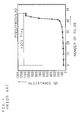
- FIG. 1 through FIG. 4 show characteristics of the variable resistive element disclosed in U.S. Patent No. 6,204,139.
- FIG. 1 and FIG. 2 are graphs schematically showing a relation between the number of applied pulses and a resistance value in the above variable resistive element.
- FIG. 1 shows a relation between the number of pulses applied to a CMR film grown on a metallic substrate and a resistance value.
- pulses up to 47 each having an amplitude of +32 V and a pulse width of 71 ns are applied.
- the resistance value changes in a range of about one digit as the number of applied pulses is increased.
- the pulse applied condition is changed, that is, pulses up to 168 each having an amplitude of +27 V and a pulse width of 65 ns are applied. Under such condition, as can be seen from the characteristics shown in FIG. 2, the resistance value changes in a range as many as about five digits as the number of applied pulses is increased.
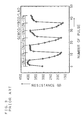
- FIG. 3 and FIG. 4 are graphs schematically showing a relation between applied pulse polarity and a resistance value of the above variable resistive element.
- FIG. 3 shows a relation between the number of applied pulses and the resistance value when pulses of +12 V (positive polarity) and -12 V (negative polarity) are applied.
- FIG. 4 shows a relation between the number of applied pulses and the resistance value which is measured after pulses of +51 V (positive polarity) and -51 V (negative polarity) are continuously applied.
- the resistance value can be increased (saturated state finally) by continuously applying the negative polarity pulses after it is reduced by applying positive polarity pulses several times.
- the element can be applied to a memory device by being set in a reset state when the positive polarity pulses are applied and in a writing state when the negative polarity pulses are applied thereto.
- the writing time is about several tens to 200 nanoseconds and an erasing operation can be performed by applying a voltage whose polarity is opposite to that in writing operation, for about several tens to 200 nanoseconds.
- a tungsten wiring, polycrystalline silicon, a diffusion layer (an impurity region) of a silicon substrate or the like which is strong in the high-temperature heating process can be used as the lower wiring.
- the 1D1R type of memory cell is constituted by the variable resistive element formed of a variable resistive material such as CMR, and the diode formed by the PN junction
- the sum of the forward threshold value of the diode and the voltage applied to the variable resistive element is applied to the memory cell at the time of reading operation.
- the applied voltage is high at the time of reading operation, a reading disturbance in which the resistance value changes at the time of reading operation is generated and, then, the resistance value of the variable resistive element changes from a low resistance state to a high resistance state, so that it is necessary to reduce the reading voltage as much as possible.
- the forward threshold value of the diode formed by the PN junction is relatively high (about 0.5 V), the reading disturbance is generated.
- a transistor constituting a word line decoder and a bit line decoder for selecting the memory cell and a transistor constituting a peripheral circuit such as a read circuit are formed first, a diode constituted by PN junction of polycrystalline silicon is formed next and, then, the variable resistive element is formed.
- the present invention was made in view of the above problems and it is an object of the present invention to provide a memory cell constituted by a series circuit of a variable resistive element and a Schottky diode, thereby reducing a reading disturbance, and a memory device comprising such memory cells.
- MOSFET transistor
- the memory cell comprises a variable resistive element and a current control element controlling a current flowing in the variable resistive element, and is characterized in that the current control element is a Schottky diode.
- the memory cell in the first aspect is characterized in that the variable resistive element is formed of a resistive material having a perovskite-type crystalline structure.
- the memory cell in the first or second aspect is characterized in that a first electrode of the Schottky diode is a second conductive type impurity region formed on a first conductive type semiconductor substrate, and a second electrode of the same is metal film deposited on the impurity region.
- the memory cell in the third aspect is characterized in that the semiconductor substrate is a silicon substrate, and the Schottky diode has a Schottky barrier between the impurity region and a metal silicide film formed between the impurity region and the metal film.
- the memory cell in the third or fourth aspect is characterized in that the impurity region is selectively formed in an element isolation region formed in the semiconductor substrate.
- the memory cell in any one of the third to fifth aspects is characterized in that a variable resistive film constituting the variable resistive element is deposited on the second electrode of the Schottky diode by a self-aligning manner.
- the memory cell in the first or second aspect is characterized in that a first electrode of the Schottky diode is a polycrystalline silicon region selectively formed in the insulating film, and a second electrode of the sama is a metal film deposited on the polycrystalline silicon region.
- the memory cell in the seventh aspect is characterized in that the Schottky diode has a Schottky barrier between the polycrystalline silicon region and a metal silicide film formed between the polycrystalline silicon region and the metal film.
- the memory device in which memory cells are located at positions where word lines and bit lines arranged in a matrix intersect with each other, and is characterized in that the memory cell is constituted by a series circuit including a variable resistive element and a Schottky diode controlling a current flowing in the variable resistive element, and one end of the series circuit is connected to the word line, and the other end of the same is connected to the bit line, respectively.
- the memory device in the first aspect is characterized in that the variable resistive element is formed of a resistive material having a perovskite-type crystalline structure.
- the memory device in the first or second aspect is characterized in that a first electrode of the Schottky diode is connected to the word line, a second electrode of the Schottky diode is connected to one end of the variable resistive element, and the other end of the variable resistive element is connected to the bit line.
- the memory device in any one of the first to third aspects is characterized in that the word line is constituted by an impurity region selectively formed in an element isolation region formed in the semiconductor substrate.
- the memory device in the fourth aspect is characterized in that the first electrode of the Schottky diode is the impurity region, and a second electrode o the same is a metal film deposited on the impurity region.
- the memory device in the fifth aspect is characterized in that the semiconductor substrate is a silicon substrate, and the Schottky diode has a Schottky barrier between the impurity region and a metal silicide film formed between the impurity region and the metal film.
- the memory device in the fifth or sixth aspect is characterized in that a variable resistive film constituting the variable resistive element is deposited on the second electrode of the Schottky diode by a self-aligning manner.
- the memory device in any one of the first to third aspects is characterized in that the word line is constituted by a polycrystalline silicon region selectively formed in an insulating film.
- the memory device in the eighth aspect is characterized in that the first electrode of the Schottky diode is the polycrystalline silicon region, and the second electrode of the same is a metal film deposited on the polycrystalline silicon region.
- the memory device in the ninth aspect is characterized in that the Schottky diode has a Schottky barrier between the polycrystalline silicon region and a metal silicide film formed between the polycrystalline silicon region and the metal film.
- the manufacturing method of forming a memory cell constituted by a series circuit of a variable resistive element and a Schottky diode, on a semiconductor substrate is characterized by comprising steps of forming an insulating film having openings on which impurity regions formed on one surface of the semiconductor substrate are exposed; depositing a metal film constituting an electrode of the variable resistive element in the openings of the insulating film; depositing a variable resistive film constituting a resistor of the variable resistive element on the metal film; and forming a Schottky diode by forming a metal silicide film between the impurity region and the metal film by a heat treatment.
- the manufacturing method in the first aspect is characterized in that the variable resistive film is deposited on the metal film in the opening by a self-aligning manner.
- the manufacturing method in the first or second aspect is characterized in that a temperature of the heat treatment is a temperature capable of improving a crystalline property of the variable resistive film.
- the manufacturing method in any one of the first to third aspects is characterized in that the semiconductor substrate is a silicon substrate, and the Schottky diode has a Schottky barrier between the metal silicide film and the impurity region.
- the manufacturing method of forming a memory cell constituted by a series circuit of a variable resistive element and a Schottky diode, on a semiconductor substrate is characterized by comprising steps of forming an insulating film having openings on which impurity regions formed on one surface of the semiconductor substrate are exposed; depositing a metal film constituting an electrode of the variable resistive element in the opening of the insulating film; depositing a variable resistive film having a first film thickness and constituting a resistor of the variable resistive element on the metal film; forming a Schottky diode by forming a metal silicide film between the impurity region and the metal film by a heat treatment, and depositing a variable resistive film having a second film thickness and constituting the resistor on the variable resistive film having the first film thickness.
- the manufacturing method in the fifth aspect is characterized in that a temperature of the heat treatment is a temperature capable of improving a crystalline property of the variable resistive film having the first film thickness.
- the manufacturing method in the fifth or sixth aspect is characterized in that the semiconductor substrate is a silicon substrate, and the Schottky diode has a Schottky barrier between the metal silicide film and the impurity region.
- the manufacturing method in any of the fifth to seventh aspects is characterized by further comprising a step of further performing a heat treatment after deposition of the variable resistive film having the second film thickness, wherein a temperature of the heat treatment is a temperature capable of improving a crystalline property of the variable resistive film having the second film thickness and capable of reducing a resistance value of the metal silicide film.
- the manufacturing method of forming a memory cell constituted by a series circuit of a variable resistive element and a Schottky diode, on a semiconductor substrate is characterized by comprising steps of: selectively forming a polycrystalline silicon region in an insulating film formed on one surface of the semiconductor substrate; depositing a metal film constituting an electrode of the variable resistive element on the polycrystalline silicon region; depositing a variable resistive film constituting a resistor of the variable resistive element on the metal film; and forming a Schottky diode by forming a metal silicide film between the polycrystalline silicon region and the metal film by a heat treatment.
- the manufacturing method in the ninth aspect is characterized in that a temperature of the heat treatment is a temperature capable of improving a crystalline property of the variable resistive film.
- the manufacturing method in the ninth or tenth aspect is characterized in that the Schottky diode has a Schottky barrier between the metal silicide film and the polycrystalline silicon region.
- the manufacturing method of forming a memory cell constituted by a series circuit of a variable resistive element and a Schottky diode, on a semiconductor substrate is characterized by comprising steps of selectively forming a polycrystalline silicon region in an insulating film formed on one surface of the semiconductor substrate; depositing a metal film constituting an electrode of the variable resistive element on the polycrystalline silicon region; depositing a variable resistive film having a first film thickness and constituting a resistor of the variable resistive element on the metal film; forming a Schottky diode by forming a metal silicide film between the polycrystalline silicon region and the metal film by a heat treatment; and depositing a variable resistive film having a second film thickness and constituting the resistor on the variable resistive film having the first film thickness.
- the manufacturing method in the twelfth aspect is characterized in that a temperature of the heat treatment is a temperature capable of improving a crystalline property of the variable resistive film having the first film thickness.
- the manufacturing method in the twelfth or thirteenth aspect is characterized in that the Schottky diode has a Schottky barrier between the metal silicide film and the polycrystalline silicon region.
- the manufacturing method in any one of twelfth to fourteenth aspects is characterized by further comprising a step of further performing a heat treatment after deposition of the variable resistive film having the second film thickness, wherein a temperature of the heat treatment is a temperature capable of improving a crystalline property of the variable resistive film having the second film thickness and capable of reducing a resistance value of the metal silicide film.
- the manufacturing method in any one of the first to fourteenth aspects is characterized in that the metal film is formed of a refractory metal material.
- the manufacturing method in the sixteenth aspect is characterized in that the refractory metal material is selected from at least one of Pt, Ti, Co and Ni.
- the memory cell is constituted by the series circuit of the variable resistive element and the Schottky diode, the threshold voltage of the diode in the forward direction can be lowered. Therefore, the nonvolatile memory cell in which the reading disturbance is not likely to be generated, and the memory device comprising such memory cells can be realized.
- the resistive material having perovskite-type crystal structure is used in the variable resistive element, the resistance variation rate of the variable resistive element can be increased. Therefore, the memory cell and the memory device in which capacity can be highly increased and electrical control is easy can be realized.
- the semiconductor integrated circuit can be easily realized.
- the second electrode is deposited to be formed in the vertical direction, the highly integrated memory cell can be realized.
- the first electrode of the Schottky diode can serve as the word line also, the highly integrated memory device can be realized.
- the metal silicide film is formed between the impurity region of the silicon substrate, becoming the first electrode of the Schottky diode and the metal film becoming the second electrode thereof, and the Schottky barrier is formed between the metal silicide film and the silicon substrate (impurity region), the threshold voltage of the diode in the forward direction can be largely reduced as compared with the threshold voltage of the PN-junction diode in the forward direction.
- the Schottky barrier is formed between the metal silicide film and the silicon substrate (impurity region), the stable diode characteristics can be obtained.
- the impurity region is formed in the element isolation region, the impurity region becoming the word line and the first electrode of the Schottky diode can be formed with high precision and high integration. Therefore, the integration degree of the memory cell and the memory device can be improved.
- variable resistive film is formed on the second electrode of the Schottky diode by the self-aligning manner, the Schottky diode is precisely aligned to the variable resistive element in the vertical direction. Therefore, the resistance value of the variable resistive element can be accurately controlled and the integration degree of the memory cell and the memory device can be improved.
- the first electrode of the Schottky diode is constituted by the polycrystalline silicon region selectively formed on the insulating film, the structure in which the memory cell is stacked on the element other than the memory cell can be implemented. Therefore, the integration degree of the memory cell and the memory device can be improved.
- the metal silicide film is formed between the polycrystalline silicon region becoming the first electrode of the Schottky diode and the metal film becoming the second electrode thereof, and the Schottky barrier is formed between the metal silicide film and the polycrystalline silicon region, the threshold voltage of the diode in the forward direction can be largely reduced as compared with the threshold voltage of the PN-junction diode in the forward direction.
- the Schottky barrier is formed between the metal silicide film and the silicon substrate (impurity region), the stable diode characteristics can be obtained.
- the heat treatment of the metal film deposited to form the Schottky diode and the heat treatment for improving the crystalline property of the variable resistive film deposited to form the resistor of the variable resistive element are performed at the same time. Therefore, since the number of heat treatments can be reduced, the manufacturing method of the memory cell in which the adverse affect on the peripheral circuit is not generated can be realized.
- variable resistive film is deposited two times and the formation of the Schottky diode and the improvement of the crystalline property of the variable resistive film having the first film thickness can be performed at the same time by the heat treatment after deposition of the variable resistive film having the first film thickness. Therefore, since the number of heating treatments can be reduced, the manufacturing method of the memory cell in which the adverse affect on the peripheral circuit is not generated can be realized.
- variable resistive film having the second film thickness is deposited after improvement of the crystalline property of the variable resistive film having the first film thickness
- the variable resistive film having the second film thickness can be deposited according to the crystalline property of the variable resistive film having the first thickness, whereby the manufacturing method of the memory cell in which the crystalline property is further improved as a whole of the variable resistive film can be realized.
- the resistance value of the Schottky diode (especially the metal silicide film) can be further reduced by further performing the heating treatment after forming the variable resistive film having the second film thickness.
- the crystalline property of the variable resistive film having the second thickness can be further improved according to the variable resistive film having the first film thickness, the crystalline property is largely improved as a whole of the variable resistive film.
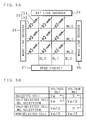
- FIG. 5A and FIG. 5B are views for explaining a schematic constitution of a memory device according to the present invention.
- FIG. 5A is a circuit diagram showing a memory cell array in which memory cells are arranged in a matrix, bit lines and word lines connected to the memory cells, and peripheral circuits connected to the bit lines and the word lines.
- FIG. 5B is a table showing conditions of applied voltages when the circuit shown in FIG. 5A is read.
- reference numeral 31 designates a variable resistive element whose resistance value varies depending on application of voltage and reference numeral 32 designates a Schottky diode which controls a current flowing in the variable resistive element 31.
- One variable resistive element 31 and one Schottky diode 32 are connected in series to each other and this series circuit constitutes each memory cell 33 according to the present invention.
- the memory cell array by 3 x 3 is illustrated. Since a resistance value of the variable resistive element 31 does not vary, that is, its resistance value is maintained while a voltage is not applied, the variable resistive element 31 can constitute a nonvolatile memory cell. This means that the memory device comprising a plurality of such memory cells according to the present invention is also a nonvolatile memory device.
- bit lines BL0, BL1 and BL2 (which will be simply referred to as the bit line BL when a distinction between them is not necessary hereinafter) are arranged in a column direction.
- One end of the bit line BL is connected to a bit line decoder 34, and the other end of the same is connected to a read circuit 37.
- the word lines WL0, WL1 and WL2 (which will be simply referred to as the word line WL when a distinction between them is not necessary hereinafter) are arranged in a row direction which intersect with the bit lines BL. Both ends of the word lines WL are connected to word line decoders 35 and 36, respectively. More specifically, the bit lines BL and word lines WL are arranged in a matrix, memory cells are located at positions where the bit lines BL and the word lines WL intersect with each other, which constitute the memory cell array (memory device) as a whole.
- the word line decoders 35 and 36 are arranged at both ends of the word lines WL, for example, the even-numbered word line WL and the odd-numbered word line WL can be connected to the word line decoders 35 and 36 alternately. Thus, a pitch of the word lines WL can be decreased and also a margin of a circuit arrangement (circuit size) of the word line decoders 35 and 36 can be increased.
- One end of the series circuit that is, the memory cell 33 according to the present invention
- the bit line decoder 34, and word line decoders 35 and 36 and the read circuit 37 constitute the peripheral circuits.
- CMOSFET MOSFET
- the variable resistive element 31 comprises a resistive material having a perovskite-type crystalline structure, a double aligned perovskite-type crystalline structure or the like which shows colossal magneto resistance or high temperature super conductivity.
- a specific resistive material Pr (1-x) Ca x MnO 3 (0 ⁇ x ⁇ 1), La (1-x) Ca x MnO 3 (0 ⁇ x ⁇ 1), Nd (1-x) Sr x MnO 3 (0 ⁇ x ⁇ 1), Sr 2 FeMoO 6 , Sr 2 FeWO 6 or the like is used.
- the Schottky diode 32 is constituted by forming a Schottky barrier by joining a semiconductor and metal.
- metal silicide refractory metal silicide
- Schottky barrier can be formed between the refractory metal silicide and silicon (at an interface).
- 0.2 V can be obtained as a forward threshold voltage. Since this value is a half or less as compared with a forward threshold voltage 0.5 V in a PN-junction diode, an influence of reading disturbance in the memory device, for example, can be largely reduced.
- a first electrode (e.g., cathode/negative electrode) of the Schottky diode 32 is connected to the word line WL
- a second electrode (e.g., anode/positive electrode) of the Schottky diode 32 is connected to one end of the variable resistive element 31 and the other end of the variable resistive element 31 is connected to the bit line BL.
- bit line BL is only selected among the bit lines BL and word lines WL, such cell is called a half-selected cell (BL selection).
- BL selection the writing voltage Vw is applied to the bit line BL0 of the half-selected cell (BL selection) similar to the selected cell, a voltage Vw/2 is applied to the word lines WL (word lines WL1 and WL2) so that a potential difference between both ends of the half-selected cell (BL selection) may become Vw/2.
- the word line WL is only selected among the bit lines BL and word lines WL, such cell is called a half-selected cell (WL selection).
- a voltage 0 is applied to the word line WL0 of the half-selected cell (WL selection) similar to the selected cell
- a voltage Vw/2 is applied to the bit lines BL (bit line BL1 and BL2) so that a potential difference between both ends of the half-selected cell (WL selection) may become Vw/2.
- the selected states of the memory cells are classified into four kinds of the selected cell, the half-selected cell (BL selection), the half-selected cell (WL selection) and the non-selected cell.
- the half-selected cell is distinguished from the non-selected cell as a matter of conveyance of the description, the half-selected cell can be contained in the non-selected cell.
- the connection direction (rectification direction) of the Schottky diode 32 can be appropriately reversed and in this case, by appropriately changing the direction (polarity) of the applied voltage, the same operation as in the case the connection direction (rectification direction) of the Schottky diode 32 is not reversed can be performed.
- the erasing operation can be performed by elongating a time for applying the writing voltage.
- the reading operation can be performed by applying the reading voltage Vr to the bit line BL of the selected cell and a voltage 0 to the word line WL of the same, respectively.
- a potential difference applied to both ends of the non-selected cell is set so as to be Vr/2. That is, the writing voltage Vw in FIG. 5B may be replaced with the reading voltage Vr.
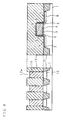
- FIG. 6 through FIG. 12 are schematic diagrams for explaining manufacturing steps in Embodiment 1 of a manufacturing method of a memory cell according to the present invention.
- a memory cell region hereinafter, referred to as the memory region
- a peripheral circuit region hereinafter, referred to as the peripheral region
- FIG. 6 through FIG. 12 are schematic diagrams for explaining manufacturing steps in Embodiment 1 of a manufacturing method of a memory cell according to the present invention.
- a memory cell region in which the memory cell is formed
- a peripheral circuit region hereinafter, referred to as the peripheral circuit is formed
- FIG. 6 through FIG. 12 are schematic diagrams for explaining manufacturing steps in Embodiment 1 of a manufacturing method of a memory cell according to the present invention.
- a memory cell region in which the memory cell is formed
- a peripheral circuit region hereinafter, referred to as the peripheral circuit is formed
- FIG. 6 through FIG. 12 are schematic diagrams for explaining manufacturing steps in Embodiment 1 of a manufacturing method of a memory cell according to
- FIG. 6 is a schematic diagram showing a state where an element isolation region, the first electrode of the Schottky diode and the N-channel MOSFET are formed on a semiconductor substrate.
- An element isolation region 2 is formed to be appropriately patterned on a semiconductor substrate (referred to as the substrate hereinafter) 1.
- the substrate 1 is a first conductive type (p-type) silicon single crystal, for example.
- the substrate 1 may be a semiconductor film and the like formed on an insulating substrate.
- the element isolation region 2 is formed of a silicon oxide film (SiO 2 ), for example.
- An impurity region 10 can be formed in the memory region by a self-aligning manner by ion implantation using a second conductive type (n-type) ion species, which is different from that of the substrate 1, on the element isolation region 2.
- the impurity region 10 becomes the first electrode of the Schottky diode and word lines WL formed in the later step. Since the impurity region 10 can be formed in the self-aligning manner in element isolation regions 2, it can be formed in a high density and, as a result, a high-integrated memory cell can be formed.
- three impurity regions 10 are illustrated.
- the impurity region 10 is formed by the self-aligning manner in the element isolation regions 2, it can be formed by a precise pattern and as a result, characteristics of the Schottky diode can be surely unified.
- an insulating film 11 such as silicon oxide film, for example, is formed in addition to the impurity region 10.
- the N-channel MOSFET (referred to as the MOSFET hereinafter) is formed according to a normal CMOS processing step.
- the MOSFET By performing ion implantation using a second conductive type ion species, which is different from that of the substrate 1, into a channel portion of the MOSFET region surrounded by the element isolation region 2, the channel concentration is controlled.
- a gate insulating film 3 is formed by thermal oxidation or the like and, then, polycrystalline silicon is deposited by an LP-CVD method and the like.
- polycrystalline silicon is patterned by photolithography to form a gate electrode 4 formed of polycrystalline silicon.
- the integration degree can be improved by minimizing a dimension of the gate electrode 4 in the direction of the channel length in general.
- the second conductive type ion species are implanted to a portion of the substrate 1 corresponding to the end portion of the gate electrode 4 in the channel-length direction to form a LDD (Lightly Doped Drain) region 5 having low concentration.
- a silicon oxide film is deposited in the MOSFET region and a sidewall 6 is formed by etching back.
- the second conductive type ion species are implanted in a high concentration to form a source region 7 and a drain region 8.
- a silicon surface of the gate electrode 4 the source region 7 and the drain region 8 is exposed and, then, a cobalt (Co) film, for example, is formed on a whole of the substrate 1 and heated by ramp annealing and the like. Cobalt reacts with silicon by this heating and a cobalt silicide film 9 is formed.
- cobalt silicide is not formed in the memory region. After the heating, the non-reacted cobalt film is appropriately removed.
- FIG. 7 is a schematic diagram showing a state where openings for the electrodes of the Schottky diode are formed in an interlayer insulating film in order to form the memory cells.
- an insulating film 12 formed of a silicon oxide film is formed as the interlayer insulating film 12 and flattened by a CMP (Chemical Mechanical Polishing) method and the openings 12w are formed in the insulating film 12 in the memory region.
- the opening 12w is appropriately formed so as to be aligned to the impurity region 10.
- FIG. 8 is a schematic diagram showing a state where the second electrodes of the Schottky diode are formed.
- a metal film 14 serving as both second electrode of the Schottky diode and lower electrode of the variable resistive element is formed (deposited) by being buried in the opening 12w with the CMP method or the etching back method. At this time, burying depth is adjusted such that an upper end of the metal film 14 may be positioned on the side of the substrate 1 from the upper end of the opening 12w. In other words, the metal film 14 is formed so as to be lower than a height of the opening 12w so that an upper end of the opening 12w is exposed.
- variable resistive film 15L resistor 15
- a material of the metal film 14 is preferably a refractory metal material, for example, and especially, any one of Pt, Ti, Co and Ni or appropriate combination thereof, in view of adhesiveness with the material of the variable resistive film 15L to be formed later, safety and the like.
- FIG. 9 is a schematic diagram showing a state where the variable resistive film is deposited.
- the variable resistive film 15L is deposited so as to fill the upper end portions of the openings 12w.
- a film thickness of the variable resistive film 15L is appropriately determined such that a resistance value of the resistor 15 to be described later may be a predetermined value.
- the variable resistive film 15L Pr (1-x) Ca x MnO 3 (0 ⁇ x ⁇ 1) (hereinafter, refereed to as the PCMO) is used, for example.
- the variable resistive film 15L consists of a stacked structure of a first variable resistive film 15a and a second variable resistive film 15b.
- PCMO is deposited to have a first film thickness thinner than a film thickness of the variable resistive film 15L to form the first variable resistive film 15a and heating treatment is performed for the film at a first temperature.
- the heat treatment at the first temperature is performed rapidly for a short time using a RTA (Rapid Thermal Anneal) method in order to reduce an affect on the MOSFET, the impurity region 10 and the like.
- RTA Rapid Thermal Anneal
- the first temperature has to satisfy a condition that the metal film 14 (the second electrode of the Schottky diode and the lower electrode of the variable resistive element) reacts with the impurity region 10 (silicon) and becomes metal silicide (refractory metal silicide) so that a metal silicide film 16 can be formed (about 800°C, in case of Pt), and crystalline property of the first variable resistive film 15a is improved (about 600°C, in case of PCMO).
- the metal silicide film 16 is formed and also the crystalline property of the first variable resistive film 15a can be improved.
- the metal silicide film 16 is formed, as a result, a Schottky barrier is formed between the metal silicide film 16 and the impurity region 10.
- the Schottky diode whose first electrode is the impurity region 10 and whose second electrode is the metal film 14 (metal silicide film 16) is formed.
- the first electrode of the impurity region 10 of the Schottky diode is n-type, it becomes a cathode and the metal film 14 as the second electrode of the Schottky diode becomes an anode.
- PCMO is deposited to form the second variable resistive film 15b having a second film thickness so as to be equal to the film thickness of the variable resistive film 15L, together with the first film thickness of the first variable resistive film 15a, and heat treatment for it is performed at a second temperature.
- the metal silicide film 16 formed by the heat treatment at the first temperature is lowered its resistance by the heat treatment at the second temperature and a crystalline property of the second variable resistive film 15b deposited according to the crystalline property of the first variable resistive film 15a is further improved.
- the second temperature has to satisfy the condition that the resistance of the metal silicide film 16 is lowered and the crystalline property of the second variable resistive film 15b is improved.
- the second temperature may be the same as the first temperature or not more than the first temperature.
- the first film thickness of the first variable resistive film 15a is preferably thinner than the second film thickness of the second variable resistive film 15b.
- the reason why the variable resistive film 15L is deposited (formed) by two separate operations is that since the second variable resistive film 15b is formed reflecting the crystalline property of the lower first variable resistive film 15a, the crystalline property of the second variable resistive film 15b is further improved as compared with a case where it is formed by one deposition process.
- the variable resistive film 15L is formed by two separate deposition processes in the above, it may be formed by one deposition process.
- variable resistive film 15L is formed so as to have the predetermined film thickness by one deposition
- the crystalline property of the variable resistive film 15L is improved and the metal silicide film 16 is formed by one heating treatment, whereby the Schottky diode is formed.
- FIG. 10 is a schematic diagram showing a state where a variable resistive element is formed.
- a metal film 17 comprising a Pt film 17a and a TiN film 17b is formed on a whole surface of the variable resistive film 15L.
- the TiN film 17b and the Pt film 17a are sequentially processed by photolithography and anisotropic etching and the variable resistive film 15L is etched using the processed Pt/TiN (the Pt film 17a and the TiN film 17b) as a mask to form the resistor 15. Since the variable resistive film 15L is processed using the processed Pt/TiN as a mask, the resistor 15 and the metal film 17 are formed by the self-aligning manner.
- variable resistive element having the metal film 14 connected to one end of the resistor 15 as the lower electrode and the metal film 17 connected to the other end of the resistor 15 as the upper electrode is formed. Since the metal film 14 is also as the second electrode of the Schottky diode, the second electrode of the Schottky diode is in a state it is connected to one end of the variable resistive element by the self-aligning manner. Therefore, the Schottky diode and the variable resistive element can be surely aligned to each other to be formed and the integration degree can be further improved.
- the metal film 14 and the resistor 15 are aligned to each other by the self-aligning manner, an area of the lower electrode of the variable resistive element is accurately controlled and its resistance value is accurately controlled. Furthermore, since the metal film 17 and the resistor 15 are also aligned to each other by the self-aligning manner, the resistance value can be accurately controlled and also the integration degree is further improved.
- FIG. 11 is a schematic diagram showing a state where the surface is flattened before a wiring is formed.
- An insulating film 18 formed of a silicon oxide film, for example, is deposited on the insulating film 12 and the metal film 17 as an interlayer insulating film, and then flattened by the CMP method or the like.
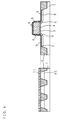
- FIG. 12 is a schematic diagram showing a state where a wiring is formed. For example, it shows a state where a tungsten wiring 19 is formed by damascene technique using tungsten.
- the tungsten wiring 19 (BL) and the impurity region 10 (WL) are formed as the bit line BL and the word line WL in the memory region, respectively. Then, the memory cell at the position where the word line WL and the bit line BL intersect with each other is selected and the writing, erasing and reading operations can be performed for it.
- the tungsten wiring 19 (WP) is formed in the peripheral region as the circuit wiring, the signal processing required for the memory device can be performed.
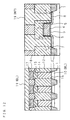
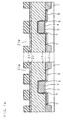
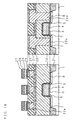
- FIG. 13 through FIG. 20 are schematic diagrams for explaining manufacturing steps in Embodiment 2 of a manufacturing method of a memory cell according to the present invention.
- a memory cell region hereinafter, -referred to as the memory region
- a peripheral circuit region hereinafter, referred to as the peripheral region
- FIG. 13 through FIG. 20 are schematic diagrams for explaining manufacturing steps in Embodiment 2 of a manufacturing method of a memory cell according to the present invention.
- a memory cell region hereinafter, -referred to as the memory region
- a peripheral circuit region hereinafter, referred to as the peripheral region
- FIG. 13 through FIG. 20 are schematic diagrams for explaining manufacturing steps in Embodiment 2 of a manufacturing method of a memory cell according to the present invention.
- a memory cell region in which the memory cell is formed
- a peripheral circuit region hereinafter, referred to as the peripheral circuit region
- FIG. 13 through FIG. 20 are schematic diagrams for explaining manufacturing steps in Embodiment 2 of a manufacturing method of a memory
- a peripheral circuit (a part of the peripheral circuit and the like) can be provided at a lower portion of the memory cell and as an example of the peripheral circuit, a case where the MOSFET is formed at the lower portion of the memory cell is shown.
- oblique lines for showing the section are appropriately omitted.
- the CMOS is constituted by combining a P-channel MOSFET and the N-channel MOSFET in general, the N-channel MOSFET is only shown here for simplification.
- the same or corresponding parts as in Embodiment 1 are allotted to the same reference numerals (a part of them is omitted) and descriptions therefor will not be given.
- a substrate 1 may be a semiconductor film and the like formed on an insulating substrate.
- FIG. 13 is a schematic diagram showing a state where the N-channel MOSFET is formed and then the surface is flattened. That is, the N-channel MOSFET (hereinafter, referred to as the MOSFET) is formed and, then, an insulating film 12, a stopper film 20 and an insulating film 21 are stacked.
- the insulating film 12 formed of a silicon oxide film for example, is formed as an interlayer insulating film and flattened by a CMP (Chemical Mechanical Polishing) method and then a nitride film (SiN) is formed as the stopper film 20 serving as a stopper for etching.
- steps until the insulating film 12 is formed are the same as the forming steps of the peripheral region shown in FIG. 6 and FIG. 7 (Embodiment 1), in a memory region and a peripheral region.
- the insulating film 21 formed of a silicon oxide film for example, is formed as the interlayer insulating film.
- FIG. 14 is a schematic diagram showing a state where openings for forming the memory cell in the interlayer insulating film and openings for forming contacts with the MOSFET are formed.
- the stopper film 20 as a stopper, the insulating film 21 is etched away to have a predetermined pattern by photolithography and anisotropic etching. That is, in the memory region, openings 21w for forming polycrystalline silicon regions 22e (see FIG. 15) to be formed at a later step are formed, and in the peripheral region, openings 21w for forming a source electrode 22s and a drain electrode 22d (see FIG. 15) to be formed at a later step are formed. Then, in the peripheral region, in order to contact with a source region 7 and a drain region 8, openings (windows for contacts) to the source region 7 and the drain region 8 are further formed by partially removing the stopper films 20 exposed to the openings 21w.
- FIG. 15 is a schematic diagram showing a state where polycrystalline silicon is deposited (filled) in the openings 12w.
- the polycrystalline silicon regions (22e, 22s and 22d) are formed (deposited) by being buried in the openings 21w having a predetermined pattern formed on the insulating film 21.
- Polycrystalline silicon containing phosphorus, for example, in a high concentration is deposited on the whole surface and flattened by the CMP method or the etching back method.
- the polycrystalline silicon region 22e in the memory region and the source electrode 22s and the drain electrode 22d formed of polycrystalline silicon in the peripheral region are selectively formed in the openings 21w.
- polycrystalline silicon containing phosphorus in a high concentration is used as the impurity is that since the polycrystalline silicon region 22e becomes a first electrode of the Schottky diode (and word line WL), it preferably has low resistance together with the source electrode 22s and the drain electrode 22d. Since the polycrystalline silicon region 22e contains phosphorus as the impurity, it becomes the n-type.
- FIG. 16 is a schematic diagram showing a state where a variable resistive film is deposited.
- a metal film 23L serving as both second electrode of the Schottky diode and lower electrode of the variable resistive element is deposited on the flattened surface of the insulating film 21, the polycrystalline silicon region 22e, the source electrode 22s and the drain electrode 22d.
- the metal film 23L since the metal film 23L is not necessary on the surface of the source electrode 22s and the drain electrode 22d in principle, it may not be deposited.
- a material of the metal film 23L is preferably a refractory metal material, for example, and especially, any one of Pt, Ti, Co and Ni or appropriate combination thereof, in view of adhesiveness with a material of a variable resistive film 24L (24a and 24b) to be formed later, safety and the like.
- a polycrystalline silicon film 22e and a metal film 23L are formed by being buried in the openings of the insulating film 21 and a variable resistive film 24L (24b on the side of the metal film 23L among 24a and 24b) may be further formed in the openings by the self-aligning manner.
- the metal film 23L is formed and, then, the variable resistive film 24L is deposited.
- a film thickness of the variable resistive film 24L is appropriately determined such that a resistance value of a resistor 24 may become a predetermined value.
- the variable resistive film 24L Pr( 1-x )Ca x MnO 3 (0 ⁇ x ⁇ 1) (hereinafter, refereed to as the PCMO) is used, for example.
- the variable resistive film 24L is a stacked structure consisting of the first variable resistive film 24a and the second variable resistive film 24b.
- PCMO is deposited to have a first film thickness thinner than a film thickness of the variable resistive film 24L to form the first variable resistive film 24a and heating treatment is performed for the film at a first temperature.
- the heat treatment at the first temperature is performed rapidly for a short time using a RTA (Rapid Thermal Anneal) method and the like in order to reduce an affect on the MOSFET, the polycrystalline silicon region 22e and the like.
- the first temperature has to satisfy a condition that the metal film 23L (the second electrode of the Schottky diode and the lower electrode of the variable resistive element) reacts with the polycrystalline silicon 22e to become metal silicide (refractory metal silicide) so that a metal silicide film 25 can be formed (about 800°C, in case of Pt), and a crystalline property of the first variable resistive film 24a is improved (about 600°C, in case of PCMO).
- the metal silicide film 25 is formed and also the crystalline property of the first variable resistive film 24a can be improved.
- the metal silicide film 25 is formed, as a result, a Schottky barrier is formed between the metal silicide film 25 and the polycrystalline silicon 22e.
- the Schottky diode whose first electrode is the polycrystalline silicon region 22e and whose second electrode is the metal film 23L (metal silicide film 25) is formed.
- the polycrystalline silicon 22e as the first electrode of the Schottky diode is n-type, it becomes a cathode and the metal film 23L as the second electrode of the Schottky diode becomes an anode. Since the polycrystalline silicon region 22e and the metal silicide film 25 are formed so as to coincide with the openings by the self-aligning manner, they can be formed by a precise pattern and as a result, characteristics of the Schottky diode can be surely unified.
- PCMO is deposited to form the second variable resistive film 24b having a second film thickness so as to be equal to the film thickness of the variable resistive film 24L, together with the first film thickness of the first variable resistive film 24a, and a heat treatment for it is performed at a second temperature.
- the metal silicide film 25 formed by the heat treatment at the first temperature is lowered its resistance by the heat treatment at the second temperature and a crystalline property of the second variable resistive film 24b deposited according to the crystalline property of the first variable resistive film 24a is further improved.
- the second temperature has to satisfy the condition that the resistance of the metal silicide film 25 is lowered and the crystalline property of the second variable resistive film 24b is improved.
- the second temperature may be the same as the first temperature or not more than the first temperature.
- the first film thickness of the first variable resistive film 24a is preferably thinner than the second film thickness of the second variable resistive film 24b.
- the reason why the variable resistive film 24L is deposited by two separate deposition processes is that since the second variable resistive film 24b is formed reflecting the crystalline property of the lower first variable resistive film 24a, the crystalline property thereof is further improved as compared with a case where it is formed by one deposition process.
- the variable resistive film 24L is formed by two separate deposition processes in the above, it may be formed by one deposition process.
- variable resistive film 24L is formed so as to have the predetermined film thickness by one deposition process
- the crystalline property of the variable resistive film 24L is improved and the metal silicide film 25 is formed by one heating treatment, whereby the Schottky diode is formed.
- FIG. 17 is a schematic diagram showing a state where a metal film becoming the upper electrode of the variable resistive element is deposited.
- a metal film 26L serving as the upper electrode of the variable resistive element is deposited on the whole surface of the variable resistive film 24L.
- a material of the metal film 26L is preferably a refractory metal material, for example, and especially, any one of Pt, Ti, Co and Ni or appropriate combination thereof, in view of adhesiveness with the variable resistive film 24L, safety and the like.
- a Pt film was used as the metal film 26L.
- a hard mask film 27L formed of a TiN film is deposited on the whole surface of the metal film 26L, as a mask for hard mask etching when the metal film 26L is etched away, and the metal film 26L and the hard mask film 27L are stacked to be formed.
- FIG. 18 is a schematic diagram showing a state where a variable resistive element is formed.
- the hard mask film 27L is processed by photolithography and anisotropic etching and a hard mask 27 having a predetermined pattern (more specifically, a pattern of the upper electrode of the variable resistive element) is formed.
- a metal film 26 (and the hard mask 27) as the upper electrode of the variable resistive element, the resistor 24 and a metal film 23 as the lower electrode of the variable resistive element are formed.
- the metal film 23 is also as the second electrode of the Schottky diode, the second electrode of the Schottky diode is in a state it is connected to one end of the variable resistive element in the self-aligning manner. Therefore, the Schottky diode and the variable resistive element can be surely aligned to each other to be formed and the integration degree can be further improved. Since the metal film 26, the resistor 24 and the metal film 23 are aligned to each other by the self-aligning manner using the hard mask 27 as a mask, areas of the upper electrode of the variable resistive element, the resistor and the lower electrode can precisely coincide with each other in the current direction. As a result, the resistance value can be accurately controlled and, also, the integration degree is further improved. In addition, the metal film 23L, the variable resistive film 24L, the metal film 26L and the hard mask film 27L deposited in the peripheral region are removed by etching.
- FIG. 19 is a schematic diagram showing a state where the surface is flattened before a wiring is formed.
- An insulating film 28 formed of a silicon oxide film, for example, is deposited as an interlayer insulating film and then flattened by the CMP method or the like.
- FIG. 20 is a schematic diagram showing a state where a wiring is formed. Openings (via holes) are formed in the insulating film 28 formed as shown in FIG. 19, corresponding to the metal film 26 (the hard mask 27) as the upper electrode of the variable resistive element, the source electrode 22s and the drain electrode 22d of the MOSFET. A tungsten plug 29 is formed by depositing tungsten in the openings. Then, a metal wiring film constituted by a three-layer film of TiN film 30a, AlCu film 30b and TiN film 30c, for example, is formed and patterned corresponding to a predetermined wiring pattern to form a metal wiring 30 so as to be appropriately connected to the tungsten plug 29.
- a metal wiring film constituted by a three-layer film of TiN film 30a, AlCu film 30b and TiN film 30c, for example, is formed and patterned corresponding to a predetermined wiring pattern to form a metal wiring 30 so as to be appropriately connected to the tungsten plug 29.
- the elements in the peripheral region and the elements in the memory region can be formed, respectively, without affecting each other.
- the metal wiring 30 (BL) and the polycrystalline silicon region 22e (WL) are formed as the bit line BL and the word line WL in the memory region, respectively. Then, the memory cell at the position where the word line WL and the bit line BL intersect with each other is selected and the writing, erasing and reading operations can be performed for it.
- the metal wiring 30 (WP) is formed in the peripheral region as the circuit wiring, the signal processing required for the memory device can be performed.
- the memory cell of the present invention is constituted by the series circuit of the variable resistive element formed by using a variable resistive material in which a resistance value varies depending on application of a voltage, and the Schottky diode, an influence of a reading disturbance can be reduced. Also, the influence of the reading disturbance can be reduced in the memory device comprising such memory cells of the present invention.
- the first electrode of the Schottky diode is constituted by the impurity region of the semiconductor substrate or the polycrystalline silicon region selectively formed on the insulating film, an integration degree of the memory cell can be improved.
- the variable resistive film is formed on the second electrode of the Schottky diode by the self-aligning manner, the resistance value of the variable resistive element can be accurately controlled and the memory device comprising such memory cells in which the integration degree is improved and the like can be realized.
- the Schottky diode is constituted by the Schottky barrier between the metal silicide film and silicon, reduction of the forward threshold value of the diode can be easily realized and the stable diode characteristics can be obtained.
- the Schottky diode is formed and the crystalline property of the variable resistive film is improved at the same time by the single heat treatment, the number of heat treatments can be reduced.
- the manufacturing method of the memory cell which has less affect in the peripheral circuits is realized and the integration degree of the peripheral circuit can be improved.
- the variable resistive film is formed by two separate deposition processes, it is realized that the manufacturing method of the memory cell in which the characteristics (resistance value) of the Schottky diode and the crystalline property of the variable resistive film can be further improved.
Landscapes
- Engineering & Computer Science (AREA)
- Computer Hardware Design (AREA)
- Chemical & Material Sciences (AREA)
- Materials Engineering (AREA)
- Semiconductor Memories (AREA)
- Mram Or Spin Memory Techniques (AREA)
Applications Claiming Priority (2)
| Application Number | Priority Date | Filing Date | Title |
|---|---|---|---|
| JP2003108021 | 2003-04-11 | ||
| JP2003108021A JP2004319587A (ja) | 2003-04-11 | 2003-04-11 | メモリセル、メモリ装置及びメモリセル製造方法 |
Publications (2)
| Publication Number | Publication Date |
|---|---|
| EP1467376A2 true EP1467376A2 (de) | 2004-10-13 |
| EP1467376A3 EP1467376A3 (de) | 2006-02-08 |
Family
ID=32866797
Family Applications (1)
| Application Number | Title | Priority Date | Filing Date |
|---|---|---|---|
| EP04252124A Withdrawn EP1467376A3 (de) | 2003-04-11 | 2004-04-08 | Speicherzelle, Speichervorrichtung und Herstellungsverfahren für eine Speicherzelle |
Country Status (6)
| Country | Link |
|---|---|
| US (1) | US20040202041A1 (de) |
| EP (1) | EP1467376A3 (de) |
| JP (1) | JP2004319587A (de) |
| KR (1) | KR100728586B1 (de) |
| CN (1) | CN1542848B (de) |
| TW (1) | TWI249166B (de) |
Cited By (3)
| Publication number | Priority date | Publication date | Assignee | Title |
|---|---|---|---|---|
| EP1542277A3 (de) * | 2003-12-08 | 2009-04-29 | Sharp Kabushiki Kaisha | Elektroden für RRAM-Speicherzellen |
| US8422268B2 (en) | 2008-07-11 | 2013-04-16 | Panasonic Corporation | Current control element, memory element, and fabrication method thereof |
| EP1846954A4 (de) * | 2005-01-19 | 2014-02-26 | Sandisk 3D Llc | Struktur und verfahren zur vorspannung einer phasenänderungs-speichermatrix für zuverlässiges schreiben |
Families Citing this family (88)
| Publication number | Priority date | Publication date | Assignee | Title |
|---|---|---|---|---|
| KR100682899B1 (ko) * | 2004-11-10 | 2007-02-15 | 삼성전자주식회사 | 저항 변화층을 스토리지 노드로 구비하는 메모리 소자의제조 방법 |
| KR100657911B1 (ko) * | 2004-11-10 | 2006-12-14 | 삼성전자주식회사 | 한 개의 저항체와 한 개의 다이오드를 지닌 비휘발성메모리 소자 |
| KR100612872B1 (ko) | 2004-11-16 | 2006-08-14 | 삼성전자주식회사 | 채널의 물성이 인가전압에 따라 가변적인 트랜지스터와 그제조 및 동작 방법 |
| JP4829502B2 (ja) * | 2005-01-11 | 2011-12-07 | シャープ株式会社 | 半導体記憶装置の製造方法 |
| JP4546842B2 (ja) * | 2005-01-20 | 2010-09-22 | シャープ株式会社 | 不揮発性半導体記憶装置及びその制御方法 |
| JP2006203098A (ja) * | 2005-01-24 | 2006-08-03 | Sharp Corp | 不揮発性半導体記憶装置 |
| KR100697282B1 (ko) | 2005-03-28 | 2007-03-20 | 삼성전자주식회사 | 저항 메모리 셀, 그 형성 방법 및 이를 이용한 저항 메모리배열 |
| JP4907916B2 (ja) * | 2005-07-22 | 2012-04-04 | オンセミコンダクター・トレーディング・リミテッド | メモリ |
| JP4883982B2 (ja) * | 2005-10-19 | 2012-02-22 | ルネサスエレクトロニクス株式会社 | 不揮発性記憶装置 |
| JP4054347B2 (ja) * | 2005-12-16 | 2008-02-27 | シャープ株式会社 | 不揮発性半導体記憶装置 |
| JP2007184419A (ja) * | 2006-01-06 | 2007-07-19 | Sharp Corp | 不揮発性メモリ装置 |
| US8395199B2 (en) | 2006-03-25 | 2013-03-12 | 4D-S Pty Ltd. | Systems and methods for fabricating self-aligned memory cell |
| US7884346B2 (en) * | 2006-03-30 | 2011-02-08 | Panasonic Corporation | Nonvolatile memory element and manufacturing method thereof |
| JP4795873B2 (ja) * | 2006-07-03 | 2011-10-19 | 日本電信電話株式会社 | メモリ装置 |
| US8454810B2 (en) | 2006-07-14 | 2013-06-04 | 4D-S Pty Ltd. | Dual hexagonal shaped plasma source |
| US7932548B2 (en) | 2006-07-14 | 2011-04-26 | 4D-S Pty Ltd. | Systems and methods for fabricating self-aligned memory cell |
| KR100803690B1 (ko) * | 2006-08-10 | 2008-02-20 | 삼성전자주식회사 | 전기적- 기계적 비휘발성 메모리 장치 및 그 제조 방법. |
| US8308915B2 (en) | 2006-09-14 | 2012-11-13 | 4D-S Pty Ltd. | Systems and methods for magnetron deposition |
| WO2008047711A1 (en) | 2006-10-16 | 2008-04-24 | Panasonic Corporation | Non-volatile storage element array, and its manufacturing method |
| US8796660B2 (en) | 2006-10-16 | 2014-08-05 | Panasonic Corporation | Nonvolatile memory element comprising a resistance variable element and a diode |
| JP4167298B2 (ja) * | 2006-11-20 | 2008-10-15 | 松下電器産業株式会社 | 不揮発性半導体記憶装置およびその製造方法 |
| CN101221804B (zh) * | 2007-01-08 | 2010-04-07 | 普诚科技股份有限公司 | 存储器及存储器数据读取电路 |
| US7868388B2 (en) * | 2007-01-31 | 2011-01-11 | Sandisk 3D Llc | Embedded memory in a CMOS circuit and methods of forming the same |
| US7888200B2 (en) * | 2007-01-31 | 2011-02-15 | Sandisk 3D Llc | Embedded memory in a CMOS circuit and methods of forming the same |
| EP2128901A4 (de) | 2007-03-22 | 2013-01-09 | Panasonic Corp | Speicherelement und speichereinrichtung |
| JP4410272B2 (ja) | 2007-05-11 | 2010-02-03 | 株式会社東芝 | 不揮発性メモリ装置及びそのデータ書き込み方法 |
| KR100900202B1 (ko) | 2007-07-31 | 2009-06-02 | 삼성전자주식회사 | 쇼트키 다이오드를 구비하는 상변화 메모리 소자 및 그의제조방법 |
| JP5172269B2 (ja) * | 2007-10-17 | 2013-03-27 | 株式会社東芝 | 不揮発性半導体記憶装置 |
| US8253136B2 (en) | 2007-10-30 | 2012-08-28 | Panasonic Corporation | Nonvolatile semiconductor memory device and manufacturing method thereof |
| KR100904737B1 (ko) * | 2007-12-20 | 2009-06-26 | 주식회사 하이닉스반도체 | 문턱전압 스위칭소자를 구비하는 반도체 메모리장치 및정보저장 방법 |
| JP5274878B2 (ja) * | 2008-04-15 | 2013-08-28 | パナソニック株式会社 | 半導体装置及びその製造方法 |
| JP2011151049A (ja) * | 2008-05-16 | 2011-08-04 | Panasonic Corp | 不揮発性半導体記憶装置およびその製造方法 |
| JPWO2009142165A1 (ja) * | 2008-05-20 | 2011-09-29 | 日本電気株式会社 | 半導体装置およびその製造方法 |
| KR20100001260A (ko) * | 2008-06-26 | 2010-01-06 | 삼성전자주식회사 | 비휘발성 메모리 소자 및 그 제조 방법 |
| US8355274B2 (en) | 2008-09-19 | 2013-01-15 | Panasonic Corporation | Current steering element, storage element, storage device, and method for manufacturing current steering element |
| KR101486984B1 (ko) * | 2008-10-30 | 2015-01-30 | 삼성전자주식회사 | 가변 저항 메모리 소자 및 그 형성방법 |
| US8027215B2 (en) * | 2008-12-19 | 2011-09-27 | Unity Semiconductor Corporation | Array operation using a schottky diode as a non-ohmic isolation device |
| JP4956598B2 (ja) * | 2009-02-27 | 2012-06-20 | シャープ株式会社 | 不揮発性半導体記憶装置及びその製造方法 |
| WO2010137339A1 (ja) | 2009-05-28 | 2010-12-02 | パナソニック株式会社 | メモリセルアレイ、不揮発性記憶装置、メモリセル、およびメモリセルアレイの製造方法 |
| US8304783B2 (en) * | 2009-06-03 | 2012-11-06 | Cree, Inc. | Schottky diodes including polysilicon having low barrier heights and methods of fabricating the same |
| CN101908547B (zh) * | 2009-06-04 | 2012-07-25 | 北京兆易创新科技有限公司 | 一次性可编程存储器、制造及编程读取方法 |
| WO2011024455A1 (ja) | 2009-08-28 | 2011-03-03 | パナソニック株式会社 | 半導体記憶装置及びその製造方法 |
| JP5284225B2 (ja) * | 2009-09-01 | 2013-09-11 | 株式会社東芝 | 不揮発性半導体記憶装置とその読み出し方法 |
| KR101070291B1 (ko) * | 2009-12-18 | 2011-10-06 | 주식회사 하이닉스반도체 | 저항성 메모리 소자 및 그 제조 방법 |
| US8482958B2 (en) | 2010-03-18 | 2013-07-09 | Panasonic Corporation | Current steering element, memory element, memory, and method of manufacturing current steering element |
| US9601692B1 (en) | 2010-07-13 | 2017-03-21 | Crossbar, Inc. | Hetero-switching layer in a RRAM device and method |
| US8946046B1 (en) | 2012-05-02 | 2015-02-03 | Crossbar, Inc. | Guided path for forming a conductive filament in RRAM |
| US9570678B1 (en) | 2010-06-08 | 2017-02-14 | Crossbar, Inc. | Resistive RAM with preferental filament formation region and methods |
| US8884261B2 (en) | 2010-08-23 | 2014-11-11 | Crossbar, Inc. | Device switching using layered device structure |
| US8569172B1 (en) | 2012-08-14 | 2013-10-29 | Crossbar, Inc. | Noble metal/non-noble metal electrode for RRAM applications |
| US8168506B2 (en) | 2010-07-13 | 2012-05-01 | Crossbar, Inc. | On/off ratio for non-volatile memory device and method |
| US8492195B2 (en) | 2010-08-23 | 2013-07-23 | Crossbar, Inc. | Method for forming stackable non-volatile resistive switching memory devices |
| US9401475B1 (en) | 2010-08-23 | 2016-07-26 | Crossbar, Inc. | Method for silver deposition for a non-volatile memory device |
| US8558212B2 (en) | 2010-09-29 | 2013-10-15 | Crossbar, Inc. | Conductive path in switching material in a resistive random access memory device and control |
| US8391049B2 (en) | 2010-09-29 | 2013-03-05 | Crossbar, Inc. | Resistor structure for a non-volatile memory device and method |
| USRE46335E1 (en) | 2010-11-04 | 2017-03-07 | Crossbar, Inc. | Switching device having a non-linear element |
| US8502185B2 (en) | 2011-05-31 | 2013-08-06 | Crossbar, Inc. | Switching device having a non-linear element |
| US8824183B2 (en) * | 2010-12-14 | 2014-09-02 | Sandisk 3D Llc | Non-volatile memory having 3D array of read/write elements with vertical bit lines and select devices and methods thereof |
| CN102158228A (zh) * | 2011-04-19 | 2011-08-17 | 复旦大学 | 极低电压毫米波注入锁定二分频器 |
| US9620206B2 (en) | 2011-05-31 | 2017-04-11 | Crossbar, Inc. | Memory array architecture with two-terminal memory cells |
| US8619459B1 (en) | 2011-06-23 | 2013-12-31 | Crossbar, Inc. | High operating speed resistive random access memory |
| US9627443B2 (en) | 2011-06-30 | 2017-04-18 | Crossbar, Inc. | Three-dimensional oblique two-terminal memory with enhanced electric field |
| US9564587B1 (en) | 2011-06-30 | 2017-02-07 | Crossbar, Inc. | Three-dimensional two-terminal memory with enhanced electric field and segmented interconnects |
| US8946669B1 (en) | 2012-04-05 | 2015-02-03 | Crossbar, Inc. | Resistive memory device and fabrication methods |
| US9166163B2 (en) | 2011-06-30 | 2015-10-20 | Crossbar, Inc. | Sub-oxide interface layer for two-terminal memory |
| WO2013015776A1 (en) | 2011-07-22 | 2013-01-31 | Crossbar, Inc. | Seed layer for a p + silicon germanium material for a non-volatile memory device and method |
| WO2013150791A1 (ja) | 2012-04-04 | 2013-10-10 | パナソニック株式会社 | 迂回電流を抑制する双方向型電流素子を用いたクロスポイント型の抵抗変化型記憶装置の設計方法 |
| US9685608B2 (en) | 2012-04-13 | 2017-06-20 | Crossbar, Inc. | Reduced diffusion in metal electrode for two-terminal memory |
| US8658476B1 (en) | 2012-04-20 | 2014-02-25 | Crossbar, Inc. | Low temperature P+ polycrystalline silicon material for non-volatile memory device |
| US9741765B1 (en) | 2012-08-14 | 2017-08-22 | Crossbar, Inc. | Monolithically integrated resistive memory using integrated-circuit foundry compatible processes |
| US9583701B1 (en) | 2012-08-14 | 2017-02-28 | Crossbar, Inc. | Methods for fabricating resistive memory device switching material using ion implantation |
| US8946673B1 (en) | 2012-08-24 | 2015-02-03 | Crossbar, Inc. | Resistive switching device structure with improved data retention for non-volatile memory device and method |
| US9312483B2 (en) | 2012-09-24 | 2016-04-12 | Crossbar, Inc. | Electrode structure for a non-volatile memory device and method |
| US9576616B2 (en) | 2012-10-10 | 2017-02-21 | Crossbar, Inc. | Non-volatile memory with overwrite capability and low write amplification |
| JP2014082279A (ja) * | 2012-10-15 | 2014-05-08 | Panasonic Corp | 不揮発性記憶装置及びその製造方法 |
| US9412790B1 (en) * | 2012-12-04 | 2016-08-09 | Crossbar, Inc. | Scalable RRAM device architecture for a non-volatile memory device and method |
| TWI543159B (zh) | 2013-04-23 | 2016-07-21 | Toshiba Kk | Semiconductor memory device |
| KR102189684B1 (ko) | 2013-12-05 | 2020-12-11 | 삼성전자주식회사 | 반도체 메모리 장치의 동작 방법 |
| CN104795397B (zh) * | 2014-01-21 | 2018-11-16 | 中芯国际集成电路制造(上海)有限公司 | 存储单元、存储器及其布局结构 |
| US10290801B2 (en) | 2014-02-07 | 2019-05-14 | Crossbar, Inc. | Scalable silicon based resistive memory device |
| US9425237B2 (en) | 2014-03-11 | 2016-08-23 | Crossbar, Inc. | Selector device for two-terminal memory |
| US10319908B2 (en) | 2014-05-01 | 2019-06-11 | Crossbar, Inc. | Integrative resistive memory in backend metal layers |
| US9633724B2 (en) * | 2014-07-07 | 2017-04-25 | Crossbar, Inc. | Sensing a non-volatile memory device utilizing selector device holding characteristics |
| US10211397B1 (en) | 2014-07-07 | 2019-02-19 | Crossbar, Inc. | Threshold voltage tuning for a volatile selection device |
| US10096362B1 (en) | 2017-03-24 | 2018-10-09 | Crossbar, Inc. | Switching block configuration bit comprising a non-volatile memory cell |
| CN111755046A (zh) * | 2020-05-19 | 2020-10-09 | 中国科学院上海微系统与信息技术研究所 | 一种存储器装置的偏置方法 |
| JP7831121B2 (ja) * | 2022-04-28 | 2026-03-17 | 東洋製罐株式会社 | ブロー成形装置、及び、ブロー成形方法 |
| US12406741B2 (en) * | 2022-08-10 | 2025-09-02 | Taiwan Semiconductor Manufacturing Company, Ltd. | Semiconductor memory devices with backside heater structure |
Family Cites Families (17)
| Publication number | Priority date | Publication date | Assignee | Title |
|---|---|---|---|---|
| US4203123A (en) * | 1977-12-12 | 1980-05-13 | Burroughs Corporation | Thin film memory device employing amorphous semiconductor materials |
| US4795657A (en) | 1984-04-13 | 1989-01-03 | Energy Conversion Devices, Inc. | Method of fabricating a programmable array |
| JP3454821B2 (ja) * | 1991-08-19 | 2003-10-06 | エナージー・コンバーション・デバイセス・インコーポレーテッド | 電気的に消去可能な、直接重ね書き可能なマルチビット単セルメモリ素子およびそれらから作製したアレイ |
| US5837564A (en) * | 1995-11-01 | 1998-11-17 | Micron Technology, Inc. | Method for optimal crystallization to obtain high electrical performance from chalcogenides |
| US5640343A (en) * | 1996-03-18 | 1997-06-17 | International Business Machines Corporation | Magnetic memory array using magnetic tunnel junction devices in the memory cells |
| EP0842537B1 (de) * | 1996-06-05 | 2005-08-24 | Koninklijke Philips Electronics N.V. | Beschreibbares festwertspeicherbauelement und das herstellungsverfahren für solch ein bauelement |
| US5838608A (en) * | 1997-06-16 | 1998-11-17 | Motorola, Inc. | Multi-layer magnetic random access memory and method for fabricating thereof |
| JP3839958B2 (ja) * | 1998-06-01 | 2006-11-01 | 株式会社東芝 | 磁気記憶装置 |
| US6204139B1 (en) * | 1998-08-25 | 2001-03-20 | University Of Houston | Method for switching the properties of perovskite materials used in thin film resistors |
| US6825489B2 (en) * | 2001-04-06 | 2004-11-30 | Axon Technologies Corporation | Microelectronic device, structure, and system, including a memory structure having a variable programmable property and method of forming the same |
| JP4560847B2 (ja) * | 1998-12-28 | 2010-10-13 | ヤマハ株式会社 | 磁気抵抗ランダムアクセスメモリ |
| AU763809B2 (en) * | 1999-02-11 | 2003-07-31 | Arizona Board Of Regents On Behalf Of The University Of Arizona, The | Programmable microelectronic devices and methods of forming and programming same |
| US6285581B1 (en) * | 1999-12-13 | 2001-09-04 | Motorola, Inc. | MRAM having semiconductor device integrated therein |
| JP3833903B2 (ja) * | 2000-07-11 | 2006-10-18 | 株式会社東芝 | 半導体装置の製造方法 |
| JP2002299584A (ja) * | 2001-04-03 | 2002-10-11 | Mitsubishi Electric Corp | 磁気ランダムアクセスメモリ装置および半導体装置 |
| US6531371B2 (en) * | 2001-06-28 | 2003-03-11 | Sharp Laboratories Of America, Inc. | Electrically programmable resistance cross point memory |
| KR100465598B1 (ko) * | 2001-12-26 | 2005-01-13 | 주식회사 하이닉스반도체 | 쇼트키 다이오드를 이용한 마그네틱 램 |
-
2003
- 2003-04-11 JP JP2003108021A patent/JP2004319587A/ja active Pending
-
2004
- 2004-04-08 EP EP04252124A patent/EP1467376A3/de not_active Withdrawn
- 2004-04-08 US US10/821,457 patent/US20040202041A1/en not_active Abandoned
- 2004-04-09 TW TW093109998A patent/TWI249166B/zh not_active IP Right Cessation
- 2004-04-09 KR KR1020040024428A patent/KR100728586B1/ko not_active Expired - Fee Related
- 2004-04-12 CN CN2004100343296A patent/CN1542848B/zh not_active Expired - Fee Related
Cited By (3)
| Publication number | Priority date | Publication date | Assignee | Title |
|---|---|---|---|---|
| EP1542277A3 (de) * | 2003-12-08 | 2009-04-29 | Sharp Kabushiki Kaisha | Elektroden für RRAM-Speicherzellen |
| EP1846954A4 (de) * | 2005-01-19 | 2014-02-26 | Sandisk 3D Llc | Struktur und verfahren zur vorspannung einer phasenänderungs-speichermatrix für zuverlässiges schreiben |
| US8422268B2 (en) | 2008-07-11 | 2013-04-16 | Panasonic Corporation | Current control element, memory element, and fabrication method thereof |
Also Published As
| Publication number | Publication date |
|---|---|
| EP1467376A3 (de) | 2006-02-08 |
| US20040202041A1 (en) | 2004-10-14 |
| JP2004319587A (ja) | 2004-11-11 |
| KR20040089527A (ko) | 2004-10-21 |
| KR100728586B1 (ko) | 2007-06-14 |
| TWI249166B (en) | 2006-02-11 |
| CN1542848B (zh) | 2011-01-26 |
| CN1542848A (zh) | 2004-11-03 |
| TW200426827A (en) | 2004-12-01 |
Similar Documents
| Publication | Publication Date | Title |
|---|---|---|
| EP1467376A2 (de) | Speicherzelle, Speichervorrichtung und Herstellungsverfahren für eine Speicherzelle | |
| US7932506B2 (en) | Fully self-aligned pore-type memory cell having diode access device | |
| JP5512700B2 (ja) | 半導体記憶装置およびその製造方法 | |
| KR101077737B1 (ko) | 불휘발성 반도체 기억 장치, 불휘발성 반도체 기억 장치의 제조 방법 및 스크리닝 방법 | |
| CN100563020C (zh) | 有金属氧化物的多阶电阻随机存取存储结构及其制造方法 | |
| US8450714B2 (en) | Semiconductor memory device including variable resistance element or phase-change element | |
| US8415651B2 (en) | Phase change memory cell having top and bottom sidewall contacts | |
| CN101685828B (zh) | 半导体存储装置 | |
| US8084842B2 (en) | Thermally stabilized electrode structure | |
| JP4350459B2 (ja) | 不揮発性半導体記憶装置 | |
| KR101141835B1 (ko) | 불휘발성 반도체 기억 장치의 제조 방법 | |
| US20100019215A1 (en) | Mushroom type memory cell having self-aligned bottom electrode and diode access device | |
| JP2008503085A (ja) | 電気デバイスおよびその製造方法 | |
| US8384198B2 (en) | Resistance change memory and manufacturing method thereof | |
| JP2011233831A (ja) | 半導体記憶装置 | |
| CN107045884A (zh) | 非易失性存储器单元 | |
| EP1562235B1 (de) | Halbleiterspeicherbauelement und dessen Herstellungsverfahren | |
| US10686012B2 (en) | Resistance change type memory | |
| US10541273B2 (en) | Vertical thin film transistors with isolation | |
| JP2010278275A (ja) | 半導体記憶装置 |
Legal Events
| Date | Code | Title | Description |
|---|---|---|---|
| PUAI | Public reference made under article 153(3) epc to a published international application that has entered the european phase |
Free format text: ORIGINAL CODE: 0009012 |
|
| AK | Designated contracting states |
Kind code of ref document: A2 Designated state(s): AT BE BG CH CY CZ DE DK EE ES FI FR GB GR HU IE IT LI LU MC NL PL PT RO SE SI SK TR |
|
| AX | Request for extension of the european patent |
Extension state: AL HR LT LV MK |
|
| PUAL | Search report despatched |
Free format text: ORIGINAL CODE: 0009013 |
|
| AK | Designated contracting states |
Kind code of ref document: A3 Designated state(s): AT BE BG CH CY CZ DE DK EE ES FI FR GB GR HU IE IT LI LU MC NL PL PT RO SE SI SK TR |
|
| AX | Request for extension of the european patent |
Extension state: AL HR LT LV MK |
|
| 17P | Request for examination filed |
Effective date: 20060608 |
|
| AKX | Designation fees paid |
Designated state(s): DE FR GB IT |
|
| R17C | First examination report despatched (corrected) |
Effective date: 20070111 |
|
| STAA | Information on the status of an ep patent application or granted ep patent |
Free format text: STATUS: THE APPLICATION IS DEEMED TO BE WITHDRAWN |
|
| 18D | Application deemed to be withdrawn |
Effective date: 20080918 |