EP1467706B1 - Dermales applikationssystem für aminolävulinsäure-derivate - Google Patents
Dermales applikationssystem für aminolävulinsäure-derivate Download PDFInfo
- Publication number
- EP1467706B1 EP1467706B1 EP03704408A EP03704408A EP1467706B1 EP 1467706 B1 EP1467706 B1 EP 1467706B1 EP 03704408 A EP03704408 A EP 03704408A EP 03704408 A EP03704408 A EP 03704408A EP 1467706 B1 EP1467706 B1 EP 1467706B1
- Authority
- EP
- European Patent Office
- Prior art keywords
- ala
- application system
- aminolevulinic acid
- derivative
- ester
- Prior art date
- Legal status (The legal status is an assumption and is not a legal conclusion. Google has not performed a legal analysis and makes no representation as to the accuracy of the status listed.)
- Expired - Lifetime
Links
- ZGXJTSGNIOSYLO-UHFFFAOYSA-N 88755TAZ87 Chemical compound NCC(=O)CCC(O)=O ZGXJTSGNIOSYLO-UHFFFAOYSA-N 0.000 title claims abstract description 121
- 230000036576 dermal application Effects 0.000 title claims abstract description 11
- 239000011159 matrix material Substances 0.000 claims abstract description 22
- QUCHWTCTBHQQDU-UHFFFAOYSA-N 2-amino-4-oxopentanoic acid Chemical class CC(=O)CC([NH3+])C([O-])=O QUCHWTCTBHQQDU-UHFFFAOYSA-N 0.000 claims abstract 4
- 229960002749 aminolevulinic acid Drugs 0.000 claims description 81
- QZCLKYGREBVARF-UHFFFAOYSA-N Acetyl tributyl citrate Chemical compound CCCCOC(=O)CC(C(=O)OCCCC)(OC(C)=O)CC(=O)OCCCC QZCLKYGREBVARF-UHFFFAOYSA-N 0.000 claims description 32
- 229920000642 polymer Polymers 0.000 claims description 22
- 239000013078 crystal Substances 0.000 claims description 14
- 239000002245 particle Substances 0.000 claims description 14
- 238000002360 preparation method Methods 0.000 claims description 14
- CSCPPACGZOOCGX-UHFFFAOYSA-N Acetone Chemical compound CC(C)=O CSCPPACGZOOCGX-UHFFFAOYSA-N 0.000 claims description 10
- 239000000203 mixture Substances 0.000 claims description 9
- 229920003153 Eudragit® NE polymer Polymers 0.000 claims description 8
- 238000000034 method Methods 0.000 claims description 8
- 125000000217 alkyl group Chemical group 0.000 claims description 6
- -1 aminolevulinic acid ester Chemical class 0.000 claims description 6
- 238000002428 photodynamic therapy Methods 0.000 claims description 6
- 150000003839 salts Chemical group 0.000 claims description 5
- IJGRMHOSHXDMSA-UHFFFAOYSA-N Atomic nitrogen Chemical compound N#N IJGRMHOSHXDMSA-UHFFFAOYSA-N 0.000 claims description 4
- 239000000853 adhesive Substances 0.000 claims description 4
- 125000003118 aryl group Chemical group 0.000 claims description 4
- 238000003745 diagnosis Methods 0.000 claims description 4
- 125000003545 alkoxy group Chemical group 0.000 claims description 3
- 230000000711 cancerogenic effect Effects 0.000 claims description 3
- 231100000315 carcinogenic Toxicity 0.000 claims description 3
- 239000006185 dispersion Substances 0.000 claims description 3
- 230000003902 lesion Effects 0.000 claims description 3
- IQAUDAWJSWAYED-UHFFFAOYSA-N octyl 5-amino-4-oxopentanoate Chemical compound CCCCCCCCOC(=O)CCC(=O)CN IQAUDAWJSWAYED-UHFFFAOYSA-N 0.000 claims description 3
- 239000010409 thin film Substances 0.000 claims description 3
- RYQOILLJDKPETL-UHFFFAOYSA-N 5-aminolevulinic acid hexyl ester Chemical compound CCCCCCOC(=O)CCC(=O)CN RYQOILLJDKPETL-UHFFFAOYSA-N 0.000 claims description 2
- 229950000258 5-aminolevulinic acid hexyl ester Drugs 0.000 claims description 2
- 229920002367 Polyisobutene Polymers 0.000 claims description 2
- NINIDFKCEFEMDL-UHFFFAOYSA-N Sulfur Chemical compound [S] NINIDFKCEFEMDL-UHFFFAOYSA-N 0.000 claims description 2
- 150000001252 acrylic acid derivatives Chemical class 0.000 claims description 2
- 125000005194 alkoxycarbonyloxy group Chemical group 0.000 claims description 2
- QVGXLLKOCUKJST-UHFFFAOYSA-N atomic oxygen Chemical compound [O] QVGXLLKOCUKJST-UHFFFAOYSA-N 0.000 claims description 2
- XTLFWLBUAMNLGH-UHFFFAOYSA-N butyl 5-amino-4-oxopentanoate Chemical compound CCCCOC(=O)CCC(=O)CN XTLFWLBUAMNLGH-UHFFFAOYSA-N 0.000 claims description 2
- CWULDSIGYRKXFB-UHFFFAOYSA-N ethyl 5-amino-4-oxopentanoate Chemical compound CCOC(=O)CCC(=O)CN CWULDSIGYRKXFB-UHFFFAOYSA-N 0.000 claims description 2
- 125000001153 fluoro group Chemical group F* 0.000 claims description 2
- APAZHFNMSZDPOQ-UHFFFAOYSA-N heptyl 5-amino-4-oxopentanoate Chemical compound CCCCCCCOC(=O)CCC(=O)CN APAZHFNMSZDPOQ-UHFFFAOYSA-N 0.000 claims description 2
- 125000004435 hydrogen atom Chemical group [H]* 0.000 claims description 2
- 125000004356 hydroxy functional group Chemical group O* 0.000 claims description 2
- YUUAYBAIHCDHHD-UHFFFAOYSA-N methyl 5-aminolevulinate Chemical group COC(=O)CCC(=O)CN YUUAYBAIHCDHHD-UHFFFAOYSA-N 0.000 claims description 2
- 229910052757 nitrogen Inorganic materials 0.000 claims description 2
- 125000004043 oxo group Chemical group O=* 0.000 claims description 2
- 229910052760 oxygen Inorganic materials 0.000 claims description 2
- 239000001301 oxygen Substances 0.000 claims description 2
- XVNIJEYEHHBPPR-UHFFFAOYSA-N pentyl 5-amino-4-oxopentanoate Chemical compound CCCCCOC(=O)CCC(=O)CN XVNIJEYEHHBPPR-UHFFFAOYSA-N 0.000 claims description 2
- 125000004437 phosphorous atom Chemical group 0.000 claims description 2
- 125000002924 primary amino group Chemical group [H]N([H])* 0.000 claims description 2
- KYELCRMQMAPVJB-UHFFFAOYSA-N propyl 5-amino-4-oxopentanoate Chemical compound CCCOC(=O)CCC(=O)CN KYELCRMQMAPVJB-UHFFFAOYSA-N 0.000 claims description 2
- 239000011593 sulfur Substances 0.000 claims description 2
- 229910052717 sulfur Inorganic materials 0.000 claims description 2
- XUIMIQQOPSSXEZ-UHFFFAOYSA-N Silicon Chemical compound [Si] XUIMIQQOPSSXEZ-UHFFFAOYSA-N 0.000 claims 1
- 125000004432 carbon atom Chemical group C* 0.000 claims 1
- 239000011888 foil Substances 0.000 claims 1
- 125000001072 heteroaryl group Chemical group 0.000 claims 1
- 125000002950 monocyclic group Chemical group 0.000 claims 1
- 125000001997 phenyl group Chemical group [H]C1=C([H])C([H])=C(*)C([H])=C1[H] 0.000 claims 1
- 229910052710 silicon Inorganic materials 0.000 claims 1
- 239000010703 silicon Substances 0.000 claims 1
- 210000003491 skin Anatomy 0.000 description 13
- 239000011505 plaster Substances 0.000 description 10
- 230000000052 comparative effect Effects 0.000 description 8
- 239000006071 cream Substances 0.000 description 8
- 229940079593 drug Drugs 0.000 description 8
- 239000003814 drug Substances 0.000 description 8
- 238000011068 loading method Methods 0.000 description 8
- 239000002674 ointment Substances 0.000 description 8
- 239000004480 active ingredient Substances 0.000 description 7
- 239000012528 membrane Substances 0.000 description 6
- 239000004014 plasticizer Substances 0.000 description 6
- 238000003860 storage Methods 0.000 description 6
- 206010028980 Neoplasm Diseases 0.000 description 4
- 230000000694 effects Effects 0.000 description 4
- 239000010408 film Substances 0.000 description 4
- 238000000338 in vitro Methods 0.000 description 4
- 238000004519 manufacturing process Methods 0.000 description 4
- 239000003883 ointment base Substances 0.000 description 4
- 150000004032 porphyrins Chemical class 0.000 description 4
- 238000004062 sedimentation Methods 0.000 description 4
- 230000001225 therapeutic effect Effects 0.000 description 4
- VOXZDWNPVJITMN-ZBRFXRBCSA-N 17β-estradiol Chemical compound OC1=CC=C2[C@H]3CC[C@](C)([C@H](CC4)O)[C@@H]4[C@@H]3CCC2=C1 VOXZDWNPVJITMN-ZBRFXRBCSA-N 0.000 description 3
- 229930000680 A04AD01 - Scopolamine Natural products 0.000 description 3
- STECJAGHUSJQJN-GAUPFVANSA-N Hyoscine Natural products C1([C@H](CO)C(=O)OC2C[C@@H]3N([C@H](C2)[C@@H]2[C@H]3O2)C)=CC=CC=C1 STECJAGHUSJQJN-GAUPFVANSA-N 0.000 description 3
- STECJAGHUSJQJN-UHFFFAOYSA-N N-Methyl-scopolamin Natural products C1C(C2C3O2)N(C)C3CC1OC(=O)C(CO)C1=CC=CC=C1 STECJAGHUSJQJN-UHFFFAOYSA-N 0.000 description 3
- 239000002998 adhesive polymer Substances 0.000 description 3
- 150000001875 compounds Chemical class 0.000 description 3
- 238000000354 decomposition reaction Methods 0.000 description 3
- 238000001727 in vivo Methods 0.000 description 3
- STECJAGHUSJQJN-FWXGHANASA-N scopolamine Chemical compound C1([C@@H](CO)C(=O)O[C@H]2C[C@@H]3N([C@H](C2)[C@@H]2[C@H]3O2)C)=CC=CC=C1 STECJAGHUSJQJN-FWXGHANASA-N 0.000 description 3
- 229960002646 scopolamine Drugs 0.000 description 3
- 210000001519 tissue Anatomy 0.000 description 3
- MKXAREWNUVZNTJ-UHFFFAOYSA-N 5-acetyl-7-butyl-6-hydroxyundecane-4,5,6-tricarboxylic acid Chemical compound CCCCC(CCCC)(C(O)=O)C(O)(C(O)=O)C(CCCC)(C(C)=O)C(O)=O MKXAREWNUVZNTJ-UHFFFAOYSA-N 0.000 description 2
- 241000024188 Andala Species 0.000 description 2
- 229920000663 Hydroxyethyl cellulose Polymers 0.000 description 2
- 239000004354 Hydroxyethyl cellulose Substances 0.000 description 2
- 206010029098 Neoplasm skin Diseases 0.000 description 2
- 208000000453 Skin Neoplasms Diseases 0.000 description 2
- 239000013543 active substance Substances 0.000 description 2
- 230000015572 biosynthetic process Effects 0.000 description 2
- 238000009792 diffusion process Methods 0.000 description 2
- 229960005309 estradiol Drugs 0.000 description 2
- 229930182833 estradiol Natural products 0.000 description 2
- 210000000245 forearm Anatomy 0.000 description 2
- 235000019447 hydroxyethyl cellulose Nutrition 0.000 description 2
- 238000011534 incubation Methods 0.000 description 2
- 238000000935 solvent evaporation Methods 0.000 description 2
- 229940126703 systemic medication Drugs 0.000 description 2
- 230000000699 topical effect Effects 0.000 description 2
- PTHCMJGKKRQCBF-UHFFFAOYSA-N Cellulose, microcrystalline Chemical compound OC1C(O)C(OC)OC(CO)C1OC1C(O)C(O)C(OC)C(CO)O1 PTHCMJGKKRQCBF-UHFFFAOYSA-N 0.000 description 1
- OWYWGLHRNBIFJP-UHFFFAOYSA-N Ipazine Chemical compound CCN(CC)C1=NC(Cl)=NC(NC(C)C)=N1 OWYWGLHRNBIFJP-UHFFFAOYSA-N 0.000 description 1
- CIUQDSCDWFSTQR-UHFFFAOYSA-N [C]1=CC=CC=C1 Chemical group [C]1=CC=CC=C1 CIUQDSCDWFSTQR-UHFFFAOYSA-N 0.000 description 1
- 238000009825 accumulation Methods 0.000 description 1
- 230000001070 adhesive effect Effects 0.000 description 1
- 230000002411 adverse Effects 0.000 description 1
- POJWUDADGALRAB-UHFFFAOYSA-N allantoin Chemical compound NC(=O)NC1NC(=O)NC1=O POJWUDADGALRAB-UHFFFAOYSA-N 0.000 description 1
- KRKNYBCHXYNGOX-UHFFFAOYSA-N citric acid Chemical class OC(=O)CC(O)(C(O)=O)CC(O)=O KRKNYBCHXYNGOX-UHFFFAOYSA-N 0.000 description 1
- 238000011278 co-treatment Methods 0.000 description 1
- 229920001577 copolymer Polymers 0.000 description 1
- 239000013039 cover film Substances 0.000 description 1
- 230000007423 decrease Effects 0.000 description 1
- 238000001212 derivatisation Methods 0.000 description 1
- 238000009826 distribution Methods 0.000 description 1
- 238000012377 drug delivery Methods 0.000 description 1
- 238000009513 drug distribution Methods 0.000 description 1
- 230000002500 effect on skin Effects 0.000 description 1
- 239000000839 emulsion Substances 0.000 description 1
- 210000002615 epidermis Anatomy 0.000 description 1
- 150000002148 esters Chemical class 0.000 description 1
- 238000009472 formulation Methods 0.000 description 1
- 239000000499 gel Substances 0.000 description 1
- 239000004519 grease Substances 0.000 description 1
- 238000004128 high performance liquid chromatography Methods 0.000 description 1
- 239000012943 hotmelt Substances 0.000 description 1
- 239000007788 liquid Substances 0.000 description 1
- 230000007774 longterm Effects 0.000 description 1
- 230000000149 penetrating effect Effects 0.000 description 1
- 230000035515 penetration Effects 0.000 description 1
- 239000008194 pharmaceutical composition Substances 0.000 description 1
- 230000002028 premature Effects 0.000 description 1
- 239000000523 sample Substances 0.000 description 1
- 229920005573 silicon-containing polymer Polymers 0.000 description 1
- 231100000444 skin lesion Toxicity 0.000 description 1
- 206010040882 skin lesion Diseases 0.000 description 1
- 230000000638 stimulation Effects 0.000 description 1
- 210000000434 stratum corneum Anatomy 0.000 description 1
- 125000005415 substituted alkoxy group Chemical group 0.000 description 1
- 239000000725 suspension Substances 0.000 description 1
- 238000013271 transdermal drug delivery Methods 0.000 description 1
Images





Classifications
-
- A—HUMAN NECESSITIES
- A61—MEDICAL OR VETERINARY SCIENCE; HYGIENE
- A61K—PREPARATIONS FOR MEDICAL, DENTAL OR TOILETRY PURPOSES
- A61K49/00—Preparations for testing in vivo
- A61K49/001—Preparation for luminescence or biological staining
- A61K49/0013—Luminescence
- A61K49/0017—Fluorescence in vivo
- A61K49/0019—Fluorescence in vivo characterised by the fluorescent group, e.g. oligomeric, polymeric or dendritic molecules
- A61K49/0021—Fluorescence in vivo characterised by the fluorescent group, e.g. oligomeric, polymeric or dendritic molecules the fluorescent group being a small organic molecule
-
- A—HUMAN NECESSITIES
- A61—MEDICAL OR VETERINARY SCIENCE; HYGIENE
- A61K—PREPARATIONS FOR MEDICAL, DENTAL OR TOILETRY PURPOSES
- A61K31/00—Medicinal preparations containing organic active ingredients
- A61K31/185—Acids; Anhydrides, halides or salts thereof, e.g. sulfur acids, imidic, hydrazonic or hydroximic acids
- A61K31/19—Carboxylic acids, e.g. valproic acid
- A61K31/195—Carboxylic acids, e.g. valproic acid having an amino group
-
- A—HUMAN NECESSITIES
- A61—MEDICAL OR VETERINARY SCIENCE; HYGIENE
- A61K—PREPARATIONS FOR MEDICAL, DENTAL OR TOILETRY PURPOSES
- A61K41/00—Medicinal preparations obtained by treating materials with wave energy or particle radiation ; Therapies using these preparations
- A61K41/0057—Photodynamic therapy with a photosensitizer, i.e. agent able to produce reactive oxygen species upon exposure to light or radiation, e.g. UV or visible light; photocleavage of nucleic acids with an agent
- A61K41/0061—5-aminolevulinic acid-based PDT: 5-ALA-PDT involving porphyrins or precursors of protoporphyrins generated in vivo from 5-ALA
-
- A—HUMAN NECESSITIES
- A61—MEDICAL OR VETERINARY SCIENCE; HYGIENE
- A61K—PREPARATIONS FOR MEDICAL, DENTAL OR TOILETRY PURPOSES
- A61K9/00—Medicinal preparations characterised by special physical form
- A61K9/70—Web, sheet or filament bases ; Films; Fibres of the matrix type containing drug
- A61K9/7023—Transdermal patches and similar drug-containing composite devices, e.g. cataplasms
-
- A—HUMAN NECESSITIES
- A61—MEDICAL OR VETERINARY SCIENCE; HYGIENE
- A61P—SPECIFIC THERAPEUTIC ACTIVITY OF CHEMICAL COMPOUNDS OR MEDICINAL PREPARATIONS
- A61P35/00—Antineoplastic agents
Definitions
- the present invention relates to a dermal application system for aminolevulinic acid salts and aminolevulinic acid esters.
- ALA 5-aminolevulinic acid
- ALA 5-aminolevulinic acid
- Kennedy et al. J. Photochem., Photobiol., B. 6 (1990) 143-148
- ALA is selectively absorbed and accumulated by tumor tissue, leading to increased porphyrin formation and concentration only there, while leaving healthy tissue essentially unaffected.
- the effect of ALA is based on the stimulation of the body's own porphyrin formation. Since the porphyrin strongly fluoresces upon irradiation, the accumulation of ALA or porphyrin in tumor tissue can be exploited for the diagnosis of pre-cancerous and cancerous lesions as well as for photodynamic therapy of tumor diseases.
- ALA The pharmaceutical formulation of preparations of ALA and its derivatives are characterized by the instability of 5-ALA and ALA derivatives in aqueous. Solution practical limits.
- ALA proves to be sufficiently stable at very low pH, but stability decreases steadily with increasing pH (see Rodriguez et al., S.P.I.E. (Society of Photooptical Instrumentation Engineers) 2371 (1995) 204-209).
- a fresh ALA solution for example, at an approximately physiological pH of 8 after just under two weeks, only about 10% of undecomposed active ingredient.
- ALA ready-to-use preparations such as solutions and ointments are not commercially available but must be made fresh immediately before use starting from pure ALA and then have a very limited shelf life, which is typically less than two weeks.
- EP 0 704 209 A1 relates to ALA-containing compositions, in particular in the form of gels, emulsions and the like, with the disadvantages described above.
- WO95 / 05813 and WO96 / 06602 disclose compositions for the dermal application of ALA, which have a comparatively low release rate for the active ingredient.
- the object of the present invention is therefore to provide a preparation which contains ALA derivative, is in the form of a finished formulation and has a storage stability with minimized decomposition of the ALA derivative.
- This system is a self-adhesive matrix system whose polymer matrix contains crystalline aminolevulinic acid derivative in the particle size range less than about 200 microns, wherein the Aminolävulin Textre.-derivative is a salt or ester of ALA.
- the said derivatives include the compounds disclosed in WO 96/28412, in particular compounds of the general formula R 2 2 N-CH 2 COCH 2 CH 2 COOR 1 , where R 1 can be an alkyl radical which is optionally substituted by hydroxy, alkoxy, Substituted alkoxy, alkoxy-carbonyloxy, amino, aryl, oxo, or fluoro group and optionally interrupted by oxygen, nitrogen, sulfur or phosphorus atoms, and R 2 each independently represent a hydrogen atom or a group such as R 1 , including salts thereof.
- the aryl group is a phenyl radical or a monoglylinked 5- to 7-membered heteroaromatic radical.
- R 1 may be a linear or branched unsubstituted alkyl group (general formula -C n H 2n + 1 ; n is a natural number of 1 to 10).
- Particularly preferred according to the present invention are 5-aminolevulinic acid ethyl ester, 5-aminolevulinic acid propyl ester, 5-aminolevulinic acid butyl ester, 5-aminolevulinic acid pentyl ester, 5-aminolevulinic acid hexyl ester, 5-aminolevulinic acid heptyl ester, 5-aminolevulinic acid octyl ester, or pharmaceutically acceptable salts thereof.
- the preparation of these compounds is described, for example, in WO 96/28412.
- the application system may contain one or more ALA derivatives, optionally in combination with crystalline aminolevulinic acid (ALA).
- ALA crystalline aminolevulinic acid
- PSA PSA type PSA
- PSA PSA
- the application system according to the invention preferably contains a water-permeable polymer matrix which, with particular preference, is only partially water-permeable.
- matrices polymers are preferred, which have only a low solubility compared to ALA, such as Ethyl acrylate-methyl methacrylate copolymer (Eudragit NE).
- ALA Ethyl acrylate-methyl methacrylate copolymer
- a further advantage is a sufficient tackiness, which allows the production of self-adhesive matrix systems, which can be achieved by the addition of plasticizers (such as ATBC).
- Eudragit NE with acetyltributyl citrate (ATBC) as plasticizer is particularly preferred, in particular in the mass ratio NE / ATBC of 1: 0.5 to 1: 2.5.
- crystals of the ALA derivative have a (mean) diameter of less than 200 ⁇ m, preferably 20 to 200 ⁇ m, particularly preferably 30 to 190 ⁇ m, are of particular advantage. Most preferred are crystals with a diameter of 90 to 160 ⁇ m.
- ALA derivative if appropriate in combination with ALA, is preferably used in a concentration of up to 50% by weight, in particular of at least 1% by weight, based on the finished polymer matrix. Particularly preferred is an ALA or ALA concentration of about 20 wt.%.
- An inventively particularly preferred embodiment of the invention relates to an application system in which the crystals have a diameter of 90 to 160 microns and the polymer matrix of Eudragit NE (NE) and Acetyltributylcitrat. (ATBC) in the weight ratio NE / ATBC of 1: 0.5 to 1: 2.5, wherein ALA derivative or ALA is present in a concentration of up to 50 wt .-% based on the finished polymer matrix.
- NE Eudragit NE
- ATBC Acetyltributylcitrat.
- the invention further relates to a process for the preparation of this application system, in which one freeze-dried Eudragit NE (NE) with acetyltributyl citrate (ATBC) in acetone in the mass ratio NE / ATBC of 1: 0.5 to 1: 2.5 is dissolved, then dispersed aminolevulinic acid derivative in the particle size range of 90 to 160 microns in the acetone solution and dispersing the dispersion thus obtained is stretched to a thin film on a support (a cover sheet), dried at 60 ° C for 45 minutes.
- NE Eudragit NE
- ATBC acetyltributyl citrate
- ALA derivative a mixture of different ALA derivatives or a mixture of one or more ALA derivatives and ALA.
- the application system provided hereby is characterized in particular by the fact that ALA or its derivative, in contrast to active ingredients of conventional plaster systems or transdermal application systems, is released very rapidly and can penetrate into the skin.
- the high release rate was just as unpredictable given the data and knowledge available to date in the field of transdermal therapeutic systems, as well as the extremely high storage stability and thus the long storage life allowed thereby (i.e., shelf life with minimal decomposition of ALA or its derivative).
- At least 30% of the ALA or ALA derivative dispersed or suspended in the polymer matrix is released by the application system within 30 minutes.
- the contact time of the application system can be shortened compared to conventional applications by means of ointments or creams, ie the residence time of the dermal application system is significantly less than the duration of use previously used ALA Här ointments or creams for application of the same amount of active ingredient.
- the application system also has the advantage that ALA or ALA derivative can be applied specifically in a sharply defined area of skin, while the application forms hitherto used in the prior art do not allow this and therefore it comes to the penetration of surrounding skin regions.
- the dermal administration system of the present invention thus provides for the first time a stable, ready-to-use preparation of ALA or of an ALA derivative which, even after storage over a period of a few weeks to several months, has no substantial decomposition of ALA or of the derivative.
- ALA or of an ALA derivative which, even after storage over a period of a few weeks to several months, has no substantial decomposition of ALA or of the derivative.
- the application system according to the invention is significantly more practicable than an ointment because it does not require any additional coverage during the application period in order to protect the patient's clothing. Furthermore, no additional light protection layer is needed to protect the drug from premature irradiation.
- Said application system is particularly suitable for use in the photodynamic therapy and / or diagnosis of precancerous or carcinogenic lesions of the skin, in particular of skin tumors (basaliomas).
- the patches may be made by "solvent evaporation", "hot melt” or other suitable methods (see, for example, T. Peterson et al., “ Design, Development, Manufacturing and Testing of Transdermal Drug Delivery Systems “ in Transdermal and Topical Drug Delivery Systems “, T. Ghosh and W. Pfister, Ed., Interpharm Press 1997, Buffalo Grove, IL / USA). This will be illustrated using the example of the "solvent evaporation" process.
- ALA (comparative example), an ALA derivative or a mixture thereof, is first milled and classified using the particle size range 90 to 160 ⁇ m.
- Freeze-dried Eudragit NE NE: carrier polymer
- ATBC acetyltributyl citrate
- acetone in the ratio NE / ATBC between 1: 0.5 and 1: 2.5.
- addition and dispersion of ALA and / or ALA derivative in concentrations in the finished films up to 50 wt .-% (% g / g).
- the preparation is then to drawn thin film on a cover and dried for 45 min. At 60 ° C.
- a cover or release liner for the side of the film, which comes into contact with the skin
- Melinex 813 is particularly suitable Melinex 813 or a siliconized cover film.
- the film tackiness can be varied by the content of ALA and / or ALA derivative (see above), by the polymer used and the proportion of plasticizer (here ATBC).
- ATBC plasticizer
- the release of active ingredient and its permeation through intact skin is influenced by ATBC (softening effect or permeation-promoting effect).
- ALA and / or ALA derivative is mostly suspended in the lipophilic NE / ATBC matrix at all loadings ⁇ about 1% by weight (% g / g) ,
- the ALA particles have a size between about 90 and 160 microns and are homogeneously distributed in the patch.
- a homogeneous distribution of the ALA particles in the finished patch requires minimization of the sedimentation of the particles in the liquid polymer / plasticizer / ALA preparation during the patch production. This is done by optimizing the viscosity of the preparation by adjusting the polymer concentration. The sedimentation behavior of the ALA particles is reduced by increasing the viscosity.
- ALA particle sizes may prove advantageous which can be readily determined by one skilled in the art in accordance with the present information and examples.
- ALA in the plaster is long-term stable.
- ALA can be applied homogeneously to skin lesions.
- plaster containing ALA can be tailored quite precisely to the skin area to be treated. This reduces the co-treatment of the rimmed skin area, which is not covered with plaster.
- the application via plaster results in a sharply limited application without penetrating surrounding skin regions.
- Fig. 2 shows that the fluorescence is sharply limited to the patch size and has a homogeneous appearance.
- TTSs are loaded with a variety of the actual required dose of drug (Dittgen, M. " Transdermal Therapeutic Systems” in “ Pharmaceutical Technology; Modern Pharmaceutical Forms “; Müller, R. & Hildebrand, G., Ed., Academicliche Verlagsgesellschaft Stuttgart, 1997 ).
- This excessive loading is necessary to allow the drug to approximate over a period of 1-7 days constant velocity is released by passive diffusion. During this application time, only a fraction ⁇ 50% of the total active ingredient loading is released.
- Scopolamine TTS (Ciba) is a membrane-controlled patch and contains in total 1.5 mg of scopolamine. It releases 170 ⁇ g of scopolamine / day and is worn for 3 days. At the end of the third day, therefore, about 30% of the total active substance load is released.
- Estraderm TTS 25 (Geigy) is an adhesive membrane-controlled patch and contains in total 2 mg estradiol. It releases 25 ⁇ g estradiol / day and is worn for 3-4 days. During this application time, therefore, about 5% of the total active substance loading is released.
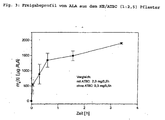
- Fig. 3 shows the in vitro measured release profile for ALA from the 250 micron thick patch of NE / ATBC (1: 2.5) with 20% g / g ALA loading (sieve fraction 90-160 microns).
- the plaster contained in. about 4 mg ALA / cm 2 and had already released more than 500 ⁇ g ALA (corresponding to 12.5% of total drug load) after 1 minute. After 30 min, more than 1.3 mg ALA (equivalent to 32% of total drug load) was released.
- the release profiles were performed as described in Example 3.
- the exposure time of the plaster system for photodynamic therapy (PDT) is shortened by about 30% compared to other applications with ointments or creams.
- FIG. 6 shows the release / permeation profile for ALA from the NE / ATBC (FIG. 1: 2.0) with a film thickness of 250 ⁇ m and loaded with 20% ALA of the sieve fraction 90 to 160 ⁇ m.
- Figures 7 and 8 show the significantly lower release / permeation profiles of the ALA from the ointment bases Psoralone Grease Cream® (containing 10% by weight ALA) and hydroxyethyl cellulose gel (containing 10% by weight ALA).
Landscapes
- Health & Medical Sciences (AREA)
- Life Sciences & Earth Sciences (AREA)
- Veterinary Medicine (AREA)
- Chemical & Material Sciences (AREA)
- Animal Behavior & Ethology (AREA)
- General Health & Medical Sciences (AREA)
- Public Health (AREA)
- Epidemiology (AREA)
- Medicinal Chemistry (AREA)
- Pharmacology & Pharmacy (AREA)
- Engineering & Computer Science (AREA)
- Bioinformatics & Cheminformatics (AREA)
- Biochemistry (AREA)
- Biomedical Technology (AREA)
- Dermatology (AREA)
- Molecular Biology (AREA)
- Chemical Kinetics & Catalysis (AREA)
- General Chemical & Material Sciences (AREA)
- Nuclear Medicine, Radiotherapy & Molecular Imaging (AREA)
- Organic Chemistry (AREA)
- Acyclic And Carbocyclic Compounds In Medicinal Compositions (AREA)
- Medicinal Preparation (AREA)
- Medicines That Contain Protein Lipid Enzymes And Other Medicines (AREA)
- Materials For Medical Uses (AREA)
Description
- Die vorliegende Erfindung betrifft ein dermales Applikationssystem für Aminolävulinsäure-Salze und Aminolävulinsäure-Ester.
- Die topische Verwendung von 5-Aminolävulinsäure (δ-ALA; im folgenden als ALA oder 5-ALA bezeichnet) bei der Behandlung oberflächlicher Hauttumoren, insbesondere von Basaliomen, ist erstmals 1990 von Kennedy et al. (J. Photochem. Photobiol. B. 6 (1990) 143-148) beschrieben worden, wobei in erster Linie visuell erkennbare Tumoren lokal mit ALA in Kontakt gebracht werden. Dabei wird ALA selektiv von Tumor-Gewebe aufgenommen und angereichert, wodurch es nur dort zu einer vermehrten Porphyrinbildung und -konzentration führt, während das gesunde Gewebe im wesentlichen unbeeinflußt bleibt. Die Wirkung von ALA beruht auf der Stimulierung der körpereigenen Porphyrinbildung. Da das Porphyrin bei Bestrahlung stark fluoresziert, kann die ALA- bzw. Porphyrin-Anreicherung im Tumorgewebe zur Diagnose präkanzeröser und kanzeröser Läsionen sowie zur photodynamischen Therapie von Tumorerkrankungen ausgenutzt werden.
- Der pharmazeutischen Formulierung von Präparaten von ALA und dessen Derivaten sind durch die Instabilität von 5-ALA und ALA-Derivaten in wässriger. Lösung praktische Grenzen gesetzt. So erweist sich ALA bei sehr niedrigem pH-Wert als ausreichend stabil, mit zunehmendem pH-Wert sinkt die Stabilität aber stetig (vergl. Rodriguez et al., S.P.I.E. (Society of Photooptical Instrumentation Engineers) 2371 (1995) 204-209). Eine frische ALA-Lösung weist beispielsweise bei einem etwa physiologischen pH-Wert von 8 nach knapp zwei Wochen nur noch etwa 10% unzersetzten Wirkstoff auf. Aus diesem Grund sind im Handel ALA-Fertigpräparate wie Lösungen und Salben nicht erhältlich, sondern sie müssen, ausgehend von reiner ALA, unmittelbar vor der Anwendung frisch zu bereitet werden und weisen dann eine sehr begrenzte Haltbarkeit auf, die typischerweise weniger als zwei Wochen beträgt.
- Eine im Stand der Technik bekannte 5-ALA Methylester-Salbe (Metvix®) ist nach Öffnung ebenfalls nur wenige Tage im Kühlschrank haltbar.
- EP 0 704 209 A1 betrifft ALA-enthaltende Zusammensetzungen, insbesondere in Form von Gelen, Emulsionen und dergleichen, mit den oben beschriebenen Nachteilen.
- WO95/05813 und WO96/06602 offenbaren Zusammensetzungen zur dermalen Applikation von ALA, die eine vergleichsweise niedrige Freisetzungsgeschwindigkeit für den Wirkstoff aufweisen.
- Aufgabe der vorliegenden Erfindung ist es daher, ein Präparat zur Verfügung zu stellen, das ALA-Derivat enthält, in Form einer fertigen Formulierung vorliegt und eine Lagerstabilität bei minimierter Zersetzung des ALA-Derivats aufweist.
- Die Aufgabe wird durch das dermale Applikationssystem der vorliegenden Erfindung gelöst. Bei diesem System handelt es sich um ein selbstklebendes Matrixsystem, dessen Polymermatrix kristallines Aminolävulinsäure-Derivat im Teilchengrößenbereich kleiner ca. 200 µm enthält, wobei das Aminolävulinsäure.-Derivat ein Salze oder Ester von ALA ist.
- Die genannten Derivate schließen die in WO 96/28412 offenbarten Verbindungen ein, insbesondere Verbindungen der allgemeinen Formel R2 2N-CH2COCH2CH2COOR1, wobei R1 einen Alkylrest darstellen kann, der wahlweise durch Hydroxy-, Alkoxy-, Alkyloxy-, Alkoxy-Carbonyloxy-, Amino-, Aryl, Oxo-, oder Fluorgruppe substituiert und wahlweise durch Sauerstoff-, Stickstoff-, Schwefel-, oder Phosphoratome unterbrochen ist, und R2 jeweils unabhängig von einander ein Wasserstoffatom oder eine Gruppe wie R1 darstellt, einschließlich Salze derselben. Gemäß einer bevorzugten Ausführungsform ist die Aryl-Gruppe ein Phenylrest oder ein monogliedriger 5- bis 7-gliedriger heteroaromatischer Rest. R1 kann eine lineare oder verzweigte, unsubstituierte Alkylgruppe (allgemeine Formel -CnH2n+1; n ist eine natürliche Zahl von 1 bis 10) sein. Erfindungsgemäß besonders bevorzugt sind 5-Aminolävulinsäuremethylester, 5-Aminolävulinsäureethylester, 5-Aminolävulinsäurepropylester, 5-Aminolävulinsäurebutylester, 5-Aminolävulinsäurepentylester, 5-Aminolävulinsäurehexylester, 5-Aminolävulinsäureheptylester, 5-Aminolävulinsäureoctylester, oder pharmazeutisch akzeptable Salze davon. Die Herstellung dieser Verbindungen ist beispielsweise in WO 96/28412 beschrieben.
- Gemäß einer bevorzugten Ausführungsform der Erfindung kann das Applikationssystem ein oder mehrere ALA-Derivate, gegebenenfalls in Kombination mit kristalliner Aminolävulinsäure (ALA), enthalten. Soweit im folgenden von ALA oder ALA-Derivat die Rede ist, können darunter auch die erwähnten Kombinationen verstanden werden.
- Im Rahmen der vorliegenden Erfindung wurde überraschenderweise festgestellt, daß eine schnelle Freigabe des ALA-Derivats (ggf. in Kombination mit ALA) durch die Wahl der selbstklebenden polymermatrix nicht nachteilig beeinflußt wird. Aufgrund des ausgewählten Kristallgrößenbereichs wird die Sedimentation der Kristalle des ALA-Derivats (bzw. der in Kombination verwendeten ALA-Kristalle) verhindert, und es herrscht eine homogene Wirkstoff-Verteilung in der Matrix vor.
- Als dermale Applikationssysteme kommen insbesondere die bislang bekannten Matrixsysteme des PSA-Typs (PSA: Pressure-Sensitive Adhesive) in Betracht, wie sie z.B. in Sugibayashi et al., J. Control. Rel. 29 (1994) 177-185 (vergl. insbesondere Figuren 1a und 1e), oder in der Monographie "Pharmazeutische Technologie: Moderne Arzneiformen" (Kapitel "Transdermale Therapeutische Systeme", M. Dittgen; Herausgeber: R. Müller, G. Hildebrand, Wissenschaftliche Verlagsgesellschaft Stuttgart, 1997) beschrieben sind.
- Das erfindungsgemäße Applikationssystem enthält vorzugsweise eine wasserdurchlässige Polymermatrix, die besonders bevorzugt nur bedingt wasserdurchlässig ist.
- Die selbstklebende Polymermatrix wird bevorzugt aus Polymeren aus der Gruppe bestehend aus
- a) Acrylaten,
- b) Silikonpolymeren und
- c) Polyisobutylen
- Bei der Wahl der Matrices sind Polymere bervorzugt, die gegenüber ALA nur eine geringes Lösungsvermögen aufweisen, wie z.B. Ethylacrylat-Methylmethacrylat-Copolymerisat (Eudragit NE). Von Vorteil ist ferner eine ausreichende Klebrigkeit, die die Herstellung von selbstklebenden Matrixsystemen ermöglicht, was durch Zusatz von Weichmachern (wie z.B. ATBC) erreicht werden kann.
- Als selbstklebende Polymermatrix ist Eudragit NE (NE) mit Acetyltributylcitrat (ATBC) als Weichmacher besonders bevorzugt, insbesondere im Massenverhältnis NE/ATBC von 1:0,5 bis 1:2,5.
- Im Rahmen der vorliegenden Erfindung hat sich gezeigt, daß Kristalle des ALA-Derivats (bzw. die in Kombination damit verwendeten ALA-Kristalle) mit einem (mittleren) Durchmesser von weniger als 200 µm, vorzugsweise 20 bis 200 µm, besonders bevorzugt 30 bis 190 µm, von besonderem Vorteil sind. Am meisten sind Kristalle mit einem Durchmesser von 90 bis 160 µm bevorzugt.
- Im erfindungsgemäßen dermalen Applikationssystem wird ALA Derivat, ggf. in Kombination mit ALA, vorzugsweise in einer Konzentration von bis zu 50 Gew.-%, insbesondere von mindestens 1 Gew.%, bezogen auf die fertige Polymermatrix eingesetzt. Besonders bevorzugt ist eine ALA- bzw. ALA-Konzentration von etwa 20 Gew.%.
- Eine erfindungsgemäß besonders bevorzugte Ausführungsform der Erfindung betrifft ein Applikationssystem, bei dem die Kristalle einen Durchmesser von 90 bis 160 µm besitzen und die Polymermatrix aus Eudragit NE (NE) und Acetyltributylcitrat. (ATBC) im Gewichtsverhältnis NE/ATBC von 1:0,5 bis 1:2,5 besteht, wobei ALA-Derivat bzw. ALA in einer Konzentration von bis zu 50 Gew.-% bezogen auf die fertige Polymermatrix vorliegt.
- Die Erfindung betrifft ferner ein Verfahren zur Herstellung dieses Applikationssystems, bei dem man gefriergetrocknetes Eudragit NE (NE) mit Acetyltributylcitrat (ATBC) in Aceton im Massenverhältnis NE/ATBC von 1:0,5 bis 1:2,5 auflöst, man anschließend gemahlenes Aminolävulinsäure-Derivat im Teilchengrößenbereich von 90 bis 160 µm in der Acetonlösung dispergiert und man die so erhaltene Dispersion zu einem dünnen Film auf einen Träger (eine Abdeckfolie) zieht, für 45 Minuten bei 60°C trocknet.
- Gemäß einer besonderen Ausführungsform der Erfindung kann man anstelle eines ALA-Derivats auch eine Mischung verschiedener ALA-Derivate oder eine Mischung aus einem oder mehreren ALA-Derivaten und ALA verwenden.
- Das hiermit zur Verfügung gestellte Applikationssystem zeichnet sich insbesondere dadurch aus, daß ALA bzw. dessen Derivat im Gegensatz zu Wirkstoffen herkömmlicher Pflastersysteme bzw. transdermaler Applikationssysteme sehr rasch freigesetzt wird und in die Haut eindringen kann. Die hohe Freisetzungsgeschwindigkeit war vor dem Hintergrund der bislang verfügbaren Daten und Kenntnisse auf dem Gebiet der transdermalen therapeutischen Systeme ebensowenig vorhersehbar wie die extrem hohe Lagerstabilität und die dadurch ermöglichte lange Aufbewahrungsdauer (d.h. Lagerfähigkeit bei minimaler Zersetzung von ALA bzw. von dessen Derivat).
- Gemäß einer besonderen Ausführungsform der Erfindung werden durch das Applikationssystem innerhalb von 30 Minuten mindestens 30% der in der Polymermatrix dispergierten bzw. suspendierten ALA oder ALA-Derivats freigesetzt. Durch diese schnelle Wirkstoff-Freigabe kann die Einwirkzeit des Applikationssystems gegenüber herkömmlichen Applikationen mittels Salben oder Cremes verkürzt werden, d.h. die Verweilzeit des dermalen Applikationssystems ist deutlich geringer als die Anwendungsdauer bisher verwendeter ALAhaltiger Salben oder Cremes zur Applikation der gleichen Wirkstoffmenge. Gegenüber den erwähnten Salben oder Cremes weist das Applikationssystem ferner den Vorteil auf, daß ALA bzw. ALA-Derivat gezielt in einem scharf begrenzten Hautareal appliziert werden kann, während die bislang im Stand der Technik verwendeten Applikationsformen dies nicht ermöglichen und es daher auch zur Penetration umliegender Hautregionen kommt.
- Mit dem dermalen Applikationssystem der vorliegenden Erfindung wird somit erstmals eine stabile, fertige Zubereitung von ALA bzw. eines ALA-Derivats zur Verfügung gestellt, die auch nach Lagerung über einen Zeitraum von einigen Wochen bis mehreren Monaten keine wesentliche Zersetzung von ALA oder des Derivats aufweist. Wie überraschenderweise festgestellt wurde, bestehen bei dem erfindungsgemäßen System unmittelbar nach Herstellung sowie nach sechsmonatiger Lagerung bei 25°C keine wesentlichen unterschiede bezüglich der Wirkstoff-Freigabe und Hautpermeation in vitro oder in vivo.
- Das erfindungsgemäße Applikationssystem ist gegenüber einer Salbe deutlich praktikabler, da es während der Applikationsdauer keine zusätzliche Abdeckung erfordert, um die Kleidung des Patienten zu schützen. Ferner wird keine zusätzliche Lichtschutzschicht benötigt, um den Wirkstoff vor vorzeitiger Bestrahlung zu schützen.
- Das genannte Applikationssystem ist zur Verwendung bei der photodynamischen Therapie und/oder Diagnose von präkanzerogenen oder kanzerogenen Läsionen der Haut, insbesondere von Hauttumoren (Basaliomen), besonders geeignet.
- Die vorliegende Erfindung wird nachfolgend anhand von Beispielen beschrieben, wobei anstelle von ALA die vorstehend genannten ALA-Derivate, insbesondere 5-Aminolävulinsäuremethylester, 5-Aminolävulinsäureethylester, 5-Aminolävulinsäurepropylester, 5-Aminolävulinsäurebutylester, 5-Aminolävulinsäurepentylester, 5-Aminolävulinsäurehexylester, 5-Aminolävulinsäureheptylester, und 5-Aminolävulinsäureoctylester, verwendet werden.
- Die Pflasterherstellung kann mittels "Solvent Evaporation", "Hot Melt" oder anderer geeigneter Verfahren erfolgen (vgl. z.B. T. Peterson et al., "Design, Development, Manufacturing and testing of Transdermal Drug Delivery Systems" in "Transdermal and Topical Drug Delivery Systems"; T. Ghosh und W. Pfister, Ed.; Interpharm Press 1997, Buffalo Grove, IL/USA). Dies soll am Beispiel des "Solvent Evaporation"-Verfahrens veranschaulicht werden.
- Gemäß einer Ausführungsform der Erfindung wird ALA (Vergleichsbeispiel), ein ALA-Derivat oder eine Mischung derselben, erst gemahlen und klassifiziert, wobei der Teilchengrößenbereich 90 bis 160 µm verwendet wurde. Gefriergetrocknetes Eudragit NE (NE:Trägerpolymer) wird zusammen mit Acetyltributylcitrat (ATBC; Weichmacher) in Aceton im Verhältnis NE/ATBC zwischen 1:0,5 und 1:2,5 aufgelöst. Anschließend erfolgt Zugabe und Dispersion von ALA und/oder ALA-Derivat (s.o.) in Konzentrationen in den fertigen Filmen bis zu 50 Gew.-% (% g/g). Die Zubereitung wird anschließend zum dünnen Film auf eine Abdeckfolie gezogen und 45 Min. bei 60°C getrocknet. Als Abdeckfolie (bzw. Abziehfolie für die Seite des Films, die mit der Haut in Kontakt kommt) eignet sich besonders Melinex 813 bzw. eine silikonisierte Abdeckfolie.
- Die Filmklebrigkeit kann durch den Gehalt an ALA und/oder ALA-Derivat (s.o.), durch das verwendete Polymer und den Anteil an Weichmacher (hier ATBC) variiert werden. Die Wirkstoff-Freigabe sowie deren Permeation durch intakte Haut wird durch ATBC beeinflußt (Weichmachereffekt bzw. Permeationsförderungseffekt).
- Im Gegensatz zu den herkömmlichen transdermalen therapeutischen systemen (TTS) liegt ALA und/oder ALA-Derivat (s.o.) bei allen Beladungen ≥ ca. 1 Gew.-% (% g/g) größtenteils suspendiert in der lipophilen NE/ATBC-Matrix vor.
- Die ALA-Partikel haben eine Größe zwischen ca. 90 und 160 µm und sind im Pflaster homogen verteilt.
- Eine homogene Verteilung der ALA-Partikel im fertigen Pflaster erfordert eine Minimalisierung der Sedimentation der Partikel im flüssigen Polymer/Weichmacher/ALA-Zubereitung während der Pflasterherstellung. Dies erfolgt mittels Optimierung der Viskosität der Zubereitung durch Einstellung der Polymerkonzentration. Das Sedimentationsverhalten der ALA-Teilchen wird durch eine Erhöhung der Viskosität reduziert.
Konzentration von NE[%g/g] in Lösung Viskosität der Lösung [mPas] Sinkgeschwindigkeit der ALA-Teilchen* in Lösung [µm/10s] 12 446 396 18 2180 119 24 3510 3 * Siebfraktion 60-90 µm - Eine angesetzte NE-Konzentration von ≥25% g/g gewährleistet eine minimale Sedimentationsgeschwindigkeit der ALA-Teilchen.
- Für andere Polymermatrices, d.h. andere Polymere, können sich andere ALA-Partikelgrößen als vorteilhaft erweisen, die vom Fachmann gemäß den vorliegenden Informationen und Beispielen auf einfache Weise ermittelt werden können.
- ALA im Pflaster ist langzeitstabil.
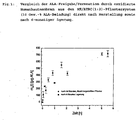
- Die ALA-Freigabe bzw. Hautpermeation aus dem Pflaster direkt nach Herstellung sowie nach 6-monatiger Lagerung bei 25°C zeigt keine wesentlichen Unterschiede (Fig. 1):
- Zur Bestimmung des Freigabeprofils wird das Pflaster in eine Diffusionszelle nach Franz (vgl. z.B. K. Tojo, "Designated Calibration of in vitro Permeation Apparatus" in "Transdermal Controlled Systemic Medication"; Y. Chien, Ed., Marcel Dekker, 1987) bei 33 °C eingespannt. Proben der wässrigen Akzeptorlösung werden nach verschiedenen Zeiten gezogen und deren ALA-Gehalt mittels Fluoreszenz/Derivatisierungs-HPLC-Methode bestimmt.
- Durch Anwendung eines Pflasters kann ALA homogen auf Hautläsionen aufgetragen werden.
- Die extrem leichte Handhabung der Pflastersysteme stellt gegenüber Salbengrundlagen eine wesentliche Verbesserung für Arzt und Patient dar. Ein entsprechendes ALA-haltiges Pflaster kann auf das zu behandelnde Hautareal recht genau zugeschnitten werden. Dies vermindert die Mitbehandlung der umrandeten Hautfläche, die mit Pflaster nicht beklebt ist.
- Durch die Applikation via Pflaster kommt es zu einer scharf begrenzten Applikation, ohne umliegende Hautregionen mit zu penetrieren.
- Nach 3h Applikation eines mit 20% ALA-beladenen Pflasters (Eudragit NE/Acetyltributylcitrat 1:1) auf Unterarm wird die Fluoreszenz der Hautareale gemessen. Fig. 2 zeigt, daß die Fluoreszenz scharf auf die Pflastergröße begrenzt ist und ein homogenes Aussehen hat.
- Überraschenderweise wird im Gegensatz zu herkömmlichen TTS ein hoher Anteil der Wirkstoffbeladung innerhalb kürzester Zeit freigesetzt.
- Konventionelle TTS sind mit einer Vielfalt der eigentlich erforderlichen Dosis des Wirkstoffs beladen (Dittgen, M. "Transdermale Therapeutische Systeme" in "Pharmazeutische Technologie; Moderne Arzneiformen"; Müller, R. & Hildebrand, G., Ed.; Wissenschaftliche Verlagsgesellschaft Stuttgart, 1997). Diese überhohe Beladung ist notwendig, damit der Wirkstoff über einen Zeitraum von 1-7 Tagen annähernd mit konstanter Geschwindigkeit durch passive Diffusion freigesetzt wird. Während dieser Applikationszeit wird nur ein Anteil <50% der Gesamtwirkstoffbeladung freigesetzt.
- Vergleichsbeispiel 1: Scopolamin TTS (Ciba) ist ein membrangesteuertes Pflaster und enthält insges. 1,5 mg Scopolamin. Es gibt 170µg Scopolamin/Tag ab und wird 3 Tage getragen. Am Ende des dritten Tages werden daher ca. 30% der Gesamtwirkstoffbeladung freigesetzt.
- Vergleichsbeispiel 2: Estraderm TTS 25 (Geigy) ist ein klebstoffmembrangesteuertes Pflaster und enthält insges. 2 mg Estradiol. Es setzt 25 µg Estradiol/Tag frei und wird 3-4 Tage getragen. Während dieser Applikationszeit werden daher ca. 5% der Gesamtwirkstoffbeladung freigesetzt.
- Im Gegensatz zu konventionellen TTS wurde überraschenderweise eine extrem rasche Freigabe der ALA aus dem NE/ATBC-Suspensinspflaster festgestellt. Fig. 3 zeigt das in vitro gemessene Freigabeprofil für ALA aus dem 250 µm-dicken Pflaster aus NE/ATBC (1:2,5) mit 20% g/g ALA-Beladung (Siebfraktion 90-160 µm). Das Pflaster enthielt ins. ca. 4 mg ALA/cm2 und hatte bereits nach 1 Minute mehr als 500 µg ALA (entsprechend 12,5% der Gesamtwirkstoffbeladung) freigesetzt. Nach 30 Min. waren mehr als 1,3 mg ALA (entspricht 32 % der Gesamtwirkstoffbeladung) freigesetzt. Die Freigabeprofile wurden wie in Beispiel 3 beschrieben durchgeführt.
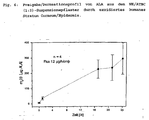
- Der Grund für diese extrem rasche Freigabe ist auf den besonderen Aufbau bzw. die Morphologie des dermalen Applikationssystems (Suspensionspflasters) zurückzuführen. Bedingt durch die Anwesenheit suspendierter ALA in der NE/ATBC-Matrix ragen die 90 bis 160 µm großen ALA-Teilchen teilweise durch die Oberfläche der ca. 250 µm dicken Matrix heraus (vgl. Fig. 4).
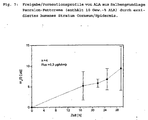
- Nach kurzem Kontakt mit dem wässrigen Freigabemedium sind die durch die Oberfläche herausragenden ALA-Teilchen nicht mehr erkennbar (Fig. 5).
- Diese unerwartet schnelle "Oberflächenauflösung" der ALA-Teilchen ist eine direkte Konsequenz ihrer hohen Hydrophile und führt zur beobachteten extrem raschen Freigabe der ALA aus dem Pflaster (vergl. Fig. 3).
- Die Einwirkzeit des Plastersystems für die Photodynamische Therapie (PDT) ist gegenüber anderen Applikationen mit Salben oder Cremes um ca. 30% verkürzt.
- Bestimmung der Permeation von Wirkstoffen durch Membranen aus exzidiertem humanem Stratum Corneum/Epidermis kann mittels Franzzellen durchgeführt werden und stellt ein geeignetes Modell für die in vivo Aufnahme durch menschliche Haut dar. Fig. 6 zeigt das Freigabe/Permeationsprofil für ALA aus dem NE/ATBC (1:2,0)-Pflaster mit Filmdicke 250µm und beladen mit 20% ALA der Siebfraktion 90 bis 160 µm.
- Nach 24 h haben bereits ca. 300 µg ALA die Humanhautmembran passiert. Im Vergleich dazu zeigen Fig. 7 und 8 die deutlich geringere Freigabe/Permeationsprofile der ALA aus den Salbengrundlagen Psoralon-Fettcreme® (enthält 10 Gew.-% ALA) und Hydroxyethylcellulosegel (enthält 10 Gew.-% ALA).
- Aus beiden Salbengrundlagen haben nach 24 h weniger als 10 µg ALA die Humanhautmembran passiert. Offensichtlich wird ALA aus dem Pflastersystem rascher und in wesentlich größeren Mengen durch die Humanhautmembran resorbiert. Ein Vergleich der Permeationsraten macht dies quantitativ deutlich:
System/Grundlage Permeationsrate [µg/cm2/h] Pflaster NE/ATBC (1:2) 12 Psoralon-Fettcreme® 0,3 Hydroxyethylcellulosegel 0,18 - Eine raschere bzw. stärkere Wirkung des Pflasters gegenüber der Salbengrundlage während der in vivo PDT ist daher zu erwarten.
- Fig. 9 zeigt die gemessene Fluoreszenzintensität an gesunden Probanden (Unterarm) in Abhängigkeit der Zeit. Die Intensität des mit 20%iger ALA beladenen NE/ATBC (1:2)-Pflasters betrug nach 2 h ca. 80% und nach 3 h ca. 140% einer Standardfluoreszenzzubereitung. Eine 50%ige ALA-Beladung des Pflasters gibt im Vergleich zur 20%igen Beladung der Pflaster keine weitere Steigerung in der Fluoreszenzintensität. Die gemessene Fluoreszenzintensität mit Psoralon-Fettcreme® (20% ALA-Beladung) nach einer Inkubationszeit von 3h ist deutlich niedriger (um ca. 60% als die aus dem NE/ATBC(1:2)-Pflaster (20% ALA-Beladung) bei gleicher Tragezeit (3h). Mit dem erfindungagemäßen Applikationssystem lassen sich somit deutlich kürzere Inkubations-/Applikationszeiten erzielen als mit Applikationsformen wie Salben oder Cremes.
Claims (25)
- Dermales Applikationssystem, das ein selbstklebendes Matrixsystem ist, dadurch gekennzeichnet, daß die Polymermatrix ein kristallines Aminolävulinsäure-Salz oder einen kristallinen Aminolävulinsäure-Ester (ALA-Derivat) enthält, wobei die Kristalle des ALA-Derivats eine Größe von weniger als etwa 200 µm aufweisen.
- Applikationssystem nach Anspruch 1, dadurch gekennzeichnet, daß der Aminolävulinsäureester die allgemeinen Formel R2 2N-CH2COCH2CH2COOR1 aufweist oder ein Salz desselben ist, wobei R1 ein Alkylrest ist und R2 jeweils unabhängig voneinander ein Wasserstoffatom oder eine Gruppe wie R1 darstellt.
- Applikationssystem nach Anspruch 2, dadurch gekennzeichnet, daß der Alkylrest durch Hydroxy-, Alkoxy-, Alkyloxy-, Alkoxy-Carbonyloxy-, Amino-, Aryl-, Oxo-, oder Fluorgruppen substituiert ist.
- Applikationssystem nach den Ansprüchen 1 bis 3, dadurch gekennzeichnet, daß der Alkylrest durch Sauerstoff-, Stickstoff-, Schwefel-, oder Phosphoratome unterbrochen ist.
- Applikationssystem nach Anspruch 3, dadurch gekennzeichnet, daß die Arylgruppe ein Phenylrest oder ein monocyclischer 5- bis 7-gliedriger heteroaromatischer Rest ist.
- Applikationssystem nach Anspruch 2, dadurch gekennzeichnet, daß R1 eine unsubstituierte Alkylgruppe ist.
- Applikationssystem nach den Ansprüchen 1 bis 6, dadurch gekennzeichnet, daß die Alkylgruppe 1 bis 10 Kohlenstoffatome aufweist.
- Applikationssystem nach den Ansprüchen 1 bis 7, dadurch gekennzeichnet, daß der Aminoläwlinsäure-Ester 5-Aminolävulinsäuremethylester, 5-Aminolävulinsäureethylester, 5-Aminolävulinsäurepropylester, 5-Aminolävulinsäurebutylester, 5-Aminolävulinsäurepentylester, 5-Aminoläwlinsäurehexylester, 5-Aminolävulinsäureheptylester, 5-Aminolävulinsäureoctylester oder ein Salz desselben ist.
- Applikationssystem nach den Ansprüchen 1 bis 8, dadurch gekennzeichnet, daß das ALA-Derivat eine Mischung verschiedener ALA-Derivate ist.
- Applikationssystem nach den Ansprüchen 1 bis 9, dadurch gekennzeichnet, daß die Polymermatrix wasserdurchlässig ist.
- Applikationssystem nach den Ansprüchen 1 bis 10, dadurch gekennzeichnet, daß die Polymermatrix aus Polymeren aus der Gruppe bestehend ausa) Acrylaten,b) Silikonpolymeren undc) Polyisobutylenausgewählt ist.
- Applikationssystem nach den Ansprüchen 1 bis 11, dadurch gekennzeichnet, daß die Kristalle des ALA-Derivats einen mittleren Durchmesser von 30 bis 190 µm haben.
- Applikationssystem nach Anspruch 12, dadurch gekennzeichnet, daß die Kristalle des ALA-Derivats einen mittleren Durchmesser von 90 µm bis 160 µm haben.
- Applikationssystem nach den Ansprüchen 1 bis 13, dadurch gekennzeichnet, daß das Aminolävulinsäure-Derivat in einer Konzentration von 1 bis 50 Gew.-% bezogen auf die fertige Polymermatrix vorliegt.
- Applikationssystem nach den Ansprüchen 1 bis 14, dadurch gekennzeichnet, daß die Kristalle des ALA-Derivats einen Durchmesser von 30 bis 190 µm besitzen und die Polymermatrix aus Eudragit NE (NE) und Acetyltributylcitrat (ATBC) im Gewichtsverhältnis NE/ATBC von 1:0,5 bis 1:2,5 besteht, wobei das ALA-Derivat in einer Konzentration von 1 bis 50 Gew.-% bezogen auf die fertige Polymermatrix vorliegt.
- Applikationssystem nach Anspruch 15, dadurch gekennzeichnet, daß die Kristalle des ALA-Derivats einen Durchmesser von 90 bis 160 µm besitzen.
- Applikationssystem nach den Ansprüchen 1 bis 16, dadurch gekennzeichnet, daß es innerhalb von 30 Minuten mindestens 30 % des ALA-Derivats freisetzt.
- Applikationssystem nach den Ansprüchen 1 bis 17, dadurch gekennzeichnet, daß es ferner kristalline Aminoläwlinsäure (ALA) enthält.
- Applikationssystem nach Anspruch 18, dadurch gekennzeichnet, daß die ALA-Kristalle einen mittleren Durchmesser von 30 bis 190 µm haben.
- Applikationssystem nach Anspruch 19, dadurch gekennzeichnet, daß die ALA-Kristalle einen mittleren Durchmesser von 90 µm bis 160 µm haben.
- Verfahren zur Herstellung des Applikationssystems nach den Ansprüchen 1 bis 17, dadurch gekennzeichnet, daß man gefriergetrocknetes Eudragit NE (NE) mit Acetyltributylcitrat (ATBC) in Aceton im Verhältnis NE/ATBC von 1:0,5 bis 1:2,5 auflöst, man anschließend gemahlenes ALA-Derivat im Teilchengrößenbereich von weniger als etwa 200 µm in der Acetonlösung dispergiert und man die so erhaltene Dispersion zu einem dünnen Film auf eine Abdeckfolie zieht, für 45 Minuten bei 60 °C trocknet.
- Verfahren nach Anspruch 21, dadurch gekennzeichnet, daß man anstelle eines ALA-Derivats eine Mischung verschiedener ALA-Derivate verwendet.
- Verfahren zur Herstellung des Applikationssystems nach den Ansprüchen 18 bis 20, dadurch gekennzeichnet, daß man das Verfahren nach Anspruch 20 durchführt, wobei man anstelle eines ALA-Derivats eine Mischung eines oder mehrerer ALA-Derivate mit ALA verwendet.
- Applikationssystem nach den Ansprüchen 1 bis 20 zur Anwendung bei der photodynamischen Therapie und/oder Diagnose von präkanzerogenen und kanzerogenen Läsionen der Haut.
- Applikationssystem nach den Ansprüchen 1 bis 20 zur Anwendung bei der photodynamischen Therapie und/oder Diagnose von Basaliomen.
Priority Applications (1)
| Application Number | Priority Date | Filing Date | Title |
|---|---|---|---|
| SI200330753T SI1467706T1 (sl) | 2002-01-23 | 2003-01-16 | Dermalni sistem za nanašanje derivatov aminolevulinske kisline |
Applications Claiming Priority (3)
| Application Number | Priority Date | Filing Date | Title |
|---|---|---|---|
| DE10202487A DE10202487A1 (de) | 2002-01-23 | 2002-01-23 | Dermales Applikationssystem für Aminolävulinsäure-Derivate |
| DE10202487 | 2002-01-23 | ||
| PCT/EP2003/000406 WO2003061621A2 (de) | 2002-01-23 | 2003-01-16 | Dermales applikationssystem für aminolävulinsäure-derivate |
Publications (2)
| Publication Number | Publication Date |
|---|---|
| EP1467706A2 EP1467706A2 (de) | 2004-10-20 |
| EP1467706B1 true EP1467706B1 (de) | 2007-03-14 |
Family
ID=7712859
Family Applications (1)
| Application Number | Title | Priority Date | Filing Date |
|---|---|---|---|
| EP03704408A Expired - Lifetime EP1467706B1 (de) | 2002-01-23 | 2003-01-16 | Dermales applikationssystem für aminolävulinsäure-derivate |
Country Status (13)
| Country | Link |
|---|---|
| US (1) | US8465762B2 (de) |
| EP (1) | EP1467706B1 (de) |
| JP (1) | JP2005521654A (de) |
| AT (1) | ATE356610T1 (de) |
| AU (1) | AU2003206734B2 (de) |
| CY (1) | CY1106577T1 (de) |
| DE (2) | DE10202487A1 (de) |
| DK (1) | DK1467706T3 (de) |
| ES (1) | ES2281621T3 (de) |
| NO (1) | NO333423B1 (de) |
| PT (1) | PT1467706E (de) |
| SI (1) | SI1467706T1 (de) |
| WO (1) | WO2003061621A2 (de) |
Cited By (1)
| Publication number | Priority date | Publication date | Assignee | Title |
|---|---|---|---|---|
| US11850025B2 (en) | 2011-11-28 | 2023-12-26 | Aranz Healthcare Limited | Handheld skin measuring or monitoring device |
Families Citing this family (28)
| Publication number | Priority date | Publication date | Assignee | Title |
|---|---|---|---|---|
| DE10034673C1 (de) * | 2000-07-17 | 2002-04-25 | Medac Klinische Spezialpraep | Dermales Applikationssystem für Aminolävulinsäure und seine Verwendung |
| CA2602074C (en) | 2005-03-17 | 2013-05-14 | Pharmafilm S.R.L. | An aqueous polymeric system for pressure sensitive adhesive matrix preparation |
| JP5081121B2 (ja) * | 2008-10-17 | 2012-11-21 | 株式会社ミルボン | 育毛剤組成物 |
| JP5991970B2 (ja) * | 2010-07-09 | 2016-09-14 | フォトキュア エイエスエイ | 光力学的治療または光力学的診断で使用する乾燥組成物および当該乾燥組成物を含む装置 |
| DE102011111865A1 (de) | 2011-08-31 | 2013-02-28 | Lts Lohmann Therapie-Systeme Ag | Transdermales therapeutisches System für 5-Aminolävulinsäurehydrochlorid |
| US9191203B2 (en) | 2013-08-06 | 2015-11-17 | Bedrock Automation Platforms Inc. | Secure industrial control system |
| US12061685B2 (en) | 2011-12-30 | 2024-08-13 | Analog Devices, Inc. | Image capture devices for a secure industrial control system |
| US8862802B2 (en) | 2011-12-30 | 2014-10-14 | Bedrock Automation Platforms Inc. | Switch fabric having a serial communications interface and a parallel communications interface |
| US11144630B2 (en) | 2011-12-30 | 2021-10-12 | Bedrock Automation Platforms Inc. | Image capture devices for a secure industrial control system |
| US8868813B2 (en) | 2011-12-30 | 2014-10-21 | Bedrock Automation Platforms Inc. | Communications control system with a serial communications interface and a parallel communications interface |
| US8971072B2 (en) | 2011-12-30 | 2015-03-03 | Bedrock Automation Platforms Inc. | Electromagnetic connector for an industrial control system |
| US10834094B2 (en) | 2013-08-06 | 2020-11-10 | Bedrock Automation Platforms Inc. | Operator action authentication in an industrial control system |
| US11314854B2 (en) | 2011-12-30 | 2022-04-26 | Bedrock Automation Platforms Inc. | Image capture devices for a secure industrial control system |
| US9600434B1 (en) | 2011-12-30 | 2017-03-21 | Bedrock Automation Platforms, Inc. | Switch fabric having a serial communications interface and a parallel communications interface |
| US11967839B2 (en) | 2011-12-30 | 2024-04-23 | Analog Devices, Inc. | Electromagnetic connector for an industrial control system |
| US9727511B2 (en) | 2011-12-30 | 2017-08-08 | Bedrock Automation Platforms Inc. | Input/output module with multi-channel switching capability |
| US9437967B2 (en) | 2011-12-30 | 2016-09-06 | Bedrock Automation Platforms, Inc. | Electromagnetic connector for an industrial control system |
| US10834820B2 (en) | 2013-08-06 | 2020-11-10 | Bedrock Automation Platforms Inc. | Industrial control system cable |
| US9467297B2 (en) | 2013-08-06 | 2016-10-11 | Bedrock Automation Platforms Inc. | Industrial control system redundant communications/control modules authentication |
| CA2880422C (en) | 2012-08-03 | 2021-02-09 | Photocure Asa | Derivatives of 5-aminolevulinic acid |
| US10613567B2 (en) | 2013-08-06 | 2020-04-07 | Bedrock Automation Platforms Inc. | Secure power supply for an industrial control system |
| CN105281061A (zh) | 2014-07-07 | 2016-01-27 | 基岩自动化平台公司 | 工业控制系统电缆 |
| CZ307444B6 (cs) * | 2015-04-22 | 2018-08-29 | Jakub Rak | Mukoadhezivní polymerní film pro fotosenzitivní terapii v ústní dutině s obsahem fotosenzitizérů |
| US10013527B2 (en) | 2016-05-02 | 2018-07-03 | Aranz Healthcare Limited | Automatically assessing an anatomical surface feature and securely managing information related to the same |
| US11116407B2 (en) | 2016-11-17 | 2021-09-14 | Aranz Healthcare Limited | Anatomical surface assessment methods, devices and systems |
| KR200483745Y1 (ko) | 2017-02-16 | 2017-06-19 | 김태완 | 자동차 매너 클락션 장치 |
| US11903723B2 (en) | 2017-04-04 | 2024-02-20 | Aranz Healthcare Limited | Anatomical surface assessment methods, devices and systems |
| WO2020234653A1 (en) | 2019-05-20 | 2020-11-26 | Aranz Healthcare Limited | Automated or partially automated anatomical surface assessment methods, devices and systems |
Family Cites Families (14)
| Publication number | Priority date | Publication date | Assignee | Title |
|---|---|---|---|---|
| US5446070A (en) * | 1991-02-27 | 1995-08-29 | Nover Pharmaceuticals, Inc. | Compositions and methods for topical administration of pharmaceutically active agents |
| DE3827561C1 (de) * | 1988-08-13 | 1989-12-28 | Lts Lohmann Therapie-Systeme Gmbh & Co Kg, 5450 Neuwied, De | |
| DE4320871C2 (de) * | 1993-06-24 | 1995-05-04 | Beiersdorf Ag | Kosmetische und dermatologische Zubereitungen mit einem Gehalt an delta-Aminolävulinsäure |
| WO1996006602A1 (en) | 1993-08-27 | 1996-03-07 | Noven Pharmaceuticals, Inc. | COMPOSITIONS AND METHODS FOR THE ADMINISTRATION OF δ-AMINOLEVULINIC ACID AND PHARMACEUTICAL EQUIVALENTS THEREOF |
| GB9318841D0 (en) | 1993-09-10 | 1993-10-27 | Res Foundation Of The Norwegia | Composition |
| JPH08175986A (ja) | 1994-09-20 | 1996-07-09 | Johnson & Johnson Medical Inc | 経皮活性を示す5−アミノレブリン酸含有薬学組成物 |
| CA2229285A1 (en) * | 1995-09-21 | 1997-03-27 | Robert Gurny | Nanoparticles in photodynamic therapy |
| GB9700396D0 (en) | 1997-01-10 | 1997-02-26 | Photocure As | Photochemotherapeutic compositions |
| FR2761889B1 (fr) * | 1997-04-11 | 1999-12-31 | Oreal | Patch pharmaceutique, cosmetique ou dermo-pharmaceutique pour la delivrance de plusieurs composes actifs de nature differente |
| US5856566A (en) | 1997-09-02 | 1999-01-05 | Dusa Pharmaceuticals, Inc. | Sterilized 5-aminolevulinic acid |
| DE19852245A1 (de) | 1998-11-12 | 2000-05-18 | Asat Ag Applied Science & Tech | 5-Aminolävulinsäure-Nanoemulsion |
| WO2001032115A1 (en) * | 1999-11-04 | 2001-05-10 | Xel Herbaceuticals | Transdermal administration of huperzine |
| DE10034673C1 (de) * | 2000-07-17 | 2002-04-25 | Medac Klinische Spezialpraep | Dermales Applikationssystem für Aminolävulinsäure und seine Verwendung |
| NZ533107A (en) * | 2001-11-08 | 2007-04-27 | Upjohn Co | N, N'-substituted-1,3-diamino-2-hydroxypropane derivatives |
-
2002
- 2002-01-23 DE DE10202487A patent/DE10202487A1/de not_active Withdrawn
-
2003
- 2003-01-16 DK DK03704408T patent/DK1467706T3/da active
- 2003-01-16 US US10/502,495 patent/US8465762B2/en not_active Expired - Fee Related
- 2003-01-16 DE DE50306796T patent/DE50306796D1/de not_active Expired - Lifetime
- 2003-01-16 WO PCT/EP2003/000406 patent/WO2003061621A2/de not_active Ceased
- 2003-01-16 AT AT03704408T patent/ATE356610T1/de active
- 2003-01-16 PT PT03704408T patent/PT1467706E/pt unknown
- 2003-01-16 SI SI200330753T patent/SI1467706T1/sl unknown
- 2003-01-16 JP JP2003561566A patent/JP2005521654A/ja active Pending
- 2003-01-16 ES ES03704408T patent/ES2281621T3/es not_active Expired - Lifetime
- 2003-01-16 AU AU2003206734A patent/AU2003206734B2/en not_active Expired
- 2003-01-16 EP EP03704408A patent/EP1467706B1/de not_active Expired - Lifetime
- 2003-09-22 NO NO20034214A patent/NO333423B1/no not_active IP Right Cessation
-
2007
- 2007-05-10 CY CY20071100632T patent/CY1106577T1/el unknown
Cited By (1)
| Publication number | Priority date | Publication date | Assignee | Title |
|---|---|---|---|---|
| US11850025B2 (en) | 2011-11-28 | 2023-12-26 | Aranz Healthcare Limited | Handheld skin measuring or monitoring device |
Also Published As
| Publication number | Publication date |
|---|---|
| ATE356610T1 (de) | 2007-04-15 |
| ES2281621T3 (es) | 2007-10-01 |
| PT1467706E (pt) | 2007-03-30 |
| NO20034214D0 (no) | 2003-09-22 |
| EP1467706A2 (de) | 2004-10-20 |
| SI1467706T1 (sl) | 2007-06-30 |
| DE10202487A1 (de) | 2003-07-31 |
| DK1467706T3 (da) | 2007-07-09 |
| NO20034214L (no) | 2003-11-24 |
| WO2003061621A2 (de) | 2003-07-31 |
| AU2003206734B2 (en) | 2007-09-06 |
| DE50306796D1 (de) | 2007-04-26 |
| JP2005521654A (ja) | 2005-07-21 |
| US8465762B2 (en) | 2013-06-18 |
| CY1106577T1 (el) | 2012-01-25 |
| NO333423B1 (no) | 2013-06-03 |
| US20060018956A1 (en) | 2006-01-26 |
| WO2003061621A3 (de) | 2003-12-31 |
Similar Documents
| Publication | Publication Date | Title |
|---|---|---|
| EP1467706B1 (de) | Dermales applikationssystem für aminolävulinsäure-derivate | |
| DE68907406T2 (de) | Deprenyl zur systemischen transdermalen anwendung. | |
| DE69715049T2 (de) | Tranilast enthaltendes externum und verfahren zu dessen herstellung | |
| DE3779999T2 (de) | Erhoehung des penetrationsvermoegens mittels eines aus die zellhuelle veraendernden substanzen und kurzkettigen alkoholen bestehenden binaeren systems. | |
| EP1303267B1 (de) | Dermales applikationssystem für aminolävulinsäure | |
| EP1178782B1 (de) | Transdermales therapeutisches system (tts) tolterodin enthaltend | |
| EP0439180A2 (de) | Transdermales therapeutisches System mit dem Wirkstoff Tulobuterol | |
| EP2750673B1 (de) | Transdermales therapeutisches system für 5-aminolävulinsäurehydrochlorid | |
| EP0305726B1 (de) | Transdermales therapeutisches System | |
| DE3587048T2 (de) | Pharmazeutische praeparate. | |
| EP0709088B1 (de) | Transdermales therapeutisches System zur Applikation von Naloxon | |
| DE60309329T2 (de) | Verbessertes transdermales abgabesystem | |
| EP0227988A2 (de) | Therapeutisches System | |
| DE102006019293A1 (de) | Pflaster, enthaltend ein Fentanyl Analogum | |
| EP1171105B1 (de) | Transdermales therapeutisches system mit einem stark wirksamen neuroleptikum | |
| DE3438005A1 (de) | Pharmazeutisches mittel zur lokalen therapie der psoriasis | |
| EP0668074B1 (de) | Transdermales therapeutisches System | |
| DE102008006791B4 (de) | Transdermales Therapeutisches System mit Harnstoff-Komponente und Verfahren zu dessen Herstellung | |
| EP1341530A1 (de) | Verwendung eines dopaminagonisten mit kurzer halbwertszeit zur behandlung von dopaminerg behandelbaren erkrankungen | |
| AT504040A1 (de) | Diclofenac-hältige zubereitung zur behandlung von verbrennungen | |
| DE3642066A1 (de) | Therapeutisches system |
Legal Events
| Date | Code | Title | Description |
|---|---|---|---|
| PUAI | Public reference made under article 153(3) epc to a published international application that has entered the european phase |
Free format text: ORIGINAL CODE: 0009012 |
|
| 17P | Request for examination filed |
Effective date: 20040723 |
|
| AK | Designated contracting states |
Kind code of ref document: A2 Designated state(s): AT BE BG CH CY CZ DE DK EE ES FI FR GB GR HU IE IT LI LU MC NL PT SE SI SK TR |
|
| AX | Request for extension of the european patent |
Extension state: AL LT LV MK RO |
|
| GRAP | Despatch of communication of intention to grant a patent |
Free format text: ORIGINAL CODE: EPIDOSNIGR1 |
|
| GRAS | Grant fee paid |
Free format text: ORIGINAL CODE: EPIDOSNIGR3 |
|
| GRAA | (expected) grant |
Free format text: ORIGINAL CODE: 0009210 |
|
| AK | Designated contracting states |
Kind code of ref document: B1 Designated state(s): AT BE BG CH CY CZ DE DK EE ES FI FR GB GR HU IE IT LI LU MC NL PT SE SI SK TR |
|
| REG | Reference to a national code |
Ref country code: GB Ref legal event code: FG4D Free format text: NOT ENGLISH |
|
| REG | Reference to a national code |
Ref country code: PT Ref legal event code: SC4A Free format text: AVAILABILITY OF NATIONAL TRANSLATION Effective date: 20070320 |
|
| REG | Reference to a national code |
Ref country code: CH Ref legal event code: NV Representative=s name: E. BLUM & CO. AG PATENT- UND MARKENANWAELTE VSP Ref country code: CH Ref legal event code: EP |
|
| REG | Reference to a national code |
Ref country code: GR Ref legal event code: EP Ref document number: 20070401027 Country of ref document: GR |
|
| REF | Corresponds to: |
Ref document number: 50306796 Country of ref document: DE Date of ref document: 20070426 Kind code of ref document: P |
|
| REG | Reference to a national code |
Ref country code: IE Ref legal event code: FG4D Free format text: LANGUAGE OF EP DOCUMENT: GERMAN |
|
| REG | Reference to a national code |
Ref country code: HU Ref legal event code: AG4A Ref document number: E001381 Country of ref document: HU |
|
| REG | Reference to a national code |
Ref country code: SE Ref legal event code: TRGR |
|
| GBT | Gb: translation of ep patent filed (gb section 77(6)(a)/1977) |
Effective date: 20070611 |
|
| REG | Reference to a national code |
Ref country code: DK Ref legal event code: T3 |
|
| ET | Fr: translation filed | ||
| REG | Reference to a national code |
Ref country code: ES Ref legal event code: FG2A Ref document number: 2281621 Country of ref document: ES Kind code of ref document: T3 |
|
| PLBE | No opposition filed within time limit |
Free format text: ORIGINAL CODE: 0009261 |
|
| STAA | Information on the status of an ep patent application or granted ep patent |
Free format text: STATUS: NO OPPOSITION FILED WITHIN TIME LIMIT |
|
| 26N | No opposition filed |
Effective date: 20071217 |
|
| REG | Reference to a national code |
Ref country code: FR Ref legal event code: PLFP Year of fee payment: 14 |
|
| REG | Reference to a national code |
Ref country code: FR Ref legal event code: PLFP Year of fee payment: 15 |
|
| REG | Reference to a national code |
Ref country code: FR Ref legal event code: PLFP Year of fee payment: 16 |
|
| PGFP | Annual fee paid to national office [announced via postgrant information from national office to epo] |
Ref country code: DE Payment date: 20200123 Year of fee payment: 18 Ref country code: ES Payment date: 20200219 Year of fee payment: 18 |
|
| PGFP | Annual fee paid to national office [announced via postgrant information from national office to epo] |
Ref country code: LU Payment date: 20210120 Year of fee payment: 19 |
|
| PGFP | Annual fee paid to national office [announced via postgrant information from national office to epo] |
Ref country code: NL Payment date: 20210120 Year of fee payment: 19 Ref country code: MC Payment date: 20210120 Year of fee payment: 19 Ref country code: PT Payment date: 20210108 Year of fee payment: 19 Ref country code: FI Payment date: 20210119 Year of fee payment: 19 Ref country code: EE Payment date: 20210119 Year of fee payment: 19 Ref country code: CZ Payment date: 20210105 Year of fee payment: 19 Ref country code: FR Payment date: 20210120 Year of fee payment: 19 Ref country code: CH Payment date: 20210122 Year of fee payment: 19 Ref country code: CY Payment date: 20210105 Year of fee payment: 19 Ref country code: IT Payment date: 20210129 Year of fee payment: 19 Ref country code: IE Payment date: 20210120 Year of fee payment: 19 Ref country code: GR Payment date: 20210119 Year of fee payment: 19 |
|
| PGFP | Annual fee paid to national office [announced via postgrant information from national office to epo] |
Ref country code: DK Payment date: 20210120 Year of fee payment: 19 Ref country code: GB Payment date: 20210122 Year of fee payment: 19 Ref country code: HU Payment date: 20210109 Year of fee payment: 19 Ref country code: TR Payment date: 20210111 Year of fee payment: 19 Ref country code: SI Payment date: 20210105 Year of fee payment: 19 Ref country code: SE Payment date: 20210122 Year of fee payment: 19 Ref country code: AT Payment date: 20210119 Year of fee payment: 19 Ref country code: BE Payment date: 20210120 Year of fee payment: 19 Ref country code: BG Payment date: 20210121 Year of fee payment: 19 |
|
| PGFP | Annual fee paid to national office [announced via postgrant information from national office to epo] |
Ref country code: SK Payment date: 20210105 Year of fee payment: 19 |
|
| REG | Reference to a national code |
Ref country code: DE Ref legal event code: R119 Ref document number: 50306796 Country of ref document: DE |
|
| PG25 | Lapsed in a contracting state [announced via postgrant information from national office to epo] |
Ref country code: DE Free format text: LAPSE BECAUSE OF NON-PAYMENT OF DUE FEES Effective date: 20210803 |
|
| REG | Reference to a national code |
Ref country code: ES Ref legal event code: FD2A Effective date: 20220422 |
|
| PG25 | Lapsed in a contracting state [announced via postgrant information from national office to epo] |
Ref country code: ES Free format text: LAPSE BECAUSE OF NON-PAYMENT OF DUE FEES Effective date: 20210117 |
|
| REG | Reference to a national code |
Ref country code: FI Ref legal event code: MAE |
|
| REG | Reference to a national code |
Ref country code: DK Ref legal event code: EBP Effective date: 20220131 |
|
| REG | Reference to a national code |
Ref country code: SK Ref legal event code: MM4A Ref document number: E 1912 Country of ref document: SK Effective date: 20220116 |
|
| REG | Reference to a national code |
Ref country code: SE Ref legal event code: EUG |
|
| PG25 | Lapsed in a contracting state [announced via postgrant information from national office to epo] |
Ref country code: MC Free format text: LAPSE BECAUSE OF NON-PAYMENT OF DUE FEES Effective date: 20220131 |
|
| REG | Reference to a national code |
Ref country code: CH Ref legal event code: PL |
|
| REG | Reference to a national code |
Ref country code: NL Ref legal event code: MM Effective date: 20220201 |
|
| REG | Reference to a national code |
Ref country code: AT Ref legal event code: MM01 Ref document number: 356610 Country of ref document: AT Kind code of ref document: T Effective date: 20220116 |
|
| GBPC | Gb: european patent ceased through non-payment of renewal fee |
Effective date: 20220116 |
|
| REG | Reference to a national code |
Ref country code: BE Ref legal event code: MM Effective date: 20220131 |
|
| PG25 | Lapsed in a contracting state [announced via postgrant information from national office to epo] |
Ref country code: SK Free format text: LAPSE BECAUSE OF NON-PAYMENT OF DUE FEES Effective date: 20220116 Ref country code: SE Free format text: LAPSE BECAUSE OF NON-PAYMENT OF DUE FEES Effective date: 20220117 Ref country code: PT Free format text: LAPSE BECAUSE OF NON-PAYMENT OF DUE FEES Effective date: 20220718 Ref country code: NL Free format text: LAPSE BECAUSE OF NON-PAYMENT OF DUE FEES Effective date: 20220201 Ref country code: LU Free format text: LAPSE BECAUSE OF NON-PAYMENT OF DUE FEES Effective date: 20220116 Ref country code: GR Free format text: LAPSE BECAUSE OF NON-PAYMENT OF DUE FEES Effective date: 20220805 Ref country code: GB Free format text: LAPSE BECAUSE OF NON-PAYMENT OF DUE FEES Effective date: 20220116 Ref country code: FI Free format text: LAPSE BECAUSE OF NON-PAYMENT OF DUE FEES Effective date: 20220116 Ref country code: CZ Free format text: LAPSE BECAUSE OF NON-PAYMENT OF DUE FEES Effective date: 20220116 Ref country code: CY Free format text: LAPSE BECAUSE OF NON-PAYMENT OF DUE FEES Effective date: 20220116 Ref country code: BG Free format text: LAPSE BECAUSE OF NON-PAYMENT OF DUE FEES Effective date: 20220731 Ref country code: AT Free format text: LAPSE BECAUSE OF NON-PAYMENT OF DUE FEES Effective date: 20220116 |
|
| PG25 | Lapsed in a contracting state [announced via postgrant information from national office to epo] |
Ref country code: SI Free format text: LAPSE BECAUSE OF NON-PAYMENT OF DUE FEES Effective date: 20220117 Ref country code: HU Free format text: LAPSE BECAUSE OF NON-PAYMENT OF DUE FEES Effective date: 20220117 Ref country code: FR Free format text: LAPSE BECAUSE OF NON-PAYMENT OF DUE FEES Effective date: 20220131 Ref country code: BE Free format text: LAPSE BECAUSE OF NON-PAYMENT OF DUE FEES Effective date: 20220131 |
|
| REG | Reference to a national code |
Ref country code: SI Ref legal event code: KO00 Effective date: 20221003 |
|
| PG25 | Lapsed in a contracting state [announced via postgrant information from national office to epo] |
Ref country code: LI Free format text: LAPSE BECAUSE OF NON-PAYMENT OF DUE FEES Effective date: 20220131 Ref country code: CH Free format text: LAPSE BECAUSE OF NON-PAYMENT OF DUE FEES Effective date: 20220131 |
|
| PG25 | Lapsed in a contracting state [announced via postgrant information from national office to epo] |
Ref country code: IT Free format text: LAPSE BECAUSE OF NON-PAYMENT OF DUE FEES Effective date: 20220116 Ref country code: IE Free format text: LAPSE BECAUSE OF NON-PAYMENT OF DUE FEES Effective date: 20220116 Ref country code: DK Free format text: LAPSE BECAUSE OF NON-PAYMENT OF DUE FEES Effective date: 20220131 |
|
| PG25 | Lapsed in a contracting state [announced via postgrant information from national office to epo] |
Ref country code: PT Free format text: LAPSE BECAUSE OF EXPIRATION OF PROTECTION Effective date: 20230125 |
|
| PG25 | Lapsed in a contracting state [announced via postgrant information from national office to epo] |
Ref country code: EE Free format text: LAPSE BECAUSE OF NON-PAYMENT OF DUE FEES Effective date: 20220131 |
|
| PG25 | Lapsed in a contracting state [announced via postgrant information from national office to epo] |
Ref country code: PT Free format text: LAPSE BECAUSE OF NON-PAYMENT OF DUE FEES Effective date: 20220117 |
|
| PG25 | Lapsed in a contracting state [announced via postgrant information from national office to epo] |
Ref country code: PT Free format text: LAPSE BECAUSE OF NON-PAYMENT OF DUE FEES Effective date: 20220117 |
|
| PG25 | Lapsed in a contracting state [announced via postgrant information from national office to epo] |
Ref country code: BG Free format text: LAPSE BECAUSE OF NON-PAYMENT OF DUE FEES Effective date: 20220116 |
|
| PG25 | Lapsed in a contracting state [announced via postgrant information from national office to epo] |
Ref country code: BG Free format text: LAPSE BECAUSE OF NON-PAYMENT OF DUE FEES Effective date: 20220116 |