EP1469247A9 - Système de raccords de tuyaux - Google Patents
Système de raccords de tuyaux Download PDFInfo
- Publication number
- EP1469247A9 EP1469247A9 EP04008398A EP04008398A EP1469247A9 EP 1469247 A9 EP1469247 A9 EP 1469247A9 EP 04008398 A EP04008398 A EP 04008398A EP 04008398 A EP04008398 A EP 04008398A EP 1469247 A9 EP1469247 A9 EP 1469247A9
- Authority
- EP
- European Patent Office
- Prior art keywords
- connection system
- seal
- peripheral seal
- cross
- groove
- Prior art date
- Legal status (The legal status is an assumption and is not a legal conclusion. Google has not performed a legal analysis and makes no representation as to the accuracy of the status listed.)
- Granted
Links
- 230000008878 coupling Effects 0.000 title claims abstract description 78
- 238000010168 coupling process Methods 0.000 title claims abstract description 78
- 238000005859 coupling reaction Methods 0.000 title claims abstract description 78
- 230000002093 peripheral effect Effects 0.000 claims abstract description 122
- 239000012530 fluid Substances 0.000 claims abstract description 33
- 238000003780 insertion Methods 0.000 claims abstract description 22
- 230000037431 insertion Effects 0.000 claims abstract description 22
- 229920001971 elastomer Polymers 0.000 claims abstract description 14
- 239000000806 elastomer Substances 0.000 claims abstract description 12
- CURLTUGMZLYLDI-UHFFFAOYSA-N Carbon dioxide Chemical compound O=C=O CURLTUGMZLYLDI-UHFFFAOYSA-N 0.000 claims description 16
- 238000007789 sealing Methods 0.000 claims description 15
- 239000001569 carbon dioxide Substances 0.000 claims description 8
- 229910002092 carbon dioxide Inorganic materials 0.000 claims description 8
- 150000001875 compounds Chemical class 0.000 claims description 6
- 230000035699 permeability Effects 0.000 claims description 6
- 239000011248 coating agent Substances 0.000 claims description 5
- 238000000576 coating method Methods 0.000 claims description 5
- 229920002943 EPDM rubber Polymers 0.000 claims description 3
- 230000032683 aging Effects 0.000 claims description 2
- 229910052782 aluminium Inorganic materials 0.000 claims description 2
- XAGFODPZIPBFFR-UHFFFAOYSA-N aluminium Chemical compound [Al] XAGFODPZIPBFFR-UHFFFAOYSA-N 0.000 claims description 2
- 230000004888 barrier function Effects 0.000 claims description 2
- 239000007769 metal material Substances 0.000 claims description 2
- 238000005096 rolling process Methods 0.000 claims description 2
- 229920002379 silicone rubber Polymers 0.000 claims description 2
- 239000004945 silicone rubber Substances 0.000 claims description 2
- 229910001256 stainless steel alloy Inorganic materials 0.000 claims description 2
- 229920003051 synthetic elastomer Polymers 0.000 claims description 2
- 239000005061 synthetic rubber Substances 0.000 claims description 2
- 229910045601 alloy Inorganic materials 0.000 claims 1
- 239000000956 alloy Substances 0.000 claims 1
- 230000000712 assembly Effects 0.000 claims 1
- 238000000429 assembly Methods 0.000 claims 1
- 229920002313 fluoropolymer Polymers 0.000 claims 1
- 239000007789 gas Substances 0.000 description 8
- 230000035882 stress Effects 0.000 description 8
- 238000004378 air conditioning Methods 0.000 description 7
- 238000007906 compression Methods 0.000 description 7
- 230000006835 compression Effects 0.000 description 7
- 239000003566 sealing material Substances 0.000 description 7
- 230000002349 favourable effect Effects 0.000 description 6
- 239000000463 material Substances 0.000 description 6
- 239000003507 refrigerant Substances 0.000 description 6
- 230000009466 transformation Effects 0.000 description 5
- 230000004323 axial length Effects 0.000 description 4
- 230000008901 benefit Effects 0.000 description 4
- 238000004364 calculation method Methods 0.000 description 4
- 230000008602 contraction Effects 0.000 description 4
- 238000013461 design Methods 0.000 description 4
- 238000004519 manufacturing process Methods 0.000 description 4
- 238000003825 pressing Methods 0.000 description 4
- LVGUZGTVOIAKKC-UHFFFAOYSA-N 1,1,1,2-tetrafluoroethane Chemical compound FCC(F)(F)F LVGUZGTVOIAKKC-UHFFFAOYSA-N 0.000 description 3
- 238000010586 diagram Methods 0.000 description 3
- 238000009792 diffusion process Methods 0.000 description 3
- 230000000694 effects Effects 0.000 description 3
- 235000019589 hardness Nutrition 0.000 description 3
- 238000000034 method Methods 0.000 description 3
- IJGRMHOSHXDMSA-UHFFFAOYSA-N Atomic nitrogen Chemical compound N#N IJGRMHOSHXDMSA-UHFFFAOYSA-N 0.000 description 2
- 238000010521 absorption reaction Methods 0.000 description 2
- 238000013459 approach Methods 0.000 description 2
- QVGXLLKOCUKJST-UHFFFAOYSA-N atomic oxygen Chemical compound [O] QVGXLLKOCUKJST-UHFFFAOYSA-N 0.000 description 2
- 238000003795 desorption Methods 0.000 description 2
- 230000007613 environmental effect Effects 0.000 description 2
- 239000001257 hydrogen Substances 0.000 description 2
- 229910052739 hydrogen Inorganic materials 0.000 description 2
- 125000004435 hydrogen atom Chemical class [H]* 0.000 description 2
- 229910052751 metal Inorganic materials 0.000 description 2
- 239000002184 metal Substances 0.000 description 2
- 239000001301 oxygen Substances 0.000 description 2
- 229910052760 oxygen Inorganic materials 0.000 description 2
- 239000004814 polyurethane Substances 0.000 description 2
- 230000008569 process Effects 0.000 description 2
- 239000005060 rubber Substances 0.000 description 2
- 229920006395 saturated elastomer Polymers 0.000 description 2
- 239000000654 additive Substances 0.000 description 1
- 230000000996 additive effect Effects 0.000 description 1
- 230000009286 beneficial effect Effects 0.000 description 1
- 230000015572 biosynthetic process Effects 0.000 description 1
- 238000003776 cleavage reaction Methods 0.000 description 1
- 230000000052 comparative effect Effects 0.000 description 1
- 238000010276 construction Methods 0.000 description 1
- 230000008094 contradictory effect Effects 0.000 description 1
- 238000001816 cooling Methods 0.000 description 1
- 230000007423 decrease Effects 0.000 description 1
- 230000001419 dependent effect Effects 0.000 description 1
- 238000011161 development Methods 0.000 description 1
- 230000018109 developmental process Effects 0.000 description 1
- 238000009826 distribution Methods 0.000 description 1
- 238000005516 engineering process Methods 0.000 description 1
- 238000001125 extrusion Methods 0.000 description 1
- -1 fluorocarbon compound Chemical class 0.000 description 1
- 238000009472 formulation Methods 0.000 description 1
- 150000008282 halocarbons Chemical class 0.000 description 1
- 239000000383 hazardous chemical Substances 0.000 description 1
- 239000001307 helium Substances 0.000 description 1
- 229910052734 helium Inorganic materials 0.000 description 1
- SWQJXJOGLNCZEY-UHFFFAOYSA-N helium atom Chemical compound [He] SWQJXJOGLNCZEY-UHFFFAOYSA-N 0.000 description 1
- 238000009434 installation Methods 0.000 description 1
- 230000010354 integration Effects 0.000 description 1
- 239000002085 irritant Substances 0.000 description 1
- 231100000021 irritant Toxicity 0.000 description 1
- 230000001050 lubricating effect Effects 0.000 description 1
- 239000000203 mixture Substances 0.000 description 1
- 229910052757 nitrogen Inorganic materials 0.000 description 1
- 230000029553 photosynthesis Effects 0.000 description 1
- 238000010672 photosynthesis Methods 0.000 description 1
- 239000004033 plastic Substances 0.000 description 1
- 229920003023 plastic Polymers 0.000 description 1
- 229920002635 polyurethane Polymers 0.000 description 1
- 230000036316 preload Effects 0.000 description 1
- 230000009467 reduction Effects 0.000 description 1
- 238000005057 refrigeration Methods 0.000 description 1
- 230000007017 scission Effects 0.000 description 1
- 238000005507 spraying Methods 0.000 description 1
- 239000000126 substance Substances 0.000 description 1
- 238000012876 topography Methods 0.000 description 1
- 231100000331 toxic Toxicity 0.000 description 1
- 230000002588 toxic effect Effects 0.000 description 1
- 230000007704 transition Effects 0.000 description 1
- 239000002966 varnish Substances 0.000 description 1
Images


Classifications
-
- F—MECHANICAL ENGINEERING; LIGHTING; HEATING; WEAPONS; BLASTING
- F16—ENGINEERING ELEMENTS AND UNITS; GENERAL MEASURES FOR PRODUCING AND MAINTAINING EFFECTIVE FUNCTIONING OF MACHINES OR INSTALLATIONS; THERMAL INSULATION IN GENERAL
- F16L—PIPES; JOINTS OR FITTINGS FOR PIPES; SUPPORTS FOR PIPES, CABLES OR PROTECTIVE TUBING; MEANS FOR THERMAL INSULATION IN GENERAL
- F16L37/00—Couplings of the quick-acting type
- F16L37/08—Couplings of the quick-acting type in which the connection between abutting or axially overlapping ends is maintained by locking members
- F16L37/084—Couplings of the quick-acting type in which the connection between abutting or axially overlapping ends is maintained by locking members combined with automatic locking
- F16L37/088—Couplings of the quick-acting type in which the connection between abutting or axially overlapping ends is maintained by locking members combined with automatic locking by means of a split elastic ring
Definitions
- the present invention relates to a connection system for pipes, fittings or Aggregates used to guide one with a versus a comparative pressure elevated pressure pressurized fluid are determined, in particular for carbon dioxide leading systems, comprising a first coupling part, such as a housing part, a along an axis in the first coupling part insertable second coupling part, such as a plug part, and at least one made of an elastomer, gas permeable Circumferential seal having in a, a groove depth and a groove length groove is arranged, which circumferentially formed in one of the two coupling parts is, wherein the one coupling part with a shaft in a round receiving opening of other coupling part can be inserted, the peripheral seal after insertion under deformation and generation of a radial Vorpreßkaft a gap with a Gap width between the outer radius of the shaft and the inner radius of the Seals receiving opening and thereby at least one perpendicular to the respective Radius of the coupling parts in the axial direction extending contact
- a system designed to guide a pressurized fluid is in motor vehicles, for example, the refrigeration cycle of air conditioning systems.
- various halogenated hydrocarbon compounds have been used in such a system. as one known under the name R134a, mainly from Tetrafluoroethane existing refrigerant used.
- R134a Tetrafluoroethane existing refrigerant used.
- the permeability in turn depends on the material and is caused by the Solubility of the fluid and its diffusion rate in the sealing material affected. It is assumed that on the side of the higher pressure at the Seal an absorption, then within the seal a diffusion and finally on the side of lower pressure desorption occurs. In the stationary state, i.e. at saturation of the elastomer with the fluid, while the absorption and the desorption process by Henry's Law and the diffusion process by that first Fick's law described.
- the equation is based on the fact that the seal is understood as a plane-parallel plate.
- the equation illustrates a linear, proportional dependence of the amount Q of the fluid passed through the peripheral seal - also referred to as leakage rate - of the cross-sectional area A of the deformed circumferential seal and a linear, proportional dependence on the reciprocal of the average permeation length L, resulting in a given system pressure p and predetermined operating time t to achieve a small leakage quantity Q principle results in the cross-sectional area A of the deformed peripheral seal as small as possible and to choose the average permeation length L as large as possible.
- a line connector is known in which, taking into account of the said principle, the sealing material in a preferred Execution extends over a length which is much larger than its radially measured Seal thickness, which is disadvantageous but due to the fact that non-positive connections under pulsating pressure tend to loosen, in the known system, the need for the seal by means of a Self-locking wedge to press.
- the upper level at about 30 bar and its lower level is about 3 bar, so far is a leak Q of not less than 5 to 9 g per year and compound reached and tolerated. Since the fluorocarbons mentioned a high so-called greenhouse potential and degraded to form toxic or irritant cleavage products therefore arises in the large number of motor vehicles equipped with air conditioning systems, currently in Germany alone about twelve million, a high environmental hazard.
- German Utility Model DE 200 02 810 U1 has disclosed a connection system described with a special sealing part, which consists of an elastomer-coated Corrugated pipe exists.
- This sealing part is intended to meet the sealing requirements for gases, such as Carbon dioxide or hydrogen, meet and be as far as elastic to the extent that it is in one conventional plug-in system with axial clearance can be used.
- This plug-in coupling has basically proven itself in practice, but in conjunction with the elastomer-coated metallic sealing elements disadvantageously high Insertion forces and difficult to maintain manufacturing tolerances occur.
- the present invention is based on the object, a connection system of to create the aforementioned type, without additional necessary support or Mounting aids for the seal, such as a self-locking wedge or the like, at a small amount of enforced by the circumferential seal fluid under high system pressures, in particular under system pressures of up to more than 150 bar, and with resistance in the temperature range from -40 ° C to over 200 ° C low during insertion, insertion forces and high reliability, i. one Reliable compensation of manufacturing tolerances of the coupling parts guaranteed.
- this is achieved in that the cross section of the unpressed Circumferential seal, the groove depth and the gap width and the groove length in such a way are tuned that in one, a permeation through the peripheral seal determining Ratio of a permeation-effective partial circumferential surface of the peripheral seal to the contact length, the partial circumferential area is not greater than half the value a perpendicular to the axial direction extending cross-sectional area of the deformed Peripheral seal.
- the invention is based first of the knowledge that it is possible by a Targeted coordination of the mentioned quantities on each other in a connection system to provide a seal in which a permeation through the peripheral seal is not by the ratio of the axially extending cross-sectional area of the deformed circumferential seal is determined to the axial length of the peripheral seal, but by the ratio of a permeation effective partial peripheral surface of the Peripheral seal to the contact length over which the circumferential seal perpendicular to respective radius of the coupling parts in the axial direction of the coupling parts is applied.
- the invention is based on the finding that these sectionings simulation by the vote of these sizes each other very much can be made smaller than the running in the axial direction cross-sectional area and that if the reduced ratio of the partial circumferential area to the contact length in the application of the known calculation equation for dimensioning the Sealing geometry is taken into account, leading to constructive advantages that arise a predetermined maximum allowable leakage in reduced necessary Express insertion forces.
- Cross-sectional area and the partial circumferential surface of the deformed circumferential seal to said contact length can be variable as, but coordinated Sizes of the cross section of the unmolded circumferential seal, the groove depth, the Slot length and the gap width can be selected.
- the circumferential seal as a quotient of a lying in the groove portion the compressed, radial cross section of the peripheral seal and the groove depth and groove length resulting cross-sectional area of the groove determines a degree of filling of the groove be controlled over the permeation-effective partial peripheral area in size is.
- an inventive connection system for fluidic systems in particular for CO 2 leading systems, in the illustrated case a plug-in coupling, a first coupling part 1 in the form of a housing, along an axis XX in the first coupling part 1 insertable second circumferential coupling element 2 in the form of a plug part, and at least one, in the illustrated embodiment two, made of an elastomer peripheral seals 3.
- the circumferential seals 3 are each arranged in a groove depth T and a groove length NL groove 4, which circumferentially in one of the two Coupling parts 1, 2 - in the illustrated embodiment in the second coupling part 2, the plug part - is formed.
- the second coupling part 2 has a round in its basic shape in cross-section shaft 5 and is thus in a round in its basic shape in cross-section receiving opening 6 of the first coupling part 1 inserted.
- the grooves 4 extend in the shell of the shaft 5 circumferentially and parallel to each other.
- peripheral seals 3 close after insertion under deformation and generation of a radial Vorpreßkaft F v each have a gap 7 with a gap width s, not well to recognize in Fig. 1 and therefore there only with a parenthesized reference numerals "(s)" indicated is.
- a clear illustration shows the enlargement in FIG. 2.
- Fig. 2 also shows that the gap 7 between the outer radius R SA of the shaft 5 and the inner radius R OI of the receiving opening 6 is located.
- the respective circumferential seal 3 closes the gap 7 and is at least over a perpendicular to the respective radius R SA , R OI of the coupling parts 1, 2 extending in the axial direction XX contact length KL to the coupling parts 1, 2 at.
- a V of the deformed circumferential seal 3 results from the sum of groove depth T and gap width s or from the difference between the inner radius R OI of the receiving opening 6 and the radius R SN of the second coupling part 2 in the region of the bottom of its groove 4.
- the radial cross-sectional area of the pressed circumferential seal 3 is instead designated by the reference symbol A R.
- a permeation through the peripheral seal 3 determining surface permeation length ratio A E / KL is formed by a permeation-effective partial peripheral surface A E of the peripheral seal 3 to the contact length KL.
- the partial circumferential surface A E is arranged in the vicinity of the gap 7 and is by the in Fig. 2 (and also Fig. 8) boldly highlighted, in particular not applied to the coupling parts 1, 2, arc line BL of the compressed, radial cross-sectional area A R of deformed circumferential seal 3 determines.
- the partial circumferential area A E is not greater than half the value, preferably not greater than one fifth of the cross-sectional area A V of the deformed circumferential seal 3 extending perpendicular to the axial direction XX.
- the length of the arched line BL assumes the value of the gap width s in the minimum case when the arching curve disappears at.
- the cross section of the uncompressed circumferential seal 3, the groove depth T and the slot width s as well as the groove length NL are matched to one another such that the circumferential surface part permeations relievee A E is independent of a cord thickness of the uncompressed circumferential seal.
- the arc line BL should not be longer than half the value, preferably a quarter of the value, the width B, ie the sum of gap width s and groove depth T.
- the plug part is in the illustrated in Fig. 1 specific embodiment of an inventive Connection system in the receiving opening 6 by means of a (as a whole unspecified) locking device in the inserted state against Loosen lockable.
- the locking device consists of at least one Locking element - in the illustrated embodiment of two axially successively on the Plug part arranged latching elements 8, 9 - and one each with a locking element 8, 9 cooperating latching shoulder 10.
- the locking elements 8, 9 are respectively by a snap ring held in each case in an annular groove 11, 12 of the plug part educated.
- the housing part is made in two parts by being made of an inner Housing part 1 a, which forms the main part of the receiving opening 6, and one with detachably connectable to the inner housing part 1a and the inner housing part 1a in the consists essentially comprehensive outer housing part 1b.
- the locking shoulder 10 is single end in the entrance area of the receiving opening 6 on the outer housing part 1b educated.
- the outer housing part 1b is as with the inner Housing part 1a screwed union nut formed.
- the second coupling part 2, ie the plug, and both the inner housing part 1a, as well as the outer housing part 1 b of the first coupling part 1 may be preferred made of metallic materials, in particular of aluminum or high-alloyed Stainless steel alloys, consist.
- the circumferential seals 3 may for example a polymeric fluorocarbon compound, synthetic rubber, such as Silicone rubber, NBR or H-NBR, PUR, EPDM, SBR, etc. consist.
- An asymmetrical position of the peripheral seal 3 can thereby adjust that this by the difference .DELTA.p between the increased pressure p 1 and the reference pressure p 2nd in the axial direction XX against a wall of the groove 4 is pressed, while on the other side of the groove 4 is still a distance between the wall of the groove 4 and the peripheral seal 3.
- the contact ratios illustrated by FIG. 2, occurring between the peripheral seal 3 and the respective coupling part 1, 2, can be described by means of the Hertz equations, if peripheral seal 3 and coupling parts 1, 2 are considered to be elastic bodies.
- the Hertz's equations are applicable. These equations are elliptic integrals of the first kind and were determined on the basis of the strict theory of elasticity.
- the sealing contour is flattened and there is a linear contact over the contact length KL.
- F V is the biasing force acting in the radial direction, with which the seal 3 is pressed against the first coupling part 1
- R OI is the inner radius of the first coupling part 1.
- E D is the value of the modulus of elasticity of the peripheral seal 3.
- R RS is a measure for the convex curvature of the gasket 3 in the radial direction, for example, the cord radius R SO of an O-ring seal in the unmolded state, as shown in FIGS. 4 and 5. According to Hertz, the maximum mechanical stress ⁇ 1max is 1.5 times as great as the specific value of the prestressing force F V related to the forming contact surface F 1 .
- the contact between the peripheral seal 3 and the second coupling part 2 can be - a radially inward and outward symmetrical effect of the biasing force F V in the circumferential seal 3 provided - the maximum mechanical stress ⁇ 2max and the contact length KL 2 between the radius R SN of Shaft 5 on the bottom of the groove 4 and the peripheral seal 3 determine.
- the radius R SN of the shank 5 of the second coupling part 2 on the bottom of the groove 4 then takes the place of the inner radius R OI of the first coupling part 1.
- Equation (6) also illustrates that an increase in the contact length KL either by an increase of the biasing force F V or by increasing the radius of curvature R RS in the cross section of the non-deformed circumferential seal 3 or by a reduction in the elastic modulus E D of the sealing material or by a smaller inner radius R OI of the first coupling part 1 cause cause.
- insertion forces F S For larger nominal diameters or for small nominal diameter, but with the relevant CO 2 pressure range, occur more insertion forces F S which can reach more than 100 N and 120 N. Such insertion forces F S can be inventively avoided and advantageously for inner radii R OI of the first coupling part 1 in the range of about 6 mm to 13 mm insertion forces F S of less than 100 N, preferably less than 50 N and even less than 30 N, can be achieved ,
- the area designated I in the right part of the diagram illustrates the conditions in the conventionally used, with the aid of the above-described equation (1) sized circumferential seal, where - as described - by a linear, proportional dependence of the leakage quantity Q from the perpendicular to the axial Direction XX oriented cross-sectional area A of the compressed seal and a linear, proportional dependence on the reciprocal of the permeation length L is assumed.
- the cross-sectional area A of the deformed circumferential seal perpendicular to the axial direction XX this results from a cross-sectional area A V as described above with reference to FIG.
- a circumferential seal 3 used according to the invention which - as shown by way of example in Fig. 2 - convexly bulges in the axial direction XX, or at a peripheral seal 3, which - as shown in Fig. 10c - in the axial direction XX is not curved, is the shortest - and therefore decisive for the permeation - Permeationsin L perpendicular to the respective radius R SA , R OI of the coupling parts 1, 2 in the axial direction XX extending contact length KL.
- the permeation by the peripheral seal 3 determining ratio A E / KL of the permeating partial area A E of the peripheral seal 3 is now assumed to the contact length KL, wherein in the ratio A E / KL, the partial peripheral surface A E is not greater than half the value of the perpendicular to the axial direction XX extending cross-sectional area A V of the deformed peripheral seal 3.
- This is illustrated in the left part of the diagram, in a region which is indicated in Fig. 3 by II.
- the amount Q of the fluid permeated through the peripheral seal 3 due to permeation after the saturation of the peripheral seal 3 with fluid is significantly lower than that expected according to the conventional dimensioning method (illustrated by the straight line continuation of region I) would.
- the value Q 1 which can be taken from FIG. 3, represents a leakage quantity Q of 5 to 9 g per year per connection, as is characteristic of the use of the refrigerant R134a in a motor vehicle air conditioning system.
- a certain operating time t the operating pressure p 1 (eg 30 bar)
- a ratio is obtained for a particular material, ie, based on a specific permeation constant P (A / L) 11 , with its attitude the previous technical requirements can be taken into account.
- the invention allows in contrast to low assembly forces F S setting a ratio A E / KL, the technical requirements - even when setting a very low leakage quantity Q 2 , as he used for the use of CO 2 as a refrigerant in a motor vehicle air conditioning is demanded - does justice.
- the ratio A E / KL may preferably be below the limit value G shown in FIG. 3.
- This limit value G ie the ratio A E / KL determining the permeation through the circumferential seal 3, should not be greater than 50.0 mm, preferably not greater than 17.5 mm, at 100 °, especially for carbon dioxide as a fluid, at room temperature C is not greater than 4.5 mm, preferably not greater than 1.2 mm, and at 150 ° C not greater than 1.00 mm, preferably not greater than 0.25 mm.
- R RS is a measure of the convex curvature of the circumferential seal 3 and is determined by the cord radius R SO of the circular cross section AU R of the cord in an O-ring, as shown as the core in Fig. 4.
- a peripheral seal 3 which has an ellipse, as it circumscribes the circular cross-section in Fig. 5 AU R , as a shape of the cross section AU E , in contrast, over its cross-sectional circumference no uniform curvature exists, as in place of the uniform radius of curvature R SO of the circle a long half-axis HA and a short half-axis HB occur.
- Peripheral seal 3 for a connection system according to the invention the case.
- the cross section AU of the unpressed Circumferential seal 3 in a symmetrical manner to a center axis Y-Y of two equal-sized semicircular surfaces KF1, KF2 - it could also be circular segment surfaces - and an intermediate rectangular area RF.
- the O-ring determines with the radius R SO the radial main extension HB of the cross section AU of the cord and the curvature in the axial direction XX.
- the axial main extension HA results as a side length SL of the half surface of the cross section AU, which has the total axial length GL.
- the choice of this total length GL - for example, in relation to a predetermined groove length NL - is in addition to the size of the radial deformation of the peripheral seal 3 during assembly is another way to vary the degree of filling FG of the groove 4 in the compressed state.
- FIGS. 6 to 8 there is also no uniform curvature over the cross-sectional circumference.
- the curvature formed in the radial direction is determined by the rectangular area RF with the side length GL-2 * R SO ; and a corresponding radius of curvature assumes the value infinity.
- Fig. 8 shows in a similar form as in Fig. 2, the mesh-like filled, compressed peripheral seal 3 compared to the unmolded peripheral seal 3. The illustration shows that there is a high degree of filling FG of the groove and that the length of the arc line BL not greater than half the value of the sum of gap width s and groove depth T.
- Fig. 9 shows another, to be regarded as optimal execution of a peripheral seal 3 for a connection system according to the invention, which is characterized in that the cross section AU opt of the unpressed circumferential seal 3 in the basic shape of a rectangle, the two with a first radius of curvature R 1st convexly curved longitudinal sides, two with a second radius of curvature R 2 convexly curved transverse sides and four with a third radius of curvature R 3 convexly rounded corners.
- the third, in particular in the compression of the peripheral seal the arc length BL and determining the degree of filling FG influencing radius of curvature R 3 is smaller than the first, in particular the contact length KL-determining, radius of curvature R 1 and the first radius of curvature R 1 is again smaller than the second Radius of curvature R 2 , which also determines arc length BL and filling degree FG, but to a lesser extent than the third radius R 3 .
- a cross-sectional shape can be achieved at a high degree of filling FG of the groove 4 and lower biasing force F V a short arc length BL and thus a smaller in comparison with an O-ring or a ring with elliptical cross-section permeable partial surface area A E.
- the cross section AU opt of the peripheral seal 3 in the unpressed state already on a preform in which the shape number, the quotient FZ U HA / HB from an axial main extension HA of the seal cross section AU opt , and a radial main extension HB a value greater than 1, preferably greater than 2.
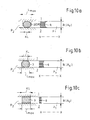
- 10a to 10c show that, depending on the embodiment of the circumferential seal 3 for a specific leakage q, ie for a relative to the cross section A V of the compressed peripheral seal 3 leakage Q of the permeation through the respective peripheral seal 3 enforced fluid, a different profile of the course of the specific leakage quantity q sets, which is dependent on the shape of the cross section A V of the compressed peripheral seal 3.
- Fig. 10a shows a compressed O-ring OR.
- Fig. 10b shows a peripheral seal 3 with a - already by the geometric design of its cross section in the unpressed state - over an O-ring OR extended contact length KL.
- a peripheral seal 3 which - as well as the embodiment of FIG. 4 and 5 with the elliptical cross-section AU E and the embodiments of FIG. 6 to 8 and 9 - in the assembled state does not have to be pressed more than a standard O Ring, the assembly forces and also necessary during assembly expansion can be kept low. Also, the risk of damage to the peripheral seal 3 during assembly or tearing out of the groove 4, less than in the O-ring OR with a circular cross-section.
- Fig. 10c shows a peripheral seal 3 with in the compressed state rectangular area of the cross section A V.
- the rectangular sides lying in the axial direction XX are longer than the rectangle sides lying in the radial direction. If such a peripheral seal inserted into a groove, the circumferential surface part permeations relievee A E is independent of the cord thickness of the uncompressed circumferential seal and the arc line BL takes the value of the gap width of s.
- the shortest permeation length L is the contact length KL, via which the peripheral seal 3 rests against the respective coupling part 1, 2.
- the largest permeation length L in each case is denoted by L max in FIGS. 10a to 10c.
- a value Q 2 of the quantity Q of the fluid permeated by the circumferential seal 3 as a result of permeation was less than 2.5 g per year and compound, in particular less than 1 g per year and compound of an H-NBR O-ring 8.0 x 5.0 at a mean compression VP of 25.0 percent achieved, the latter could fluctuate in the range of 21.2 percent to 27.4 percent tolerance.
- the mean FG of groove 4 was 86.0 percent and could range from 78.2 percent to 92.1 percent.
- the axial length NL of the groove 4 was 5.8 mm
- the depth T of the groove 4 in the range of 3.47 mm to 3.63 mm
- the gap width s was in the range of 0.05 mm to 0.25 mm
- the inner radius R OI of the receiving opening 6 was 7.75 mm
- the axial length NL of the groove 4 was 4.9 mm
- the depth T of the groove 4 in the range of 3.47 mm to 3.63 mm
- the gap width s was in the range of 0.05 mm to 0.25 mm
- the inner radius R OI of the receiving opening 6 was 6.2 mm
- the radius R SN of the shaft 5 at the bottom of the groove 4 at 4.35 mm. It formed at room temperature, a contact length KL of about 3.9 mm.
- connection system according to the invention then has a particularly favorable design if, in the radial cross section A R of the deformed peripheral seal 3, the contact length KL is less than approximately 15 percent, preferably less than approximately 10 percent, particularly preferably less differs from the maximum axial permeation length L max by the peripheral seal 3, ie when, for example, the seal 3 in the axial direction has a very large radius of curvature, such as the radius R 2 in Fig. 9.
- a gas leakage flow GLS occurring therein is always composed of two components in an additive manner.
- this is the quantity Q of the fluid permeated as a result of permeation through the peripheral seal 3
- microleakage currents MQ over the contact length KL, the size of which is determined by the topography of the surfaces of the coupling parts 1, 2.
- a maximum roughness value R max of the surfaces of the coupling parts 1, 2, at least in the region of the outer radius R SA of the shaft 5 and the inner radius R OI of the receiving opening 6, where the circumferential seal 3 is applied, is smaller than 16 microns, preferably less than 10 microns.
- a mean roughness R a should be in the range of 0.3 to 0.8 microns, which can advantageously be achieved in diameters of 12 to 25 mm, characterized in that provided with an allowance of 0.018 to 0.040 mm surfaces in the pre-machined Condition should have a roughness R a in the range of 1.6 to 3.2 microns, smoothed.
- the invention is not limited to the illustrated embodiments, but also includes all the same in the context of the invention embodiments.
- the first coupling part 1 has the groove 4 instead of the second coupling part 2.
- the first radius R 1 could be greater than the second radius R 2 .
- the Hertz equations - and in particular the equation for the approach of two elastic bodies pressed onto one another - can be used with advantage.
- a circumferential seal 3 of an inventive Connection system additionally with a special gas barrier coating be provided, for example, a coating with polyurethane-based lubricating varnish or with a spray-coating applied permeation-reducing coating, in a preferred thickness range of 15 microns to 60 microns, in particular in a circular coating of O-rings in a thickness range of 20 microns to 30 ⁇ m.
- a coating with polyurethane-based lubricating varnish or with a spray-coating applied permeation-reducing coating in a preferred thickness range of 15 microns to 60 microns, in particular in a circular coating of O-rings in a thickness range of 20 microns to 30 ⁇ m.
- the invention is not yet in the independent Claims defined feature combination limited, but it can also by any any other combination of certain features of all disclosed Be defined individual characteristics. This means that basically every single feature of claim 1 or 31 omitted or by at least one elsewhere in the application disclosed individual feature can be replaced. insofar the claims are merely intended as a first formulation attempt for an invention understand.
Landscapes
- Engineering & Computer Science (AREA)
- General Engineering & Computer Science (AREA)
- Mechanical Engineering (AREA)
- Gasket Seals (AREA)
Priority Applications (1)
| Application Number | Priority Date | Filing Date | Title |
|---|---|---|---|
| EP04008398A EP1469247B1 (fr) | 2003-04-14 | 2004-04-07 | Système de raccords de tuyaux |
Applications Claiming Priority (5)
| Application Number | Priority Date | Filing Date | Title |
|---|---|---|---|
| EP03008547 | 2003-04-14 | ||
| EP03008547A EP1355100B1 (fr) | 2002-04-15 | 2003-04-14 | Raccord enfichable pour système fluidique |
| DE20314133U DE20314133U1 (de) | 2003-04-14 | 2003-09-10 | Verbindungssystem |
| DE20314133U | 2003-09-10 | ||
| EP04008398A EP1469247B1 (fr) | 2003-04-14 | 2004-04-07 | Système de raccords de tuyaux |
Publications (3)
| Publication Number | Publication Date |
|---|---|
| EP1469247A1 EP1469247A1 (fr) | 2004-10-20 |
| EP1469247A9 true EP1469247A9 (fr) | 2005-04-06 |
| EP1469247B1 EP1469247B1 (fr) | 2006-06-21 |
Family
ID=32912589
Family Applications (1)
| Application Number | Title | Priority Date | Filing Date |
|---|---|---|---|
| EP04008398A Expired - Lifetime EP1469247B1 (fr) | 2003-04-14 | 2004-04-07 | Système de raccords de tuyaux |
Country Status (1)
| Country | Link |
|---|---|
| EP (1) | EP1469247B1 (fr) |
Families Citing this family (2)
| Publication number | Priority date | Publication date | Assignee | Title |
|---|---|---|---|---|
| DE202004017316U1 (de) | 2004-11-09 | 2006-03-16 | Voss Automotive Gmbh | Verbindungssystem |
| CN118565078B (zh) * | 2024-06-21 | 2024-12-13 | 广州纬华节能设备有限公司 | 水箱电加热口结构的防水反渗控制方法 |
Family Cites Families (5)
| Publication number | Priority date | Publication date | Assignee | Title |
|---|---|---|---|---|
| US2365574A (en) * | 1943-10-21 | 1944-12-19 | Mcwane Cast Iron Pipe Company | Pipe joint |
| FR2592701B1 (fr) * | 1986-01-03 | 1988-07-08 | Pont A Mousson | Joint d'etancheite pour le raccordement de deux elements de canalisation, l'un a bout uni, l'autre a emboitement |
| EP0806594A1 (fr) * | 1996-04-30 | 1997-11-12 | Teruaki Masuoka | Joint torique à section multi-lobulaire |
| US20020106526A1 (en) * | 2000-06-05 | 2002-08-08 | Satoru Kuramoto | Seal member |
| JP2001355733A (ja) * | 2000-06-12 | 2001-12-26 | Toyota Industries Corp | ハウジング接合部のシール装置 |
-
2004
- 2004-04-07 EP EP04008398A patent/EP1469247B1/fr not_active Expired - Lifetime
Also Published As
| Publication number | Publication date |
|---|---|
| EP1469247A1 (fr) | 2004-10-20 |
| EP1469247B1 (fr) | 2006-06-21 |
Similar Documents
| Publication | Publication Date | Title |
|---|---|---|
| EP2376801B1 (fr) | Amortisseur pneumatique | |
| DE2920983C2 (de) | Anordnung zur druckdichten Befestigung eines Schlauches auf einem Nippel | |
| DE69512401T2 (de) | Verbinder für schläuche mit wenigstens einem elastischen dichtungsring | |
| DE10393981T5 (de) | Verbindervorrichtung | |
| DE102011087176A1 (de) | Rohrverbindung | |
| EP0942205A1 (fr) | Joint plat métallique | |
| EP2989355B1 (fr) | Joint plat | |
| EP1469247B1 (fr) | Système de raccords de tuyaux | |
| EP1774217B1 (fr) | Raccord de conduites pour milieux sous haute pression | |
| DE20314133U1 (de) | Verbindungssystem | |
| DE10028503A1 (de) | Dichtungsanordnung für hohe Drücke und Temperaturen | |
| US7258371B1 (en) | Connection system | |
| EP1184572A2 (fr) | Joint d'étanchéité haute pression | |
| DE102017119307A1 (de) | Zylinderkopfdichtung | |
| EP1687557B1 (fr) | Systeme d'assemblage | |
| DE2821329C2 (de) | Dichtungsanordnung für Armaturen | |
| DE102010036363A1 (de) | Rollbalg für eine Luftfeder | |
| DE19855795B4 (de) | Schneidringverschraubung für Druckmittel-Rohrleitungen | |
| DE112017005493T5 (de) | Dichtungsanordnung, Dichtungsverfahren und Kupplung mit der Dichtungsanordnung | |
| DE102004057408A1 (de) | Dichtungsanordnung, insbesondere für einen Anschluss einer Leitung an einem Expansionsorgan | |
| DE102009008791A1 (de) | Flachdichtungen mit zusätzlichem Abdichtelement | |
| EP1507996A1 (fr) | Collier d'attache pour tuyaux | |
| EP3324083B1 (fr) | Agencement d'étanchéité et son utilisation | |
| DE102004020446B3 (de) | Zylinderkopfdichtung für Brennkraftmaschinen | |
| EP2952789A1 (fr) | Soupape de sécurité |
Legal Events
| Date | Code | Title | Description |
|---|---|---|---|
| PUAI | Public reference made under article 153(3) epc to a published international application that has entered the european phase |
Free format text: ORIGINAL CODE: 0009012 |
|
| AK | Designated contracting states |
Kind code of ref document: A1 Designated state(s): AT BE BG CH CY CZ DE DK EE ES FI FR GB GR HU IE IT LI LU MC NL PL PT RO SE SI SK TR |
|
| AX | Request for extension of the european patent |
Extension state: AL HR LT LV MK |
|
| 17P | Request for examination filed |
Effective date: 20050119 |
|
| 17Q | First examination report despatched |
Effective date: 20050304 |
|
| AKX | Designation fees paid |
Designated state(s): AT BE BG CH CY CZ DE DK EE ES FI FR GB GR HU IE IT LI LU MC NL PL PT RO SE SI SK TR |
|
| GRAP | Despatch of communication of intention to grant a patent |
Free format text: ORIGINAL CODE: EPIDOSNIGR1 |
|
| GRAS | Grant fee paid |
Free format text: ORIGINAL CODE: EPIDOSNIGR3 |
|
| GRAA | (expected) grant |
Free format text: ORIGINAL CODE: 0009210 |
|
| AK | Designated contracting states |
Kind code of ref document: B1 Designated state(s): AT BE BG CH CY CZ DE DK EE ES FI FR GB GR HU IE IT LI LU MC NL PL PT RO SE SI SK TR |
|
| PG25 | Lapsed in a contracting state [announced via postgrant information from national office to epo] |
Ref country code: IT Free format text: LAPSE BECAUSE OF FAILURE TO SUBMIT A TRANSLATION OF THE DESCRIPTION OR TO PAY THE FEE WITHIN THE PRESCRIBED TIME-LIMIT;WARNING: LAPSES OF ITALIAN PATENTS WITH EFFECTIVE DATE BEFORE 2007 MAY HAVE OCCURRED AT ANY TIME BEFORE 2007. THE CORRECT EFFECTIVE DATE MAY BE DIFFERENT FROM THE ONE RECORDED. Effective date: 20060621 Ref country code: PL Free format text: LAPSE BECAUSE OF FAILURE TO SUBMIT A TRANSLATION OF THE DESCRIPTION OR TO PAY THE FEE WITHIN THE PRESCRIBED TIME-LIMIT Effective date: 20060621 Ref country code: CZ Free format text: LAPSE BECAUSE OF FAILURE TO SUBMIT A TRANSLATION OF THE DESCRIPTION OR TO PAY THE FEE WITHIN THE PRESCRIBED TIME-LIMIT Effective date: 20060621 Ref country code: RO Free format text: LAPSE BECAUSE OF FAILURE TO SUBMIT A TRANSLATION OF THE DESCRIPTION OR TO PAY THE FEE WITHIN THE PRESCRIBED TIME-LIMIT Effective date: 20060621 Ref country code: SI Free format text: LAPSE BECAUSE OF FAILURE TO SUBMIT A TRANSLATION OF THE DESCRIPTION OR TO PAY THE FEE WITHIN THE PRESCRIBED TIME-LIMIT Effective date: 20060621 Ref country code: NL Free format text: LAPSE BECAUSE OF FAILURE TO SUBMIT A TRANSLATION OF THE DESCRIPTION OR TO PAY THE FEE WITHIN THE PRESCRIBED TIME-LIMIT Effective date: 20060621 Ref country code: SK Free format text: LAPSE BECAUSE OF FAILURE TO SUBMIT A TRANSLATION OF THE DESCRIPTION OR TO PAY THE FEE WITHIN THE PRESCRIBED TIME-LIMIT Effective date: 20060621 Ref country code: FI Free format text: LAPSE BECAUSE OF FAILURE TO SUBMIT A TRANSLATION OF THE DESCRIPTION OR TO PAY THE FEE WITHIN THE PRESCRIBED TIME-LIMIT Effective date: 20060621 Ref country code: IE Free format text: LAPSE BECAUSE OF FAILURE TO SUBMIT A TRANSLATION OF THE DESCRIPTION OR TO PAY THE FEE WITHIN THE PRESCRIBED TIME-LIMIT Effective date: 20060621 |
|
| REG | Reference to a national code |
Ref country code: GB Ref legal event code: FG4D Free format text: NOT ENGLISH |
|
| REG | Reference to a national code |
Ref country code: CH Ref legal event code: EP |
|
| REG | Reference to a national code |
Ref country code: IE Ref legal event code: FG4D Free format text: LANGUAGE OF EP DOCUMENT: GERMAN |
|
| REF | Corresponds to: |
Ref document number: 502004000793 Country of ref document: DE Date of ref document: 20060803 Kind code of ref document: P |
|
| GBT | Gb: translation of ep patent filed (gb section 77(6)(a)/1977) |
Effective date: 20060814 |
|
| PG25 | Lapsed in a contracting state [announced via postgrant information from national office to epo] |
Ref country code: SE Free format text: LAPSE BECAUSE OF FAILURE TO SUBMIT A TRANSLATION OF THE DESCRIPTION OR TO PAY THE FEE WITHIN THE PRESCRIBED TIME-LIMIT Effective date: 20060921 Ref country code: DK Free format text: LAPSE BECAUSE OF FAILURE TO SUBMIT A TRANSLATION OF THE DESCRIPTION OR TO PAY THE FEE WITHIN THE PRESCRIBED TIME-LIMIT Effective date: 20060921 |
|
| PG25 | Lapsed in a contracting state [announced via postgrant information from national office to epo] |
Ref country code: ES Free format text: LAPSE BECAUSE OF FAILURE TO SUBMIT A TRANSLATION OF THE DESCRIPTION OR TO PAY THE FEE WITHIN THE PRESCRIBED TIME-LIMIT Effective date: 20061002 |
|
| PG25 | Lapsed in a contracting state [announced via postgrant information from national office to epo] |
Ref country code: PT Free format text: LAPSE BECAUSE OF FAILURE TO SUBMIT A TRANSLATION OF THE DESCRIPTION OR TO PAY THE FEE WITHIN THE PRESCRIBED TIME-LIMIT Effective date: 20061121 |
|
| ET | Fr: translation filed | ||
| NLV1 | Nl: lapsed or annulled due to failure to fulfill the requirements of art. 29p and 29m of the patents act | ||
| REG | Reference to a national code |
Ref country code: IE Ref legal event code: FD4D |
|
| PLBE | No opposition filed within time limit |
Free format text: ORIGINAL CODE: 0009261 |
|
| STAA | Information on the status of an ep patent application or granted ep patent |
Free format text: STATUS: NO OPPOSITION FILED WITHIN TIME LIMIT |
|
| 26N | No opposition filed |
Effective date: 20070322 |
|
| BERE | Be: lapsed |
Owner name: VOSS AUTOMOTIVE G.M.B.H. Effective date: 20070430 |
|
| PG25 | Lapsed in a contracting state [announced via postgrant information from national office to epo] |
Ref country code: BE Free format text: LAPSE BECAUSE OF NON-PAYMENT OF DUE FEES Effective date: 20070430 |
|
| PG25 | Lapsed in a contracting state [announced via postgrant information from national office to epo] |
Ref country code: GR Free format text: LAPSE BECAUSE OF FAILURE TO SUBMIT A TRANSLATION OF THE DESCRIPTION OR TO PAY THE FEE WITHIN THE PRESCRIBED TIME-LIMIT Effective date: 20060922 |
|
| PG25 | Lapsed in a contracting state [announced via postgrant information from national office to epo] |
Ref country code: BG Free format text: LAPSE BECAUSE OF FAILURE TO SUBMIT A TRANSLATION OF THE DESCRIPTION OR TO PAY THE FEE WITHIN THE PRESCRIBED TIME-LIMIT Effective date: 20060921 |
|
| PG25 | Lapsed in a contracting state [announced via postgrant information from national office to epo] |
Ref country code: EE Free format text: LAPSE BECAUSE OF FAILURE TO SUBMIT A TRANSLATION OF THE DESCRIPTION OR TO PAY THE FEE WITHIN THE PRESCRIBED TIME-LIMIT Effective date: 20060621 |
|
| PG25 | Lapsed in a contracting state [announced via postgrant information from national office to epo] |
Ref country code: AT Free format text: LAPSE BECAUSE OF NON-PAYMENT OF DUE FEES Effective date: 20070407 |
|
| REG | Reference to a national code |
Ref country code: CH Ref legal event code: PL |
|
| PG25 | Lapsed in a contracting state [announced via postgrant information from national office to epo] |
Ref country code: LI Free format text: LAPSE BECAUSE OF NON-PAYMENT OF DUE FEES Effective date: 20080430 Ref country code: CH Free format text: LAPSE BECAUSE OF NON-PAYMENT OF DUE FEES Effective date: 20080430 |
|
| PG25 | Lapsed in a contracting state [announced via postgrant information from national office to epo] |
Ref country code: MC Free format text: LAPSE BECAUSE OF NON-PAYMENT OF DUE FEES Effective date: 20070430 |
|
| PG25 | Lapsed in a contracting state [announced via postgrant information from national office to epo] |
Ref country code: LU Free format text: LAPSE BECAUSE OF NON-PAYMENT OF DUE FEES Effective date: 20070407 Ref country code: CY Free format text: LAPSE BECAUSE OF FAILURE TO SUBMIT A TRANSLATION OF THE DESCRIPTION OR TO PAY THE FEE WITHIN THE PRESCRIBED TIME-LIMIT Effective date: 20060621 |
|
| PG25 | Lapsed in a contracting state [announced via postgrant information from national office to epo] |
Ref country code: TR Free format text: LAPSE BECAUSE OF FAILURE TO SUBMIT A TRANSLATION OF THE DESCRIPTION OR TO PAY THE FEE WITHIN THE PRESCRIBED TIME-LIMIT Effective date: 20060621 Ref country code: HU Free format text: LAPSE BECAUSE OF FAILURE TO SUBMIT A TRANSLATION OF THE DESCRIPTION OR TO PAY THE FEE WITHIN THE PRESCRIBED TIME-LIMIT Effective date: 20061222 |
|
| REG | Reference to a national code |
Ref country code: FR Ref legal event code: PLFP Year of fee payment: 13 |
|
| REG | Reference to a national code |
Ref country code: FR Ref legal event code: PLFP Year of fee payment: 14 |
|
| PGFP | Annual fee paid to national office [announced via postgrant information from national office to epo] |
Ref country code: GB Payment date: 20170426 Year of fee payment: 14 Ref country code: FR Payment date: 20170427 Year of fee payment: 14 |
|
| PGFP | Annual fee paid to national office [announced via postgrant information from national office to epo] |
Ref country code: IT Payment date: 20170421 Year of fee payment: 14 |
|
| PGFP | Annual fee paid to national office [announced via postgrant information from national office to epo] |
Ref country code: DE Payment date: 20170629 Year of fee payment: 14 |
|
| REG | Reference to a national code |
Ref country code: DE Ref legal event code: R119 Ref document number: 502004000793 Country of ref document: DE |
|
| GBPC | Gb: european patent ceased through non-payment of renewal fee |
Effective date: 20180407 |
|
| PG25 | Lapsed in a contracting state [announced via postgrant information from national office to epo] |
Ref country code: DE Free format text: LAPSE BECAUSE OF NON-PAYMENT OF DUE FEES Effective date: 20181101 |
|
| PG25 | Lapsed in a contracting state [announced via postgrant information from national office to epo] |
Ref country code: GB Free format text: LAPSE BECAUSE OF NON-PAYMENT OF DUE FEES Effective date: 20180407 |
|
| PG25 | Lapsed in a contracting state [announced via postgrant information from national office to epo] |
Ref country code: FR Free format text: LAPSE BECAUSE OF NON-PAYMENT OF DUE FEES Effective date: 20180430 Ref country code: IT Free format text: LAPSE BECAUSE OF NON-PAYMENT OF DUE FEES Effective date: 20180407 |