EP1471166A2 - Couche avec dimension de grain contrôlée et morphologie pour une résistance accrue à l'usure - Google Patents
Couche avec dimension de grain contrôlée et morphologie pour une résistance accrue à l'usure Download PDFInfo
- Publication number
- EP1471166A2 EP1471166A2 EP04009403A EP04009403A EP1471166A2 EP 1471166 A2 EP1471166 A2 EP 1471166A2 EP 04009403 A EP04009403 A EP 04009403A EP 04009403 A EP04009403 A EP 04009403A EP 1471166 A2 EP1471166 A2 EP 1471166A2
- Authority
- EP
- European Patent Office
- Prior art keywords
- layer
- coating
- mtcvd
- hkl
- coatings
- Prior art date
- Legal status (The legal status is an assumption and is not a legal conclusion. Google has not performed a legal analysis and makes no representation as to the accuracy of the status listed.)
- Withdrawn
Links
Images

Classifications
-
- C—CHEMISTRY; METALLURGY
- C23—COATING METALLIC MATERIAL; COATING MATERIAL WITH METALLIC MATERIAL; CHEMICAL SURFACE TREATMENT; DIFFUSION TREATMENT OF METALLIC MATERIAL; COATING BY VACUUM EVAPORATION, BY SPUTTERING, BY ION IMPLANTATION OR BY CHEMICAL VAPOUR DEPOSITION, IN GENERAL; INHIBITING CORROSION OF METALLIC MATERIAL OR INCRUSTATION IN GENERAL
- C23C—COATING METALLIC MATERIAL; COATING MATERIAL WITH METALLIC MATERIAL; SURFACE TREATMENT OF METALLIC MATERIAL BY DIFFUSION INTO THE SURFACE, BY CHEMICAL CONVERSION OR SUBSTITUTION; COATING BY VACUUM EVAPORATION, BY SPUTTERING, BY ION IMPLANTATION OR BY CHEMICAL VAPOUR DEPOSITION, IN GENERAL
- C23C16/00—Chemical coating by decomposition of gaseous compounds, without leaving reaction products of surface material in the coating, i.e. chemical vapour deposition [CVD] processes
- C23C16/22—Chemical coating by decomposition of gaseous compounds, without leaving reaction products of surface material in the coating, i.e. chemical vapour deposition [CVD] processes characterised by the deposition of inorganic material, other than metallic material
- C23C16/30—Deposition of compounds, mixtures or solid solutions, e.g. borides, carbides, nitrides
- C23C16/36—Carbonitrides
-
- E—FIXED CONSTRUCTIONS
- E02—HYDRAULIC ENGINEERING; FOUNDATIONS; SOIL SHIFTING
- E02D—FOUNDATIONS; EXCAVATIONS; EMBANKMENTS; UNDERGROUND OR UNDERWATER STRUCTURES
- E02D29/00—Independent underground or underwater structures; Retaining walls
- E02D29/02—Retaining or protecting walls
- E02D29/0258—Retaining or protecting walls characterised by constructional features
- E02D29/0266—Retaining or protecting walls characterised by constructional features made up of preformed elements
-
- A—HUMAN NECESSITIES
- A01—AGRICULTURE; FORESTRY; ANIMAL HUSBANDRY; HUNTING; TRAPPING; FISHING
- A01G—HORTICULTURE; CULTIVATION OF VEGETABLES, FLOWERS, RICE, FRUIT, VINES, HOPS OR SEAWEED; FORESTRY; WATERING
- A01G9/00—Cultivation in receptacles, forcing-frames or greenhouses; Edging for beds, lawn or the like
- A01G9/02—Receptacles, e.g. flower-pots or boxes; Glasses for cultivating flowers
- A01G9/022—Pots for vertical horticulture
- A01G9/025—Containers and elements for greening walls
-
- C—CHEMISTRY; METALLURGY
- C23—COATING METALLIC MATERIAL; COATING MATERIAL WITH METALLIC MATERIAL; CHEMICAL SURFACE TREATMENT; DIFFUSION TREATMENT OF METALLIC MATERIAL; COATING BY VACUUM EVAPORATION, BY SPUTTERING, BY ION IMPLANTATION OR BY CHEMICAL VAPOUR DEPOSITION, IN GENERAL; INHIBITING CORROSION OF METALLIC MATERIAL OR INCRUSTATION IN GENERAL
- C23C—COATING METALLIC MATERIAL; COATING MATERIAL WITH METALLIC MATERIAL; SURFACE TREATMENT OF METALLIC MATERIAL BY DIFFUSION INTO THE SURFACE, BY CHEMICAL CONVERSION OR SUBSTITUTION; COATING BY VACUUM EVAPORATION, BY SPUTTERING, BY ION IMPLANTATION OR BY CHEMICAL VAPOUR DEPOSITION, IN GENERAL
- C23C30/00—Coating with metallic material characterised only by the composition of the metallic material, i.e. not characterised by the coating process
- C23C30/005—Coating with metallic material characterised only by the composition of the metallic material, i.e. not characterised by the coating process on hard metal substrates
-
- E—FIXED CONSTRUCTIONS
- E02—HYDRAULIC ENGINEERING; FOUNDATIONS; SOIL SHIFTING
- E02D—FOUNDATIONS; EXCAVATIONS; EMBANKMENTS; UNDERGROUND OR UNDERWATER STRUCTURES
- E02D2600/00—Miscellaneous
- E02D2600/20—Miscellaneous comprising details of connection between elements
-
- E—FIXED CONSTRUCTIONS
- E02—HYDRAULIC ENGINEERING; FOUNDATIONS; SOIL SHIFTING
- E02D—FOUNDATIONS; EXCAVATIONS; EMBANKMENTS; UNDERGROUND OR UNDERWATER STRUCTURES
- E02D2600/00—Miscellaneous
- E02D2600/40—Miscellaneous comprising stabilising elements
-
- Y—GENERAL TAGGING OF NEW TECHNOLOGICAL DEVELOPMENTS; GENERAL TAGGING OF CROSS-SECTIONAL TECHNOLOGIES SPANNING OVER SEVERAL SECTIONS OF THE IPC; TECHNICAL SUBJECTS COVERED BY FORMER USPC CROSS-REFERENCE ART COLLECTIONS [XRACs] AND DIGESTS
- Y02—TECHNOLOGIES OR APPLICATIONS FOR MITIGATION OR ADAPTATION AGAINST CLIMATE CHANGE
- Y02P—CLIMATE CHANGE MITIGATION TECHNOLOGIES IN THE PRODUCTION OR PROCESSING OF GOODS
- Y02P60/00—Technologies relating to agriculture, livestock or agroalimentary industries
- Y02P60/20—Reduction of greenhouse gas [GHG] emissions in agriculture, e.g. CO2
-
- Y—GENERAL TAGGING OF NEW TECHNOLOGICAL DEVELOPMENTS; GENERAL TAGGING OF CROSS-SECTIONAL TECHNOLOGIES SPANNING OVER SEVERAL SECTIONS OF THE IPC; TECHNICAL SUBJECTS COVERED BY FORMER USPC CROSS-REFERENCE ART COLLECTIONS [XRACs] AND DIGESTS
- Y10—TECHNICAL SUBJECTS COVERED BY FORMER USPC
- Y10T—TECHNICAL SUBJECTS COVERED BY FORMER US CLASSIFICATION
- Y10T428/00—Stock material or miscellaneous articles
- Y10T428/25—Web or sheet containing structurally defined element or component and including a second component containing structurally defined particles
- Y10T428/252—Glass or ceramic [i.e., fired or glazed clay, cement, etc.] [porcelain, quartz, etc.]
-
- Y—GENERAL TAGGING OF NEW TECHNOLOGICAL DEVELOPMENTS; GENERAL TAGGING OF CROSS-SECTIONAL TECHNOLOGIES SPANNING OVER SEVERAL SECTIONS OF THE IPC; TECHNICAL SUBJECTS COVERED BY FORMER USPC CROSS-REFERENCE ART COLLECTIONS [XRACs] AND DIGESTS
- Y10—TECHNICAL SUBJECTS COVERED BY FORMER USPC
- Y10T—TECHNICAL SUBJECTS COVERED BY FORMER US CLASSIFICATION
- Y10T428/00—Stock material or miscellaneous articles
- Y10T428/26—Web or sheet containing structurally defined element or component, the element or component having a specified physical dimension
- Y10T428/263—Coating layer not in excess of 5 mils thick or equivalent
- Y10T428/264—Up to 3 mils
- Y10T428/265—1 mil or less
-
- Y—GENERAL TAGGING OF NEW TECHNOLOGICAL DEVELOPMENTS; GENERAL TAGGING OF CROSS-SECTIONAL TECHNOLOGIES SPANNING OVER SEVERAL SECTIONS OF THE IPC; TECHNICAL SUBJECTS COVERED BY FORMER USPC CROSS-REFERENCE ART COLLECTIONS [XRACs] AND DIGESTS
- Y10—TECHNICAL SUBJECTS COVERED BY FORMER USPC
- Y10T—TECHNICAL SUBJECTS COVERED BY FORMER US CLASSIFICATION
- Y10T428/00—Stock material or miscellaneous articles
- Y10T428/30—Self-sustaining carbon mass or layer with impregnant or other layer
Definitions
- the present invention relates to a cutting tool inserts consisting of a substrate at least partially coated with a coating consisting of one or more refractory layers of which at least one layer is a MTCVD-Ti(C,N)-layer composed of grains with grain size just above the nanograined region with columnar grain morphology.
- a MTCVD-Ti(C,N)-layer composed of grains with grain size just above the nanograined region with columnar grain morphology.
- Coated bodies used for metal cutting are well known.
- the bodies are made of a cemented carbide, cermet or ceramic and the coatings are one or more of a Group VIB metal carbide, nitride, oxide or mixtures thereof.
- cemented carbides coated with layers of TiC, Ti(C,N), Al 2 O 3 and TiN are widely used.
- layer composition and thickness There are many variations in layer composition and thickness.
- the layers are applied by various methods such as CVD (chemical vapour deposition), both conducted at normal temperatures of from about 900 to 1100 °C and MTCVD (medium temperature chemical vapour deposition) conducted at temperatures of from about 700 to 900°C, and PVD (physical vapour deposition).
- CVD TiC coatings are usually composed of equiaxed grains with the grain size being form about 0.5 to 1.0 microns.
- CVD TiN as well as MTCVD TiCN coatings are composed of columnar grains with the length of the grains approaching the coating layer thickness.
- the morphology of CVD coatings can be slightly modified by process adjustments.
- the MTCVD coatings are, however, very difficult to modify by conventional process adjustments.
- MTCVD coatings are particularly characterized by the presence of large columnar grains with the length of the crystals approaching the thickness of the coating layer.
- Ti(C,N) layers produced by using MTCVD are today almost exclusively used instead of CVD TiC or Ti(C,N).
- H H° +C/ ⁇ d
- H° the hardness of a polycrystalline material
- H° the hardness of a single crystal
- C a material constant (C>0)
- d the grain size.
- U.S. 6,472,060 discloses a method where relatively high amounts of CO, from about 5 to 10 %, preferably from about 7 to 9% of the total gaseous mixture, are used in MTCVD in order to obtain a grain size of the order of 25 nm or less, preferably 10 nm or less.
- the CO-doped nanograined MTCVD coatings exhibited increased toughness, however, with reduced crater wear resistance as a consequence.
- nanocrystalline coatings can be used as friction reducing/lubricating layers and should, as mentioned above, deposited on top of the existing coating structure.
- the columnar structure is the preferred embodiment.
- the grain size of MTCVD Ti(C,N) can be reduced, simultaneously maintaining the columnar structure. In this way the problems with grain boundary sliding at higher temperatures will be reduced.
- the coating according to this invention consists of needle-like columnar crystals.
- the fine-grained, columnar structure exhibits less grain boundary sliding than equiaxed coatings of the same grain size do at the same temperature and should be used in carbon steels or grey cast irons where wear resistance is important.
- the ideal situation in the above indicated wear resistance demanding applications is to control the deposition process so that the Ti(C,N) layer is composed of fine needle-like (columnar) grains. It has been found possible to control CVD process and the grain size and shape by using texture- and structure-modifying agents (referred to as dopants in this application) in such degree that these structures can be produced industrially.
- a coated body having as a MTCVD layer of Ti(C,N) as a part of a multicoating layer or as a single layer the said layer having an columnar grain morphology with the grain width of 30-300 nm, preferably from 50 to 200 nm and most preferably from 50 to 100 nm.
- a method of forming a coated body of MTCVD Ti(C,N) comprising contacting a body with a gas containing titanium halide, nitrogen and carbon compound and a reducing agent.
- controlled dopant addition of CO, ZrCl 4 , HfCl 4 and/or AlCl 3 can be used to form Ti(C,N) coatings in the specified range of grain size and shape.
- the above mentioned coatings can be used in combination of other CVD materials such as alumina to enhance the performance and wear resistance of the prior-art products.
- controlled reduction of the grain size of the MTCVD layers simultaneously maintaining the columnar grain morphology enhances the wear resistance by more than 100% over the prior-art MTCVD coatings in carbon steels and cast iron. Especially important is that crater wear resistance is enhanced with maintained toughness.
- the coatings according to this invention increase the cutting performance at higher cutting speeds and can be combined with alumina layers to tailor-made a tool for extreme high-speed applications.
- the process can be performed in a controlled way by using modem CVD reactors from the typical MTCVD temperatures of the order of 800-900 °C up to 1000 °C.
- a cutting tool insert consisting of a substrate at least partially coated with a coating with a total thickness of 10-40 ⁇ m, preferably 15-25 ⁇ m consisting of one or more refractory layers of which at least one layer is a MTCVD-Ti(C,N)-layer with columnar grains with a thickness of 3 to 30 ⁇ m, preferably 5-20 ⁇ m.
- the columnar grains should have a width from 30-300 nm, preferably 50 to 200 nm and most preferably 50 to 100 nm.
- the L/W ratio (Length/Width) should be higher than 3, preferably higher than 5 and most preferably higher than 10.
- This kind of coating is consequently composed of fine, needle-like grains and shows clearly enhanced wear resistance. Wear resistance of these coatings may exceed that of the prior art MTCVD Ti(C,N) coating deposited from the TiCl 4 -CH 3 CN-N 2 -H 2 system by up to several hundreds of percents.
- the said layer can be applied onto an ⁇ -Al 2 O 3 , ⁇ -Al 2 O 3 or ⁇ -Al 2 O 3 layer which itself has been deposited on top the said layer.
- the fine-grained, columnar morphology can be obtained by using extremely low and controlled levels of CO and/or ZrCl 4 or HfCl 4 doping. These dopants can be added simultaneously and preferably together with AlCl 3 .
- the amount of CO should be from 0.1 to 1.0% and most preferably from 0.2 to 0.8%.
- ZrCl 4 and HfCl 4 should be applied in the range of 0.1 to 0.5%, preferably from 0.2 to 0.3% and AlCl 3 should be applied in the range of 0.5 to 3.0%, preferably from 1.0 to 1.5%.
- Very low amounts of CO 2 can be used. In this case we want to avoid equiaxed grain morphology and, thus, CO 2 should be used with extreme care.
- CO 2 must be less than 0.1%, preferably from 0.01 to 0.08% of the total flow with a high CO/CO 2 ratio.
- the CO/CO 2 ratio should be higher than 8, preferably higher than 10 and if possible about 15.
- the deposition is performed at a temperature of from 700 to 1000°C, preferably 800-900°C.
- Table 1 the effects of the additions of ZrCl 4 , HfCl 4 , AlCl 3 , CO or CO 2 dopants in the TiCl 4 -CH 3 CN-N 2 -H 2 system are depicted.
- the coatings were deposited at 880 °C and at a total pressure of 70 mbar.
- the grain size depends on the coating thickness.
- the prior-art CVD coatings show large variation in grain size: in the near vicinity of the substrate the coating may be composed of sub-micron grains while on top of the coating the grain size may be of the order of several micrometers.
- the present invention relates the cutting performance with the growth texture.
- the growth texture can be described by texture coefficients (TC), which are determined as follows: where
- the texture coefficient for all coatings according to this invention should be as follows:
- the texture coefficient for 422 (TC(422)) should be higher than 5.0, preferably higher than 6 and most preferably higher than 7 or the texture coefficient for 331 (TC(331)) should be higher than 4, preferably higher than 5 and most preferably higher than 6.
- line broadening of the 422 reflection should be less than 2.0 expressed as a relative value, the reference being non-doped prior-art Ti(C,N).
- Line broadening is defined as B n /B 0 , where B 0 is the Full Width at Half Maximum (FWHM) of the reference reflection and B n is the Full Width at Half Maximum (FWHM) of the corresponding reflection of the coating according to this invention. Both are measured from K ⁇ 2 - stripped Gaussian profiles of the 422 reflection.
- Line broadening is also a useful means to control that the produced layer has not been brought into the nanograined region manifested by strong line broadening.
- the FWHM of either (422) or (331) diffraction peaks should be less than 1.5°, preferably less than 1.2° most preferably less than 1.0 °.
- compositions of the obtained layers can be described by the following formula (Ti x Al y X z )(C u O w N v ), where x, u and v >0 and at least one of y, z and w >0.
- the compositions of the layers according to this invention should be varied in the following limits: x is from 0.3 to 0.8, y is from 0.0 to 0.1, z is from 0.0 to 0.1, u is from 0.3 to 0.9, w is from 0.0 to 0.1 and y is from 0.3 to 0.6.
- X can be selected from groups 4 to 6.
- the useful elements are Zr, Hf, Nb, Ta or Mo even though Zr and Hf are used preferably.
- the substrate comprises a hard material such as cemented carbide, cermets, ceramics, high speed steel or a superhard material such as cubic boron nitride (CBN) or diamond preferably cemented carbide or CBN.
- CBN cubic boron nitride
- the substrate is a cemented carbide with or without a binder phase enriched surface zone.
- coatings 1, 2, 3, 4 and 5 were produced at a pressure of 70 mbar and at a temperature of 880°C according to the process data given in Table 2. Compared with the U.S. 6,472,060, considerably lower amounts of doping were used except coating 5, which was produced according to prior art U.S. 6,472,060.
- a maximum amount of CO should be less than 1%, preferably from 0.1 to 0.8%. In this example 0.8% of CO was used (Coating 2).
- Coating 3 was deposited at CO doping level of 2.5% to obtain equiaxed grain morphology.
- Coating 4 was deposited using ZrCl 4 doping to obtain columnar morphology.
- Coating 5 was deposited using 8% CO according to U.S. 6,472,060 to obtain a nanograined layer.
- Coating 1 was deposited according to prior art without any dopant addition and is an example of a typical structure of a MTCVD coating.
- Cemented carbide cutting inserts with a composition of 6.0% Co and balance WC (hardness about 1580 HV) were used as substrates in all Examples.
- the following geometries were used in the cutting tests: SNUN120408 and CNMG120408-M3.
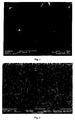
- Example 1 The coatings from Example 1 were investigated using Transmission electron microscopy (TEM) and Scanning electron microscopy (SEM) in order to elucidate the effect of CO and ZrCl 4 doping on the grain size and morphology. It appeared clear even in SEM that the microstructure of the typical MTCVD Ti(C,N) coating being composed of large columnar crystals (Fig. 1) can be refined by CO doping. The obtained layer was composed of needle like crystals as shown in Fig. 2 at a CO doping level of 0.8%. Similar surface morphologies could be obtained either by ZrCl 4 or HfCl 4 doping alone or together with CO. The equiaxed grain morphology was obtained at CO doping level of 2.5%.
- TEM Transmission electron microscopy
- SEM Scanning electron microscopy
- coatings 6, 7, 8, 9 and 10 were produced at a pressure of 70 mbar and at a temperature of 880°C according to the process data given in Table 4.
- the coating thickness was 8 ⁇ m for all coatings.
- CO 2 was not used in this particular example but could be applied with extreme care because coatings can in the presence of this precursor easily be brought into the nanograined region with equiaxed grain size.
- the coatings were studied by using TEM together with EDS/WDS. The results are presented in Table 5. Surface morphology of Coating 9 is shown in Fig.3.
- Coating 6 70 x 650 nm Needle-like Traces of Zr Coating 7 55 x 750 nm Needle-like 1.32 wt % Zr Coating 8 45 x 820 nm Needle-like 1.33 wt % Zr Coating 9 75 x 400 nm Needle-like 2.11 wt % Zr 0.91 wt % Al Coating 10 90 x 450
- the coatings 1, 2, 3, 4 and 8 were studied using XRD.
- the texture coefficients were determined according to the following.
- Coatings 1, 2, 4 and 8 were studied by using XRD.
- the grain refinement was slightly manifested as line broadening.
- XRD demonstrated that the coatings according to this invention are not in the nanograined region, Table 7.
- Grain Shape Coating 1 0.541 (B 0 ) 1.00
- Large columnar Coating 2 0.849 (B n 2 ) 1,57 columnar Coating 4 0.860 (B n 4 ) 1.59 columnar Coating 8 0,924 (B n 8 ) 1.71 columnar
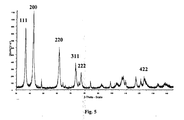
- Typical X-ray diffraction patterns originating from Coating 2 (Example 1) and Coating 3 (Example 1) are shown in Figs 4 and 5, respectively.
- Coating 2 (Fig. 4) is deposited according to this invention and is composed of needle-like grains with a strong 422-diffraction peak and Coating 3 (Fig. 5) is composed of small columnar grains. The differences are clear.
- XRD easily can be used to show that the coating is composed of columnar grains and not of equiaxed grains or visa versa. Further, XRD can be used to verify that the grain size is not brought into the nanograined region.
- Example 1 The coatings produced in Example 1 were tested in carbon steel under the following conditions: Work piece Cylindrical bar Material SS1672 Insert type SNUN120418 Cutting speed 250 and 400 m/min Feed 0.5 mm/rev Depth of cut 2.5 mm Remarks Dry turning
- Results are shown in Table 9. All coatings composed of fine-grained columnar crystals outperformed the reference coating (Coating 1) composed of large columnar grains and also the coating composed of equiaxed grains (Coating 3). The coatings 7 and 8 with the highest L/W ratios were found to show the longest tool life.
Landscapes
- Chemical & Material Sciences (AREA)
- Engineering & Computer Science (AREA)
- Chemical Kinetics & Catalysis (AREA)
- Materials Engineering (AREA)
- Mechanical Engineering (AREA)
- Metallurgy (AREA)
- Organic Chemistry (AREA)
- Inorganic Chemistry (AREA)
- General Chemical & Material Sciences (AREA)
- Life Sciences & Earth Sciences (AREA)
- Environmental Sciences (AREA)
- Environmental & Geological Engineering (AREA)
- General Life Sciences & Earth Sciences (AREA)
- Mining & Mineral Resources (AREA)
- Paleontology (AREA)
- Civil Engineering (AREA)
- General Engineering & Computer Science (AREA)
- Structural Engineering (AREA)
- Chemical Vapour Deposition (AREA)
- Cutting Tools, Boring Holders, And Turrets (AREA)
Applications Claiming Priority (2)
| Application Number | Priority Date | Filing Date | Title |
|---|---|---|---|
| SE0301196A SE527346C2 (sv) | 2003-04-24 | 2003-04-24 | Skär med beläggning av skikt av MTCVD-Ti (C,N) med styrd kornstorlek och morfologi och metod för att belägga skäret |
| SE0301196 | 2003-04-24 |
Publications (2)
| Publication Number | Publication Date |
|---|---|
| EP1471166A2 true EP1471166A2 (fr) | 2004-10-27 |
| EP1471166A3 EP1471166A3 (fr) | 2007-08-29 |
Family
ID=20291109
Family Applications (1)
| Application Number | Title | Priority Date | Filing Date |
|---|---|---|---|
| EP04009403A Withdrawn EP1471166A3 (fr) | 2003-04-24 | 2004-04-21 | Couche avec dimension de grain contrôlée et morphologie pour une résistance accrue à l'usure |
Country Status (5)
| Country | Link |
|---|---|
| US (2) | US7192660B2 (fr) |
| EP (1) | EP1471166A3 (fr) |
| KR (1) | KR20040093037A (fr) |
| CN (1) | CN100557077C (fr) |
| SE (1) | SE527346C2 (fr) |
Cited By (3)
| Publication number | Priority date | Publication date | Assignee | Title |
|---|---|---|---|---|
| CN102653146A (zh) * | 2011-03-04 | 2012-09-05 | 钴碳化钨硬质合金公司 | 涂覆的基体及其制造方法 |
| EP1825943B1 (fr) | 2004-12-14 | 2017-01-25 | Sumitomo Electric Hardmetal Corp. | Outil de coupe recouvert en surface |
| DE102005049393B4 (de) | 2005-10-15 | 2019-08-08 | Kennametal Widia Produktions Gmbh & Co. Kg | Verfahren zur Herstellung eines beschichteten Substratkörpers, Substratkörper mit einer Beschichtung und Verwendung des beschichteten Substratkörpers |
Families Citing this family (35)
| Publication number | Priority date | Publication date | Assignee | Title |
|---|---|---|---|---|
| JP4518258B2 (ja) * | 2004-08-11 | 2010-08-04 | 三菱マテリアル株式会社 | 高速断続切削加工で硬質被覆層がすぐれた耐チッピング性を発揮する表面被覆サーメット製切削工具 |
| US7597970B2 (en) * | 2005-03-22 | 2009-10-06 | Kyocera Corporation | Surface coated member and cutting tool |
| US8637127B2 (en) | 2005-06-27 | 2014-01-28 | Kennametal Inc. | Composite article with coolant channels and tool fabrication method |
| RU2432445C2 (ru) | 2006-04-27 | 2011-10-27 | Ти Ди Уай Индастриз, Инк. | Модульное буровое долото с неподвижными режущими элементами, корпус данного модульного бурового долота и способы их изготовления |
| US8080312B2 (en) * | 2006-06-22 | 2011-12-20 | Kennametal Inc. | CVD coating scheme including alumina and/or titanium-containing materials and method of making the same |
| EP2078101A2 (fr) | 2006-10-25 | 2009-07-15 | TDY Industries, Inc. | Articles ayant une meilleure résistance aux fissurations dues à la chaleur |
| SE532023C2 (sv) * | 2007-02-01 | 2009-09-29 | Seco Tools Ab | Texturhärdat alfa-aluminiumoxidbelagt skär för metallbearbetning |
| US20090004449A1 (en) * | 2007-06-28 | 2009-01-01 | Zhigang Ban | Cutting insert with a wear-resistant coating scheme exhibiting wear indication and method of making the same |
| US8080323B2 (en) * | 2007-06-28 | 2011-12-20 | Kennametal Inc. | Cutting insert with a wear-resistant coating scheme exhibiting wear indication and method of making the same |
| JP2009095907A (ja) * | 2007-10-15 | 2009-05-07 | Sumitomo Electric Hardmetal Corp | 刃先交換型切削チップ |
| CN101952070B (zh) * | 2008-01-29 | 2013-03-13 | 京瓷株式会社 | 切削工具 |
| US8790439B2 (en) | 2008-06-02 | 2014-07-29 | Kennametal Inc. | Composite sintered powder metal articles |
| US8025112B2 (en) | 2008-08-22 | 2011-09-27 | Tdy Industries, Inc. | Earth-boring bits and other parts including cemented carbide |
| US9050673B2 (en) * | 2009-06-19 | 2015-06-09 | Extreme Surface Protection Ltd. | Multilayer overlays and methods for applying multilayer overlays |
| AT12293U1 (de) * | 2009-10-05 | 2012-03-15 | Ceratizit Austria Gmbh | Schneidwerkzeug zur bearbeitung metallischer werkstoffe |
| US9643236B2 (en) | 2009-11-11 | 2017-05-09 | Landis Solutions Llc | Thread rolling die and method of making same |
| US8734070B2 (en) | 2010-10-20 | 2014-05-27 | Kennametal Inc. | Toolholder with externally-mounted dynamic absorber |
| US8524360B2 (en) | 2011-08-29 | 2013-09-03 | Kennametal Inc. | Cutting insert with a titanium oxycarbonitride coating and method for making the same |
| US8800848B2 (en) | 2011-08-31 | 2014-08-12 | Kennametal Inc. | Methods of forming wear resistant layers on metallic surfaces |
| US9016406B2 (en) | 2011-09-22 | 2015-04-28 | Kennametal Inc. | Cutting inserts for earth-boring bits |
| WO2013081047A1 (fr) * | 2011-11-29 | 2013-06-06 | 京セラ株式会社 | Outil revêtu |
| EP2604720A1 (fr) * | 2011-12-14 | 2013-06-19 | Sandvik Intellectual Property Ab | Outil de coupe revêtu et son procédé de fabrication |
| IN2015DN01831A (fr) * | 2012-10-01 | 2015-05-29 | Hitachi Tool Eng | |
| WO2014198881A1 (fr) * | 2013-06-14 | 2014-12-18 | Sandvik Intellectual Property Ab | Outil de coupe enrobé |
| EP3099912A4 (fr) | 2014-01-28 | 2017-02-01 | United Technologies Corporation | Éléments de turbine à revêtement céramique |
| RU2704949C2 (ru) | 2014-12-19 | 2019-10-31 | Сандвик Интеллекчуал Проперти Аб | Режущий инструмент с хогф-покрытием |
| KR101687142B1 (ko) * | 2016-07-20 | 2016-12-15 | 한국야금 주식회사 | 절삭공구용 경질피막 |
| JP6481897B2 (ja) * | 2016-09-16 | 2019-03-13 | 三菱マテリアル株式会社 | 表面被覆切削工具 |
| CN109963674B (zh) * | 2016-11-17 | 2021-07-06 | 株式会社泰珂洛 | 被覆切削工具 |
| EP3366796A1 (fr) * | 2017-02-28 | 2018-08-29 | Sandvik Intellectual Property AB | Outil de coupe recouvert |
| RU2760426C2 (ru) * | 2017-04-07 | 2021-11-25 | Сандвик Интеллекчуал Проперти Аб | Снабженный покрытием режущий инструмент |
| US12465980B2 (en) | 2019-08-30 | 2025-11-11 | Seco Tools Ab | Coated cutting tool |
| JP7141601B2 (ja) * | 2019-12-19 | 2022-09-26 | 株式会社タンガロイ | 被覆切削工具 |
| CN112342525B (zh) * | 2020-10-20 | 2023-04-28 | 厦门金鹭特种合金有限公司 | 一种适用于蠕墨铸铁切削加工的cvd涂层及其制备方法 |
| CN117178079B (zh) * | 2021-04-23 | 2026-04-24 | 山特维克科洛曼特公司 | 切削工具 |
Family Cites Families (25)
| Publication number | Priority date | Publication date | Assignee | Title |
|---|---|---|---|---|
| SE406090B (sv) | 1977-06-09 | 1979-01-22 | Sandvik Ab | Belagd hardmetallkropp samt sett att framstalla en dylik kropp |
| USRE31256E (en) * | 1978-01-18 | 1983-05-31 | Automatic damper means and controls therefor | |
| US4619866A (en) * | 1980-07-28 | 1986-10-28 | Santrade Limited | Method of making a coated cemented carbide body and resulting body |
| US4357382A (en) * | 1980-11-06 | 1982-11-02 | Fansteel Inc. | Coated cemented carbide bodies |
| JPS60200250A (ja) * | 1984-03-23 | 1985-10-09 | Fuji Photo Film Co Ltd | 高コントラストネガ画像形成方法 |
| CH669347A5 (fr) * | 1986-05-28 | 1989-03-15 | Vni Instrument Inst | |
| JP3136778B2 (ja) * | 1992-06-11 | 2001-02-19 | 三菱マテリアル株式会社 | 耐チッピング性にすぐれた表面被覆炭窒化チタン基サーメット製切削工具 |
| JP3109306B2 (ja) * | 1992-11-25 | 2000-11-13 | 三菱マテリアル株式会社 | 硬質被覆層の耐摩耗性が向上した表面被覆サーメット製切削工具 |
| JP3278785B2 (ja) * | 1993-08-27 | 2002-04-30 | 三菱マテリアル株式会社 | 表面被覆切削工具の製造法 |
| US5496762A (en) * | 1994-06-02 | 1996-03-05 | Micron Semiconductor, Inc. | Highly resistive structures for integrated circuits and method of manufacturing the same |
| JPH08132130A (ja) * | 1994-11-10 | 1996-05-28 | Mitsubishi Materials Corp | 硬質被覆層がすぐれた密着性を有する表面被覆サーメット製引抜ダイス |
| SE514181C2 (sv) * | 1995-04-05 | 2001-01-15 | Sandvik Ab | Belagt hårmetallskär för fräsning av gjutjärn |
| SE514177C2 (sv) * | 1995-07-14 | 2001-01-15 | Sandvik Ab | Belagt hårdmetallskär för intermittent bearbetning i låglegerat stål |
| US5981078A (en) * | 1995-08-19 | 1999-11-09 | Widia Gmbh | Composite body and process for its production |
| JP3250134B2 (ja) * | 1995-12-25 | 2002-01-28 | 三菱マテリアル株式会社 | 耐チッピング性のすぐれた表面被覆超硬合金製切削工具 |
| SE509560C2 (sv) * | 1996-09-06 | 1999-02-08 | Sandvik Ab | Belagt hårdmetallskär för bearbetning av gjutjärn |
| DE69730576T2 (de) * | 1996-12-04 | 2005-02-03 | Sumitomo Electric Industries, Ltd. | Beschichtetes Werkzeug und Verfahren zu seiner Herstellung |
| SE511211C2 (sv) * | 1996-12-20 | 1999-08-23 | Sandvik Ab | Ett multiskiktbelagt skärverktyg av polykristallin kubisk bornitrid |
| US20010016273A1 (en) * | 1998-05-08 | 2001-08-23 | Krishnan Narasimhan | Multilayer cvd coated article and process for producing same |
| DE69901985T2 (de) * | 1998-07-29 | 2002-12-05 | Toshiba Tungaloy Co. Ltd., Kawasaki | Aluminiumoxid-beschichteter Werkzeugteil |
| US6221469B1 (en) * | 1998-12-09 | 2001-04-24 | Seco Tools Ab | Grade for steel |
| US6251508B1 (en) * | 1998-12-09 | 2001-06-26 | Seco Tools Ab | Grade for cast iron |
| DE19962056A1 (de) * | 1999-12-22 | 2001-07-12 | Walter Ag | Schneidwerkzeug mit mehrlagiger, verschleissfester Beschichtung |
| US6472060B1 (en) * | 2000-01-19 | 2002-10-29 | Seco Tools Ab | Coated body with nanocrystalline CVD coating for enhanced edge toughness and reduced friction |
| EP1323847A3 (fr) * | 2001-12-28 | 2005-09-14 | Seco Tools Ab | Substrat en carbure cementé revêtu et procédé de sa fabrication |
-
2003
- 2003-04-24 SE SE0301196A patent/SE527346C2/sv not_active IP Right Cessation
-
2004
- 2004-04-21 EP EP04009403A patent/EP1471166A3/fr not_active Withdrawn
- 2004-04-23 KR KR1020040028362A patent/KR20040093037A/ko not_active Ceased
- 2004-04-26 CN CNB2004100385034A patent/CN100557077C/zh not_active Expired - Fee Related
- 2004-04-26 US US10/831,167 patent/US7192660B2/en not_active Expired - Lifetime
-
2006
- 2006-10-13 US US11/580,196 patent/US7718226B2/en not_active Expired - Fee Related
Cited By (4)
| Publication number | Priority date | Publication date | Assignee | Title |
|---|---|---|---|---|
| EP1825943B1 (fr) | 2004-12-14 | 2017-01-25 | Sumitomo Electric Hardmetal Corp. | Outil de coupe recouvert en surface |
| DE102005049393B4 (de) | 2005-10-15 | 2019-08-08 | Kennametal Widia Produktions Gmbh & Co. Kg | Verfahren zur Herstellung eines beschichteten Substratkörpers, Substratkörper mit einer Beschichtung und Verwendung des beschichteten Substratkörpers |
| CN102653146A (zh) * | 2011-03-04 | 2012-09-05 | 钴碳化钨硬质合金公司 | 涂覆的基体及其制造方法 |
| CN102653146B (zh) * | 2011-03-04 | 2016-05-04 | 钴碳化钨硬质合金公司 | 涂覆的基体及其制造方法 |
Also Published As
| Publication number | Publication date |
|---|---|
| CN1570202A (zh) | 2005-01-26 |
| CN100557077C (zh) | 2009-11-04 |
| US7192660B2 (en) | 2007-03-20 |
| US20070110897A1 (en) | 2007-05-17 |
| US7718226B2 (en) | 2010-05-18 |
| KR20040093037A (ko) | 2004-11-04 |
| SE527346C2 (sv) | 2006-02-14 |
| EP1471166A3 (fr) | 2007-08-29 |
| SE0301196L (sv) | 2004-10-25 |
| SE0301196D0 (sv) | 2003-04-24 |
| US20050013995A1 (en) | 2005-01-20 |
Similar Documents
| Publication | Publication Date | Title |
|---|---|---|
| US7192660B2 (en) | Layer with controlled grain size and morphology for enhanced wear resistance | |
| US7927663B2 (en) | Method of forming a coating with controlled grain size and morphology for enhanced wear resistance and toughness | |
| RU2062260C1 (ru) | Спеченное изделие | |
| EP1953258B1 (fr) | Outil revêtu d'alpha-alumine à la texture durcie | |
| EP0850324B1 (fr) | Plaquette de tournage revetue | |
| US6652913B2 (en) | Method of forming a coated body having a nanocrystalline CVD coating of Ti(C,N,O) | |
| US6713172B2 (en) | Oxide coated cutting tool | |
| EP0871796B1 (fr) | Piece rapportee de type fraise pourvue d'un revetement et procede de fabrication correspondant | |
| EP1528125B1 (fr) | Plaquette revêtue pour dégrossissage | |
| EP1655392B1 (fr) | Couche d'alumine présentant une texture améliorée | |
| EP1655387B1 (fr) | Couche d'alumine améliorée avec une texture | |
| EP2604720A1 (fr) | Outil de coupe revêtu et son procédé de fabrication | |
| EP1262576B1 (fr) | Outil coupant revêtu d'Al2O3 par CVD | |
| CN115786875B (zh) | 一种具有增强韧性和耐磨性的涂层及其制备方法与应用 |
Legal Events
| Date | Code | Title | Description |
|---|---|---|---|
| PUAI | Public reference made under article 153(3) epc to a published international application that has entered the european phase |
Free format text: ORIGINAL CODE: 0009012 |
|
| AK | Designated contracting states |
Kind code of ref document: A2 Designated state(s): AT BE BG CH CY CZ DE DK EE ES FI FR GB GR HU IE IT LI LU MC NL PL PT RO SE SI SK TR |
|
| AX | Request for extension of the european patent |
Extension state: AL HR LT LV MK |
|
| PUAL | Search report despatched |
Free format text: ORIGINAL CODE: 0009013 |
|
| AK | Designated contracting states |
Kind code of ref document: A3 Designated state(s): AT BE BG CH CY CZ DE DK EE ES FI FR GB GR HU IE IT LI LU MC NL PL PT RO SE SI SK TR |
|
| AX | Request for extension of the european patent |
Extension state: AL HR LT LV MK |
|
| 17P | Request for examination filed |
Effective date: 20070907 |
|
| AKX | Designation fees paid |
Designated state(s): AT BE BG CH CY CZ DE DK EE ES FI FR GB GR HU IE IT LI LU MC NL PL PT RO SE SI SK TR |
|
| 17Q | First examination report despatched |
Effective date: 20101029 |
|
| STAA | Information on the status of an ep patent application or granted ep patent |
Free format text: STATUS: THE APPLICATION IS DEEMED TO BE WITHDRAWN |
|
| 18D | Application deemed to be withdrawn |
Effective date: 20131008 |