EP1473638A2 - Bussystem für die Verwaltung eines Endgeräts - Google Patents
Bussystem für die Verwaltung eines Endgeräts Download PDFInfo
- Publication number
- EP1473638A2 EP1473638A2 EP03291032A EP03291032A EP1473638A2 EP 1473638 A2 EP1473638 A2 EP 1473638A2 EP 03291032 A EP03291032 A EP 03291032A EP 03291032 A EP03291032 A EP 03291032A EP 1473638 A2 EP1473638 A2 EP 1473638A2
- Authority
- EP
- European Patent Office
- Prior art keywords
- bus
- circuit
- master
- slave
- data
- Prior art date
- Legal status (The legal status is an assumption and is not a legal conclusion. Google has not performed a legal analysis and makes no representation as to the accuracy of the status listed.)
- Granted
Links
Images



Classifications
-
- G—PHYSICS
- G06—COMPUTING OR CALCULATING; COUNTING
- G06F—ELECTRIC DIGITAL DATA PROCESSING
- G06F13/00—Interconnection of, or transfer of information or other signals between, memories, input/output devices or central processing units
- G06F13/38—Information transfer, e.g. on bus
- G06F13/40—Bus structure
- G06F13/4063—Device-to-bus coupling
- G06F13/4068—Electrical coupling
- G06F13/4072—Drivers or receivers
-
- G—PHYSICS
- G06—COMPUTING OR CALCULATING; COUNTING
- G06F—ELECTRIC DIGITAL DATA PROCESSING
- G06F13/00—Interconnection of, or transfer of information or other signals between, memories, input/output devices or central processing units
- G06F13/38—Information transfer, e.g. on bus
- G06F13/40—Bus structure
- G06F13/4004—Coupling between buses
-
- G—PHYSICS
- G06—COMPUTING OR CALCULATING; COUNTING
- G06F—ELECTRIC DIGITAL DATA PROCESSING
- G06F13/00—Interconnection of, or transfer of information or other signals between, memories, input/output devices or central processing units
- G06F13/38—Information transfer, e.g. on bus
- G06F13/42—Bus transfer protocol, e.g. handshake; Synchronisation
- G06F13/4282—Bus transfer protocol, e.g. handshake; Synchronisation on a serial bus, e.g. I2C bus, SPI bus
- G06F13/4295—Bus transfer protocol, e.g. handshake; Synchronisation on a serial bus, e.g. I2C bus, SPI bus using an embedded synchronisation
Definitions
- This invention relates in general to electronics and, more particularly, to a bus for mobile electronic devices.
- each specific data transfer uses its own dedicated bus, wires and pins.
- the number of buses is increasing rapidly causing severe PCB (printed circuit board) congestion and high system cost.
- PCB printed circuit board
- four buses are used: a voice bus, a microcontroller bus, a DSP bus and a real-time management bus.
- the complexity of the bus structure creates several problems. It increases the complexity of both the hardware and software (including both embedded software and development tools). Moreover, the bus structure does not adapt well to new generations of mobile phones.
- the Philips I 2 C bus is a serial bus relying on the use of two wires: a data wire and a clock wire. It has a multi-master architecture, which means that there can be many masters at the same time (implying an arbitration procedure).
- the bus has three modes: standard, fast and high speed, the bit rate of these modes is 100 kbits/s, 400 kbits/s and 3.4 Mbits/s.
- this bus has few disadvantages.
- the slave sends the data asked by the master, it uses the clock given by the master using the clock line and the master uses its own clock to sample the data. This means that the data arrives to the master with a double-delay: the delay needed for the clock to reach the slave, and the delay needed for the data to reach the master. If these delays are excessive, the master could sample an invalid data.
- the swing of the wires corresponds to the supply swing of the supply domains that are crossed by the bus. Not only does this large swing increase the power consumption and reduce the maximum bit rate, but it also forces the bus to use discrete level shifters between the different supply domains.
- the frontier between supply domains corresponds to the frontier between mode domains (standard or fast mode and high speed mode)
- these level shifters are inside the chip that makes the bridge, adding two pins. In both cases, level shifting takes place.
- a circuit comprises a master circuit and a plurality of slave circuits.
- a bus provides communication between the master circuit and said slave circuits.
- the bus includes first and second wires for communicating using DS (Data Strobe) encoding and a third wire for allocating access of said first and second wires between the master circuit and the slave circuits.
- DS Data Strobe
- an optional fourth wire can transport a system clock and an optional fifth wire can provide a general purpose electrical link.
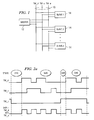
- Figure 1 illustrates a block diagram of a circuit using a "terminal management" (TM) bus 10.
- TM terminal management
- a master circuit 12 is coupled to TM bus 10, along with n slave circuits 14.
- the terminal management bus 10 includes at least three bidirectional wires: TM_d, TM_s and TM_e.
- FIG. 2a illustrates a timing diagram describing the operation of a "terminal management" bus 10.
- Wires TM_d and TM_s transmit data and clock information using the well known DS encoding.
- the data is sent on the TM_d wire by the "sender" of the data (either the master circuit 12 or a slave 14) using the local clock of the sender.
- TM_d a logical voltage transition on TM_d
- TM_d there is a data change from a logical "0" to a logical "1" or from a logical "1" to a logical "0”
- the sender forces a logical voltage transition on TM_s.
- a data clock (bclk) can be locally generated by the receiver (either the master circuit 12 or a slave 14) from the information on the TM_d and TM_s lines by performing a logical XOR (exclusive-or) operation.
- bclk can then be used to sample the data on TM_d (the data on TM_d is double-edge clocked; data is sampled on both edges of bclk).
- the reconstruction on the fly of the clock at the receiver solves the problem of clock extraction, making the data slicing very tolerant to clock skews. This is a major advantage of DS encoding.
- the TM_s signal is generated in such a way that the reconstructed bit clock has no missing transitions and no spikes.
- the polarity of the signal on TM_s is dependant on its initial state before the beginning of a word transmission, but has no other meaning.
- the DS encoding transmits two bits per clock period. In the preferred embodiment, an even number of bits for a word transmission is chosen as it simplifies the physical realization of the bus.
- TM_d and the TM_s signals alone cannot unequivocally determine the direction (master to slave or slave to master) of a transmission, and the beginning and the end of a word transmission especially when variable word length is allowed.
- a third signal, on the TM_e wire frames the word transmission by allocating control of the bus 10 to either the master 12 or one of the slaves 14.
- a logical low signal on TM_e is chosen to indicate control of the bus 10 by the master 12 and a logical high signal on TM_e to indicate control of the bus 10 by one of the slaves 14. According to this choice, low-to-high transitions on TM_e are generated by the master 12 and high-to-low transitions on TM_e are typically generated by the active slave, although the master 12 can force a high-to-low transition in certain cases.
- the bus drivers associated with the master 12 and the slaves 14 use three states: strong, weak, and HiZ (high impedance).
- strong, weak, and HiZ high impedance
- TM_e is latched by the master 12 using a weak latch. Strong drivers are used on TM_e (by either the master 12 or slave 14) only when a transition is necessary.
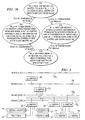
- State S10 indicates a wait state prior to communication from the master 12.
- TM_e is latched in a logical low state by the master 12 using a weak driver.
- TM_d and TM_s remain in their previous states by the last active slave with a weak driver (keeper), while the master 12 helps maintain the state using a weak driver (follower) as well. All other slaves are in a HiZ state. If there is no last active slave, such as after a reset, the wires are connected to the master 12 using a weak driver and all slaves are in a HiZ state.
- the master 12 begins a data communication targeting a particular slave 14 using a strong driver on TM_s and TM_d.
- the strong driver overcomes any weak drivers from the last active slave.
- the last active slave places its TM_s and TM_d drivers in HiZ.
- the master 12 uses its strong driver to raise TM_e to a logical high state, returning control to the targeted slave 14.
- TM_e remains weakly latched by the master 12.
- TM_s and TM_d are kept in their previous state by weak driver of the master 12 (keeper) and of the active slave (follower).
- TM_e is weakly latched in a logical high state by the master 12 to allow the new active slave to communicate over TM_s and TM_d.
- slave transmission begins.
- the new active slave uses strong drivers on TM_s and TM_d.
- the master 12 Upon sensing the strong drivers on TM_s or TM_d, the master 12 immediately makes its drivers HiZ.
- TM_e is weakly latched by the master 12.
- the slave 14 uses its strong driver to lower TM_e to a logical low state, returning control to the master 12.
- TM_e is weakly latched by the master 12.
- the TM bus can be used to distribute data between integrated circuits and between imbedded devices within an integrated circuit.
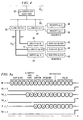
- Figures 3 - 5 illustrate a preferred embodiment for passing data between master 12 and slaves 14 within an integrated circuit using a hierarchical organization with multiple levels of TM buses. Switches are used to pass data between buses of different levels and between a bus and a device register.
- three types of switches exist: an ⁇ -switch, which is a switch with an alias (which is the IC address), a ⁇ -switch, which is a switch that bridges buses of different levels, and an ⁇ -switch, which is a switch that addresses registers or scan paths.
- ⁇ -switch which is a switch with an alias (which is the IC address)
- a ⁇ -switch which is a switch that bridges buses of different levels
- an ⁇ -switch which is a switch that addresses registers or scan paths.
- a physical realization of a switch could combine the functionalities of
- An ⁇ -switch 20 passes data from a bus 10 to a register 21 (which could be, for example, part of a scan chain).
- a ⁇ -switch 22 passes data between different bus levels.
- An ⁇ -switch 24 passes data from the highest level bus (level 0) to lower level buses. In this preferred embodiment, the alias of the ⁇ -switch 24 is a four bit address.
- FIG. 4 illustrates a block diagram of a multiple bus structure.
- three bus levels are shown (buses 10 0 through 10 2 ).
- An ⁇ -switch 30 with chip alias "0001" couples bus 10 0 to bus 10 1 .
- a ⁇ -switch 32 has address “0" on bus 10 1 and an ⁇ -switch 34 has address “1” on bus 10 1 .
- Two registers 36 and 38 are coupled to ⁇ -switch 34 at addresses “0” and “1", respectively.
- Three switches 40, 42, and 44 are coupled to ⁇ -switch 32, at addresses "00", "01” and “10", respectively.
- Switch 42 is an ⁇ -switch.
- Three registers 46, 48 and 50 are coupled to ⁇ -switch 42, at addresses "000", "001" and "010", respectively.
- Figure 5b illustrates an example where configuration information may be passed in the data stream.
- two configuration bits are placed in the data stream after the address for the ⁇ -switch and port (shown as "xx").
- the ⁇ -switch 32 recognizes the bits as configuration bits, configures itself accordingly and passes the remaining bits to the next bus.
- Each switch may independently decode the address field and pass the remaining bits after removing any configuration bits.
- a typical transaction has the following steps: (1) the master 12 sends its command and sets TM_e to a high logical level to pass control of the bus to the slave, (2) the slave 14 sends its answer and sets TM_e back to a low logic level, giving the control of the bus back to the master 12.
- the master 12 can take the control back by itself, by lowering TM_e. Except for a short command (described below), the word sent by the master 12 always begin with the 4-bit alias of the targeted IC or by 0000 for a broadcasted command.
- each chip is assigned a chip alias.
- This alias can be hard-coded (no need to run the alias setting command but only one alias possible) or soft-coded (need to run the alias setting command but multi-aliasing possible).
- the alias 0000 is reserved for the master 12 and is not assigned to any slave 14.
- slave circuits 14 may be desirable to use slave circuits 14 with hard-coded addresses. This may cause a problem, if two slave circuits 14 have the same hard-coded address. In some cases, it may be possible to use both slave circuits, despite the identical address, by switching the connections to the TM_d and TM_s wires on one of the slaves. If both slave circuits had, for example, a hard-coded address of "1001", the slave circuit with the reversed TM_d and TM_s connections could be addressed as "0011". In this case, the master should drive the TM_d and the TM_s accordingly: what was normally sent on TM_d should now be sent on TM_s and what was normally sent on TM_s should now be sent on TM_d.
- the write command is used to write a value in a register 21.
- the targeted IC sends back two status bits that tell if the write was successful or if it has been denied.
- the first bit is a don't care bit and the second bit indicates a successful write operation as a "1" and a denied write operation as a "0".
- the write command is made up with the alias of the targeted IC, the internal address of the register 21 followed by a 0 and the data to be written in the register 21.
- a write denial can happen when the master 12 tries to write in a register 21 that has not been read yet by the IC owner of this register since the last write. In that case, the previous value of the register is preserved.
- the read command is used to retrieve data stored by a register 21 in slave 14.
- the process remains the same: the master 12 sends the alias of the targeted IC, the internal address of the register 21 but followed this time by a "1" and nothing else.
- the answer of the slave 14 is composed by two status bits, followed by the data. In a read operation, it is the last status bit that is a don't care, the first one indicates the success (1) or the denial (0) of the operation.
- the register address is be followed whether by "1" (read) or "0" (write). In effect, this convention splits the address in two: a write address, and a read address. Thus, if desired, it is possible to make a write-only register and a read-only register sharing the same "address".
- Special commands can be sent to the slaves 14 using a process similar to a write command.
- the address of the register is replaced by the command's ID, followed by a 0 and the parameter (if any) of the command.
- the slave 14 sends, as usual, two status bits, the second bit at "1" if the command is accepted and at "0" if the command is denied. If a slave 14 does not support handshaking, it can give the control back to the master 12 (by lowering TM_e) without replying with the status bits.
- a set of bits could be transmitted with the only purpose to create a complimentary clock to be used by the slave to execute the command without the need of a local clock.
- the alias setting command is a write command using the reserved alias "0000" (broadcast), the chip ID of the IC as the internal address and the alias to be set as the data.
- the chip answers with the two status bits. If the alias is accepted, the second bit is a "1"; if not, the second bit is a "0".
- a slave 14 could be "upgraded” to the rank of master by the previous master, which then becomes a slave 14. This can be accomplished by the alias setting command, using the chip ID of the new master, and the master alias "0000" as the alias to be set. The chip answers with the two status bits. If the second bit is a "1”, the chip becomes the new master; if the second bit is a "0", the control stays with the previous master.
- the bus 10 is able to deal with "short commands" (2 bits long).
- the "00" is a broadcasted "ping" command used for test purposes.
- the slaves 14 can send an interrupt to the master 12. To do so, the master 12 must open an "interrupt window". It does this by simply raising TM_e without sending any command. If a slave 14 has an interrupt to send, it simply has to lower TM_e, giving the control back to the master 12, which then reads the interrupt registers of all slaves 14 to determine which one launched the interrupt, and which one has the priority, if more than one slave 14 launched it.
- the TM bus is designed to accommodate isochronous transactions; i.e., in transactions where the master's clock and the slaves' clocks may be different, the bus will still be able to transfer data without any lost.
- the main problem occurs when the master 12 tries to write to a register that has not been read yet by the slave 14 or when the master 12 tries to read a register that has not yet been written by the slave 14 (where this data has already been read by the master 12).
- the two-bit status sent back by the slave 14 after a read or a write is very useful.
- the slave 14 will "look" at the write status register assigned to the targeted register, if it holds a "1", it means that the slave chip has not yet read the register and the write is denied. If the write status register holds a "0", the slave 14 has read the register and is waiting for more data. Thus, the slave 14 must set the write status register to "0" after reading the register, or else the write will always be denied.
- the mechanism is very similar, except that the read status register tells whether the slave 14 has written in the register since last read or not. However, the master 12 may want to read a register it has already read, therefore the slave 14 sends the content of the register, even if the read is denied.
- Figure 6 illustrates an adaptive bit rate scheme that can be used by the master 12 when various slaves 14 have different speeds at which data can be received.
- the master 12 outputs the chip alias at the speed of the slowest slave 14. All slaves 14 can then determine whether the current transaction is destined for them. After outputting the slave alias (the first four bits of the transaction), however, the transaction may proceed at the highest bit rate compatible with the particular slave involved in the transaction. Accordingly, the bits following the slave alias (i.e., the "private transaction" bits) can be sent at the fastest possible speed (up to the fastest speed of the master 12), making the transaction as efficient as possible. Since the data clock is derived from TM_d and TM_e, bclk is automatically adjusted to the proper speed. The chosen slave 14 can answer at its speed without regard to the speed of the other slaves 14.
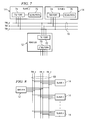
- Figure 7 illustrates the bus used in conjunction with scan path testing.
- Test data is received through JTAG port 70 in master circuit 12.
- the data is passed through the bus driver port 72 of master 12 to bus 10.
- Test data is received by the slaves 14 through their bus driver ports 74 and passed to scan paths 76 (using ⁇ -switches as described above).
- Figure 8 illustrates a block diagram using the bus 10 with multiple TM_d and TM_e lines to provide additional bandwidth where necessary.
- the bus 10 could be scaled as appropriate to provide a desired bandwidth.
- the present invention provides significant advantages over the prior art.
- Third, the data lines are scalable, so the bus can support additional bandwidth without changing its overall structure.
- Fourth, The TM_e line provides support for variable length words between the master and slave.
- latency is kept low by adaptive bit rates in private transactions between the master and a selected slave, while compatibility is maintained for slave with varying speeds.
- Sixth, the simplicity of the bus allows for low power and low area requirements.
- Figure 9 illustrates an alternative embodiment of bus 10, an extended TM bus 60 with two additional lines: TM_c and TM_a.
- TM_a is a general purpose link, which can pass analog or digital signals. This wire can be used for many purposes. For example, the TM_a wire could be used to share an analog signal between modules of the integrated circuits of the system. TM_a could also be used for test and calibration purposes. Another interesting service given by TM_a is the possible wake up of the system from a deep very low power standby. Some examples of the use of the TM_a line are provided below.
- TM_c carries a system clock.
- the clock on TM_c can be used, for example, by a slave 14 that has no local clock.
- TM_a could be used without TM_c and TM_c could be used without TM_a.
- the example illustrated in Figure 10 shows an application where a system is wakened from a deep power down using the TM_a wire.
- the master 12 has opened an interrupt window (TM_e is therefore set to high) and put itself in deep power down.
- the master 12 is totally powered off at the exception of the bus keeper of the TM_e wire, which could be supplied by a voltage regulator 132 from a slave 14 through the TM_a wire.
- the system could be wakened by a on/off button 130 connected to the TM_e wire of the bus 60. By pushing the on/off button 130, the TM_e wire is forced to ground interpreted as a signal of power up by the system. Using this configuration, a wake-up from deep power down can therefore be implemented without extra hardware or wire.
- the TM bus is the low number of pins needed on each integrated circuit to support the bus. Accordingly, it is beneficial to use the bus 60 to test the integrated circuits.
- the ping command described above can be used.
- the master can send a ping after the power-on reset. If the test equipment is connected to the bus 60, it will answer by sending its ID.
- the master gives the control of the bus to the test equipment by a master status setting command, using the received ID from the test equipment.
- the test equipment can proceed for example to BIST (built-in self test), non volatile memory download, access the scan path of any slave 14, cooperative calibration, calibration for performance, optimization, and so on. If no test equipment is connected, the master 12 takes control back after a time-out.
- the TM_a wire can be an important asset for making digital and/or analog measurements.
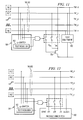
- Figure 11 illustrates a test scenario where TM_a is used to supply and analog signal for testing purposes and
- Figure 12 illustrates a test scenario where TM_a is used to supply a digital signal.
- FIG 11 illustrates use of the bus 60 to test a device-under-test (DUT) 78, shown in Figure 11 as an n-channel transistor.
- a test equipment 80 takes control of the bus in the place of master 12.
- Slave devices 14 are set to HiZ on TM_d, TM_s and TM_a.
- TM_a is used by the test equipment 80 to generate a gate voltage to DUT 78 and TM_d and TM_e allow the test equipment 80 to monitor the source-drain voltage and current of the DUT 78.
- FIG. 12 illustrates use of the bus 60 to test a circuit 90.
- TM_a is used to communicate a digital synchronization signal to or from the module under test 90
- TM_d and TM_s are used for I/O
- TM_c is used for a clock signal to the module 90.
- slave devices 14 are set to HiZ on TM_d, TM_s and TM_a.
- a low-to-high transition on TM_e in conjunction with a test register 92 on ⁇ -switch 94 enables the switches coupling the module 90 to bus 10.
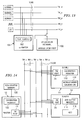
- Figure 13 illustrates a test configuration wherein TM_d, TM_s and TM_e are used in their normal operation and TM_a is used for I/O to a module under test 100.
- a test bit in register 102 of ⁇ -switch 104 couples TM_a to the module 100.
- FIG 14 illustrates a cooperative calibration wherein TM_a is used to send an analog signal from a module under calibration 112 to an Analog-to-Digital Converter (ADC) 116.
- ADC Analog-to-Digital Converter
- Figure 15 illustrates a block diagram illustrating multiple integrated circuits coupled to a bus 10 0 (level zero).
- the master circuit 12 is an integrated circuit fabricated using the latest technology.
- the slaves 14 may be fabricated using older technology. Accordingly, the slave circuit 14 may use voltage levels that are significantly higher than the voltage levels used by the master 12. In some cases, the voltage levels used by a slave circuit 14 to communicate on bus 10 0 could be damaging to the master circuit 12. Accordingly, the ports 74 s (individually referenced as 74 s1 thorough 74 sn ) use an adaptive voltage technology to automatically adjust to suitable voltage levels for communication with the master circuit 12. Drivers for lower level buses are not affected, since they are internal to an integrated circuit and will thus share a fabrication technology.
- the adaptive ports 74 s allow a slave 14 to be designed to coexist with future technology.
- Each adaptive port 74 s outputs data and control signals to bus 10 based on a Reference signal received from the master circuit 12 over bus 10. Accordingly, a particular slave circuit 14 with and adaptive port 74 s does not need to be redesigned to support signals for a state-of-the-art master circuit 12. Further, the master circuit 12 can be used with slave circuits 14 using a variety of different processing technologies.
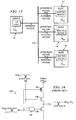
- FIG 16 illustrates a block diagram of a master bus driver 140 that could be used in port 74 m .
- a port 74 m would have strong and weak drivers; hence, a pair of drivers 140, one strong and one weak, would be used for each wire TM_d, TM_s and TM_e.
- the drivers 140 of the master for the TM_e wire also supply the Reference voltage to the slave circuits 14.
- Driver 140 includes a logical AND gate 142 coupled to the input (IN) signal and an active low tristate (HiZ) signal.
- the IN signal is also coupled to the gate of p-channel transistor 144.
- the tristate signal is coupled to the gate of n-channel transistor 146.
- the output of AND gate 142 is coupled to the gate of n-channel transistor 148.
- the source/drains of p-channel transistor 144, n-channel transistor 146 and n-channel transistor 148 are coupled in series between the power supply of the master (Vdd m ) and ground.
- the output (OUT) signal of driver 140 is the node between n-channel transistors 146 and 148.
- n-channel transistors 146 and 148 are turned off, regardless of the value of IN.
- the OUT signal is therefore in a high impedance state.
- the tristate signal is high, the n-channel transistor 146 is on, then a high signal at IN will turn off p-channel transistor 144 and turn on n-channel transistor 148, causing OUT to output a logical low signal (zero volts).
- a logical low IN signal will turn on p-channel transistor 144 and turn off n-channel transistor 148, causing OUT to output a logical high signal (Vdd m -VT n , where VT n is the threshold voltage of n-channel transistor 146).
- driver 140 acts as an inverter.
- N-channel transistor 146 acts to reduce the output voltage swing of the driver 140 by VT n . While this feature is optional, it reduces power requirements for the drivers.
- Driver 140 is a known implementation of a low swing bus driving circuit.
- FIG 17 illustrates an adaptive driver 149 for use in the slave's adaptive ports 74 s (once again, separate drivers would be needed for the strong and weak drivers).
- the Reference signal is received from the TM_e wire of bus 10 by input stage 150 of a slave 14. This Reference signal is held (weakly) at a logical high (Vdd m -Vt n ) when a slave is asked to reply (see state S30 of Figure 2b) and remains high until the end of the transmission from the slave (state S40 of Figure 2b).
- the Reference signal is coupled to the input of Schmitt trigger 151 and to the gate of p-channel transistor 154.
- the output of Schmitt trigger 151 is coupled to the gates of p-channel transistor 156 and n-channel transistor 158.
- P-channel transistor 156, p-channel 154 and n-channel transistor 158 have their source/drains coupled in series between Vdd s (the slave power supply) and ground.
- a slave reference node 160 (with a voltage equal to the Reference+VT p , where VT p is the threshold voltage of p-channel transistor 154) is coupled to the gate of n-channel transistor 162 of each output stage 164 (there is a separate output stage for each wire TM_d and TM_s).
- the active-low tristate signal and the input (IN) signal are coupled to AND gate 166.
- the output of AND gate 166 is coupled to the gate of n-channel transistor 168.
- the IN signal is also coupled to OR gate 170, along with the inverted tristate signal (inverted by inverter 172).
- the output of OR gate 170 is coupled to the gate of p-channel transistor 174.
- P-channel transistor 174, n-channel transistor 162 and n-channel transistor 168 have source/drains coupled in series between Vdd s and ground.
- the Schmitt trigger 151 applies the slave's voltage swing to the voltage swing of the Reference signal; when the Reference is low (zero volts) the output of the Schmitt trigger 151 is low (zero volts) when the Reference is high (Vdd m - VT n ), the output of the Schmitt trigger 151 is at Vdd s .
- TM_e is at a low level (after a transmission by a slave 14 or during transmission by the master 12)
- p-channel transistors 154 and 156 are turned on and n-channel transistor 158 is turned off, causing a voltage of Vdd s on node 160.
- p-channel transistor 156 turns off and n-channel transistor 158 turns on.
- the voltage on node 160 falls until the output at node 160 is at the Reference+VT p , at which point the p-channel transistor 154 turns off.
- the n-channel transistors 162 are being driven by Reference+VT p . If the tristate signal is low, then n-channel transistor 168 is turned off as is p-channel transistor 174, creating a HiZ state for the OUT signal from each output stage 164. If the tristate signal is high, then OR gate 170 passes the IN signal to the gate of p-channel transistor 174 and AND gate passes the IN signal to n-channel transistor 168. If the IN signal is high, then n-channel transistor 168 will be turned on and p-channel transistor 174 will be turned off. Hence, OUT will be coupled to ground through n-channel transistor 168.
- n-channel transistor 168 will be turned off and p-channel transistor 174 will be turned on.
- the OUT signal will reach the voltage of the slave reference node 160, less the threshold voltage VT n of n-channel transistor 162, or Reference+VT p -VT n .
- threshold voltages VT p and VT n are roughly equal, the OUT signal is then roughly equal to the slave reference node 160. Accordingly, the voltage swing on the bus 10 during a slave transmission will automatically be compatible with the voltage swing of the master 12.
- This aspect of the present invention provides a significant advantage, since the bus 10 may be used with a mix of older technologies with newer technologies, thereby protecting the investment in the slave circuits 14.
- Figure 18 illustrates a driver 180 which is a variation on the bus drivers described above, where multiple "fingers" 182 of the output transistors may be programmably added to the output of the driver 180 in order to adapt the drive capability to the actual capacitance of an external TM bus to provide the high drive needed to match an external tester.
- a status register (not shown) could be used, for example, to configure the number of fingers used. While Figure 18 is shown with a master bus driver 140, the same programmability could be provided to the output stages 164 of slave bus drivers 149.
Landscapes
- Engineering & Computer Science (AREA)
- Theoretical Computer Science (AREA)
- General Engineering & Computer Science (AREA)
- Physics & Mathematics (AREA)
- General Physics & Mathematics (AREA)
- Computer Hardware Design (AREA)
- Bus Control (AREA)
- Information Transfer Systems (AREA)
- Small-Scale Networks (AREA)
- Dc Digital Transmission (AREA)
Priority Applications (3)
| Application Number | Priority Date | Filing Date | Title |
|---|---|---|---|
| DE60322348T DE60322348D1 (de) | 2003-04-28 | 2003-04-28 | Bussystem für die Verwaltung eines Endgeräts |
| EP03291032A EP1473638B1 (de) | 2003-04-28 | 2003-04-28 | Bussystem für die Verwaltung eines Endgeräts |
| US10/701,672 US20040215856A1 (en) | 2003-04-28 | 2003-11-05 | Terminal management bus |
Applications Claiming Priority (1)
| Application Number | Priority Date | Filing Date | Title |
|---|---|---|---|
| EP03291032A EP1473638B1 (de) | 2003-04-28 | 2003-04-28 | Bussystem für die Verwaltung eines Endgeräts |
Publications (3)
| Publication Number | Publication Date |
|---|---|
| EP1473638A2 true EP1473638A2 (de) | 2004-11-03 |
| EP1473638A3 EP1473638A3 (de) | 2004-12-01 |
| EP1473638B1 EP1473638B1 (de) | 2008-07-23 |
Family
ID=32981969
Family Applications (1)
| Application Number | Title | Priority Date | Filing Date |
|---|---|---|---|
| EP03291032A Expired - Lifetime EP1473638B1 (de) | 2003-04-28 | 2003-04-28 | Bussystem für die Verwaltung eines Endgeräts |
Country Status (3)
| Country | Link |
|---|---|
| US (1) | US20040215856A1 (de) |
| EP (1) | EP1473638B1 (de) |
| DE (1) | DE60322348D1 (de) |
Families Citing this family (3)
| Publication number | Priority date | Publication date | Assignee | Title |
|---|---|---|---|---|
| US10031674B2 (en) * | 2015-10-07 | 2018-07-24 | Samsung Electronics Co., Ltd. | DIMM SSD addressing performance techniques |
| US10503657B2 (en) | 2015-10-07 | 2019-12-10 | Samsung Electronics Co., Ltd. | DIMM SSD Addressing performance techniques |
| DE102019111881A1 (de) * | 2019-05-07 | 2020-11-12 | Infineon Technologies Ag | Verfahren und vorrichtung zum senden von daten gemäss einem signalzeitablauf |
Family Cites Families (12)
| Publication number | Priority date | Publication date | Assignee | Title |
|---|---|---|---|---|
| US4204251A (en) * | 1977-12-28 | 1980-05-20 | Finn Brudevold | Interconnection unit for multiple data processing systems |
| US4941126A (en) * | 1987-07-24 | 1990-07-10 | Advanced Micro Devices, Inc. | Weak/strong bus driver |
| GB9011700D0 (en) * | 1990-05-25 | 1990-07-18 | Inmos Ltd | Communication interface |
| JPH06324977A (ja) * | 1993-05-14 | 1994-11-25 | Matsushita Electric Ind Co Ltd | データ転送方法 |
| US5926651A (en) * | 1995-07-28 | 1999-07-20 | Intel Corporation | Output buffer with current paths having different current carrying characteristics for providing programmable slew rate and signal strength |
| US5909369A (en) * | 1996-07-24 | 1999-06-01 | Network Machines, Inc. | Coordinating the states of a distributed finite state machine |
| KR100258361B1 (ko) * | 1997-11-21 | 2000-06-01 | 김영환 | 출력 데이터 보정장치를 가지는 고속 디램 시스템 |
| GB2351884B (en) * | 1999-04-10 | 2002-07-31 | Peter Strong | Data transmission method |
| US6557059B1 (en) * | 1999-10-12 | 2003-04-29 | Cypress Semiconductor Corp. | Parallel peripheral interface |
| US6760772B2 (en) * | 2000-12-15 | 2004-07-06 | Qualcomm, Inc. | Generating and implementing a communication protocol and interface for high data rate signal transfer |
| US6842806B2 (en) * | 2001-05-29 | 2005-01-11 | Sun Microsystems, Inc. | Method and apparatus for interconnecting wired-AND buses |
| US6920574B2 (en) * | 2002-04-29 | 2005-07-19 | Apple Computer, Inc. | Conserving power by reducing voltage supplied to an instruction-processing portion of a processor |
-
2003
- 2003-04-28 DE DE60322348T patent/DE60322348D1/de not_active Expired - Lifetime
- 2003-04-28 EP EP03291032A patent/EP1473638B1/de not_active Expired - Lifetime
- 2003-11-05 US US10/701,672 patent/US20040215856A1/en not_active Abandoned
Also Published As
| Publication number | Publication date |
|---|---|
| EP1473638A3 (de) | 2004-12-01 |
| US20040215856A1 (en) | 2004-10-28 |
| EP1473638B1 (de) | 2008-07-23 |
| DE60322348D1 (de) | 2008-09-04 |
Similar Documents
| Publication | Publication Date | Title |
|---|---|---|
| US5729152A (en) | Termination circuits for reduced swing signal lines and methods for operating same | |
| US7034565B2 (en) | On-die termination circuit and method for reducing on-chip DC current, and memory system including memory device having the same | |
| KR100431651B1 (ko) | 온칩 종단 회로 | |
| US6809546B2 (en) | On-chip termination apparatus in semiconductor integrated circuit, and method for controlling the same | |
| CN101636913B (zh) | 使用串行i/o脉冲串选通的低功率串行器/解串器体系结构 | |
| EP1308850A2 (de) | Rechnerbuskonfiguration und Eingangs-Ausgangstreiber | |
| JPH1185345A (ja) | 入出力インターフェース回路及び半導体システム | |
| US6552410B1 (en) | Programmable antifuse interfacing a programmable logic and a dedicated device | |
| US20100064083A1 (en) | Communications device without passive pullup components | |
| JPH07182078A (ja) | データ処理システムおよび動作方法 | |
| US6760857B1 (en) | System having both externally and internally generated clock signals being asserted on the same clock pin in normal and test modes of operation respectively | |
| CN115269491B (zh) | 一种单线通信装置以及单线通信方法 | |
| CN101427226A (zh) | 具有有源上拉的串行通信总线 | |
| US10171268B2 (en) | Asymmetric on-state resistance driver optimized for multi-drop DDR4 | |
| US6232814B1 (en) | Method and apparatus for controlling impedance on an input-output node of an integrated circuit | |
| JPH10290147A (ja) | 遅延量可変回路 | |
| US20060250884A1 (en) | Memory device and method of controlling the same | |
| KR20050108759A (ko) | S11 파라미터 측정을 위한 반도체 메모리 장치, 반도체메모리 장치의 s11 파라미터 측정을 위한 테스트 보드,및 반도체 메모리 장치의 s11 파라미터 측정 방법 | |
| EP1473638B1 (de) | Bussystem für die Verwaltung eines Endgeräts | |
| US6301182B1 (en) | Semiconductor memory device | |
| TW200837773A (en) | High-speed memory device easily testable by low-speed automatic test equipment and input/output pin control method thereof | |
| US6961883B2 (en) | Tester built-in semiconductor integrated circuit device | |
| JP3784979B2 (ja) | バス駆動回路 | |
| KR100564868B1 (ko) | 데이터 송신 장치, 데이터 전송 시스템 및 방법 | |
| US5938746A (en) | System for prioritizing slave input register to receive data transmission via bi-directional data line from master |
Legal Events
| Date | Code | Title | Description |
|---|---|---|---|
| PUAI | Public reference made under article 153(3) epc to a published international application that has entered the european phase |
Free format text: ORIGINAL CODE: 0009012 |
|
| PUAL | Search report despatched |
Free format text: ORIGINAL CODE: 0009013 |
|
| AK | Designated contracting states |
Kind code of ref document: A2 Designated state(s): AT BE BG CH CY CZ DE DK EE ES FI FR GB GR HU IE IT LI LU MC NL PT RO SE SI SK TR |
|
| AX | Request for extension of the european patent |
Extension state: AL LT LV MK |
|
| AK | Designated contracting states |
Kind code of ref document: A3 Designated state(s): AT BE BG CH CY CZ DE DK EE ES FI FR GB GR HU IE IT LI LU MC NL PT RO SE SI SK TR |
|
| AX | Request for extension of the european patent |
Extension state: AL LT LV MK |
|
| 17P | Request for examination filed |
Effective date: 20050601 |
|
| AKX | Designation fees paid |
Designated state(s): DE FR GB |
|
| 17Q | First examination report despatched |
Effective date: 20051012 |
|
| GRAP | Despatch of communication of intention to grant a patent |
Free format text: ORIGINAL CODE: EPIDOSNIGR1 |
|
| GRAS | Grant fee paid |
Free format text: ORIGINAL CODE: EPIDOSNIGR3 |
|
| GRAA | (expected) grant |
Free format text: ORIGINAL CODE: 0009210 |
|
| AK | Designated contracting states |
Kind code of ref document: B1 Designated state(s): DE FR GB |
|
| REG | Reference to a national code |
Ref country code: GB Ref legal event code: FG4D |
|
| REF | Corresponds to: |
Ref document number: 60322348 Country of ref document: DE Date of ref document: 20080904 Kind code of ref document: P |
|
| PLBE | No opposition filed within time limit |
Free format text: ORIGINAL CODE: 0009261 |
|
| STAA | Information on the status of an ep patent application or granted ep patent |
Free format text: STATUS: NO OPPOSITION FILED WITHIN TIME LIMIT |
|
| 26N | No opposition filed |
Effective date: 20090424 |
|
| REG | Reference to a national code |
Ref country code: FR Ref legal event code: PLFP Year of fee payment: 14 |
|
| REG | Reference to a national code |
Ref country code: FR Ref legal event code: PLFP Year of fee payment: 15 |
|
| REG | Reference to a national code |
Ref country code: FR Ref legal event code: PLFP Year of fee payment: 16 |
|
| PGFP | Annual fee paid to national office [announced via postgrant information from national office to epo] |
Ref country code: GB Payment date: 20180328 Year of fee payment: 16 |
|
| PGFP | Annual fee paid to national office [announced via postgrant information from national office to epo] |
Ref country code: FR Payment date: 20180320 Year of fee payment: 16 |
|
| PGFP | Annual fee paid to national office [announced via postgrant information from national office to epo] |
Ref country code: DE Payment date: 20180409 Year of fee payment: 16 |
|
| REG | Reference to a national code |
Ref country code: DE Ref legal event code: R119 Ref document number: 60322348 Country of ref document: DE |
|
| GBPC | Gb: european patent ceased through non-payment of renewal fee |
Effective date: 20190428 |
|
| PG25 | Lapsed in a contracting state [announced via postgrant information from national office to epo] |
Ref country code: DE Free format text: LAPSE BECAUSE OF NON-PAYMENT OF DUE FEES Effective date: 20191101 Ref country code: GB Free format text: LAPSE BECAUSE OF NON-PAYMENT OF DUE FEES Effective date: 20190428 |
|
| PG25 | Lapsed in a contracting state [announced via postgrant information from national office to epo] |
Ref country code: FR Free format text: LAPSE BECAUSE OF NON-PAYMENT OF DUE FEES Effective date: 20190430 |