EP1475229A2 - Films en polyester coextrudés thermoscellable et peelable leur production et leur utilisation - Google Patents
Films en polyester coextrudés thermoscellable et peelable leur production et leur utilisation Download PDFInfo
- Publication number
- EP1475229A2 EP1475229A2 EP04008943A EP04008943A EP1475229A2 EP 1475229 A2 EP1475229 A2 EP 1475229A2 EP 04008943 A EP04008943 A EP 04008943A EP 04008943 A EP04008943 A EP 04008943A EP 1475229 A2 EP1475229 A2 EP 1475229A2
- Authority
- EP
- European Patent Office
- Prior art keywords
- sealable
- film
- peelable
- mol
- polyester
- Prior art date
- Legal status (The legal status is an assumption and is not a legal conclusion. Google has not performed a legal analysis and makes no representation as to the accuracy of the status listed.)
- Withdrawn
Links
Images


Classifications
-
- B—PERFORMING OPERATIONS; TRANSPORTING
- B01—PHYSICAL OR CHEMICAL PROCESSES OR APPARATUS IN GENERAL
- B01D—SEPARATION
- B01D39/00—Filtering material for liquid or gaseous fluids
- B01D39/14—Other self-supporting filtering material ; Other filtering material
-
- B—PERFORMING OPERATIONS; TRANSPORTING
- B32—LAYERED PRODUCTS
- B32B—LAYERED PRODUCTS, i.e. PRODUCTS BUILT-UP OF STRATA OF FLAT OR NON-FLAT, e.g. CELLULAR OR HONEYCOMB, FORM
- B32B27/00—Layered products comprising a layer of synthetic resin
- B32B27/36—Layered products comprising a layer of synthetic resin comprising polyesters
-
- B—PERFORMING OPERATIONS; TRANSPORTING
- B01—PHYSICAL OR CHEMICAL PROCESSES OR APPARATUS IN GENERAL
- B01D—SEPARATION
- B01D46/00—Filters or filtering processes specially modified for separating dispersed particles from gases or vapours
- B01D46/56—Filters or filtering processes specially modified for separating dispersed particles from gases or vapours with multiple filtering elements, characterised by their mutual disposition
-
- B—PERFORMING OPERATIONS; TRANSPORTING
- B32—LAYERED PRODUCTS
- B32B—LAYERED PRODUCTS, i.e. PRODUCTS BUILT-UP OF STRATA OF FLAT OR NON-FLAT, e.g. CELLULAR OR HONEYCOMB, FORM
- B32B27/00—Layered products comprising a layer of synthetic resin
- B32B27/06—Layered products comprising a layer of synthetic resin as the main or only constituent of a layer, which is next to another layer of the same or of a different material
- B32B27/08—Layered products comprising a layer of synthetic resin as the main or only constituent of a layer, which is next to another layer of the same or of a different material of synthetic resin
-
- B—PERFORMING OPERATIONS; TRANSPORTING
- B32—LAYERED PRODUCTS
- B32B—LAYERED PRODUCTS, i.e. PRODUCTS BUILT-UP OF STRATA OF FLAT OR NON-FLAT, e.g. CELLULAR OR HONEYCOMB, FORM
- B32B27/00—Layered products comprising a layer of synthetic resin
- B32B27/18—Layered products comprising a layer of synthetic resin characterised by the use of special additives
- B32B27/20—Layered products comprising a layer of synthetic resin characterised by the use of special additives using fillers, pigments, thixotroping agents
-
- B—PERFORMING OPERATIONS; TRANSPORTING
- B32—LAYERED PRODUCTS
- B32B—LAYERED PRODUCTS, i.e. PRODUCTS BUILT-UP OF STRATA OF FLAT OR NON-FLAT, e.g. CELLULAR OR HONEYCOMB, FORM
- B32B37/00—Methods or apparatus for laminating, e.g. by curing or by ultrasonic bonding
- B32B37/14—Methods or apparatus for laminating, e.g. by curing or by ultrasonic bonding characterised by the properties of the layers
- B32B37/15—Methods or apparatus for laminating, e.g. by curing or by ultrasonic bonding characterised by the properties of the layers with at least one layer being manufactured and immediately laminated before reaching its stable state, e.g. in which a layer is extruded and laminated while in semi-molten state
- B32B37/153—Methods or apparatus for laminating, e.g. by curing or by ultrasonic bonding characterised by the properties of the layers with at least one layer being manufactured and immediately laminated before reaching its stable state, e.g. in which a layer is extruded and laminated while in semi-molten state at least one layer is extruded and immediately laminated while in semi-molten state
-
- B—PERFORMING OPERATIONS; TRANSPORTING
- B32—LAYERED PRODUCTS
- B32B—LAYERED PRODUCTS, i.e. PRODUCTS BUILT-UP OF STRATA OF FLAT OR NON-FLAT, e.g. CELLULAR OR HONEYCOMB, FORM
- B32B2307/00—Properties of the layers or laminate
- B32B2307/30—Properties of the layers or laminate having particular thermal properties
- B32B2307/31—Heat sealable
-
- B—PERFORMING OPERATIONS; TRANSPORTING
- B32—LAYERED PRODUCTS
- B32B—LAYERED PRODUCTS, i.e. PRODUCTS BUILT-UP OF STRATA OF FLAT OR NON-FLAT, e.g. CELLULAR OR HONEYCOMB, FORM
- B32B2307/00—Properties of the layers or laminate
- B32B2307/40—Properties of the layers or laminate having particular optical properties
- B32B2307/412—Transparent
-
- B—PERFORMING OPERATIONS; TRANSPORTING
- B32—LAYERED PRODUCTS
- B32B—LAYERED PRODUCTS, i.e. PRODUCTS BUILT-UP OF STRATA OF FLAT OR NON-FLAT, e.g. CELLULAR OR HONEYCOMB, FORM
- B32B2307/00—Properties of the layers or laminate
- B32B2307/50—Properties of the layers or laminate having particular mechanical properties
- B32B2307/514—Oriented
- B32B2307/518—Oriented bi-axially
-
- Y—GENERAL TAGGING OF NEW TECHNOLOGICAL DEVELOPMENTS; GENERAL TAGGING OF CROSS-SECTIONAL TECHNOLOGIES SPANNING OVER SEVERAL SECTIONS OF THE IPC; TECHNICAL SUBJECTS COVERED BY FORMER USPC CROSS-REFERENCE ART COLLECTIONS [XRACs] AND DIGESTS
- Y10—TECHNICAL SUBJECTS COVERED BY FORMER USPC
- Y10T—TECHNICAL SUBJECTS COVERED BY FORMER US CLASSIFICATION
- Y10T428/00—Stock material or miscellaneous articles
- Y10T428/14—Layer or component removable to expose adhesive
- Y10T428/1405—Capsule or particulate matter containing [e.g., sphere, flake, microballoon, etc.]
-
- Y—GENERAL TAGGING OF NEW TECHNOLOGICAL DEVELOPMENTS; GENERAL TAGGING OF CROSS-SECTIONAL TECHNOLOGIES SPANNING OVER SEVERAL SECTIONS OF THE IPC; TECHNICAL SUBJECTS COVERED BY FORMER USPC CROSS-REFERENCE ART COLLECTIONS [XRACs] AND DIGESTS
- Y10—TECHNICAL SUBJECTS COVERED BY FORMER USPC
- Y10T—TECHNICAL SUBJECTS COVERED BY FORMER US CLASSIFICATION
- Y10T428/00—Stock material or miscellaneous articles
- Y10T428/14—Layer or component removable to expose adhesive
- Y10T428/1462—Polymer derived from material having at least one acrylic or alkacrylic group or the nitrile or amide derivative thereof [e.g., acrylamide, acrylate ester, etc.]
-
- Y—GENERAL TAGGING OF NEW TECHNOLOGICAL DEVELOPMENTS; GENERAL TAGGING OF CROSS-SECTIONAL TECHNOLOGIES SPANNING OVER SEVERAL SECTIONS OF THE IPC; TECHNICAL SUBJECTS COVERED BY FORMER USPC CROSS-REFERENCE ART COLLECTIONS [XRACs] AND DIGESTS
- Y10—TECHNICAL SUBJECTS COVERED BY FORMER USPC
- Y10T—TECHNICAL SUBJECTS COVERED BY FORMER US CLASSIFICATION
- Y10T428/00—Stock material or miscellaneous articles
- Y10T428/14—Layer or component removable to expose adhesive
- Y10T428/1476—Release layer
-
- Y—GENERAL TAGGING OF NEW TECHNOLOGICAL DEVELOPMENTS; GENERAL TAGGING OF CROSS-SECTIONAL TECHNOLOGIES SPANNING OVER SEVERAL SECTIONS OF THE IPC; TECHNICAL SUBJECTS COVERED BY FORMER USPC CROSS-REFERENCE ART COLLECTIONS [XRACs] AND DIGESTS
- Y10—TECHNICAL SUBJECTS COVERED BY FORMER USPC
- Y10T—TECHNICAL SUBJECTS COVERED BY FORMER US CLASSIFICATION
- Y10T428/00—Stock material or miscellaneous articles
- Y10T428/25—Web or sheet containing structurally defined element or component and including a second component containing structurally defined particles
-
- Y—GENERAL TAGGING OF NEW TECHNOLOGICAL DEVELOPMENTS; GENERAL TAGGING OF CROSS-SECTIONAL TECHNOLOGIES SPANNING OVER SEVERAL SECTIONS OF THE IPC; TECHNICAL SUBJECTS COVERED BY FORMER USPC CROSS-REFERENCE ART COLLECTIONS [XRACs] AND DIGESTS
- Y10—TECHNICAL SUBJECTS COVERED BY FORMER USPC
- Y10T—TECHNICAL SUBJECTS COVERED BY FORMER US CLASSIFICATION
- Y10T428/00—Stock material or miscellaneous articles
- Y10T428/26—Web or sheet containing structurally defined element or component, the element or component having a specified physical dimension
- Y10T428/263—Coating layer not in excess of 5 mils thick or equivalent
- Y10T428/264—Up to 3 mils
- Y10T428/265—1 mil or less
Definitions
- the invention relates to a coextruded, peelable, transparent and biaxially oriented Polyester film with a base layer (B) and at least one on this base layer (B) applied top layer (A).
- the heat-sealable and peelable top layer (A) contains polyester based on aromatic and aliphatic acids and aliphatic diols.
- the invention further relates to a method for producing the film and its use.
- the growth rates for ready meals in Europe are currently in Europe binary.
- the ready meals are trays after they have been prepared. filled (see Figure 1).
- a film is heat-sealed onto the edge of the menu tray, which The packaging closes and the ready meal is protected against external influences.
- Menu tray and for the lid film come for "dual ovenable" applications only selected materials in question.
- Typical materials for the Menu trays in this case are CPET, aluminum, with PET or with PET film coated cardboard or trays made of APET / CPET.
- Menu shells made of APET / CPET consist of a CPET layer on the outside and an APET layer on the inside. The thick crystalline and mostly pigmented, d. H.
- the CPET layer filled with particles provides the Stability of the bowl, even at the comparatively high temperatures in the oven.
- the amorphous PET on the other hand, essentially improves the adhesion of the film to the Meal tray.
- PET is usually used for the lidding film, that is dimensionally stable and strong enough even at 220 ° C. Cut materials such as PP or PE here because of their low melting points from the outset.
- the requirements for Lidding films are best filled with biaxially oriented polyester film.
- the polyester film When preparing the ready meal in the oven, the polyester film is just before Heating or shortly after heating from the menu tray by hand. The polyester film must not tear, tear and continue under any circumstances. The stripping the film from the menu tray, without the film tearing or tearing, is in the Food industry also referred to as "peeling". For this application the Polyester film is therefore not only heat sealable, but in particular also peelable. For a given material and a given total thickness of the film, the Peelability of the film mainly depends on the properties of the surface layer Foil that is sealed on the menu tray determined.
- the peelability of foils is relatively easy in the laboratory with a stress-strain tester (e.g. Zwick) (see Figure 2).
- a stress-strain tester e.g. Zwick
- the tester's clips are at a speed of 200 mm / min apart, the film in the best case of the Menu tray is completely peeled off (based on ASTM-D 3330).
- This test essentially involves two different mechanisms differ.
- the pulling force quickly increases to a maximum during the pulling process (cf. Figure 3a) and then immediately falls back to zero.
- the maximum force tears the film off or before delamination from the menu tray, which increases the strength immediately goes back to zero.
- the film is not peelable because it destroys it becomes.
- the behavior of the film can be seen more as a kind of "weldable" describe with the menu tray.
- the destruction of the film when peeling off the Menu tray is undesirable because it opens the packaging cleanly and easily (English easy opening) without tools such as scissors or knives.
- a peelable film is obtained if the tensile or peel force is up to a certain value (or up to a certain plateau) and then over the distance over which the two strips are sealed together remains approximately constant (see Figure 3b). In this case, the film does not tear, but can be removed as required peel off the menu shell with little effort.
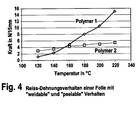
- the level of the peeling force is primarily that used in the sealing layer (A) Polymers determined (see FIG. 4, polymer 1 and polymer 2).
- the Peeling power usually increases with the heat sealing temperature. With increasing Heat sealing temperature increases the risk that the sealing layer will no longer peel loses. I.e. a film that is peelable when using a low heat sealing temperature this property loses if a sufficiently high heat seal temperature is applied. This behavior can be expected in particular in the case of polymers which have the Show characteristic shown in Figure 4 for polymer 1. This tends to generally applicable but rather unfavorable for the application must Design of the sealing layer are taken into account.
- the film must be in one Sufficiently large temperature range can be heat sealed without the Desired peelability is lost (see Polymer 2 in Figure 4). In practice is this temperature range generally 150 to 220 ° C, preferably 150 to 200 ° C and particularly preferably 150 to 190 ° C.
- the heat-sealable and peelable layer is usually made according to the prior art using so-called off-line methods (i.e. in an additional, the film production downstream process step) applied to the polyester film.
- off-line methods i.e. in an additional, the film production downstream process step
- a "standard polyester film” is produced by a conventional method.
- the so The polyester film produced is then processed in a further processing step Coating line "off-line” with a heat sealable and peelable layer coated.
- the heat-sealable and peelable polymer is first dissolved in an organic solvent.
- the finished solution is then over a suitable application process (knife caster, anilox roller, nozzle) is applied to the film.
- the solvent is evaporated in a downstream drying oven peelable polymer remains as a solid layer on the film.
- the solvent can never be completely during the drying can be removed from the coating, in particular because of the Drying process can not be as long as you want. Traces remaining in the coating of the solvent then migrate into the via the film on the tray Dishes where they distort the taste or even the health of the consumer can damage.
- polyester films differ in the structure and composition of the top layer (A). Depending on their (peel) properties, they are used in different applications. It is Z. For example, it is customary to divide the films from the application into films with easy peelability (easy peel), with firm peelability (medium peel) and with strong, resistant peelability (strong peel). An essential quantifiable distinguishing feature between these foils is the level of the respective peeling force according to FIG. 3b.
- EP-A-0 035 835 describes a coextruded sealable polyester film which to improve the winding and processing behavior in the sealing layer Particles are buried, whose average particle size is the layer thickness of the sealing layer exceeds.
- the polymer of the sealing film layer is essentially one Polyester copolymer based on aromatic dicarboxylic acids and aliphatic Diolen is built up.
- the particulate additives create surface protrusions formed which an undesirable blocking and sticking of the film on rollers or Prevent guides. By choosing particles with a larger diameter than that Sealing layer deteriorates the sealing behavior of the film. Information about the sealing temperature range the film is not made in the script.
- the seal seam strength is at Measured 140 ° C and is in a range from 63 to 120 N / m (corresponding to 0.97 to 1.8 N / 15 mm film width). About the peeling behavior of the film against menu dishes APET, CPET and APET / CPET are not found in the scriptures.
- EP-A 0 379 190 describes a coextruded, biaxially oriented polyester film which comprises a carrier film layer made of polyester and at least one sealing film layer made of a polyester composition.
- the sealing film layer can contain aliphatic and aromatic dicarboxylic acids as well as aliphatic diols.
- the polymer for the sealing film layer contains two different polyesters A and B, of which at least one (polyester B) contains aliphatic dicarboxylic acids and / or aliphatic diols.
- organic particles - if they are used at all - are used in amounts of at most 0.3% by weight.
- the film is characterized by good peel properties (with a plateau character in the peel diagram [see]) against itself (ie sealing film layer against sealing film layer), there is no indication of the peeling behavior against menu trays made of APET, CPET and APET / CPET.
- the film according to this invention is in need of improvement in terms of its manufacture and processability (the raw materials tend to stick).
- WO-A-96/19333 describes a process for producing peelable films in which the heat-sealable, peelable layer is applied inline to the polyester film. Comparatively small amounts of organic solvents are used in the process.
- the heat-sealable, peelable layer contains a copolyester in which a) 40 to 90 mol% of an aromatic dicarboxylic acid, b) 10 to 60 mol% of an aliphatic dicarboxylic acid, c) 0.1 to 10 mol% of a dicarboxylic acid containing a free one Acid group or a salt thereof, d) 40 to 90 mol% of a glycol containing 2 to 12 carbon atoms and e) 10 to 60 mol% of a polyalkyldiol were used to form the copolyester.
- the coating is applied to the film from an aqueous dispersion or a solution which contains up to 10% by weight of organic solvent.
- the process is limited in terms of the polymers that can be used and the layer thicknesses that can be achieved for the heat-sealable, peelable layer.
- the maximum achievable layer thickness is given as 0.5 ⁇ m.
- the maximum seal seam strength is low, it is 500 to 600 g / 25 mm 2 or [(500 to 600) / 170] N / 15 mm film width.
- WO 02/059186 A1 describes a process for producing peelable films, where the heat-sealable, peelable layer is also in-line on the polyester film is applied.
- the so-called enamel coating is used (melt-coating), preferably the elongated film with the heat-sealable, peelable polymer is coated.
- the heat sealable, peelable polymer contains Polyester based on aromatic and aliphatic acids as well as based on aliphatic diols.
- the copolymers disclosed in the examples have glass transition temperatures below -10 ° C; such copolyesters are too soft, which is why they are not Have it oriented in conventional roll stretching processes (sticking to the rolls).
- the fat the heat-sealable, peelable layer is less than 8 ⁇ m.
- WO 02/059186 A1 becomes the melt coating known per se from the extrusion coating known per se technically and delimited by the viscosity of the melt.
- the procedure is that only comparatively thin polymers (max. 50 Pa * sec) with low molecular weight can be used. This results in disadvantageous Peel properties of the film.
- the coating speed limited, which makes the manufacturing process uneconomical. In terms of quality, there are defects in the look of the film. B. as a coating strip become visible. It is also difficult with this method, one across the web width the film to get uniform thickness of the sealing layer, which in turn leads to a leads to uneven peel characteristics.
- the known properties which characterize polyester films should not deteriorate at the same time. These include, for example, the mechanical (the modulus of elasticity of the biaxially stretched films should be greater than 3000 N / mm 2 , preferably greater than 3500 N / mm 2 and particularly preferably greater than 4000 N / mm 2 in both orientation directions) and the thermal properties (The shrinkage of the biaxially stretched films should not be greater than 3%, preferably not greater than 2.8% and particularly preferably not greater than 2.5% in both orientation directions), the winding behavior and the processability of the film, particularly when printing , Lamination or when coating the film with metallic or ceramic materials.
- the Melting point of the heat sealable layer used as a polymer for the base layer, for example polyethylene terephthalate used with a melting point of 254 ° C, the Melting point of the heat sealable layer generally less than 230 ° C, in in the present case, preferably less than 210 ° C. and particularly preferably less than 190 ° C.
- the combination of heat-sealable film and substrate passes between the heat seal layer when the film is peeled off the substrate in the seam and the substrate surface (see also Ahlhaus, O.E .: packaging with plastics, Carl Hanser Verlag, p. 271, 1997, ISBN 3-446-17711-6).
- the material of the cover layer (A) consists mainly of a polyester and inorganic and / or organic particles.
- the polyester is made up of units which are derived from aromatic and aliphatic dicarboxylic acids.
- the on the Aromatic dicarboxylic acid units are in one in the polyester Amount of 30-95 mol%, preferably 50-90 mol%, particularly preferably 60-88 mol% contain.
- the units based on the aliphatic dicarboxylic acids are in the Polyester in an amount of 5-70 mol%, preferably 10-50 mol%, particularly preferred Contain 12-40 mol%, the mol% information always being 100% complementary.
- the the corresponding diol units always also give 100 mol%.
- Preferred aliphatic dicarboxylic acids are pimelic acid, suberic acid, azelaic acid, Sebacic acid, glutaric acid and adipic acid. Those are particularly preferred Azelaic acid, sebacic acid and adipic acid.
- Preferred aromatic dicarboxylic acids are terephthalic acid, isophthalic acid and 2,6-naphthalenedicarboxylic acid, especially terephthalic acid and isophthalic acid.
- Preferred diols are ethylene glycol, butylene glycol and neopentyl glycol.
- the material of the cover layer (A) consists of additives and auxiliaries and / or other commonly used in polyester film technology Additives.
- the heat sealable and peelable top layer (A) has compared to the APET side of APET / CPET menu trays, a max.
- Sealing temperature of generally 220 ° C, preferably 200 ° C and particularly preferably 190 ° C, wherein in entire sealing area one opposite the APET side of APET / CPET menu trays peelable film is obtained. I.e. This film is used in the 180 ° tensile test Figure 2 obtained a curve according to Figure 3b.
- the film according to the present invention contains a base layer (B) and at least a top layer (A) according to the invention.
- the film has two layers built up.
- the film is three or more than built up in three layers.
- the particularly preferred three-layer embodiment it then consists of the base layer (B), the cover layer (A) according to the invention and a cover layer (C) opposite the cover layer (A).
- the embodiment contains an intermediate layer (D) between the Base layer (B) and the top layer (A) or (C).
- the base layer of the film consists of at least 80% by weight of thermoplastic Polyester.
- Ethylene units are preferred Containing polyesters, which - based on the dicarboxylate units - from at least 90 Mol%, particularly preferably at least 95 mol%, terephthalate or 2,6-naphthalate units consist.
- the remaining monomer units come from others Dicarboxylic acids or diols.
- the base layer (B) can also Copolymers or mixtures or blends of the homo- and / or Copolymers can be used. (When specifying the amounts for the dicarboxylic acids forms the total amount of all dicarboxylic acids 100 mol%. The total quantity is analogous of all diols also 100 mol%.)
- Suitable other aromatic dicarboxylic acids are preferably benzenedicarboxylic acids, naphthalenedicarboxylic acids (for example naphthalene-1,4- or 1,6-dicarboxylic acid), biphenyl-x, x'-dicarboxylic acids (in particular biphenyl-4,4'-dicarboxylic acid), diphenylacetylene-x, x '-dicarboxylic acids (especially diphenylacetylene-4,4'-dicarboxylic acid) or stilbene-x, x'-dicarboxylic acids.
- cyclohexanedicarboxylic acids (in particular cyclohexane-1,4-dicarboxylic acid) should be mentioned.
- aliphatic dicarboxylic acids the (C 3 C 19 ) alkanedioic acids are particularly suitable, the alkane fraction being straight-chain or branched.
- Suitable other aliphatic diols are, for example, diethylene glycol, triethylene glycol, aliphatic glycols of the general formula HO- (CH 2 ) n -OH, where n represents an integer from 3 to 6 (in particular propane-1,3-diol, butane-1,4) diol, pentane-1,5-diol and hexane-1,6-diol), or branched aliphatic glycols with up to 6 carbon atoms, cycloaliphatic, optionally heteroatom-containing diols with one or more rings.
- cyclohexanediols (in particular cyclohexane-1,4-diol) may be mentioned.
- Suitable other aromatic diols correspond, for example, to the formula HO-C 6 H 4 -XC 6 H 4 -OH, where X is -CH 2 -, -C (CH 3 ) 2 -, -C (CF 3 ) 2 -, -O -, -S- or -SO 2 - stands.
- bisphenols of the formula HO-C 6 H 4 -C 6 H 4 -OH are also very suitable.
- the base layer (B) then essentially contains one Polyester copolymer consisting predominantly of terephthalic acid and isophthalic acid units and / or terephthalic acid and naphthalene-2,6-dicarboxylic acid units and from Ethylene glycol units is composed.
- the most preferred copolyesters that provide the desired properties of the film are those that are made of terephthalate and isophthalate units and are composed of ethylene glycol units.
- the polyester can be produced by the transesterification process. It goes one of dicarboxylic acid esters and diols with the usual transesterification catalysts how zinc, calcium, lithium and manganese salts are implemented. The intermediates are then in the presence of common polycondensation catalysts such as antimony trioxide, titanium oxides or esters and germanium compounds polycondensed. The preparation can also be carried out in the presence of the direct esterification process of polycondensation catalysts. You go straight from the Dicarboxylic acids and the diols.
- the film according to the present invention has at least two layers. She then consists of the base layer (B) and the one applied to it by coextrusion sealable and peelable top layer according to the invention (A).
- the sealable and peelable applied to the base layer (B) by coextrusion Cover layer (A) is predominant, i. H. at least about 80% by weight of polyesters built up.
- the heat-sealable and peelable top layer (A) contains polyester Basis of aromatic and aliphatic acids and preferably aliphatic diols.
- copolyesters or Mixtures of homo- and copolyesters or mixtures of different copolyesters understood that based on aromatic and aliphatic dicarboxylic acids and aliphatic diols are constructed.
- aromatic dicarboxylic acids which can be used according to the invention are Terephthalic acid, isophthalic acid, phthalic acid and 2,6-naphthalenedicarboxylic acid.
- aliphatic dicarboxylic acids which can be used according to the invention are Succinic acid, glutaric acid, adipic acid, pimelic acid, suberic acid, the Azelaic acid and sebacic acid.
- Examples of the aliphatic diols which can be used according to the invention are ethylene glycol, 1,3-propanediol, 1,3-butanediol, 1,4-butanediol, 1,5-pentanediol, 2,2-dimethyl-1,3-propanediol, Diethylene glycol, triethylene glycol and 1,4-cyclohexanedimethanol.
- the polyester for the cover layer (A) is preferably composed of two polyesters I and II manufactured.
- polyester I consisting of one or more aromatic dicarboxylates and one or more aliphatic alkylenes in the top layer (A) 20 to 80% by weight.
- the proportion of polyester is I. 25 to 75% by weight and in the particularly preferred embodiment it is 30 to 70 Wt .-%.
- the polyester consists of a mixture which is a copolyester composed of terephthalate, isophthalate and ethylene units, and an aromatic polyester homopolymer, e.g. B. a polybutylene terephthalate contains.
- the proportion of polyester I in the top layer (A) is less than 20 wt .-%, the producibility of the film using coextrusion technology is significantly more difficult or no longer guaranteed.
- the tendency of the slide to stick to certain machine parts, especially to moving, metallic ones Rolling in the longitudinal stretching and after the transverse stretching is particularly high here.
- the proportion of polyester I in the top layer (A) is more than 80% by weight, the peeling behavior of the film is severely impaired.
- the proportion is of polyester II 25 to 70 wt .-% and in the particularly preferred embodiment it is 30 to 65% by weight.
- Polyester II preferably consists of a copolymer of aliphatic and aromatic acid components in which the aliphatic acid components 20 up to 90 mol%, preferably 30 to 70 mol% and particularly preferably 35 to 60 mol% amount, based on the total amount of acid of polyester II.
- the 100 mol% missing dicarboxylate content comes from aromatic acids, preferably terephthalic acid and / or isophthalic acid, and on the glycolic side of aliphatic or cycloaliphatic or aromatic diols, as already described above with regard to Base layer have been described in detail.
- Dicarboxylic acids and other aliphatic diols such as those previously used for the base layer (B) have been listed as major and minor carboxylic acids, or by Hydroxycarboxylic acids such as hydroxybenzoic acid or the like.
- polyester II in the top layer (A) If the proportion of polyester II in the top layer (A) is less than 20% by weight, this becomes Peeling behavior of the film is severely impaired. The sealing behavior of the film changes to in this case from “peelable” to "weldable”. On the other hand, the proportion is on the other hand of polyester II in the top layer (A) more than 75 wt .-%, so the manufacturability of Foil over the coextrusion technology difficult or no longer guaranteed.
- the glass transition temperature of polyester I is more than 50 ° C.
- the glass transition temperature of polyester I is preferably more than 55 ° C. and especially preferably more than 60 ° C.
- the glass transition temperature of polyester I is lower than 50 ° C, the film cannot be produced in a process-safe manner.
- the tendency to stick Cover layer (A) z. B. compared to rollers is so large that with frequent film breaks, especially in the longitudinal direction. The slide can thereby wrap around the rollers in the longitudinal direction, causing considerable damage of the machine. During extrusion, such a polyester easily sticks to the metallic walls and thus leads to blockages.
- the glass transition temperature of polyester II is expediently less than 20 ° C.
- the glass transition temperature is preferably less than 15 ° C. and particularly preferably less than 10 ° C. Is the glass transition temperature of polyester II greater than 20 ° C, the film tends to tear when pulled off the menu tray to tear off what is undesirable.
- the heat-sealable and peelable top layer (A) contains inorganic and / or organic particles (also referred to as "pigments” or “antiblocking agents”) in a concentration of 2 to 10 wt .-%, based on the mass of the cover layer (A).
- the proportion of particles is 3 to 9 wt .-% and in particularly preferred embodiment, it is 4 to 8% by weight, also based on the mass of the top layer (A).
- top layer (A) of the film contains less than 2% by weight of particles, a positive one No longer influences the peeling behavior (peeling behavior) of the film from the menu tray given; the film tends to tear in or tear off.
- the particles are of a certain size, in a certain distribution (one speaks of a particle system) and in one certain concentration. Mixtures of two and several different particle systems and / or mixtures of particle systems with different chemical composition of the cover layer (A) are added.
- Common particles are inorganic and / or organic particles, for example Calcium carbonate, amorphous silica, talc, magnesium carbonate, barium carbonate, Calcium sulfate, barium sulfate, lithium phosphate, calcium phosphate, magnesium phosphate, Aluminum oxide, lithium fluoride, calcium, barium, zinc or manganese salts used dicarboxylic acids, carbon black, titanium dioxide, kaolin or cross-linked polystyrene or Arcrylat particles.
- the particles can each be advantageous in the layer Concentrations e.g. B. as a glycolic dispersion during polycondensation or over Masterbatches are added during extrusion.
- Particles preferred according to the invention are synthetically produced, amorphous SiO 2 particles in colloidal form. These particles are excellently integrated into the polymer matrix and only generate a few vacuoles (cavities). Vacuoles arise on the particles during biaxial orientation, generally cause turbidity and are therefore not very suitable for the present invention.
- SiO 2 particles also called silica gel
- sulfuric acid and sodium silicate are first mixed together under controlled conditions to form hydrosol. This eventually forms a hard, translucent mass known as a hydrogel.
- the sodium sulfate obtained as a by-product is separated by a washing process, it can be dried and processed further. By checking the wash water pH and the drying conditions, the important physical parameters such as B.
- the desired particle size (e.g. the d 50 value) and the desired particle size distribution (e.g. the SPAN98) are obtained by suitable grinding of the silica gel (e.g. mechanical or hydromechanical). Such particles can e.g. B. can be obtained from Grace, Fuji, Degussa or Ineos.
- the particles have an average particle diameter d 50 of 2.0 to 8 ⁇ m, preferably 2.5 to 7 ⁇ m and particularly preferably 3.0 to 6 ⁇ m.
- d 50 average particle diameter of 2.0 to 8 ⁇ m, preferably 2.5 to 7 ⁇ m and particularly preferably 3.0 to 6 ⁇ m.
- the ratio of particle size d 50 and layer thickness d A of the top layer (A) in the heat-sealable and peelable top layer (A) is greater than 1.3.
- the diameter / layer thickness ratio is preferably at least 1.6 and particularly preferably at least 2.0. In these cases, the particles have a particularly positive influence on the peeling behavior of the film from the menu tray.
- the roughness of the heat-sealable and peelable top layer (A) in such a way that its R a value is greater than 120 nm.
- the roughness R a is preferably greater than 140 nm and particularly preferably it is greater than 160 nm.
- the upper limit of the roughness should not exceed 400 nm, preferably 350 nm, in particular 300 nm. This can be controlled by the selection of the particle diameter, its concentration and the variation of the layer thickness.
- the amount of particles in the Base layer (B) should be set lower than in top layer (A).
- the amount of in the base layer (B) Particles are between 0 and 2.0% by weight, preferably between 0 and 1.5% by weight, in particular between 0 and 1.0% by weight. It has proven to be particularly useful proven to only incorporate particles into the base layer as they do via the species Regenerate (recyclate) get into the film.
- the optical properties of the film, the haze of the film in particular is then particularly good.
- the intermediate layer consists of the polyesters used for the base layer.
- the Intermediate layer can also contain the usual additives described below.
- the fat the intermediate layer is generally larger than 0.3 ⁇ m and is preferably in Range of 0.5 to 15 microns, especially in the range of 1.0 to 10 microns, particularly preferably in the range from 1.0 to 5 ⁇ m.
- the thickness of the cover layer (A) of the film according to the invention is in the range of 0.5 and 2.5 ⁇ m, preferably in the range from 0.5 and 2.0 ⁇ m and particularly preferably in the range from 0.5 and 1.5 ⁇ m. If the thickness of the cover layer (A) is more than 2.5 ⁇ m, the thickness increases Peel force clearly and is no longer in the range according to the invention. Furthermore the peeling behavior of the film is impaired. Is the thickness of the top layer (A) however, less than 0.5 ⁇ m, the film is no longer heat-sealable.
- the thickness of the other, non-sealable top layer (C) can be equal to the top layer (A) be or different from this; their thickness is generally between 0.5 and 5 ⁇ m.
- the total thickness of the polyester film according to the invention can be within certain Limits vary. It is 3 to 200 ⁇ m, in particular 4 to 150 ⁇ m, preferably 5 to 100 microns, wherein the layer (B) a share of preferably 45 to 97% of the Total thickness.
- the base layer and the other layers can additionally conventional additives such as Stabilizers (UV, hydrolysis), flame retardants or fillers contain. you will be Expediently the polymer or the polymer mixture before melting added.
- the present invention also relates to a method for producing the film.
- the respective polymers polymers (polyester I, polyester II, possibly further Polymers, e.g. B. Masterbatch (s) for the particles) directly to the extruder for the top layer (A) fed.
- the materials can be extruded at around 200 to 280 ° C.
- the polymers for the base layer (B) and for the possibly further top layer (C) and optionally the intermediate layer are expedient via further extruders fed to the (coextrusion) system.
- the melts are in a multi-layer nozzle formed into flat melt films and layered on top of each other. Then will the multilayer film with the help of a cooling roll and, if necessary, further rolls peeled and solidified.
- the biaxial stretching of the film is generally carried out sequentially.
- a Simultaneous stretching of the film is also possible, but is not necessary.
- the sequential stretching is preferably performed only in the longitudinal direction (i.e. in the machine direction) and then in the transverse direction (i.e. perpendicular to the machine direction) stretched.
- the stretching in the longitudinal direction can be done with the help of two according to the achieve the desired stretch ratio of rollers rotating at different speeds.
- To the Cross sections are generally used with an appropriate tenter frame.
- the temperature at which the stretching is carried out can be in a relatively large Range vary and depends on the desired properties of the film.
- the machine direction orientation (MDO) in a temperature range of 60 to 130 ° C (heating temperatures 60 to 130 ° C) and in Transverse direction (TDO) in a temperature range of 90 ° C (start of stretching) to 140 ° C (end of stretching).
- the longitudinal stretch ratio is in the range from 2.0: 1 to 5.5: 1, preferably from 2.3: 1 to 5.0: 1.
- the Cross-stretch ratio is generally in the range from 2.4: 1 to 5.0: 1, preferably from 2.6: 1 to 4.5: 1.
- the preferred temperature range at which biaxial stretching is performed is 60 to 120 ° C for longitudinal stretching (MDO).
- the heating temperatures of the film in the longitudinal stretching range from 60 to 115 ° C.
- stretching (TDO) the temperatures of the film are in a range of 90 ° C (beginning stretch) to 140 ° C (end of stretch).
- the longitudinal stretch ratio is included this preferred temperature range in the range from 2.0: 1 to 5.0: 1, preferably from 2.3: 1 up to 4.8: 1.
- the transverse stretching ratio is generally in the range from 2.4: 1 to 5.0: 1, preferably from 2.6: 1 to 4.5: 1.
- the most preferred temperature range at which biaxial stretching is performed is 60 to 110 ° C for longitudinal stretching (MDO).
- the heating temperatures of the The film in the longitudinal stretching is in a range from 60 to 105 ° C.
- the temperatures of the film are in a range of 90 ° C (Start of stretching) up to 140 ° C (end of stretching).
- the longitudinal stretch ratio is at this preferred temperature range in the range from 2.0: 1 to 4.8: 1, preferably from 2.3: 1 to 4.6: 1.
- the transverse stretching ratio is generally in the range from 2.4: 1 to 5.0: 1, preferably from 2.6: 1 to 4.5: 1.
- top layer (A) on rollers metallic, ceramic or specially coated roller surfaces
- one or both surface (s) of the film can be made according to itself coat known processes in-line.
- the in-line coating can, for example improved adhesion between a metal layer or an ink and the Foil, to improve the antistatic behavior, the processing behavior or also to further improve the barrier properties of the film.
- the latter is, for example, by applying barrier coatings such as EVOH, PVOH or the like. receive.
- barrier coatings such as EVOH, PVOH or the like.
- the film is over a period of about 0.1 to Maintained at a temperature of 150 to 250 ° C for 10 s. Then the slide in wound up in the usual way.
- the gloss of the film surface (B) in the case of a two-layer film or the gloss of the Film surface (C) for a three-layer film is greater than 100 (measured according to DIN 67530 based on ASTM-D 523-78 and ISO 2813 with 20 ° beam angle). In a preferred embodiment, the gloss of these pages is more than 110 and in one particularly preferred embodiment more than 120. These film surfaces are suitable is therefore particularly suitable for a further functional coating, for printing or for metallization.
- the haze of the film is less than 20. In a preferred embodiment it is Turbidity of the film less than 16 and in a particularly preferred embodiment less than 12.
- Another advantage of the invention is that the manufacturing cost of film according to the invention not significantly above that of a film made of standard polyester lie.
- the production of the film ensures that waste material, that is inherent in the production of films in the company, as regrind in a quantity of up to 60% by weight, preferably 5 to 50% by weight, in each case based on the total weight the film, can be used again for film production without the physical properties of the film are negatively influenced.
- the film according to the invention is excellently suitable for packaging food and luxury foods, especially for packaging food and luxury foods in menu trays, where peelable polyester films are used to open the packaging become.
- Table 1 summarizes the most important film properties according to the invention.
- the The present invention uses the following measurement methods:
- the determination of d 98 and d 10 is in turn based on the (relative) cumulative curve of the particle size distribution (see “measurement of the mean diameter d 50 ).
- the intersection of the 98% ordinate value with the cumulative curve immediately provides the desired d 98 on the abscissa axis Value, and the intersection of the 10% ordinate value of the cumulative curve with the curve provides the desired d 10 value on the abscissa axis.
- the SV of the polymer was determined by measuring the relative viscosity ( ⁇ rel ) of a 1% solution in dichloroacetic acid in an Ubbelohde viscometer at 25 ° C.
- the glass transition temperature T g was determined on the basis of film samples with the aid of DSC (Differential Scanning Calorimetry). A DSC 1090 from Perkin-Elmer was used. The heating rate was 20 K / min and the initial weight was about 12 mg. To eliminate the thermal history, the samples were first heated to 300 ° C, held for 5 minutes and then quenched with liquid nitrogen. The temperature for the glass transition T g was taken from the thermogram as the temperature at half the step height.
- the sealed Strips clamped in the tensile testing machine (e.g. Zwick, Germany) and the 180 ° seal strength, d. H. the force required to split the test strips, with a take-off speed of 200 mm / min.
- the seal seam strength will in N per 15 mm film strip (e.g. 3 N / 15 mm).
- the sealing device HSG / ET from Brugger as before, when measuring the Seal seam strength described, heat-sealed samples (seal seam 15mm x 100mm) produced, the film at different temperatures with the help of two heated sealing jaws with a sealing pressure of 4bar and a sealing time of 0.5s is sealed.
- the 180 ° seal seam strength was as in the determination of Seal seam strength measured.
- the minimum sealing temperature is the temperature at which a seal seam strength of at least 1.0N / 15mm is achieved.
- the roughness R a of the film was determined according to DIN 4768 with a cut-off of 0.25 mm. It was not measured on a glass plate, but in the ring. In the ring method, the film is clamped in a ring so that neither surface touches a third surface (e.g. glass).
- the gloss of the film was determined in accordance with DIN 67530.
- the tear strength of the film was measured in accordance with DIN 53455.
- the test speed is 1% / min; 23 ° C; 50% RH
- the modulus of elasticity of the film was measured in accordance with DIN 53457.
- the test speed is 1% / min; 23 ° C; 50% RH
- the gloss of the film was measured in accordance with DIN 40634.
- the test conditions are 150 ° C, 15 min.
- Polyethylene terephthalate chips were used in the extruder for the base layer (B) fed. Chips made of polyethylene terephthalate and particles were also used Extruder (twin-screw extruder) for the non-sealable top layer (C) fed. According to the process conditions listed in the table below the raw materials were melted in the two respective extruders and homogenized.
- the three melt streams were made by coextrusion in a three layer die layered on top of each other and ejected through the nozzle lip.
- the resulting one The melt film was cooled and then over a stepwise orientation in the longitudinal and transverse directions a transparent, three-layer film with ABC structure in a total thickness of 25 microns.
- the thicknesses of the two cover layers are each 1 ⁇ m (see also Table 2).
- Top layer (A) mixture of:
- the glass transition temperature of polyester I is approx. 75 ° C.
- the ratio of particle diameter d 50 to cover layer thickness d (A) is 3.4: 1 (see Table 2).
- Polyester II copolymer containing 40 mol% ethylene azelate, 50 mol% ethylene terephthalate, 10 mol% ethylene isophthalate
- the glass transition temperature of polyester II is approx. 0 ° C.
- Top layer (C) mixture of:
- the manufacturing conditions in the individual process steps were: extrusion temperatures A layer 230 ° C B-layer 280 ° C C layer 280 ° C Pull roller temperature 20 ° C longitudinal stretching heating temperature 70-100 ° C stretching temperature 105 ° C Longitudinal stretching ratio 4.0 transverse stretching heating temperature 100 ° C stretching temperature 135 ° C Transverse stretching ratio 4.0 fixation temperature 230 ° C duration 3 s
- the top layer thickness of the sealable layer (A) was 1.0 to 1.5 ⁇ m with an otherwise identical film structure and otherwise identical production method raised.
- the minimum sealing temperature of the film opposite the APET side of APET / CPET menu dishes is now 140 ° C.
- For all sealing temperatures showed the desired peeling of the films from the menu tray according to Figure 3b.
- the measured seal seam strengths are listed in column 3.
- peelable films were again obtained.
- the seal strength of the Films according to the invention are somewhat higher than in Example 1. However, they always lie still in the lower area so that the film can be removed from the menu tray without exertion pulls off. A somewhat lower haze of the film was measured; the Handling and processing behavior of the film were as in Example 1.
- the minimum sealing temperature of the film opposite the APET side of APET / CPET menu trays is now 138 ° C. This was evident for all sealing temperatures Desired peeling of the films from the menu tray according to Figure 3b.
- the measured Seal seam strengths are listed in column 3. For all sealing temperatures peelable films were again obtained.
- the seal seam strengths of the invention Slides are slightly higher than in example 1. They are in the middle Area so that the slide can be removed from the menu tray without significant effort pulls off.
- the handling and processing behavior of the film were as in Example 1.
- polyester II for the sealable top layer (A) was changed while the film structure was otherwise identical.
- the composition of the individual components in the mixture remained unchanged compared to Example 3.
- the mixture used in the top layer (A) now consists of the following raw material components: 40% by weight Polyester I, identical to example 1 60% by weight Polyester II, ®Vitel1912, (Polyester, Bostik-Findley, USA; contains the dicarboxylic acid components azelaic acid, sebacic acid, terephthalic acid, isophthalic acid and other dicarboxylic acids in a molar ratio of approximately 40/1/45/10/4 and as a diol component at least 60 mol% ethylene glycol).
- the glass transition temperature of polyester II is approx. -1 ° C.
- the process parameters in the longitudinal stretching corresponded to those in Example 5.
- the minimum sealing temperature of the film produced according to the invention compared to APET side of APET / CPET menu trays is now 138 ° C.
- the measured seal seam strengths are listed in column 3.
- the seal strength of the films according to the invention are higher than in Example 1. They are in one middle area, so that the film moves away from the Menu tray can be removed.
- the handling and processing behavior of the film were as in Example 1.
- the manufacturing conditions in the individual process steps have been adjusted in the longitudinal stretching of the glass transition temperature of the top layer raw material: longitudinal stretching heating temperature 70-115 ° C stretching temperature 120 ° C Longitudinal stretching ratio 4.0
- Table 3 shows the properties of the film. Although the film is highly pigmented and the pigments represent weak points in the sealing layer do not receive a peelable film for any of the specified sealing temperatures. At the Removing the film from the menu tray tore the film directly and showed one Diagram according to FIG. 3a. The film showed "weldable" behavior and is therefore for the Unsuitable solution to the stated task.
- Example 5 from EP-A 0 035 835 was reworked. In Table 3 they are Properties of the slide shown. It was not indicated for any of the sealing temperatures get a peelable film. When the film was pulled off the menu tray, it tore the film directly and showed a diagram according to FIG. 3a. The film showed "weldable" Behavior and is therefore unsuitable for the solution of the stated task.
- Example 1 from EP-A 0 379190 was reworked.
- Table 3 they are Properties of the slide shown. It was not indicated for any of the sealing temperatures get a peelable film. When the film was pulled off the menu tray, it tore the film directly and showed a diagram according to FIG. 3a. The film showed "weldable" Behavior and is therefore unsuitable for the solution of the stated task.
- Example 22 from EP-A 0 379190 was reworked.
- Table 3 shows the properties of the film. A peelable film was not obtained for any of the sealing temperatures given. When the film was pulled off the menu tray, the film tore directly and showed a diagram according to FIG. 3a. The film showed "weldable" behavior and is therefore unsuitable for the solution of the stated task.
Landscapes
- Chemical & Material Sciences (AREA)
- Chemical Kinetics & Catalysis (AREA)
- Laminated Bodies (AREA)
- Shaping By String And By Release Of Stress In Plastics And The Like (AREA)
- Closures For Containers (AREA)
- Wrappers (AREA)
- Extrusion Moulding Of Plastics Or The Like (AREA)
Applications Claiming Priority (2)
| Application Number | Priority Date | Filing Date | Title |
|---|---|---|---|
| DE10318098A DE10318098A1 (de) | 2003-04-22 | 2003-04-22 | Coextrudierte, heißsiegelbare und peelfähige Polyesterfolie mit leichter Peelbarkeit, Verfahren zu ihrer Herstellung und ihre Verwendung |
| DE10318098 | 2003-04-22 |
Publications (2)
| Publication Number | Publication Date |
|---|---|
| EP1475229A2 true EP1475229A2 (fr) | 2004-11-10 |
| EP1475229A3 EP1475229A3 (fr) | 2005-03-09 |
Family
ID=32981133
Family Applications (1)
| Application Number | Title | Priority Date | Filing Date |
|---|---|---|---|
| EP04008943A Withdrawn EP1475229A3 (fr) | 2003-04-22 | 2004-04-15 | Films en polyester coextrudés thermoscellable et peelable leur production et leur utilisation |
Country Status (5)
| Country | Link |
|---|---|
| US (1) | US20050019559A1 (fr) |
| EP (1) | EP1475229A3 (fr) |
| JP (1) | JP2004322643A (fr) |
| KR (1) | KR20040091573A (fr) |
| DE (1) | DE10318098A1 (fr) |
Cited By (18)
| Publication number | Priority date | Publication date | Assignee | Title |
|---|---|---|---|---|
| EP1475228A3 (fr) * | 2003-04-22 | 2005-03-09 | Mitsubishi Polyester Film GmbH | Films en polyester coextrudés thermoscellable et peelable leur production et leur utilisation |
| EP1529799A1 (fr) * | 2003-11-10 | 2005-05-11 | Mitsubishi Polyester Film GmbH | Procédé pour la préparation d'un film coextrudé en polyester thermoscellable et pelable |
| EP1529798A1 (fr) * | 2003-11-10 | 2005-05-11 | Mitsubishi Polyester Film GmbH | Film thermoscellable et pelable en polyester à adhésivité améliorée, procédé pour sa préparation et son usage |
| US7141293B2 (en) | 2003-04-22 | 2006-11-28 | Mitsubishi Polyester Film Gmbh | Coextruded, hot-sealable and peelable polyester film having high peeling resistance, process for its production and its use |
| US7205040B2 (en) | 2003-11-10 | 2007-04-17 | Mitsubishi Polyester Film Gmbh | Peelable polyester film having improved oxygen barrier, process for its production and its use |
| US7211306B2 (en) | 2003-11-10 | 2007-05-01 | Mitsubishi Polyester Film Gmbh | Peelable polyester film with self-venting, process for its production and its use |
| US7329453B2 (en) | 2003-11-10 | 2008-02-12 | Mitsubishi Polyester Film Gmbh | White, heatsealable, peelable polyester film, process for its production and its use |
| EP1942002A3 (fr) * | 2006-09-15 | 2008-07-16 | Mitsubishi Polyester Film GmbH | Feuille de polyester revêtue à base de polyester catalysé au titane |
| EP2030781A1 (fr) | 2007-09-03 | 2009-03-04 | Mitsubishi Polyester Film GmbH | Film polyester pelable orienté de manière biaxiale |
| EP2030782A1 (fr) | 2007-09-03 | 2009-03-04 | Mitsubishi Polyester Film GmbH | Film en polyester coextrudé pouvant être scellé à chaud et pelable |
| EP2062726A1 (fr) | 2007-11-21 | 2009-05-27 | Mitsubishi Polyester Film GmbH | Feuille de polyester pour scellement à basse temperature pour des substrates polaires |
| DE102009021714A1 (de) | 2009-05-18 | 2010-11-25 | Mitsubishi Polyester Film Gmbh | Niedrigsiegelnde Polyesterfolie für unpolare Substrate |
| US7871696B2 (en) | 2006-11-21 | 2011-01-18 | Kraft Foods Global Brands Llc | Peelable composite thermoplastic sealants in packaging films |
| US7871697B2 (en) | 2006-11-21 | 2011-01-18 | Kraft Foods Global Brands Llc | Peelable composite thermoplastic sealants in packaging films |
| DE202010008675U1 (de) | 2010-09-30 | 2011-01-27 | Kobusch-Sengewald Gmbh | Mehrschichtverbundfolie |
| DE202011050984U1 (de) | 2011-08-15 | 2012-01-18 | Kobusch-Sengewald Gmbh | Peelfähige Mehrschichtverbundfolie mit Wiederverschliessbarkeit |
| EP2990455A4 (fr) * | 2013-04-26 | 2016-05-11 | Toyo Boseki | Film polyester d'étanchéité, stratifié et sachet d'emballage |
| US10287077B2 (en) | 2010-02-26 | 2019-05-14 | Intercontinental Great Brands Llc | Low-tack, UV-cured pressure sensitive adhesive suitable for reclosable packages |
Families Citing this family (17)
| Publication number | Priority date | Publication date | Assignee | Title |
|---|---|---|---|---|
| US7358861B2 (en) * | 1999-05-04 | 2008-04-15 | Intellimats | Electronic floor display with alerting |
| US7186452B2 (en) * | 2003-04-22 | 2007-03-06 | Mitsubishi Polyester Film Gmbh | Coextruded, hot-sealable and peelable polyester film having high peeling resistance, process for its production and its use |
| US7144615B2 (en) * | 2003-04-22 | 2006-12-05 | Mitsubishi Polyester Film Gmbh | Coextruded, hot-sealable and peelable polyester film, process for its production and its use |
| US7223459B2 (en) * | 2003-04-22 | 2007-05-29 | Mitsubishi Polyester Film Gmbh | Coextruded, hot-sealable and peelable polyester film, process for its production and its use |
| US20060182984A1 (en) * | 2005-02-17 | 2006-08-17 | Abele Wolfgang P | Protected polycarbonate films having thermal and UV radiation stability, and method of making |
| US8398306B2 (en) | 2005-11-07 | 2013-03-19 | Kraft Foods Global Brands Llc | Flexible package with internal, resealable closure feature |
| USD600113S1 (en) | 2006-12-20 | 2009-09-15 | Kraft Foods Global Brands Llc | Reclosable package |
| US20080160143A1 (en) * | 2006-12-29 | 2008-07-03 | Jay Anthony Edwards | Reclosable Food Package |
| US9232808B2 (en) | 2007-06-29 | 2016-01-12 | Kraft Foods Group Brands Llc | Processed cheese without emulsifying salts |
| US8227658B2 (en) | 2007-12-14 | 2012-07-24 | Kimberly-Clark Worldwide, Inc | Film formed from a blend of biodegradable aliphatic-aromatic copolyesters |
| PT104282A (pt) * | 2008-12-05 | 2010-06-07 | Univ Do Porto | Processo de selagem com vidro de células solares dsc |
| MX2012009795A (es) | 2010-02-26 | 2012-09-12 | Kraft Foods Global Brands Llc | Envase susceptible de volver a cerrarse usando adhesivo de baja pegajosidad. |
| US9533472B2 (en) | 2011-01-03 | 2017-01-03 | Intercontinental Great Brands Llc | Peelable sealant containing thermoplastic composite blends for packaging applications |
| US9656447B2 (en) * | 2012-08-31 | 2017-05-23 | Toray Plastics (America), Inc. | Lidding structure based on aromatic polyester film, extrusion-coated with a sealable/peelable copolyester layer |
| CN103390497B (zh) * | 2013-07-30 | 2016-06-22 | 浙江南洋科技股份有限公司 | 一种超薄电容膜及其制备方法 |
| DE102016222146A1 (de) * | 2016-11-11 | 2018-05-17 | Mitsubishi Polyester Film Gmbh | Biaxial orientierte, heißsiegelbare und peelfähige Polyesterfolie, Verfahren zu ihrer Herstellung und ihre Verwendung |
| WO2019100019A1 (fr) * | 2017-11-17 | 2019-05-23 | Promier Products, Inc. | Commutateur de lumière coulissant avec source de lumière intégrée |
Family Cites Families (8)
| Publication number | Priority date | Publication date | Assignee | Title |
|---|---|---|---|---|
| KR960004763B1 (ko) * | 1989-01-19 | 1996-04-13 | 도오요오 보오세끼 가부시끼가이샤 | 폴리에스테르계 수지 적층 필름 |
| GB9425641D0 (en) * | 1994-12-20 | 1995-02-22 | Ici Plc | Polymeric film |
| GB0101994D0 (en) * | 2001-01-25 | 2001-03-14 | Dupont Teijin Films Us Ltd | Process for the production of coated polumeric film |
| DE10318100A1 (de) * | 2003-04-22 | 2004-11-11 | Mitsubishi Polyester Film Gmbh | Coextrudierte, heißsiegelbare und peelfähige Polyesterfolie, Verfahren zu ihrer Herstellung und ihre Verwendung |
| DE10318102A1 (de) * | 2003-04-22 | 2004-11-11 | Mitsubishi Polyester Film Gmbh | Coextrudierte, heißsiegelbare und peelfähige Polyesterfolie mit starker Peelbarkeit, Verfahren zu ihrer Herstellung und ihre Verwendung |
| DE10318097A1 (de) * | 2003-04-22 | 2004-11-11 | Mitsubishi Polyester Film Gmbh | Coextrudierte, heißsiegelbare und peelfähige Polyesterfolie, Verfahren zu ihrer Herstellung und ihre Verwendung |
| DE10318101A1 (de) * | 2003-04-22 | 2004-11-11 | Mitsubishi Polyester Film Gmbh | Coextrudierte, heißsiegelbare und peelfähige Polyesterfolie, Verfahren zu ihrer Herstellung und ihre Verwendung |
| DE10318099A1 (de) * | 2003-04-22 | 2004-11-11 | Mitsubishi Polyester Film Gmbh | Coextrudierte, heißsiegelbare und peelfähige Polyesterfolie, Verfahren zu ihrer Herstellung und ihre Verwendung |
-
2003
- 2003-04-22 DE DE10318098A patent/DE10318098A1/de not_active Withdrawn
- 2003-08-21 US US10/645,102 patent/US20050019559A1/en not_active Abandoned
-
2004
- 2004-04-15 EP EP04008943A patent/EP1475229A3/fr not_active Withdrawn
- 2004-04-20 KR KR1020040027239A patent/KR20040091573A/ko not_active Withdrawn
- 2004-04-22 JP JP2004127208A patent/JP2004322643A/ja not_active Withdrawn
Cited By (29)
| Publication number | Priority date | Publication date | Assignee | Title |
|---|---|---|---|---|
| EP1475228A3 (fr) * | 2003-04-22 | 2005-03-09 | Mitsubishi Polyester Film GmbH | Films en polyester coextrudés thermoscellable et peelable leur production et leur utilisation |
| US7141293B2 (en) | 2003-04-22 | 2006-11-28 | Mitsubishi Polyester Film Gmbh | Coextruded, hot-sealable and peelable polyester film having high peeling resistance, process for its production and its use |
| EP1529799A1 (fr) * | 2003-11-10 | 2005-05-11 | Mitsubishi Polyester Film GmbH | Procédé pour la préparation d'un film coextrudé en polyester thermoscellable et pelable |
| EP1529798A1 (fr) * | 2003-11-10 | 2005-05-11 | Mitsubishi Polyester Film GmbH | Film thermoscellable et pelable en polyester à adhésivité améliorée, procédé pour sa préparation et son usage |
| US7205040B2 (en) | 2003-11-10 | 2007-04-17 | Mitsubishi Polyester Film Gmbh | Peelable polyester film having improved oxygen barrier, process for its production and its use |
| US7211306B2 (en) | 2003-11-10 | 2007-05-01 | Mitsubishi Polyester Film Gmbh | Peelable polyester film with self-venting, process for its production and its use |
| US7329453B2 (en) | 2003-11-10 | 2008-02-12 | Mitsubishi Polyester Film Gmbh | White, heatsealable, peelable polyester film, process for its production and its use |
| US7396578B2 (en) | 2003-11-10 | 2008-07-08 | Mitsubishi Polyester Film Gmbh | Adhesion-promoted , heatsealable and peelable polyester film, process for its production and its use |
| EP1942002A3 (fr) * | 2006-09-15 | 2008-07-16 | Mitsubishi Polyester Film GmbH | Feuille de polyester revêtue à base de polyester catalysé au titane |
| US8110286B2 (en) | 2006-11-21 | 2012-02-07 | Kraft Foods Global Brands Llc | Peelable composite thermoplastic sealants in packaging films |
| CN103213756B (zh) * | 2006-11-21 | 2015-07-15 | 洲际大品牌有限责任公司 | 包装膜中可剥离的复合热塑性密封剂 |
| US7871696B2 (en) | 2006-11-21 | 2011-01-18 | Kraft Foods Global Brands Llc | Peelable composite thermoplastic sealants in packaging films |
| US7871697B2 (en) | 2006-11-21 | 2011-01-18 | Kraft Foods Global Brands Llc | Peelable composite thermoplastic sealants in packaging films |
| CN103213756A (zh) * | 2006-11-21 | 2013-07-24 | 卡夫食品环球品牌有限责任公司 | 包装膜中可剥离的复合热塑性密封剂 |
| US8470397B2 (en) | 2006-11-21 | 2013-06-25 | Kraft Foods Global Brands Llc | Peelable composite thermoplastic sealants in packaging films |
| EP2030781A1 (fr) | 2007-09-03 | 2009-03-04 | Mitsubishi Polyester Film GmbH | Film polyester pelable orienté de manière biaxiale |
| DE102007041705A1 (de) | 2007-09-03 | 2009-03-05 | Mitsubishi Polyester Film Gmbh | Peelfähige, biaxial orientierte Polyesterfolie |
| DE102007041706A1 (de) | 2007-09-03 | 2009-03-05 | Mitsubishi Polyester Film Gmbh | Coextrudierte, heißsiegelbare und peelfähige Polyesterfolie |
| EP2030782A1 (fr) | 2007-09-03 | 2009-03-04 | Mitsubishi Polyester Film GmbH | Film en polyester coextrudé pouvant être scellé à chaud et pelable |
| EP2062726A1 (fr) | 2007-11-21 | 2009-05-27 | Mitsubishi Polyester Film GmbH | Feuille de polyester pour scellement à basse temperature pour des substrates polaires |
| DE102007055491A1 (de) | 2007-11-21 | 2009-06-04 | Mitsubishi Polyester Film Gmbh | Niedrigsiegelnde Polyesterfolie für polare Substrate |
| EP2275256A2 (fr) | 2009-05-18 | 2011-01-19 | Mitsubishi Polyester Film GmbH | Film de polyester à scellement à basse température pour des substrats non polaires |
| DE102009021714A1 (de) | 2009-05-18 | 2010-11-25 | Mitsubishi Polyester Film Gmbh | Niedrigsiegelnde Polyesterfolie für unpolare Substrate |
| US10287077B2 (en) | 2010-02-26 | 2019-05-14 | Intercontinental Great Brands Llc | Low-tack, UV-cured pressure sensitive adhesive suitable for reclosable packages |
| DE202010008675U1 (de) | 2010-09-30 | 2011-01-27 | Kobusch-Sengewald Gmbh | Mehrschichtverbundfolie |
| WO2013023646A1 (fr) | 2011-08-15 | 2013-02-21 | Kobusch-Sengewald Gmbh | Feuille composite multicouche pelable et refermable |
| DE202011050984U1 (de) | 2011-08-15 | 2012-01-18 | Kobusch-Sengewald Gmbh | Peelfähige Mehrschichtverbundfolie mit Wiederverschliessbarkeit |
| EP2990455A4 (fr) * | 2013-04-26 | 2016-05-11 | Toyo Boseki | Film polyester d'étanchéité, stratifié et sachet d'emballage |
| US10421835B2 (en) | 2013-04-26 | 2019-09-24 | Toyobo Co., Ltd. | Polyester film for sealant use, laminate, and packaging bag |
Also Published As
| Publication number | Publication date |
|---|---|
| DE10318098A1 (de) | 2004-11-11 |
| US20050019559A1 (en) | 2005-01-27 |
| JP2004322643A (ja) | 2004-11-18 |
| KR20040091573A (ko) | 2004-10-28 |
| EP1475229A3 (fr) | 2005-03-09 |
Similar Documents
| Publication | Publication Date | Title |
|---|---|---|
| EP1475228B1 (fr) | Films en polyester coextrudés thermoscellable et peelable leur production et leur utilisation | |
| EP1471098B1 (fr) | Film en polyester coextrudé, thermoscellable et pelable, son procédé de préparation et son utilisation | |
| EP1471097B1 (fr) | Film en polyester coextrudé, thermoscellable et pelable à grande pelabilité, son procédé de préparation et son utilisation | |
| EP1471096B1 (fr) | Film en polyester coextrudé, thermoscellable et pelable à grande pelabilité, son procédé de préparation et son utilisation | |
| EP1529636B1 (fr) | Film blanc en polyester, thermoscellable et pelable, son procédé de préparation et son utilisation | |
| EP3248777B1 (fr) | Feuilles en polyester thermoscellables et pelables, leur procédé de fabrication et d'utilisation | |
| DE10318098A1 (de) | Coextrudierte, heißsiegelbare und peelfähige Polyesterfolie mit leichter Peelbarkeit, Verfahren zu ihrer Herstellung und ihre Verwendung | |
| EP1529635A1 (fr) | Films en polyester peelable, présentant des propriétés barrière à l'oxygène améliorées, leur production et leur utilisation | |
| EP1529797A1 (fr) | Film pelable auto-ventilable en polyester, procédé pour sa préparation et son usage | |
| EP1529799A1 (fr) | Procédé pour la préparation d'un film coextrudé en polyester thermoscellable et pelable | |
| EP1529798A1 (fr) | Film thermoscellable et pelable en polyester à adhésivité améliorée, procédé pour sa préparation et son usage | |
| EP1380414B1 (fr) | Feuille polyester multicouche, transparente, scellable à chaud et orientée biaxialement, ainsi que son procédé de fabrication et son utilisation | |
| EP1471094B1 (fr) | Feuille thermoscellable et pelable de polyester coextrudé; méthode de fabrication et usage. | |
| DE10352439A1 (de) | Verfahren zur Herstellung einer heißsiegelbaren und peelfähigen Polysterfolie | |
| EP1176005A2 (fr) | Film composite multicouches de polyester transparent et orienté biaxialement | |
| EP2030782A1 (fr) | Film en polyester coextrudé pouvant être scellé à chaud et pelable | |
| EP3437853A1 (fr) | Feuilles en polyester pelables, leur procédé de fabrication et leur utilisation | |
| EP1440793A1 (fr) | Film polyester comprenant une couche de protection en polymétaxylylène adipamide et présentant des propriétés barrières à l'oxygène améliorées, son procédé de fabrication et son utilisation | |
| DE10302034A1 (de) | Polyesterfolie mit verbesserter Sauerstoffbarriere und Poly(m-xylol-adipinamid)-haltiger Basisschicht, Verfahren zu ihrer Herstellung und ihre Verwendung | |
| EP1900775B1 (fr) | Feuille de polyester pelable à base de polyester catalysé au titane | |
| EP1806226B1 (fr) | Feuille de polyester blanche, thermosoudable, biaxialement étirée | |
| EP1942002A2 (fr) | Feuille de polyester revêtue à base de polyester catalysé au titane | |
| EP1291168B1 (fr) | Film en polyester à orientation biaxiale ayant une bonne adhésion aux métaux, méthode pour sa production et son utilisation | |
| EP1176163A2 (fr) | Film de polyester transparent et orienté biaxialement | |
| DE102005058907A1 (de) | Matte, siegelfähige, biaxial orientierte Polyesterfolie |
Legal Events
| Date | Code | Title | Description |
|---|---|---|---|
| PUAI | Public reference made under article 153(3) epc to a published international application that has entered the european phase |
Free format text: ORIGINAL CODE: 0009012 |
|
| AK | Designated contracting states |
Kind code of ref document: A2 Designated state(s): AT BE BG CH CY CZ DE DK EE ES FI FR GB GR HU IE IT LI LU MC NL PL PT RO SE SI SK TR |
|
| AX | Request for extension of the european patent |
Extension state: AL HR LT LV MK |
|
| PUAL | Search report despatched |
Free format text: ORIGINAL CODE: 0009013 |
|
| AK | Designated contracting states |
Kind code of ref document: A3 Designated state(s): AT BE BG CH CY CZ DE DK EE ES FI FR GB GR HU IE IT LI LU MC NL PL PT RO SE SI SK TR |
|
| AX | Request for extension of the european patent |
Extension state: AL HR LT LV MK |
|
| 17P | Request for examination filed |
Effective date: 20050909 |
|
| AKX | Designation fees paid |
Designated state(s): DE FR GB IT LU NL |
|
| 17Q | First examination report despatched |
Effective date: 20060724 |
|
| RAP1 | Party data changed (applicant data changed or rights of an application transferred) |
Owner name: MITSUBISHI POLYESTER FILM GMBH |
|
| STAA | Information on the status of an ep patent application or granted ep patent |
Free format text: STATUS: THE APPLICATION HAS BEEN WITHDRAWN |
|
| 18W | Application withdrawn |
Effective date: 20101021 |