EP1478040B1 - Dispositif électrochimique et matière active d'électrode - Google Patents
Dispositif électrochimique et matière active d'électrode Download PDFInfo
- Publication number
- EP1478040B1 EP1478040B1 EP04252356A EP04252356A EP1478040B1 EP 1478040 B1 EP1478040 B1 EP 1478040B1 EP 04252356 A EP04252356 A EP 04252356A EP 04252356 A EP04252356 A EP 04252356A EP 1478040 B1 EP1478040 B1 EP 1478040B1
- Authority
- EP
- European Patent Office
- Prior art keywords
- group
- active material
- atom
- compound
- electrode active
- Prior art date
- Legal status (The legal status is an assumption and is not a legal conclusion. Google has not performed a legal analysis and makes no representation as to the accuracy of the status listed.)
- Expired - Lifetime
Links
Images
Classifications
-
- H—ELECTRICITY
- H01—ELECTRIC ELEMENTS
- H01M—PROCESSES OR MEANS, e.g. BATTERIES, FOR THE DIRECT CONVERSION OF CHEMICAL ENERGY INTO ELECTRICAL ENERGY
- H01M4/00—Electrodes
- H01M4/02—Electrodes composed of, or comprising, active material
- H01M4/13—Electrodes for accumulators with non-aqueous electrolyte, e.g. for lithium-accumulators; Processes of manufacture thereof
- H01M4/137—Electrodes based on electro-active polymers
-
- H—ELECTRICITY
- H01—ELECTRIC ELEMENTS
- H01G—CAPACITORS; CAPACITORS, RECTIFIERS, DETECTORS, SWITCHING DEVICES, LIGHT-SENSITIVE OR TEMPERATURE-SENSITIVE DEVICES OF THE ELECTROLYTIC TYPE
- H01G11/00—Hybrid capacitors, i.e. capacitors having different positive and negative electrodes; Electric double-layer [EDL] capacitors; Processes for the manufacture thereof or of parts thereof
- H01G11/02—Hybrid capacitors, i.e. capacitors having different positive and negative electrodes; Electric double-layer [EDL] capacitors; Processes for the manufacture thereof or of parts thereof using combined reduction-oxidation reactions, e.g. redox arrangement or solion
-
- H—ELECTRICITY
- H01—ELECTRIC ELEMENTS
- H01G—CAPACITORS; CAPACITORS, RECTIFIERS, DETECTORS, SWITCHING DEVICES, LIGHT-SENSITIVE OR TEMPERATURE-SENSITIVE DEVICES OF THE ELECTROLYTIC TYPE
- H01G11/00—Hybrid capacitors, i.e. capacitors having different positive and negative electrodes; Electric double-layer [EDL] capacitors; Processes for the manufacture thereof or of parts thereof
- H01G11/22—Electrodes
- H01G11/30—Electrodes characterised by their material
- H01G11/48—Conductive polymers
-
- H—ELECTRICITY
- H01—ELECTRIC ELEMENTS
- H01M—PROCESSES OR MEANS, e.g. BATTERIES, FOR THE DIRECT CONVERSION OF CHEMICAL ENERGY INTO ELECTRICAL ENERGY
- H01M4/00—Electrodes
- H01M4/02—Electrodes composed of, or comprising, active material
- H01M4/36—Selection of substances as active materials, active masses, active liquids
- H01M4/60—Selection of substances as active materials, active masses, active liquids of organic compounds
- H01M4/602—Polymers
- H01M4/606—Polymers containing aromatic main chain polymers
- H01M4/608—Polymers containing aromatic main chain polymers containing heterocyclic rings
-
- H—ELECTRICITY
- H01—ELECTRIC ELEMENTS
- H01G—CAPACITORS; CAPACITORS, RECTIFIERS, DETECTORS, SWITCHING DEVICES, LIGHT-SENSITIVE OR TEMPERATURE-SENSITIVE DEVICES OF THE ELECTROLYTIC TYPE
- H01G11/00—Hybrid capacitors, i.e. capacitors having different positive and negative electrodes; Electric double-layer [EDL] capacitors; Processes for the manufacture thereof or of parts thereof
- H01G11/22—Electrodes
- H01G11/30—Electrodes characterised by their material
- H01G11/46—Metal oxides
-
- H—ELECTRICITY
- H01—ELECTRIC ELEMENTS
- H01M—PROCESSES OR MEANS, e.g. BATTERIES, FOR THE DIRECT CONVERSION OF CHEMICAL ENERGY INTO ELECTRICAL ENERGY
- H01M4/00—Electrodes
- H01M4/02—Electrodes composed of, or comprising, active material
- H01M2004/026—Electrodes composed of, or comprising, active material characterised by the polarity
- H01M2004/027—Negative electrodes
-
- H—ELECTRICITY
- H01—ELECTRIC ELEMENTS
- H01M—PROCESSES OR MEANS, e.g. BATTERIES, FOR THE DIRECT CONVERSION OF CHEMICAL ENERGY INTO ELECTRICAL ENERGY
- H01M4/00—Electrodes
- H01M4/02—Electrodes composed of, or comprising, active material
- H01M2004/026—Electrodes composed of, or comprising, active material characterised by the polarity
- H01M2004/028—Positive electrodes
-
- H—ELECTRICITY
- H01—ELECTRIC ELEMENTS
- H01M—PROCESSES OR MEANS, e.g. BATTERIES, FOR THE DIRECT CONVERSION OF CHEMICAL ENERGY INTO ELECTRICAL ENERGY
- H01M50/00—Constructional details or processes of manufacture of the non-active parts of electrochemical cells other than fuel cells, e.g. hybrid cells
- H01M50/10—Primary casings; Jackets or wrappings
- H01M50/102—Primary casings; Jackets or wrappings characterised by their shape or physical structure
- H01M50/109—Primary casings; Jackets or wrappings characterised by their shape or physical structure of button or coin shape
-
- Y—GENERAL TAGGING OF NEW TECHNOLOGICAL DEVELOPMENTS; GENERAL TAGGING OF CROSS-SECTIONAL TECHNOLOGIES SPANNING OVER SEVERAL SECTIONS OF THE IPC; TECHNICAL SUBJECTS COVERED BY FORMER USPC CROSS-REFERENCE ART COLLECTIONS [XRACs] AND DIGESTS
- Y02—TECHNOLOGIES OR APPLICATIONS FOR MITIGATION OR ADAPTATION AGAINST CLIMATE CHANGE
- Y02E—REDUCTION OF GREENHOUSE GAS [GHG] EMISSIONS, RELATED TO ENERGY GENERATION, TRANSMISSION OR DISTRIBUTION
- Y02E60/00—Enabling technologies; Technologies with a potential or indirect contribution to GHG emissions mitigation
- Y02E60/10—Energy storage using batteries
-
- Y—GENERAL TAGGING OF NEW TECHNOLOGICAL DEVELOPMENTS; GENERAL TAGGING OF CROSS-SECTIONAL TECHNOLOGIES SPANNING OVER SEVERAL SECTIONS OF THE IPC; TECHNICAL SUBJECTS COVERED BY FORMER USPC CROSS-REFERENCE ART COLLECTIONS [XRACs] AND DIGESTS
- Y02—TECHNOLOGIES OR APPLICATIONS FOR MITIGATION OR ADAPTATION AGAINST CLIMATE CHANGE
- Y02E—REDUCTION OF GREENHOUSE GAS [GHG] EMISSIONS, RELATED TO ENERGY GENERATION, TRANSMISSION OR DISTRIBUTION
- Y02E60/00—Enabling technologies; Technologies with a potential or indirect contribution to GHG emissions mitigation
- Y02E60/13—Energy storage using capacitors
Definitions
- Organic compounds are so light as to have a specific gravity of about 1 g/cm 3 , which is lighter than lithium cobaltate currently in use as a material for lithium secondary batteries.
- the use of organic compounds as electrode materials therefore allows fabrication of batteries lighter in weight and higher in capacity than conventional batteries.
- U.S. Patent No. 4,833,048 and Japanese Patent No. 2,715,778 have proposed lithium secondary batteries where an organosulfur compound having a disulfide bond is used as an electrode material.
- Such an organosulfur compound is most simply represented by: M + - - S-R-S - -M + .
- R represents an aliphatic group or an aromatic group
- S represents sulfur
- M + represents a proton or a metal cation.
- the above compounds are bonded to each other via the S-S bond through an electrochemical oxidative reaction to give a polymer with a structure of M + - - S-S-S-R-S-S-R-S -M + .
- the polymer thus produced returns to the original monomers through an electrochemical reduction reaction. In lithium secondary batteries, this reaction is applied to the charging/discharging reaction in secondary batteries.
- an object of the present invention is to improve a cycle characteristic of a lightweight electrochemical device having high energy density.
- US2002/0027415 A1 discloses a dithiafulvene derivative represented by Formula (1): wherein R 1 and R 2 represent an alkyl group, an aryl group or a heterocyclic group; R 3 to R 6 represent a hydrogen atom, an alkyl group, an alkenyl group, an alkylthio group, an arylthio group, an aryl group or a heterocyclic group; and when R 3 to R 6 are an aryl group or a heterocyclic group adjacent to each other, they may be condensed to each other.
- this derivative is for use in an organic electroluminescent device.
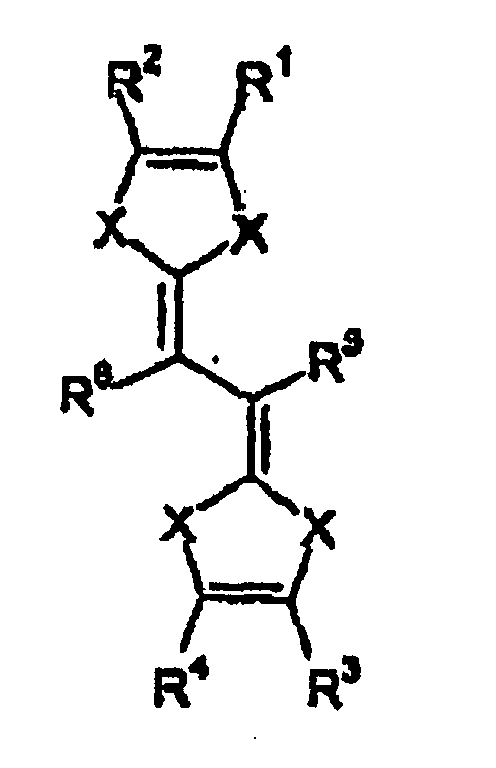
- An electrochemical device of the present invention comprises a positive electrode, a negative electrode and an electrolyte, wherein at least one of said positive electrode and said negative electrode includes a compound having a structure represented by the general formula (1a): where X is a sulfur atom or an oxygen atom; each of R 1 to R 4 is independently a methyl group, a linear or cyclic aliphatic group, a hydrogen atom, a hydroxyl group, a cyano group, an amino group, a nitro group or a nitroso group; each of R 5 and R 6 is independently a linear or cyclic aliphatic group or a hydrogen atom; said aliphatic group includes at least one selected from the group consisting of an oxygen atom, a nitrogen atom, a sulfur atom, a silicon atom, a phosphorus atom, a boron atom and a halogen atom.
- X is a sulfur atom or an oxygen atom
- each of R 1 to R 4 is independently
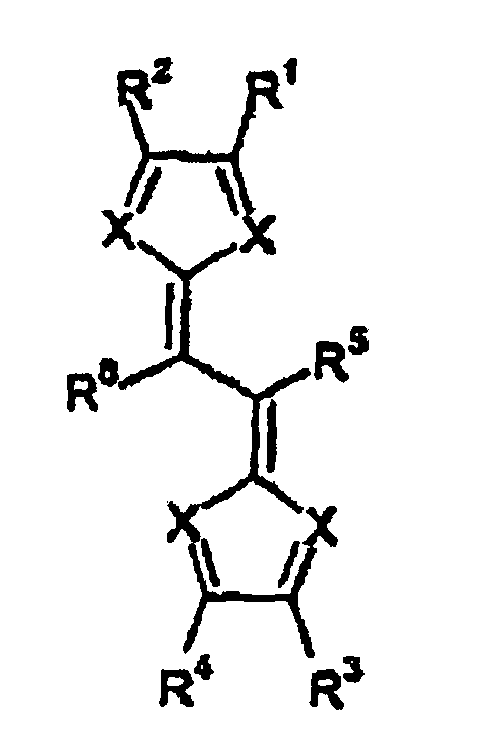
- a further electrochemical device of the present invention comprises a positive electrode, a negative electrode and an electrolyte, wherein at least one of said positive electrode and said negative electrode includes a compound having a structure represented by the general formula (1b): where X is a nitrogen atom; each of R 1 to R 4 is independently a methyl group, a linear or cyclic aliphatic group, a hydrogen atom, a hydroxyl group, a cyano group, an amino group, a nitro group or a nitroso group; each of R 5 and R 6 is independently a linear or cyclic aliphatic group or a hydrogen atom; said aliphatic group includes at least one selected from the group consisting of an oxygen atom, a nitrogen atom, a sulfur atom, a silicon atom, a phosphorus atom, a boron atom and a halogen atom.
- each X in the general formula (1a) or (1b) is the same, it is contemplated that each X may be independently selected from sulfur, nitrogen or oxygen.
- a further electrochemical device of the present invention comprises a positive electrode, a negative electrode and an electrolyte, wherein at least one of said positive electrode and said negative electrode includes a compound represented by the general formula (2): where each of R 1 to R 4 and R 7 to R 10 is independently a methyl group, a linear or cyclic aliphatic group, a hydrogen atom, a hydroxyl group, a cyano group, an amino group, a nitro group or a nitroso group; said aliphatic group includes at least one selected from the group consisting of an oxygen atom, a nitrogen atom, a sulfur atom, a silicon atom, a phosphorus atom, a boron atom and a halogen atom.
- the compound be a polymer compound having more than one structure represented by the general formula (1a), (1b) or (2).
- the electrolyte comprises a solvent, and an anion and a cation that diffuse in the solvent, and the compound be capable of forming a coordinate bond with the cation through an oxidation-reduction reaction.
- the cation be a lithium ion.
- the electrolyte comprises a solvent, and an anion and a cation that diffuse in the solvent, and the compound be capable of forming a coordinate bond with the anion through an oxidation-reduction reaction.
- the positive electrode includes the compound as a positive electrode active material
- the negative electrode include a carbon material as a negative electrode active material
- the positive electrode includes the compound as a positive electrode active material
- the negative electrode include, as a negative electrode active material, at least one selected from the group consisting of a lithium metal, a lithium-containing composite nitride, a lithium-containing composite titanium oxide, a silicon-based alloy, and a silicon oxide.
- An electrochemical device of the present invention provides an electric energy by converting an electron transfer through an oxidation-reduction reaction into the electric energy, and comprises a positive electrode, a negative electrode and an electrolyte. At least one of the positive electrode and the negative electrode includes a compound having a structure represented by the general formula (1a), (1b) or (2).
- General formula (1a) is: where X is a sulfur atom or an oxygen atom; each of R 1 to R 4 is independently a methyl group, a linear or cyclic aliphatic group, a hydrogen atom, a hydroxyl group, a cyano group, an amino group, a nitro group or a nitroso group; each of R 5 and R 6 is independently a linear or cyclic aliphatic group or a hydrogen atom; the aliphatic group includes at least one selected from the group consisting of an oxygen atom, a nitrogen atom, a sulfur atom, a silicon atom, a phosphorus atom, a boron atom and a halogen atom.
- General formula (1b) is: where X is a nitrogen atom; each of R 1 to R 4 is independently a methyl group, a linear or cyclic aliphatic group, a hydrogen atom, a hydroxyl group, a cyano group, an amino group, a nitro group or a nitroso group; each of R 5 and R 6 is independently a linear or cyclic aliphatic group or a hydrogen atom; said aliphatic group includes at least ona selected from the group consisting of an oxygen atom, a nitrogen atom, a sulfur atom, silicon atom, a phosphorus atom, a boron atom and a halogen atom.
- each of R 1 to R 4 and R 7 to R 10 is independently a methyl group, a linear or cyclic aliphatic group, a hydrogen atom, a hydroxyl group, a cyano group, an amino group, a nitro group or a nitroso group; said aliphatic group includes at least one selected from the group consisting of an oxygen atom, a nitrogen atom, a sulfur atom, a silicon atom, a phosphorus atom, a baron atom and a halogen atom.
- the compound may be referred to as "active material compound".
- the active material compound as an electrode active material brings about an oxidation-reduction reaction within the battery to give and receive electrons.
- the active material compound can cause an oxidation-reduction reaction without any significant structural change therein.
- the mechanism is described below.
- the active material compound has a structural symmetry and a planar structure. Further, the active material compound has a carbon-carbon double bond at the center of the molecule thereof, and cyclic structures, including hetero atoms such as sulfur and oxygen. The hetero atoms have lone electron pairs. This causes formation of conjugation by ⁇ electrons on the molecule. In the ⁇ -electron conjugation portion, having spread over the molecule, electrons can be given and received. This giving and receiving of the electrons proceed as the oxidation-reduction reaction of the active material compound.
- a reductive reaction for example, the active material compound is reduced and cations in an electrolyte are coordinated in the reduced molecule.
- a subsequent oxidative reaction for example, the cations having been coordinated in the active material compound are eliminated. This reaction is usable as a battery reaction.
- the compound whose oxidation-reduction reaction occurs in the ⁇ -electron conjugation portion having spread over the molecule, is used as the electrode active material.
- the above reaction mechanism there occurs no significant change of the skeletal structure of the active material through the oxidation-redaction reaction. Accordingly, deterioration in structure of the active material, attributed to repetition of the oxidation-reduction reactions, is suppressed so that an excellent charge/discharge cycle characteristic can be obtained.
- the reaction is expected to proceed more rapidly than dissociation and recombination reaction cause by a conventional organosulfur compounds.
- the reaction rate becomes faster, a rate characteristic excellent as a battery characteristic can be expected, and it is thus advantageous for rapid charge/discharge.
- a compound represented by the chemical formula (3): and a compound represented by the chemical formula (4): are preferred. Since those compounds have the smallest molecular weight among the compounds represented by the general formulae (1a) and (1b), the active materials thereof have the highest energy density, and hence an electrochemical device having high energy density can be obtained.
- the active material compound be a compound represented by the general formula (2) : where each of R 1 to R 4 and R 7 to R 10 is independently a linear or cyclic aliphatic group, a hydrogen atom, a hydroxyl group, a cyano group, an amino group, a nitro group or a nitroso group; the aliphatic group includes at least one selected from the group consisting of an oxygen atom, a nitrogen atom, a sulfur atom, a silicon atom, a phosphorus atom, a boron atom and a halogen atom.
- Each of R 1 to R 4 and R 7 to R 10 in the general formulae (1a), (1b) and (2) is preferably; a nitro group (NO 2 ) so that a high voltage electrochemical device having an excellent charge/discharge cycle characteristic can be obtained; a cyano group (CN) so that a high voltage and high capacity electrochemical device can be obtained; or a methyl group (CH 3 ) so that a high voltage and high capacity electrochemical device excellent in rate characteristic as well as cycle characteristic can be obtained.
- an aliphatic group used in each of R 1 to R 4 and R 7 to R 10 in the general formulae (1a), (1b) and (2) for example, an alkyl group, a cycloalkyl group, an alkoxy group, a hydroxyalkyl group, a thioalkyl group, an aldehyde group, a carboxylic acid group, an alkyl halide group can be cited.
- the carbon number of the aliphatic group is not particularly limited but is preferably from 1 to 6.
- any compound including monomer compounds and polymer compound can be used so long as it has a structure represented by the general formula (1a), (1b) or (2). Those compounds can be used singly or in combination of two or more of them.
- the polymer compound is defined as a compound, with a molecular weight not less than 10,000, prepared by polymerization of monomer compounds.
- the polymer compound has a lower solubility in an electrolyte or the like than the monomer compound. In the case of using the polymer compound as the electrode active material, therefore, the dissolving of the active material in the electrolyte is inhibited to further enhance the stability of the cycle characteristic.
- the polymer compound preferably used is a compound obtained by polymerizing the compounds represented by the general formula (1a).
- a compound may be exemplified by one represented by the general formula (9): where n is an integer not less than 1. Since this compound is constituted of monomers small in molecular weight, the active material having high energy density can be obtained.
- the polymer compound a compound having a polyacetylene chain, or a polymethylmethacrylate chain, as a main chain is preferred. It is further preferable that two or more of structures represented by the general formula (1a), (1b) or (2) be included in one molecule. It is preferable that the polyacetylene chain has a molecular weight of 10,000 to 200,000. Such a compound may be exemplified by one represented by the general formula (10): where n is an integer not less than 1.
- the active material compound is preferably used as an electrode active material of a secondary battery, among electrochemical devices, it can also be used, for example, for electrodes of primary batteries, electrolytic capacitors, various sensors, electrochromic devices and the like. While these devices have been provided merely as examples, there are a large number of other devices for which the compound can be used.
- the active material compound can be used in both/either a positive electrode and/or a negative electrode.
- this compound is used for one of the electrodes, a conventionally used material can be used for the other of the electrodes as an active material of a secondary battery without any particular limitation.
- the following can be used as the negative electrode active material: a carbon material such as graphite or amorphous carbon, a lithium metal, a lithium-containing composite nitride, a lithium-containing composite titanium oxide, a composite material of tin and carbon, a composite material of tin and other metals, an alloy of silicon and other metals, a silicon oxide, or the like.
- the positive electrode active material a metal oxide such as LiCoO 2 , LiNiO 2 or LiMn 2 O 4
- a carbon material such as carbon black, graphite or acetylene black, ⁇ -conjugated polymer such as polyaniline, polypyrrole or polythiophene, or some other materials may be mixed into the electrode active material as a conductive material to decrease the electrode resistance.
- a solid electrolyte comprising polyethylene oxide or the like, or a gel electrolyte comprising polymethyl methacrylate or the like, may be mixed into the electrode active material.
- a binder may be used for the purpose of improving a bonding property of constituents of materials in the electrode.
- the binder used can be polyvinylidene fluoride, a copolymer of vinylidene fluoride and hexafluoropropylene, a copolymer of vinylidene fluoride and tetrafluoroethylene, polytetrafluoroethylene, a copolymer of styrene and butadiene, polypropylene, polyethylene, polyimide, polyacrylate or the like.
- a positive electrode current collector or a negative electrode current collector used can be metal foil, metal mesh, resin containing a conductive filler or the like, which is made of nickel, aluminum, gold, silver, copper, stainless steel, aluminum alloy or the like.
- a conductive filler or the like which is made of nickel, aluminum, gold, silver, copper, stainless steel, aluminum alloy or the like.
- the electrolyte When a separator is interposed between the positive electrode and the negative electrode, the electrolyte is impregnated into a separator. It is preferable that the electrolyte comprises a solvent and a salt having dissolved in the solvent. Further, the electrolyte itself may be gelated so as to function as a separator. In this case, it is preferable that the electrolyte be impregnated into a matrix of a polymer including polyacrylonitrile, an acrylate unit or a methacrylate unit, a copolymer of ethylene and acrylonitrile, or the like. A cross-linked polymer is preferably used for the matrix.
- the preferable examples of the salt to be dissolved in the electrolyte may include halides of alkaline metals such as lithium, sodium and potassium, halides of an alkali earth metal such as magnesium, perchlorate, and salts of fluorine-containing compounds typified by trifluoromethanesulfonate.
- Specific examples thereof may include lithium fluoride, lithium chloride, lithium perchlorate, lithium trifluoromethanesulfonate, lithium tetrafluoroborate, lithium bis(trifluoromethylsulfonyl)imide, lithium thiocyanate, magnesium perchlorate, magnesium trifluoromethanesulfate and sodium tetrafluoroborate. Those can be used singly or in combination of two or more of them.
- the preferable examples of the solvent of the electrolyte may include organic solvents such as ethylene carbonate, propylene carbonate, dimethyl carbonate, diethyl carbonate, methyl ethyl carbonate, ⁇ -butyrolactone, tetrahydrofuran, dioxolane, sulfolane and dimethylformamide.
- organic solvents such as ethylene carbonate, propylene carbonate, dimethyl carbonate, diethyl carbonate, methyl ethyl carbonate, ⁇ -butyrolactone, tetrahydrofuran, dioxolane, sulfolane and dimethylformamide.
- a solid electrolyte may be used except for the above electrolyte.
- the solid electrolyte cited can be Li 2 S-SiS 2 , Li 2 S-P 2 O 5 , Li 2 S-B 2 S 5 , Li 2 S-P 2 S 5 -GeS 2 , sodium/alumina (Al 2 O 3 ), polyether with an amorphous or low-phase transition temperature (Tg), a copolymer of amorphous vinylidene fluoride-hexafluoropropylene, blends of different polymer or polyethylene oxide.
- Tg amorphous or low-phase transition temperature
- a coin-type cell was fabricated to evaluate an electrode active material.
- a method for preparing a test electrode, a method for fabricating a coin-type cell and an evaluation of battery characteristics are sequentially described.
- an electrode active material used was a compound represented by the chemical formula (3): (X is a sulfur atom and each of R 1 to R 4 is a hydrogen atom in the general formula (1a).
- This compound represented by the chemical formula (3) was prepared by oxidative coupling of 1,4-dithiarulvenes, following the non-patent document (the non-patent document: R. Carlier, P. Hapiot et al., Electrochem Acta, 46, 3269-3277, 2001 ).
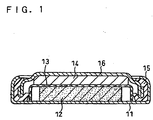
- a coin-type cell comprising was fabricated in the following procedure. A vertical sectional view of the obtained coin-type cell is shown in FIG. 1 .
- test electrode (positive electrode) 12 was disposed on the inner surface of a positive electrode case 11, and a separator 13 comprising a porous polyethylene sheet was disposed on the test electrode 12. Subsequently, an electrolyte was pouring into the positive electrode case 11.
- the electrolyte was prepared by dissolving 1 mol/L of lithium hexafluorophosphate (LiPF 6 ) in a mixed solvent of ethylene carbonate and diethyl carbonate in a weight ratio of 1:1.
- the fabricated coin-type cell was charged/discharged at a constant current of 0.133 mA and at a voltage in the range of 2.5 to 4.5 V at an ambient temperature of 20°C to determine discharge capacities at 1st, 50th, 100th and 300th cycles. Further, an average discharge voltage in respect to an oxidation-reduction potential of lithium (Li/Li + ) was determined. As the average discharge voltage used was the average of voltage values in the discharge at the 1st cycle. It is to be noted that there was almost no variation of the discharge voltage until the 300th cycle. The average of all voltage values in the case where a discharge curve has a staircase pattern through a two-steps discharging reaction was also determined. The results are shown in Table 1.
- a charge/discharge rate characteristic was evaluated.
- the fabricated coin-type cell was charged/discharged at a constant current of 0.133, 0.665, 1.33 or 2.66 mA and at a voltage in the range of 2.5 to 4.5 V at an ambient temperature of 20°C, and a discharge capacity at the 50th cycle at each of the above current values was determined. The results are shown in Table 2.
- the charging/discharging reaction mechanism of the organosulfur compound having the disulfide site used in COMPARATIVE EXAMPLE 1 is based on the dissociation and recombination reaction of the S-S bond. Since this reaction occurs with low frequency and the charging/discharging reaction causes a large change of the molecular structure, it is unlikely that the S-S bond is recombined. This can be considered a cause of the evaluation result that almost no discharge capacity was obtained at the 300th cycle even though a high discharge capacity was obtained in the initial cycles. It is accordingly found that, in the case of using a compound having a reaction mechanism based on the dissociation and recombination reaction of the S-S bond, an excellent cycle characteristic cannot be obtained.
- the electrochemical device including, as the electrode active material, the compound having the structure represented by the general formula (1a) or (2) has an excellent cycle characteristic.
- the electrochemical device including, as the electrode active material, the compound having the structure represented by the general formula (1a) or (2) has an excellent rate characteristic.
- a polymer compound having more than one structure represented by the chemical formula (3) was used as an electrode active material.
- a polymer compound having more than one structure represented by the chemical formula (3) was used as an electrode active material.
- a coin-type cell was fabricated in the same manner as in EXAMPLE 1. Subsequently, the fabricated coin-type cell was charged and discharged at a constant current of 0.133 mA and at a voltage in the range of 2.5 to 4.5 V at an ambient temperature of 20°C to determine discharge capacities at 1st, 50th, 100th and 300th cycles. The results are shown in Table 3.
- a lithium-containing composite nitride was prepared in such a manner that an alloy of lithium and cobalt in a molar ratio of 2.6:0.4 was put into a copper-made container and held there under a nitrogen atmosphere at 800°C for two hours so that the alloy was reacted with nitrogen. After the reaction, the resultant black ash colored nitride was pulverized into a powder to be used as a negative electrode active material.
- the obtained negative electrode active material powder was subjected to powder X-ray diffraction with CuK ⁇ radiation to observe the same hexagonal-based diffraction pattern as that of the lithium nitride (LiN 3 ). This confirmed formation of a single-phase solid solution in such a state as Co had been incorporated into the crystal structure of lithium nitride.
- the composition of the lithium-containing composite nitride thus synthesized was Li 2.6 Co 0.4 N.
- the Li 2.6 Co 0.4 N powder as thus obtained, a carbon powder and a polytetrafluoroethylene powder as a binder were mixed well in a weight ratio of 100:25:5 to give a negative electrode material mixture.
- This negative electrode material mixture was applied onto a copper sheet, followed by rolling, and the resultant electrode plate was punched out into a disk with a diameter of 13.5 mm to serve as a negative electrode.
- a powder of LiTi 5 O 12 was used as the lithium-containing composite titanium oxide.
- the LiTi 5 O 12 powder, a carbon powder and a polytetrafluoroethylene powder as a binder were mixed well in a weight ratio of 100:25:5 to give a negative electrode material mixture.
- This negative electrode material mixture was applied onto a copper sheet, followed by rolling, and the resultant electrode plate was punched out into a disk with a diameter of 13.5 mm to serve as a negative electrode.
- the coin-type cell was charged/discharged at a constant current of 0.133 mA and at a voltage in the range of 2.5 to 4.5 V at an ambient temperature of 20°C to determine discharge capacities at 1st, 50th, 100th and 300th cycles. The results are shown in Table 4.
- the electrochemical device where the compound having the structure represented by the general formula (1a) is used as one of the electrode active materials while the lithium-containing composite nitride or the lithium-containing composite titanium oxide is used as the other of the electrode active materials, also exhibits an excellent cycle characteristic.
- the compound having the structure represented by the general formula (2) was used as the active materials of both the positive electrode and the negative electrode.
- the compound represented by the chemical formula (7): was used as the positive electrode active material
- the compound represented by the chemical formula (4): was used as the negative electrode active material.
Landscapes
- Engineering & Computer Science (AREA)
- Chemical & Material Sciences (AREA)
- Power Engineering (AREA)
- Chemical Kinetics & Catalysis (AREA)
- Materials Engineering (AREA)
- Microelectronics & Electronic Packaging (AREA)
- Electrochemistry (AREA)
- General Chemical & Material Sciences (AREA)
- Battery Electrode And Active Subsutance (AREA)
- Secondary Cells (AREA)
Claims (18)
- Matériau actif d'électrode destiné à un dispositif électrochimique, comprenant un composé possédant une structure représentée par la formule générale (1a) :
- Matériau actif d'électrode destiné à un dispositif électrochimique, comprenant un composé possédant une structure représentée par la formule générale (1b) :
- Matériau actif d'électrode destiné à un dispositif électrochimique, comprenant un composé possédant une structure représentée par la formule générale (2) :

- Matériau actif d'électrode en conformité avec l'une quelconque des revendications 1 à 3, dans lequel ledit composé est un composé polymère possédant plus d'une structure représentée par la formule générale (1a), (1b) ou (2) .
- Matériau actif d'électrode en conformité avec la revendication 4 dans lequel ledit composé est représenté par la formule générale (9) :

- Matériau actif d'électrode en conformité avec la revendication 4 dans lequel le composé polymère comporte une chaîne de polyacétylène ou une chaîne de polyméthacrylate en tant que chaîne principale.
- Matériau actif d'électrode en conformité avec la revendication 6 dans lequel ledit composé est représenté par la formule générale (10) :

- Matériau actif d'électrode en conformité avec l'une quelconque des revendications 1 à 4, dans lequel le nombre d'atomes de carbone se trouvant dans le groupement aliphatique se situe dans la plage de 1 à 6.
- Matériau actif d'électrode en conformité avec la revendication 3 dans lequel chacun de R1 à R4, R8 et R10 est un atome d'hydrogène ; et chacun de R7 et R9 est un groupement méthyle.
- Dispositif électrochimique, comprenant une électrode positive, une électrode négative et un électrolyte, dans lequel au moins l'une de la dite électrode positive et de ladite électrode négative inclut un matériau actif d'électrode comprenant un composé possédant une structure représentée par la formule générale (1a), (1b) ou (2) en conformité avec l'une quelconque des revendications 1 à 9.
- Dispositif électrochimique en conformité avec la revendication 10, dans lequel ledit électrolyte comprend un solvant, ainsi qu'un anion et un cation qui se diffusent dans ledit solvant, et ledit composé est capable de former une liaison de coordination avec ledit cation par l'intermédiaire d'une réaction d'oxydation-réduction.
- Dispositif électrochimique en conformité avec la revendication 11, dans lequel ledit cation est un ion lithium.
- Dispositif électrochimique en conformité avec l'une quelconque des revendications 10 à 12, dans lequel ladite électrode positive inclut ledit composé en tant que matériau actif d'électrode positive, et ladite électrode négative inclut un matériau de carbone en tant que matériau actif d'électrode négative.
- Dispositif électrochimique en conformité avec l'une quelconque des revendications 10 à 12, dans lequel ladite électrode positive inclut ledit composé en tant que matériau actif d'électrode positive, et ladite électrode négative inclut, en tant que matériau actif d'électrode négative, au moins l'un choisi parmi le groupe consistant en un métal lithium, un nitrure composite contenant du lithium et un oxyde de titane composite contenant du lithium.
- Dispositif électrochimique en conformité avec l'une quelconque des revendications 10 à 12, dans lequel ladite électrode négative inclut ledit composé en tant que matériau actif d'électrode négative, et ladite électrode positive inclut un matériau d'oxyde métallique en tant que matériau actif d'électrode positive.
- Dispositif électrochimique en conformité avec l'une quelconque des revendications 10 à 14, dans lequel quand ledit composé est utilisé en tant que matériau actif d'électrode, un matériau conducteur est mélangé dans le matériau actif d'électrode.
- Dispositif électrochimique en conformité avec l'une quelconque des revendications 10 à 12, dans lequel quand ladite électrode positive inclut ledit composé en tant que matériau actif d'électrode positive, l'un parmi ce qui suit est utilisé en tant que matériau d'électrode négative de ladite électrode négative : un matériau de carbone, un métal lithium, un nitrure composite contenant du lithium, un oxyde de titane composite contenant du lithium, un matériau composite d'étain et de carbone, et un matériau composite d'étain et d'un autre métal.
- Dispositif électrochimique en conformité avec l'une quelconque des revendications 10 à 17, dans lequel ledit dispositif électrochimique comprend l'un d'une batterie secondaire, d'une batterie primaire, d'un condensateur électrolytique, d'un capteur et d'un dispositif électrochimique.
Applications Claiming Priority (2)
| Application Number | Priority Date | Filing Date | Title |
|---|---|---|---|
| JP2003116843 | 2003-04-22 | ||
| JP2003116843 | 2003-04-22 |
Publications (2)
| Publication Number | Publication Date |
|---|---|
| EP1478040A1 EP1478040A1 (fr) | 2004-11-17 |
| EP1478040B1 true EP1478040B1 (fr) | 2008-04-23 |
Family
ID=33028291
Family Applications (1)
| Application Number | Title | Priority Date | Filing Date |
|---|---|---|---|
| EP04252356A Expired - Lifetime EP1478040B1 (fr) | 2003-04-22 | 2004-04-21 | Dispositif électrochimique et matière active d'électrode |
Country Status (4)
| Country | Link |
|---|---|
| US (1) | US8034484B2 (fr) |
| EP (1) | EP1478040B1 (fr) |
| CN (1) | CN1264237C (fr) |
| DE (1) | DE602004013216T2 (fr) |
Families Citing this family (27)
| Publication number | Priority date | Publication date | Assignee | Title |
|---|---|---|---|---|
| US20090017379A1 (en) * | 2005-05-31 | 2009-01-15 | Matsushita Electric Industrial Co., Ltd. | Secondary battery, power supply system using same and usage of power supply system |
| JP4162096B2 (ja) * | 2006-05-12 | 2008-10-08 | 松下電器産業株式会社 | 蓄電デバイス |
| JP4633864B2 (ja) * | 2008-06-25 | 2011-02-16 | パナソニック株式会社 | 蓄電材料および蓄電デバイス |
| WO2010013492A1 (fr) | 2008-07-31 | 2010-02-04 | パナソニック株式会社 | Polymère, film semi-conducteur, électrode, matière active d'électrode, élément électrochimique et dispositif de stockage d'électricité |
| CN101809789B (zh) * | 2008-07-31 | 2013-09-18 | 松下电器产业株式会社 | 蓄电材料和蓄电装置 |
| CN102484253B (zh) | 2010-02-15 | 2014-10-15 | 松下电器产业株式会社 | 蓄电装置用电极活性物质和蓄电装置以及电子设备和输送设备 |
| JP5983631B2 (ja) | 2012-01-23 | 2016-09-06 | 日産化学工業株式会社 | カルバゾールポリマー |
| EP2909875B1 (fr) | 2012-10-16 | 2020-06-17 | Ambri Inc. | Dispositifs et boîtiers pour le stockage d'énergie électrochimique |
| US11211641B2 (en) | 2012-10-18 | 2021-12-28 | Ambri Inc. | Electrochemical energy storage devices |
| US11387497B2 (en) | 2012-10-18 | 2022-07-12 | Ambri Inc. | Electrochemical energy storage devices |
| US11721841B2 (en) | 2012-10-18 | 2023-08-08 | Ambri Inc. | Electrochemical energy storage devices |
| US10541451B2 (en) | 2012-10-18 | 2020-01-21 | Ambri Inc. | Electrochemical energy storage devices |
| US10270139B1 (en) | 2013-03-14 | 2019-04-23 | Ambri Inc. | Systems and methods for recycling electrochemical energy storage devices |
| US9502737B2 (en) | 2013-05-23 | 2016-11-22 | Ambri Inc. | Voltage-enhanced energy storage devices |
| US12347832B2 (en) | 2013-09-18 | 2025-07-01 | Ambri, LLC | Electrochemical energy storage devices |
| DK3058605T3 (da) | 2013-10-16 | 2024-03-04 | Ambri Inc | Tætninger til anordninger af reaktivt højtemperaturmateriale |
| WO2015058165A1 (fr) | 2013-10-17 | 2015-04-23 | Ambri Inc. | Systèmes de gestion de batterie pour des dispositifs de stockage d'énergie |
| US12142735B1 (en) | 2013-11-01 | 2024-11-12 | Ambri, Inc. | Thermal management of liquid metal batteries |
| US10181800B1 (en) | 2015-03-02 | 2019-01-15 | Ambri Inc. | Power conversion systems for energy storage devices |
| WO2016141354A2 (fr) | 2015-03-05 | 2016-09-09 | Ambri Inc. | Céramiques et joints pour dispositifs de matériau réactif à haute température |
| JP6361599B2 (ja) * | 2015-07-07 | 2018-07-25 | 株式会社豊田中央研究所 | 蓄電デバイス |
| US11929466B2 (en) | 2016-09-07 | 2024-03-12 | Ambri Inc. | Electrochemical energy storage devices |
| CN110731027B (zh) | 2017-04-07 | 2024-06-18 | 安保瑞公司 | 具有固体金属阴极的熔盐电池 |
| US11431040B2 (en) * | 2018-08-31 | 2022-08-30 | Purdue Research Foundation | Arrangement for lithium-ion battery thermal events prediction, prevention, and control |
| WO2020131617A1 (fr) | 2018-12-17 | 2020-06-25 | Ambri Inc. | Systèmes et procédés de stockage d'énergie à haute température |
| WO2023164794A1 (fr) * | 2022-03-01 | 2023-09-07 | 宁德新能源科技有限公司 | Dispositif électrochimique et dispositif électronique le comprenant |
| US12024480B2 (en) * | 2022-11-29 | 2024-07-02 | City University Of Hong Kong | Polynitroso compound, its preparation and electrochemical use |
Family Cites Families (9)
| Publication number | Priority date | Publication date | Assignee | Title |
|---|---|---|---|---|
| US2715778A (en) | 1954-04-26 | 1955-08-23 | Kenneth A Murdock | Angle calculator |
| US4312992A (en) | 1976-12-03 | 1982-01-26 | International Business Machines Corporation | Substituted heterofulvalenes |
| US4833048A (en) | 1988-03-31 | 1989-05-23 | The United States Of America As Represented By The United States Department Of Energy | Metal-sulfur type cell having improved positive electrode |
| JP2715778B2 (ja) | 1991-01-29 | 1998-02-18 | 松下電器産業株式会社 | 可逆性電極材料 |
| US5523179A (en) | 1994-11-23 | 1996-06-04 | Polyplus Battery Company | Rechargeable positive electrode |
| US5833048A (en) | 1995-02-07 | 1998-11-10 | Eaton Corporation | Rocker switch especially for vehicles |
| US6110619A (en) * | 1997-12-19 | 2000-08-29 | Moltech Corporation | Electrochemical cells with cationic polymers and electroactive sulfur compounds |
| US6617053B2 (en) * | 2000-08-04 | 2003-09-09 | Chisso Corporation | Organic electroluminescent device containing dithiafulvene derivative |
| US7282298B2 (en) | 2002-08-29 | 2007-10-16 | Matsushita Electric Industrial Co., Ltd. | Electrochemical device |
-
2004
- 2004-04-20 US US10/827,424 patent/US8034484B2/en not_active Expired - Fee Related
- 2004-04-21 EP EP04252356A patent/EP1478040B1/fr not_active Expired - Lifetime
- 2004-04-21 DE DE602004013216T patent/DE602004013216T2/de not_active Expired - Lifetime
- 2004-04-22 CN CNB2004100353141A patent/CN1264237C/zh not_active Expired - Fee Related
Also Published As
| Publication number | Publication date |
|---|---|
| CN1540786A (zh) | 2004-10-27 |
| US8034484B2 (en) | 2011-10-11 |
| CN1264237C (zh) | 2006-07-12 |
| EP1478040A1 (fr) | 2004-11-17 |
| DE602004013216T2 (de) | 2009-06-18 |
| DE602004013216D1 (de) | 2008-06-05 |
| US20040214082A1 (en) | 2004-10-28 |
Similar Documents
| Publication | Publication Date | Title |
|---|---|---|
| EP1478040B1 (fr) | Dispositif électrochimique et matière active d'électrode | |
| EP1381100B1 (fr) | Dispositif de stockage d'electricite | |
| JP4467926B2 (ja) | 電気化学素子 | |
| US8242213B2 (en) | Method for manufacturing polyradical compound and battery | |
| EP1722430B1 (fr) | Batterie secondaire avec matière active d'électrode comprenant un composé radicalaire | |
| EP2025689B1 (fr) | Procédé de production d'un polyradical et élément de batterie | |
| EP1416553B1 (fr) | Dispositif électrochimique avec materiau d'électrode organique insaturé | |
| EP1881544A1 (fr) | Mareriau d electrode positive pour pile secondaire au lithium | |
| JP4468058B2 (ja) | 二次電池および二次電池用電極活物質 | |
| US6337155B1 (en) | Battery and method of manufacture thereof | |
| JP2013134947A (ja) | 電極活物質およびそれを含む二次電池 | |
| JP5818689B2 (ja) | リチウムイオン二次電池 | |
| JP2006324179A (ja) | 電極およびそれを用いた電気化学素子 | |
| JP2007305461A (ja) | 蓄電デバイスの充放電制御方法 | |
| KR100606170B1 (ko) | 이차전지 | |
| JP4314508B2 (ja) | ラジカル電池 | |
| JP4737365B2 (ja) | 電極活物質、電池および重合体 | |
| JP2008159275A (ja) | 電極活物質およびこれを用いた蓄電デバイス | |
| JP5536519B2 (ja) | 電極活物質及び二次電池 | |
| JP3444463B2 (ja) | 有機ジスルフィド化合物を含有する電極およびその製造方法 | |
| JP4752217B2 (ja) | 活物質、電池および重合体 | |
| JP2008078040A (ja) | 二次電池 | |
| JP2005228640A (ja) | 二次電池 | |
| KR100454503B1 (ko) | 폴리다이싸이오다이아닐린 유도체를 포함하는 양극조성물, 이로부터 얻어지는 리튬 이차 전지 및 이들의제조 방법 | |
| JP2010165491A (ja) | 電極活物質、およびそれを用いた二次電池 |
Legal Events
| Date | Code | Title | Description |
|---|---|---|---|
| PUAI | Public reference made under article 153(3) epc to a published international application that has entered the european phase |
Free format text: ORIGINAL CODE: 0009012 |
|
| AK | Designated contracting states |
Kind code of ref document: A1 Designated state(s): AT BE BG CH CY CZ DE DK EE ES FI FR GB GR HU IE IT LI LU MC NL PL PT RO SE SI SK TR |
|
| AX | Request for extension of the european patent |
Extension state: AL HR LT LV MK |
|
| 17P | Request for examination filed |
Effective date: 20041209 |
|
| 17Q | First examination report despatched |
Effective date: 20050620 |
|
| AKX | Designation fees paid |
Designated state(s): DE FR GB |
|
| GRAP | Despatch of communication of intention to grant a patent |
Free format text: ORIGINAL CODE: EPIDOSNIGR1 |
|
| GRAS | Grant fee paid |
Free format text: ORIGINAL CODE: EPIDOSNIGR3 |
|
| GRAA | (expected) grant |
Free format text: ORIGINAL CODE: 0009210 |
|
| AK | Designated contracting states |
Kind code of ref document: B1 Designated state(s): DE FR GB |
|
| REG | Reference to a national code |
Ref country code: GB Ref legal event code: FG4D |
|
| REF | Corresponds to: |
Ref document number: 602004013216 Country of ref document: DE Date of ref document: 20080605 Kind code of ref document: P |
|
| RAP2 | Party data changed (patent owner data changed or rights of a patent transferred) |
Owner name: PANASONIC CORPORATION |
|
| ET | Fr: translation filed | ||
| PLBE | No opposition filed within time limit |
Free format text: ORIGINAL CODE: 0009261 |
|
| STAA | Information on the status of an ep patent application or granted ep patent |
Free format text: STATUS: NO OPPOSITION FILED WITHIN TIME LIMIT |
|
| 26N | No opposition filed |
Effective date: 20090126 |
|
| PGFP | Annual fee paid to national office [announced via postgrant information from national office to epo] |
Ref country code: GB Payment date: 20130417 Year of fee payment: 10 |
|
| PGFP | Annual fee paid to national office [announced via postgrant information from national office to epo] |
Ref country code: FR Payment date: 20130625 Year of fee payment: 10 |
|
| GBPC | Gb: european patent ceased through non-payment of renewal fee |
Effective date: 20140421 |
|
| REG | Reference to a national code |
Ref country code: FR Ref legal event code: ST Effective date: 20141231 |
|
| PG25 | Lapsed in a contracting state [announced via postgrant information from national office to epo] |
Ref country code: GB Free format text: LAPSE BECAUSE OF NON-PAYMENT OF DUE FEES Effective date: 20140421 |
|
| PG25 | Lapsed in a contracting state [announced via postgrant information from national office to epo] |
Ref country code: FR Free format text: LAPSE BECAUSE OF NON-PAYMENT OF DUE FEES Effective date: 20140430 |
|
| PGFP | Annual fee paid to national office [announced via postgrant information from national office to epo] |
Ref country code: DE Payment date: 20220223 Year of fee payment: 19 |
|
| REG | Reference to a national code |
Ref country code: DE Ref legal event code: R119 Ref document number: 602004013216 Country of ref document: DE |
|
| PG25 | Lapsed in a contracting state [announced via postgrant information from national office to epo] |
Ref country code: DE Free format text: LAPSE BECAUSE OF NON-PAYMENT OF DUE FEES Effective date: 20231103 |