EP1480446A2 - Procédé de lecture d'image avec réglage automatique des conditions de lecture d'image et appareil de lecture d'image - Google Patents
Procédé de lecture d'image avec réglage automatique des conditions de lecture d'image et appareil de lecture d'image Download PDFInfo
- Publication number
- EP1480446A2 EP1480446A2 EP04020185A EP04020185A EP1480446A2 EP 1480446 A2 EP1480446 A2 EP 1480446A2 EP 04020185 A EP04020185 A EP 04020185A EP 04020185 A EP04020185 A EP 04020185A EP 1480446 A2 EP1480446 A2 EP 1480446A2
- Authority
- EP
- European Patent Office
- Prior art keywords
- image
- type
- light source
- color component
- component signals
- Prior art date
- Legal status (The legal status is an assumption and is not a legal conclusion. Google has not performed a legal analysis and makes no representation as to the accuracy of the status listed.)
- Withdrawn
Links
- 238000000034 method Methods 0.000 title claims description 62
- 239000003086 colorant Substances 0.000 claims abstract description 62
- 238000001514 detection method Methods 0.000 claims description 56
- 238000000926 separation method Methods 0.000 claims description 25
- 238000012545 processing Methods 0.000 description 21
- 238000006243 chemical reaction Methods 0.000 description 10
- 238000011156 evaluation Methods 0.000 description 9
- 239000011159 matrix material Substances 0.000 description 7
- 230000000873 masking effect Effects 0.000 description 3
- 239000000463 material Substances 0.000 description 3
- WFKWXMTUELFFGS-UHFFFAOYSA-N tungsten Chemical compound [W] WFKWXMTUELFFGS-UHFFFAOYSA-N 0.000 description 3
- 229910052721 tungsten Inorganic materials 0.000 description 3
- 239000010937 tungsten Substances 0.000 description 3
- 238000010521 absorption reaction Methods 0.000 description 2
- 238000004040 coloring Methods 0.000 description 2
- 238000010586 diagram Methods 0.000 description 2
- 230000003595 spectral effect Effects 0.000 description 2
- 230000006835 compression Effects 0.000 description 1
- 238000007906 compression Methods 0.000 description 1
- 239000012141 concentrate Substances 0.000 description 1
- 238000007796 conventional method Methods 0.000 description 1
- 238000013507 mapping Methods 0.000 description 1
- 238000012986 modification Methods 0.000 description 1
- 230000004048 modification Effects 0.000 description 1
- 230000007935 neutral effect Effects 0.000 description 1
- 230000003287 optical effect Effects 0.000 description 1
- 238000001454 recorded image Methods 0.000 description 1
Images





Classifications
-
- H—ELECTRICITY
- H04—ELECTRIC COMMUNICATION TECHNIQUE
- H04N—PICTORIAL COMMUNICATION, e.g. TELEVISION
- H04N1/00—Scanning, transmission or reproduction of documents or the like, e.g. facsimile transmission; Details thereof
- H04N1/46—Colour picture communication systems
- H04N1/56—Processing of colour picture signals
- H04N1/60—Colour correction or control
- H04N1/6083—Colour correction or control controlled by factors external to the apparatus
- H04N1/6086—Colour correction or control controlled by factors external to the apparatus by scene illuminant, i.e. conditions at the time of picture capture, e.g. flash, optical filter used, evening, cloud, daylight, artificial lighting, white point measurement, colour temperature
-
- H—ELECTRICITY
- H04—ELECTRIC COMMUNICATION TECHNIQUE
- H04N—PICTORIAL COMMUNICATION, e.g. TELEVISION
- H04N1/00—Scanning, transmission or reproduction of documents or the like, e.g. facsimile transmission; Details thereof
- H04N1/46—Colour picture communication systems
- H04N1/56—Processing of colour picture signals
-
- H—ELECTRICITY
- H04—ELECTRIC COMMUNICATION TECHNIQUE
- H04N—PICTORIAL COMMUNICATION, e.g. TELEVISION
- H04N1/00—Scanning, transmission or reproduction of documents or the like, e.g. facsimile transmission; Details thereof
- H04N1/46—Colour picture communication systems
- H04N1/56—Processing of colour picture signals
- H04N1/60—Colour correction or control
- H04N1/6077—Colour balance, e.g. colour cast correction
Definitions
- the present invention relates to a method for adjusting signal levels of image signals and image read apparatus adopting the method and, more particularly, to a method, in which light reflected from or transmitted through an original image are separated into color components, for automatically adjusting conditions for reading the original image depending upon the type of the original image so that the original image is properly expressed by image signals within a predetermined signal level range and an image read apparatus, such as an image scanner, adopting the method.
- the most fundamental technique of the method is to convert the distribution of the obtained histogram into a balanced distribution as disclosed in the USP No. 4745465. Further, in the USP No. 4639769, means for expressing an image in good contrast by changing mapping of each pixel data based on a histogram is disclosed.
- color bias of the original image e.g., color cast in a color photograph, taken under fluorescent light, other than daylight
- a final image is expressed in a desired contrast
- the signal level range is determined without considering characteristics of an original image. Furthermore, whether an imbalance in tone and color of the separated color components is due to color cast of the color image to be corrected, caused by light source other than daylight, or due to the original colors, of an object of the image, which are not to be corrected is not distinguished for determining the signal level range.
- the present invention has been made in consideration of the above situation, and has as its object to provide a method capable of determining whether the imbalance in tone and color of a photographed image is to be corrected or not, and, by determining conditions for scanning the photographed image, compensating the imbalance in tone and color, when necessary and properly expressing the photographed image by image signals within a predetermined signal level range, and an image read apparatus adopting the method.
- an image read method comprising: a pre-scanning step of pre-scanning a photographed image and outputting an image signal; a color separation step of separating the image signal obtained in the pre-scanning step into primary color component signals; a type determination step of determining a type of a light source which illuminated an object, in the photographed image, when it was photographed on the basis of signal levels of the color component signals obtained in the color separation step; and a condition determination step of determining scanning conditions for main scanning operation on the basis of the type of the light source determined in the type determination step.
- An image read system comprising: image read means for scanning a photographed image and outputting an image signal; color separation means for separating the image signal obtained by the pre-scanning means into color component signals; type determination means for determining a type of a light source which illuminated an object, in the photographed image, when it was photographed on the basis of signal levels of the color component signals obtained by the color separation means; and condition determination means for determining scanning conditions for main scanning operation on the basis of the type of the light source determined by the type determination means.
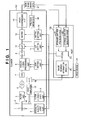
- Fig. 1 is a block diagram illustrating a configuration of an image scanning system comprising a scanner 101 having color separation function and a host device 102, such as a host computer according to a first embodiment of the present invention.
- reference numeral 1 denotes a light source for illuminating an original image.
- the intensity of the light can be changed by controlling the light source 1 by an intensity adjustment unit 2.
- reference numeral 3 denotes an original image, such as a negative film and a positive film; 4, a filter unit to which an Neutral Density filter for adjusting the intensity of light which incidents on a CCD (charge coupled device) 7 is provided; 5, a filter change-over unit; and 6, a lens group which focuses the light transmitted through the original image 3.
- CCD charge coupled device
- reference numeral 7 denotes the CCD (photoelectric conversion elements) for converting the light transmitted through the lens group 6 into electric signals; 8, an analog signal processing unit for electrically off-setting and amplifying the electric signals obtained from the CCD 7; 9, an analog-digital (A/D) converter for converting the analog signals from the analog signal processing unit 8 into digital signals; 10, a digital signal converter for converting the digital signals outputted from the A/D converter 9 into digital signals of another format using tables (look-up tables, the digital signal converter 10 is referred to as "LUT 10" hereinafter); and 11, a look-up table (LUT) setting unit for setting look-up tables in the LUT 10.
- CCD photoelectric conversion elements
- Reference numeral 12 denotes a color space conversion matrix circuit; 13, a matrix setting unit for setting the matrix to the color space conversion matrix circuit 12; 14, an image compressing unit for compressing the image; 15, a gain setting unit for electrically setting a gain used in the analog signal processing unit 8 in accordance with an instruction from the host computer 102; 16, a magnetic head for reading digital image sensing information recorded on a transparent magnetic layer which is applied on the original image 3; 17, a head amplifier for amplifying the output from the magnetic head 16; and 18, an analog digital (A/D) converter for converting the analog signals outputted from the head amplifier 17 into digital signals.
- A/D analog digital
- Reference numerals 21 and 22 are storage units for storing a pre-scan image 26 and a main scan image 27, respectively; 23, a CPU for controlling respective units; 24, an input device; and 25, an image sensing information decoder for decoding the digital signals transmitted from the scanner 101 to obtain the recorded image sensing information.
- the scanning processing is initiated in response to a scanning instruction designated by a user.
- the user inputs the type of the film (either negative or positive) to be scanned through the input device 24.
- the host device 102 instructs the scanner 101 to set predetermined conditions corresponding to the inputted film type for pre-scanning, and the scanner 101 sets the instructed predetermined conditions in step S205.
- the conditions to be set at this point are predetermined for respective film types, and the intensity adjustment unit 2, the filter change-over unit 5, and the gain in the analog signal processing unit 8 are controlled, further, tables, including one for negative-positive conversion, are set in the LUT 10 by the LUT setting unit 11 in accordance with the instructed conditions so that various images recorded on the film, namely, the entire density range of the film, are represented by image signals which are within a predetermined signal level range.
- step S206 the pre-scanning is performed in a lower resolution than the resolution to be used in the main scanning. Then, analog signals representing the original image 3 obtained under the set predetermined conditions are converted into digital signals by the A/D converter 9, further converted into digital signals of another format by the LUT 10. Then, the pre-scan image obtained as above is stored in the storage unit 21 for pre-scan image in step S202.
- the CPU 23 generates a histogram on the density of the input pre-scan image, and analyzes characteristics, such as an average signal level and distribution of signal levels, of the pre-scan image in step S203. Then, the host device 102 controls in step S207, the intensity adjustment unit 2, the filter change-over unit 5, the LUT setting unit 11, and the matrix setting unit 13 on the basis of the determination results so that the optimum intensity of light, the optimum filter, the optimum tables, and the optimum color space conversion matrix are set for the main scanning.
- the main scanning is performed, in step S208, under the conditions set as above for main scanning.
- processes where the light transmitted through the filter is converted into electric signals by the CCD 7, and further converted into digital signals are the same as those performed in the pre-scanning.
- the digital image signals are further converted using the LUT 10 which is newly set for the main scanning operation, then processed by the color space conversion matrix circuit 12 and compressed by the image compression unit 14. Finally, the compressed image signals are stored in the storage unit 22 for main scan image in step S204.
- the original image 3 is a positive film
- the latitude of the positive film is narrow, a scene is usually photographed using a carefully controlled exposure value so that the most important luminance range of the scene is expressed in as wide dynamic range of the film as possible. Therefore, the density range of an image recorded on the positive film is constant in most cases, and it is not necessary for controlling scanning conditions for each image.
- the film can record an image in a very wide luminous exposure range. Accordingly, even though the luminous exposure is too much or not enough for photographing a scene, it is possible for the negative film to record a primary luminance range of the scene using a part of the width of the dynamic range of the film.
- Fig. 3 is a graph showing sensitometric characteristic lines of a negative color film, obtained in the pre-scanning, corresponding to a luminance range S of a photographed scene are shown.
- the ordinate of the graph indicates optical density and the abscissa indicates the logarithm of luminous exposure applied to the film when photographing a scene. Note, if the density of the film is high (i.e., the luminous exposure was high), the signal level obtained in the pre-scanning is low, whereas if the density of the film is low (i.e., the luminous exposure was low), the signal level is high.
- Figs. 4A to 4C are histograms of image data values outputted from the A/D converter 9 obtained by scanning the original image 3 under the aforesaid conditions for pre-scanning.
- frequencies of the digital values between 0 and 1023 of B, G and R data are shown, respectively, when the resolution of the A/D converter 9 is 10 bits, for instance.
- Fig. 4A shows the histogram of the B data
- Fig. 4B shows the histogram of the G data
- Fig. 4C shows the histogram of the R data.
- These histograms are of the data values of a negative image, and the frequencies of the respective B, G and R data are concentrated within some data values, where the data values on which the frequencies of the respective B, G and R data concentrate are shifted from each other due to the orange masking.
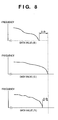
- Figs. 6 to 8 are enlarged view of the right end portion of the distribution of the histograms, as shown in Figs. 5A to 5C, obtained by scanning images having different characteristics in the pre-scanning operation.
- Fig. 6 shows right edges of histograms of an image, photographed under daylight, which includes a white portion
- Fig. 7 shows right edges of histograms of an image, photographed under daylight, which does not include a white portion
- Fig. 8 shows right edges of histograms of an image which is photographed under fluorescent light.
- the data values of the B, G and R data at the brightest points in the respective images are different from each other as shown by the histograms of the three images shown in Figs. 6 to 8.
- the greatest data value for each of the B, G and R data of the image including the white portion as shown in Fig. 6 is almost the same for R, G and B data because the white portion exist in the image, and there is little differences ⁇ d 1 and ⁇ d 2 between the respective greatest data values of the B, G and R data.
- the main scanning conditions such as intensity of the light source 1, a filter selected in the filter unit 4, and a gain used in the analog signal processing unit 8, are set so that each greatest data value for each of the B, G and R data is expressed by the possible maximum value, namely 255, in the main scanning operation. Note the conditions set in this case are common for the respective B, G and R data.
- the greatest data value is determined for each of the primary colors (in this case, blue, green and red) or colors near the primary colors. Therefore, differences between the greatest data values for the respective B, G and R data are usually considerably large. For preserving the colors of the image under this condition, it is necessary to keep the differences ⁇ d 3 and ⁇ d 4 between the greatest data values of the R, G and B data. Accordingly, the conditions for the main scanning operation are determined on the basis of the largest data value among the G, B and R data so that the largest value is expressed by the possible maximum value, namely 255, in the main scanning operation. Further, in this case, it is necessary to set the conditions common for the respective B, G and R data.
- Fig. 8 shows a part of the histogram of the image which is photographed under the fluorescent light, and it is necessary to correct the G data which is enhanced due to the characteristics of the fluorescent light.
- the differences ⁇ d 5 and ⁇ d 6 between the greatest data values for the respective R, G and B data are between the differences ⁇ d 1 and ⁇ d 2 shown in Fig. 6 and the differences ⁇ d 3 and ⁇ d 4 shown in Fig. 7, and the G data has the greatest data value among the R, G and B data.
- the greatest data value for each G, B and R data is expressed by the possible maximum value, namely 255, in the main scanning operation.
- Fig. 9 is a flowchart briefly showing processing for determining conditions used in the main scanning operation according to the first embodiment of the present invention.
- pre-scanning operation is performed under the predetermined conditions, as described above, so that the entire density range of the film can be represented by image signals which are within a predetermined signal level range.
- the greatest data values for the respective R, G and B data are compared using histograms of the pre-scan images (positive image).
- step S303 whether or not the differences between the greatest data values for the respective R, G and B data are in range between a first threshold A and a second threshold B is checked. If yes, then the process proceeds to step S305, whereas if it is not, then the process proceeds to step S304.
- Step S304 is a process for a case where either a pure white or a primary color exists in the image, and common conditions for main scanning operation are set for all the R, G and B data so that the greatest data value of the R, G and B data is represented by the possible maximum data value (e.g., 255) as a result of the main scanning operation.
- Step S305 is a process for a case where the differences between the greatest data values for the respective R, G and B data of an image have to be compensated, and the conditions for the main scanning are set so that the greatest data value for each R, G and G data is represented by the possible maximum data value (e.g., 255) as a result of the main scanning operation.
- step S306 main scanning operation is performed in step S306.
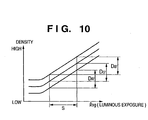
- Fig. 10 is a graph showing how the obtained density ranges corresponding to the luminance range S of a scene in the main scanning processing are determined.
- obtained density ranges D B ', D G ' and D R ' are set for respective B, G and R data for extracting signals representing a density range of the film corresponding to the luminance range S of the photographed scene.
- different methods are used for adjusting the density levels corresponding to the densities at the upper limit of the luminance range S and for adjusting the density levels corresponding to the densities at the lower limit of the luminance range S, as described below.
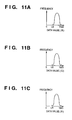
- Figs. 11A to 11C are histograms showing the digital image signals obtained under the conditions set in step S305 in Fig. 9, and the maximum data values for the respective R, G and B data are 1023.
- the data having values between LB, LG and LR and 1023 are performed with negative-to-positive conversion, further mapped to eight-bit data by the LUT 10, thereby all the data having values between LB, LG and LR and 1023 are converted to eight-bit data having data values between 0 and 255.
- the luminance range S of the scene is expressed by eight-bit data having data values between 0 and 255.
- Figs. 12A to 12C are histograms showing the resultant data of conversion.
- the signal levels at the right (upper) end of the luminance range S of the scene are adjusted so as to have the voltage equivalent to the digital signal level of 1023, and the signal levels of the left end of the luminance range S of the scenes are eventually mapped to 0 level of eight-bit data.
- the edge portion of the histograms of a pre-scan image by analyzing the edge portion of the histograms of a pre-scan image, it is possible to easily and automatically determine conditions to be used when scanning a film. Especially, it is possible to automatically determine whether it is unnecessary to compensate the bias of colors of an image because the bias is due to the original colors of an object, or it is necessary to compensate the bias of the colors of an image because the bias is due to, e.g., the light source used when recording the image, thereby automatically setting the conditions used for scanning the image.
- the light source used for photographing the image is an artificial light source, such as the tungsten light and the fluorescent light, is also determined by the CPU 23 in the second embodiment by analyzing the histograms of the pre-scan image, as described in the first embodiment.
- step S401 pre-scanning is performed and histograms of respective R, G and B data, as shown in Figs. 4A to 4C are obtained.
- step S402 the greatest data values for the respective R, G and B data in the histograms of the pre-scan image (positive image) are compared, and whether or not the respective differences between the greatest data values are between the first threshold A and the second threshold B is determined. If yes, then the process proceeds to step S403, whereas if no, then the process proceeds to step S404.
- step S403 an evaluation value EV1 is set to 0, whereas in step S404, the evaluation value EV1 is set to 1.
- step S405 on the basis of the output data of the image sensing information decoder 25, whether or not the light source used for photographing the image is daylight is determined.
- step S406 an evaluation value EV2 is set to 0, whereas, in step S407, the evaluation value EV2 is set to 1.
- step S408 the evaluation value EV1 set in either step S403 or S404 is added to the evaluation value EV2 set in either step S406 or S407 and an added value EV3 is obtained.
- step S409 the greatest data values for the respective R, G and B data in the histograms of the pre-scan image (positive image) are compared to each other. At this time, whether the relationship of the greatest data values for the respective R, G and B data is R > G > B (tungsten light) or whether the data value of the G data has the largest value (fluorescent light) is checked. If characteristics of the greatest data values for the respective R, G and B signals are either of the above, the process proceeds to step S410, whereas if not, then the process proceeds to step S411. In step S410, an evaluation value EV4 is set to 0, whereas in step S411, the evaluation value is set to 1.
- step S412 the value EV3 which is obtained in step S408 is added to the evaluation value EV4 obtained in either step S410 or S411. Then, in step S413, the sum EV5 is compared to 2. If the sum EV5 is greater or equal to 2, then the process proceeds to step S414, whereas if the sum is less than 2, then the process proceeds to step S415.
- Step S414 is a process for a case where either a pure white or a primary color exists in the image which is sensed under daylight, and common conditions for main scanning operation are set for all the R, G and B data so that the greatest data value of the R, G and B data is represented by the possible maximum data value (e.g., 255) as a result of the main scanning operation.
- the possible maximum data value e.g. 255
- Step S415 is a process for a case where the differences between the greatest data values for the respective R, G and B data of an image, which is sensed under light other then daylight, have to be compensated, and the conditions for the main scanning are set so that each of the greatest data values for the respective R, G and G data is represented by the possible maximum data value (e.g., 255) as a result of the main scanning operation. Thereafter, in step S416, under the conditions set in either step S414 or S415, the main scanning is performed.
- the possible maximum data value e.g. 255
- the present invention is not limited to the film scanner, and can be applied to a system capable of separating image signals, obtained from light reflected by an original color image, into color components, for instance.
- An original image is pre-scanned, then scanning conditions to be used in main scanning are determined on the basis of obtained data in the pre-scanning.
- First, an original image is pre-scanned, and the obtained image signal is separated into color component signals. Thereafter, maximum values of the color component signals are detected for the respective colors. Further, the detected maximum values are analyzed to determine a type of the original image. After scanning conditions to be used in the main scanning are set on the basis of the type of the original image, the main scanning is performed.
Landscapes
- Engineering & Computer Science (AREA)
- Multimedia (AREA)
- Signal Processing (AREA)
- Facsimile Image Signal Circuits (AREA)
- Color Image Communication Systems (AREA)
- Image Input (AREA)
- Facsimile Scanning Arrangements (AREA)
- Accessory Devices And Overall Control Thereof (AREA)
- Image Processing (AREA)
Applications Claiming Priority (3)
| Application Number | Priority Date | Filing Date | Title |
|---|---|---|---|
| JP01867297A JP3706708B2 (ja) | 1997-01-31 | 1997-01-31 | 画像形成システム及び画像形成方法 |
| JP1867297 | 1997-01-31 | ||
| EP98101492A EP0856987A3 (fr) | 1997-01-31 | 1998-01-28 | Procédé de lecture d'image avec réglage automatique des conditions de lecture d'image et appareil de lecture d'image |
Related Parent Applications (1)
| Application Number | Title | Priority Date | Filing Date |
|---|---|---|---|
| EP98101492A Division EP0856987A3 (fr) | 1997-01-31 | 1998-01-28 | Procédé de lecture d'image avec réglage automatique des conditions de lecture d'image et appareil de lecture d'image |
Publications (2)
| Publication Number | Publication Date |
|---|---|
| EP1480446A2 true EP1480446A2 (fr) | 2004-11-24 |
| EP1480446A3 EP1480446A3 (fr) | 2005-04-13 |
Family
ID=11978105
Family Applications (2)
| Application Number | Title | Priority Date | Filing Date |
|---|---|---|---|
| EP04020185A Withdrawn EP1480446A3 (fr) | 1997-01-31 | 1998-01-28 | Procédé de lecture d'image avec réglage automatique des conditions de lecture d'image et appareil de lecture d'image |
| EP98101492A Withdrawn EP0856987A3 (fr) | 1997-01-31 | 1998-01-28 | Procédé de lecture d'image avec réglage automatique des conditions de lecture d'image et appareil de lecture d'image |
Family Applications After (1)
| Application Number | Title | Priority Date | Filing Date |
|---|---|---|---|
| EP98101492A Withdrawn EP0856987A3 (fr) | 1997-01-31 | 1998-01-28 | Procédé de lecture d'image avec réglage automatique des conditions de lecture d'image et appareil de lecture d'image |
Country Status (4)
| Country | Link |
|---|---|
| US (1) | US6289119B1 (fr) |
| EP (2) | EP1480446A3 (fr) |
| JP (1) | JP3706708B2 (fr) |
| TW (1) | TW389017B (fr) |
Families Citing this family (8)
| Publication number | Priority date | Publication date | Assignee | Title |
|---|---|---|---|---|
| US6961066B2 (en) * | 1999-04-13 | 2005-11-01 | Athentech Technologies, Inc. | Automatic color adjustment for digital images |
| US6967752B1 (en) * | 1999-09-22 | 2005-11-22 | Fuji Photo Film Co., Ltd. | Image reading apparatus and method |
| DE10046357C2 (de) * | 2000-09-19 | 2003-08-21 | Agfa Gevaert Ag | Vorrichtung und Verfahren zum digitalen Erfassen einer Vorlage mit mehreren Einzelbildern |
| TW501363B (en) * | 2001-03-06 | 2002-09-01 | Veutron Corp | Method for enhancing scanning resolution |
| JP2003169177A (ja) * | 2001-09-18 | 2003-06-13 | Fuji Photo Film Co Ltd | 画像読取装置 |
| TWI246847B (en) * | 2004-03-16 | 2006-01-01 | Benq Corp | Method and apparatus for improving quality of a scanned image through a preview operation |
| JP4759393B2 (ja) * | 2006-01-20 | 2011-08-31 | 株式会社リコー | 文書電子化装置、文書電子化方法、文書電子化プログラム及び記録媒体 |
| JP2010114578A (ja) * | 2008-11-05 | 2010-05-20 | Ricoh Co Ltd | 画像処理装置 |
Citations (2)
| Publication number | Priority date | Publication date | Assignee | Title |
|---|---|---|---|---|
| US5014332A (en) * | 1987-03-31 | 1991-05-07 | Minolta Camera Kabushiki Kaisha | Image reader |
| US5412737A (en) * | 1992-02-20 | 1995-05-02 | Scitex Corporation Ltd. | Method for identifying film type |
Family Cites Families (8)
| Publication number | Priority date | Publication date | Assignee | Title |
|---|---|---|---|---|
| US4685071A (en) * | 1985-03-18 | 1987-08-04 | Eastman Kodak Company | Method for determining the color of a scene illuminant from a color image |
| US4926251A (en) * | 1987-04-07 | 1990-05-15 | Kabushiki Kaisha Toshiba | Color image processing apparatus with image corrector |
| JPH0250859A (ja) * | 1988-08-11 | 1990-02-20 | Dainippon Screen Mfg Co Ltd | 色分解条件設定方法および装置 |
| JPH03230174A (ja) * | 1990-02-05 | 1991-10-14 | Konica Corp | カラー画像形成装置 |
| JPH04249975A (ja) * | 1990-10-10 | 1992-09-04 | Fuji Xerox Co Ltd | 画像処理装置 |
| US5489997A (en) | 1990-11-27 | 1996-02-06 | Canon Kabushiki Kaisha | Color image processing apparatus |
| US5568270A (en) * | 1992-12-09 | 1996-10-22 | Fuji Photo Film Co., Ltd. | Image reading apparatus which varies reading time according to image density |
| US5495428A (en) * | 1993-08-31 | 1996-02-27 | Eastman Kodak Company | Method for determining color of an illuminant in an image based on histogram data |
-
1997
- 1997-01-31 JP JP01867297A patent/JP3706708B2/ja not_active Expired - Fee Related
-
1998
- 1998-01-22 TW TW087100875A patent/TW389017B/zh not_active IP Right Cessation
- 1998-01-27 US US09/076,167 patent/US6289119B1/en not_active Expired - Fee Related
- 1998-01-28 EP EP04020185A patent/EP1480446A3/fr not_active Withdrawn
- 1998-01-28 EP EP98101492A patent/EP0856987A3/fr not_active Withdrawn
Patent Citations (2)
| Publication number | Priority date | Publication date | Assignee | Title |
|---|---|---|---|---|
| US5014332A (en) * | 1987-03-31 | 1991-05-07 | Minolta Camera Kabushiki Kaisha | Image reader |
| US5412737A (en) * | 1992-02-20 | 1995-05-02 | Scitex Corporation Ltd. | Method for identifying film type |
Also Published As
| Publication number | Publication date |
|---|---|
| TW389017B (en) | 2000-05-01 |
| EP1480446A3 (fr) | 2005-04-13 |
| EP0856987A2 (fr) | 1998-08-05 |
| JP3706708B2 (ja) | 2005-10-19 |
| US6289119B1 (en) | 2001-09-11 |
| JPH10224645A (ja) | 1998-08-21 |
| EP0856987A3 (fr) | 1999-10-20 |
Similar Documents
| Publication | Publication Date | Title |
|---|---|---|
| EP0267793B1 (fr) | Appareil de lecture d'images en couleurs | |
| US7024035B1 (en) | Method of setting region to be subjected to red eye correction and red eye correcting method | |
| US7076119B2 (en) | Method, apparatus, and program for image processing | |
| CN100444200C (zh) | 红眼检测及修正方法 | |
| US5371615A (en) | Image-dependent color correction using black point and white point in a natural scene pictorial image | |
| JP3011432B2 (ja) | カラー画像処理装置 | |
| US5802214A (en) | Method for determining and loading an image-dependent look-up table for generating an enhanced image representation | |
| JPH05207280A (ja) | 画像形成装置の下地かぶり除去及び下地除去方式 | |
| JP4197276B2 (ja) | 画像処理装置、画像読取装置、画像形成装置、および画像処理方法 | |
| US6289119B1 (en) | Image reading method capable of automatically adjusting image read conditions and image read apparatus adopting the method | |
| US20040036899A1 (en) | Image forming method, image processing apparatus, print producing apparatus and memory medium | |
| JPH11191871A (ja) | 画像処理装置 | |
| US6658163B1 (en) | Image processing method | |
| JPH1075374A (ja) | 画像処理方法および装置 | |
| JP2003283849A (ja) | 赤目検出および修正方法 | |
| JP2001222710A (ja) | 画像処理装置および画像処理方法 | |
| WO2001078368A2 (fr) | Systeme et procede de correspondance de couleurs bidirectionnelle pour films et video | |
| JP2004248103A (ja) | 画像処理装置、画像読取装置、画像形成装置、画像処理方法、画像処理プログラム、およびこれを記録したコンピュータ読み取り可能な記録媒体 | |
| JPH11346303A (ja) | 画像処理方法 | |
| JPH0738757A (ja) | 領域別濃度補正型画像処理装置 | |
| JP2728208B2 (ja) | 画像処理方法 | |
| JP3352106B2 (ja) | 画像処理装置及び方法 | |
| JPH042269A (ja) | カラー画像処理装置 | |
| JP3500639B2 (ja) | 画像形成装置 | |
| JP3351606B2 (ja) | カラー画像形成装置における下地制御装置 |
Legal Events
| Date | Code | Title | Description |
|---|---|---|---|
| PUAI | Public reference made under article 153(3) epc to a published international application that has entered the european phase |
Free format text: ORIGINAL CODE: 0009012 |
|
| AC | Divisional application: reference to earlier application |
Ref document number: 0856987 Country of ref document: EP Kind code of ref document: P |
|
| AK | Designated contracting states |
Kind code of ref document: A2 Designated state(s): DE FR GB |
|
| PUAL | Search report despatched |
Free format text: ORIGINAL CODE: 0009013 |
|
| AK | Designated contracting states |
Kind code of ref document: A3 Designated state(s): DE FR GB |
|
| 17P | Request for examination filed |
Effective date: 20050824 |
|
| AKX | Designation fees paid |
Designated state(s): DE FR GB |
|
| 17Q | First examination report despatched |
Effective date: 20070522 |
|
| STAA | Information on the status of an ep patent application or granted ep patent |
Free format text: STATUS: THE APPLICATION HAS BEEN WITHDRAWN |
|
| 18W | Application withdrawn |
Effective date: 20130404 |