EP1481988A2 - Procédé pour l'obtention et l'utilisation de peptides ayant une activité antibiotique pour le traitement de maladies infectieuses - Google Patents
Procédé pour l'obtention et l'utilisation de peptides ayant une activité antibiotique pour le traitement de maladies infectieuses Download PDFInfo
- Publication number
- EP1481988A2 EP1481988A2 EP04019254A EP04019254A EP1481988A2 EP 1481988 A2 EP1481988 A2 EP 1481988A2 EP 04019254 A EP04019254 A EP 04019254A EP 04019254 A EP04019254 A EP 04019254A EP 1481988 A2 EP1481988 A2 EP 1481988A2
- Authority
- EP
- European Patent Office
- Prior art keywords
- peptides
- diseases
- peptides according
- treatment
- buffer
- Prior art date
- Legal status (The legal status is an assumption and is not a legal conclusion. Google has not performed a legal analysis and makes no representation as to the accuracy of the status listed.)
- Withdrawn
Links
Images


Classifications
-
- A—HUMAN NECESSITIES
- A23—FOODS OR FOODSTUFFS; TREATMENT THEREOF, NOT COVERED BY OTHER CLASSES
- A23B—PRESERVATION OF FOODS, FOODSTUFFS OR NON-ALCOHOLIC BEVERAGES; CHEMICAL RIPENING OF FRUIT OR VEGETABLES
- A23B2/00—Preservation of foods or foodstuffs, in general
- A23B2/70—Preservation of foods or foodstuffs, in general by treatment with chemicals
- A23B2/725—Preservation of foods or foodstuffs, in general by treatment with chemicals in the form of liquids or solids
- A23B2/729—Organic compounds; Microorganisms; Enzymes
- A23B2/762—Organic compounds containing nitrogen
-
- A—HUMAN NECESSITIES
- A23—FOODS OR FOODSTUFFS; TREATMENT THEREOF, NOT COVERED BY OTHER CLASSES
- A23L—FOODS, FOODSTUFFS OR NON-ALCOHOLIC BEVERAGES, NOT OTHERWISE PROVIDED FOR; PREPARATION OR TREATMENT THEREOF
- A23L33/00—Modifying nutritive qualities of foods; Dietetic products; Preparation or treatment thereof
- A23L33/10—Modifying nutritive qualities of foods; Dietetic products; Preparation or treatment thereof using additives
- A23L33/17—Amino acids, peptides or proteins
- A23L33/18—Peptides; Protein hydrolysates
-
- C—CHEMISTRY; METALLURGY
- C07—ORGANIC CHEMISTRY
- C07K—PEPTIDES
- C07K14/00—Peptides having more than 20 amino acids; Gastrins; Somatostatins; Melanotropins; Derivatives thereof
- C07K14/435—Peptides having more than 20 amino acids; Gastrins; Somatostatins; Melanotropins; Derivatives thereof from animals; from humans
- C07K14/46—Peptides having more than 20 amino acids; Gastrins; Somatostatins; Melanotropins; Derivatives thereof from animals; from humans from vertebrates
- C07K14/47—Peptides having more than 20 amino acids; Gastrins; Somatostatins; Melanotropins; Derivatives thereof from animals; from humans from vertebrates from mammals
-
- C—CHEMISTRY; METALLURGY
- C07—ORGANIC CHEMISTRY
- C07K—PEPTIDES
- C07K14/00—Peptides having more than 20 amino acids; Gastrins; Somatostatins; Melanotropins; Derivatives thereof
- C07K14/435—Peptides having more than 20 amino acids; Gastrins; Somatostatins; Melanotropins; Derivatives thereof from animals; from humans
- C07K14/46—Peptides having more than 20 amino acids; Gastrins; Somatostatins; Melanotropins; Derivatives thereof from animals; from humans from vertebrates
- C07K14/47—Peptides having more than 20 amino acids; Gastrins; Somatostatins; Melanotropins; Derivatives thereof from animals; from humans from vertebrates from mammals
- C07K14/4701—Peptides having more than 20 amino acids; Gastrins; Somatostatins; Melanotropins; Derivatives thereof from animals; from humans from vertebrates from mammals not used
- C07K14/4715—Pregnancy proteins, e.g. placenta proteins, alpha-feto-protein, pregnancy specific beta glycoprotein
-
- C—CHEMISTRY; METALLURGY
- C07—ORGANIC CHEMISTRY
- C07K—PEPTIDES
- C07K14/00—Peptides having more than 20 amino acids; Gastrins; Somatostatins; Melanotropins; Derivatives thereof
- C07K14/435—Peptides having more than 20 amino acids; Gastrins; Somatostatins; Melanotropins; Derivatives thereof from animals; from humans
- C07K14/46—Peptides having more than 20 amino acids; Gastrins; Somatostatins; Melanotropins; Derivatives thereof from animals; from humans from vertebrates
- C07K14/47—Peptides having more than 20 amino acids; Gastrins; Somatostatins; Melanotropins; Derivatives thereof from animals; from humans from vertebrates from mammals
- C07K14/4701—Peptides having more than 20 amino acids; Gastrins; Somatostatins; Melanotropins; Derivatives thereof from animals; from humans from vertebrates from mammals not used
- C07K14/4723—Cationic antimicrobial peptides, e.g. defensins
-
- A—HUMAN NECESSITIES
- A61—MEDICAL OR VETERINARY SCIENCE; HYGIENE
- A61K—PREPARATIONS FOR MEDICAL, DENTAL OR TOILETRY PURPOSES
- A61K38/00—Medicinal preparations containing peptides
Definitions
- the invention relates to antibiotic peptides, processes for their preparation as well as their use.
- antibiotic active peptides also from human placenta extract and from bovine thymus extract can be won.
- the tissue extracts mentioned were purified by chromatography, and the fractions obtained using the radial diffusion inhibition test checked for antimicrobial activity. Surprisingly found that the fractions contained substances that the Strongly inhibit bacterial growth. By further chromatographic Separation processes were able to concentrate the biologically active substances for Homogeneity cleaned and its structure can be elucidated.
- the purified peptides have a surprisingly strong growth-inhibiting effect both on Gram-positive bacteria such as Bacillus subtilis, Micrococcus luteus and Staphylococcus carnosus and on Gram-negative bacteria such as Escherichia coli and Pseudomonas fluorescens .
- Gram-positive bacteria such as Bacillus subtilis, Micrococcus luteus and Staphylococcus carnosus
- Gram-negative bacteria such as Escherichia coli and Pseudomonas fluorescens .
- the growth-modulating property of the purified peptides on microorganisms was first demonstrated in the development of the method presented here.
- the present invention thus relates to new antimicrobial agents Peptides, their production, pharmaceuticals containing these peptides and these Preparations containing peptides and their use.
- the present invention relates to peptides with the amino acid sequence 1.
- R 1 -WQKMVTAVASALSSRYH-R 2 Second
- Third R 1 -VCVLAHHFGKEFTPPVQAAYQKWAGVANALAHKYH-R 2
- R 1 -KAGAHLKGGAKRVIISAPS-R 2 5th
- R 1 -KAASKKAPSKASPNPRSGTRRSP-R 2 7th
- R 1 -CAIHAKRVTIMPKDIQLARRIRGERA-R 2 9th R 1 -LSKGLIKLVSKHRAQVIYTRNTKGGDAPAAG-R 2 10th R 1 -QQKQQKGRGMGGAGRGVFGGRGRGGIPGTGRG QPEKKPG-R 2 11th R 1 -LKSLVSKGTLVQTKGTGASGSFKLNKKAATGEAK PKGKKAGAAKPKKAAGAAKKPKK-R 2 12th R 1 -SSGEEVVIPQKKGKKAATTPAKKMWSPTKKVAVAT PAKKAVVTPGKKAAAMPAKKTVTPAKAVVTPGKKGATPGKA WATSGKKGAATPGKGAKNGKNAKKED-R 2 wherein R 1 represents an amino group (NH 2 ), an amino acid or a peptide of up to 50 amino acids and R 2 represents COOH, CONH 2 , an amino acid or a peptide of up to 50 amino acids, as well as the amidated, acetylated,
- the peptides can also be used instead of the natural ones L-amino acids have D-amino acids, which degradation by proteases delayed.
- the invention also relates to peptides in which individual amino acids are exchanged, especially by so-called conservative exchanges within the known groups of acidic, basic, neutral, hydrophobic, aromatic and hydrophilic amino acids. Examples of this are serine against alanine or alanine against serine, isoleucine against leucine or Leucine against isoleucine etc.
- N- or C-terminally shortened peptides come in as fragments Question, but also peptides in which individual amino acids are deleted, preferably no more than 10% of the amino acids.
- fragments subject of the invention insofar as they have antimicrobial properties exhibit.
- Antimicrobial properties of the fragment means that the Fragment has at least 50% of the activity of the parent peptide, ie a maximum of twice the inhibitory concentration is required.
- Test microorganisms either Staphylococcus aureus or Escherichia coli used, depending on which microorganism the peptide is better Has effectiveness.
- the bacteria are characterized as follows: Staphylococcous aureus: Gram-positive cocci, ATCC 25923 Escherichia coli: Gram-negative rods, ATCC 25922
- Staphylococcous aureus Gram-positive cocci
- ATCC 25923 Escherichia coli Gram-negative rods
- ATCC 25922 The minimum inhibition concentration was based on that of the NCCLS (National Committee for Clinical Laboratory Standards) published recommendations (M7-A3) determined analogously to Example 4.
- the peptides according to the invention can be isolated from human and animal tissue extracts, by proteolysis from corresponding Precursor proteins, through chemical and biotechnological synthesis in pure and be produced in a biologically active form.
- the peptides according to the invention are fragments of larger precursor proteins. This is shown in more detail in the table below.
- Nuclear mitotic apparatus protein 6 7 Histone H1 11 nucleolin 12
- the peptides according to the invention are suitable for the treatment of by microbial colonization-related diseases such as infections, Inflammation, microbially induced tumors, microbially induced degenerative diseases, diarrhea, colic, abnormalities the oral, intestinal and vaginal flora, caries.
- microbial colonization-related diseases such as infections, Inflammation, microbially induced tumors, microbially induced degenerative diseases, diarrhea, colic, abnormalities the oral, intestinal and vaginal flora, caries.
- the microbial overgrowth can be caused by bacteria, fungi, yeasts, protists, viruses, Mycoplasmas, filaria and / or plasmodia. You can both be used for acute as well as chronic diseases.
- the pharmaceutical preparation contains the peptides according to the invention or a physiologically acceptable salt of the peptides.
- the shape and composition of the drug containing the peptides depends on the type of Administration. Pharmaceutical preparations are preferably used and Application forms chosen in which the peptides undegraded to the Reach the place of action. Pharmaceutical preparations can be pharmaceutically customary Excipients, e.g. B. a contribution to the solubility, stability or sterility of the Drug or the efficiency of absorption in the body increase, contain.
- the peptides can be administered parenterally, intranasally, orally and by means of Inhalation can be administered. Preferably the peptides become one Injection preparation, either as a solution or as a lyophilisate for dissolution immediately before use, assembled.
- the dose of peptides to be administered depends on the indication and the Application of certain derivatives.
- the invention Peptides are used in amounts of 0.1 to 100 mg / kg body weight.
- the peptides according to the invention can also be used as additives for food be used. You can use it in the production of food Excipients, especially in the case of food, through fermentation and others bacterial processes are produced, used. Both Preparations according to the invention are natural Preservative.
- Human placenta was extracted with extraction buffer (1.0 M acetic acid, 20 mM Ascorbic acid, 1 mM EDTA, pH 2.45) and ice homogenized and for extraction Stirred overnight at 4 ° C.
- the extracted homogenate was centrifuged and the supernatant is filtered.
- the filtrate obtained was ultrafiltered (50 kDa PS membrane) and the permeate subsequently on a cation exchanger given and gradually eluted depending on pH. Contained in the eluates Peptides / proteins were further separated using RP chromatography.
- HPLC separation processes For the purification of antimicrobial peptides from placenta extract, various HPLC separation processes can be combined in order to achieve the purest possible display by means of optimal separation and to separate inactive, undesired components.
- the respective samples which arise after each separation step are examined for their antimicrobial activity against Escherichia coli with the aid of the radial diffusion inhibition test (see Example 3).
- the combination of at least two reverse phase chromatography steps and the use of a cation exchange HPLC separation are necessary for the purification.
- the respective sample should be used with low salt in order to obtain the best possible screening result.
- the first separation step was carried out using a Fineline RPC polymer column (20 x 15.5 cm, 15 ⁇ m, Pharmacia Biotech, Freiburg, Germany).
- Buffer A 10 mM HCl
- Buffer B 10 mM HCl / 80% acetonitrile / 20% double distilled water
- Gradient 0 -50% B in 60 minutes
- Flow 400 ml / min
- Detection 280 nm
- the chromatogram is shown in Figure la. The bars indicate the antimicrobial activity of the fractions obtained.
- the fractions obtained were separated using a reverse phase Chromatography step desalted before testing for antimicrobial Activity was supplied.
- the chromatogram is shown in Figure 1c. The bars indicate the antimicrobial activity of the fractions obtained.
- Fractions 5 + 6 contained the pure, antimicrobial peptide hHEM-g-130-146 with the amino acid sequence: WQKMVTAVASALSSRYH Seq ID No. 1
- Fraction 13 contained the pure, antimicrobial peptide hGAPDH-1-31 with the amino acid sequence: GKVKVGVNGFGRIGRLVTRAAFNSGKVDIVA Seq ID No. 2
- Calf thymus was extracted with extraction buffer (1.0 M acetic acid, 10 mM Ascorbic acid, 0.5 mM EDTA) and ice homogenized and extracted for extraction Stirred at 4 ° C overnight. The extracted homogenate was centrifuged and the supernatant is filtered. The filtrate obtained was ultrafiltered (50 kDa PS membrane) and the permeate following a cation exchanger given and gradually eluted depending on pH. Contained in the eluates Peptides / proteins were further separated using RP chromatography.
- HPLC separation processes For the purification of antimicrobial peptides from thymus extract, various HPLC separation processes can be combined in order to achieve the purest possible display through optimal separation and to separate inactive, undesired components.
- the respective samples that arise after each separation step are examined for their antimicrobial activity against Escherichia coli using the radial diffusion inhibition test (see Example 2).
- the combination of at least two reverse phase chromatography steps and the use of a cation exchange HPLC separation are recommended for the purification.
- the respective sample should be used with low salt in order to obtain the best possible screening result.
- the first separation step was carried out using a reverse phase RP C15 column (10 ⁇ 15 cm, 15 ⁇ m, Pharmacia Biotech, Freiburg, Germany).
- Buffer A 10 mM HCl
- Buffer B 10 mM HCl / 80% acetonitrile / 20% double distilled water
- Gradient 1% b / min, 60 minutes
- Flow 130 ml / min
- Detection 280 nm
- Rechromatography of fraction 8 with a YMC C18 column (47 x 300 mm, 15 ⁇ m, 300 ⁇ , Waters, Milford, MA, USA).
- Buffer A 10 mM HCl
- Buffer B 10 mM HCl / 80% acetonitrile / 20% double distilled water
- Gradient 10 - 60% B in 50 min
- Flow 40 ml / min
- Detection 280 nm
- the chromatogram is shown in Figure 2 (1st chromatography). The bars indicate the antimicrobial activity of the fractions obtained.
- Rechromatography of fractions 10 and 11 with a YMC C18 column (47 x 300 mm, 15 ⁇ m, 300 ⁇ , Waters, Milford, MA, USA).
- Buffer A 20% methanol in 10 mM HCl
- Buffer B methanol in 10 mM HCl
- Gradient 10 - 50% B in 57 min
- Flow 30 ml / min
- Detection 280 nm
- the chromatogram is shown in Figure 2 (2nd chromatography). The bars indicate the antimicrobial activity of the fractions obtained.
- sample solutions here HPLC fractions
- E. coli the antimicrobial effect of sample solutions, here HPLC fractions
- HPLC fractions were lyophilized and taken up in bidistilled water.
- the test for their antimicrobial activity was as follows: to the medium incubated at 37 ° C. (300 mg / l tryptic soy broth, 0.8% (w / v) NuSieve GTG agarose, 0.02% (v / v) tween 20 in 10 mM sodium phosphate buffer pH 7.2), a bacterial suspension (in LB medium), which had an optical density of 1.0 at a wavelength of 600 nm, was added.
- the antimicrobial activity of the peptides according to the invention was investigated using the determination of the minimum inhibitor concentration (MIC) against various germs, such as Gram-positive and Gram-negative bacteria and yeasts.
- the minimum inhibitor concentration is the minimum peptide concentration required to completely inhibit the growth of microorganisms after an incubation period of 18 ⁇ 2 h. This quantification of the antimicrobial activity was carried out with chemically synthesized peptides (peptide sequences 1-5) against non-pathogenic and human pathogenic pathogens.
- the minimum inhibitory concentrations are given in the following table in [ ⁇ g / ml]: peptides 1 2 3 4 5 6 7 8th 10 Bacillus subtilis ATCC 6051 100 7.8 62.5 62.5 1.95 25 3.9 nd 20 Micrococcus luteus ATCC 9341 200 31.25 31.25 200 6.25 50 25 31.2 5 18.7 5 Staphylococcus aureus ATTC 25923 200 nd nd > 200 25 100 25 100 200 Staphylococcus carnosus TM 300 100 12.5 40 50 6.25 25 15.6 12.5 37.5 Escherichia coli ATTC 25922 200 nd nd > 200 6.25 50 12.5 > 20 0 100 Escherichia coli BL21 (DE3) 100 7.8 62.5 100 1.95 6.2 3.9 > 25 0 9.4 Saccharomyces cerevisiae ATCC 9763 100 100 50 100 3125 31.3 25 > 25 0 25 0 25 Salmonella typhimurium ATCC 13311 nd nd nd 10
- the peptides according to the invention effectively inhibit the growth of both Gram-positive and Gram-negative bacteria and yeast.
- Human pathogens such as Pseudomonas aeruginosa , Salmonella typhimurium and Klebsiella pneumoniae are also effectively killed.
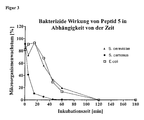
- Experiments on the kinetics of action showed that the germs were completely destroyed after 2 hours of incubation (see FIG. 3).
Landscapes
- Health & Medical Sciences (AREA)
- Life Sciences & Earth Sciences (AREA)
- Chemical & Material Sciences (AREA)
- Organic Chemistry (AREA)
- Zoology (AREA)
- Molecular Biology (AREA)
- Proteomics, Peptides & Aminoacids (AREA)
- Medicinal Chemistry (AREA)
- Toxicology (AREA)
- Engineering & Computer Science (AREA)
- Genetics & Genomics (AREA)
- General Health & Medical Sciences (AREA)
- Biophysics (AREA)
- Biochemistry (AREA)
- Gastroenterology & Hepatology (AREA)
- Polymers & Plastics (AREA)
- Food Science & Technology (AREA)
- Reproductive Health (AREA)
- Pregnancy & Childbirth (AREA)
- Gynecology & Obstetrics (AREA)
- Nutrition Science (AREA)
- Mycology (AREA)
- Wood Science & Technology (AREA)
- Medicines That Contain Protein Lipid Enzymes And Other Medicines (AREA)
- Peptides Or Proteins (AREA)
- Preparation Of Compounds By Using Micro-Organisms (AREA)
Applications Claiming Priority (3)
| Application Number | Priority Date | Filing Date | Title |
|---|---|---|---|
| DE10027992 | 2000-06-08 | ||
| DE10027992 | 2000-06-08 | ||
| EP01960288A EP1313763B1 (fr) | 2000-06-08 | 2001-06-08 | Procede de preparation et d'utilisation de peptides a efficacite antibiotique pour traiter des maladies infectieuses |
Related Parent Applications (1)
| Application Number | Title | Priority Date | Filing Date |
|---|---|---|---|
| EP01960288A Division EP1313763B1 (fr) | 2000-06-08 | 2001-06-08 | Procede de preparation et d'utilisation de peptides a efficacite antibiotique pour traiter des maladies infectieuses |
Publications (2)
| Publication Number | Publication Date |
|---|---|
| EP1481988A2 true EP1481988A2 (fr) | 2004-12-01 |
| EP1481988A3 EP1481988A3 (fr) | 2005-02-23 |
Family
ID=7644875
Family Applications (2)
| Application Number | Title | Priority Date | Filing Date |
|---|---|---|---|
| EP04019254A Withdrawn EP1481988A3 (fr) | 2000-06-08 | 2001-06-08 | Procédé pour l'obtention et l'utilisation de peptides ayant une activité antibiotique pour le traitement de maladies infectieuses |
| EP01960288A Expired - Lifetime EP1313763B1 (fr) | 2000-06-08 | 2001-06-08 | Procede de preparation et d'utilisation de peptides a efficacite antibiotique pour traiter des maladies infectieuses |
Family Applications After (1)
| Application Number | Title | Priority Date | Filing Date |
|---|---|---|---|
| EP01960288A Expired - Lifetime EP1313763B1 (fr) | 2000-06-08 | 2001-06-08 | Procede de preparation et d'utilisation de peptides a efficacite antibiotique pour traiter des maladies infectieuses |
Country Status (6)
| Country | Link |
|---|---|
| EP (2) | EP1481988A3 (fr) |
| AT (1) | ATE319740T1 (fr) |
| AU (1) | AU2001281821A1 (fr) |
| DE (1) | DE50109168D1 (fr) |
| ES (1) | ES2199098T3 (fr) |
| WO (1) | WO2001094386A2 (fr) |
Cited By (1)
| Publication number | Priority date | Publication date | Assignee | Title |
|---|---|---|---|---|
| WO2006018431A3 (fr) * | 2004-08-18 | 2006-06-08 | Ipf Pharmaceuticals Gmbh | Peptides pour le traitement d'infections par le virus de l'herpes |
Families Citing this family (3)
| Publication number | Priority date | Publication date | Assignee | Title |
|---|---|---|---|---|
| JP2005532784A (ja) | 2001-12-07 | 2005-11-04 | イーペーエフ ファルマシューティカルス ゲゼルシャフト ミット ベシュレンクテル ハフツング | 新規の抗菌ボリシンペプチド |
| DE10327518A1 (de) * | 2003-06-17 | 2005-01-13 | Klett-Loch, Lore Maria | Synthetische Peptidkombinationen und Verfahren zu deren Herstellung |
| EP2789343A1 (fr) * | 2013-04-11 | 2014-10-15 | Clinique La Prairie | Nouvelles compositions pharmaceutiques à base de peptide dérivée de l'hémoglobine |
Family Cites Families (3)
| Publication number | Priority date | Publication date | Assignee | Title |
|---|---|---|---|---|
| WO1998031706A1 (fr) * | 1997-01-15 | 1998-07-23 | Johns Hopkins University | METHODES DE TRAITEMENT DES INFECTIONS PULMONAIRES AVEC LE PEPTIDE ANTIMICROBIEN TRACHEAL HUMAIN (hTAP) |
| CN1260834A (zh) * | 1997-05-14 | 2000-07-19 | 人类基因组科学公司 | 抗微生物肽 |
| CA2309554A1 (fr) * | 1997-10-08 | 1999-04-15 | Theragem, Inc. | Peptides derives de mammiferes pour le traitement des infections microbiennes |
-
2001
- 2001-06-08 ES ES01960288T patent/ES2199098T3/es not_active Expired - Lifetime
- 2001-06-08 AT AT01960288T patent/ATE319740T1/de not_active IP Right Cessation
- 2001-06-08 EP EP04019254A patent/EP1481988A3/fr not_active Withdrawn
- 2001-06-08 AU AU2001281821A patent/AU2001281821A1/en not_active Abandoned
- 2001-06-08 DE DE50109168T patent/DE50109168D1/de not_active Expired - Fee Related
- 2001-06-08 WO PCT/EP2001/006518 patent/WO2001094386A2/fr not_active Ceased
- 2001-06-08 EP EP01960288A patent/EP1313763B1/fr not_active Expired - Lifetime
Cited By (3)
| Publication number | Priority date | Publication date | Assignee | Title |
|---|---|---|---|---|
| WO2006018431A3 (fr) * | 2004-08-18 | 2006-06-08 | Ipf Pharmaceuticals Gmbh | Peptides pour le traitement d'infections par le virus de l'herpes |
| JP2008509969A (ja) * | 2004-08-18 | 2008-04-03 | イーペーエフ ファルマシューティカルス ゲゼルシャフト ミット ベシュレンクテル ハフツング | ヘルペスウイルス感染の治療のためのペプチド |
| US7741287B2 (en) | 2004-08-18 | 2010-06-22 | Ipf Pharmaceuticals Gmbh | Peptides for the treatment of herpes virus infections |
Also Published As
| Publication number | Publication date |
|---|---|
| AU2001281821A1 (en) | 2001-12-17 |
| EP1313763B1 (fr) | 2006-03-08 |
| WO2001094386A3 (fr) | 2003-03-20 |
| ES2199098T3 (es) | 2006-10-01 |
| EP1313763A2 (fr) | 2003-05-28 |
| EP1481988A3 (fr) | 2005-02-23 |
| ES2199098T1 (es) | 2004-02-16 |
| WO2001094386A2 (fr) | 2001-12-13 |
| ATE319740T1 (de) | 2006-03-15 |
| DE50109168D1 (de) | 2006-05-04 |
Similar Documents
| Publication | Publication Date | Title |
|---|---|---|
| DE69429176T2 (de) | Protegrine | |
| DE69835279T2 (de) | Zusammensetzungen und verfahren zur behandlung von infektionen unter verwendung von kationischen peptiden allein oder in kombination mit antibiotika | |
| DE69220679T2 (de) | Antibakterielles mittel und behandlung von gegenständen mit diesem | |
| DE69920877T2 (de) | Antimikrobiell wirksame peptide | |
| DE69224524T2 (de) | Antimikrobielle breitspektrum-verbindungen und verfahren zu deren verwendung | |
| EP0151246B1 (fr) | Polypeptide ayant une activité inhibitrice d'alpha-amylase, son procédé de préparation, son emploi et préparations pharmaceutiques | |
| DE69223844T2 (de) | Antimikrobielles Peptid und antimikrobieller Wirkstoff | |
| DE69937798T2 (de) | Peptide, basierend auf der sequenz des menschlichen lactoferrins und ihre anwendung | |
| EP2822958B1 (fr) | Peptides antimicrobiens | |
| DE60034879T2 (de) | Lantibiotikum | |
| EP1068232B1 (fr) | Proteine antibiotique humaine | |
| DE112011100556T5 (de) | Gering hämolytisches antimimikrobielles Peptid, dessen pharmazeutische Zusammensetzung und Verwendung | |
| EP0181578A2 (fr) | Polypeptide antibiotique, son procédé de préparation et son application | |
| EP1481988A2 (fr) | Procédé pour l'obtention et l'utilisation de peptides ayant une activité antibiotique pour le traitement de maladies infectieuses | |
| DE60313970T2 (de) | Lineare kationische peptide mit fungizider wirksamkeit | |
| DE112015004182T5 (de) | Antimykotische Zusammensetzung umfassend antimykotisches Peptid und Terpenalkohol | |
| DE602004008051T2 (de) | Aus einer bifidobakterien-kultur gewonnener immunomodulator und diesen enthaltende zusammensetzungen | |
| CH657989A5 (de) | Biologisch aktive substanz, verfahren zur herstellung der substanz, sowie die substanz enthaltende, immunoaktive zusammensetzung. | |
| EP1028977A2 (fr) | Peptides bifidigenes | |
| DE69518934T2 (de) | Antibiotikum WAP-8294A, Verfahren zu seiner Herstellung und antibakterielle Zusammensetzung | |
| KR102951826B1 (ko) | 오리 유래 항균 펩타이드로부터 설계된 신규 항균 펩타이드 및 이의 용도 | |
| DE69112727T2 (de) | Physiologisch wirksame Peptide, die eine immunoregulierende Aktivität besitzen. | |
| DE60114567T2 (de) | Selektive acylierung von a82846-glycopeptid-analoge | |
| DE69613489T2 (de) | Antibiotische peptide aus der kuhmilch | |
| EP1196439B1 (fr) | Composes a action antibiotique |
Legal Events
| Date | Code | Title | Description |
|---|---|---|---|
| PUAI | Public reference made under article 153(3) epc to a published international application that has entered the european phase |
Free format text: ORIGINAL CODE: 0009012 |
|
| AC | Divisional application: reference to earlier application |
Ref document number: 1313763 Country of ref document: EP Kind code of ref document: P |
|
| AK | Designated contracting states |
Kind code of ref document: A2 Designated state(s): AT BE CH CY DE DK ES FI FR GB GR IE IT LI LU MC NL PT SE TR |
|
| PUAL | Search report despatched |
Free format text: ORIGINAL CODE: 0009013 |
|
| AK | Designated contracting states |
Kind code of ref document: A3 Designated state(s): AT BE CH CY DE DK ES FI FR GB GR IE IT LI LU MC NL PT SE TR |
|
| 17P | Request for examination filed |
Effective date: 20050430 |
|
| 17Q | First examination report despatched |
Effective date: 20050608 |
|
| AKX | Designation fees paid |
Designated state(s): DE ES FR GB IT |
|
| STAA | Information on the status of an ep patent application or granted ep patent |
Free format text: STATUS: THE APPLICATION IS DEEMED TO BE WITHDRAWN |
|
| 18D | Application deemed to be withdrawn |
Effective date: 20060419 |