EP1482019B1 - Pyranderivate - Google Patents
Pyranderivate Download PDFInfo
- Publication number
- EP1482019B1 EP1482019B1 EP04010357A EP04010357A EP1482019B1 EP 1482019 B1 EP1482019 B1 EP 1482019B1 EP 04010357 A EP04010357 A EP 04010357A EP 04010357 A EP04010357 A EP 04010357A EP 1482019 B1 EP1482019 B1 EP 1482019B1
- Authority
- EP
- European Patent Office
- Prior art keywords
- denotes
- formula
- aralkyl
- denote
- alkanyl
- Prior art date
- Legal status (The legal status is an assumption and is not a legal conclusion. Google has not performed a legal analysis and makes no representation as to the accuracy of the status listed.)
- Expired - Lifetime
Links
- 125000004309 pyranyl group Chemical class O1C(C=CC=C1)* 0.000 title claims abstract description 20
- -1 naphthalene-2,6-diyl Chemical group 0.000 claims abstract description 114
- 229910052731 fluorine Inorganic materials 0.000 claims abstract description 60
- 125000003710 aryl alkyl group Chemical group 0.000 claims abstract description 53
- 238000000034 method Methods 0.000 claims abstract description 46
- 125000003342 alkenyl group Chemical group 0.000 claims abstract description 36
- 229910052739 hydrogen Inorganic materials 0.000 claims abstract description 29
- 230000008569 process Effects 0.000 claims abstract description 23
- 229910052794 bromium Inorganic materials 0.000 claims abstract description 19
- 125000001997 phenyl group Chemical group [H]C1=C([H])C([H])=C(*)C([H])=C1[H] 0.000 claims abstract description 18
- 125000005842 heteroatom Chemical group 0.000 claims abstract description 15
- 238000002360 preparation method Methods 0.000 claims abstract description 15
- 229910052801 chlorine Inorganic materials 0.000 claims abstract description 14
- 125000003545 alkoxy group Chemical group 0.000 claims abstract description 13
- 229910052740 iodine Inorganic materials 0.000 claims abstract description 13
- 125000004955 1,4-cyclohexylene group Chemical group [H]C1([H])C([H])([H])C([H])([*:1])C([H])([H])C([H])([H])C1([H])[*:2] 0.000 claims abstract description 8
- 150000001875 compounds Chemical class 0.000 claims description 214
- 125000004432 carbon atom Chemical group C* 0.000 claims description 60
- 229910052736 halogen Inorganic materials 0.000 claims description 58
- 150000002367 halogens Chemical class 0.000 claims description 56
- 238000006243 chemical reaction Methods 0.000 claims description 36
- 150000001299 aldehydes Chemical class 0.000 claims description 28
- 239000003054 catalyst Substances 0.000 claims description 27
- 238000005649 metathesis reaction Methods 0.000 claims description 22
- 229910052760 oxygen Inorganic materials 0.000 claims description 21
- 229910052717 sulfur Inorganic materials 0.000 claims description 20
- 238000006798 ring closing metathesis reaction Methods 0.000 claims description 19
- 230000015572 biosynthetic process Effects 0.000 claims description 16
- 239000000460 chlorine Substances 0.000 claims description 15
- 238000006722 reduction reaction Methods 0.000 claims description 14
- WKBOTKDWSSQWDR-UHFFFAOYSA-N Bromine atom Chemical compound [Br] WKBOTKDWSSQWDR-UHFFFAOYSA-N 0.000 claims description 13
- GDTBXPJZTBHREO-UHFFFAOYSA-N bromine Substances BrBr GDTBXPJZTBHREO-UHFFFAOYSA-N 0.000 claims description 13
- ZAMOUSCENKQFHK-UHFFFAOYSA-N Chlorine atom Chemical compound [Cl] ZAMOUSCENKQFHK-UHFFFAOYSA-N 0.000 claims description 8
- ZCYVEMRRCGMTRW-UHFFFAOYSA-N 7553-56-2 Chemical compound [I] ZCYVEMRRCGMTRW-UHFFFAOYSA-N 0.000 claims description 5
- 238000009903 catalytic hydrogenation reaction Methods 0.000 claims description 5
- 239000011630 iodine Substances 0.000 claims description 5
- KJTLSVCANCCWHF-UHFFFAOYSA-N Ruthenium Chemical group [Ru] KJTLSVCANCCWHF-UHFFFAOYSA-N 0.000 claims description 3
- PNDPGZBMCMUPRI-UHFFFAOYSA-N iodine Chemical compound II PNDPGZBMCMUPRI-UHFFFAOYSA-N 0.000 claims description 3
- 229910052707 ruthenium Inorganic materials 0.000 claims description 3
- 125000001118 alkylidene group Chemical group 0.000 claims description 2
- 239000000470 constituent Substances 0.000 claims description 2
- 125000003903 2-propenyl group Chemical group [H]C([*])([H])C([H])=C([H])[H] 0.000 abstract description 14
- 125000000217 alkyl group Chemical group 0.000 abstract description 12
- 125000003118 aryl group Chemical group 0.000 abstract description 10
- 125000001140 1,4-phenylene group Chemical group [H]C1=C([H])C([*:2])=C([H])C([H])=C1[*:1] 0.000 abstract description 4
- 125000000113 cyclohexyl group Chemical group [H]C1([H])C([H])([H])C([H])([H])C([H])(*)C([H])([H])C1([H])[H] 0.000 abstract description 3
- LSNNMFCWUKXFEE-UHFFFAOYSA-M Bisulfite Chemical compound OS([O-])=O LSNNMFCWUKXFEE-UHFFFAOYSA-M 0.000 abstract description 2
- 125000005843 halogen group Chemical group 0.000 abstract 3
- 125000004203 4-hydroxyphenyl group Chemical group [H]OC1=C([H])C([H])=C(*)C([H])=C1[H] 0.000 abstract 1
- 125000005715 5,2-(1,3-dioxanylene) group Chemical group [H]C1([H])OC([H])([*:2])OC([H])([H])C1([H])[*:1] 0.000 abstract 1
- 125000003003 spiro group Chemical group 0.000 abstract 1
- 125000005757 tetralin-2,6-ylene group Chemical group [H]C1=C([*:2])C([H])=C2C(=C1[H])C([H])([H])C([H])([*:1])C([H])([H])C2([H])[H] 0.000 abstract 1
- 150000003254 radicals Chemical class 0.000 description 44
- 239000011737 fluorine Substances 0.000 description 36
- PXGOKWXKJXAPGV-UHFFFAOYSA-N Fluorine Chemical compound FF PXGOKWXKJXAPGV-UHFFFAOYSA-N 0.000 description 34
- WYURNTSHIVDZCO-UHFFFAOYSA-N Tetrahydrofuran Chemical compound C1CCOC1 WYURNTSHIVDZCO-UHFFFAOYSA-N 0.000 description 34
- YXFVVABEGXRONW-UHFFFAOYSA-N Toluene Chemical compound CC1=CC=CC=C1 YXFVVABEGXRONW-UHFFFAOYSA-N 0.000 description 33
- 150000004880 oxines Chemical class 0.000 description 32
- 0 Cc1cc(ccc(c(I)c2*)c3cc2I)c3c(I)c1 Chemical compound Cc1cc(ccc(c(I)c2*)c3cc2I)c3c(I)c1 0.000 description 31
- BZLVMXJERCGZMT-UHFFFAOYSA-N Methyl tert-butyl ether Chemical compound COC(C)(C)C BZLVMXJERCGZMT-UHFFFAOYSA-N 0.000 description 21
- 239000000203 mixture Substances 0.000 description 19
- YMWUJEATGCHHMB-UHFFFAOYSA-N Dichloromethane Chemical compound ClCCl YMWUJEATGCHHMB-UHFFFAOYSA-N 0.000 description 18
- LFQSCWFLJHTTHZ-UHFFFAOYSA-N Ethanol Chemical compound CCO LFQSCWFLJHTTHZ-UHFFFAOYSA-N 0.000 description 17
- YLQBMQCUIZJEEH-UHFFFAOYSA-N tetrahydrofuran Natural products C=1C=COC=1 YLQBMQCUIZJEEH-UHFFFAOYSA-N 0.000 description 17
- 238000003786 synthesis reaction Methods 0.000 description 16
- 150000002148 esters Chemical class 0.000 description 15
- 239000007858 starting material Substances 0.000 description 14
- XLYOFNOQVPJJNP-UHFFFAOYSA-N water Substances O XLYOFNOQVPJJNP-UHFFFAOYSA-N 0.000 description 14
- 125000004093 cyano group Chemical group *C#N 0.000 description 13
- VYPSYNLAJGMNEJ-UHFFFAOYSA-N Silicium dioxide Chemical compound O=[Si]=O VYPSYNLAJGMNEJ-UHFFFAOYSA-N 0.000 description 12
- BHELZAPQIKSEDF-UHFFFAOYSA-N allyl bromide Chemical compound BrCC=C BHELZAPQIKSEDF-UHFFFAOYSA-N 0.000 description 12
- 239000000741 silica gel Substances 0.000 description 12
- 229910002027 silica gel Inorganic materials 0.000 description 12
- RTZKZFJDLAIYFH-UHFFFAOYSA-N Diethyl ether Chemical compound CCOCC RTZKZFJDLAIYFH-UHFFFAOYSA-N 0.000 description 11
- IMNFDUFMRHMDMM-UHFFFAOYSA-N N-Heptane Chemical compound CCCCCCC IMNFDUFMRHMDMM-UHFFFAOYSA-N 0.000 description 11
- KDLHZDBZIXYQEI-UHFFFAOYSA-N palladium Substances [Pd] KDLHZDBZIXYQEI-UHFFFAOYSA-N 0.000 description 11
- 239000012074 organic phase Substances 0.000 description 10
- 230000009467 reduction Effects 0.000 description 10
- HEMHJVSKTPXQMS-UHFFFAOYSA-M Sodium hydroxide Chemical compound [OH-].[Na+] HEMHJVSKTPXQMS-UHFFFAOYSA-M 0.000 description 9
- XXROGKLTLUQVRX-UHFFFAOYSA-N allyl alcohol Chemical compound OCC=C XXROGKLTLUQVRX-UHFFFAOYSA-N 0.000 description 9
- 238000001816 cooling Methods 0.000 description 9
- 238000005984 hydrogenation reaction Methods 0.000 description 9
- 125000003178 carboxy group Chemical group [H]OC(*)=O 0.000 description 8
- 239000012071 phase Substances 0.000 description 8
- 239000002904 solvent Substances 0.000 description 8
- NUJOXMJBOLGQSY-UHFFFAOYSA-N manganese dioxide Chemical compound O=[Mn]=O NUJOXMJBOLGQSY-UHFFFAOYSA-N 0.000 description 7
- ZMANZCXQSJIPKH-UHFFFAOYSA-N Triethylamine Chemical compound CCN(CC)CC ZMANZCXQSJIPKH-UHFFFAOYSA-N 0.000 description 6
- 239000002253 acid Substances 0.000 description 6
- 150000001733 carboxylic acid esters Chemical class 0.000 description 6
- 239000000543 intermediate Substances 0.000 description 6
- 125000002496 methyl group Chemical group [H]C([H])([H])* 0.000 description 6
- LPNYRYFBWFDTMA-UHFFFAOYSA-N potassium tert-butoxide Chemical compound [K+].CC(C)(C)[O-] LPNYRYFBWFDTMA-UHFFFAOYSA-N 0.000 description 6
- 239000002243 precursor Substances 0.000 description 6
- HGINCPLSRVDWNT-UHFFFAOYSA-N Acrolein Chemical class C=CC=O HGINCPLSRVDWNT-UHFFFAOYSA-N 0.000 description 5
- 239000004990 Smectic liquid crystal Substances 0.000 description 5
- 150000004808 allyl alcohols Chemical class 0.000 description 5
- 125000001797 benzyl group Chemical group [H]C1=C([H])C([H])=C(C([H])=C1[H])C([H])([H])* 0.000 description 5
- 229910052799 carbon Inorganic materials 0.000 description 5
- 239000003153 chemical reaction reagent Substances 0.000 description 5
- 125000002243 cyclohexanonyl group Chemical class *C1(*)C(=O)C(*)(*)C(*)(*)C(*)(*)C1(*)* 0.000 description 5
- 238000001212 derivatisation Methods 0.000 description 5
- 239000001257 hydrogen Substances 0.000 description 5
- 125000001449 isopropyl group Chemical group [H]C([H])([H])C([H])(*)C([H])([H])[H] 0.000 description 5
- 230000003287 optical effect Effects 0.000 description 5
- 230000003647 oxidation Effects 0.000 description 5
- 238000007254 oxidation reaction Methods 0.000 description 5
- BASFCYQUMIYNBI-UHFFFAOYSA-N platinum Chemical compound [Pt] BASFCYQUMIYNBI-UHFFFAOYSA-N 0.000 description 5
- 238000003756 stirring Methods 0.000 description 5
- 125000001424 substituent group Chemical group 0.000 description 5
- 239000000725 suspension Substances 0.000 description 5
- 125000000999 tert-butyl group Chemical group [H]C([H])([H])C(*)(C([H])([H])[H])C([H])([H])[H] 0.000 description 5
- DYLIWHYUXAJDOJ-OWOJBTEDSA-N (e)-4-(6-aminopurin-9-yl)but-2-en-1-ol Chemical compound NC1=NC=NC2=C1N=CN2C\C=C\CO DYLIWHYUXAJDOJ-OWOJBTEDSA-N 0.000 description 4
- ZSPTYLOMNJNZNG-UHFFFAOYSA-N 3-Buten-1-ol Chemical compound OCCC=C ZSPTYLOMNJNZNG-UHFFFAOYSA-N 0.000 description 4
- KZMGYPLQYOPHEL-UHFFFAOYSA-N Boron trifluoride etherate Chemical compound FB(F)F.CCOCC KZMGYPLQYOPHEL-UHFFFAOYSA-N 0.000 description 4
- VEXZGXHMUGYJMC-UHFFFAOYSA-N Hydrochloric acid Chemical compound Cl VEXZGXHMUGYJMC-UHFFFAOYSA-N 0.000 description 4
- UFHFLCQGNIYNRP-UHFFFAOYSA-N Hydrogen Chemical compound [H][H] UFHFLCQGNIYNRP-UHFFFAOYSA-N 0.000 description 4
- ZOKXTWBITQBERF-UHFFFAOYSA-N Molybdenum Chemical compound [Mo] ZOKXTWBITQBERF-UHFFFAOYSA-N 0.000 description 4
- MZRVEZGGRBJDDB-UHFFFAOYSA-N N-Butyllithium Chemical compound [Li]CCCC MZRVEZGGRBJDDB-UHFFFAOYSA-N 0.000 description 4
- HCHKCACWOHOZIP-UHFFFAOYSA-N Zinc Chemical compound [Zn] HCHKCACWOHOZIP-UHFFFAOYSA-N 0.000 description 4
- NIXOWILDQLNWCW-UHFFFAOYSA-N acrylic acid group Chemical group C(C=C)(=O)O NIXOWILDQLNWCW-UHFFFAOYSA-N 0.000 description 4
- 125000000051 benzyloxy group Chemical group [H]C1=C([H])C([H])=C(C([H])=C1[H])C([H])([H])O* 0.000 description 4
- SIPUZPBQZHNSDW-UHFFFAOYSA-N bis(2-methylpropyl)aluminum Chemical compound CC(C)C[Al]CC(C)C SIPUZPBQZHNSDW-UHFFFAOYSA-N 0.000 description 4
- 125000001246 bromo group Chemical group Br* 0.000 description 4
- 150000001732 carboxylic acid derivatives Chemical class 0.000 description 4
- 239000007789 gas Substances 0.000 description 4
- 239000003446 ligand Substances 0.000 description 4
- ZCSHNCUQKCANBX-UHFFFAOYSA-N lithium diisopropylamide Chemical compound [Li+].CC(C)[N-]C(C)C ZCSHNCUQKCANBX-UHFFFAOYSA-N 0.000 description 4
- 239000011777 magnesium Substances 0.000 description 4
- 239000000463 material Substances 0.000 description 4
- 229910052751 metal Inorganic materials 0.000 description 4
- 239000002184 metal Substances 0.000 description 4
- 229910052750 molybdenum Inorganic materials 0.000 description 4
- 239000011733 molybdenum Substances 0.000 description 4
- 239000007800 oxidant agent Substances 0.000 description 4
- 230000001590 oxidative effect Effects 0.000 description 4
- WJKHJLXJJJATHN-UHFFFAOYSA-N triflic anhydride Chemical compound FC(F)(F)S(=O)(=O)OS(=O)(=O)C(F)(F)F WJKHJLXJJJATHN-UHFFFAOYSA-N 0.000 description 4
- RIOQSEWOXXDEQQ-UHFFFAOYSA-N triphenylphosphine Chemical compound C1=CC=CC=C1P(C=1C=CC=CC=1)C1=CC=CC=C1 RIOQSEWOXXDEQQ-UHFFFAOYSA-N 0.000 description 4
- 229910052725 zinc Inorganic materials 0.000 description 4
- 239000011701 zinc Substances 0.000 description 4
- VNDYJBBGRKZCSX-UHFFFAOYSA-L zinc bromide Chemical compound Br[Zn]Br VNDYJBBGRKZCSX-UHFFFAOYSA-L 0.000 description 4
- MGADZUXDNSDTHW-UHFFFAOYSA-N 2H-pyran Chemical class C1OC=CC=C1 MGADZUXDNSDTHW-UHFFFAOYSA-N 0.000 description 3
- WEVYAHXRMPXWCK-UHFFFAOYSA-N Acetonitrile Chemical compound CC#N WEVYAHXRMPXWCK-UHFFFAOYSA-N 0.000 description 3
- UHOVQNZJYSORNB-UHFFFAOYSA-N Benzene Chemical compound C1=CC=CC=C1 UHOVQNZJYSORNB-UHFFFAOYSA-N 0.000 description 3
- XTHFKEDIFFGKHM-UHFFFAOYSA-N Dimethoxyethane Chemical compound COCCOC XTHFKEDIFFGKHM-UHFFFAOYSA-N 0.000 description 3
- XEKOWRVHYACXOJ-UHFFFAOYSA-N Ethyl acetate Chemical compound CCOC(C)=O XEKOWRVHYACXOJ-UHFFFAOYSA-N 0.000 description 3
- WHXSMMKQMYFTQS-UHFFFAOYSA-N Lithium Chemical compound [Li] WHXSMMKQMYFTQS-UHFFFAOYSA-N 0.000 description 3
- OKKJLVBELUTLKV-UHFFFAOYSA-N Methanol Chemical compound OC OKKJLVBELUTLKV-UHFFFAOYSA-N 0.000 description 3
- PXHVJJICTQNCMI-UHFFFAOYSA-N Nickel Chemical compound [Ni] PXHVJJICTQNCMI-UHFFFAOYSA-N 0.000 description 3
- DHXVGJBLRPWPCS-UHFFFAOYSA-N Tetrahydropyran Chemical compound C1CCOCC1 DHXVGJBLRPWPCS-UHFFFAOYSA-N 0.000 description 3
- 125000001931 aliphatic group Chemical group 0.000 description 3
- 239000008346 aqueous phase Substances 0.000 description 3
- 125000004429 atom Chemical group 0.000 description 3
- 125000005517 carbenium group Chemical group 0.000 description 3
- 150000001721 carbon Chemical group 0.000 description 3
- 125000002915 carbonyl group Chemical group [*:2]C([*:1])=O 0.000 description 3
- 238000006555 catalytic reaction Methods 0.000 description 3
- 239000003638 chemical reducing agent Substances 0.000 description 3
- 239000011651 chromium Substances 0.000 description 3
- 238000006880 cross-coupling reaction Methods 0.000 description 3
- 239000012043 crude product Substances 0.000 description 3
- 238000002425 crystallisation Methods 0.000 description 3
- 230000008025 crystallization Effects 0.000 description 3
- 125000004122 cyclic group Chemical group 0.000 description 3
- 238000001035 drying Methods 0.000 description 3
- 125000001495 ethyl group Chemical group [H]C([H])([H])C([H])([H])* 0.000 description 3
- 238000013213 extrapolation Methods 0.000 description 3
- 125000001153 fluoro group Chemical group F* 0.000 description 3
- 238000005755 formation reaction Methods 0.000 description 3
- 125000000524 functional group Chemical group 0.000 description 3
- 125000000959 isobutyl group Chemical group [H]C([H])([H])C([H])(C([H])([H])[H])C([H])([H])* 0.000 description 3
- 150000002576 ketones Chemical class 0.000 description 3
- 229910052744 lithium Inorganic materials 0.000 description 3
- AMXOYNBUYSYVKV-UHFFFAOYSA-M lithium bromide Inorganic materials [Li+].[Br-] AMXOYNBUYSYVKV-UHFFFAOYSA-M 0.000 description 3
- 229910052749 magnesium Inorganic materials 0.000 description 3
- 125000001570 methylene group Chemical group [H]C([H])([*:1])[*:2] 0.000 description 3
- 125000002524 organometallic group Chemical group 0.000 description 3
- 239000001301 oxygen Substances 0.000 description 3
- 125000004430 oxygen atom Chemical group O* 0.000 description 3
- 125000006503 p-nitrobenzyl group Chemical group [H]C1=C([H])C(=C([H])C([H])=C1[N+]([O-])=O)C([H])([H])* 0.000 description 3
- 229910052763 palladium Inorganic materials 0.000 description 3
- NLKNQRATVPKPDG-UHFFFAOYSA-M potassium iodide Chemical compound [K+].[I-] NLKNQRATVPKPDG-UHFFFAOYSA-M 0.000 description 3
- 239000000047 product Substances 0.000 description 3
- 239000011541 reaction mixture Substances 0.000 description 3
- 230000035484 reaction time Effects 0.000 description 3
- 238000010992 reflux Methods 0.000 description 3
- 238000007152 ring opening metathesis polymerisation reaction Methods 0.000 description 3
- 229910000104 sodium hydride Inorganic materials 0.000 description 3
- 230000000707 stereoselective effect Effects 0.000 description 3
- 238000004809 thin layer chromatography Methods 0.000 description 3
- 125000004001 thioalkyl group Chemical group 0.000 description 3
- 229910052723 transition metal Inorganic materials 0.000 description 3
- 150000003624 transition metals Chemical class 0.000 description 3
- 238000006478 transmetalation reaction Methods 0.000 description 3
- WFKWXMTUELFFGS-UHFFFAOYSA-N tungsten Chemical compound [W] WFKWXMTUELFFGS-UHFFFAOYSA-N 0.000 description 3
- 229910052721 tungsten Inorganic materials 0.000 description 3
- 239000010937 tungsten Substances 0.000 description 3
- RYHBNJHYFVUHQT-UHFFFAOYSA-N 1,4-Dioxane Chemical compound C1COCCO1 RYHBNJHYFVUHQT-UHFFFAOYSA-N 0.000 description 2
- NGNBDVOYPDDBFK-UHFFFAOYSA-N 2-[2,4-di(pentan-2-yl)phenoxy]acetyl chloride Chemical compound CCCC(C)C1=CC=C(OCC(Cl)=O)C(C(C)CCC)=C1 NGNBDVOYPDDBFK-UHFFFAOYSA-N 0.000 description 2
- VHYFNPMBLIVWCW-UHFFFAOYSA-N 4-Dimethylaminopyridine Chemical compound CN(C)C1=CC=NC=C1 VHYFNPMBLIVWCW-UHFFFAOYSA-N 0.000 description 2
- YYROPELSRYBVMQ-UHFFFAOYSA-N 4-toluenesulfonyl chloride Chemical compound CC1=CC=C(S(Cl)(=O)=O)C=C1 YYROPELSRYBVMQ-UHFFFAOYSA-N 0.000 description 2
- HBAQYPYDRFILMT-UHFFFAOYSA-N 8-[3-(1-cyclopropylpyrazol-4-yl)-1H-pyrazolo[4,3-d]pyrimidin-5-yl]-3-methyl-3,8-diazabicyclo[3.2.1]octan-2-one Chemical class C1(CC1)N1N=CC(=C1)C1=NNC2=C1N=C(N=C2)N1C2C(N(CC1CC2)C)=O HBAQYPYDRFILMT-UHFFFAOYSA-N 0.000 description 2
- CSCPPACGZOOCGX-UHFFFAOYSA-N Acetone Chemical compound CC(C)=O CSCPPACGZOOCGX-UHFFFAOYSA-N 0.000 description 2
- RPMUDXVQHUECRE-UHFFFAOYSA-N CC1COC(C)OC1 Chemical compound CC1COC(C)OC1 RPMUDXVQHUECRE-UHFFFAOYSA-N 0.000 description 2
- 101100257127 Caenorhabditis elegans sma-2 gene Proteins 0.000 description 2
- OKTJSMMVPCPJKN-UHFFFAOYSA-N Carbon Chemical compound [C] OKTJSMMVPCPJKN-UHFFFAOYSA-N 0.000 description 2
- 239000004215 Carbon black (E152) Substances 0.000 description 2
- VGGSQFUCUMXWEO-UHFFFAOYSA-N Ethene Chemical compound C=C VGGSQFUCUMXWEO-UHFFFAOYSA-N 0.000 description 2
- 238000006546 Horner-Wadsworth-Emmons reaction Methods 0.000 description 2
- FYYHWMGAXLPEAU-UHFFFAOYSA-N Magnesium Chemical compound [Mg] FYYHWMGAXLPEAU-UHFFFAOYSA-N 0.000 description 2
- SECXISVLQFMRJM-UHFFFAOYSA-N N-Methylpyrrolidone Chemical compound CN1CCCC1=O SECXISVLQFMRJM-UHFFFAOYSA-N 0.000 description 2
- 101150003085 Pdcl gene Proteins 0.000 description 2
- OFBQJSOFQDEBGM-UHFFFAOYSA-N Pentane Chemical compound CCCCC OFBQJSOFQDEBGM-UHFFFAOYSA-N 0.000 description 2
- 229910052772 Samarium Inorganic materials 0.000 description 2
- KEAYESYHFKHZAL-UHFFFAOYSA-N Sodium Chemical compound [Na] KEAYESYHFKHZAL-UHFFFAOYSA-N 0.000 description 2
- QAOWNCQODCNURD-UHFFFAOYSA-N Sulfuric acid Chemical compound OS(O)(=O)=O QAOWNCQODCNURD-UHFFFAOYSA-N 0.000 description 2
- ATJFFYVFTNAWJD-UHFFFAOYSA-N Tin Chemical compound [Sn] ATJFFYVFTNAWJD-UHFFFAOYSA-N 0.000 description 2
- 238000007239 Wittig reaction Methods 0.000 description 2
- 150000001298 alcohols Chemical class 0.000 description 2
- 238000005865 alkene metathesis reaction Methods 0.000 description 2
- 125000004414 alkyl thio group Chemical group 0.000 description 2
- 125000001309 chloro group Chemical group Cl* 0.000 description 2
- MVPPADPHJFYWMZ-UHFFFAOYSA-N chlorobenzene Chemical compound ClC1=CC=CC=C1 MVPPADPHJFYWMZ-UHFFFAOYSA-N 0.000 description 2
- 238000004587 chromatography analysis Methods 0.000 description 2
- 238000007796 conventional method Methods 0.000 description 2
- 238000005686 cross metathesis reaction Methods 0.000 description 2
- NKLCNNUWBJBICK-UHFFFAOYSA-N dess–martin periodinane Chemical compound C1=CC=C2I(OC(=O)C)(OC(C)=O)(OC(C)=O)OC(=O)C2=C1 NKLCNNUWBJBICK-UHFFFAOYSA-N 0.000 description 2
- ZUOUZKKEUPVFJK-UHFFFAOYSA-N diphenyl Chemical compound C1=CC=CC=C1C1=CC=CC=C1 ZUOUZKKEUPVFJK-UHFFFAOYSA-N 0.000 description 2
- 239000002019 doping agent Substances 0.000 description 2
- 230000032050 esterification Effects 0.000 description 2
- 238000005886 esterification reaction Methods 0.000 description 2
- WBJINCZRORDGAQ-UHFFFAOYSA-N ethyl formate Chemical compound CCOC=O WBJINCZRORDGAQ-UHFFFAOYSA-N 0.000 description 2
- 239000000284 extract Substances 0.000 description 2
- 150000004795 grignard reagents Chemical class 0.000 description 2
- 229930195733 hydrocarbon Natural products 0.000 description 2
- 125000004435 hydrogen atom Chemical group [H]* 0.000 description 2
- 239000005457 ice water Substances 0.000 description 2
- 239000012442 inert solvent Substances 0.000 description 2
- 125000001972 isopentyl group Chemical group [H]C([H])([H])C([H])(C([H])([H])[H])C([H])([H])C([H])([H])* 0.000 description 2
- 150000002596 lactones Chemical class 0.000 description 2
- 239000007788 liquid Substances 0.000 description 2
- 239000012280 lithium aluminium hydride Substances 0.000 description 2
- CYSFUFRXDOAOMP-UHFFFAOYSA-M magnesium;prop-1-ene;chloride Chemical compound [Mg+2].[Cl-].[CH2-]C=C CYSFUFRXDOAOMP-UHFFFAOYSA-M 0.000 description 2
- 150000002825 nitriles Chemical group 0.000 description 2
- 239000003921 oil Substances 0.000 description 2
- 239000003960 organic solvent Substances 0.000 description 2
- 230000036961 partial effect Effects 0.000 description 2
- YNPNZTXNASCQKK-UHFFFAOYSA-N phenanthrene Chemical compound C1=CC=C2C3=CC=CC=C3C=CC2=C1 YNPNZTXNASCQKK-UHFFFAOYSA-N 0.000 description 2
- 150000002987 phenanthrenes Chemical class 0.000 description 2
- 229910052697 platinum Inorganic materials 0.000 description 2
- 239000002244 precipitate Substances 0.000 description 2
- SUDMKGNNRMLBMF-UHFFFAOYSA-N prop-2-enyl methanesulfonate Chemical compound CS(=O)(=O)OCC=C SUDMKGNNRMLBMF-UHFFFAOYSA-N 0.000 description 2
- 125000002914 sec-butyl group Chemical group [H]C([H])([H])C([H])([H])C([H])(*)C([H])([H])[H] 0.000 description 2
- SQGYOTSLMSWVJD-UHFFFAOYSA-N silver(1+) nitrate Chemical compound [Ag+].[O-]N(=O)=O SQGYOTSLMSWVJD-UHFFFAOYSA-N 0.000 description 2
- 239000012312 sodium hydride Substances 0.000 description 2
- 239000000126 substance Substances 0.000 description 2
- 229910052718 tin Inorganic materials 0.000 description 2
- 239000010936 titanium Substances 0.000 description 2
- 229910052719 titanium Inorganic materials 0.000 description 2
- 230000007704 transition Effects 0.000 description 2
- AQRLNPVMDITEJU-UHFFFAOYSA-N triethylsilane Chemical compound CC[SiH](CC)CC AQRLNPVMDITEJU-UHFFFAOYSA-N 0.000 description 2
- ITMCEJHCFYSIIV-UHFFFAOYSA-N triflic acid Chemical compound OS(=O)(=O)C(F)(F)F ITMCEJHCFYSIIV-UHFFFAOYSA-N 0.000 description 2
- 125000000391 vinyl group Chemical group [H]C([*])=C([H])[H] 0.000 description 2
- 229920002554 vinyl polymer Polymers 0.000 description 2
- ZFNVDHOSLNRHNN-UHFFFAOYSA-N xi-3-(4-Isopropylphenyl)-2-methylpropanal Chemical compound O=CC(C)CC1=CC=C(C(C)C)C=C1 ZFNVDHOSLNRHNN-UHFFFAOYSA-N 0.000 description 2
- 229940102001 zinc bromide Drugs 0.000 description 2
- PPTXVXKCQZKFBN-UHFFFAOYSA-N (S)-(-)-1,1'-Bi-2-naphthol Chemical compound C1=CC=C2C(C3=C4C=CC=CC4=CC=C3O)=C(O)C=CC2=C1 PPTXVXKCQZKFBN-UHFFFAOYSA-N 0.000 description 1
- KZPYGQFFRCFCPP-UHFFFAOYSA-N 1,1'-bis(diphenylphosphino)ferrocene Chemical compound [Fe+2].C1=CC=C[C-]1P(C=1C=CC=CC=1)C1=CC=CC=C1.C1=CC=C[C-]1P(C=1C=CC=CC=1)C1=CC=CC=C1 KZPYGQFFRCFCPP-UHFFFAOYSA-N 0.000 description 1
- BTTUMVHWIAXYPJ-UHFFFAOYSA-N 1,3-dithian-2-yl(trimethyl)silane Chemical compound C[Si](C)(C)C1SCCCS1 BTTUMVHWIAXYPJ-UHFFFAOYSA-N 0.000 description 1
- IYTUPMAAMJDPCR-UHFFFAOYSA-N 1-chlorophenanthrene Chemical compound C1=CC2=CC=CC=C2C2=C1C(Cl)=CC=C2 IYTUPMAAMJDPCR-UHFFFAOYSA-N 0.000 description 1
- DVWQNBIUTWDZMW-UHFFFAOYSA-N 1-naphthalen-1-ylnaphthalen-2-ol Chemical class C1=CC=C2C(C3=C4C=CC=CC4=CC=C3O)=CC=CC2=C1 DVWQNBIUTWDZMW-UHFFFAOYSA-N 0.000 description 1
- GTBXZWADMKOZQJ-UHFFFAOYSA-N 1-phenanthrol Chemical compound C1=CC2=CC=CC=C2C2=C1C(O)=CC=C2 GTBXZWADMKOZQJ-UHFFFAOYSA-N 0.000 description 1
- 125000006017 1-propenyl group Chemical group 0.000 description 1
- 238000005160 1H NMR spectroscopy Methods 0.000 description 1
- SSGAUHZTPJJDJR-UHFFFAOYSA-N 2,2-dicyclohexylhexane-3,3-diol Chemical compound C(CC)C(C(C)(C1CCCCC1)C1CCCCC1)(O)O SSGAUHZTPJJDJR-UHFFFAOYSA-N 0.000 description 1
- FHVRTMVXBVDWCK-UHFFFAOYSA-N 2-methyl-2-prop-2-enoxypropane Chemical compound CC(C)(C)OCC=C FHVRTMVXBVDWCK-UHFFFAOYSA-N 0.000 description 1
- 125000004493 2-methylbut-1-yl group Chemical group CC(C*)CC 0.000 description 1
- 125000005916 2-methylpentyl group Chemical group 0.000 description 1
- 125000000094 2-phenylethyl group Chemical group [H]C1=C([H])C([H])=C(C([H])=C1[H])C([H])([H])C([H])([H])* 0.000 description 1
- 125000004975 3-butenyl group Chemical group C(CC=C)* 0.000 description 1
- 125000005917 3-methylpentyl group Chemical group 0.000 description 1
- 125000006043 5-hexenyl group Chemical group 0.000 description 1
- OZJPLYNZGCXSJM-UHFFFAOYSA-N 5-valerolactone Chemical compound O=C1CCCCO1 OZJPLYNZGCXSJM-UHFFFAOYSA-N 0.000 description 1
- KYARBIJYVGJZLB-UHFFFAOYSA-N 7-amino-4-hydroxy-2-naphthalenesulfonic acid Chemical compound OC1=CC(S(O)(=O)=O)=CC2=CC(N)=CC=C21 KYARBIJYVGJZLB-UHFFFAOYSA-N 0.000 description 1
- OSDWBNJEKMUWAV-UHFFFAOYSA-N Allyl chloride Chemical compound ClCC=C OSDWBNJEKMUWAV-UHFFFAOYSA-N 0.000 description 1
- ZOXJGFHDIHLPTG-UHFFFAOYSA-N Boron Chemical compound [B] ZOXJGFHDIHLPTG-UHFFFAOYSA-N 0.000 description 1
- CPELXLSAUQHCOX-UHFFFAOYSA-M Bromide Chemical compound [Br-] CPELXLSAUQHCOX-UHFFFAOYSA-M 0.000 description 1
- KAKZBPTYRLMSJV-UHFFFAOYSA-N Butadiene Chemical group C=CC=C KAKZBPTYRLMSJV-UHFFFAOYSA-N 0.000 description 1
- RKIQFLAMJHBDJG-UHFFFAOYSA-N C=CC1=CCC(N)OC1=O Chemical compound C=CC1=CCC(N)OC1=O RKIQFLAMJHBDJG-UHFFFAOYSA-N 0.000 description 1
- VGVHNLRUAMRIEW-UHFFFAOYSA-N CC(CC1)CCC1=O Chemical compound CC(CC1)CCC1=O VGVHNLRUAMRIEW-UHFFFAOYSA-N 0.000 description 1
- NHYHNFWMTNPBPP-UHFFFAOYSA-N CCC(C)(C)NC(C)(C)C(C)(C)N Chemical compound CCC(C)(C)NC(C)(C)C(C)(C)N NHYHNFWMTNPBPP-UHFFFAOYSA-N 0.000 description 1
- CFTVAQACXHPUGR-UHFFFAOYSA-N CCCC(CC)(C1CCCCC1)C1CCCCC1.Br.Br Chemical compound CCCC(CC)(C1CCCCC1)C1CCCCC1.Br.Br CFTVAQACXHPUGR-UHFFFAOYSA-N 0.000 description 1
- HLMAJSBSQLAPGV-UHFFFAOYSA-N Cc(cc1)cc(F)c1-c(cc1F)cc(C)c1F Chemical compound Cc(cc1)cc(F)c1-c(cc1F)cc(C)c1F HLMAJSBSQLAPGV-UHFFFAOYSA-N 0.000 description 1
- WYVXMSNZNQAOFV-UHFFFAOYSA-N Cc(cc1C)cc(F)c1-c1cc(C)c(C(F)(F)F)c(F)c1 Chemical compound Cc(cc1C)cc(F)c1-c1cc(C)c(C(F)(F)F)c(F)c1 WYVXMSNZNQAOFV-UHFFFAOYSA-N 0.000 description 1
- HQMWMGYKRPHNDK-UHFFFAOYSA-N Cc1cc(F)c(-c2cc(F)c(C(F)(F)F)c(F)c2)c([FH+])c1 Chemical compound Cc1cc(F)c(-c2cc(F)c(C(F)(F)F)c(F)c2)c([FH+])c1 HQMWMGYKRPHNDK-UHFFFAOYSA-N 0.000 description 1
- LZZYPRNAOMGNLH-UHFFFAOYSA-M Cetrimonium bromide Chemical compound [Br-].CCCCCCCCCCCCCCCC[N+](C)(C)C LZZYPRNAOMGNLH-UHFFFAOYSA-M 0.000 description 1
- SBUKLPSBNFWJCU-UHFFFAOYSA-N ClIBr Chemical compound ClIBr SBUKLPSBNFWJCU-UHFFFAOYSA-N 0.000 description 1
- 238000005821 Claisen rearrangement reaction Methods 0.000 description 1
- 238000006952 Enyne metathesis reaction Methods 0.000 description 1
- 239000005977 Ethylene Substances 0.000 description 1
- 239000007818 Grignard reagent Substances 0.000 description 1
- 238000007341 Heck reaction Methods 0.000 description 1
- 239000002841 Lewis acid Substances 0.000 description 1
- 229910012381 LiSn Inorganic materials 0.000 description 1
- 239000012448 Lithium borohydride Substances 0.000 description 1
- AFVFQIVMOAPDHO-UHFFFAOYSA-N Methanesulfonic acid Chemical compound CS(O)(=O)=O AFVFQIVMOAPDHO-UHFFFAOYSA-N 0.000 description 1
- 239000012359 Methanesulfonyl chloride Substances 0.000 description 1
- PCLIMKBDDGJMGD-UHFFFAOYSA-N N-bromosuccinimide Chemical compound BrN1C(=O)CCC1=O PCLIMKBDDGJMGD-UHFFFAOYSA-N 0.000 description 1
- 239000005662 Paraffin oil Substances 0.000 description 1
- 239000004793 Polystyrene Substances 0.000 description 1
- XBDQKXXYIPTUBI-UHFFFAOYSA-M Propionate Chemical compound CCC([O-])=O XBDQKXXYIPTUBI-UHFFFAOYSA-M 0.000 description 1
- 239000007868 Raney catalyst Substances 0.000 description 1
- 229910000564 Raney nickel Inorganic materials 0.000 description 1
- XUIMIQQOPSSXEZ-UHFFFAOYSA-N Silicon Chemical compound [Si] XUIMIQQOPSSXEZ-UHFFFAOYSA-N 0.000 description 1
- PMZURENOXWZQFD-UHFFFAOYSA-L Sodium Sulfate Chemical compound [Na+].[Na+].[O-]S([O-])(=O)=O PMZURENOXWZQFD-UHFFFAOYSA-L 0.000 description 1
- NINIDFKCEFEMDL-UHFFFAOYSA-N Sulfur Chemical compound [S] NINIDFKCEFEMDL-UHFFFAOYSA-N 0.000 description 1
- 238000006069 Suzuki reaction reaction Methods 0.000 description 1
- 229910021626 Tin(II) chloride Inorganic materials 0.000 description 1
- RTAQQCXQSZGOHL-UHFFFAOYSA-N Titanium Chemical compound [Ti] RTAQQCXQSZGOHL-UHFFFAOYSA-N 0.000 description 1
- 238000006959 Williamson synthesis reaction Methods 0.000 description 1
- QCWXUUIWCKQGHC-UHFFFAOYSA-N Zirconium Chemical compound [Zr] QCWXUUIWCKQGHC-UHFFFAOYSA-N 0.000 description 1
- BOUARFRGCVOQDU-UHFFFAOYSA-M [Br-].[Zn+]C=C Chemical compound [Br-].[Zn+]C=C BOUARFRGCVOQDU-UHFFFAOYSA-M 0.000 description 1
- 125000003668 acetyloxy group Chemical group [H]C([H])([H])C(=O)O[*] 0.000 description 1
- 125000005396 acrylic acid ester group Chemical group 0.000 description 1
- 230000009471 action Effects 0.000 description 1
- 150000001338 aliphatic hydrocarbons Chemical group 0.000 description 1
- 150000001336 alkenes Chemical class 0.000 description 1
- 125000000304 alkynyl group Chemical group 0.000 description 1
- 150000008064 anhydrides Chemical group 0.000 description 1
- 125000000129 anionic group Chemical group 0.000 description 1
- 150000004945 aromatic hydrocarbons Chemical class 0.000 description 1
- 238000006717 asymmetric allylation reaction Methods 0.000 description 1
- 239000012298 atmosphere Substances 0.000 description 1
- QVGXLLKOCUKJST-UHFFFAOYSA-N atomic oxygen Chemical compound [O] QVGXLLKOCUKJST-UHFFFAOYSA-N 0.000 description 1
- PVCAHWGKXBBBQJ-UHFFFAOYSA-L benzylidene-[1,3-bis(2,4,6-trimethylphenyl)imidazolidin-2-ylidene]-dichlororuthenium Chemical compound CC1=CC(C)=CC(C)=C1N(CCN1C=2C(=CC(C)=CC=2C)C)C1=[Ru](Cl)(Cl)=CC1=CC=CC=C1 PVCAHWGKXBBBQJ-UHFFFAOYSA-L 0.000 description 1
- 239000004305 biphenyl Substances 0.000 description 1
- 235000010290 biphenyl Nutrition 0.000 description 1
- 238000009835 boiling Methods 0.000 description 1
- KGBXLFKZBHKPEV-UHFFFAOYSA-N boric acid Chemical class OB(O)O KGBXLFKZBHKPEV-UHFFFAOYSA-N 0.000 description 1
- 229910052796 boron Inorganic materials 0.000 description 1
- 150000001639 boron compounds Chemical class 0.000 description 1
- 125000005621 boronate group Chemical class 0.000 description 1
- 125000000484 butyl group Chemical group [H]C([*])([H])C([H])([H])C([H])([H])C([H])([H])[H] 0.000 description 1
- 125000004744 butyloxycarbonyl group Chemical group 0.000 description 1
- 150000001720 carbohydrates Chemical class 0.000 description 1
- 235000014633 carbohydrates Nutrition 0.000 description 1
- 150000001735 carboxylic acids Chemical class 0.000 description 1
- 230000003197 catalytic effect Effects 0.000 description 1
- 239000003518 caustics Substances 0.000 description 1
- 239000007795 chemical reaction product Substances 0.000 description 1
- 238000006757 chemical reactions by type Methods 0.000 description 1
- IJOOHPMOJXWVHK-UHFFFAOYSA-N chlorotrimethylsilane Chemical compound C[Si](C)(C)Cl IJOOHPMOJXWVHK-UHFFFAOYSA-N 0.000 description 1
- 229910052804 chromium Inorganic materials 0.000 description 1
- JOPOVCBBYLSVDA-UHFFFAOYSA-N chromium(6+) Chemical compound [Cr+6] JOPOVCBBYLSVDA-UHFFFAOYSA-N 0.000 description 1
- 238000005352 clarification Methods 0.000 description 1
- 238000003776 cleavage reaction Methods 0.000 description 1
- 238000004440 column chromatography Methods 0.000 description 1
- 150000004696 coordination complex Chemical class 0.000 description 1
- 230000008878 coupling Effects 0.000 description 1
- 238000010168 coupling process Methods 0.000 description 1
- 238000005859 coupling reaction Methods 0.000 description 1
- 239000002178 crystalline material Substances 0.000 description 1
- 125000000058 cyclopentadienyl group Chemical group C1(=CC=CC1)* 0.000 description 1
- 238000006264 debenzylation reaction Methods 0.000 description 1
- 238000006477 desulfuration reaction Methods 0.000 description 1
- 230000023556 desulfurization Effects 0.000 description 1
- VILAVOFMIJHSJA-UHFFFAOYSA-N dicarbon monoxide Chemical group [C]=C=O VILAVOFMIJHSJA-UHFFFAOYSA-N 0.000 description 1
- 150000005690 diesters Chemical class 0.000 description 1
- 125000004177 diethyl group Chemical group [H]C([H])([H])C([H])([H])* 0.000 description 1
- 238000006251 dihalogenation reaction Methods 0.000 description 1
- ZJTROANVDZIEGB-UHFFFAOYSA-M dimethyl(methylidene)azanium;chloride Chemical compound [Cl-].C[N+](C)=C ZJTROANVDZIEGB-UHFFFAOYSA-M 0.000 description 1
- 150000002009 diols Chemical class 0.000 description 1
- 239000003814 drug Substances 0.000 description 1
- 230000000694 effects Effects 0.000 description 1
- ZSWFCLXCOIISFI-UHFFFAOYSA-N endo-cyclopentadiene Natural products C1C=CC=C1 ZSWFCLXCOIISFI-UHFFFAOYSA-N 0.000 description 1
- VVDUZZGYBOWDSQ-UHFFFAOYSA-M eschenmoser's salt Chemical compound [I-].C[N+](C)=C VVDUZZGYBOWDSQ-UHFFFAOYSA-M 0.000 description 1
- CCGKOQOJPYTBIH-UHFFFAOYSA-N ethenone Chemical compound C=C=O CCGKOQOJPYTBIH-UHFFFAOYSA-N 0.000 description 1
- 125000001033 ether group Chemical group 0.000 description 1
- 238000006266 etherification reaction Methods 0.000 description 1
- 150000002170 ethers Chemical class 0.000 description 1
- 125000003754 ethoxycarbonyl group Chemical group C(=O)(OCC)* 0.000 description 1
- 125000004494 ethyl ester group Chemical group 0.000 description 1
- 238000001704 evaporation Methods 0.000 description 1
- 230000008020 evaporation Effects 0.000 description 1
- 230000007717 exclusion Effects 0.000 description 1
- 238000001640 fractional crystallisation Methods 0.000 description 1
- 238000007306 functionalization reaction Methods 0.000 description 1
- 238000004817 gas chromatography Methods 0.000 description 1
- 239000011521 glass Substances 0.000 description 1
- 125000000623 heterocyclic group Chemical group 0.000 description 1
- 150000002430 hydrocarbons Chemical class 0.000 description 1
- 125000004356 hydroxy functional group Chemical group O* 0.000 description 1
- 230000003100 immobilizing effect Effects 0.000 description 1
- 239000012535 impurity Substances 0.000 description 1
- APFVFJFRJDLVQX-UHFFFAOYSA-N indium atom Chemical compound [In] APFVFJFRJDLVQX-UHFFFAOYSA-N 0.000 description 1
- 239000004615 ingredient Substances 0.000 description 1
- 238000002955 isolation Methods 0.000 description 1
- 238000006317 isomerization reaction Methods 0.000 description 1
- 125000000468 ketone group Chemical group 0.000 description 1
- 150000007517 lewis acids Chemical class 0.000 description 1
- 239000004996 licristal® Substances 0.000 description 1
- 230000000670 limiting effect Effects 0.000 description 1
- 239000004973 liquid crystal related substance Substances 0.000 description 1
- 229910001623 magnesium bromide Inorganic materials 0.000 description 1
- RMGJCSHZTFKPNO-UHFFFAOYSA-M magnesium;ethene;bromide Chemical compound [Mg+2].[Br-].[CH-]=C RMGJCSHZTFKPNO-UHFFFAOYSA-M 0.000 description 1
- 239000011572 manganese Substances 0.000 description 1
- 238000004949 mass spectrometry Methods 0.000 description 1
- 239000011159 matrix material Substances 0.000 description 1
- 238000005259 measurement Methods 0.000 description 1
- 238000000691 measurement method Methods 0.000 description 1
- 238000002844 melting Methods 0.000 description 1
- 230000008018 melting Effects 0.000 description 1
- 229910052987 metal hydride Inorganic materials 0.000 description 1
- 150000004681 metal hydrides Chemical class 0.000 description 1
- 238000006263 metalation reaction Methods 0.000 description 1
- 150000002739 metals Chemical class 0.000 description 1
- HZVOZRGWRWCICA-UHFFFAOYSA-N methanediyl Chemical class [CH2] HZVOZRGWRWCICA-UHFFFAOYSA-N 0.000 description 1
- QARBMVPHQWIHKH-UHFFFAOYSA-N methanesulfonyl chloride Chemical compound CS(Cl)(=O)=O QARBMVPHQWIHKH-UHFFFAOYSA-N 0.000 description 1
- 125000001160 methoxycarbonyl group Chemical group [H]C([H])([H])OC(*)=O 0.000 description 1
- 125000004108 n-butyl group Chemical group [H]C([H])([H])C([H])([H])C([H])([H])C([H])([H])* 0.000 description 1
- 125000003136 n-heptyl group Chemical group [H]C([H])([H])C([H])([H])C([H])([H])C([H])([H])C([H])([H])C([H])([H])C([H])([H])* 0.000 description 1
- 125000001280 n-hexyl group Chemical group C(CCCCC)* 0.000 description 1
- 125000000740 n-pentyl group Chemical group [H]C([H])([H])C([H])([H])C([H])([H])C([H])([H])C([H])([H])* 0.000 description 1
- 125000004123 n-propyl group Chemical group [H]C([H])([H])C([H])([H])C([H])([H])* 0.000 description 1
- 125000001971 neopentyl group Chemical group [H]C([*])([H])C(C([H])([H])[H])(C([H])([H])[H])C([H])([H])[H] 0.000 description 1
- 230000007935 neutral effect Effects 0.000 description 1
- 229910052759 nickel Inorganic materials 0.000 description 1
- 125000002560 nitrile group Chemical group 0.000 description 1
- 125000000449 nitro group Chemical group [O-][N+](*)=O 0.000 description 1
- 229910052757 nitrogen Inorganic materials 0.000 description 1
- IJGRMHOSHXDMSA-UHFFFAOYSA-N nitrogen Substances N#N IJGRMHOSHXDMSA-UHFFFAOYSA-N 0.000 description 1
- 239000012299 nitrogen atmosphere Substances 0.000 description 1
- VVRQVWSVLMGPRN-UHFFFAOYSA-N oxotungsten Chemical class [W]=O VVRQVWSVLMGPRN-UHFFFAOYSA-N 0.000 description 1
- 125000002255 pentenyl group Chemical group C(=CCCC)* 0.000 description 1
- 125000001148 pentyloxycarbonyl group Chemical group 0.000 description 1
- 239000003208 petroleum Substances 0.000 description 1
- 239000003444 phase transfer catalyst Substances 0.000 description 1
- ISWSIDIOOBJBQZ-UHFFFAOYSA-N phenol group Chemical group C1(=CC=CC=C1)O ISWSIDIOOBJBQZ-UHFFFAOYSA-N 0.000 description 1
- ISWSIDIOOBJBQZ-UHFFFAOYSA-M phenolate Chemical compound [O-]C1=CC=CC=C1 ISWSIDIOOBJBQZ-UHFFFAOYSA-M 0.000 description 1
- 229940031826 phenolate Drugs 0.000 description 1
- 230000000704 physical effect Effects 0.000 description 1
- 229920002223 polystyrene Polymers 0.000 description 1
- 229910052700 potassium Inorganic materials 0.000 description 1
- 150000003138 primary alcohols Chemical class 0.000 description 1
- XAWVLWQXWMTMGJ-UHFFFAOYSA-N prop-2-enyl trifluoromethanesulfonate Chemical compound FC(F)(F)S(=O)(=O)OCC=C XAWVLWQXWMTMGJ-UHFFFAOYSA-N 0.000 description 1
- WLHPCEJPGLYEJZ-UHFFFAOYSA-N prop-2-enyltin Chemical compound [Sn]CC=C WLHPCEJPGLYEJZ-UHFFFAOYSA-N 0.000 description 1
- 125000004742 propyloxycarbonyl group Chemical group 0.000 description 1
- 125000006239 protecting group Chemical group 0.000 description 1
- 230000001681 protective effect Effects 0.000 description 1
- 238000000746 purification Methods 0.000 description 1
- 150000003214 pyranose derivatives Chemical group 0.000 description 1
- 150000003220 pyrenes Chemical class 0.000 description 1
- 150000003222 pyridines Chemical class 0.000 description 1
- 125000004076 pyridyl group Chemical group 0.000 description 1
- 239000000376 reactant Substances 0.000 description 1
- 239000012429 reaction media Substances 0.000 description 1
- 230000002829 reductive effect Effects 0.000 description 1
- 238000006894 reductive elimination reaction Methods 0.000 description 1
- 238000007363 ring formation reaction Methods 0.000 description 1
- 150000003303 ruthenium Chemical class 0.000 description 1
- KZUNJOHGWZRPMI-UHFFFAOYSA-N samarium atom Chemical compound [Sm] KZUNJOHGWZRPMI-UHFFFAOYSA-N 0.000 description 1
- 238000007127 saponification reaction Methods 0.000 description 1
- 229920006395 saturated elastomer Polymers 0.000 description 1
- 229930195734 saturated hydrocarbon Natural products 0.000 description 1
- 230000007017 scission Effects 0.000 description 1
- 229910052710 silicon Inorganic materials 0.000 description 1
- 239000010703 silicon Substances 0.000 description 1
- 229910001961 silver nitrate Inorganic materials 0.000 description 1
- 239000012279 sodium borohydride Substances 0.000 description 1
- 229910000033 sodium borohydride Inorganic materials 0.000 description 1
- 229910052938 sodium sulfate Inorganic materials 0.000 description 1
- 235000011152 sodium sulphate Nutrition 0.000 description 1
- 235000011150 stannous chloride Nutrition 0.000 description 1
- 239000011593 sulfur Substances 0.000 description 1
- 238000010189 synthetic method Methods 0.000 description 1
- 238000010257 thawing Methods 0.000 description 1
- 239000011135 tin Substances 0.000 description 1
- AXZWODMDQAVCJE-UHFFFAOYSA-L tin(II) chloride (anhydrous) Chemical compound [Cl-].[Cl-].[Sn+2] AXZWODMDQAVCJE-UHFFFAOYSA-L 0.000 description 1
- 150000003608 titanium Chemical class 0.000 description 1
- 238000005809 transesterification reaction Methods 0.000 description 1
- YLGRTLMDMVAFNI-UHFFFAOYSA-N tributyl(prop-2-enyl)stannane Chemical compound CCCC[Sn](CCCC)(CCCC)CC=C YLGRTLMDMVAFNI-UHFFFAOYSA-N 0.000 description 1
- WLPUWLXVBWGYMZ-UHFFFAOYSA-N tricyclohexylphosphine Chemical compound C1CCCCC1P(C1CCCCC1)C1CCCCC1 WLPUWLXVBWGYMZ-UHFFFAOYSA-N 0.000 description 1
- GRGCWBWNLSTIEN-UHFFFAOYSA-N trifluoromethanesulfonyl chloride Chemical compound FC(F)(F)S(Cl)(=O)=O GRGCWBWNLSTIEN-UHFFFAOYSA-N 0.000 description 1
- 150000003657 tungsten Chemical class 0.000 description 1
- 238000002604 ultrasonography Methods 0.000 description 1
- 238000005292 vacuum distillation Methods 0.000 description 1
- 229910052720 vanadium Inorganic materials 0.000 description 1
- 238000010626 work up procedure Methods 0.000 description 1
- 229910052726 zirconium Inorganic materials 0.000 description 1
Classifications
-
- C—CHEMISTRY; METALLURGY
- C07—ORGANIC CHEMISTRY
- C07D—HETEROCYCLIC COMPOUNDS
- C07D407/00—Heterocyclic compounds containing two or more hetero rings, at least one ring having oxygen atoms as the only ring hetero atoms, not provided for by group C07D405/00
- C07D407/02—Heterocyclic compounds containing two or more hetero rings, at least one ring having oxygen atoms as the only ring hetero atoms, not provided for by group C07D405/00 containing two hetero rings
- C07D407/04—Heterocyclic compounds containing two or more hetero rings, at least one ring having oxygen atoms as the only ring hetero atoms, not provided for by group C07D405/00 containing two hetero rings directly linked by a ring-member-to-ring-member bond
-
- C—CHEMISTRY; METALLURGY
- C07—ORGANIC CHEMISTRY
- C07D—HETEROCYCLIC COMPOUNDS
- C07D309/00—Heterocyclic compounds containing six-membered rings having one oxygen atom as the only ring hetero atom, not condensed with other rings
- C07D309/02—Heterocyclic compounds containing six-membered rings having one oxygen atom as the only ring hetero atom, not condensed with other rings having no double bonds between ring members or between ring members and non-ring members
- C07D309/04—Heterocyclic compounds containing six-membered rings having one oxygen atom as the only ring hetero atom, not condensed with other rings having no double bonds between ring members or between ring members and non-ring members with only hydrogen atoms, hydrocarbon or substituted hydrocarbon radicals, directly attached to ring carbon atoms
-
- C—CHEMISTRY; METALLURGY
- C07—ORGANIC CHEMISTRY
- C07D—HETEROCYCLIC COMPOUNDS
- C07D309/00—Heterocyclic compounds containing six-membered rings having one oxygen atom as the only ring hetero atom, not condensed with other rings
- C07D309/02—Heterocyclic compounds containing six-membered rings having one oxygen atom as the only ring hetero atom, not condensed with other rings having no double bonds between ring members or between ring members and non-ring members
- C07D309/04—Heterocyclic compounds containing six-membered rings having one oxygen atom as the only ring hetero atom, not condensed with other rings having no double bonds between ring members or between ring members and non-ring members with only hydrogen atoms, hydrocarbon or substituted hydrocarbon radicals, directly attached to ring carbon atoms
- C07D309/06—Radicals substituted by oxygen atoms
-
- C—CHEMISTRY; METALLURGY
- C07—ORGANIC CHEMISTRY
- C07D—HETEROCYCLIC COMPOUNDS
- C07D309/00—Heterocyclic compounds containing six-membered rings having one oxygen atom as the only ring hetero atom, not condensed with other rings
- C07D309/16—Heterocyclic compounds containing six-membered rings having one oxygen atom as the only ring hetero atom, not condensed with other rings having one double bond between ring members or between a ring member and a non-ring member
- C07D309/20—Heterocyclic compounds containing six-membered rings having one oxygen atom as the only ring hetero atom, not condensed with other rings having one double bond between ring members or between a ring member and a non-ring member with hydrogen atoms and substituted hydrocarbon radicals directly attached to ring carbon atoms
-
- C—CHEMISTRY; METALLURGY
- C07—ORGANIC CHEMISTRY
- C07D—HETEROCYCLIC COMPOUNDS
- C07D309/00—Heterocyclic compounds containing six-membered rings having one oxygen atom as the only ring hetero atom, not condensed with other rings
- C07D309/16—Heterocyclic compounds containing six-membered rings having one oxygen atom as the only ring hetero atom, not condensed with other rings having one double bond between ring members or between a ring member and a non-ring member
- C07D309/20—Heterocyclic compounds containing six-membered rings having one oxygen atom as the only ring hetero atom, not condensed with other rings having one double bond between ring members or between a ring member and a non-ring member with hydrogen atoms and substituted hydrocarbon radicals directly attached to ring carbon atoms
- C07D309/22—Radicals substituted by oxygen atoms
-
- C—CHEMISTRY; METALLURGY
- C09—DYES; PAINTS; POLISHES; NATURAL RESINS; ADHESIVES; COMPOSITIONS NOT OTHERWISE PROVIDED FOR; APPLICATIONS OF MATERIALS NOT OTHERWISE PROVIDED FOR
- C09K—MATERIALS FOR MISCELLANEOUS APPLICATIONS, NOT PROVIDED FOR ELSEWHERE
- C09K19/00—Liquid crystal materials
- C09K19/04—Liquid crystal materials characterised by the chemical structure of the liquid crystal components, e.g. by a specific unit
- C09K19/06—Non-steroidal liquid crystal compounds
- C09K19/08—Non-steroidal liquid crystal compounds containing at least two non-condensed rings
- C09K19/30—Non-steroidal liquid crystal compounds containing at least two non-condensed rings containing saturated or unsaturated non-aromatic rings, e.g. cyclohexane rings
- C09K19/3001—Cyclohexane rings
-
- C—CHEMISTRY; METALLURGY
- C09—DYES; PAINTS; POLISHES; NATURAL RESINS; ADHESIVES; COMPOSITIONS NOT OTHERWISE PROVIDED FOR; APPLICATIONS OF MATERIALS NOT OTHERWISE PROVIDED FOR
- C09K—MATERIALS FOR MISCELLANEOUS APPLICATIONS, NOT PROVIDED FOR ELSEWHERE
- C09K19/00—Liquid crystal materials
- C09K19/04—Liquid crystal materials characterised by the chemical structure of the liquid crystal components, e.g. by a specific unit
- C09K19/06—Non-steroidal liquid crystal compounds
- C09K19/34—Non-steroidal liquid crystal compounds containing at least one heterocyclic ring
- C09K19/3402—Non-steroidal liquid crystal compounds containing at least one heterocyclic ring having oxygen as hetero atom
-
- C—CHEMISTRY; METALLURGY
- C09—DYES; PAINTS; POLISHES; NATURAL RESINS; ADHESIVES; COMPOSITIONS NOT OTHERWISE PROVIDED FOR; APPLICATIONS OF MATERIALS NOT OTHERWISE PROVIDED FOR
- C09K—MATERIALS FOR MISCELLANEOUS APPLICATIONS, NOT PROVIDED FOR ELSEWHERE
- C09K19/00—Liquid crystal materials
- C09K19/04—Liquid crystal materials characterised by the chemical structure of the liquid crystal components, e.g. by a specific unit
- C09K19/06—Non-steroidal liquid crystal compounds
- C09K19/32—Non-steroidal liquid crystal compounds containing condensed ring systems, i.e. fused, bridged or spiro ring systems
- C09K2019/327—Non-steroidal liquid crystal compounds containing condensed ring systems, i.e. fused, bridged or spiro ring systems containing a spiro ring system
-
- C—CHEMISTRY; METALLURGY
- C09—DYES; PAINTS; POLISHES; NATURAL RESINS; ADHESIVES; COMPOSITIONS NOT OTHERWISE PROVIDED FOR; APPLICATIONS OF MATERIALS NOT OTHERWISE PROVIDED FOR
- C09K—MATERIALS FOR MISCELLANEOUS APPLICATIONS, NOT PROVIDED FOR ELSEWHERE
- C09K19/00—Liquid crystal materials
- C09K19/04—Liquid crystal materials characterised by the chemical structure of the liquid crystal components, e.g. by a specific unit
- C09K19/06—Non-steroidal liquid crystal compounds
- C09K19/34—Non-steroidal liquid crystal compounds containing at least one heterocyclic ring
- C09K19/3402—Non-steroidal liquid crystal compounds containing at least one heterocyclic ring having oxygen as hetero atom
- C09K2019/3422—Non-steroidal liquid crystal compounds containing at least one heterocyclic ring having oxygen as hetero atom the heterocyclic ring being a six-membered ring
Definitions
- the invention relates to pyran derivatives, to processes for their preparation and derivatization and to their use in liquid-crystalline media.
- Pyrene derivatives play an important role in chemistry and pharmacy, including as ingredients of natural and synthetic flavorings, in pharmaceuticals and in liquid crystalline materials.
- preparative access to many pyrans, especially those with 2,5-disubstitution is currently limited and is often limited to the derivatization of carbohydrates that have pyranose ring moieties.
- Many theoretically conceivable pyran derivatives are currently not synthetically accessible.
- liquid crystalline compounds which include a tetrahydropyran, a 2-oxotetrahydropyran or a 2H-5,6-dihydropyran.
- the compounds of the formula I according to the invention are used in liquid-crystalline media or serve as starting compounds for the efficient synthesis of further pyran compounds, in particular those having mesogenic properties.
- the compounds of the formula I according to the invention are preferably mesogenic, in particular liquid-crystalline.
- alkyl unless otherwise defined in this specification or claims, means a straight or branched chain aliphatic hydrocarbon radical of 1 to 15 (ie 1, 2, 3, 4, 5 , 6, 7, 8, 9, 10, 11, 12, 13, 14 or 15) carbon atoms; this radical is unsubstituted or monosubstituted or polysubstituted by identical or different substituents with fluorine, chlorine, bromine, iodine and / or cyano.
- alkyl radical is a saturated radical, it is also referred to as "alkanyl” (C a H 2a + 1 -, where a is an integer from 1 to 15 and one or more hydrogen atoms are halogen, in particular fluorine, and / or cyano may be replaced).
- alkyl is a straight-chain or branched, unsubstituted or substituted alkanyl, alkenyl or alkoxy radical having 1, 2, 3, 4, 5, 6, 7 or 8 carbon atoms.
- alkyl is an alkanyl radical, this is preferably methyl, ethyl, n-propyl, isopropyl, n-butyl, isobutyl, tert-butyl, n-pentyl, neopentyl, n-hexyl, n-heptyl, n-octyl ; CF 3 , CHF 2 , CH 2 F; CF 2 CF 3 .
- the alkanyl radical is particularly preferably straight-chain and unsubstituted or substituted by F.
- alkyl also includes "alkoxy" or "oxaalkyl” radicals.
- alkoxy is meant an O-alkyl radical in which the oxygen atom is bonded directly to the alkoxy substituted group or substituted ring and alkyl as defined above; preferably, alkyl is then alkanyl or alkenyl.
- Preferred alkoxy radicals are methoxy, ethoxy, propoxy, butoxy, pentoxy, hexoxy, heptoxy and octoxy, where each of these radicals may also be substituted by halogen or cyano, preferably by one or more fluorine atoms.
- oxaalkyl means alkyl radicals in which at least one non-terminal CH 2 group has been replaced by -O- such that there are no adjacent heteroatoms (O, S).
- oxaalkyl includes straight-chain radicals of the formula -C a H 2a + 1 -O- (CH 2 ) b -, wherein a and b are each independently 1, 2, 3, 4, 5, 6, 7, 8, 9 or 10 mean; more preferably a is an integer from 1 to 6 and b is 1 or 2.
- thioalkyl includes a straight chain radical of the formula C a H 2a + 1 -S- (CH 2 ) b - wherein a is 1, 2, 3, 4, 5, 6, 7, 8, 9 or 10 and b 0, 1, 2, 3, 4, 5, 6, 7, 8, 9 or 10; more preferably a is an integer from 1 to 6 and b is 0, 1 or 2.
- the thioalkyl radical may also be substituted with F, Cl, Br, I and / or -CN and is preferably unsubstituted.
- An alkenyl radical may contain 2 to 15 (ie 2, 3, 4, 5, 6, 7, 8, 9, 10, 11, 12, 13, 14 or 15) carbon atoms and is branched chain or preferably straight chain. The rest is unsubstituted or monosubstituted or polysubstituted or disubstituted by F, Cl, Br, I and / or CN.
- one or more CH 2 groups can each independently be replaced by -O-, -S-, -C ⁇ C-, -CO-O-, -OC-O- so that heteroatoms (O, S) are not directly connected to each other.
- the alkenyl radical contains 2, 3, 4, 5, 6 or 7 carbon atoms and is vinyl, 1E-propenyl, 1E-butenyl, 1E-pentenyl, 1E-hexenyl, 1E-heptenyl, 2-propenyl, 2E-butenyl, 2E Pentenyl, 2E-hexenyl, 2E-heptenyl, 3-butenyl, 3E-pentenyl, 3E-hexenyl, 3E-heptenyl, 4-pentenyl, 4Z-hexenyl, 4E-hexenyl, 4Z-heptenyl, 5-hexenyl and 6-heptenyl , Particularly preferred alkenyl radicals are vinyl, 1-propenyl and 3E-butenyl.
- an alkynyl radical is present.
- the replacement of one or more CH 2 groups by -CO-O- or -O-CO- is possible.
- the following of these radicals are preferred: acetyloxy, propionyloxy, butyryloxy, pentanoyloxy, hexanoyloxy, acetyloxymethyl, propionyloxymethyl, butyryloxymethyl, pentanoyloxymethyl, 2-acetyloxyethyl, 2-propionyloxyethyl, 2-butyryloxyethyl, 2-acetyloxypropyl, 3-propionyloxypropyl, 4-acetyloxybutyl, Methoxycarbonyl, ethoxycarbonyl, propoxycarbonyl, butoxycarbonyl, pentoxycarbonyl, methoxycarbonylmethyl, ethoxycarbonylmethyl, propoxycarbonylmethyl, butoxycarbon
- it is straight-chain and has 4 to 13 carbon atoms. It therefore particularly preferably means acryloyloxymethyl, 2-acryloyloxyethyl, 3-acryloyloxypropyl, 4-acryloyloxybutyl, 5-acryloyloxypentyl, 6-acryloyloxyhexyl, 7-acryloyloxyheptyl, 8-acryloyloxyoctyl, 9-acryloyloxynonyl, 10-acryloyloxydecyl, methacryloyloxymethyl, 2-methacryloyloxyethyl, 3 Methacryloyloxypropyl, 4-methacryloyloxybutyl, 5-methacryloyloxypentyl, 6-methacryloyloxyhexyl, 7-methacryloyloxyheptyl, 8-methacryloyloxyoctyl and 9-methacryloyloxynonyl.
- aralkyl refers to an aryl-alkyl radical, ie, a radical in which an aryl substituent links via an alkyl bridge to an atom, chain, other radical or functional group is.
- -O-aralkyl represents an aryl-alkoxy radical, ie a radical in which an aryl-alkyl radical is linked via an oxygen atom to an atom, a chain, another radical or a functional group.
- An aryl substituent is understood as meaning an aromatic hydrocarbon having 6 to 18 carbon atoms which is optionally substituted by halogen, nitro, alkanyl and / or alkoxy radicals, in particular a phenyl and a naphthyl radical.
- the alkyl bridge is preferably a saturated hydrocarbon radical, in particular methylene (-CH 2 -) and ethylene (-CH 2 CH 2 -).
- Preferred examples of an aralkyl group are benzyl and phenethyl.
- Preferred examples of an -O-aralkyl group are O-benzyl (-O-CH 2 phenyl), O-phenethyl (-O-CH 2 CH 2 phenyl) and O- (p-nitrobenzyl).
- alkylene bridge means an aliphatic hydrocarbon chain which is unbranched or branched and has the formula -C n H 2n- , for example -CH 2 CH 2 -, -CH 2 CH 2 CH 2 - or -CH 2 C (CH 3 ) 2 CH 2 -,
- Halogen in the context of the present invention includes fluorine, chlorine, bromine and iodine.
- radicals or substituents of the pyran derivatives according to the invention or the pyran derivatives according to the invention may themselves be present as optically active or stereoisomeric radicals, substituents or compounds because they have, for example, an asymmetric center, these are also included in the present invention.
- the pyran derivatives of the general formulas I and III according to the invention in isomerically pure form, for example as pure enantiomers, diastereomers, E or Z isomers, trans or cis isomers, or as a mixture of several isomers in any ratio , For example, as a racemate, E / Z isomer mixture or as a cis / trans isomer mixture may be present.
- the compounds of the formula I according to the invention including the central pyran ring, have no more than four ring systems in total, so that a + b + c + d + e ⁇ 3; particularly preferably: 1 ⁇ a + b + c + d + e ⁇ 3, ie in addition to the pyran ring at least one further and not more than three further ring systems are present.
- R 11 is a straight-chain alkenyl or particularly preferably a straight-chain alkanyl radical having 1 to 7 carbon atoms, in particular methyl
- R 12 is halogen, in particular fluorine, or an unbranched alkanyl radical which is optionally monosubstituted by halogen, in particular fluorine, mono- or polysubstituted or alkoxy radical having 1 to 5 carbon atoms.
- Branched groups of this type usually contain no more than one chain branch.
- Another preferred class of compounds of the formula I according to the invention is formed by pyran derivatives in which W in formula I is a methylene group, ie -CH 2 -. These are then dihydropyrans of the general formula IB: wherein a, b, c, d, e, R 11 , R 12 , Z 11 , Z 12 , Z 13 , Z 14 , Z 15 , A 11 , A 12 , A 13 , A 14 and A 15 have the same meaning as own for formula I above.
- the compounds of the formula I according to the invention are also referred to as "pyran derivatives"; the term “pyran derivatives” encompasses both pyrans of the formula I-B and lactones of the formula I-A.
- preferred compounds of the invention are those in which b is 1, Z 11 is a single bond and A 12 is a 1,4-cyclohexylene ring (Formula ID): wherein a, c, d, e, W, R 11 , R 12 , Z 12 , Z 13 , Z 14 , Z 15 , A 11 , A 13 , A 14 and A 15 have the same meaning as for formula I above.
- Z 12 is also a single bond
- Z 13 is a single bond or -CF 2 O-
- c and d both are zero at the same time
- a 15 is a 1,4-phenylene ring which is optionally mono- or polysubstituted by fluorine.
- Particularly preferred compounds of the formula I-EB are those compounds of the formulas I-EBA and I-EBB; very particular preference is given to compounds of the formula I-EBC: wherein b, c, d, e, R 11 , R 12 , Z 11 , Z 12 , Z 13 , Z 14 , Z 15 , A 12 , A 13 , A 14 and A 15 have the same meaning as for formula I above , It is preferred that Z 13 is a single bond or -CF 2 O-, c and d are both zero at the same time and A 15 is a fluorine-mono- or polysubstituted or substituted monosubstituted 1,4-phenylene ring.
- Z 13 in formula I represents a single bond (formula IF) or represents a carboxyl function (formula IG) or a difluorooxymethylene bridge (formula IH): wherein a, b, c, d, e, W, R 11 , R 12 , Z 11 , Z 12 , Z 14 , Z 15 , A 11 , A 12 , A 13 , A 14 and A 15 have the same meaning as for have the formulas I, IC, ID or IE above. Preferred subgroups of compounds of the formula IF.
- Z 12 represents a single bond.
- R 11 is preferably an alkanyl radical having 1 to 7 carbon atoms.
- a 11 is preferably a 1,4-cyclohexylene ring.
- b is 1, preferably Z 11 is a single bond and A 12 is also a 1,4-cyclohexylene ring.
- the compounds of formula I according to the invention have a ring A 15 , wherein it is particularly preferred that this ring is a 1,4-phenylene ring optionally substituted in the 3- and / or 5-position with fluorine (formula IJ ): wherein a, b, c, d, W, R 11 , R 12 , Z 11 , Z 12 , Z 13 , Z 14 , Z 15 , A 11 , A 12 , A 13 and A 14 have the same meaning as for the formulas I, IC, ID, IE, IF, IG or IH above and L 11 and L 12 independently of one another are H or F.
- R 12 here is particularly preferably halogen, in particular fluorine, or an optionally branched alkanyl or alkoxy radical having 1 to 5 carbon atoms, optionally mono- or polysubstituted by halogen, in particular fluorine.
- Another group of preferred compounds of the formula I according to the invention is formed by compounds in which A 15 -R 12 for or wherein R 13 and R 14 are as defined above for formula I and represented by the formulas IK (cyclohexanones) and IL (ketals), respectively: wherein a, b, c, d, W, R 11 , Z 11 , Z 12 , Z 13 , Z 14 , Z 15 , A 11 , A 12 , A 13 and A 14 have the same meaning as for formula I above. More preferably, c and d in the formulas IK and IL are both zero.
- Another group of preferred compounds of the formula I according to the invention is formed by compounds in which c is 1; Z 14 represents a single bond, -C (O) -O- or -CF 2 O-; A 13 for or stands; and L 13 and L 14 independently represent H or F.
- These compounds are represented by the formulas IM, IN, IO, IP, IQ and IR: wherein a, b, d, e, R 11 , R 12 , Z 11 , Z 12 , Z 13 , Z 15 , A 11 , A 12 , A 14 and A 15 have the same meaning as for formula I above.
- Very particularly preferred compounds of the formula I-CB according to the invention are those of the formulas I-CBI and I-CBII (which, inter alia, also embodiments of compounds of the formulas IF, IJ, IP, IQ, IR and IT (I-CBI) or IF, IJ, IM, IN and IO (I-CBII)):
- L 13 and L 14 are independently H or F and R 11 , R 12 , L 11 , L 12 and Z 14 as defined for formula 1 above, where R 11 is preferably a straight-chain alkenyl- (C n H 2n-1 - or particularly preferably alkanyl radical (C n H 2n + 1 -) having 1 to 7 carbon atoms, in particular methyl, while R 12 preferably halogen, in particular fluorine, or an unbranched alkanyl radical which is optionally monosubstituted or halogen-substituted, in particular fluorine, mono- or polysubstituted or alkoxy group having 1 to 5 carbon atoms, and Z 14 preferably represents a single bond, a carboxyl group or a difluorooxymethylene bridge.
- R 11 is preferably a straight-chain alkenyl- (C n H 2n-1 - or particularly preferably alkanyl radical (C n H 2n + 1 -) having 1 to 7 carbon
- Exemplary compounds of the formulas I-CBI and I-CBII are represented by the formulas I-CBIa, I-CBIb, I-CBIc, I-CBIIa, I-CBIIb and I-CBIIc, the preferred meaning for R 12 , L 11 , L 12 , L 13 and L 14 and n in Tables 1 and 2 below:
- Another group of very particularly preferred compounds of the formula I-CB are those of the formula I-CBIII: wherein R 11 and Z 14 -R 12 are as defined for formula I above and L 13 and L 14 are independently H or F. Z 14 -R 12 preferably form substituents which facilitate further functionalization or derivatization to form other compounds of the formula I according to the invention, for example by introducing further ring systems A 14 and / or A 15 .
- Z 14 -R 12 alkoxy or O-aralkyl in particular Ot-butyl, O-benzyl or O- (p-nitrobenzyl); CO 2 H; CO 2 alkanyl or CO 2 aralkyl, in particular CO 2 -t-butyl or CO 2 benzyl; and (single bond) -halogen, especially -Br.
- R 11 is preferably a straight-chain alkenyl or alkanyl radical having up to 7 carbon atoms.
- Exemplary compounds of the formula I-CBIII are those of the formulas I-CBIIIa, I-CBIIIb and I-CBIIIc:
- L 13 and L 14 are independently H or F
- R 12a is t-butyl, benzyl or p-nitrobenzyl
- R 12b is H, alkanyl of 1 to 5 carbon atoms or aralkyl, especially H, t-butyl or benzyl
- Very particularly preferred compounds of the formula I-DBA according to the invention are those of the formulas I-DBAI, I-DBAII and I-DBAIII:
- L 13 and L 14 are independently H or F and R 11 , R 12 , L 11 , L 12 , Z 13 and Z 14 as defined for formula I above, wherein R 11 is preferably H, a straight-chain alkenyl (C n H 2n-1 -) or particularly preferably alkanyl radical (C n H 2n + 1 -) having 1 to 7 carbon atoms, in particular methyl, while R 12 is preferably halogen, in particular fluorine, or an optionally branched alkanyl or alkoxy radical having 1 to 5 carbon atoms which is mono- or polysubstituted by halogen, in particular fluorine, Z 13 is preferably a single bond or CF 2 O and Z 14 is preferably one Represents single bond, a carboxyl group or a difluoroxymethylene bridge.
- R 11 is preferably H, a straight-chain alkenyl (C n H 2n-1 -) or particularly preferably alkanyl radical (C n H 2n
- Exemplary compounds of formulas I-DBAI, I-DBAII and I-DBAIII are represented by the formulas I-DBAIa, I-DBAIb, I-DBAIIa, I-DBAIIb, I-DBAIIIa and I-DBAIIIb, the preferred meaning for R 12 , L 11 , L 12 , L 13 and L 14 and n (n is 0, 1, 2, 3, 4, 5, 6 or 7) are given in Tables 3 and 4 below:
- R 11 and R 12 are as defined for formula I above, wherein R 11 is preferably H, a straight-chain alkenyl (C n H 2n-1 -) or in particular alkanyl (C n H 2n + 1 -) having 1 to 7 carbon atoms while R 12 is preferably halogen, in particular fluorine, or an unsubstituted or halogenated, especially fluorine, mono- or polysubstituted, unbranched alkanyl or alkoxy radical having 1 to 5 carbon atoms.
- R 11 is preferably H, a straight-chain alkenyl (C n H 2n-1 -) or in particular alkanyl (C n H 2n + 1 -) having 1 to 7 carbon atoms
- R 12 is preferably halogen, in particular fluorine, or an unsubstituted or halogenated, especially fluorine, mono- or polysubstituted, unbranched alkanyl or alkoxy radical having 1 to 5 carbon
- Exemplary compounds of the formulas I-EBCI are represented by the formula I-EBCIa, where the preferred meaning for R 12 , L 11 and L 12 and n (n is 0, 1, 2, 3, 4, 5, 6 or 7) given in Table 3 below:
- L 13 and L 14 are each independently H or F
- R 12b is as defined for R 12 for formula I above and R 11 , R 12 , L 11 and L 12 as defined for formula I above, wherein R 11 is preferably a straight-chain alkenyl (C n H 2n-1 -) or in particular alkanyl (C n H 2n + 1 -) having 1 to 7 carbon atoms, while R 12 for I-GBII and I-GBIII preferably halogen, especially fluorine, or optionally with halogen , in particular fluorine, mono- or polysubstituted unbranched alkanyl or alkoxy radical having 1 to 5 carbon atoms; for I-GBI, R 12b is preferably H, alkanyl of 1 to 5 carbon atoms or aralkyl, especially H, tert-butyl or benzyl.
- Exemplary compounds of the formula I-GBI are represented by the formula I-GBIa, wherein the preferred meaning for R 12b and n (n is 1, 2, 3, 4, 5, 6 or 7) is given in Table 5 below.
- Exemplary compounds of the formulas I-GBII and I-GBIII are represented by the formulas I-GBIIa and I-GBIIIa, the preferred meaning for R 12 , L 11 , L 12 , L 13 and L 14 and n (n being 1, 2, 3, 4, 5, 6 or 7) in Tables 1 and 2 below:
- Very particularly preferred compounds of the formula I-HB according to the invention are those of the formulas I-HBI and I-HBII (where the compounds of the formulas I-HBI and I-HBII are, inter alia, also embodiments of compounds of the formula IJ):
- L 13 and L 14 are independently H or F and R 11 , R 12 , L 11 and L 12 as defined for formula I above, wherein R 11 is preferably a straight-chain alkenyl (C n H 2n-1 -) or in particular Alkanyl radical (C n H 2n + 1 -) having 1 to 7 carbon atoms, while R 12 is preferably halogen, in particular fluorine, or optionally with halogen, in particular fluorine, mono- or polysubstituted unbranched alkanyl or alkoxy radical having 1 to 5 carbon atoms ,
- Exemplary compounds of the formulas I-HBI and I-HBII are represented by the formulas I-HBIa and I-HBIIa, the preferred meaning for R 12 , L 11 , L 12 , L 13 and L 14 and n (n being 1, 2, 3, 4, 5, 6 or 7) in Tables 1 and 2 below:
- Very particularly preferred compounds of the formula I-KB according to the invention are those of the formulas I-KBI and I-KBII:
- R 11 is as defined for formula I above and preferably a straight-chain alkenyl (C n H 2n-1 -) or in particular alkanyl (C n H 2n + 1 -) having 1 to 7 carbon atoms, in the case of I-KBII also H.
- Very particularly preferred compounds of the formula I-LB according to the invention are those of the formulas I-LBI and I-LBII:
- R 11 is as defined for formula I above and preferably a straight-chain alkenyl (C n H 2n-1 -) or in particular alkanyl (C n H 2n + 1 -) having 1 to 7 carbon atoms, in the case of I-LBII also H.
- R 13 and R 14 are also as defined for formula I above and are preferably both methyl or together - (CH 2 ) 3 -.
- Very particularly preferred compounds of the formula I-MB according to the invention are those of the formulas I-MBA and I-MBB:
- L 13 and L 14 are independently H or F and R 11 , R 12 , L 11 and L 12 as defined for formula I above, wherein R 11 is preferably a straight-chain alkenyl (C n H 2n-1 -) or in particular Alkanyl radical (C n H 2n + 1 -) having 1 to 7 carbon atoms, in the case of I-MBB also H, while R 12 is preferably halogen, in particular fluorine, or an optionally substituted by halogen, especially fluorine, mono- or polysubstituted unbranched alkanyl - or alkoxy radical having 1 to 5 carbon atoms.
- R 11 is preferably a straight-chain alkenyl (C n H 2n-1 -) or in particular Alkanyl radical (C n H 2n + 1 -) having 1 to 7 carbon atoms
- R 12 is preferably halogen, in particular fluorine, or an optionally substituted by halogen, especially fluorine, mono- or poly
- Exemplary compounds of formula I-MBA are compounds also represented by formula I-CBIIa above, and exemplary compounds of formula I-MBB are compounds also represented by formula I-DBAIIIa above.
- Very particularly preferred compounds of the formula I-NB according to the invention are those of the formulas I-NBA, I-NBB, I-NBC and I-NBD:
- L 13 and L 14 are independently H or F and R 11 , R 12 , L 11 and L 12 as defined for formula I above, wherein R 11 is preferably a straight-chain alkenyl (C n H 2n-1 -) or in particular Alkanyl radical (C n H 2n + 1 -) having 1 to 7 carbon atoms, in the case of I-NBB and I-NBD also H, while R 12 is preferably halogen, in particular fluorine, or optionally halogen, in particular fluorine, simple or polysubstituted unbranched alkanyl or alkoxy radical having 1 to 5 carbon atoms.
- R 12b has the same meaning as for formula I-CBIIIb or I-GBIa above.
- Exemplary compounds of the formula I-NBA are compounds which are also represented by formula I-CBIIb above, and exemplary compounds of the formula I-NBC are compounds which are also characterized by Formula I-CBIIIb above.
- Exemplary compounds of the formula I-NBB are those represented by the formula I-NBBIa, wherein the meaning for R 12 , L 11 , L 12 , L 13 and L 14 and n (n is 0, 1, 2, 3 , 4, 5, 6 or 7) in Table 4 below:
- Very particularly preferred compounds of the formula I-OB according to the invention are those of the formulas I-OBA and I-OBB:
- L 13 and L 14 are independently H or F and R 11 , R 12 , L 11 and L 12 as defined for formula I above, wherein R 11 is preferably a straight-chain alkenyl (C n H 2n-1 -) or in particular Alkanyl radical (C n H 2n + 1 -) having 1 to 7 carbon atoms, in the case of I-OBB also H, while R 12 is preferably halogen, in particular fluorine, or an optionally substituted by halogen, especially fluorine, mono- or polysubstituted unbranched alkanyl - or alkoxy radical having 1 to 5 carbon atoms.
- Exemplary compounds of formula I-OBA are compounds also represented by formula I-CBIIc above, and exemplary compounds of formula I-OBB are compounds also represented by formula I-DBAIIIb above.
- Very particularly preferred compounds of the formula I-PB according to the invention are those of the formulas I-PBA and I-PBB:
- R 11 , R 12 , L 11 and L 12 are as defined above for formula I, wherein R 11 is preferably a straight-chain alkenyl (C n H 2n-1 -) or in particular alkanyl (C n H 2n + 1 -) with 1 to 7 carbon atoms, in the case of I-PBB also H, while R 12 is preferably halogen, in particular fluorine, or an optionally substituted by halogen, in particular fluorine, mono- or polysubstituted unbranched alkanyl or alkoxy radical having 1 to 5 carbon atoms.
- Exemplary compounds of Formula I-PBA are compounds also represented by Formula I-CBIa above, and exemplary compounds of Formula I-PBB are compounds also represented by Formula I-DBAIIa above.
- Very particularly preferred compounds of the formula I-QB according to the invention are those of the formulas I-QBA, I-QBB and I-QBC:
- R 11 , R 12 , L 11 and L 12 are as defined above for formula I, wherein R 11 is preferably a straight-chain alkenyl (C n H 2n-1 -) or in particular alkanyl (C n H 2n + 1 -) with 1 to 7 carbon atoms, in the case of I-QBB also H, while R 12 is preferably halogen, in particular fluorine, or an optionally substituted by halogen, especially fluorine, mono- or polysubstituted unbranched alkanyl or alkoxy radical having 1 to 5 carbon atoms.
- R 12b has the same meaning as for formula I-CBIIIb above.
- Exemplary compounds of formula I-QBA are compounds also represented by formula I-CBIb above.
- Exemplary compounds of formula I-QBB are compounds represented by formula I-QBBIa, wherein the meaning for R 12 , L 11 and L 12 and n (n is 0, 1, 2, 3, 4, 5, 6 or 7) in Table 3 below:
- Very particularly preferred compounds of the formula I-RB according to the invention are those of the formulas I-RBA and I-RBB:
- R 11 , R 12 , L 11 and L 12 are as defined above for formula I, wherein R 11 is preferably a straight-chain alkenyl (C n H 2n-1 -) or in particular alkanyl (C n H 2n + 1 -) with 1 to 7 carbon atoms, in the case of I-RBB also H, while R 12 is preferably halogen, in particular fluorine, or an optionally substituted by halogen, especially fluorine, mono- or polysubstituted unbranched alkanyl or alkoxy radical having 1 to 5 carbon atoms.
- Exemplary compounds of Formula 1 RBA are compounds also represented by Formula I-CBIc above, and exemplary compounds of Formula I-RBB are compounds also represented by Formula I-DBAIIb above.
- Very particularly preferred compounds of the formula I-SB according to the invention are those of the formulas I-SBA and I-SBB:
- L 13 , L 14 , L 15 and L 16 are independently H or F and R 11 , R 12 , L 11 and L 12 as defined for formula I above, wherein R 11 is preferably a straight-chain alkenyl (C n H 2n 1 -) or in particular alkanyl (C n H 2n + 1 -) having 1 to 7 carbon atoms
- R 12 is preferably halogen, in particular fluorine, or an optionally substituted by halogen, especially fluorine, mono- or polysubstituted unbranched alkanyl or alkoxy with 1 to 5 carbon atoms.
- Exemplary compounds of formulas I-SBA and I-SBB are compounds represented by formula I-SBAIa or I-SBBIa, respectively, where R 12 , L 11 , L 12, L 13 , L 14 , L 15 and L 16 and n (n is 1, 2, 3, 4, 5, 6 or 7) in Tables 2 and 6 below:
- Very particularly preferred compounds of the formula I-TB according to the invention are those of the formula I-TBA:
- R 11 , R 12 , L 11 and L 12 are as defined above for formula I, wherein R 11 is preferably a straight-chain alkenyl (C n H 2n-1 -) or in particular alkanyl (C n H 2n + 1 -) with 1 to 7 carbon atoms, while R 12 is preferably halogen, in particular fluorine, or an optionally substituted by halogen, in particular fluorine, mono- or polysubstituted unbranched alkanyl or alkoxy radical having 1 to 5 carbon atoms.
- Exemplary compounds of formula I-TBA are compounds represented by formula 1 TBAIa, wherein the meaning for R 12 , L 11 and L 12 and n (n is 1, 2, 3, 4, 5, 6 or 7) is given in Table 1 below: Table 1 connection n * R 12 L 11 L 12 I-CBIa- / I-CBIb- / I-CBIc- / I-GBIIa- / I-HBIa- / I-TBAIa no.
- Another object of the invention is a process for the preparation of pyran derivatives, in particular of the general formula I.
- Metathesis reactions also commonly referred to as olefin metathesis
- carbocycles or of (poly) olefins from carbocycles
- olefin metathesis for the synthesis of carbocycles (or of (poly) olefins from carbocycles) are well known in the art (see, inter alia, RH Grubbs and S. Chang, Tetrahedron 54 (1998). Armstrong, J. Chem. Soc., Perkin Trans. I, 1998, 371; A. Harrisonstner et al., Chem. Eur. 4413; TM Trnka and RH Grubbs, Acc. Chem. Res. 2001, 34, 18; J. 2001, 7, 3236, and references cited therein). With their help, by simultaneous cleavage and formation of unsaturated carbon-carbon bonds, especially in the presence of selected metal-carbene complexes, new CC bonds and thus more complex molecules can be built up.
- ring-opening metathesis polymerized R ING o pening m etathesis p olymerization
- RCM ring closing etathesis m
- CM cross metathesis
- enyne enyne
- the metathesis reactions are preferably catalyzed by so-called Schrock (or also Grubbs) carbene complexes (metal-alkylidene complexes) of transition metals such as tungsten, molybdenum and, in particular, ruthenium.
- Schrock or also Grubbs
- carbene complexes metal-alkylidene complexes
- transition metals such as tungsten, molybdenum and, in particular, ruthenium.
- These complexes usually have a structure which can be represented by the following formula COMP-A (cf., inter alia, WO 96/04289, WO 97/06185, WO 99/00396 and WO 99/00397):
- (L) x is a plurality of identical or different ligands and R y is an organic radical, usually aryl, alkanyl or alkenyl.
- Preferred molybdenum metathesis catalysts are those of the formulas COMP-Mo1, COMP-Mo2, COMP-Mo3 and COMP-Mo4, while formula COMP-W1 shows a preferred tungsten metathesis catalyst:
- ruthenium-alkylidene complexes of the type COMP-RuA which are known per se from the literature (see, inter alia, WO 96/04289, WO 97/06185, WO 99/00396, WO 99 WO 00/15339, EP 1 022 282 A2, WO 00/58322, WO 00/71554, WO 02/14336, WO 02/14376, WO 02/083742):
- anionic ligands preferably bromine, iodine or especially chlorine, optionally also O-aralkyl
- L w stands for an optionally present ligand, ie w is 0 or 1, where this usually has the same meaning as L x1 , L x2 , L y and / or L z .
- R z is an organic radical, in particular aryl, alkanyl or alkenyl.
- COMP-RuA ruthenium-alkylidene complexes
- alkylidene complexes used as metathesis catalysts are prepared either by processes known from the literature (see in addition to WO 96/04289, WO 97/06185, WO 99/00396, WO 99/00397, WO 99/29701, WO 99/51344, WO 00 / 15339, EP 1 022 282 A2, WO-00/58322, WO 00/71554, WO 02/14336, WO 02/14376, WO 02/083742 and others also R. H. Grubbs and S. Chang, Tetrahedron 54 (1998) 4413; TM Tmka and RH Grubbs, Acc. Chem. Res. 2001, 34, 18; SK Armstrong, J. Chem.
- Some of these catalysts can also be used on immobilizing supports, for example of polystyrene (eg COMP-Ru3: M. Ahmed et al., Synlett 2000, 1007, or COMP-Ru5a and complexes derived therefrom: St. Randl et al., Synlett 2001, 1547) or glass (eg COMP-Ru5 and complexes derived therefrom: JS Kingsbury et al., Angew Chem. 2001, 113 , 4381).
- polystyrene eg COMP-Ru3: M. Ahmed et al., Synlett 2000, 1007
- COMP-Ru5a and complexes derived therefrom St. Randl et al., Synlett 2001, 1547
- glass eg COMP-Ru5 and complexes derived therefrom: JS Kingsbury et al., Angew Chem. 2001, 113 , 4381.
- catalyst for the step of ring-closing metathesis of the process according to the invention apart from the abovementioned molybdenum and tungsten complexes, to a metal complex selected from the group consisting of complexes of the formulas COMP-Ru1, -Ru2, -Ru3, -Ru4, -Ru5, -Ru6, -Ru7, -Ru8, -Ru9, -Ru10, -Ru11, -Ru12 and -Ru13, in particular of the formulas COMP-Ru2a, -Ru3, -Ru5a, -Ru6, -Ru11 and -Ru13 ,
- the molar ratio of compound of the formula II to catalyst is generally from 0.001 to 20 mol% (based on the compound of the formula II), preferably from 0.01 to 10 mol%, very particularly preferably from 0.01 to 2 mol -% and especially 0.01 mol% to 0.1 mol%.
- the ring-closing metathesis of the process according to the invention is carried out under conditions customary for such metal complex-catalyzed reactions.
- the reaction is carried out without solvent or in a suitable solvent.
- the solvent used is an inert solvent, preferably an aromatic and / or halogenated organic solvent and in particular toluene, benzene, chlorobenzene or dichloromethane.
- the reaction is generally carried out at temperatures from room temperature to the boiling point of the solvent (e.g., about 20 ° C to 40 ° C (dichloromethane) or to 80 ° C or 110 ° C (toluene)).
- the reaction temperature is 40 ° C to 60 ° C.
- the reaction time is not critical per se, since the metathesis reaction generally proceeds with complete reaction of the starting material of the formula II and gives the desired pyran derivative of the formula I in good yields.
- the reaction time is usually from 10 minutes to 2 days, preferably from 1 hour to 24 hours, in particular from 2 hours to 8 hours.
- compounds of the formula IA are the metathesis reaction step according to the invention in a further reaction step of a reduction reaction for conversion into a pyran derivative of the formula I, wherein W is a methylene group (ie, a pyran derivative of the formula 1-B).
- This reduction reaction can be carried out with suitable reducing agents, for example, diisobutylaluminum hydride (DIBAH) or boron trifluoride etherate + lithium aluminum hydride or lithium borohydride or sodium borohydride (see J.
- a further preferred embodiment of the process according to the invention comprises, as a further reaction step taking place before the ring-closing metathesis step, the reaction of an acrylic compound or allyl compound of the formula IV with a homoallyl compound of the formula V to form the compound of the formula II where X 11 is a leaving group and a, b, c, d, e, W, R 11 , R 12 , Z 11 , Z 12 , Z 13 , Z 14 , Z 15 , A 11 , A 12 , A 13 , A 14 and A 15 in the formulas II, IV and V have the same meaning as for formula I above.
- X 11 is preferably methoxy, ethoxy, propoxy, t-butoxy, chloro, bromo or an anhydride Residue, especially acetoxy.
- the process step then proceeds under conditions customary for such ester formation reactions (cf., inter alia, J. March: Advanced Organic Chemistry, John Wiley & Sons, New York, et al., 3rd ed., 1985, pp. 346-351, 0-22, 0- 23 and 0-24).
- W is -CH 2 - (ie the compound of formula IV is an allyl derivative (formula IV-B)).
- X 11 is preferably chlorine, bromine, iodine or a sulfonic acid radical, for example CF 3 -SO 3 -, CH 3 -SO 3 -, C 4 F 9 -SO 3 or p-CH 3 -C 6 H 4 -SO 3 -.
- the etherification reaction step according to the invention is generally carried out under conditions of the Williamson ether synthesis (see, for example, J. March: Advanced Organic Chemistry, John Wiley & Sons, New York, et al., 3rd ed., 1985, pp. 342, 0-14).
- ethers such as tetrahydrofuran (THF), methyl tert-butyl ether (MTBE), dioxane or dimethoxyethane.
- THF tetrahydrofuran
- MTBE methyl tert-butyl ether
- This variant is particularly suitable for those homoallylic alcohols of the formula V which have no carboxyl function (ie homoallylic alcohols of the formula V, in which Z 13 , Z 14 and Z 15 are not CO 2 ).
- sodium hydride can be used as the base, preferably in an organic solvent.
- the acrylic compounds or allyl compounds of the formula IV used in the process according to the invention and homoallyl compounds of the formula V are - as far as they are known from the literature - either commercially available or are known per se Methods are described as described in the literature (for example, the standard works such as Houben-Weyl, Methods of Organic Chemistry, Georg Thieme Verlag, Stuttgart), under reaction conditions that are known and suitable for the reactions mentioned there. One can also make use of known per se, not mentioned here variants.
- the corresponding literature-known diols of the formula Vo-IVc which are known from the literature or analogous to known processes, can be prepared for preparing the allyl derivatives of the formula IV-B (see, inter alia, P. Kirsch and E. Poetsch, 1998 , 10 , 602, and references cited therein, C. Tschierske et al., Mol. Cryst., Liq., Cryst., 1990, 191, 295, EP 400 861 A1).
- the corresponding acrylic derivatives of the formula IV-A are obtainable inter alia by oxidation of the corresponding allyl alcohols of the formula IV-Ba1 or IV-Bb1 with a strong oxidizing agent such as a chromium (VI) oxidizing agent (J.March: Advanced Organic Chemistry; Sons, New York, et al., 3rd ed., 1985, p. 1084, 9-22).
- a strong oxidizing agent such as a chromium (VI) oxidizing agent
- the allyl alcohols may also first be converted with a milder oxidizing agent such as manganese dioxide (MnO 2 ) into the corresponding aldehydes (acrolein derivatives), which then with an alkaline Ag 2 O or silver nitrate solution or by means of air-oxygen in the acrylic derivatives of the formula IV-A are transferred.
- a milder oxidizing agent such as manganese dioxide (MnO 2 ) into the corresponding aldehydes (acrolein derivatives)
- an alkaline Ag 2 O or silver nitrate solution or by means of air-oxygen in the acrylic derivatives of the formula IV-A are transferred.
- allyl bromide for example, by adding allyl bromide to indium powder in a suitable reaction medium, for example water or water / tetrahydrofuran, a corresponding intermediate indium-allyl compound (according to T.-P. Loh et al., Tetrahedron Letters 42 (2001) 8701 and 8705), which then reacts with the aldehyde Vo-Va to form the corresponding homoallylic alcohol V.
- a suitable reaction medium for example water or water / tetrahydrofuran
- Allyl bromide can also react with lithium or a lithium-organic base or with magnesium, usually in excess, or a reactive Grignard base under halogen-metal exchange in the corresponding intermediate lithium or magnesium bromide allyl compound, which then reacts with the aldehyde Vo-Va to Homoallylalkohol V. If the aldehyde Vo-Va additionally contains an ester or nitrile function, it is advantageous to recalculate the intermediate lithium or magnesium bromide-allyl compound in a known manner with zinc or titanium salts since the corresponding zinc or titanium allyl compounds are chemoselective only with the aldehydic carbonyl function and do not react with the ester-carboxy or nitrile function.
- allyl derivatives of other metals and semimetals for example allyl derivatives of chromium, tin, zinc, samarium, boron and silicon, can also be used for the preparation of the homoallyl compounds V.
- allyl mesylate bromine in the allyl bromide is replaced by a mesylate (-OSO 2 CH 3 )
- the corresponding allyl stannanes are available by transmetalation with, for example, LiSn (butyl) 3 , which can also be obtained by reacting allyl bromide with tin (II) chloride and potassium iodide in water (see VV Samoshin et al., Tetrahedron Lett., 43 (2002) 6329) or with tin metal under the action of ultrasound and water (see PC Andrews, Tetrahedron Lett., 43 (2002) 7541) and with the Aldehyde Vo-V to Homoallylalkohol V can be implemented
- the zinc allyl compound (compare BC Ranu et al., Tetrahedron Lett 36 (1995), 4885) with, for example, zinc dust in tetrahydrofuran, and the samarium allyl compound with Sml 2 in tetrahydrofuran (see B. Hamann-Gaudinet et al., Tetrahedron Lett. 38 (1997) 6585) or with Cr (II) Cl 2 / Mn the Chromallyltagen available, which can be reacted with an aldehyde Vo-V to Homoallylalkoholen V.
- the stereoselective synthesis is preferably carried out by catalytic asymmetric allylation of the aldehyde of the formula Vo-V with an allyl tin compound, usually the allyltributylstannane, in the presence of a chiral catalyst.
- a chiral catalyst particularly suitable as chiral catalysts are complexes of chiral binaphthol (BINOL) compounds with zirconium ⁇ eg ( R, R ) - or ( S, S ) -BINOL-Zr (O-tert-butyl) 4 : M. Kurosu et al ., Tetrahedron Lett.
- the isolation of the enantiomers from the racemic mixture is carried out by conventional methods, for example by crystallization with a chiral base or chromatography on a chiral column material.
- the corresponding pyran derivative of the formula I which has an asymmetric center in the 2-position is obtained in enantiomerically pure form via the intermediate II after the ring-closing metathesis reaction according to the invention.
- one of the optical antipodes of the pyran derivative of the formula I is stereoselective in the use of a chiral metathesis catalyst, for example COMP-Mo3 or COMP-Mo4 (GS Weatherhead et al., Tetrahedron Lett. 41 (2000) 9553).
- Aldehydes of the formula Vo-Va are known from the literature (see, inter alia, EP 122 389 A2) or can be prepared analogously thereto.
- the resulting thiol thioester is treated with trifluoromethanesulfonic acid (in analogy to the methods according to P. Kirsch et al., Angew Chem.
- the final introduction of the aldehyde function to give the aldehyde of formula Vo-Va is either by direct reduction of the ester with a suitable reducing agent such as diisobutylaluminum hydride in an inert solvent, for example methylene chloride, or by reduction of the ester to the corresponding alcohol followed by oxidation to the aldehyde with a suitable oxidizing agent, for example with Dess-Martin reagent.
- a suitable reducing agent such as diisobutylaluminum hydride in an inert solvent, for example methylene chloride
- a suitable oxidizing agent for example with Dess-Martin reagent.
- step (1) CC coupling takes place under Pd ° catalysis to biphenyl, which in step (2) is converted into the divinyl derivative with vinylmagnesium bromide or vinylzinc bromide in the presence of a palladium complex (PdCl 2 .dppf).
- step (3) an intramolecular cross metathesis to the phenanthrene derivative takes place in the presence of a ruthenium-alkylidene complex COMP-RuA, preferably COMP-Ru2a-c or COMP-Ru4.
- the chlorphenanthrene is then in step (4) with CO / ethanol at 70 ° C and 5 bar in the presence of PdCl 2 ⁇ [2P (cyclohexyl) 3 ] as a catalyst in the ethyl ester, which after final reduction with DIBAH in step (5 ) gives the desired phenanthrenaldehyde.
- phenanthrenaldehyde of the formula in step (1) of Scheme 5 the corresponding benzyloxy compound is substituted for the chloro-substituted compound which is correspondingly converted in steps (1) to (4) into the corresponding benzyloxy-substituted phenanthrene compound.
- the starting compounds for these phenanthrene syntheses are either commercially available or easily accessible by known synthetic methods.
- the acid VII is first prepared, for example, from allyl alcohol IV and bromoacetic acid VI (according to, for example, J. March: Advanced Organic Chemistry, John Wiley & Sons, New York, et al., 3rd ed., 1985, pp. 342, 0-14). which are subsequently treated with allyl alcohol under customary conditions (cf., inter alia, J. March: Advanced Organic Chemistry; John Wiley & Sons, New York et al., 3rd ed., 1985, pp. 346-351, 0-22, 0-23 and 0-24) is converted into the compound VIII.
- precursors and starting compounds of the formulas II, IV and V for compounds of the formula I according to the invention can be prepared from other suitable precursors and starting compounds of the formulas II, IV and V, and, secondly, compounds of the formula I according to the invention Successful ring closure can be converted into other inventive pyran derivatives of the formula I.
- Carboxylic acid, benzyloxy and halogen derivatives have proved to be particularly useful.
- synthesis blocks of the type HO- [A 13 -Z 14 ] c - [A 14 -Z 15 ] d - [A 15 ] e -R 12 then other compounds of the formula IG according to the invention can be obtained.
- a corresponding esterification can also, if desired, prior to the ring-closing metathesis reaction with precursor II-1.
- ketones of the formula I ## STR8 ## with, for example, Z 13 - [A 13 -Z 14 ] c - [A 14 -Z 15 ] d - [A 15 ] e -R 12 are identical to -C (O) - [A 13 - Z 14 ] c - [A 14 -Z 15 ] d - [A 15 ] e -R 12 by reaction with a suitable organometallic reagent Met * - [A 13 -Z 14 ] c - [A 14 -Z 15 ] d - [A 15 ] e -R 12 (where "Met *" means, for example, Br-Mg or Li). If Z 14 and Z 15 are not CO 2 and R 12 contains no carboxyl function, the ketones of the formula I are obtainable by reduction of the corresponding esters of the formula IG. Similarly, keto functions can also be introduced as Z 14 or Z 15 .
- cyclohexanones of the formula IK according to the invention can also be combined with a suitable Grignard reagent, for example of the type Br-Mg-Z 14 -A 14 -R 12 with Z 14, for example -CH 2 - or -CH 2 CH 2 - tertiary alcohols, in this example with the structural element be implemented.
- a suitable Grignard reagent for example of the type Br-Mg-Z 14 -A 14 -R 12 with Z 14, for example -CH 2 - or -CH 2 CH 2 - tertiary alcohols
- the intermediate metallated compound can be further reacted with various reagents, for example with CO 2 to form the corresponding carboxylic acid, boric acid esters or related boron compounds with formation the corresponding aryl-boron compounds, or in the presence of suitable catalysts with reactants, the CC cross-coupling reactions, for example, the type of Heck or Suzuki reaction.
- organometallic base such as n-butyllithium
- the corresponding hydrogenated compounds III-DB from I-EB III-EB, from I-FB III-FB, from I-GB III-GB, from I-JB III-JB , from I-KB III-KB, from I-LB III-LB, from I-MB III-MB, from I-NB III-NB, from I-OB III-OB, from I-PB III-PB, I -QB III-QB, obtained from I-RB III-RB, from I-SB III-SB and from I-TB III-TB.
- the catalytic hydrogenation is usually carried out at a hydrogen partial pressure of 1 bar to 10 bar.
- hydrogenation catalysts transition metal catalysts of nickel, platinum or palladium such as Raney nickel, 5% or 10% platinum on carbon and 5% palladium on charcoal, in a suitable solvent such as n-heptane, ethyl acetate, are usually used , Toluene, ethanol, methanol or THF.
- the reaction time is not critical per se; Usually, the hydrogenation until complete reaction of executed respective output connection.
- the reaction temperature is generally in the range between room temperature and 100 ° C.
- carboxylic acid esters of the formula III-GB in particular those of the formula III-GBI, are particularly suitable for this purpose. They may, for example, be saponified to the corresponding free carboxylic acid, debenzylated by hydrogenation or palladium catalyzed desallylated and then further derivatized to allow, for example, the introduction of a difluoroxymethylene bridge.
- the compound of the formula III can be present both as cis and as trans isomer.
- the trans-isomer which is generally preferred for many uses, is obtained as the sole product of the hydrogenation.
- the pyran of formula III precipitates predominantly as a cis isomer or as a mixture of both isomers, the preferred trans isomer is formed by treatment with a strong base, for example potassium tert-butoxide in N-methylpyrrolidone, or with a strong acid , For example, sulfuric acid in dioxane, obtained from the cis isomer.
- the compounds of the formula III are mesogenic, preferably liquid-crystalline, and are used in liquid-crystalline media.
- the present invention further relates to the use of a pyran derivative of the formula I above as a constituent of a liquid-crystalline medium which is used in particular in electro-optical display devices such as TN, STN and active matrix displays.
- electro-optical display devices such as TN, STN and active matrix displays.
- electro-optical display device These are, for example, displays of mobile devices, screens of portable computers (notebooks) and TFT flat screens.
- the optical data were measured at 20 ° C unless expressly stated otherwise.
- the rotational viscosity ⁇ 1 [mPa ⁇ s] was also determined at 20 ° C.
- the starting compounds, reagents and solvents used in the exemplary syntheses were either commercially available or prepared by literature methods.
- the exemplary syntheses were usually carried out in dry apparatus with exclusion of moisture and - if the relevant implementation so required - even under a protective gas atmosphere to exclude air.
- Compound B1.1 (100 mmol) is heated in bulk or dissolved in toluene under nitrogen atmosphere to 40 to 60 ° C. Then tricyclohexylphosphine (1,3-bis (2,4,6-trimethylphenyl) -4,5-dihydroimidazol-2-ylidene-benzylidene ruthenium dichloride (COMP-Ru2a) (0.1 to 0.5 mmol, Strem Chemicals Inc., Kehl, Germany) are added all at once, with very vigorous evolution of gas being started in. The mixture is stirred for 15 minutes at 60 ° C.
- the cis / trans isomerization is carried out either by stirring for 15 minutes with 15 mol% potassium tert-butoxide in N-methylpyrrolidone or using a Lewis acid such as MgBr 2 in toluene between -10 ° C and room temperature or with a Brönsted acid such as Trifluoromethanesulfonic acid carried out at room temperature for 24 h.
- a Lewis acid such as MgBr 2 in toluene between -10 ° C and room temperature
- a Brönsted acid such as Trifluoromethanesulfonic acid carried out at room temperature for 24 h.
- Triphenylphosphane (0.4 mol) is suspended in acetonitrile, cooled to 10 ° C and at this temperature with bromine (0.39 mol). The suspension is stirred for a further 1 hour and then treated with dicyclohexyl-propylpropandiol B3.7 (0.2 mol). The mixture is stirred overnight at room temperature and then heated for 4 hours to reflux. After cooling to room temperature, water is added and extracted with petroleum ether. The organic phase is dried and concentrated, and the residue is filtered through silica gel. After concentration, dicyclohexyl-propyl-propandibromide B3.8 is obtained. Yield: 94%.
- the dibromide B3.8 (0.402 mol) and potassium tert-butylate (0.503 mol) are mixed in toluene and stirred overnight at 80 ° C. It is cooled, mixed with water and extracted with methyl tert-butyl ether. The organic phase is dried and concentrated. The residue is on silica gel filtered. After concentration, the allyl bromide B3.9 is obtained. Yield: 90%.
- aldehyde B3.11 (0.321 mol) and N, N-dimethylmethyleneiminium chloride (Eschenmoser's salt, 0.321 mol) are suspended in dichloromethane. Then triethylamine is added dropwise at room temperature and stirred overnight. It is shaken out with water, the organic phase is separated off, rotated, taken up in heptane / methyl tert-butyl ether and filtered through silica gel. Yield: 40%.
- Allylmagnesium chloride (0.40 mol) in 400 ml of diethyl ether (Aldrich Co.) are added dropwise with external cooling to a solution of zinc bromide (0.4 mol) in 200 ml of THF, so that the temperature is between 10 to 15 ° C.
- the resulting suspension is stirred at this temperature for 2 hours before 0.4 mol of the aldehyde B 4.3 dissolved in 400 ml of diethyl ether, added dropwise.
- the suspension is stirred for a further 16 hours at room temperature and then poured onto 600 ml of 0.5N HCl.
- the organic phase is isolated and concentrated after drying with sodium sulfate.
- the crude product can be used without further purification.
- zinc bromide can be used for transmetallation with CITi (i-propoxide) 3 .
- This reaction with transmetallation is particularly suitable for the reaction of aldehydes which contain, in addition to the aldehydic carbonyl function, a functional group which is reactive towards Grignard reagents, such as a carboxylic acid ester or nitrile group.
- 0.4 mol of granulated sodium hydroxide are suspended at room temperature in 200 ml of THF and 2 ml of water.
- 0.4 mol of homoallyl alcohol B 4.2 and 0.02 mol of N-cetyl-N, N, N-trimethylammonium bromide at 25 ° C with stirring.
- 0.4 mol of the allyl bromide are added with stirring.
- the mixture is stirred for 20 hours at 40 to 50 ° C.
- unreacted homoallylic alcohol B4.2 is admixed with an additional 0.05 to 0.1 mol of allyl bromide in order to complete the reaction after continued stirring (12 hours).
- the preparation of acrylic acid esters B 5.2 is carried out according to the method AAV B 5a or AAV B 5b, wherein the allyl bromide is replaced by the corresponding acid chloride.
- Table B3 shows selected physical parameters of some of the compounds of this invention prepared according to the prescriptive examples. (The details in the column “compound” refer to the designations given in examples 1 to 5). ⁇ b> Table B3 ⁇ / b> connection .DELTA.n ⁇ ⁇ 1 [mPa ⁇ s] Mp [° C] Klp.
Landscapes
- Chemical & Material Sciences (AREA)
- Organic Chemistry (AREA)
- Crystallography & Structural Chemistry (AREA)
- Engineering & Computer Science (AREA)
- Materials Engineering (AREA)
- Plural Heterocyclic Compounds (AREA)
- Pharmaceuticals Containing Other Organic And Inorganic Compounds (AREA)
- Saccharide Compounds (AREA)
- Pyrane Compounds (AREA)
- Low-Molecular Organic Synthesis Reactions Using Catalysts (AREA)
- Organic Low-Molecular-Weight Compounds And Preparation Thereof (AREA)
Description
- Die Erfindung betrifft Pyranderivate, Verfahren zur ihrer Herstellung und Derivatisierung sowie ihre Verwendung in flüssigkristallinen Medien.
- Pyranderivate spielen eine bedeutende Rolle in Chemie und Pharmazie, unter anderem als Inhaltsstoffe von natürlichen und synthetischen Aromastoffen, in Arzneimitteln und in flüssigkristallinen Materialien. Allerdings ist der präparative Zugang zu vielen Pyranen, insbesondere solchen mit 2,5-Disubstitution, gegenwärtig limitiert und beschränkt sich oft auf die Derivatisierung von Kohlenhydraten, die Pyranoseringeinheiten aufweisen. Viele theoretisch denkbaren Pyranderivate sind bislang synthetisch nicht zugänglich.
- Aus den Dokumenten DE 3306960 A1 und DE 19640618 A1 sind flüssigkristalline Verbindungen bekannt, die ein Tetrahydropyran, ein 2-Oxotetrahydropyran oder ein 2H-5,6-Dihydropyran beinhalten.
- Der vorliegenden Erfindung liegt daher als eine Aufgabe zugrunde, neue Pyranderivate bereitzustellen, die über technisch nützliche Eigenschaften verfügen beziehungsweise als Ausgangsverbindungen zur effizienten Synthese weiterer Pyranderivate dienen können.
- Gelöst wird diese Aufgabe durch Verbindungen der allgemeinen Formel I

- a, b, c, d und e
- jeweils unabhängig voneinander 0 oder 1 sind;
- W
- -CH2- oder-C(=O)- bedeutet;
- R11
- H, einen unsubstituierten oder einfach oder mehrfach gleich oder verschieden mit Halogen oder -CN substituierten Alkylrest mit 1 bis 15 Kohlenstoffatomen bedeutet, wobei in diesem Rest auch eine oder mehrere CH2-Gruppen durch -C≡C-, -CH=CH-, -O-, -S-, -C(O)-O- und/oder -O-C(O)- so ersetzt sein können, dass Heteroatome (O, S) nicht direkt miteinander verknüpft sind;
- R12
- H, Halogen, -CN, -NCS, Aralkyl, O-Aralkyl oder einen unsubstituierten oder einfach oder mehrfach gleich oder verschieden mit Halogen oder -CN substituierten Alkylrest mit 1 bis 15 Kohlenstoffatomen bedeutet, wobei in diesem Rest auch eine oder mehrere CH2-Gruppen durch -C≡C-, -CH=CH-, -O-, -S-, -C(O)-O- und/oder -O-C(O)- so ersetzt sein können, dass Heteroatome (O, S) nicht direkt miteinander verknüpft sind;
- Z11
- eine Einfachbindung, -CH2-, -CH2CH2-, -CF2CH2-, -CH2CF2-, -CF2CF2-, -CH=CH- oder -C≡C- bedeutet;
- Z12
- eine Einfachbindung, -CH2-, -CH2CH2-, -CF2CH2-, -CH2CF2- oder -CF2CF2- bedeutet;
- Z13, Z14 und Z15
- jeweils unabhängig voneinander eine Einfachbindung, -CH2CH2-, -CF2CH2-, -CH2CF2-, -CF2CF2-, -CH=CH-, -C≡C-, -CH2O-, -CF2O-, -C(O)- oder -C(O)-O- bedeuten;
- A11 und A12
- unabhängig voneinander für


- A13 und A14
- unabhängig voneinander für


- A15
- für


- A15-R12
- zusammen für


- Z13-[-A13-Z14-]c-[-A14-Z15-]d-[-A15-]e-R12
- für


- q
- 0, 1, 2, 3 oder 4 ist;
- p
- 0, 1, 2 oder 3 ist;
- R13 und R14
- unabhängig voneinander einen Alkanylrest mit 1 bis 7 Kohlenstoffatomen bedeuten oder zusammen für eine Alkylenbrücke mit 2 bis 7 Kohlenstoffatomen stehen;
- Die erfindungsgemäßen Verbindungen der Formel I finden auf Grund ihrer Eigenschaften Verwendung in flüssigkristallinen Medien beziehungsweise dienen als Ausgangsverbindungen zur effizienten Synthese weiterer Pyranverbindungen, insbesondere solchen mit mesogenen Eigenschaften. Bevorzugt sind die erfindungsgemäßen Verbindungen der Formel I mesogen, insbesondere flüssigkristallin.
- Im Zusammenhang mit der vorliegenden Erfindung bedeutet der Ausdruck "Alkyl" - sofern er nicht an anderer Stelle dieser Beschreibung oder in den Ansprüchen abweichend definiert ist - einen geradkettigen oder verzweigten aliphatischen Kohlenwasserstoffrest mit 1 bis 15 (d.h. 1, 2, 3, 4, 5, 6, 7, 8, 9, 10, 11, 12, 13, 14 oder 15) Kohlenstoffatomen; dieser Rest ist unsubstituiert oder einfach oder mehrfach gleich oder verschieden mit Fluor, Chlor, Brom, Iod und/oder Cyano substituiert.
- Sofern es sich bei diesem Alkylrest um einen gesättigten Rest handelt, wird er auch als "Alkanyl" bezeichnet (CaH2a+1-, wobei a eine ganze Zahl von 1 bis 15 ist und ein oder mehrere Wasserstoffatome durch Halogen, insbesondere Fluor, und/oder Cyano ersetzt sein können). Ferner umfaßt der Ausdruck "Alkyl" auch unsubstituierte oder entsprechend mit F, Cl, Br, I und/oder -CN ein- oder mehrfach gleich oder verschieden substituierte Kohlenwasserstoffreste, in denen auch eine oder mehrere CH2-Gruppen derart durch -O- ("Alkoxy", "Oxaalkyl"), -S- ("Thioalkyl"), -CH=CH-("Alkenyl"), -C≡C- ("Alkinyl"), -CO-O- oder -O-CO- ersetzt sein können, dass Heteroatome (O, S) nicht direkt miteinander verknüpft sind. Vorzugsweise ist Alkyl ein geradkettiger oder verzweigter, unsubstituierter oder substituierter Alkanyl-, Alkenyl- oder Alkoxyrest mit 1, 2, 3, 4, 5, 6, 7 oder 8 Kohlenstoffatomen. Sofern Alkyl einen Alkanylrest bedeutet, ist dieser bevorzugt Methyl, Ethyl, n-Propyl, i-Propyl, n-Butyl, i-Butyl, t-Butyl, n-Pentyl, Neopentyl, n-Hexyl, n-Heptyl, n-Octyl; CF3, CHF2, CH2F; CF2CF3. Besonders bevorzugt ist der Alkanylrest geradkettig und unsubstituiert oder mit F substituiert.
- Da in einem Alkylrest erfindungsgemäß eine oder mehrere CH2-Gruppen durch -O- ersetzt sein können, umfaßt der Ausdruck "Alkyl" auch "Alkoxy"-beziehungsweise "Oxaalkyl"-Reste. Unter Alkoxy ist ein O-Alkyl-Rest zu verstehen, in dem das Sauerstoffatom direkt mit der durch den Alkoxyrest substituierten Gruppe oder dem substituierten Ring verbunden ist und Alkyl wie oben definiert ist; vorzugsweise ist Alkyl dann Alkanyl oder Alkenyl. Bevorzugte Alkoxyreste sind Methoxy, Ethoxy, Propoxy, Butoxy, Pentoxy, Hexoxy, Heptoxy und Octoxy, wobei jeder dieser Reste auch mit Halogen oder Cyano substituiert sein kann, vorzugsweise mit einem oder mehreren Fluoratomen. Besonders bevorzugt ist Alkoxy -OCH3, -OC2H5, -O-n-C3H7. -O-n-C4H9, -O-t-C4H9, -OCF3, -OCHF2, -OCH2F or -OCHFCHF2.
- Im Zusammenhang mit der vorliegenden Erfindung bedeutet der Ausdruck "Oxaalkyl" Alkylreste, in denen wenigstens eine nicht-terminale CH2-Gruppe durch -O- derart ersetzt ist, dass keine benachbarten Heteroatome (O, S) vorliegen. Vorzugsweise umfaßt Oxaalkyl geradkettige Reste der Formel -CaH2a+1-O-(CH2)b-, wobei a und b jeweils unabhängig voneinander 1, 2, 3, 4, 5, 6, 7, 8, 9 oder 10 bedeuten; besonders bevorzugt ist a eine ganze Zahl von 1 bis 6 und b 1 oder 2.
- Sofern in einem wie oben definerten Alkylrest eine oder mehrere CH2-Gruppen durch Schwefel ersetzt sind, liegt ein "Thioalkyl"-Rest vor. Vorzugsweise umfaßt "Thioalkyl" einen geradkettigen Rest der Formel CaH2a+1-S-(CH2)b-, wobei a 1, 2, 3, 4, 5, 6, 7, 8, 9 oder 10 ist und b 0, 1, 2, 3, 4, 5, 6, 7, 8, 9 oder 10 ; besonders bevorzugt ist a eine ganze Zahl von 1 bis 6 und b 0, 1 oder 2. Der Thioalkylrest kann ebenfalls mit F, Cl, Br, I und/oder -CN substituiert sein und ist vorzugsweise unsubstituiert.
- Im Zusammenhang der vorliegenden Erfindung bedeutet der Ausdruck "Alkenyl" einen wie oben definierten Alkylrest, in dem eine oder mehrere -CH=CH-Gruppen vorhanden sind. Sofern zwei -CH=CH-Gruppen in dem Rest vorhanden sind, kann dieser auch als "Alkadienyl" bezeichnet werden. Ein Alkenylrest kann 2 bis 15 (d.h. 2, 3, 4, 5, 6, 7, 8, 9, 10, 11, 12, 13, 14 oder 15) Kohlenstoffatome enthalten und ist verzweigtkettig oder vorzugsweise geradkettig. Der Rest ist unsubstituiert oder ein- oder mehrfach gleich oder verschieden mit F, Cl, Br, I und/oder CN substituiert. Ferner können eine oder mehrere CH2-Gruppen jeweils unabhängig voneinander durch -O-, -S-, -C≡C-, -CO-O-, -OC-O- so ersetzt sein, dass Heteroatome (O, S) nicht direkt miteinander verbunden sind. Falls die CH=CH-Gruppe an beiden Kohlenstoffatomen einen anderen Rest als Wasserstoff trägt, etwa wenn sie eine nicht-terminale Gruppe ist, kann die CH=CH-Gruppe in zwei Konfigurationen vorliegen, nämlich als E-Isomer und als Z-Isomer. Im allgemeinen ist das E-Isomer (trans) bevorzugt. Vorzugsweise enthält der Alkenylrest 2, 3, 4, 5, 6 oder 7 Kohlenstoffatome und bedeutet Vinyl, 1E-Propenyl, 1E-Butenyl, 1E-Pentenyl, 1E-Hexenyl, 1 E-Heptenyl, 2-Propenyl, 2E-Butenyl, 2E-Pentenyl, 2E-Hexenyl, 2E-Heptenyl, 3-Butenyl, 3E-Pentenyl, 3E-Hexenyl, 3E-Heptenyl, 4-Pentenyl, 4Z-Hexenyl, 4E-Hexenyl, 4Z-Heptenyl, 5-Hexenyl und 6-Heptenyl. Besonders bevorzugte Alkenylreste sind Vinyl, 1 E-Propenyl und 3E-Butenyl.
- Falls in einem Alkylrest eine oder mehrere CH2-Gruppen durch -C≡Cersetzt sind, liegt ein Alkinylrest vor. Auch die Ersetzung von einer oder mehreren CH2-Gruppen durch -CO-O- oder -O-CO- ist möglich. Dabei sind die folgenden dieser Reste bevorzugt: Acetyloxy, Propionyloxy, Butyryloxy, Pentanoyloxy, Hexanoyloxy, Acetyloxymethyl, Propionyloxymethyl, Butyryloxymethyl, Pentanoyloxymethyl, 2-Acetyloxyethyl, 2-Propionyloxyethyl, 2-Butyryloxyethyl, 2-Acetyloxypropyl, 3-Propionyloxypropyl, 4-Acetyloxybutyl, Methoxycarbonyl, Ethoxycarbonyl, Propoxycarbonyl, Butoxycarbonyl, Pentoxycarbonyl, Methoxycarbonylmethyl, Ethoxycarbonylmethyl, Propoxycarbonylmethyl, Butoxycarbonylmethyl, 2-(Methoxycarbonyl)ethyl, 2-(Ethoxycarbonyl)ethyl, 2-(Propoxycarbonyl)-ethyl, 3-(Methoxycarbonyl)-propyl, 3-(Ethoxy-carbonyl)-propyl oder 4-(Methoxycarbonyl)-butyl.
- Falls in einem Alkylrest eine CH2-Gruppe durch unsubstituiertes oder substituiertes -CH=CH- und eine benachbarte CH2-Gruppe durch -CO-O- oder -O-CO- ersetzt ist, so kann dieser Rest geradkettig oder verzweigt sein.
- Vorzugsweise ist er geradkettig und hat 4 bis 13 Kohlenstoffatome. Er bedeutet demnach besonders bevorzugt Acryloyloxymethyl, 2-Acryloyloxyethyl, 3-Acryloyloxypropyl, 4-Acryloyloxybutyl, 5-Acryloyloxypentyl, 6-Acryloyloxyhexyl, 7-Acryloyloxyheptyl, 8-Acryloyloxyoctyl, 9-Acryloyloxynonyl, 10-Acryloyloxydecyl, Methacryloyloxymethyl, 2-Methacryloyloxyethyl, 3-Methacryloyloxypropyl, 4-Methacryloyloxybutyl, 5-Methacryloyloxypentyl, 6-Methacryloyloxyhexyl, 7-Methacryloyloxyheptyl, 8-Methacryloyloxyoctyl und 9-Methacryloyloxynonyl.
- Im Zusammenhang der vorliegenden Erfindung steht der Ausdruck "Aralkyl" für einen Aryl-Alkyl-Rest, d.h. für einen Rest, in dem ein Aryl-Substituent über eine Alkyl-Brücke mit einem Atom, einer Kette, einem anderen Rest oder einer funktionellen Gruppe verknüpft ist. Der Ausdruck "-O-Aralkyl" steht für einen Aryl-Alkoxy-Rest, d.h. für einen Rest, in dem ein Aryl-Alkyl-Rest über ein Sauerstoffatom mit einem Atom, einer Kette, einem anderen Rest oder einer funktionellen Gruppe verknüpft ist. Unter einem ArylSubstituenten versteht man dabei einen aromatischen Kohlenwasserstoff mit 6 bis 18 Kohlenstoffatomen, der gegebenenfalls mit Halogen, Nitro, Alkanyl- und/oder Alkoxy-Resten substituiert ist, insbesondere einen Phenyl- und einen Naphthylrest. Bei der Alkyl-Brücke handelt es sich vorzugsweise um einen gesättigten Kohlenwasserstoffrest, insbesondere um Methylen (-CH2-) und Ethylen (-CH2CH2-). Bevorzugte Beispiele eines Aralkylrests sind Benzyl und Phenethyl. Bevorzugte Beispiele eines -O-Aralkylrests sind O-Benzyl (-O-CH2Phenyl), O-Phenethyl (-O-CH2CH2Phenyl) und O-(p-Nitrobenzyl).
- Erfindungsgemäß bedeutet "Alkylenbrücke" eine aliphatische Kohlenwasserstoffkette, die unverzweigt oder verzweigt ist und die Formel -CnH2n-aufweist, beispielsweise -CH2CH2-, -CH2CH2CH2- oder -CH2C(CH3)2CH2-,
- "Halogen" umfasst im Zusammenhang der vorliegenden Erfindung Fluor, Chlor, Brom und Iod.
- Sofern Reste oder Substituenten der erfindungsgemäßen Pyranderivate beziehungsweise die erfindungsgemäßen Pyranderivate selbst als optisch aktive oder stereoisomere Reste, Substituenten beziehungsweise Verbindungen vorliegen können, weil sie beispielsweise ein asymmetrisches Zentrum aufweisen, so sind diese von der vorliegenden Erfindung mit umfaßt. Dabei ist es selbstverständlich, daß die erfindungsgemäßen Pyranderivate der allgemeinen Formeln I und III in isomerenreiner Form, zum Beispiel als reine Enantiomeren, Diastereomeren, E- beziehungsweise Z-Isomeren, trans- beziehungsweise cis-Isomeren, oder als Gemisch mehrerer Isomeren in jedem beliebigen Verhältnis, zum Beispiel als Racemat, E-/Z-Isomerengemisch oder als cis/trans-Isomerengemisch, vorliegen können.
- Bevorzugt weisen die erfindungsgemäßen Verbindungen der Formel I einschließlich des zentralen Pyranrings nicht mehr als insgesamt vier Ringsysteme auf, so dass a+b+c+d+e ≤ 3 ist; besonders bevorzugt gilt: 1 ≤ a+b+c+d+e ≤ 3, d.h. neben dem Pyranring sind wenigstens ein weiteres und nicht mehr als drei weitere Ringsysteme vorhanden. Weiterhin ist bevorzugt, dass R11 ein geradkettiger Alkenyl- oder besonders bevorzugt ein geradkettiger Alkanylrest mit 1 bis 7 Kohlenstoffatomen, insbesondere Methyl, und R12 Halogen, insbesondere Fluor, oder ein gegebenenfalls mit Halogen, insbesondere Fluor, einfach oder mehrfach substituierter unverzweigter Alkanyl- oder Alkoxyrest mit 1 bis 5 Kohlenstoffatomen ist.
- Verbindungen der Formel I mit verzweigten Flügelgruppen R11 und/oder R12 können gelegentlich bei Verwendung in flüssigkristallinen Medien wegen ihrer sehr guten Löslichkeit in den üblichen, flüssigkristallinen Basismaterialien von Bedeutung sein, insbesondere aber als chirale Dotierstoffe, wenn sie optisch aktiv sind. Smektische Verbindungen dieser Art eignen sich als Komponenten für ferroelektrische Materialien.
- Verzweigte Gruppen dieser Art enthalten in der Regel nicht mehr als eine Kettenverzweigung. Bevorzugte verzweigte Reste R11 beziehungsweise R12 sind Isopropyl, 2-Butyl (= 1-Methylpropyl), Isobutyl (= 2-Methylpropyl), 2-Methylbutyl, Isopentyl (= 3-Methylbutyl), 2-Methylpentyl, 3-Methylpentyl, 2-Ethylhexyl, 2-Propylpentyl, Isopropoxy, 2-Methylpropoxy, 2-Methylbutoxy, 3-Methylbutoxy, 2-Methylpentyloxy, 3-Methylpentyloxy, 2-Ethylhexyloxy, 1-Methylhexyloxy, 1-Methylheptyloxy.
- Eine bevorzugte Klasse erfindungsgemäßer Verbindungen der Formel I wird von Pyranderivaten gebildet, bei denen W in Formel I für eine Carbonylgruppe, d.h. für -C(=O)- steht. Es handelt sich dann um Lactone der allgemeinen Formel I-A:

- Eine andere bevorzugte Klasse erfindungsgemäßer Verbindungen der Formel I wird von Pyranderivaten gebildet, bei denen W in Formel I für eine Methylengruppe, d.h. für -CH2- steht. Es handelt sich dann um Dihydropyrane der allgemeinen Formel I-B:

- Im Zusammenhang der vorliegenden Erfindung werden die erfindungsgemäßen Verbindungen der Formel I auch als "Pyranderivate" bezeichnet; der Ausdruck "Pyranderivate" umfasst sowohl Pyrane der Formel I-B als auch Lactone der Formel I-A.
- Ferner sind solche Verbindungen der Formel I bevorzugte Ausführungsformen der Erfindung, in denen Z12 eine Einfachbindung ist und der zentrale Pyranring entweder direkt mit R11 (a = b = 0) oder mit dem Ring A11 (a = 1; b = 0) beziehungsweise dem Ring A12 (a = 0; b =1) verbunden ist (Formel I-C):


- Außerdem sind bevorzugte Verbindungen der Erfindung solche, bei denen b 1 ist, Z11 eine Einfachbindung bedeutet und A12 für einen 1,4-Cyclohexylenring steht (Formel I-D):

- Bevorzugte Untergruppen von Verbindungen der Formel I-D werden dabei von Verbindungen der Formel I-DA mit W gleich -C(=O)- und insbesondere von Verbindungen der Formel I-DB mit W gleich -CH2- gebildet.
- Besonders bevorzugt sind dabei solche Verbindungen der Formel I-DB, bei denen ferner Z12 eine Einfachbindung darstellt (Formel I-DBA):

- Eine weitere Gruppe bevorzugter erfindungsgemäßen Verbindungen wird von Verbindungen der Formel I-E gebildet, d.h. Verbindungen der Formel I mit a = 1 und A11 = 1,4-Cyclohexylen:

- Besonders bevorzugte Verbindungen der Formel I-EB sind dabei solche Verbindungen der Formeln I-EBA und I-EBB; ganz besonders bevorzugt sind Verbindungen der Formel I-EBC:



- Darüber hinaus ist es auch bevorzugt, dass Z13 in Formel I eine Einfachbindung darstellt (Formel I-F) oder für eine Carboxylfunktion (Formel I-G) oder eine Difluoroxymethylenbrücke (Formel I-H) steht:



- Es ist ferner bevorzugt, dass die erfindungsgemäßen Verbindungen der Formel I einen Ring A15 besitzen, wobei es besonders bevorzugt ist, dass dieser Ring ein gegebenenfalls in 3- und/oder 5-Position mit Fluor substituierter 1,4-Phenylenring ist (Formel I-J):

- Eine weitere Gruppe bevorzugter erfindungsgemäßer Verbindungen der Formel I wird von Verbindungen gebildet, in denen A15-R12 für



- Eine weitere Gruppe bevorzugter erfindungsgemäßer Verbindungen der Formel I wird von Verbindungen gebildet, bei denen c 1 ist; Z14 eine Einfachbindung, -C(O)-O- oder -CF2O- bedeutet; A13 für
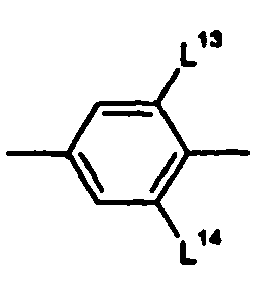


- Eine weitere Gruppe bevorzugter erfindungsgemäßer Verbindungen wird von Verbindungen der Formeln I-S und I-T gebildet, d.h. Verbindungen der Formel I, in denen d 1 ist; Z15 -CF2O- bedeutet; A14 für


- Bevorzugte Untergruppen von Verbindungen der Formeln I-S und I-T werden dabei von Verbindungen der Formeln I-SA und I-TA mit W gleich -C(=O)- und insbesondere von Verbindungen der Formeln I-SB und I-TB mit W gleich -CH2- gebildet.
- Ganz besonders bevorzugte erfindungsgemäße Verbindungen der Formel I-CB sind solche der Formeln I-CBI und I-CBII (die unter anderem auch Ausführungsformen von Verbindungen der Formeln I-F, I-J, I-P, I-Q, I-R und I-T (I-CBI) beziehungsweise I-F, I-J, I-M, I-N und I-O (I-CBII) darstellen):


- Dabei sind L13 und L14 unabhängig voneinander H oder F und R11, R12, L11, L12 und Z14 wie für Formel 1 oben definiert, wobei R11 bevorzugt ein geradkettiger Alkenyl- (CnH2n-1-) oder besonders bevorzugt Alkanylrest (CnH2n+1-) mit 1 bis 7 Kohlenstoffatomen, insbesondere Methyl, ist, während R12 bevorzugt Halogen, insbesondere Fluor, oder ein gegebenenfalls mit Halogen, insbesondere Fluor, einfach oder mehrfach substituierter unverzweigter Alkanyl- oder Alkoxyrest mit 1 bis 5 Kohlenstoffatomen ist und Z14 bevorzugt eine Einfachbindung, eine Carboxylgruppe oder eine Difluoroxymethylen-Brücke darstellt.
- Beispielhafte Verbindungen der Formeln I-CBI und I-CBII werden durch die Formeln I-CBIa, I-CBIb, I-CBIc, I-CBIIa, I-CBIIb und I-CBIIc wiedergegeben, wobei die bevorzugte Bedeutung für R12, L11, L12, L13 und L14 sowie n in den Tabellen 1 und 2 unten angegeben ist:


- Eine weitere Gruppe ganz besonders bevorzugter Verbindungen der Formel I-CB sind solche der Formel I-CBIII:

- Beispielhafte Verbindungen der Formel I-CBIII sind solche der Formeln I-CBIIIa, I-CBIIIb und I-CBIIIc:


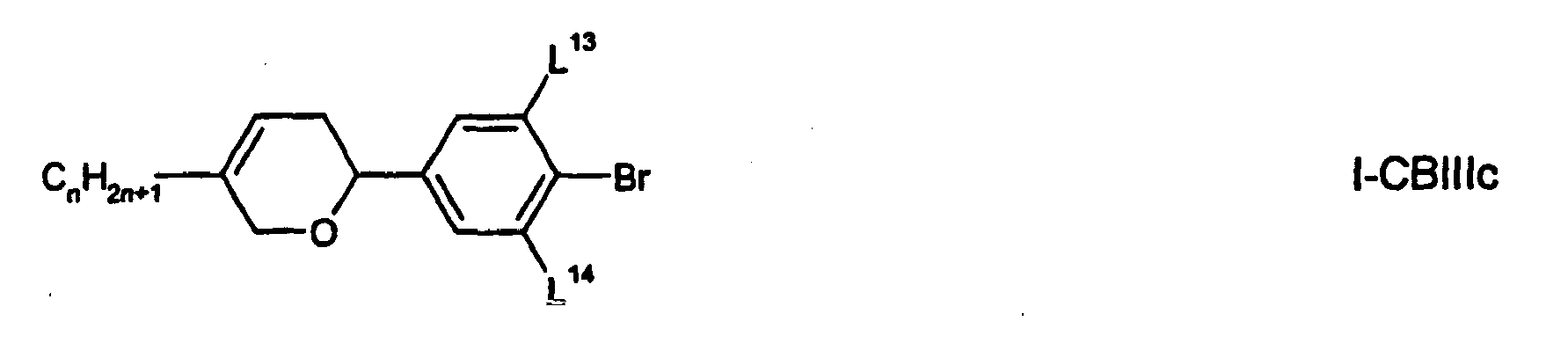
- Dabei sind L13 und L14 unabhängig voneinander H oder F, R12a t-Butyl, Benzyl oder p-Nitrobenzyl, R12b H, Alkanyl mit 1 bis 5 Kohlenstoffatomen oder Aralkyl, insbesondere H, t-Butyl oder Benzyl, während CnH2n+1 für einen geradkettigen Alkanylrest mit n = 1, 2, 3, 4, 5, 6 oder 7 steht.
- Ganz besonders bevorzugte erfindungsgemäße Verbindungen der Formel I-DBA sind solche der Formeln I-DBAI, I-DBAII und I-DBAIII:


- Dabei sind L13 und L14 unabhängig voneinander H oder F und R11, R12 , L11, L12, Z13 und Z14 wie für Formel I oben definiert, wobei R11 bevorzugt H, ein geradkettiger Alkenyl- (CnH2n-1-) oder besonders bevorzugt Alkanylrest (CnH2n+1-) mit 1 bis 7 Kohlenstoffatomen, insbesondere Methyl, ist, während R12 bevorzugt Halogen, insbesondere Fluor, oder ein gegebenenfalls mit Halogen, insbesondere Fluor, einfach oder mehrfach substituierter unverzweigter Alkanyl- oder Alkoxyrest mit 1 bis 5 Kohlenstoffatomen ist, Z13 bevorzugt für eine Einfachbindung oder CF2O steht und Z14 bevorzugt eine Einfachbindung, eine Carboxylgruppe oder eine Difluoroxymethylen-Brücke darstellt.
- Beispielhafte Verbindungen der Formeln I-DBAI, I-DBAII und I-DBAIII werden durch die Formeln I-DBAIa, I-DBAIb, I-DBAIIa, I-DBAIIb, I-DBAIIIa und I-DBAIIIb wiedergegeben, wobei die bevorzugte Bedeutung für R12, L11, L12, L13 und L14 sowie n (n ist 0, 1, 2, 3, 4, 5, 6 oder 7) in den Tabellen 3 und 4 unten angegeben ist:


- Ganz besonders bevorzugte erfindungsgemäße Verbindungen der Formel I-EBC sind solche der Formel I-EBCI:

- Dabei sind R11 und R12 wie für Formel I oben definiert, wobei R11 bevorzugt H, ein geradkettiger Alkenyl- (CnH2n-1-) oder insbesondere Alkanylrest (CnH2n+1-) mit 1 bis 7 Kohlenstoffatomen ist, während R12 bevorzugt Halogen, insbesondere Fluor, oder ein gegebenenfalls mit Halogen, insbesondere Fluor, einfach oder mehrfach substituierter unverzweigter Alkanyl- oder Alkoxyrest mit 1 bis 5 Kohlenstoffatomen ist.
- Beispielhafte Verbindungen der Formeln I-EBCI werden durch die Formel I-EBCIa wiedergegeben, wobei die bevorzugte Bedeutung für R12, L11 und L12 sowie n (n ist 0, 1, 2, 3, 4, 5, 6 oder 7) in Tabelle 3 unten angegeben ist:

- Ganz besonders bevorzugte erfindungsgemäße Verbindungen der Formel I-GB sind neben Verbindungen der Formel I-GBI auch solche der Formeln I-GBII und I-GBIII (die unter anderem auch Ausführungsformen von Verbindungen der Formel I-J darstellen):


- Dabei sind L13 und L14 unabhängig voneinander H oder F, R12b wie R12 für Formel I oben definiert und R11, R12, L11 und L12 wie für Formel I oben definiert, wobei R11 bevorzugt ein geradkettiger Alkenyl- (CnH2n-1-) oder insbesondere Alkanylrest (CnH2n+1-) mit 1 bis 7 Kohlenstoffatomen ist, während R12 für I-GBII und I-GBIII bevorzugt Halogen, insbesondere Fluor, oder ein gegebenenfalls mit Halogen, insbesondere Fluor, einfach oder mehrfach substituierter unverzweigter Alkanyl- oder Alkoxyrest mit 1 bis 5 Kohlenstoffatomen ist; für I-GBI ist R12b bevorzugt H, Alkanyl mit 1 bis 5 Kohlenstoffatomen oder Aralkyl, insbesondere H, tert.-Butyl oder Benzyl.
- Beispielhafte Verbindungen der Formel I-GBI werden durch die Formel I-GBIa wiedergegeben, wobei die bevorzugte Bedeutung für R12b sowie n (n ist 1, 2, 3, 4, 5, 6 oder 7) in Tabelle 5 unten angegeben ist. Beispielhafte Verbindungen der Formeln I-GBII und I-GBIII werden durch die Formeln I-GBlla und I-GBllla wiedergegeben, wobei die bevorzugte Bedeutung für R12, L11, L12 , L13 und L14 sowie n (n ist 1, 2, 3, 4, 5, 6 oder 7) in den Tabellen 1 und 2 unten angegeben ist:


- Ganz besonders bevorzugte erfindungsgemäße Verbindungen der Formel I-HB sind solche der Formeln I-HBI und I-HBII (wobei die Verbindungen der Formeln I-HBI und I-HBII unter anderem auch Ausführungsformen von Verbindungen der Formel I-J sind):


- Dabei sind L13 und L14 unabhängig voneinander H oder F und R11, R12, L11 und L12 wie für Formel I oben definiert, wobei R11 bevorzugt ein geradkettiger Alkenyl- (CnH2n-1-) oder insbesondere Alkanylrest (CnH2n+1-) mit 1 bis 7 Kohlenstoffatomen ist, während R12 bevorzugt Halogen, insbesondere Fluor, oder ein gegebenenfalls mit Halogen, insbesondere Fluor, einfach oder mehrfach substituierter unverzweigter Alkanyl- oder Alkoxyrest mit 1 bis 5 Kohlenstoffatomen ist.
- Beispielhafte Verbindungen der Formeln I-HBI und I-HBII werden durch die Formeln I-HBIa und I-HBIIa wiedergegeben, wobei die bevorzugte Bedeutung für R12, L11, L12, L13 und L14 sowie n (n ist 1, 2, 3, 4, 5, 6 oder 7) in den Tabellen 1 und 2 unten angegeben ist:


- Ganz besonders bevorzugte erfindungsgemäße Verbindungen der Formel I-KB sind solche der Formeln I-KBI und I-KBII:


- Dabei ist R11 wie für Formel I oben definiert und bevorzugt ein geradkettiger Alkenyl- (CnH2n-1-) oder insbesondere Alkanylrest (CnH2n+1-) mit 1 bis 7 Kohlenstoffatomen, im Falle von I-KBII auch H. Beispielhafte Verbindungen der Formeln I-KBI und I-KBII sind solche, in denen R11 für einen geradkettigen Alkanylrest CnH2n+1- mit n = 1, 2, 3, 4, 5, 6 oder 7 steht.
- Ganz besonders bevorzugte erfindungsgemäße Verbindungen der Formel I-LB sind solche der Formeln I-LBI und I-LBII:


- Dabei ist R11 wie für Formel I oben definiert und bevorzugt ein geradkettiger Alkenyl- (CnH2n-1-) oder insbesondere Alkanylrest (CnH2n+1-) mit 1 bis 7 Kohlenstoffatomen, im Falle von I-LBII auch H. R13 und R14 sind ebenfalls wie für Formel I oben definiert und bevorzugt beide Methyl oder zusammen -(CH2)3-. Beispielhafte Verbindungen der Formeln I-LBI und I-LBII sind solche, in denen R11 für einen geradkettigen Alkanylrest CnH2n+1- mit n = 1, 2, 3, 4, 5, 6 oder 7 steht.
- Ganz besonders bevorzugte erfindungsgemäße Verbindungen der Formel I-MB sind solche der Formeln I-MBA und I-MBB:


- Dabei sind L13 und L14 unabhängig voneinander H oder F und R11, R12, L11 und L12 wie für Formel I oben definiert, wobei R11 bevorzugt ein geradkettiger Alkenyl- (CnH2n-1-) oder insbesondere Alkanylrest (CnH2n+1-) mit 1 bis 7 Kohlenstoffatomen ist, im Falle von I-MBB auch H, während R12 bevorzugt Halogen, insbesondere Fluor, oder ein gegebenenfalls mit Halogen, insbesondere Fluor, einfach oder mehrfach substituierter unverzweigter Alkanyl- oder Alkoxyrest mit 1 bis 5 Kohlenstoffatomen ist.
- Beispielhafte Verbindungen der Formel I-MBA sind Verbindungen, die auch durch Formel I-CBIIa oben dargestellt werden, und beispielhafte Verbindungen der Formel I-MBB sind Verbindungen, die auch durch Formel I-DBAIIIa oben dargestellt werden.
- Ganz besonders bevorzugte erfindungsgemäße Verbindungen der Formel I-NB sind solche der Formeln I-NBA, I-NBB, I-NBC und I-NBD:


- Dabei sind L13 und L14 unabhängig voneinander H oder F und R11, R12, L11 und L12 wie für Formel I oben definiert, wobei R11 bevorzugt ein geradkettiger Alkenyl- (CnH2n-1-) oder insbesondere Alkanylrest (CnH2n+1-) mit 1 bis 7 Kohlenstoffatomen ist, im Falle von I-NBB und I-NBD auch H, während R12 bevorzugt Halogen, insbesondere Fluor, oder ein gegebenenfalls mit Halogen, insbesondere Fluor, einfach oder mehrfach substituierter unverzweigter Alkanyl- oder Alkoxyrest mit 1 bis 5 Kohlenstoffatomen ist. R12b hat die gleiche Bedeutung wie für Formel I-CBIIIb beziehungsweise I-GBIa oben.
- Beispielhafte Verbindungen der Formel I-NBA sind Verbindungen, die auch durch Formel I-CBIIb oben dargestellt werden, und beispielhafte Verbindungen der Formel I-NBC sind Verbindungen, die auch durch Formel I-CBIIIb oben dargestellt werden. Beispielhafte Verbindungen der Formel I-NBB sind solche, die durch die Formel I-NBBIa wiedergegeben werden, wobei die Bedeutung für R12, L11, L12, L13 und L14 sowie n (n ist 0, 1, 2, 3, 4, 5, 6 oder 7) in Tabelle 4 unten angegeben ist:

- Ganz besonders bevorzugte erfindungsgemäße Verbindungen der Formel I-OB sind solche der Formeln I-OBA und I-OBB:


- Dabei sind L13 und L14 unabhängig voneinander H oder F und R11, R12, L11 und L12 wie für Formel I oben definiert, wobei R11 bevorzugt ein geradkettiger Alkenyl- (CnH2n-1-) oder insbesondere Alkanylrest (CnH2n+1-) mit 1 bis 7 Kohlenstoffatomen ist, im Falle von I-OBB auch H, während R12 bevorzugt Halogen, insbesondere Fluor, oder ein gegebenenfalls mit Halogen, insbesondere Fluor, einfach oder mehrfach substituierter unverzweigter Alkanyl- oder Alkoxyrest mit 1 bis 5 Kohlenstoffatomen ist.
- Beispielhafte Verbindungen der Formel I-OBA sind Verbindungen, die auch durch Formel I-CBIIc oben dargestellt werden, und beispielhafte Verbindungen der Formel I-OBB sind Verbindungen, die auch durch Formel I-DBAIIIb oben dargestellt werden.
- Ganz besonders bevorzugte erfindungsgemäße Verbindungen der Formel I-PB sind solche der Formeln I-PBA und I-PBB:


- Dabei sind R11, R12, L11 und L12 wie für Formel I oben definiert, wobei R11 bevorzugt ein geradkettiger Alkenyl- (CnH2n-1-) oder insbesondere Alkanylrest (CnH2n+1-) mit 1 bis 7 Kohlenstoffatomen ist, im Falle von I-PBB auch H, während R12 bevorzugt Halogen, insbesondere Fluor, oder ein gegebenenfalls mit Halogen, insbesondere Fluor, einfach oder mehrfach substituierter unverzweigter Alkanyl- oder Alkoxyrest mit 1 bis 5 Kohlenstoffatomen ist.
- Beispielhafte Verbindungen der Formel I-PBA sind Verbindungen, die auch durch Formel I-CBIa oben dargestellt werden, und beispielhafte Verbindungen der Formel I-PBB sind Verbindungen, die auch durch Formel I-DBAIIa oben dargestellt werden.
- Ganz besonders bevorzugte erfindungsgemäße Verbindungen der Formel I-QB sind solche der Formeln I-QBA, I-QBB und I-QBC:


- Dabei sind R11, R12, L11 und L12 wie für Formel I oben definiert, wobei R11 bevorzugt ein geradkettiger Alkenyl- (CnH2n-1-) oder insbesondere Alkanylrest (CnH2n+1-) mit 1 bis 7 Kohlenstoffatomen ist, im Falle von I-QBB auch H, während R12 bevorzugt Halogen, insbesondere Fluor, oder ein gegebenenfalls mit Halogen, insbesondere Fluor, einfach oder mehrfach substituierter unverzweigter Alkanyl- oder Alkoxyrest mit 1 bis 5 Kohlenstoffatomen ist. R12b hat die gleiche Bedeutung wie für Formel I-CBIIIb oben.
- Beispielhafte Verbindungen der Formel I-QBA sind Verbindungen, die auch durch Formel I-CBIb oben dargestellt werden. Beispielhafte Verbindungen der Formel I-QBB sind Verbindungen, die durch Formel I-QBBIa wiedergegeben werden, wobei die Bedeutung für R12, L11 und L12 sowie n (n ist 0, 1, 2, 3, 4, 5, 6 oder 7) in Tabelle 3 unten angegeben ist:

- Ganz besonders bevorzugte erfindungsgemäße Verbindungen der Formel I-RB sind solche der Formeln I-RBA und I-RBB:


- Dabei sind R11, R12, L11 und L12 wie für Formel I oben definiert, wobei R11 bevorzugt ein geradkettiger Alkenyl- (CnH2n-1-) oder insbesondere Alkanylrest (CnH2n+1-) mit 1 bis 7 Kohlenstoffatomen ist, im Falle von I-RBB auch H, während R12 bevorzugt Halogen, insbesondere Fluor, oder ein gegebenenfalls mit Halogen, insbesondere Fluor, einfach oder mehrfach substituierter unverzweigter Alkanyl- oder Alkoxyrest mit 1 bis 5 Kohlenstoffatomen ist.
- Beispielhafte Verbindungen der Formel 1-RBA sind Verbindungen, die auch durch Formel I-CBIc oben dargestellt werden, und beispielhafte Verbindungen der Formel I-RBB sind Verbindungen, die auch durch Formel I-DBAIIb oben dargestellt werden.
- Ganz besonders bevorzugte erfindungsgemäße Verbindungen der Formel I-SB sind solche der Formeln I-SBA und I-SBB:

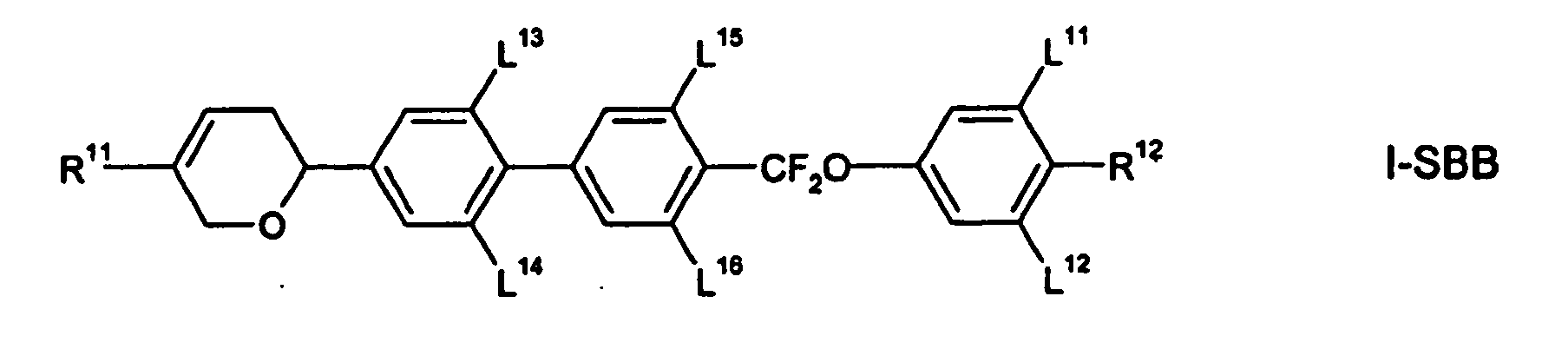
- Beispielhafte Verbindungen der Formeln I-SBA und I-SBB sind Verbindungen, die durch Formel I-SBAIa beziehungsweise I-SBBIa wiedergegeben werden, wobei die Bedeutung für R12, L11, L12 L13, L14, L15 und L16 sowie n (n ist 1, 2, 3, 4, 5, 6 oder 7) in den Tabellen 2 und 6 unten angegeben ist:


- Ganz besonders bevorzugte erfindungsgemäße Verbindungen der Formel I-TB sind solche der Formel I-TBA:

- Dabei sind R11, R12 , L11 und L12 wie für Formel I oben definiert, wobei R11 bevorzugt ein geradkettiger Alkenyl- (CnH2n-1-) oder insbesondere Alkanylrest (CnH2n+1-) mit 1 bis 7 Kohlenstoffatomen ist, während R12 bevorzugt Halogen, insbesondere Fluor, oder ein gegebenenfalls mit Halogen, insbesondere Fluor, einfach oder mehrfach substituierter unverzweigter Alkanyl- oder Alkoxyrest mit 1 bis 5 Kohlenstoffatomen ist.
- Beispielhafte Verbindungen der Formel I-TBA sind Verbindungen, die durch Formel 1-TBAIa wiedergegeben werden, wobei die Bedeutung für R12, L11 und L12 sowie n (n ist 1, 2, 3, 4, 5, 6 oder 7) in Tabelle 1 unten angegeben ist:

Tabelle 1 Verbindung n* R 12 L 11 L 12 I-CBIa-/I-CBIb-/I-CBIc-/I-GBIIa-/I-HBIa-/I-TBAIa-Nr. -1 1 F H H -2 1 F F H -3 1 F F F -4 1 CF3 H H -5 1 CF3 F H -6 1 CF3 F F -7 1 OCF3 H H -8 1 OCF3 F H -9 1 OCF3 F F -10 1 OCHF2 H H -11 1 OCHF2 F H -12 1 OCHF2 F F -13 1 -CN H H -14 1 -CN F H -15 1 -CN F F -16 2 F H H -17 2 F F H -18 2 F F F -19 2 CF3 H H -20 2 CF3 F H -21 2 CF3 F F -22 2 OCF3 H H -23 2 OCF3 F H -24 2 OCF3 F F -25 2 OCHF2 H H -26 2 OCHF2 F H -27 2 OCHF2 F F -28 2 -CN H H -29 2 -CN F H -30 2 -CN F F -31 3 F H H -32 3 F F H -33 3 F F F -34 3 CF3 H H -35 3 CF3 F H -36 3 CF3 F F -37 3 OCF3 H H -38 3 OCF3 F H -39 3 OCF3 F F -40 3 OCHF2 H H -41 3 OCHF2 F H -42 3 OCHF2 F F -43 3 -CN H H -44 3 -CN F H -45 3 -CN F F -46 4 F H H -47 4 F F H -48 4 F F F -49 4 CF3 H H -50 4 CF3 F H -51 4 CF3 F F -52 4 OCF3 H H -53 4 OCF3 F H -54 4 OCF3 F F -55 4 OCHF2 H H -56 4 OCHF2 F H -57 4 OCHF2 F F -58 4 -CN H H -59 4 -CN F H -60 4 -CN F F -61 5 F H H -62 5 F F H -63 5 F F F -64 5 CF3 H H -65 5 CF3 F H -66 5 CF3 F F -67 5 OCF3 H H -68 5 OCF3 F H -69 5 OCF3 F F -70 5 OCHF2 H H -71 5 OCHF2 F H -72 5 OCHF2 F F -73 5 -CN H H -74 5 -CN F H -75 5 -CN F F *: Der Rest CnH2n+1 ist unverzweigt. Tabelle 2 Verbindung n* R 12 L 11 L 12 L 13** L 14*** I-CBIIa-/I-CBIIb-/I-CBIIc-/ I-GBIIIa-/I-HBIIa-/I-SBAIa-Nr. -1 1 F H H H H -2 1 F F H H H -3 1 F F F H H -4 1 F F F F H -5 1 F F F F F -6 1 F F H F H -7 1 F F H F F -8 1 CF3 H H H H -9 1 CF3 F H H H -10 1 CF3 F F H H -11 1 CF3 F F F H -12 1 CF3 F F F F -13 1 CF3 F H F H -14 1 CF3 F H F F -15 1 OCF3 H H H H -16 1 OCF3 F H H H -17 1 OCF3 F F H H -18 1 OCF3 F F F H -19 1 OCF3 F F F F -20 1 OCF3 F H F H -21 1 OCF3 F H F F -22 1 OCHF2 H H H H -23 1 OCHF2 F H H H -24 1 OCHF2 F F H H -25 1 OCHF2 F F F H -26 1 OCHF2 F F F F -27 1 OCHF2 F H F H -28 1 OCHF2 F H F F -29 1 -CN H H H H -30 1 -CN F H H H -31 1 -CN F F H H -32 1 -CN F F F H -33 1 -CN F F F F -34 1 -CN F H F H -35 1 -CN F H F F -36 2 F H H H H -37 2 F F H H H -38 2 F F F H H -39 2 F F F F H -40 2 F F F F F -41 2 F F H F H -42 2 F F H F F -43 2 CF3 H H H H -44 2 CF3 F H H H -45 2 CF3 F F H H -46 2 CF3 F F F H -47 2 CF3 F F F F -48 2 CF3 F H F H -49 2 CF3 F H F F -50 2 OCF3 H H H H -51 2 OCF3 F H H H -52 2 OCF3 F F H H -53 2 OCF3 F F F H -54 2 OCF3 F F F F -55 2 OCF3 F H F H -56 2 OCF3 F H F F -57 2 OCHF2 H H H H -58 2 OCHF2 F H H H -59 2 OCHF2 F F H H -60 2 OCHF2 F F F H -61 2 OCHF2 F F F F -62 2 OCHF2 F H F H -63 2 OCHF2 F H F F -64 2 -CN H H H H -65 2 -CN F H H H -66 2 -CN F F H H -67 2 -CN F F F H -68 2 -CN F F F F -69 2 -CN F H F H -70 2 -CN F H F F -71 3 F H H H H -72 3 F F H H H -73 3 F F F H H -74 3 F F F F H -75 3 F F F F F -76 3 F F H F H -77 3 F F H F F -78 3 CF3 H H H H -79 3 CF3 F H H H -80 3 CF3 F F H H -81 3 CF3 F F F H -82 3 CF3 F F F F -83 3 CF3 F H F H -84 3 CF3 F H F F -85 3 OCF3 H H H H -86 3 OCF3 F H H H -87 3 OCF3 F F H H -88 3 OCF3 F F F H -89 3 OCF3 F F F F -90 3 OCF3 F H F H -91 3 OCF3 F H F F -92 3 OCHF2 H H H H -93 3 OCHF2 F H H H -94 3 OCHF2 F F H H -95 3 OCHF2 F F F H -96 3 OCHF2 F F F F -97 3 OCHF2 F H F H -98 3 OCHF2 F H F F -99 3 -CN H H H H -100 3 -CN F H H H -101 3 -CN F F H H -102 3 -CN F F F H -103 3 -CN F F F F -104 3 -CN F H F H -105 3 -CN F H F F -106 4 F H H H H -107 4 F F H H H -108 4 F F F H H -109 4 F F F F H -110 4 F F F F F -111 4 F F H F H -112 4 F F H F F -113 4 CF3 H H H H -114 4 CF3 F H H H -115 4 CF3 F F H H -116 4 CF3 F F F H -117 4 CF3 F F F F -118 4 CF3 F H F H -119 4 CF3 F H F F -120 4 OCF3 H H H H -121 4 OCF3 F H H H -122 4 OCF3 F F H H -123 4 OCF3 F F F H -124 4 OCF3 F F F F -125 4 OCF3 F H F H -126 4 OCF3 F H F F -127 4 OCHF2 H H H H -128 4 OCHF2 F H H H -129 4 OCHF2 F F H H -130 4 OCHF2 F F F H -131 4 OCHF2 F F F F -132 4 OCHF2 F H F H -133 4 OCHF2 F H F F -134 4 -CN H H H H -135 4 -CN F H H H -136 4 -CN F F H H -137 4 -CN F F F H -138 4 -CN F F F F -139 4 -CN F H F H -140 4 -CN F H F F -141 5 F H H H H -142 5 F F H H H -143 5 F F F H H -144 5 F F F F H -145 5 F F F F F -146 5 F F H F H -147 5 F F H F F -148 5 CF3 H H H H -149 5 CF3 F H H H -150 5 CF3 F F H H -151 5 CF3 F F F H -152 5 CF3 F F F F -153 5 CF3 F H F H -154 5 CF3 F H F F -155 5 OCF3 H H H H -156 5 OCF3 F H H H -157 5 OCF3 F F H H -158 5 OCF3 F F F H -159 5 OCF3 F F F F -160 5 OCF3 F H F H -161 5 OCF3 F H F F -162 5 OCHF2 H H H H -163 5 OCHF2 F H H H -164 5 OCHF2 F F H H -165 5 OCHF2 F F F H -166 5 OCHF2 F F F F -167 5 OCHF2 F H F H -168 5 OCHF2 F H F F -169 5 -CN H H H H -170 5 -CN F H H H -171 5 -CN F F H H -172 5 -CN F F F H -173 5 -CN F F F F -174 5 -CN F H F H -175 5 -CN F H F F *: Der Rest CnH2n+1 ist unverzweigt.
**: L15 für die Verbindungen der Formel I-SBAIa
***: L16 für die Verbindungen der Formel I-SBAIaTabelle 3 Verbindung n* R 12 L 11 L 12 I-DBAIa-/I-DBAIb-/I-DBAIIa-/I-DBAIIb-/I-EBCIa- /I-QBBIa-Nr. -1 0 F H H -2 0 F F H -3 0 F F F -4 0 CF3 H H -5 0 CF3 F H -6 0 CF3 F F -7 0 OCF3 H H -8 0 OCF3 F H -9 0 OCF3 F F -10 0 OCHF2 H H -11 0 OCHF2 F H -12 0 OCHF2 F F -13 0 -CN H H -14 0 -CN F H -15 0 -CN F F -16 1 F H H -17 1 F F H -18 1 F F F -19 1 CF3 H H -20 1 CF3 F H -21 1 CF3 F F -22 1 OCF3 H H -23 1 OCF3 F H -24 1 OCF3 F F -25 1 OCHF2 H H -26 1 OCHF2 F H -27 1 OCHF2 F F -28 1 -CN H H -29 1 -CN F H -30 1 -CN F F -31 2 F H H -32 2 F F H -33 2 F F F -34 2 CF3 H H -35 2 CF3 F H -36 2 CF3 F F -37 2 OCF3 H H -38 2 OCF3 F H -39 2 OCF3 F F -40 2 OCHF2 H H -41 2 OCHF2 F H -42 2 OCHF2 F F -43 2 -CN H H -44 2 -CN F H -45 2 -CN F F -46 3 F H H -47 3 F F H -48 3 F F F -49 3 CF3 H H -50 3 CF3 F H -51 3 CF3 F F -52 3 OCF3 H H -53 3 OCF3 F H -54 3 OCF3 F F -55 3 OCHF2 H H -56 3 OCHF2 F H -57 3 OCHF2 F F -58 3 -CN H H -59 3 -CN F H -60 3 -CN F F -61 4 F H H -62 4 F F H -63 4 F F F -64 4 CF3 H H -65 4 CF3 F H -66 4 CF3 F F -67 4 OCF3 H H -68 4 OCF3 F H -69 4 OCF3 F F -70 4 OCHF2 H H -71 4 OCHF2 F H -72 4 OCHF2 F F -73 4 -CN H H -74 4 -CN F H -75 4 -CN F F -76 5 F H H -77 5 F F H -78 5 F F F -79 5 CF3 H H -80 5 CF3 F H -81 5 CF3 F F -82 5 OCF3 H H -83 5 OCF3 F H -84 5 OCF3 F F -85 5 OCHF2 H H -86 5 OCHF2 F H -87 5 OCHF2 F F -88 5 -CN H H -89 5 -CN F H -90 5 -CN F F *: Der Rest CnH2n+1 ist unverzweigt. Tabelle 4 Verbindung n* R 12 L 11 L 12 L 13 L 14 I-DBAIIIa-/I-DBAIIIb-/I-NBBIa-Nr. -1 0 F H H H H -2 0 F F H H H -3 0 F F F H H -4 0 F F F F H -5 0 F F F F F -6 0 F F H F H -7 0 F F H F F -8 0 CF3 H H H H -9 0 CF3 F H H H -10 0 CF3 F F H H -11 0 CF3 F F F H -12 0 CF3 F F F F -13 0 CF3 F H F H -14 0 CF3 F H F F -15 0 OCF3 H H H H -16 0 OCF3 F H H H -17 0 OCF3 F F H H -18 0 OCF3 F F F H -19 0 OCF3 F F F F -20 0 OCF3 F H F H -21 0 OCF3 F H F F -22 0 OCHF2 H H H H -23 0 OCHF2 F H H H -24 0 OCHF2 F F H H -25 0 OCHF2 F F F H -26 0 OCHF2 F F F F -27 0 OCHF2 F H F H -28 0 OCHF2 F H F F -29 0 -CN H H H H -30 0 -CN F H H H -31 0 -CN F F H H -32 0 -CN F F F H -33 0 -CN F F F F -34 0 -CN F H F H -35 0 -CN F H F F -36 1 F H H H H -37 1 F F H H H -38 1 F F F H H -39 1 F F F F H -40 1 F F F F F -41 1 F F H F H -42 1 F F H F F -43 1 CF3 H H H H -44 1 CF3 F H H H -45 1 CF3 F F H H -46 1 CF3 F F F H -47 1 CF3 F F F F -48 1 CF3 F H F H -49 1 CF3 F H F F -50 1 OCF3 H H H H -51 1 OCF3 F H H H -52 1 OCF3 F F H H -53 1 OCF3 F F F H -54 1 OCF3 F F F F -55 1 OCF3 F H F H -56 1 OCF3 F H F F -57 1 OCHF2 H H H H -58 1 OCHF2 F H H H -59 1 OCHF2 F F H H -60 1 OCHF2 F F F H -61 1 OCHF2 F F F F -62 1 OCHF2 F H F H -63 1 OCHF2 F H F F -64 1 -CN H H H H -65 1 -CN F H H H -66 1 -CN F F H H -67 1 -CN F F F H -68 1 -CN F F F F -69 1 -CN F H F H -70 1 -CN F H F F -71 2 F H H H H -72 2 F F H H H -73 2 F F F H H -74 2 F F F F H -75 2 F F F F F -76 2 F F H F H -77 2 F F H F F -78 2 CF3 H H H H -79 2 CF3 F H H H -80 2 CF3 F F H H -81 2 CF3 F F F H -82 2 CF3 F F F F -83 2 CF3 F H F H -84 2 CF3 F H F F -85 2 OCF3 H H H H -86 2 OCF3 F H H H -87 2 OCF3 F F H H -88 2 OCF3 F F F H -89 2 OCF3 F F F F -90 2 OCF3 F H F H -91 2 OCF3 F H F F -92 2 OCHF2 H H H H -93 2 OCHF2 F H H H -94 2 OCHF2 F F H H -95 2 OCHF2 F F F H -96 2 OCHF2 F F F F -97 2 OCHF2 F H F H -98 2 OCHF2 F H F F -99 2 -CN H H H H -100 2 -CN F H H H -101 2 -CN F F H H -102 2 -CN F F F H -103 2 -CN F F F F -104 2 -CN F H F H -105 2 -CN F H F F -106 3 F H H H H -107 3 F F H H H -108 3 F F F H H -109 3 F F F F H -110 3 F F F F F -111 3 F F H F H -112 3 F F H F F -113 3 CF3 H H H H -114 3 CF3 F H H H -115 3 CF3 F F H H -116 3 CF3 F F F H -117 3 CF3 F F F F -118 3 CF3 F H F H -119 3 CF3 F H F F -120 3 OCF3 H H H H -121 3 OCF3 F H H W -122 3 OCF3 F F H H -123 3 OCF3 F F F H -124 3 OCF3 F F F F -125 3 OCF3 F H F H -126 3 OCF3 F H F F -127 3 OCHF2 H H H H -128 3 OCHF2 F H H H -129 3 OCHF2 F F H H -130 3 OCHF2 F F F H -131 3 OCHF2 F F F F -132 3 OCHF2 F H F H -133 3 OCHF2 F F H F F -134 3 -CN H H H H -135 3 -CN F H H H -136 3 -CN F F H H -137 3 -CN F F F H -138 3 -CN F F F F -139 3 -CN F H F H -140 3 -CN F H F F -141 4 F H H H H -142 4 F F H H H -143 4 F F F H H -144 4 F F F F H -145 4 F F F F F -146 4 F F H F H -147 4 F F H F F -148 4 CF3 H H H H -149 4 CF3 F H H H -150 4 CF3 F F H H -151 4 CF3 F F F H -152 4 CF3 F F F F -153 4 CF3 F H F H -154 4 CF3 F H F F -155 4 OCF3 H H H H -156 4 OCF3 F H H H -157 4 OCF3 F F H H -158 4 OCF3 F F F H -159 4 OCF3 F F F F -160 4 OCF3 F H F H -161 4 OCF3 F H F F -162 4 OCHF2 H H H H -163 4 OCHF2 F H H H -164 4 OCHF2 F F H H -165 4 OCHF2 F F F H -166 4 OCHF2 F F F F -167 4 OCHF2 F H F H -168 4 OCHF2 F H F F -169 4 -CN H H H H -170 4 -CN F H H H -171 4 -CN F F H H -172 4 -CN F F F H -173 4 -CN F F F F F -174 4 -CN F H F H -175 4 -CN F H F F -176 5 F H H H H -177 5 F F H H H -178 5 F F F H H -179 5 F F F F H -180 5 F F F F F -181 5 F F H F H -182 5 F F H F F -183 5 CF3 H H H H -184 5 CF3 F H H H -185 5 CF3 F F H H -186 5 CF3 F F F H -187 5 CF3 F F F F -188 5 CF3 F H F H -189 5 CF3 F H F F -190 5 OCF3 H H H H -191 5 OCF3 F H H H -192 5 OCF3 F F H H -193 5 OCF3 F F F H -194 5 OCF3 F F F F -195 5 OCF3 F H F H -196 5 OCF3 F H F F -197 5 OCHF2 H H H H -198 5 OCHF2 F H H H -199 5 OCHF2 F F H H -200 5 OCHF2 F F F H -201 5 OCHF2 F F F F -202 5 OCHF2 F H F H -203 5 OCHF2 F H F F -204 5 -CN H H H H -205 5 -CN F H H H -206 5 -CN F F H H -207 5 -CN F F F H -208 5 -CN F F F F -209 5 -CN F H F H -210 5 -CN F H F F Tabelle 5 Verbindung n* R 12b Verbindung n* R 12b I-GBIa I-GBIa -1 0 H -2 0 CH3 -3 0 C2H5 -4 0 n-C3H7 -5 0 t-C4H9 -6 0 CH2Phenyl -7 1 H -8 1 CH3 -9 1 C2H5 -10 1 n-C3H7 -11 1 t-C4H9 -12 1 CH2Phenyl -13 3 H -14 3 CH3 -15 3 C2H5 -16 3 n-C3H7 -17 3 t-C4H9 -18 3 CH2Phenyl -19 5 H -20 5 CH3 -21 5 C2H5 -22 5 n-C3H7 -23 5 t-C4H9 -24 5 CH2Phenyl *: Der Rest CnH2n+1 ist unverzweigt. Tabelle 6 Verbindung I-SBBIa-Nr. n* R 12 L 11 L 12 L 15 L 16 L 13 L 14 -1 1 F H H H H H H -2 1 F F H H H H H -3 1 F F F H H H H -4 1 F F F F H H H -5 1 F F F F F H H -6 1 F F H F H H H -7 1 F F H F F H H -8 1 F H H H H F H -9 1 F F H H H F H -10 1 F F F H H F H -11 1 F F F F H F H -12 1 F F F F F F H -13 1 F F H F H F H -14 1 F F H F F F H -15 1 CF3 H H H H H H -16 1 CF3 F H H H H H -17 1 CF3 F F H H H H -18 1 CF3 F F F H H H -19 1 CF3 F F F F H H -20 1 CF3 F H F H H H -21 1 CF3 F H F F H H -22 1 CF3 H H H H F H -23 1 CF3 F H H H F H -24 1 CF3 F F H H F H -25 1 CF3 F F F H F H -26 1 CF3 F F F F F H -27 1 CF3 F H F H F H -28 1 CF3 F H F F F H -29 1 OCF3 H H H H H H -30 1 OCF3 F H H H H H -31 1 OCF3 F F H H H H -32 1 OCF3 F F F H H H -33 1 OCF3 F F F F H H -34 1 OCF3 F H F H H H -35 1 OCF3 F H F F H H -36 1 OCF3 H H H H F H -37 1 OCF3 F H H H F H -38 1 OCF3 F F H H F H -39 1 OCF3 F F F H F H -40 1 OCF3 F F F F F H -41 1 OCF3 F H F H F H -42 1 OCF3 F H F F F H -43 1 OCHF2 H H H H H H -44 1 OCHF2 F H H H H H -45 1 OCHF2 F F H H H H -46 1 OCHF2 F F F H H H -47 1 OCHF2 F F F F H H -48 1 OCHF2 F H F H H H -49 1 OCHF2 F H F F H H -50 1 OCHF2 H H H H F H -51 1 OCHF2 F H H H F H -52 1 OCHF2 F F H H F H -53 1 OCHF2 F F F H F H -54 1 OCHF2 F F F F F H -55 1 OCHF2 F H F H F H -56 1 OCHF2 F H F F F H -57 1 -CN H H H H H H -58 1 -CN F H H H H H -59 1 -CN F F H H H H -60 1 -CN F F F H H H -61 1 -CN F F F F H H -62 1 -CN F H F H H H -63 1 -CN F H F F H H -64 1 -CN H H H H F H -65 1 -CN F H H H F H -66 1 -CN F F H H F H -67 1 -CN F F F H F H -68 1 -CN F F F F F H -69 1 -CN F H F H F H -70 1 -CN F H F F F H -71 2 F H H H H H H -72 2 F F H H H H H -73 2 F F F H H H H -74 2 F F F F H H H -75 2 F F F F F H H -76 2 F F H F H H H -77 2 F F H F F H H -78 2 F H H H H F H -79 2 F F H H H F H -80 2 F F F H H F H -81 2 F F F F H F H -82 2 F F F F F F H -83 2 F F H F H F H -84 2 F F H F F F H -85 2 CF3 H H H H H H -86 2 CF3 F H H H H H -87 2 CF3 F F H H H H -88 2 CF3 F F F H H H -89 2 CF3 F F F F H H -90 2 CF3 F H F H H H -91 2 CF3 F H F F H H -92 2 CF3 H H H H F H -93 2 CF3 F H H H F H -94 2 CF3 F F H H F H -95 2 CF3 F F F H F H -96 2 CF3 F F F F F H -97 2 CF3 F H F H F H -98 2 CF3 F H F F F H -99 2 OCF3 H H H H H H -100 2 OCF3 F H H H H H -101 2 OCF3 F F H H H H -102 2 OCF3 F F F H H H -103 2 OCF3 F F F F H H -104 2 OCF3 F H F H H H -105 2 OCF3 F H F F H H -106 2 OCF3 H H H H F H -107 2 OCF3 F H H H F H -108 2 OCF3 F F H H F H -109 2 OCF3 F F F H F H -110 2 OCF3 F F F F F H -111 2 OCF3 F H F H F H -112 2 OCF3 F H F F F H -113 2 OCHF2 H H H H H H -114 2 OCHF2 F H H H H H -115 2 OCHF2 F F H H H H -116 2 OCHF2 F F F H H H -117 2 OCHF2 F F F F H H -118 2 OCHF2 F H F H H H -119 2 OCHF2 F H F F H H -120 2 OCHF2 H H H H F H -121 2 OCHF2 F H H H F H -122 2 OCHF2 F F H H F H -123 2 OCHF2 F F F H F H -124 2 OCHF2 F F F F F H -125 2 OCHF2 F H F H F H -126 2 OCHF2 F H F F F H -127 2 -CN H H H H H H -128 2 -CN F H H H H H -129 2 -CN F F H H H H -130 2 -CN F F F H H H -131 2 -CN F F F F H H -132 2 -CN F H F H H H -133 2 -CN F H F F H H -134 2 -CN H H H H F H -135 2 -CN F H H H F H -136 2 -CN F F H H F H -137 2 -CN F F F H F H -138 2 -CN F F F F F H -139 2 -CN F H F H F H -140 2 -CN F H F F F H -141 3 F H H H H H H -142 3 F F H H H H H -143 3 F F F H H H H -144 3 F F F F H H H -145 3 F F F F F H H -146 3 F F H F H H H -147 3 F F H F F H H -148 3 F H H H H F H -149 3 F F H H H F H -150 3 F F F H H F H -151 3 F F F F H F H -152 3 F F F F F F H -153 3 F F H F H F H -154 3 F F H F F F H -155 3 CF3 H H H H H H -156 3 CF3 F H H H H H -157 3 CF3 F F H H H H -158 3 CF3 F F F H H H -159 3 CF3 F F F F H H -160 3 CF3 F H F H H H -161 3 CF3 F H F F H H -162 3 CF3 H H H H F H -163 3 CF3 F H H H F H -164 3 CF3 F F H H F H -165 3 CF3 F F F H F H -166 3 CF3 F F F F F H -167 3 CF3 F H F H F H -168 3 CF3 F H F F F H -169 3 OCF3 H H H H H H -170 3 OCF3 F H H H H H -171 3 OCF3 F F H H H H -172 3 OCF3 F F F H H H -173 3 OCF3 F F F F H H -174 3 OCF3 F H F H H H -175 3 OCF3 F H F F H H -176 3 OCF3 H H H H F H -177 3 OCF3 F H H H F H -178 3 OCF3 F F H H F H -179 3 OCF3 F F F H F H -180 3 OCF3 F F F F F H -181 3 OCF3 F H F H F H -182 3 OCF3 F H F F F H -183 3 OCHF2 H H H H H H -184 3 OCHF2 F H H H H H -185 3 OCHF2 F F H H H H -186 3 OCHF2 F F F H H H -187 3 OCHF2 F F F F H H -188 3 OCHF2 F H F H H H -189 3 OCHF2 F H F F H H -190 3 OCHF2 H H H H F H -191 3 OCHF2 F H H H F H -192 3 OCHF2 F F H H F H -193 3 OCHF2 F F F H F H -194 3 OCHF2 F F F F F H -195 3 OCHF2 F H F H F H -196 3 OCHF2 F H F F F H -197 3 -CN H H H H H H -198 3 -CN F H H H H H -199 3 -CN F F H H H H -200 3 -CN F F F H H H -201 3 -CN F F F F H H -202 3 -CN F H F H H H -203 3 -CN F H F F H H -204 3 -CN H H H H F H -205 3 -CN F H H H F H -206 3 -CN F F H H F H -207 3 -CN F F F H F H -208 3 -CN F F F F F H -209 3 -CN F H F H F H -210 3 -CN F H F F F H -211 4 F H H H H H H -212 4 F F H H H H H -213 4 F F F H H H H -214 4 F F F F H H H -215 4 F F F F F F H H -216 4 F F H F H H H -217 4 F F H F F H H -218 4 F H H H H F H -219 4 F F H H H F H -220 4 F F F H H F H -221 4 F F F F H F H -222 4 F F F F F F H -223 4 F F H F H F H -224 4 F F H F F F H -225 4 CF3 H H H H H H -226 4 CF3 F H H H H H -227 4 CF3 F F H H H H -228 4 CF3 F F F H H H -229 4 CF3 F F F F H H -230 4 CF3 F H F H H H -231 4 CF3 F H F F H H -232 4 CF3 H H H H F H -233 4 CF3 F H H H F H -234 4 CF3 F F H H F H -235 4 CF3 F F F H F H -236 4 CF3 F F F F F H -237 4 CF3 F H F H F H -238 4 CF3 F H F F F H -239 4 OCF3 H H H H H H -240 4 OCF3 F H H H H H -241 4 OCF3 F F H H H H -242 4 OCF3 F F F H H H -243 4 OCF3 F F F F H H -244 4 OCF3 F H F H H H -245 4 OCF3 F H F F H H -246 4 OCF3 H H H H F H -247 4 OCF3 F H H H F H -248 4 OCF3 F F H H F H -249 4 OCF3 F F F H F H -250 4 OCF3 F F F F F H -251 4 OCF3 F H F H F H -252 4 OCF3 F H F F F H -253 4 OCHF2 H H H H H H -254 4 OCHF2 F H H H H H -255 4 OCHF2 F F H H H H -256 4 OCHF2 F F F H H H -257 4 OCHF2 F F F F H H -258 4 OCHF2 F H F H H H -259 4 OCHF2 F H F F H H -260 4 OCHF2 H H H H F H -261 4 OCHF2 F H H H F H -262 4 OCHF2 F F H H F H -263 4 OCHF2 F F F H F H -264 4 OCHF2 F F F F F H -265 4 OCHF2 F H F H F H -266 4 OCHF2 F H F F F H -267 4 -CN H H H H H H -268 4 -CN F H H H H H -269 4 -CN F F H H H H -270 4 -CN F F F H H H -271 4 -CN F F F F H H -272 4 -CN F H F H H H -273 4 -CN F H F F H H -274 4 -CN H H H H F H -275 4 -CN F H H H F H -276 4 -CN F F H H F H -277 4 -CN F F F H F H -278 4 -CN F F F F F H -279 4 -CN F H F H F H -280 4 -CN F H F F F H -281 5 F H H H H H H -282 5 F F H H H H H -283 5 F F F H H H H -284 5 F F F F H H H -285 5 F F F F F H H -286 5 F F H F H H H -287 5 F F H F F H H -288 5 F H H H H F H -289 5 F F H H H F H -290 5 F F F H H F H -291 5 F F F F H F H -292 5 F F F F F F H -293 5 F F H F H F H -294 5 F F H F F F H -295 5 CF3 H H H H H H -296 5 CF3 F H H H H H -297 5 CF3 F F H H H H -298 5 CF3 F F F H H H -299 5 CF3 F F F F H H -300 5 CF3 F H F H H H -301 5 CF3 F H F F H H -302 5 CF3 H H H H F H -303 5 CF3 F H H H F H -304 5 CF3 F F H H F H -305 5 CF3 F F F F H F H -306 5 CF3 F F F F F H -307 5 CF3 F H F H F H -308 5 CF3 F H F F F H -309 5 OCF3 H H H H H H -310 5 OCF3 F H H H H H -311 5 OCF3 F F H H H H -312 5 OCF3 F F F H H H -313 5 OCF3 F F F F H H -314 5 OCF3 F H F H H H -315 5 OCF3 F H F F H H -316 5 OCF3 H H H H F H -317 5 OCF3 F H H H F H -318 5 OCF3 F F H H F H -319 5 OCF3 F F F H F H -320 5 OCF3 F F F F F H -321 5 OCF3 F H F H F H -322 5 OCF3 F H F F F H -323 5 OCHF2 H H H H H H -324 5 OCHF2 F H H H H H -325 5 OCHF2 F F H H H H -326 5 OCHF2 F F F H H H -327 5 OCHF2 F F F F H H -328 5 OCHF2 F H F H H H -329 5 OCHF2 F H F F H H -330 5 OCHF2 H H H H F H -331 5 OCHF2 F H H H F H -332 5 OCHF2 F F H H F H -333 5 OCHF2 F F F H F H -334 5 OCHF2 F F F F F H -335 5 OCHF2 F H F H F H -336 5 OCHF2 F H F F F H -337 5 -CN H H H H H H -338 5 -CN F H H H H H -339 5 -CN F F H H H H -340 5 -CN F F F H H H -341 5 -CN F F F F H H -342 5 -CN F H F H H H -343 5 -CN F H F F H H -344 5 -CN H H H H F H -345 5 -CN F H H H F H -346 5 -CN F F H H F H -347 5 -CN F F F H F H -348 5 -CN F F F F F H -349 5 -CN F H F H F H -350 5 -CN F H F F F H *: Der Rest CnH2n+1 ist unverzweigt. - Ein weiterer erfindungsgemäßer Gegenstand ist ein Verfahren zur Herstellung von Pyranderivaten, insbesondere der allgemeinen Formel I.
- Das erfindungsgemäße Verfahren ist dadurch gekennzeichnet, dass es als einen Verfahrensschritt eine ringschließende Metathese-Reaktion einer Verbindung der allgemeinen Formel II
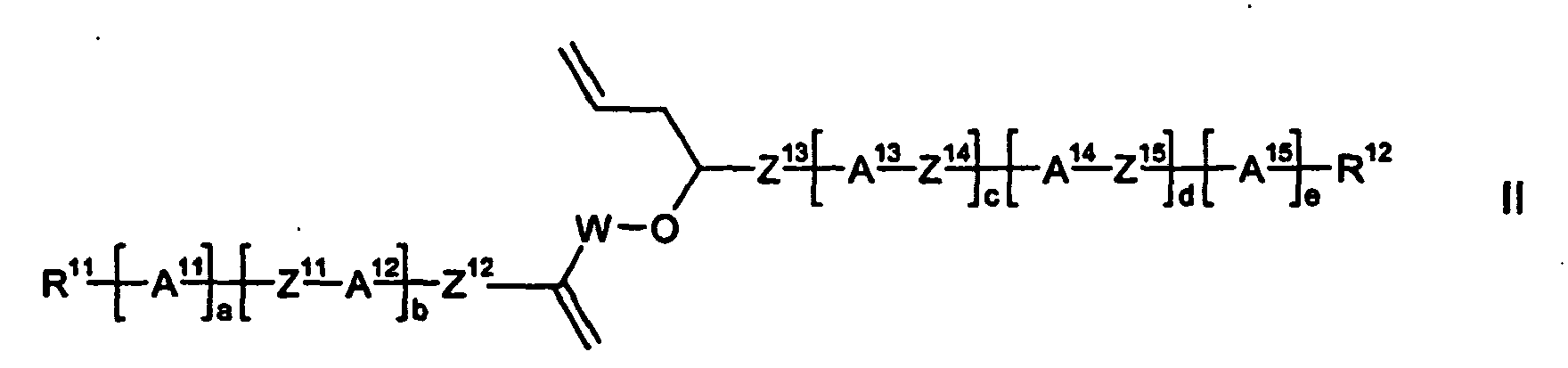

wobei a, b, c, d, e, W, R11, R12, Z11, Z12, Z13, Z14, Z15, A11, A12, A13, A14 und A15 in den FormeIn I und II die gleiche Bedeutung wie für Formel I oben haben; mit der Maßgabe, dass für den Fall der direkten Verknüpfung von Z13 und R12 zu -Z13-R12 R12 H, Aralkyl oder Alkanyl bedeutet, wenn Z13 -C(=O)- bedeutet, R12 Aralkyl oder Alkanyl bedeutet, wenn Z13 -C(=O)-O-bedeutet, und Z13 nicht -CH2O- oder -CF2O- bedeutet; dass für den Fall der direkten Verknüpfung von Z14 und R12 zu -Z14-R12 R12 H, Aralkyl oder Alkanyl bedeutet, wenn Z14 -C(=O)- bedeutet, R12 Aralkyl oder Alkanyl bedeutet, wenn Z14 -C(=O)-O- bedeutet, und Z14 nicht -CH2O- oder -CF2O-bedeutet; dass für den Fall der direkten Verknüpfung von Z15 und R12 zu -Z15-R12 R12 H, Aralkyl oder Alkanyl bedeutet, wenn Z15 -C(=O)- bedeutet, R12 Aralkyl oder Alkanyl bedeutet, wenn Z15 -C(=O)-O- bedeutet, und Z15 nicht -CH2O- oder -CF2O- bedeutet; dass R11 nicht H bedeutet, wenn a und b beide zugleich null sind und Z12 eine Einfachbindung bedeutet; dass R11 nicht CH3 bedeutet, wenn zugleich a und b beide null sind, Z12 und Z13 jeweils eine Einfachbindung bedeuten, W -CH2- bedeutet und -[-A13-Z14-]c-[-A14-Z15-]d-[-A15-]e-R12 für unsubstituiertes Phenyl steht. - Metathese-Reaktionen (auch häufig als Olefin-Metathese bezeichnet) zur Synthese von Carbocyclen (bzw. von (Poly-)Olefinen aus Carbocyclen) sind im Stand der Technik gut bekannt (siehe u.a. R. H. Grubbs und S. Chang, Tetrahedron 54 (1998) 4413; T. M. Trnka und R. H. Grubbs, Acc. Chem. Res. 2001, 34, 18; S. K. Armstrong, J. Chem. Soc., Perkin Trans. I, 1998, 371; A. Fürstner et al., Chem. Eur. J. 2001, 7, 3236, und dort zitierte Literaturstellen). Mit ihrer Hilfe können durch gleichzeitige Spaltung und Knüpfung von ungesättigten Kohlenstoff-Kohlenstoff-Bindungen insbesondere in Gegenwart ausgewählter Metall-Carben-Komplexe neue C-C-Bindungen und somit komplexere Moleküle aufgebaut werden.
- Dabei kann man verschiedene ringschließende und ringöffnende Metathese-Reaktionstypen unterscheiden. Neben der hier nicht weiter interessierenden ringöffnenden polymerisierenden Metathese (ROMP; Ring-opening metathesis polymerization) sind insbesondere die (intramolekulare) ringschließende Metathese (RCM; Ring closing metathesis), die Kreuzmetathese (CM; Cross metathesis) und die Enin-Metathese (Enin) von besonderer Bedeutung. Die genannten Metathese-Typen sind in Schema 1 am Beispiel eines Kohlenwasserstoffs veranschaulicht:

- Die Metathese-Reaktionen werden bevorzugt durch so genannte Schrock-(oder auch Grubbs-)Carben-Komplexe (Metall-Alkyliden-Komplexe) von Übergangsmetallen wie Wolfram, Molybdän und insbesondere Ruthenium katalysiert. Diese Komplexe weisen zumeist eine Struktur auf, die durch die folgende Formel COMP-A wiedergegeben werden kann (vgl. u.a. WO 96/04289, WO 97/06185, WO 99/00396 und WO 99/00397):

- Dabei steht Met für ein Übergangsmetall, (L)x für mehrere gleiche oder verschiedene Liganden und Ry für einen organischen Rest, zumeist Aryl, Alkanyl oder Alkenyl.
- Die genannten ringschließenden Metathese-Reaktionen sind auch eingesetzt worden, um heterocyclische Ringsysteme zu bilden und entsprechende Verbindungen darzustellen. So sind Stickstoff-Heterocyclen in großer Vielzahl durch Olefin-Metathese zugänglich. Auch Sauerstoff-Heterocyclen sind laut Literatur mit Hilfe dieser synthetischen Methodologie herstellbar, jedoch offenbar in deutlich geringerer struktureller Breite.
- So sind von gut zugänglichen Ausgangsverbindungen ausgehende Metathese-Verfahren zur Synthese von Pyranderivaten, die sowohl einen exocyclischen Substituenten an einem Kohlenstoffatom der durch Metathese gebildeten endocyclischen C=C-Doppelbindung und eine 2,5-Disubstitution aufweisen

- Es ist daher besonders überraschend, dass die ringschließende Metathese ausgehend von Verbindungen der Formel II in Gegenwart eines Metathese-Katalysators zuverlässig und effizient zu den erfindungsgemäßen Pyranderivaten der Formel 1 führt.
- Als Metathese-Katalysator für die ringschließende Metathese finden bevorzugt die im Stand der Technik beschriebenen Übergangsmetall-Alkyliden-Komplexe der allgemeinen Formel COMP-A Verwendung (siehe u.a. R. H. Grubbs und S. Chang, Tetrahedron 54 (1998) 4413; T. M. Tmka und R. H. Grubbs, Acc. Chem. Res. 2001, 34, 18; S. K. Armstrong, J. Chem. Soc., Perkin Trans. I, 1998, 371; A. Fürstner et al., Chem. Eur. J. 2001, 7, 3236, und dort zitierte Literaturstellen). Bevorzugt handelt es sich dabei um einen Komplex der Formel COMP-A mit Met = Wolfram, Molybdän oder Ruthenium. Ferner finden Oxo-Wolfram-Komplexe des Typs trans-W(=O)Cl2(Aryl)2 (mit Aryl vorzugsweise gleich 2,6-Dibromphenyl), die unter anderem von W. A Nugent et al., J. Am. Chem. Soc., 1995, 117, 8992, beschrieben worden sind, Verwendung als Metathese-Katalysatoren in den erfindungsgemäßen Verfahren.
- Bevorzugte Molybdän-Metathese-Katalysatoren sind solche der Formeln COMP-Mo1, COMP-Mo2, COMP-Mo3 und COMP-Mo4, während Formel COMP-W1 einen bevorzugten Wolfram-Metathese-Katalysator zeigt:


- Besonders bevorzugte Komplexe zur Verwendung als Metathese-Katalysator in dem erfindungsgemäßen Verfahren sind Ruthenium-Alkyliden-Komplexe des Typs COMP-RuA, die an sich literaturbekannt sind (siehe u.a. WO 96/04289, WO 97/06185, WO 99/00396, WO 99/00397, WO 99/29701, WO 99/51344, WO 00/15339, EP 1 022 282 A2, WO 00/58322, WO 00/71554, WO 02/14336, WO 02/14376, WO 02/083742):

- Vorzugsweise sind dabei Lx1 und/oder Lx2 anionische Liganden, bevorzugt Brom, Iod oder insbesondere Chlor, gegebenenfalls auch O-Aralkyl, während Ly und Lz vorzugsweise andere, zumeist neutrale Liganden wie zum Beispiel PPh3 (Ph = Phenyl), P(i-Pr)3 (i-Pr = iso-Propyl), PCy3 (Cy = Cyclohexyl), P(Cp)3 (Cp = Cyclopentadienyl), unsubstituiertes oder substituiertes Pyridyl, Im1, Im2 oder über das Sauerstoffatom koordinierendes Alkoxy darstellen. Lw steht für einen optional vorhandenen Liganden, d.h. w ist 0 oder 1, wobei dieser zumeist die gleiche Bedeutung hat wie Lx1, Lx2, Ly und/oder Lz. Rz steht für einen organischen Rest, insbesondere Aryl, Alkanyl oder Alkenyl.


- Diese Ruthenium-Komplexe sind im allgemeinen wenig empfindlich für Luftsauerstoff und tolerieren sowohl Feuchtigkeitsspuren als auch geringe Verunreinigungen. Unter den Ruthenium-Alkyliden-Komplexen COMP-RuA sind beispielhaft solche der folgenden Formeln COMP-Ru1 bis COMP-Ru13 zu nennen:

COMP-Ru1 a:R=H b: R = 3-Br c: R = 4-Phenyl 
COMP-Ru2 a: R=Cy b: R = Phenyl c: R = p-CF 3 -Phenyl 
COMP-Ru3 
COMP-Ru4 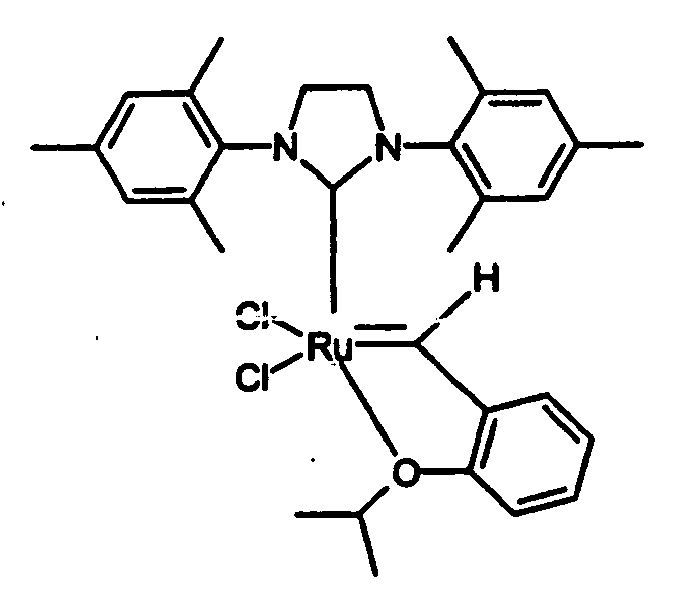
COMP-Ru5 a: R=H b: R = Br c: R = NO 2 
COMP-Ru6 
COMP-Ru7 
COMP-Ru8 
COMP-Ru9 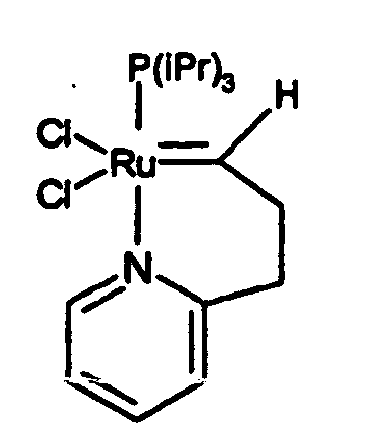
COMP-Ru10 
COMP-Ru11 
COMP-Ru12 
COMP-Ru13 - Die als Metathese-Katalysatoren eingesetzten Alkyliden-Komplexe werden entweder nach literaturbekannten Verfahren hergestellt (siehe neben WO 96/04289, WO 97/06185, WO 99/00396, WO 99/00397, WO 99/29701, WO 99/51344, WO 00/15339, EP 1 022 282 A2, WO-00/58322, WO 00/71554, WO 02/14336, WO 02/14376, WO 02/083742 u.a. auch u.a. R. H. Grubbs und S. Chang, Tetrahedron 54 (1998) 4413; T. M. Tmka und R. H. Grubbs, Acc. Chem. Res. 2001, 34, 18; S. K. Armstrong, J. Chem. Soc., Perkin Trans. I, 1998, 371; A. Fürstner et al., Chem. Eur. J. 2001, 7, 3236; J. A. Love et al., Angew. Chem. 2002, 114, 4207; K. Grela et al., Angew. Chem. 2002, 114, 4210; G. S. Weatherhead et al., Tetrahedron Lett. 41 (2000) 9553; J. S. Kingsbury et al., J. Am. Chem. Soc. 1999, 121, 791, und dort angegebene Literaturstellen) oder sind kommerziell erhältlich, zum Beispiel von Sigma-Aldrich, Inc. (USA), oder Strem Chemicals Inc. (Kehl, Deutschland).
- Einige dieser Katalysatoren können auch an immobilisierenden Trägem, zum Beispiel aus Polystyrol (z.B. COMP-Ru3: M. Ahmed et al., Synlett 2000, 1007; oder COMP-Ru5a und davon abgeleitete Komplexe: St. Randl et al., Synlett 2001, 1547) oder Glas (z.B. COMP-Ru5 und davon abgeleitete Komplexe: J. S. Kingsbury et al., Angew. Chem. 2001, 113, 4381), angebracht sein.
- Ganz besonders bevorzugt wird als Katalysator für den Schritt der ringschließenden Metathese des erfindungsgemäßen Verfahrens außer den oben genannten Molybdän- und Wolfram-Komplexen ein MetallKomplex, ausgewählt aus der Gruppe bestehend aus Komplexen der Formeln COMP-Ru1, -Ru2, -Ru3, -Ru4, -Ru5, -Ru6, -Ru7, -Ru8, -Ru9, -Ru10, -Ru11, -Ru12 und -Ru13, insbesondere der Formeln COMP-Ru2a, -Ru3, -Ru5a, -Ru6, -Ru11 und -Ru13, verwendet. Das Mol-Verhältnis von Verbindung der Formel II zu Katalysator beträgt im allgemeinen von 0,001 bis 20 mol-% (bezogen auf die Verbindung der Formel II), bevorzugt 0,01 bis 10 mol-%, ganz besonders bevorzugt 0,01 bis 2 mol-% und insbesondere 0,01 mol-% bis 0,1 mol-%.
- Die ringschließende Metathese des erfindungsgemäßen Verfahrens wird unter für solche Metallkomplex-katalysierten Reaktionen üblichen Bedingungen ausgeführt. Die Reaktion erfolgt lösungsmittelfrei oder in einem geeigneten Solvens. Als Lösungsmittel wird ein inertes Lösungsmittel, bevorzugt ein aromatisches und/oder halogeniertes organisches Lösungsmittel und insbesondere Toluol, Benzol, Chlorbenzol oder Dichlormethan verwendet. Die Reaktion erfolgt in der Regel bei Temperaturen von Raumtemperatur bis Siedetemperatur des Lösungsmittels (z.B. ca. 20 °C bis 40 °C (Dichlormethan) beziehungsweise bis 80 °C oder 110 °C (Toluol)). Bevorzugt beträgt die Reaktionstemperatur 40 °C bis 60 °C. Die Reaktionszeit ist an sich nicht kritisch, da die Metathese-Reaktion im allgemeinen unter vollständiger Umsetzung des Edukts der Formel II abläuft und das gewünschte Pyranderivat der Formel I in guten Ausbeuten ergibt. Üblicherweise beträgt die Reaktionsdauer von 10 min bis 2 Tagen, bevorzugt von 1 h bis 24 h, insbesondere von 2 h bis 8 h.
- Es ist ferner vorteilhaft, den Katalysator dem Reaktionsgemisch portionsweise zuzusetzen, was eine bessere Steuerung der Umsetzung erlaubt und zu einer Einsparung an Katalysator-Gesamtmenge führt.
- In einer bevorzugten Ausführungsform des erfindungsgemäßen Verfahrens werden Verbindungen der Formel I-A (d.h. Verbindungen der Formel I mit W = -C(=O)-), in denen Z13, Z14 und Z15 nicht -C(O)- bedeuten, nach dem erfindungsgemäßen Metathese-Reaktionsschritt in einem weiteren Reaktionsschritt einer Reduktionsreaktion zur Überführung in ein Pyranderivat der Formel I, worin W eine Methylen-Gruppe ist (d.h. ein Pyranderivat der Formel 1-B) unterworfen. Diese Reduktionsreaktion kann mit geeigneten Reduktionsmitteln, zum Beispiel Düsobutylaluminiumhydrid (DIBAH) oder Bortrifluorid-Etherat + Lithiumaluminumhydrid oder Lithiumborhydrid oder Natriumborhydrid (siehe J. March: Advanced Organic Chemistry; John Wiley & Sons, New York u.a., 3. Aufl., 1985, S. 1100, 9-41), ausgeführt werden. Dabei werden auch andere im Molekül vorhandene Carboxy-Funktionen (C(=O)O) zu Ether-Funktionen (CH2O) reduziert.
- Eine weitere bevorzugte Ausführungsform des erfindungsgemäßen Verfahrens umfaßt als einen weiteren, vor dem ringschließenden Metathese-Schritt erfolgenden Reaktionsschritt die Umsetzung einer Acrylverbindung beziehungsweise Allylverbindung der Formel IV mit einer Homoallylverbindung der Formel V unter Bildung der Verbindung der Formel II


- Wenn W für -C(=O)- steht (d.h. die Verbindung der Formel IV ist ein Acrylderivat (Formel IV-A)), ist X11 bevorzugt Methoxy, Ethoxy, Propoxy, t-Butoxy, Chlor, Brom oder ein Anhydrid-Rest, insbesondere Acetoxy. Der Verfahrensschritt verläuft dann unter für derartige Esterbildungsreaktionen üblichen Bedingungen (vgl: u.a. J. March: Advanced Organic Chemistry; John Wiley & Sons, New York u.a., 3. Aufl., 1985, S. 346-351, 0-22, 0-23 und 0-24).
- Vorzugsweise steht W für -CH2- (d.h. die Verbindung der Formel IV ist ein Allylderivat (Formel IV-B)). In diesem Fall ist X11 bevorzugt Chlor, Brom, iod oder ein Sulfonsäurerest, z.B. CF3-SO3-, CH3-SO3-, C4F9-SO3 oder p-CH3-C6H4-SO3-. Der erfindungsgemäße Etherbildungs-Reaktionsschritt erfolgt im allgemeinen unter Bedingungen der Williamson-Ether-Synthese (s. z.B. J. March: Advanced Organic Chemistry; John Wiley & Sons, New York u.a., 3. Aufl., 1985, S. 342, 0-14), d.h. unter basischen Reaktionsbedingungen und bei Temperaturen von Raumtemperatur bis ca. 60 °C in geeigneten Lösungsmitteln, z.B. Ethern wie Tetrahydrofuran (THF), Methyl-tert.-butylether (MTBE), Dioxan oder Dimethoxyethan. Eine besonders bevorzugte Variante dieser Reaktion arbeitet mit granuliertem NaOH in THF in Gegenwart eines Phasentransferkatalysators und von wenig Wasser, wobei die Allylverbindung der Formel IV-B mit X11 = Brom oder Chlor und der Homoallylalkohol der Formel V für 4 bis 48 h auf 40 °C bis 60 °C erwärmt werden. Diese Variante eignet sich besonders für diejenigen Homoallylalkohole der Formel V, die keine Carboxylfunktion aufweisen (also Homoallylalkohole der Formel V, in denen Z13, Z14 und Z15 nicht CO2 bedeuten). Alternativ kann als Base Natriumhydrid, bevorzugt in einem organischen Lösunsmittel, eingesetzt werden.
- Die in dem erfindungsgemäßen Verfahren eingesetzten Acrylverbindungen beziehungsweise Allylverbindungen der Formel IV und Homoallylverbindungen der Formel V sind - soweit sie literaturbekannt sind - entweder käuflich erhältlich oder werden nach an sich bekannten Methoden dargestellt, wie sie in der Literatur (zum Beispiel den Standardwerken wie Houben-Weyl, Methoden der Organischen Chemie, Georg-Thieme-Verlag, Stuttgart) beschrieben sind, und zwar unter Reaktionsbedingungen, die für die dort genannten Umsetzungen bekannt und geeignet sind. Dabei kann man auch von an sich bekannten, hier nicht näher erwähnten Varianten Gebrauch machen.
- Die Allylverbindungen der Formel IV-Ba mit a = b = 0 sind unter anderem über die in Anlehnung an ein Verfahren von Weigand und Brückner (S. Weigand, R. Brückner, Synthesis 1996,475) gemäß Schema 2 zugänglichen Allylalkohole der Formel IV-Ba1 erhältlich. Die Umwandlung von IV-Ba1 in die Allylverbindungen der Formel IV-Ba2 erfolgt nach bekannten Verfahren, z.B. für X11 = Br mit Brom/Triphenylphosphan und für X11 = CF3SO3 mittels Trifluormethansulfonsäurechlorid oder Trifluormethansulfonsäureanhydrid.

- Die Synthese der bislang unbekannten Allylderivate der Formel IV-Bb mit a und/oder b gleich 1 erfolgt analog und ist in Schema 3 dargestellt:

- Anstelle der substituierten Malonsäurediester Vo-IVa beziehungsweise Vo-IVb können zur Herstellung der Allylderivate der Formel IV-B auch die entsprechenden literaturbekannten oder in Analogie zu bekannten Verfahren zugänglichen Diole der Formel Vo-IVc (siehe unter anderem P. Kirsch und E. Poetsch, Adv. Mater. 1998, 10, 602, und dort angegebene Literaturstellen; C. Tschierske et al., Mol. Cryst. Liq. Cryst. 1990, 191, 295; EP 400 861 A1) verwendet werden. Die Vorstufe Vo-IVc ergibt zum Beispiel nach Dihalogenierung und Behandlung mit 1 Äquivalent Kalium-tert.-butylat die Allylverbindung IV-B mit X11 = Halogen.

- Die Allylalkohole der FormeIn IV-Ba1 und IV-Ba2 sind auch in Analogie zu einem Verfahren von H. Mitzutani et al. (Tetrahedron 58 (2002) 8929) aus den entsprechenden Acroleinderivaten mit NaBH4/CeCl3 zugänglich; die Acroleinderivate ihrerseits werden aus dem entsprechenden Aldehyd R11-Z12-CH2-CHO beziehungsweise R11-[-A11-]a-[-Z11-A12-]b-Z12-CH2-CHO mit Eschenmosers Reagenz erhalten.
Die neuen Allylderivate der Formel IV-Bb
- X11a
- Chlor, Brom, Iod, einen Sulfonsäurerest, -OH, Alkoxy oder O-Aralkyl bedeutet oder -X11a für =O steht;
- R11, Z11 und Z12
- wie für Formel I oben definiert sind; und
- A11 und A12
- wie für Formel I oben definiert sind und bevorzugt 1,4-Cyclohexylen bedeuten;
- Die korrespondierenden Acrylderivate der Formel IV-A sind unter anderem durch Oxidation der entsprechenden Allylalkohole der Formel IV-Ba1 beziehungsweise IV-Bb1 mit einem starken Oxidationsmittel wie einem Chrom(VI)-Oxidationsmittel zugänglich (J. March: Advanced Organic Chemistry; John Wiley & Sons, New York u.a., 3. Aufl., 1985, S. 1084, 9-22). Alternativ können die Allylalkohole auch zunächst mit einem milderen Oxidationsmittel wie Braunstein (MnO2) in die entsprechenden Aldehyde (Acroleinderivate) überführt werden, die dann beispielsweise mit einer alkalischen Ag2O- oder Silbernitrat-Lösung oder mittels Luft-Sauerstoff in die Acrylderivate der Formel IV-A überführt werden.
- Die Homoallylverbindungen der Formel V sind gemäß Schema 4 durch Umsetzung von Aldehyden der Formel Vo-Va mit Allylbromid zugänglich (wobei anstelle des Bromids auch andere Allylhalogenide, insbesondere das Allylchlorid, verwendet werden können):

- Dabei kann die erforderliche Aktivierung des Allylhalogenids auf unterschiedliche Weise erfolgen: Beispielsweise wird durch Zugabe von Allylbromid zu Indium-Pulver in einem geeigneten Reaictionsmedium, zum Beispiel Wasser oder Wasser/Tetrahydrofuran, zunächst eine entsprechende intermediäre Indium-Allylverbindung (nach T.-P. Loh et al., Tetrahedron Letters 42 (2001) 8701 und 8705) gebildet, die dann mit dem Aldehyd Vo-Va unter Bildung des korrespondierenden Homoallylalkohols V reagiert. Allylbromid kann auch mit Lithium oder einer Lithium-organischen Base oder mit Magnesium, zumeist im Überschuß, oder einer reaktiven Grignard-Base unter Halogen-Metall-Austausch in die entsprechende intermediäre Lithium- beziehungsweise Magnesiumbromid-Allylverbindung überführt werden, die dann mit dem Aldehyd Vo-Va zu dem Homoallylalkohol V reagiert. Enthält der Aldehyd Vo-Va zusätzlich eine Ester- oder Nitrilfunktion, so ist es vorteilhaft, die intermediäre Lithiumbeziehungsweise Magnesiumbromid-Allylverbindung in bekannter Weise mit Zink- oder Titansalzen umzumetallieren, da die entsprechenden Zinkbeziehungsweise Titan-Allylverbindungen chemoselektiv nur mit der aldehydischen Carbonyl-Funktion und nicht mit der Ester-Carboxybeziehungsweise Nitril-Funktion reagieren.
- Ferner können auch Allylderivate anderer Metalle und Halbmetalle, zum Beispiel Allylderivate von Chrom, Zinn, Zink, Samarium, Bor und Silicium, zur Herstellung der Homoallylverbindungen V eingesetzt werden. Ausgehend von Allylmesylat (Brom im Allylbromid ist durch einen Mesylatrest (-OSO2CH3) ersetzt), sind mittels Transmetallierung mit z.B. LiSn(butyl)3 die entsprechenden Allyl-Stannane zugänglich, die auch durch Umsetzung von Allylbromid mit Zinn(II)chlorid und Kaliumiodid in Wasser (vgl. V.V. Samoshin et al., Tetrahedron Lett. 43 (2002) 6329) oder mit Zinnmetall unter Einwirken von Ultraschall und Wasser (vgl. P. C. Andrews, Tetrahedron Lett. 43 (2002) 7541) hergestellt und mit dem Aldehyd Vo-V zum Homoallylalkohol V umgesetzt werden können.
- Entsprechend ist unter anderem mit Zinkstaub in Tetrahydrofuran die Zinkallylverbindung (vgl. B. C. Ranu et al., Tetrahedron Lett. 36 (1995), 4885), mit Sml2 in Tetrahydrofuran die Samariumallylverbindung (vgl. B. Hamann-Gaudinet et al., Tetrahedron Lett. 38 (1997) 6585) beziehungsweise mit Cr(II)Cl2/Mn die Chromallylverbindung erhältlich, die mit einem Aldehyd Vo-V zu Homoallylalkoholen V umgesetzt werden können.
- Da die Aldehyde der Formel Vo-V am Carbonyl-Kohlenstoffatom ein prochirales Zentrum aufweisen, wird bei der Umsetzung mit dem aus Allylbromid gebildeten aktivierten Allylderivat zu dem Homoallylalkohol V ein Chiralitätszentrum am die Hydroxyfunktion tragenden Kohlenstoffatom gebildet. Im allgemeinen entsteht dabei ein Racemat der optischen Antipoden des Homoallylalkohols V. Es ist jedoch auch möglich, eines der optischen Isomeren des Homoallylalkohols V stereoselektiv herzustellen oder alternativ aus der racemischen Mischung zu isolieren.
- Die stereoselektive Synthese erfolgt bevorzugt durch katalytische asymmetrische Allylierung des Aldehyds der Formel Vo-V mit einer Allylzinnverbindung, zumeist dem Allyltributylstannan, in Gegenwart eines chiralen Katalysators. Als chirale Katalysatoren eignen sich insbesondere Komplexe chiraler Binaphtol- (BINOL-)Verbindungen mit Zirkonium {z.B. (R,R)- oder (S,S)-BINOL-Zr(O-tert.-Butyl)4: M. Kurosu et al., Tetrahedron Lett. 43 (2002) 1765) beziehungsweise Titan (z.B. Bis(((S)(napthoxy)-(isopropxy)titanoxid: H. Hanawa et al., J. Am. Chem. Soc. 2003, 125, 1708) oder entsprechende Boronate (vgl. z.B. S. Thormeier et al., J. Organomet. Chem. 657 (2002) 136). Grundsätzlich ist so - je nach Wahl des chiralen Katalysators - das R- oder das S-Isomere selektiv zugänglich.
- Die Isolierung der Enantiomeren aus der racemischen Mischung erfolgt nach üblichen Verfahren, zum Beispiel mittels Kristallisation mit einer chiralen Base oder Chromatographie an einem chiralen Säulenmaterial.
- Durch Verwendung eines so zugänglichen enantiomerenreinen Homoallylalkohols der Formel V wird über die Zwischenstufe II nach der erfindungsgemäßen ringschließenden Metathese-Reaktion das entsprechende Pyranderivat der Formel I, das in 2-Position ein asymmetrisches Zentrum aufweist, in enantiomerenreiner Form erhalten. Eine weitere Möglichkeit, einen der optischen Antipoden des Pyranderivats der Formel I stereoselektiv zu erhalten, besteht in der Verwendung eines chiralen Metathese-Katalysators, z.B. COMP-Mo3 oder COMP-Mo4 (G. S. Weatherhead et al., Tetrahedron Lett. 41 (2000) 9553).
- Aldehyde der Formel Vo-Va sind als solche literaturbekannt (siehe u.a. EP 122 389 A2) beziehungsweise in Analogie dazu herstellbar. Die Synthese von Aldehyden der Formel Vo-Va mit Z13 = CF2O erfolgt dabei zum Beispiel ausgehend von dem Säurechlorid
EthylO-C(=O)-C(=O)-Cl Vo-Vb
durch Umsetzung mit zunächst NaS-(CH2)3-SH. Der dabei entstehende Thiolthioester wird mit Trifluormethansulfonsäure (in Analogie zu den Verfahren gemäß P. Kirsch et al., Angew. Chem. 2001, 113, 1528, und WO 01/64667) zu dem entsprechenden Bis(alkylthio)carbenium-Salz
HO-[A13-Z14]c-[A14-Z15]d-[A15]e-R12 Vo-Vd,
dann mit 1,3-Dibrom-5,5-dimethylhydanthoin (DBH) oder N-Bromsuccinimid (NBS) oder Brom und schließlich mit wäßriger Lauge zum Ester
Ethyl-O-C(=O)-CF2O-[A13-Z14]c-[A14-Z]d-[A15]e-R12 Vo-Ve
umgesetzt wird. Die abschließende Einführung der Aldehyd-Funktion unter Ergeben des Aldehyds der Formel Vo-Va erfolgt entweder durch direkte Reduktion des Esters mit einem geeigneten Reduktionsmittel wie Diisobutylaluminiumhydrid in einem inerten Solvens, zum Beispiel Methylenchlorid, oder über die Reduktion des Esters zum entsprechenden Alkohol und anschließende Oxidation zum Aldehyd mit einem geeigneten Oxidationsmittel, zum Beispiel mit Dess-Martin-Reagenz. - Eine alternative Syntheseroute, die sich vor allem für die Darstellung von Aldehyden der Formel Vo-Va eignet, in denen die Difluoroxymethylen-Brücke mit einem aromatischen Rest verknüpft ist, geht von dem Ester Ethyl-O-C(=O)-CF2Br aus, der mit einem geeigneten Phenolat in Gegenwart von beispielsweise Hexamethylenphosphortribromid oder unter Pd0-Komplex-Katalyse unter Bildung der CF2O-Brücke und nach abschließender Reduktion der Esterfunktion in den gewünschten Aldehyd Vo-Va überführt wird.
- Sofern es sich bei dem Aldehyd der Formel V-IV um ein Phenanthrenderivat der Formel


- In Schritt (1) erfolgt eine C-C-Kupplung unter Pd°-Katalyse zum Biphenyl, das in Schritt (2) mit Vinylmagnesiumbromid oder Vinylzinkbromid in Gegenwart eines Palladium-Komplexes (PdCl2·dppf) in das Divinylderivat überführt wird. In Schritt (3) erfolgt eine intramolekulare Kreuzmetathese zum Phenanthrenderivat in Gegenwart eines Ruthenium-Alkyliden-Komplexes COMP-RuA, bevorzugt COMP-Ru2a-c oder COMP-Ru4. Das Chlorphenanthren wird anschließend in Schritt (4) mit CO/Ethanol bei 70 °C und 5 bar in Gegenwart von PdCl2·[2P(Cyclohexyl)3] als Katalysator in den Ethylester überführt, der nach abschließender Reduktion mit DIBAH in Schritt (5) den gewünschten Phenanthrenaldehyd ergibt.
- Zur Herstellung des Phenanthrenaldehyds der Formel


- Die für die Herstellung von erfindungsgemäßen Verbindungen der Formel I-G nach dem erfindungsgemäßen Verfahren mittels ringschließender Metathese-Reaktion erforderlichen Ausgangsverbindungen sind auch nach einem weiteren Verfahren zugänglich, das in Schema 6 illustriert ist:

- Dabei wird zunächst z.B. aus dem Allylalkohol IV und Bromessigsäure VI die Säure VII hergestellt (gemäß z.B. J. March: Advanced Organic Chemistry; John Wiley & Sons, New York u.a., 3. Aufl., 1985, S. 342, 0-14), die anschließend mit Allylalkohol unter üblichen Bedingungen (vgl. u.a. J. March: Advanced Organic Chemistry; John Wiley & Sons, New York u.a., 3. Aufl., 1985, S. 346-351, 0-22, 0-23 und 0-24) in die Verbindung VIII überführt wird.
- Diese wird anschließend einer Claisen-Umlagerung (siehe z.B. J. March: Advanced Organic Chemistry; John Wiley & Sons, New York u.a., 3. Aufl., 1985, S. 1028, 8-37) unterworfen, z.B. indem eine Lösung von VIII in THF bei sehr tiefen Temperaturen (ca. -100 °C) zunächst mit Lithiumdiisopropylamid (LDA) und dann mit einer 1:1-Mischung von Trimethylsilylchlorid und Triethylamin versetzt wird; nach langsamem Auftauen wird mit wäßriger Base oder Säure versetzt und nach üblicher Aufarbeitung die Säure II-1 erhalten. Für die erfindungsgemäße ringschließende Metathese-Reaktion ist es bevorzugt, anstelle der freien Carbonsäure II-1 einen Ester II-2 einzusetzen, der nach üblichen Veresterungs-Methoden hergestellt wird und nach der Metathese-Reaktion die erfindungsgemäßen Verbindungen der Formel I-G ergibt.
- Es ist selbstverständlich, dass zum einen Vorstufen und Ausgangsverbindungen der Formeln II, IV und V für erfindungsgemäße Verbindungen der Formel I aus anderen geeigneten Vorstufen und Ausgangsverbindungen der Formeln II, IV und V hergestellt werden können, und zum anderen auch erfindungsgemäße Verbindungen der Formel I nach erfolgtem Ringschluss in andere erfindungsgemäße Pyranderivate der Formel I umgewandelt werden können. Als besonders nützlich haben sich dabei Carbonsäure-, Benzyloxy- und Halogenderivate erwiesen.
- So kann beispielsweise der Carbonsäureester der Formel II-2-(mit c = d = e = 0 und R12 Aralkyl, Alkanyl oder Alkenyl) zuerst einer ringschließenden Metathese-Reaktion unter Bildung des entsprechenden Pyranderivats der Formel I-G (mit c = d = e = 0 und R12 Aralkyl, Alkanyl oder Alkenyl) unterworfen werden. Durch Umesterung dieses Esters mit Synthesebausteinen des Typs HO-[A13-Z14]c-[A14-Z15]d-[A15]e-R12 können dann andere erfindungsgemäße Verbindungen der Formel I-G erhalten werden. Eine entsprechende Veresterung kann aber auch, falls gewünscht, vor der ringschließenden Metathese-Reaktion mit der Vorstufe II-1 ausgeführt werden.
- Die erfindungsgemäßen Carbonsäuren der Formel I-G (mit R12 = H und c = d = e = 0), die aus den entsprechenden Estern durch basische oder saure Verseifung dargestellt werden, können eingesetzt werden, um über das korrespondierende Bis(alkythio)carbeniumsalz und anschließende oxidative Fluordesulfurierung (vgl. WO 01/64667) das entsprechende CF2O-verbrückte Pyranderivat der Formel I-H zu erhalten. Die oxidative Fluordesulfurierung ist natürlich auch bei solchen erfindungsgemäßen Verbindungen der Formel I anwendbar, bei denen die Carboxyl-Funktion nicht direkt mit dem zentralen Pyranring verknüpft ist, d.h. wenn Z14 oder Z15 = -CO2H bedeutet; auf diese Weise werden dann -CF2O-[A14-Z15]d-[A15]e-R12- beziehungsweise -CF2O-A15-R12-Reste eingeführt.
- Aus den erfindungsgemäßen Carbonsäureestern der Formel I-G mit R12≠ H und c = d = e = 0 sind entweder durch direkte Reduktion beispielsweise mit einem geeigneten Metallhydrid oder zweistufig durch Reduktion zum primären Alkohol und anschließende schonende Oxidation mit beispielsweise Dess-Martin-Reagenz erfindungsgemäße Aldehyde der Formel I mit Z13-R12 = -C(=O)-H zugänglich. Die Reduktion zu erfindungsgemäßen Pyranderivaten mit Aldehyd-Funktion ist selbstverständlich auch mit Verbindungen der Formel I durchführbar, bei denen die Carbonsäureester-Funktion nicht direkt mit dem zentralen Pyranring verknüpft ist, d.h. wenn Z14 oder Z15 = -CO2R12 bedeutet. Auf diese Weise wird die -C(=O)-H-Funktion als Rest Z14-R12 beziehungsweise Z15-R12 eingeführt.
- Aus den so zugänglichen Aldehyden der Formel I sind beispielsweise mittels Wittig- oder Wittig-Horner-Reaktion mit Molekülen des Typs Rx-[A13-Z14]c-[A14-Z15]d-[A15]e-R12 (wobei Rx beispielsweise für (Phenyl)3P=CH- oder (EthylO)2P(=O)-CH2- steht) die entsprechenden erfindungsgemäßen Verbindungen der Formel I mit Z13, Z14 beziehungsweise Z15 = -CH=CH- zugänglich.
- Die Herstellung von erfindungsgemäßen Ketonen der Formel I mit Z13-R12, Z14-R12 beziehungsweise Z15-R12 = -C(O)-R12 und R12 = Alkanyl, Alkenyl oder Aralkyl erfolgt z.B. durch Umsetzung des korrespondierenden Carbonsäureesters der Formel I-G mit einem geeigneten metallorganischen Reagenz, zum Beispiel mit einer Verbindung R12-Mg-Br nach Grignard (siehe z.B. J. March: Advanced Organic Chemistry, John Wiley & Sons, New York u.a., 3. Aufl., 1985, S. 434, 0-107). Analog sind auch weitere Ketone der Formel I mit beispielsweise Z13-[A13-Z14]c-[A14-Z15]d-[A15]e-R12 gleich -C(O)-[A13-Z14]c-[A14-Z15]d-[A15]e-R12 durch Umsetzung mit einem geeigneten metallorganischen Reagenz Met*-[A13-Z14]c-[A14-Z15]d-[A15]e-R12 (wobei "Met*" zum Beispiel Br-Mg oder Li bedeutet) zugänglich. Sofern Z14 und Z15 nicht CO2 bedeuten und R12 keine Carboxylfunktion enthält, sind die Ketone der Formel I durch Reduktion der entsprechenden Ester der Formel I-G erhältlich. Analog können Keto-Funktionen auch als Z14 oder Z15 eingeführt werden.
- Auch erfindungsgemäße Verbindungen der Formel I-K sind gut für weitere Derivatisierungen geeignet. Durch Umsetzung am Cyclohexanonring mit beispielsweise Trimethylsilyl-1,3-dithian in THF in Gegenwart von n-Butyllithium (in Anlehnung an das Verfahren von J. Mlynarski und A. Banaszek, Tetrahedron 55 (1999) 2785) oder analog zu den Verfahren von P. Kirsch et al., Angew. Chem. 2001, 113, 1528, sind die entsprechenden Ketendithioketale (mit dem Strukturbestandteil
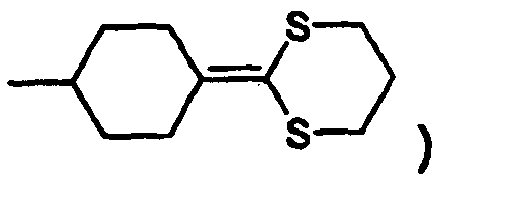

- Die erfindungsgemäßen Cyclohexanone der Formel I-K können auch mit einem geeigneten Grignard-Reagenz, zum Beispiel des Typs Br-Mg-Z14-A14-R12 mit Z14 beispielsweise -CH2- oder -CH2CH2-, zu den entsprechenden tertiären Alkoholen, in diesem Beispiel mit dem Strukturelement


- Erfindungsgemäße Verbindungen der Formel I, die einen endständigen Phenylring mit R12 = Halogen, insbesondere Brom oder Iod, aufweisen, zum Beispiel entsprechende Verbindungen der Formeln I-CBI, I-CBII, I-CBIIIc, I-GII, I-GIII, I-HI, I-HII oder I-J, können ebenfalls als Ausgangsverbindungen zur Herstellung weiterer erfindungsgemäßer Verbindungen der Formel I eingesetzt werden. So kann - nach Metallierung unter Metall-Halogen-Austausch beispielsweise mit einer metallorganischen Base wie n-Butyllithium - die intermediäre metallierte Verbindung mit verschiedenen Reagenzien weiter umgesetzt werden, so z.B. mit CO2 unter Bildung der korrespondierenden Carbonsäure, mit Borsäureestem oder verwandten Borverbindungen unter Bildung der korrespondierenden Aryl-Bor-Verbindungen, oder in Gegenwart geeigneter Katalysatoren mit Reaktionspartnern, die C-C-Kreuzkupplungsreaktionen beispielsweise vom Typ der Heck- oder der Suzuki-Reaktion eingehen.
- Auch die genannten Aryl-Bor-Verbindungen oder die halogenierten Verbindungen selbst können in derartigen literaturbekannten Kreuzkupplungsreaktionen (siehe z.B. N. Miyaura, A. Suzuki, Chem. Rev. 1995, 95, 2457) umgesetzt werden. Ferner sei angemerkt, dass auch bestimmte Vorstufen und Ausgangsverbindungen der erfindungsgemäßen Verfahren, zum Beispiel solche, in denen ein aromatischer Ring A13 direkt mit einem aromatischen Ring A14 (beziehungsweise A15) über Z14 (beziehungsweise Z15) = Einfachbindung verknüpft ist, mit Hilfe dieser Kreuzkupplungsreaktionen hergestellt werden können.
- Ferner ist es bevorzugt, in dem erfindungsgemäßen Verfahren nach dem ringschließenden Metathese-Reaktionsschritt als einen weiteren Reaktionsschritt eine katalytische Hydrierung zu einem Pyranderivat der allgemeinen Formel III durchzuführen:

- f, g, h, j und k
- jeweils unabhängig voneinander 0 oder 1 sind;
- R31
- H, einen unsubstituierten oder einfach oder mehrfach gleich oder verschieden mit Halogen oder -CN substituierten Alkylrest mit 1 bis 15 Kohlenstoffatomen bedeutet, wobei in diesem Rest auch eine oder mehrere CH2-Gruppen durch -O-, -S-, -C(O)-O- und/oder -O-C(O)- so ersetzt sein können, dass Heteroatome (O, S) nicht direkt miteinander verknüpft sind;
- R32
- H, Halogen, -CN, -NCS, Aralkyl oder einen unsubstituierten oder einfach oder mehrfach gleich oder verschieden mit Halogen oder -CN substituierten Alkylrest mit 1 bis 15 Kohlenstoffatomen bedeutet, wobei in diesem Rest auch eine oder mehrere CH2-Gruppen durch -O-, -S-, -C(O)-O- und/oder -O-C(O)- so ersetzt sein können, dass Heteroatome (O, S) nicht direkt miteinander verknüpft sind;
- Z31 und Z32
- unabhängig voneinander eine Einfachbindung, -CH2-, -CH2CH2-, -CF2CH2-, -CH2CF2- oder -CF2CF2- bedeuten;
- Z33, Z34 und Z35
- jeweils unabhängig voneinander eine Einfachbindung, -CH2CH2-, -CF2CH2-, -CH2CF2-, -CF2CF2-, -CH2O-, -CF2O-, -C(O)- oder -C(O)-O- bedeuten;
- A31 und A32
- unabhängig voneinander für


- A33 und A34
- unabhängig voneinander für


- A35
- unabhängig voneinander für


- A35 -R32
- zusammen für


- Z33-[-A33-Z34-]h-[-A34-Z35-]j-[-A35-]k-R32
- für


- r
- 0, 1, 2, 3 oder 4 ist;
- s
- 0, 1, 2 oder 3 ist;
- R33 und R34
- unabhängig voneinander einen Alkanylrest mit 1 bis 7 Kohlenstoffatomen bedeutet oder zusammen für eine Alkylenbrücke mit 2 bis 7 Kohlenstoffatomen stehen;
- Als Ausgangsverbindungen zur Herstellung eines Pyranderivats der allgemeinen Formel III können grundsätzlich alle erfindungsgemäßen Verbindungen der Formel I mit W = -CH2- (d.h. Verbindungen der Formel I-B) eingesetzt werden. Bei der Hydrierung werden neben der (endocyclischen) C=C-Doppelbindung in dem zentralen Pyranring auch weitere gegebenenfalls vorhandene aliphatische C=C-Doppelbindungen der Verbindung der Formel I-B zu einer C-C-Einfachbindung hydriert. So wird beispielsweise ausgehend von einer Verbindung der Formel I-CB durch die katalytische Hydrierung die entsprechende Verbindung der Formel III-CB erhalten (siehe Schema 7), wobei dann die Bedeutung von f, g, h, j, k, R31, R32, Z31, Z33, Z34, Z35, A31, A32, A33, A34 und A35 in Formel III-CB der Bedeutung von a, b, c, d, e, R11, R12, Z11, Z13, Z14, Z15, A11, A12, A13, A14 beziehungsweise A15 in Formel I-CB entspricht und Z12 = Z32 = Einfachbindung bedeutet unter der Maßgabe, dass, wenn Z11, Z13, Z14 und/oder Z15 -CH=CH- bedeuten beziehungsweise R11 und/oder R12 eine -CH=CH-Gruppe enthalten, diese aliphatischen -CH=CH-Gruppen in CH2-CH2-Gruppen überführt werden.

- Analog werden aus den erfindungsgemäßen Verbindungen der Formel I-DB die entsprechenden hydrierten Verbindungen III-DB, aus I-EB III-EB, aus I-FB III-FB, aus I-GB III-GB, aus I-JB III-JB, aus I-KB III-KB, aus I-LB III-LB, aus I-MB III-MB, aus I-NB III-NB, aus I-OB III-OB, aus I-PB III-PB, I-QB III-QB, aus I-RB III-RB, aus I-SB III-SB und aus I-TB III-TB erhalten. Beispielhafte Verbindungen der Formel III sind solche, die sich von den in den Tabellen 1 bis 6 dargestellten Pyranderivaten der Formel I ableiten und von diesen dadurch unterscheiden, dass sie im zentralen Pyranring keine C=C-Doppelbindung aufweisen. (Der Einfachheit und der besseren Kongruenz wegen werden Verbindungen der Formel III auch als Verbindungen der Formel III-B bezeichnet.)
- Die katalytische Hydrierung erfolgt üblicherweise bei einem Wasserstoff-Partialdruck von 1 bar bis 10 bar. Als Hydrierungskatalysatoren werden üblicherweise Übergangsmetall-Katalysatoren aus Nickel, Platin oder Palladium, wie zum Beispiel Raney-Nickel, 5% oder 10% Platin auf Kohlenstoff und 5% Palladium auf Aktivkohle, in einem geeigneten, Lösungsmittel, wie zum Beispiel n-Heptan, Ethylacetat, Toluol, Ethanol, Methanol oder THF, eingesetzt. Die Reaktionszeit ist an sich nicht kritisch; üblicherweise wird die Hydrierung bis zur vollständigen Umsetzung der jeweiligen Ausgangsverbindung ausgeführt. Die Reaktionstemperatur liegt im allgemeinen im Bereich zwischen Raumtemperatur und 100 °C.
- Bei der Hydrierung des Pyranderivats I zu dem Pyranderivat III wird zusätzlich zu dem Asymmetriezentrum in 2-Position des Pyranrings ein weiteres chirales Zentrum in 5-Position gebildet. Sofern als Ausgangsverbindung für die katalytische Hydrierung zur Bildung des Tetrahydropyrans III ein solches Pyranderivat der Formel I eingesetzt wird, das nach entsprechender, oben beschriebener stereoselektiver Synthese oder Aufreiniung in enantiomerenreiner (oder enantiomerenangereicherter) Form vorliegt, werden üblicherweise nur 2 der 4 theoretisch denkbaren Diastereomeren von III erhalten (in Abhängigkeit von der absoluten Konfiguration am C-2-Atom mit 2R,5R- und 2R,5S- oder mit 2S,5R- und 2S,5S- Konfiguration). Diese beiden Isomeren, die sich zueinander als Diastereomeren verhalten, können mittels herkömmlicher Verfahren wie fraktionierter Kristallisation oder Chromatographie voneinander getrennt werden, so dass das Tetrahydropyran der Formel III auch in enantiomerenreiner Form erhalten werden kann. Die isomerenreinen Verbindungen der Formel III finden ebenso wie die isomerenreinen Verbindungen der Formel I unter anderem Verwendung als chirale Dotierstoffe für nematische flüssigkristalline Medien, die die für verschiedene elektrooptische Anwendungen erforderliche verdrillte Anordnung der in den flüssigkristallinen Medien enthaltenen Verbindungen bewirken.
- Selbstverständlich können Verbindungen der Formel III ihrerseits in andere Verbindungen der Formel III überführt werden, und zwar mittels der gleichen synthetischen Verfahren, die oben für die erfindungsgemäßen Verbindungen der Formel I ausführlich erläutert worden sind. Wie auch im Falle der erfindungsgemäßen Verbindungen der Formel I, die eine Carboxylfunktion aufweisen, eignen sich hierfür besonders Carbonsäureester der Formel III-GB, insbesondere solche der Formel III-GBI. Sie können beispielsweise zur entsprechenden freien Carbonsäure verseift, durch Hydrierung debenzyliert oder Palladium-katalysiert desallyliert und dann weiter derivatisiert werden, um zum Beispiel die Einführung einer Difluoroxymethylenbrücke zu ermöglichen. Unter vielen anderen Derivatisierungsmöglichkeiten soll hier auch beispielhaft die Möglichkeit erwähnt werden, den Ester der Formel III-GBI zum entsprechenden Aldehyd zu reduzieren, welcher seinerseits in einer Wittig- oder Wittig-Horner-Reaktion unter Einführung einer aliphatischen C=C-Doppelbindung umgesetzt werden kann.
- Ferner sind Verbindungen der Formel III-KB nicht nur direkt durch Hydrierung von entsprechenden Verbindungen der Formel I-KB zugänglich. Sie können zum Beispiel auch in der Weise hergestellt werden, dass ein Pyranderivat der Formel I-B mit einem endständigem Phenylring mit R12 = O-Aralkyl, wie z.B. Verbindungen der Formel I-CBIIIa mit R12a = Aralkyl, zunächst unter gleichzeitiger Debenzylierung zu der korrespondierenden Verbindung der Formel III-B mit endständigem Phenolring hydriert wird, um sie anschließend mit geeigneten Reduktionsmitteln (siehe z.B. J. March: Advanced Organic Chemistry; John Wiley & Sons, New York u.a., 3. Aufl., 1985, S. 700, 5-11) in die entsprechende Verbindung der Formel III-KB mit endständigem Cyclohexanonring zu überführen. Für die beispielhaften Verbindungen wird dieses Vorgehen durch Schema 8 wiedergegeben. Die Verbindungen der Formel III-KB sind insbesondere für die Einführung von CF2O-Brücken geeignet, deren Einzelheiten oben für die Umsetzung der ebenfalls erfindungsgemäßen Cyclohexanonderivate der Formel I-KB beschrieben sind.

- Aufgrund der 2,5-Disubstitution des zentralen Pyranrings kann die Verbindung der Formel III sowohl als cis- als auch als trans-Isomer vorliegen. Mitunter wird das im allgemeinen für viele Verwendungen bevorzugte trans-Isomer als einziges Produkt der Hydrierung erhalten. Fällt das Pyran der Formel III vorwiegend als cis-Isomer oder als Gemisch beider Isomeren an, so wird das bevorzugte trans-Isomer durch Behandlung mit einer starken Base, zum Beispiel Kalium-tert.-butylat in N-Methylpyrrolidon, oder mit einer starken Säure, zum Beispiel Schwefelsäure in Dioxan, aus dem cis-Isomeren erhalten.
- Die Verbindungen der Formel III sind mesogen, vorzugsweise flüssigkristallin, und finden Verwendung in flüssigkristallinen Medien.
- Die vorliegende Erfindung betrifft ferner die Verwendung eines Pyranderivats der Formel I oben als Bestandteil eines flüssigkristallinen Mediums, das insbesondere in elektrooptischen Anzeigevorrichtungen wie TN-, STN- und Aktiv-Matrix-Displays eingesetzt wird. Bei dieser elektrooptischen Anzeigevorrichtung handelt es sich beispielsweise um Displays von Mobilfunkgeräten, Bildschirme von portablen Computern (Notebooks) und TFT-Flachbildschirme.
- Vor- und nachstehend bedeuten Prozentangaben Gewichtsprozent. Alle Temperaturen sind in Grad Celsius angegeben. Fp. bedeutet Schmelzpunkt, Klp. Klärpunkt. Ferner bedeuten K beziehungsweise C = kristalliner Zustand, N = nematische Phase, S = smektische Phase und I = isotrope Phase. Sc bedeutet eine smektische C Phase, SB eine smektische B Phase, SA eine smektische A Phase. An bezeichnet die optische Anisotropie (Δn = ne - no, wobei ne der Brechungsindex des außerordentlichen und no der Brechungsindex des ordentlichen Strahls ist) (589 nm, 20 °C). Δε bezeichnet die dielektrische Anisotropie (Δε = ε∥ - ε⊥, wobei ε∥ die Dielektrizitätskonstante parallel zu den Moleküllängsachsen und ε⊥ die Dielektrizitätskonstante senkrecht dazu bedeutet) (1 kHz, 20 °C). Die optischen Daten wurden bei 20 °C gemessen, sofern nicht ausdrücklich etwas anderes angegeben wird. Die Rotationsviskosität γ1 [mPa·s] wurde ebenfalls bei 20 °C bestimmt. Zur experimentellen Bestimmung der physikalischen Parameter wurde gemäß "Licristal, Physical Properties Of Liquid Crystals, Description of the measurement methods", Hrsg. W. Becker, Merck KGaA, Darmstadt, überarbeitete Ausgabe, 1998, verfahren, wobei die Eigenschaften von Einzelverbindungen zum Teil nach Messung einer definierten Menge der Verbindung (zumeist 5 oder 10 Gew.-%) in einer definierten Host-Mischung mit bekannten Eigenschaften und anschließende Extrapolation ermittelt wurden.
- Die beigefügten Beispiele veranschaulichen die vorliegende Erfindung weiter, ohne sie in irgendeiner Weise zu beschränken.
- Die in den beispielhaften Synthesen eingesetzten Ausgangsverbindungen, Reagenzien und Lösungsmittel wurden entweder käuflich erworben oder nach literaturbekannten Verfahren hergestellt. Die beispielhaften Synthesen wurden üblicherweise in trockenen Apparaturen unter Feuchtigkeitsausschluss und - sofern die betreffende Umsetzung dies erforderte - auch unter Schutzgasatmosphäre zum Luftausschluss ausgeführt.
- Der Verlauf von Reaktionen wurde im allgemeinen mittels Dünnschichtchromatographie oder Gaschromatographie überwacht. Die Reaktionsprodukte wurden nach üblichen Verfahren aufgearbeitet und gereinigt, beispielsweise mittels Säulenchromatographie beziehungsweise Kristallisation. Ihre strukturelle Identität wurde mittels Massenspektrometrie und 1H-NMR-Spektroskopie gesichert. Die Ausbeuten sind nicht optimiert.
-

- Verbindung B1.1 (100 mmol) wird in Substanz oder gelöst in Toluol unter Stickstoffatmosphäre auf 40 bis 60 °C erwärmt. Dann wird Tricyclohexylphospin(1,3-bis(2,4,6-trimethylphenyl)-4,5-dihydroimidazol-2-yliden-benzylidenrutheniumdichlorid (COMP-Ru2a) (0,1 bis 0,5 mmol; Strem Chemicals Inc., Kehl, Deutschland) auf einmal hinzugegeben, wobei sofort sehr starke Gasentwicklung einsetzt. Es wird 15 Minuten bei 60 °C gerührt. Nach dem Abklingen der Gasentwicklung aufgrund des durch die Reaktion gebildeten Ethens wird nochmals etwas Katalysator (0,05-0,1 mmol) hinzugegeben, um sich durch das ausbleibende Aufschäumen vom Ende der Reaktion zu überzeugen. Die Reaktionsmischung wird an Kieselgel gereinigt und ergibt das Produkt B1.2 nach Kristallisation oder Vakuumdestillation. Ausbeuten: 45-75%.
- Einige der gemäß AAV B1 hergestellten Verbindungen sind in Tabelle B1 wiedergegeben.
- (Bei Durchführung der Reaktion in größerem Maßstab erfolgt die Zugabe des Katalysators portionsweise (zumeist 4 bis 8 Portionen zu je ca. 0,0025 mol-%). Das Ende der Reaktion wird dadurch indiziert, dass nach erneuter Zugabe von Katalysator keine Gasentwicklung mehr zu beobachten ist.)
Tabelle B1 Verbindung B 1.2-Nr. R B1 R B2 -1 

-2 

-3 

-4 n-C3H7 
-5 n-C3H7 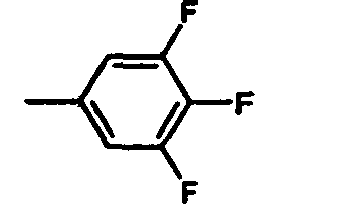
-6 

-7 

-8 CH3 
-9 CH3 
-10 CH3 
-11 

-12 

-13 C2H5 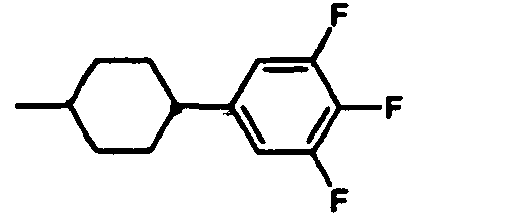
-14 n-C3H7 
-15 n-C3H7 
-16 C2H5 
-17 C2H5 
-18 n-C3H7 
-19 n-C3H7 
-20 n-C3H7 
-21 n-C3H7 
-22 C2H5 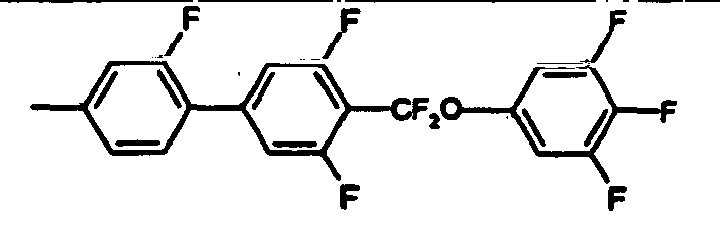
-23 n-C3H7 
-24 n-C5H11 
-25 n-C3H7 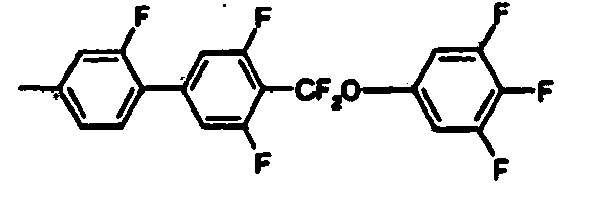
-26 n-C3H7 
-27 n-C3H7 
-28 n-C4H9 
-29 n-C4H9 
-30 n-C3H7 
-31 n-C3H7 
-32 C2H6 
-33 n-C3H7 
-34 n-C3H7 
-35 n-C3H7 
-36 n-C3H7 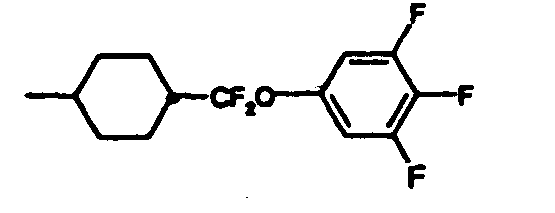
-37 C2H5 
-38 C2H5 
-39 C2H5 
-40 n-C3H7 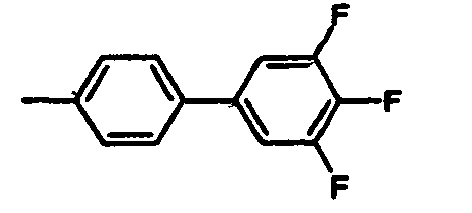
-41 C2H5 
-42 C2H5 
-43 n-C3H7 
-44 n-C3H7 
-45 n-C3H7 
-46 n-C3H7 
-47 n-C3H7 
-48 n-C3H7 
-49 C2H5 
-50 C2H5 
-51 C2H5 
-52 n-C3H7 
-53 n-C3H7 
-54 n-C3H7 
-55 n-C3H7 
-56 n-C3H7 
-57 

-58 n-C3H7 
-59 n-C3H7 
-60 n-C3H7 
-61 n-C3H7 
-62 CH3 
-63 

-64 n-C3H7 
-65 n-C3H7 
-66 

-67 n-C3H7 
-68 n-C3H7 
-69 n-C5H11 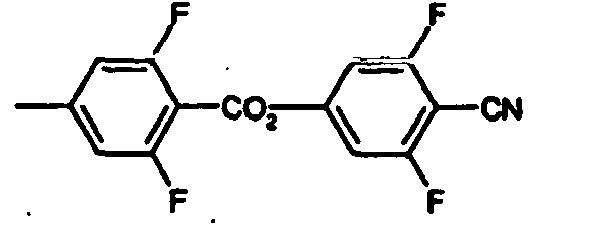
-70 C2H5 
-71 C2H5 
-72 n-C4H9 
-73 n-C3H7 
-74 n-C3H7 
-75 C2H5 
-76 C2H5 
-77 n-C5H11 
-78 n-C4H9 
-79 n-C7H15 
-80 n-C4H9 
-81 n-C5H11 
-82 n-C7H13 
-83 CH3 
-84 n-C4H9 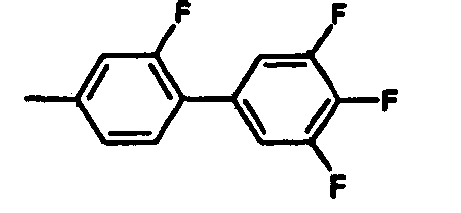
-85 n-C3H7 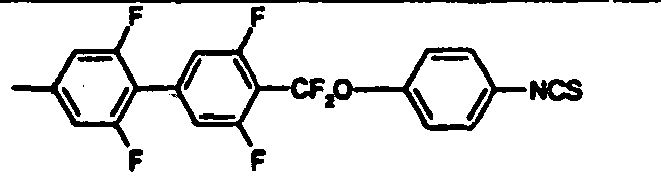
-86 n-C3H7 
-87 n-C6H13 
-88 n-C3H7 
-

- Verbindung B1.2 (100 mmol) wird in Heptan gelöst, mit Hydrierkatalysator (10% Platin auf Aktivkohle oder 5%-Pd-C) versetzt und bei einer Temperatur zwischen Raumtemperatur und 50°C unter einem Wasserstoff-Partialdruck von 5 bar hydriert. Die Reaktionslösung wird eingeengt, filtriert, und das Rohprodukt B2.1 wird gegebenenfalls isomerisiert und chromatographiert sowie anschließend im Vakuum destilliert und/oder kristallisiert. Die cis/trans-Isomerisierung wird entweder durch zweistündiges Rühren mit 15 mol-% Kalium-tert.-butylat in N-Methylpyrrolidon oder unter Verwendung einer Lewissäure wie MgBr2 in Toluol zwischen -10 °C und Raumtemperatur oder mit einer Brönsted-Säure wie Trifluormethansulfonsäure bei Raumtemperatur für 24 h durchgeführt.
- Einige der gemäß AAV B2 hergestellten Verbindungen sind in Tabelle B2 wiedergegeben.
Tabelle B2 Verbindung B 2.1-Nr. R 81 R 82 -1 

-2 

-3 

-4 n-C3H7 
-5 n-C3H7 
-6 

-7 

-8 CH3 
-9 CH3 
-10 CH3 
-11 

-12 
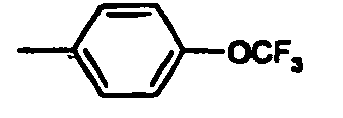
-13 C2H5 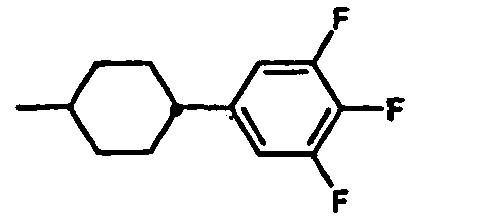
-14 n-C3H7 
-15 n-C3H7 
-16 C2H5 
-17 C2H5 
-18 n-C3H7 
-19 n-C3H7 
-20 n-C3H7 
-21 n-C3H7 
-22 C2H5 
-23 n-C3H7 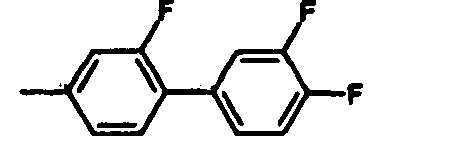
-24 n-C5H11 
-25 n-C3H7 
-26 n-C3H7 
-27 n-C3H7 
-28 n-C4H9 
-29 n-C4H9 
-30 n-C3H7 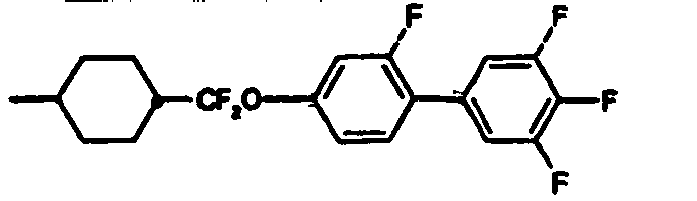
-31 n-C3H7 
-32 C2H5 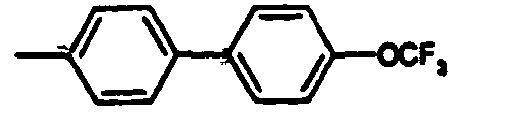
-33 n-C3H7 
-34 n-C3H7 
-35 n-C3H7 
-36 n-C3H7 
-37 C2H5 
-38 C2H5 
-39 C2H5 
-40 n-C3H7 
-41 C2H5 
-42 C2H5 
-43 n-C3H7 
-44 n-C3H7 
-45 n-C3H7 
-46 n-C3H7 
-47 n-C3H7 
-48 n-C3H7 
-49 C2H5 
-50 C2H5 
-51 C2H5 
-52 n-C3H7 
-53 n-C3H7 
-54 n-C3H7 
-55 n-C3H7 
-56 n-C3H7 
-57 

-58 n-C3H7 
-59 n-C3H7 
-60 n-C3H7 
-61 n-C3H7 
-62 CH3 
-63 

-64 n-C3H7 
-65 n-C3H7 
-66 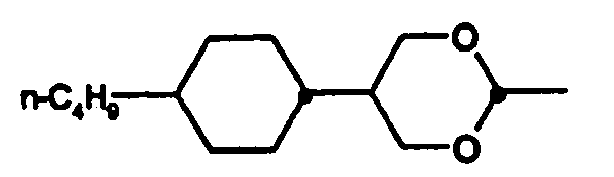

-67 n-C3H7 
-68 n-C3H7 
-69 n-C5H11 
-70 C2H5 
-71 C2H5 
-72 n-C4H9 
-73 n-C3H7 
-74 n-C3H7 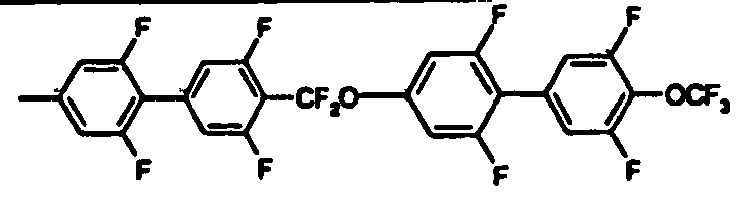
-75 C2H5 
-76 C2H5 
-77 n-C5H11 
-78 n-C4H9 
-79 n-C7H15 
-80 n-C4H9 
-81 n-C5H11 
-82 n-C7H13 
-83 CH3 
-84 n-C4H9 
-85 n-C3H7 
-86 n-C3H7 
-87 n-C6H13 
-88 n-C3H7 
-

- 4-trans-Propylcyclohexyl-(1)-malonsäurediethylester B3.1 (0,2 mol) in wasserfreiem Dimethoxyethan wird zu einer Suspension von Natriumhydrid (0,24 mol) in Dimethoxyethan getropft. Es wird 5 Stunden zum Rückfluss erhitzt und dann Lithiumaluminiumhydrid (0,5 mol) bei 0 °C hinzugegeben. Anschließend wird weitere 3 Stunden zum Rückfluss erhitzt. Nach Abkühlen auf 0 °C wird Ameisensäureethylester, dann Wasser, wässrige Natronlauge und erneut Wasser hinzugegeben. Man filtriert und extrahiert die wässrige Phase mit tert.-Butylmethylether. Die vereinigten organischen Phasen werden getrocknet und eingedampft, und der Rückstand wird an Kieselgel filtriert. Nach Entfernen des Lösungsmittels wird der Allylalkohol B 3.2 erhalten. Ausbeute: 76%.
- Zu einer Lösung von p-Toluolsulfonsäurechlorid (0,2 mol) und 2-(4-trans-Propylcyclohexyl-(1)-allylalkohol B3.2 (0,2 mol) in Tetrahydrofuran wird 4-Dimethylaminopyridin (0,4 mol) in Tetrahydrofuran unter Rühren bei 0 °C zugetropft. Nach vollendeter Zugabe lässt man auf Raumtemperatur kommen und erhitzt noch weitere 12 Stunden zum Rückfluss. Nach dem Abkühlen wird auf eine Mischung aus Eis und konzentrierter Salzsäure gegossen. Die organische Phase wird abgetrennt, die wässrige Phase wird dreimal mit tert.-Butylmethylether extrahiert. Die vereinigten organischen Phasen werden getrocknet und eingedampft, der Rückstand an Kieselgel chromatographiert. Der Allyltosylester B3.3 wird als Öl erhalten. Ausbeute: 87%. Analog lässt sich mit Methansulfonsäurechlorid der entsprechende Methansulfonsäureallylester und mit Trifluormethansulfonsäureanhydrid der entsprechende Trifluormethansulfonsäureallylester darstellen.
- Der Allyltosylester B3.3 (0,1 mol) wird in Aceton aufgenommen und mit Lithiumbromid (0,1 mol) 36 Stunden zum Rückfluss erhitzt. Nach dem Abkühlen wird vom Niederschlag abfiltriert, eingedampft und der entstehende Rückstand über Kieselgel filtriert. Nach Einengen wird 2-(4-trans-Propylcyclohexyl-(1)-allylbromid B3.4 erhalten. Ausbeute: 68%.

- Verbindung B3.5 (0,553 mol) und Kalium-tert.-butylat (0,692 mol) werden in Toluol zusammengegeben und über Nacht bei 80 °C gerührt. Nach dem Abkühlen versetzt man mit Wasser und extrahiert mit Methyl-tert.-butylether. Die organische Phase wird abgetrennt, getrocknet und eingeengt. Der Rückstand wird in Pentan aufgenommen und an Kieselgel filtriert. Nach Einengen wird das Allylbromid B3.4 erhalten. Ausbeute: 73%.

- 2-(4-trans-Propylcyclohexyl-(1))-1,3-dibrompropan B3.5 (0,5 mol) wird zusammen mit Kalium-tert-butylat (1,25 mol) in Toluol 16 Stunden bei 80 °C gerührt. Nach dem Abkühlen wird mit Wasser versetzt und unter Zugabe von tert.-Butylmethylether extrahiert. Die organische Phase wird getrocknet und eingedampft, der Rückstand über Kieselgel filtriert. 2-(4-trans-Propylcyclohexyl-(1))-allyl-tert.-butylether B3.6 wird als öliges Produkt erhalten. Ausbeute: 68%.

- Triphenylphosphan (0,4 mol) wird in Acetonitril suspendiert, auf 10 °C gekühlt und bei dieser Temperatur mit Brom (0,39 mol) versetzt. Die Suspension wird noch 1 Stunde gerührt und dann mit Dicyclohexyl-propylpropandiol B3.7 (0,2 mol) versetzt. Man rührt über Nacht bei Raumtemperatur und erhitzt anschließend 4 Stunden zum Rückfluss. Nach Abkühlen auf Raumtemperatur wird mit Wasser versetzt und mit Petrolether extrahiert. Die organische Phase wird getrocknet und eingeengt, der Rückstand an Kieselgel filtriert. Nach dem Einengen wird Dicyclohexyl-propyl-propandibromid B3.8 erhalten. Ausbeute: 94%.
- Das Dibromid B3.8 (0,402 mol) und Kalium-tert-butylat (0,503 mol) werden in Toluol gemischt und über Nacht bei 80°C gerührt. Man kühlt ab, versetzt mit Wasser und extrahiert mit Methyl-tert.-butylether. Die organische Phase wird getrocknet und eingeengt. Der Rückstand wird an Kieselgel filtriert. Nach dem Einengen erhält man das Allylbromid B3.9. Ausbeute: 90 %.

- 2-(4-trans-Propylcyclohexyl-(1))-allylalkohol (0,2 mol) werden mit 105 g aktivem Braunstein in 350 ml Dichlormethan 24 Stunden bei Raumtemperatur kräftig gerührt. Danach wird filtriert, mit Dichlormethan gewaschen, die organische Phase eingedampft und mit Toluol/Methyl-tert.-butylether über Kieselgel filtriert. Ausbeute des Acrolein B3.10: 64%.

- Der Aldehyd B3.11 (0,321 mol) und N,N-Dimethylmethyleniminiumchlorid (Eschenmosers Salz; 0,321 mol) werden in Dichlormethan suspendiert. Dann wird bei Raumtemperatur Triethylamin zugetropft und über Nacht gerührt. Man schüttelt mit Wasser aus, trennt die organische Phase ab, rotiert ein, nimmt in Heptan/Methyl-tert.-butylether auf und filtriert über Kieselgel. Ausbeute: 40%.
-

- 200 ml (2 mol) Allylmagnesiumchlorid in Diethylether (Aldrich Co.) werden unter schwacher Eiskühlung mit dem Aldehyd B 4.1, gelöst in 100 ml THF, tropfenweise versetzt und dann 4 Stunden bei Raumtemperatur gerührt. Die Redaktionsmischung wird anschließend in 100 ml 0,5 N HCl eingegossen und fünf Minuten gerührt. Die organische Phase wird abgetrennt, die wässrige Phase zweimal mit Methyl-tert.-butylether extrahiert. Die vereinigten organischen Extrakte werden mit Wasser nachgewaschen, getrocknet, filtriert und eingeengt. Das quantitativ erhaltene Rohprodukt kann aufgrund seiner Reinheit direkt in der nachfolgenden Umsetzung verwendet werden.
-

- Allylmagnesiumchlorid (0,40 mol) in 400 ml Diethylether (Aldrich Co.) werden unter Außenkühlung zu einer Lösung von Zinkbromid (0,4 mol) in 200 ml THF getropft, so dass die Temperatur zwischen 10 bis 15°C liegt. Die entstandene Suspension wird bei dieser Temperatur noch 2 Stunden gerührt, bevor 0,4 mol des Aldehyds B 4.3, gelöst in 400 ml Diethylether, tropfenweise zugesetzt werden. Die Suspension wird weitere 16 Stunden bei Raumtemperatur gerührt und dann auf 600 ml 0,5N HCl gegossen. Die organische Phase wird isoliert und nach dem Trocknen mit Natriumsulfat eingeengt. Das Rohprodukt kann ohne weitere Reinigung eingesetzt werden. Anstelle von Zinkbromid kann zur Ummetallierung auch mit CITi(i-Propoxid)3 verwendet werden.
- Diese Reaktionsführung mit Ummetallierung eignet sich insbesondere für für die Umsetzung von Aldehyden, die neben der aldehydischen Carbonylfunktion eine gegenüber Grignard-Reagenzien reaktive funktionelle Gruppe wie eine Carbonsäureester oder Nitrilgruppe enthalten.
-

- 0,4 mol granuliertes Natriumhydroxid werden bei Raumtemperatur in 200 ml THF suspendiert und mit 2 ml Wasser. 0.4 mol Homoallylalkohol B 4.2 und 0,02 mol N-Cetyl-N,N,N-trimethylammoniumbromid bei 25 °C unter Rühren versetzt. Darauf werden 0,4 mol des Allylbromids unter Rühren zugegeben. Das Gemisch wird 20 Stunden bei 40 bis 50 °C gerührt. Anschließend wird laut DC nicht umgesetzter Homoallylalkohol B4.2 mit weiteren 0,05 bis 0,1 mol Allylbromid versetzt, um die Reaktion nach fortgesetztem Rühren (12 Stunden) zu vervollständigen. Nach dem Abkühlen wird auf 500 ml Eiswasser gegossen und zweimal mit Methyl-tert.-butylether extrahiert. Die vereinigten organischen Extrakte werden nach dem Trocknen eingedampft und über Kieselgel mit Heptan/Toluol filtriert. Die Verbindungen B 5.1 werden dabei zumeist als Öle erhalten. Ausbeute: 70 bis 95%.
- 0,46 mol NaH (60 %ige Suspension in Paraffinöl) werden in 200 ml THF vorgelegt. Hierzu wird der Homoallylalkohol B 4.2 (0,4 mol) in 200 ml THF bei einer Temperatur zwischen -10 und +20 °C zugetropft. Es wird solange zwischen 20 und 30 °C nachgerührt, bis die Wasserstoffentwicklung abgeschlossen ist. Dann werden 0,4 mol des Allylbromids in 200 ml THF bei Raumtemperatur zugetropft und je nach Ergebnis der DC-Kontrolle 12 bis 48 Stunden bei Raumtemperatur gerührt. Das Reaktionsgemisch wird auf Eiswasser gegossen, mit Methyl-tert.-butylether extrahiert, nach dem Trocknen und Eindampfen mit Heptan/Toluol über Kieselgel filtriert.
-

- Die Herstellung von Arcylsäureestern B 5.2 erfolgt gemäß den Verfahren AAV B 5a oder AAV B 5b, wobei das Allylbromid durch das entsprechende Säurechlorid ersetzt wird.
- In Tabelle B3 sind ausgewählte physikalische Parameter einiger erfindungsgemäßer Verbindungen wiedergegeben, die gemäß den Vorschriften der angehenden Beispiele hergestellt worden sind. (Die Angaben in der Spalte "Verbindung" beziehen sich auf die in den Beispielen 1 bis 5 wiedergegebenen Bezeichnungen.)
Tabelle B3 Verbindung Δn Δε γ 1 [mPa·s] Fp. [°C] Klp. [°C] Phasenübergänge B1.2-1* 0,0640 12,8 205 48 21*** K 48 I B1.2-2* 0,0740 14,5 286 35 36*** K 35 N (10,3) I B1.2-3* 0,1060 12,1 562 98 217 K 98 N 2171 I B1.2-4* 0,0560 13.3 203 74 3*** K 741 I B1.2-7* 0,0740 14,5 286 35 36*** K 35 N (10,3) I B1.2-8* -0,0142 7,5 62 K 62 I B1.2-9* 0,0520 14,8 99 89 25*** K 89 I B1.2-11* 0,0760 8,2 137 84 63*** K 84 SmB? 90 I B1.2-12* 0,0739 8,4 79 37*** K 79 SmB (74) I B2.1-1* 0,0710 12,2 182 57 62*** K 57 N (50,9) I B2.1-2* 0,0770 13,5 325 69 68*** K 69 N 70 I B2.1-3* 0,1020 11,8 582 113 256 K 113 N256 I B2.1-4* 0,0599 14,1 136 71 32*** K 71 I B2.1-9* 0,0490 34,9 142 54 16*** K 54 I B2.1-11* 0,0810 8,5 149 37 106 K 37 SmB 93 N 106 I B2.1-13* 0,0475 14,0 140 72 14*** K 72 I B2.1-14* 0,1256 18,0 239 58 61 K 58 SmA (37) N 61 I B2.1-15* 0,0570 13,4 34 58 K 34 N 58 I B2.1-16* 0,1493 27,3 287 77 91 K 77 N 91 I B2.1-17* 0,0540 14,1 124 45 35*** K 45 N (35) I B2.1-18* 0,1390 9,4 84 232 K 84 N 232 I B2.1-19* 0,1370 10,7 47 238 K 47 SmB 91 N 238 I B2.1-20* 0,1291 15,7 725 60 207 K 60 SmB 81 N 207 I B2.1-21* 0,1071 17,3 176 64 13*** K 64 I B2.1-22* 0,1310 29,9 89 69*** K 89 N (77) I B2.1-23* 0,1254 12,7 225 43 44 K 43 N 44 I B2.1-24* 0,0568 11,8 216 39 75 K 39 N 75 I B2.1-25* 0,1364 29,7 70 102 K 70 N 102 I B2.1-26* 0,0580 35,6 75 27 -83*** K 27 I B2.1-27* 0,1231 34,9 457 81 83 K 81 N 83 I B2.1-28* 0,0623 11,5 106 SmB 81 N 106 I B2.1-29* 0,0689 9,1 -54 117*** K? -54 SmB 129 I B2.1-30* 0,1220 19,1 625 61 192 K61 N 192 I B2.1-31* 0,1328 13,4 806 44 213 K 44 Sm? 45 B 213 I B2.1-32* 0,1422 10,1 116 54 106*** K 54 Sm? SmB 154 SmA 168 I B2.1-33* 0,1243 14,8 178 42 44*** K 41 I B2.1-34* 0,1256 18,0 239 58 61 K 58 SmA (37) N 61 I B2.1-35* 0,0599 14,1 136 71 32*** K 71 I B2.1-36* 0,0570 13,4 160 35 66 K 35 N 66 I B2.1-37* 0,1070 29,7 213 89 48*** K 89 I B2.1-38* 0,1493 27,3 287 78 92 K 78 N 92 I B2.1-39* 0,1159 14,5 130 52 17*** K 52 I B2.1-40* 0,1243 14,8 178 41 44*** K 41 I B2.1-41* 0,0475 14,0 140 72 14*** K 72 I B2.1-42* 0,1159 14,5 130 52 17*** K 52 I B2.1-43* 0,1430 9,6 189 50 99 K 50 SmA-1 (32) SmA-2 64 N99 I B2.1-44* 0,1380 12,7 236 45 90*** K 45 SmA-1 68 SmA-2 118 I B2.1-45* 0,0780 9,1 178 -41 129 K-41 SmB 123 N 129 I B2.1-46* 0,0701 11,7 199 106 SmB 74 N 106 B2.1-47* 0,0688 9,7 187 41 96 K 41 SmB 51 N 96 I B2.1-48* 0,1384 19,7 74 198 K 74 N 198 I B2.1-49* 0,1157 12,3 28 25*** K 28 N (11) I B2.1-50* 0,1100 15,2 177 37 39 K 37 SmA-(35) N 39 I B2.1-52* 0,1450 23,2 300 75 118 K 75 N 118 I B2.1-53** 0,1190 40,8 529 91 47*** K 91 I B2.1-54* 0,0800 28,2 128 32 -50*** K 32 I B2.1-57* 0,0550 23,7 241 87 20*** K 87 I B2.1-58* 0,1158 35,6 541 74 101 K 74 N 101 I B2.1-59* 0,1330 25,3 466 80 120 K 80 N 120 I B2.1-60* 0,1230 61,4 625 79 91 K 79 N 91 I B2.1-61* 0,1706 35,4 115 198 K 115 N 198 I B2.1-62* 0,0950 18,9 160 58 -30*** K 58 I B2.1-63* 0,0871 21,7 106 207 K 106 N 2071 I B2.1-64** 0,1649 37,9 98 193 K 98 N 193 I B2.1-65* 0,0049 7,7 76 7 -78*** K7 SmB 15 I B2.1-66* 0,0880 21,3 91 203 K 91 SmH (63) N 203 I B2.1-67** 0,1510 42,1 144 181 K 144 N 181 I B2.1-68* 0,1180 29,8 541 48 105 K 48 SmA (46) N 105 I B2.1-69* 0,1279 57,4 50 95 K 50 N 95 I B2.1-70* 0,1149 35,0 356 91 38*** K 91 N (59) I B2.1-71* 0,1202 64,0 536 77 38*** K 77 N (66) I B2.1-72* 0,1270 58,0 534 76 90 K 76 N 90 I B2.1-73** 0,1634 37,7 121 205 K 121 N 205 I B2.1-74** 0,1411 43,8 128 201 K 128 N 201 I B2.1-75** 0,1431 29,8 113 149 K 113 N 149 I B2.1-76* 0,1459 67,8 98 128 K 98 N 128 I B2.1-77* 0,1490 61,8 65 142 K 65 SmC (44) N 142 I B2.1-78* 0,1477 64,2 79 139 K 79 N 139 I B2.1-79* 0,1459 58,5 64 131 K 64 N 131 I B2.1-80* 0,1171 32,4 381 90 54*** K 90 N (81) I B2.1-81* 0,1205 31,9 589 82 89 K 82 N 89 I B2.1-82* 0,1130 30,3 662 83 86 K 83 N 86 I B2.1-83* 0,0459 14,5 126 72 -19*** K 72 I B2.1-84* 0,0960 16,4 185 55 14*** K 55 I 82.1-85* 0,2052 31,4 107 186 K 107 N 186 I B2.1-86* 0,1372 31,5 607 80 107 K 80 N 1071 I B2.1-87* 0,1116 30,6 473 89 59*** K 89 N (83) I B2.1-88* 0,2125 59,4 121 269 K 121 N 269 *Die Bestimmung der Parameter Δn, Δε und γ1 erfolgte durch Messung einer Mischung von 10 Gew.% der Verbindung in dem Host ZLI-4792 (Merck KGaA, Darmstadt) und nachfolgende Extrapolation.
** Die Bestimmung der Parameter Δn, Δε und γ1 erfolgte mit 5 Gew.% der Verbindung in ZLI-4792.
*** Die Bestimmung des Klärpunkts erfolgte durch Messung einer Mischung von 10 beziehungsweise 5 Gew.% der Verbindung in dem Host ZLI-4792 und nachfolgende Extrapolation.
dass für den Fall der direkten Verknüpfung von Z13 und R12 zu -Z13-R12 R12 H, Aralkyl, Alkanyl oder Alkenyl bedeutet, wenn Z13 -C(=O)-O- oder -C(=O)-bedeutet, und Z13 nicht -CH2O oder -CF2O- bedeutet;
dass für den Fall der direkten Verknüpfung von Z14 und R12 zu -Z14-R12 R12 H, Aralkyl, Alkanyl oder Alkenyl bedeutet, wenn Z14 -C(=O)-O- oder -C(=O)-bedeutet, und Z14 nicht -CH2O- oder -CF2O- bedeutet;
dass für den Fall der direkten Verknüpfung von Z15 und R12 zu -Z15-R12 R12 H, Aralkyl, Alkanyl oder Alkenyl bedeutet, wenn Z15 -C(=O)-O- oder -C(=O)-bedeutet, und Z15 nicht -CH2O- oder -CF2O- bedeutet;
dass R11 nicht H bedeutet, wenn zugleich a und b beide null sind und Z12 eine Einfachbindung bedeutet;
dass R11 nicht CH3 bedeutet, wenn zugleich a und b beide null sind, Z12 und Z13 jeweils eine Einfachbindung bedeuten, W -CH2- bedeutet und -[-A13-Z14-]c-[-A14-Z15-]d-[-A15-]e-R12 für unsubstituiertes Phenyl steht.
Claims (20)
- Verbindung der allgemeinen Formel I
 a, b, c, d und e jeweils unabhängig voneinander 0 oder 1 sind;W -CH2- oder -C(=O)- bedeutet;R11 H, einen unsubstituierten oder einfach oder mehrfach gleich oder verschieden mit Halogen oder -CN substituierten Alkylrest mit 1 bis 15 Kohlenstoffatomen bedeutet, wobei in diesem Rest auch eine oder mehrere CH2-Gruppen durch -C≡C-, -CH=CH-, -O-, -S-, -C(O)-O- und/oder -O-C(O)- so ersetzt sein können, dass Heteroatome (O, S) nicht direkt miteinander verknüpft sind;R12 H, Halogen, -CN, -NCS, Aralkyl, -O-Aralkyl oder einen unsubstituierten oder einfach oder mehrfach gleich oder verschieden mit Halogen oder -CN substituierten Alkylrest mit 1 bis 15 Kohlenstoffatomen bedeutet, wobei in diesem Rest auch eine oder mehrere CH2-Gruppen durch -C≡C-, -CH=CH-, -O-, -S-, -C(O)-O- und/oder-O-C(O)- so ersetzt sein können, dass Heteroatome (O, S) nicht direkt miteinander verknüpft sind;Z11 eine Einfachbindung, -CH2-, -CH2CH2-, -CF2CH2, -CH2CF2-, -CF2CF2-, -CH=CH- oder -C≡C- bedeutet;Z12 eine Einfachbindung, -CH2-, -CH2CH2-, -CF2CH2-, -CH2CF2- oder -CF2CF2- bedeutet;Z13, Z14 und Z15 jeweils unabhängig voneinander eine Einfachbindung, -CH2CH2-, -CF2CH2-, -CH2CF2-, -CF2CF2-, -CH=CH-, -C≡C-, -CH2O-, -CF2O-, -C(O)- oder -C(O)-O- bedeuten;A11 und A12 unabhängig voneinander für
 A13 und A14 unabhängig voneinander für

 A15 für
 A15-R12 zusammen für

oderZ13-[-A13-Z14-]c-[-A14-Z15-]d-[-A15-]e-R12 für
 q 0, 1, 2, 3 oder 4 ist;p 0, 1, 2 oder 3 ist;R13 und R14 unabhängig voneinander einen Alkanylrest mit 1 bis 7 Kohlenstoffatomen bedeuten oder zusammen für eine Alkylenbrücke mit 2 bis 7 Kohlenstoffatomen stehen;mit der Maßgabe,
dass für den Fall der direkten Verknüpfung von Z13 und R12 zu -Z13-R12 R12 H, Aralkyl, Alkanyl oder Alkenyl bedeutet, wenn Z13 -C(=O)-O- oder -C(=O)- bedeutet, und Z13 nicht -CH2O- oder -CF2O-bedeutet;
dass für den Fall der direkten Verknüpfung von Z14 und R12 zu -Z14-R12 R12 H, Aralkyl, Alkanyl oder Alkenyl bedeutet, wenn Z14 -C(=O)-O- oder -C(=O)- bedeutet, und Z14 nicht -CH2O- oder -CF2O-bedeutet;
dass für den Fall der direkten Verknüpfung von Z15 und R12 zu -Z15-R12 R12 H, Aralkyl, Alkanyl oder Alkenyl bedeutet, wenn Z15 -C(=O)-O- oder -C(=O)- bedeutet, und Z15 nicht -CH2O- oder -CF2O-bedeutet;
dass R11 nicht H bedeutet, wenn zugleich a und b beide null sind und Z12 eine Einfachbindung bedeutet;
dass R11 nicht CH3 bedeutet, wenn zugleich a und b beide null sind, Z12 und Z13 jeweils eine Einfachbindung bedeuten, W -CH2- bedeutet und -[A13-Z14-]c-[-A14-Z15-]d-[-A15]e-R12 für unsubstituiertes Phenyl steht. - Verbindung gemäß Anspruch 1, dadurch gekennzeichnet, dass a+b+c+d+e ≤ 3.
- Verbindung gemäß wenigstens einem der vorangehenden Ansprüche,
dadurch gekennzeichnet, dass
W -C(=O)- bedeutet. - Verbindung gemäß wenigstens einem der Ansprüche 1 oder 2,
dadurch gekennzeichnet, dass
W -CH2- bedeutet. - Verbindung gemäß wenigstens einem der vorangehenden Ansprüche,
dadurch gekennzeichnet, dass
Z12 eine Einfachbindung bedeutet. - Verbindung gemäß wenigstens einem der vorangehenden Ansprüche,
dadurch gekennzeichnet, dassb 1 ist;Z11 eine Einfachbindung bedeutet; undA12 für
- Verbindung gemäß wenigstens einem der vorangehenden Ansprüche,
dadurch gekennzeichnet, dassa 1 ist; undA11 für
- Verbindung gemäß wenigstens einem der vorangehenden Ansprüche,
dadurch gekennzeichnet, dass
Z13 eine Einfachbindung, -C(O)-O- oder -CF2O- bedeutet. - Verbindung gemäß wenigstens einem der vorangehenden Ansprüche,
dadurch gekennzeichnet, dasse 1 ist;A15 für L11 und L12 unabhängig voneinander H oder F bedeuten.
 - Verbindung gemäß wenigstens einem der Ansprüche 1 bis 8, dadurch
gekennzeichnet, dasse 1 ist;A15-R12 für R13 und R14 wie in Anspruch 1 definiert sind.
 - Verbindung gemäß wenigstens einem der vorangehenden Ansprüche,
dadurch gekennzeichnet, dassc 1 ist;Z14 eine Einfachbindung, -C(O)-O- oder -CF2O- bedeutet;A13 für L13 und L14 unabhängig voneinander für H oder F stehen.
 - Verbindung gemäß wenigstens einem der vorangehenden Ansprüche,
dadurch gekennzeichnet, dassd 1 ist;Z15 -CF2O- bedeutet:A14 für L15 und L16 unabhängig voneinander H oder F bedeuten.
 - Verfahren zur Herstellung von Pyranderivaten umfassend einen Verfahrensschritt, der eine ringschließende Metathese-Reaktion einer Verbindung der allgemeinen Formel II


mit der Maßgabe,
dass für den Fall der direkten Verknüpfung von Z13 und R12 zu -Z13-R12 R12 H, Aralkyl oder Alkanyl bedeutet, wenn Z13 -C(=O)-bedeutet, R12 Aralkyl oder Alkanyl bedeutet, wenn Z13 -C(=O)-O-bedeutet, und Z13 nicht -CH2O- oder-CF2O- bedeutet; dass für den Fall der direkten Verknüpfung von Z14 und R12 zu -Z14-R12 R12 H, Aralkyl oder Alkanyl bedeutet, wenn Z14 -C(=O)-bedeutet, R12 Aralkyl oder Alkanyl bedeutet, wenn Z14 -C(=O)-O-bedeutet, und Z14 nicht -CH2O- oder -CF2O- bedeutet; dass für den Fall der direkten Verknüpfung von Z15 und R12 zu -Z15-R12 R12 H, Aralkyl oder Alkanyl bedeutet, wenn Z15 -C(=O)-bedeutet, R12 Aralkyl oder Alkanyl bedeutet, wenn Z15 -C(=O)-O-bedeutet, und Z15 nicht -CH2O- oder -CF2O- bedeutet; dass R11 nicht H bedeutet, wenn a und b beide zugleich null sind und Z12 eine Einfachbindung bedeutet;
dass R11 nicht CH3 bedeutet, wenn zugleich a und b beide null sind, Z12 und Z13 jeweils eine Einfachbindung bedeuten, W -CH2- bedeutet und -[-A13-Z14-]c-[-A14-Z15-]d-[-A15-]e-R12 für unsubstituiertes Phenyl steht;
in Gegenwart eines Metathese-Katalysators umfaßt. - Verfahren gemäß Anspruch 13, dadurch gekennzeichnet, dass der Metathese-Katalysator ein Ruthenium-Alkyliden-Komplex ist.
- Verfahren gemäß wenigstens einem der Ansprüche 13 und 14 umfassend nach dem Metathese-Reaktionsschritt als einen weiteren Reaktionsschritt eine Reduktionsreaktion zur Überführung des Pyranderivats der Formel I, worin W -C(=O)- bedeutet und Z13, Z14 und Z15 nicht -C(O)- bedeuten, in ein Pyranderivat der Formel I, worin W -CH2- bedeutet;R11 H, einen unsubstituierten oder einfach oder mehrfach gleich oder verschieden mit Halogen oder -CN substituierten Alkylrest mit 1 bis 15 Kohlenstoffatomen bedeutet, wobei in diesem Rest auch eine oder mehrere CH2-Gruppen durch -C≡C-, -CH=CH-, -O- und/oder -S- so ersetzt sein können, dass Heteroatome (O, S) nicht direkt miteinander verknüpft sind;R12 H, Halogen, -CN, -NCS, Aralkyl, -O-Aralkyl oder einen unsubstituierten oder einfach oder mehrfach gleich oder verschieden mit Halogen oder -CN substituierten Alkylrest mit 1 bis 15 Kohlenstoffatomen bedeutet, wobei in diesem Rest auch eine oder mehrere CH2-Gruppen durch -C≡C-, -CH=CH-, -O- und/oder -S- so ersetzt sein können, dass Heteroatome (O, S) nicht direkt miteinander verknüpft sind;Z13, Z14 und Z15 jeweils unabhängig voneinander eine Einfachbindung, -CH2CH2-, -CF2CH2-, -CH2CF2-, -CF2CF2-, -CH=CH-, -C≡C, -CH2O- oder -CF2O- bedeuten;und a, b, c, d, e, Z11, Z12, A11, A12, A13, A14 und A15 wie in Anspruch 1 definiert sind.
- Verfahren gemäß wenigstens einem der Ansprüche 13 bis 15 umfassend nach dem Metathese-Reaktionsschritt und nach dem gegebenenfalls durchzuführenden Reduktionsreaktionsschritt als einen weiteren Reaktionsschritt eine katalytische Hydrierung zu einem Pyranderivat der allgemeinen Formel III:
 f, g, h, j und k jeweils unabhängig voneinander 0 oder 1 sind;R31 H, einen unsubstituierten oder einfach oder mehrfach gleich oder verschieden mit Halogen oder -CN substituierten Alkylrest mit 1 bis 15 Kohlenstoffatomen bedeutet, wobei in diesem Rest auch eine oder mehrere CH2-Gruppen durch -O-, -S-, -C(O)-O- und/oder -O-C(O)- so ersetzt sein können, dass Heteroatome (O, S) nicht direkt miteinander verknüpft sind;R32 H, Halogen, -CN, -NCS, Aralkyl oder einen unsubstituierten oder einfach oder mehrfach gleich oder verschieden mit Halogen oder -CN substituierten Alkylrest mit 1 bis 15 Kohlenstoffatomen bedeutet, wobei in diesem Rest auch eine oder mehrere CH2-Gruppen durch -O-, -S-, -C(O)-O- und/oder -O-C(O)- so ersetzt sein können, dass Heteroatome (O, S) nicht direkt miteinander verknüpft sind;Z31 und Z32 unabhängig voneinander eine Einfachbindung, -CH2-, -CH2CH2-, -CF2CH2-, -CH2CF2- oder -CF2CF2- bedeuten;Z33, Z34 und Z35 jeweils unabhängig voneinander eine Einfachbindung, -CH2CH2-, CF2CH2-, -CH2CF2-, -CF2CF2-, -CH2O-, -CF2O-, -C(O)- oder -C(O)-O- bedeuten;A31 und A32 unabhängig voneinander für
 A33 und A34 unabhängig voneinander für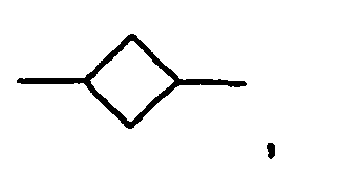

 A35 unabhängig voneinander für

 A35-R32 zusammen für

oderZ33-[-A33-Z34-]h-[-A34-Z35-]j-[-A35-]k-R32 für
 r 0, 1, 2, 3 oder 4 ist;s 0, 1, 2 oder 3 ist;R33 und R34 unabhängig voneinander einen Alkanylrest mit 1 bis 7 Kohlenstoffatomen bedeutet oder zusammen für eine Alkylenbrücke mit 2 bis 7 Kohlenstoffatomen stehen;mit der Maßgabe,
dass für den Fall der direkten Verknüpfung von Z33 und R32 zu -Z33-R32 R32 H, Aralkyl oder Alkanyl bedeutet, wenn Z33 -C(=O)-bedeutet, R32 Aralkyl oder Alkanyl bedeutet, wenn Z33 -C(=O)-O-bedeutet, und Z33 nicht -CH2O- oder -CF2O- bedeutet; dass für den Fall der direkten Verknüpfung von Z34 und R32 zu -Z34-R32 R32 H, Aralkyl oder Alkanyl bedeutet, wenn Z34 -C(=O)-bedeutet, R32 Aralkyl oder Alkanyl bedeutet, wenn Z34 -C(=O)-O-bedeutet, und Z34 nicht -CH2O- oder -CF2O- bedeutet; dass für den Fall der direkten Verknüpfung von Z35 und R32 zu -Z35-R32 R32 H, Aralkyl oder Alkanyl bedeutet, wenn Z35 -C(=O)-bedeutet, R32 Aralkyl oder Alkanyl bedeutet, wenn Z35 -C(=O)-O-bedeutet, und Z35 nicht -CH2O- oder -CF2O- bedeutet;
dass R31 nicht H bedeutet, wenn zugleich f und g beide null sind und Z32 eine Einfachbindung bedeutet. - Verfahren gemäß wenigstens einem der Ansprüche 13 bis 16 umfassend vor dem Metathese-Reaktionsschritt als einen weiteren Reaktionsschritt die Umsetzung einer Verbindung der Formel IV mit einer Homoallylverbindung der Formel V


- Verfahren gemäß Anspruch 17, dadurch gekennzeichnet, dassW -CH2- bedeutet; undX11 Chlor, Brom, Iod oder einen Sulfonsäurerest bedeutet.
- Allylverbindung der Formel IV-Bb

a null und b 1 oder a 1 und b null oder a und b beide 1 sind;X11a Chlor, Brom, Iod, einen Sulfonsäurerest, -OH, Alkoxy oder O-Aralkyl bedeutetoder-X11a für =O steht, im Sinn von Aldehyden;R11, Z11 und Z12 wie in Anspruch 1 definiert sind; undA11 und A12 wie in Anspruch 1 definiert sind und bevorzugt 1,4-Cyclohexylen bedeuten. - Verwendung eines Pyranderivats der Formel I gemäß Anspruch 1 als Bestandteil eines flüssigkristallinen Mediums insbesondere in einer elektrooptischen Anzeigevorrichtung.
Applications Claiming Priority (2)
| Application Number | Priority Date | Filing Date | Title |
|---|---|---|---|
| DE10324312 | 2003-05-27 | ||
| DE10324312 | 2003-05-27 |
Publications (2)
| Publication Number | Publication Date |
|---|---|
| EP1482019A1 EP1482019A1 (de) | 2004-12-01 |
| EP1482019B1 true EP1482019B1 (de) | 2006-09-27 |
Family
ID=33103628
Family Applications (1)
| Application Number | Title | Priority Date | Filing Date |
|---|---|---|---|
| EP04010357A Expired - Lifetime EP1482019B1 (de) | 2003-05-27 | 2004-04-30 | Pyranderivate |
Country Status (5)
| Country | Link |
|---|---|
| US (1) | US7888519B2 (de) |
| EP (1) | EP1482019B1 (de) |
| JP (1) | JP2004352721A (de) |
| AT (1) | ATE340836T1 (de) |
| DE (2) | DE102004021338A1 (de) |
Cited By (1)
| Publication number | Priority date | Publication date | Assignee | Title |
|---|---|---|---|---|
| CN101180285B (zh) * | 2005-05-25 | 2013-01-09 | 默克专利股份有限公司 | 甲酰基四氢吡喃、其制备方法及其用途 |
Families Citing this family (30)
| Publication number | Priority date | Publication date | Assignee | Title |
|---|---|---|---|---|
| US7393369B2 (en) * | 2002-06-11 | 2008-07-01 | Trulite, Inc. | Apparatus, system, and method for generating hydrogen |
| US7556660B2 (en) | 2003-06-11 | 2009-07-07 | James Kevin Shurtleff | Apparatus and system for promoting a substantially complete reaction of an anhydrous hydride reactant |
| DE102004036068B4 (de) * | 2003-08-18 | 2023-05-17 | Merck Patent Gmbh | Verfahren zur Hydrierung |
| WO2006053236A1 (en) * | 2004-11-12 | 2006-05-18 | Trulite, Inc. | Hydrogen generator cartridge |
| JP5208376B2 (ja) * | 2005-05-25 | 2013-06-12 | メルク パテント ゲゼルシャフト ミット ベシュレンクテル ハフツング | 液晶媒体および電気光学ディスプレイ |
| JP5484724B2 (ja) * | 2005-05-25 | 2014-05-07 | メルク パテント ゲゼルシャフト ミット ベシュレンクテル ハフツング | 酸素を含む環を複数含むテトラヒドロピラン誘導体類、およびそれの調製方法 |
| CN101180284B (zh) * | 2005-05-25 | 2013-03-27 | 默克专利股份有限公司 | 从四氢吡喃-3-酮制备四氢吡喃的方法 |
| EP1891059B1 (de) | 2005-05-25 | 2012-12-05 | Merck Patent GmbH | Pyran-dioxan-derivate und deren verwendung in flüssigkristallinen medien |
| JP5259391B2 (ja) * | 2005-05-25 | 2013-08-07 | メルク パテント ゲゼルシャフト ミット ベシュレンクテル ハフツング | テトラヒドロピラン誘導体類の調製方法 |
| JP5260279B2 (ja) * | 2005-05-25 | 2013-08-14 | メルク パテント ゲゼルシャフト ミット ベシュレンクテル ハフツング | 対応する4−ハロゲン誘導体の還元的脱離による2,5−2置換テトラヒドロピラン誘導体類の調製方法 |
| US7648786B2 (en) * | 2006-07-27 | 2010-01-19 | Trulite, Inc | System for generating electricity from a chemical hydride |
| US7651542B2 (en) * | 2006-07-27 | 2010-01-26 | Thulite, Inc | System for generating hydrogen from a chemical hydride |
| KR101455428B1 (ko) | 2007-02-28 | 2014-10-27 | 제이엔씨 석유 화학 주식회사 | Cf2o 결합기를 갖는 5 고리 액정 화합물, 액정 조성물 및 액정 표시 소자 |
| US8357214B2 (en) * | 2007-04-26 | 2013-01-22 | Trulite, Inc. | Apparatus, system, and method for generating a gas from solid reactant pouches |
| US20090029227A1 (en) * | 2007-07-25 | 2009-01-29 | John Patton | Apparatus, system, and method for securing a cartridge |
| AU2008279082A1 (en) | 2007-07-25 | 2009-01-29 | Trulite, Inc. | Apparatus, system, and method to manage the generation and use of hybrid electric power |
| KR20110015605A (ko) | 2008-06-09 | 2011-02-16 | 짓쏘 가부시끼가이샤 | 시클로헥산 고리를 갖는 5 고리 액정 화합물, 액정 조성물 및 액정 표시 소자 |
| JP5359053B2 (ja) | 2008-06-24 | 2013-12-04 | Jnc株式会社 | 液晶組成物および液晶表示素子 |
| JP5359055B2 (ja) | 2008-06-25 | 2013-12-04 | Jnc株式会社 | 液晶組成物および液晶表示素子 |
| EP2351741B1 (de) | 2008-10-21 | 2016-11-30 | JNC Corporation | Pentacyclische flüssigkristallverbindung mit einem stickstoffhaltigen heterocyclischen ring, flüssigkristallzusammensetzung und flüssigkristallanzeigevorrichtung |
| DE102012014896A1 (de) | 2012-07-26 | 2014-02-13 | Merck Patent Gmbh | Verfahren zur Herstellung von Tetrahydropyran-Derivaten |
| US9315727B2 (en) | 2012-10-09 | 2016-04-19 | DIC Corporation (Tokyo) | Compound having fluorinated naphthalene structure and liquid crystal composition of the same |
| JP6299020B2 (ja) * | 2012-10-23 | 2018-03-28 | Jnc株式会社 | 液晶化合物、液晶媒体および光素子 |
| US9637466B2 (en) | 2013-07-25 | 2017-05-02 | Dic Corporation | Liquid crystal compound having 2, 6-difluorophenyl ether structure and liquid crystal composition thereof |
| JP5776864B1 (ja) | 2013-08-30 | 2015-09-09 | Dic株式会社 | ネマチック液晶組成物 |
| JP5741986B1 (ja) | 2013-10-03 | 2015-07-01 | Dic株式会社 | 2,6−ジフルオロフェニルエーテル構造を持つ液晶性化合物及びその液晶組成物 |
| JP5910800B1 (ja) | 2014-07-31 | 2016-04-27 | Dic株式会社 | ネマチック液晶組成物 |
| US10253258B2 (en) | 2014-07-31 | 2019-04-09 | Dic Corporation | Nematic liquid crystal composition |
| JP6627515B2 (ja) * | 2015-02-06 | 2020-01-08 | Jnc株式会社 | 3,6−ジヒドロ−2h−ピランを有する誘電率異方性が負の液晶性化合物、液晶組成物および液晶表示素子 |
| CN108277019A (zh) * | 2017-11-13 | 2018-07-13 | 晶美晟光电材料(南京)有限公司 | 一种反式环己基类液晶化合物的制备方法 |
Family Cites Families (20)
| Publication number | Priority date | Publication date | Assignee | Title |
|---|---|---|---|---|
| DE3306960A1 (de) * | 1983-02-28 | 1984-08-30 | Merck Patent Gmbh, 6100 Darmstadt | Tetrahydropyrane |
| DE3717484A1 (de) | 1987-05-23 | 1988-12-01 | Merck Patent Gmbh | Cyclobutanderivate |
| JPH03128371A (ja) * | 1989-07-12 | 1991-05-31 | Mitsubishi Rayon Co Ltd | 光学活性体及び液晶組成物 |
| JPH03261779A (ja) * | 1990-03-12 | 1991-11-21 | Mitsubishi Petrochem Co Ltd | 光学活性化合物およびそれをを含む液晶組成物 |
| EP0467721B1 (de) * | 1990-07-20 | 1996-03-27 | Mitsubishi Rayon Co., Ltd | Optisch aktive Delta-Valerolacton-Ring enthaltende Verbindung und dieselbe enthaltende flüssigkristalline Zusammensetzung |
| JPH0625210A (ja) * | 1991-05-10 | 1994-02-01 | Dainippon Ink & Chem Inc | 光学活性5,6−ジヒドロ−2−ピロン誘導体、及びその製造方法、その誘導体を含む液晶組成物及び液晶表示素子 |
| DE4230288A1 (de) * | 1992-09-10 | 1994-03-24 | Merck Patent Gmbh | Chirale Valerolacton-Derivate |
| JP3261779B2 (ja) | 1993-01-08 | 2002-03-04 | 株式会社村田製作所 | マイクロ波用回路素子 |
| US5698137A (en) * | 1995-05-01 | 1997-12-16 | Kashima Oil Company | Optically active dihydropyran derivative, and liquid crystal composition, liquid crystal device, and racemic mixture comprising the derivative |
| DE19640618A1 (de) * | 1996-10-01 | 1998-04-02 | Basf Ag | Chirale Verbindungen |
| WO1998023561A1 (en) * | 1996-11-28 | 1998-06-04 | Chisso Corporation | Chlorobenzene derivatives, liquid-crystal composition, and liquid-crystal display elements |
| JPH11349582A (ja) * | 1998-06-10 | 1999-12-21 | Chisso Corp | 誘電率異方性値が負の液晶性化合物、この液晶性化合物を含有する液晶組成物、及びこの液晶組成物を用いた液晶表示素子 |
| US20020165222A1 (en) | 1999-02-19 | 2002-11-07 | Smithkline Beecham Corporation | Protease inhibitors |
| DZ3083A1 (fr) * | 1999-02-19 | 2004-06-02 | Smithkline Beecham Corp | Composés nouveaux inhibiteurs de protéases, procédé pour leur préparation et compositions pharmaceutiques les conentant. |
| JP4441953B2 (ja) | 1999-06-29 | 2010-03-31 | チッソ株式会社 | 負の誘電率異方性値を有する新規な液晶性化合物、液晶組成物および液晶表示素子 |
| JP4547742B2 (ja) * | 1999-10-13 | 2010-09-22 | チッソ株式会社 | 液晶組成物および液晶表示素子 |
| EP1138680A1 (de) | 2000-03-29 | 2001-10-04 | Pfizer Products Inc. | Gem substituierte Sulfonylhydroxamsäuren mit MMP inhibierender Wirkung |
| DE10134299A1 (de) * | 2000-08-11 | 2002-02-21 | Merck Patent Gmbh | Dioxanderivate und flüssigkristallines Medium |
| JP5225531B2 (ja) | 2000-12-19 | 2013-07-03 | メルク パテント ゲゼルシャフト ミット ベシュレンクテル ハフツング | 負のdc異方性の四環式化合物および液晶媒体 |
| DE10359469A1 (de) * | 2002-12-21 | 2004-07-08 | Merck Patent Gmbh | Flüssigkristallines Medium |
-
2004
- 2004-04-30 EP EP04010357A patent/EP1482019B1/de not_active Expired - Lifetime
- 2004-04-30 AT AT04010357T patent/ATE340836T1/de not_active IP Right Cessation
- 2004-04-30 DE DE102004021338A patent/DE102004021338A1/de not_active Withdrawn
- 2004-04-30 DE DE502004001563T patent/DE502004001563D1/de not_active Expired - Lifetime
- 2004-05-27 JP JP2004157022A patent/JP2004352721A/ja active Pending
- 2004-05-27 US US10/854,718 patent/US7888519B2/en not_active Expired - Fee Related
Cited By (1)
| Publication number | Priority date | Publication date | Assignee | Title |
|---|---|---|---|---|
| CN101180285B (zh) * | 2005-05-25 | 2013-01-09 | 默克专利股份有限公司 | 甲酰基四氢吡喃、其制备方法及其用途 |
Also Published As
| Publication number | Publication date |
|---|---|
| DE102004021338A1 (de) | 2005-03-03 |
| US20050017216A1 (en) | 2005-01-27 |
| US7888519B2 (en) | 2011-02-15 |
| DE502004001563D1 (de) | 2006-11-09 |
| ATE340836T1 (de) | 2006-10-15 |
| JP2004352721A (ja) | 2004-12-16 |
| EP1482019A1 (de) | 2004-12-01 |
Similar Documents
| Publication | Publication Date | Title |
|---|---|---|
| EP1482019A1 (de) | Pyranderivate | |
| EP0541793B1 (de) | Vinylverbindungen und flüssigkristallines medium | |
| DE19980536B4 (de) | Vinylenverbindungen und deren Verwendung in flüssigkristallinen Medien und in elektrooptischen Anzeigeelementen | |
| EP2052055B1 (de) | Cyclohexen-verbindungen für flüssigkristalline mischungen | |
| EP1565450B1 (de) | Tetrahydropyran-derivate | |
| DE19909761A1 (de) | Benzofuran- und Benzodifuran-Derivate | |
| EP2258695B1 (de) | Chroman-derivate sowie ihre verwendung in flüssigkristallinen medien | |
| EP1482020B1 (de) | Pyranderivative mit exocyclischer Doppelbindung | |
| EP3712230A1 (de) | Flüssigkristalline verbindungen | |
| DE19909760B4 (de) | Benzofuran-Derivate | |
| DE19513007A1 (de) | Hexafluorpropylether und flüssigkristallines Medium | |
| DE102005031554B4 (de) | Difluorsubstituierte heterocyclische Verbindungen | |
| EP0449015B1 (de) | Difluormethylverbindungen und flüssigkristallines Medium | |
| DE19714231B4 (de) | Fluorcyclohexan-Derivate und flüssigkristallines Medium | |
| DE19906254A1 (de) | alpha,beta-Difluorzimtsäureester | |
| WO2008092491A1 (de) | Chromanverbindungen zur verwendung als komponenten in flüssigkristallinen medien z.b. in elektrooptischen anzeigeelementen | |
| WO2006125526A1 (de) | Verfahren zur herstellung von 2,5-substituierten tetrahydropyran-derivaten durch reduktive eliminierung des entsprechenden 4-halogen-derivats | |
| WO2019034588A1 (de) | Flüssigkristalline verbindungen | |
| DE19755245B4 (de) | Spiroverbindungen | |
| DE10058472A1 (de) | Pentafluorosulfuranyloxybenzol-Derivate und flüssigkristallines Medium | |
| DE19807371A1 (de) | Perfluoralkyltetrafluorsulfanyl-Derivate und flüssigkristallines Medium | |
| DE10303638A1 (de) | Axial substituiertes Cyclohexylenderivat und flüssigkristallines Medium | |
| DE10151492A1 (de) | Difluoracrylsäurederivate | |
| EP1937661A1 (de) | Spiro [3.3] heptyl-dioxanderivate und ihre verwendung in flüssigkristallinen medien | |
| DE102004037515A1 (de) | Verfahren zur Herstellung von Aldehyden |
Legal Events
| Date | Code | Title | Description |
|---|---|---|---|
| PUAI | Public reference made under article 153(3) epc to a published international application that has entered the european phase |
Free format text: ORIGINAL CODE: 0009012 |
|
| 17P | Request for examination filed |
Effective date: 20040430 |
|
| AK | Designated contracting states |
Kind code of ref document: A1 Designated state(s): AT BE BG CH CY CZ DE DK EE ES FI FR GB GR HU IE IT LI LU MC NL PL PT RO SE SI SK TR |
|
| AX | Request for extension of the european patent |
Extension state: AL HR LT LV MK |
|
| AKX | Designation fees paid |
Designated state(s): AT BE BG CH CY CZ DE DK EE ES FI FR GB GR HU IE IT LI LU MC NL PL PT RO SE SI SK TR |
|
| GRAP | Despatch of communication of intention to grant a patent |
Free format text: ORIGINAL CODE: EPIDOSNIGR1 |
|
| GRAS | Grant fee paid |
Free format text: ORIGINAL CODE: EPIDOSNIGR3 |
|
| GRAA | (expected) grant |
Free format text: ORIGINAL CODE: 0009210 |
|
| AK | Designated contracting states |
Kind code of ref document: B1 Designated state(s): AT BE BG CH CY CZ DE DK EE ES FI FR GB GR HU IE IT LI LU MC NL PL PT RO SE SI SK TR |
|
| PG25 | Lapsed in a contracting state [announced via postgrant information from national office to epo] |
Ref country code: SK Free format text: LAPSE BECAUSE OF FAILURE TO SUBMIT A TRANSLATION OF THE DESCRIPTION OR TO PAY THE FEE WITHIN THE PRESCRIBED TIME-LIMIT Effective date: 20060927 Ref country code: IE Free format text: LAPSE BECAUSE OF FAILURE TO SUBMIT A TRANSLATION OF THE DESCRIPTION OR TO PAY THE FEE WITHIN THE PRESCRIBED TIME-LIMIT Effective date: 20060927 Ref country code: IT Free format text: LAPSE BECAUSE OF FAILURE TO SUBMIT A TRANSLATION OF THE DESCRIPTION OR TO PAY THE FEE WITHIN THE PRESCRIBED TIME-LIMIT;WARNING: LAPSES OF ITALIAN PATENTS WITH EFFECTIVE DATE BEFORE 2007 MAY HAVE OCCURRED AT ANY TIME BEFORE 2007. THE CORRECT EFFECTIVE DATE MAY BE DIFFERENT FROM THE ONE RECORDED. Effective date: 20060927 Ref country code: FI Free format text: LAPSE BECAUSE OF FAILURE TO SUBMIT A TRANSLATION OF THE DESCRIPTION OR TO PAY THE FEE WITHIN THE PRESCRIBED TIME-LIMIT Effective date: 20060927 Ref country code: CZ Free format text: LAPSE BECAUSE OF FAILURE TO SUBMIT A TRANSLATION OF THE DESCRIPTION OR TO PAY THE FEE WITHIN THE PRESCRIBED TIME-LIMIT Effective date: 20060927 Ref country code: NL Free format text: LAPSE BECAUSE OF FAILURE TO SUBMIT A TRANSLATION OF THE DESCRIPTION OR TO PAY THE FEE WITHIN THE PRESCRIBED TIME-LIMIT Effective date: 20060927 Ref country code: PL Free format text: LAPSE BECAUSE OF FAILURE TO SUBMIT A TRANSLATION OF THE DESCRIPTION OR TO PAY THE FEE WITHIN THE PRESCRIBED TIME-LIMIT Effective date: 20060927 Ref country code: SI Free format text: LAPSE BECAUSE OF FAILURE TO SUBMIT A TRANSLATION OF THE DESCRIPTION OR TO PAY THE FEE WITHIN THE PRESCRIBED TIME-LIMIT Effective date: 20060927 Ref country code: RO Free format text: LAPSE BECAUSE OF FAILURE TO SUBMIT A TRANSLATION OF THE DESCRIPTION OR TO PAY THE FEE WITHIN THE PRESCRIBED TIME-LIMIT Effective date: 20060927 |
|
| REG | Reference to a national code |
Ref country code: GB Ref legal event code: FG4D Free format text: NOT ENGLISH |
|
| REG | Reference to a national code |
Ref country code: CH Ref legal event code: EP |
|
| REG | Reference to a national code |
Ref country code: IE Ref legal event code: FG4D Free format text: LANGUAGE OF EP DOCUMENT: GERMAN |
|
| REF | Corresponds to: |
Ref document number: 502004001563 Country of ref document: DE Date of ref document: 20061109 Kind code of ref document: P |
|
| PG25 | Lapsed in a contracting state [announced via postgrant information from national office to epo] |
Ref country code: DK Free format text: LAPSE BECAUSE OF FAILURE TO SUBMIT A TRANSLATION OF THE DESCRIPTION OR TO PAY THE FEE WITHIN THE PRESCRIBED TIME-LIMIT Effective date: 20061227 Ref country code: SE Free format text: LAPSE BECAUSE OF FAILURE TO SUBMIT A TRANSLATION OF THE DESCRIPTION OR TO PAY THE FEE WITHIN THE PRESCRIBED TIME-LIMIT Effective date: 20061227 Ref country code: BG Free format text: LAPSE BECAUSE OF FAILURE TO SUBMIT A TRANSLATION OF THE DESCRIPTION OR TO PAY THE FEE WITHIN THE PRESCRIBED TIME-LIMIT Effective date: 20061227 |
|
| PG25 | Lapsed in a contracting state [announced via postgrant information from national office to epo] |
Ref country code: ES Free format text: LAPSE BECAUSE OF FAILURE TO SUBMIT A TRANSLATION OF THE DESCRIPTION OR TO PAY THE FEE WITHIN THE PRESCRIBED TIME-LIMIT Effective date: 20070107 |
|
| GBT | Gb: translation of ep patent filed (gb section 77(6)(a)/1977) |
Effective date: 20061219 |
|
| NLV1 | Nl: lapsed or annulled due to failure to fulfill the requirements of art. 29p and 29m of the patents act | ||
| PG25 | Lapsed in a contracting state [announced via postgrant information from national office to epo] |
Ref country code: PT Free format text: LAPSE BECAUSE OF FAILURE TO SUBMIT A TRANSLATION OF THE DESCRIPTION OR TO PAY THE FEE WITHIN THE PRESCRIBED TIME-LIMIT Effective date: 20070313 |
|
| REG | Reference to a national code |
Ref country code: IE Ref legal event code: FD4D |
|
| EN | Fr: translation not filed | ||
| PLBE | No opposition filed within time limit |
Free format text: ORIGINAL CODE: 0009261 |
|
| STAA | Information on the status of an ep patent application or granted ep patent |
Free format text: STATUS: NO OPPOSITION FILED WITHIN TIME LIMIT |
|
| 26N | No opposition filed |
Effective date: 20070628 |
|
| BERE | Be: lapsed |
Owner name: MERCK PATENT G.M.B.H. Effective date: 20070430 |
|
| PG25 | Lapsed in a contracting state [announced via postgrant information from national office to epo] |
Ref country code: BE Free format text: LAPSE BECAUSE OF NON-PAYMENT OF DUE FEES Effective date: 20070430 |
|
| PG25 | Lapsed in a contracting state [announced via postgrant information from national office to epo] |
Ref country code: FR Free format text: LAPSE BECAUSE OF FAILURE TO SUBMIT A TRANSLATION OF THE DESCRIPTION OR TO PAY THE FEE WITHIN THE PRESCRIBED TIME-LIMIT Effective date: 20070525 Ref country code: GR Free format text: LAPSE BECAUSE OF FAILURE TO SUBMIT A TRANSLATION OF THE DESCRIPTION OR TO PAY THE FEE WITHIN THE PRESCRIBED TIME-LIMIT Effective date: 20061228 |
|
| PG25 | Lapsed in a contracting state [announced via postgrant information from national office to epo] |
Ref country code: EE Free format text: LAPSE BECAUSE OF FAILURE TO SUBMIT A TRANSLATION OF THE DESCRIPTION OR TO PAY THE FEE WITHIN THE PRESCRIBED TIME-LIMIT Effective date: 20060927 |
|
| PG25 | Lapsed in a contracting state [announced via postgrant information from national office to epo] |
Ref country code: AT Free format text: LAPSE BECAUSE OF NON-PAYMENT OF DUE FEES Effective date: 20070430 |
|
| PG25 | Lapsed in a contracting state [announced via postgrant information from national office to epo] |
Ref country code: FR Free format text: LAPSE BECAUSE OF FAILURE TO SUBMIT A TRANSLATION OF THE DESCRIPTION OR TO PAY THE FEE WITHIN THE PRESCRIBED TIME-LIMIT Effective date: 20060927 |
|
| REG | Reference to a national code |
Ref country code: CH Ref legal event code: PL |
|
| PG25 | Lapsed in a contracting state [announced via postgrant information from national office to epo] |
Ref country code: LI Free format text: LAPSE BECAUSE OF NON-PAYMENT OF DUE FEES Effective date: 20080430 Ref country code: CH Free format text: LAPSE BECAUSE OF NON-PAYMENT OF DUE FEES Effective date: 20080430 |
|
| PG25 | Lapsed in a contracting state [announced via postgrant information from national office to epo] |
Ref country code: MC Free format text: LAPSE BECAUSE OF NON-PAYMENT OF DUE FEES Effective date: 20070430 |
|
| PG25 | Lapsed in a contracting state [announced via postgrant information from national office to epo] |
Ref country code: LU Free format text: LAPSE BECAUSE OF NON-PAYMENT OF DUE FEES Effective date: 20070430 Ref country code: CY Free format text: LAPSE BECAUSE OF FAILURE TO SUBMIT A TRANSLATION OF THE DESCRIPTION OR TO PAY THE FEE WITHIN THE PRESCRIBED TIME-LIMIT Effective date: 20060927 |
|
| PG25 | Lapsed in a contracting state [announced via postgrant information from national office to epo] |
Ref country code: HU Free format text: LAPSE BECAUSE OF FAILURE TO SUBMIT A TRANSLATION OF THE DESCRIPTION OR TO PAY THE FEE WITHIN THE PRESCRIBED TIME-LIMIT Effective date: 20070328 Ref country code: TR Free format text: LAPSE BECAUSE OF FAILURE TO SUBMIT A TRANSLATION OF THE DESCRIPTION OR TO PAY THE FEE WITHIN THE PRESCRIBED TIME-LIMIT Effective date: 20060927 |
|
| PGFP | Annual fee paid to national office [announced via postgrant information from national office to epo] |
Ref country code: GB Payment date: 20160427 Year of fee payment: 13 |
|
| GBPC | Gb: european patent ceased through non-payment of renewal fee |
Effective date: 20170430 |
|
| PG25 | Lapsed in a contracting state [announced via postgrant information from national office to epo] |
Ref country code: GB Free format text: LAPSE BECAUSE OF NON-PAYMENT OF DUE FEES Effective date: 20170430 |
|
| PGFP | Annual fee paid to national office [announced via postgrant information from national office to epo] |
Ref country code: DE Payment date: 20190416 Year of fee payment: 16 |
|
| REG | Reference to a national code |
Ref country code: DE Ref legal event code: R119 Ref document number: 502004001563 Country of ref document: DE |
|
| PG25 | Lapsed in a contracting state [announced via postgrant information from national office to epo] |
Ref country code: DE Free format text: LAPSE BECAUSE OF NON-PAYMENT OF DUE FEES Effective date: 20201103 |