EP1482034A1 - Neue oxydase - Google Patents
Neue oxydase Download PDFInfo
- Publication number
- EP1482034A1 EP1482034A1 EP03730849A EP03730849A EP1482034A1 EP 1482034 A1 EP1482034 A1 EP 1482034A1 EP 03730849 A EP03730849 A EP 03730849A EP 03730849 A EP03730849 A EP 03730849A EP 1482034 A1 EP1482034 A1 EP 1482034A1
- Authority
- EP
- European Patent Office
- Prior art keywords
- polypeptide
- amino acid
- acid sequence
- substance
- seq
- Prior art date
- Legal status (The legal status is an assumption and is not a legal conclusion. Google has not performed a legal analysis and makes no representation as to the accuracy of the status listed.)
- Withdrawn
Links
- 108090000854 Oxidoreductases Proteins 0.000 title abstract description 10
- 102000004316 Oxidoreductases Human genes 0.000 title abstract description 8
- 238000000034 method Methods 0.000 claims abstract description 121
- 239000000126 substance Substances 0.000 claims abstract description 82
- 238000012216 screening Methods 0.000 claims abstract description 77
- 201000008482 osteoarthritis Diseases 0.000 claims abstract description 24
- 238000007689 inspection Methods 0.000 claims abstract description 22
- 238000004519 manufacturing process Methods 0.000 claims abstract description 17
- 239000008194 pharmaceutical composition Substances 0.000 claims abstract description 3
- 102000004196 processed proteins & peptides Human genes 0.000 claims description 108
- 108090000765 processed proteins & peptides Proteins 0.000 claims description 108
- 229920001184 polypeptide Polymers 0.000 claims description 103
- 108090000623 proteins and genes Proteins 0.000 claims description 70
- 150000001413 amino acids Chemical class 0.000 claims description 56
- 230000014509 gene expression Effects 0.000 claims description 47
- 102000040430 polynucleotide Human genes 0.000 claims description 36
- 108091033319 polynucleotide Proteins 0.000 claims description 36
- 239000002157 polynucleotide Substances 0.000 claims description 36
- 230000000694 effects Effects 0.000 claims description 26
- 239000002773 nucleotide Substances 0.000 claims description 20
- 125000003729 nucleotide group Chemical group 0.000 claims description 20
- 230000002401 inhibitory effect Effects 0.000 claims description 14
- 206010039073 rheumatoid arthritis Diseases 0.000 claims description 14
- 239000013604 expression vector Substances 0.000 claims description 8
- 230000015572 biosynthetic process Effects 0.000 claims description 4
- 230000002441 reversible effect Effects 0.000 claims description 4
- 125000003275 alpha amino acid group Chemical group 0.000 claims 12
- 238000003745 diagnosis Methods 0.000 abstract description 13
- 239000003112 inhibitor Substances 0.000 abstract description 5
- 239000004480 active ingredient Substances 0.000 abstract description 3
- MWUXSHHQAYIFBG-UHFFFAOYSA-N Nitric oxide Chemical compound O=[N] MWUXSHHQAYIFBG-UHFFFAOYSA-N 0.000 description 122
- 210000004027 cell Anatomy 0.000 description 51
- 102000004169 proteins and genes Human genes 0.000 description 30
- 108060008682 Tumor Necrosis Factor Proteins 0.000 description 20
- 102000000852 Tumor Necrosis Factor-alpha Human genes 0.000 description 20
- 102100038280 Prostaglandin G/H synthase 2 Human genes 0.000 description 18
- 108050003267 Prostaglandin G/H synthase 2 Proteins 0.000 description 18
- 238000006243 chemical reaction Methods 0.000 description 18
- 238000003752 polymerase chain reaction Methods 0.000 description 17
- MZOFCQQQCNRIBI-VMXHOPILSA-N (3s)-4-[[(2s)-1-[[(2s)-1-[[(1s)-1-carboxy-2-hydroxyethyl]amino]-4-methyl-1-oxopentan-2-yl]amino]-5-(diaminomethylideneamino)-1-oxopentan-2-yl]amino]-3-[[2-[[(2s)-2,6-diaminohexanoyl]amino]acetyl]amino]-4-oxobutanoic acid Chemical compound OC[C@@H](C(O)=O)NC(=O)[C@H](CC(C)C)NC(=O)[C@H](CCCN=C(N)N)NC(=O)[C@H](CC(O)=O)NC(=O)CNC(=O)[C@@H](N)CCCCN MZOFCQQQCNRIBI-VMXHOPILSA-N 0.000 description 16
- 239000003795 chemical substances by application Substances 0.000 description 16
- 239000000523 sample Substances 0.000 description 16
- 239000013598 vector Substances 0.000 description 16
- 102000004019 NADPH Oxidase 1 Human genes 0.000 description 14
- 108090000424 NADPH Oxidase 1 Proteins 0.000 description 14
- 210000002437 synoviocyte Anatomy 0.000 description 14
- 108020004999 messenger RNA Proteins 0.000 description 13
- 239000002299 complementary DNA Substances 0.000 description 10
- 239000000203 mixture Substances 0.000 description 10
- 102000018832 Cytochromes Human genes 0.000 description 9
- 108010052832 Cytochromes Proteins 0.000 description 9
- ZMMJGEGLRURXTF-UHFFFAOYSA-N ethidium bromide Chemical compound [Br-].C12=CC(N)=CC=C2C2=CC=C(N)C=C2[N+](CC)=C1C1=CC=CC=C1 ZMMJGEGLRURXTF-UHFFFAOYSA-N 0.000 description 9
- 229960005542 ethidium bromide Drugs 0.000 description 9
- 230000009467 reduction Effects 0.000 description 9
- LFQSCWFLJHTTHZ-UHFFFAOYSA-N Ethanol Chemical compound CCO LFQSCWFLJHTTHZ-UHFFFAOYSA-N 0.000 description 7
- 208000037265 diseases, disorders, signs and symptoms Diseases 0.000 description 7
- 230000006698 induction Effects 0.000 description 7
- 108020004414 DNA Proteins 0.000 description 6
- 102000004190 Enzymes Human genes 0.000 description 6
- 108090000790 Enzymes Proteins 0.000 description 6
- 108700026244 Open Reading Frames Proteins 0.000 description 6
- 201000010099 disease Diseases 0.000 description 6
- 238000002347 injection Methods 0.000 description 6
- 239000007924 injection Substances 0.000 description 6
- 238000003757 reverse transcription PCR Methods 0.000 description 6
- 238000010186 staining Methods 0.000 description 6
- 230000004544 DNA amplification Effects 0.000 description 5
- 108010006785 Taq Polymerase Proteins 0.000 description 5
- 150000001875 compounds Chemical class 0.000 description 5
- 239000012634 fragment Substances 0.000 description 5
- 210000002429 large intestine Anatomy 0.000 description 5
- 108010014303 DNA-directed DNA polymerase Proteins 0.000 description 4
- 102000016928 DNA-directed DNA polymerase Human genes 0.000 description 4
- 238000004435 EPR spectroscopy Methods 0.000 description 4
- 201000003741 Gastrointestinal carcinoma Diseases 0.000 description 4
- 239000007864 aqueous solution Substances 0.000 description 4
- 238000002306 biochemical method Methods 0.000 description 4
- 239000003814 drug Substances 0.000 description 4
- 102000006602 glyceraldehyde-3-phosphate dehydrogenase Human genes 0.000 description 4
- 108020004445 glyceraldehyde-3-phosphate dehydrogenase Proteins 0.000 description 4
- 238000009396 hybridization Methods 0.000 description 4
- 239000003701 inert diluent Substances 0.000 description 4
- 230000005764 inhibitory process Effects 0.000 description 4
- 201000002313 intestinal cancer Diseases 0.000 description 4
- -1 lipid peroxide Chemical class 0.000 description 4
- 238000004020 luminiscence type Methods 0.000 description 4
- JPXMTWWFLBLUCD-UHFFFAOYSA-N nitro blue tetrazolium(2+) Chemical compound COC1=CC(C=2C=C(OC)C(=CC=2)[N+]=2N(N=C(N=2)C=2C=CC=CC=2)C=2C=CC(=CC=2)[N+]([O-])=O)=CC=C1[N+]1=NC(C=2C=CC=CC=2)=NN1C1=CC=C([N+]([O-])=O)C=C1 JPXMTWWFLBLUCD-UHFFFAOYSA-N 0.000 description 4
- 238000007911 parenteral administration Methods 0.000 description 4
- 150000003180 prostaglandins Chemical class 0.000 description 4
- 230000002829 reductive effect Effects 0.000 description 4
- 230000002194 synthesizing effect Effects 0.000 description 4
- VCUVETGKTILCLC-UHFFFAOYSA-N 5,5-dimethyl-1-pyrroline N-oxide Chemical group CC1(C)CCC=[N+]1[O-] VCUVETGKTILCLC-UHFFFAOYSA-N 0.000 description 3
- 102000004127 Cytokines Human genes 0.000 description 3
- 108090000695 Cytokines Proteins 0.000 description 3
- IGXWBGJHJZYPQS-SSDOTTSWSA-N D-Luciferin Chemical class OC(=O)[C@H]1CSC(C=2SC3=CC=C(O)C=C3N=2)=N1 IGXWBGJHJZYPQS-SSDOTTSWSA-N 0.000 description 3
- 102000000589 Interleukin-1 Human genes 0.000 description 3
- 108010002352 Interleukin-1 Proteins 0.000 description 3
- 102000004889 Interleukin-6 Human genes 0.000 description 3
- 108090001005 Interleukin-6 Proteins 0.000 description 3
- XJLXINKUBYWONI-NNYOXOHSSA-N NADP zwitterion Chemical compound NC(=O)C1=CC=C[N+]([C@H]2[C@@H]([C@H](O)[C@@H](COP([O-])(=O)OP(O)(=O)OC[C@@H]3[C@H]([C@@H](OP(O)(O)=O)[C@@H](O3)N3C4=NC=NC(N)=C4N=C3)O)O2)O)=C1 XJLXINKUBYWONI-NNYOXOHSSA-N 0.000 description 3
- 206010028980 Neoplasm Diseases 0.000 description 3
- 108091028043 Nucleic acid sequence Proteins 0.000 description 3
- DNIAPMSPPWPWGF-UHFFFAOYSA-N Propylene glycol Chemical compound CC(O)CO DNIAPMSPPWPWGF-UHFFFAOYSA-N 0.000 description 3
- 241000238583 Vargula hilgendorfii Species 0.000 description 3
- 239000000654 additive Substances 0.000 description 3
- 238000000246 agarose gel electrophoresis Methods 0.000 description 3
- 239000003153 chemical reaction reagent Substances 0.000 description 3
- 238000001514 detection method Methods 0.000 description 3
- 238000011156 evaluation Methods 0.000 description 3
- 239000013613 expression plasmid Substances 0.000 description 3
- 230000002757 inflammatory effect Effects 0.000 description 3
- 229940100601 interleukin-6 Drugs 0.000 description 3
- 238000010841 mRNA extraction Methods 0.000 description 3
- 239000012528 membrane Substances 0.000 description 3
- 230000033116 oxidation-reduction process Effects 0.000 description 3
- 210000001539 phagocyte Anatomy 0.000 description 3
- 238000002360 preparation method Methods 0.000 description 3
- 239000000047 product Substances 0.000 description 3
- 239000000376 reactant Substances 0.000 description 3
- 210000005222 synovial tissue Anatomy 0.000 description 3
- 238000003786 synthesis reaction Methods 0.000 description 3
- 210000001519 tissue Anatomy 0.000 description 3
- 239000012096 transfection reagent Substances 0.000 description 3
- 230000003827 upregulation Effects 0.000 description 3
- XLYOFNOQVPJJNP-UHFFFAOYSA-N water Chemical compound O XLYOFNOQVPJJNP-UHFFFAOYSA-N 0.000 description 3
- 238000001262 western blot Methods 0.000 description 3
- 206010004446 Benign prostatic hyperplasia Diseases 0.000 description 2
- 101000979342 Homo sapiens Nuclear factor NF-kappa-B p105 subunit Proteins 0.000 description 2
- 102000013462 Interleukin-12 Human genes 0.000 description 2
- 108010065805 Interleukin-12 Proteins 0.000 description 2
- 102000003812 Interleukin-15 Human genes 0.000 description 2
- 108090000172 Interleukin-15 Proteins 0.000 description 2
- 102000003810 Interleukin-18 Human genes 0.000 description 2
- 108090000171 Interleukin-18 Proteins 0.000 description 2
- 102000004890 Interleukin-8 Human genes 0.000 description 2
- 108090001007 Interleukin-8 Proteins 0.000 description 2
- 102000004722 NADPH Oxidases Human genes 0.000 description 2
- 108010002998 NADPH Oxidases Proteins 0.000 description 2
- 102100023050 Nuclear factor NF-kappa-B p105 subunit Human genes 0.000 description 2
- 241000283973 Oryctolagus cuniculus Species 0.000 description 2
- 238000012408 PCR amplification Methods 0.000 description 2
- 239000002033 PVDF binder Substances 0.000 description 2
- 208000004403 Prostatic Hyperplasia Diseases 0.000 description 2
- 230000002159 abnormal effect Effects 0.000 description 2
- 238000002835 absorbance Methods 0.000 description 2
- 238000010521 absorption reaction Methods 0.000 description 2
- 230000001133 acceleration Effects 0.000 description 2
- 230000002421 anti-septic effect Effects 0.000 description 2
- 239000007900 aqueous suspension Substances 0.000 description 2
- 206010003246 arthritis Diseases 0.000 description 2
- QVGXLLKOCUKJST-UHFFFAOYSA-N atomic oxygen Chemical compound [O] QVGXLLKOCUKJST-UHFFFAOYSA-N 0.000 description 2
- 230000010261 cell growth Effects 0.000 description 2
- 230000001684 chronic effect Effects 0.000 description 2
- 238000010367 cloning Methods 0.000 description 2
- 230000006378 damage Effects 0.000 description 2
- 238000011161 development Methods 0.000 description 2
- 239000003085 diluting agent Substances 0.000 description 2
- 229940079593 drug Drugs 0.000 description 2
- 239000000839 emulsion Substances 0.000 description 2
- 239000000284 extract Substances 0.000 description 2
- 230000006870 function Effects 0.000 description 2
- 238000010353 genetic engineering Methods 0.000 description 2
- 230000005283 ground state Effects 0.000 description 2
- 229940117681 interleukin-12 Drugs 0.000 description 2
- 229940096397 interleukin-8 Drugs 0.000 description 2
- XKTZWUACRZHVAN-VADRZIEHSA-N interleukin-8 Chemical compound C([C@H](NC(=O)[C@H](CC(O)=O)NC(=O)[C@H](CC=1C2=CC=CC=C2NC=1)NC(=O)[C@@H](NC(C)=O)CCSC)C(=O)N[C@@H](CC(O)=O)C(=O)N[C@@H](CC(O)=O)C(=O)N[C@@H](CC(C)C)C(=O)N[C@@H](CC(N)=O)C(=O)N[C@@H](CC=1C=CC=CC=1)C(=O)N[C@@H]([C@@H](C)O)C(=O)NCC(=O)N[C@@H](CCSC)C(=O)N1[C@H](CCC1)C(=O)N1[C@H](CCC1)C(=O)N[C@@H](C)C(=O)N[C@H](CC(O)=O)C(=O)N[C@H](CCC(O)=O)C(=O)N[C@H](CC(O)=O)C(=O)N[C@H](CC=1C=CC(O)=CC=1)C(=O)N[C@H](CO)C(=O)N1[C@H](CCC1)C(N)=O)C1=CC=CC=C1 XKTZWUACRZHVAN-VADRZIEHSA-N 0.000 description 2
- 238000010253 intravenous injection Methods 0.000 description 2
- HWYHZTIRURJOHG-UHFFFAOYSA-N luminol Chemical compound O=C1NNC(=O)C2=C1C(N)=CC=C2 HWYHZTIRURJOHG-UHFFFAOYSA-N 0.000 description 2
- 238000005259 measurement Methods 0.000 description 2
- 239000002609 medium Substances 0.000 description 2
- 244000005700 microbiome Species 0.000 description 2
- 238000012544 monitoring process Methods 0.000 description 2
- 229930027945 nicotinamide-adenine dinucleotide Natural products 0.000 description 2
- 239000012457 nonaqueous media Substances 0.000 description 2
- 102000039446 nucleic acids Human genes 0.000 description 2
- 108020004707 nucleic acids Proteins 0.000 description 2
- 150000007523 nucleic acids Chemical class 0.000 description 2
- 229910052760 oxygen Inorganic materials 0.000 description 2
- 239000001301 oxygen Substances 0.000 description 2
- 229940094443 oxytocics prostaglandins Drugs 0.000 description 2
- 239000000825 pharmaceutical preparation Substances 0.000 description 2
- 239000006187 pill Substances 0.000 description 2
- 229920002981 polyvinylidene fluoride Polymers 0.000 description 2
- 230000008569 process Effects 0.000 description 2
- 201000004240 prostatic hypertrophy Diseases 0.000 description 2
- 150000003254 radicals Chemical class 0.000 description 2
- 239000008247 solid mixture Substances 0.000 description 2
- 230000007928 solubilization Effects 0.000 description 2
- 238000005063 solubilization Methods 0.000 description 2
- 230000003381 solubilizing effect Effects 0.000 description 2
- 239000000243 solution Substances 0.000 description 2
- 238000013319 spin trapping Methods 0.000 description 2
- 239000003381 stabilizer Substances 0.000 description 2
- 239000000725 suspension Substances 0.000 description 2
- 210000001258 synovial membrane Anatomy 0.000 description 2
- 229940124597 therapeutic agent Drugs 0.000 description 2
- 230000001225 therapeutic effect Effects 0.000 description 2
- 238000002560 therapeutic procedure Methods 0.000 description 2
- 238000013519 translation Methods 0.000 description 2
- GOJUJUVQIVIZAV-UHFFFAOYSA-N 2-amino-4,6-dichloropyrimidine-5-carbaldehyde Chemical group NC1=NC(Cl)=C(C=O)C(Cl)=N1 GOJUJUVQIVIZAV-UHFFFAOYSA-N 0.000 description 1
- WGLQHUKCXBXUDV-UHFFFAOYSA-N 3-aminophthalic acid Chemical compound NC1=CC=CC(C(O)=O)=C1C(O)=O WGLQHUKCXBXUDV-UHFFFAOYSA-N 0.000 description 1
- JJCDCMDVPYDUEU-UHFFFAOYSA-N 4-chloro-1-(4-methylphenyl)pyrazolo[3,4-d]pyrimidine Chemical compound C1=CC(C)=CC=C1N1C2=NC=NC(Cl)=C2C=N1 JJCDCMDVPYDUEU-UHFFFAOYSA-N 0.000 description 1
- HRPVXLWXLXDGHG-UHFFFAOYSA-N Acrylamide Chemical compound NC(=O)C=C HRPVXLWXLXDGHG-UHFFFAOYSA-N 0.000 description 1
- GUBGYTABKSRVRQ-XLOQQCSPSA-N Alpha-Lactose Chemical compound O[C@@H]1[C@@H](O)[C@@H](O)[C@@H](CO)O[C@H]1O[C@@H]1[C@@H](CO)O[C@H](O)[C@H](O)[C@H]1O GUBGYTABKSRVRQ-XLOQQCSPSA-N 0.000 description 1
- 241000894006 Bacteria Species 0.000 description 1
- FBPFZTCFMRRESA-KVTDHHQDSA-N D-Mannitol Chemical compound OC[C@@H](O)[C@@H](O)[C@H](O)[C@H](O)CO FBPFZTCFMRRESA-KVTDHHQDSA-N 0.000 description 1
- 238000000018 DNA microarray Methods 0.000 description 1
- 102000004163 DNA-directed RNA polymerases Human genes 0.000 description 1
- 108090000626 DNA-directed RNA polymerases Proteins 0.000 description 1
- CYCGRDQQIOGCKX-UHFFFAOYSA-N Dehydro-luciferin Natural products OC(=O)C1=CSC(C=2SC3=CC(O)=CC=C3N=2)=N1 CYCGRDQQIOGCKX-UHFFFAOYSA-N 0.000 description 1
- MYMOFIZGZYHOMD-UHFFFAOYSA-N Dioxygen Chemical compound O=O MYMOFIZGZYHOMD-UHFFFAOYSA-N 0.000 description 1
- 238000002965 ELISA Methods 0.000 description 1
- 241000196324 Embryophyta Species 0.000 description 1
- 208000009386 Experimental Arthritis Diseases 0.000 description 1
- BJGNCJDXODQBOB-UHFFFAOYSA-N Fivefly Luciferin Natural products OC(=O)C1CSC(C=2SC3=CC(O)=CC=C3N=2)=N1 BJGNCJDXODQBOB-UHFFFAOYSA-N 0.000 description 1
- WQZGKKKJIJFFOK-GASJEMHNSA-N Glucose Natural products OC[C@H]1OC(O)[C@H](O)[C@@H](O)[C@@H]1O WQZGKKKJIJFFOK-GASJEMHNSA-N 0.000 description 1
- 108010001336 Horseradish Peroxidase Proteins 0.000 description 1
- 229920002153 Hydroxypropyl cellulose Polymers 0.000 description 1
- 102100034343 Integrase Human genes 0.000 description 1
- 229910002567 K2S2O8 Inorganic materials 0.000 description 1
- GUBGYTABKSRVRQ-QKKXKWKRSA-N Lactose Natural products OC[C@H]1O[C@@H](O[C@H]2[C@H](O)[C@@H](O)C(O)O[C@@H]2CO)[C@H](O)[C@@H](O)[C@H]1O GUBGYTABKSRVRQ-QKKXKWKRSA-N 0.000 description 1
- DDWFXDSYGUXRAY-UHFFFAOYSA-N Luciferin Natural products CCc1c(C)c(CC2NC(=O)C(=C2C=C)C)[nH]c1Cc3[nH]c4C(=C5/NC(CC(=O)O)C(C)C5CC(=O)O)CC(=O)c4c3C DDWFXDSYGUXRAY-UHFFFAOYSA-N 0.000 description 1
- 229930195725 Mannitol Natural products 0.000 description 1
- 241001465754 Metazoa Species 0.000 description 1
- 229920000168 Microcrystalline cellulose Polymers 0.000 description 1
- 229940123857 NADPH oxidase inhibitor Drugs 0.000 description 1
- 108091034117 Oligonucleotide Proteins 0.000 description 1
- 239000002202 Polyethylene glycol Substances 0.000 description 1
- 238000010802 RNA extraction kit Methods 0.000 description 1
- 108010092799 RNA-directed DNA polymerase Proteins 0.000 description 1
- 102000007056 Recombinant Fusion Proteins Human genes 0.000 description 1
- 108010008281 Recombinant Fusion Proteins Proteins 0.000 description 1
- 239000012722 SDS sample buffer Substances 0.000 description 1
- 229920002472 Starch Polymers 0.000 description 1
- 108010090804 Streptavidin Proteins 0.000 description 1
- 108091023040 Transcription factor Proteins 0.000 description 1
- 102000040945 Transcription factor Human genes 0.000 description 1
- JLCPHMBAVCMARE-UHFFFAOYSA-N [3-[[3-[[3-[[3-[[3-[[3-[[3-[[3-[[3-[[3-[[3-[[5-(2-amino-6-oxo-1H-purin-9-yl)-3-[[3-[[3-[[3-[[3-[[3-[[5-(2-amino-6-oxo-1H-purin-9-yl)-3-[[5-(2-amino-6-oxo-1H-purin-9-yl)-3-hydroxyoxolan-2-yl]methoxy-hydroxyphosphoryl]oxyoxolan-2-yl]methoxy-hydroxyphosphoryl]oxy-5-(5-methyl-2,4-dioxopyrimidin-1-yl)oxolan-2-yl]methoxy-hydroxyphosphoryl]oxy-5-(6-aminopurin-9-yl)oxolan-2-yl]methoxy-hydroxyphosphoryl]oxy-5-(6-aminopurin-9-yl)oxolan-2-yl]methoxy-hydroxyphosphoryl]oxy-5-(6-aminopurin-9-yl)oxolan-2-yl]methoxy-hydroxyphosphoryl]oxy-5-(6-aminopurin-9-yl)oxolan-2-yl]methoxy-hydroxyphosphoryl]oxyoxolan-2-yl]methoxy-hydroxyphosphoryl]oxy-5-(5-methyl-2,4-dioxopyrimidin-1-yl)oxolan-2-yl]methoxy-hydroxyphosphoryl]oxy-5-(4-amino-2-oxopyrimidin-1-yl)oxolan-2-yl]methoxy-hydroxyphosphoryl]oxy-5-(5-methyl-2,4-dioxopyrimidin-1-yl)oxolan-2-yl]methoxy-hydroxyphosphoryl]oxy-5-(5-methyl-2,4-dioxopyrimidin-1-yl)oxolan-2-yl]methoxy-hydroxyphosphoryl]oxy-5-(6-aminopurin-9-yl)oxolan-2-yl]methoxy-hydroxyphosphoryl]oxy-5-(6-aminopurin-9-yl)oxolan-2-yl]methoxy-hydroxyphosphoryl]oxy-5-(4-amino-2-oxopyrimidin-1-yl)oxolan-2-yl]methoxy-hydroxyphosphoryl]oxy-5-(4-amino-2-oxopyrimidin-1-yl)oxolan-2-yl]methoxy-hydroxyphosphoryl]oxy-5-(4-amino-2-oxopyrimidin-1-yl)oxolan-2-yl]methoxy-hydroxyphosphoryl]oxy-5-(6-aminopurin-9-yl)oxolan-2-yl]methoxy-hydroxyphosphoryl]oxy-5-(4-amino-2-oxopyrimidin-1-yl)oxolan-2-yl]methyl [5-(6-aminopurin-9-yl)-2-(hydroxymethyl)oxolan-3-yl] hydrogen phosphate Polymers Cc1cn(C2CC(OP(O)(=O)OCC3OC(CC3OP(O)(=O)OCC3OC(CC3O)n3cnc4c3nc(N)[nH]c4=O)n3cnc4c3nc(N)[nH]c4=O)C(COP(O)(=O)OC3CC(OC3COP(O)(=O)OC3CC(OC3COP(O)(=O)OC3CC(OC3COP(O)(=O)OC3CC(OC3COP(O)(=O)OC3CC(OC3COP(O)(=O)OC3CC(OC3COP(O)(=O)OC3CC(OC3COP(O)(=O)OC3CC(OC3COP(O)(=O)OC3CC(OC3COP(O)(=O)OC3CC(OC3COP(O)(=O)OC3CC(OC3COP(O)(=O)OC3CC(OC3COP(O)(=O)OC3CC(OC3COP(O)(=O)OC3CC(OC3COP(O)(=O)OC3CC(OC3COP(O)(=O)OC3CC(OC3COP(O)(=O)OC3CC(OC3CO)n3cnc4c(N)ncnc34)n3ccc(N)nc3=O)n3cnc4c(N)ncnc34)n3ccc(N)nc3=O)n3ccc(N)nc3=O)n3ccc(N)nc3=O)n3cnc4c(N)ncnc34)n3cnc4c(N)ncnc34)n3cc(C)c(=O)[nH]c3=O)n3cc(C)c(=O)[nH]c3=O)n3ccc(N)nc3=O)n3cc(C)c(=O)[nH]c3=O)n3cnc4c3nc(N)[nH]c4=O)n3cnc4c(N)ncnc34)n3cnc4c(N)ncnc34)n3cnc4c(N)ncnc34)n3cnc4c(N)ncnc34)O2)c(=O)[nH]c1=O JLCPHMBAVCMARE-UHFFFAOYSA-N 0.000 description 1
- 230000009471 action Effects 0.000 description 1
- 239000013543 active substance Substances 0.000 description 1
- 229940009868 aluminum magnesium silicate Drugs 0.000 description 1
- WMGSQTMJHBYJMQ-UHFFFAOYSA-N aluminum;magnesium;silicate Chemical compound [Mg+2].[Al+3].[O-][Si]([O-])([O-])[O-] WMGSQTMJHBYJMQ-UHFFFAOYSA-N 0.000 description 1
- 210000004102 animal cell Anatomy 0.000 description 1
- 125000003118 aryl group Chemical group 0.000 description 1
- 238000002869 basic local alignment search tool Methods 0.000 description 1
- WQZGKKKJIJFFOK-VFUOTHLCSA-N beta-D-glucose Chemical compound OC[C@H]1O[C@@H](O)[C@H](O)[C@@H](O)[C@@H]1O WQZGKKKJIJFFOK-VFUOTHLCSA-N 0.000 description 1
- 230000037396 body weight Effects 0.000 description 1
- 239000007853 buffer solution Substances 0.000 description 1
- 210000004899 c-terminal region Anatomy 0.000 description 1
- 239000002775 capsule Substances 0.000 description 1
- 150000001728 carbonyl compounds Chemical class 0.000 description 1
- 238000004113 cell culture Methods 0.000 description 1
- 230000004663 cell proliferation Effects 0.000 description 1
- 238000001311 chemical methods and process Methods 0.000 description 1
- 208000037976 chronic inflammation Diseases 0.000 description 1
- 208000037893 chronic inflammatory disorder Diseases 0.000 description 1
- 239000013599 cloning vector Substances 0.000 description 1
- 238000010276 construction Methods 0.000 description 1
- 239000012228 culture supernatant Substances 0.000 description 1
- 238000012258 culturing Methods 0.000 description 1
- 230000007123 defense Effects 0.000 description 1
- 230000029087 digestion Effects 0.000 description 1
- 238000007865 diluting Methods 0.000 description 1
- 238000010790 dilution Methods 0.000 description 1
- 239000012895 dilution Substances 0.000 description 1
- 208000035475 disorder Diseases 0.000 description 1
- 239000002270 dispersing agent Substances 0.000 description 1
- 239000012153 distilled water Substances 0.000 description 1
- 239000003937 drug carrier Substances 0.000 description 1
- 238000007876 drug discovery Methods 0.000 description 1
- 238000001362 electron spin resonance spectrum Methods 0.000 description 1
- 238000001962 electrophoresis Methods 0.000 description 1
- 239000003995 emulsifying agent Substances 0.000 description 1
- 238000002474 experimental method Methods 0.000 description 1
- 238000001914 filtration Methods 0.000 description 1
- 235000003599 food sweetener Nutrition 0.000 description 1
- 230000002496 gastric effect Effects 0.000 description 1
- 239000000499 gel Substances 0.000 description 1
- 230000002070 germicidal effect Effects 0.000 description 1
- 239000008103 glucose Substances 0.000 description 1
- 235000001727 glucose Nutrition 0.000 description 1
- 239000008187 granular material Substances 0.000 description 1
- 208000019622 heart disease Diseases 0.000 description 1
- 239000001863 hydroxypropyl cellulose Substances 0.000 description 1
- 235000010977 hydroxypropyl cellulose Nutrition 0.000 description 1
- QWPPOHNGKGFGJK-UHFFFAOYSA-N hypochlorous acid Chemical compound ClO QWPPOHNGKGFGJK-UHFFFAOYSA-N 0.000 description 1
- 238000001114 immunoprecipitation Methods 0.000 description 1
- 208000027866 inflammatory disease Diseases 0.000 description 1
- 238000003780 insertion Methods 0.000 description 1
- 230000037431 insertion Effects 0.000 description 1
- 238000010255 intramuscular injection Methods 0.000 description 1
- 239000007927 intramuscular injection Substances 0.000 description 1
- 230000009545 invasion Effects 0.000 description 1
- 239000008101 lactose Substances 0.000 description 1
- 230000003902 lesion Effects 0.000 description 1
- 239000007788 liquid Substances 0.000 description 1
- 230000033001 locomotion Effects 0.000 description 1
- 239000000314 lubricant Substances 0.000 description 1
- 210000004962 mammalian cell Anatomy 0.000 description 1
- 239000000594 mannitol Substances 0.000 description 1
- 235000010355 mannitol Nutrition 0.000 description 1
- 239000011159 matrix material Substances 0.000 description 1
- 230000007246 mechanism Effects 0.000 description 1
- 239000008108 microcrystalline cellulose Substances 0.000 description 1
- 235000019813 microcrystalline cellulose Nutrition 0.000 description 1
- 229940016286 microcrystalline cellulose Drugs 0.000 description 1
- 238000002156 mixing Methods 0.000 description 1
- 238000012986 modification Methods 0.000 description 1
- 230000004048 modification Effects 0.000 description 1
- 238000010369 molecular cloning Methods 0.000 description 1
- VMGAPWLDMVPYIA-HIDZBRGKSA-N n'-amino-n-iminomethanimidamide Chemical compound N\N=C\N=N VMGAPWLDMVPYIA-HIDZBRGKSA-N 0.000 description 1
- 230000004770 neurodegeneration Effects 0.000 description 1
- 208000015122 neurodegenerative disease Diseases 0.000 description 1
- 230000007935 neutral effect Effects 0.000 description 1
- 238000003199 nucleic acid amplification method Methods 0.000 description 1
- 239000004006 olive oil Substances 0.000 description 1
- 235000008390 olive oil Nutrition 0.000 description 1
- 238000012261 overproduction Methods 0.000 description 1
- 230000003647 oxidation Effects 0.000 description 1
- 238000007254 oxidation reaction Methods 0.000 description 1
- 230000036407 pain Effects 0.000 description 1
- 230000036961 partial effect Effects 0.000 description 1
- 230000007170 pathology Effects 0.000 description 1
- 238000002823 phage display Methods 0.000 description 1
- 239000008023 pharmaceutical filler Substances 0.000 description 1
- 230000000144 pharmacologic effect Effects 0.000 description 1
- 239000002504 physiological saline solution Substances 0.000 description 1
- 239000010773 plant oil Substances 0.000 description 1
- 239000013612 plasmid Substances 0.000 description 1
- 229920001223 polyethylene glycol Polymers 0.000 description 1
- 239000000244 polyoxyethylene sorbitan monooleate Substances 0.000 description 1
- 235000010482 polyoxyethylene sorbitan monooleate Nutrition 0.000 description 1
- 229920000053 polysorbate 80 Polymers 0.000 description 1
- 229940068968 polysorbate 80 Drugs 0.000 description 1
- 229920000036 polyvinylpyrrolidone Polymers 0.000 description 1
- 239000001267 polyvinylpyrrolidone Substances 0.000 description 1
- 235000013855 polyvinylpyrrolidone Nutrition 0.000 description 1
- 239000000843 powder Substances 0.000 description 1
- 239000008213 purified water Substances 0.000 description 1
- 238000004445 quantitative analysis Methods 0.000 description 1
- 239000003642 reactive oxygen metabolite Substances 0.000 description 1
- 230000006950 reactive oxygen species formation Effects 0.000 description 1
- 238000003753 real-time PCR Methods 0.000 description 1
- 108020003175 receptors Proteins 0.000 description 1
- BOLDJAUMGUJJKM-LSDHHAIUSA-N renifolin D Natural products CC(=C)[C@@H]1Cc2c(O)c(O)ccc2[C@H]1CC(=O)c3ccc(O)cc3O BOLDJAUMGUJJKM-LSDHHAIUSA-N 0.000 description 1
- 238000012552 review Methods 0.000 description 1
- 230000035807 sensation Effects 0.000 description 1
- 239000012679 serum free medium Substances 0.000 description 1
- 238000010183 spectrum analysis Methods 0.000 description 1
- 239000008107 starch Substances 0.000 description 1
- 235000019698 starch Nutrition 0.000 description 1
- 239000008223 sterile water Substances 0.000 description 1
- 230000001954 sterilising effect Effects 0.000 description 1
- 238000004659 sterilization and disinfection Methods 0.000 description 1
- 210000002784 stomach Anatomy 0.000 description 1
- 239000000758 substrate Substances 0.000 description 1
- 238000009495 sugar coating Methods 0.000 description 1
- 239000000829 suppository Substances 0.000 description 1
- 239000000375 suspending agent Substances 0.000 description 1
- 239000003765 sweetening agent Substances 0.000 description 1
- 230000008961 swelling Effects 0.000 description 1
- 208000024891 symptom Diseases 0.000 description 1
- 239000006188 syrup Substances 0.000 description 1
- 235000020357 syrup Nutrition 0.000 description 1
- 239000003826 tablet Substances 0.000 description 1
- 125000003831 tetrazolyl group Chemical group 0.000 description 1
- 238000013518 transcription Methods 0.000 description 1
- 230000035897 transcription Effects 0.000 description 1
- 238000012546 transfer Methods 0.000 description 1
- 208000019553 vascular disease Diseases 0.000 description 1
Images


Classifications
-
- C—CHEMISTRY; METALLURGY
- C12—BIOCHEMISTRY; BEER; SPIRITS; WINE; VINEGAR; MICROBIOLOGY; ENZYMOLOGY; MUTATION OR GENETIC ENGINEERING
- C12N—MICROORGANISMS OR ENZYMES; COMPOSITIONS THEREOF; PROPAGATING, PRESERVING, OR MAINTAINING MICROORGANISMS; MUTATION OR GENETIC ENGINEERING; CULTURE MEDIA
- C12N9/00—Enzymes; Proenzymes; Compositions thereof; Processes for preparing, activating, inhibiting, separating or purifying enzymes
- C12N9/0004—Oxidoreductases (1.)
- C12N9/0012—Oxidoreductases (1.) acting on nitrogen containing compounds as donors (1.4, 1.5, 1.6, 1.7)
- C12N9/0036—Oxidoreductases (1.) acting on nitrogen containing compounds as donors (1.4, 1.5, 1.6, 1.7) acting on NADH or NADPH (1.6)
-
- A—HUMAN NECESSITIES
- A61—MEDICAL OR VETERINARY SCIENCE; HYGIENE
- A61P—SPECIFIC THERAPEUTIC ACTIVITY OF CHEMICAL COMPOUNDS OR MEDICINAL PREPARATIONS
- A61P19/00—Drugs for skeletal disorders
- A61P19/02—Drugs for skeletal disorders for joint disorders, e.g. arthritis, arthrosis
-
- A—HUMAN NECESSITIES
- A61—MEDICAL OR VETERINARY SCIENCE; HYGIENE
- A61P—SPECIFIC THERAPEUTIC ACTIVITY OF CHEMICAL COMPOUNDS OR MEDICINAL PREPARATIONS
- A61P29/00—Non-central analgesic, antipyretic or antiinflammatory agents, e.g. antirheumatic agents; Non-steroidal antiinflammatory drugs [NSAID]
-
- C—CHEMISTRY; METALLURGY
- C12—BIOCHEMISTRY; BEER; SPIRITS; WINE; VINEGAR; MICROBIOLOGY; ENZYMOLOGY; MUTATION OR GENETIC ENGINEERING
- C12Q—MEASURING OR TESTING PROCESSES INVOLVING ENZYMES, NUCLEIC ACIDS OR MICROORGANISMS; COMPOSITIONS OR TEST PAPERS THEREFOR; PROCESSES OF PREPARING SUCH COMPOSITIONS; CONDITION-RESPONSIVE CONTROL IN MICROBIOLOGICAL OR ENZYMOLOGICAL PROCESSES
- C12Q1/00—Measuring or testing processes involving enzymes, nucleic acids or microorganisms; Compositions therefor; Processes of preparing such compositions
- C12Q1/68—Measuring or testing processes involving enzymes, nucleic acids or microorganisms; Compositions therefor; Processes of preparing such compositions involving nucleic acids
- C12Q1/6876—Nucleic acid products used in the analysis of nucleic acids, e.g. primers or probes
- C12Q1/6883—Nucleic acid products used in the analysis of nucleic acids, e.g. primers or probes for diseases caused by alterations of genetic material
-
- G—PHYSICS
- G01—MEASURING; TESTING
- G01N—INVESTIGATING OR ANALYSING MATERIALS BY DETERMINING THEIR CHEMICAL OR PHYSICAL PROPERTIES
- G01N33/00—Investigating or analysing materials by specific methods not covered by groups G01N1/00 - G01N31/00
- G01N33/48—Biological material, e.g. blood, urine; Haemocytometers
- G01N33/50—Chemical analysis of biological material, e.g. blood, urine; Testing involving biospecific ligand binding methods; Immunological testing
- G01N33/53—Immunoassay; Biospecific binding assay; Materials therefor
- G01N33/564—Immunoassay; Biospecific binding assay; Materials therefor for pre-existing immune complex or autoimmune disease, i.e. systemic lupus erythematosus, rheumatoid arthritis, multiple sclerosis, rheumatoid factors or complement components C1-C9
-
- A—HUMAN NECESSITIES
- A61—MEDICAL OR VETERINARY SCIENCE; HYGIENE
- A61K—PREPARATIONS FOR MEDICAL, DENTAL OR TOILETRY PURPOSES
- A61K38/00—Medicinal preparations containing peptides
-
- C—CHEMISTRY; METALLURGY
- C12—BIOCHEMISTRY; BEER; SPIRITS; WINE; VINEGAR; MICROBIOLOGY; ENZYMOLOGY; MUTATION OR GENETIC ENGINEERING
- C12Q—MEASURING OR TESTING PROCESSES INVOLVING ENZYMES, NUCLEIC ACIDS OR MICROORGANISMS; COMPOSITIONS OR TEST PAPERS THEREFOR; PROCESSES OF PREPARING SUCH COMPOSITIONS; CONDITION-RESPONSIVE CONTROL IN MICROBIOLOGICAL OR ENZYMOLOGICAL PROCESSES
- C12Q2600/00—Oligonucleotides characterized by their use
- C12Q2600/158—Expression markers
-
- G—PHYSICS
- G01—MEASURING; TESTING
- G01N—INVESTIGATING OR ANALYSING MATERIALS BY DETERMINING THEIR CHEMICAL OR PHYSICAL PROPERTIES
- G01N2333/00—Assays involving biological materials from specific organisms or of a specific nature
- G01N2333/90—Enzymes; Proenzymes
- G01N2333/902—Oxidoreductases (1.)
- G01N2333/90209—Oxidoreductases (1.) acting on NADH or NADPH (1.6), e.g. those with a heme protein as acceptor (1.6.2) (general), Cytochrome-b5 reductase (1.6.2.2) or NADPH-cytochrome P450 reductase (1.6.2.4)
Definitions
- This invention relates to a polypeptide as a novel oxidase, a polynucleotide coding for the polypeptide, a vector comprising the polynucleotide, a transformed cell comprising the vector, an inspection method useful for diagnosing rheumatoid arthritis (to be referred to as RA) and a method for screening a substance for the treatment of RA and/or a substance for the treatment of osteoarthritis.
- RA rheumatoid arthritis
- Nicotinamide adenine dinucleotide phosphate (NADPH) oxidase is an enzyme which forms an reactive oxygen species (to be referred to as ROS) by receiving an electron from NADPH and finally delivering it to an oxygen molecule.
- ROS reactive oxygen species
- the aforementioned enzyme mainly existing in phagocytes is taking an important role in a defense system in a living body against invasion of foreign bodies such as microorganisms, which is sterilization of them by forming ROS and the like.
- NOX1 NADPH oxidase family
- RA is a chronic inflammatory disease of unknown origin, which has the mainlocus of lesion in the synovial tissue and causes flare, swelling, heat sensation, pain, movement restriction and destruction of joints.
- Overproduction of inflammatory cytokines such as interleukin-1 (IL-1), interleukin-6 (IL-6), interleukin-8 (IL-8), interleukin-12 (IL-12), interleukin-15 (IL-15), interleukin-18 (IL-18), tumor necrosis factor- ⁇ (TNF- ⁇ ) and the like, nitric oxide (NO), prostaglandins (PGs) and the like is known in the synovial tissue of RA (cf. non-patent reference 5).
- IL-1 interleukin-1
- IL-6 interleukin-6
- IL-8 interleukin-8
- IL-12 interleukin-12
- IL-15 interleukin-15
- IL-18 interleukin-18
- TNF- ⁇ tumor necrosis factor- ⁇
- NO nitric oxide
- NF ⁇ B which is a transcription factor that expresses and induces various molecules, via oxidation-reduction control
- TNF ⁇ known as an inflammatory cytokine
- COX-2 known as a prostaglandin synthesizing enzyme is also broadly acknowledged in the clinical field as the target of agents for treating RA and osteoarthritis (cf. non-patent reference 10).
- the inventor of the present invention have conducted intensive studies and as a result succeeded in obtaining complete length sequence of a gene of a novel oxidase (to be referred to as NOX1-b) from synovial cells derived from a human RA patient. Also, it was found that the NOX1-b gene is not expressed in synovial cells derived from healthy persons but expressed specifically in synovial cells derived from RA patients to make an inspection method useful as a diagnosis method for RA possible by the use of NOX1-b-specific polymerase chain reaction (PCR) primers. Additionally, a method for screening a substance for the treatment of RA and/or a substance for the treatment of osteoarthritis was constructed by using the NOX1-b gene.
- NOX1-b novel oxidase
- the present invention has been accomplished by providing a novel oxidase NOX1-b, an inspection method useful for the diagnosis of RA and a method for screening a substance for the treatment of RA and/or a substance for the treatment of osteoarthritis.
- the present invention relates to
- sequences identical to the NOX1-b complete length amino acid sequence comprising SEQ ID NO:2 and a nucleotide sequence coding for the sequence there are various reports on amino acid sequences having high homology therewith and nucleotide sequences coding for the sequences.
- a sequence in which 1 amino acid or 1 base is different from the NOX1-b sequence of the present invention is registered at the databases GENPEPT and GENBANK as a accession number AF166328.
- sequences in which 2 amino acids or 4 bases are different from the NOX1-b sequence of the present invention are registered at the databases of GENPEPT and GENBANK as accession numbers AJ438989 and HSA438989, respectively.
- Proteins having high homology with the polypeptide of the present invention have been registered at the data base of GENPEPT as accession numbers AF127763 and AF166327, and at the data base of SWISSPROT as accession numbers Q9Y5S8 and Q9WV87, respectively, and reported in "Science, 287, 138 (2000)", “ Nature , 401 , 79 (1999)” and WO 02/06515.
- a protein having high homology with the polypeptide of the present invention (16 amino acids are inserted between the 80th and 81st positions of SEQ ID NO:2, and 49 amino acids are inserted between the 432nd and 433rd positions) has been reported in WO 01/96390.
- the molecule is described in these references as a factor which exists and functions in the large intestine and is useful for the diagnosis of large bowel cancer, development of a therapeutic agent for large bowel cancer and the like, while its relation to RA is not described therein.
- a protein having high homology with the polypeptide of the present invention (49 amino acids are inserted between the 432nd and 433rd positions of SEQ ID NO:2) has been reported in WO 00/28031, and it is described that the sequence is concerned with the formation of reactive oxygen. It is described that the aforementioned protein is specifically and frequently expressed in the large intestine and useful for the treatment of diseases in which abnormal cell growth is concerned, such as cancers and prostatic hypertrophy. Although it is necessary to diagnose RA by synovial membrane, expression of the aforementioned protein in synovial tissue was not confirmed in the international publication pamphlet, and whether or not it is specifically expressed in RA patients is not verified, too. Additionally, whether or not the aforementioned protein accelerates expression of TNF- ⁇ and COX-2 as the cause of RA is not verified too, and there is no information that the protein is useful for the inspection of RA and as a target of the treatment of RA.
- the fact that the polypeptide of the present invention is not present in the healthy person-derived synovial cells but specifically present in the RA patient-derived synovial cells and the polypeptide of the present invention becomes a target of the treatment of RA is a knowledge found for the first time by the inventor of the present invention, and the method for inspecting RA using the same and the method for screening a substance for the treatment of RA are inventions carried out for the first time by the inventor of the present invention.
- RA is used as the abbreviation of "rheumatoid arthritis”.
- Japanese translation of RA was “Mansei kansetsu riumachi(chronic rheumatoid arthritis)", but it was announced by The Japan Rheumatism Association in 2002 that the Japanese version of RA is changed from “Mansei kansetsu riumachi(chronic rheumatoid arthritis)” to “Kansetsu riumachi(rheumatoid arthritis)", so that the terminology was changed accordingly in this specification.
- a polypeptide which comprises the amino acid sequence represented by SEQ ID NO:2 and which is expressed specifically in RA patients
- a polypeptide which comprises an amino acid sequence in which from 1 to 10, preferably from 1 to 7 and more preferably from 1 to 5, amino acids of the amino acid sequence represented by SEQ ID NO:2 are deleted and/or inserted, and which is expressed specifically in RA patients is desirable.
- polypeptides of the present invention have been described in the foregoing, the polypeptide consisting of the amino acid sequence represented by SEQ ID NO:2 and the functionally equivalent variant of the present invention are generally referred to as "the polypeptide of the present invention” hereinafter.
- a protein which is a polypeptide comprising the amino acid sequence represented by SEQ ID NO:2 is called "NOX1-b protein”.
- polypeptide of the present invention "a polypeptide consisting of the amino acid sequence represented by SEQ ID NO:2" and "a polypeptide which comprises the amino acid sequence represented by SEQ ID NO:2, and which is expressed specifically in RA patients, or a polypeptide which comprises an amino acid sequence in which from 1 to 10, preferably from 1 to 7 and more preferably from 1 to 5, amino acids of the amino acid sequence represented by SEQ ID NO:2 are deleted and/or inserted, and which is specifically expressed in RA patients" are desirable, and "a polypeptide comprising the amino acid sequence represented by SEQ ID NO:2" is more desirable.
- polynucleotide of the present invention may be any nucleotide sequence coding for the NOX1-b protein represented by the amino acid sequence described in SEQ ID NO:2 or a functionally equivalent variant thereof.
- Preferred is a polynucleotide having a nucleotide sequence coding for the amino acid sequence described in SEQ ID NO:2, and more preferred is the nucleotide sequence described in SEQ ID NO:1.
- the production method of the polynucleotide of the present invention is not particularly limited, but for example includes (1) a method using PCR, (2) a method using an usual genetic engineering technique (namely a method for selecting a transformant containing an amino acid sequence of interest from transformants which is transformed with a cDNA library) or (3) a chemical synthesis method and the like.
- Each of the production methods can be carried out in the same manner as described in WO 01/34785 in which invention of a novel enzyme is disclosed.
- novel protein of the invention according to the aforementioned patent application specification is interpreted as a polypeptide of the present invention (e.g., NOX1-b protein), and the "gene of the invention” as a polynucleotide of the present invention (e.g., NOX1-b).
- the polynucleotide of the present invention can be produced, for example, by the procedure described in the a) First production method in 1) Production method of protein gene in "Mode for Carrying Out the Invention" of the aforementioned patent reference. Firstly, mRNA is extracted from a cell or tissue having the ability to produce the protein of the present invention, such as a human RA patient-derived synovial membrane. Next, a first strand cDNA can be synthesized by a reverse transcriptase reaction using the mRNA in the presence of a random primer or an oligo(dT) primer.
- the polynucleotide of the present invention or a part thereof is obtainable by subjecting the thus obtained first strand cDNA to a polymerase chain reaction (PCR) using two primers interposing a partial region of the objective gene.
- PCR polymerase chain reaction
- the objective gene is amplified, for example, by the method described in Example 1 using the sequences represented by SEQ ID NO:5 and SEQ ID NO:6 as the primers.
- the gene which is RA patient-specifically expressed in comparison with a healthy parson can be selected as the polynucleotide of the present invention.
- the polynucleotide of the present invention can be produced, for example, by the procedure described in the b) Second production method in 1) Production method of protein gene in "Mode for Carrying Out the Invention" of the aforementioned patent reference.
- the polynucleotide of the present invention can be produced, for example, by the methods described in the c) Third production method and d) Fourth production method in 1) Production method of protein gene in "Mode for Carrying Out the Invention" of the aforementioned patent reference.
- the methods for producing the expression vector, host cell and protein of the present invention can be carried out, for example, by the methods described in 2) Production methods of the vector of the present invention, the host cell of the present invention and the recombinant protein of the present invention in "Mode for Carrying Out the Invention" of the aforementioned patent reference. More illustratively, the expression vector of the present invention can be produced by the method described in Example 2 using a mammalian cell expression vector pcDNA3.1/HisB, and the host cell and protein of the present invention by the method described in Example 3 in which an NIH3T3 cell is transfected using a transfection reagent.
- the polynucleotide of the present invention can be used by itself as a hybridization probe in the following RA inspection method, it is useful for the inspection of RA. Additionally, the polynucleotide of the present invention can be used in preparing an antibody capable of specifically recognizing the polynucleotide of the present invention and as a control in detecting and/or determining its expression level.
- NOX1-b was not expressed in samples derived from healthy persons, but NOX1-b was specifically expressed in samples derived from RA patients, the RA disease can be detected by using the expression.
- an embodiment containing the following steps can be exemplified. Namely,
- polypeptide which comprises an amino acid sequence having 90% or more of homology with the amino acid sequence represented by SEQ ID NO:2 and which is specifically expressed in RA patients is called as "homologous polypeptide according to the present invention".
- the homologous polypeptide according to the present invention is not particularly limited, so far as it is "a polypeptide which comprises an amino acid sequence having 95% or more of homology with the amino acid sequence represented by SEQ ID NO:2 and which is expressed specifically in RA patients", a polypeptide which comprises an amino acid sequence preferably having 97% or more, more preferably 99% or more, of the homology is desirable.
- the aforementioned "homology” means the Identities value obtained by the BLAST (Basic local alignment search tool; Altschul, S.F. et al., J. Mol. Biol., 215, 403 - 410, 1990) retrieval.
- BLAST Basic local alignment search tool
- Altschul, S.F. et al., J. Mol. Biol., 215, 403 - 410, 1990 retrieval.
- “blastp” is used as the "program name”
- BLOSUM62 as the "Matrix
- the homologous polypeptide according to the present invention can be produced by the same method for the production of the polypeptide of the present invention.
- the polypeptide of the present invention and the homologous polypeptide according to the present invention are generally referred to as the polypeptide for screening of the present invention.
- As the polypeptide for screening of the present invention a polypeptide comprising the amino acid sequence represented by SEQ ID NO:2 is particularly desirable.
- the gene expression level according to the RA inspection method of the present invention include transcription of the gene into mRNA and its translation into protein. Accordingly, the RA inspection method by the present invention is carried out based on the comparison of the expression level of mRNA which corresponds to a polynucleotide coding for the polypeptide for screening of the present invention (e.g., NOX1-b gene), or the expression level of a protein encoded by the gene.
- a polynucleotide coding for the polypeptide for screening of the present invention e.g., NOX1-b gene
- the method for measuring expression level of a gene (e.g., NOX1-b gene) in the step [1] can be carried out in accordance with a conventionally known gene analyzing method.
- a hybridization technique in which a nucleic acid capable of hybridizing with the NOX1-b gene is used as the probe
- a gene amplification technique in which DNA fragments capable of hybridizing with the NOX1-b gene are used as the primers, and the like can be used.
- it can be measured using a synovial cell-derived nucleic acid, such as mRNA or the like, obtained from a subject.
- mRNA it can be measured by a gene amplification reaction method using primers designed in such a manner that they can specifically amplify a polynucleotide coding for the polypeptide for screening of the present invention (e.g., NOX1-b sequence).
- a gene amplification reaction method is not particularly limited, a PCR method, an nucleic acid amplification method using a RNA polymerase and the like can be employed. More illustratively, it can be carried out by the method described in Example 4.
- the primers to be used in the RA inspection method, or the primers to be contained in the kit for RA inspection of the present invention are not particularly limited as far as they can specifically amplify a polynucleotide coding for the polypeptide for screening of the present invention (e.g., NOX1-b sequence), and they can be designed based on a polynucleotide coding for the polypeptide for screening of the present invention (e.g., NOX1-b nucleotide sequence).
- the RA inspection which uses a hybridization technique can be carried out, for example, by using a northern hybridization, a dot blotting, a DNA micro-array method and the like. It can also be carried out using gene amplification technique such as a RT-PCR. According to the RT-PCR method, it is possible to carry out more quantitative analysis of the expression of a gene comprising a polynucleotide coding for the polypeptide for screening of the present invention (e.g., NOX1-b gene), by using a PCR amplification monitoring (real time PCR) method in the gene amplification process. For example, ABI PRISM 7700 (Applied Biosystems) can be used as PCR amplification monitoring method.
- the method in the step [1] for measuring the expression level of a gene containing the nucleotide sequence of a polynucleotide coding for the polypeptide for screening of the present invention it is possible to employ a method in which the expression level is measured by detecting a protein comprising the polypeptide for screening of the present invention, preferably the NOX1-b protein.
- an inspection method for example, it is able to use western blotting, immunoprecipitation, ELISA or the like, using a cell extract of synovial cells derived from a subject and using an antibody capable of binding to a protein comprising the polypeptide for screening of the present invention, preferably an NOX1-b protein and more preferably an antibody capable of specifically binding to NOX1-b.
- the comparing method of the step [2] is not particularly limited, as far as the expression level obtained in the step [1] is compared with an expression level in a healthy person, and the comparison can be carried out, for example, by the method described in Example 4.
- the RA inspection kit of the present invention contains at least forward and reverse primers designed in such a manner that it can specifically amplify a polynucleotide coding for the polypeptide for screening of the present invention.
- the forward and reverse primers include such as primers represented by the nucleotide sequences described in SEQ ID NO:5 and SEQ ID NO:6.
- examples of other reagents which can be contained in the RA inspection kit of the present invention include those reagents such as those which are necessary for carrying out PCR (e.g., Taq polymerase, a nucleotide substrate, a buffer solution and the like).
- a method for screening a substance capable of inhibiting activity of the polypeptide for screening of the present invention and a method for screening a substance for the treatment of RA and/or a substance for the treatment of osteoarthritis are included.
- TNF- ⁇ known as an inflammatory cytokine is also broadly acknowledged in the clinical field as the target of treating agents for RA
- COX-2 known as a prostaglandin synthesizing enzyme is also broadly acknowledged in the clinical field as the target of the agents for treating RA and osteoarthritis.
- a substance for the treatment of RA and/or a substance for the treatment of osteoarthritis can be screened by selecting a substance which reduces expression of TNF- ⁇ or COX-2.
- a substance which reduces expression of TNF- ⁇ or COX-2 As is shown in the following Examples, it was revealed that expression of COX-2 and expression of TNF- ⁇ are significantly accelerated in a cell which expresses NOX1-b which is one of the polypeptides of the present invention (Example 6 and Example 7).
- the method for screening a substance for the treatment of RA and/or a substance for the treatment of osteoarthritis is not particularly limited so far as it contains the following steps (i) to (iii):
- the substance obtained by the aforementioned screening method is a useful substance as the treating substance of RA can be judged by subjecting it to a conventionally known evaluation system of the treating agents of RA, or by subjecting to a modified evaluation system thereof.
- confirming the RA-treating action can be carried out by a method which uses a collagen-induced arthritis model mouse (Fiona H. Duris et al., Immunol. Immunopathol ., 73 , 11 - 18, 1994).
- a collagen-induced arthritis model mouse Fiona H. Duris et al., Immunol. Immunopathol ., 73 , 11 - 18, 1994.
- a conventionally known evaluation system of treating agents of osteoarthritis whether or not it is an useful substance as a substance for the treatment of osteoarthritis can be judged.
- the screening method of the present invention includes, for example,
- a substance capable of inhibiting activity of the polypeptide for screening of the present invention and a substance for the treatment of RA and/or a substance for the treatment of osteoarthritis can be screened using a chemical-biochemical method.
- the chemical-biochemical method includes, for example, (i) a screening method which uses a cytochrome C reduction method, (ii) a screening method which uses reduction of nitroblue tetrazolium (NBT) and (iii) a screening method which uses reduction of a water-soluble tetrazolium salt. Detection by the cytochrome C reduction method uses an effect that oxidized cytochrome C changes to reduced counterpart having strong absorption at 550 nm when the former is reduced (J.M.
- the NBT reduction method uses an effect that NBT forms water-insoluble blue formazan (absorption maximum 560 nm) when it is reduced by O 2 - (C. Beauchamp and I. Fridovich, Anal. Biochem., 44, 276 (1971)).
- Cells expressing the polypeptide for screening of the present invention are prepared.
- a substance to be tested is added thereto, an appropriate amount of a probe (e.g., cytochrome C) is further added thereto, and the mixture is incubated for a predetermined time. After the reaction, absorbance at 550 nm is measured.
- the aforementioned substance to be tested is a substance which inhibits activity of the polypeptide for screening of the present invention. It is desirable to carry out the screening method which uses a cytochrome C reduction method, as one of these methods, under the conditions described in Example 5.
- the substance which inhibits activity of the polypeptide for screening of the present invention it is desirable to select a substance of 10 ⁇ M or less, preferably 1 ⁇ M or less, more preferably 0.1 ⁇ M or less.
- Examples of the chemiluminescence method include (i) a screening method which uses a Vargula hilgendorfii luciferin derivative and (ii) a screening method which uses a luminol method.
- the Vargula hilgendorfii luciferin derivative forms an exited carbonyl compound by reacting with O 2 - in an aqueous solution of about neutral range and generates strong luminescence at 380 nm when the latter is reaching a ground state, so that the phenomenon is used (Goto, T: Pure Appl. Chem., Vol. 17, 421 - 441, 1968).
- the detection by a luminol method uses a phenomenon that it forms an aminophthalic acid dianion (exited state) by undergoing oxidation by HOCl, K 3 Fe(CN) 6 , K 2 S 2 O 8 , Fe 2+ salt, Co 3+ or the like in the presence of O 2 - or H 2 O 2 in an alkaline aqueous solution and generates luminescence when the latter is reaching a ground state (Roswell, D.F. et al., Method in Enzymology, Vol. 15, 409 - 423, 1972).
- Cells expressing the polypeptide for screening of the present invention are prepared.
- a substance to be tested is added thereto and an appropriate amount of a probe (e.g., a Vargula hilgendorfii luciferin derivative) is further added thereto, and the mixture is allowed to undergo the reaction for a predetermined time.
- luminescence at 380 nm is measured.
- the substance which inhibits activity of the polypeptide for screening of the present invention it is desirable to select a substance of 10 ⁇ M or less, preferably 1 ⁇ M or less and more preferably 0.1 ⁇ M or less.
- the ESR signal of O 2 - can be indirectly measured by the use of the spin-trap method. That is, the ESR method uses a process in which a radical species having a short life span is allowed to react with a trapping agent, and ESR spectrum of the thus formed stable radical is analyzed.
- the currently used spin-trapping agent having most high general purpose performance is 5,5-dimethyl-1-pyrroline-N-oxide (DMPO) (Y. Noda, K. Anzai, A. Mori, M. Kohno, M. Shinmei and L. Packer, Biochem. Mol. Biol. Int ., 42 , 35 (1997)).
- Cells expressing the polypeptide for screening of the present invention are prepared.
- a substance to be tested is added thereto, an appropriate amount of a spin-trapping agent (e.g., DMPO) is further added thereto, and the mixture is allowed to react for a predetermined time.
- spectral analysis of the radical-added product is carried out.
- signal of the radical-added product is inhibited when the substance to be tested is added, it can be judged that the aforementioned substance to be tested is a substance which inhibits activity of the polypeptide for screening of the present invention.
- the substance which inhibits activity of the polypeptide for screening of the present invention it is desirable to select a substance of 10 ⁇ M or less, preferably 1 ⁇ M or less and more preferably 0.1 ⁇ M or less.
- the compound to be tested as the subject to be selected by the screening method of the present invention is not particularly limited, for example, various conventionally known compounds (including peptides) registered in chemical files, a group of compounds obtained by the combinatorial chemistry techniques (Terrett, N.K. et al ., Tetrahedron, 51, 8135 - 8137, 1995) and a group of random peptides prepared by applying the phage display method (Felici, F. et al., J. Mol. Biol ., 222 , 301 - 310, 1991) and the like can be used.
- natural components derived from microorganisms, plants, marine organisms or animals e.g., culture supernatants or tissue extracts
- compounds (including peptides) obtained by chemically or biologically modifying the compounds (including peptides) selected by the screening method of the present invention can also be used.
- a method for producing a medicinal composition for the treatment of RA and/or the treatment of osteoarthritis comprising a step in which screening is carried out by using the screening method of the present invention and a step in which a substance obtained by the aforementioned screening is made into a pharmaceutical preparation.
- the pharmaceutical preparation which comprises a substance obtained by the screening method of the present invention as the active ingredient can be prepared using generally used pharmaceutical carriers, fillers and/or other additives.
- parenteral administration examples include oral administration through such as tablets, pills, capsules, granules, fine subtilaes, powders and solutions for oral use, or parenteral administration through such as injections for intravenous injection, intramuscular injection and intraarticular injection, suppositories, percutaneous administration preparations, transmucosal administration preparations and the like.
- parenteral administration such as intravenous injection is particularly desirable.
- one or more active substances are mixed with at least one inert diluent such as lactose, mannitol, glucose, microcrystalline cellulose, hydroxypropylcellulose, starch, polyvinyl pyrrolidone, aluminum magnesium silicate or the like.
- the aforementioned composition may contain other additives than the inert diluent, such as a lubricant, a disintegrating agent, a stabilizing agent and a solubilizing or solubilization assisting agent. If necessary, tablets or pills may be subjected to sugar coating or coated with a film of a gastric or enteric substance.
- the liquid composition for oral administration includes, for example, emulsions, solutions, suspensions, syrups, elixirs and the like and contains a generally used inert diluent such as purified water or ethanol.
- a generally used inert diluent such as purified water or ethanol.
- the aforementioned composition may also includes other additives such as a moistening agent, a suspending agent, a sweetener, an aromatic and antiseptic.
- the injections for parenteral administration includes aseptic aqueous or non-aqueous solutions, suspensions and emulsions.
- examples of the diluent for use in the aqueous solutions and suspensions include distilled water for injection and physiological saline.
- examples of the diluent for use in the non-aqueous solutions and suspensions include propylene glycol, polyethylene glycol, a plant oil (e.g., olive oil), an alcohol (e.g., ethanol), polysorbate 80 and the like.
- the aforementioned composition may further contains a moistening agent, an emulsifying agent, a dispersing agent, a stabilizing agent, a solubilizing or solubilization assisting agent, an antiseptic and the like.
- compositions can be sterilized by filtration through a bacteria retaining filter, blending of a germicide or irradiation. Alternatively, it can also be used by firstly making into a sterile solid composition and dissolving it in sterile water or a sterile medium for injection prior to its use.
- the clinical dose can be optionally decided by taking into consideration strength of the activity of the active ingredient, namely the substance obtained by the screening method of the present invention, symptoms, age and sex of the subject to be administered and the like.
- the dose in the case of oral administration, is usually approximately from 0.1 to 100 mg, preferably from 0.1 to 50 mg, per day per adult (as 60 kg in body weight). In the case of parenteral administration, it is from 0.01 to 50 mg, preferably from 0.01 to 10 mg, per day in the form of injections.
- RNA extraction kit RNAeasy Protect Mini Kit
- mRNA was purified from an RA patient-derived synovial cell (HS-RA) manufactured by Toyobo and converted into cDNA using SUPERSCRIPT II (SUPERSCRIPT First-Strand Synthesis System for RT-PCR) (Gibco-BRL), and the thus obtained homemade cDNA was used as the template.
- HS-RA RA patient-derived synovial cell
- SUPERSCRIPT II SUPPERSCRIPT First-Strand Synthesis System for RT-PCR
- Oligo DNA fragments coding for the outside of NOX1 ORF were synthesized, and a PCR reaction of 94°C for 1 minute and 35 cycles consisting of 94°C for 30 seconds, 55°C for 30 seconds and 68°C for 3 minutes, was carried out using a DNA polymerase (PLATINUMTM Taq DNA polymerase; mfd. by Invitrogen).
- PPATINUMTM Taq DNA polymerase PAPTINUMTM Taq DNA polymerase
- NOX1 vector analyzed by the dideoxy terminator method using ABI3700 DNA Sequencer (mfd.
- NOX1-b Complete length nucleotide sequence of the gene is shown in SEQ ID NO:1, and its deduced amino acid sequence in SEQ ID NO:2.
- the ORF sequence of NOX1-b encoded a novel protein in which from the 433rd position to the 481st position of NOX1 (GenBank accession number: AF127763) are spliced out.
- NOX1-b vector prepared in Example 1 was digested with Eco RI and Xho I and inserted into the Eco RI and Xho I sites of a protein expression vector (pcDNA3.1/HisB; mfd. by Invitrogen), thereby completing a complete length protein expression plasmid pcDNA3.1/HisB ⁇ NOX1-b.
- NIH3T3 cells (mfd. by Dainippon Pharmaceutical) were spread on a 10 cm plate at a density of 1 ⁇ 10 6 cells and cultured for 12 hours, and then the expression plasmid pcDNA3.1/HisB ⁇ NOX1-b prepared in Example 2 and the vacant vector pcDNA3.1/HisB were introduced into the NIH3T3 cells using a transfection reagent (FuGENETM 6 Transfection Reagent; mfd. by Roche) in accordance with the instructions attached thereto. After 12 to 16 hours of the plasmid introduction, the medium was replaced by a serum-free medium and then the culturing was continued for 48 hours to 60 hours.
- a transfection reagent FuGENETM 6 Transfection Reagent
- the introduced cells were washed with PBS and then recovered with an SDS sample buffer (S.B).
- S.B SDS sample buffer
- the presence of the subject protein in the S.B was confirmed by a western blotting using an antibody which recognizes a C-terminal sequence common to the NOX1 protein and NOX1-b protein as an epitope (rabbit anti-MOX antibody; mfd. by Santa Cruz). That is, the thus recovered aforementioned S.B was subjected to an SDS/4% - 20% acrylamide gel (mfd. by Daiichi Pure Chemicals) electrophoresis (under reduction condition) and then transferred on a PVDF membrane (mfd. by Millipore) using a blotting device.
- SDS sample buffer S.B
- the PVDF membrane was blocked by adding Block Ace (mfd. by Dainippon Pharmaceutical) and then allowed to react with a biotinylated rabbit anti-IgG antibody (M2; mfd. by Sigma) and a horseradish peroxidase-labeled streptavidin (mfd. by Amersham Pharmacia) in that order. After the reaction, expression of the subject protein was verified using an ECL western blotting detection system (mfd. by Amersham Pharmacia).
- a band of 52 ⁇ 0.5 kD in molecular weight was detected in the sample obtained from the cells introduced with pcDNA3.1/HisB ⁇ NOX1-b, but the band was not detected in the sample obtained from the vacant vector-introduced cells, so that it was found that HisB ⁇ NOX1-b is expressed in the cells introduced with pcDNA3.1/HisB ⁇ NOX1-b.
- Example 4 Expression increase of NOX1-b mRNA in RA patient-derived synovial cells
- a homemade cDNA was prepared from healthy person-derived synovial cells (Cell System-SS cells) manufactured by Dainippon Pharmaceutical.
- Cell System-SS cells healthy person-derived synovial cells
- probe primers coding for the NOX1-b-specific sequences represented by SEQ ID NO:5 and SEQ ID NO:6 By synthesizing probe primers coding for the NOX1-b-specific sequences represented by SEQ ID NO:5 and SEQ ID NO:6, a semi-quantitative RT-PCT reaction of 94°C for 1 minute and 45 cycles consisting of 94°C for 10 seconds, 55°C for 20 seconds and 72°C for 30 seconds, was carried out on each of RA patient- and healthy person-derived samples (prepared by diluting each template cDNA at 1, 1/10 and 1/100 times dilution ratios), using a DNA polymerase (r Taq DNA polymerase; mfd.
- r Taq DNA polymerase r Taq DNA polymerase
- the primer sequence represented by SEQ ID NO:5 is a nucleotide sequence coding for a connecting region from which NOX1 was spliced out, namely the region where the 432nd position and the 482nd position of the NOX1 protein are connected, so that this is a sequence which does not recognize NOX1. Accordingly, the PCR products by SEQ ID NO:5 and SEQ ID NO:6 are NOX1-b-specific.
- the RT-PCR reaction was carried out on each of RA patient- and healthy person-derived samples in the same manner as in the above using probe primers coding for conventionally known NOX1-specific sequences represented by SEQ ID NO:13 and SEQ ID NO:6, and the results were compared with the data obtained by the use of the NOX1-b-specific probe primers.
- NOX1-b a band having a size considered to be that of NOX1 was found not only in the RA patient-derived samples but also in the healthy person-derived samples.
- changes in the band quantity of NOX1 stained by EtBr were not found in the RA patient-derived samples and healthy person-derived samples (Fig. 1B). Based on these results, it was revealed that expression of NOX1-b is significantly accelerated in the RA patient-derived synovial cells in comparison with the case of healthy person. It was also found that inspection of RA diagnosis can be carried out by the method described in this example.
- the ROS productivity was measured by a cytochrome C reduction method.
- vacant vector expressing cells and NOX1-b expressing cells were respectively dispensed in 0.5 x 10 6 cells/100 ⁇ l/well portions into a 96 well multi-well plate for cell culture (to be referred to as multi-well plate).
- 4.62 mg/ml of cytochrome C was added and mixed in 100 ⁇ l/well portions under respective conditions, and then the multi-well plate was set on a plate reader to periodically measurement of absorbance at 550 nm. Integrated values after 1 hour thereof are shown in Fig. 2.
- NOX1-b expressing cells have significant ROS producing activity in comparison with the vacant vector expressing cells.
- DPI diphenylene iodonium chloride
- NADPH NADPH oxidase inhibitor
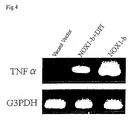
- Example 7 Expression increase of TNF ⁇ mRNA in NOX1-b expressing cells
- Probe primers coding for the TNF- ⁇ -specific sequences represented by SEQ ID NO:11 and SEQ ID NO:12 were synthesized. On each of the cDNA samples prepared in Example 6 and using a DNA polymerase (r Taq DNA polymerase; mfd. by Toyobo), RT-PCR reaction of 94°C for 1 minute, 45 cycles of consisting of 94°C for 10 seconds and 55°C for 20 seconds and 72°C for 30 seconds, was carried out.
- r Taq DNA polymerase mfd. by Toyobo
- the polynucleotide of the present invention can be used as an index of RA diagnosis, because its expression acceleration reflects the pathology. It became possible to carry out inspection of the RA diagnosis, by using the expression of the polynucleotide of the present invention and of the polypeptide of the present invention encoded by the polynucleotide as indexes. Additionally, the present invention provides a novel oxidase which is expressed specifically in RA patient-derived synovial cells, and it is expected that PCR using the specific primer sequences can be applied to the inspection of diagnosis of RA.
- the screening method of the present invention is useful for the screening of a substance for the treatment of RA and/or a substance for the treatment of osteoarthritis.
Landscapes
- Health & Medical Sciences (AREA)
- Life Sciences & Earth Sciences (AREA)
- Chemical & Material Sciences (AREA)
- Engineering & Computer Science (AREA)
- Organic Chemistry (AREA)
- Immunology (AREA)
- General Health & Medical Sciences (AREA)
- Zoology (AREA)
- Wood Science & Technology (AREA)
- Genetics & Genomics (AREA)
- Molecular Biology (AREA)
- Bioinformatics & Cheminformatics (AREA)
- Analytical Chemistry (AREA)
- Proteomics, Peptides & Aminoacids (AREA)
- Biomedical Technology (AREA)
- Biotechnology (AREA)
- Medicinal Chemistry (AREA)
- Microbiology (AREA)
- Hematology (AREA)
- Biochemistry (AREA)
- General Engineering & Computer Science (AREA)
- Pathology (AREA)
- Physics & Mathematics (AREA)
- Urology & Nephrology (AREA)
- Rheumatology (AREA)
- Cell Biology (AREA)
- General Physics & Mathematics (AREA)
- General Chemical & Material Sciences (AREA)
- Rehabilitation Therapy (AREA)
- Public Health (AREA)
- Nuclear Medicine, Radiotherapy & Molecular Imaging (AREA)
- Food Science & Technology (AREA)
- Pharmacology & Pharmacy (AREA)
- Biophysics (AREA)
- Chemical Kinetics & Catalysis (AREA)
- Animal Behavior & Ethology (AREA)
- Veterinary Medicine (AREA)
- Pain & Pain Management (AREA)
- Orthopedic Medicine & Surgery (AREA)
- Physical Education & Sports Medicine (AREA)
Applications Claiming Priority (5)
| Application Number | Priority Date | Filing Date | Title |
|---|---|---|---|
| JP2002165612 | 2002-06-06 | ||
| JP2002165612 | 2002-06-06 | ||
| JP2003060749 | 2003-03-07 | ||
| JP2003060749 | 2003-03-07 | ||
| PCT/JP2003/007148 WO2003104454A1 (ja) | 2002-06-06 | 2003-06-05 | 新規オキシダーゼ |
Publications (2)
| Publication Number | Publication Date |
|---|---|
| EP1482034A1 true EP1482034A1 (de) | 2004-12-01 |
| EP1482034A4 EP1482034A4 (de) | 2005-09-21 |
Family
ID=29738336
Family Applications (1)
| Application Number | Title | Priority Date | Filing Date |
|---|---|---|---|
| EP03730849A Withdrawn EP1482034A4 (de) | 2002-06-06 | 2003-06-05 | Neue oxydase |
Country Status (6)
| Country | Link |
|---|---|
| US (1) | US7186511B2 (de) |
| EP (1) | EP1482034A4 (de) |
| JP (1) | JP3716858B2 (de) |
| AU (1) | AU2003242163A1 (de) |
| CA (1) | CA2480619A1 (de) |
| WO (1) | WO2003104454A1 (de) |
Families Citing this family (2)
| Publication number | Priority date | Publication date | Assignee | Title |
|---|---|---|---|---|
| CN103864893B (zh) * | 2007-07-27 | 2017-01-04 | 伊玛提克斯生物技术有限公司 | 免疫疗法的免疫抗原表位 |
| WO2018119142A1 (en) | 2016-12-21 | 2018-06-28 | Amgen Inc. | Anti-tnf alpha antibody formulations |
Family Cites Families (5)
| Publication number | Priority date | Publication date | Assignee | Title |
|---|---|---|---|---|
| DE69934903T2 (de) * | 1998-11-10 | 2007-10-18 | Emory University | Mitogene regulatoren |
| EP1287029A2 (de) * | 2000-06-09 | 2003-03-05 | Corixa Corporation | Zusammensetzungen und verfahren zur therapie und diagnose von dickdarmkrebs |
| AU2002222944A1 (en) * | 2000-07-17 | 2002-01-30 | Diadexus, Inc. | Method of diagnosing, monitoring, staging, imaging and treating colon cancer |
| JP2004537981A (ja) * | 2000-11-16 | 2004-12-24 | エモリー・ユニバーシティ | マイトジェンオキシゲナーゼ調節因子 |
| AU2002330714A1 (en) | 2001-05-30 | 2003-01-02 | Biomedical Center | In silico screening for phenotype-associated expressed sequences |
-
2003
- 2003-06-05 CA CA002480619A patent/CA2480619A1/en not_active Abandoned
- 2003-06-05 JP JP2004511514A patent/JP3716858B2/ja not_active Expired - Fee Related
- 2003-06-05 EP EP03730849A patent/EP1482034A4/de not_active Withdrawn
- 2003-06-05 US US10/509,622 patent/US7186511B2/en not_active Expired - Fee Related
- 2003-06-05 WO PCT/JP2003/007148 patent/WO2003104454A1/ja not_active Ceased
- 2003-06-05 AU AU2003242163A patent/AU2003242163A1/en not_active Abandoned
Non-Patent Citations (2)
| Title |
|---|
| See also references of WO03104454A1 * |
| SORESCU DAN ET AL: "Superoxide production and expression of nox family proteins in human atherosclerosis." CIRCULATION. 26 MAR 2002, vol. 105, no. 12, 26 March 2002 (2002-03-26), pages 1429-1435, XP002335674 ISSN: 1524-4539 * |
Also Published As
| Publication number | Publication date |
|---|---|
| AU2003242163A1 (en) | 2003-12-22 |
| US20050124056A1 (en) | 2005-06-09 |
| JPWO2003104454A1 (ja) | 2005-10-06 |
| CA2480619A1 (en) | 2003-12-18 |
| US7186511B2 (en) | 2007-03-06 |
| JP3716858B2 (ja) | 2005-11-16 |
| EP1482034A4 (de) | 2005-09-21 |
| WO2003104454A1 (ja) | 2003-12-18 |
Similar Documents
| Publication | Publication Date | Title |
|---|---|---|
| O’Dell et al. | Apal polymorphism in insulin-like growth factor II (IGF2) gene and weight in middle-aged males | |
| KR20140092905A (ko) | 방광암의 치료 및 진단을 위한 방법 및 조성물 | |
| CN109295221B (zh) | 环状rna作为结直肠癌分子标志物的应用 | |
| Jin et al. | Metallothionein 1E mRNA is highly expressed in oestrogen receptor-negative human invasive ductal breast cancer | |
| US6946243B2 (en) | Method of identifying compounds suitable for treatment and/or prophylaxis of obesity | |
| TW201000905A (en) | Use of cathepsin C | |
| CN109477146A (zh) | 炎症促进因子表达抑制剂、其有效成分的筛选方法、对该方法有用的表达盒、诊断药和诊断方法 | |
| US7186511B2 (en) | Oxidase | |
| US20060121465A1 (en) | Sgk and nedd used as diagnostic and therapeutic targets | |
| KR20230049059A (ko) | 염증성 질환 치료를 위한 팔모틸화/탈팔모틸화 주기 표적화 | |
| WO2002059370A2 (en) | Methods for identifying compounds that modulate disorders related to nitric oxide/cgmp-dependent protein kinase signaling | |
| CN1322899C (zh) | 抗肝癌基因药物组合物、小分子干扰rna及其筛选方法 | |
| JP2003532430A (ja) | ヒトにおける成長ホルモン異形の検出方法、上記異形及びそれらの使用 | |
| CN114908162A (zh) | Rrm2在晚期胃肠间质瘤的诊断和治疗中的应用 | |
| CA2464700C (en) | Ibc-1 (invasive breast cancer-1), a putative oncogene amplified in breast cancer | |
| US20040224363A1 (en) | IBC-1 (Invasive Breast Cancer-1), a putative oncogene amplified in breast cancer | |
| EP1700921A2 (de) | Regulation einer humanen Asparaginhydroxylase | |
| KR102585974B1 (ko) | 전립선암 진단 점수 계산 방법 및 그 용도 | |
| JP4232423B2 (ja) | 新規ユビキチン特異プロテアーゼ | |
| CN116287246B (zh) | Trappc1基因在制备肿瘤诊断和/或预后的试剂中的应用 | |
| TW200405006A (en) | Treatment of liver diseases | |
| KR20120073261A (ko) | 카텝신 h의 용도 | |
| EP1848736A2 (de) | Salzgeschmackrezeptor und seine verwendung in einer testvorrichtung für salzgeschmack | |
| JP2008536880A (ja) | 哺乳動物の中枢神経系におけるgpr39遺伝子の機能および使用 | |
| CN110133274B (zh) | Igfbpl1作为标志物在制备心血管疾病诊断试剂中的应用 |
Legal Events
| Date | Code | Title | Description |
|---|---|---|---|
| PUAI | Public reference made under article 153(3) epc to a published international application that has entered the european phase |
Free format text: ORIGINAL CODE: 0009012 |
|
| 17P | Request for examination filed |
Effective date: 20040928 |
|
| AK | Designated contracting states |
Kind code of ref document: A1 Designated state(s): AT BE BG CH CY CZ DE DK EE ES FI FR GB GR HU IE IT LI LU MC NL PT RO SE SI SK TR |
|
| AX | Request for extension of the european patent |
Extension state: AL LT LV MK |
|
| A4 | Supplementary search report drawn up and despatched |
Effective date: 20050809 |
|
| DAX | Request for extension of the european patent (deleted) | ||
| RAP1 | Party data changed (applicant data changed or rights of an application transferred) |
Owner name: ASTELLAS PHARMA INC. |
|
| RAP1 | Party data changed (applicant data changed or rights of an application transferred) |
Owner name: ASTELLAS PHARMA INC. |
|
| 17Q | First examination report despatched |
Effective date: 20061011 |
|
| STAA | Information on the status of an ep patent application or granted ep patent |
Free format text: STATUS: THE APPLICATION IS DEEMED TO BE WITHDRAWN |
|
| 18D | Application deemed to be withdrawn |
Effective date: 20071120 |