EP1484373B2 - Polysiloxane zum Beschichten von Oberflächen - Google Patents
Polysiloxane zum Beschichten von Oberflächen Download PDFInfo
- Publication number
- EP1484373B2 EP1484373B2 EP20040013089 EP04013089A EP1484373B2 EP 1484373 B2 EP1484373 B2 EP 1484373B2 EP 20040013089 EP20040013089 EP 20040013089 EP 04013089 A EP04013089 A EP 04013089A EP 1484373 B2 EP1484373 B2 EP 1484373B2
- Authority
- EP
- European Patent Office
- Prior art keywords
- component
- substrate
- coating
- group
- diisocyanate
- Prior art date
- Legal status (The legal status is an assumption and is not a legal conclusion. Google has not performed a legal analysis and makes no representation as to the accuracy of the status listed.)
- Expired - Lifetime
Links
- 238000000576 coating method Methods 0.000 title claims description 127
- -1 Polysiloxane Polymers 0.000 title claims description 71
- 229920001296 polysiloxane Polymers 0.000 title claims description 56
- 239000011248 coating agent Substances 0.000 claims description 107
- 239000000758 substrate Substances 0.000 claims description 67
- 238000000034 method Methods 0.000 claims description 59
- 229920000642 polymer Polymers 0.000 claims description 34
- 239000000463 material Substances 0.000 claims description 33
- 125000005442 diisocyanate group Chemical group 0.000 claims description 30
- 125000003118 aryl group Chemical group 0.000 claims description 29
- 125000000623 heterocyclic group Chemical group 0.000 claims description 25
- 229920006395 saturated elastomer Polymers 0.000 claims description 24
- 150000004820 halides Chemical class 0.000 claims description 20
- 229910000838 Al alloy Inorganic materials 0.000 claims description 18
- 230000007797 corrosion Effects 0.000 claims description 16
- 238000005260 corrosion Methods 0.000 claims description 16
- 125000000217 alkyl group Chemical group 0.000 claims description 14
- 150000001875 compounds Chemical class 0.000 claims description 14
- 230000008569 process Effects 0.000 claims description 14
- QIQCZROILFZKAT-UHFFFAOYSA-N tetracarbon dioxide Chemical group O=C=C=C=C=O QIQCZROILFZKAT-UHFFFAOYSA-N 0.000 claims description 14
- 238000002203 pretreatment Methods 0.000 claims description 12
- 125000004051 hexyl group Chemical group [H]C([H])([H])C([H])([H])C([H])([H])C([H])([H])C([H])([H])C([H])([H])* 0.000 claims description 11
- 239000001257 hydrogen Substances 0.000 claims description 11
- 229910052739 hydrogen Inorganic materials 0.000 claims description 11
- DVKJHBMWWAPEIU-UHFFFAOYSA-N toluene 2,4-diisocyanate Chemical compound CC1=CC=C(N=C=O)C=C1N=C=O DVKJHBMWWAPEIU-UHFFFAOYSA-N 0.000 claims description 9
- 238000007743 anodising Methods 0.000 claims description 8
- UFHFLCQGNIYNRP-UHFFFAOYSA-N Hydrogen Chemical compound [H][H] UFHFLCQGNIYNRP-UHFFFAOYSA-N 0.000 claims description 7
- 230000002401 inhibitory effect Effects 0.000 claims description 7
- 125000002496 methyl group Chemical group [H]C([H])([H])* 0.000 claims description 7
- 125000000008 (C1-C10) alkyl group Chemical group 0.000 claims description 5
- OKTJSMMVPCPJKN-UHFFFAOYSA-N Carbon Chemical compound [C] OKTJSMMVPCPJKN-UHFFFAOYSA-N 0.000 claims description 5
- 229910052799 carbon Inorganic materials 0.000 claims description 5
- 235000013824 polyphenols Nutrition 0.000 claims description 5
- 239000007769 metal material Substances 0.000 claims description 4
- 239000004593 Epoxy Substances 0.000 claims description 3
- 229910000640 Fe alloy Inorganic materials 0.000 claims description 3
- 229910000934 Monel 400 Inorganic materials 0.000 claims description 3
- 229910000556 Monel K-500 Inorganic materials 0.000 claims description 3
- 239000004642 Polyimide Substances 0.000 claims description 3
- OANFWJQPUHQWDL-UHFFFAOYSA-N copper iron manganese nickel Chemical compound [Mn].[Fe].[Ni].[Cu] OANFWJQPUHQWDL-UHFFFAOYSA-N 0.000 claims description 3
- 125000003700 epoxy group Chemical group 0.000 claims description 3
- 229910001055 inconels 600 Inorganic materials 0.000 claims description 3
- 229920000647 polyepoxide Polymers 0.000 claims description 3
- 229920001721 polyimide Polymers 0.000 claims description 3
- 229920002635 polyurethane Polymers 0.000 claims description 3
- 239000004814 polyurethane Substances 0.000 claims description 3
- 229920000915 polyvinyl chloride Polymers 0.000 claims description 3
- 229910001220 stainless steel Inorganic materials 0.000 claims description 3
- 125000000484 butyl group Chemical group [H]C([*])([H])C([H])([H])C([H])([H])C([H])([H])[H] 0.000 claims 4
- 125000001495 ethyl group Chemical group [H]C([H])([H])C([H])([H])* 0.000 claims 4
- 125000001997 phenyl group Chemical group [H]C1=C([H])C([H])=C(*)C([H])=C1[H] 0.000 claims 4
- 125000001436 propyl group Chemical group [H]C([*])([H])C([H])([H])C([H])([H])[H] 0.000 claims 4
- 125000000349 (Z)-3-carboxyprop-2-enoyl group Chemical group O=C([*])/C([H])=C([H])\C(O[H])=O 0.000 claims 2
- 229920000877 Melamine resin Polymers 0.000 claims 2
- 150000001252 acrylic acid derivatives Chemical class 0.000 claims 2
- 125000002877 alkyl aryl group Chemical group 0.000 claims 2
- 150000002118 epoxides Chemical class 0.000 claims 2
- 150000007974 melamines Chemical class 0.000 claims 2
- 150000003673 urethanes Chemical class 0.000 claims 2
- YMWUJEATGCHHMB-UHFFFAOYSA-N Dichloromethane Chemical compound ClCCl YMWUJEATGCHHMB-UHFFFAOYSA-N 0.000 description 24
- 229910045601 alloy Inorganic materials 0.000 description 22
- 239000000956 alloy Substances 0.000 description 22
- 239000000243 solution Substances 0.000 description 22
- XAGFODPZIPBFFR-UHFFFAOYSA-N aluminium Chemical compound [Al] XAGFODPZIPBFFR-UHFFFAOYSA-N 0.000 description 21
- 229910052782 aluminium Inorganic materials 0.000 description 20
- 229920002647 polyamide Polymers 0.000 description 15
- 239000004952 Polyamide Substances 0.000 description 13
- 150000001408 amides Chemical group 0.000 description 13
- 238000006243 chemical reaction Methods 0.000 description 13
- 230000015572 biosynthetic process Effects 0.000 description 12
- XLYOFNOQVPJJNP-UHFFFAOYSA-N water Substances O XLYOFNOQVPJJNP-UHFFFAOYSA-N 0.000 description 12
- 238000010438 heat treatment Methods 0.000 description 11
- 239000000203 mixture Substances 0.000 description 11
- 239000000126 substance Substances 0.000 description 11
- 239000002253 acid Substances 0.000 description 10
- ZMANZCXQSJIPKH-UHFFFAOYSA-N Triethylamine Chemical compound CCN(CC)CC ZMANZCXQSJIPKH-UHFFFAOYSA-N 0.000 description 9
- ZLYYJUJDFKGVKB-OWOJBTEDSA-N (e)-but-2-enedioyl dichloride Chemical compound ClC(=O)\C=C\C(Cl)=O ZLYYJUJDFKGVKB-OWOJBTEDSA-N 0.000 description 8
- XSQUKJJJFZCRTK-UHFFFAOYSA-N Urea Chemical compound NC(N)=O XSQUKJJJFZCRTK-UHFFFAOYSA-N 0.000 description 8
- 239000000565 sealant Substances 0.000 description 8
- 239000007921 spray Substances 0.000 description 8
- 238000011282 treatment Methods 0.000 description 8
- 239000000047 product Substances 0.000 description 7
- WSFSSNUMVMOOMR-UHFFFAOYSA-N Formaldehyde Chemical compound O=C WSFSSNUMVMOOMR-UHFFFAOYSA-N 0.000 description 6
- YXFVVABEGXRONW-UHFFFAOYSA-N Toluene Chemical compound CC1=CC=CC=C1 YXFVVABEGXRONW-UHFFFAOYSA-N 0.000 description 6
- 239000003054 catalyst Substances 0.000 description 6
- 239000000853 adhesive Substances 0.000 description 5
- 230000001070 adhesive effect Effects 0.000 description 5
- 239000003570 air Substances 0.000 description 5
- 229920001400 block copolymer Polymers 0.000 description 5
- ZCDOYSPFYFSLEW-UHFFFAOYSA-N chromate(2-) Chemical class [O-][Cr]([O-])(=O)=O ZCDOYSPFYFSLEW-UHFFFAOYSA-N 0.000 description 5
- KRVSOGSZCMJSLX-UHFFFAOYSA-L chromic acid Substances O[Cr](O)(=O)=O KRVSOGSZCMJSLX-UHFFFAOYSA-L 0.000 description 5
- AWJWCTOOIBYHON-UHFFFAOYSA-N furo[3,4-b]pyrazine-5,7-dione Chemical compound C1=CN=C2C(=O)OC(=O)C2=N1 AWJWCTOOIBYHON-UHFFFAOYSA-N 0.000 description 5
- 239000002904 solvent Substances 0.000 description 5
- 125000002730 succinyl group Chemical group C(CCC(=O)*)(=O)* 0.000 description 5
- 238000012360 testing method Methods 0.000 description 5
- VEXZGXHMUGYJMC-UHFFFAOYSA-M Chloride anion Chemical compound [Cl-] VEXZGXHMUGYJMC-UHFFFAOYSA-M 0.000 description 4
- OFOBLEOULBTSOW-UHFFFAOYSA-N Malonic acid Chemical compound OC(=O)CC(O)=O OFOBLEOULBTSOW-UHFFFAOYSA-N 0.000 description 4
- 150000007945 N-acyl ureas Chemical class 0.000 description 4
- 239000004809 Teflon Substances 0.000 description 4
- RTAQQCXQSZGOHL-UHFFFAOYSA-N Titanium Chemical compound [Ti] RTAQQCXQSZGOHL-UHFFFAOYSA-N 0.000 description 4
- 238000009825 accumulation Methods 0.000 description 4
- 125000001931 aliphatic group Chemical group 0.000 description 4
- 238000005275 alloying Methods 0.000 description 4
- 239000012298 atmosphere Substances 0.000 description 4
- 230000008901 benefit Effects 0.000 description 4
- 150000001732 carboxylic acid derivatives Chemical class 0.000 description 4
- 150000001805 chlorine compounds Chemical class 0.000 description 4
- 230000001427 coherent effect Effects 0.000 description 4
- 239000000470 constituent Substances 0.000 description 4
- 238000004132 cross linking Methods 0.000 description 4
- 238000010586 diagram Methods 0.000 description 4
- 230000000694 effects Effects 0.000 description 4
- 238000005516 engineering process Methods 0.000 description 4
- 238000009434 installation Methods 0.000 description 4
- 239000012948 isocyanate Substances 0.000 description 4
- 239000010410 layer Substances 0.000 description 4
- 238000004519 manufacturing process Methods 0.000 description 4
- 125000001557 phthalyl group Chemical group C(=O)(O)C1=C(C(=O)*)C=CC=C1 0.000 description 4
- BASFCYQUMIYNBI-UHFFFAOYSA-N platinum Chemical compound [Pt] BASFCYQUMIYNBI-UHFFFAOYSA-N 0.000 description 4
- 238000001556 precipitation Methods 0.000 description 4
- 239000003351 stiffener Substances 0.000 description 4
- 239000010936 titanium Substances 0.000 description 4
- 229910052719 titanium Inorganic materials 0.000 description 4
- 230000032683 aging Effects 0.000 description 3
- 238000000137 annealing Methods 0.000 description 3
- 238000013459 approach Methods 0.000 description 3
- 230000004888 barrier function Effects 0.000 description 3
- 239000004202 carbamide Substances 0.000 description 3
- 230000015556 catabolic process Effects 0.000 description 3
- 238000006731 degradation reaction Methods 0.000 description 3
- 150000001991 dicarboxylic acids Chemical class 0.000 description 3
- 239000004205 dimethyl polysiloxane Substances 0.000 description 3
- 230000002349 favourable effect Effects 0.000 description 3
- 238000007710 freezing Methods 0.000 description 3
- 230000008014 freezing Effects 0.000 description 3
- RRAMGCGOFNQTLD-UHFFFAOYSA-N hexamethylene diisocyanate Chemical compound O=C=NCCCCCCN=C=O RRAMGCGOFNQTLD-UHFFFAOYSA-N 0.000 description 3
- 230000002209 hydrophobic effect Effects 0.000 description 3
- 125000002887 hydroxy group Chemical group [H]O* 0.000 description 3
- 230000005923 long-lasting effect Effects 0.000 description 3
- 239000011159 matrix material Substances 0.000 description 3
- 238000002156 mixing Methods 0.000 description 3
- 229920003986 novolac Polymers 0.000 description 3
- 230000035515 penetration Effects 0.000 description 3
- 229920000435 poly(dimethylsiloxane) Polymers 0.000 description 3
- 238000012545 processing Methods 0.000 description 3
- 238000005728 strengthening Methods 0.000 description 3
- 150000003512 tertiary amines Chemical class 0.000 description 3
- NGNBDVOYPDDBFK-UHFFFAOYSA-N 2-[2,4-di(pentan-2-yl)phenoxy]acetyl chloride Chemical class CCCC(C)C1=CC=C(OCC(Cl)=O)C(C(C)CCC)=C1 NGNBDVOYPDDBFK-UHFFFAOYSA-N 0.000 description 2
- JDTUPLBMGDDPJS-UHFFFAOYSA-N 2-methoxy-2-phenylethanol Chemical compound COC(CO)C1=CC=CC=C1 JDTUPLBMGDDPJS-UHFFFAOYSA-N 0.000 description 2
- IJGRMHOSHXDMSA-UHFFFAOYSA-N Atomic nitrogen Chemical compound N#N IJGRMHOSHXDMSA-UHFFFAOYSA-N 0.000 description 2
- RYGMFSIKBFXOCR-UHFFFAOYSA-N Copper Chemical compound [Cu] RYGMFSIKBFXOCR-UHFFFAOYSA-N 0.000 description 2
- OAKJQQAXSVQMHS-UHFFFAOYSA-N Hydrazine Chemical compound NN OAKJQQAXSVQMHS-UHFFFAOYSA-N 0.000 description 2
- FYYHWMGAXLPEAU-UHFFFAOYSA-N Magnesium Chemical compound [Mg] FYYHWMGAXLPEAU-UHFFFAOYSA-N 0.000 description 2
- ISWSIDIOOBJBQZ-UHFFFAOYSA-N Phenol Chemical compound OC1=CC=CC=C1 ISWSIDIOOBJBQZ-UHFFFAOYSA-N 0.000 description 2
- 239000004698 Polyethylene Substances 0.000 description 2
- 229910000831 Steel Inorganic materials 0.000 description 2
- HCHKCACWOHOZIP-UHFFFAOYSA-N Zinc Chemical compound [Zn] HCHKCACWOHOZIP-UHFFFAOYSA-N 0.000 description 2
- 239000000654 additive Substances 0.000 description 2
- 125000003368 amide group Chemical group 0.000 description 2
- DSVRVHYFPPQFTI-UHFFFAOYSA-N bis(ethenyl)-methyl-trimethylsilyloxysilane;platinum Chemical compound [Pt].C[Si](C)(C)O[Si](C)(C=C)C=C DSVRVHYFPPQFTI-UHFFFAOYSA-N 0.000 description 2
- 239000011247 coating layer Substances 0.000 description 2
- 239000002131 composite material Substances 0.000 description 2
- 229910052802 copper Inorganic materials 0.000 description 2
- 239000010949 copper Substances 0.000 description 2
- 125000004956 cyclohexylene group Chemical group 0.000 description 2
- 230000008021 deposition Effects 0.000 description 2
- KPUWHANPEXNPJT-UHFFFAOYSA-N disiloxane Chemical compound [SiH3]O[SiH3] KPUWHANPEXNPJT-UHFFFAOYSA-N 0.000 description 2
- 230000007613 environmental effect Effects 0.000 description 2
- VKYKSIONXSXAKP-UHFFFAOYSA-N hexamethylenetetramine Chemical compound C1N(C2)CN3CN1CN2C3 VKYKSIONXSXAKP-UHFFFAOYSA-N 0.000 description 2
- 150000004678 hydrides Chemical group 0.000 description 2
- 239000012535 impurity Substances 0.000 description 2
- IQPQWNKOIGAROB-UHFFFAOYSA-N isocyanate group Chemical group [N-]=C=O IQPQWNKOIGAROB-UHFFFAOYSA-N 0.000 description 2
- 150000002513 isocyanates Chemical class 0.000 description 2
- 229910052749 magnesium Inorganic materials 0.000 description 2
- 239000011777 magnesium Substances 0.000 description 2
- 230000013011 mating Effects 0.000 description 2
- 239000000155 melt Substances 0.000 description 2
- 229910052751 metal Inorganic materials 0.000 description 2
- 239000002184 metal Substances 0.000 description 2
- 238000012986 modification Methods 0.000 description 2
- 230000004048 modification Effects 0.000 description 2
- 230000000704 physical effect Effects 0.000 description 2
- 229910052697 platinum Inorganic materials 0.000 description 2
- 229920000573 polyethylene Polymers 0.000 description 2
- 239000011241 protective layer Substances 0.000 description 2
- 238000010791 quenching Methods 0.000 description 2
- 230000000171 quenching effect Effects 0.000 description 2
- 239000012812 sealant material Substances 0.000 description 2
- 238000000926 separation method Methods 0.000 description 2
- 229920002379 silicone rubber Polymers 0.000 description 2
- 239000004945 silicone rubber Substances 0.000 description 2
- 239000010959 steel Substances 0.000 description 2
- 238000003860 storage Methods 0.000 description 2
- 239000002344 surface layer Substances 0.000 description 2
- 231100000331 toxic Toxicity 0.000 description 2
- 230000002588 toxic effect Effects 0.000 description 2
- 239000011701 zinc Substances 0.000 description 2
- 229910052725 zinc Inorganic materials 0.000 description 2
- IVSZLXZYQVIEFR-UHFFFAOYSA-N 1,3-Dimethylbenzene Natural products CC1=CC=CC(C)=C1 IVSZLXZYQVIEFR-UHFFFAOYSA-N 0.000 description 1
- VGHSXKTVMPXHNG-UHFFFAOYSA-N 1,3-diisocyanatobenzene Chemical compound O=C=NC1=CC=CC(N=C=O)=C1 VGHSXKTVMPXHNG-UHFFFAOYSA-N 0.000 description 1
- ALQLPWJFHRMHIU-UHFFFAOYSA-N 1,4-diisocyanatobenzene Chemical compound O=C=NC1=CC=C(N=C=O)C=C1 ALQLPWJFHRMHIU-UHFFFAOYSA-N 0.000 description 1
- CDMDQYCEEKCBGR-UHFFFAOYSA-N 1,4-diisocyanatocyclohexane Chemical compound O=C=NC1CCC(N=C=O)CC1 CDMDQYCEEKCBGR-UHFFFAOYSA-N 0.000 description 1
- SBJCUZQNHOLYMD-UHFFFAOYSA-N 1,5-Naphthalene diisocyanate Chemical compound C1=CC=C2C(N=C=O)=CC=CC2=C1N=C=O SBJCUZQNHOLYMD-UHFFFAOYSA-N 0.000 description 1
- VFOZPUQEFHZHBT-UHFFFAOYSA-N 2-ethenylbenzoyl chloride Chemical compound ClC(=O)C1=CC=CC=C1C=C VFOZPUQEFHZHBT-UHFFFAOYSA-N 0.000 description 1
- 125000003903 2-propenyl group Chemical group [H]C([*])([H])C([H])=C([H])[H] 0.000 description 1
- 101000828805 Cowpox virus (strain Brighton Red) Serine proteinase inhibitor 2 Proteins 0.000 description 1
- 239000005057 Hexamethylene diisocyanate Substances 0.000 description 1
- HDONYZHVZVCMLR-UHFFFAOYSA-N N=C=O.N=C=O.CC1CCCCC1 Chemical compound N=C=O.N=C=O.CC1CCCCC1 HDONYZHVZVCMLR-UHFFFAOYSA-N 0.000 description 1
- USWMCMSAHICGFU-UHFFFAOYSA-N O-aminosilylhydroxylamine Chemical compound NO[SiH2]N USWMCMSAHICGFU-UHFFFAOYSA-N 0.000 description 1
- 239000004820 Pressure-sensitive adhesive Substances 0.000 description 1
- QCWXUUIWCKQGHC-UHFFFAOYSA-N Zirconium Chemical compound [Zr] QCWXUUIWCKQGHC-UHFFFAOYSA-N 0.000 description 1
- 150000007513 acids Chemical class 0.000 description 1
- HFBMWMNUJJDEQZ-UHFFFAOYSA-N acryloyl chloride Chemical compound ClC(=O)C=C HFBMWMNUJJDEQZ-UHFFFAOYSA-N 0.000 description 1
- 230000001464 adherent effect Effects 0.000 description 1
- 125000003342 alkenyl group Chemical group 0.000 description 1
- 125000006193 alkinyl group Chemical group 0.000 description 1
- 125000003545 alkoxy group Chemical group 0.000 description 1
- 239000012080 ambient air Substances 0.000 description 1
- 239000010426 asphalt Substances 0.000 description 1
- QFFVPLLCYGOFPU-UHFFFAOYSA-N barium chromate Chemical compound [Ba+2].[O-][Cr]([O-])(=O)=O QFFVPLLCYGOFPU-UHFFFAOYSA-N 0.000 description 1
- 229940083898 barium chromate Drugs 0.000 description 1
- 239000010953 base metal Substances 0.000 description 1
- 239000011324 bead Substances 0.000 description 1
- 125000001797 benzyl group Chemical group [H]C1=C([H])C([H])=C(C([H])=C1[H])C([H])([H])* 0.000 description 1
- 230000000740 bleeding effect Effects 0.000 description 1
- 230000000903 blocking effect Effects 0.000 description 1
- 150000001721 carbon Chemical class 0.000 description 1
- 238000006555 catalytic reaction Methods 0.000 description 1
- 239000003518 caustics Substances 0.000 description 1
- 239000000919 ceramic Substances 0.000 description 1
- 230000008859 change Effects 0.000 description 1
- 239000007795 chemical reaction product Substances 0.000 description 1
- 239000003795 chemical substances by application Substances 0.000 description 1
- 229940117975 chromium trioxide Drugs 0.000 description 1
- WGLPBDUCMAPZCE-UHFFFAOYSA-N chromium trioxide Inorganic materials O=[Cr](=O)=O WGLPBDUCMAPZCE-UHFFFAOYSA-N 0.000 description 1
- GAMDZJFZMJECOS-UHFFFAOYSA-N chromium(6+);oxygen(2-) Chemical compound [O-2].[O-2].[O-2].[Cr+6] GAMDZJFZMJECOS-UHFFFAOYSA-N 0.000 description 1
- 238000010073 coating (rubber) Methods 0.000 description 1
- 238000001816 cooling Methods 0.000 description 1
- 229920001577 copolymer Polymers 0.000 description 1
- 239000013078 crystal Substances 0.000 description 1
- LPIQUOYDBNQMRZ-UHFFFAOYSA-N cyclopentenylidene Natural products C1CC=CC1 LPIQUOYDBNQMRZ-UHFFFAOYSA-N 0.000 description 1
- 238000002716 delivery method Methods 0.000 description 1
- 230000001419 dependent effect Effects 0.000 description 1
- KORSJDCBLAPZEQ-UHFFFAOYSA-N dicyclohexylmethane-4,4'-diisocyanate Chemical compound C1CC(N=C=O)CCC1CC1CCC(N=C=O)CC1 KORSJDCBLAPZEQ-UHFFFAOYSA-N 0.000 description 1
- 238000001035 drying Methods 0.000 description 1
- 230000009977 dual effect Effects 0.000 description 1
- 230000005611 electricity Effects 0.000 description 1
- 238000005538 encapsulation Methods 0.000 description 1
- 230000003203 everyday effect Effects 0.000 description 1
- 239000000945 filler Substances 0.000 description 1
- 229920005570 flexible polymer Polymers 0.000 description 1
- 239000012530 fluid Substances 0.000 description 1
- 238000005242 forging Methods 0.000 description 1
- SLGWESQGEUXWJQ-UHFFFAOYSA-N formaldehyde;phenol Chemical compound O=C.OC1=CC=CC=C1 SLGWESQGEUXWJQ-UHFFFAOYSA-N 0.000 description 1
- 238000009472 formulation Methods 0.000 description 1
- 238000009432 framing Methods 0.000 description 1
- 239000011521 glass Substances 0.000 description 1
- 229910052736 halogen Inorganic materials 0.000 description 1
- 150000002367 halogens Chemical group 0.000 description 1
- 239000004312 hexamethylene tetramine Substances 0.000 description 1
- 235000010299 hexamethylene tetramine Nutrition 0.000 description 1
- 230000002706 hydrostatic effect Effects 0.000 description 1
- 150000003949 imides Chemical class 0.000 description 1
- 238000007689 inspection Methods 0.000 description 1
- 238000005304 joining Methods 0.000 description 1
- 230000000670 limiting effect Effects 0.000 description 1
- 239000007788 liquid Substances 0.000 description 1
- 238000003754 machining Methods 0.000 description 1
- 238000005272 metallurgy Methods 0.000 description 1
- VHRYZQNGTZXDNX-UHFFFAOYSA-N methacryloyl chloride Chemical compound CC(=C)C(Cl)=O VHRYZQNGTZXDNX-UHFFFAOYSA-N 0.000 description 1
- 229960004011 methenamine Drugs 0.000 description 1
- UAEPNZWRGJTJPN-UHFFFAOYSA-N methylcyclohexane Chemical compound CC1CCCCC1 UAEPNZWRGJTJPN-UHFFFAOYSA-N 0.000 description 1
- 229910052757 nitrogen Inorganic materials 0.000 description 1
- 239000003973 paint Substances 0.000 description 1
- 230000036961 partial effect Effects 0.000 description 1
- 239000002245 particle Substances 0.000 description 1
- 229920001568 phenolic resin Polymers 0.000 description 1
- 239000004014 plasticizer Substances 0.000 description 1
- 239000005056 polyisocyanate Substances 0.000 description 1
- 229920001228 polyisocyanate Polymers 0.000 description 1
- 239000002244 precipitate Substances 0.000 description 1
- 238000004881 precipitation hardening Methods 0.000 description 1
- 238000002360 preparation method Methods 0.000 description 1
- 230000002265 prevention Effects 0.000 description 1
- 230000001681 protective effect Effects 0.000 description 1
- 238000010926 purge Methods 0.000 description 1
- 229920005989 resin Polymers 0.000 description 1
- 239000011347 resin Substances 0.000 description 1
- 230000000717 retained effect Effects 0.000 description 1
- 238000007789 sealing Methods 0.000 description 1
- 229910052710 silicon Inorganic materials 0.000 description 1
- 239000010703 silicon Substances 0.000 description 1
- 239000007787 solid Substances 0.000 description 1
- 239000006104 solid solution Substances 0.000 description 1
- 238000003756 stirring Methods 0.000 description 1
- 238000005482 strain hardening Methods 0.000 description 1
- 230000035882 stress Effects 0.000 description 1
- NVKTUNLPFJHLCG-UHFFFAOYSA-N strontium chromate Chemical compound [Sr+2].[O-][Cr]([O-])(=O)=O NVKTUNLPFJHLCG-UHFFFAOYSA-N 0.000 description 1
- 125000003107 substituted aryl group Chemical group 0.000 description 1
- 239000010891 toxic waste Substances 0.000 description 1
- 239000002699 waste material Substances 0.000 description 1
- 230000003313 weakening effect Effects 0.000 description 1
- 239000002023 wood Substances 0.000 description 1
- NDKWCCLKSWNDBG-UHFFFAOYSA-N zinc;dioxido(dioxo)chromium Chemical compound [Zn+2].[O-][Cr]([O-])(=O)=O NDKWCCLKSWNDBG-UHFFFAOYSA-N 0.000 description 1
- 229910052726 zirconium Inorganic materials 0.000 description 1
Images


Classifications
-
- C—CHEMISTRY; METALLURGY
- C09—DYES; PAINTS; POLISHES; NATURAL RESINS; ADHESIVES; COMPOSITIONS NOT OTHERWISE PROVIDED FOR; APPLICATIONS OF MATERIALS NOT OTHERWISE PROVIDED FOR
- C09D—COATING COMPOSITIONS, e.g. PAINTS, VARNISHES OR LACQUERS; FILLING PASTES; CHEMICAL PAINT OR INK REMOVERS; INKS; CORRECTING FLUIDS; WOODSTAINS; PASTES OR SOLIDS FOR COLOURING OR PRINTING; USE OF MATERIALS THEREFOR
- C09D183/00—Coating compositions based on macromolecular compounds obtained by reactions forming in the main chain of the macromolecule a linkage containing silicon, with or without sulfur, nitrogen, oxygen, or carbon only; Coating compositions based on derivatives of such polymers
- C09D183/04—Polysiloxanes
-
- C—CHEMISTRY; METALLURGY
- C08—ORGANIC MACROMOLECULAR COMPOUNDS; THEIR PREPARATION OR CHEMICAL WORKING-UP; COMPOSITIONS BASED THEREON
- C08G—MACROMOLECULAR COMPOUNDS OBTAINED OTHERWISE THAN BY REACTIONS ONLY INVOLVING UNSATURATED CARBON-TO-CARBON BONDS
- C08G18/00—Polymeric products of isocyanates or isothiocyanates
- C08G18/06—Polymeric products of isocyanates or isothiocyanates with compounds having active hydrogen
- C08G18/28—Polymeric products of isocyanates or isothiocyanates with compounds having active hydrogen characterised by the compounds used containing active hydrogen
- C08G18/40—High-molecular-weight compounds
- C08G18/61—Polysiloxanes
-
- C—CHEMISTRY; METALLURGY
- C09—DYES; PAINTS; POLISHES; NATURAL RESINS; ADHESIVES; COMPOSITIONS NOT OTHERWISE PROVIDED FOR; APPLICATIONS OF MATERIALS NOT OTHERWISE PROVIDED FOR
- C09D—COATING COMPOSITIONS, e.g. PAINTS, VARNISHES OR LACQUERS; FILLING PASTES; CHEMICAL PAINT OR INK REMOVERS; INKS; CORRECTING FLUIDS; WOODSTAINS; PASTES OR SOLIDS FOR COLOURING OR PRINTING; USE OF MATERIALS THEREFOR
- C09D175/00—Coating compositions based on polyureas or polyurethanes; Coating compositions based on derivatives of such polymers
- C09D175/04—Polyurethanes
-
- C—CHEMISTRY; METALLURGY
- C09—DYES; PAINTS; POLISHES; NATURAL RESINS; ADHESIVES; COMPOSITIONS NOT OTHERWISE PROVIDED FOR; APPLICATIONS OF MATERIALS NOT OTHERWISE PROVIDED FOR
- C09D—COATING COMPOSITIONS, e.g. PAINTS, VARNISHES OR LACQUERS; FILLING PASTES; CHEMICAL PAINT OR INK REMOVERS; INKS; CORRECTING FLUIDS; WOODSTAINS; PASTES OR SOLIDS FOR COLOURING OR PRINTING; USE OF MATERIALS THEREFOR
- C09D183/00—Coating compositions based on macromolecular compounds obtained by reactions forming in the main chain of the macromolecule a linkage containing silicon, with or without sulfur, nitrogen, oxygen, or carbon only; Coating compositions based on derivatives of such polymers
- C09D183/14—Coating compositions based on macromolecular compounds obtained by reactions forming in the main chain of the macromolecule a linkage containing silicon, with or without sulfur, nitrogen, oxygen, or carbon only; Coating compositions based on derivatives of such polymers in which at least two but not all the silicon atoms are connected by linkages other than oxygen atoms
-
- C—CHEMISTRY; METALLURGY
- C25—ELECTROLYTIC OR ELECTROPHORETIC PROCESSES; APPARATUS THEREFOR
- C25D—PROCESSES FOR THE ELECTROLYTIC OR ELECTROPHORETIC PRODUCTION OF COATINGS; ELECTROFORMING; APPARATUS THEREFOR
- C25D11/00—Electrolytic coating by surface reaction, i.e. forming conversion layers
- C25D11/02—Anodisation
- C25D11/04—Anodisation of aluminium or alloys based thereon
- C25D11/18—After-treatment, e.g. pore-sealing
- C25D11/24—Chemical after-treatment
-
- Y—GENERAL TAGGING OF NEW TECHNOLOGICAL DEVELOPMENTS; GENERAL TAGGING OF CROSS-SECTIONAL TECHNOLOGIES SPANNING OVER SEVERAL SECTIONS OF THE IPC; TECHNICAL SUBJECTS COVERED BY FORMER USPC CROSS-REFERENCE ART COLLECTIONS [XRACs] AND DIGESTS
- Y10—TECHNICAL SUBJECTS COVERED BY FORMER USPC
- Y10T—TECHNICAL SUBJECTS COVERED BY FORMER US CLASSIFICATION
- Y10T428/00—Stock material or miscellaneous articles
- Y10T428/31504—Composite [nonstructural laminate]
- Y10T428/31652—Of asbestos
- Y10T428/31663—As siloxane, silicone or silane
Definitions
- This application is a CIP of US 2003/0235696 A1 which is a CIP of US 2003/023294 concerning surface coatings which inhibit the formation of ice upon the surface of a substrate comprising a polysiloxane amide-ureide.
- This invention relates to polymeric coatings and sealants to inhibit corrosion and ice formation on substrates, especially the faying surfaces of a substrate.
- the invention further relates to compositions and methods of making and applying a polysiloxane-containing composition resistant to corrosion and ice formation or sealant on a faying surface of a substrate.
- the aircraft may be de-iced before takeoff by application of a chemical spray, which melts the ice from the wings.
- a chemical spray which melts the ice from the wings.
- Such deicing sprays are often toxic and harmful to the environment.
- the ritual of de-icing is well known to airline passengers traveling through cold environments.
- Another method of de-icing aircraft includes providing flexible pneumatic coverings along the leading edges of the wings, and supplying bursts of air or fluid to the wing through the flexible coverings to break away any overlying ice. Similarly, bleeding air from the aircraft engine and routing the heated air to the surface of the wing heats the wing and melts the ice. Finally, ice may be removed from the wing by providing high-current pulses of electricity to a solenoid disposed within the wing that causes the wing to vibrate, fracturing any accumulated ice.
- What is needed is a durable surface coating, with long lasting anti-icing properties delivered to coat and protect surfaces, including faying surfaces. What is further needed is a surface coating with anti-icing properties that may be easily applied to the faying surfaces of an aircraft as well as an effective moisture barrier.
- Patent Abstract of Japan, vol. 0186, No. 82 (M-1729), 22 December 1994 and JP 06 270555A concern a heat-resistant protective layer composed of a polysiloxane/urea/polyamid multi-block copolymer.
- a heat-resistant protective layer composed of a polysiloxane/urea/polyamid multi-block copolymer represented by a specific formula to the rear surface of a support having a transferable inlayer provided on the upper surface thereof.
- US-A-4 950 728 concerns a thermally stable imide/amide-urea/siloxane block copolymer.
- the present invention is directed to a method for applying to a substrate having a faying surface, a polysiloxane-containing coating, preferably a polysiloxane(amide-ureide) coating capable of inhibiting corrosion as well as the accumulation of ice.
- a polysiloxane-containing coating preferably a polysiloxane(amide-ureide) coating capable of inhibiting corrosion as well as the accumulation of ice.
- One embodiment of the present invention is directed to a polysiloxane(amide-ureide) that forms a durable, long lasting, anti-corrosive and anti-ice coating when directed to a substrate faying surface.
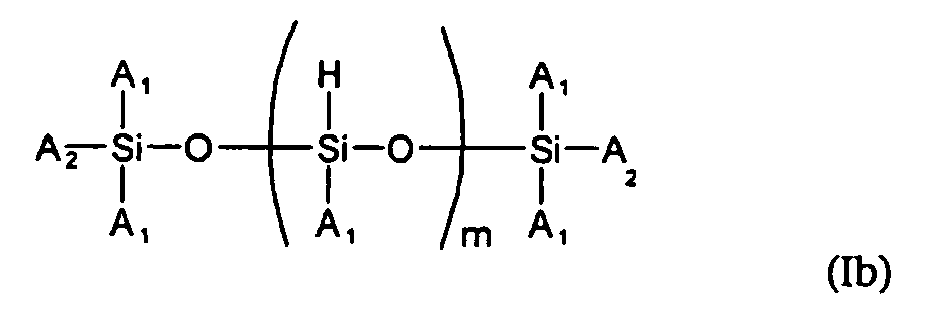
- the present invention is directed to a substrate having a faying surface coated by a coating made from a material comprising a polymer formed from a combination of two components: - (Component A) - (Component B) - wherein Component A is as defined in claim 1 and represented by the formula shown in (Ia): and Component B is represented by either structure, as shown in (Ib) or (Ic): where X is a prepolymer, shown in formula (Id): wherein R 1 , R 3 , and R 4 are independently selected from the group consisting of hydrogen; C 1 to C 6 alkyls and aryls; C 3 to C 6 cycloaliphatics; and C 3 to C 6 heterocycles; A 1 and A 2 are independently selected from the group consisting of C 1 to C 6 alkyls and aryls; C 7 to C 12 alkylaryls; C 3 to C 6 cycloaliphatics; and C 3 to C 6 heterocycles; and are preferably methyl;
- At least a portion of the dicarboxylic acids is selected from fumaryl, succinyl, phthalyl, terephthalyl, and maleiyl halides, and more preferably fumaryl chlorides and maleiyl chlorides.
- an olefinic acid halide generally represented by the formula shown in (If), as: where R 3 is as defined above, and R 5 is aliphatic, aryl; C 3 to C 6 cycloaliphatic; and C 3 to C 6 heterocyclic; wherein the alkyls may be linear or branched, saturated or unsaturated, halogenated on non-halogenated; aryls may be halogenated or non-halogenated; cycloaliphatics may be saturated or unsaturated, halogenated or non-halogenated; heterocycles may be saturated or unsaturated, halogenated or non-halogenated; and alkyaryls may be linear or branched, saturated or unsaturated, halogenated on non-hal
- the invention is an improved surface coating for inhibiting corrosion and ice formation on a coated faying surface.
- the surface coating is particularly effective when applied to aluminum, steel, titanium, glass, ceramic, and carbon composite surfaces and may be particularly useful for inhibiting the formation of ice on the flight and faying surfaces of aircraft or space vehicles.
- the coating also forms an effective ice inhibitor when used on a wide variety of substrate materials other than the preferred aluminum, titanium or carbon composite.
- the coating may be used as the primary, or sole faying surface coating, or may be used as a secondary coating to overcoat another coating.
- faying surfaces are the interfaces of abutting or mating components that become so intimately and permanently fitted in relation to one another that the point of interface is virtually undetectable after assembly.
- wet-sealant compounds on the faying surfaces of larger aircraft structural components results in additional waste, excessive application and clean-up time, toxic waste disposal complications, and increased cost.
- the present invention is directed to a substrate having a faying surface coated by a coating made from a material, and coating methods for applying to such a substrate a material comprising a polysiloxane-containing polymer, preferably a polysiloxane (amide-ureide) coating capable of inhibiting corrosion as well as the accumulation of ice upon the surface of a substrate formed from a combination of two components: - (Component A) - (Component B) - wherein Component A is as defined in claim 1 and represented by the formula shown in (Ia): and Component B is represented by either structure, as shown in (Ib) or (Ic): where X is a prepolymer, shown in formula (Id): wherein R 1 , R 3 , and R 4 are independently selected from the group consisting of hydrogen; C 1 to C 6 alkyls and aryls; C 3 to C 6 cycloaliphatics; and C 3 to C 6 heterocycles; A 1 and A 2 are independently selected from
- At least a portion of the dicarboxylic acids is selected from fumaryl, succinyl, phthalyl, terephthalyl, and maleiyl halides, and more preferably fumaryl chlorides and maleiyl chlorides.
- an olefinic acid halide generally represented by the formula shown in (If), as: where R 3 is as defined above, and R 5 is aliphatic, aryl; C 3 to C 6 cycloaliphatic; and C 3 to C 6 heterocyclic; wherein the alkyls may be linear or branched, saturated or unsaturated, halogenated on non-halogenated; aryls may be halogenated or non-halogenated; cycloaliphatics may be saturated or unsaturated, halogenated or non-halogenated; heterocycles may be saturated or unsaturated, halogenated or non-halogenated; and alkyaryls may be linear or branched, saturated or unsaturated, halogenated on non-hal
- the ratio of (Ie) to (If) is two moles of (If) to one mole of (Ie) to result in a product with an unsaturation moiety at the terminal ends of the molecules, as shown in formula (Ia) and which is now called Component A.
- Component A is reacted with Component B, which is shown as either formula (Ib) or (Ic) in a one mole of A to one mole of B ratio with a platinum catalyst; said catalyst being a platinum-divinyltetramethyldisiloxane complex to result in the fay surface coating; with the platinum catalyst and Component B being obtained from United Chemical Technologies, Inc. (Bristol, PA) and where m is an integer from 1 to 1000.
- This product of the reaction (Ig), as mentioned above, is now the surface coating with A 1 and A 2 being independently selected from the group consisting of C 1 to C 6 alkyls; aryls; C 7 to C 12 alkylaryls; C 3 to C 6 cycloaliphatics, and C 3 to C 6 heterocycles; and are preferably methyl; wherein the alkyls may be linear or branched, saturated or unsaturated, halogenated or non-halogenated; aryls may be halogenated or non-halogenated; cycloaliphatics may be saturated or unsaturated, halogenated or non-halogenated; heterocycles may be saturated or unsaturated, halogenated or non-halogenated.
- the beginning diamine-terminated polysiloxane obtained from United Chemical Technologies, Inc. (Bristol, PA) has the general formula: wherein R 1 , R 2 , R 3 , R 4 , A 1 , A 2 , and x are as defined above.
- the dicarboxylic acid halide is a low molecular weight dicarboxylic acid wherein the hydroxyl from each carboxylic acid component has been replaced with a halide constituent, typically chloride. At least a portion of the dicarboxylic acid halides are preferably selected from fumaryl, succinyl, phthalyl, terephthalyl and maleiyl halides, and more preferably fumaryl chlorides and maleiyl chlorides.
- two moles of the amine-terminated polysiloxane is first reacted with one mole of a dicarboxylic halide to form a polyamide intermediate (formula (Id)).
- a polyamide intermediate formula (Id)
- two moles of the polyamide is reacted with one mole of a non-linear diisocyanate to form the polysiloxane(amide-ureide) of formula (Ie).
- Use of fumaryl halides, phthaloyl halides, and maleiyl halides as the dicarboxylic acid halides and use of the non-linear diisocyanate result in a polysiloxane(amide-ureide) with a decidedly non-linear orientation.
- the resulting polymer (Ie) contains functional amide groups, functional urea groups, and is amorphous rather than crystalline in nature, due to the non-linear orientation of the polymer molecules.
- Each of the amide functionality, the urea functionality, and the non-linearity of the polymer improve the polymer's strength or anti-icing properties.
- the amide/urea moieties create crystallinity within the polymer via intermolecular hydrogen bonding which, in conjunction with the amorphous nature of the polysiloxane and the non-linearity of the diacid or diisocyanate, create a toughened polymer with enhanced physical properties.
- the combination of Component A and Component B may be applied in neat form by having Component A and Component B in two separate reservoirs, for example, within a spray gun with the catalyst included in Component A (formula (Ia)).
- a spray gun with the catalyst included in Component A (formula (Ia)
- the reaction between component A and Component B begins immediately upon mixing and deposits on the substrate as a coherent film.
- the Component B may contain a mixture of (Ib) and (Ic), such that (Ib) is in slight excess, but still maintaining an equivalent stoichiometry of (Ia) to the total amount of hydride moieties.
- the solutions of A and B may be dissolved in a solvent such as a toluene/methylene chloride mixture (1:1 ratio) and the subsequent solutions mixed at the nozzle of the spray gun (as was done in the neat reaction). Upon deposition on the substrate, the solvent will flash off and leave a coherent film on the fay surface.
- the present invention relates to using the polysiloxane coatings of the present invention to coat any aircraft structural components such as wing and fuselage skin panels, stiffeners, stringers, spars, clips, frames, etc., where faying surfaces exist.
- Figure 1a shows an aircraft wing panel assembly 1 prior to affixing the aluminum skins.
- the panel assembly 1 comprises hardware shown in enlarged Figures 1b-1f.
- Figure 1b shows a stringer 2 attached to wing panel skin 7.
- Figure 1c depicts a spar cap 3 attached to wing panel skin 7.
- Figure 1d shows an angled shear clip 4 in position between stringers 2.
- Figure le shows a butterfly clip 5 in position adjoining a stringer 2 and a shear clip 4.
- Figure 1f shows a center spar clip 6 affixed to a section of wing panel skin 7.
- Figure 1g depicts a section of fuselage structure showing framing 8 affixed to fuselage skin 7.
- FIG. 2 shows one preferred method of the present invention.
- an artificially-aged aluminum-alloy component 10 is optionally pretreated 11.
- the coating of the present invention is provided 12 and applied to the optionally pretreated component 14.
- the optional pre-treatment step shown in Figures 2-5 is preferably a treatment step that would prepare the substrate surface for coating as desired, such as, for example, a ZnNi treatment, a Cd flash treatment, or an anodizing process.
- the component 10 may or may not be in its final heat-treated state.
- the component is then optionally assembled in an assembly step 16.
- Figure 3 shows an alternate method of the present invention wherein the coating material is provided 32 and applied 34 to the naturally-aged component 30 prior to an optional component assembly step 36.
- the component may be optionally pretreated 31 prior to the coating step 34.
- Figure 4 shows another method of the present invention.
- a naturally-aged, aluminum-alloy component 50 is optionally pretreated 51 and coated with the first coating material of the present invention 54 that has been provided 52.
- a second coating material is provided 56 and applied 58 preferably as an overcoat to the first coating before optional component assembly 64.
- the overcoat may comprise an adhesive such as a pressure sensitive adhesive and may preferably be applied in an encapsulated state.
- the component 61 is either an artificially or a naturally-aged alloy in its final heat-treated state.
- the component is optionally pretreated 62 and then coated with a first coating 63, followed by an optional second coating 65.
- the component 61 is then cured at room or elevated temperature 66.
- a releasable film 68 is optionally applied to the component after the second coating is applied.
- the film 68 is removed from the component without disturbing the coatings, prior to optionally positioning and assembling the part 69. It is particularly preferred that at least one of the first and second coatings be encapsulated.
- non-linear diisocyanate As with the non-linear dicarboxylic acids, the purpose of utilizing a non-linear diisocyanate is to give the resulting polysiloxane(amide-ureide) an overall non-linear orientation, which results in a polymer that is more amorphous and less crystalline.
- Non-linear aliphatic or aromatic diisocyanates may be used, with ortho- or meta-oriented aromatic diisocyanates being preferred.
- diisocyanates The functionality of the diisocyanates is gained from the dual isocyanate groups being located in a non-linear relationship around an aliphatic or aromatic carbon structure.
- Polyisocyanates i.e., those compounds having three or more isocyanate groups, may be used for enhanced crosslinking of the resulting polysiloxane(amide-ureide) (Ic).
- the diisocyanates may be substituted or unsubstituted with groups such as alkyl, alkoxy, halogen, benzyl, allyl, unsubstituted or substituted aryl, alkenyl, alkinyl, amide, or combinations thereof.
- diisocyanates examples include 1,5-naphthalene diisocyanate, 4,4-diphenyl-methane diisocyanate, tetra-alkyl-diphenyl methane diisocyanate, 1,3-phenylene diisocyanate, 1,4-phenylene diisocyanate, butane-1,4-diisocyanate, hexamethylene 1,6-diisocyanate, 2,2,4-trimethyl-hexamethylene 1,6-diisocyanate, 2,4,4-trimethyl-hexamethylene 1,6-diisocyanate, tridinediisocyanate, cyclohexane-1,4-diisocyanate, xylilene diisocyanate, dicyclohexyl-methane-4,4'-diisocyanate, methyl-cyclohexane diisocyanate, 1,4-tetramethylene diisocyanate, hexamethylene diiso
- the invented polysiloxane(amide-ureide)s of the present invention have several functional aspects which combine to make the polysiloxane(amide-ureide)s superior, durable, and long lasting anti-icing agents which can be used on a wide variety of surfaces. It has been found that the urea groups of the polysiloxane(amide-ureide)s act to disrupt the hydrogen bonding between molecules of water, which inhibits the formation of ice, and also greatly diminishes the adhesion of ice and moisture to the polysiloxane(amide-ureide)s when the polysiloxane(amide-ureide)s are used as a coating layer upon a substrate.
- the polysiloxane(amide-ureide)s' anti-icing properties act first to inhibit the formation of ice, and secondly to inhibit the ability of ice and moisture to adhere to a coated surface.
- the polysiloxane portion of the polymer chain is hydrophobic, hence water does not readily "sheet out", but tends to bead up.
- the urea moiety in weakening the hydrogen bonding of the water molecule causes the resultant ice to have a weak structure which prevents water from forming a strong ice crystal layer upon a coating of the polysiloxane(amide-ureide)s, thus allowing it to be easily broken away from the coating.
- the polysiloxane(amide-ureide) may be applied as a continuous coating upon a wide variety of surfaces, particularly metal surfaces such as aluminum or titanium. Because the coating is continuous, water cannot penetrate the coating. As mentioned above, it is believed that the penetration of water and moisture into sintered coatings, such as Teflon TM , result in the gradual degradation in icephobic properties of such sintered coatings. There is no such related degradation in the invented polysiloxane(amide-ureide).
- the polysiloxane(amide-ureide)s of the present invention have anti-icing properties not previously found in polyamides. Further, such compounds display degradation resistance not previously found in polyureides. Still further, such compounds display physical toughness and durability not previously found in polyamides or polyureides.
- Component A as defined in claim 1, will take advantage of the icephobic properties of the polysiloxane (amide-ureide), thereby enabling the faying surface coating to be able to resist separation of mated parts due to the hydrostatic forces encountered by freezing of water.
- a preferred dicarboxylic acid halide is a low molecular weight dicarboxylic acid wherein the hydrogen from each carboxylic acid component has been replaced with a halide constituent, typically chloride. At least a portion of the dicarboxylic acid halides is preferably selected from fumaryl, succinyl, phthalyl, terephthalyl, and maleily halides, and more preferably fumaryl chlorides and maleiyl chlorides.
- two moles of the amine-terminated polysiloxane is first reacted with one mole of a dicarboxylic halide to form an amine-terminated polyamide intermediate (formula (Ie)).
- amine-terminated polyamide intermediate formula (Ie)
- two moles of the polyamide are reacted with one mole of a non-linear diisocyanate to form the polysiloxane (amide-ureide) of said halides, and use of the non-linear diisocyante result in a polysiloxane (amide-ureide) with a decidedly non-linear orientation.
- the resulting polymer (If) contains functional amide groups, functional urea groups, and is amorphous rather than crystalline in nature, due to the non-linear orientation of the polymer molecules.
- Each of the amide functionality, the urea functionality and the non-linearity of the polymer improve the polymer's strength or anti-iciing properties.
- the amide/urea moieties create crystallinity within the polymer via intermolecular hydrogen bonding which, in conjunction with the amorphous nature of the polysiloxane and the non-linearity of the diacid or diisocyanate, create a toughened polymer with enhanced physical properties.
- the polysiloxane(amide-ureide) is particularly useful for application to aluminum or titanium surfaces and provides a coating which may be used to prevent ice formation upon the flight surfaces of an aircraft.
- the usefulness of the polysiloxane(amide-ureide) is not limited to metal surfaces, however.
- the polysiloxane(amide-ureide) finds use as a coating on any of a wide variety of substrates such as steel and carbon composites, and even wood or asphalt, a number of which may be applications unrelated to aircraft.
- the polysiloxane-containing coatings used in connection with the present invention may directly contact the faying surface, or may be used as a second coating over a first coating, such as a corrosion-inhibiting coating.
- a corrosion-inhibiting coating are those capable of minimizing the passage of moisture, acids, or bases from the environmental surroundings under operational conditions to the aluminum substrate.
- coatings are either hydrophobic materials and/or sacrificial substances, e.g, SrCrO 4 or other chromates, etc.
- Such useful coatings include hydrophobic coatings such as, polyethylene, polyethylene/tetrafluoroethylene copolymers, phenolics, epoxies, polyimides, polyurethanes, polyvinylchlorides, silicones and novolaks, with or without chromate fillers.
- a number of curable, organic coating materials are available and may be used in conjunction with the present process to pre-coat or coat the substrate material.
- One coating material of this type comprises resin mixed with one or more plasticizers, other organic components such as polytetrafluororoethylene, and inorganic additives such as aluminum powder and/or chromates, such as strontium chromate, barium chromate, zinc chromate, and the like. See, for example, U.S Patent Nos. 6,475,610 ; 5,614,037 ; 6,274,200 ; 6,494,972 ; 5,944,918 ; and 5,858,133 .
- Novolaks are phenol/formaldehyde polymers that are formed by reacting phenol with less than an equivalent amount of formaldehyde (i.e., approximately 1:0.8 mole ratio) in an acid catalyzed reaction. This results in a more flexible polymer than the standard phenol formaldehyde which allows for ease of handling and application prior to it being further crosslinked at a later stage.
- formaldehyde i.e., approximately 1:0.8 mole ratio
- novolaks can be applied to a substrate and later crosslinked by the addition of, for example, hexamethylene tetramine.
- the preferred embodiments of the present invention relate to the preparation of the faying surfaces of aircraft structural components, preferably aluminum-alloy components, and the following discussion will emphasize such articles.
- the use of the invention is not limited to components such as aircraft wing and fuselage skin panels, hinges, doors, etc., and instead is more broadly applicable.
- aircraft structural components offers particular advantages.
- the procedures and compounds of the present invention in no way inhibit the optimum performance of the alloy components.
- the present methods allow the components to maintain their optimum mechanical and metallurgical properties while providing equivalent and or improved levels of corrosion protection and pressurizations without the disadvantages associated with the wet-sealant approach.
- the present invention is contemplated as being useful with aluminum alloys, ferrous alloys and non-metallic materials that include ceramic-, epoxy-, glass-, wood-, carbon-containing materials, etc.
- aluminum-alloy or “aluminum-base” means that the alloy has more than 50 percent by weight aluminum but less than 100 percent by weight of aluminum. Typically, the aluminum-base alloy has from about 85 to about 98 percent by weight of aluminum, with the balance being alloying elements, and a minor amount of impurity. Alloying elements are added in precisely controlled amounts to predictably modify the properties of the aluminum alloy. Alloying elements that are added to aluminum in combination to modify its properties include, for example, magnesium, copper, and zinc, as well as other elements.
- Additional corrosion- and heat-resistant alloys contemplated for use with the coatings of the present invention include Monel 400, Monel K-500, A-286 and Inconel 600, and stainless steels such as 302, 303, 304, 305, 410, 416, 430, Custom 450, and 17-4PH.
- the aluminum alloy is heat-treatable.
- aircraft structural components having faying surfaces such as wing and fuselage skin panels, stiffeners, frames, doors, hinges, etc.
- faying surfaces such as wing and fuselage skin panels, stiffeners, frames, doors, hinges, etc.
- the component such as a wing skin panel or wing skin panel stiffener such as a stringer is first fabricated to a desired shape.
- the alloying elements are selected such that the fabricated shape may be processed to have a relatively soft state, preferably by heating it to an elevated temperature for a period of time and thereafter quenching it to a lower temperature.
- solution heat-treating This process is termed “solution heat-treating” or “annealing.”
- solute elements are dissolved into the alloy matrix (i.e., solution-treating) and retained in solution by the rapid quenching, and the matrix itself is simultaneously annealed.
- the component After the component is solution-treated/annealed, it may be further processed to increase its strength several fold to have desired high-strength properties.
- Such further processing typically by a precipitation-hardening/aging process, may be accomplished either by heating to an elevated temperature for a period of time (termed artificial-aging) or by holding at room temperature for a longer period of time (termed natural-aging).
- a precipitation-hardening/aging process may be accomplished either by heating to an elevated temperature for a period of time (termed artificial-aging) or by holding at room temperature for a longer period of time (termed natural-aging).
- different artificial-aging, precipitation heat-treatments (some in combination with intermediate deformation or cold working), produce the basic T6, T7, T8, or T9 temper conditions.
- a natural-aging precipitation treatment produces the basic T3 or T4 temper conditions.
- Aluminum Association terminology for heat-treatments, alloy types, and the like are understood by those skilled in the metallurgical field, and will be used herein. Some alloys require artificial-aging and other alloys may be aged in either fashion.
- the treated structural components of the present invention are commonly made of both types of materials.
- heat-treating wherein the component is subjected to one or more periods of exposure to an elevated temperature for a duration of time. Heating and cooling rates are selected to aid in producing the desired final properties.
- the temperatures, times, and other parameters required to achieve particular properties are known to those skilled in the field of aluminum-base alloys and metallurgy.
- the 7150 alloy is a specific, artificially-aged, aluminum-base alloy of particular interest for aircraft structural applications.
- the 7150 alloy has a composition of about 2.2 percent by weight copper, about 2.3 percent by weight magnesium, 6.4 percent by weight zinc, about 0.12 percent by weight zirconium and balance of aluminum plus minor impurities.
- Other suitable alloys include, but are not limited to, 2000, 4000, 6000, and 7000 series heat-treatable aluminum alloys.
- the 7150 alloy is available commercially from several aluminum companies, including ALCOA, Reynolds, Pechiney, and Kaiser.
- the 7150 alloy is fully solution-treated/annealed to have an ultimate tensile strength of about 42,000 pounds per square inch (psi) and yield strength of about 24,000 psi with an ultimate elongation of about 12% or as otherwise required.
- This state is usually obtained following the component's fabrication processing including machining, forging, or otherwise forming the component into the desired shape.
- This condition is termed the "untreated state” herein, as it precedes the final aging/precipitation heat-treatment cycle required to optimize the strength and other properties of the material.
- the component may be subjected to multiple forming operations and is periodically re-annealed as needed, prior to the strengthening, precipitation heat-treatment process. After forming (and optionally re-annealing), the 7150 alloy may be heat-treated at a temperature of about 250°F for about 24 hours.
- An alternative two-stage heat treatment may be used. This treatment is comprised of first heat-treating the component at a temperature of about 225°F from about 6 hours to about 8 hours. The temperature is thereafter increased from about 250°F to about 350°F for a period from about 6 hours to about 10 hours, followed by an ambient air cool.
- This final state of heat-treatment termed T77511 condition, produces a strength of from about 82,000 psi to about 89,000 psi in the 7150 alloy, which is suitable for aircraft structural component applications.
- the component is initially optionally chemically-etched, grit-blasted or otherwise processed to roughen its surface, and thereafter anodized in chromic-acid solution.
- Chromic-acid solution is available commercially or prepared by dissolving chromium trioxide in water.
- the chromic-acid solution is preferably of a concentration of about 4 percent chromate in water, and at a temperature of from about 90°F to about 100°F.
- the article or component to be anodized becomes the anode in the mildly agitated chromic-acid solution at an applied DC voltage of from about 18 volts to about 22 volts.
- Anodizing is preferably continued for from about 30 minutes to about 40 minutes, but shorter times were also found to be sufficient.
- the anodizing operation produces a strongly adherent oxide surface layer from about 0.0001 inches to about 0.0003 inches thick on the aluminum-alloy article, which surface layer promotes the adherence of the subsequently applied first organic coating.
- the optional anodizing process preferably in chromic acid, conducted prior to application of the coating serves to promote strong chemical and mechanical bonding of the organic coating to the aluminum-alloy article substrate.
- the bonding is apparently promoted both by physical, mechanical interlocking and chromate-activated, chemical bonding effects.
- the anodized surface is not chemically-sealed against further water intrusion after the anodizing process.
- a first coating on the faying surfaces is desired, such a cured organic coating serves to seal the anodized surface.
- the first coating material described above is preferably provided in about 100% low-viscosity solid solution or "neat" material so that it may be readily and evenly applied.
- the usual function of the coating material is to protect the base metal to which it is applied from corrosion, including, for example, conventional electrolytic corrosion, galvanic corrosion, and stress corrosion.
- the preferred first coating material is a formulation primarily comprising an organic composition, but also may contain additives to improve the properties of the final coating.
- the coating may also be desirably dissolved initially in a carrier liquid and encapsulated. After application, the coating material is subjected to an environmental change of temperature and/or pressure to rupture the encapsulation. The coating is thus released to the component's substrate surface where it is subsequently cured to effect structural changes within the organic coating, typically cross-linking organic molecules to improve the adhesion and cohesion of the coating.
- the installation step reflects one of the advantages of the present invention. If the coatings were not applied to the component before assembly, it would be necessary to place a viscous, wet-sealant material onto the faying surfaces to coat the contacting surfaces as the mating components are either assembled, installed, or joined.
- the wet-sealant material is potentially toxic to workers, messy and difficult to work with, and necessitates extensive cleanup (of both tools and the exposed surfaces of the resulting aircraft section) with caustic chemical solutions after component installation.
- the presence of residual, wet-sealant inhibits the adhesion of later-applied paint or other top coats onto the assembled components.
- the present coating approach overcomes these problems, along with providing a superior barrier to moisture. As a result of the present invention, wet-sealant is not needed or used during installation and consequent joining or assembly.
- the protective surface coating of the present invention to aluminum-alloy, aircraft structural components to facilitate automated part assembly and inspection.
- the present invention further enhances the integrity, consistency, and performance of aircraft faying and other surfaces, as well as improving existing part storage, general handling, installation, and assembly systems, while also reducing manufacturing cycle time.
- the present invention allows for the coated components to retain all mechanical and metallurgical properties, and the required degree of corrosion protection, without any of the disadvantages of the conventional wet sealant corrosion treatments.
- the tertiary amine hydrochloride was filtered off and the resultant diamide was reacted with toluene-2, 4-diisocyanate in a 1:1 molar ratio of diamide to diisocyanate to form a polysiloxane(amide-ureide) with repeated trans structure about the double bond of the fumaryl moiety.
- the ratio of amine-terminated poly(siloxane amide) to isocyanate was dictated by the functionality of the isocyanate, i.e., a tri-isocyanate would require two moles of the poly(siloxane amide) to one mole of tri-isocyanate.
- the linearity of the polyamide may be adjusted prior to reaction with the diisocyanate by controlling the relative amounts of saturated and unsaturated acid halide, i.e. the relative amounts of fumaryl chloride versus succinyl chloride.
- Component A two moles of ⁇ , ⁇ -diaminopolysiloxane were dissolved in one liter of methylene chloride, containing two moles of a tertiary amine, such as triethylamine as an acid acceptor, and one mole of an acid dihalide, such as fumaryl chloride, added under inert atmosphere to the diaminopolysiloxane. After the addition was completed, the mixture was heated to 50°C for one hour and the amine hydrochloride filtered off, leaving the amine-terminated fumaryl polyamide in solution.
- a tertiary amine such as triethylamine as an acid acceptor
- an acid dihalide such as fumaryl chloride
- amine-terminated polysiloxane/amide Two moles of the amine-terminated polysiloxane/amide was then added to one mole of a diisocyanate, such as 2,4-toluene diisocyanate, under inert atmosphere conditions. After allowing the reaction to proceed for 24 hours at room temperature, the resultant amine-terminated polysiloxane (amide/ureide) was now ready for reaction with an unsaturated acid halide, such as acryloyl chloride or methacryloyl chloride or vinyl benzoyl chloride.
- an unsaturated acid halide such as acryloyl chloride or methacryloyl chloride or vinyl benzoyl chloride.
- Component A and Component B may be applied in neat form to a fay surface or any other surface, by having Component A and Component B in two separate reservoirs of a spray gun with the catalyst dissolved in Component A.
- the catalyst is a platinum divinyltetramethyldisiloxane complex (obtained from United Chemical Technologies, Inc. - Bristol, PA).
- Component B a polysiloxane-hydride terminated or polyhydrosiloxane (with hydrogen attached to silicon along the polymer chain, may be obtained from United Chemical Technologies, Inc. or Dow Chemical Co., Midland, MI.).
- the reaction between Component A and Component B begins immediately upon mixing and deposits on the substrate as a coherent film.
- the Component B may contain mixtures of (Ic) and (Ib) such that (Ic) is in slight excess, but still maintaining an equivalent stoichiometry of (Ia) (Component A) to the total amount of hydride moieties (Component B).
- the solutions of Component A and Component B may be dissolved in a solvent such as a toluene/methylene chloride mixture (1:1 ratio) and the subsequent solutions mixed at the nozzle of the spray gun (as was done in the neat reaction). Upon deposition on the substrate, the solvent will flash off and leave a coherent film on the faying surface.
- a solvent such as a toluene/methylene chloride mixture (1:1 ratio
- Ice adhesion tests were performed by freezing ice between two surfaces of a temperature controlled Instron tester and then forcing the surfaces apart until the ice reached cohesive or adhesive failure.
- an upper aluminum plate and lower aluminum plate are positioned directly opposite and facing one another.
- the lower plate is coated with a sealing layer.
- Water is then positioned between the upper plate and the coating layer where it is allowed to freeze into a solid ice layer in a temperature controlled chamber chilled to 20 °F.
- the aluminum plates were pulled apart at a rate of 0.02 in/min from one another under carefully measured conditions until the ice separates from one of the surfaces, or suffers adhesive failure. The tension at separation is noted.
- the type of ice failure (adhesive vs. cohesive) is also noted.
- Table 1 For this example, four different substances were tested in the temperature-controlled Instron TM test machine. The results are shown in Table 1 below. The samples were as follows: Table 1 Surface Ice Thickness (in.) Breakforce (lb./in 2 ) Number of Runs Standard Deviation Adhesive/ Cohesive Failure (%) A 0.03 7 3 3.4 100/0 0.01 5 3 0.6 100/0 B 0.03 91 5 52.8 10/90 0.01 9 3 10.1 97/3 C 0.03 5 3 0.58 100/0 0.01 10 4 2.6 100/0 D 0.03 0 3 0 100/0 0.01 2 3 2.6 100/0
- the polysiloxane(amide-ureide) Samples C and D had very favorable ice release characteristics, releasing at 5 lb/in 2 and 0 lb/in 2 respectively for ice thicknesses of 0.03 inches, and 10 lb/in 2 and 2 lb/in 2 respectively for ice thickness of 0.01 inches.
- the silicone rubber coating A had very favorable ice shedding characteristics, but silicone rubber does not form a tough coating and is unsuitable for application to aircraft surfaces, etc.
- the polysiloxane(amide-ureide)s of the present invention show significantly better ice shedding characteristics compared with the fluorinated siloxane samples, which are typically considered to be highly icephobic.
Landscapes
- Chemical & Material Sciences (AREA)
- Organic Chemistry (AREA)
- Chemical Kinetics & Catalysis (AREA)
- Engineering & Computer Science (AREA)
- Materials Engineering (AREA)
- Wood Science & Technology (AREA)
- Life Sciences & Earth Sciences (AREA)
- Health & Medical Sciences (AREA)
- Medicinal Chemistry (AREA)
- Polymers & Plastics (AREA)
- Paints Or Removers (AREA)
- Application Of Or Painting With Fluid Materials (AREA)
- Laminated Bodies (AREA)
Claims (66)
- Beschichtung zur Verwendung auf einer Oberfläche eines Bauteils, wobei die Beschichtung ein Polymer aufweist, das einen Bestandteil A und einen Bestandteil B enthält, wobei der Bestandteil A eine Verbindung ist, die die folgende Formel aufweist:


 wobei R1, R3, und R4 unabhängig voneinander ausgewählt sind aus der Gruppe bestehend aus Wasserstoff; C1 bis C6 Alkylen und Arylen; C3 bis C6 Cycloaliphaten; und C3 bis C6 Heterocyclen;A1 und A2 unabhängig voneinander ausgewählt sind aus der Gruppe bestehend aus C1 bis C6 Alkylen und Arylen; C7 bis C12 Alkylarylen; C3 bis C6 Cycloaliphaten; und C3 bis C6 Heterocyclen;R2, R5 und R6 unabhängig voneinander ausgewählt sind aus der Gruppe bestehend aus C1 bis C10 Alkylen; Arylen und Heterocyclen;m und x jeweils eine Zahl von 1 bis etwa 10.000 ist;CYAN von einem Diisocyanat
 Z von einem Dicarbonsäurehalogenid
 wobei das Diisocyanat oder das Dicarbonsäurehalogenid Nichtlinearität zeigt.
 - Beschichtung nach Anspruch 1, wobei das Diisocyanat ausgewählt ist aus der Gruppe bestehend aus Alkyldiisocyanat, wobei der Alkylteil von C1 bis C10 ist; nichtlinearem Aryldiisocyanat; und nichtlinearem heterocyclischem Diisocyanat.
- Beschichtung nach Anspruch 1, wobei zumindest ein Teil des Dicarbonsäurehalogenids ausgewählt ist aus der Gruppe bestehend aus Fumarylhalogeniden, Succinylhalogeniden, Phthaloylhalogeniden, Terephthalhalogeniden und Maleylhalogeniden.
- Beschichtung nach Anspruch 1, wobei das Bauteil ein Luftfahrzeugbauteil aufweist.
- Beschichtung nach Anspruch 1, wobei die Oberfläche des Bauteils eine Passfläche aufweist.
- Substrat, das eine mit einer Beschichtung beschichtete Oberfläche aufweist, wobei die Beschichtung ein Polymer aufweist, das einen Bestandteil A und einen Bestandteil B enthält, wobei der Bestandteil A eine Verbindung ist, die die folgende Formel aufweist:


 wobei R1, R3 und R4 unabhängig voneinander ausgewählt sind aus der Gruppe bestehend aus Wasserstoff; C1 bis C6 Alkylen und Arylen; C3 bis C6 Cycloaliphaten; und C3 bis C6 Heterocyclen;A1 und A2 unabhängig voneinander ausgewählt sind aus der Gruppe bestehend aus C1 bis C6 Alkylen und Arylen; C7 bis C12 Alkylarylen; C3 bis C6 Cycloaliphaten; und C3 bis C6 Heterocyclen;R2, R5 und R6 unabhängig voneinander ausgewählt sind aus der Gruppe bestehend aus C1 bis C10 Alkylen; Arylen und Heterocyclen;m und x jeweils eine Zahl von 1 bis etwa 10.000 ist;CYAN von einem Diisocyanat
 Z von einem Dicarbonsäurehalogenid
 wobei das Diisocyanat oder das Dicarbonsäurehalogenid Nichtlinearität zeigt.
 - Substrat nach Anspruch 6, wobei das Diisocyanat ausgewählt ist aus der Gruppe bestehend aus Alkyldüsocyanat, wobei der Alkylteil von C1 bis C10 ist; nichtlinearem Aryldiisocyanat; und nichtlinearem heterocyclischem Diisocyanat.
- Substrat nach Anspruch 6, wobei zumindest ein Teil des Dicarbonsäurehalogenids ausgewählt ist aus der Gruppe bestehend aus Furmarylhalogeniden, Succinylhalogeniden, Phthaloylhalogeniden, Terephthalhalogeniden und Maleylhalogeniden.
- Substrat nach Anspruch 6, wobei der Dicarboxylbestandteil ausgewählt ist aus Fumarylkomponenten, Maleylkomponeneten, gesättigten C4 bis C8 Dicarboxylkomponenten und teilweise gesättigten C4 bis C8 Dicarboxylkomponenten.
- Substrat nach Anspruch 6, wobei mehr als annährend 50 Mol.-% des Dicarboxylbestandteils des Polymers Fumarylkomponente aufweist.
- Substrat nach Anspruch 6, wobei mehr als annährend 80 Mol.-% des Dicarboxylbestandteils des Polymers Fumarylkomponente aufweist.
- Substrat nach Anspruch 6, wobei R1 und R2 unabhängig voneinander ausgewählt sind aus der Gruppe bestehend aus Methyl-, Ethyl-, Propyl-, Butyl- und Phenylkomponenten.
- Substrat nach Anspruch 6, wobei zumindest einer von R1 und R2 ausgewählt ist aus der Gruppe bestehend aus halogenierten Alkylen und halogenierten Arylen.
- Substrat nach Anspruch 6, wobei A1 und A2 unabhängig voneinander ausgewählt sind aus der Gruppe bestehend aus Methyl-, Ethyl-, Propyl-, Butyl-, und Phenylkomponenten.
- Substrat nach Anspruch 6, wobei zumindest einer von A1 und A2 ausgewählt ist aus der Gruppe bestehend aus halogenierten Akylen, halogenierten Arylen, halogenierten Alkylarylen, halogenierten Cycloaliphaten und halogenierten Heterocyclen.
- Substrat nach Anspruch 6, wobei der Diisocyanatbestandteil ein aromatisches Diisocyanat aufweist.
- Substrat nach Anspruch 6, wobei der Diisocyanatbestandteil Toluol-2,4-diisocyanat aufweist.
- Substrat nach Anspruch 6, wobei der Diisocyanatbestandteil ein gesättigtes aliphatisches Diisocyanat aufweist.
- Substrat nach Anspruch 6, wobei x eine Zahl von 1 bis etwa 1000 ist.
- Substrat nach Anspruch 6, wobei x eine Zahl von etwa 20 bis etwa 200 ist.
- Substrat nach Anspruch 6, wobei das Substrat ein Luftfahrzeugbauteil aufweist.
- Substrat nach Anspruch 6, wobei die Oberfläche eine Passfläche aufweist.
- Substrat nach Anspruch 6, wobei die Beschichtung die Neigung von Eis zum Anhaften an einer Oberfläche der Luftfahrzeugbauteilsoberfläche hemmt.
- Substrat nach Anspruch 6, wobei die Beschichtung die Neigung von Feuchtigkeit zum Anhaften an einer Oberfläche der Luftfahrzeugbauteilsoberfläche hemmt.
- Substrat nach Anspruch 6, wobei das Substrat ferner eine weitere Beschichtung aufweist, die auf die Polymerbeschichtung aufgebracht ist.
- Substrat nach Anspruch 6, wobei das Substrat ferner eine Vorbehandlung aufweist, die auf der Oberfläche des Substrats durchgeführt wird.
- Substrat nach Anspruch 26, wobei die Vorbehandlung ausgewählt ist aus der Gruppe bestehend aus einer ZnNi Vorbehandlung, Cd Blitzvorbehandlung und einem Anodisierungsvorbehandlungsprozess.
- Substrat nach Anspruch 6, wobei das Substrat ferner eine erste Beschichtung aufweist, die auf das Substrat aufgebracht ist, wobei die Polymerbeschichtung auf die erste Beschichtung als eine zweite Beschichtung aufgebracht ist.
- Substrat nach Anspruch 28, wobei die erste Beschichtung ein härtbares organisches Beschichtungsmaterial aufweist, ausgewählt aus der Gruppe bestehend aus Phenolen, Urethanen, Epoxiden und Melaminen.
- Substrat nach Anspruch 28, wobei die erste Beschichtung ein härtbares organisches Beschichtungsmaterial aufweist, ausgewählt aus der Gruppe bestehend aus Polyurethanen, Polyvinylchloriden, Silikonen, Epoxiden, Acrylaten, Polyimiden und Phenolen.
- Substrat nach Anspruch 6, wobei das Substrat aus einem Material hergestellt ist, ausgewählt aus der Gruppe bestehend aus Aluminiumlegierungen, Stahllegierungen und nichtmetallischen Materialien.
- Substrat nach Anspruch 31, wobei das nichtmetallische Material ausgewählt ist aus der Gruppe bestehend aus keramik-, epoxy-, glas-, holz- und kohlenstoffhaltigen Materialien.
- Substrat nach Anspruch 6, wobei das Substrat aus einem Material hergestellt ist, ausgewählt aus der Gruppe bestehend aus Monel 400, Monel K-500, A-286, Inconel 600, rostfreien Stählen 302, 303, 304, 410, 416, 430, Custom 450 und 17-4PH.
- Substrat nach Anspruch 6, wobei das Substrat ein Luftfahrzeugbauteil aus einer Aluminiumlegierung aufweist.
- Substrat nach Anspruch 28, wobei das Substrat ein Luftfahrzeugbauteil aus einer Aluminiumlegierung aufweist.
- Luftfahrzeug mit dem Substrat nach Anspruch 6.
- Luftfahrzeug mit dem Substrat nach Anspruch 28.
- Verfahren zum Beschichten der Oberfläche eines Bauteils mit einer korrosionshemmenden Beschichtung, das folgende Schritte aufweist:Bereitstellen eines Bauteils mit einer Oberfläche; Bereitstellen eines Beschichtungsmaterials, das ein Polymer aufweist, wobei das Polymer einen Bestandteil A und einen Bestandteil B enthält, wobei der Bestandteil A eine Verbindung ist, die die folgende Formel aufweist:


 wobei R1, R3 und R4 unabhängig voneinander ausgewählt sind aus der Gruppe bestehend aus Wasserstoff; C1 bis C6 Alkylen und Arylen; C3 bis C6 Cycloaliphaten; und C3 bis C6 Heterocyclen;A1 und A2 unabhängig voneinander ausgewählt sind aus der Gruppe bestehend aus C1 bis C6 Alkylen und Arylen; C7 bis C12 Alkylarylen; C3 bis C6 Cycloaliphaten und C3 bis C6 Heterocyclen;R2, R5 und R6 unabhängig voneinander ausgewählt sind aus der Gruppe bestehend aus C1 bis C10 Alkylen; Arylen und Heterocyclen; m und x jeweils eine Zahl von 1 bis etwa 10.000 ist;CYAN von einem Diisocyanat
 Z von einem Dicarbonsäurehalogenid
 und Aufbringen der Polymerbeschichtung auf die Oberfläche.
 - Verfahren nach Anspruch 38, wobei der Dicarboxylbestandteil ausgewählt ist aus Fumarylkomponenten, Maleylkomponenten, gesättigten C4 bis C8 Dicarboxylkomponenten und teilweise gesättigten C4 bis C8 Dicarboxylkomponenten.
- Verfahren nach Anspruch 38, wobei mehr als annährend 50 Mol.-% des Dicarboxylbestandteils des Polymers Fumarylkomponente aufweist.
- Verfahren nach Anspruch 38, wobei mehr als annähernd 80 Mol.-% des Dicarbonsäurebestandteils des Polymers Fumarylkomponente aufweist.
- Verfahren nach Anspruch 38, wobei R1 und R2 unabhängig voneinander ausgewählt sind aus der Gruppe bestehend aus Methyl-, Ethyl-, Propyl-, Butyl-und Phenylkomponenten.
- Verfahren nach Anspruch 38, wobei zumindest einer von R1 und R2 ausgewählt ist aus der Gruppe bestehend aus halogenierten Alkylen und halogenierten Arylen.
- Verfahren nach Anspruch 38, wobei A1 und A2 unabhängig voneinander ausgewählt sind aus der Gruppe bestehend aus Methyl-, Ethyl-, Propyl-, Butyl-und Phenylkomponenten.
- Verfahren nach Anspruch 38, wobei zumindest einer von A1 und A2 ausgewählt ist aus der Gruppe bestehend aus halogenierten Alkylen, halogenierten Arylen, halogenierten Alkyarylen, halogenierten Cycloaliphaten und halogenierten Heterocyclen.
- Verfahren nach Anspruch 38, wobei der Diisocyanatbestandteil ein aromatisches Diisocyanat aufweist.
- Verfahren nach Anspruch 38, wobei der Diisocyanatbestandteil Toluol-2,4-diisocyanat aufweist.
- Verfahren nach Anspruch 38, wobei der Diisocyanatbestandteil ein gesättigtes aliphatisches Diisocyanat aufweist.
- Verfahren nach Anspruch 38, wobei x eine Zahl von 1 bis etwa 1000 ist.
- Verfahren nach Anspruch 38, wobei x eine Zahl von etwa 20 bis etwa 200 ist.
- Verfahren nach Anspruch 38, das ferner die Schritte des Bewerkstelligens einer ersten Beschichtung zwischen der Oberfläche des Bauteils und der Polymerbeschichtung aufweist.
- Verfahren nach Anspruch 51, wobei die erste Beschichtung ein härtbares organisches Beschichtungsmaterial aufweist, ausgewählt aus der Gruppe bestehend aus Phenolen, Urethanen, Epoxiden und Melaminen.
- Verfahren nach Anspruch 51, wobei die erste Beschichtung ein härtbares organisches Beschichtungsmaterial aufweist, ausgewählt aus der Gruppe bestehend aus Polyurethan, Polyvinylchloriden, Silikonen, Epoxiden, Acrylaten, Polyimiden und Phenolen.
- Verfahren nach Anspruch 38, wobei das Bauteil ein Luftfahrzeugbauteil aufweist.
- Verfahren nach Anspruch 38, wobei das Bauteil aus einem Material hergestellt ist, ausgewählt aus der Gruppe bestehend aus Aluminiumlegierungen, Stahllegierungen und nichtmetallischen Materialien.
- Verfahren nach Anspruch 38, wobei das Bauteil aus einem Material hergestellt ist, ausgewählt aus der Gruppe bestehend aus Monel 400, Monel K-500, A-286, Inconel 600, rostfreien Stählen 302, 303, 304, 410, 416, 430, Custom 450 und 17-4PH.
- Verfahren nach Anspruch 38, das ferner den Schritt des Aufbringens einer zweiten Beschichtung auf die Polymerbeschichtung aufweist.
- Verfahren nach Anspruch 38, das ferner den Schritt des Anwendens einer Vorbehandlung auf die Oberfläche des Bauteils aufweist.
- Verfahren nach Anspruch 38, wobei die Vorbehandlung ausgewählt ist aus der Gruppe bestehend aus einer ZnNi Vorbehandlung und einer Anodisierungsvorbehandlung.
- Verfahren nach Anspruch 38, wobei die Oberfläche eine Passfläche aufweist.
- Luftfahrzeug mit Bauteilen, die Oberflächen aufweisen, die gemäß dem Verfahren nach Anspruch 38 beschichtet sind.
- Luftfahrzeug mit Bauteilen, die Oberflächen aufweisen, die gemäß dem Verfahren nach Anspruch 51 beschichtet sind.
- Verfahren nach Anspruch 38, wobei die Beschichtung die Neigung von Eis zum Anhaften an einer Oberfläche eines Bauteils hemmt.
- Verfahren nach Anspruch 38, wobei die Beschichtung die Neigung von Feuchtigkeit zum Anhaften an einer Oberfläche eines Bauteils hemmt.
- Verfahren nach Anspruch 51, wobei die Beschichtung die Neigung von Eis zum Anhaften an einer Oberfläche der Luftfahrzeugbauteilsoberfläche hemmt.
- Verfahren nach Anspruch 51, wobei die Beschichtung die Neigung von Feuchtigkeit zum Anhaften an einer Oberfläche der Luftfahrzeugbauteilsoberfläche hemmt.
Priority Applications (1)
| Application Number | Priority Date | Filing Date | Title |
|---|---|---|---|
| DE200460008148 DE602004008148T3 (de) | 2003-06-05 | 2004-06-03 | Polysiloxane zum Beschichten von Oberflächen |
Applications Claiming Priority (2)
| Application Number | Priority Date | Filing Date | Title |
|---|---|---|---|
| US455070 | 1989-12-22 | ||
| US10/455,070 US6809169B2 (en) | 2002-06-07 | 2003-06-05 | Polysiloxane coatings for surfaces |
Publications (3)
| Publication Number | Publication Date |
|---|---|
| EP1484373A1 EP1484373A1 (de) | 2004-12-08 |
| EP1484373B1 EP1484373B1 (de) | 2007-08-15 |
| EP1484373B2 true EP1484373B2 (de) | 2013-02-27 |
Family
ID=33159564
Family Applications (1)
| Application Number | Title | Priority Date | Filing Date |
|---|---|---|---|
| EP20040013089 Expired - Lifetime EP1484373B2 (de) | 2003-06-05 | 2004-06-03 | Polysiloxane zum Beschichten von Oberflächen |
Country Status (5)
| Country | Link |
|---|---|
| US (1) | US6809169B2 (de) |
| EP (1) | EP1484373B2 (de) |
| BR (1) | BRPI0401920A (de) |
| CA (1) | CA2469979C (de) |
| DE (1) | DE602004008148T3 (de) |
Families Citing this family (30)
| Publication number | Priority date | Publication date | Assignee | Title |
|---|---|---|---|---|
| US7202321B2 (en) * | 2002-06-07 | 2007-04-10 | The Boeing Company | Method and composition for sealing components and components sealed thereby |
| US7910683B2 (en) * | 2002-06-07 | 2011-03-22 | The Boeing Company | Tough and strongly-adherent anti-icing coatings |
| US6953509B2 (en) * | 2003-06-03 | 2005-10-11 | The Boeing Company | Method for preparing pre-coated, metallic components and components prepared thereby |
| US7959783B2 (en) | 2003-09-30 | 2011-06-14 | The Boeing Company | Electrochemical deposition process for composite structures |
| WO2005092517A1 (en) * | 2004-03-03 | 2005-10-06 | The Boeing Company | Method for preparing pre-coated, composite components and components prepared thereby |
| US20060281861A1 (en) * | 2005-06-13 | 2006-12-14 | Putnam John W | Erosion resistant anti-icing coatings |
| US7527872B2 (en) * | 2005-10-25 | 2009-05-05 | Goodrich Corporation | Treated aluminum article and method for making same |
| US20070254170A1 (en) * | 2006-04-28 | 2007-11-01 | Hoover Kelly L | Erosion resistant anti-icing coatings |
| EP2069440B1 (de) * | 2006-08-02 | 2011-09-28 | Battelle Memorial Institute | Elektrisch leitfähige beschichtungszusammensetzung |
| US20090067993A1 (en) * | 2007-03-22 | 2009-03-12 | Roberge Gary D | Coated variable area fan nozzle |
| US8282266B2 (en) * | 2007-06-27 | 2012-10-09 | H R D Corporation | System and process for inhibitor injection |
| US7906215B2 (en) * | 2008-04-17 | 2011-03-15 | The Boeing Company | Composition and method for corrosion protection of a structure |
| US8245981B2 (en) * | 2008-04-30 | 2012-08-21 | General Electric Company | Ice shed reduction for leading edge structures |
| US7992823B2 (en) * | 2008-04-30 | 2011-08-09 | General Electric Company | Ice shed reduction for leading edge structures |
| EP2344681B1 (de) * | 2008-09-19 | 2017-08-30 | Acme United Corporation | Beschihtungen für schneidevorrichtungen |
| TWI439976B (zh) * | 2009-04-17 | 2014-06-01 | Ind Tech Res Inst | 可撓曲膜自載板上脫離的方法及可撓式電子裝置的製造方法 |
| TWI396702B (zh) * | 2009-05-08 | 2013-05-21 | Yun Liang Ouyang | 生醫材料之預聚物 |
| GB0916597D0 (en) * | 2009-09-22 | 2009-10-28 | Rolls Royce Plc | Coating of metallic articles to restrict ice accumulation |
| US20110143148A1 (en) * | 2009-12-13 | 2011-06-16 | General Electric Company | Articles comprising a weather resistant silicone coating |
| US8779945B2 (en) * | 2010-03-17 | 2014-07-15 | Sikorsky Aircraft Corporation | Virtual ice accretion meter display |
| DE102010056518A1 (de) | 2010-12-29 | 2012-07-05 | Gmbu E.V., Fachsektion Dresden | Oberfläche mit verringerter Eisadhäsion |
| US9309781B2 (en) | 2011-01-31 | 2016-04-12 | General Electric Company | Heated booster splitter plenum |
| US8911832B2 (en) | 2011-12-02 | 2014-12-16 | Ppg Industries Ohio, Inc. | Method of mitigating ice build-up on a substrate |
| US9090797B2 (en) | 2011-12-02 | 2015-07-28 | Ppg Industries Ohio, Inc. | Method of mitigating ice build-up on a substrate |
| RU2547754C2 (ru) | 2013-08-16 | 2015-04-10 | Игорь Леонидович Радченко | Полимерная порошковая композиция для супергидрофобного покрытия и способ получения супергидрофобного покрытия |
| DE102014204075A1 (de) | 2014-03-06 | 2015-09-10 | MTU Aero Engines AG | Anti - Eis - Schicht für Verdichterschaufeln |
| AU2015268086B2 (en) * | 2014-05-30 | 2019-03-28 | Commonwealth Scientific And Industrial Research Organisation | Ice adhesion reducing polymers |
| BR112016027902B1 (pt) | 2014-05-30 | 2021-10-19 | Commonwealth Scientifc And Industrial Research Organisation | Prepolímeros de poli-isocianato de silsesquioxanos oligoméricos poliédricos fluorados e de siloxano de fposs, polímero, formulação de polímero, revestimento, objeto, e, método para conferir propriedades redutoras de gelo a pelo menos uma porção de uma superfície externa de um objeto |
| US11661196B2 (en) * | 2019-06-25 | 2023-05-30 | B/E Aerospace, Inc. | Optimized electronics grounding path for high-frequency noise |
| US12054638B2 (en) | 2019-08-01 | 2024-08-06 | The Boeing Company | Transparent hydrophobic and icephobic compositions, coatings, and methods |
Citations (5)
| Publication number | Priority date | Publication date | Assignee | Title |
|---|---|---|---|---|
| US4275184A (en) † | 1974-10-01 | 1981-06-23 | Rhone-Poulenc Industries | Ethylenic silicon compounds and thermoplastic elastomers obtained therefrom |
| JPH01168718A (ja) † | 1987-12-25 | 1989-07-04 | Japan Synthetic Rubber Co Ltd | ポリアミド−ポリシロキサンブロック共重合体の製造方法 |
| US4950728A (en) † | 1987-06-05 | 1990-08-21 | Rhone-Poulenc Chimie | Thermally stable (imide/amide)/(urea/siloxane) block copolymers |
| JPH06270555A (ja) † | 1993-03-24 | 1994-09-27 | Ricoh Co Ltd | 熱転写記録媒体 |
| US6384171B1 (en) † | 1999-07-14 | 2002-05-07 | Shin-Etsu Chemical Co., Ltd. | Coating composition and coated silicone rubber member |
Family Cites Families (3)
| Publication number | Priority date | Publication date | Assignee | Title |
|---|---|---|---|---|
| US5296144A (en) * | 1992-01-02 | 1994-03-22 | World Trade Corporation | Composite membrane of a hydrophilic asymmetric membrane coated with an organosiloxane block copolymer |
| US6797795B2 (en) * | 2002-06-07 | 2004-09-28 | The Boeing Company | Polysiloxane(amide-ureide) anti-ice coating |
| US20030232941A1 (en) * | 2002-06-07 | 2003-12-18 | The Boeing Company | Polysiloxane(amide-ureide) anti-ice coating and associated method for producing same |
-
2003
- 2003-06-05 US US10/455,070 patent/US6809169B2/en not_active Expired - Fee Related
-
2004
- 2004-06-03 DE DE200460008148 patent/DE602004008148T3/de not_active Expired - Lifetime
- 2004-06-03 EP EP20040013089 patent/EP1484373B2/de not_active Expired - Lifetime
- 2004-06-04 CA CA 2469979 patent/CA2469979C/en not_active Expired - Fee Related
- 2004-06-07 BR BRPI0401920 patent/BRPI0401920A/pt not_active Application Discontinuation
Patent Citations (5)
| Publication number | Priority date | Publication date | Assignee | Title |
|---|---|---|---|---|
| US4275184A (en) † | 1974-10-01 | 1981-06-23 | Rhone-Poulenc Industries | Ethylenic silicon compounds and thermoplastic elastomers obtained therefrom |
| US4950728A (en) † | 1987-06-05 | 1990-08-21 | Rhone-Poulenc Chimie | Thermally stable (imide/amide)/(urea/siloxane) block copolymers |
| JPH01168718A (ja) † | 1987-12-25 | 1989-07-04 | Japan Synthetic Rubber Co Ltd | ポリアミド−ポリシロキサンブロック共重合体の製造方法 |
| JPH06270555A (ja) † | 1993-03-24 | 1994-09-27 | Ricoh Co Ltd | 熱転写記録媒体 |
| US6384171B1 (en) † | 1999-07-14 | 2002-05-07 | Shin-Etsu Chemical Co., Ltd. | Coating composition and coated silicone rubber member |
Also Published As
| Publication number | Publication date |
|---|---|
| CA2469979C (en) | 2007-08-07 |
| US6809169B2 (en) | 2004-10-26 |
| DE602004008148T2 (de) | 2008-05-08 |
| CA2469979A1 (en) | 2004-12-05 |
| DE602004008148D1 (de) | 2007-09-27 |
| US20030232201A1 (en) | 2003-12-18 |
| DE602004008148T3 (de) | 2013-09-12 |
| EP1484373A1 (de) | 2004-12-08 |
| EP1484373B1 (de) | 2007-08-15 |
| BRPI0401920A (pt) | 2005-02-01 |
Similar Documents
| Publication | Publication Date | Title |
|---|---|---|
| EP1484373B2 (de) | Polysiloxane zum Beschichten von Oberflächen | |
| US7915371B2 (en) | Method and composition for sealing components and components sealed thereby | |
| US6797795B2 (en) | Polysiloxane(amide-ureide) anti-ice coating | |
| EP2785803B1 (de) | Verfahren zur verringerung der eisbildung auf einem substrat | |
| CA2279084C (en) | Method for coating faying surfaces of aluminum-alloy components and faying surfaces coated thereby | |
| EP3149063B1 (de) | Eishaftungsreduzierende polymere | |
| US8367791B2 (en) | Composition and method for corrosion protection of a structure | |
| EP3436506B1 (de) | Verfahren zum reparieren eines beschichtungsfilms, verwendung einer haftgrundierung in diesem verfahren und substrat mit einem reparierten beschichtungsfilm | |
| GB2088385A (en) | Curable fluorocarbon polymer compositions | |
| EP2862957B1 (de) | Verfahren zur Herstellung einer mehrschichtigen Beschichtung | |
| US9631281B2 (en) | Processes for producing a multilayer coating | |
| US20030232941A1 (en) | Polysiloxane(amide-ureide) anti-ice coating and associated method for producing same | |
| US7854967B2 (en) | Method for pre-sealing faying surfaces of components and faying surfaces pre-sealed thereby | |
| CN112105668B (zh) | 作为pu体系助粘剂的金属部件的基于阴极浸涂(ktl)的环氧树脂 | |
| US20080051526A1 (en) | Coating composition | |
| JPH01146965A (ja) | フッ素樹脂塗料用プライマー組成物 | |
| WO2003095581A1 (en) | Fluorinated activator | |
| CN111386278A (zh) | 离子液体 | |
| JPH01288374A (ja) | 塗膜形成方法 |
Legal Events
| Date | Code | Title | Description |
|---|---|---|---|
| PUAI | Public reference made under article 153(3) epc to a published international application that has entered the european phase |
Free format text: ORIGINAL CODE: 0009012 |
|
| AK | Designated contracting states |
Kind code of ref document: A1 Designated state(s): AT BE BG CH CY CZ DE DK EE ES FI FR GB GR HU IE IT LI LU MC NL PL PT RO SE SI SK TR |
|
| AX | Request for extension of the european patent |
Extension state: AL HR LT LV MK |
|
| 17P | Request for examination filed |
Effective date: 20050604 |
|
| AKX | Designation fees paid |
Designated state(s): DE FR GB |
|
| GRAP | Despatch of communication of intention to grant a patent |
Free format text: ORIGINAL CODE: EPIDOSNIGR1 |
|
| GRAS | Grant fee paid |
Free format text: ORIGINAL CODE: EPIDOSNIGR3 |
|
| GRAA | (expected) grant |
Free format text: ORIGINAL CODE: 0009210 |
|
| AK | Designated contracting states |
Kind code of ref document: B1 Designated state(s): DE FR GB |
|
| REG | Reference to a national code |
Ref country code: GB Ref legal event code: FG4D |
|
| REF | Corresponds to: |
Ref document number: 602004008148 Country of ref document: DE Date of ref document: 20070927 Kind code of ref document: P |
|
| ET | Fr: translation filed | ||
| PLBI | Opposition filed |
Free format text: ORIGINAL CODE: 0009260 |
|
| PLAX | Notice of opposition and request to file observation + time limit sent |
Free format text: ORIGINAL CODE: EPIDOSNOBS2 |
|
| 26 | Opposition filed |
Opponent name: AIRBUS SAS Effective date: 20080514 |
|
| PLAF | Information modified related to communication of a notice of opposition and request to file observations + time limit |
Free format text: ORIGINAL CODE: EPIDOSCOBS2 |
|
| PLBB | Reply of patent proprietor to notice(s) of opposition received |
Free format text: ORIGINAL CODE: EPIDOSNOBS3 |
|
| APBM | Appeal reference recorded |
Free format text: ORIGINAL CODE: EPIDOSNREFNO |
|
| APBP | Date of receipt of notice of appeal recorded |
Free format text: ORIGINAL CODE: EPIDOSNNOA2O |
|
| APAH | Appeal reference modified |
Free format text: ORIGINAL CODE: EPIDOSCREFNO |
|
| APBQ | Date of receipt of statement of grounds of appeal recorded |
Free format text: ORIGINAL CODE: EPIDOSNNOA3O |
|
| APBU | Appeal procedure closed |
Free format text: ORIGINAL CODE: EPIDOSNNOA9O |
|
| PUAH | Patent maintained in amended form |
Free format text: ORIGINAL CODE: 0009272 |
|
| STAA | Information on the status of an ep patent application or granted ep patent |
Free format text: STATUS: PATENT MAINTAINED AS AMENDED |
|
| 27A | Patent maintained in amended form |
Effective date: 20130227 |
|
| AK | Designated contracting states |
Kind code of ref document: B2 Designated state(s): DE FR GB |
|
| REG | Reference to a national code |
Ref country code: DE Ref legal event code: R102 Ref document number: 602004008148 Country of ref document: DE Effective date: 20130227 |
|
| REG | Reference to a national code |
Ref country code: FR Ref legal event code: PLFP Year of fee payment: 13 |
|
| REG | Reference to a national code |
Ref country code: FR Ref legal event code: PLFP Year of fee payment: 14 |
|
| PGFP | Annual fee paid to national office [announced via postgrant information from national office to epo] |
Ref country code: GB Payment date: 20170627 Year of fee payment: 14 Ref country code: FR Payment date: 20170627 Year of fee payment: 14 |
|
| PGFP | Annual fee paid to national office [announced via postgrant information from national office to epo] |
Ref country code: DE Payment date: 20170628 Year of fee payment: 14 |
|
| REG | Reference to a national code |
Ref country code: DE Ref legal event code: R119 Ref document number: 602004008148 Country of ref document: DE |
|
| GBPC | Gb: european patent ceased through non-payment of renewal fee |
Effective date: 20180603 |
|
| PG25 | Lapsed in a contracting state [announced via postgrant information from national office to epo] |
Ref country code: FR Free format text: LAPSE BECAUSE OF NON-PAYMENT OF DUE FEES Effective date: 20180630 Ref country code: GB Free format text: LAPSE BECAUSE OF NON-PAYMENT OF DUE FEES Effective date: 20180603 Ref country code: DE Free format text: LAPSE BECAUSE OF NON-PAYMENT OF DUE FEES Effective date: 20190101 |