EP1486776A1 - Instrument de mesure de grande sensibilite - Google Patents
Instrument de mesure de grande sensibilite Download PDFInfo
- Publication number
- EP1486776A1 EP1486776A1 EP03710444A EP03710444A EP1486776A1 EP 1486776 A1 EP1486776 A1 EP 1486776A1 EP 03710444 A EP03710444 A EP 03710444A EP 03710444 A EP03710444 A EP 03710444A EP 1486776 A1 EP1486776 A1 EP 1486776A1
- Authority
- EP
- European Patent Office
- Prior art keywords
- time
- difference
- value
- measuring instrument
- measurement
- Prior art date
- Legal status (The legal status is an assumption and is not a legal conclusion. Google has not performed a legal analysis and makes no representation as to the accuracy of the status listed.)
- Withdrawn
Links
- 238000005259 measurement Methods 0.000 claims abstract description 68
- 239000000126 substance Substances 0.000 claims abstract description 34
- 238000001514 detection method Methods 0.000 claims abstract description 24
- 239000011295 pitch Substances 0.000 claims description 26
- 239000012530 fluid Substances 0.000 claims description 4
- 230000035945 sensitivity Effects 0.000 abstract description 15
- 238000012545 processing Methods 0.000 description 9
- 239000007864 aqueous solution Substances 0.000 description 6
- 238000004364 calculation method Methods 0.000 description 6
- 238000010586 diagram Methods 0.000 description 4
- 238000005516 engineering process Methods 0.000 description 3
- 238000000034 method Methods 0.000 description 3
- 230000002238 attenuated effect Effects 0.000 description 2
- 239000012535 impurity Substances 0.000 description 2
- 238000009434 installation Methods 0.000 description 2
- 238000012360 testing method Methods 0.000 description 2
- 229910021642 ultra pure water Inorganic materials 0.000 description 2
- 239000012498 ultrapure water Substances 0.000 description 2
- XLYOFNOQVPJJNP-UHFFFAOYSA-N water Substances O XLYOFNOQVPJJNP-UHFFFAOYSA-N 0.000 description 2
- 230000003321 amplification Effects 0.000 description 1
- 238000004458 analytical method Methods 0.000 description 1
- 230000000052 comparative effect Effects 0.000 description 1
- 238000013480 data collection Methods 0.000 description 1
- 238000002848 electrochemical method Methods 0.000 description 1
- 239000010419 fine particle Substances 0.000 description 1
- -1 for example Substances 0.000 description 1
- 238000004255 ion exchange chromatography Methods 0.000 description 1
- 238000004811 liquid chromatography Methods 0.000 description 1
- 238000012544 monitoring process Methods 0.000 description 1
- 238000003199 nucleic acid amplification method Methods 0.000 description 1
- 238000003672 processing method Methods 0.000 description 1
- 230000001360 synchronised effect Effects 0.000 description 1
- 238000011144 upstream manufacturing Methods 0.000 description 1
Images



Classifications
-
- G—PHYSICS
- G01—MEASURING; TESTING
- G01N—INVESTIGATING OR ANALYSING MATERIALS BY DETERMINING THEIR CHEMICAL OR PHYSICAL PROPERTIES
- G01N27/00—Investigating or analysing materials by the use of electric, electrochemical, or magnetic means
- G01N27/02—Investigating or analysing materials by the use of electric, electrochemical, or magnetic means by investigating impedance
- G01N27/04—Investigating or analysing materials by the use of electric, electrochemical, or magnetic means by investigating impedance by investigating resistance
- G01N27/06—Investigating or analysing materials by the use of electric, electrochemical, or magnetic means by investigating impedance by investigating resistance of a liquid
-
- G—PHYSICS
- G01—MEASURING; TESTING
- G01N—INVESTIGATING OR ANALYSING MATERIALS BY DETERMINING THEIR CHEMICAL OR PHYSICAL PROPERTIES
- G01N27/00—Investigating or analysing materials by the use of electric, electrochemical, or magnetic means
- G01N27/02—Investigating or analysing materials by the use of electric, electrochemical, or magnetic means by investigating impedance
- G01N27/04—Investigating or analysing materials by the use of electric, electrochemical, or magnetic means by investigating impedance by investigating resistance
- G01N27/06—Investigating or analysing materials by the use of electric, electrochemical, or magnetic means by investigating impedance by investigating resistance of a liquid
- G01N27/08—Investigating or analysing materials by the use of electric, electrochemical, or magnetic means by investigating impedance by investigating resistance of a liquid which is flowing continuously
-
- G—PHYSICS
- G01—MEASURING; TESTING
- G01N—INVESTIGATING OR ANALYSING MATERIALS BY DETERMINING THEIR CHEMICAL OR PHYSICAL PROPERTIES
- G01N30/00—Investigating or analysing materials by separation into components using adsorption, absorption or similar phenomena or using ion-exchange, e.g. chromatography or field flow fractionation
- G01N30/02—Column chromatography
- G01N30/62—Detectors specially adapted therefor
- G01N30/64—Electrical detectors
-
- G—PHYSICS
- G01—MEASURING; TESTING
- G01R—MEASURING ELECTRIC VARIABLES; MEASURING MAGNETIC VARIABLES
- G01R27/00—Arrangements for measuring resistance, reactance, impedance, or electric characteristics derived therefrom
- G01R27/02—Measuring real or complex resistance, reactance, impedance, or other two-pole characteristics derived therefrom, e.g. time constant
- G01R27/22—Measuring resistance of fluids
Definitions
- the present invention relates to a high-sensitivity measuring instrument which detects a variation in characteristic of a substance being measured such as an aqueous solution with high sensitivity and accuracy, and can detect the characteristic value itself at that time with high sensitivity and accuracy based on the detected value of the variation in characteristic.
- an electric conductivity is used as, in particular, a scale for measuring a concentration of an ion capable of moving in an aqueous solution
- an electric conductivity measuring instrument is used for measurement of ion concentration of many aqueous solutions.
- the electric conductivity measuring instrument determines increase/decrease of ion concentration of an aqueous solution being measured by measuring a resistance between a detection electrode and an electrode for supplying a current from a power source.
- a multi-dimension electric conductivity measuring instrument in JP-A-2001-311710 as an instrument capable of abstracting and determining a variation of characteristics of a substance being measured such as an aqueous solution with a high accuracy.
- This multi-dimension electric conductivity measuring instrument comprises at least two electric conductivity measuring cells each having at least two electrodes coming into contact with a substance being measured, and the electric conductivity measuring cells are electrically connected to each other so that the detection signals themselves from the respective electric conductivity measuring cells are processed by at least addition or subtraction.
- the electrical processing such as addition or subtraction is carried out, and the signals after the processing, being amplified as needed, are outputted as a difference or a variation between measured electric conductivities of the respective electric conductivity measuring cells. Because a difference between detection signals abstracted simultaneously is outputted, it becomes possible to detect a variation with a high S/N ratio by erasing a noise commonly generated in the respective electric conductivity measuring cells, and it becomes possible to output only the difference or the variation at a high accuracy, by amplification, etc.
- this instrument unlike an arrangement wherein a plurality of conventional electric conductivity measuring instruments are disposed and a difference or variation between the data measured therefrom is obtained, a fine difference or variation between electric conductivities of a plurality of measurement points different in position or in time from each other can be determined with a high reliability and with high accuracy and sensitivity.
- the indicated value in the multi-dimension electric conductivity measuring instrument proposed by the above-described JP-A-2001-311710 is a fine difference or variation between electric conductivities in a plurality of measurement points different in position or in time from each other, and such an indicated value is not an absolute value of electric conductivity.
- a variation in absolute value of electric conductivity is frequently required for measurement of variation in concentration of impurities in an aqueous solution, etc. Even when a characteristic other than the electric conductivity is determined, measurement of absolute value of the characteristic is frequently required.
- an object of the present invention is to provide a measuring instrument which can further determine not a difference or variation but a measurement value of an objective characteristic with high accuracy and sensitivity, desirably, as an absolute value.
- a high-sensitivity measuring instrument comprises at least two sensors for detecting the same characteristics by bringing them into contact with a substance being measured with a specified time difference, wherein a difference between detection signals abstracted simultaneously from respective sensors is determined, a difference between characteristic values upon elapsing the specified time difference is determined from said difference between detection signals, a reference time of measurement and a reference characteristic value at that time are preset, a time axis having a time pitch of the specified time difference is set, and a measurement value is obtained at a point in time elapsing an arbitrary time pitch from the reference time.
- the data in time sequence may comprise a plurality of groups of data in time sequence including data in time sequence, a position of a time pitch of which is present within the above-mentioned specified time difference.
- the plurality of groups of data in time sequence can output measurement values at respective points in time elapsing respective time pitches in the direction of the time axis with a pitch smaller than the above-mentioned specified time difference, and it becomes possible to indicate the variation of the measurement value as if it were a continuous variation.
- a reference characteristic value at a reference time it is necessary to set a reference characteristic value at a reference time, and various methods for setting this reference characteristic value can be employed.
- a substance being measured for reference is brought into contact with the sensors, and an output value thereof in the measuring instrument can be set as the reference characteristic value.
- the characteristic value of this substance being measured for reference is not known, by using a substance being measured for reference adequate for comparing it with an objective substance being measured, it becomes possible to determine what value the characteristic value of the objective substance being measured becomes relative to the characteristic value which the substance being measured for reference has, thereby obtaining at least a relative value compared with the substance being measured for reference.
- the substance being measured is not particularly restricted, but the present invention can be easily applied particularly to a case where it is a fluid.
- a difference between characteristic values upon elapsing the specified time difference is determined from the above-described difference between the detection signals, a reference time of measurement and a reference characteristic value at that time are preset, the above-mentioned specified time difference is set as a time pitch, and a measurement value is obtained at a point in time elapsing an arbitrary time pitch from the reference time (namely, at a point in time elapsing an arbitrary time pitch at which an output as the measurement value is required).
- This measurement value is obtained as a value calculated by setting the reference characteristic value as a reference of the measurement, and as long as an absolute value is set as the reference characteristic value, the measurement value is obtained also as an absolute value of characteristic value.
- the above-described variation in time of the characteristic detected at high sensitivity and accuracy at the specified time difference is added to the reference characteristic value at the reference time, and the finally outputted signal indicates a variation of the absolute value of the characteristic detected precisely at this variation in time, and it becomes possible to detect the target absolute value itself at a high sensitivity and a high accuracy.
- the high-sensitivity measuring instrument it becomes possible to determine a variation of characteristic of a substance being measured at a high sensitivity and a high accuracy, in particular, as an absolute value. Therefore, an absolute value of a measurement value having a generality can be outputted, and using this output, a characteristic value can be monitored at high sensitivity and accuracy, and a detailed determination becomes possible by applying a general data processing method utilized in various fields at the present time such as a determination due to wave analysis or time integral of variation.
- the characteristic of a substance being measured which is a target for measurement, is not limited to electric conductivity, and the present invention can be applied to measurement of substantially any characteristic, but the following explanation will be described mainly with respect to a case of measurement of electric conductivity.
- Figs. 1 and 2 exemplify cases where a high-sensitivity measuring instrument according to the present invention is applied to an electric conductivity measurement system for a fluid, for example, water flowing in a pipe as a substance being measured 4.
- sensor A (2) and sensor B (3) for detecting electric conductivity are provided respectively at the upstream side and the downstream side of the substance being measured 4.
- the substance being measured 4 through sensor A and also passes through sensor B that is, the substance being measured 4 comes into contact with sensors A and B with a specified time difference, and it is possible that detection signals from both sensors are taken out simultaneously.
- a signal processor 5 provided are a multi-dimension electric conductivity measuring instrument capable of outputting a difference between detection signals taken out from both sensors simultaneously at a certain time (exemplified in Figs. 3 and 4), and a calculation processing part wherein using the difference as a difference between characteristic values at that time and at a time before or after the above-described time difference (namely, as a difference between characteristic values upon elapsing the specified time difference), a reference time of measurement and a reference characteristic at that time are preset, a time axis having a time pitch of the specified time difference is set, and a measurement value can be obtained at a point in time elapsing an arbitrary time pitch from the reference time.
- a sample water sampled from an identical position as an object for measuring electric conductivity comes into contact with sensor A (2) as it is, and comes into contact with sensor B (3) via a time delay column 12 capable of being adjusted in time, and a specified time difference is given through the time delay column 12.
- Other structure is substantially the same as that of the embodiment shown in Fig. 1.
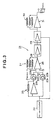
- a multi-dimension electric conductivity measuring instrument 21 shown in Fig. 3 at least two sensors A and B (2, 3) for measurement of electric conductivity each having at least two electrodes (in this embodiment, shown as a three-electrode structure) touching a substance being measured are provided.
- respective sensors A and B (2, 3) are electrically connected so that the detection signals themselves from the respective sensors are processed by addition.
- Respective sensors A and B (2, 3) are connected electrically in parallel to each other, an AC current is supplied from an AC oscillator 24 provided as a power source to electrodes 22a, 23a of the respective sensors for current supply at a condition of the same phase. Electrodes 22b, 23b of respective sensors A and B (2, 3) for electric conductivity detection are electrically connected to each other, and the values of the detection signals themselves from both detection electrodes 22b and 23b are added to each other.
- a multiplier or divider 25 for multiplying the value of the supplied current at a predetermined magnification or for dividing it at a predetermined rate is provided at a position before electrode 22a for current supply to one sensor A (2), and it is possible to differentiate the level of the electric conductivity of a substance being measured to be detected by sensor A (2) as compared with that of sensor B (3). Namely, an AC current before being supplied to electrode 22a for current supply is amplified or attenuated at a predetermined magnification. In such a structure, it becomes possible to detect a variation in time of electric conductivity of a substance being measured, which comes into contact with the respective sensors with a specified time difference, at an optimum sensitivity.
- the above-described processed signals that is, the signals obtained from electrodes 22b and 23b for electric conductivity detection are amplified as an output signal having an adequate level by a single amplifier 26. At that time, an optimum range depending upon an objective measurement can be selected by a measurement range switching device 27.
- the signal from amplifier 26, after a temperature compensation for measurement environment is carried out by a temperature compensator 28, is synchronized with the output side of AC oscillator 24, and further, is amplified by an amplifier 31 with a range adjustor 30 so that the signal becomes a signal having a level optimum for control or output display to be employed, and the signal is taken out as an actual output 32.
- a multiplier or divider 42 for multiplying the value of the supplied current at a predetermined magnification or for dividing it at a predetermined rate is provided at a position before electrode 23a for current supply of sensor B (3), and it is possible to differentiate the level of the electric conductivity of a substance being measured to be detected by sensor B (3) as compared with that of sensor A (2). Namely, an AC current before being supplied to electrode 23a for current supply is amplified or attenuated at a predetermined magnification.
- the multiplier or divider has also a function to reverse the phase of the supplied AC current.
- the detection signals themselves from respective sensors A, B (2, 3) are substantially processed by subtraction, and the signal after the subtraction processing is sent to amplifier 26.
- the structure of other parts is substantially the same as that of the embodiment shown in Fig. 3.
- the above-described difference is used as a difference between characteristic values upon elapsing a specified time difference, a reference time of measurement and a reference characteristic value at that time are preset, a time axis having a time pitch of the specified time difference is set, and a measurement value is obtained at a point in time elapsing an arbitrary time pitch from the reference time.
- F A (t) D A-B (t) + F B (t)
- F A (t) D A-B (t) + F B (t)
- the inventors of the present invention paid attention to the fact that the signal difference D A-B (t) corresponds to the time difference between sensor A and sensor B, and considered that by utilizing this correspondence, a sensor sole signal, that is, a signal corresponding to an absolute value of characteristic can be derived.
- the above-described difference (that is, D A-B (t)) is treated as a variation in time of a signal as if the signal were detected by a single sensor between at that time and at a time before or after that time by the aforementioned time difference.
- DT a specified time difference between sensors A and B
- D A-B (t) is used as a difference of characteristic value at a point upon expiring DT.
- a time axis is set by setting this DT as a time pitch, and relatively to the reference characteristic value preset at the reference time, a measurement value at a point in time elapsing an arbitrary time pitch from the reference time is calculated as follows.
- F A and F B The relationship between F A and F B is represented as follows by using the specified time difference DT between sensors A and B.
- F B (t) F A (t - DT)
- F A (t - DT) D A-B (t) + F A (t - DT)
- the signal (F A (t)) of sensor A at an arbitrary time t becomes a signal calculated by adding a signal difference between sensors A and B (D A-B (t)) to a signal of sensor A at a point before the time of DT (F A (t - DT)).
- a reference value is an absolute value of a characteristic
- a value added with the above-described variation can also be obtained as an absolute value of the characteristic to be measured as an object, and a variation of absolute value itself can be outputted.
- any value may be used as this reference characteristic value as long as the value is a known value, usually, it is understandable to employ a value, at a state where a signal difference between sensors A and B is zero at a condition that a particular signal does not enter, as the reference value.
- a time pitch within a DT time theoretically can be set arbitrarily, usually it is easy to set a time pitch at an equal interval. Further, if an appropriate analog circuit can be assembled, it may be employed. Hereinafter, a digital processing case will be explained wherein a time pitch within a DT time is set at an equal interval.
- ⁇ t The time pitch within a DT time
- t an arbitrary time “t” on a time axis
- the signal of sensor A is F A (mDT+n ⁇ t)
- the signal of sensor A is F B (mDT+n ⁇ t)
- a signal difference is D A-B (mDT+n ⁇ t).
- a signal of a sole sensor to be determined is referred to as X(mDT+n ⁇ t).
- a parameter capable of being observed is D A-B (mDT+n ⁇ t), for example, due to the aforementioned multi-dimension electric conductivity measuring instrument.
- a initially set known value is inputted at least as DT time, and a known value is set as a reference characteristic value at a reference time in data series of a sole sensor signal.
- data in time sequence at respective points in time elapsing respective time pitches from the reference time can be obtained as data of measurement values
- the data in time sequence can comprise a plurality of groups of data in time sequence which are obtained by dividing with a pitch of ⁇ t smaller than the specified time difference DT.
- Fig. 5 shows an example of measurement in a case where a temporary variation of electric conductivity occurred
- Fig. 6 shows an example of measurement in a case where a variation of electric conductivity with a certain continuous time occurred.
- a difference in conductivity indicates only a variation of electric conductivity outputted from a difference signal of sensors A and B
- an absolute conductivity -1- is an electric conductivity detected by a sensor provided at a downstream position separately from sensors A and B and is outputted for confirming the effectiveness of the present invention.
- An absolute conductivity -2- (calculated from difference in conductivity)” indicates an absolute value of electric conductivity as an objective high-sensitivity measurement value which is calculated by adding the difference in conductivity to the above-described preset reference characteristic value.
- the absolute conductivity -2- extremely precisely indicates substantially the same characteristic as the characteristic measured as the absolute conductivity -1-, and it is understood that the measurement by the high-sensitivity measuring instrument according to the present invention has been carried out at a high sensitivity. Further, in the high-sensitivity measuring instrument according to the present invention, because it is possible that a difference between detection signals of sensors A and B outputted as a high-accuracy observation value is outputted as an absolute value added to a known reference value, the accuracy of the absolute value as the outputted measurement value can also be maintained surely at a high level. Namely, a high-sensitivity and high-accuracy measurement becomes possible.
- the high-sensitivity measuring instrument according to the present invention can be applied not only to this, but also to basically any measurement system requiring the determination of a variation of an absolute value of an objective characteristic to be measured or a relative variation from a certain reference value as the case may be. Therefore, the present invention can be applied to any measuring instrument requiring a high-sensitivity measurement at an excellent S/N ratio, for example, a measurement of ultraviolet ray, a measurement of differential refractive index, a measurement of fluorescent luminous intensity, an electrochemical measurement, a measurement of fine particles, etc.
- the high-sensitivity measuring instrument according to the present invention can be applied to any measurement system requiring a determination of a variation of an absolute value of an objective characteristic to be measured or a relative variation from a certain reference value.
- the high-sensitivity measuring instrument according to the present invention exhibits remarkable advantages when it is used particularly as a detector in ion chromatography or liquid chromatography requiring a high-sensitivity measurement of characteristics in a fluid at a high S/N ratio, or as a monitor for observing a minute concentration of impurities contained in a ultra pure water.
Landscapes
- Chemical & Material Sciences (AREA)
- General Physics & Mathematics (AREA)
- Physics & Mathematics (AREA)
- Health & Medical Sciences (AREA)
- Life Sciences & Earth Sciences (AREA)
- Analytical Chemistry (AREA)
- Biochemistry (AREA)
- General Health & Medical Sciences (AREA)
- Immunology (AREA)
- Pathology (AREA)
- Electrochemistry (AREA)
- Chemical Kinetics & Catalysis (AREA)
- Investigating Or Analyzing Materials By The Use Of Electric Means (AREA)
- Measurement Of Resistance Or Impedance (AREA)
Applications Claiming Priority (3)
| Application Number | Priority Date | Filing Date | Title |
|---|---|---|---|
| JP2002078067A JP2003270183A (ja) | 2002-03-20 | 2002-03-20 | 高感度測定装置 |
| JP2002078067 | 2002-03-20 | ||
| PCT/JP2003/003370 WO2003078989A1 (fr) | 2002-03-20 | 2003-03-19 | Instrument de mesure de grande sensibilite |
Publications (1)
| Publication Number | Publication Date |
|---|---|
| EP1486776A1 true EP1486776A1 (fr) | 2004-12-15 |
Family
ID=28035555
Family Applications (1)
| Application Number | Title | Priority Date | Filing Date |
|---|---|---|---|
| EP03710444A Withdrawn EP1486776A1 (fr) | 2002-03-20 | 2003-03-19 | Instrument de mesure de grande sensibilite |
Country Status (7)
| Country | Link |
|---|---|
| US (1) | US7154274B2 (fr) |
| EP (1) | EP1486776A1 (fr) |
| JP (1) | JP2003270183A (fr) |
| KR (1) | KR20040094812A (fr) |
| CN (1) | CN1643372A (fr) |
| AU (1) | AU2003221439A1 (fr) |
| WO (1) | WO2003078989A1 (fr) |
Families Citing this family (4)
| Publication number | Priority date | Publication date | Assignee | Title |
|---|---|---|---|---|
| US20110026816A1 (en) * | 2009-07-29 | 2011-02-03 | Vaughn Robert L | Rapid image categorization |
| CN105334242A (zh) * | 2014-07-07 | 2016-02-17 | 北京大学深圳研究生院 | 一种基于液体饮品特征值识别液体饮品真伪的方法 |
| JP6988925B2 (ja) * | 2018-02-09 | 2022-01-05 | 株式会社島津製作所 | 電気伝導度検出器及びバックグランド減算信号の位相調整値を求めるための方法 |
| US12607608B2 (en) * | 2022-10-20 | 2026-04-21 | Dionex Corporation | Electrolytic device noise reduction and lifetime improvement using modulated driver |
Family Cites Families (7)
| Publication number | Priority date | Publication date | Assignee | Title |
|---|---|---|---|---|
| JPH0425656Y2 (fr) * | 1984-12-10 | 1992-06-19 | ||
| JPH04299244A (ja) * | 1991-03-28 | 1992-10-22 | Yokogawa Electric Corp | ガス分析計の校正方法 |
| JP2509981Y2 (ja) * | 1991-06-06 | 1996-09-04 | 忠弘 大見 | 導電率測定用セル |
| JPH11241977A (ja) * | 1998-02-25 | 1999-09-07 | Shimadzu Corp | 流体濃度測定装置 |
| AU3230201A (en) * | 2000-02-23 | 2001-09-03 | Organo Corporation | Multiple electric conductivity measuring apparatus |
| JP2001281189A (ja) * | 2000-03-30 | 2001-10-10 | Japan Organo Co Ltd | 全有機体炭素の測定方法および装置 |
| EP1197747A1 (fr) * | 2000-03-30 | 2002-04-17 | Organo Corporation | Dispositif mesurant la concentration ionique |
-
2002
- 2002-03-20 JP JP2002078067A patent/JP2003270183A/ja active Pending
-
2003
- 2003-03-19 CN CNA038062496A patent/CN1643372A/zh active Pending
- 2003-03-19 WO PCT/JP2003/003370 patent/WO2003078989A1/fr not_active Ceased
- 2003-03-19 AU AU2003221439A patent/AU2003221439A1/en not_active Abandoned
- 2003-03-19 US US10/508,225 patent/US7154274B2/en not_active Expired - Fee Related
- 2003-03-19 EP EP03710444A patent/EP1486776A1/fr not_active Withdrawn
- 2003-03-19 KR KR10-2004-7014601A patent/KR20040094812A/ko not_active Withdrawn
Non-Patent Citations (1)
| Title |
|---|
| See references of WO03078989A1 * |
Also Published As
| Publication number | Publication date |
|---|---|
| KR20040094812A (ko) | 2004-11-10 |
| US20050110499A1 (en) | 2005-05-26 |
| WO2003078989A1 (fr) | 2003-09-25 |
| JP2003270183A (ja) | 2003-09-25 |
| US7154274B2 (en) | 2006-12-26 |
| CN1643372A (zh) | 2005-07-20 |
| AU2003221439A1 (en) | 2003-09-29 |
Similar Documents
| Publication | Publication Date | Title |
|---|---|---|
| JP3915459B2 (ja) | 電磁流量計 | |
| KR102167577B1 (ko) | 전자 유량계의 오차 검출 회로 및 오차 검출 방법 및 전자 유량계 | |
| KR950019728A (ko) | 이온농도 측정장치 및 이온농도 측정방법 | |
| EP4030148A2 (fr) | Système et procédé pour fournir des mesures dans un tuyau | |
| US5307688A (en) | Method and flowmeter for unsteady fluid flow study | |
| US7154274B2 (en) | High-sensitivity measuring instrument and method of using the instrument to measure a characteristic value at a point in time | |
| US3717566A (en) | Corrosion ratemeter | |
| EP0268207B1 (fr) | Dispositif de mesure à haute résistivité pour la mesure de plusieurs paramètres non électriques | |
| CN119438876B (zh) | 一种电流检测放大器失调电压测试方法及系统 | |
| TWI678530B (zh) | 電傳導度檢測器以及求取背景減法訊號的相位調整值的方法 | |
| JP4424511B2 (ja) | 電磁流量計及び電磁流量計のシステム | |
| US11022587B2 (en) | Electric conductivity detector and method for determining phase adjustment value | |
| US2885637A (en) | Continuous electronic etch depth indicator | |
| US3435678A (en) | Apparatus for flow monitoring | |
| US7511504B2 (en) | Method and device for monitoring a reference half cell | |
| RU2724589C1 (ru) | Измерительная система для локализации утечек и анализа загазованности на участке газопровода | |
| CN110133054B (zh) | 一种金属管道特性分析系统 | |
| RU2855362C1 (ru) | Способ и система определения концентрации летучих компонентов водного раствора сточных вод по их следам в воздухе | |
| JP6861445B2 (ja) | 電位測定に基づく電子集積多電極検出システム | |
| CN114720536B (zh) | 基于单点标定拟合算法的矿用有毒有害气体浓度检测方法 | |
| JP3964761B2 (ja) | 2線式電磁流量計 | |
| US4680472A (en) | Process and apparatus for the stabilization of measuring results furnished by an "electron capture" detector with identification of anomalies affecting the detector | |
| US20260043863A1 (en) | Characterising electrochemical cells | |
| JP3512401B2 (ja) | 粉体流量測定装置、粉体流量測定プログラム及び当該プログラムを記録したコンピュータ読み取り可能な記録媒体 | |
| EP4657031A1 (fr) | Contrôleur de détecteur, débitmètre électromagnétique, et programme d'ordinateur |
Legal Events
| Date | Code | Title | Description |
|---|---|---|---|
| PUAI | Public reference made under article 153(3) epc to a published international application that has entered the european phase |
Free format text: ORIGINAL CODE: 0009012 |
|
| 17P | Request for examination filed |
Effective date: 20040923 |
|
| AK | Designated contracting states |
Kind code of ref document: A1 Designated state(s): AT BE BG CH CY CZ DE DK EE ES FI FR GB GR HU IE IT LI LU MC NL PT RO SE SI SK TR |
|
| AX | Request for extension of the european patent |
Extension state: AL LT LV MK |
|
| STAA | Information on the status of an ep patent application or granted ep patent |
Free format text: STATUS: THE APPLICATION HAS BEEN WITHDRAWN |
|
| 18W | Application withdrawn |
Effective date: 20080221 |