EP1489062A1 - Verfahren zur Herstellung von Isobuten aus tert.-Butanol - Google Patents
Verfahren zur Herstellung von Isobuten aus tert.-Butanol Download PDFInfo
- Publication number
- EP1489062A1 EP1489062A1 EP04101656A EP04101656A EP1489062A1 EP 1489062 A1 EP1489062 A1 EP 1489062A1 EP 04101656 A EP04101656 A EP 04101656A EP 04101656 A EP04101656 A EP 04101656A EP 1489062 A1 EP1489062 A1 EP 1489062A1
- Authority
- EP
- European Patent Office
- Prior art keywords
- water
- reactor
- reaction
- isobutene
- column
- Prior art date
- Legal status (The legal status is an assumption and is not a legal conclusion. Google has not performed a legal analysis and makes no representation as to the accuracy of the status listed.)
- Granted
Links
- VQTUBCCKSQIDNK-UHFFFAOYSA-N Isobutene Chemical compound CC(C)=C VQTUBCCKSQIDNK-UHFFFAOYSA-N 0.000 title claims abstract description 238
- DKGAVHZHDRPRBM-UHFFFAOYSA-N Tert-Butanol Chemical compound CC(C)(C)O DKGAVHZHDRPRBM-UHFFFAOYSA-N 0.000 title claims abstract description 183
- 238000004519 manufacturing process Methods 0.000 title abstract description 9
- XLYOFNOQVPJJNP-UHFFFAOYSA-N water Substances O XLYOFNOQVPJJNP-UHFFFAOYSA-N 0.000 claims abstract description 155
- 238000006243 chemical reaction Methods 0.000 claims abstract description 103
- 238000000034 method Methods 0.000 claims abstract description 78
- 238000000926 separation method Methods 0.000 claims abstract description 77
- 239000000203 mixture Substances 0.000 claims abstract description 52
- 239000000047 product Substances 0.000 claims abstract description 45
- 238000003776 cleavage reaction Methods 0.000 claims abstract description 42
- 230000007017 scission Effects 0.000 claims abstract description 37
- 239000003054 catalyst Substances 0.000 claims abstract description 30
- 239000011541 reaction mixture Substances 0.000 claims abstract description 27
- 239000003456 ion exchange resin Substances 0.000 claims abstract description 20
- 229920003303 ion-exchange polymer Polymers 0.000 claims abstract description 20
- 239000006227 byproduct Substances 0.000 claims abstract description 16
- NWUYHJFMYQTDRP-UHFFFAOYSA-N 1,2-bis(ethenyl)benzene;1-ethenyl-2-ethylbenzene;styrene Chemical compound C=CC1=CC=CC=C1.CCC1=CC=CC=C1C=C.C=CC1=CC=CC=C1C=C NWUYHJFMYQTDRP-UHFFFAOYSA-N 0.000 claims abstract description 12
- 239000007788 liquid Substances 0.000 claims description 42
- 239000012528 membrane Substances 0.000 claims description 30
- 230000008569 process Effects 0.000 claims description 27
- BTANRVKWQNVYAZ-UHFFFAOYSA-N butan-2-ol Chemical compound CCC(C)O BTANRVKWQNVYAZ-UHFFFAOYSA-N 0.000 claims description 24
- 150000002430 hydrocarbons Chemical class 0.000 claims description 22
- 239000012071 phase Substances 0.000 claims description 22
- 229930195733 hydrocarbon Natural products 0.000 claims description 21
- 239000007791 liquid phase Substances 0.000 claims description 17
- 238000001704 evaporation Methods 0.000 claims description 15
- 230000008020 evaporation Effects 0.000 claims description 15
- 230000002378 acidificating effect Effects 0.000 claims description 13
- 238000005373 pervaporation Methods 0.000 claims description 10
- 239000007795 chemical reaction product Substances 0.000 claims description 9
- 238000004821 distillation Methods 0.000 claims description 8
- 239000000376 reactant Substances 0.000 claims description 6
- 238000010533 azeotropic distillation Methods 0.000 claims description 5
- 238000002360 preparation method Methods 0.000 claims description 4
- 230000008859 change Effects 0.000 claims description 3
- 239000003795 chemical substances by application Substances 0.000 claims description 3
- 239000012535 impurity Substances 0.000 claims description 3
- 238000005191 phase separation Methods 0.000 claims description 3
- 239000007858 starting material Substances 0.000 claims description 3
- 230000008021 deposition Effects 0.000 claims 1
- 239000002253 acid Substances 0.000 abstract description 2
- 239000000126 substance Substances 0.000 description 17
- 239000002351 wastewater Substances 0.000 description 11
- 239000007789 gas Substances 0.000 description 10
- 239000011347 resin Substances 0.000 description 9
- 229920005989 resin Polymers 0.000 description 9
- 239000012466 permeate Substances 0.000 description 7
- BZLVMXJERCGZMT-UHFFFAOYSA-N Methyl tert-butyl ether Chemical compound COC(C)(C)C BZLVMXJERCGZMT-UHFFFAOYSA-N 0.000 description 6
- 239000002689 soil Substances 0.000 description 6
- YZUPZGFPHUVJKC-UHFFFAOYSA-N 1-bromo-2-methoxyethane Chemical compound COCCBr YZUPZGFPHUVJKC-UHFFFAOYSA-N 0.000 description 5
- 230000015572 biosynthetic process Effects 0.000 description 5
- 239000013505 freshwater Substances 0.000 description 5
- 229910052751 metal Inorganic materials 0.000 description 5
- 239000002184 metal Substances 0.000 description 5
- 238000010992 reflux Methods 0.000 description 5
- 239000012808 vapor phase Substances 0.000 description 5
- 238000010626 work up procedure Methods 0.000 description 5
- MYRTYDVEIRVNKP-UHFFFAOYSA-N 1,2-Divinylbenzene Chemical compound C=CC1=CC=CC=C1C=C MYRTYDVEIRVNKP-UHFFFAOYSA-N 0.000 description 4
- PPBRXRYQALVLMV-UHFFFAOYSA-N Styrene Chemical compound C=CC1=CC=CC=C1 PPBRXRYQALVLMV-UHFFFAOYSA-N 0.000 description 4
- 229920001429 chelating resin Polymers 0.000 description 4
- 238000007599 discharging Methods 0.000 description 4
- 238000010438 heat treatment Methods 0.000 description 4
- 229920005597 polymer membrane Polymers 0.000 description 4
- 239000012465 retentate Substances 0.000 description 4
- CIHOLLKRGTVIJN-UHFFFAOYSA-N tert‐butyl hydroperoxide Chemical compound CC(C)(C)OO CIHOLLKRGTVIJN-UHFFFAOYSA-N 0.000 description 4
- 239000004215 Carbon black (E152) Substances 0.000 description 3
- OKKJLVBELUTLKV-UHFFFAOYSA-N Methanol Chemical compound OC OKKJLVBELUTLKV-UHFFFAOYSA-N 0.000 description 3
- KTUQUZJOVNIKNZ-UHFFFAOYSA-N butan-1-ol;hydrate Chemical compound O.CCCCO KTUQUZJOVNIKNZ-UHFFFAOYSA-N 0.000 description 3
- 230000018044 dehydration Effects 0.000 description 3
- 238000006297 dehydration reaction Methods 0.000 description 3
- 238000010586 diagram Methods 0.000 description 3
- 239000000463 material Substances 0.000 description 3
- VXNZUUAINFGPBY-UHFFFAOYSA-N 1-Butene Chemical compound CCC=C VXNZUUAINFGPBY-UHFFFAOYSA-N 0.000 description 2
- KAKZBPTYRLMSJV-UHFFFAOYSA-N Butadiene Chemical compound C=CC=C KAKZBPTYRLMSJV-UHFFFAOYSA-N 0.000 description 2
- VYPSYNLAJGMNEJ-UHFFFAOYSA-N Silicium dioxide Chemical compound O=[Si]=O VYPSYNLAJGMNEJ-UHFFFAOYSA-N 0.000 description 2
- 229920002125 Sokalan® Polymers 0.000 description 2
- 229910052799 carbon Inorganic materials 0.000 description 2
- 238000007700 distillative separation Methods 0.000 description 2
- 238000009826 distribution Methods 0.000 description 2
- 230000000694 effects Effects 0.000 description 2
- 238000002474 experimental method Methods 0.000 description 2
- 239000000945 filler Substances 0.000 description 2
- 238000005342 ion exchange Methods 0.000 description 2
- 238000000465 moulding Methods 0.000 description 2
- 238000012856 packing Methods 0.000 description 2
- 229920003023 plastic Polymers 0.000 description 2
- 239000004033 plastic Substances 0.000 description 2
- 238000012545 processing Methods 0.000 description 2
- 238000001223 reverse osmosis Methods 0.000 description 2
- 125000000542 sulfonic acid group Chemical group 0.000 description 2
- 238000003786 synthesis reaction Methods 0.000 description 2
- 230000007306 turnover Effects 0.000 description 2
- -1 unsaturated C 4 hydrocarbons Chemical class 0.000 description 2
- CHRJZRDFSQHIFI-UHFFFAOYSA-N 1,2-bis(ethenyl)benzene;styrene Chemical compound C=CC1=CC=CC=C1.C=CC1=CC=CC=C1C=C CHRJZRDFSQHIFI-UHFFFAOYSA-N 0.000 description 1
- WAEOXIOXMKNFLQ-UHFFFAOYSA-N 1-methyl-4-prop-2-enylbenzene Chemical group CC1=CC=C(CC=C)C=C1 WAEOXIOXMKNFLQ-UHFFFAOYSA-N 0.000 description 1
- IGGDKDTUCAWDAN-UHFFFAOYSA-N 1-vinylnaphthalene Chemical compound C1=CC=C2C(C=C)=CC=CC2=C1 IGGDKDTUCAWDAN-UHFFFAOYSA-N 0.000 description 1
- FXNDIJDIPNCZQJ-UHFFFAOYSA-N 2,4,4-trimethylpent-1-ene Chemical compound CC(=C)CC(C)(C)C FXNDIJDIPNCZQJ-UHFFFAOYSA-N 0.000 description 1
- ISRGONDNXBCDBM-UHFFFAOYSA-N 2-chlorostyrene Chemical compound ClC1=CC=CC=C1C=C ISRGONDNXBCDBM-UHFFFAOYSA-N 0.000 description 1
- ZQXSFZAMFNRZOQ-UHFFFAOYSA-N 2-methylpropan-2-ol;hydrate Chemical compound O.CC(C)(C)O ZQXSFZAMFNRZOQ-UHFFFAOYSA-N 0.000 description 1
- JLBJTVDPSNHSKJ-UHFFFAOYSA-N 4-Methylstyrene Chemical compound CC1=CC=C(C=C)C=C1 JLBJTVDPSNHSKJ-UHFFFAOYSA-N 0.000 description 1
- PNEYBMLMFCGWSK-UHFFFAOYSA-N Alumina Chemical class [O-2].[O-2].[O-2].[Al+3].[Al+3] PNEYBMLMFCGWSK-UHFFFAOYSA-N 0.000 description 1
- OKTJSMMVPCPJKN-UHFFFAOYSA-N Carbon Chemical compound [C] OKTJSMMVPCPJKN-UHFFFAOYSA-N 0.000 description 1
- RYGMFSIKBFXOCR-UHFFFAOYSA-N Copper Chemical compound [Cu] RYGMFSIKBFXOCR-UHFFFAOYSA-N 0.000 description 1
- LFQSCWFLJHTTHZ-UHFFFAOYSA-N Ethanol Chemical compound CCO LFQSCWFLJHTTHZ-UHFFFAOYSA-N 0.000 description 1
- ISWSIDIOOBJBQZ-UHFFFAOYSA-N Phenol Chemical compound OC1=CC=CC=C1 ISWSIDIOOBJBQZ-UHFFFAOYSA-N 0.000 description 1
- 239000004642 Polyimide Substances 0.000 description 1
- 229920002367 Polyisobutene Polymers 0.000 description 1
- 150000001298 alcohols Chemical class 0.000 description 1
- 239000002168 alkylating agent Substances 0.000 description 1
- 229940100198 alkylating agent Drugs 0.000 description 1
- 229910000323 aluminium silicate Inorganic materials 0.000 description 1
- 238000009835 boiling Methods 0.000 description 1
- PBGVMIDTGGTBFS-UHFFFAOYSA-N but-3-enylbenzene Chemical compound C=CCCC1=CC=CC=C1 PBGVMIDTGGTBFS-UHFFFAOYSA-N 0.000 description 1
- 229920005549 butyl rubber Polymers 0.000 description 1
- 150000001768 cations Chemical class 0.000 description 1
- 239000000470 constituent Substances 0.000 description 1
- 238000010276 construction Methods 0.000 description 1
- 238000007796 conventional method Methods 0.000 description 1
- 229910052802 copper Inorganic materials 0.000 description 1
- 239000010949 copper Substances 0.000 description 1
- 230000008878 coupling Effects 0.000 description 1
- 238000010168 coupling process Methods 0.000 description 1
- 238000005859 coupling reaction Methods 0.000 description 1
- 238000013461 design Methods 0.000 description 1
- 230000006326 desulfonation Effects 0.000 description 1
- 238000005869 desulfonation reaction Methods 0.000 description 1
- 238000006471 dimerization reaction Methods 0.000 description 1
- HNPSIPDUKPIQMN-UHFFFAOYSA-N dioxosilane;oxo(oxoalumanyloxy)alumane Chemical compound O=[Si]=O.O=[Al]O[Al]=O HNPSIPDUKPIQMN-UHFFFAOYSA-N 0.000 description 1
- 238000001035 drying Methods 0.000 description 1
- 229910052571 earthenware Inorganic materials 0.000 description 1
- 230000005611 electricity Effects 0.000 description 1
- 238000005516 engineering process Methods 0.000 description 1
- 238000006735 epoxidation reaction Methods 0.000 description 1
- 150000002170 ethers Chemical group 0.000 description 1
- 238000000605 extraction Methods 0.000 description 1
- 230000002349 favourable effect Effects 0.000 description 1
- 125000002485 formyl group Chemical class [H]C(*)=O 0.000 description 1
- 239000008246 gaseous mixture Substances 0.000 description 1
- 239000011521 glass Substances 0.000 description 1
- 238000005984 hydrogenation reaction Methods 0.000 description 1
- 239000011261 inert gas Substances 0.000 description 1
- 150000002500 ions Chemical class 0.000 description 1
- 210000003739 neck Anatomy 0.000 description 1
- 238000006384 oligomerization reaction Methods 0.000 description 1
- 239000002245 particle Substances 0.000 description 1
- 150000002978 peroxides Chemical class 0.000 description 1
- 229920001467 poly(styrenesulfonates) Polymers 0.000 description 1
- 229920001721 polyimide Polymers 0.000 description 1
- 229920000642 polymer Polymers 0.000 description 1
- 229910052573 porcelain Inorganic materials 0.000 description 1
- 239000002243 precursor Substances 0.000 description 1
- HJWLCRVIBGQPNF-UHFFFAOYSA-N prop-2-enylbenzene Chemical compound C=CCC1=CC=CC=C1 HJWLCRVIBGQPNF-UHFFFAOYSA-N 0.000 description 1
- 230000009467 reduction Effects 0.000 description 1
- 229920006395 saturated elastomer Polymers 0.000 description 1
- 238000007086 side reaction Methods 0.000 description 1
- 239000000377 silicon dioxide Substances 0.000 description 1
- 239000007787 solid Substances 0.000 description 1
- 229910001220 stainless steel Inorganic materials 0.000 description 1
- 239000010935 stainless steel Substances 0.000 description 1
- 238000006277 sulfonation reaction Methods 0.000 description 1
- 230000008961 swelling Effects 0.000 description 1
- 125000000383 tetramethylene group Chemical group [H]C([H])([*:1])C([H])([H])C([H])([H])C([H])([H])[*:2] 0.000 description 1
- 238000012546 transfer Methods 0.000 description 1
- 239000010457 zeolite Substances 0.000 description 1
Images
Classifications
-
- C—CHEMISTRY; METALLURGY
- C07—ORGANIC CHEMISTRY
- C07C—ACYCLIC OR CARBOCYCLIC COMPOUNDS
- C07C11/00—Aliphatic unsaturated hydrocarbons
- C07C11/02—Alkenes
- C07C11/08—Alkenes with four carbon atoms
- C07C11/09—Isobutene
-
- B—PERFORMING OPERATIONS; TRANSPORTING
- B01—PHYSICAL OR CHEMICAL PROCESSES OR APPARATUS IN GENERAL
- B01J—CHEMICAL OR PHYSICAL PROCESSES, e.g. CATALYSIS OR COLLOID CHEMISTRY; THEIR RELEVANT APPARATUS
- B01J8/00—Chemical or physical processes in general, conducted in the presence of fluids and solid particles; Apparatus for such processes
- B01J8/02—Chemical or physical processes in general, conducted in the presence of fluids and solid particles; Apparatus for such processes with stationary particles, e.g. in fixed beds
- B01J8/0242—Chemical or physical processes in general, conducted in the presence of fluids and solid particles; Apparatus for such processes with stationary particles, e.g. in fixed beds the fluid flow within the bed being predominantly vertical
-
- B—PERFORMING OPERATIONS; TRANSPORTING
- B01—PHYSICAL OR CHEMICAL PROCESSES OR APPARATUS IN GENERAL
- B01J—CHEMICAL OR PHYSICAL PROCESSES, e.g. CATALYSIS OR COLLOID CHEMISTRY; THEIR RELEVANT APPARATUS
- B01J19/00—Chemical, physical or physico-chemical processes in general; Their relevant apparatus
- B01J19/0006—Controlling or regulating processes
- B01J19/0013—Controlling the temperature of the process
-
- B—PERFORMING OPERATIONS; TRANSPORTING
- B01—PHYSICAL OR CHEMICAL PROCESSES OR APPARATUS IN GENERAL
- B01J—CHEMICAL OR PHYSICAL PROCESSES, e.g. CATALYSIS OR COLLOID CHEMISTRY; THEIR RELEVANT APPARATUS
- B01J19/00—Chemical, physical or physico-chemical processes in general; Their relevant apparatus
- B01J19/24—Stationary reactors without moving elements inside
- B01J19/2475—Membrane reactors
-
- B—PERFORMING OPERATIONS; TRANSPORTING
- B01—PHYSICAL OR CHEMICAL PROCESSES OR APPARATUS IN GENERAL
- B01J—CHEMICAL OR PHYSICAL PROCESSES, e.g. CATALYSIS OR COLLOID CHEMISTRY; THEIR RELEVANT APPARATUS
- B01J8/00—Chemical or physical processes in general, conducted in the presence of fluids and solid particles; Apparatus for such processes
- B01J8/0005—Catalytic processes under superatmospheric pressure
-
- B—PERFORMING OPERATIONS; TRANSPORTING
- B01—PHYSICAL OR CHEMICAL PROCESSES OR APPARATUS IN GENERAL
- B01J—CHEMICAL OR PHYSICAL PROCESSES, e.g. CATALYSIS OR COLLOID CHEMISTRY; THEIR RELEVANT APPARATUS
- B01J8/00—Chemical or physical processes in general, conducted in the presence of fluids and solid particles; Apparatus for such processes
- B01J8/02—Chemical or physical processes in general, conducted in the presence of fluids and solid particles; Apparatus for such processes with stationary particles, e.g. in fixed beds
- B01J8/06—Chemical or physical processes in general, conducted in the presence of fluids and solid particles; Apparatus for such processes with stationary particles, e.g. in fixed beds in tube reactors; the solid particles being arranged in tubes
-
- C—CHEMISTRY; METALLURGY
- C07—ORGANIC CHEMISTRY
- C07C—ACYCLIC OR CARBOCYCLIC COMPOUNDS
- C07C1/00—Preparation of hydrocarbons from one or more compounds, none of them being a hydrocarbon
- C07C1/20—Preparation of hydrocarbons from one or more compounds, none of them being a hydrocarbon starting from organic compounds containing only oxygen atoms as heteroatoms
-
- C—CHEMISTRY; METALLURGY
- C07—ORGANIC CHEMISTRY
- C07C—ACYCLIC OR CARBOCYCLIC COMPOUNDS
- C07C1/00—Preparation of hydrocarbons from one or more compounds, none of them being a hydrocarbon
- C07C1/20—Preparation of hydrocarbons from one or more compounds, none of them being a hydrocarbon starting from organic compounds containing only oxygen atoms as heteroatoms
- C07C1/24—Preparation of hydrocarbons from one or more compounds, none of them being a hydrocarbon starting from organic compounds containing only oxygen atoms as heteroatoms by elimination of water
-
- C—CHEMISTRY; METALLURGY
- C07—ORGANIC CHEMISTRY
- C07C—ACYCLIC OR CARBOCYCLIC COMPOUNDS
- C07C7/00—Purification; Separation; Use of additives
- C07C7/144—Purification; Separation; Use of additives using membranes, e.g. selective permeation
-
- B—PERFORMING OPERATIONS; TRANSPORTING
- B01—PHYSICAL OR CHEMICAL PROCESSES OR APPARATUS IN GENERAL
- B01J—CHEMICAL OR PHYSICAL PROCESSES, e.g. CATALYSIS OR COLLOID CHEMISTRY; THEIR RELEVANT APPARATUS
- B01J2219/00—Chemical, physical or physico-chemical processes in general; Their relevant apparatus
- B01J2219/00002—Chemical plants
- B01J2219/00004—Scale aspects
- B01J2219/00006—Large-scale industrial plants
-
- C—CHEMISTRY; METALLURGY
- C07—ORGANIC CHEMISTRY
- C07C—ACYCLIC OR CARBOCYCLIC COMPOUNDS
- C07C2531/00—Catalysts comprising hydrides, coordination complexes or organic compounds
- C07C2531/02—Catalysts comprising hydrides, coordination complexes or organic compounds containing organic compounds or metal hydrides
- C07C2531/06—Catalysts comprising hydrides, coordination complexes or organic compounds containing organic compounds or metal hydrides containing polymers
- C07C2531/08—Ion-exchange resins
Definitions
- the present invention relates to a process for the preparation of isobutene by cleavage of tert-butanol (TBA) on acidic ion exchange resins.
- Isobutene is a starting material for the production of butyl rubber, polyisobutylene, isobutene oligomers, branched C 5 -aldehydes and C 5 -carboxylic acids. Furthermore, it is used as an alkylating agent and as an intermediate for the production of peroxides.
- isobutene is present together with saturated and unsaturated C 4 hydrocarbons. From these mixtures isobutene can not be separated economically by distillation because of the low boiling point difference or the very low separation factor between isobutene and 1-butene by distillation. Therefore, isobutene is obtained from technical hydrocarbon mixtures by reacting isobutene to give a derivative that is easily separated from the remaining hydrocarbon mixture and that the isolated derivative is split back to isobutene and derivatizing agent.
- isobutene is separated from C 4 cuts, for example the C 4 fraction of a steam cracker, as follows. After removal of most of the polyunsaturated hydrocarbons, mainly butadiene, by extraction (selective distillation) or selective hydrogenation to linear butenes, the remaining mixture (raffinate 1 or hydrogenated crack C 4 ) is reacted with alcohol or water. When methanol is used, methyl tert-butyl ether (MTBE) is formed from isobutene and tert-butanol (TBA) when water is used. After their separation, both products can be cleaved to isobutene in inversion of their formation.
- MTBE methyl tert-butyl ether
- TSA tert-butanol
- the cleavage of TBA is easier to do than the cleavage of MTBE and yields less by-products.
- the acid-catalyzed cleavage of TBA to produce isobutene high purity is known. This cleavage can be carried out in the gas or liquid phase become.
- the dehydration of TBA in the gas phase is carried out on acidic aluminosilicate catalysts, such as for example, in EP 0 255 948, or on aluminum oxides, such as in US 3,665,048, or to zeolites, as described, for example, in WO 93/21139, carried out.
- acidic aluminosilicate catalysts such as for example, in EP 0 255 948
- aluminum oxides such as in US 3,665,048, or to zeolites, as described, for example, in WO 93/21139
- the liquid from the reactor withdrawn phase is in at least two columns in water, by-products, such as oligomers of the isobutene and TBA, which is returned to the reactor, separated.
- by-products such as oligomers of the isobutene and TBA
- the subject of the present invention is therefore a process for the preparation of isobutene by cleavage of tert-butanol in at least one reactor at one in this reactor in Fixed bed arranged strongly acidic ion exchange resin to isobutene and water, preferably at a temperature of 80 to 150 ° C and a pressure of 5 to 25 bar, and subsequent separation of the reaction mixture into isobutene, by-products, water and at least one mixture of uncleaved tertiary butanol and water passing through it characterized in that the reactor is operated quasi-isothermally, d. H.
- the feed to the reactor is made up of fresh Feed stream and one or more recycle streams, which is a mixture of not cleaved tert-butanol and water together, the mass ratio of fresh reactant stream to the sum of the recycle streams less than 1:10, preferably smaller 1: 5 and most preferably less than 1: 3.
- object of the present invention is isobutene, prepared according to the inventive method.
- the subject of the present invention is a reactor system for isothermal Conducting equilibrium reactions in the liquid phase on fixed bed catalysts, at which at least one of the reaction products under temperature and pressure conditions, at which all starting materials and at least one reaction product are predominantly liquid, for Part, preferably for the most part, is present in gaseous form, in particular for carrying out the process according to the invention, which is characterized in that Reactor system has at least two structurally separate reaction zones, the each one arranged in a fixed bed catalyst and devices for isothermal Have temperature control, wherein between two reaction zones each have a separation zone is present, which has means by which at least a part of at least one of the products the equilibrium reaction by pressure or temperature change into the gas phase, separated from the reaction mixture and discharged from the reactor and with which the the remaining reaction mixture is transferred to the following reaction zone, where appropriate Another means may be present, with which the temperature or pressure in the following reaction zone is set exactly as in the previous reaction zone.
- This reactor or this reactor system can in particular for the implementation of endothermic reactions, such as the
- the streams to be treated on be reduced. In this way, the sales per reactor pass can be continued increase.
- the inventive method for the preparation of isobutene by cleavage of tert-butanol in at least one reactor on a fixed bed arranged in this reactor acidic ion exchange resin to isobutene and water, preferably at a temperature of 80 to 150 ° C and a pressure of 5 to 25 bar and subsequent separation of the reaction mixture in isobutene, by-products, water and at least a mixture of not cleaved tert-butyl alcohol and water is characterized in that the reactor quasi isothermal with a temperature difference between the incoming and outgoing streams (Eduktund Product flow) of less than 15, preferably less than 10 K, and more preferably less than 5 K and most preferably less than 1 K is operated.
- Eduktund Product flow a temperature difference between the incoming and outgoing streams
- the feed to the Reactor is composed of fresh reactant stream and one or more recycle streams, which have a mixture of non-cleaved tert-butanol and water together, wherein the mass ratio of fresh reactant stream to the sum of the recycle streams less than 1: 10, preferably less than 1: 5 and most preferably less than 1: 3.
- the reaction temperature in the cleavage reactor (s) is in accordance with the invention Process preferred in the range of 80 ° C to 150 ° C, preferably in the range of 100 ° C to 130 ° C.
- the temperatures can be independent be the same or different from each other.
- the reaction pressure in the cleavage reactor or in the cleavage reactor is from 5 to 25 bar, the pressure being chosen so high that in the reactors, or in the Isobutene resulting from reaction zones of the reactors almost without formation of a gas phase remains completely and substantially homogeneously dissolved in the reaction mixture.
- the pressure in the cleavage reactor is greater than the column pressure the feed point of a reactor or the last reactor of a reactor cascade downstream column for separating the resulting isobutene from the product stream, because then used to support the Isobutenabtrennung the flash evaporation can be and a feed pump can be saved.
- the process is carried out in one or more reactors, the or a lumpy arranged in a fixed bed acidic ion exchanger as a catalyst have / performed.
- a preferred group of acidic ion exchange resins used as catalysts Catalysts are solid ion exchange resins with sulfonic acid groups.
- suitable Ion exchange resins are, for example, those obtained by sulfonation of phenol / aldehyde condensates or from cooligomers of aromatic vinyl compounds.
- aromatic vinyl compounds for preparing the cooligomers are: styrene, Vinyltoluene, vinylnaphthalene, vinylethylbenzene, methylstyrene, vinylchlorobenzene, vinylxylene and Divinylbenzene.
- the co-oligomers obtained by reaction of styrene with Divinylbenzene arise as a precursor for the production of ion exchange resins Sulfonic acid groups used.
- the resins can be gel, macroporous or be made spongy. Strongly acidic resins of styrene-divinylbenzene type are u. a.
- Duolite C20 Duolite C26
- Amberlite IR-120 Amberlite IR-120
- Amberlite 200 Dowex 50
- Lewatit SPC 118 Lewatit SPC 108
- Lewatit K2611 Lewatit K2631
- OC 1501 Lewatit K2671, Lewatit K2629, Lewatit K2431.
- the ion exchange resins are preferably in their H form used.
- the ion exchange capacity is preferably from 2 to 7, in particular 3 to 6 eq / kg (based on wet commercial resin).
- Macrolids such as Lewatit SCP 118, Lewatit SCP 108, Lewatit K2631, Amberlyst 15 or Amberlyst 35.
- the Ion exchange resins as moldings, such as cylinders, rings or spheres, be used.
- the grain size of the engineering resins is generally between 0.5 and 2 mm.
- reactors that flows at high linear velocities be used to reduce the differential pressure, a larger grain, and in Reactors, which are flowed through with a low linear velocity, to achieve the optimal turnover to use a smaller grain.
- these can be the same or different with resin Grain size (or particle size distribution) or with different or identical moldings be equipped.
- the Ion exchange resin can be pretreated, for example by rinsing with water, the TBA or TBA / water mixtures.
- the rinsing is preferably carried out at a temperature of 40 to 120 ° C performed.
- the method is particularly preferred performed the cleavage in a first reaction zone up to (near) the equilibrium of the Cleavage reaction is carried out in a subsequent separation zone isobutene gas is separated and in a subsequent reaction zone, the cleavage again until (close) to the equilibrium of the cleavage reaction is carried out, and if more Separation zones and reaction zones are present, these steps accordingly be repeated frequently.
- the aforementioned procedure can be achieved in various ways. So it may be z. B. be advantageous to use in the process according to the invention at least one reactor, the has at least two reaction zones, each one arranged in a fixed bed strongly acidic Have ion exchange resin, wherein between two reaction zones in each case one Separation zone is present, in the at least part of one of the products of the cleavage by (Partially) transferred to the gas phase from the reaction mixture and from the Discharged reactor.
- the reaction zones are each means such.
- the pressure and the temperature in the Reaction zones of the reactor is preferably chosen so that the reaction mixture in liquid phase is present.
- the pressure and the temperature in the separation zones is preferably chosen so that the isobutene is present at least partly in the gas phase.
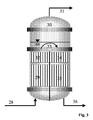
- Fig. 3 shows the structure of such a particular reactor.
- the reactor inlet (28) is the Reactor fed from below and passed into the first reaction region (29). Located there Catalyst in heatable pipes or other heated spaces.
- isobutene and water are formed, to a maximum extent to reach the chemical Balance.
- the operating pressure of the reactor evaporates a part of the Isobutene and forms a vapor phase (30), which as a product stream (31) directly in column (4) of Fig. 1 or 2 can be passed.
- the evaporation of the isobutene can additionally be amplified by an optional heating register (32).
- the liquid phase (33) can with a another heat exchanger element (34) set back to the permissible reaction temperature before being in the second reaction area (35), which also like the first (29) with Catalyst can be filled and heated, is passed. There the reaction runs again further up to maximum chemical equilibrium.
- the reaction areas (29) and (35) are structurally separated.
- the exiting partial flows (36) and (31) correspond in total the stream (3) in Fig. 1 and 2. While stream (31) is introduced directly into the column (4), can current (36) as shown in Fig. 1 and 2 only with a separation unit (21) of water depleted and then in column (4) or fed directly.
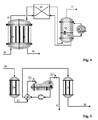
- the reactor inlet (28) is the Reactor again analogous to FIG. 3 fed from below or alternatively from above and in the first Reaction area (29) passed. There is the catalyst in heatable pipes or other heatable spaces. Due to the ongoing reaction isobutene and Water, to maximum for reaching the chemical equilibrium. The operating pressure of the Reactor is chosen high enough so that no evaporation occurs in the reactor.
- a Vapor phase (30) which as a product stream (31) directly into a column for workup, such as z. B. in column (4) of Fig.
- the liquid phase (33) can with a heat exchanger element (39) set back to the permissible reaction temperature and preheat the stream (37) to save energy before it enters the second reaction region (35), which also like the first (29) filled with catalyst and can be heated. There, the reaction continues again to a maximum of chemical balance.
- Reaction area (29) and (35) are structurally separated. This design is technically easy to implement.
- the reactor can also be used with the Reaction mixture in both reaction areas in cocurrent from bottom to top or from flows through the top down.
- the exiting partial streams (36) and (31) correspond to Sum of the stream (3) in Fig. 1 and 2. While stream (31) directly into the column (4) is introduced, current (36), as shown in FIGS. 1 and 2, only with a separation unit (21) depleted of water and then in column (4) or fed directly.
- this procedure can also be achieved by using the method in at least two reactors is carried out, wherein the liquid reactor discharge from the first Reactor is transferred to a zone in which a part of the reactor discharge by changing of pressure and / or temperature is converted into a gas phase and of the liquid phase is separated and the liquid phase is transferred to the second reactor.
- This Intermediate evaporation in the two- or multi-stage reactor system can, for. B. by Reduction of pressure compared to the reaction pressure can be performed. It can be advantageous if in the evaporation in the two- or multi-stage reactor system a Heat exchange between the evaporation of the supplied liquid stream and that of the Evaporation recycled liquid stream is performed. That way you can Heat losses are avoided.
- FIG. 5 A corresponding Connection is shown in FIG. 5.
- the reactor inlet (28) is analogous to FIG. 4 in the first Reaction area (29) passed.
- This reaction area consists of one or more Reactors, in which / which the catalyst in heated pipes or other heated spaces located.
- the reactor (s) can be from top to bottom or be flowed through in reverse.
- the ongoing reaction produces isobutene and water to maximum for reaching the chemical equilibrium.
- the operating pressure of the reactor is chosen so high that no evaporation occurs in the reactor.
- the reaction discharge (37) is placed in a container with evaporator or directly in an evaporator, preferably a kettle evaporator guided and forms by the heat supply to the heating element or evaporator (38) a vapor phase (30), which as product stream (31) directly into a work-up column, such as B.
- a work-up column such as B.
- Column (4) of FIG. 1 or 2 can be passed.
- the evaporation can still be supported by the fact that the operating pressure of the evaporator is lowered. hereby The product is less overheated than in the above-mentioned types.
- the liquid Phase (33) can with a heat exchanger element (39) back to the permissible reaction temperature be set and the stream (37) preheat to such energy Save before entering the second reaction area (35), which also like the first (29) is carried out as one or more reactors and filled with catalyst and can be heated, is passed. There, the reaction continues to maximum to the chemical Balance.
- the exiting partial streams (36) and (31) correspond in total to the stream (3) in Fig. 1 and 2. While stream (31) is introduced directly into the column (4), current (36) As shown in Fig. 1 and 2, first depleted of water with a separation unit (21) and then in Column (4) or fed directly.
- the mass-related vapor content which is generated in the reactors according to FIGS. 3 to 5 and as Stream (31) of a workup column, such. B. column (4) of Fig. 1 or 2 is passed, is preferably 1 to 80% by mass, preferably 5 to 75% by mass of the used Electricity (28).
- tert-butanol (TBA) in isobutene and water be split.
- TBA tert-butanol
- both technical, with Oligomers of isobutene, such as diisobutene, contaminated TBA and pure TBA be used.
- the TBA used can be obtained by reacting isobutene or isobutene-containing hydrocarbon mixtures, in particular raffinate I or selectively hydrogenated crack C 4 , with water or originate from other industrial processes in which TBA was not necessarily prepared by addition but as by-pass or Coupling product is obtained, as for example in the synthesis of tert-butyl hydroperoxide or epoxidations with tert-butyl hydroperoxide.
- the TBA content in the feed to the first cleavage reactor, the fresh reactant and TBA / water recycle stream is preferably from 40 to 99% by mass, preferably from 55 up to 98% by mass.
- the particularly favorable space velocity in the individual case depends on the water content of the Reaction mixture and highly of the reaction temperature and the activity of the catalyst used and is to be determined individually for each catalyst.
- the space velocity (LHSV) in liters of feed per liter of swollen catalyst per each Hour is generally from 10 to 100 at a reaction temperature of 80 to 100 ° C. 1 / (1 * h), at a reaction temperature of 100 to 130 ° C of 15 to 300 1 / (1 * h) and a Reaction temperature of 130 to 150 ° C to 600 1 / (1 * h). But it can also be lower Space velocities are chosen.
- the reactor discharge from the cleavage of TBA according to the invention is preferably carried out in Isobutene, by-products, water, and a TBA / water mixture that enters the reactor is reduced, with a water content less than 20 mass%, preferably less than 18 % By mass, preferably less than 10% by mass and particularly preferably with a water content from 3 to 9% by mass, separately.
- the workup of the reaction output is preferably carried out in that from the reactor in a first column over head the predominant part of the isobutene as Isobutene / water azeotrope is separated. From the top product of the first column can after separation of part of the water, e.g. B. by phase separation, by azeotropic Distillation in a second column (16) an almost anhydrous isobutene are obtained.
- an isobutene having a purity greater than 97, preferably greater than 98, more preferably greater than 99, and most preferably greater than 99.9 mass% are obtained, the maximum water content being smaller in values 10000, preferably less than 1000, more preferably less than 250, and most preferably less than 50 ppm.
- An isobutene-containing mixture containing isobutene and water in the above is also subject matter of the present invention.
- C 8 -hydrocarbons and long-chain hydrocarbons which are present as by-products in the reaction effluent, can be separated from the isobutene-free bottom product of the first column (4), for example in a third column (6) as top product.
- a third column (6) as top product.
- a mixture of water and TBA is separated, which may optionally have isobutene and as the bottom product Water, which optionally has organic impurities, wherein the tert-butanol / water mixture at least partially into the reactor for cleaving the tert-butanol is returned.
- 2-butanol, which is an impurity in the bottom product of the first or Third column may be present, for. B. from the distillative as the bottom product separated water by means of another column or as a side stream in the fifth column (9) are separated.
- the distillate (12) of the isobutene enrichment (4a), which is a substantially Isobutene / water azeotrope can be prepared in different ways. In particular, it can be condensed and transferred to a Absitz- or separation vessel or alternatively directly into a Absitz- or separation vessel with heat exchanger elements be condensed and subjected to a liquid-liquid separation. After the liquid-liquid separation a part of the organic liquid of a further column (16) on Head or in the upper part of the column are fed and in which almost anhydrous Isobutene (18) is recovered in the sump and an isobutene / water azeotrope over this Column is separated, which are returned to the liquid-liquid separation tank can.
- reaction before separation into different fractions in a first column or a fraction fraction after separation part of the water present in the reaction or in the resulting fractions, z. B. by pervaporation and / or vapor permeation by means of a membrane is separated.
- the entire water present in the reaction product is separated off except for the part which is possibly necessary for the distillative removal of isobutene and C 8 -hydrocarbons by azeotropic distillation. Separation of a portion of the water from the reaction effluent prior to separation into various fractions in a first column may also be accomplished by phase separation in a separation or settling vessel.
- the separation of water from these streams or fractions which may include mixtures containing water, TBA, isobutene and C 8 hydrocarbons, and optionally other organic components, occurs on membranes which are water-scarcely or not at all for the above permeable to said organic substances.
- the separation of the water by means of a membrane can by reverse osmosis (retentate and permeate are liquid), by pervaporation (liquid retentate, vapor permeate) or by vapor permeation (retentate and permeate in vapor form). Furthermore, one is Separation by simultaneous pervaporation and vapor permeation possible.
- hydrophilic membranes For water separation by reverse osmosis, pervaporation or vapor permeation can commercially available hydrophilic membranes are used.
- This membrane can Be polymeric membrane or inorganic membrane.
- polymer membranes from Sulzer Chemtech, CM-Celfa, GKSS or Sophisticated Systems become.
- Usable types are z.
- inorganic Membrane can be used, for example, the following: SMS (Sulzer Chemtech); Silica (Pervatech); NaA (Mitsui or Smart Chemical). You can also continue Combinations of inorganic membrane or inorganic support material and a Polymer membrane or applied polymer separation layer can be used.
- the water separation according to the invention is preferably carried out on the inorganic membranes at a temperature of 20 to 200 ° C and at the polymer membranes preferably at a Temperature from 20 to 150 ° C. Particularly preferred is the water separation at both Membrane types carried out at a temperature of 60 to 140 ° C.
- the inventive method is preferably at a pressure of the membrane unit supplied mixture (liquid, vapor or mixed phase) from 0.5 to 30 bar, preferably carried out from 0.8 to 20 bar.
- the pressure on the permeate side of the membrane is preferably from 0.001 to 1 bar.
- the differential pressure is preferably from 0.01 to 20 bar and in inorganic membranes preferably from 0.01 to 30 bar. Particularly preferred are the differential pressures in the range of 1 to 5 bar.
- the mass flow (kg permeate per square meter membrane surface per hour) is preferably from 0.1 to 10 kg / (m 2 h), more preferably from 1 to 8 kg / (m 2 h).
- the water separated as permeate preferably has a content of organic constituents, in particular of TBA of less than 10% by mass, preferably less than 5% by mass and very particularly preferably from 3 to 0.05% by mass. It can also be achieved smaller values up to 0.001% by mass, but this is usually not necessary and economically not useful.
- Suitable streams are, for example, the Cleavage reactor leaving reaction mixture or the recycled TBA / water mixture the azeotrope column (column (9)).
- the reaction mixture leaving the cleavage reactor is, apart from the waste water streams, the river with the highest water content. Therefore lets This results in comparison to other streams with the least energy expenditure remove relatively large part of the water by a membrane process. More options can be found in the reactor feed.
- a portion of the water present by pervaporation and / or vapor permeation is separated by means of a membrane. That way you can Reach TBA contents greater than 90% by mass, which is a particularly high sales in the Enable reactor (system).
- the top product (10) of the azeotrope column (9), which is recycled to the reactor (2) has about an azeotrope-near composition, ie a water content of about 20 to 12% by mass.
- an azeotrope-near composition ie a water content of about 20 to 12% by mass.
- the membrane method (21) can be used be to the water-containing stream (26), which is obtained as the bottom of the first separation column (4) and which is partially returned to the reactor to dewater.
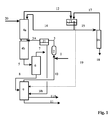
- FIG. 1 A block diagram of a system (interconnection) in which the method according to the invention can be carried out is shown in FIG.
- the feed (mixture) (1) is fed together with the TBA / water azeotrope, or with azeotrope-near composition (10) in the reactor (2).
- the reactor (2) can in this case consist of a single reactor or a reactor system (see below).
- the reaction mixture (3) leaving the reactor (2) is introduced into the column (4).
- the reaction mixture (3) leaving the reactor (2) can be dehydrated and thus largely freed of reaction water before it is introduced into the column (4).
- a drainage module (21) can be used in the simplest case, a decanter (separation or Absitz senser), which separates a possibly resulting two-phase mixture in an organic liquid stream (3A) and an aqueous liquid stream (3B).
- a decanter separation or Absitz senser
- the organic liquid stream (3A) is introduced into the column (4) and the aqueous liquid stream (3B) in column (9) for discharging and further purifying the water or the direct disposal.
- isobutene is separated off with small amounts of water, which is separated in the settling tank (13) into an isobutene and a water phase.
- the water phase (19) can be driven into the column (9). Part of the isobutene phase is recycled as reflux to the head of the column (4), the other part (15) in column (16) in pure isobutene (18) and in a water / isobutene azeotrope (17), which in the separation tank (13) is returned, separated.
- a fresh water stream (20) can be added at the top or in the enrichment section of the column (4).
- the bottom product (8) is in column (9) in water with any organic components (such as 2-butanol and / or C 12 hydrocarbons) (11) and a TBA / water azeotrope (10), the may contain small amounts of isobutene (from stream (19)), separated.
- Stream (10) is returned to the reactor (2).
- Any existing organic components (such as 2-butanol (SBA) and / or C 12 hydrocarbons) in the waste water stream (11) can be easily separated from pure water by distillation.
- 2-butanol can be discharged in a targeted manner by drawing off a stream from the vapor phase of the evaporator of the column or in vapor or liquid as side stream (11A) in the stripping section of the column (9).
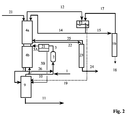
- FIG. 1 A block diagram of an alternative plant in which the process according to the invention can be carried out is shown in FIG.
- the (Das) feedstock (mixture) (1) is fed together with the TBA / water azeotrope, or with azeotrope-near composition (10) in the reactor (2).
- the reactor (2) can in this case consist of a single or a reactor system (see below).
- the reaction mixture (3) leaving the reactor (2) is introduced into the column (4).
- the reaction mixture (3) leaving the reactor (2) can be dehydrated and thus largely freed of reaction water before it is introduced into the column (4).
- a drainage module (21) can be used in the simplest case, a decanter (separation or Absitz constituer) which separates any resulting two-phase mixture in an organic liquid stream (3A) and an aqueous liquid stream (3B).
- a decanter separation or Absitz capableer
- the organic liquid stream (3A) is introduced into the column (4) and the aqueous liquid stream (3B) in column (9) for discharging and further purifying the water or the direct disposal.
- isobutene is separated off with small amounts of water, which is separated in the settling tank (13) into an isobutene and a water phase.
- the water phase (19) can be driven into the column (9). Part of the isobutene phase is recycled as reflux to the head of the column (4), the other part (15) in column (16) in pure isobutene (18) and in a water / isobutene azeotrope (17), which in the separation tank (13) is returned, separated.
- a fresh water stream (20) can be added at the top or in the enrichment section of the column (4).
- the bottom product (5) is in column (9) in water with any organic components (such as 2-butanol and / or C 12 hydrocarbons) (11) and a TBA / water azeotrope (10) may contain small amounts of isobutene (from stream (19)), separated.
- Stream (10) is returned to the reactor (2).
- the vapors (27) of the column (9) can be wholly or partly for energy saving and concentration adjustment in column (4) to be initiated.
- a part (26) of the bottom stream (5) can be fed directly into the reactor.
- Any existing organic components (such as 2-butanol and / or C 12 hydrocarbons) in the waste water stream (11) can be easily separated from pure water by distillation.
- a vaporous or liquid side stream (22) of the column (4) is removed and withdrawn in column (23) as the bottom product (24) with TBA and water. Isobutene and TBA are recovered as the top product (25) and recycled to the column (4).
- the distillative separation of occurring in the inventive method Material flows can be in one or more columns with internals, which are made of soils, rotating Internals, disorderly and / or ordered beds or packs, be performed.
- the distillative separation of isobutene is carried out from the Reactor discharge in a single column.
- the return is either through rotating funnels sprayed or spread by means of a rotor as a film on a heated tube wall.
- Columns used in the process of the invention may contain random beds different packing can be used. You can from almost all materials, such. B. Steel, stainless steel, copper, carbon, earthenware, porcelain, glass, plastics etc. or Mixtures thereof exist and in various forms, such as. B. balls, rings with smooth or profiled surfaces, rings with inner webs or wall breakthroughs, Wire mesh rings, calipers or spirals are present.
- Packages with regular geometry can, for. B. of sheet metal or woven metal or plastic.
- Examples of such packages are Sulzer tissue packs BX, Sulzer multi-plate packs Mellapak made of sheet metal, high-performance packs such as MellapakPlus, Structural packs from Sulzer (Optiflow), Montz (BSH) and Kühni (Rombopak).
- the operating pressure of the columns used in the process according to the invention is preferably from 0.5 to 15 bar abs. (bara), more preferably from 1 to 10 bara.
- the column (4) used to separate the reactor discharge preferably has one theoretical separation number from 5 to 80, preferably a theoretical separation number of 10 up to 60.
- the inlet bottom depends on the composition of the feed. It turned out to be proven advantageous when the feed of the reactor discharge on the counted from above, 4th to 55. theoretical soil, especially on the 5th to 50th in the lower section of the column, in particular the column (4a) of Fig. 1 and Fig. 2 takes place.
- the supply of fresh water (21) takes place at the top of the column (4) at level 1.
- the supply of the optional vapor stream (27) of the column (9) takes place in the bottom of the column (4).
- the column used for discharging the waste water and concentration of TBA (9) preferably has a theoretical separation number of 5 to 70, preferably one theoretical separation number from 8 to 65.
- the inlet floor depends on the Composition of the inlet from. It has proved to be advantageous if the feed of the Current (5) in Fig. 2, and the current (8) in Fig. 1 on the counted from above, 1 to 55. theoretical ground, especially on the 1st to 45th place.
- the feed of the possible Wastewater (3B) and (19) takes place on the, from above counted, 1. to 60. theoretical soil, especially on the 1st to 50th floor.
- the column (16) used for drying the isobutene preferably has one theoretical separation number from 4 to 35, preferably a theoretical separation number of 5 up to 30. It has proved to be advantageous if the feed of the feed (15) to the, counted from above, 1st to 6th theoretical soil, in particular on the 1st to 4th takes place.
- the column (6) used in FIG. 1 for discharging C 8 -hydrocarbons preferably has a theoretical separation stage number of 4 to 75, preferably a theoretical separation stage number of 5 to 50.
- the inlet bottom depends on the composition of the feed. It has proved to be advantageous if the feeding of the stream (5) in Fig. 1 to the, counted from above, 1 to 55th theoretical soil, in particular on the 1st to 45th takes place.
- the column (23) used in FIG. 2 for the discharge of C 8 -hydrocarbons preferably has a theoretical separation stage number of 4 to 65, preferably a theoretical separation stage number of 5 to 50. It has proved to be advantageous if the feed of the feed (22) to the counted from above, 1 to 25 theoretical soil, in particular on the 1st to 15th takes place.
- the product stream (25) is taken off in vapor or liquid as distillate, preferably in vapor form at the top of the column.
- the block diagrams show common components such as pumps, compressors, valves, Heat exchanger and evaporator not shown, but these are natural components a plant.
- the reactor system for the isothermal performance of equilibrium reactions in the Liquid phase of fixed bed catalysts in which at least one of the reaction products under Temperature and pressure conditions at which all educts and at least one Reaction product predominantly liquid, in part, preferably for the most part Part is present in gaseous form, in particular for carrying out the method according to the invention is characterized in particular by the fact that the reactor system at least two structurally Having separate reaction zones, each arranged one in a fixed bed Have catalyst and devices for isothermal temperature control, wherein between two reaction zones in each case a separation zone is present, which has means with which at least a part of at least one of the products of the equilibrium reaction by pressure or temperature change into the gas phase, separated from the reaction mixture and from is discharged from the reactor and with which the remaining reaction mixture in the following Reaction zone is transferred, where appropriate, another agent may be present with which the temperature or pressure in the following reaction zone just like that is adjusted as in the previous reaction zone.
- the means of adjusting the Temperature can z. B. conventional plate or tube heat exchangers.
- the means to Transfer of at least one of the products of the equilibrium reaction into the gas phase can also be a heat exchanger, so that by entry of heat energy in the Reaction mixture of this reaction product is evaporated.
- the Means a Kettle evaporator or a container with heating is, with which one Pressure decrease is achieved when the reaction mixture enters the separation zone. At a such embodiment of the reactor, this is in the following on the separation zone Reaction zone at a lower pressure than in the previous Reaction zone.
- Isobutene was produced in a plant realized according to FIGS. 1 and 5, with the peculiarity that no water separation with the module (21) took place, and thus the Streams 3 and 3A had the same composition.
- the fresh water stream (20) and the Wastewater flow (3B) accounted for.
- the waste water stream (19) was disposed of directly.
- the reaction part (2) was realized in two stages according to FIG. 5.
- the reactor (29) consisted of a, at 120 ° C isothermally operated laboratory tubular reactor with a catalyst volume of about 310 ml.
- the catalyst used was Amberlyst 15.
- the second reactor (35) was also from a, at 120 ° C isothermally operated laboratory tubular reactor with a Catalyst volume of about 310 ml.
- Amberlyst 15 was also used for the intermediate evaporation, a heatable container was used.
- the column diameter of the columns (4), (6), (9) and (16) was 50 mm in each case. It Metal fillers were used.
- column (4) were about 30 theoretical stages installed, the feed of the reactor discharge (3) took place on the 20 counted from above. theoretical level.
- the reflux (14) was added to the top of the column at stage 1.
- Column (6) were installed about 18 theoretical stages, the feed (5) from column (4) took place on the 12th theoretical stage, counted from above.
- column (9) about 13 installed theoretical stage, the feed (8) from column (6) took place on the, from above counted, 2nd theoretical stage.
- the side stream (11A) was vapor on, from the top counted, taken about 10th theoretical stage.
- the feed (1) used for the experiments was taken from a large-scale plant for producing isobutene and had the composition given in Table 1.
- Some of C 8 hydrocarbons and other high boilers are already present in small amounts in the feed and are formed in part during the cleavage of the TBA in the reactor system.
- the flow numbers in the following table correspond to the designations in FIG. 1, in the reaction part they correspond to FIG. 5. Components with a concentration of less than 0.1 mass parts in the mixture are generally not listed in the table.
- the pressure of the reactor (29) was 19 bar abs.
- the pressure of the reactor (35) was 18 bar abs.
- the intermediate evaporation (38) was at 15 bar abs. carried out.
- the columns (4), (6), (9) and (16) were at about 6 bar abs. Operated head pressure.
- Column (4) was equipped with a dephlegmator and operated with a reflux flow of about 11.5 kg / h. This gave a space-time yield of 2.7 kg / (1 * h) based on the total amount of catalyst used.
- the reaction part (2) was realized in one stage.
- the reactor (2) consisted of one at 120 ° C isothermally operated laboratory tubular reactor with a catalyst volume of about 285 ml.
- Als Catalyst was Amberlyst 15 used.
- the column diameter of the columns (4), (6), (9) and (16) were each 50 mm. There were each metal filler (Pall rings) used.
- column (4) about 30 theoretical stages were installed, the inlet of the Reaktoraustrags (3) took place on the, counted from above, 20th theoretical stage.
- the return (14) was added at the top of the column at step 1.
- column (6) about 18 installed theoretical stage, the feed (5) from column (4) took place on the, from above counted, 12th theoretical stage.
- In column (9) were about 13 theoretical stages installed, the feed (8) from column (6) took place on the, from above counted, 2. theoretical Step.
- the side stream (11A) was vapor on the, counted from above, about 10. taken from the
- the feed (1) used for the experiments was taken from a large-scale plant for producing isobutene and had the composition shown in Table 2.
- C 8 hydrocarbons and other high boilers are sometimes already present in small amounts in the feed and are formed in part in the cleavage of the TBAs in the reactor system.
- the flow numbers in the following table correspond to the designations in FIG. 1. Components with a concentration of less than 0.1 mass parts in the mixture are generally not listed in the table.
- the pressure of the reactor (2) was 19 bar abs.
- the columns (4), (6), (9) and (16) were at about 6 bar abs. Operated head pressure.
- Column (4) was equipped with a dephlegmator and operated with a reflux flow of about 5.1 kg / h. This gave a space-time yield of 5.8 kg / (1 * h) based on the total amount of catalyst used.
Landscapes
- Chemical & Material Sciences (AREA)
- Organic Chemistry (AREA)
- Chemical Kinetics & Catalysis (AREA)
- Physics & Mathematics (AREA)
- Fluid Mechanics (AREA)
- Engineering & Computer Science (AREA)
- Analytical Chemistry (AREA)
- Oil, Petroleum & Natural Gas (AREA)
- Water Supply & Treatment (AREA)
- Organic Low-Molecular-Weight Compounds And Preparation Thereof (AREA)
- Catalysts (AREA)
- Low-Molecular Organic Synthesis Reactions Using Catalysts (AREA)
Abstract
Description
| Stromnummer | Stombezeichnung | Massenfluß [kg/h] | Konzentration der abzutrennenden Komponente in Massenteile |
| 1 | Frisch-Zulauf | 2,5 | 9,4 Wasser |
| 90,5 TBA | |||
| 0,1 SBA (2-Butanol) | |||
| 3 | Reaktorgesamtaustrag | 7,891 | 21,4Isobuten |
| 21,4 Wasser | |||
| 57,0 TBA | |||
| 0,2 SBA | |||
| 5 | Sumpf der Kolonne (4) | 6,187 | 27,1 Wasser |
| 72,7 TBA | |||
| 0,2 SBA | |||
| 7 | Destillat der Kolonne (6) | 0,003 | 13,0 Wasser |
| 58,2 TBA | |||
| 28,8 C8 | |||
| 8 | Sumpf der Kolonne (6) | 6,185 | 27,1 Wasser |
| 72,7 TBA | |||
| 0,2 SBA | |||
| 10 | Destillat der Kolonne (9) | 5,391 | 17,0 Wasser |
| 82,8 TBA | |||
| 0,2 SBA | |||
| 11A | Seitenstromentnahme der Kolonne (9) | 0,04 | 21,3 Wasser |
| 74,9 TBA | |||
| 3,7 SBA | |||
| 0,1 sonstige Stoffe | |||
| 11 | Sumpf der Kolonne (9) | 0,754 | 99,995 Wasser |
| 0,005 sonstige Stoffe | |||
| 12 | Destillat der Kolonne (4) | 2,503 | 99,3 Isobuten |
| 0,6 Wasser | |||
| 14 | Externer Rücklauf zur Kolonne (4) | 0,8 | 99,9 Isobuten |
| 0,1 Wasser | |||
| 15 | Zulauf zur Kolonne (16) | 1,986 | 99,9 Isobuten |
| 0,1 Wasser | |||
| 17 | Destillat der Kolonne (16) | 0,297 | 99,5 Isobuten |
| 0,5 Wasser | |||
| 18 | Sumpf der Kolonne (16) | 1,689 | 99,96 Isobuten |
| 0,04 sonstige Stoffe | |||
| 19 | Abwasser aus Trennbehälter (13) | 0,015 | 99,9 Wasser |
| 0,1 TBA | |||
| 28 | Zulauf zum Reaktor (29) | 7,891 | 14,6 Wasser |
| 85,2 TBA | |||
| 0,2 SBA | |||
| 31 | Abgetrennte Dampfphase (30) | 1,13 | 61,5 Isobuten |
| 8,5 Wasser | |||
| 30,0 TBA | |||
| 0,1 SBA | |||
| 36 | Austrag des Reaktors (35) | 6,76 | 14,7Isobuten |
| 23,6 Wasser | |||
| 61,5 TBA | |||
| 0,2 SBA | |||
| 37 | Austrag des Reaktors (29) | 7,891 | 17,3Isobuten |
| 20,1 Wasser | |||
| 62,4 TBA | |||
| 0,2 SBA |
| Stromnummer | Strombezeichnung | Massenfluss [kg/h] | Konzentration der abzutrennenden Komponente in Massenteile |
| 1 | Frisch-Zulauf | 2,5 | 9,4 Wasser |
| 90,5 TBA | |||
| 0,1 SBA | |||
| 3 | Reaktoraustrag | 9,756 | 17,3Isobuten |
| 20,1 Wasser | |||
| 62,4 TBA | |||
| 0,2 SBA | |||
| 5 | Sumpf der Kolonne (4) | 7,988 | 23,6 Wasser |
| 76,2 TBA | |||
| 0,2 SBA | |||
| 7 | Destillat der Kolonne (6) | 0,004 | 3,3 Isobuten |
| 12,5 Wasser | |||
| 65,2 TBA | |||
| 19,1 C8 | |||
| 8 | Sumpf der Kolonne (6) | 7,984 | 23,6 Wasser |
| 76,2 TBA | |||
| 0,2 SBA | |||
| 10 | Destillat der Kolonne (9) | 7,256 | 16,4 Wasser |
| 83,4 TBA | |||
| 0,2 SBA | |||
| 11A | Seitenstromentnahme der Kolonne (9) | 0,040 | 22,7 Wasser |
| 73,6 TBA | |||
| 3,7 SBA | |||
| 0,1 sonstige Stoffe | |||
| 11 | Sumpf der Kolonne (9) | 0,688 | 99,995 Wasser |
| 0,005 sonstige Stoffe | |||
| 12 | Destillat der Kolonne (4) | 2,568 | 96,8 Isobuten |
| 3,2 Wasser | |||
| 14 | Externer Rücklauf zur Kolonne (4) | 0,800 | 99,9 Isobuten |
| 0,1 Wasser | |||
| 15 | Zulauf zur Kolonne (16) | 1,988 | 99,9 Isobuten |
| 0,1 Wasser | |||
| 17 | Destillat der Kolonne (16) | 0,300 | 99,5 Isobuten |
| 0,5 Wasser | |||
| 18 | Sumpf der Kolonne (16) | 1,688 | 99,965 Isobuten |
| 0,045 sonstige Stoffe | |||
| 19 | Abwasser aus Trennbehälter (13) | 0,081 | 99,9 Wasser |
| 0,1 TBA |
Claims (25)
- Verfahren zur Herstellung von Isobuten durch Spaltung von tert.-Butanol in zumindest einem Reaktor an einem in diesem Reaktor im Festbett angeordneten stark saueren Ionenaustauscherharz zu Isobuten und Wasser bei einer Temperatur von 80 bis 150 °C und einem Druck von 5 bis 25 bar und anschließende Auftrennung des Reaktionsgemisches in Isobuten, Nebenprodukte, Wasser und zumindest eine Mischung aus nicht gespaltenem tert.-Butanol und Wasser,
dadurch gekennzeichnet, dass der Reaktor quasi isotherm mit einer Temperaturdifferenz zwischen den ein- und austretenden Strömen von weniger als 15 K betrieben wird. - Verfahren nach Anspruch 1,
dadurch gekennzeichnet, dass der Zulauf zum Reaktor sich aus frischem Eduktstrom und einem oder mehreren Rückführungsströmen, die eine Mischung aus nicht gespaltenem tert.-Butanol, Wasser und gegebenenfalls Nebenprodukten aufweist, zusammensetzt, wobei das Massen-Verhältnis von frischem Eduktstrom zu der Summe der Rückführungsströme kleiner 1 : 10 beträgt. - Verfahren nach Anspruch 1 oder 2,
dadurch gekennzeichnet, dass mehrere Reaktoren, die in Reihe oder parallel angeordnet sind, eingesetzt werden, wobei alle Reaktoren isotherm betrieben werden. - Verfahren nach einem der Ansprüche 1 bis 3,
dadurch gekennzeichnet, dass das Verfahren so durchgeführt wird, dass die Spaltung in der ersten Reaktionszone bis zum Gleichgewicht der Spaltungsreaktion durchgeführt wird, in einer anschließenden Abtrennzone Isobuten gasförmig abgetrennt wird und in einer sich daran anschließenden Reaktionszone die Spaltung wieder bis zum Gleichgewicht der Spaltungsreaktion durchgeführt wird, und, wenn weitere Abtrennzonen und Reaktionszonen vorhanden sind, diese Verfahrensschritte entsprechend häufig wiederholt werden. - Verfahren nach einem der Ansprüche 1 bis 4,
dadurch gekennzeichnet, dass zumindest ein Reaktor eingesetzt wird, der zumindest zwei Reaktionszonen aufweist, die jeweils ein im Festbett angeordneten stark saueres Ionenaustauscherharz aufweisen, wobei zwischen zwei Reaktionszonen jeweils eine Abtrennzone vorhanden ist, in der zumindest ein Teil eines der Produkte der Spaltung durch Überführung in die Gasphase vom Reaktionsgemisch abgetrennt wird und aus dem Reaktor ausgeschleust wird. - Verfahren nach einem der Ansprüche 1 bis 5,
dadurch gekennzeichnet, dass der Druck und die Temperatur in den Reaktionszonen des Reaktors so gewählt werden, dass das Reaktionsgemisch in flüssiger Phase vorliegt, und der Druck und die Temperatur in den Abtrennzonen so gewählt werden, dass das Isobuten zum Teil in der Gasphase vorliegt. - Verfahren nach einem der Ansprüche 1 bis 4,
dadurch gekennzeichnet, dass das Verfahren in zumindest zwei Reaktoren durchgeführt wird, wobei der flüssige Reaktoraustrag aus dem ersten Reaktor in eine Zone überführt wird, in welcher ein Teil des Reaktoraustrags durch Änderung von Druck und/oder Temperatur in eine Gasphase überführt wird und von der flüssigen Phase abgetrennt wird und die flüssige Phase in den zweiten Reaktor überführt wird. - Verfahren nach einem der Ansprüche 1 bis 7,
dadurch gekennzeichnet, dass die Zwischenverdampfung im zwei- oder mehrstufigen Reaktorsystem durch Verringerung des Drucks gegenüber dem Reaktionsdruck durchgeführt wird. - Verfahren nach einem der Ansprüche 1 bis 8,
dadurch gekennzeichnet, dass bei der Verdampfung im zwei- oder mehrstufigen Reaktorsystem ein Wärmeaustausch zwischen dem der Verdampfung zugeführten flüssigen Strom und dem von der Verdampfung rückgeführten flüssigen Strom durchgeführt wird. - Verfahren nach einem der Ansprüche 1 bis 9,
dadurch gekennzeichnet, dass das der Reaktoraustrag in Isobuten, Nebenprodukte, Wasser und ein TBA/Wasser-Gemisch mit einem Wassergehalt unter 10 Massen-%, das in den Reaktor zurückgefahren wird, getrennt wird. - Verfahren nach einem der Ansprüche 1 bis 10,
dadurch gekennzeichnet, dass aus dem Reaktoraustrag in einer ersten Kolonne über Kopf der überwiegende Teil des Isobutens als Isobuten/Wasser-Azeotrop abgetrennt wird. - Verfahren nach einem der Ansprüche 1 bis 11,
dadurch gekennzeichnet, dass aus dem Kopfprodukt der ersten Kolonne nach Abtrennung eines Teil des Wassers durch Phasentrennung durch azeotrope Destillation in einer zweiten Kolonne (16) ein nahezu wasserfreies Isobuten gewonnen wird. - Verfahren nach einem der Ansprüche 1 bis 12,
dadurch gekennzeichnet, dass C8-Kohlenwasserstoffe und langkettigere Kohlenwasserstoffe, die als Nebenprodukte im Reaktionsaustrag vorliegen aus dem isobutenfreien Sumpfprodukt der ersten Kolonne (4) in einer dritten Kolonne (6) als Kopfprodukt abgetrennt werden. - Verfahren nach einem der Ansprüche 1 bis 12,
dadurch gekennzeichnet, dass die C8-Kohlenwasserstoffe und eventuell langkettigere Kohlenwasserstoffe, die als Nebenprodukte im Reaktionsaustrag vorliegen, als Sumpfprodukt in einer vierten Kolonne (23), in der ein dampfförmiger oder flüssiger Seitenabzug der ersten Kolonne (4) destilliert wird, abgetrennt werden. - Verfahren nach einem der Ansprüche 1 bis 14,
dadurch gekennzeichnet, dass aus dem Sumpfprodukt der ersten Kolonne (4) oder dritten Kolonne (6) in einer fünften Kolonne (9) über Kopf ein Gemisch aus Wasser und TBA abgetrennt wird, welches gegebenenfalls Isobuten aufweisen kann und als Sumpfprodukt Wasser, welches gegebenenfalls organische Verunreinigungen aufweist, wobei das tert.-Butanol/Wasser-Gemisch zumindest teilweise in den Reaktor zur Spaltung des tert.-Butanols zurückgeführt wird. - Verfahren nach einem der Ansprüche 1 bis 15,
dadurch gekennzeichnet, dass 2-Butanol destillativ aus dem als Sumpfprodukt abgetrennten Wasser oder als Seitenstrom in der fünften Kolonne (9) abgetrennt wird. - Verfahren nach einem der Ansprüche 1 bis 16,
dadurch gekennzeichnet, dass das Destillat (12) einer Isobuten-Anreicherung (4a), welches im wesentlichen ein Isobuten/Wasser-Azeotrop aufweist, kondensiert und in einen Absitz- oder Trennbehälter überführt wird oder alternativ direkt in einen Absitz- oder Trennbehälter mit Wärmeaustauscherelementen kondensiert wird und dass nach der Flüssig-Flüssig-Trennung ein Teil der organischen Flüssigkeit einer Kolonne (16) am Kopf oder im oberen Teil der Kolonne zugeführt wird und in dieser nahezu wasserfreies Isobuten (18) im Sumpf gewonnen wird und ein Isobuten/Wasser-Azeotrop über Kopf dieser Kolonne abgetrennt und wieder dem Flüssig-Flüssig-Trennbehälter zugeführt wird. - Verfahren nach einem der Ansprüche 1 bis 17,
dadurch gekennzeichnet, dass aus dem Reaktionsaustrag vor dem Auftrennen in verschiedene Fraktionen in einer ersten Kolonne ein Teil des im Reaktionsaustrag vorhandenen Wassers durch Pervaporation und/oder Dampfpermeation mittels einer Membran abgetrennt wird. - Verfahren nach einem der Ansprüche 1 bis 18,
dadurch gekennzeichnet, dass aus dem Reaktionszulauf vor dem Eintritt in den Reaktor, also aus Strom (1), Strom (10) und/oder dem daraus gemischten Strom, ein Teil des vorhandenen Wassers durch Pervaporation und/oder Dampfpermeation mittels einer Membran abgetrennt wird. - Verfahren nach einem der Ansprüche 1 bis 19,
dadurch gekennzeichnet, dass aus dem Reaktionsaustrag vor dem Auftrennen in verschiedene Fraktionen in einer ersten Kolonne ein Teil des im Reaktionsaustrag vorhandenen Wassers durch Abscheidung in einem Trenn- oder Absitzbehälter abgetrennt wird. - Verfahren nach Anspruch 20,
dadurch gekennzeichnet, dass das gesamte Reaktionswasser bis auf den Teil, der gegebenenfalls für die destillative Abtrennung von Isobuten und C8-Kohlenwasserstoffen durch Azeotropdestillation notwendig ist, abgetrennt wird. - Verfahren nach einem der Ansprüche 1 bis 21,
dadurch gekennzeichnet, dass Isobuten in einer Reinheit von 99 Massen-% gewonnen wird, wobei der maximale Wassergehalt bei Werten kleiner 250 ppm liegt. - Isobutenhaltiges Gemisch, hergestellt nach einem Verfahren gemäß einem der Ansprüche 1 bis 22.
- Isobutenhaltiges Gemisch gemäß Anspruch 23,
dadurch gekennzeichnet, dass Gemisch Isobuten in einer Konzentration von größer 99 Massen-% aufweist und einen Wassergehalt von kleiner 250 ppm aufweist. - Reaktorsystem zur isothermen Durchführung von Gleichgewichtsreaktionen in der Flüssigphase an Festbettkatalysatoren, bei denen zumindest eines der Reaktionsprodukte unter Temperatur und Druckbedingungen, bei denen alle Edukte sowie zumindest ein Reaktionsprodukt überwiegend flüssig vorliegt, zum Teil gasförmig vorliegt, insbesondere zur Durchführung des Verfahren gemäß einem der Ansprüche 1 bis 22,
dadurch gekennzeichnet, dass das Reaktorsystem zumindest zwei baulich voneinander getrennte Reaktionszonen aufweist, die jeweils einen im Festbett angeordneten Katalysator sowie Vorrichtungen zur isothermen Temperaturführung aufweisen, wobei zwischen zwei Reaktionszonen jeweils eine Abtrennzone vorhanden ist, die Mittel aufweist, mit denen zumindest ein Teil zumindest eines der Produkte der Gleichgewichtsreaktion durch Druck oder Temperaturänderung in die Gasphase überführt, vom Reaktionsgemisch abgetrennt und aus dem Reaktor ausgeschleust wird und mit denen das restliche Reaktionsgemisch in die folgende Reaktionszone überführt wird, wobei gegebenenfalls ein weiteres Mittel vorhanden sein kann, mit welchem die Temperatur oder der Druck in der folgenden Reaktionszone genau so eingestellt wird wie in der vorangegangenen Reaktionszone.
Priority Applications (1)
| Application Number | Priority Date | Filing Date | Title |
|---|---|---|---|
| PL04101656T PL1489062T3 (pl) | 2003-06-17 | 2004-04-21 | Sposób wytwarzania izobutenu z tert.-butanolu |
Applications Claiming Priority (2)
| Application Number | Priority Date | Filing Date | Title |
|---|---|---|---|
| DE10327215A DE10327215A1 (de) | 2003-06-17 | 2003-06-17 | Verfahren zur Herstellung von Isobuten aus tert.-Butanol |
| DE10327215 | 2003-06-17 |
Publications (2)
| Publication Number | Publication Date |
|---|---|
| EP1489062A1 true EP1489062A1 (de) | 2004-12-22 |
| EP1489062B1 EP1489062B1 (de) | 2012-12-19 |
Family
ID=33394844
Family Applications (1)
| Application Number | Title | Priority Date | Filing Date |
|---|---|---|---|
| EP04101656A Expired - Lifetime EP1489062B1 (de) | 2003-06-17 | 2004-04-21 | Verfahren zur Herstellung von Isobuten aus tert.-Butanol |
Country Status (10)
| Country | Link |
|---|---|
| US (1) | US7235704B2 (de) |
| EP (1) | EP1489062B1 (de) |
| JP (1) | JP4800584B2 (de) |
| KR (1) | KR101104106B1 (de) |
| CN (1) | CN1331829C (de) |
| DE (1) | DE10327215A1 (de) |
| ES (1) | ES2400558T3 (de) |
| PL (1) | PL1489062T3 (de) |
| SG (1) | SG153629A1 (de) |
| TW (1) | TW200503987A (de) |
Cited By (6)
| Publication number | Priority date | Publication date | Assignee | Title |
|---|---|---|---|---|
| DE102012105876A1 (de) | 2012-07-02 | 2014-01-02 | Oxea Gmbh | Verfahren zur Herstellung von Terephthalsäure und ihren Derivaten |
| DE102012105877A1 (de) | 2012-07-02 | 2014-01-02 | Oxea Gmbh | Verfahren zur Herstellung von Diisobuten |
| DE102012105879A1 (de) | 2012-07-02 | 2014-01-02 | Oxea Gmbh | Verfahren zur Herstellung von Isononylderivaten |
| DE102012105878A1 (de) | 2012-07-02 | 2014-01-02 | Oxea Gmbh | Verfahren zur Herstellung von Isopentanderivaten |
| DE102012105874A1 (de) | 2012-07-02 | 2014-01-02 | Oxea Gmbh | Verfahren zur Herstellung von Isononansäurevinylestern |
| EP3808442A1 (de) * | 2019-10-17 | 2021-04-21 | Commissariat à l'Énergie Atomique et aux Énergies Alternatives | Reaktor-wärmetauscher mit rohren, und kalander, der die stufenweise injektion eines reagens ermöglicht |
Families Citing this family (25)
| Publication number | Priority date | Publication date | Assignee | Title |
|---|---|---|---|---|
| DE10241762A1 (de) * | 2002-09-10 | 2004-03-18 | Oxeno Olefinchemie Gmbh | Verfahren zur Herstellung von wasserfreiem tert.-Butanol |
| EP1431264B1 (de) * | 2002-12-19 | 2010-01-20 | Evonik Oxeno GmbH | Verfahren zur Herstellung von tert.-Butanol |
| DE10260991A1 (de) * | 2002-12-24 | 2004-07-08 | Oxeno Olefinchemie Gmbh | Verfahren zur Herstellung von tert.-Butanol mittels Reaktivrektifikation |
| CA2614044C (en) * | 2005-07-06 | 2014-05-06 | Bp Chemicals Limited | Reactive distillation for the dehydration of mixed alcohols |
| CN101381273B (zh) * | 2007-09-06 | 2012-08-22 | 四川古杉油脂化学有限公司 | 一种用叔丁醇制备异丁烯的方法及装置 |
| EP2105428A1 (de) | 2007-12-12 | 2009-09-30 | BP p.l.c. | Verfahren zur Umwandlung von n-Butanol in Isobuten |
| EP2070894A1 (de) | 2007-12-12 | 2009-06-17 | BP p.l.c. | Verfahren zur Umwandlung von n-Butanol in Di-Isobuten und Penten |
| EP2070896A1 (de) | 2007-12-12 | 2009-06-17 | BP p.l.c. | Verfahren zur Umwandlung von n-Butanol in Di-Isobuten und Propen |
| US8067655B2 (en) * | 2008-05-29 | 2011-11-29 | Lyondell Chemical Technology, L.P. | Diisobutylene process |
| US8912373B2 (en) * | 2009-07-29 | 2014-12-16 | The United States Of America As Represented By The Secretary Of The Navy | Process for the dehydration of aqueous bio-derived terminal alcohols to terminal alkenes |
| CN102020526B (zh) * | 2009-09-09 | 2013-04-24 | 中国石油天然气股份有限公司 | 一种采用叔丁醇制备异丁烯的方法 |
| KR101161845B1 (ko) * | 2010-04-26 | 2012-07-03 | 송원산업 주식회사 | 알켄 화합물의 제조 방법 |
| KR101876612B1 (ko) | 2011-12-05 | 2018-07-09 | 사우디 아라비안 오일 컴퍼니 | 친수성 멤브레인 통합형 올레핀 수화 공정 |
| CN103804116B (zh) * | 2012-11-08 | 2016-03-30 | 中国石油化工股份有限公司 | 一种甲基叔丁基醚裂解制聚合级异丁烯的方法 |
| WO2016086781A1 (zh) | 2014-12-03 | 2016-06-09 | 中国石油化工股份有限公司 | 一种催化剂及其制备方法和应用其制备异丁烯的方法 |
| KR20170035621A (ko) | 2015-09-23 | 2017-03-31 | 롯데케미칼 주식회사 | 터트-부탄올로부터 이소부틸렌의 제조 방법 |
| KR101880741B1 (ko) | 2016-09-27 | 2018-07-20 | 롯데케미칼 주식회사 | 터트-부탄올로부터 이소부틸렌의 제조 방법 |
| KR101899136B1 (ko) | 2016-09-27 | 2018-09-14 | 롯데케미칼 주식회사 | 터트-부탄올로부터 이소부틸렌의 제조 방법 |
| CN109776247A (zh) * | 2018-03-30 | 2019-05-21 | 住友化学株式会社 | 异丁烯的制造方法及异丁烯的制造装置 |
| CN109550520A (zh) * | 2018-11-06 | 2019-04-02 | 丹东明珠特种树脂有限公司 | 叔丁醇脱水制备高纯度异丁烯用催化剂、其制备方法和其脱水应用 |
| US12220662B2 (en) | 2019-01-09 | 2025-02-11 | Sabic Global Technologies B.V. | Dehydration of a mixture containing a diol with high water content using optimized pervaporation process |
| KR102325331B1 (ko) | 2019-12-20 | 2021-11-10 | 한화토탈 주식회사 | 터트-부탄올로부터 이소부틸렌의 제조방법 |
| CN111187137B (zh) * | 2020-02-13 | 2024-02-09 | 浙江信汇新材料股份有限公司 | 一种tba制备聚合级异丁烯的工艺 |
| CN115135624A (zh) * | 2020-03-31 | 2022-09-30 | 三菱化学株式会社 | 异丁烯的制造方法、甲基丙烯酸的制造方法和甲基丙烯酸甲酯的制造方法 |
| CN116983907A (zh) * | 2023-06-30 | 2023-11-03 | 上海合全药业股份有限公司 | 一种可用于易燃湿催化剂的加料机构、反应装置及其使用方法 |
Citations (2)
| Publication number | Priority date | Publication date | Assignee | Title |
|---|---|---|---|---|
| DE3151446A1 (de) * | 1981-12-24 | 1983-07-14 | Chemische Werke Hüls AG, 4370 Marl | Verfahren zur herstellung von hochreinem isobuten durch dehydratisierung von tertiaer-butanol |
| DE19936675A1 (de) * | 1999-08-04 | 2001-07-05 | Borsig Energy Gmbh | Verfahren zum Betreiben eines kontinuierlich arbeitenden Reaktors sowie nach diesem Verfahren arbeitender Reaktor |
Family Cites Families (8)
| Publication number | Priority date | Publication date | Assignee | Title |
|---|---|---|---|---|
| US3665048A (en) | 1970-01-14 | 1972-05-23 | Atlantic Richfield Co | Process to produce high purity isobutylene |
| DE2913796A1 (de) | 1978-04-10 | 1979-10-11 | Nippon Oil Co Ltd | Verfahren zum kontinuierlichen abtrennen und gewinnen von isobuten |
| US4208540A (en) | 1978-12-22 | 1980-06-17 | Nippon Oil Co., Ltd. | Process for separation and recovery of isobutene |
| JPH0788318B2 (ja) * | 1986-08-06 | 1995-09-27 | 三菱レイヨン株式会社 | イソブチレンの製造法 |
| JPH06508640A (ja) * | 1992-04-22 | 1994-09-29 | ビーピー ケミカルズ リミテッド | オレフィンの製造方法 |
| DE4322712A1 (de) | 1993-07-08 | 1995-01-12 | Huels Chemische Werke Ag | Verfahren zur Durchführung chemischer Reaktionen in Reaktionsdestillationskolonnen |
| FR2747120B1 (fr) * | 1996-04-09 | 1998-05-15 | Inst Francais Du Petrole | Procede de production d'olefine(s) tertiaire(s) par decomposition de l'ether correspondant a l'aide d'un catalyseur particulier |
| EP1431264B1 (de) | 2002-12-19 | 2010-01-20 | Evonik Oxeno GmbH | Verfahren zur Herstellung von tert.-Butanol |
-
2003
- 2003-06-17 DE DE10327215A patent/DE10327215A1/de not_active Withdrawn
-
2004
- 2004-03-29 JP JP2004096756A patent/JP4800584B2/ja not_active Expired - Fee Related
- 2004-04-02 SG SG200401997-2A patent/SG153629A1/en unknown
- 2004-04-21 ES ES04101656T patent/ES2400558T3/es not_active Expired - Lifetime
- 2004-04-21 EP EP04101656A patent/EP1489062B1/de not_active Expired - Lifetime
- 2004-04-21 PL PL04101656T patent/PL1489062T3/pl unknown
- 2004-06-10 TW TW093116732A patent/TW200503987A/zh unknown
- 2004-06-16 CN CNB2004100495231A patent/CN1331829C/zh not_active Expired - Fee Related
- 2004-06-17 KR KR1020040045140A patent/KR101104106B1/ko not_active Expired - Fee Related
- 2004-06-17 US US10/868,904 patent/US7235704B2/en not_active Expired - Fee Related
Patent Citations (2)
| Publication number | Priority date | Publication date | Assignee | Title |
|---|---|---|---|---|
| DE3151446A1 (de) * | 1981-12-24 | 1983-07-14 | Chemische Werke Hüls AG, 4370 Marl | Verfahren zur herstellung von hochreinem isobuten durch dehydratisierung von tertiaer-butanol |
| DE19936675A1 (de) * | 1999-08-04 | 2001-07-05 | Borsig Energy Gmbh | Verfahren zum Betreiben eines kontinuierlich arbeitenden Reaktors sowie nach diesem Verfahren arbeitender Reaktor |
Cited By (10)
| Publication number | Priority date | Publication date | Assignee | Title |
|---|---|---|---|---|
| DE102012105876A1 (de) | 2012-07-02 | 2014-01-02 | Oxea Gmbh | Verfahren zur Herstellung von Terephthalsäure und ihren Derivaten |
| DE102012105877A1 (de) | 2012-07-02 | 2014-01-02 | Oxea Gmbh | Verfahren zur Herstellung von Diisobuten |
| DE102012105879A1 (de) | 2012-07-02 | 2014-01-02 | Oxea Gmbh | Verfahren zur Herstellung von Isononylderivaten |
| DE102012105878A1 (de) | 2012-07-02 | 2014-01-02 | Oxea Gmbh | Verfahren zur Herstellung von Isopentanderivaten |
| DE102012105874A1 (de) | 2012-07-02 | 2014-01-02 | Oxea Gmbh | Verfahren zur Herstellung von Isononansäurevinylestern |
| WO2014005978A1 (de) | 2012-07-02 | 2014-01-09 | Oxea Gmbh | Verfahren zur herstellung von diisobuten |
| WO2014005975A1 (de) | 2012-07-02 | 2014-01-09 | Oxea Gmbh | Verfahren zur herstellung von isopentanderivaten |
| WO2014005854A1 (de) | 2012-07-02 | 2014-01-09 | Oxea Gmbh | Verfahren zur herstellung von isononylderivaten |
| EP3808442A1 (de) * | 2019-10-17 | 2021-04-21 | Commissariat à l'Énergie Atomique et aux Énergies Alternatives | Reaktor-wärmetauscher mit rohren, und kalander, der die stufenweise injektion eines reagens ermöglicht |
| FR3102070A1 (fr) * | 2019-10-17 | 2021-04-23 | Commissariat A L'energie Atomique Et Aux Energies Alternatives | Réacteur échangeur à tubes et calandre permettant l’injection étagée d’un réactif |
Also Published As
| Publication number | Publication date |
|---|---|
| JP2005008618A (ja) | 2005-01-13 |
| EP1489062B1 (de) | 2012-12-19 |
| KR20040111120A (ko) | 2004-12-31 |
| KR101104106B1 (ko) | 2012-01-12 |
| DE10327215A1 (de) | 2005-01-13 |
| JP4800584B2 (ja) | 2011-10-26 |
| PL1489062T3 (pl) | 2013-05-31 |
| CN1609082A (zh) | 2005-04-27 |
| SG153629A1 (en) | 2009-07-29 |
| CN1331829C (zh) | 2007-08-15 |
| TW200503987A (en) | 2005-02-01 |
| ES2400558T3 (es) | 2013-04-10 |
| US7235704B2 (en) | 2007-06-26 |
| US20050014985A1 (en) | 2005-01-20 |
Similar Documents
| Publication | Publication Date | Title |
|---|---|---|
| EP1489062B1 (de) | Verfahren zur Herstellung von Isobuten aus tert.-Butanol | |
| DE3884352T2 (de) | Pervaporationsverfahren zur Trennung von Alkoholen von Äthern. | |
| EP1616848B1 (de) | Verfahren zur Herstellung von tert.-Butanol aus Isobuten-haltigen Kohlenwasserstoffgemischen | |
| EP1900713B1 (de) | Verfahren zur Spaltung von Methyl-tertiär-butylether | |
| EP1900712B1 (de) | Verfahren zur Spaltung von Methyl-tertiär-butylether | |
| EP1903019B1 (de) | Verfahren zur Herstellung von Isoolefinen | |
| EP1826193A1 (de) | Verfahren zur Entwässerung von Ethanol | |
| EP1508558B1 (de) | Verfahren zur Erzeugung von tert.-Butanol | |
| EP1894908A1 (de) | Verfahren zur Spaltung von Methyl-tertiär-butylether | |
| EP1462431B1 (de) | Verfahren zur Abtrennung von 2-Butanol aus tert.-Butanol/Wasser-Gemischen | |
| EP2991973B1 (de) | Verfahren zur herstellung von 2-substituierten 4-hydroxy-4-methyl-tetrahydropyranen mit rückführung | |
| DE2759237C2 (de) | ||
| EP2760809B1 (de) | Verfahren und anlage zur herstellung von olefinen aus dimethylether | |
| EP1565241B1 (de) | Verfahren und vorrichtung zur hydrolytischen gewinnung einer carbonsäure und alkohol aus dem entsprechenden carbonsäureester | |
| DE3509292A1 (de) | Verfahren zur herstellung von reinen tertiaeren olefinen | |
| EP1575886B1 (de) | Verfahren zur herstellung von tert.-butanol mittels reaktivrektifikation | |
| EP1462433B1 (de) | Verfahren zur Abtrennung von 2-Butanol aus tert.-Butanol/Wasser-Gemischen | |
| EP2447244B1 (de) | Verfahren zur kontinuierlichen Herstellung von Dialkylcarbonat | |
| EP1462432B1 (de) | Verfahren zur Ausschleusung von 2-Butanol aus tert.-Butanol/Wasser-Gemischen | |
| EP4495091B1 (de) | Verfahren zur herstellung von alkoholen durch alkoxycarbonylierung von di-isobuten und einem c4- bis c7-olefin und anschliessender hydrierung | |
| EP4477644A1 (de) | Verfahren zur herstellung einer carbonsäure oder deren salz durch alkoxycarbonylierung von di-isobuten mit vorheriger destillation und anschliessender hydrolyse | |
| DE102006057856A1 (de) | Verfahren zur Herstellung von Alkyl-tert-butylether und hochreinem Raffinat II | |
| EP4477641A1 (de) | Verfahren zur herstellung eines alkohols durch alkoxycarbonylierung von di-isobuten mit vorheriger destillation und anschliessender hydrierung | |
| EP4477645A1 (de) | Verfahren zur alkoxycarbonylierung von di-isobuten mit vorheriger destillation | |
| EP4477639A1 (de) | Verfahren zur bereitstellung eines stroms, der einen hohen anteil an 2,4,4-trimethylpent-1-en aufweist |
Legal Events
| Date | Code | Title | Description |
|---|---|---|---|
| PUAI | Public reference made under article 153(3) epc to a published international application that has entered the european phase |
Free format text: ORIGINAL CODE: 0009012 |
|
| 17P | Request for examination filed |
Effective date: 20040421 |
|
| AK | Designated contracting states |
Kind code of ref document: A1 Designated state(s): AT BE BG CH CY CZ DE DK EE ES FI FR GB GR HU IE IT LI LU MC NL PL PT RO SE SI SK TR |
|
| AX | Request for extension of the european patent |
Extension state: AL HR LT LV MK |
|
| AKX | Designation fees paid |
Designated state(s): AT BE BG CH CY CZ DE DK EE ES FI FR GB GR HU IE IT LI LU MC NL PL PT RO SE SI SK TR |
|
| RAP1 | Party data changed (applicant data changed or rights of an application transferred) |
Owner name: EVONIK OXENO GMBH |
|
| 17Q | First examination report despatched |
Effective date: 20100705 |
|
| REG | Reference to a national code |
Ref country code: DE Ref legal event code: R079 Ref document number: 502004013941 Country of ref document: DE Free format text: PREVIOUS MAIN CLASS: C07C0001200000 Ipc: C07C0001240000 |
|
| RIC1 | Information provided on ipc code assigned before grant |
Ipc: B01J 8/02 20060101ALI20120621BHEP Ipc: C07C 1/24 20060101AFI20120621BHEP Ipc: B01J 8/06 20060101ALI20120621BHEP Ipc: B01J 19/24 20060101ALI20120621BHEP Ipc: C07C 11/09 20060101ALI20120621BHEP Ipc: B01J 8/00 20060101ALI20120621BHEP Ipc: B01J 19/00 20060101ALI20120621BHEP Ipc: B01J 8/04 20060101ALI20120621BHEP |
|
| GRAP | Despatch of communication of intention to grant a patent |
Free format text: ORIGINAL CODE: EPIDOSNIGR1 |
|
| GRAS | Grant fee paid |
Free format text: ORIGINAL CODE: EPIDOSNIGR3 |
|
| GRAA | (expected) grant |
Free format text: ORIGINAL CODE: 0009210 |
|
| AK | Designated contracting states |
Kind code of ref document: B1 Designated state(s): AT BE BG CH CY CZ DE DK EE ES FI FR GB GR HU IE IT LI LU MC NL PL PT RO SE SI SK TR |
|
| REG | Reference to a national code |
Ref country code: GB Ref legal event code: FG4D Free format text: NOT ENGLISH |
|
| REG | Reference to a national code |
Ref country code: CH Ref legal event code: EP |
|
| REG | Reference to a national code |
Ref country code: AT Ref legal event code: REF Ref document number: 589320 Country of ref document: AT Kind code of ref document: T Effective date: 20130115 |
|
| REG | Reference to a national code |
Ref country code: DE Ref legal event code: R096 Ref document number: 502004013941 Country of ref document: DE Effective date: 20130214 |
|
| REG | Reference to a national code |
Ref country code: ES Ref legal event code: FG2A Ref document number: 2400558 Country of ref document: ES Kind code of ref document: T3 Effective date: 20130410 Ref country code: NL Ref legal event code: T3 |
|
| PG25 | Lapsed in a contracting state [announced via postgrant information from national office to epo] |
Ref country code: SE Free format text: LAPSE BECAUSE OF FAILURE TO SUBMIT A TRANSLATION OF THE DESCRIPTION OR TO PAY THE FEE WITHIN THE PRESCRIBED TIME-LIMIT Effective date: 20121219 |
|
| PG25 | Lapsed in a contracting state [announced via postgrant information from national office to epo] |
Ref country code: GR Free format text: LAPSE BECAUSE OF FAILURE TO SUBMIT A TRANSLATION OF THE DESCRIPTION OR TO PAY THE FEE WITHIN THE PRESCRIBED TIME-LIMIT Effective date: 20130320 Ref country code: SI Free format text: LAPSE BECAUSE OF FAILURE TO SUBMIT A TRANSLATION OF THE DESCRIPTION OR TO PAY THE FEE WITHIN THE PRESCRIBED TIME-LIMIT Effective date: 20121219 |
|
| REG | Reference to a national code |
Ref country code: PL Ref legal event code: T3 |
|
| PG25 | Lapsed in a contracting state [announced via postgrant information from national office to epo] |
Ref country code: EE Free format text: LAPSE BECAUSE OF FAILURE TO SUBMIT A TRANSLATION OF THE DESCRIPTION OR TO PAY THE FEE WITHIN THE PRESCRIBED TIME-LIMIT Effective date: 20121219 Ref country code: BG Free format text: LAPSE BECAUSE OF FAILURE TO SUBMIT A TRANSLATION OF THE DESCRIPTION OR TO PAY THE FEE WITHIN THE PRESCRIBED TIME-LIMIT Effective date: 20130319 Ref country code: CZ Free format text: LAPSE BECAUSE OF FAILURE TO SUBMIT A TRANSLATION OF THE DESCRIPTION OR TO PAY THE FEE WITHIN THE PRESCRIBED TIME-LIMIT Effective date: 20121219 Ref country code: SK Free format text: LAPSE BECAUSE OF FAILURE TO SUBMIT A TRANSLATION OF THE DESCRIPTION OR TO PAY THE FEE WITHIN THE PRESCRIBED TIME-LIMIT Effective date: 20121219 Ref country code: CY Free format text: LAPSE BECAUSE OF FAILURE TO SUBMIT A TRANSLATION OF THE DESCRIPTION OR TO PAY THE FEE WITHIN THE PRESCRIBED TIME-LIMIT Effective date: 20121219 |
|
| PG25 | Lapsed in a contracting state [announced via postgrant information from national office to epo] |
Ref country code: RO Free format text: LAPSE BECAUSE OF FAILURE TO SUBMIT A TRANSLATION OF THE DESCRIPTION OR TO PAY THE FEE WITHIN THE PRESCRIBED TIME-LIMIT Effective date: 20121219 Ref country code: PT Free format text: LAPSE BECAUSE OF FAILURE TO SUBMIT A TRANSLATION OF THE DESCRIPTION OR TO PAY THE FEE WITHIN THE PRESCRIBED TIME-LIMIT Effective date: 20130419 |
|
| RAP2 | Party data changed (patent owner data changed or rights of a patent transferred) |
Owner name: EVONIK DEGUSSA GMBH |
|
| PLBE | No opposition filed within time limit |
Free format text: ORIGINAL CODE: 0009261 |
|
| STAA | Information on the status of an ep patent application or granted ep patent |
Free format text: STATUS: NO OPPOSITION FILED WITHIN TIME LIMIT |
|
| PG25 | Lapsed in a contracting state [announced via postgrant information from national office to epo] |
Ref country code: DK Free format text: LAPSE BECAUSE OF FAILURE TO SUBMIT A TRANSLATION OF THE DESCRIPTION OR TO PAY THE FEE WITHIN THE PRESCRIBED TIME-LIMIT Effective date: 20121219 |
|
| REG | Reference to a national code |
Ref country code: DE Ref legal event code: R081 Ref document number: 502004013941 Country of ref document: DE Owner name: EVONIK DEGUSSA GMBH, DE Free format text: FORMER OWNER: OXENO OLEFINCHEMIE GMBH, 45772 MARL, DE Effective date: 20121219 Ref country code: DE Ref legal event code: R081 Ref document number: 502004013941 Country of ref document: DE Owner name: EVONIK DEGUSSA GMBH, DE Free format text: FORMER OWNER: EVONIK OXENO GMBH, 45772 MARL, DE Effective date: 20130905 |
|
| 26N | No opposition filed |
Effective date: 20130920 |
|
| PG25 | Lapsed in a contracting state [announced via postgrant information from national office to epo] |
Ref country code: MC Free format text: LAPSE BECAUSE OF FAILURE TO SUBMIT A TRANSLATION OF THE DESCRIPTION OR TO PAY THE FEE WITHIN THE PRESCRIBED TIME-LIMIT Effective date: 20121219 |
|
| REG | Reference to a national code |
Ref country code: CH Ref legal event code: PL |
|
| REG | Reference to a national code |
Ref country code: DE Ref legal event code: R097 Ref document number: 502004013941 Country of ref document: DE Effective date: 20130920 |
|
| REG | Reference to a national code |
Ref country code: IE Ref legal event code: MM4A |
|
| PG25 | Lapsed in a contracting state [announced via postgrant information from national office to epo] |
Ref country code: CH Free format text: LAPSE BECAUSE OF NON-PAYMENT OF DUE FEES Effective date: 20130430 Ref country code: LI Free format text: LAPSE BECAUSE OF NON-PAYMENT OF DUE FEES Effective date: 20130430 |
|
| REG | Reference to a national code |
Ref country code: GB Ref legal event code: 732E Free format text: REGISTERED BETWEEN 20140327 AND 20140402 |
|
| PG25 | Lapsed in a contracting state [announced via postgrant information from national office to epo] |
Ref country code: IE Free format text: LAPSE BECAUSE OF NON-PAYMENT OF DUE FEES Effective date: 20130421 |
|
| REG | Reference to a national code |
Ref country code: NL Ref legal event code: SD Effective date: 20140502 |
|
| REG | Reference to a national code |
Ref country code: AT Ref legal event code: PC Ref document number: 589320 Country of ref document: AT Kind code of ref document: T Owner name: EVONIK DEGUSSA GMBH, DE Effective date: 20140428 |
|
| REG | Reference to a national code |
Ref country code: ES Ref legal event code: PC2A Owner name: EVONIK DEGUSSA GMBH. Effective date: 20141008 |
|
| PG25 | Lapsed in a contracting state [announced via postgrant information from national office to epo] |
Ref country code: TR Free format text: LAPSE BECAUSE OF FAILURE TO SUBMIT A TRANSLATION OF THE DESCRIPTION OR TO PAY THE FEE WITHIN THE PRESCRIBED TIME-LIMIT Effective date: 20121219 |
|
| PG25 | Lapsed in a contracting state [announced via postgrant information from national office to epo] |
Ref country code: LU Free format text: LAPSE BECAUSE OF NON-PAYMENT OF DUE FEES Effective date: 20130421 Ref country code: HU Free format text: LAPSE BECAUSE OF FAILURE TO SUBMIT A TRANSLATION OF THE DESCRIPTION OR TO PAY THE FEE WITHIN THE PRESCRIBED TIME-LIMIT; INVALID AB INITIO Effective date: 20040421 |
|
| REG | Reference to a national code |
Ref country code: FR Ref legal event code: PLFP Year of fee payment: 13 |
|
| PGFP | Annual fee paid to national office [announced via postgrant information from national office to epo] |
Ref country code: NL Payment date: 20160420 Year of fee payment: 13 |
|
| PGFP | Annual fee paid to national office [announced via postgrant information from national office to epo] |
Ref country code: GB Payment date: 20160421 Year of fee payment: 13 Ref country code: FI Payment date: 20160413 Year of fee payment: 13 Ref country code: ES Payment date: 20160413 Year of fee payment: 13 |
|
| PGFP | Annual fee paid to national office [announced via postgrant information from national office to epo] |
Ref country code: FR Payment date: 20160421 Year of fee payment: 13 Ref country code: AT Payment date: 20160421 Year of fee payment: 13 Ref country code: BE Payment date: 20160420 Year of fee payment: 13 Ref country code: IT Payment date: 20160427 Year of fee payment: 13 |
|
| PGFP | Annual fee paid to national office [announced via postgrant information from national office to epo] |
Ref country code: PL Payment date: 20160421 Year of fee payment: 13 |
|
| REG | Reference to a national code |
Ref country code: NL Ref legal event code: MM Effective date: 20170501 |
|
| REG | Reference to a national code |
Ref country code: AT Ref legal event code: MM01 Ref document number: 589320 Country of ref document: AT Kind code of ref document: T Effective date: 20170421 |
|
| GBPC | Gb: european patent ceased through non-payment of renewal fee |
Effective date: 20170421 |
|
| REG | Reference to a national code |
Ref country code: FR Ref legal event code: ST Effective date: 20171229 |
|
| PG25 | Lapsed in a contracting state [announced via postgrant information from national office to epo] |
Ref country code: FR Free format text: LAPSE BECAUSE OF NON-PAYMENT OF DUE FEES Effective date: 20170502 Ref country code: NL Free format text: LAPSE BECAUSE OF NON-PAYMENT OF DUE FEES Effective date: 20170501 Ref country code: AT Free format text: LAPSE BECAUSE OF NON-PAYMENT OF DUE FEES Effective date: 20170421 Ref country code: FI Free format text: LAPSE BECAUSE OF NON-PAYMENT OF DUE FEES Effective date: 20170421 |
|
| PG25 | Lapsed in a contracting state [announced via postgrant information from national office to epo] |
Ref country code: GB Free format text: LAPSE BECAUSE OF NON-PAYMENT OF DUE FEES Effective date: 20170421 |
|
| REG | Reference to a national code |
Ref country code: BE Ref legal event code: MM Effective date: 20170430 Ref country code: BE Ref legal event code: PD Owner name: EVONIK DEGUSSA GMBH; DE Free format text: DETAILS ASSIGNMENT: CHANGE OF OWNER(S), AUTRE, DOCUMENT OEB; FORMER OWNER NAME: EVONIK OXENO GMBH Effective date: 20140612 |
|
| PG25 | Lapsed in a contracting state [announced via postgrant information from national office to epo] |
Ref country code: IT Free format text: LAPSE BECAUSE OF NON-PAYMENT OF DUE FEES Effective date: 20170421 Ref country code: BE Free format text: LAPSE BECAUSE OF NON-PAYMENT OF DUE FEES Effective date: 20170430 |
|
| REG | Reference to a national code |
Ref country code: ES Ref legal event code: FD2A Effective date: 20180704 |
|
| PG25 | Lapsed in a contracting state [announced via postgrant information from national office to epo] |
Ref country code: ES Free format text: LAPSE BECAUSE OF NON-PAYMENT OF DUE FEES Effective date: 20170422 |
|
| PGFP | Annual fee paid to national office [announced via postgrant information from national office to epo] |
Ref country code: DE Payment date: 20180420 Year of fee payment: 15 |
|
| PG25 | Lapsed in a contracting state [announced via postgrant information from national office to epo] |
Ref country code: PL Free format text: LAPSE BECAUSE OF NON-PAYMENT OF DUE FEES Effective date: 20170421 |
|
| REG | Reference to a national code |
Ref country code: DE Ref legal event code: R119 Ref document number: 502004013941 Country of ref document: DE |
|
| PG25 | Lapsed in a contracting state [announced via postgrant information from national office to epo] |
Ref country code: DE Free format text: LAPSE BECAUSE OF NON-PAYMENT OF DUE FEES Effective date: 20191101 |