EP1489537A1 - Verfahren zur Vervolgung des Weges von Nahrungsmitteln - Google Patents
Verfahren zur Vervolgung des Weges von Nahrungsmitteln Download PDFInfo
- Publication number
- EP1489537A1 EP1489537A1 EP03447158A EP03447158A EP1489537A1 EP 1489537 A1 EP1489537 A1 EP 1489537A1 EP 03447158 A EP03447158 A EP 03447158A EP 03447158 A EP03447158 A EP 03447158A EP 1489537 A1 EP1489537 A1 EP 1489537A1
- Authority
- EP
- European Patent Office
- Prior art keywords
- animals
- products
- food products
- food
- code
- Prior art date
- Legal status (The legal status is an assumption and is not a legal conclusion. Google has not performed a legal analysis and makes no representation as to the accuracy of the status listed.)
- Withdrawn
Links
Images

Classifications
-
- G—PHYSICS
- G06—COMPUTING OR CALCULATING; COUNTING
- G06Q—INFORMATION AND COMMUNICATION TECHNOLOGY [ICT] SPECIALLY ADAPTED FOR ADMINISTRATIVE, COMMERCIAL, FINANCIAL, MANAGERIAL OR SUPERVISORY PURPOSES; SYSTEMS OR METHODS SPECIALLY ADAPTED FOR ADMINISTRATIVE, COMMERCIAL, FINANCIAL, MANAGERIAL OR SUPERVISORY PURPOSES, NOT OTHERWISE PROVIDED FOR
- G06Q10/00—Administration; Management
- G06Q10/08—Logistics, e.g. warehousing, loading or distribution; Inventory or stock management
- G06Q10/087—Inventory or stock management, e.g. order filling, procurement or balancing against orders
-
- A—HUMAN NECESSITIES
- A01—AGRICULTURE; FORESTRY; ANIMAL HUSBANDRY; HUNTING; TRAPPING; FISHING
- A01K—ANIMAL HUSBANDRY; AVICULTURE; APICULTURE; PISCICULTURE; FISHING; REARING OR BREEDING ANIMALS, NOT OTHERWISE PROVIDED FOR; NEW BREEDS OF ANIMALS
- A01K11/00—Marking of animals
- A01K11/006—Automatic identification systems for animals, e.g. electronic devices, transponders for animals
Definitions
- the present invention relates to a animal and product traceability process food of vegetable origin (cereals, fruits, juice fruit, spices, %), animal (meat, eggs, milk or cheese and possibly non-food items such as leather, wool, %) or mineral (salt, trace elements, dyes, ).
- traceability is defined as "the ability to trace, through all stages of production, processing and distribution, the progress of a food, a animal feed, a food-producing animal or a substance intended to be incorporated or liable to be incorporated into human food or animal feed '.
- traceability seen under its microeconomic aspect is the capacity to trace, through all the steps from the receipt of raw materials until shipment of finished products at customers' premises, the food or food product.
- the present invention aims to provide a process and means meeting this goal.
- the present invention relates to the subject of appended claims.
- This traceability is done by a identification of each product, both in terms of the entry of raw materials, that at the production, processing and shipping of finished products (i.e. processed products) by a given company.
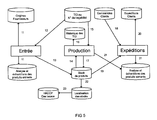
- This identification can be done at the level certain specific processing units (input, storage, shipping) and / or processing areas intermediate products during production (see figure 5).
- H.A.C.C.P Hazard Analysis Critical Control Point
- This traceability can be applied by a marking of living products (animals), products vegetables, products derived from these animals (meat, eggs), as well as different packaging or containers including these said products.
- the identification of these different products can be made by systems known per se by use of a unique object code (bar code, chip electronics, hologram, biological labeling, ).
- entry, exit and production are also identified by code single place. It is this double identification of the premises and products or various containers (packaging or food containers, carts carrying these containers, cages comprising the animals, etc.) which allows the implementation of traceability geographic that combines identification and location products within a company or a place of production. In addition, simply reading the unique code product present on a packaging, on a cage, on a container or on a means of transport allows possibly identify the container (living product or food product).
- marking with a unique location code or object of the various premises, containers and means of transport and their double integration into a data facilitate quality management (compliance with food preparation recipes, tracking of products, %) and the inventory in production or at the end of production.
- the traceability system can also be suitable for providing data, such as taking the date and time of entry of a raw material or shipping of a finished product or the passage of different elements by different production units.
- the inventive traceability system therefore also makes it possible to advantageously view the quantities of products present in a container or on a means of transport and optimize logistics and transfer of products.
- this traceability within a company can be advantageously integrated or not in traceability of a food chain integrating times products intended for animal feed, the breeding of said animals and possibly obtaining products derived from these animals (leather, milk, eggs, ...), the transport of said animals or their derived products, the treatment of these animals (slaughter, insemination, therapeutic treatment, ...), the treatment applied (thermal, chemical, biological, ...) on products derived from these animals, the preparation of products complex food comprising one or more of these derived from animal products, recovery stages, for processing slaughter and production waste, transformation of this slaughter waste into products food, the mixture of food products, ....
- This traceability of a food chain can be present within the same company, different subsidiaries of the same company or companies different belonging to one or more agro-food sectors. Managing the traceability of these different data can be advantageously performed or controlled by national or supranational organizations, especially in the event that these products or animals cross borders.
- the validation step or operation (6) is performed on receipt of raw materials or before the use of products in stock, each company (1) querying the central database (2) (the database government data attached to a sector), and possibly the database present within the company for product traceability, for allow health validation of products that will enter a production line.
- the central database (2) the database government data attached to a sector
- a closing step or operation (7) is carried out when production (finished products reuse or ship) is finished or at the end of the day, the company (1) sending to the central database (2) the links between the company code and the codes unique object of validated products (raw materials) and used and the unique object codes assigned to products (possibly from mixtures of products) made from said raw materials (fence) (Fig.2).
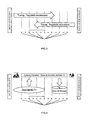
- the principle of this validation operation is to feed the central database (in information and links between companies (1) and products) and easily identify these products and companies and ensure bottom-up traceability and descending (fig. 3).
- This bottom-up traceability or "Tracing” allows all stages to find the history and origin of an animal, a product given food or a lot of food on basis of one or more criteria (product code, code company, links between companies, links between products, ).
- Top-down traceability or "tracking” consists in finding the industrial location or commercial at all stages of a batch of products to from these given criteria.
- Top-down traceability is used in particular recall, withdrawal or blockage of products (live animals or food products).
- This blocking database (8) allows to ensure with certainty that the products in question dangerous or suspected of being dangerous by their nature, their location or detention may contaminate other products or actors in the production or distribution.
- the company (1) performing this validation (6) should not perform analyzes complementary; simply, when some of these raw materials or semi-finished products, will be identified as bad or suspect, he must set aside (do not integrate them into the production of finished products) and / or follow the recommendations use of these products donated by the institution government responsible for the database central (2).
- Similar systems may be possibly integrated within a single unit of production according to the needs of management or quality management of a company.
- the products the deviation can be destroyed or seized by agents government departments.
- Figure 1 shows the flowchart of a macro-economic traceability of a production chain food.
- Figure 2 shows the links between different companies and the central database.
- Figure 3 shows the different top-down and bottom-up traceability possibilities different companies within the same industry food production.
- Figure 4 shows the blocking of animals or food products within a food production chain.
- Figure 5 shows a flowchart simplified traceability within a company.
- R1 5499950467103 VO 20030315-2 GLN identification Lot References Value
- R2 7145892 1 R2 258963 2
- R2 5842 2 R9 5499950467103 VO 20030315-2 3
- Figure 5 shows traceability within premises entry, production and shipping premises of a company, each of these premises can be identified by a unique location code.
Landscapes
- Business, Economics & Management (AREA)
- Life Sciences & Earth Sciences (AREA)
- Engineering & Computer Science (AREA)
- Environmental Sciences (AREA)
- Economics (AREA)
- Tourism & Hospitality (AREA)
- General Business, Economics & Management (AREA)
- Human Resources & Organizations (AREA)
- Marketing (AREA)
- Operations Research (AREA)
- Quality & Reliability (AREA)
- Strategic Management (AREA)
- Development Economics (AREA)
- Physics & Mathematics (AREA)
- Entrepreneurship & Innovation (AREA)
- General Physics & Mathematics (AREA)
- Theoretical Computer Science (AREA)
- Finance (AREA)
- Birds (AREA)
- Zoology (AREA)
- Animal Husbandry (AREA)
- Biodiversity & Conservation Biology (AREA)
- Accounting & Taxation (AREA)
- Management, Administration, Business Operations System, And Electronic Commerce (AREA)
Priority Applications (1)
| Application Number | Priority Date | Filing Date | Title |
|---|---|---|---|
| EP03447158A EP1489537A1 (de) | 2003-06-20 | 2003-06-20 | Verfahren zur Vervolgung des Weges von Nahrungsmitteln |
Applications Claiming Priority (1)
| Application Number | Priority Date | Filing Date | Title |
|---|---|---|---|
| EP03447158A EP1489537A1 (de) | 2003-06-20 | 2003-06-20 | Verfahren zur Vervolgung des Weges von Nahrungsmitteln |
Publications (1)
| Publication Number | Publication Date |
|---|---|
| EP1489537A1 true EP1489537A1 (de) | 2004-12-22 |
Family
ID=33396146
Family Applications (1)
| Application Number | Title | Priority Date | Filing Date |
|---|---|---|---|
| EP03447158A Withdrawn EP1489537A1 (de) | 2003-06-20 | 2003-06-20 | Verfahren zur Vervolgung des Weges von Nahrungsmitteln |
Country Status (1)
| Country | Link |
|---|---|
| EP (1) | EP1489537A1 (de) |
Citations (2)
| Publication number | Priority date | Publication date | Assignee | Title |
|---|---|---|---|---|
| EP0945060A2 (de) * | 1998-03-24 | 1999-09-29 | Timothy P. Dr. Guichon | Verfahren und Vorrichtung zur Überwachung von Tieren |
| WO2003027718A1 (en) * | 2001-09-28 | 2003-04-03 | Telenvironment Ab | A method and a system for controlling meat products |
-
2003
- 2003-06-20 EP EP03447158A patent/EP1489537A1/de not_active Withdrawn
Patent Citations (2)
| Publication number | Priority date | Publication date | Assignee | Title |
|---|---|---|---|---|
| EP0945060A2 (de) * | 1998-03-24 | 1999-09-29 | Timothy P. Dr. Guichon | Verfahren und Vorrichtung zur Überwachung von Tieren |
| WO2003027718A1 (en) * | 2001-09-28 | 2003-04-03 | Telenvironment Ab | A method and a system for controlling meat products |
Non-Patent Citations (3)
| Title |
|---|
| INTERSCAN SYSTEMES: "Tiens, voilà du Bahier, de la traçabilité et de l'efficacité!", COMMUNIQUES DE PRESSE, 12 March 2001 (2001-03-12), pages 1 - 2, XP002261379 * |
| R. G. PETTIT: "Traceability in the food animal industry and supermarket chains", REVUE SCIENTIFIQUE ET TECHNIQUE DE L'OFFICE INTERNATIONAL DES ÉPIZOOTIES, vol. 20, no. 2, August 2001 (2001-08-01), pages 584 - 597, XP002261378 * |
| R. HOUSTON: "A computerised database system for bovine traceability", REVUE SCIENTIFIQUE ET TECHNIQUE DE L'OFFICE INTERNATIONAL DES ÉPIZOOTIES, vol. 20, no. 2, August 2001 (2001-08-01), pages 652 - 661, XP002261437 * |
Similar Documents
| Publication | Publication Date | Title |
|---|---|---|
| Rejeb | Halal meat supply chain traceability based on HACCP, blockchain and internet of things | |
| CN110210812B (zh) | 一种物品冷链溯源方法及系统 | |
| US6878052B2 (en) | Method and system for controlling meat products | |
| CN103942631A (zh) | Rfid溯源系统 | |
| KR102269446B1 (ko) | IoT 기반의 농수축산물 실시간 통합 이력관리 시스템 | |
| Rajkovic et al. | The performance of food safety management systems in the raspberries chain | |
| Ene | The relevance of traceability in the food chain | |
| EP1489538A1 (de) | Verfahren zur Vervolgung des Weges von Nahrungsmitteln | |
| Busyra et al. | A preliminary findings of risk categories in halal supply chain in Indonesia: Upstream level of meat industry | |
| CN113095850A (zh) | 动物全程管控溯源系统 | |
| Alkahtani et al. | IoT implementation in slaughterhouses supply chain: A case study of the Adahi experiment in the Kingdom of Saudi Arabia | |
| CN110717768A (zh) | 奶粉溯源及合理化销售系统 | |
| Navarro et al. | Assessment of good agricultural practices on cocoa and coffee farms in northern Haiti | |
| Ahmed et al. | The intersection of artificial intelligence and food systems: exploring technological breakthroughs and data-driven agriculture | |
| EP1498835A1 (de) | Verfahren zur Verfolgung des Weges von Nahrungsmitteln | |
| Farrar et al. | Identification of the source of contamination | |
| Wicki et al. | THE ROLE OF IT SYSTEMS IN SUPPORTING LOGISTICS SYSTEMS IN AGRIBUSINESS ENTERPRISES. | |
| Pulita et al. | How does traceability support stakeholders in food recall management? A case study of the beef chain | |
| US20050205674A1 (en) | System and method for tracing agricultural commodities | |
| Aysha et al. | Overcoming the quality challenges across the supply chain | |
| CN116188038A (zh) | 一种基于区块链的农产品质量溯源系统 | |
| Vernede et al. | Tractability in Food Processing Chains | |
| Lehtinen | Traceability in Agrifood Chains | |
| Aung et al. | Food traceability | |
| CN113807778A (zh) | 第三代化合物半导体的仓库物料管理方法及相关设备 |
Legal Events
| Date | Code | Title | Description |
|---|---|---|---|
| PUAI | Public reference made under article 153(3) epc to a published international application that has entered the european phase |
Free format text: ORIGINAL CODE: 0009012 |
|
| AK | Designated contracting states |
Kind code of ref document: A1 Designated state(s): AT BE BG CH CY CZ DE DK EE ES FI FR GB GR HU IE IT LI LU MC NL PT RO SE SI SK TR |
|
| AX | Request for extension of the european patent |
Extension state: AL LT LV MK |
|
| RAP1 | Party data changed (applicant data changed or rights of an application transferred) |
Owner name: BIV |
|
| AKX | Designation fees paid | ||
| REG | Reference to a national code |
Ref country code: DE Ref legal event code: 8566 |
|
| STAA | Information on the status of an ep patent application or granted ep patent |
Free format text: STATUS: THE APPLICATION IS DEEMED TO BE WITHDRAWN |
|
| 18D | Application deemed to be withdrawn |
Effective date: 20050623 |