EP1498835A1 - Verfahren zur Verfolgung des Weges von Nahrungsmitteln - Google Patents
Verfahren zur Verfolgung des Weges von Nahrungsmitteln Download PDFInfo
- Publication number
- EP1498835A1 EP1498835A1 EP04447146A EP04447146A EP1498835A1 EP 1498835 A1 EP1498835 A1 EP 1498835A1 EP 04447146 A EP04447146 A EP 04447146A EP 04447146 A EP04447146 A EP 04447146A EP 1498835 A1 EP1498835 A1 EP 1498835A1
- Authority
- EP
- European Patent Office
- Prior art keywords
- products
- elements
- food
- company
- code
- Prior art date
- Legal status (The legal status is an assumption and is not a legal conclusion. Google has not performed a legal analysis and makes no representation as to the accuracy of the status listed.)
- Withdrawn
Links
Images


Classifications
-
- G—PHYSICS
- G06—COMPUTING OR CALCULATING; COUNTING
- G06Q—INFORMATION AND COMMUNICATION TECHNOLOGY [ICT] SPECIALLY ADAPTED FOR ADMINISTRATIVE, COMMERCIAL, FINANCIAL, MANAGERIAL OR SUPERVISORY PURPOSES; SYSTEMS OR METHODS SPECIALLY ADAPTED FOR ADMINISTRATIVE, COMMERCIAL, FINANCIAL, MANAGERIAL OR SUPERVISORY PURPOSES, NOT OTHERWISE PROVIDED FOR
- G06Q10/00—Administration; Management
- G06Q10/08—Logistics, e.g. warehousing, loading or distribution; Inventory or stock management
- G06Q10/087—Inventory or stock management, e.g. order filling, procurement or balancing against orders
Definitions
- the present invention relates to a process for the identification and traceability of animals and food products or original cosmetic products vegetable (cereals, vegetables, fruits, fruit juices, oils vegetable, spices, ...), of animal origin (meat, offal animal, kidneys, heart, liver, brain, intestines, bones, animal oils or fats, eggs, milk, cheese, etc.) and possibly non-food items (such as leather, wool, ...) of micro-organic origin (yeast, bacteria, fungi) or of mineral or chemical origin (salts, trace elements, dyes, preservatives ).
- traceability is defined as' the ability to trace, through all stages of production, processing and distribution, the path of a foodstuff, d 'an animal feed, a food-producing animal or a substance intended to be incorporated or capable of being incorporated into a human food or feed '.
- traceability seen under its microeconomic aspect is the capacity to retrace, through all the steps since the receipt of raw materials until the dispatch of finished products at the customers, the path of a food or cosmetic product.
- the present invention aims to provide a method and identification means for this purpose.
- the food products or outgoing cosmetics are products derived from animal transformation or the resultant of a mixture of several animal parts or several food or cosmetic products entering the company, each of these outgoing products being identified after transformation or mixing by a code unique object.
- the database is linked to a blocking database identifying the elements to control, seize or destroy within a sector.
- the process of the invention is identified at a database level blocking, one or more elements to control, to grasp or to destroy in a die and we attribute to these elements a unique object-specific code preventing the validation and entry into a company or the element (s) before their possible control, seizure or destruction.
- the step of marking by a unique object code elements is carried out by marking with a bar-code, by a chip electronic or by a hologram.
- the elements are containers (containers, trolleys, cages %) or animal packaging, products food or cosmetics.
- the products food or cosmetics may be original plant, animal, mineral or chemical include microorganisms.
- the original products are cereals, fruits, vegetables, vegetable oils, fruit juices or spices.
- the products of animal origin are preferably meat, animal offals (such as liver, heart, kidneys, brains, intestines, bones ...), milk, cheese or eggs or possibly non foodstuffs, such as skin (leather) or wool.
- the products of mineral or chemical origin are preferably salt, trace elements, dyes or preservatives and elements of micro-organic origin are for example yeasts, bacteria (probiotics) or mushrooms.
- the method of identifying the invention may be combined with one or more steps traceability of elements in a database blockage, to identify the origin of the contamination of these elements contained in the blocking database, that is, the identification of the company comprising the or the elements causing the contamination of the sector and all or part of the elements contaminated in the blocking database.
- This identification process can be also combined with a traceability process allowing to identify from elements in a database of blocking data of other elements likely to be contaminated by items in the database blocking.
- This traceability is done by a identification of each product, both at the entry of raw materials entering the company, at the level of the shipment of the finished products (that is to say processed products) coming out of a business given and possibly within the company (when processing or production of products).
- H.A.C.C.P Hazard Analysis Critical Control Point
- This traceability can be applied by a marking of elements including living products (animals), plant products, derived products animals (meat, eggs), as well as the different packaging or containers incorporating such products (chemicals, minerals, plants, animals, products micro-organic, liquid or solid, etc.).
- premises for entry, exit and production are also identified by means of a code unique place. It's this double identification of the premises and elements (products and various containers (packaging or containers of food or cosmetic products, trolleys carrying these containers, cages comprising animals, etc.)) which allows the implementation of a geographical traceability which combines identification and location of the elements within a company or a place of production or transformation of the elements in the company. Moreover, simply reading the unique code product present on a package, on a cage, on a container or on a means of transport allows possibly to identify the container (living product food or cosmetic).
- marking by a unique code place and a unique code object of different premises, containers and means of transport and their dual integration into a database facilitate quality management (respect of food preparation recipes, followed products, %) and inventory in production or at the end of production.
- the identification system can also be adapted to collect data, such as the date and time of entry of a raw material or output (shipping) of a finished product or the passage of different elements by different production units.
- the identification system of the invention also allows to visualize advantageously the quantities of products in a container or on a means of transport and to optimize logistics and transfer of elements.
- this identification within a company can be advantageously integrated or not into traceability of a food chain integrating the times elements intended for the feeding of animals, raising said animals and possibly obtaining products derived from these animals (leather, milk, eggs, ...), the transport of the said elements, the treatment of the elements (slaughter, insemination, therapeutic treatment of animals), the applied treatment (thermal, chemical, biological, ...) elements, the preparation of mixtures, the stages of recovery, waste treatment slaughter and production, the processing of these slaughter waste in food products, the mixture of foodstuffs, ....
- This identification in a sector can to be present in different subsidiaries of the same business or different businesses belonging to one or several agro-food sectors.
- This identification and storing these different data can be advantageously carried out or controlled by organisms national or supra-national, particularly where these products or animals cross borders, or a organization dedicated to a particular sector (self-control).
- the validation step or operation (6) is carried out on receipt of the raw materials or before the use of products in stock, each company (1) queries the central database (2), that is to say the governmental database attached to a sector, and possibly the database present within the company for the traceability of these elements, to allow a validation (to ensure an authorized entry of products in the chain of production or distribution ).
- This interrogation is carried out by known telecommunication means (for example, by internet transmission or via a virtual private network (VPN) type network for the transmission of text files, these text files are presented in a standard format (ACII, XML, etc.) containing minimal information, namely the unique company code and the unique object codes of the elements entering the company.
- This text file is optionally transmitted via an interface to the database which collects and stores these files and compares them to the files in the database
- the interface or database response consists of an identification of the known product codes of the database which returns to the company the information in the form of a database.
- the validation is made by exception, that is to say that the text file contains the number of identified elements and unknown or blocked elements. Known and accepted elements are not identified as such.
- This procedure advantageously allows the company not to retake new control over the all of these products accepted but simply identify among all incoming products, products unknown or dangerous.
- the company can then authorize the entry of these elements according to the risks, that is to say the entry of known elements is allowed, the entrance unknown elements is allowed at the risk of the company; entry of blocked items is prohibited.
- a closing step or operation (7) is carried out when the production (elements to reuse or to ship) is finished or at the end of the day, the company (1) sending to the database (2) a second text file containing the company code and the unique object codes of the items coming into the company, validated and used, and unique codes object assigned to items exiting the business (possibly from mixtures of incoming manufactured from (processing or mixing) raw materials (incoming elements) (fig.2) and links between the incoming elements and the elements Outgoing.
- the principle of this validation operation and closing is to feed the database (2) (in information and links between companies (1) and between incoming and outgoing elements) and to allow to identify these elements and these companies and to ensure ascending and descending traceability of each of elements (fig.3).
- This ascending traceability or "Tracing” allows all the steps to find the history and origin of an animal, a product food or cosmetic given on the basis of one or several criteria (product code, company code, links between companies, links between products, quality code product, expiry date code, etc ).
- Downward traceability or tracking is to find the industrial location or at all stages of the contaminated elements at from these criteria and then incorporate these elements (to be controlled, seized or destroyed) in the database blocking data.
- Downward traceability serves in particular case of control, recall, seizure or blocking of elements.
- a number of elements are integrated into a database of blocking data (8) which by a link with the database of data (2) makes it possible to directly identify which elements within a sector can no longer enter a enterprise (via preventing the validation of an element entering the company receiving a text file informing him that said element is blocked). This procedure prevents the hazardous element, (contaminated products, expired, stolen) can be put in contact with other products or actors (staff, animals, consumers) in another company or in another sector (Fig.4).
- This blocking database (8) allows also to identify within the database (2) in a certain way dangerous or incriminated elements suspected of being dangerous by their nature, their location or their detention.
- the database level (2) it is possible to carry out an analysis of (links between products, links between companies of a sector) in order to block elements and to establish to what stage and when, different actors (company, distributor, consumer) were able to contact with these elements and thus ensure a level of sufficient health protection. So, during the stage of validation (6), that is before the entry of elements entering a business and before using products in stock, the incriminated items will be identified as dangerous due to the response (file text) received from the database (2).
- the company (1) performing this validation (6) shall not perform additional analyzes; simply, when some of these elements will be identified as dangerous or suspected to be dangerous, you have to put them aside (do not integrate them into production) and / or follow recommendations for use (possibly transmitted with the response of the text file from the database) of these elements given by the governmental institution responsible for the database. (2).
- Similar systems may be possibly integrated within a single unit of production according to the needs of the management or the quality management of a company.
- the elements set the gap may be destroyed or seized by agents competent authorities.
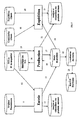
- Figure 1 represents the flowchart of a Macro-economic identification of a production chain food.
- Figure 2 shows the links between different companies and the central database.
- Figure 3 shows the different possibilities of upward and downward traceability between different companies within the same sector of food production.
- Figure 4 shows the devices of blocking of elements within a production chain food.
- Figure 5 shows a flowchart simplified traceability within a company.
- R1 5499950467103 VO 20030315-2 GLN identification Lot References Value
- R2 7145892 1 R2 258963 2
- R2 5842 2 R9 5499950467103 VO 20030315-2 3
- Figure 5 shows the steps of identification and traceability of elements within the premises of entry, production and shipping premises of one company, each of these premises being identifiable by a unique code place.
Landscapes
- Business, Economics & Management (AREA)
- Economics (AREA)
- Engineering & Computer Science (AREA)
- Marketing (AREA)
- Quality & Reliability (AREA)
- Finance (AREA)
- Entrepreneurship & Innovation (AREA)
- Human Resources & Organizations (AREA)
- Accounting & Taxation (AREA)
- Operations Research (AREA)
- Development Economics (AREA)
- Strategic Management (AREA)
- Tourism & Hospitality (AREA)
- Physics & Mathematics (AREA)
- General Business, Economics & Management (AREA)
- General Physics & Mathematics (AREA)
- Theoretical Computer Science (AREA)
- Management, Administration, Business Operations System, And Electronic Commerce (AREA)
Priority Applications (1)
| Application Number | Priority Date | Filing Date | Title |
|---|---|---|---|
| EP04447146A EP1498835A1 (de) | 2003-06-20 | 2004-06-21 | Verfahren zur Verfolgung des Weges von Nahrungsmitteln |
Applications Claiming Priority (3)
| Application Number | Priority Date | Filing Date | Title |
|---|---|---|---|
| EP03447159 | 2003-06-20 | ||
| EP03447159A EP1489538A1 (de) | 2003-06-20 | 2003-06-20 | Verfahren zur Vervolgung des Weges von Nahrungsmitteln |
| EP04447146A EP1498835A1 (de) | 2003-06-20 | 2004-06-21 | Verfahren zur Verfolgung des Weges von Nahrungsmitteln |
Publications (1)
| Publication Number | Publication Date |
|---|---|
| EP1498835A1 true EP1498835A1 (de) | 2005-01-19 |
Family
ID=33477658
Family Applications (1)
| Application Number | Title | Priority Date | Filing Date |
|---|---|---|---|
| EP04447146A Withdrawn EP1498835A1 (de) | 2003-06-20 | 2004-06-21 | Verfahren zur Verfolgung des Weges von Nahrungsmitteln |
Country Status (1)
| Country | Link |
|---|---|
| EP (1) | EP1498835A1 (de) |
Cited By (1)
| Publication number | Priority date | Publication date | Assignee | Title |
|---|---|---|---|---|
| WO2013110662A1 (fr) | 2012-01-25 | 2013-08-01 | Icare Institut De Recherche En Informatique | Procédé d'édition de formulaires pour la saisie de données en différents points de collecte |
Citations (2)
| Publication number | Priority date | Publication date | Assignee | Title |
|---|---|---|---|---|
| FR2813683A1 (fr) * | 2000-09-07 | 2002-03-08 | Lionel Guivarch | Procede de gestion d'informations relatives au chemin de vie d'une pluralite de produits alimentaires |
| WO2003027718A1 (en) * | 2001-09-28 | 2003-04-03 | Telenvironment Ab | A method and a system for controlling meat products |
-
2004
- 2004-06-21 EP EP04447146A patent/EP1498835A1/de not_active Withdrawn
Patent Citations (2)
| Publication number | Priority date | Publication date | Assignee | Title |
|---|---|---|---|---|
| FR2813683A1 (fr) * | 2000-09-07 | 2002-03-08 | Lionel Guivarch | Procede de gestion d'informations relatives au chemin de vie d'une pluralite de produits alimentaires |
| WO2003027718A1 (en) * | 2001-09-28 | 2003-04-03 | Telenvironment Ab | A method and a system for controlling meat products |
Non-Patent Citations (4)
| Title |
|---|
| "A computerised database system for bovine traceability", REVUE SCIENTIFIQUE ET TECHNIQUE - OFFICE INTERNATIONAL DES PIZOOTIES / SCIENTIFIC AND TECHNICAL REVIEW - INTERNATIONAL OFFICE OF EPIZOOTICS, OFFICE INTERNATIONAL DES EPIZOOTIES, PARIS, FR, vol. 20, no. 2, August 2001 (2001-08-01), pages 652 - 661, XP002261437, ISSN: 0253-1933 * |
| KURT C. HOFFMAN: "Real-time location systems take asset tracking to new level", SUPPLYCHAINBRAIN.COM, October 2001 (2001-10-01), pages 1 - 5, XP002259982 * |
| L. O. BARCOS: "Recent developments in animal identification and the traceability of animal products in the international trade", REVUE SCIENTIFIQUE ET TECHNIQUE DE L'OFFICE INTERNATIONAL DES ÉPIZOOTIES, vol. 20, no. 2, August 2001 (2001-08-01), pages 640 - 651, XP002261735 * |
| PETTIT R G: "Traceability in the food animal industry and supermarket chains", REVUE SCIENTIFIQUE ET TECHNIQUE - OFFICE INTERNATIONAL DES PIZOOTIES / SCIENTIFIC AND TECHNICAL REVIEW - INTERNATIONAL OFFICE OF EPIZOOTICS, OFFICE INTERNATIONAL DES EPIZOOTIES, PARIS, FR, vol. 20, no. 2, August 2001 (2001-08-01), pages 584 - 597, XP002261378, ISSN: 0253-1933 * |
Cited By (1)
| Publication number | Priority date | Publication date | Assignee | Title |
|---|---|---|---|---|
| WO2013110662A1 (fr) | 2012-01-25 | 2013-08-01 | Icare Institut De Recherche En Informatique | Procédé d'édition de formulaires pour la saisie de données en différents points de collecte |
Similar Documents
| Publication | Publication Date | Title |
|---|---|---|
| MODULE | IMPROVING FOOD SAFETY AND TRACEABILITY WHILE EMPOWERING SMALLHOLDERS THROUGH ICT | |
| EP1489538A1 (de) | Verfahren zur Vervolgung des Weges von Nahrungsmitteln | |
| CN110717768A (zh) | 奶粉溯源及合理化销售系统 | |
| Alkahtani et al. | IoT implementation in slaughterhouses supply chain: A case study of the Adahi experiment in the Kingdom of Saudi Arabia | |
| Navarro et al. | Assessment of good agricultural practices on cocoa and coffee farms in northern Haiti | |
| EP1498835A1 (de) | Verfahren zur Verfolgung des Weges von Nahrungsmitteln | |
| EP1489537A1 (de) | Verfahren zur Vervolgung des Weges von Nahrungsmitteln | |
| Ntawubizi et al. | Situational analysis of the food safety control system in Rwanda: Animal-source foods, fruits and vegetables | |
| Aysha et al. | Overcoming the quality challenges across the supply chain | |
| Kang'ethe et al. | A review of the food safety architecture in the East African Community: Animal-source foods, fruits and vegetables | |
| Aung et al. | Food traceability | |
| Vernede et al. | Tractability in Food Processing Chains | |
| Moore et al. | Continuing education needs assessment for on-farm food safety services | |
| Isyagi-Levine et al. | Aquatic Animal Health Monitoring Control and Surveillance in Uganda-Gap Analysis | |
| Lehtinen | Traceability in Agrifood Chains | |
| Saray et al. | Determination and implementation of traceability tools for the meat and meat products supply chain to promote consumer awareness and public confidence | |
| Phillips | Israeli technologies could boost SA agriculture | |
| Balkrishna et al. | Global food traceability: current status and future prospects | |
| WO2003107247A1 (fr) | Methode d'évaluation des risques destinées a assurer la sécurité d'un produit assimilable par l'organisme humain | |
| Fairfield | NGFA Guidance on FDA Regulations Applicable to the Grain, Feed and Processing Industry | |
| Millar et al. | Bioethical analysis of biotechnologies: Lessons from automatic milking systems (AMS) and bovine somatotrophin (bST) | |
| Oprea | Ontological and logical relations in animal science language. | |
| Abdallah | A Survey of Artificial Intelligence Use in the Food Industry | |
| Chuah et al. | Food Traceability Rule Overview: A Guide for Florida Food Industry: FSHN23-5/FS455, 01/2024 | |
| Shankland | Case: Food Safety Act |
Legal Events
| Date | Code | Title | Description |
|---|---|---|---|
| PUAI | Public reference made under article 153(3) epc to a published international application that has entered the european phase |
Free format text: ORIGINAL CODE: 0009012 |
|
| AK | Designated contracting states |
Kind code of ref document: A1 Designated state(s): AT BE BG CH CY CZ DE DK EE ES FI FR GB GR HU IE IT LI LU MC NL PL PT RO SE SI SK TR |
|
| AX | Request for extension of the european patent |
Extension state: AL HR LT LV MK |
|
| AKX | Designation fees paid | ||
| REG | Reference to a national code |
Ref country code: DE Ref legal event code: 8566 |
|
| STAA | Information on the status of an ep patent application or granted ep patent |
Free format text: STATUS: THE APPLICATION IS DEEMED TO BE WITHDRAWN |
|
| 18D | Application deemed to be withdrawn |
Effective date: 20050720 |