EP1491993A2 - Aufzeichnungsgerät und Steuerverfahren für Aufzeichnungen zur Ausführung von Aufzeichnungen gemäss Einstellung von Druckparametern - Google Patents
Aufzeichnungsgerät und Steuerverfahren für Aufzeichnungen zur Ausführung von Aufzeichnungen gemäss Einstellung von Druckparametern Download PDFInfo
- Publication number
- EP1491993A2 EP1491993A2 EP20040014521 EP04014521A EP1491993A2 EP 1491993 A2 EP1491993 A2 EP 1491993A2 EP 20040014521 EP20040014521 EP 20040014521 EP 04014521 A EP04014521 A EP 04014521A EP 1491993 A2 EP1491993 A2 EP 1491993A2
- Authority
- EP
- European Patent Office
- Prior art keywords
- recording
- image
- data
- setting
- Prior art date
- Legal status (The legal status is an assumption and is not a legal conclusion. Google has not performed a legal analysis and makes no representation as to the accuracy of the status listed.)
- Withdrawn
Links
Images









Classifications
-
- B—PERFORMING OPERATIONS; TRANSPORTING
- B41—PRINTING; LINING MACHINES; TYPEWRITERS; STAMPS
- B41J—TYPEWRITERS; SELECTIVE PRINTING MECHANISMS, i.e. MECHANISMS PRINTING OTHERWISE THAN FROM A FORME; CORRECTION OF TYPOGRAPHICAL ERRORS
- B41J29/00—Details of, or accessories for, typewriters or selective printing mechanisms not otherwise provided for
- B41J29/38—Drives, motors, controls or automatic cut-off devices for the entire printing mechanism
- B41J29/393—Devices for controlling or analysing the entire machine ; Controlling or analysing mechanical parameters involving printing of test patterns
-
- H—ELECTRICITY
- H04—ELECTRIC COMMUNICATION TECHNIQUE
- H04N—PICTORIAL COMMUNICATION, e.g. TELEVISION
- H04N1/00—Scanning, transmission or reproduction of documents or the like, e.g. facsimile transmission; Details thereof
- H04N1/32—Circuits or arrangements for control or supervision between transmitter and receiver or between image input and image output device, e.g. between a still-image camera and its memory or between a still-image camera and a printer device
- H04N1/32101—Display, printing, storage or transmission of additional information, e.g. ID code, date and time or title
-
- G—PHYSICS
- G06—COMPUTING OR CALCULATING; COUNTING
- G06F—ELECTRIC DIGITAL DATA PROCESSING
- G06F3/00—Input arrangements for transferring data to be processed into a form capable of being handled by the computer; Output arrangements for transferring data from processing unit to output unit, e.g. interface arrangements
- G06F3/12—Digital output to print unit, e.g. line printer, chain printer
- G06F3/1201—Dedicated interfaces to print systems
- G06F3/1202—Dedicated interfaces to print systems specifically adapted to achieve a particular effect
- G06F3/1203—Improving or facilitating administration, e.g. print management
- G06F3/1204—Improving or facilitating administration, e.g. print management resulting in reduced user or operator actions, e.g. presetting, automatic actions, using hardware token storing data
-
- G—PHYSICS
- G06—COMPUTING OR CALCULATING; COUNTING
- G06F—ELECTRIC DIGITAL DATA PROCESSING
- G06F3/00—Input arrangements for transferring data to be processed into a form capable of being handled by the computer; Output arrangements for transferring data from processing unit to output unit, e.g. interface arrangements
- G06F3/12—Digital output to print unit, e.g. line printer, chain printer
- G06F3/1201—Dedicated interfaces to print systems
- G06F3/1223—Dedicated interfaces to print systems specifically adapted to use a particular technique
- G06F3/1236—Connection management
-
- G—PHYSICS
- G06—COMPUTING OR CALCULATING; COUNTING
- G06F—ELECTRIC DIGITAL DATA PROCESSING
- G06F3/00—Input arrangements for transferring data to be processed into a form capable of being handled by the computer; Output arrangements for transferring data from processing unit to output unit, e.g. interface arrangements
- G06F3/12—Digital output to print unit, e.g. line printer, chain printer
- G06F3/1201—Dedicated interfaces to print systems
- G06F3/1278—Dedicated interfaces to print systems specifically adapted to adopt a particular infrastructure
- G06F3/1292—Mobile client, e.g. wireless printing
-
- H—ELECTRICITY
- H04—ELECTRIC COMMUNICATION TECHNIQUE
- H04N—PICTORIAL COMMUNICATION, e.g. TELEVISION
- H04N1/00—Scanning, transmission or reproduction of documents or the like, e.g. facsimile transmission; Details thereof
- H04N1/00127—Connection or combination of a still picture apparatus with another apparatus, e.g. for storage, processing or transmission of still picture signals or of information associated with a still picture
- H04N1/00281—Connection or combination of a still picture apparatus with another apparatus, e.g. for storage, processing or transmission of still picture signals or of information associated with a still picture with a telecommunication apparatus, e.g. a switched network of teleprinters for the distribution of text-based information, a selective call terminal
- H04N1/00307—Connection or combination of a still picture apparatus with another apparatus, e.g. for storage, processing or transmission of still picture signals or of information associated with a still picture with a telecommunication apparatus, e.g. a switched network of teleprinters for the distribution of text-based information, a selective call terminal with a mobile telephone apparatus
-
- H—ELECTRICITY
- H04—ELECTRIC COMMUNICATION TECHNIQUE
- H04N—PICTORIAL COMMUNICATION, e.g. TELEVISION
- H04N2201/00—Indexing scheme relating to scanning, transmission or reproduction of documents or the like, and to details thereof
- H04N2201/0077—Types of the still picture apparatus
- H04N2201/0082—Image hardcopy reproducer
-
- H—ELECTRICITY
- H04—ELECTRIC COMMUNICATION TECHNIQUE
- H04N—PICTORIAL COMMUNICATION, e.g. TELEVISION
- H04N2201/00—Indexing scheme relating to scanning, transmission or reproduction of documents or the like, and to details thereof
- H04N2201/0077—Types of the still picture apparatus
- H04N2201/0084—Digital still camera
-
- H—ELECTRICITY
- H04—ELECTRIC COMMUNICATION TECHNIQUE
- H04N—PICTORIAL COMMUNICATION, e.g. TELEVISION
- H04N2201/00—Indexing scheme relating to scanning, transmission or reproduction of documents or the like, and to details thereof
- H04N2201/32—Circuits or arrangements for control or supervision between transmitter and receiver or between image input and image output device, e.g. between a still-image camera and its memory or between a still-image camera and a printer device
- H04N2201/3201—Display, printing, storage or transmission of additional information, e.g. ID code, date and time or title
- H04N2201/3225—Display, printing, storage or transmission of additional information, e.g. ID code, date and time or title of data relating to an image, a page or a document
- H04N2201/3242—Display, printing, storage or transmission of additional information, e.g. ID code, date and time or title of data relating to an image, a page or a document of processing required or performed, e.g. for reproduction or before recording
-
- H—ELECTRICITY
- H04—ELECTRIC COMMUNICATION TECHNIQUE
- H04N—PICTORIAL COMMUNICATION, e.g. TELEVISION
- H04N2201/00—Indexing scheme relating to scanning, transmission or reproduction of documents or the like, and to details thereof
- H04N2201/32—Circuits or arrangements for control or supervision between transmitter and receiver or between image input and image output device, e.g. between a still-image camera and its memory or between a still-image camera and a printer device
- H04N2201/3201—Display, printing, storage or transmission of additional information, e.g. ID code, date and time or title
- H04N2201/3278—Transmission
Definitions
- the present invention relates to recording apparatuses and recording control methods that allow receiving and recording data transmitted by wireless from outside. More specifically, the present invention relates to a recording apparatus and a recording control method that allow receiving and recording data including image data, transmitted by wireless from an image-data supplying device such as a cellular phone.
- printers usually receive image data transmitted from connected computers that serve as host apparatuses, and execute printing based on the image data received.
- digital cameras become more common, other types of printers have become available.
- some printers have slots for mounting memory cards storing image data captured by digital cameras, which can be attached to and detached from the digital cameras, so that the printers are capable of directly reading the image data stored on the memory cards and printing the image data.
- some printers are connected to digital cameras via USB (Universal Serial Bus) interfaces or other special interfaces so that the printers can receive image data directly from the digital cameras and print the image data.
- USB Universal Serial Bus
- the printers described above are allowed to print images without host apparatuses acting between the printers and digital cameras. Print setting for printing the image is made via operation panels of the printers, or via operation panels of the digital cameras connected to the printers.
- some cellular phones have interfaces for infrared communications with external devices, allowing infrared communications by wireless with external devices.
- Such cellular phones can be used, for example, as remote controllers for television sets, or allow exchanging data or captured images between cellular phones without using a telephone circuit.
- the ink-jet printer disclosed in Japanese Patent Laid-Open No. 2001-75765 has a plurality of interfaces including an infrared communication interface, and switching among the plurality of interfaces can be monitored.
- the document does not disclose or suggest a scheme for using the infrared communication interface to allow printing of image data transferred via, for example, the infrared communication interface of the cellular phone described above.
- image data is transferred from the cellular phone to a computer via the Internet using a telephone line.
- the image data is once saved in the computer, and the computer sends the image data to a printer. Then, the printer prints the image data.
- the conventional scheme requires many and complex operations for printing.
- image data to be printed is sent to a printer using a printer driver installed on a computer connected to the printer, number of copies, print size, type of paper used as a recording medium for printing, print quality, and the like, are specified for each print command. Then, image data with such setting is sent to the printer so that the image data will be printed according to setting desired by a user.
- a small terminal such as a cellular phone is only capable of communications mainly aimed at exchanging data or files stored therein, and does not allow various setting for printing.
- implementing functions of a printer driver in a cellular phone leads to increase in cost of the cellular phone and is not therefore practical.
- the present invention has been made in order to overcome the problems described above, and it is an object of the present invention to provide a recording apparatus and a recording control method for receiving and recording image data transmitted by wireless from an image-data supplying device and for allowing setting of desired recording parameters from the image-data supplying device.
- the present invention in one aspect thereof, provides a recording apparatus for receiving and recording data transmitted by wireless from an image-data supplying device, the recording apparatus including a setting unit for setting one or more recording parameters included in setting data received from the image-data supplying device; and a recording control unit for recording an image on a recording medium based on image data included in data transmitted from the image-data supplying device separately from the setting data; wherein when the recording parameters have been set by the setting unit, the recording control unit records an image according to the recording parameters.
- the present invention in another aspect thereof, provides a recording apparatus for receiving and recording data transmitted by wireless from an image-data supplying device, the recording apparatus including a key operation unit having one or more keys that can be operated by a user; and a setting unit for setting one or more recording parameters according to a predefined key operation by the key operation unit; and a recording control unit for recording an image on a recording medium based on image data included in data transmitted from the image-data supplying device separately from the setting data; wherein when the recording parameters have been set by the setting unit, the recording control unit records an image according to the recording parameters.
- the present invention in another aspect thereof, provides a recording apparatus for recording an image on a recording medium, the recording apparatus including a first interface for receiving data transmitted by wireless from an image-data supplying device; a second interface for receiving data transmitted from an externally connected host apparatus; a first recording control unit for extracting image data included in data received via the first interface, the data having a data format that is dependent on the image-data supplying device, decoding the image data extracted, rendering the decoded image data to form a rendered image, and recording an image based on the rendered image; a second recording control unit for recording an image based on data transmitted from the externally connected host apparatus via the second interface; and a setting unit for setting one or more image recording parameters for each of the first and second interfaces.
- the present invention in another aspect thereof, provides a recording apparatus for recording an image on a recording medium, the recording apparatus including a plurality of interfaces for receiving data transmitted by wireless from an image-data supplying device, the plurality of interfaces supporting mutually different communication methods; a recording control unit for recording an image based on data received via one of the plurality of interfaces; and a setting unit for setting one or more image recording parameters individually for each of the plurality of interfaces.
- the present invention in another aspect thereof, provides a recording control method of a recording apparatus for receiving and recording data transmitted by wireless from an image-data supplying device, the recording control method including a setting step of setting one or more recording parameters included in setting data transmitted from the image-data supplying device; and a recording control step of recording an image on a recording medium based on image data included in data transmitted from the image-data supplying device separately from the setting data; wherein when the recording parameters have been set in the setting step, an image is recorded according to the recording parameters in the recording control step.
- the present invention in another aspect thereof, provides a recording control method of a recording apparatus for receiving and recording data transmitted by wireless from an image-data supplying device, the recording control method including a key input step of inputting key information according to an operation by a user; a setting step of setting one or more recording parameters according to a predefined key operation in the key input step; and a recording control step of recording an image based on image data included in data transmitted from the image-data supplying device, the data having a data format that is dependent on the image-data supplying device; wherein when the recording parameters have been set in the setting step, an image is recorded according to the recording parameters in the recording control step.
- the present invention in another aspect thereof, provides a recording control method for recording an image on a recording medium, the recording control method including a first receiving step of receiving, via a first interface, data transmitted by wireless from an image-data supplying device; a second receiving step of receiving, via a second interface, data transmitted from an externally connected host apparatus; a first recording control step of extracting image data included in data received via the first interface, the data having a data format that is dependent on the image-data supplying device, decoding the image data extracted, rendering the decoded image data to form a rendered image, and recording an image based on the rendered image; a second recording control step of recording an image based on data transmitted from the externally connected host apparatus via the second interface; and a setting step of setting one or more image recording parameters for each of the first and second interfaces.
- the present invention it is possible to receive and record image data transmitted by wireless from an image-data supplying device, and to set desired recording parameters from the image-data supplying device.
- desired recording parameters can be set for each of the plurality of interfaces.
- Fig. 1 is a block diagram showing a schematic construction of a printer according to an embodiment of the present invention, and communication with a camera-equipped cellular phone.
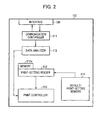
- Fig. 2 is a functional block diagram of a printer according to a first embodiment of the present invention.
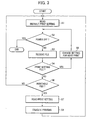
- Fig. 3 is a flowchart of a process executed in the printer according to the first embodiment.
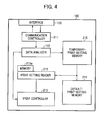
- Fig. 4 is a functional block diagram of a printer according to a second embodiment of the present invention.
- Fig. 5 is a flowchart of a process executed in the printer according to the second embodiment.
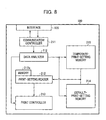
- Fig. 6 is a functional block diagram of a printer according to a third embodiment of the present invention.
- Fig. 7 is a flowchart of a process executed in the printer according to the third embodiment.
- Fig. 8 is a functional block diagram of a printer according to a fourth embodiment of the present invention.
- Fig. 9 is a flowchart of a process executed in the printer according to the fourth embodiment.
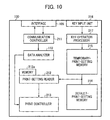
- Fig. 10 is a functional block diagram of a printer according to a fifth embodiment of the present invention.
- Fig. 11 is a flowchart of a process executed in the printer according to the fifth embodiment.
- Fig. 12 is a flowchart of a process executed in a printer according to a sixth embodiment of the present invention.
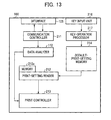
- Fig. 13 is a functional block diagram of a printer according to a seventh embodiment of the present invention.
- Fig. 14 is a flowchart of a process executed in the printer according to the seventh embodiment.
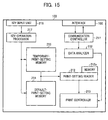
- Fig. 15 is a functional block diagram of a printer according to an eighth embodiment of the present invention.
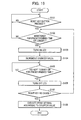
- Fig. 16 is a flowchart of a process executed in the printer according to the eighth embodiment.
- Fig. 17 is a functional block diagram of a printer according to a ninth embodiment of the present invention.
- Fig. 18 is a functional block diagram of a printer according to a tenth embodiment of the present invention.
- Fig. 19 is a flowchart for explaining print setting by keys of a printer according to an embodiment of the present invention.
- Fig. 1 is a block diagram showing a schematic construction of a printer 100 according to an embodiment of the present invention, and communication with a camera-equipped cellular phone 200.
- the camera-equipped cellular phone 200 has an infrared communication interface 205, and is capable of sending captured image data or the like to an external device via the infrared communication interface 205.
- the printer 100 has an infrared communication interface 105, and is capable of communicating with the infrared communication interface 205 of the cellular phone 200.
- a controller 101 controls the operation of the printer 100.
- the controller 101 includes a CPU, a ROM storing programs to be executed by the CPU, a RAM that is used as a work area of the CPU and that temporarily stores various data, and other associated devices.
- a data processor 110 includes a data analyzer 112 and a data extractor 114.
- the data analyzer 112 analyzes a file (data) received via the infrared communication interface 105. Based on the result of the analysis, the data extractor 114 extracts image data and print setting data described later.
- the image data and print setting data extracted are stored in a storage unit 120.
- the image data is decoded by a JPEG processor 130, and the decoded image data is rendered by a renderer 132.
- the rendered image is supplied to and printed by a print engine 150. Print specifications in this case are determined based on the print setting data stored in the storage unit 120.
- a USB interface 140 allows connection of a device such as a personal computer (PC) or a digital camera, so that image data can be received via the USB interface 140 and then printed. It is to be noted that processing in the data processor 110 and the JPEG processor 130 may be executed by software according to control programs of the CPU of the controller 101.
- the extracted image file is a JPEG file
- the renderer 132 decodes and renders a compressed image file.
- the JPEG processor 130 is also capable of enlarging or reducing the image data rendered by the renderer 132 in accordance with a print size of the image data. That is, before supplying the image data to the print engine 150, the JPEG processor 130 converts the size of the image data so that the image data will be accommodated in a specified print size.
- a setting file including print parameters is sent from a cellular phone 200 to a printer 100 in the OBEX (Object Exchange) format.
- OBEX Object Exchange
- Print parameters are sent in a single file from the cellular phone 200 to the printer 100 via infrared communication interfaces.
- Print parameters herein include, for example, sheet size, paper type, layout, print quality, image processing method, number of copies, and the like. These print parameters are also used in embodiments described later.
- print parameters included in the setting file are effective only for print data received next to the setting file.
- Print data received subsequently is printed using default print parameters of the printer 100.
- print data i.e., image data or text data
- the print data arrives without a setting file arriving before the print data, the print data is printed using the default print parameters of the printer 100.
- Fig. 2 is a functional block diagram of the printer 100 in the first embodiment. Parts corresponding to those in Fig. 1 are designated by the same numerals.
- a communication controller 211 controls infrared wireless communications carried out via the infrared communication interface 105.
- a print-setting reader 212 reads default print setting stored in a default-print-setting memory 214 and temporarily stores the default print setting in a memory 212a.
- the print-setting reader 212 sets the print setting stored in the memory 212a to a print controller 213 immediately before a print is started.
- the data analyzer 112 analyzes data received from the cellular phone 200. If a setting file is included in the data received, the data analyzer 112 sets print parameters of the print controller 213 based on the setting file.
- the default-print-setting memory 214 is included in the storage unit 120 shown in Fig. 1, and the print controller 213 includes the print engine 150.
- Fig. 3 is a flowchart of a process executed in the printer 100 according to the first embodiment.
- a program for allowing execution of the process is stored in the ROM of the controller 101, and is executed under the control of the CPU.
- step S1 the print-setting reader 212 reads default print setting from the default-print-setting memory 214, and stores the default print setting in the memory 212a of the print-setting reader 212.
- step S2 it is checked whether the printer 100 is powered off. If the printer 100 is not powered off, the process proceeds to step S3, in which the communication controller 211 receives a file via the infrared communication interface 105. Then, in step S4, the data analyzer 112 analyzes the content of the file received, and determines whether the file is a print setting file for setting print parameters. If the file is a print setting file, the process proceeds to step S5, in which the print setting specified in the print setting file is temporarily stored in the memory 212a. The process then returns to step S2, and waits for reception of a next file.
- step S4 If it is determined in step S4 that the file received is not a print setting file, the process proceeds to step S6, in which it is determined whether the file received is a printable file, i.e., an image file or a text file. If the file received is a printable file, the process proceeds to step S7, in which the print setting stored in the memory 212a in step S1 or step S5 is read and set in the print controller 213. The process then proceeds to step S8, in which the print controller 213 executes printing according to the print setting. When printing is finished in the manner described above, the process returns to step S1, in which the print-setting reader 212 reads the default print setting from the default-print-setting memory 214, and writes the default print setting in the memory 212a.
- step S6 it is determined whether the file received is a printable file, i.e., an image file or a text file. If the file received is a printable file, the process proceeds to step S7, in which the print setting stored in the memory 212a in step S
- the print parameters included in the print setting file is used only for printing of print data that is received next to the print setting file.
- the default print setting stored in the default-print-setting memory 214 is used for printing.
- the second embodiment is basically the same as the first embodiment, but differs in that print parameters once set are effective until a soft power off.
- print parameters once set are effective until a soft power off.
- default print parameters stored in the default-print-setting memory 214 of the printer 100 becomes effective.
- Fig. 4 is a functional block diagram of a printer 100 according to the second embodiment. Parts corresponding to those in Fig. 1 are designated by the same numerals.
- the print setting is temporarily stored in a temporary-print-setting memory 215.
- the temporary-print-setting memory 215 and the default-print-setting memory 214 are included in the storage unit 120 shown in Fig. 1.
- Fig. 5 is a flowchart of a process executed in the printer 100 according to the second embodiment.
- a program for allowing execution of the process is stored in the ROM of the controller 101, and is executed under the control of the CPU.
- step S11 the print-setting reader 212 reads default print setting from thedefault-print-setting memory 214, and stores the default print setting in the memory 212a.
- step S12 it is checked whether the printer 100 is powered off. If the printer 100 is not powered off, the process proceeds to step S13, in which the communication controller 211 receives a file via the infrared communication interface 105. Then, in step S14, the data analyzer 112 analyzes the content of the file received, and determines whether the file is a print setting file. If the file received is a print setting file, the process proceeds to step S15, in which print setting specified in the print setting file is stored in the temporary-print-setting memory 215. In this case, the content of the memory 212a is also updated to reflect the new print setting. The process then returns to step S12, and waits for reception of a next file.
- step S14 If it is determined in step S14 that the file received is not a print setting file, the process proceeds to step S16, in which it is determined whether the file is a printable file, i.e., an image file or a text file. If the file received is a printable file, the process proceeds to step S17, in which the print-setting reader 212 reads print setting stored in the memory 212a and sets the print setting in the print controller 213.
- step S15 is not executed, i.e., when print setting is not stored in the temporary-print-setting memory 215, the default print setting stored in the memory 212a in step S11 is set in the print controller 213.
- step S18 in which the print controller 213 executes printing according to the print setting made in step S17.
- the process then returns to step S12, and waits for reception of a next file. Also, if it is determined in step S16 that the file received is not a printable file, the process returns to step S12, and waits for reception of a next file.
- the print parameters included in the print setting file received from the cellular phone 200 are effective for printing until a soft power off.
- the third embodiment is basically the same as the first embodiment, but differs in that print parameters once set are effective until print parameters are set next time.
- print parameters once set are effective until print parameters are set next time.
- Fig. 6 is a functional block diagram of a printer 100 according to the third embodiment. Parts corresponding to those in Fig. 1 are designated by the same numerals.
- the data analyzer 112 when print setting is included in a file received, stores the print setting in the default-print-setting memory 214.
- the default-print-setting memory 214 is included in the storage unit 120 shown in Fig. 1.
- Fig. 7 is a flowchart of a process executed in the printer 100 according to the third embodiment.
- a program for allowing execution of the process is stored in the ROM of the controller 101, and is executed under the control of the CPU.
- step S21 the print-setting reader 212 reads default print setting from the default-print-setting memory 214, and stores the default print setting in the memory 212a.
- step S22 it is checked whether the printer 100 is powered off. If the printer 100 is not powered off, the process proceeds to step S23, in which the communication controller 211 receives a file via the infrared communication interface 105. The process then proceeds to step S24, in which the data analyzer 112 analyzes the content of the file received, and determines whether the file is a print setting file. If the file received is a print setting file, the process proceeds to step S25, in which print setting specified in the print setting file is stored in the default-print-setting memory 214. The process then returns to step S21.
- step S24 If it is determined in step S24 that the file received is not a print setting file, the process proceeds to step S26, in which it is determined whether the file is a printable file, i.e., an image file or a text file. If the file received is a printable file, the process proceeds to step S27, in which print setting stored in the memory 212a, i.e., the print setting stored in the default-print-setting memory 214 in this case, is set in the print controller 213. The process then proceeds to step S28, in which the print controller 213 executes printing according to the print setting. The process then returns to step S21, and waits for reception of a next file. If it is determined in step S26 that the file received is not a printable file, the process returns to step S22, and waits for reception of a next file.
- a printable file i.e., an image file or a text file. If the file received is a printable file, the process proceeds to step S27, in which print setting stored in the memory 212
- the print setting is effective for printing until a next print setting file is received.
- one of the schemes according to the first to third embodiments is used selectively based on a setting command received.
- Fig. 8 is a functional block diagram of a printer 100 according to the fourth embodiment. Parts corresponding to those in Fig. 4 are designated by the same numerals.
- the data analyzer 112 determines whether to store the print setting in the temporary-print-setting memory 215 or the default-print-setting memory 214, and stores the print setting accordingly.
- Fig. 9 is a flowchart of a process executed in the printer 100 according to the fourth embodiment.
- a program for allowing execution of the process is stored in the ROM of the controller 101, and is executed under the control of the CPU.
- step S31 the print-setting reader 212 registers print setting stored in the default-print-setting memory 214 to the temporary-print-setting memory 215.
- step S32 the print-setting reader 212 reads the print setting from the temporary-print-setting memory 215, and stores the print setting in the memory 212a.
- step S33 it is checked whether the printer 100 is powered off. If the printer 100 is not powered off, the process proceeds to step S34, in which the communication controller 211 receives a file via the infrared communication interface 105.
- step S35 the data analyzer 112 analyzes the content of the file received, and determines whether the file is a print setting file. If the file received is not a print setting file, the process proceeds to step S36, in which it is determined whether the file is a printable file, i.e., an image file or a text file. If the file received is a printable file, the process proceeds to step S37, in which print parameters are set in the print controller 213 according to the print setting stored in the memory 212a, and the print controller 213 executes printing according to the print setting. The process then returns to step S32.
- the content of the memory 212a is the print setting read from the temporary-print-setting memory 215.
- step S35 If it is determined in step S35 that the file received is a print setting file, the process proceeds to step S39, in which it is determined whether the setting command received requests changing the default print setting. If so, the process proceeds to step S43, in which the print setting stored in the default-print-setting memory 214 is changed. The process then returns to step S31. If it is determined in step S39 that the setting command does not request changing the default print setting, the process proceeds to step S40, in which it is determined whether the setting command requests changing setting that is effective until a soft power off. If so, the process proceeds to step S42, in which the content of the temporary-print-setting memory 215 is changed. The process then returns to step S32, and waits for reception of a next file. If it is determined in step S40 that the print setting is effective only for a next file, the print-setting reader 212 changes the content of the memory 212a to the default print setting. The process then proceeds to step S33, and waits for reception of a next file.
- print setting received can be stored as default print setting or temporary print setting, and the effective period of the print setting received can be switched accordingly.
- print parameters can be set at a printer 100 by operating keys on an operation panel of the printer 100.
- Fig. 10 is a functional block diagram of a printer 100 according to the fifth embodiment.
- parts corresponding to those in Fig. 8 are designated by the same numerals.
- a key input unit 216 corresponds to the operation keys of the operation panel of the printer 100.
- a key-operation processor 217 creates print setting by recognizing key operations on the key input unit 216, and stores the print setting in the temporary-print-setting memory 215.
- print setting once made is only effective for next print data.
- default print setting stored in the default-print-setting memory 214 of the printer 100 is used.
- the default print setting of the printer 100 is used for printing.
- Fig. 11 is a flowchart of a process executed in the printer 100 according to the fifth embodiment.
- a program for allowing execution of the process is stored in the ROM of the controller 101, and is executed under the control of the CPU.
- step S51 the print-setting reader 212 reads print setting stored in the default-print-setting memory 214, and stores the print setting in the memory 212a.
- step S52 it is checked whether the printer 100 is powered off. If the printer 100 is not powered off, the process proceeds to step S53, in which the key-operation processor 217 determines whether a key operation has been performed via the key input unit 216 and whether the key operation requests changing print setting. If the key operation requests changing print setting, the process proceeds to step S54, in which print setting stored in the temporary-print-setting memory 215 is changed and the content of the memory 212a is updated.
- step S53 If it is determined in step S53 that the key operation does not request changing print setting, the process proceeds to step S55, in which the ongoing operation involves receiving a file. If it is determined in step S55 that the ongoing operation does not involve receiving a file, the process returns to step S52. On the other hand, if it is determined in step S55 that the ongoing operation involves receiving a file, the process proceeds to step S56, in which reception of a file is executed. Then, the process proceeds to step S57, in which the data analyzer 112 determines whether the file received is a printable file. If the file received is a printable file, the process proceeds to step S58, in which the print-setting reader 212 reads print setting stored in the memory 212a, and sets the print setting in the print controller 213.
- step S59 in which the print controller 213 executes printing.
- the process returns to step S51, in which the print-setting reader 212 reads the print setting stored in the default-print-setting memory 214, and stores the print setting in the memory 212a.
- print setting can be made by key operations, and the print setting is applied only to print data received next to execution of the print setting.
- print parameters can be set at a printer 100 by operating keys on an operation panel of the printer, as in the fifth embodiment.
- the functional configuration of a printer 100 according to the sixth embodiment is not shown since it the same as the functional configuration shown in Fig. 10.
- print setting once made is effective until a soft power off.
- print setting made by key operations is effective not only for next image or text data but also for subsequent image or text data.
- Fig. 12 is a flowchart of a process executed in the printer 100 according to the sixth embodiment.
- a program for allowing execution of the process is stored in the ROM of the controller 101, and is executed under the control of the CPU.
- steps corresponding to those in Fig. 11 are designated by the same numerals, and descriptions thereof will be omitted.
- steps S54, S55, S57, and S59 return to step S52.
- print parameters set in the print controller 213 are not changed until new print parameters are set.
- print parameters can be set at a printer 100 by operating keys on an operation panel of the printer 100.
- the seventh embodiment differs from the sixth embodiment in that print setting once made is effective until print setting is made next time. That is, when print setting is once made, the print setting is effective not only for next image or text data but also for subsequent image or text data. Furthermore, the print setting is effective even when the printer 100 is once powered off and is then powered on. Print setting is changed, however, when new print setting is made or when default print parameters are changed.
- Fig. 13 is a functional block diagram of a printer 100 according to the seventh embodiment.
- parts corresponding to those in Fig. 10 are designated by the same numerals.
- the key-operation processor 217 creates print setting by recognizing key operations on the key input unit 216, and stores the print setting in the default-print-setting memory 214.
- Fig. 14 is a flowchart of a process executed in the printer 100 according to the seventh embodiment.
- a program for allowing execution of the process is stored in the ROM of the controller 101, and is executed under the control of the CPU.
- step S61 the print-setting reader 212 reads print setting stored in the default-print-setting memory 214, and stores the print setting in the memory 212a.
- step S62 it is checked whether the printer 100 is powered off. If the printer 100 is not powered off, the process proceeds to step S63, in which the key-operation processor 217 determines whether a key operation has been performed via the key input unit 216 and whether the key operation requests changing print setting. If so, the process proceeds to step S64, in which print setting stored in the default-print-setting memory 214 is changed. The process then returns to step S61, and the content of the memory 212a is also updated to reflect the new print setting.
- step S65 it is determined whether the ongoing operation involves receiving a file. If it is determined in step S65 that the ongoing operation does not involve receiving a file, the process returns to step S62. On the other hand, if it is determined in step S65 that the ongoing operation involves receiving a file, the process proceeds to step S66, in which reception of a file is executed. Then, the process proceeds to step S67, in which the data analyzer 112 determines whether the file received is a printable file.
- step S68 the print-setting reader 212 reads print setting stored in the memory 212a, and sets the print setting in the print controller 213.
- step S69 the print controller 213 executes printing.
- the process returns to step S62, in which it is determined whether print setting is to be performed. Then, the process described above is executed.
- the print setting when print setting is once made, the print setting is effective not only for next image or text data but also for subsequent image or text data. Furthermore, the setting is effective even when the printer 100 is once powered off and is then powered on again.
- print parameters can be set at a printer 100 by operating keys on an operation panel of the printer 100. Furthermore, it is possible to choose by a key operation whether the print setting is to be effective only for next print data, the print setting is to be effective until a soft power off, or default print setting is to be changed.
- Fig. 15 is a functional block diagram of a printer 100 according to the eighth embodiment.
- the key-operation processor 217 determines according to a key operation whether print setting is to be stored in the temporary-print-setting memory 215 or the default-print-setting memory 214.
- Fig. 16 is a flowchart of a process executed by the printer 100 according to the eighth embodiment.
- a program for allowing execution of the process is stored in the ROM of the controller 101, and is executed under the control of the CPU.
- step S71 the print-setting reader 212 reads print setting stored in the default-print-setting memory 214, and registers the print setting in the temporary-print-setting memory 215.
- step S72 the print-setting reader 212 reads print setting from the temporary-print-setting memory 215, and stores the print setting in the memory 212a.
- step S73 it is checked whether the printer 100 is powered off. If the printer 100 is not powered off, the process proceeds to step S74, in which the key-operation processor 217 determines whether the key operation requests changing print setting based on key input from the key input unit 216. If so, the process proceeds to step S79.
- step S75 in which it is determined whether the ongoing operation involves receiving a file. If it is determined in step S75 that the ongoing operation does not involve receiving a file, the process returns to step S73. On the other hand, if it is determined in step S75 that the ongoing operation involves receiving a file, the process proceeds to step S76, in which reception of a file is executed. The process then proceeds to step S77, in which it is determined whether the file received is a printable file. If the file received is a printable file, the process proceeds to step S78, in which print parameters are set in the print controller 213 according to the print setting stored in the memory 212a and printing is executed.
- step S79 the content of the key operation is analyzed. Then, in step S80, it is determined whether the key operation requests changing default print setting. If so, the process proceeds to step S84, in which print setting stored in the default-print-setting memory 214 is changed. The process then returns to step S71.
- step S81 in which it is determined whether the key operation requests changing setting that is effective until a soft power off. If so, the process proceeds to step S83, in which print setting stored in the temporary-print-setting memory 215 is changed. The process then returns to step S72. If it is determined in step S81 that the key operation requests changing setting that is effective only for a next file, the process proceeds to step S82, in which the print setting is stored in the memory 212a of the print-setting reader 212. The process then returns to step S73, and waits for a next operation.
- the print setting is to be effective only for next print data, the print setting is to be effective until a soft power off, or default print setting is to be changed.
- print setting can be made individually for each of the interfaces. That is, in a multi-interface printer having a plurality of interfaces, print setting can be stored individually for each of the interfaces. For example, in a printer having a USB interface and an IrDA interfaces, print setting for the USB interface and print setting for the IrDA interface are both allowed.
- print setting herein include, for example, sheet size, paper type, layout, print quality, image processing method, number of copies, and the like.
- the effective period of the print setting and the method of changing the print setting are the same as in the embodiments described above.
- Fig. 17 is a functional block diagram of a printer 100 according to the ninth embodiment.
- the printer 100 has a first interface that is used for infrared communications, and a second interface for that is used for USB communications.
- the printer 100 includes a temporary-print-setting memory 215a for the infrared communication interface, and a default-print-setting memory 214a for the infrared communication interface.
- the printer 100 also includes a temporary-print-setting memory 215b for the USB interface, and a default-print-setting memory 214b for the USB interface.
- print setting can be made individually for the interfaces through the respective interfaces. That is, in a multi-interface printer having a plurality of interfaces, print setting can be stored individually for each of the interfaces. For example, in a printer having a USB interface and an IrDA interface, print setting for the USB interface and print setting for the IrDA interface can be made through the respective interfaces. Furthermore, the print setting may be made by key operations, as in the fifth embodiment. Similarly to the embodiments described above, print setting herein include, for example, sheet size, paper type, layout, print quality, image processing method, number of copies, and the like.
- the effective period of the print setting and the method of changing the print setting are the same as in the embodiments described above.
- Fig. 18 is a functional block diagram of a printer 100 according to the tenth embodiment.
- the printer 100 has a first interface that is used for infrared communications, and a second interface that is used for USB communications.
- the printer includes a temporary-print-setting memory 215a for the infrared communication interface, and a default-print-setting memory 214a for the infrared communication interface.
- the printer 100 also includes a temporary-print-setting memory 215b for the USB interface, and a default-print-setting memory 214b for the USB interface.
- Fig. 19 is a flowchart showing an example of a process of print setting by key operations of the printers 100 in the fifth to eighth and tenth embodiments.
- a printer 100 has operation keys including a reset key for returning from an error or stopping a print operation, and a power key for turning power on or off.
- operation keys including a reset key for returning from an error or stopping a print operation, and a power key for turning power on or off.
- step S101 while the printer 100 is not in a print operation, it is determined whether the reset key is pressed. If the reset key is pressed, the process proceeds to step S102, in which it is determined whether the reset key is kept pressed for a predetermined time or longer. If so, the process proceeds to step S103, in which, for example, an LED for indicating an error is turned on. Then, in step S104, a counter is incremented. In step S105, it is determined whether the LED is kept turned on for a predetermined time. If so, the process proceeds to step S106, in which the LED is turned off. Then, in step S107, it is determined whether the reset key is released. If the reset key is not released, the process repeats steps S102 to S107 described above. If the reset key is released, the process proceeds to step S108, in which print setting is changed according to the number of times the LED is turned on and off, i.e., the value of the counter. This allows various print setting.
- the sheet size is switched between the name card size and the L size. If the reset key is released after the LED is turned on and off six times, switching occurs between a fine mode in which special coated paper for printing photographs is used and an ordinary paper mode in which inexpensive normal paper is used.
- a print parameter may be specified according to the number of times the LED is turned on and off before the reset key is released.
- the name card size is chosen when the reset key is released after the LED is turned on and off five times
- the L size is chosen when the reset key is released after the LED is turned on and off six times.
- Print setting by key operations is not limited to key operations described above.
- an online key or power key usually provided on a printer may be used.
- setting may be based on buzzer sound.
- the ninth and tenth embodiments have been described in the context of multi-interface printers having USB and IrDA interfaces, without limitation to USB and IrDA interfaces, the present invention can be applied to a printer having a plurality of interfaces for wireless communications, or a printer having other types of interfaces for wired communications.
- a plurality of interfaces for wireless communications such as an IrDA infrared communication interface and a Bluetooth wireless communication interface, may be provided, allowing print setting individually for each of the interfaces, so that print setting for each of the interfaces can be stored.
- the printer 100 shown in Fig. 1 includes a plurality of interfaces such as the USB interface 140 and the infrared communication interface 105.
- each of the interfaces is ready for communication.
- communications by the other interfaces are prohibited.
- the printer 100 enters a wait state again.
- the objects of the present invention can also be achieved by providing a system or apparatus with a storage medium storing program code of software implementing functions of the embodiments so that a computer (CPU or MPU) of the system or apparatus can read and execute the program code stored in the storage medium.
- a computer CPU or MPU
- the functions of the embodiments described above are implemented by the program code read from the storage medium, so that the storage medium storing the program code falls within the scope of the present invention.
- the storage medium for supplying the program code may be, for example, a floppy disk, a hard disk, an optical disk, a magneto-optical disk, a CD-ROM, a CD-R, a magnetic tape, a non-volatile memory card, or a ROM.
- an operating system (OS) running on the computer may execute part of or the entire processing according to the program code to achieve the functions of the embodiments. This also falls within the scope of the present invention.
- OS operating system
- the program code read from the storage medium may be written to a memory of a function extension board disposed in the computer or a function extension unit connected to the computer so that a CPU or the like of the function extension board or the function extension unit will execute part of or the entire processing according to the program code. This also falls within the scope of the present invention.
Landscapes
- Engineering & Computer Science (AREA)
- Theoretical Computer Science (AREA)
- Human Computer Interaction (AREA)
- Physics & Mathematics (AREA)
- General Engineering & Computer Science (AREA)
- General Physics & Mathematics (AREA)
- Multimedia (AREA)
- Signal Processing (AREA)
- Computer Networks & Wireless Communication (AREA)
- Accessory Devices And Overall Control Thereof (AREA)
- Facsimiles In General (AREA)
- Record Information Processing For Printing (AREA)
Applications Claiming Priority (2)
| Application Number | Priority Date | Filing Date | Title |
|---|---|---|---|
| JP2003178617 | 2003-06-23 | ||
| JP2003178617A JP2005020101A (ja) | 2003-06-23 | 2003-06-23 | 記録装置及びその記録制御方法 |
Publications (2)
| Publication Number | Publication Date |
|---|---|
| EP1491993A2 true EP1491993A2 (de) | 2004-12-29 |
| EP1491993A3 EP1491993A3 (de) | 2006-04-05 |
Family
ID=33411045
Family Applications (1)
| Application Number | Title | Priority Date | Filing Date |
|---|---|---|---|
| EP04014521A Withdrawn EP1491993A3 (de) | 2003-06-23 | 2004-06-21 | Aufzeichnungsgerät und Steuerverfahren für Aufzeichnungen zur Ausführung von Aufzeichnungen gemäss Einstellung von Druckparametern |
Country Status (5)
| Country | Link |
|---|---|
| US (1) | US7626716B2 (de) |
| EP (1) | EP1491993A3 (de) |
| JP (1) | JP2005020101A (de) |
| KR (1) | KR20050000334A (de) |
| CN (1) | CN1573805B (de) |
Cited By (5)
| Publication number | Priority date | Publication date | Assignee | Title |
|---|---|---|---|---|
| WO2006112204A1 (ja) * | 2005-03-30 | 2006-10-26 | Matsushita Electric Industrial Co., Ltd. | 携帯端末装置、印刷装置、および、携帯端末装置用印刷装置 |
| EP1727345A1 (de) * | 2005-05-27 | 2006-11-29 | Norbert Weig | Verfahren und System zur Herstellung von Fotobüchern |
| EP1818805A2 (de) * | 2006-01-31 | 2007-08-15 | Ricoh Company, Ltd. | Netzwerkdrucken mit Clients ohne Treiber |
| US7791757B2 (en) | 2005-05-27 | 2010-09-07 | Norbert Weig | Procedure and system for the production of photo books |
| US8773687B2 (en) | 2009-03-06 | 2014-07-08 | Ricoh Company, Ltd. | Driverless architecture for printing systems |
Families Citing this family (22)
| Publication number | Priority date | Publication date | Assignee | Title |
|---|---|---|---|---|
| JP2006327017A (ja) * | 2005-05-26 | 2006-12-07 | Citizen Watch Co Ltd | 印刷装置及び条件設定方法 |
| JP4049174B2 (ja) * | 2005-07-22 | 2008-02-20 | コニカミノルタビジネステクノロジーズ株式会社 | 画像形成システム、画像形成装置及び画像形成装置におけるデータ処理方法 |
| JP4082427B2 (ja) | 2005-10-14 | 2008-04-30 | コニカミノルタビジネステクノロジーズ株式会社 | 画像形成装置、画像形成方法、画像処理装置、および画像形成プログラム |
| JP4683642B2 (ja) * | 2006-02-20 | 2011-05-18 | キヤノン株式会社 | 画像供給装置、画像印刷装置及びそれらからなる画像印刷システム |
| JP4404064B2 (ja) * | 2006-03-31 | 2010-01-27 | ブラザー工業株式会社 | 画像処理装置、画像処理装置の重複設定防止プログラム。 |
| JP4232802B2 (ja) * | 2006-08-23 | 2009-03-04 | セイコーエプソン株式会社 | データ受信装置、データ受信方法及びそのプログラム |
| JP5084359B2 (ja) * | 2007-06-13 | 2012-11-28 | キヤノン株式会社 | 印刷装置およびその制御方法 |
| JP2009190252A (ja) * | 2008-02-14 | 2009-08-27 | Seiko Epson Corp | 印刷制御装置、印刷装置、印刷制御方法及びそのプログラム |
| JP2010173151A (ja) * | 2009-01-28 | 2010-08-12 | Seiko Epson Corp | プリンター |
| JP5315217B2 (ja) * | 2009-11-26 | 2013-10-16 | 京セラドキュメントソリューションズ株式会社 | 画像形成装置 |
| US8842334B2 (en) * | 2010-06-30 | 2014-09-23 | Konica Minolta Laboratory U.S.A., Inc. | Maintaining print settings across multiple applications |
| JP5752017B2 (ja) * | 2011-11-28 | 2015-07-22 | 京セラドキュメントソリューションズ株式会社 | 画像形成装置 |
| JP5452572B2 (ja) * | 2011-11-29 | 2014-03-26 | 京セラドキュメントソリューションズ株式会社 | 画像形成装置 |
| JP5682604B2 (ja) | 2012-09-20 | 2015-03-11 | コニカミノルタ株式会社 | 画像形成装置、画像形成装置の制御方法、および画像形成装置の制御プログラム |
| JP2016015546A (ja) * | 2014-06-30 | 2016-01-28 | 富士ゼロックス株式会社 | 画像処理装置および画像処理システム |
| CN104139525A (zh) * | 2014-07-08 | 2014-11-12 | 燕山大学 | 一种3d打印机断电保护系统及其实现方法 |
| CN106933518A (zh) * | 2015-12-29 | 2017-07-07 | 口碑控股有限公司 | 一种打印装置及打印方法 |
| JP6720705B2 (ja) * | 2016-06-07 | 2020-07-08 | セイコーエプソン株式会社 | プリンター、及び制御方法 |
| JP6870924B2 (ja) * | 2016-06-08 | 2021-05-12 | シャープ株式会社 | 印刷装置、印刷方法及び印刷制御用プログラム |
| JP7255277B2 (ja) * | 2019-03-25 | 2023-04-11 | ブラザー工業株式会社 | 画像処理装置および画像処理システム |
| JP7683248B2 (ja) * | 2021-03-10 | 2025-05-27 | 富士フイルムビジネスイノベーション株式会社 | 情報処理装置およびプログラム |
| KR102433118B1 (ko) * | 2022-03-21 | 2022-08-18 | 주식회사 키닉스 테크놀로지 | 잉크젯 프린터 장치의 제어 방법 |
Citations (3)
| Publication number | Priority date | Publication date | Assignee | Title |
|---|---|---|---|---|
| US5075874A (en) * | 1989-04-10 | 1991-12-24 | Eastman Kodak Company | Communications interface for computer output printer |
| US6285889B1 (en) * | 1996-08-08 | 2001-09-04 | Nokia Mobile Phones Limited | Information output system, method for outputting information and terminal devices for outputting information via mobile communication network |
| US20020099884A1 (en) * | 2001-01-19 | 2002-07-25 | Chang William Ho | Output controller systems and method for universal data output |
Family Cites Families (21)
| Publication number | Priority date | Publication date | Assignee | Title |
|---|---|---|---|---|
| JPS62253473A (ja) | 1986-04-28 | 1987-11-05 | Tokyo Electric Co Ltd | 印字装置 |
| US5638183A (en) * | 1989-05-10 | 1997-06-10 | Canon Kabushiki Kaisha | Image forming apparatus with selectively controlled resolution |
| JPH0550665A (ja) | 1991-08-20 | 1993-03-02 | Hokuriku Nippon Denki Software Kk | ページプリンタ装置 |
| US5250986A (en) * | 1992-05-06 | 1993-10-05 | Hewlett-Packard Company | Peripheral unit control panel with smart key |
| JP3225711B2 (ja) | 1993-10-27 | 2001-11-05 | 富士ゼロックス株式会社 | ジョブ処理システムおよびジョブ処理実行装置 |
| JP3309540B2 (ja) | 1994-02-15 | 2002-07-29 | 株式会社リコー | 無線データ伝送印刷方法と無線データ伝送装置 |
| DE69935696T2 (de) * | 1998-08-31 | 2007-12-27 | Canon Europa N.V. | Anpassung der Funkübertragungsparameter eines drahtlosen Kommunikationssystems |
| JP2001075765A (ja) | 1999-09-07 | 2001-03-23 | Canon Inc | 電子装置、他の機器との交換情報管理方法および記憶媒体 |
| JP3893442B2 (ja) * | 2000-01-14 | 2007-03-14 | 富士フイルム株式会社 | プリント注文方法および装置ならびに印刷装置 |
| JP2001325182A (ja) * | 2000-03-10 | 2001-11-22 | Ricoh Co Ltd | 印刷システム、印刷方法及びプログラムを記録したコンピュータ読取可能な記録媒体並びに該印刷システムにおける携帯通信機器、プリンタ、プリントサーバー及びクライアント |
| JP2001253122A (ja) * | 2000-03-10 | 2001-09-18 | Fuji Photo Film Co Ltd | プリント方法、携帯通信端末及び携帯型プリンタ |
| US7414746B2 (en) * | 2000-05-23 | 2008-08-19 | Fujifilm Corporation | Image data communication method |
| JP2002116679A (ja) * | 2000-07-31 | 2002-04-19 | Ricoh Co Ltd | 画像形成装置及び画像形成方法 |
| JP3877944B2 (ja) * | 2000-08-03 | 2007-02-07 | シャープ株式会社 | 画像出力装置制御システム |
| JP4363555B2 (ja) * | 2000-09-11 | 2009-11-11 | 株式会社リコー | 印刷装置及び印刷システム |
| IL142057A0 (en) * | 2001-03-18 | 2002-03-10 | Ink Jet Tech Ltd | A unified device for scanning, printing and photo taking in cellular telephony |
| JP4193378B2 (ja) | 2001-06-27 | 2008-12-10 | セイコーエプソン株式会社 | 画像ファイル生成装置 |
| US7760375B2 (en) * | 2001-06-29 | 2010-07-20 | Hewlett-Packard Development Company, L.P. | Print by reference service method |
| US20040001217A1 (en) * | 2002-06-26 | 2004-01-01 | Microsoft Corporation | System and method for users of mobile computing devices to print documents |
| US20040137928A1 (en) * | 2003-01-13 | 2004-07-15 | Biundo Marc C. | Cellular phone printing configuration short message system message |
| US20040137919A1 (en) * | 2003-01-13 | 2004-07-15 | Biundo Marc C. | Short message service (SMS) message e-mail configuration message |
-
2003
- 2003-06-23 JP JP2003178617A patent/JP2005020101A/ja active Pending
-
2004
- 2004-06-21 US US10/873,736 patent/US7626716B2/en not_active Expired - Fee Related
- 2004-06-21 EP EP04014521A patent/EP1491993A3/de not_active Withdrawn
- 2004-06-22 KR KR1020040046505A patent/KR20050000334A/ko not_active Ceased
- 2004-06-23 CN CN2004100616679A patent/CN1573805B/zh not_active Expired - Fee Related
Patent Citations (3)
| Publication number | Priority date | Publication date | Assignee | Title |
|---|---|---|---|---|
| US5075874A (en) * | 1989-04-10 | 1991-12-24 | Eastman Kodak Company | Communications interface for computer output printer |
| US6285889B1 (en) * | 1996-08-08 | 2001-09-04 | Nokia Mobile Phones Limited | Information output system, method for outputting information and terminal devices for outputting information via mobile communication network |
| US20020099884A1 (en) * | 2001-01-19 | 2002-07-25 | Chang William Ho | Output controller systems and method for universal data output |
Cited By (5)
| Publication number | Priority date | Publication date | Assignee | Title |
|---|---|---|---|---|
| WO2006112204A1 (ja) * | 2005-03-30 | 2006-10-26 | Matsushita Electric Industrial Co., Ltd. | 携帯端末装置、印刷装置、および、携帯端末装置用印刷装置 |
| EP1727345A1 (de) * | 2005-05-27 | 2006-11-29 | Norbert Weig | Verfahren und System zur Herstellung von Fotobüchern |
| US7791757B2 (en) | 2005-05-27 | 2010-09-07 | Norbert Weig | Procedure and system for the production of photo books |
| EP1818805A2 (de) * | 2006-01-31 | 2007-08-15 | Ricoh Company, Ltd. | Netzwerkdrucken mit Clients ohne Treiber |
| US8773687B2 (en) | 2009-03-06 | 2014-07-08 | Ricoh Company, Ltd. | Driverless architecture for printing systems |
Also Published As
| Publication number | Publication date |
|---|---|
| KR20050000334A (ko) | 2005-01-03 |
| JP2005020101A (ja) | 2005-01-20 |
| CN1573805B (zh) | 2010-04-28 |
| US20040257605A1 (en) | 2004-12-23 |
| US7626716B2 (en) | 2009-12-01 |
| CN1573805A (zh) | 2005-02-02 |
| EP1491993A3 (de) | 2006-04-05 |
Similar Documents
| Publication | Publication Date | Title |
|---|---|---|
| US7626716B2 (en) | Recording apparatus and recording control method for executing recording according to setting of print parameters by wireless device | |
| JP4059027B2 (ja) | プリンタおよびプリンタの印刷条件設定方法 | |
| JP2001016539A (ja) | 画像入力装置およびその制御方法、情報処理装置およびその方法、印刷システム、並びに、記録媒体 | |
| US20030200403A1 (en) | Compound peripheral device | |
| JP2010004215A (ja) | 画像処理システム | |
| JP2007200235A (ja) | リムーバブルメディア装置、リムーバブルメディア装置制御プログラムおよびネット機器制御プログラム | |
| US20030210420A1 (en) | Print system, portable information device, print apparatus, print data source apparatus, print execution method, program, and storage medium | |
| JP4720882B2 (ja) | 画像処理装置 | |
| JP3955772B2 (ja) | 複合機及びその表示装置用制御方法 | |
| JP4643555B2 (ja) | 印刷システム、印刷管理サーバおよびその制御方法とプログラム | |
| CN101004665A (zh) | 成像装置及其控制方法 | |
| EP1835713A1 (de) | Bilderzeugungssystem, Bilderzeugungsvorrichtung und Bilderzeugungsverfahren | |
| JP5023958B2 (ja) | 画像処理装置、画像処理方法及び画像処理プログラム | |
| US8004723B2 (en) | Information processing apparatus and image processing apparatus executing script stored in association with storage region | |
| KR20050005156A (ko) | 복수의 화상저장장치에 저장된 화상데이터를 인쇄하는인쇄시스템 및 이에 의한 화상데이터 인쇄방법 | |
| JP3059643B2 (ja) | 画像処理方法及び装置 | |
| JP2008049627A (ja) | 印刷装置 | |
| JP2006033387A (ja) | 取り外し可能な外部メモリを備えた画像形成装置およびその制御方法 | |
| JP4618447B2 (ja) | プリンタおよびプリンタの印刷条件設定方法 | |
| US20070024884A1 (en) | Image processing apparatus, image processing method, and image processing program | |
| JP4444590B2 (ja) | 記録装置及びその制御方法 | |
| JP2006004059A (ja) | 画像処理装置におけるブラウザ利用においてのコンテンツ保護方法 | |
| JP2004030087A (ja) | 情報処理システム、情報処理端末、情報処理装置、情報処理方法、および情報処理プログラム | |
| JPH096556A (ja) | プリントデータ転送システム | |
| JP2006244281A (ja) | 画像検索システム、画像検索装置、画像検索方法、プログラム及び記憶媒体 |
Legal Events
| Date | Code | Title | Description |
|---|---|---|---|
| PUAI | Public reference made under article 153(3) epc to a published international application that has entered the european phase |
Free format text: ORIGINAL CODE: 0009012 |
|
| AK | Designated contracting states |
Kind code of ref document: A2 Designated state(s): AT BE BG CH CY CZ DE DK EE ES FI FR GB GR HU IE IT LI LU MC NL PL PT RO SE SI SK TR |
|
| AX | Request for extension of the european patent |
Extension state: AL HR LT LV MK |
|
| PUAL | Search report despatched |
Free format text: ORIGINAL CODE: 0009013 |
|
| AK | Designated contracting states |
Kind code of ref document: A3 Designated state(s): AT BE BG CH CY CZ DE DK EE ES FI FR GB GR HU IE IT LI LU MC NL PL PT RO SE SI SK TR |
|
| AX | Request for extension of the european patent |
Extension state: AL HR LT LV MK |
|
| 17P | Request for examination filed |
Effective date: 20061005 |
|
| AKX | Designation fees paid |
Designated state(s): DE FR GB IT |
|
| 17Q | First examination report despatched |
Effective date: 20080521 |
|
| STAA | Information on the status of an ep patent application or granted ep patent |
Free format text: STATUS: THE APPLICATION HAS BEEN WITHDRAWN |
|
| 18W | Application withdrawn |
Effective date: 20130405 |