EP1492630B1 - Herstellung von superabsorbierendem material mittels plasmamodifizierung - Google Patents
Herstellung von superabsorbierendem material mittels plasmamodifizierung Download PDFInfo
- Publication number
- EP1492630B1 EP1492630B1 EP03715089A EP03715089A EP1492630B1 EP 1492630 B1 EP1492630 B1 EP 1492630B1 EP 03715089 A EP03715089 A EP 03715089A EP 03715089 A EP03715089 A EP 03715089A EP 1492630 B1 EP1492630 B1 EP 1492630B1
- Authority
- EP
- European Patent Office
- Prior art keywords
- plasma
- substrate
- polymer
- treatment
- modified
- Prior art date
- Legal status (The legal status is an assumption and is not a legal conclusion. Google has not performed a legal analysis and makes no representation as to the accuracy of the status listed.)
- Expired - Lifetime
Links
- 239000000463 material Substances 0.000 title claims abstract description 37
- 230000004048 modification Effects 0.000 title claims abstract description 13
- 238000012986 modification Methods 0.000 title claims abstract description 13
- 239000000758 substrate Substances 0.000 claims abstract description 44
- 238000000034 method Methods 0.000 claims abstract description 37
- 239000007788 liquid Substances 0.000 claims abstract description 29
- 238000004132 cross linking Methods 0.000 claims abstract description 26
- 230000008021 deposition Effects 0.000 claims abstract description 9
- 239000002250 absorbent Substances 0.000 claims abstract description 8
- 230000002745 absorbent Effects 0.000 claims abstract description 5
- 239000011243 crosslinked material Substances 0.000 claims abstract description 3
- 229920001600 hydrophobic polymer Polymers 0.000 claims abstract description 3
- -1 nitrogen containing chemical compounds Chemical class 0.000 claims description 46
- 229920000642 polymer Polymers 0.000 claims description 39
- 238000009832 plasma treatment Methods 0.000 claims description 24
- 239000007789 gas Substances 0.000 claims description 16
- 230000000694 effects Effects 0.000 claims description 15
- 238000000576 coating method Methods 0.000 claims description 10
- 239000011159 matrix material Substances 0.000 claims description 10
- 239000002243 precursor Substances 0.000 claims description 9
- 239000011248 coating agent Substances 0.000 claims description 7
- 229910052756 noble gas Inorganic materials 0.000 claims description 6
- 238000011282 treatment Methods 0.000 claims description 6
- 230000003647 oxidation Effects 0.000 claims description 5
- 238000007254 oxidation reaction Methods 0.000 claims description 5
- 150000001412 amines Chemical group 0.000 claims description 4
- 230000003750 conditioning effect Effects 0.000 claims description 4
- 229920000098 polyolefin Polymers 0.000 claims description 4
- 239000007864 aqueous solution Substances 0.000 claims description 3
- QVGXLLKOCUKJST-UHFFFAOYSA-N atomic oxygen Chemical compound [O] QVGXLLKOCUKJST-UHFFFAOYSA-N 0.000 claims description 3
- QJGQUHMNIGDVPM-UHFFFAOYSA-N nitrogen group Chemical group [N] QJGQUHMNIGDVPM-UHFFFAOYSA-N 0.000 claims description 3
- 229910052760 oxygen Inorganic materials 0.000 claims description 3
- 239000011148 porous material Substances 0.000 claims description 3
- KRHYYFGTRYWZRS-UHFFFAOYSA-M Fluoride anion Chemical compound [F-] KRHYYFGTRYWZRS-UHFFFAOYSA-M 0.000 claims description 2
- 229920006037 cross link polymer Polymers 0.000 claims description 2
- 239000001301 oxygen Substances 0.000 claims description 2
- 238000005949 ozonolysis reaction Methods 0.000 claims description 2
- 239000011800 void material Substances 0.000 claims description 2
- 230000014759 maintenance of location Effects 0.000 abstract description 6
- 239000002861 polymer material Substances 0.000 abstract 1
- 210000002381 plasma Anatomy 0.000 description 134
- XKRFYHLGVUSROY-UHFFFAOYSA-N Argon Chemical compound [Ar] XKRFYHLGVUSROY-UHFFFAOYSA-N 0.000 description 80
- 238000010521 absorption reaction Methods 0.000 description 45
- 230000009102 absorption Effects 0.000 description 44
- 239000004743 Polypropylene Substances 0.000 description 43
- 229920001155 polypropylene Polymers 0.000 description 43
- VAYGXNSJCAHWJZ-UHFFFAOYSA-N dimethyl sulfate Chemical compound COS(=O)(=O)OC VAYGXNSJCAHWJZ-UHFFFAOYSA-N 0.000 description 40
- 229910052786 argon Inorganic materials 0.000 description 39
- XLYOFNOQVPJJNP-UHFFFAOYSA-N water Substances O XLYOFNOQVPJJNP-UHFFFAOYSA-N 0.000 description 38
- 239000010408 film Substances 0.000 description 31
- IJGRMHOSHXDMSA-UHFFFAOYSA-N Atomic nitrogen Chemical compound N#N IJGRMHOSHXDMSA-UHFFFAOYSA-N 0.000 description 30
- 238000005406 washing Methods 0.000 description 20
- 238000002203 pretreatment Methods 0.000 description 19
- 150000003839 salts Chemical class 0.000 description 19
- 229920002125 Sokalan® Polymers 0.000 description 16
- 230000006872 improvement Effects 0.000 description 16
- 239000010410 layer Substances 0.000 description 15
- 229910052757 nitrogen Inorganic materials 0.000 description 15
- 239000004584 polyacrylic acid Substances 0.000 description 15
- 239000002904 solvent Substances 0.000 description 15
- 238000004833 X-ray photoelectron spectroscopy Methods 0.000 description 14
- 230000000607 poisoning effect Effects 0.000 description 14
- KFZMGEQAYNKOFK-UHFFFAOYSA-N Isopropanol Chemical compound CC(C)O KFZMGEQAYNKOFK-UHFFFAOYSA-N 0.000 description 13
- 238000005259 measurement Methods 0.000 description 12
- 230000015572 biosynthetic process Effects 0.000 description 10
- 150000002500 ions Chemical class 0.000 description 10
- 230000002209 hydrophobic effect Effects 0.000 description 9
- 230000035515 penetration Effects 0.000 description 9
- FAPWRFPIFSIZLT-UHFFFAOYSA-M Sodium chloride Chemical compound [Na+].[Cl-] FAPWRFPIFSIZLT-UHFFFAOYSA-M 0.000 description 8
- 238000011084 recovery Methods 0.000 description 8
- XTQHKBHJIVJGKJ-UHFFFAOYSA-N sulfur monoxide Chemical compound S=O XTQHKBHJIVJGKJ-UHFFFAOYSA-N 0.000 description 8
- 239000003792 electrolyte Substances 0.000 description 7
- 241000894007 species Species 0.000 description 7
- 239000000178 monomer Substances 0.000 description 6
- 239000011780 sodium chloride Substances 0.000 description 6
- 238000001228 spectrum Methods 0.000 description 6
- 239000000126 substance Substances 0.000 description 6
- NINIDFKCEFEMDL-UHFFFAOYSA-N Sulfur Chemical compound [S] NINIDFKCEFEMDL-UHFFFAOYSA-N 0.000 description 5
- 235000011114 ammonium hydroxide Nutrition 0.000 description 5
- 239000000975 dye Substances 0.000 description 5
- 239000000835 fiber Substances 0.000 description 5
- 239000012530 fluid Substances 0.000 description 5
- 125000000524 functional group Chemical group 0.000 description 5
- 239000011521 glass Substances 0.000 description 5
- 238000010348 incorporation Methods 0.000 description 5
- 150000003254 radicals Chemical class 0.000 description 5
- 239000000243 solution Substances 0.000 description 5
- LSNNMFCWUKXFEE-UHFFFAOYSA-L sulfite Chemical compound [O-]S([O-])=O LSNNMFCWUKXFEE-UHFFFAOYSA-L 0.000 description 5
- 210000002700 urine Anatomy 0.000 description 5
- QGZKDVFQNNGYKY-UHFFFAOYSA-N Ammonia Chemical compound N QGZKDVFQNNGYKY-UHFFFAOYSA-N 0.000 description 4
- 238000004458 analytical method Methods 0.000 description 4
- 230000008901 benefit Effects 0.000 description 4
- 239000012153 distilled water Substances 0.000 description 4
- 238000002474 experimental method Methods 0.000 description 4
- 239000000499 gel Substances 0.000 description 4
- 238000000399 optical microscopy Methods 0.000 description 4
- 231100000572 poisoning Toxicity 0.000 description 4
- 229920006254 polymer film Polymers 0.000 description 4
- 238000004483 ATR-FTIR spectroscopy Methods 0.000 description 3
- RYGMFSIKBFXOCR-UHFFFAOYSA-N Copper Chemical compound [Cu] RYGMFSIKBFXOCR-UHFFFAOYSA-N 0.000 description 3
- 238000005033 Fourier transform infrared spectroscopy Methods 0.000 description 3
- 239000005864 Sulphur Substances 0.000 description 3
- 230000009471 action Effects 0.000 description 3
- 238000005102 attenuated total reflection Methods 0.000 description 3
- 125000002915 carbonyl group Chemical group [*:2]C([*:1])=O 0.000 description 3
- 239000003795 chemical substances by application Substances 0.000 description 3
- 229910052802 copper Inorganic materials 0.000 description 3
- 239000010949 copper Substances 0.000 description 3
- 230000006378 damage Effects 0.000 description 3
- 239000008367 deionised water Substances 0.000 description 3
- 238000007654 immersion Methods 0.000 description 3
- 239000013627 low molecular weight specie Substances 0.000 description 3
- 230000008018 melting Effects 0.000 description 3
- 238000002844 melting Methods 0.000 description 3
- 239000000203 mixture Substances 0.000 description 3
- 229920005989 resin Polymers 0.000 description 3
- 239000011347 resin Substances 0.000 description 3
- 239000000523 sample Substances 0.000 description 3
- 238000012360 testing method Methods 0.000 description 3
- XDTMQSROBMDMFD-UHFFFAOYSA-N Cyclohexane Chemical compound C1CCCCC1 XDTMQSROBMDMFD-UHFFFAOYSA-N 0.000 description 2
- 241001365789 Oenanthe crocata Species 0.000 description 2
- QAOWNCQODCNURD-UHFFFAOYSA-L Sulfate Chemical compound [O-]S([O-])(=O)=O QAOWNCQODCNURD-UHFFFAOYSA-L 0.000 description 2
- LSNNMFCWUKXFEE-UHFFFAOYSA-N Sulfurous acid Chemical group OS(O)=O LSNNMFCWUKXFEE-UHFFFAOYSA-N 0.000 description 2
- 238000004224 UV/Vis absorption spectrophotometry Methods 0.000 description 2
- LGDAGYXJBDILKZ-UHFFFAOYSA-N [2-methyl-1,1-dioxo-3-(pyridin-2-ylcarbamoyl)-1$l^{6},2-benzothiazin-4-yl] 2,2-dimethylpropanoate Chemical compound CC(C)(C)C(=O)OC=1C2=CC=CC=C2S(=O)(=O)N(C)C=1C(=O)NC1=CC=CC=N1 LGDAGYXJBDILKZ-UHFFFAOYSA-N 0.000 description 2
- 238000002835 absorbance Methods 0.000 description 2
- 238000005054 agglomeration Methods 0.000 description 2
- 230000002776 aggregation Effects 0.000 description 2
- 229910021529 ammonia Inorganic materials 0.000 description 2
- 125000000129 anionic group Chemical group 0.000 description 2
- 230000009286 beneficial effect Effects 0.000 description 2
- 210000004369 blood Anatomy 0.000 description 2
- 239000008280 blood Substances 0.000 description 2
- 239000001045 blue dye Substances 0.000 description 2
- 210000001124 body fluid Anatomy 0.000 description 2
- 239000012482 calibration solution Substances 0.000 description 2
- 239000003990 capacitor Substances 0.000 description 2
- 230000015556 catabolic process Effects 0.000 description 2
- 125000002091 cationic group Chemical group 0.000 description 2
- AFYCEAFSNDLKSX-UHFFFAOYSA-N coumarin 460 Chemical compound CC1=CC(=O)OC2=CC(N(CC)CC)=CC=C21 AFYCEAFSNDLKSX-UHFFFAOYSA-N 0.000 description 2
- 238000006731 degradation reaction Methods 0.000 description 2
- 238000010494 dissociation reaction Methods 0.000 description 2
- 230000005593 dissociations Effects 0.000 description 2
- 230000005670 electromagnetic radiation Effects 0.000 description 2
- 239000008187 granular material Substances 0.000 description 2
- 230000005660 hydrophilic surface Effects 0.000 description 2
- 230000003993 interaction Effects 0.000 description 2
- 238000011835 investigation Methods 0.000 description 2
- 210000004914 menses Anatomy 0.000 description 2
- 238000000879 optical micrograph Methods 0.000 description 2
- 230000003204 osmotic effect Effects 0.000 description 2
- 239000002245 particle Substances 0.000 description 2
- 229920000307 polymer substrate Polymers 0.000 description 2
- 239000012462 polypropylene substrate Substances 0.000 description 2
- 230000008569 process Effects 0.000 description 2
- 230000000630 rising effect Effects 0.000 description 2
- 230000035945 sensitivity Effects 0.000 description 2
- 229910052717 sulfur Inorganic materials 0.000 description 2
- 229910021653 sulphate ion Inorganic materials 0.000 description 2
- 239000012085 test solution Substances 0.000 description 2
- 239000012498 ultrapure water Substances 0.000 description 2
- NLHHRLWOUZZQLW-UHFFFAOYSA-N Acrylonitrile Chemical compound C=CC#N NLHHRLWOUZZQLW-UHFFFAOYSA-N 0.000 description 1
- QGZKDVFQNNGYKY-UHFFFAOYSA-O Ammonium Chemical compound [NH4+] QGZKDVFQNNGYKY-UHFFFAOYSA-O 0.000 description 1
- NLXLAEXVIDQMFP-UHFFFAOYSA-N Ammonium chloride Substances [NH4+].[Cl-] NLXLAEXVIDQMFP-UHFFFAOYSA-N 0.000 description 1
- VHUUQVKOLVNVRT-UHFFFAOYSA-N Ammonium hydroxide Chemical compound [NH4+].[OH-] VHUUQVKOLVNVRT-UHFFFAOYSA-N 0.000 description 1
- 241000272478 Aquila Species 0.000 description 1
- 229920002134 Carboxymethyl cellulose Polymers 0.000 description 1
- VEXZGXHMUGYJMC-UHFFFAOYSA-M Chloride anion Chemical compound [Cl-] VEXZGXHMUGYJMC-UHFFFAOYSA-M 0.000 description 1
- 241001323490 Colias gigantea Species 0.000 description 1
- 239000004971 Cross linker Substances 0.000 description 1
- 238000004566 IR spectroscopy Methods 0.000 description 1
- DGAQECJNVWCQMB-PUAWFVPOSA-M Ilexoside XXIX Chemical compound C[C@@H]1CC[C@@]2(CC[C@@]3(C(=CC[C@H]4[C@]3(CC[C@@H]5[C@@]4(CC[C@@H](C5(C)C)OS(=O)(=O)[O-])C)C)[C@@H]2[C@]1(C)O)C)C(=O)O[C@H]6[C@@H]([C@H]([C@@H]([C@H](O6)CO)O)O)O.[Na+] DGAQECJNVWCQMB-PUAWFVPOSA-M 0.000 description 1
- VVQNEPGJFQJSBK-UHFFFAOYSA-N Methyl methacrylate Chemical compound COC(=O)C(C)=C VVQNEPGJFQJSBK-UHFFFAOYSA-N 0.000 description 1
- 229920005372 Plexiglas® Polymers 0.000 description 1
- 229920003171 Poly (ethylene oxide) Polymers 0.000 description 1
- 239000004793 Polystyrene Substances 0.000 description 1
- 229920002472 Starch Polymers 0.000 description 1
- 238000000026 X-ray photoelectron spectrum Methods 0.000 description 1
- 239000000654 additive Substances 0.000 description 1
- 230000001464 adherent effect Effects 0.000 description 1
- 239000010839 body fluid Substances 0.000 description 1
- 238000010504 bond cleavage reaction Methods 0.000 description 1
- 229910052799 carbon Inorganic materials 0.000 description 1
- 150000001722 carbon compounds Chemical class 0.000 description 1
- 239000001768 carboxy methyl cellulose Substances 0.000 description 1
- 235000010948 carboxy methyl cellulose Nutrition 0.000 description 1
- 150000001732 carboxylic acid derivatives Chemical class 0.000 description 1
- 239000008112 carboxymethyl-cellulose Substances 0.000 description 1
- 239000003054 catalyst Substances 0.000 description 1
- 239000000919 ceramic Substances 0.000 description 1
- 238000012668 chain scission Methods 0.000 description 1
- 230000008859 change Effects 0.000 description 1
- 239000000701 coagulant Substances 0.000 description 1
- 239000000470 constituent Substances 0.000 description 1
- 238000007796 conventional method Methods 0.000 description 1
- 229920001577 copolymer Polymers 0.000 description 1
- 230000001419 dependent effect Effects 0.000 description 1
- 230000006866 deterioration Effects 0.000 description 1
- 238000010586 diagram Methods 0.000 description 1
- 229910003460 diamond Inorganic materials 0.000 description 1
- 239000010432 diamond Substances 0.000 description 1
- 239000003989 dielectric material Substances 0.000 description 1
- 239000003085 diluting agent Substances 0.000 description 1
- 229910001873 dinitrogen Inorganic materials 0.000 description 1
- 238000000609 electron-beam lithography Methods 0.000 description 1
- 238000000921 elemental analysis Methods 0.000 description 1
- 230000002708 enhancing effect Effects 0.000 description 1
- 238000005530 etching Methods 0.000 description 1
- 239000004744 fabric Substances 0.000 description 1
- 238000013467 fragmentation Methods 0.000 description 1
- 238000006062 fragmentation reaction Methods 0.000 description 1
- 229920000578 graft copolymer Polymers 0.000 description 1
- 229910052734 helium Inorganic materials 0.000 description 1
- 230000007062 hydrolysis Effects 0.000 description 1
- 238000006460 hydrolysis reaction Methods 0.000 description 1
- 229920001477 hydrophilic polymer Polymers 0.000 description 1
- 238000002329 infrared spectrum Methods 0.000 description 1
- 229910052743 krypton Inorganic materials 0.000 description 1
- 238000004519 manufacturing process Methods 0.000 description 1
- 239000002184 metal Substances 0.000 description 1
- 229910052751 metal Inorganic materials 0.000 description 1
- 230000000877 morphologic effect Effects 0.000 description 1
- 229920005615 natural polymer Polymers 0.000 description 1
- 229910052754 neon Inorganic materials 0.000 description 1
- 230000007935 neutral effect Effects 0.000 description 1
- 230000003287 optical effect Effects 0.000 description 1
- 238000010525 oxidative degradation reaction Methods 0.000 description 1
- 125000004430 oxygen atom Chemical group O* 0.000 description 1
- 239000000123 paper Substances 0.000 description 1
- 230000000149 penetrating effect Effects 0.000 description 1
- 229920000058 polyacrylate Polymers 0.000 description 1
- 229920002223 polystyrene Polymers 0.000 description 1
- 229920002451 polyvinyl alcohol Polymers 0.000 description 1
- 235000019422 polyvinyl alcohol Nutrition 0.000 description 1
- 239000000843 powder Substances 0.000 description 1
- 150000003141 primary amines Chemical class 0.000 description 1
- 238000012545 processing Methods 0.000 description 1
- 125000001453 quaternary ammonium group Chemical group 0.000 description 1
- 238000011867 re-evaluation Methods 0.000 description 1
- 230000009467 reduction Effects 0.000 description 1
- 238000009877 rendering Methods 0.000 description 1
- 230000000717 retained effect Effects 0.000 description 1
- 230000007017 scission Effects 0.000 description 1
- 150000003335 secondary amines Chemical class 0.000 description 1
- 239000010802 sludge Substances 0.000 description 1
- 238000002791 soaking Methods 0.000 description 1
- 229910052708 sodium Inorganic materials 0.000 description 1
- 239000011734 sodium Substances 0.000 description 1
- 239000007790 solid phase Substances 0.000 description 1
- 238000007614 solvation Methods 0.000 description 1
- 230000003019 stabilising effect Effects 0.000 description 1
- 239000008107 starch Substances 0.000 description 1
- 235000019698 starch Nutrition 0.000 description 1
- 239000011593 sulfur Substances 0.000 description 1
- 229920000247 superabsorbent polymer Polymers 0.000 description 1
- 239000004583 superabsorbent polymers (SAPs) Substances 0.000 description 1
- 238000005211 surface analysis Methods 0.000 description 1
- 239000002344 surface layer Substances 0.000 description 1
- 230000008961 swelling Effects 0.000 description 1
- 230000002522 swelling effect Effects 0.000 description 1
- 238000003786 synthesis reaction Methods 0.000 description 1
- 229920001059 synthetic polymer Polymers 0.000 description 1
- 150000003512 tertiary amines Chemical class 0.000 description 1
- 230000003685 thermal hair damage Effects 0.000 description 1
- 239000010409 thin film Substances 0.000 description 1
- 229910052724 xenon Inorganic materials 0.000 description 1
Images






Classifications
-
- C—CHEMISTRY; METALLURGY
- C08—ORGANIC MACROMOLECULAR COMPOUNDS; THEIR PREPARATION OR CHEMICAL WORKING-UP; COMPOSITIONS BASED THEREON
- C08J—WORKING-UP; GENERAL PROCESSES OF COMPOUNDING; AFTER-TREATMENT NOT COVERED BY SUBCLASSES C08B, C08C, C08F, C08G or C08H
- C08J7/00—Chemical treatment or coating of shaped articles made of macromolecular substances
- C08J7/12—Chemical modification
- C08J7/123—Treatment by wave energy or particle radiation
-
- A—HUMAN NECESSITIES
- A61—MEDICAL OR VETERINARY SCIENCE; HYGIENE
- A61L—METHODS OR APPARATUS FOR STERILISING MATERIALS OR OBJECTS IN GENERAL; DISINFECTION, STERILISATION OR DEODORISATION OF AIR; CHEMICAL ASPECTS OF BANDAGES, DRESSINGS, ABSORBENT PADS OR SURGICAL ARTICLES; MATERIALS FOR BANDAGES, DRESSINGS, ABSORBENT PADS OR SURGICAL ARTICLES
- A61L15/00—Chemical aspects of, or use of materials for, bandages, dressings or absorbent pads
- A61L15/16—Bandages, dressings or absorbent pads for physiological fluids such as urine or blood, e.g. sanitary towels, tampons
- A61L15/42—Use of materials characterised by their function or physical properties
-
- A—HUMAN NECESSITIES
- A61—MEDICAL OR VETERINARY SCIENCE; HYGIENE
- A61L—METHODS OR APPARATUS FOR STERILISING MATERIALS OR OBJECTS IN GENERAL; DISINFECTION, STERILISATION OR DEODORISATION OF AIR; CHEMICAL ASPECTS OF BANDAGES, DRESSINGS, ABSORBENT PADS OR SURGICAL ARTICLES; MATERIALS FOR BANDAGES, DRESSINGS, ABSORBENT PADS OR SURGICAL ARTICLES
- A61L15/00—Chemical aspects of, or use of materials for, bandages, dressings or absorbent pads
- A61L15/16—Bandages, dressings or absorbent pads for physiological fluids such as urine or blood, e.g. sanitary towels, tampons
- A61L15/42—Use of materials characterised by their function or physical properties
- A61L15/60—Liquid-swellable gel-forming materials, e.g. super-absorbents
-
- B—PERFORMING OPERATIONS; TRANSPORTING
- B29—WORKING OF PLASTICS; WORKING OF SUBSTANCES IN A PLASTIC STATE IN GENERAL
- B29C—SHAPING OR JOINING OF PLASTICS; SHAPING OF MATERIAL IN A PLASTIC STATE, NOT OTHERWISE PROVIDED FOR; AFTER-TREATMENT OF THE SHAPED PRODUCTS, e.g. REPAIRING
- B29C35/00—Heating, cooling or curing, e.g. crosslinking or vulcanising; Apparatus therefor
- B29C35/02—Heating or curing, e.g. crosslinking or vulcanizing during moulding, e.g. in a mould
- B29C35/0266—Local curing
-
- B—PERFORMING OPERATIONS; TRANSPORTING
- B29—WORKING OF PLASTICS; WORKING OF SUBSTANCES IN A PLASTIC STATE IN GENERAL
- B29C—SHAPING OR JOINING OF PLASTICS; SHAPING OF MATERIAL IN A PLASTIC STATE, NOT OTHERWISE PROVIDED FOR; AFTER-TREATMENT OF THE SHAPED PRODUCTS, e.g. REPAIRING
- B29C59/00—Surface shaping of articles, e.g. embossing; Apparatus therefor
- B29C59/14—Surface shaping of articles, e.g. embossing; Apparatus therefor by plasma treatment
-
- B—PERFORMING OPERATIONS; TRANSPORTING
- B29—WORKING OF PLASTICS; WORKING OF SUBSTANCES IN A PLASTIC STATE IN GENERAL
- B29K—INDEXING SCHEME ASSOCIATED WITH SUBCLASSES B29B, B29C OR B29D, RELATING TO MOULDING MATERIALS OR TO MATERIALS FOR MOULDS, REINFORCEMENTS, FILLERS OR PREFORMED PARTS, e.g. INSERTS
- B29K2023/00—Use of polyalkenes or derivatives thereof as moulding material
- B29K2023/10—Polymers of propylene
- B29K2023/12—PP, i.e. polypropylene
-
- B—PERFORMING OPERATIONS; TRANSPORTING
- B29—WORKING OF PLASTICS; WORKING OF SUBSTANCES IN A PLASTIC STATE IN GENERAL
- B29K—INDEXING SCHEME ASSOCIATED WITH SUBCLASSES B29B, B29C OR B29D, RELATING TO MOULDING MATERIALS OR TO MATERIALS FOR MOULDS, REINFORCEMENTS, FILLERS OR PREFORMED PARTS, e.g. INSERTS
- B29K2105/00—Condition, form or state of moulded material or of the material to be shaped
- B29K2105/24—Condition, form or state of moulded material or of the material to be shaped crosslinked or vulcanised
- B29K2105/243—Partially cured
-
- B—PERFORMING OPERATIONS; TRANSPORTING
- B29—WORKING OF PLASTICS; WORKING OF SUBSTANCES IN A PLASTIC STATE IN GENERAL
- B29K—INDEXING SCHEME ASSOCIATED WITH SUBCLASSES B29B, B29C OR B29D, RELATING TO MOULDING MATERIALS OR TO MATERIALS FOR MOULDS, REINFORCEMENTS, FILLERS OR PREFORMED PARTS, e.g. INSERTS
- B29K2995/00—Properties of moulding materials, reinforcements, fillers, preformed parts or moulds
- B29K2995/0037—Other properties
- B29K2995/0068—Permeability to liquids; Adsorption
-
- B—PERFORMING OPERATIONS; TRANSPORTING
- B29—WORKING OF PLASTICS; WORKING OF SUBSTANCES IN A PLASTIC STATE IN GENERAL
- B29K—INDEXING SCHEME ASSOCIATED WITH SUBCLASSES B29B, B29C OR B29D, RELATING TO MOULDING MATERIALS OR TO MATERIALS FOR MOULDS, REINFORCEMENTS, FILLERS OR PREFORMED PARTS, e.g. INSERTS
- B29K2995/00—Properties of moulding materials, reinforcements, fillers, preformed parts or moulds
- B29K2995/0037—Other properties
- B29K2995/0092—Other properties hydrophilic
-
- B—PERFORMING OPERATIONS; TRANSPORTING
- B29—WORKING OF PLASTICS; WORKING OF SUBSTANCES IN A PLASTIC STATE IN GENERAL
- B29K—INDEXING SCHEME ASSOCIATED WITH SUBCLASSES B29B, B29C OR B29D, RELATING TO MOULDING MATERIALS OR TO MATERIALS FOR MOULDS, REINFORCEMENTS, FILLERS OR PREFORMED PARTS, e.g. INSERTS
- B29K2995/00—Properties of moulding materials, reinforcements, fillers, preformed parts or moulds
- B29K2995/0037—Other properties
- B29K2995/0093—Other properties hydrophobic
Definitions
- the invention relates particularly, but not exclusively, to the provision of a method and apparatus for the improvement of plasma processing in the application of coatings to substrates and to the improved control and efficiency in the application of specific coatings.
- Plasma modification is widely employed to modify the surface properties of bulk materials and the term is used to describe the use of gases and/or monomers or polymerisation to bring about the modification.
- gases and/or monomers or polymerisation By introducing inorganic or organic gases/monomers (including those that are not polymerisable by conventional methods) into the electrical discharge, specific functional groups can be applied onto the substrate.
- inorganic or organic gases/monomers including those that are not polymerisable by conventional methods
- specific functional groups can be applied onto the substrate.
- scission of the polymer backbone in the surface region caused by incident ions, photons, and reactive neutrals from the plasma can often lead to the formation of poorly adherent low molecular weight species.
- the surface properties can become unstable and disappear over a period of time, or be lost during immersion in a solvent.
- SAPs super absorbent polymers
- SAPs typically comprise crosslinked hydrophilic polymers.
- SAPs are normally capable of absorbing and retaining amounts of aqueous fluids equivalent to many times their own weight, even under moderate pressure.
- the dramatic swelling and absorbent properties of SAPs are attributed to (a) electrostatic repulsion between the charges along the polymer chains, and (b) osmotic pressure of the counter ions.
- the ability to absorb aqueous fluids under a confining pressure is an important requirement for a SAP used in a hygienic article, like a diaper.
- the salt poisoning effect can be explained as follows. Water-absorption and water retention characteristics of SAPs are attributed to the presence of ionisable functional groups in the polymer structure.
- the ionisable groups typically are carbonyl groups, a high proportion of which are in the salt form when the polymer is dry, and which undergo dissociation and solvation upon contact with water. In the dissociated state, the polymer chains contain a plurality of functional groups having the same electric charge and, thus, repel one another. This electronic repulsion leads to expansion of the polymer structure, which in turn, permits further absorption of water molecules. Polymer expansion, however, is limited by the crosslinks in the polymer structure, which are present in a sufficient number to prevent solubilisation of the polymer.
- a significant concentration of electrolytes can interfere with the dissociation process of the ionised functional groups, and lead to the "salt poisoning" effect.
- Dissolved ions such as sodium and chloride ions, therefore, have two effects on SAP gels.
- the ions screen the polymer charges and eliminate the osmotic imbalance due to the presence of counter ions inside and outside of the gel.
- the dissolved ions therefore, effectively convert an ionic gel into a non-ionic gel, and swelling properties are lost.
- anionic superabsorbents with suitable cationic functional groups including quaternary ammonium groups or primary, secondary or tertiary amines that should be present in base form.
- suitable cationic functional groups including quaternary ammonium groups or primary, secondary or tertiary amines that should be present in base form.
- SAP cationic functional groups
- the most commonly used SAP for absorbing electrolyte-containing liquids, like urine, is neutralised polyacrylic acid.
- Neutralised polyacrylic acid is susceptible to salt poisoning.
- the aim of the present invention is to provide an improved superabsorbent material which allows improved absorbance of liquids in general, and in particular, liquids containing electrolytes.
- a method of applying a conditioning effect to a material substrate including the step of performing a plasma modification and/or plasma deposition treatment on the substrate, said conditioning effect comprising exposing the substrate to at least two treatment steps: (i) cross-linking of either or both the exterior and internal surfaces of the material; and (ii) plasma modification or plasma deposition of/onto the cross-linked material.
- steps (i) and (ii) are both performed and in sequence onto a superabsorbent material, hereinafter referred to in a non-limiting manner as the substrate.
- the precursor gas used in the generation of the plasma is, by way of example only, a noble, inert or nitrogenous gas.
- a coating material is modified and in one embodiment is a hydrophilic layer wherein the plasma treatment in the second step acts to oxidise or nitrogenate the same.
- the precursor gas/liquid used during the second plasma treatment step can be oxygen or nitrogen containing chemical compounds. Any suitable oxidation method can be used, such as ozonolysis
- the precursor gas/liquid used for the plasma treatment in step (ii) contains fluoride.
- Suitable types of plasma and remote plasma can be used and reference to the use of plasma can include the use of any or any combination of pulsed and/or continuous wave plasma and include non-equilibrium plasmas such as those generated by radio frequency (RF), microwaves and/or direct current.
- the plasma can be operated at low pressures, atmospheric or subatmospheric pressures to suit particular purposes.
- the plasma power applied during the first step can be in the range 0.01 watt to 500 Watts.
- the plasma power applied during the second step can be in the range 0.01 watt to 500 Watts.
- the plasma power applied during either or both of the first and second steps is pulsed.
- the precursor gas/liquid introduced during either or both the first and second steps is pulsed.
- the material which is modified is a substrate which is defined as any article which is capable of supporting a coating applied thereto, so it will be appreciated that the same can be rigid or flexible, and can be any of a porous or non-porous substrate such as a film, powder or 3-dimensional article.
- the substrate when the substrate is a porous article, the substrate has an exterior surface, a bulk matrix and pores extending from the exterior surface into the bulk matrix, wherein the bulk matrix is, at least in part, polymeric or oligomeric, and the exterior and interstitial surfaces, at least in part, are polymeric or oligomeric.
- the porous matrix is a polyolefin.
- the porous matrix can have a void volume ranging from 0.01% to 99%, but most preferably between 1% and 99%.
- the surface is composed of fabric, metal, glass, ceramic, paper or polymer.
- step (i) the effect of said step can be controlled to be applied only to a limited depth or throughout the material below the external surface.
- step (ii) the effect of said step can be controlled to be applied to a limited depth below or throughout the material below the external surface.
- the plasma used in either or both steps (i) and (ii) is selectively applied to localised areas across the substrate surface and/or below the substrate surface.
- an absorbent, hydrophobic polymer such as polyacrylic acid which is cross-linked by a noble gas plasma, improving its ability to retain water and rendering it super absorbent.
- a subsequent nitrogenating plasma then renders said cross-linked polymer compatible with amine functionalities and thus the overall effect of the two step treatment is the formation of a super-absorbent polymer with the ability to retain large quantities of amine containing aqueous solutions.
- products modified in accordance with the invention have application in, for example, the formation of an article for absorbing bodily fluids such as, for example, a nappy (aka diaper), wound dressings, burns treatment, printing techniques, bio integrated circuits, and generally any product where absorbance of liquid is a problematic issue.
- bodily fluids such as, for example, a nappy (aka diaper), wound dressings, burns treatment, printing techniques, bio integrated circuits, and generally any product where absorbance of liquid is a problematic issue.
- any suitable cross linking method can be used such as e-beam lithography.
- the effect of the first step of the method is to improve the thermal stability of the polymer, which in turn means that it can be plasma treated in the second step at higher temperatures.
- both steps are performed as, without the first step, the second step can cause the polymer to deteriorate.
- the invention is also applicable to copolymer and blend coatings thereby having the same advantageous effect.
- the application of material to the substrate surface such as, for example, by plasma deposition, is improved both in the application of the coating and the adhesion of the coating to the substrate surface as the two-step process also leads to an improvement in surface adhesion.
- non-porous polypropylene film capacitor grade, ICI, 0.5 ⁇ m thickness
- porous non-woven polypropylene film Corovin GmbH, MD300A, 125 ⁇ m thickness
- 8 sheet stacks were used in order to evaluate the depth of plasma penetration.
- a copper coil wrapped around the reactor was connected to a 13.56 MHz radio frequency power supply via an LC matching network.
- the chamber Prior to each experiment the chamber was cleaned using an air plasma operating at 50 W and 0.2 mbar. At this stage the polymer substrate was placed into the centre of the reactor.
- the noble gas pre-treatment step entailed introducing Argon (99% purity, Air Products) at a pressure of 0.2 mbar followed by plasma ignition for 5 min.
- dimethyl sulphate precursor (Aldrich, 99% purity, further purified using several freeze-pump-thaw cycles) was introduced via a fine control needle valve at a pressure of 0.1 mbar and 4.0 x 10 -8 mol s -1 flow rate followed by re-ignition of the electrical discharge for 5 min.
- Film thickness measurements were carried out using an nkd-6000 spectrophotometer (Aquila Instruments Ltd). Transmission-reflectance curves (350-1000 nm wavelength range) were fitted to a Cauchy model for dielectric materials using a modified Levenburg-Marquardt method.
- sessile drop water contact angle measurements were carried out using a video capture apparatus (AST Products Inc., Model VCA 2500). Each contact angle value was acquired 10 s after dispensing a 2 ⁇ l drop of high purity water onto the surface.
- water absorption measurements were adopted as a means for following changes in wettability. This entailed immersion of individual plasma treated sheets into 1 ml of aqueous dye solution (0.625 wt % solution of blue dye Coumarin 47, Parker Pen Company).
- Substrate subtracted attenuated total reflectance (ATR) infrared spectra of plasma polymer films deposited onto polypropylene film were acquired using a diamond ATR accessory (Graseby Specac Golden Gate) fitted to a Perkin Elmer Spectrum One FTIR spectrometer. Spectra were acquired at a resolution of 4 cm -1 over 500-4000 cm -1 wavelength range using a liquid nitrogen cooled MCT detector.
- ATR attenuated total reflectance
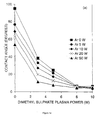
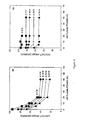
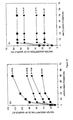
- Argon plasma pre-treatment prior to plasma polymerisation of dimethyl sulphate produced two beneficial effects. Firstly, an improvement in surface wettability was noted, and in addition, the deposited dimethyl sulphate plasma polymer layer exhibited greater stability towards solvent removal, Figure 1B. The most hydrophilic and stable surfaces were achieved by using a combination of high power levels for both argon plasma crosslinking and plasma polymerisation of dimethyl sulphate.
- XPS analysis indicated a strong correlation between the concentration of high oxidation state sulphur species and surface hydrophilicity, as shown in Table 1 and Figure 4.
- Table 1 XPS elemental analysis of dimethyl sulphate plasma polymer deposited onto polypropylene film.
- Dimethyl sulphate power level (W) %C %O %S 3 60 ⁇ 0.5 29 ⁇ 0.5 8 ⁇ 0.5 5 31 ⁇ 1.0 55 ⁇ 0.6 14 ⁇ 0.5 8 23 ⁇ 0.6 60 ⁇ 0.6 17 ⁇ 0.5 10 19 ⁇ 0.5 63 ⁇ 0.6 18 ⁇ 0.5
- the lower binding energy S(2p) peak at 164.8 eV can be assigned to sulphur atoms bonded to one or two oxygen atoms (e.g. sulphur monoxide groups (Structure 2), whilst the higher binding energy component at 169.4 eV is typical of sulphate (Structure 1) and sulphite (Structure 3) environments.
- Structure 2 sulphur monoxide groups
- Reflectometer measurements provided values of increasing deposition rates for thin films of the plasma polymers with rising power level settings, Table 2.
- Table 2 Reflectometer thickness measurements of dimethyl sulphate plasma polymer layers deposited onto polypropylene film.
- Plasma power level used (W) Deposition rate (nm/min) 3 17 ⁇ 3.2 5 26 ⁇ 2.4 8 33 ⁇ 2.1 10 39 ⁇ 1.8
- Noble gas plasma pre-treatment was found to significantly improve the wettability and adhesion of deposited dimethyl sulphate plasma polymer films. This can be explained in terms of crosslinking, and the formation of trapped free radicals at the polyolefin surface.
- a crosslinked polypropylene surface will be less susceptible towards chain sissions and the formation of low molecular weight material. Whilst the entrapped free radicals at the surface can participate in chemical bonding interactions during subsequent exposure to dimethyl sulphate plasma species.
- a copper coil wrapped around the reactor was coupled to a 13.56 MHz radio frequency power supply via an LC matching network.
- the chamber was cleaned using a 50 W air plasma at 26.7 Pa (0.2 Torr). Samples were exposed to a source gas, introduced via a fine control needle valve at a pressure of 26.7 Pa (0.2 Torr), followed by plasma exposure for 5 minutes. Upon completion, the reactor was purged with monomer for 5 minutes.
- Absorption under load is a measure of the ability of an SAP to absorb fluid under an applied pressure.
- the AUL was determined by the following method, as described elsewhere. A sap (0.100 g ⁇ 0.001 g) was carefully scattered onto a 140-micron, water permeable mesh attached to the base of a hollow plexiglass cylinder with an internal diameter of 25 mm. The sample was covered with a 100 g cover plate and the cylinder assembly weighed. This gives an applied pressure of 20 g.cm -2 (0.28 psi). The screened base of the cylinder was placed in a 100 mm petridish containing 25 ml of a test solution, and the polymer was allowed to absorb for 1 hour.
- absorption under load (AUL) at the given pressure was calculated by dividing the weight of the liquid absorbed by the dry weight of the polymer before liquid contact.
- Test solutions used were distilled water, 0.9% saline solution and a 0.9% ammonia solution both to show the effects of salt poisoning and the uptake of materials such as urine, blood etc.
- ATR-FTIR was used to probe the plasma treated polymer granules on a Perkin Elmer Spectrum One FTIR instrument at a resolution of 4 cm -1 and averaged over 64 scans between 4000 - 700 cm -1 using a liquid nitrogen cooled MCT detector.
- a combination of argon plasma pre-treatment at 20 W for 5 minutes, followed by nitrogen plasma treatment indicated further improvements of the absorptive capacity of the SAP materials, Figure 12.
- the effect of overcoming the salt poisoning effect and enhancing the absorption due to crosslinking generates materials that can be termed and used as SAPs.
- SAPs that overcome the salt poisoning effect and can have enhanced absorptive capacity under pressure are possible without the use of conventional chemical additives such as ion exchangers or surfaces crosslinkers which dilute the properties of the SAPs.
- Plasma modification of polyacrylic acids using argon and/or nitrogen gas can generate SAPs that substantially reduce the salt poisoning effect even under pressure.
- Radio frequency (RF) power at 13.56 MHz was applied through a copper cil wound around the outside of a tubular glass reactor (3 dm 3 volume capacity, with an inner diameter of 5 cm and a length of 68 cm).
- a Faraday cage was placed around the apparatus to prevent the leakage of stray electromagnetic radiation.
- a typical experimental run comprised evacuating the plasma chamber to a base pressure of 2 x 10 -3 mbar using a liquid nitrogen trapped mechanical rotary pump. Feed gas was then introduced at 0.2 mbar pressure and the electrical discharge ignited. Plasma exposure time was kept constant at 5 mins in all cases. Both the influence of argon plasma pre-treatment, and subsequent air plasma exposure were investigated in terms of power settings.
- Sessile drop water contact angle measurements were carried ot on the non-porous polypropylene films using a video capture apparatus (AST Products Inc. VC2500). Each contact angle value was taken for a 2 ⁇ l drop of high purity water syringed onto the surface.
- the stability of the plasma modified samples towards hydrophobic recovery was evaluated by rinsing them in propan-2-ol in order to remove any low molecular weight oxidised material generated at the surface, followed by re-evaluation of surface wettability.
- a water contact angle value of 95 ⁇ 3° was measured for the untreated non-porous polypropylene film surface.
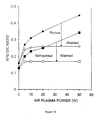
- the contact angle was found to decrease with increasing power, to eventually reach a minimum of 45° at 20 W (higher power levels caused physical damage to the samples) as shown in Figure 13a. Washing the plasma modified polymer surfaces in propan-2-ol gave rise to the loss of hydrophilicity, with the water contact angle value becoming reminiscent of that associated with untreated polypropylene film as shown in Figure 13b.
- argon plasma crosslinking improved the stability of the oxidised surface towards solvent washing (hydrophobic recovery). Control experiments comprising just argon plasma exposure were found to be not as effective (in this case free radical sites at the plasma modified surface undergoing oxidation upon exposure to air); however these oxidised surfaces were also stable towards hydrophobic recovery. The extent of argon plasma crosslinking (i.e argon plasma power level) was found to govern the stability towards hydrophobic recovery following air plasma exposure.
- Optical microscopy of the untreated polypropylene non-woven film showed the presence of randomly orientated fibres, as illustrated in Figure 17.
- the fibre surface becomes etched and parts of the film appear highly densified due to localised melting. The extent of damage was found to correspond to the air plasma power level setting.
- Argon plasma crosslinking pre-treatment alleviated deterioration of the substrate. In this case, the fibres retained the structure previously identified for the untreated non-woven surface.
- the surface wettability of polypropylene can be unstable and easily removed by solvent washing. This can be attributed to the formation of a layer of oxidised low molecular weight material on the surface generation by polymer chain scission.
- Noble gas plasma treatment of polymeric materials comprises interactions of energetic particles and electromagnetic radiation with the surface. Some of the photons possess sufficient energy to break chemical bonds in the surface region and create radicals, which subsequently undergo cross-linking. Any trapped radicals become oxidised upon exposure to air leading to an improvement in surface wettability with low hydrophobic recovery. This can be ascribed to a partially oxidised and crosslinked surface layer.
- Argon plasma exposure prior to air plasma treatment imparts two major benefits on surface hydrophilicity. Firstly, there is an enhancement in water contact angle and absorption values compared to just straightforward air plasma exposure. Also it permits air plasma treatment to be carried out at higher power levels without causing surface damage. Crosslinking of the polymer surface in this manner helps to retard the effects of oxidative degradation and formation of mobile low molecular weight species commonly associated with air plasma treatment. Similar improvements in hydrophilicity were found for other combinations of crosslinking gases (e.g N 2 , He, Ne, Xe and Kr) and oxidising gases (e.g. O 2 , CO 2 and H 2 O).
- crosslinking gases e.g N 2 , He, Ne, Xe and Kr
- oxidising gases e.g. O 2 , CO 2 and H 2 O
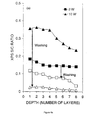
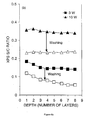
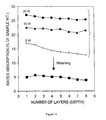
- Wettability measurements and XPS data confirm that plasma penetration extends throughout several layers of the porous polypropylene substrate.
- argon plasma pre-treatment significantly improves the hydrophilic stability of the surface.
- Optical microscopy revealed that air plasma exposure alone causes fibre agglomeration attributable to thermal damage. Whereas argon plasma treatment helps to raise the melting temperature of the fibre surfaces via crosslinking, thereby improving their structural integrity.
- the ability to incorporate hydrophilic groups throughout porous polymer structures is of potential commercial interest for applications such as diapers, filters, solid phase organic synthesis, and catalyst supports.
- the wettability and stability towards hydrophobic recovery of plasma oxidised polymer surfaces can be significantly improved by using an argon plasma pre-treatment to cross-link the surface. This stabilises the surface against thermal degradation and the formation of low molecular weight oxidised species.
- the wettability and stability of dimethyl sulphate plasma polymer films deposited onto polypropylene surfaces can be significantly improved by the use of an argon plasma crosslinking pre-treatment.
- the latter stabilises the polyolefin surface against thermal degradation and the formation of poorly adhered low molecular weight oligomeric species.
- the two-step sequence of plasma treatments gives rise to stable wettable polymer surfaces. This entails crosslinking the surface first, followed by the deposition of hydrophilic species.
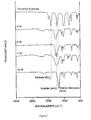
- the contact angle, XPS and FTIR measurements all indicate that these surfaces are stable towards hydrophobic recovery and in the case of porous substrates, both the exterior and interior interstitial surfaces can be modified by this method to yield high capacities for water absorption.
- the polymer substrate is stabilised prior to plasma polymerisation.
- Extension of these examples of the invention to porous polymer films is shown to produce a significant rise in total water absorption capacity and thus the modification steps of this invention provide significant advantages and improvements in the provision of material with super absorption characteristics.
- the invention relates to the particular advantages to be gained with super absorption materials it should be appreciated that the method and steps thereof as herein described can be of use with other forms of materials and therefore can be used as required to give required advantages.
Landscapes
- Health & Medical Sciences (AREA)
- Chemical & Material Sciences (AREA)
- Engineering & Computer Science (AREA)
- General Health & Medical Sciences (AREA)
- Veterinary Medicine (AREA)
- Public Health (AREA)
- Hematology (AREA)
- Physics & Mathematics (AREA)
- Materials Engineering (AREA)
- Epidemiology (AREA)
- Life Sciences & Earth Sciences (AREA)
- Animal Behavior & Ethology (AREA)
- Medicinal Chemistry (AREA)
- Dispersion Chemistry (AREA)
- Thermal Sciences (AREA)
- Plasma & Fusion (AREA)
- General Chemical & Material Sciences (AREA)
- Chemical Kinetics & Catalysis (AREA)
- Oral & Maxillofacial Surgery (AREA)
- Polymers & Plastics (AREA)
- Organic Chemistry (AREA)
- Treatments Of Macromolecular Shaped Articles (AREA)
- Addition Polymer Or Copolymer, Post-Treatments, Or Chemical Modifications (AREA)
- Chemical Or Physical Treatment Of Fibers (AREA)
- Absorbent Articles And Supports Therefor (AREA)
Claims (22)
- Verfahren zum Anwenden eines Konditionierungseffekts auf ein Materialsubstrat, wobei der genannte Konditionierungseffekt das Unterziehen des Substrats wenigstens den folgenden beiden Behandlungsschritten beinhaltet: (i) Vernetzen des Materials der Außen- und/oder der Innenfläche des Substrats; und (ii) Plasmamodifizierung oder Plasmaablagerung des/auf das vernetzte(n) Material(s).
- Verfahren nach Anspruch 1, bei dem das bei der Erzeugung des Plasmas verwendete Vorläufergas ein Edel-, Inert- oder Stickstoffgas ist.
- Verfahren nach einem der vorherigen Ansprüche, bei dem das Beschichtungsmaterial in der Form einer hydrophilen Schicht im ersten Schritt modifiziert wird, wobei durch die Plasmabehandlung im zweiten Schritt das Material oxidiert oder nitrogenisiert wird.
- Verfahren nach Anspruch 3, bei dem das/die im Plasmabehandlungsschritt eingesetzte Vorläufergas oder -flüssigkeit sauerstoff- oder stickstoffhaltige chemische Verbindungen sind.
- Verfahren nach einem der vorherigen Ansprüche, bei dem ein Oxidationsverfahren in der Form von Ozonolyse angewendet wird.
- Verfahren nach Anspruch 1, bei dem das/die im Plasmabehandlung in Schritt 2 (ii) eingesetzte Vorläufergas Fluorid enthält.
- Verfahren nach Anspruch 1, bei dem das verwendete Plasma ein Nichtgleichgewichtsplasma ist, das durch eine Funkfrequenz, durch Mikrowellen und/oder durch Gleichstrom erzeugt wird.
- Verfahren nach einem der vorherigen Ansprüche, bei dem die im ersten Schritt angewendete Plasmaleistung im Bereich von 0,01 Watt bis 500 Watt liegt.
- Verfahren nach einem der vorherigen Ansprüche, bei dem die im zweiten Schritt angewendete Plasmaleistung im Bereich von 0,01 Watt bis 500 Watt liegt.
- Verfahren nach einem der vorherigen Ansprüche, bei dem die im ersten und/oder zweiten Schritt angewendete Plasmaleistung pulsiert wird.
- Verfahren nach einem der vorherigen Ansprüche, bei dem das/die im ersten und/oder im zweiten Schritt eingeleitete Vorläufergas oder -flüssigkeit pulsiert wird.
- Verfahren nach einem der vorherigen Ansprüche, bei dem das Substrat als ein Artikel definiert ist, der eine darauf aufgebrachte Beschichtung tragen kann.
- Verfahren nach Anspruch 12, bei dem das Substrat ein poröser Artikel mit einer Außenfläche ist, wobei eine Massenmatrix und Poren von der Außenfläche in die Massenmatrix verlaufen, wobei die Außen- und Einlagerungsflächen der genannten Massenmatrix, wenigstens teilweise, polymer oder oligomer sind.
- Verfahren nach Anspruch 13, bei dem die Massenmatrix ein Polyolefin ist.
- Verfahren nach Anspruch 14, bei dem die Massenmatrix ein Hohlraumvolumen im Bereich von 0,01 bis 99% hat.
- Verfahren nach einem der vorherigen Ansprüche, bei dem Schritt (i) so gesteuert wird, dass der Effekt des genannten Schrittes so reguliert wird, dass die Applikation bis auf eine begrenzte Tiefe des Materials unter der Außenfläche erfolgt.
- Verfahren nach einem der vorherigen Ansprüche, bei dem in Schritt (ii) der Effekt des genannten Schrittes so reguliert wird, dass die Applikation bis auf eine begrenzte Tiefe des Materials unter der Außenfläche des Substrats erfolgt.
- Verfahren nach einem der vorherigen Ansprüche, bei dem das in Schritt (i) und/oder (ii) verwendete Plasma selektiv auf lokalisierte Bereiche über der Substratoberfläche und/oder unter der Substratoberfläche appliziert wird.
- Verfahren nach einem der vorherigen Ansprüche, bei dem das Material ein absorptionsfähiges, hydrophobes Polymer ist, das in Schritt (i) zum Vernetzen durch ein Edelgasplasma erhitzt wird, um seine Flüssigkeitsretentionsfähigkeit zu verbessern und um es superabsorbierend zu machen.
- Verfahren nach Anspruch 19, bei dem das Material durch ein nachfolgendes Nitrogenisierplasma als Schritt (ii) modifiziert wird, um das genannte vernetzte Polymer mit Aminfunktionalitäten kompatibel zu machen, um ein superabsorbierendes Polymer zu bilden, das große Mengen an aminhaltigen wässrigen Lösungen zu halten.
- Verfahren nach einem der vorherigen Ansprüche, bei dem das Substrat ein superabsorbierendes Material ist.
- Substrat mit einer modifizierten Oberfläche, wobei die genannte Oberfläche mit einem Verfahren gemäß einem der Ansprüche 1 bis 21 modifiziert ist.
Applications Claiming Priority (3)
| Application Number | Priority Date | Filing Date | Title |
|---|---|---|---|
| GBGB0206932.6A GB0206932D0 (en) | 2002-03-23 | 2002-03-23 | Preparation of superabsorbent materials by plasma modification |
| GB0206932 | 2002-03-23 | ||
| PCT/GB2003/001220 WO2003080259A1 (en) | 2002-03-23 | 2003-03-24 | Preparation of superabsorbent materials by plasma modification |
Publications (2)
| Publication Number | Publication Date |
|---|---|
| EP1492630A1 EP1492630A1 (de) | 2005-01-05 |
| EP1492630B1 true EP1492630B1 (de) | 2006-05-17 |
Family
ID=9933608
Family Applications (1)
| Application Number | Title | Priority Date | Filing Date |
|---|---|---|---|
| EP03715089A Expired - Lifetime EP1492630B1 (de) | 2002-03-23 | 2003-03-24 | Herstellung von superabsorbierendem material mittels plasmamodifizierung |
Country Status (7)
| Country | Link |
|---|---|
| US (1) | US20060008592A1 (de) |
| EP (1) | EP1492630B1 (de) |
| AT (1) | ATE326293T1 (de) |
| AU (1) | AU2003219284A1 (de) |
| DE (1) | DE60305307D1 (de) |
| GB (1) | GB0206932D0 (de) |
| WO (1) | WO2003080259A1 (de) |
Families Citing this family (12)
| Publication number | Priority date | Publication date | Assignee | Title |
|---|---|---|---|---|
| US20050142965A1 (en) * | 2003-12-29 | 2005-06-30 | Kimberly-Clark Worldwide, Inc. | Surface charge manipulation for improved fluid intake rates of absorbent composites |
| DE102004002129A1 (de) * | 2004-01-15 | 2005-08-11 | Arccure Technologies Gmbh | Verfahren und Vorrichtung zur Härtung von radikalisch polymerisierbaren Beschichtungen von Oberflächen |
| DE102009040949A1 (de) * | 2009-09-11 | 2011-03-31 | Evonik Stockhausen Gmbh | Plasmamodifizierung wasserabsorbierender Polymergebilde |
| EP2464680B1 (de) | 2010-10-21 | 2013-10-02 | The Procter & Gamble Company | Aufnahmestrukturen mit nachher vernetzten wasseraufnahmefähigen teilchen |
| US20130207037A1 (en) * | 2010-10-21 | 2013-08-15 | Basf Se | Water-Absorbing Polymeric Particles and Method for the Production Thereof |
| US9878101B2 (en) | 2010-11-12 | 2018-01-30 | Sio2 Medical Products, Inc. | Cyclic olefin polymer vessels and vessel coating methods |
| AU2013352436B2 (en) | 2012-11-30 | 2018-10-25 | Sio2 Medical Products, Inc. | Controlling the uniformity of PECVD deposition on medical syringes, cartridges, and the like |
| CN105392916B (zh) | 2013-03-11 | 2019-03-08 | Sio2医药产品公司 | 涂布包装材料 |
| US9937099B2 (en) | 2013-03-11 | 2018-04-10 | Sio2 Medical Products, Inc. | Trilayer coated pharmaceutical packaging with low oxygen transmission rate |
| ES2913087T3 (es) | 2015-12-30 | 2022-05-31 | Cytec Ind Inc | Partículas poliméricas tratadas en superficie, suspensión que las contiene y uso de las mismas |
| GB201718387D0 (en) * | 2017-11-07 | 2017-12-20 | Univ College Dublin Nat Univ Ireland Dublin | Surface preparation |
| CN121535968B (zh) * | 2026-01-16 | 2026-03-27 | 晋江滨湖新材料科技有限公司 | 一种环保可降解包装袋及其制备方法 |
Family Cites Families (45)
| Publication number | Priority date | Publication date | Assignee | Title |
|---|---|---|---|---|
| US3916033A (en) * | 1971-06-09 | 1975-10-28 | High Voltage Engineering Corp | Contact lens |
| US3959102A (en) * | 1973-08-06 | 1976-05-25 | Essilor International (Compagnie Generale D'optique S.A.) | Method for preparing a crosslinked graft copolymer of silicone and polyvinylpyrrolidone for use as a contact lens, and a contact lens produced thereby |
| US4265959A (en) * | 1977-01-12 | 1981-05-05 | Sumitomo Chemical Company, Limited | Process for producing semipermeable membranes |
| US4259187A (en) * | 1979-06-07 | 1981-03-31 | Baxter Travenol Laboratories, Inc. | Intravenous fluid filter |
| US4312575A (en) * | 1979-09-18 | 1982-01-26 | Peyman Gholam A | Soft corneal contact lens with tightly cross-linked polymer coating and method of making same |
| US4475837A (en) * | 1982-04-14 | 1984-10-09 | The Procter & Gamble Company | Roll-on applicating package with sealing cap |
| US4626473A (en) * | 1985-04-22 | 1986-12-02 | Massachusetts Institute Of Technology | Thermal energy storage powdered material |
| GB2188947A (en) * | 1986-04-14 | 1987-10-14 | Shell Int Research | Plasma treatment for making non-polar polymeric material dyeable with an acid dye |
| US5318552A (en) * | 1986-12-10 | 1994-06-07 | Kao Corporation | Absorbent article having an improved non-woven fabric layer |
| US5026591A (en) * | 1987-04-21 | 1991-06-25 | W. L. Gore & Associates, Inc. | Coated products and methods for making |
| US4885077A (en) * | 1988-11-17 | 1989-12-05 | Becton, Dickinson And Company | Composite membrane, method for its preparation and electrolyte sensor including same |
| US5972505A (en) * | 1989-04-04 | 1999-10-26 | Eastman Chemical Company | Fibers capable of spontaneously transporting fluids |
| US5326584A (en) * | 1989-04-24 | 1994-07-05 | Drexel University | Biocompatible, surface modified materials and method of making the same |
| US6022902A (en) * | 1989-10-31 | 2000-02-08 | The United States Of America As Represented By The Administrator Of The National Aeronautics And Space Administration | Porous article with surface functionality and method for preparing same |
| US5236563A (en) * | 1990-06-18 | 1993-08-17 | Advanced Surface Technology Inc. | Surface-modified bioabsorbables |
| DE69101147T2 (de) * | 1990-06-28 | 1994-09-01 | Eastman Kodak Co | Absorbierende und flüssigkeittransportierende fasern. |
| US5244730A (en) * | 1991-04-30 | 1993-09-14 | International Business Machines Corporation | Plasma deposition of fluorocarbon |
| JP2671072B2 (ja) * | 1991-11-26 | 1997-10-29 | 宇部興産株式会社 | ガス分離膜の製造法 |
| JPH0649251A (ja) * | 1992-06-09 | 1994-02-22 | Ciba Geigy Ag | 表面特性を改質するための、予め成形した基材表面へのグラフト重合法 |
| US6689608B1 (en) * | 1993-02-01 | 2004-02-10 | Massachusetts Institute Of Technology | Porous biodegradable polymeric materials for cell transplantation |
| US5356936A (en) * | 1993-09-28 | 1994-10-18 | The United States Of America As Represented By The Secretary Of The Navy | Process for producing hydrophilic polymer membranes |
| US5700559A (en) * | 1994-12-16 | 1997-12-23 | Advanced Surface Technology | Durable hydrophilic surface coatings |
| JP3530287B2 (ja) * | 1995-10-24 | 2004-05-24 | 株式会社メニコン | 低含水性眼用レンズ用材料、それからなる低含水性眼用レンズ用成形体、ならびにそれからなる低含水性眼用レンズおよびその製法 |
| US5876753A (en) * | 1996-04-16 | 1999-03-02 | Board Of Regents, The University Of Texas System | Molecular tailoring of surfaces |
| US6169127B1 (en) * | 1996-08-30 | 2001-01-02 | Novartis Ag | Plasma-induced polymer coatings |
| AR009439A1 (es) * | 1996-12-23 | 2000-04-12 | Novartis Ag | Un articulo que comprende un sustrato con un recubrimiento polimerico primario que porta grupos reactivos predominantemente en su superficie, unmetodo para preparar dicho articulo, un articulo que posee un recubrimiento de tipo hibrido y una lente de contacto |
| GB9712338D0 (en) * | 1997-06-14 | 1997-08-13 | Secr Defence | Surface coatings |
| ES2252840T3 (es) * | 1997-06-14 | 2006-05-16 | The Secretary Of State For Defence | Revestimientos de superficies. |
| GB9726807D0 (en) * | 1997-12-18 | 1998-02-18 | Mupor Ltd | Hydrophobic/Oleophobic surfaces and a method of manufacture |
| US6156394A (en) * | 1998-04-17 | 2000-12-05 | Optical Coating Laboratory, Inc. | Polymeric optical substrate method of treatment |
| US5971505A (en) * | 1998-08-26 | 1999-10-26 | Carrier Corporation | Snap-in grille for an air conditioner housing |
| ES2209554T3 (es) * | 1998-09-21 | 2004-06-16 | THE PROCTER & GAMBLE COMPANY | Bandas permeables a los liquidos duramente humectables preparadas usando un procedimiento de polimerizacion por plasma distante. |
| EP1115505B1 (de) * | 1998-09-21 | 2003-05-28 | The Procter & Gamble Company | Mit flüssigkeit dauerbefeuchtbarer durchlässiger stoff |
| BR0012307A (pt) * | 1999-06-11 | 2002-03-12 | Bausch & Lomb | Moldes para lente com revestimentos protetores para produção de lentes de contato e outros produtos oftálmicos |
| DE10047717A1 (de) * | 2000-09-27 | 2002-04-18 | Basf Ag | Hydrophile, offenzellige, elastische Schaumstoffe auf Basis von Melamin/Formaldehyd-Harzen, ihre Herstellung und ihre Verwendung in Hygieneartikeln |
| US6579604B2 (en) * | 2000-11-29 | 2003-06-17 | Psiloquest Inc. | Method of altering and preserving the surface properties of a polishing pad and specific applications therefor |
| US6967105B2 (en) * | 2000-12-02 | 2005-11-22 | Queststar Medical, Inc. | Surface-modified wick for diagnostic test strip |
| US6872444B2 (en) * | 2001-01-30 | 2005-03-29 | The Procter & Gamble Company | Enhancement of color on surfaces |
| US20050214442A1 (en) * | 2001-11-27 | 2005-09-29 | Anders Larsson | Surface and its manufacture and uses |
| US6878419B2 (en) * | 2001-12-14 | 2005-04-12 | 3M Innovative Properties Co. | Plasma treatment of porous materials |
| GB0206930D0 (en) * | 2002-03-23 | 2002-05-08 | Univ Durham | Method and apparatus for the formation of hydrophobic surfaces |
| GB0505367D0 (en) * | 2005-03-16 | 2005-04-20 | Combining Co The Ltd | A method for producing a grafted polymer coating |
| GB0507537D0 (en) * | 2005-04-14 | 2005-05-18 | Univ Durham | Protein resistant surfaces |
| EP1892080A1 (de) * | 2006-08-25 | 2008-02-27 | Sauflon CL Limited | Verfahren zur Beschichtung einer Kontaktlinse |
| GB201119867D0 (en) * | 2011-11-17 | 2011-12-28 | Surface Innovations Ltd | Method |
-
2002
- 2002-03-23 GB GBGB0206932.6A patent/GB0206932D0/en not_active Ceased
-
2003
- 2003-03-24 US US10/509,290 patent/US20060008592A1/en not_active Abandoned
- 2003-03-24 DE DE60305307T patent/DE60305307D1/de not_active Expired - Lifetime
- 2003-03-24 AU AU2003219284A patent/AU2003219284A1/en not_active Abandoned
- 2003-03-24 AT AT03715089T patent/ATE326293T1/de not_active IP Right Cessation
- 2003-03-24 EP EP03715089A patent/EP1492630B1/de not_active Expired - Lifetime
- 2003-03-24 WO PCT/GB2003/001220 patent/WO2003080259A1/en not_active Ceased
Also Published As
| Publication number | Publication date |
|---|---|
| ATE326293T1 (de) | 2006-06-15 |
| EP1492630A1 (de) | 2005-01-05 |
| AU2003219284A1 (en) | 2003-10-08 |
| WO2003080259A1 (en) | 2003-10-02 |
| US20060008592A1 (en) | 2006-01-12 |
| DE60305307D1 (de) | 2006-06-22 |
| GB0206932D0 (en) | 2002-05-08 |
Similar Documents
| Publication | Publication Date | Title |
|---|---|---|
| EP1492630B1 (de) | Herstellung von superabsorbierendem material mittels plasmamodifizierung | |
| US5326584A (en) | Biocompatible, surface modified materials and method of making the same | |
| DE69312294T2 (de) | Azlactonfunktionen aufweisende trägerfläche, addukt träger und verfahren zur herstellung davon | |
| Desai et al. | Surface modification of polyethylene | |
| CN102046261B (zh) | 过滤介质 | |
| AU775730B2 (en) | Coatings for biomedical devices | |
| KR940010532B1 (ko) | 흡수성 복합재료의 제조방법 | |
| US4536179A (en) | Implantable catheters with non-adherent contacting polymer surfaces | |
| EP1892080A1 (de) | Verfahren zur Beschichtung einer Kontaktlinse | |
| WO1999025745A1 (en) | Poly(vinylamine)-based superabsorbent gels and method of manufacturing the same | |
| US11167311B2 (en) | Hydrophilic, multifunctional ultra-thin coatings with excellent stability and durability | |
| CN1317057A (zh) | 超疏水涂布底材 | |
| US20150328620A1 (en) | Method of capturing heavy metals by a chemically functionalized surface | |
| Sheu et al. | A new gas discharge process for preparation of non-fouling surfaces on biomaterials | |
| JP2954360B2 (ja) | 吸水性複合体の製造法 | |
| JPH02173127A (ja) | 吸水性高分子物質及びその製造方法 | |
| JPH041774B2 (de) | ||
| JP2010132868A (ja) | アリールアジド基を有する高分子重合開始剤およびこれを利用した環式オレフィン共重合体表面改質方法。 | |
| ES2265347T3 (es) | Metodo para funcionalizar superficies solidas. | |
| Minto et al. | Grafting reactions onto poly (organophosphazenes)-III. Light-induced graft copolymerization of poly-N, N′-dimethyl-acrylamide onto mobile-hydrogen-containing phosphazene polymers | |
| CN110772662A (zh) | 一种抗菌膨体聚四氟乙烯面部植入材料及其制备工艺 | |
| CN116854977A (zh) | 一种tpu材料及其制备方法和应用 | |
| KR910003714B1 (ko) | 무적성 고분자 물질 및 그의 제조방법 | |
| JPH06306199A (ja) | 高分子材料の表面処理方法 | |
| JPH03139534A (ja) | 高分子構造物の表面改質方法 |
Legal Events
| Date | Code | Title | Description |
|---|---|---|---|
| PUAI | Public reference made under article 153(3) epc to a published international application that has entered the european phase |
Free format text: ORIGINAL CODE: 0009012 |
|
| 17P | Request for examination filed |
Effective date: 20041018 |
|
| AK | Designated contracting states |
Kind code of ref document: A1 Designated state(s): AT BE BG CH CY CZ DE DK EE ES FI FR GB GR HU IE IT LI LU MC NL PT RO SE SI SK TR |
|
| AX | Request for extension of the european patent |
Extension state: AL LT LV MK |
|
| GRAP | Despatch of communication of intention to grant a patent |
Free format text: ORIGINAL CODE: EPIDOSNIGR1 |
|
| RAP1 | Party data changed (applicant data changed or rights of an application transferred) |
Owner name: SURFACE INNOVATIONS LIMITED |
|
| GRAS | Grant fee paid |
Free format text: ORIGINAL CODE: EPIDOSNIGR3 |
|
| GRAA | (expected) grant |
Free format text: ORIGINAL CODE: 0009210 |
|
| STAA | Information on the status of an ep patent application or granted ep patent |
Free format text: STATUS: THE PATENT HAS BEEN GRANTED |
|
| AK | Designated contracting states |
Kind code of ref document: B1 Designated state(s): AT BE BG CH CY CZ DE DK EE ES FI FR GB GR HU IE IT LI LU MC NL PT RO SE SI SK TR |
|
| PG25 | Lapsed in a contracting state [announced via postgrant information from national office to epo] |
Ref country code: IT Free format text: LAPSE BECAUSE OF FAILURE TO SUBMIT A TRANSLATION OF THE DESCRIPTION OR TO PAY THE FEE WITHIN THE PRESCRIBED TIME-LIMIT;WARNING: LAPSES OF ITALIAN PATENTS WITH EFFECTIVE DATE BEFORE 2007 MAY HAVE OCCURRED AT ANY TIME BEFORE 2007. THE CORRECT EFFECTIVE DATE MAY BE DIFFERENT FROM THE ONE RECORDED. Effective date: 20060517 Ref country code: SI Free format text: LAPSE BECAUSE OF FAILURE TO SUBMIT A TRANSLATION OF THE DESCRIPTION OR TO PAY THE FEE WITHIN THE PRESCRIBED TIME-LIMIT Effective date: 20060517 Ref country code: LI Free format text: LAPSE BECAUSE OF FAILURE TO SUBMIT A TRANSLATION OF THE DESCRIPTION OR TO PAY THE FEE WITHIN THE PRESCRIBED TIME-LIMIT Effective date: 20060517 Ref country code: BE Free format text: LAPSE BECAUSE OF FAILURE TO SUBMIT A TRANSLATION OF THE DESCRIPTION OR TO PAY THE FEE WITHIN THE PRESCRIBED TIME-LIMIT Effective date: 20060517 Ref country code: NL Free format text: LAPSE BECAUSE OF FAILURE TO SUBMIT A TRANSLATION OF THE DESCRIPTION OR TO PAY THE FEE WITHIN THE PRESCRIBED TIME-LIMIT Effective date: 20060517 Ref country code: RO Free format text: LAPSE BECAUSE OF FAILURE TO SUBMIT A TRANSLATION OF THE DESCRIPTION OR TO PAY THE FEE WITHIN THE PRESCRIBED TIME-LIMIT Effective date: 20060517 Ref country code: CH Free format text: LAPSE BECAUSE OF FAILURE TO SUBMIT A TRANSLATION OF THE DESCRIPTION OR TO PAY THE FEE WITHIN THE PRESCRIBED TIME-LIMIT Effective date: 20060517 Ref country code: FI Free format text: LAPSE BECAUSE OF FAILURE TO SUBMIT A TRANSLATION OF THE DESCRIPTION OR TO PAY THE FEE WITHIN THE PRESCRIBED TIME-LIMIT Effective date: 20060517 Ref country code: SK Free format text: LAPSE BECAUSE OF FAILURE TO SUBMIT A TRANSLATION OF THE DESCRIPTION OR TO PAY THE FEE WITHIN THE PRESCRIBED TIME-LIMIT Effective date: 20060517 Ref country code: CZ Free format text: LAPSE BECAUSE OF FAILURE TO SUBMIT A TRANSLATION OF THE DESCRIPTION OR TO PAY THE FEE WITHIN THE PRESCRIBED TIME-LIMIT Effective date: 20060517 Ref country code: AT Free format text: LAPSE BECAUSE OF FAILURE TO SUBMIT A TRANSLATION OF THE DESCRIPTION OR TO PAY THE FEE WITHIN THE PRESCRIBED TIME-LIMIT Effective date: 20060517 |
|
| REG | Reference to a national code |
Ref country code: GB Ref legal event code: FG4D |
|
| REG | Reference to a national code |
Ref country code: CH Ref legal event code: EP |
|
| REG | Reference to a national code |
Ref country code: IE Ref legal event code: FG4D |
|
| REF | Corresponds to: |
Ref document number: 60305307 Country of ref document: DE Date of ref document: 20060622 Kind code of ref document: P |
|
| PG25 | Lapsed in a contracting state [announced via postgrant information from national office to epo] |
Ref country code: DK Free format text: LAPSE BECAUSE OF FAILURE TO SUBMIT A TRANSLATION OF THE DESCRIPTION OR TO PAY THE FEE WITHIN THE PRESCRIBED TIME-LIMIT Effective date: 20060817 Ref country code: SE Free format text: LAPSE BECAUSE OF FAILURE TO SUBMIT A TRANSLATION OF THE DESCRIPTION OR TO PAY THE FEE WITHIN THE PRESCRIBED TIME-LIMIT Effective date: 20060817 |
|
| PG25 | Lapsed in a contracting state [announced via postgrant information from national office to epo] |
Ref country code: DE Free format text: LAPSE BECAUSE OF FAILURE TO SUBMIT A TRANSLATION OF THE DESCRIPTION OR TO PAY THE FEE WITHIN THE PRESCRIBED TIME-LIMIT Effective date: 20060818 |
|
| PG25 | Lapsed in a contracting state [announced via postgrant information from national office to epo] |
Ref country code: ES Free format text: LAPSE BECAUSE OF FAILURE TO SUBMIT A TRANSLATION OF THE DESCRIPTION OR TO PAY THE FEE WITHIN THE PRESCRIBED TIME-LIMIT Effective date: 20060828 |
|
| PG25 | Lapsed in a contracting state [announced via postgrant information from national office to epo] |
Ref country code: PT Free format text: LAPSE BECAUSE OF FAILURE TO SUBMIT A TRANSLATION OF THE DESCRIPTION OR TO PAY THE FEE WITHIN THE PRESCRIBED TIME-LIMIT Effective date: 20061017 |
|
| NLV1 | Nl: lapsed or annulled due to failure to fulfill the requirements of art. 29p and 29m of the patents act | ||
| REG | Reference to a national code |
Ref country code: CH Ref legal event code: PL |
|
| PLAZ | Examination of admissibility of opposition: despatch of communication + time limit |
Free format text: ORIGINAL CODE: EPIDOSNOPE2 |
|
| PLBI | Opposition filed |
Free format text: ORIGINAL CODE: 0009260 |
|
| 26 | Opposition filed |
Opponent name: STOCKHAUSEN GMBH & CO.KG Effective date: 20070219 |
|
| EN | Fr: translation not filed | ||
| PLBG | Opposition deemed not to have been filed |
Free format text: ORIGINAL CODE: 0009274 |
|
| 26D | Opposition deemed not to have been filed |
Opponent name: STOCKHAUSEN GMBH & CO.KG Effective date: 20071001 |
|
| PG25 | Lapsed in a contracting state [announced via postgrant information from national office to epo] |
Ref country code: IE Free format text: LAPSE BECAUSE OF NON-PAYMENT OF DUE FEES Effective date: 20070326 Ref country code: MC Free format text: LAPSE BECAUSE OF NON-PAYMENT OF DUE FEES Effective date: 20070331 |
|
| PG25 | Lapsed in a contracting state [announced via postgrant information from national office to epo] |
Ref country code: GR Free format text: LAPSE BECAUSE OF FAILURE TO SUBMIT A TRANSLATION OF THE DESCRIPTION OR TO PAY THE FEE WITHIN THE PRESCRIBED TIME-LIMIT Effective date: 20060818 Ref country code: FR Free format text: LAPSE BECAUSE OF FAILURE TO SUBMIT A TRANSLATION OF THE DESCRIPTION OR TO PAY THE FEE WITHIN THE PRESCRIBED TIME-LIMIT Effective date: 20070309 |
|
| PG25 | Lapsed in a contracting state [announced via postgrant information from national office to epo] |
Ref country code: BG Free format text: LAPSE BECAUSE OF FAILURE TO SUBMIT A TRANSLATION OF THE DESCRIPTION OR TO PAY THE FEE WITHIN THE PRESCRIBED TIME-LIMIT Effective date: 20060817 |
|
| PG25 | Lapsed in a contracting state [announced via postgrant information from national office to epo] |
Ref country code: EE Free format text: LAPSE BECAUSE OF FAILURE TO SUBMIT A TRANSLATION OF THE DESCRIPTION OR TO PAY THE FEE WITHIN THE PRESCRIBED TIME-LIMIT Effective date: 20060517 |
|
| PG25 | Lapsed in a contracting state [announced via postgrant information from national office to epo] |
Ref country code: FR Free format text: LAPSE BECAUSE OF FAILURE TO SUBMIT A TRANSLATION OF THE DESCRIPTION OR TO PAY THE FEE WITHIN THE PRESCRIBED TIME-LIMIT Effective date: 20060517 |
|
| PG25 | Lapsed in a contracting state [announced via postgrant information from national office to epo] |
Ref country code: LU Free format text: LAPSE BECAUSE OF NON-PAYMENT OF DUE FEES Effective date: 20070324 Ref country code: CY Free format text: LAPSE BECAUSE OF FAILURE TO SUBMIT A TRANSLATION OF THE DESCRIPTION OR TO PAY THE FEE WITHIN THE PRESCRIBED TIME-LIMIT Effective date: 20060517 |
|
| PG25 | Lapsed in a contracting state [announced via postgrant information from national office to epo] |
Ref country code: TR Free format text: LAPSE BECAUSE OF FAILURE TO SUBMIT A TRANSLATION OF THE DESCRIPTION OR TO PAY THE FEE WITHIN THE PRESCRIBED TIME-LIMIT Effective date: 20060517 Ref country code: HU Free format text: LAPSE BECAUSE OF FAILURE TO SUBMIT A TRANSLATION OF THE DESCRIPTION OR TO PAY THE FEE WITHIN THE PRESCRIBED TIME-LIMIT Effective date: 20061118 |
|
| PGFP | Annual fee paid to national office [announced via postgrant information from national office to epo] |
Ref country code: GB Payment date: 20150319 Year of fee payment: 13 |
|
| GBPC | Gb: european patent ceased through non-payment of renewal fee |
Effective date: 20160324 |
|
| PG25 | Lapsed in a contracting state [announced via postgrant information from national office to epo] |
Ref country code: GB Free format text: LAPSE BECAUSE OF NON-PAYMENT OF DUE FEES Effective date: 20160324 |
|
| PLAB | Opposition data, opponent's data or that of the opponent's representative modified |
Free format text: ORIGINAL CODE: 0009299OPPO |
|
| R26D | Opposition deemed not to have been filed (corrected) |
Opponent name: STOCKHAUSEN GMBH Effective date: 20071001 |
|
| P01 | Opt-out of the competence of the unified patent court (upc) registered |
Effective date: 20230527 |