EP1494408A2 - Kommunikationssystem zwischen unterschiedlichen Modulen und Verfahren - Google Patents
Kommunikationssystem zwischen unterschiedlichen Modulen und Verfahren Download PDFInfo
- Publication number
- EP1494408A2 EP1494408A2 EP04291345A EP04291345A EP1494408A2 EP 1494408 A2 EP1494408 A2 EP 1494408A2 EP 04291345 A EP04291345 A EP 04291345A EP 04291345 A EP04291345 A EP 04291345A EP 1494408 A2 EP1494408 A2 EP 1494408A2
- Authority
- EP
- European Patent Office
- Prior art keywords
- request
- address
- slave
- data
- instruction
- Prior art date
- Legal status (The legal status is an assumption and is not a legal conclusion. Google has not performed a legal analysis and makes no representation as to the accuracy of the status listed.)
- Withdrawn
Links
- 238000004891 communication Methods 0.000 title claims abstract description 44
- 238000000034 method Methods 0.000 title claims description 19
- 108091030087 Initiator element Proteins 0.000 claims abstract description 50
- 230000004044 response Effects 0.000 claims abstract description 32
- 230000015654 memory Effects 0.000 claims description 35
- 230000000977 initiatory effect Effects 0.000 claims description 21
- 239000003999 initiator Substances 0.000 claims description 16
- 239000000543 intermediate Substances 0.000 description 74
- 238000007726 management method Methods 0.000 description 16
- 239000003795 chemical substances by application Substances 0.000 description 13
- 238000010586 diagram Methods 0.000 description 5
- 238000012545 processing Methods 0.000 description 5
- 230000001360 synchronised effect Effects 0.000 description 4
- 238000012546 transfer Methods 0.000 description 4
- 230000005540 biological transmission Effects 0.000 description 2
- 238000012550 audit Methods 0.000 description 1
- 238000013461 design Methods 0.000 description 1
- 239000006185 dispersion Substances 0.000 description 1
- 239000000463 material Substances 0.000 description 1
- 230000008520 organization Effects 0.000 description 1
- 238000005192 partition Methods 0.000 description 1
- 238000002360 preparation method Methods 0.000 description 1
- 230000009466 transformation Effects 0.000 description 1
Images




Classifications
-
- H—ELECTRICITY
- H04—ELECTRIC COMMUNICATION TECHNIQUE
- H04W—WIRELESS COMMUNICATION NETWORKS
- H04W40/00—Communication routing or communication path finding
- H04W40/02—Communication route or path selection, e.g. power-based or shortest path routing
- H04W40/22—Communication route or path selection, e.g. power-based or shortest path routing using selective relaying for reaching a BTS [Base Transceiver Station] or an access point
-
- H—ELECTRICITY
- H04—ELECTRIC COMMUNICATION TECHNIQUE
- H04L—TRANSMISSION OF DIGITAL INFORMATION, e.g. TELEGRAPHIC COMMUNICATION
- H04L45/00—Routing or path finding of packets in data switching networks
- H04L45/302—Route determination based on requested QoS
- H04L45/306—Route determination based on the nature of the carried application
-
- H—ELECTRICITY
- H04—ELECTRIC COMMUNICATION TECHNIQUE
- H04L—TRANSMISSION OF DIGITAL INFORMATION, e.g. TELEGRAPHIC COMMUNICATION
- H04L65/00—Network arrangements, protocols or services for supporting real-time applications in data packet communication
- H04L65/1066—Session management
- H04L65/1101—Session protocols
Definitions
- the present invention relates to the field of communication between modules.
- agent an element susceptible to receive or transmit data on a bus, for example a CPU, memory, input / output device, etc.
- operand an element on which carries an operation.
- a system including a coprocessor arithmetic and an SDRAM-type memory that contains data must, for an operation to be executed, transfer the operands stored in memory via the controller memory, then through the bus to the coprocessor. The results of the operation will be transferred to the same bus.
- the invention aims to remedy the disadvantages of the system classic mentioned above.
- the invention proposes a system and a method for particularly effective communication, allowing extremely fast communications between different agents while judiciously using the capabilities of the communication.
- the communication system between modules comprises an initiator element, at least one intermediate element and a slave element.
- the initiating element is equipped with means to elaborate a first request and means to send the first request to the intermediate element.
- the first request includes the address of the initiator element, the address of the intermediate element, data and at least one instruction to be processed by the intermediate element.
- the element intermediary is equipped with means to receive a request for source of the initiating element, means to develop a second request in response to the first request and means for send the second request to a slave element.
- the second request includes the address of the slave element, at least one instruction to be processed by the slave element, data, and the address of the initiator element.
- the slave element is equipped with means to receive a request from the intermediate element, and means for performing at least one instruction contained in the second query.
- the slave element includes means for sending an acknowledgment to the item initiator in response to the second request.
- the acknowledgment of receipt will be sent without going through the intermediate element. This reduces the number of messages to pass through the communication system.
- the slave element includes means for sending data to the initiator element.
- the system comprises a plurality of intermediate elements, an element intermediary of rank n comprising means for sending to a intermediate element of rank n + 1 a request of rank n + 1 in response to a request of rank n.
- the request of rank n + 1 includes the address of the intermediate element of rank n + 1, at least one instruction before be treated by the intermediate element of rank n + 1, and the address of the initiating element.
- a request can therefore pass in a large number intermediate elements, each carrying out the treatment for which it is intended and sending to the next element a new request.
- the different queries can include a field of the sending element of said request, this field being preferably indicated with the address of the initiating element. So, an intermediate element sees the query as being directly emitted by the initiator element and not by the intermediate element, of rank immediately preceding.
- the element intermediary includes means to develop a third request, the third request including the address of the element initiator, the address of an intermediate element, data, and less an instruction to be processed by the intermediate element, and means for sending the third request to said element intermediate.
- said element intermediary includes means to develop a fourth query, the fourth query including the address of an element slave, data, and at least one instruction to be processed by the slave element, and means to send the fourth request to said slave element.
- the slave element may include means for receiving the fourth request from the intermediate element, and the means to carry out at least one instruction contained in the fourth request.
- Such a system is particularly well adapted for the case where the slave elements are memories, and the elements intermediaries are memory controllers.
- the modules are part of an integrated circuit. It is particularly advantageous that only one integrated circuit understands the whole system, including the modules.
- the modules are part of a plurality of integrated circuits arranged in a common carrier, and / or present on removable media connected to each other.
- said removable media can be connected by a sheet of wires, a wire coaxial, differential pairs, laser diodes, etc.
- a support can be formed by a printed circuit board provided with elements welded or removably attached.
- a request subsequent request such as the second request, includes the address of the initiator element as the address of the issuer of the second request.
- the slave element in response to the second request, sends, in addition, an acknowledgment of reception to the initiating element.
- the slave element can send data to the initiator element or not to issue a response.
- slave element an element located at the end of a chain agents involved in a transaction, likely to execute a statement, and report back to the initiator element of the transaction.
- the response sent by a slave element to the initiating element is devoid of instruction.
- the transaction may include a plurality of requests each comprising at least less an instruction and, where appropriate, a response consisting of a transaction identifier, the address of the initiator element, an accused reception and / or data.
- the intermediate element in response to the first query, sends to another element intermediate a request including the address of the initiator element, the address of said other intermediate element, data, and at least an instruction to be processed by said other element intermediate.
- an intermediate element of rank n in response to a request of rank n, sends to a intermediate element of rank n + 1, a request of rank n + 1 including the address of the initiating element, the address of the element intermediate of rank n + 1, data and at least one instruction to be processed by the intermediate element of rank n + 1.
- the elements, initiators, intermediates and slave, of the interconnection system communicate according to the same protocol.
- the first request includes the address of the slave element, and the number of data to to transfer.
- the initiator element builds a query copy containing the address of the initiating element, the address of the the intermediate element, an instruction to be dealt with by the intermediate element, the address of the slave element and the number of used data, and sends the request to the intermediate element.
- the intermediate element creates a storage request that includes the address of the initiating element, the address of the slave element, a instruction to be processed by the slave element, data resulting from the execution of the instruction processed by the element intermediate and sends the storage request to the slave element.
- the slave element executes the instruction by storing the data.
- the instruction to be processed by the slave element is an instruction loading said data.
- the data contained in the copy request include the address of the intermediate element, and the address of the slave element.
- a request includes the address of the initiator element, the address of the element recipient of the request, an operational instruction, the address of the data in a repository of the recipient element of the request, and an identifier of the request.
- Operational instruction can be selected from a load, store or copy instruction.
- a query can include the number of bytes of data in said request.
- a request may include an element allowing make the link between a query and a response.
- An initiator element can send a request before receiving a response to a request previously sent. This is particularly advantageous because initiator element is not slowed down by waiting for a response to a request for sending a subsequent request. We thus arrive at increase the speed of data processing by the element initiator.
- the invention thus allows not only a saving on communication resources of a communication system but also an increase in the speed of data processing by different agents.
- FIG. 1 shows a chip 1 of integrated circuits with an orientation indicator 2, and legs 3 for the communication with the outside of said chip 1.
- the components of the puce 1, more and more numerous, are grouped into multi-synchronous modules 4.
- Multi-synchronous module means a subset of circuit clocked by one or more dedicated clocks audit module.
- An asynchronous communication management module 5 of messages connected to at least two multi-synchronous modules 4, here all the multi-synchronous modules 4, with point-to-point links 6, manages the communication between the different modules 4 of the chip 1 of integrated circuits.
- the modules 4 communicate with the outside of the chip 1 by links 7 between the modules and legs 3 of the chip 1.
- Two multi-synchronous modules 4 can also, if the design constraints require it, communicate directly through a point-to-point link 6 identical to point-to-point links 6 between the asynchronous communication management module 5 and each module multi-synchronous 4. However, it is preferable that communications between two synchronous modules 4 go through the management module of asynchronous communication 5.
- a unique, predetermined, specific communication protocol is used for communications between said modules of the chip 1 taking place on the links 6.
- Each point-to-point link 6 includes, for each end, transmission means and reception means of messages, each receiving means comprising a memory of first-in, first-out type, commonly referred to as a "FIFO stack".
- clock data and other data are sent simultaneously.
- the data the clock are phase shifted, and the arrival clock data do not have the same phase as the starting clock data.
- the other data are then temporally dispersed. If the time dispersion is too important, a re-synchronization is performed.
- Figure 2 shows a variant of the device of Figure 1.
- the device comprises at least two management modules of asynchronous communication 5, here two are represented. He can be necessary, given the complexity of a circuit and its partition in a large number of multi-synchronous modules, to have several asynchronous communication management modules 5.
- the circuit may comprise one or more modules 9, of which only one is shown here, not connected to communication management modules asynchronous 5. This device can be seen from the outside as a single asynchronous communication management module allowing find a device similar to that of Figure 1.
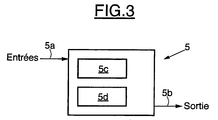
- FIG. 3 is a block diagram of a management module Asynchronous communication 5.
- This includes inputs 5a of receiving data messages from other modules and 5b outputs for transmitting data messages to others modules.
- the input messages are stored temporarily, by example in a first-in, first-out memory, commonly referred to as a "FIFO stack" means for receiving point-to-point link messages 6. This temporary storage allows to be able to handle incoming messages, even if they arrive at a rate higher than the message processing capacity of the module 5.
- the asynchronous communication management module 5 further comprises means 5c for routing messages of output to their recipient module, as well as 5d means for manage the routing of exit messages.
- An input message is stored in the FIFO stack of message receiving means of a point-to-point link 6, then taken into account by module 5, which will manage its referral to its destination synchronous module 4 by the means 5c and 5d.
- This message then leaves module 5 by the output 5b and passes through the message transmission means of a link point-to-point 6 to the synchronous module 4 of destination of the message.
- the communication system comprises an element 11, called “initiating element", capable of generating a transaction resulting in a plurality of requests, an element intermediate 12, able to process a request and send a request, an intermediate element 13, able to receive a request and to transmit a request, and a slave element 14, able to send to the element initiator 11 of the data and / or acknowledgment of receipt.
- the element initiator initiates the transaction by drawing up a request the address of said initiator element, the address of the intermediate element 12, an operational instruction to be executed by the element intermediate 12 and, in general, data.
- the initiating element 11 also includes means for transmitting said request to destination of the intermediate element 12.
- the intermediate element 12 receives the request sent by the initiator element 11 and performs a processing on the received data according to the operational instruction contained in the request 15 received.
- Intermediate 12 includes a means to develop a second request 16 for the intermediate element 13 of the part of the initiator element 11, and means for sending said request 16.
- the request 16 sent by intermediate element 12 to the intermediate element 13 includes the address of the element intermediate 13, the address of the initiator element 11 as address of the issuer of the said request, an instruction to be performed by the intermediate agent 13, and data.
- Intermediate element 13 which also includes means of preparation and means of sending the request, upon receipt of the request 16 sent by the intermediate element 12, performs the defined by the operational instruction concluded in the said request 16 and prepare a request 17 containing, like the previous address, the address of the recipient of the said request 17, the address of the initiator element 11 as the sender's address of said request, data, and an operational instruction.
- the generated query 17 by the intermediate element 13 can be sent directly to the slave element 14 or to another intermediate element, no represented, the transaction may pass through an unlimited number of intermediate elements, between the intermediate element 13 and the slave element 14.
- the slave element 14 upon receipt of a request 17 from, either the intermediate element 13 or the last element intermediate chain of intermediate elements, performs the defined by the operational instruction contained in the received and, in response to that request, may transmit to the initiator element 11 the data and / or an acknowledgment of receipt.
- the slave element 14 can also transmit nothing to the element initiator 11.
- any request received by an element intermediate or by the slave element understands, as an address transmitter, the address of the initiating element 11.
- each element intermediate and the slave element receives a request identical to that that he would have received if it was sent directly from the element initiator 11 to the element under consideration. We thus manage to avoid operating protocol changes.
- different types can be provided operational instructions that can be contained in requests: an unacknowledged storage instruction, an instruction storage with acknowledgment of receipt, an instruction supply and storage in memory, an instruction supply, an unaccounted copy instruction of receipt and a copy command with acknowledgment of receipt.
- a storage request may include an issuer address field, filled in with the item's address initiator 11, an address field of the recipient element of the query, a message size field, an operational code defining the operational instruction and a data field.
- a supply request will have the same structure, with the exception of data field.
- a copy request will have the same structure, to this the data field is populated with the item's address slave of destination.
- each request also includes a relatively short field that allows for the link between a request and a response, as long as the element initiator does not wait for the answer to a first request to send another request.
- FIG. 5 illustrates the case of an application of the invention in the field of telecommunications.
- a data disaggregator receives as input a line of broadband telecommunications, carrying a very high number of flows, for example a thousand, which are multiplexed. He sends out thousand independent lines.
- Such disaggregation of data requires the management of a context depending on each line.
- context defining the requirements of each line.
- Memories of first-in, first-out type are typically used for memorize the incoming packets associated with a line. Then, periodically, these first-in, first-out memories are dumped to line interfaces. If the number of memories is high, by example one thousand, material realization with a memory by flow is particularly expensive.
- the invention proposes a first-input memory manager first out, allowing to reduce the number of memories with a dynamic allocation of a memory to a line resulting from the execution of management software by a hardware module.
- an element is provided intermediate 12 formed by the memory manager and an element slave 14 formed by a memory.
- Initiator element 11 sends a query 15 to the intermediate element 12.
- the request 15 may understand the address of the initiator element 11, the address of the element intermediate 12, the number of bytes of data, the operational code the desired instruction, for example storage with an acknowledgment of receipt, the address in the intermediate element 12, the address of the slave element 14, the address in the slave element 14, and a transaction identifier.
- the intermediate element 12, manager memories transforms the selected memory address into a physical address present in the memory formed by the element slave 14.
- the intermediate element 12 launches a request 16 including, as the sender address, the address of the initiator element 11, as recipient address, the memory containing the address data selected, the number of data transmitted, the operational code of storage with acknowledgment of receipt, the actual address representing the selected memory, data and transaction ID.
- the slave element 14 Upon receipt of the request 16 of the intermediate element 12, the slave element 14, here a memory, containing the data of the selected line, updates the data of the selected memory then sends an acknowledgment to the initiator element 11.
- Figure 6 illustrates the case of an unstacking instruction of data stored in a memory and sending the data to the initiator element 19, which is here another initiating element.
- Initiator element 19, initiator of the transaction initiates a request 20 loading data from a corresponding memory virtually to the telecommunication line being processed.
- the request for the initiator element 19 is addressed to the memory manager, aka the intermediate element 12, and includes the address of the element initiator 19, the address of the intermediate element 12, the number bytes of data, the operational code of the storage instruction with acknowledgment, the virtual address of the selected memory and the identifier of the transaction.
- the intermediate element 12 performs the transformation of the selected memory virtual address to a physical address present in the memory forming the slave element 14 and containing the data of the line processed by the initiating element 19.
- the element intermediary 12 issues a supply request to the slave element 14.
- the request includes as issuer address, the address of the initiating element 19, the address of the memory containing the data required for the processed line, the number of bytes, the operational instruction of storage with acknowledged receipt, the actual address representing the selected memory and the transaction identifier.
- the slave element 14 Upon receipt of said request, the slave element 14 which contains the searched data updates the data of the memory selected then sends the data to the initiator element 19 under the form of a response 22 containing the address of the initiator element 19, the data and the identifier of the transaction.
- Figure 7 illustrates the case of an intermediate element 12 receiving a request 16 from an intermediate element 12 who himself received a request from an initiator 11.
- Intermediate element 12 develops a response and sends it to a slave element 23.
- the slave element 23 develops a answer 24 and sends it to the initiator element 11. So it's possible to send a response through a number of elements intermediaries according to the system architecture.
Landscapes
- Engineering & Computer Science (AREA)
- Computer Networks & Wireless Communication (AREA)
- Signal Processing (AREA)
- Business, Economics & Management (AREA)
- General Business, Economics & Management (AREA)
- Multimedia (AREA)
- Multi Processors (AREA)
- Small-Scale Networks (AREA)
Applications Claiming Priority (2)
| Application Number | Priority Date | Filing Date | Title |
|---|---|---|---|
| FR0308225 | 2003-07-04 | ||
| FR0308225A FR2857114B1 (fr) | 2003-07-04 | 2003-07-04 | Systeme et procede de communication entre des modules |
Publications (2)
| Publication Number | Publication Date |
|---|---|
| EP1494408A2 true EP1494408A2 (de) | 2005-01-05 |
| EP1494408A3 EP1494408A3 (de) | 2008-05-14 |
Family
ID=33427700
Family Applications (1)
| Application Number | Title | Priority Date | Filing Date |
|---|---|---|---|
| EP04291345A Withdrawn EP1494408A3 (de) | 2003-07-04 | 2004-05-28 | Kommunikationssystem zwischen unterschiedlichen Modulen und Verfahren |
Country Status (3)
| Country | Link |
|---|---|
| US (1) | US20050086412A1 (de) |
| EP (1) | EP1494408A3 (de) |
| FR (1) | FR2857114B1 (de) |
Cited By (2)
| Publication number | Priority date | Publication date | Assignee | Title |
|---|---|---|---|---|
| US7720099B2 (en) | 2007-08-13 | 2010-05-18 | Honeywell International Inc. | Common protocol and routing scheme for space data processing networks |
| US8031633B2 (en) | 2007-08-13 | 2011-10-04 | Honeywell International Inc. | Virtual network architecture for space data processing |
Families Citing this family (13)
| Publication number | Priority date | Publication date | Assignee | Title |
|---|---|---|---|---|
| FR2858895B1 (fr) * | 2003-08-13 | 2006-05-05 | Arteris | Procede et dispositif de gestion de priorite lors de la transmission d'un message |
| US9087036B1 (en) | 2004-08-12 | 2015-07-21 | Sonics, Inc. | Methods and apparatuses for time annotated transaction level modeling |
| FR2890766B1 (fr) * | 2005-09-12 | 2007-11-30 | Arteris Sa | Systeme et procede de communication asynchrone sur circuit, entre des sous-circuits synchrones |
| FR2899413B1 (fr) * | 2006-03-31 | 2008-08-08 | Arteris Sa | Systeme de commutation de message |
| FR2900017B1 (fr) * | 2006-04-12 | 2008-10-31 | Arteris Sa | Systeme d'interconnexions de blocs fonctionnels externes sur puce muni d'un unique protocole parametrable de communication |
| FR2901437B1 (fr) * | 2006-05-16 | 2008-08-08 | Arteris Sa | Procede de realisation d'un circuit de synchronisation de donnees echangees de maniere asynchrone entre deux blocs synchrones, et circuit de synchronisation elabore a partir d'un tel procede |
| FR2902957B1 (fr) * | 2006-06-23 | 2008-09-12 | Arteris Sa | Systeme et procede de gestions de messages transmis dans un reseau d'interconnexions |
| FR2904445B1 (fr) * | 2006-07-26 | 2008-10-10 | Arteris Sa | Systeme de gestion de messages transmis dans un reseau d'interconnexions sur puce |
| US8868397B2 (en) * | 2006-11-20 | 2014-10-21 | Sonics, Inc. | Transaction co-validation across abstraction layers |
| US9495290B2 (en) * | 2007-06-25 | 2016-11-15 | Sonics, Inc. | Various methods and apparatus to support outstanding requests to multiple targets while maintaining transaction ordering |
| US8972995B2 (en) | 2010-08-06 | 2015-03-03 | Sonics, Inc. | Apparatus and methods to concurrently perform per-thread as well as per-tag memory access scheduling within a thread and across two or more threads |
| US10921874B2 (en) | 2017-03-06 | 2021-02-16 | Facebook Technologies, Llc | Hardware-based operating point controller for circuit regions in an integrated circuit |
| US11231769B2 (en) | 2017-03-06 | 2022-01-25 | Facebook Technologies, Llc | Sequencer-based protocol adapter |
Family Cites Families (9)
| Publication number | Priority date | Publication date | Assignee | Title |
|---|---|---|---|---|
| US5535405A (en) * | 1993-12-23 | 1996-07-09 | Unisys Corporation | Microsequencer bus controller system |
| US5651002A (en) * | 1995-07-12 | 1997-07-22 | 3Com Corporation | Internetworking device with enhanced packet header translation and memory |
| US6434743B1 (en) * | 1999-04-23 | 2002-08-13 | Sun Microsystems, Inc. | Method and apparatus for allocating stack slots |
| US6400720B1 (en) * | 1999-06-21 | 2002-06-04 | General Instrument Corporation | Method for transporting variable length and fixed length packets in a standard digital transmission frame |
| KR100644596B1 (ko) * | 2000-07-27 | 2006-11-10 | 삼성전자주식회사 | 버스 시스템 및 그 버스 중재방법 |
| KR100467643B1 (ko) * | 2000-12-28 | 2005-01-24 | 엘지전자 주식회사 | 무선 랜에서의 멀티미디어 데이터 전송 방법 |
| US7164678B2 (en) * | 2001-06-25 | 2007-01-16 | Intel Corporation | Control of processing order for received network packets |
| US7277449B2 (en) * | 2002-07-29 | 2007-10-02 | Freescale Semiconductor, Inc. | On chip network |
| CN100390771C (zh) * | 2003-05-07 | 2008-05-28 | 皇家飞利浦电子股份有限公司 | 用于发送数据的处理系统和方法 |
-
2003
- 2003-07-04 FR FR0308225A patent/FR2857114B1/fr not_active Expired - Fee Related
-
2004
- 2004-05-28 EP EP04291345A patent/EP1494408A3/de not_active Withdrawn
- 2004-07-02 US US10/884,794 patent/US20050086412A1/en not_active Abandoned
Non-Patent Citations (2)
| Title |
|---|
| GUERRIER P ET AL: "A Generic Architecture for On-Chip Packet-Switched Interconnections" -, 27 mars 2000 (2000-03-27), pages 250-256, XP010377472 * |
| J.ROSENBERG,H.SCHULZERINNE: "SIP:Sesion Initiation Protocol" -, 27 février 2002 (2002-02-27), pages 1-194, XP015005931 * |
Cited By (2)
| Publication number | Priority date | Publication date | Assignee | Title |
|---|---|---|---|---|
| US7720099B2 (en) | 2007-08-13 | 2010-05-18 | Honeywell International Inc. | Common protocol and routing scheme for space data processing networks |
| US8031633B2 (en) | 2007-08-13 | 2011-10-04 | Honeywell International Inc. | Virtual network architecture for space data processing |
Also Published As
| Publication number | Publication date |
|---|---|
| EP1494408A3 (de) | 2008-05-14 |
| US20050086412A1 (en) | 2005-04-21 |
| FR2857114A1 (fr) | 2005-01-07 |
| FR2857114B1 (fr) | 2005-09-30 |
Similar Documents
| Publication | Publication Date | Title |
|---|---|---|
| EP1494408A2 (de) | Kommunikationssystem zwischen unterschiedlichen Modulen und Verfahren | |
| EP1507374B1 (de) | Verfahren und Vorrichtung zur Prioritätsverwaltung während der Übertragung einer Nachricht. | |
| US20190004868A1 (en) | System and method for distributed graphics processing unit (gpu) computation | |
| CN106412137A (zh) | 一种文件下载系统及文件下载方法 | |
| EP2507711B1 (de) | Direktspeicherzugriffsteuerung für direkte datenübertragung zwischen mehreren peripheriegerätespeicher | |
| JP2022551742A (ja) | 会話メッセージ表示方法、装置、電子機器および記憶媒体 | |
| CN107370657A (zh) | 设备间应用程序联动方法及系统 | |
| WO2007048987A1 (fr) | Routeur et reseau de routage | |
| EP1641197B1 (de) | NoC(Network on Chip)-Kommunikationsarchitektur für Datenstrom Anwendungen | |
| EP3217290A1 (de) | Chipsystem und verfahren zum datenaustausch zwischen rechenknoten eines solchen chipsystems | |
| US8265095B2 (en) | Resource management finite state machine for handling resource management tasks separate from a protocol finite state machine | |
| EP1531589B1 (de) | System und Verfahren zur Übertragung von einer Nachrichtenreihenfolge in einem Verbindungsnetzwerk | |
| EP2254066A1 (de) | Verfahren zur Unterstützung der Realisierung und Validierung einer Flugzeugcomputingplatform | |
| EP1845456B1 (de) | On-Chip System zur Verbindung von externen Funktionsbausteinen mit einem einzigen parametrierbaren Kommunikationsprotokoll | |
| EP2507712B1 (de) | System zur direkte datenübertragung zwischen speichern von mehreren elementen dieses systems | |
| FR2466808A1 (fr) | Systeme pour controler la duree de l'intervalle de temps entre blocs dans un systeme de communication calculateur a calculateur | |
| US20090132582A1 (en) | Processor-server hybrid system for processing data | |
| FR2815801A1 (fr) | Protocole de transmission d'une pluralite de flux logiques d'echange multiple de couples de commande/reponse sur un canal physique unique d'echange entre maitre et esclave et systeme de suivi et de controle d'execution d'appliquettes | |
| EP0524089A1 (de) | Programmstruktur für ein Datenverarbeitungssystem, insbesondere für ein Telekommunikationssystem | |
| CN105915587A (zh) | 内容推送方法、系统、以及缓存服务器 | |
| FR3057127A1 (fr) | Processeur adapte pour un reseau ethernet commute deterministe | |
| FR3031822A1 (fr) | Telechargement de donnees sur un equipement distant | |
| US20230068635A1 (en) | Cross machine request forwarding | |
| CN110430256B (zh) | 推送交易消息报文的方法、装置和计算机系统 | |
| EP1443734A1 (de) | Vorrichtung zur Behandlung von Audio-und Videodaten für ein Multimediakommunikation über ein lokales Netzwerk in einem asynchronen Netz |
Legal Events
| Date | Code | Title | Description |
|---|---|---|---|
| PUAI | Public reference made under article 153(3) epc to a published international application that has entered the european phase |
Free format text: ORIGINAL CODE: 0009012 |
|
| AK | Designated contracting states |
Kind code of ref document: A2 Designated state(s): AT BE BG CH CY CZ DE DK EE ES FI FR GB GR HU IE IT LI LU MC NL PL PT RO SE SI SK TR |
|
| AX | Request for extension of the european patent |
Extension state: AL HR LT LV MK |
|
| PUAL | Search report despatched |
Free format text: ORIGINAL CODE: 0009013 |
|
| STAA | Information on the status of an ep patent application or granted ep patent |
Free format text: STATUS: THE APPLICATION IS DEEMED TO BE WITHDRAWN |
|
| AK | Designated contracting states |
Kind code of ref document: A3 Designated state(s): AT BE BG CH CY CZ DE DK EE ES FI FR GB GR HU IE IT LI LU MC NL PL PT RO SE SI SK TR |
|
| AX | Request for extension of the european patent |
Extension state: AL HR LT LV MK |
|
| 18D | Application deemed to be withdrawn |
Effective date: 20071201 |